
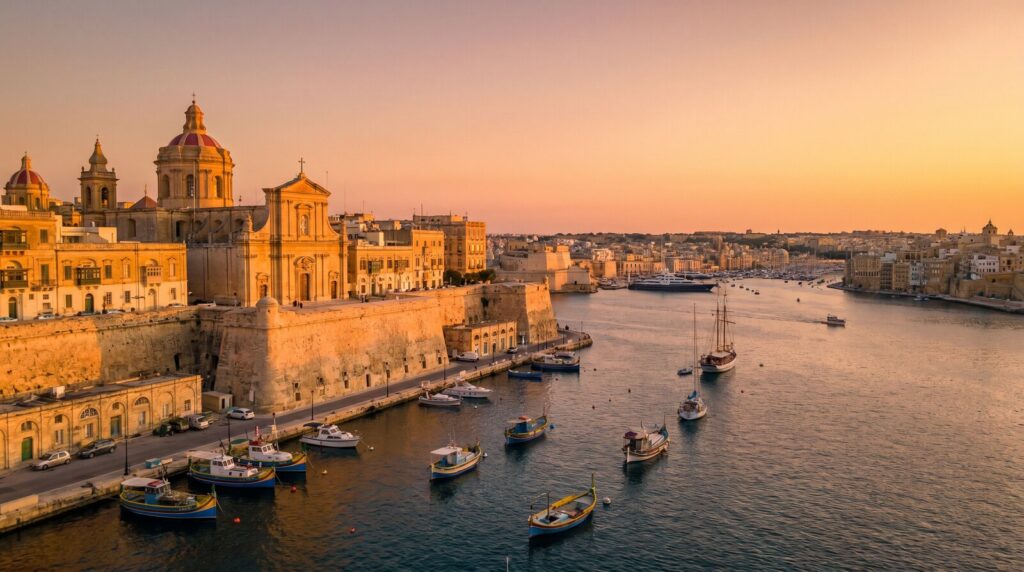
Valletta, Malta: Knights’ Fortress, Honey-Stone Streets & Blue Lagoon
Knights’ Fortress, Honey-Stone Streets & Blue Lagoon Where Mediterranean History Rises from Fortifications
Valletta represents one of Europe’s most dramatically fortified cities—a peninsula surrounded by massive bastions and fortification walls constructed by the Knights Hospitaller beginning in 1566. Every building constructed required approval from Knights’ authorities.
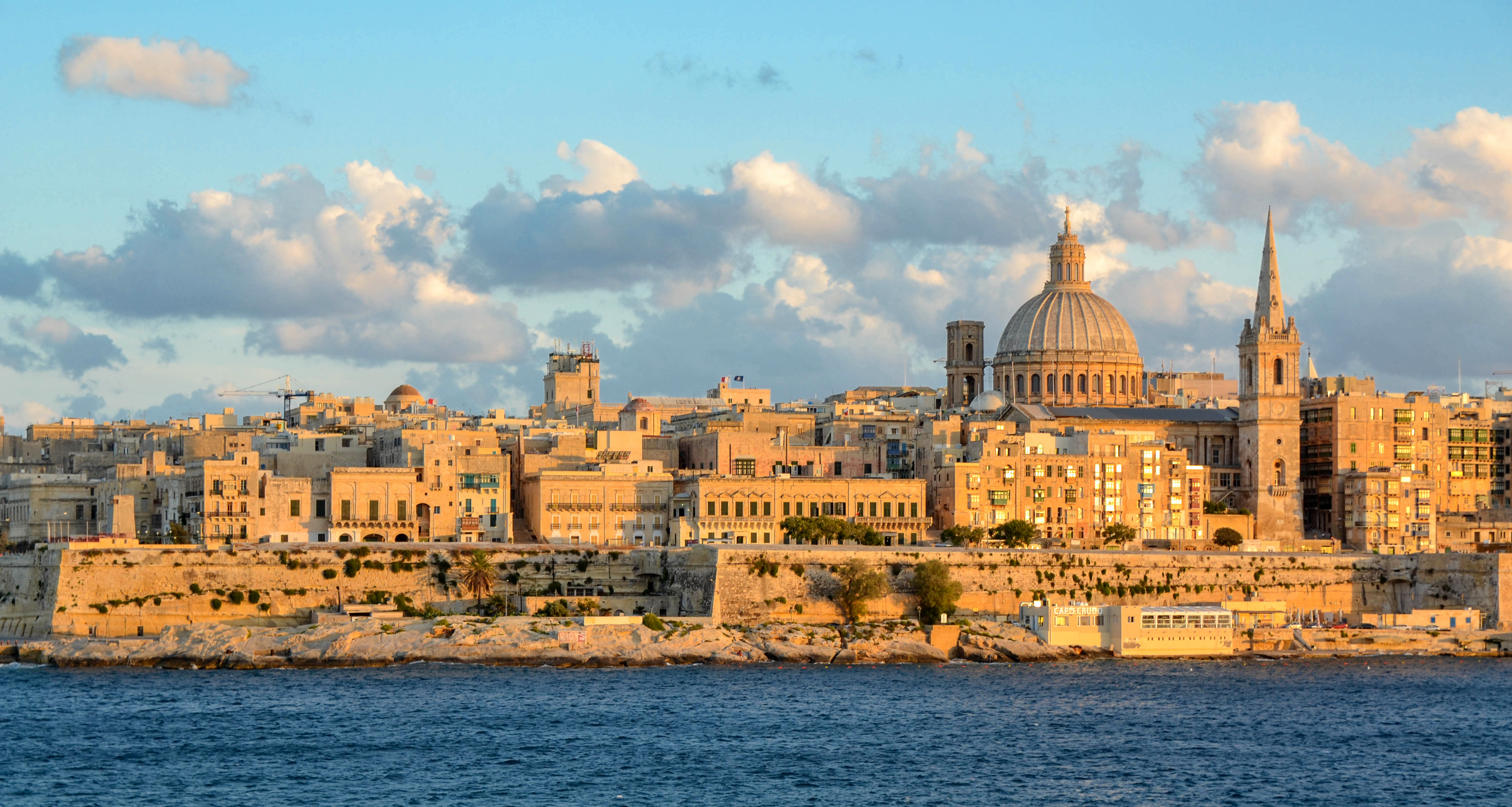
Valletta remains Europe’s smallest capital city by area while containing extraordinary concentration of historical buildings. The city functioned as Knights’ Mediterranean power center for centuries.
Table of Contents
Fortifications & Military Architecture
Valletta’s fortification system demonstrates Renaissance military science applied to peninsular defense. The bastions and curtain walls, designed by Italian military engineer Francesco Laparelli, incorporated contemporary artillery science.
Walking Valletta’s streets reveals how fortifications determined urban layout—streets positioned to enable cannon defense, buildings incorporated into defensive works.
Knights Hospitaller & Medieval Heritage
The Knights Hospitaller (also called Knights of Malta), originally established to provide hospital care for Crusader pilgrims, evolved into Mediterranean military power.
The Auberges (Knights’ residences) throughout Valletta reveal how different national groups maintained distinct corporate identity while serving unified military order.
Palace of Grand Masters
Knights’ governance seat with state rooms and ceremonial spaces.
Co-Cathedral of St. John
Knights’ religious center with baroque splendor and artistic masterworks.
Auberges of Castile and Leon
National grouphouse revealing Knights’ organizational structure.
Grand Harbor
Strategic harbor position enabling Mediterranean naval dominance.
Baroque Architecture & Religious Art
Valletta’s architecture reflects Knights’ aesthetic preferences—baroque style emphasizing drama, movement, and visual impact.
Architectural unity throughout Valletta reflects urban planning requirements—all buildings constructed with honey-colored limestone extracted from local quarries.
Church interiors throughout Valletta feature religious artwork, marble decoration, and architectural drama reflecting baroque aesthetic achievements.
Mediterranean Beauty & Island Geography
Valletta’s geographic position on Mediterranean peninsula provides access to distinctive coastal landscapes and marine environments. The Blue Lagoon, located on nearby Comino Island, features remarkably clear water.
Day trips to surrounding islands—Comino, Gozo—reveal Mediterranean island life distinct from Valletta’s urban intensity. These islands maintain lower development density.
Blue Lagoon
Transparent Mediterranean water enabling swimming and snorkeling.
Comino Island
Unpopulated island with minimal development maintaining Mediterranean landscape.
Gozo Island
Larger island with distinct culture and traditional Mediterranean villages.
Grand Harbor
Historic harbor with maritime commerce, fishing boats, and ferry services.
Exploring Valletta
Valletta remains affordable compared to Western Mediterranean destinations, with accommodations, food, and activities available at moderate costs. The city’s compact size enables comprehensive exploration within 1-2 days.
Getting to Valletta requires flights to Malta International Airport followed by bus or taxi. Regular ferry services connect Malta to surrounding Mediterranean destinations.
May through October represents optimal visiting season with warm weather and calm seas enabling Mediterranean activities. Summer brings heat and peak tourism crowds.
Euro currency accepted throughout Malta. ATMs provide good exchange rates. Prices remain reasonable—quality meals 10-16 EUR, accommodations 80-150 EUR.
Valletta: Knights’ Legacy Preserved
Experience Valletta’s unique fortified splendor where Knights Hospitaller constructed Mediterranean stronghold combining military sophistication with baroque artistic achievement.
Food & Dining in Valletta
Maltese cuisine reflects centuries of Mediterranean trade and occupation—a delicious blend of Sicilian, North African, British, and Middle Eastern influences. Pastizzi, flaky diamond-shaped pastries filled with ricotta or mushy peas, are the national snack and available at pastizzerias throughout the city for mere cents. Rabbit (fenek) is Malta’s unofficial national dish, served stewed, roasted, or in spaghetti sauce at traditional restaurants across Valletta’s backstreets.
Republic Street and Merchant Street host a growing scene of wine bars and modern Maltese restaurants reinventing local classics. Try ftira, a Maltese flatbread similar to focaccia topped with tomatoes, capers, and local goat cheese, or kapunata, a Maltese take on ratatouille. The covered Valletta Food Market in the Is-Suq tal-Belt building is a curated food hall with stalls serving everything from fresh seafood to artisan gelato. Maltese wines from small family vineyards are increasingly acclaimed—Gellewza and Girgentina are indigenous grape varieties worth seeking out.
Getting Around Valletta & Malta
Valletta is one of Europe’s smallest capital cities, and its entire peninsula can be walked end to end in about 15 minutes. The grid-pattern streets climb and descend steep hills, so comfortable shoes are essential. The recently installed Barrakka Lift connects the Grand Harbour waterfront to the Upper Barrakka Gardens, saving a steep climb and offering panoramic harbor views.
Beyond Valletta, Malta’s public bus network radiates from the city gate terminus to every corner of the island. Buses to Mdina, the Blue Grotto, and the Three Cities run frequently. For Gozo island, a regular ferry crosses from Cirkewwa in about 25 minutes. Hop-on hop-off bus tours are popular for first-time visitors covering the main sights efficiently. Ride-hailing apps and car rental are available but Malta’s narrow roads and creative local driving can be an adventure in themselves.
Frequently Asked Questions About Valletta
What is the best time to visit Valletta?
Spring (April-June) and autumn (September-November) deliver warm weather, fewer crowds, and comfortable temperatures for sightseeing. Summer (July-August) is hot with peak tourist numbers but brings vibrant festa (village feast) celebrations across the island. Winter is mild by European standards with temperatures rarely dropping below 10 C, making Malta an appealing escape from northern European cold.
How many days do you need in Valletta?
One to two days covers Valletta’s main attractions: St. John’s Co-Cathedral, the Grand Master’s Palace, the Barrakka Gardens, and the excellent museums. However, using Valletta as a base for four to five days allows you to explore the entire Maltese archipelago—Mdina, the Three Cities, Gozo’s megalithic temples, and the island’s stunning coastline and swimming spots.
Is Valletta expensive?
Malta is moderately priced by European standards—cheaper than Italy or France but slightly above Eastern Mediterranean destinations. Pastizzi and local bus rides are very affordable, while restaurant meals and attractions are reasonably priced. Accommodation in Valletta’s converted historic buildings offers unique character and generally good value, especially in shoulder season.
What language is spoken in Malta?
Maltese and English are both official languages, and virtually everyone speaks fluent English. Maltese—a Semitic language with heavy Italian and French influence—is fascinating linguistically and one of the few Arabic-derived languages written in Latin script. Italian is also widely understood. Language is never a barrier for English-speaking visitors.
Start planning your Valletta adventure today with Facts From Upstairs.