
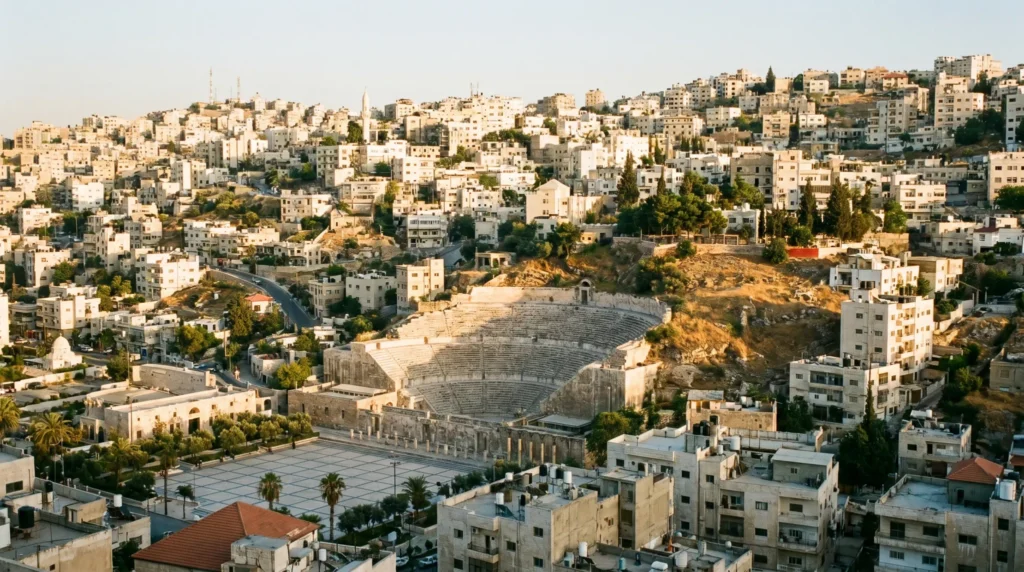
Amman, Jordan: Hilltop Capital, Roman Citadel, Levantine Crossroads
I have been using Amman as my Levant base for a decade and the city still surprises me on every return — it is the only Arab capital where you can walk from a Roman amphitheatre to a third-wave coffee bar to a Circassian falafel counter in twenty minutes. We tell first-timers Amman is the gateway, not the destination, and that is half right. My favourite ritual is a knafeh at Habibah on Rainbow Street, a sunset hike up Jebel Amman to the Citadel for the call-to-prayer chorus, and a late mezze at Sufra in the renovated Jebel Lweibdeh quarter. Treat this guide as the brief I would hand my own family before they boarded the Queen Alia airport bus to Tabarbour station.

Table of Contents
Why Amman?
Amman is one of the world’s oldest continuously inhabited cities — settlement evidence on the Citadel hill (Jebel Al-Qala’a) goes back more than seven thousand years, the site has been the Ammonite capital Rabbath-Ammon, the Hellenistic Philadelphia of the Decapolis under Ptolemy II, the Roman Philadelphia, the Umayyad provincial capital, and finally the Hashemite Kingdom’s capital since 1921. Greater Amman now holds about 4.6 million people across nineteen named hills — almost half of Jordan’s national population, an unusually capital-heavy share for a Middle-Eastern country. The result is a Levantine capital where second-century Roman columns, Umayyad-era cisterns, mid-century Circassian neighbourhoods, and twenty-first-century glass towers sit on the same skyline, and where the call to prayer from the King Abdullah I Mosque carries clean across half a dozen jebels at sunset.
What makes Amman feel different from its regional peers is the white-stone uniformity and the contrast between East and West Amman. Building regulations require a limestone-or-white-stone facade across most of the metropolitan area, so the city reads as a single cream-toned quilt draped over the seven-to-nineteen hills. Downtown (Al-Balad) on the valley floor — Roman Theatre, Hashemite Plaza, the gold souk and the spice souk — is the historic core. West Amman (Jebel Amman, Jebel Lweibdeh, Abdoun, Sweifieh) holds the third-wave-coffee scene, the embassies, the international hotels and the modern art galleries. East Amman (Marka, Hashemi, Tabarbour) is denser, more conservative and where most of the city’s Palestinian, Syrian and Iraqi diaspora communities have settled.
The city is also Jordan’s transport hub. Queen Alia International Airport (AMM) is 32 km south of the centre, with the Sariyah airport bus running to Tabarbour station every 30–60 minutes for 3.50 JOD. The JETT bus network runs to Petra (3 hr, 11 JOD), Aqaba (4 hr, 14 JOD) and Wadi Rum on dedicated routes; the King Hussein Bridge to Israel/Palestine is 50 km west. Amman is the natural starting point for Jordan: two days in the city, a day at Jerash, two nights at Petra, a Wadi Rum overnight and a Dead Sea decompression day. The Jordan Pass (70–80 JOD) bundles the visa fee with entry to forty sites including Petra and is mandatory-good-value for any traveller staying three or more nights.
The other elevator above its peers is the food culture. Amman’s cuisine is the canonical Levantine repertoire — mansaf (the national dish, lamb on jameed-yogurt rice), maqluba, mezze tables, knafeh, falafel, foul, hummus — and a rapidly maturing third-wave coffee scene. The annual Amman Citadel Sound & Light Show runs select evenings between April and October. National Day is May 25 (independence from the British Mandate, 1946). Plan around the Jerash Festival of Culture and Arts in late July and the cultural payoff doubles for the same flight cost.
Neighborhoods: Finding Your Amman


Downtown (Al-Balad)
The historic valley-floor core — the Roman Theatre, Hashemite Plaza, the Nymphaeum, the gold and spice souks, and the Husseini Mosque are all within a fifteen-minute walk. Downtown holds the city’s most photogenic morning markets — the Friday-and-Saturday vegetable souk, the Hashem Restaurant falafel queue at dawn, and the tea-and-shisha cafés tucked into side streets off King Faisal Street. The accommodation here is mostly budget-tier; mid-range and luxury travellers stay in West Amman and taxi down for half-day visits. The Citadel (Jebel Al-Qala’a) sits directly above downtown — a steep ten-minute walk or a 2-JOD taxi.
- Roman Theatre (admission included with Jordan Pass; 2 JOD otherwise)
- Hashemite Plaza (free, the city’s main downtown gathering square)
- Hashem Restaurant — the falafel-and-foul institution near the King Faisal Mosque, open 24 hours
Best for: first-time visitors, downtown atmosphere, budget hotels, photography. Access: Walk from any downtown hotel; servees taxi from West Amman 1.5–3 JOD.
Jebel Amman (1st Circle to 3rd Circle)
The original West Amman residential quarter — built in the 1930s on the hill immediately west of downtown, anchored by Rainbow Street (officially Abu Bakr Al-Siddiq Street) running between First Circle and Third Circle. Friday evenings on Rainbow Street are the city’s social peak — Souk Jara craft market in summer, vintage cafés year-round, and the Wild Jordan Centre on the Wadi Saqra escarpment for the city’s best westward sunset view. The neighbourhood also holds the Royal Automobile Museum, the Mango House heritage hotel, and the renovated Duke’s Diwan — Amman’s oldest surviving residential building (1924).
- Rainbow Street — the postcard café strip with First Circle gallery cluster
- Wild Jordan Centre — Royal Society for the Conservation of Nature café and shop with sunset views
- Souk Jara (Fridays, May–September) — craft and antique market
Best for: sunset cafés, mid-range boutique hotels, walking culture. Access: Taxi from downtown 2–3 JOD, or the steep stairs from Hashemite Plaza.
Jebel Lweibdeh
The city’s most concentrated arts-and-coffee neighbourhood — the renovated 1930s villas now hold Darat Al Funun (the Khalid Shoman Foundation contemporary art space), the National Gallery of Fine Arts, Jadal cultural centre, and the highest density of independent third-wave coffee bars in the country. The historic Paris Circle is the neighbourhood’s social spine. Lweibdeh is genuinely walkable and sits ten minutes’ taxi from downtown.
- Darat Al Funun — the Khalid Shoman Foundation arts space (free)
- National Gallery of Fine Arts — the country’s largest public art collection
- Paris Circle — the neighbourhood’s café-and-stairs heart
Best for: contemporary art, independent coffee, repeat visitors. Access: Taxi from downtown 2 JOD, ten minutes.
Abdoun & Sweifieh
The newer affluent districts in West Amman — Abdoun holds the embassies, the Abdoun Bridge (the architectural landmark of the modern city), the Mecca Mall and Galleria Mall. Sweifieh is the residential and dining hub for the Jordanian upper-middle class. Most international hotel chains (Four Seasons, W, Kempinski, Sheraton) cluster between the Fifth and Eighth Circles. The neighbourhoods are car-dependent and short on street life, but hold the city’s best modern restaurants — Sufra, Shams El Balad, Beit Sitti, and the Abdoun-bridge perched Vinaigrette.
- Abdoun Bridge — the cable-stayed pedestrian-and-traffic bridge
- Mecca Mall & Galleria — air-conditioned mid-summer escapes
- Sufra (rooftop Levantine fine dining) and Shams El Balad (slow-food)
Best for: luxury hotels, modern dining, business travel. Access: Taxi or Careem from downtown 4–6 JOD, fifteen minutes.
East Amman (Hashemi, Marka, Al-Wehdat)
The denser, more conservative half of the city — most of Amman’s Palestinian, Syrian and Iraqi diaspora communities settled here from 1948 onward. The Al-Wehdat refugee camp is the most-cited Palestinian community in Jordan; Marka holds the original Amman Civil Airport and a strong Bedouin-cuisine restaurant scene. Tourist density is near zero and the visit is strongest on a guided food tour. Most travellers do not stay east of downtown; the neighbourhoods reward a half-day cultural visit with a knowledgeable local.
- Hashemi Mosque area — local-life souks
- Marka — Bedouin and Iraqi-diaspora restaurants
- Al-Wehdat — Palestinian community and the Al-Wehdat football club’s ground
Best for: repeat visitors, food tours, social-issue context. Access: Careem or guided tour; the public bus 30 from Tabarbour reaches Hashemi in twenty minutes.
Citadel Hill (Jebel Al-Qala’a)
The archaeological hill above downtown — Bronze Age, Iron Age (Ammonite), Hellenistic (Philadelphia of the Decapolis), Roman, Byzantine and Umayyad layers all sit on the same plateau. The Temple of Hercules columns, the Umayyad Palace dome, the Byzantine basilica ruin, and the Jordan Archaeological Museum are all on the site. The Citadel is the single best sunset viewpoint over the seven-hilled white-stone capital. Admission included with Jordan Pass; 3 JOD otherwise.
The Food

Mansaf & the National Cuisine
Mansaf is Jordan’s national dish — slow-cooked lamb served on a bed of jameed (fermented dried-yogurt) rice and shrak flatbread, topped with toasted almonds, pine nuts and parsley. Traditionally eaten communally with the right hand from a single large platter — the dish was inscribed on UNESCO’s Intangible Cultural Heritage list in 2022. The Amman headline addresses for mansaf are Sufra (refined version, 18–24 JOD), Reem Al-Bawadi (the suburban roadside chain, 12–16 JOD), and the Friday-only home-style mansaf at the Beit Sitti cooking school (45 JOD with the cooking class).
- Sufra (Rainbow Street) — refined Levantine in a 1937 villa with rooftop seating; mansaf on Fridays (18–24 JOD)
- Reem Al-Bawadi (Sweifieh) — the upscale-roadside Bedouin-cuisine chain
- Beit Sitti (Jebel Lweibdeh) — Friday cooking class plus mansaf lunch (45 JOD)
Mezze, Hummus & the Levantine Bench
The Levantine mezze table is Amman’s everyday meal — hummus, mutabal, baba ghanouj, fattoush, tabbouleh, kibbeh, sambousek, warak inab (stuffed vine leaves), labneh and shanklish. Two breakfast institutions anchor the downtown food scene:
- Hashem Restaurant (downtown, off King Faisal Street) — the falafel-foul-hummus open-air canteen since 1956; King Abdullah II is a periodic visitor; meal cost 2–4 JOD; open 24 hours daily
- Abu Mahjoob (Jebel Amman 1st Circle) — knafeh and Arab sweets in the late-night format
- Habibah Sweets (downtown, near the Husseini Mosque) — the city’s most-cited knafeh nabulsiyya; 1.5 JOD a portion, takeaway only
- Al-Quds Restaurant (downtown) — the East-Jerusalem-rooted falafel-and-mezze counter since 1966
- Shams El Balad (Jebel Amman) — the slow-food Levantine seasonal-menu restaurant in a renovated villa
Knafeh & the Arab Sweets Tradition
Knafeh — shredded-wheat-and-cheese pastry soaked in attar (rose-water syrup) — is the Levant’s signature dessert. The Nablus-style version (knafeh nabulsiyya) is what Amman serves, and Habibah on the King Faisal Street downtown corner is the year-after-year reference. A first-timer should order the small portion (1.5 JOD), eat it on the street with a plastic spoon, and return for the full plate two visits later. The Zalatimo Sweets chain is the supermarket-tier alternative; the Nafisah branch on Khalifa Street is the Lweibdeh stop.
Coffee Culture — Third Wave Meets Cardamom Tradition
Jordanian coffee is the small bitter cardamom-spiced cup served at funerals, weddings and Bedouin tents — the formal “qahwa sada” Bedouin coffee remains the cultural anchor. Modern Amman has built a parallel third-wave coffee scene over the past decade, concentrated in Jebel Lweibdeh and Jebel Amman. The headline addresses:
- Rumi Café (Jebel Lweibdeh) — Amman’s most-photographed Lebanese-Jordanian café in a 1940s villa
- Books@Café (Jebel Amman, behind the German embassy) — the city’s longest-running art-bookshop-and-coffee combination
- Dimitri’s Coffee Lab (Jebel Lweibdeh) — single-origin specialty pour-over
- Café Auberge (Jebel Lweibdeh) — the renovated French-mandate-era villa
Food Experiences You Can’t Miss
- A 7 a.m. falafel-and-foul breakfast at Hashem Restaurant (downtown) — the line forms before 6 a.m. on Fridays
- A Friday Souk Jara craft-and-food market afternoon on Rainbow Street (May–September)
- A Beit Sitti cooking class — pick mansaf-Friday or maqluba-Saturday; 45 JOD includes the meal
- A late-night knafeh from Habibah, eaten on the downtown sidewalk with the second-generation Hashemite Plaza shisha crowd
Cultural Sights

The Citadel (Jebel Al-Qala’a)
Amman’s archaeological centrepiece — the hill above downtown holding seven thousand years of stratified urban history. The Bronze Age Ammonite walls underlie everything; the surviving above-ground monuments are predominantly Roman (Temple of Hercules, 161–166 AD), Byzantine (the basilica ruin), and Umayyad (the eighth-century Umayyad Palace, the cistern, the gate). The Jordan Archaeological Museum on the site houses the famous Ain Ghazal statues — the eight-thousand-year-old Neolithic plaster figures discovered north of Amman in 1983, among the oldest large-scale human representations in existence. Admission included with Jordan Pass; 3 JOD otherwise. Open daily 08:00–19:00 (summer) / 08:00–16:00 (winter).
Roman Theatre & the Forum
The 6,000-seat Antonine-era amphitheatre carved into the Jebel Al-Joufah hillside in downtown — built between 138 and 161 AD under Antoninus Pius and still functioning as a venue for the Amman Festival summer concerts. Two small museums sit in the wings of the stage: the Folklore Museum (traditional Bedouin and rural Jordanian life) and the Museum of Popular Traditions (jewellery and costume). The Hashemite Plaza in front of the theatre is the city’s main downtown gathering square — children play football, families eat ice cream, the call to prayer echoes off the limestone. Admission included with Jordan Pass; 2 JOD otherwise.
Jordan Museum (Ras Al-Ain)
The country’s flagship museum, opened 2014 in the new Ras Al-Ain cultural district below downtown — it houses the Dead Sea Scrolls Copper Scroll (the only known Dead Sea Scroll inscribed on copper rather than parchment, found at Qumran in 1952), the Ain Ghazal Neolithic statues, the Mesha Stele cast, and a strong prehistory-to-modern arc on Jordanian civilisation. Allow two hours. Admission 5 JOD; included with Jordan Pass. Closed Tuesdays.
King Abdullah I Mosque
The blue-mosaic-domed mosque on Jebel Al-Hussein — built 1989 to commemorate Jordan’s founding king Abdullah I (assassinated 1951 at the Al-Aqsa Mosque). The 7,000-worshipper main hall is the only mosque in Amman that admits non-Muslim visitors; the small Islamic Museum in the basement displays the king’s personal effects and a strong calligraphy collection. Visiting hours 08:00–11:00 and 13:30–15:00 (Sat–Thu); closed during Friday prayers (11:00–13:30). Modest dress required; women’s robes provided at the entrance. Admission 2 JOD.
Darat Al Funun
The contemporary art space and library complex run by the Khalid Shoman Foundation in three renovated 1920s villas on Jebel Lweibdeh — the most active contemporary visual-arts venue in Jordan. The library focuses on Arab modern and contemporary art and is open to researchers. Free admission. Open Sat–Thu 10:00–19:00. The garden café is the neighbourhood’s most-cited writers’ hangout.
The Royal Automobile Museum
The unexpected highlight on most repeat-visit Amman itineraries — the personal car collection of the late King Hussein, displayed in a purpose-built museum in the King Hussein Park (eight kilometres north of downtown). The collection covers seventy years of Hashemite royal vehicles, from the king’s first 1952 Lincoln through Aston Martin and Mercedes flagships. Admission 3 JOD. Open Tue–Sun 10:00–19:00.
The National Gallery of Fine Arts
The Jordanian National Gallery on Jebel Lweibdeh — about 2,500 works in the permanent collection, with strong holdings of twentieth-century Arab modernist painting and a global Islamic-world contemporary section that is genuinely important. Free admission. Open Sat–Thu 09:00–17:00. Closed Fridays.
Wild Jordan Centre
The Royal Society for the Conservation of Nature flagship at the Wadi Saqra escarpment edge of Jebel Amman — a craft shop selling RSCN-supported nature-reserve crafts, a well-regarded café with the city’s best westward sunset view, and the booking desk for the country’s six RSCN nature reserves (Dana, Mujib, Ajloun, Azraq, Dibeen, Shaumari). Free entry. Open daily 09:00–22:00.
Entertainment

Summer Concert Calendar — Roman Theatre & Citadel
The Amman Citadel and the Roman Theatre both host evening concerts and sound-and-light shows from May through September — the Greater Amman Municipality’s “Amman Summer Festival” runs the headline programme, with the Jordan Festival adding a parallel fortnight at the Citadel in late August. The 6,000-seat Roman Theatre is the city’s most atmospheric concert venue. Tickets typically 10–35 JOD depending on the act; check the Greater Amman Municipality cultural calendar in the four weeks before your visit.
Jerash Festival of Culture and Arts (late July)
Jordan’s headline annual cultural festival — held at the second-century Roman ruins of Jerash, fifty kilometres north of Amman. Two weeks of evening concerts, theatre and dance performances in the South Theatre and the Forum oval. Most travellers stay in Amman and bus or drive up for individual evenings (one-hour transfer). Tickets 15–50 JOD. The 2026 edition runs late July through early August.
Souk Jara & the Jebel Amman Friday Scene
The Friday-only Souk Jara craft and food market on Fawzi Al-Maalouf Street, between First and Second Circle on Rainbow Street — runs every Friday from May through September, 10:00–22:00. Local craft, jewellery, leather, ceramics; food stalls run a parallel fair. The market is the single best Friday-evening event in the city; arrive at 17:00 for the late-afternoon shade and stay through the music programme that runs from 19:00.
Live Music & the Coffee-Bar Bands
The Jebel Lweibdeh and Rainbow Street neighbourhoods hold the city’s live-music scene — Books@Café, Cantaloupe Gastro Pub, La Calle (the Spanish-tapas bar on Mecca Street), and Carakale Brewing’s tap room (the country’s first craft brewery, in Fuheis 25 km north). The scene is small but genuinely good for indie Arab folk and electronic acts. Cover charges run 5–15 JOD; book ahead for the headliner Friday-Saturday slots.
Cinema & the Royal Film Commission
Royal Film Commission’s Rainbow Theatre on Jebel Amman runs the city’s best art-house and independent-film programme — the annual Karama Human Rights Film Festival in December is the headline event. Mainstream cinema is concentrated in the Mecca Mall, City Mall and Galleria Mall multiplexes — Hollywood releases run with Arabic subtitles, and ticket prices are 5–10 JOD.
Shisha & Café Culture
The downtown shisha cafés on Hashemite Plaza — Al-Rashid Court Café and the corner tea-and-shisha lounges off King Faisal Street — are the city’s most atmospheric evening hangout, especially on the half-shaded terrace tier above the plaza. A shisha pipe runs 4–6 JOD, mint tea 0.50–1 JOD; expect to share a table on busy weekend evenings.
Day Trips

Jerash (50 km north — one hour)
The most complete Roman provincial city outside Italy — Gerasa was a Decapolis member from 63 BC and was at its peak under Hadrian (early second century AD). The site preserves the Oval Forum (one of only two oval forums anywhere — 56 Ionic columns), Hadrian’s Arch (129 AD), the Cardo Maximus colonnaded main street, the Temple of Artemis, two Roman theatres, and the Byzantine Church of St Theodore. Allow three to four hours on site. Admission included with Jordan Pass; 10 JOD otherwise. JETT bus from Tabarbour 4 JOD each way; private car or guided full-day tour 70–120 JOD.
Ajloun Castle & Forest Reserve (75 km north — 1.5 hours)
The 12th-century Ayyubid Crusader-era castle Qa’lat Ar-Rabad was built by Saladin’s nephew in 1184 to defend the Jordan Valley iron mines against the Crusader Kingdom of Jerusalem. Combine with the RSCN Ajloun Forest Reserve five kilometres further — Mediterranean oak-and-pistachio forest, the only forest reserve in Jordan, with marked walking trails. Admission Ajloun Castle 3 JOD (Jordan Pass included); reserve entry 2.50 JOD. Full-day private-car combination 80–120 JOD.
The Dead Sea (50 km west — 50 minutes)
The lowest point on Earth at 430 metres below sea level, and the saltiest body of water in the world (33% salinity). The Jordanian shore holds a string of resort beaches — Mövenpick, Kempinski, Hilton, Crowne Plaza — that all sell day-pass beach access (25–55 JOD including towels and pool access). Public-beach access at Amman Beach Tourist Resort is 25 JOD. The MuJib Adventure Centre runs the famous Wadi MuJib Siq Trail (1 April–31 October) — a wading-and-swimming canyon hike that ends at a waterfall (21 JOD; book ahead). Float, do not swim; keep the water out of your eyes; rinse off thoroughly afterwards.
Madaba & Mount Nebo (35 km south-west — 45 minutes)
Madaba is the Byzantine “City of Mosaics” — the 6th-century mosaic map of the Holy Land in the Greek Orthodox Church of St George is the most famous of the city’s eighty-plus surviving mosaics. Mount Nebo, eight kilometres west of Madaba, is the biblical site where Moses is said to have viewed the Promised Land (Deuteronomy 34) — the Memorial Church of Moses preserves a fourth-century baptistery mosaic and the panoramic westward viewpoint over the Jordan Valley to Jericho and Jerusalem on a clear day. Joint admission to both 3.50 JOD; included with Jordan Pass.
Petra (235 km south — 3 hours by JETT bus)
Jordan’s headline UNESCO site and one of the New Seven Wonders of the World — the Nabataean rock-carved capital city was the trading hub between Arabia, the Mediterranean and Egypt from the 4th century BC to the 2nd century AD. Almost no traveller does Petra as an Amman day trip — it deserves a minimum two-night stay in Wadi Musa. JETT bus from Tabarbour 11 JOD each way (3 hours); private car 100–180 JOD. See our Petra City Guide for the dedicated visit plan.
The Desert Castles Loop (eastern desert — 100–250 km east)
The seven Umayyad-era desert palaces and caravanserais east of Amman — Qasr Kharana (early 8th century), Qasr Amra (UNESCO 1985, with the only known surviving Umayyad figurative frescoes), Qasr Azraq (the basalt fortress where T. E. Lawrence wintered in 1917–1918), Qasr Hallabat, and the smaller Qastal, Mushatta and Tuba palaces. The standard loop is a full-day (10 hr) private-car circuit including Qasr Kharana → Qasr Amra → Azraq Wetland Reserve (RSCN) → Qasr Azraq, returning via the Zarqa highway. Private car with driver 100–150 JOD. Self-drive is straightforward but the desert highway is poorly signed; download offline maps.
Seasonal Guide

Spring (March – May)
The first peak window — daytime highs of 18–28 °C, mostly dry, the wildflower window in late April through Wadi Mujib and Ajloun. Hotel rates climb steadily from late March; book three to four weeks ahead. May 25 is Independence Day — large parade, government offices closed. Rainbow Street’s Souk Jara reopens in May; the Roman Theatre concert calendar starts late April.
Summer (June – August)
Hot and dry — daytime highs 30–36 °C in Amman (the hilltop elevation keeps it manageable), but the Dead Sea side trips run 38–45 °C and require an early-morning visit only. The Jerash Festival of Culture and Arts in late July is the calendar headline. Cool evenings (18–22 °C) make rooftop restaurants the social peak; the city’s coffee-bar scene runs late. Hotel rates dip slightly in July and August versus the spring peak.
Autumn (September – November)
The unambiguous best season — daytime highs 18–28 °C, low humidity, mostly clear skies, the Petra and Wadi Rum side trips at their most comfortable. October and early November are the cool-season peak; book six weeks ahead. The Amman Citadel evening sound-and-light shows run weekly. The annual Amman Marathon falls in late October.
Winter (December – February)
Cool and wet — daytime highs 8–14 °C, occasional snow on the highest hills (Jebel Amman dustings every two to three years), and most of the year’s rainfall. The Dead Sea side trip is at its most pleasant in winter (24–28 °C at sea level); Petra is empty and dramatic in low cloud. Hotel rates are the year’s lowest. Pack a warm coat — Amman hotels are not all centrally heated.
Ramadan (Feb 17 – Mar 18, 2026 in Amman)
Ramadan 2026 falls February 17 to March 18. Restaurant hours shift dramatically — most close during daylight, then run iftar (sunset breaking-fast) buffets at 18:00 followed by suhoor (pre-dawn) service through 03:00. Tourist sites stay open with shorter hours (often 09:00–15:00). Eating in public during daylight is legally permitted for non-Muslims but culturally inappropriate; hotels run normal indoor service. Visiting during Ramadan is a richer cultural experience but a less practical sightseeing trip.
Getting Around

Walking Downtown & Jebel Amman
Downtown is genuinely walkable — the Roman Theatre, Hashemite Plaza, the souks and the Citadel staircase fit a half-day on foot. Jebel Amman (1st-3rd Circle) is also walkable along Rainbow Street. The catch is the hill geography: any north-south transition between hills involves a long climb or a short taxi. Pavements are inconsistent and parked cars block them frequently.
Careem & Uber
Careem (now Uber-owned) is the city’s dominant ride-hail app — it works seamlessly, accepts credit cards and is consistently cheaper than street taxis. Uber operates a parallel service. A typical cross-city Careem ride runs 2–6 JOD; Queen Alia airport to downtown 18–25 JOD. Both apps display fixed fares before booking, which avoids the meter-bypass problem of street taxis.
Yellow Taxis (Street Taxis)
Yellow metered taxis are everywhere and the metered fare is genuinely cheap (flag-fall 0.25 JOD plus 0.30 JOD per kilometre). Always insist on the meter (“addaad shaghal, lao samaht”). The downtown-to-airport flat rate is around 25 JOD; the meter would run lower but most drivers refuse the meter for that route. Tipping is not required but rounding up is appreciated.
Servees (Shared Taxis)
The white-and-yellow servees taxis run fixed routes between hill circles for 0.50–1.50 JOD per ride — Tabarbour to downtown, downtown to Sweifieh, downtown to Jebel Lweibdeh. They depart when full (4–5 passengers). The lines start at the official servees stations; downtown’s main station is on Cinema Al-Hussein Street. Worth it for the genuine local-life experience; not worth it as a primary tourist mode.
Bus Rapid Transit (BRT)
Amman’s BRT system opened in 2022 — three trunk lines (Sweileh, Mahatta, Sahab) running on dedicated bus lanes through the city. Fare 0.45 JOD per ride; pay at automated stations. Useful for the Sweileh airport-shuttle alternative and the Sahab line to the eastern desert; less useful for tourist itineraries that cluster around Jebel Amman and downtown.
Airport Access
- Queen Alia International (AMM): Sariyah airport bus from Tabarbour 3.50 JOD, runs 06:00–22:00 every 30–60 minutes; Careem 18–25 JOD; yellow taxi flat rate 25 JOD. Allow 45–60 minutes by road.
- Amman Civil Airport (Marka): domestic and Royal Jordanian regional flights only; 10–15 JOD by Careem from downtown.
Driving & Car Rental
Amman driving is aggressive but not dangerous; the bigger challenge is parking. Most international hotels offer paid valet (3–6 JOD per night). Rental cars are useful if you plan a self-drive Jordan loop (Petra, Wadi Rum, Dead Sea) — Sixt, Hertz, Avis and the local Reliable Rent-A-Car all operate at the airport. Daily rates 22–45 JOD for a small sedan; international permit recommended.
Budget Breakdown: Making Your JOD Count
| Tier | Daily | Sleep | Eat | Transport | Activities | Extras |
|---|---|---|---|---|---|---|
| Budget | 25–45 JOD ($35–60) | Hostel dorm 10–18 JOD | Falafel + mezze 4–9 JOD/meal | Walk + servees 2 JOD | Citadel 3 + Jordan Museum 5 | Knafeh 1.5 + tea 0.5 |
| Mid-Range | 65–115 JOD ($90–160) | Boutique 50–90 JOD | Sit-down 12–25 JOD/meal | Careem 6 JOD/day | Jordan Pass 70 + show 15 | Cocktail 8 + spa 35 |
| Luxury | 200+ JOD ($280+) | Four Seasons / W 250+ JOD | Tasting 80–140 JOD | Private car 100 JOD/day | Spa + tour 100 JOD | Dead Sea spa 90 |
Where Your Money Goes
Amman’s cost stack is mid-priced by regional standards — cheaper than the Gulf, more expensive than Cairo, comparable to Beirut. Sleeping costs are the biggest swing: hostels run as low as 10 JOD a dorm, while a Four Seasons or W suite tops 350 JOD. Food is genuinely cheap at the falafel-and-knafeh tier (Hashem Restaurant 2–4 JOD a full meal) and quickly normal-Western once you reach Sufra or Shams El Balad (12–25 JOD per person). Jordan’s standard sales tax is sixteen per cent and is included in restaurant menu prices; international hotels add a 26% combined sales-and-service charge that is sometimes folded into headline rates and sometimes not — check the small print.
The Jordan Pass
The Jordan Pass (70–80 JOD depending on tier) is the single best money-saver for any traveller staying three or more nights. It bundles the visa fee (40 JOD, waived if you stay 3+ nights), entry to forty sites including Petra, Jerash, the Citadel, Wadi Rum, Ajloun and the Desert Castles. Buy online before you fly; print the QR-code voucher. The Wanderer (one-day Petra) tier is 70 JOD; Explorer (two-day Petra) is 75; Expert (three-day Petra) is 80. Even the cheapest tier covers Petra one-day plus everything else.
Money-Saving Tips
- Buy the Jordan Pass before arrival — it pays for itself by the time you reach Petra.
- Use Careem/Uber rather than yellow taxis — the fixed-fare display avoids meter disputes.
- Eat at downtown falafel-and-foul counters (Hashem, Al-Quds) — the prices are one-fifth of West Amman sit-down restaurants.
- Take the Sariyah airport bus (3.50 JOD) rather than a 25-JOD yellow taxi.
- Visit on Friday for Souk Jara plus the open-air markets; Saturday for Madaba and Mount Nebo.
- Book international hotels in JOD rather than USD — the rate often differs by 5–8% on the dollar booking.
Currency & Exchange
The Jordanian dinar (JOD) is pegged at 0.709 JOD per US dollar (1 JOD = $1.41), and has been since 1995. The peg makes US-dollar pricing reliable. ATMs are everywhere; most charge a 3–5 JOD foreign-card fee per withdrawal. Cards work at hotels, mid-range-and-up restaurants, supermarkets and petrol stations; cash is needed at street stalls, taxis, and most markets. Exchange counters in West Amman (Abdoun, Sweifieh) consistently beat airport rates; carry small denominations (1, 5, 10 JOD).
Practical Tips
Language
Arabic is the official language; Levantine Arabic is the local dialect and is mutually intelligible with Lebanese, Syrian and Palestinian Arabic. English is functional in West Amman, the airport, mid-range-and-up hotels, and most of the under-30 generation. Younger Jordanians often speak excellent English from a Western-curriculum schooling background. Learn five phrases: marhaba (hello), shukran (thanks), la shukran (no thanks), kam haḏa? (how much?), min faḍlak (please). The standard greeting between strangers is “as-salaam alaykum” (peace be upon you), reply “wa alaykum as-salaam”; functional outside the most secular West Amman cafés.
Cash vs. Cards
Mid-priced — cards work at every hotel, mid-range-up restaurant, supermarket and petrol station; cash is needed at downtown falafel counters, knafeh shops, shisha cafés, yellow taxis and traditional markets. Plan to carry 30–80 JOD in cash for any given day. ATMs charge 3–5 JOD per foreign-card withdrawal; withdraw 200–400 JOD at a time to amortise. Visa and Mastercard work everywhere; Amex acceptance is mid-range hotels and up only.
Safety
Amman is statistically one of the safest Middle-Eastern capitals — violent crime is rare, the city’s terror-attack history has been quieter than its regional peers, and the Hashemite security infrastructure is genuinely effective. The U.S. State Department maintains Jordan at travel advisory Level 2 (exercise increased caution) — primarily a function of the Syria/Iraq border zones rather than Amman itself. Avoid the immediate Syrian and Iraqi border districts (50+ km north and east) and the Aqaba-Israeli border crossing during periods of regional tension. Emergency numbers: 911 (general emergency, 2014 unified), 191 (police), 199 (ambulance), 193 (fire). The Tourist Police office at the Roman Theatre is English-speaking.
What to Wear
Amman is the most relaxed Middle-Eastern capital on dress code — Western dress is normal in West Amman, with covered shoulders and knees the only practical baseline. Mosque visits (King Abdullah I) require the full robe — provided at the entrance for both men and women. Downtown and East Amman are more conservative — covered shoulders and knees are appropriate; women may want a light scarf available for spontaneous mosque visits. Pack a warm coat for December–February; the hilltop elevation makes Amman colder than most travellers expect.
Cultural Etiquette
Three rules: (1) Never criticise the Hashemite royal family in public — King Abdullah II, Queen Rania and the late King Hussein retain near-sacred status; the country’s lèse-majesté laws are real and prosecuted. (2) Refuse a Bedouin coffee invitation only with a polite “shukran, marra okhra” (“thanks, another time”) — accepting and not finishing a small cup is an insult. (3) The right hand only for eating, especially at communal mansaf platters; the left hand is reserved for hygiene tasks. The Israeli-Palestinian conflict is a culturally sensitive topic — most Jordanians have direct family ties to the West Bank or 1948 Palestine; let locals lead the conversation rather than initiating.
Connectivity
Jordanian SIM cards are cheap — Zain, Orange and Umniah all sell tourist SIMs at the airport (10–15 JOD for 15–25 GB for a week). 4G coverage is excellent in Amman and along the Petra–Aqaba highway; weaker in Wadi Rum and the eastern desert. eSIMs (Airalo, Holafly) work fine. Hotel Wi-Fi is universal and generally fast.
Health & Medications
Amman’s private hospitals (King Hussein Medical Center, Jordan Hospital, Khalidi Hospital, Istishari Hospital) operate to international standards and run English-speaking clinics — Jordan is a regional medical-tourism destination for the Gulf. Tap water is technically treated but not advised for drinking; bottled water (0.30 JOD per 1.5L) is everywhere. Travel insurance is recommended; the public-hospital system is not free for foreigners but rates are moderate by Western standards.
Tipping
Tipping is normal but not aggressive in Jordan — restaurants typically include a 10% service charge, in which case rounding up is sufficient; otherwise leave 10%. Hotel porters: 1–2 JOD per bag. Yellow taxi drivers: round up to the nearest dinar. Tour guides on full-day trips: 10–20 JOD per group is the convention. Bedouin hosts at Wadi Rum or Petra: 5–15 JOD per person for a meal-and-tea.
Alcohol & Ramadan Rules
Alcohol is legal and widely available in Amman — sold at hotels, restaurants licensed for it (most Jebel Amman and Abdoun restaurants), and dedicated liquor stores. Beer, wine and spirits are imported; expect Western-equivalent prices. During Ramadan, daytime alcohol service is restricted to hotels; restaurants resume serving after sunset. Public drinking outside licensed venues is illegal year-round.
Frequently Asked Questions
How many days do I need in Amman?
Two full days is the sweet spot for the city itself. Day 1: Citadel + Roman Theatre + downtown souks + Rainbow Street sunset. Day 2: Jordan Museum + King Abdullah I Mosque + Jebel Lweibdeh galleries + Abdoun mezze dinner. One day is enough to hit the headlines but feels rushed; three is comfortable if you also want a Jerash day-trip. Most Jordan itineraries spend two nights in Amman, then move to Petra/Wadi Rum/Aqaba.
Is Amman safe for solo travellers, including women?
Yes — Amman is statistically one of the safer Middle-Eastern capitals and is widely considered the easiest Arab capital for solo female travellers. Violent crime is rare; petty street harassment exists at the level of a Mediterranean city rather than a Cairo or Casablanca level. West Amman (Jebel Amman, Jebel Lweibdeh, Abdoun) is genuinely Western-equivalent; downtown after dark requires more situational awareness. Stick to Careem after 22:00 rather than walking through quieter areas. The Tourist Police office at the Roman Theatre is the dedicated foreign-visitor support point.
Is the Jordan Pass worth it?
Almost always yes — it bundles the 40-JOD visa-on-arrival fee with entry to forty sites. The cheapest tier is 70 JOD and includes Petra one-day; Petra alone is 50 JOD at the gate, so the pass pays for itself by the time you reach Petra. Buy online before you fly and print the QR-code voucher. The pass is valid for two weeks from first use. The visa-fee waiver requires that you stay in Jordan three or more nights.
What about the language barrier?
It rarely blocks travel. English is functional in West Amman, the airport, mid-range-up hotels, the Jordan Museum and the headline tourist sites, and most under-30 Jordanians. Where it matters: addressing yellow-taxi drivers (use Careem instead), ordering at downtown street stalls (point at the next-table customer’s plate), and any East Amman or rural interaction. The Tourist Police is explicitly English-speaking. Older Jordanians often speak French as a second language from the mandate-era school system.
When are the busiest weeks?
April–May and October–November (the spring and autumn cool-clear peaks) are the two unambiguous high seasons; hotel rates climb 25–40% versus the summer baseline and book up four to six weeks ahead. The Jerash Festival’s late-July week is a smaller surge. Ramadan (Feb 17 – Mar 18 in 2026) is a low-tourist season but a culturally rich visit. The summer (June–August) is hot but the cheapest window with the best concert calendar.
Can I use credit cards everywhere?
Mostly yes. Cards (Visa, Mastercard) work at every hotel, mid-range-up restaurant, supermarket, petrol station and chain café. Cash is needed at downtown falafel counters, knafeh shops, yellow taxis, traditional markets, and most independent restaurants outside West Amman. Plan to carry 30–80 JOD in cash for any given day. ATMs charge 3–5 JOD per foreign-card withdrawal.
Ramadan 2026 — should I visit during Ramadan or avoid it?
It depends. Ramadan 2026 falls February 17 to March 18. Avoid if you want a normal sightseeing trip — most restaurants close during daylight, sights run shorter hours, and the social rhythm shifts entirely. Visit if you specifically want the cultural experience: the iftar buffets at sunset are extraordinary, the late-night street life from 19:00 to 03:00 is one of the year’s most photogenic moments, and the spirit of community is the trip’s central memory. Eid al-Fitr at the end is a four-day national holiday; book transport and hotels four to six weeks ahead.
Amman or Petra — what’s the right balance?
Both, in that order. Almost every Jordan itinerary opens with two nights in Amman before moving to Petra (3 hours south) — the city is the international entry point, the Jerash and Madaba day-trips, and the cultural setup for Petra. Petra demands two nights in Wadi Musa to do justice to the site (the Treasury at sunrise and Monastery hike both need a full day). If forced to compress: one night Amman, two nights Wadi Musa, one Wadi Rum desert camp, fly out from Aqaba.
What’s the deal with mansaf — do I have to eat it with my hands?
If you eat mansaf at a Bedouin host’s table, yes — the right hand only, and the formal “rolling a small ball of rice and lamb between thumb and fingers” technique is the polite execution. At restaurants like Sufra and Reem Al-Bawadi, the dish is served on individual plates with cutlery and no one expects the hand-eating performance. The dish was inscribed on the UNESCO Intangible Cultural Heritage list in 2022, both for the recipe and the communal-eating tradition. Try it both ways across two visits.
Ready to Experience Amman?
Two days, one Citadel sunset, one Hashem falafel breakfast, one Rainbow Street Friday and one Jerash day-trip — that is the Amman rhythm. For the full country context, read the Jordan Travel Guide; if you are looping south, see our Petra City Guide.
Explore More City Guides
Where to Stay
- Petra City Guide — Jordan’s Nabataean rock-cut UNESCO capital, three hours south of Amman
- Wadi Rum City Guide — the protected sandstone desert and Bedouin-camp landscape
- Aqaba City Guide — Jordan’s Red Sea port and reef-diving gateway
- Jordan Country Guide
- All City Guides
Alex the Travel Guru
Alex has been writing destination guides for FFU since 2019, with eight Jordan trips on the docket and a long-running Amman-as-base habit on the Levant loop. The city is Alex’s favourite under-rated Arab capital — the Citadel sunset, the Hashem falafel queue, and a Friday Rainbow Street evening are the unchanging anchors of every visit. For the full country context, read the Jordan Travel Guide.
More city guides you might like

Plan your trip to Amman
The booking tools we use ourselves. FFU may earn a commission at no extra cost to you.
Plan & book your trip to Amman
Booking through these searches supports our guides at no extra cost to you.