
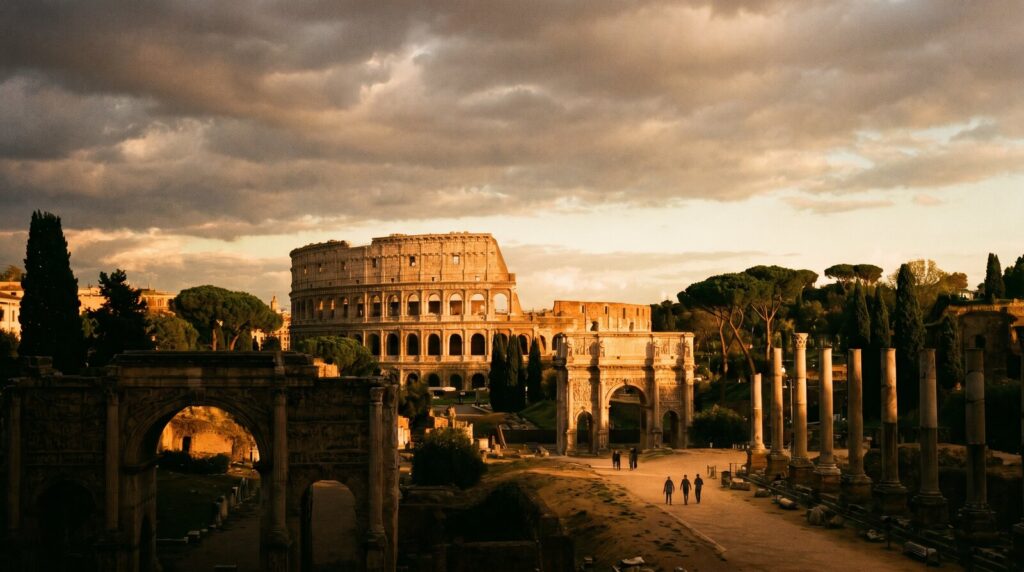
You’re standing in the Roman Forum at sunrise, and the stone beneath your feet has absorbed two millennia of footsteps—emperors, gladiators, merchants, slaves, pilgrims, and millions of people like you who came to witness greatness. But without context, without someone to unlock the stories embedded in these ruins, you’re just looking at expensive rubble. This tour roundup is part of our full Italy travel guide.
Rome is one of the few cities where a great guide transforms experience into understanding. The logistics alone justify booking a tour: the Colosseum and Vatican Museums are designed to overwhelm you, with lines stretching hours and crowds so dense you can barely see what you came for. But beyond logistics, Rome rewards deep dives. Centuries of history are stacked on top of each other—pagan temples beneath churches, medieval apartments carved into ancient walls, Renaissance fountains spraying water redirected from aqueducts built 2,000 years ago.
We’ve filtered through hundreds of tour operators and traveler reviews to find the guides and experiences that actually deliver on their promises. These nine tours cut through the noise, get you skip-the-line access where it matters, and put you with guides who treat Rome like a text to be read rather than a checklist to be crossed off.
1. Underground Colosseum: Hypogeum & First Tier Access
The Colosseum’s secret is literally beneath the arena floor. You descend into the hypogeum—the network of tunnels, trap doors, and lifting mechanisms that once hoisted wild animals and gladiators onto the sand—and suddenly the “Flavian Amphitheatre” stops being architecture and starts being engineering. Most Colosseum tours stick you on the main floor with 6,000 other people; this one gets you into the restricted hypogeum level and First Tier seating that’s normally closed to standard admission.
What makes this specific tour valuable is the access combined with guide expertise. You’re seeing the actual mechanism channels where they once flooded the arena for mock sea battles, the stone sockets for the velarium awning system, and getting explanations of how Romans staged 30-ton animals from moving cages.
Most tours run 2.5–3 hours with groups capped at 12–15 people. Expect to pay €85–130 per person.
Say it like a local. Your first word at the Colosseum: buongiorno (bwon-JOR-no). Practise it out loud with Maya on a free phone class, no app needed: book your free class. All six Italy phrases: watch the series. Maya is an AI language coach; this video is AI-generated.
2. Vatican Museums Early Access + Sistine Chapel Skip-the-Line
The Vatican Museums can hold 25,000 people per day. An early-access tour meets you before the museum opens at 7:30 or 8:00 AM, walking you through the map galleries, Raphael rooms, and sculpture collections when the light is good and the crowds haven’t arrived yet. You get the Sistine Chapel nearly to yourself. These tours typically include a trained art historian guide. Group sizes stay under 20. Duration is usually 3–3.5 hours. Budget €120–180 per person.
3. Trastevere Evening Food Tour (Small Group)
Trastevere is the neighborhood where Romans go when they want to remember why they live in Rome. The good food tours keep groups to 8–10 people, start at 6:00 PM, and move through back streets where locals still actually eat. You taste 10–12 small courses over 3 hours. The best versions include wine pairings and explanations of why Rome’s four signature pastas are the only pastas a Roman will admit to eating. Expect €95–140 per person.
4. Galleria Borghese: Timed-Entry Small Group Tour
The Borghese Gallery holds one of the most staggering private art collections in Europe and caps daily admission at 360 people. A good guide will walk you through Bernini’s Apollo and Daphne, then the paintings: Titian, Raphael, Caravaggio. Tours are capped at 8–12 people, last 2 hours, and cost €65–95 per person.
5. Catacombs & Appian Way Half-Day Tour
Beneath Rome’s streets runs a city of the dead—miles of underground burial chambers carved into soft volcanic rock. A good guide explains the theology, the social history, and the practical facts. You emerge back into daylight on the Appian Way—one of the first Roman roads, still lined with tomb structures 2,100 years old. Tours run 3–3.5 hours. Budget €65–100 per person.
6. Rome by Night Walking Tour (Historic Center)
Rome at night, when the monuments are lit and the streets are yours, is a completely different city. The Trevi Fountain at 9:00 PM has one-tenth the crowd. The Pantheon glows like a jewel. Tours run 2.5–3.5 hours. Expect €35–65 per person.
7. Pompeii Day Trip from Rome (with Archaeologist Guide)
Pompeii is 240 kilometers south of Rome. With a real archaeologist guide and a smaller group, Pompeii becomes what it actually is: a moment in time preserved in ash. Tours depart Rome around 6:00–7:00 AM, walk 3–4 hours on-site, then return by 8:00–9:00 PM. Cost ranges €90–160 per person.
8. Pasta-Making Class (Morning or Afternoon Session)
Learning to make pasta in Rome puts you inside a skill that Italians have been refining for 500 years. A good class runs 2.5–3 hours with 4–8 people and a Roman chef. You make 2–4 types of pasta from scratch, then eat what you made. Classes cost €65–120 per person.
9. E-Bike Tour of Historic Rome (Electric-Assisted)
An e-bike tour covers 3–4 times the distance at a pace that feels leisurely, letting you see neighborhoods most tourists miss. You’ll pedal through Testaccio, glide past the Aventine Hill, and roll through Monti before the crowds hit. Tours run 2.5–4 hours and cost €45–80 per person.
Planning a Full Italy Trip?
What to Actually Skip
Mega-Group “Highlights” Tours. If a tour is cheaper than €40 per person for a 3-hour experience, it’s a factory operation. Save your money.
“Roman Aristocracy” or “Costumes & Drama” Tours. Rome needs context and clarity, not performance. Skip these entirely.
Overpriced “Exclusive” Tours. Book directly with operators or through established platforms like Viator or GetYourGuide.
Practical Information
Best Time to Visit
Visit in late March, April, early May, or late September through October. Temperatures are 18–24°C, monuments aren’t mobbed, and tours run on normal schedules.
Book in Advance?
For major skip-the-line tours, book 2–4 weeks ahead. For food tours and walking tours, 3–7 days is usually fine.
Tipping Etiquette
Tipping is not mandatory in Italy, but a 10–15% tip for exceptional service is increasingly expected. Tip €10–15 for great guides.
What to Wear
Comfortable walking shoes. Sun protection. For Vatican tours, shoulders and knees must be covered. Bring a water bottle and light sweater.
Rome Travel Specs
| Aspect | Details |
|---|---|
| Best Months | April–May, September–October |
| Daily Budget | €100–180 per person |
| Language | Italian; English widely spoken in tourism areas |
| Currency | Euro (EUR) |
| Visa | Schengen visa required for some; 90-day visa-free for EU |
| Timezone | CET (UTC+1) / CEST (UTC+2 in summer) |
Book Your Trip
Tours: Reserve through established platforms with verified reviews. Most operators offer free cancellation up to 24 hours before departure.
Accommodation: Book in Centro Storico for walkability, or Trastevere for neighborhood atmosphere. €80–200 per night for mid-range hotels.
Travel Insurance: International travel insurance covers medical emergencies, trip cancellations, and lost luggage. Many policies cost €1–2 per day.
Phone & Internet: An eSIM gives you data access immediately upon arrival. Purchase before you leave home.
Last Updated: March 2026
Booking Resources
Ready to book? Here are the platforms we recommend for Rome tours:
You Might Also Like
- Our complete Rome travel guide — ancient ruins, neighborhoods, and local tips
- Explore Naples — pizza, Pompeii day trips, and southern Italian charm
- Florence travel guide — Renaissance art, Tuscan food, and Ponte Vecchio
- Venice travel guide — canals, gondolas, and hidden squares
- Amalfi Coast guide — cliffside villages, limoncello, and the Blue Grotto
- Best Tours in Lisbon (2026)
- Best Tours in Bali (2026)
- Best Tours in Istanbul (2026) — where East meets West across the Bosphorus
- Best Tours in Bangkok (2026) — temples, street food, and river cruises
FFU contains affiliate links. We earn a commission when you book through them — at no extra cost to you.
Plan your trip
- Tours & experiences: browse Rome tours and experiences on Klook.
- Airport pickup: pre-book an airport transfer with GetTransfer.
- Car hire: compare rental cars on GetRentacar.
- Bag storage: store your bags with RadicalStorage.
Disclosure: some links above are affiliate links — booking through them supports Facts From Upstairs at no extra cost to you.