
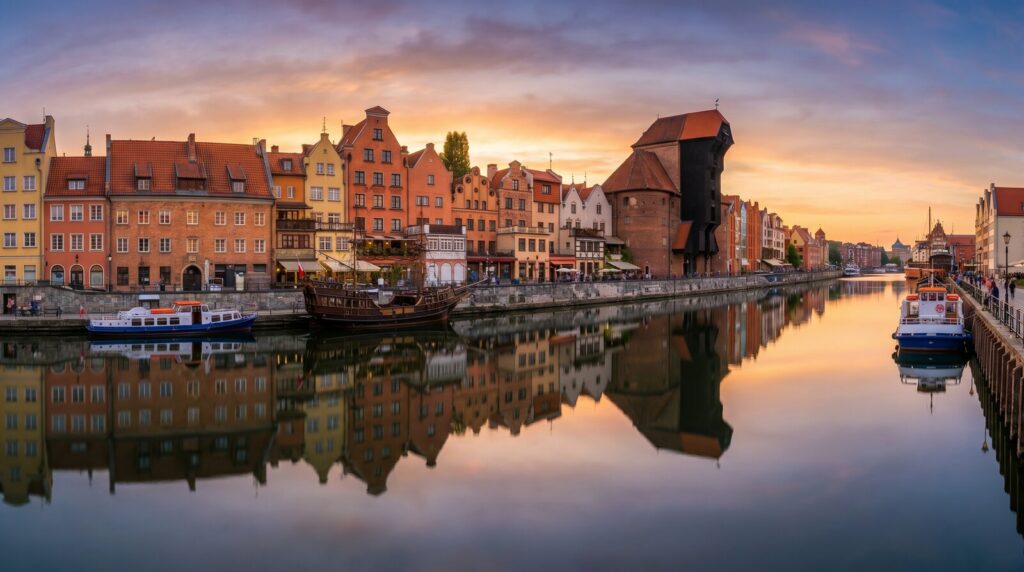
Gdańsk, Poland: Amber Coast, Shipyard History & Solidarity Movement
Gdańsk represents European history’s most dramatic narrative—a city completely destroyed and painstakingly rebuilt, a place where maritime trade enriched merchant guilds, where workers challenged communist authority and changed the world, where ancient amber connects prehistoric forests to contemporary markets. The city experienced destruction so comprehensive in World War II that only photographs and historical records preserved architectural memory. Yet contemporary Gdańsk meticulously reconstructed medieval buildings, creating a historically authentic cityscape despite recent origin—an unusual achievement where destroyed heritage was restored from documentary evidence rather than preserved in place.
The city’s role in the Solidarity movement that toppled communist governments across Eastern Europe grants it profound historical significance beyond its architectural beauty. The 1980 shipyard strikes initiated transformation that ended Soviet influence in Poland and inspired liberation movements throughout the region. Visiting Gdańsk means engaging with twentieth-century history at the moment it changed global politics. The city’s contemporary recovery—becoming a prosperous EU city with thriving culture and creative energy—represents triumph over historical trauma.
In This Guide
Reconstruction: Rebuilding from Ashes
The destruction of Gdańsk during World War II ranks among Europe’s most devastating urban devastation. The city was approximately 90% destroyed—buildings reduced to rubble, infrastructure demolished, population displaced or killed. Yet unlike many war-damaged cities that built modern replacements, Gdańsk chose historical restoration. Using archives, historical drawings, photographs, and architectural records, teams meticulously reconstructed the medieval old town. The reconstruction achieved authenticity while utilizing modern building techniques and materials—the buildings look genuinely medieval yet contain contemporary infrastructure.
The reconstruction process took decades. Work began in the 1950s and continued through the 1960s and 1970s, with ongoing restoration continuing today. The commitment to historical accuracy created a city that paradoxically feels genuinely old despite being recently built. Walking through reconstructed streets, you observe architectural details, proportions, and urban form identical to pre-war photographs. The psychological effect is disorienting—the city simultaneously feels ancient and recent.
The reconstruction represents philosophical statement about historical memory and cultural continuity. Rather than erasing traumatic past through modern development, Gdańsk chose to preserve and restore its heritage. This choice transformed reconstruction from mere building process into act of cultural resilience—asserting that historical identity matters despite destruction, that Polish culture would persist despite war’s attempt to erase it.

The reconstruction’s perfection creates subtle discomfort—everything appears too well-preserved, perhaps because the buildings lack the aging that genuine medieval cities accumulate. Yet this aesthetic quality allows visitors to imagine pre-war Gdańsk uncluttered by contemporary modifications. The cityscape conveys the beauty that destruction interrupted.
Solidarity & the Shipyard: Where History Changed
The Gdańsk Shipyard (Stocznia Gdańska) holds extraordinary historical significance as the birthplace of Solidarity, the labor movement that challenged Soviet communist authority and inspired liberation across Eastern Europe. In August 1980, shipyard workers led by Lech Wałęsa went on strike demanding independent trade unions, better working conditions, and political freedoms. The strike spread from Gdańsk shipyard throughout Poland, mobilizing millions of workers and ultimately forcing the communist government to recognize Solidarity as a legitimate organization.
Wałęsa, an electrician and union activist, became Solidarity’s face and later Poland’s first democratic president. The movement combined labor demands with broader calls for freedom and human dignity. The communist regime declared martial law in December 1981, imprisoning Solidarity leaders and temporarily crushing the movement. Yet Solidarity persisted underground and reemerged in the late 1980s with redoubled strength. By 1989, Poland held elections where Solidarity candidates won overwhelming victory, triggering the collapse of communist rule across Eastern Europe.
The European Solidarity Center, located at the shipyard, documents this transformative period through exhibits, multimedia presentations, and artifacts. The museum explains context—Poland’s historical independence struggles, Soviet occupation, Cold War pressures—that motivated workers’ determination. The physical space preserves shipyard buildings, cranes, and infrastructure conveying the working-class character that made labor movement credible. Visiting the center provides essential historical understanding of twentieth-century transformations.
Lech Wałęsa & Solidarity
Wałęsa, a working-class shipyard electrician with minimal formal education, emerged as Solidarity’s leader and catalyzed political revolution. His working-class credibility, moral courage, and pragmatic negotiations made him trusted by both workers and Western governments.
Cold War Significance
Solidarity’s challenge to Soviet authority demonstrated that communist control wasn’t absolute. The movement inspired workers throughout Eastern Europe, contributing to domino effect that collapsed Soviet communism by 1991.
Old Town: Medieval Merchant Heritage
Gdańsk’s old town developed as one of the Hanseatic League’s most prosperous trading centers. The Hanseatic League, a commercial confederation of merchant guilds and market towns, dominated Baltic trade from the 12th-17th centuries. Gdańsk’s position on the Vistula River’s mouth provided direct access to inland Polish territories while maintaining Baltic access. This geography made Gdańsk a critical trading hub where goods from throughout Europe and beyond passed through.
The wealth generated by trade manifested in magnificent guild buildings and merchant houses. The Artus Court, a merchant guild hall, featured elaborate architectural details, intricate wooden interiors, and ceremonial spaces where merchants conducted business and social gatherings. The Long Market (Długi Targ), a market square flanked by colorful merchant buildings, served as commercial and social heart. These buildings—reconstructed but following original designs—convey the prosperity and pride that trade generated.
The Main Town Hall, a Gothic brick structure, exemplifies the civic ambition that commercial success inspired. The elaborate architecture asserts Gdańsk’s importance and independence. The town’s autonomy derived from Hanseatic League membership and royal charters granting trading privileges. This independence created distinctive urban culture where merchant interests shaped governance and public spaces.
The old town preserves not just buildings but street patterns, public spaces, and urban form developed across centuries. The narrow streets, market squares, and religious buildings recreate medieval urban experience. Walking through feels like temporal transport—the effect enhanced by architectural authenticity despite recent reconstruction.
Amber: Baltic Gold & Prehistoric Heritage
Amber—fossilized tree resin originating from ancient forests—defines Baltic coast geography and cultural heritage. Approximately 80% of world’s amber originates from the Baltic region, with Gdańsk serving as primary center for amber trade, craftsmanship, and commerce. Amber’s golden glow, translucence, and malleability made it valuable trade commodity since antiquity. Archaeological evidence shows amber reaching Mediterranean civilizations via Baltic-to-Mediterranean trade routes as early as Bronze Age.
Contemporary Gdańsk maintains amber culture through workshops, galleries, and museums. The Amber Museum displays amber artifacts spanning thousands of years, showing how successive cultures valued and worked the material. Amber workshops where craftspeople fashion jewelry and decorative objects remain operating along Gdańsk’s main tourist streets. The ubiquitous amber shops selling jewelry, sculptures, and decorative items reflect continuing commercial importance.
Amber’s geological origin involves understanding deep time. The resin flowed from ancient trees millions of years ago, accumulated on pre-ice-age forest floors, and became fossilized through chemical transformation. Ice age glaciation distributed amber deposits along the Baltic coast where it’s visible in beach geology. Finding amber while walking Baltic beaches provides tangible connection to deep prehistory—holding fossilized tree resin from forests that vanished millions of years ago.
Amber mining occurs along the Baltic coast, particularly after storms when waves disturb coastal geology exposing new deposits. Contemporary mining balances resource extraction with environmental protection. Amber remains economically significant—jewelry, decorative objects, and traditional medicine applications generate substantial income for coastal communities. The material’s connection to prehistoric nature gives amber romantic appeal distinguishing it from other gemstones.
Maritime Heritage: Port City Culture
Gdańsk’s location on the Vistula River mouth created port city character emphasizing maritime activity, shipbuilding, and naval tradition. The river’s access to inland Poland’s agricultural richness made Gdańsk essential for grain export. Shipbuilding became major industry, with vessels built in Gdańsk ports shipping goods throughout Europe. The maritime heritage shaped cultural identity, creating communities dependent on water-based economics and intimately connected to seafaring traditions.
Contemporary Gdańsk maintains maritime character despite reduced shipbuilding. River cruises along the Vistula provide perspectives on the waterfront, industrial heritage, and relationships between city and water. The Maritime Museum displays maritime artifacts, historical vessels, and technological developments in shipping. Walking along the riverfront reveals dock infrastructure, maritime workshops, and working port activity alongside tourist attractions.
The three-city region—Gdańsk, Gdynia, and Sopot—collectively represent Polish maritime culture. Gdynia developed as modern port city in the twentieth century, while Sopot became beach resort. Each city maintains distinctive character while interconnecting through metropolitan area and shared maritime heritage. Visiting all three provides comprehensive perspective on Baltic coast development and Polish relationship to the sea.
Gdynia: Modern Port
Developed as Poland’s primary modern port, Gdynia represents twentieth-century maritime planning. The city features contemporary port infrastructure, naval museum, and seaside promenade distinct from Gdańsk’s historical character.
Sopot: Beach Resort
Known for its pier extending into the sea, Sopot combines maritime heritage with contemporary beach culture. The resort atmosphere attracts Polish families and international visitors seeking Baltic Sea beach experiences.
Contemporary Gdańsk: Modern Renaissance
Contemporary Gdańsk has transformed from historical city dependent on tourism to vibrant metropolitan center attracting businesses, creative enterprises, and international residents. Tech companies establish offices in Gdańsk, drawn by educated workforce and lower costs than Western Europe. The creative sector flourishes with galleries, design studios, and cultural initiatives celebrating contemporary art alongside historical preservation. The city balances heritage tourism with forward-looking development.
The European Solidarity Center, while documenting historical movements, also functions as contemporary cultural venue hosting concerts, debates, and artistic events. The space recognizes that Solidarity’s principles—dignity, freedom, self-organization—remain relevant to contemporary social movements. This approach prevents history from becoming museum piece and instead treats it as living heritage informing present challenges.
Street art adorns walls throughout residential neighborhoods, representing contemporary Gdańsk creative energy. Murals depicting historical figures, contemporary social issues, and artistic exploration transform urban spaces. The vibrant artistic culture distinguishes Gdańsk from other Polish cities and demonstrates how traumatic historical experience can catalyze cultural resilience and creative expression.
Witness History in Gdańsk’s Stones & Stories
Gdańsk embodies European resilience—destroyed and rebuilt, oppressed and liberated, historical and contemporary simultaneously. The reconstructed medieval old town preserves architectural heritage while remaining authentic to original forms. The Solidarity movement’s birthplace connects personal freedom struggles to world-changing political movements. Amber connecting to prehistoric forests adds geological deep time to historical narratives. Visiting Gdańsk means engaging with multiple historical layers and understanding how cities recover from trauma to build meaningful futures.