
Luxor, Egypt: Valley of the Kings, Karnak Temple & Nile Cruises
Journey through ancient Egypt’s greatest monuments where pharaonic grandeur and Nile beauty create incomparable historical immersion
Luxor, located 680 kilometers south of Cairo along the Nile River, occupies the site of ancient Thebes—the capital of Egypt’s New Kingdom and arguably human civilization’s most powerful ancient city. The modern city of 500,000 residents clusters on the Nile’s east bank, while archaeological sites extend across both banks creating outdoor museums of incomparable scale. Nowhere on Earth permits examination of an ancient civilization’s monumental achievements more directly than Luxor, where temples, tombs, and urban remnants spanning 3,000+ years remain largely accessible within compact geographic area.
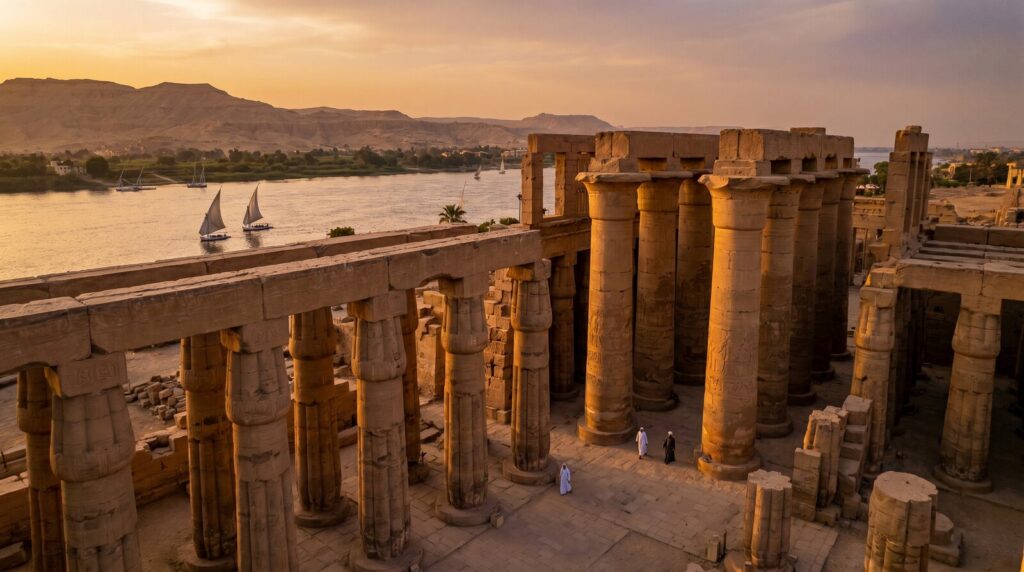
The Nile’s centrality to Luxor experience cannot be overstated. The river created the geographic conditions enabling Egyptian civilization, and contemporary Luxor development remains oriented toward the Nile’s flow. Felucca sailboats—traditional wooden vessels using triangular sails—operate continuously, transporting visitors on sunset cruises through landscapes unchanged fundamentally for millennia. Walking along the Corniche (waterfront promenade), observing sunset light transform limestone temples from gold to amber to deep blue, reconnects visitors with the sensory experiences of ancient inhabitants gazing upon the same monuments.
What You’ll Discover
Valley of the Kings & Royal Tombs
The Valley of the Kings, carved into barren limestone hills west of the Nile, preserves 62 identified royal tombs spanning approximately 500 years of New Kingdom pharaonic rule (1550-1050 BCE). The valley’s geographic isolation in the desert, combined with elaborate security measures and hidden tomb entrances, represented the ancient Egyptian solution to tomb robbery—a constant threat given the valuable mortuary goods buried with pharaohs. Despite these precautions, nearly all tombs were eventually plundered, though the tombs’ architecture, decoration, and remaining artifacts provide incomparable insight into pharaonic ideology, religious beliefs, and artistic achievement.
The tomb of Tutankhamun (King Tut), discovered in 1922 virtually intact, became the most famous archaeological find of the 20th century. The discovery ignited worldwide fascination with ancient Egypt and made Tutankhamun the most recognized pharaoh despite his historical insignificance during his lifetime. The tomb’s relatively intact condition—preserved through historical fortune rather than security success—revealed sophisticated burial practices and mortuary beliefs. Contemporary visitors can enter the tomb, though the small chamber and thousands of daily visitors create claustrophobic experience. The famous gold mask and principal artifacts now reside in Cairo’s Egyptian Museum rather than in Luxor.
The tomb of Ramesses II (Ramesses the Great), pharaoh of Egypt’s last powerful dynasty, offers monumental grandeur and preserved decoration. The entrance, flanked by colossal statues, descends through multiple chambers decorated with vibrant paintings and hieroglyphic texts. The decorative program narrates the pharaoh’s ascent to the sun god Ra and eternal existence in the afterlife. The scale and artistic quality demonstrate peak pharaonic artistic achievement and labor organization capacity.
The tomb of Seti I, father of Ramesses II, presents similar decoration with subtle stylistic distinctions. These tombs required years of labor, involving teams of artisans creating detailed decoration under challenging underground conditions. The effort expended—moving millions of stone tons, quarrying limestone, decorating chambers with precise hieroglyphic and artistic work—illustrates the organizational capability and ideological commitment underpinning pharaonic civilization.
Visiting the Valley requires early morning arrival to avoid peak crowds and extreme heat. Tourist tickets provide entry to three tombs of choice, with additional fee for particularly significant tombs. Walking the valley floor among the hillside tomb entrances, observing the archaeological evidence of thousands of years of human labor and ambition, creates visceral historical connection. The barren desert landscape—unchanged since antiquity—enhances the sense of temporal displacement.
Karnak Temple Complex
Karnak, located on the Nile’s east bank two kilometers north of Luxor city center, represents Earth’s largest ancient religious complex and arguably the most spectacular surviving temple edifice. The site encompasses approximately 100 hectares, with major temples, smaller shrines, sacred lakes, and administrative buildings distributed across the complex. The central temple of Amun-Ra dominated the site religiously and politically, serving as the nation’s primary religious institution and commanding tremendous wealth and labor resources.
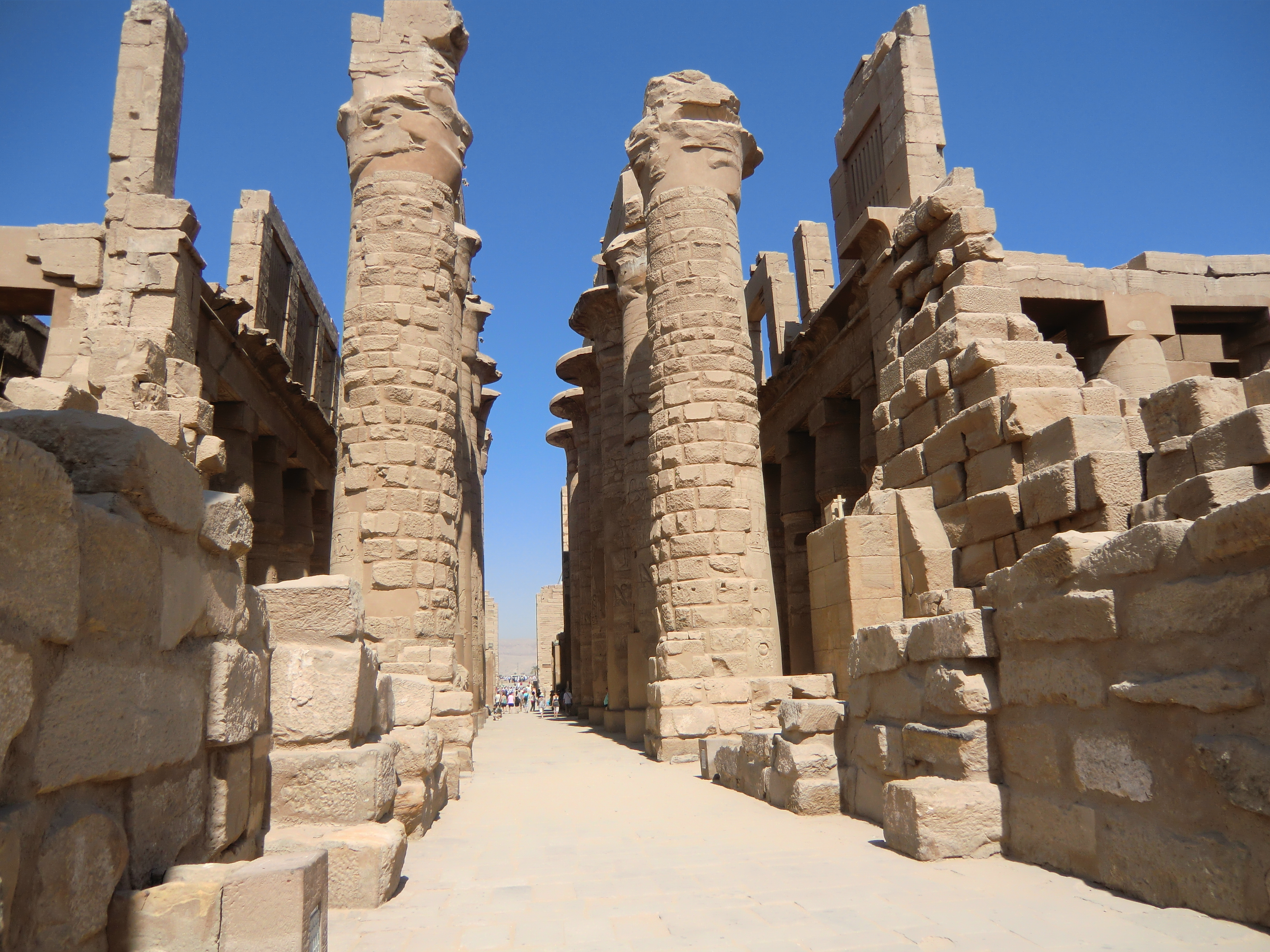
The Great Hypostyle Hall represents Karnak’s architectural showpiece—a forest of 134 massive columns arranged in 16 rows creating an interior landscape of stone. Each column rises to 25+ meters, with capitals carved to represent papyrus flowers or lotus buds. The ceiling, supported by these columns, once featured astronomical ceiling paintings documenting constellations and celestial movements. Walking through the hypostyle hall—squinting upward to comprehend the architectural scale, moving through the columns’ shadows and light—produces overwhelming impression of human achievement and religious devotion.
The pylons (monumental gateways) leading toward the sanctuary demonstrate Egyptian architectural grandeur. The First Pylon, the temple’s ceremonial entrance, rises 43 meters and once featured colossal statues and painted reliefs. The avenue leading to the pylon—traditionally flanked by sphinxes—created impressive processional route for religious ceremonies. Walking this avenue today, lined with excavated sphinxes, recreates the experience of approaching the temple as an ancient worshipper or official.
The sanctuary at Karnak’s center—the holiest space accessible only to the pharaoh and highest-ranking priests—once housed the sacred barque (boat) of Amun-Ra. The sanctuary’s relative simplicity contrasted with the monumental approaches, creating compression of space and sanctity progression. The sanctuary remains largely intact despite centuries of decay and modern looting.
Evening sound-and-light shows at Karnak employ dramatic lighting and historical narration to tell the temple’s story. While touristy, the shows effectively convey the temple’s grandeur and religious significance. Witnessing the pylons and columns illuminated against dark night sky creates emotional impact supplementing daytime historical understanding.
Luxor Temple & Avenue of Sphinxes
Luxor Temple, located in the city center on the Nile’s east bank, served as an important religious site focused on Amun-Ra but distinctively different from Karnak’s public temple function. Luxor Temple functioned as the setting for the Opet Festival—a major religious ceremony where the statue of Amun processed from Karnak to Luxor and back in ceremonial affirmation of the pharaoh’s divine legitimacy. The journey occurred along the Avenue of Sphinxes, a processional route connecting the two temples.
The temple’s pylon, fronted by colossal statues of Ramesses II, creates dramatic focal point when approached from the Corniche. The statues—carved from single stone blocks—depict the pharaoh in classic pose with hands folded across the chest. The hieroglyphic inscriptions and relief carvings cover the pylon surface, documenting the pharaoh’s victories and invoking divine protection. Entering through the pylon creates compression of space—the monumental scale dominates individual perspective.
The colonnaded courtyard features rows of papyrus-capitol columns arranged around an open space where worshippers and officials gathered during ceremonies. The columns’ capitals—carved to represent papyrus flower heads—demonstrate Egyptian botanical knowledge combined with symbolic meaning, papyrus representing rebirth and renewal. The courtyard’s openness creates dramatic contrast with the enclosed sanctuary spaces beyond.
The Avenue of Sphinxes, once connecting Karnak to Luxor, has been partially excavated and reconstructed. The avenue’s remaining sphinxes—carved with ram heads representing Amun—once stretched approximately two kilometers between the temples. Walking the partial avenue today, with sphinx heads looming through the modern Luxor cityscape, illustrates the temple’s original scale and processional importance.
West Bank Sites & Necropolis
The Nile’s west bank, where the sun sets symbolizing death and the afterlife, concentrated ancient Egypt’s necropolis and funerary monuments. Beyond the Valley of the Kings, the west bank hosts the Valley of the Nobles (non-royal tombs of high officials), the Temple of Hatshepsut (the female pharaoh’s mortuary temple), and the Ramesseum (Ramesses II’s mortuary temple). These sites cluster within walking distance of each other, creating concentrated archaeological zone.
The Temple of Hatshepsut—Egypt’s most architecturally distinctive temple—descends in three terraced levels into a limestone cliff. The temple’s graceful proportions, colonnaded courts, and decorated relief carvings document the reign of Egypt’s most successful female pharaoh (1479-1458 BCE). The temple celebrated her legitimacy and accomplishments, with inscriptions detailing her trading expedition and military campaigns. The architectural elegance and sophisticated decoration distinguish the temple from more typical pharaonic religious buildings.
The Ramesseum, Ramesses II’s mortuary temple, sprawls across the plain with colossal seated statues, pylons, and columned courts. The temple’s scale documents the pharaoh’s power and the resources devoted to ensuring his eternal prosperity. The site’s excavation revealed evidence of workers’ villages, suggesting the organized labor involved in such monumental construction.
The Valley of the Nobles contains approximately 1,400 tombs of high officials spanning multiple dynasties. Unlike royal tombs with emphasis on pharaonic theology, noble tombs feature biographical inscriptions detailing careers, administrative accomplishments, and family relationships. Walking among the noble tombs provides perspective on non-royal Egyptian society and the bureaucratic structures supporting civilization.
Valley of Kings
62 royal tombs, pharaonic ideology, most famous archaeological site. Requires early arrival, guide assistance. Expect crowds.
West Bank Temples
Hatshepsut Temple, Ramesseum, Valley of Nobles. Diverse sites requiring 6+ hours for comprehensive exploration. Less crowded than Valley of Kings.
Nile Cruises & Felucca Sailing
The Nile, flowing northward from tropical Africa to the Mediterranean, created the geographic and hydrographic foundation for Egyptian civilization. Luxor’s position as a Nile city makes the river integral to daily experience. Felucca sailboats—traditional wooden vessels using triangular sails adapted to Nile wind patterns—operate throughout the day offering short cruises (1-2 hours) through sunset sailing experiences popular for tourism.
Sunset felucca cruises provide romantic evening experience with the Nile’s water reflecting amber-tinted light, temple silhouettes darkening against the sunset sky, and palm-lined banks passing slowly. The felucca’s gentle motion, the sound of water lapping against wood, and the absence of engine noise create tranquil sensory experience. Sailing typically occurs between downtown Luxor and the Valley of the Kings’ general area, passing archaeological sites and rural Nile communities.
Multi-day Nile cruises between Luxor and Aswan (approximately 240 kilometers south) operate as floating hotels with entertainment, dining, and organized shore excursions. The cruises follow the Nile through Upper Egypt landscape, with stops at intermediate temples including Edfu and Kom Ombo. The cruise vessel becomes your accommodation, eliminating daily hotel changes while providing continuous Nile perspective.
Nile cruises represent a different sensory experience than site-based tourism—the river landscapes reveal themselves slowly as the boat progresses, agricultural land appears immediately beyond the touristic sites, and fellow passengers often remain constant, creating social interaction spanning multiple days. The cruises’ pace accommodates reflection impossible during rushed site-visiting.
Practical Travel Details
Luxor International Airport (LXR) receives domestic flights from Cairo and occasionally international chartered flights. Most visitors connect through Cairo International Airport before traveling south to Luxor via 90-minute flight or 8-10 hour driving through the Nile Valley. The drive offers scenic landscape views but requires time investment many tourists cannot accommodate. Flights provide practical access to the site.
Accommodation options range from international five-star hotels through mid-range establishments to budget guesthouses. The Winter Palace Hotel offers historic luxury with riverfront positioning near Karnak. Many hotels cluster along the Corniche with direct Nile access. Mid-range options provide comfortable accommodations at reasonable costs. Luxury cruise ships dock throughout the season providing floating accommodation.
Egyptian Pound (EGP) is the currency, with approximately 50 EGP equaling 1 USD in 2026. ATMs distribute throughout Luxor, accepting international cards. Most tourist establishments accept credit cards, though cash proves useful for smaller transactions and street vendors.
Guides are absolutely essential for meaningful site visits. Licensed guides possess historical knowledge impossible to develop independently. Hotel concierge services facilitate guide booking, or tourists can negotiate directly with guides congregating near major sites. Guides typically cost $40-80 per day depending on group size and comprehensiveness desired.
Heat represents the principal environmental challenge. Summer temperatures (May-August) regularly exceed 40°C (104°F), making extensive walking exhausting and potentially dangerous. Winter months (November-March) offer more moderate temperatures (18-28°C) and represent optimal visiting season. Even winter months require substantial sun protection, hydration, and pacing awareness.
Best visiting periods are October through April when Mediterranean winter weather moderates temperatures and provides pleasant conditions. May-September constitutes extremely hot season with minimal tourism due to heat intensity. Peak tourism (December-February) involves significant crowds at major sites, though accommodations and cruises remain accessible with advance booking.
Security has improved substantially, with Luxor returning to normal tourism operations following earlier safety concerns. Standard urban precautions apply, with valuables secured and evening activities planned prudently. Tourist police presence is substantial at archaeological sites.
Witness Humanity’s Greatest Ancient Achievement
Luxor provides immersion into ancient Egypt’s grandeur unmatched globally. The monumental temples, royal tombs, and Nile landscape create visceral connection across millennia with the civilization that built such enduring monuments. Few experiences rival standing in the Valley of the Kings’ barren landscape contemplating the enormous effort and theological conviction behind the tombs surrounding you.
2026 Travel Update for Luxor
Luxor remains one of Egypt’s crown jewels for travelers in 2026. The Grand Egyptian Museum near Cairo has drawn global attention, but Luxor’s own archaeological sites continue to reveal new discoveries—recent excavations on the West Bank have uncovered additional tombs that are expected to open to visitors by late 2026. The Luxor International Airport now handles increased charter flights from Europe, and the Egyptian government has invested in improved visitor infrastructure around the Valley of the Kings, including shaded walkways and enhanced lighting inside select tombs. Nile cruise vessels have also been upgraded to meet modern sustainability standards, with several operators launching electric-powered boats.
Frequently Asked Questions About Luxor
What is the best time to visit Luxor?
The best time to visit Luxor is from October to April, when temperatures are more manageable, ranging from 20–30°C during the day. Summer months (June to August) can see temperatures exceeding 45°C, making outdoor sightseeing uncomfortable and potentially dangerous. Winter mornings are ideal for hot air balloon rides over the Valley of the Kings, and evening temperatures are pleasantly cool for temple visits.
How many days should I spend in Luxor?
Plan for at least 3 to 4 days to properly explore Luxor’s highlights. Day one can cover the East Bank with Karnak and Luxor Temples. Day two is best spent on the West Bank visiting the Valley of the Kings, Hatshepsut’s Temple, and the Colossi of Memnon. A third day allows for a hot air balloon ride at dawn and visits to lesser-known tombs. A fourth day can include a felucca sail on the Nile or a visit to the Luxor Museum.
Are Nile cruises from Luxor worth it?
Absolutely. A Nile cruise between Luxor and Aswan is one of Egypt’s most iconic travel experiences. The 3–4 night journey passes through stunning Nile Valley scenery with stops at Edfu and Kom Ombo temples. Cruise options range from budget-friendly to ultra-luxury dahabiyas (traditional sailing boats). Booking in advance during peak season (December–February) is highly recommended as popular vessels sell out months ahead.
Is Luxor safe for tourists?
Luxor is one of the safest tourist destinations in Egypt, with a strong security presence around all major archaeological sites. Tourism is the lifeblood of the local economy, and visitors are treated with genuine hospitality. As in all popular tourist areas, be aware of persistent touts and agree on prices before hiring guides, carriages, or taxis. The tourist police are responsive and helpful.
Do I need a guide in Luxor?
While not mandatory, hiring a licensed Egyptologist guide significantly enriches the experience. The tombs and temples contain complex symbolism and history that is easy to miss without expert interpretation. Licensed guides can be arranged through your hotel or cruise operator, and typically charge $40–80 for a half-day tour. Audio guides are also available at major sites for a more budget-friendly option.