
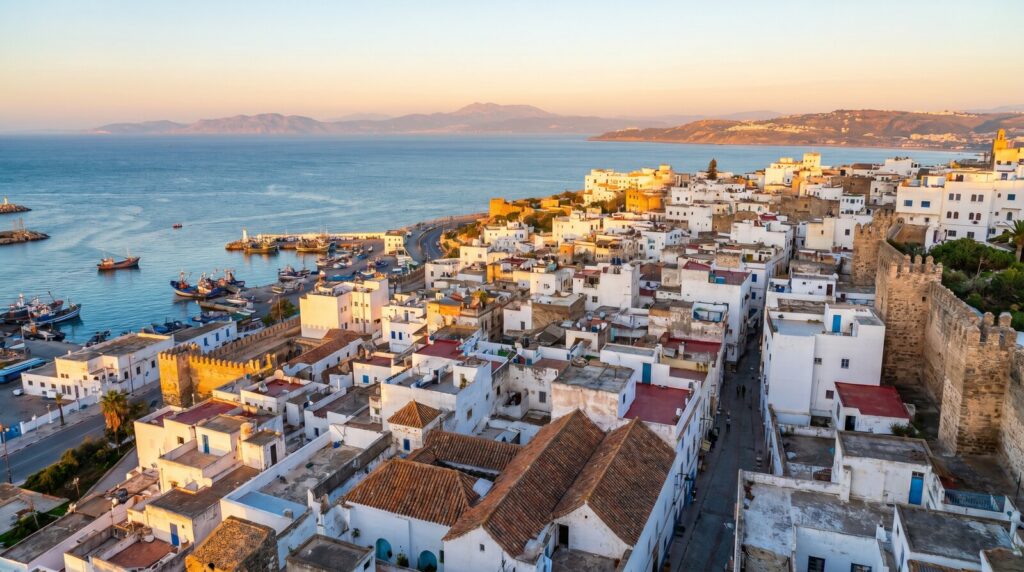
Tangier, Morocco: Gateway to Africa, Beat Generation Haven & Mediterranean Soul
Your Complete Guide to Tangier, Morocco
📍 In This Guide
- When to Visit Tangier ☀️
- The Medina & Kasbah 🏰
- Literary Tangier 📚
- Cap Spartel & Caves 🌊
- Food & Café Culture ☕
- Day Trips 🚌
- Budget & Practical Tips 💰
When to Visit Tangier ☀️
Tangier enjoys a mild Mediterranean climate moderated by both the Atlantic and the Med. Spring (April-June) and autumn (September-November) are ideal, with warm days and comfortable nights. Summer (July-August) brings crowds from Casablanca and European visitors on day trips from Spain. Winter is mild but rainy. The city is quieter and more atmospheric in the off-season — perfect for literary pilgrims and medina wanderers.

🌸 Spring
April-June. Perfect temperatures, wildflowers, quiet medina. The best time overall.
☀️ Summer
July-August. Hot, crowded with Moroccan and European tourists. Beach season in full swing.
🍂 Autumn
September-November. Warm seas, thinning crowds, golden light. Great for photography.
🌧️ Winter
December-March. Mild (14°C) but rainy. Atmospheric, cheap, few tourists. Cafés are cozy.
The Medina & Kasbah 🏰
Tangier’s medina is smaller and more navigable than Marrakech’s or Fez’s, but just as atmospheric. The narrow streets climb from the port up to the Kasbah, a fortified quarter with whitewashed walls, bougainvillea-draped doorways, and views across the Strait of Gibraltar to Spain. The Kasbah Museum (in the old sultan’s palace) tells the city’s story from Phoenician times through its international zone era. The Petit Socco is the medina’s social heart — a tiny square of cafés where writers once held court.
🏰 Kasbah
Fortified hilltop quarter with the best views. Wander the narrow streets and find the lookout over the strait.
☕ Petit Socco
Tiny square where Paul Bowles, William Burroughs, and Tennessee Williams drank mint tea.
🏛️ Kasbah Museum
Former sultan’s palace. Beautiful gardens and exhibits on Tangier’s remarkably diverse history. $2 entry.
🛍️ Grand Socco
Main square connecting old and new Tangier. The gateway to the medina. Cinema Rif nearby screens art films.
Literary Tangier 📚
In the 1950s and 60s, Tangier was an international zone with no taxes, loose laws, and a magnetic pull for artists and writers. Paul Bowles lived here for 52 years, writing The Sheltering Sky. William Burroughs wrote Naked Lunch in a room above the Petit Socco. Jack Kerouac, Allen Ginsberg, Tennessee Williams, and Truman Capote all spent significant time here. The city’s literary heritage is palpable — you can visit Bowles’ apartment, Burroughs’ hotel, and the cafés where they wrote.
📖 Paul Bowles’ Apartment
The writer lived in a modest apartment on a quiet street for decades. Sometimes open for visits — ask locally.
🏨 Hotel El Muniria
Where Burroughs wrote much of Naked Lunch. Still operating, Room 9 is the famous one.
📚 Librairie des Colonnes
Historic bookshop on Boulevard Pasteur. Meeting point for the literary set since the 1940s.
☕ Café Hafa
Cliff-edge café overlooking the strait. Rolling Stones, Beatles, and Beat poets all drank here. Mint tea $1.
Food & Café Culture ☕
Tangier’s food reflects its crossroads position. The fish market near the port sells the morning’s catch, and tiny restaurants around it will grill your selection for a few dollars. Café culture is central to Tangier life — men (and increasingly women) spend hours over glasses of mint tea and plates of pastries. The city’s signature dish is tangia, a slow-cooked meat stew traditionally prepared in clay pots left in the embers of a hammam furnace overnight.
🐟 Fish Market
Near the port. Choose your fish, have it grilled on the spot. A full meal for $5-8 with sides.
🫖 Mint Tea Ritual
Sweet mint tea is the social lubricant of Morocco. Never refuse an offer — it’s hospitality incarnate.
🥘 Tangia
Slow-cooked meat in a clay pot. Tangier’s signature dish — different from Marrakech’s tanjia. Ask at small medina restaurants.
🥐 Café de Paris
Grand Boulevard Pasteur café. Good pastries, people-watching, and the feeling of a 1950s Tangier salon.
Budget & Practical Tips 💰
Tangier is affordable and increasingly accessible. The fast ferry from Tarifa, Spain takes just 35 minutes, making it an easy day trip from southern Spain — though it deserves more time. The new TGV train connects Tangier to Casablanca in 2 hours and 10 minutes. The medina is walkable, and petit taxis (blue) are cheap for getting around the new city. Bargaining is expected in the medina but prices are generally lower than in Marrakech or Fez.
⛴️ Getting There
35-min ferry from Tarifa, Spain ($35 one-way). Flights from Europe. TGV train to Casablanca in 2h10.
🏨 Accommodation
Medina riads from $20/night. Hotel Continental (overlooking the port) is a faded gem from $40.
🚕 Getting Around
Petit taxis (blue) within the city, $1-3 per ride. The medina is entirely walkable.
💰 Costs
Very affordable. $3-5 for a full meal, $1 for mint tea, $2 for museum entry. Budget travelers: $30/day.
Where two continents almost touch.
Tangier has been reinventing itself for 3,000 years — Phoenician port, international zone, literary capital, and now a city in full renaissance. Cross the strait and see for yourself.
❓ Frequently Asked Questions
What is the best time to visit Tangier?
Spring (April–June) and autumn (September–November) offer the most pleasant weather with temperatures around 65–80°F (18–27°C). Summer brings crowds and heat, while winter is mild but can be rainy and windy along the coast.
How do you get to Tangier from Spain?
The fastest option is a ferry from Tarifa, Spain, which takes about 35 minutes and runs multiple times daily. Ferries also operate from Algeciras (about one hour). The Tangier Ibn Battouta Airport receives flights from European and Moroccan cities.
Is Tangier worth visiting?
Yes, Tangier offers a unique blend of African and European influences, a storied literary history (home to writers like Paul Bowles and the Beat Generation), a dramatic kasbah overlooking the Strait of Gibraltar, and an increasingly vibrant food and art scene.
How many days do you need in Tangier?
Two to three days is ideal. This allows time to explore the Kasbah and Medina, visit the Caves of Hercules, walk along the corniche, browse the Petit Socco cafés, and perhaps take a day trip to Chefchaouen, the famous blue city.