
Languages of Andorra
All languages of Southern Europe →fluent beta classical · classes by phone with Maya at ranas.ai/maya
Andorra Travel Guide — Europe’s Highest Capital, Duty-Free Shopping & the Pyrenees’ Best-Kept Ski Secret
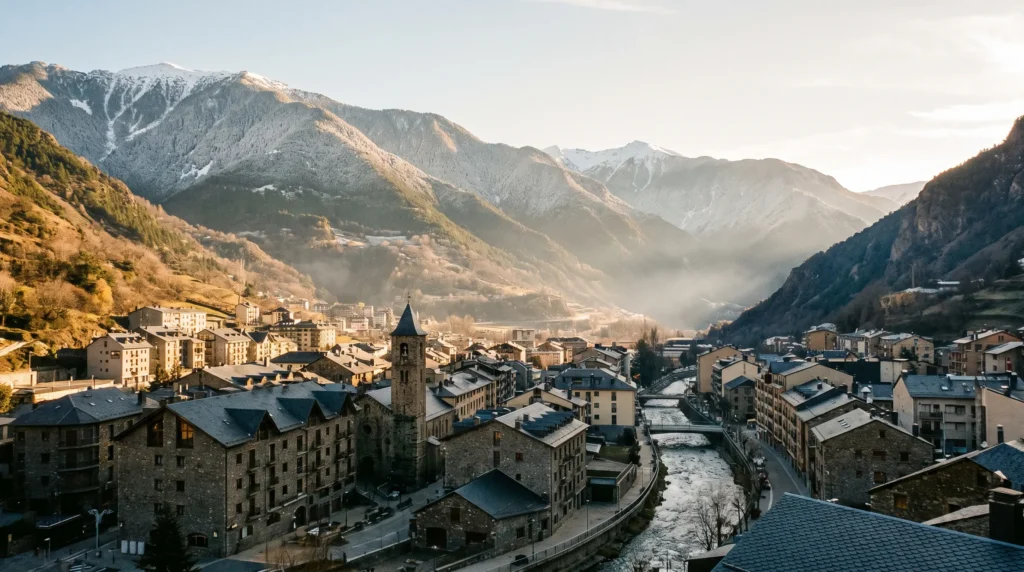
Andorra is the country most people can’t quite place on a map, and I mean that literally — it’s a comma-sized principality wedged between France and Spain in the eastern Pyrenees, ruled jointly by the Bishop of Urgell and the President of France, a co-principality arrangement that dates to a land-sharing pact from 1278. It isn’t in the EU, it isn’t in Schengen, and it doesn’t have its own airport — yet it still pulls in roughly 8 million visitors a year, which tells you everything about what’s waiting once you actually make the drive up the mountain. I’ve watched people arrive expecting a tax-free shopping pit stop between Barcelona and Toulouse and leave talking about the hiking. Both experiences are real, and neither cancels the other out.
In This Guide
- Overview — A Micro-Country That Punches Absurdly Above Its Weight
- Summer Trekking Season — the Pyrenees Without the Crowds
- Best Time to Visit Andorra (Season by Season)
- Getting There — No Airport, One Mountain Road In
- Getting Around — Buses, Cable Cars & a Ban on Rail
- Top Regions — Parishes, Peaks & Ski Sectors
- Culture & People — Catalan Roots, Co-Princes & No Army
- A Food Lover’s Guide to Andorra
- Off the Beaten Path
- Practical Information
- Budget Breakdown — What Andorra Actually Costs in 2026
- Frequently Asked Questions
Overview — A Micro-Country That Punches Absurdly Above Its Weight
Andorra covers about 468 square kilometers of the eastern Pyrenees, roughly the footprint of a mid-sized city, and yet manages to contain ski slopes, glacial valleys, thermal spas and a genuinely distinct national identity. It has been governed as a co-principality since a 1278 paréage split sovereignty between the Bishop of Urgell in Spain and the Count of Foix, whose role passed down to the President of France — an arrangement that, remarkably, still holds today, modernized by the 1993 constitution that voters approved by 74.2%.
Andorra la Vella, the capital, sits at 1,023 meters above sea level, making it the highest capital city in Europe. The country’s high point, Coma Pedrosa, tops out at 2,946 meters. None of this required a booming population to pull off — Andorra has only around 89,000 residents — but tourism, tax-advantaged retail and banking have built one of the highest GDP-per-capita figures in the world, ranked 18th globally by PPP in 2024.
What surprises first-time visitors most is how the country splits cleanly in two: a shopping-and-spa identity centered on Andorra la Vella and Escaldes-Engordany, and a high-mountain identity built around Grandvalira and Vallnord, Europe’s most underrated ski country outside the Alps. Neither half requires you to abandon the other — the whole country is small enough to experience both in a long weekend.
Summer Trekking Season — the Pyrenees Without the Crowds
Andorra’s skiing gets all the marketing, but its short, intense hiking season — roughly June through September, once the snowpack clears from the high passes — is the country’s best-kept secret. The centerpiece is the Madriu-Perafita-Claror Valley, a 4,247-hectare glacial valley that became Andorra’s only UNESCO World Heritage Site in 2004 for its living record of Pyrenean pastoral culture: stone huts, terraced fields and a communal land system that traces back to the 13th century. It’s accessible only on foot, which keeps it wonderfully uncrowded even in August.
Late June also brings the Revetlla de Sant Joan, Andorra’s midsummer bonfire festival shared across the Catalan-speaking Pyrenees — a good excuse to time a trip around the solstice before the July trekking rush. Whichever week you land, the Cirque de Pessons and the network of refugis (mountain refuge huts) along the GR11 give you multi-day routes without needing Alpine-level logistics.
Best Time to Visit Andorra (Season by Season)
December – April · Ski season (peak: February, Christmas & Easter weeks)
This is Andorra’s headline season. Grandvalira and Vallnord run lifts, base villages fill up, and prices climb hardest around Christmas/New Year and February school-holiday weeks. Snow reliability is generally strong given the altitude, but always check current conditions before booking non-refundable lodging.
May – June · Quiet shoulder
Ski season ends, high trails are still patchy with snow, and much of the mountain infrastructure is between seasons. Lower-altitude towns and the spa/shopping side of the country stay fully open, and prices are the year’s softest.
July – August · Summer high season
Warm days, cool mountain nights, full hiking access, and Andorra la Vella’s busiest shopping weeks as French and Spanish visitors cross the border for a getaway. Book hotels ahead for August in particular.
September – November · Second shoulder
Trekking conditions stay good into September, autumn color moves through the valleys, and the country empties out again before the first snow closes the high passes ahead of the ski season restart.
Getting There — No Airport, One Mountain Road In
Andorra has no commercial international airport of its own — a small regional airfield exists at nearby La Seu d’Urgell in Spain, but the practical gateways are Barcelona–El Prat (BCN) and Toulouse–Blagnac (TLS), both roughly 180–210 km away by road. Direct scheduled buses connect both airports to Andorra la Vella’s bus station, generally running every one to two hours from Barcelona (about a 3-hour ride) and several times daily from Toulouse (roughly 3.5 hours), with driving times of 2.5–3 hours from either city depending on mountain conditions.
Because Andorra sits outside both the EU and the Schengen area but is only reachable by crossing France or Spain, your entry paperwork is really governed by Schengen rules for whichever neighbor you transit — passports should be valid at least three months beyond your planned departure. From late 2026, travelers from visa-exempt countries entering via France or Spain are expected to need an ETIAS authorization as the EU’s new system phases in — worth checking before you fly.
Getting Around — Buses, Cable Cars & a Ban on Rail
Andorra has no railway at all — the mountainous terrain and the country’s small size never justified one — so road transport does everything. A cheap, frequent national bus network (run by several local operators) links Andorra la Vella with every parish and most ski base stations; fares are a few euros and buses are the default way to get from the capital to Grandvalira’s Soldeu/El Tarter sector or Vallnord’s Arinsal base.
Renting a car gives you the most flexibility for reaching smaller villages and trailheads, though winter driving demands care — snow chains or winter tires are legally required on Andorran roads from 1 November to 15 May. Within the ski resorts, gondolas and chairlifts do the vertical work, and Andorra la Vella and Escaldes-Engordany are compact enough to walk between comfortably.
Top Regions — Parishes, Peaks & Ski Sectors
Andorra la Vella
The capital and Europe’s highest, built around duty-free shopping streets, government buildings and the Casa de la Vall, Andorra’s historic seat of parliament. It’s compact, walkable, and the natural first stop for every visitor.
Escaldes-Engordany
Practically fused to the capital, this parish is home to Caldea, one of southern Europe’s largest thermal spa complexes, drawing on Andorra’s natural hot springs. A soak here is the classic après-ski (or après-hike) ritual.
Grandvalira (Canillo, Encamp, El Tarter, Soldeu, Pas de la Casa, Grau Roig)
The largest ski area in the Pyrenees, spanning seven interconnected sectors with 215 km of skiable terrain across 140 runs — 23 green, 53 blue, 46 red and 20 black. Soldeu and El Tarter carry the liveliest nightlife; Pas de la Casa sits right on the French border and doubles as a shopping town.
Vallnord (Ordino, La Massana, Arinsal, Pal)
Andorra’s other ski zone, quieter and generally better value than Grandvalira, split between the Ordino Arcalís and Pal-Arinsal sectors. A combined countrywide lift pass covers both Grandvalira and Vallnord for a total of roughly 308 km of slopes.
Sant Julià de Lòria
The southernmost parish, bordering Spain, with a lower-key, more residential feel and the gateway to some of the country’s quieter valley hikes.
Madriu-Perafita-Claror Valley
Not a town but a destination in itself — Andorra’s UNESCO-listed glacial valley, reachable only on foot from trailheads near Escaldes-Engordany, Encamp or Sant Julià de Lòria.
Culture & People — Catalan Roots, Co-Princes & No Army
Catalan is Andorra’s sole official language, though the country’s makeup — with large Spanish, Portuguese and French-speaking communities from decades of immigration for tourism and construction work — means Spanish and French are heard just as often on the street. The co-principality system, with the Bishop of Urgell and the President of France as joint heads of state, is a living medieval holdover rather than a ceremonial curiosity — both co-princes retain real, if largely symbolic, constitutional roles.
Andorra has no standing army, a matter of quiet national pride, and joined the United Nations and Council of Europe only in 1993 after its modern constitution passed. National festivals cluster around each parish’s own patron saint days through the summer, plus the Meritxell festival on 8 September honoring Andorra’s patron saint, Our Lady of Meritxell — the closest thing the country has to a unifying national day.
A Food Lover’s Guide to Andorra
Andorran cuisine leans hearty mountain Catalan, built for cold-weather appetites. Trinxat — mashed potato and cabbage fried with bacon — is the classic comfort dish, alongside escudella, a slow-simmered meat-and-vegetable stew that’s a winter staple across the wider Pyrenean region. Cured meats and mountain cheeses show up on every menu, often alongside grilled trout from Andorra’s rivers.
Because Andorra borders both France and Spain, its food culture borrows freely from both — expect Catalan-style grilled meats and calçots in season alongside French-influenced pastry and cheese boards. The country’s duty-free status also makes it a genuinely good place to stock up on wine, spirits, cheese and chocolate at prices well below what you’d pay across the border in France or Spain.
Off the Beaten Path
Cirque de Pessons
A dramatic glacial cirque ringed by a chain of alpine lakes above Grau Roig, reached by a half-day hike that most Grandvalira day-trippers never bother with.
Ordino village
One of Andorra’s prettiest and least commercial villages, with stone architecture largely untouched by the retail sprawl of the capital, plus the Areny de Plandolit manor house museum.
Roc del Quer & the “Mirador”
A cantilevered glass-and-steel viewpoint jutting out over the Canillo valley — a five-minute detour that delivers one of the country’s best photo stops with almost no crowd management needed.
Casa de la Vall
Andorra’s former parliament building in the capital’s old quarter, a low-key stop for anyone curious how a country this small actually governs itself.
Practical Information
Money. Andorra uses the euro unilaterally, without EU membership, formalized under a 2006 monetary agreement. Cards are widely accepted in shops and restaurants; carry some cash for smaller mountain villages. Declare cash over €10,000 on entry or exit.
Safety. Andorra has a low crime rate and no recent history of terrorism, and both the US State Department and UK FCDO advise only the standard precautions travelers should take anywhere. Drug laws are strictly enforced with zero tolerance, and drink-driving penalties are tougher than in many neighboring countries.
Health. No unusual health risks beyond standard travel precautions; healthcare is not free for visitors, so travel insurance covering medical costs and evacuation is essential, especially for ski injuries and high-altitude hiking.
Connectivity. Since Andorra isn’t in the EU, standard EU roam-free plans typically don’t cover it automatically — check your carrier or grab a regional eSIM. Plugs: European two-pin (Type C/F), 230V. Time zone: Central European Time (UTC+1), UTC+2 in summer.
Budget Breakdown — What Andorra Actually Costs in 2026
Andorra isn’t cheap by Iberian standards, but it undercuts full-price Alpine skiing meaningfully, and its duty-free shopping can offset costs elsewhere in your trip.
Budget (US$70–120/day): Guesthouse or budget hotel in Andorra la Vella, self-catered or bakery lunches, bus travel between parishes, day hikes instead of lift tickets.
Mid-range (US$180–320/day): Three-star hotel near the slopes or in Escaldes-Engordany, a day lift pass at Grandvalira or Vallnord, restaurant dinners, a Caldea spa session, occasional car rental.
Luxury (US$500+/day): Ski-in/ski-out chalets, private spa suites, high-end Catalan-French dining, and peak-week (Christmas, February, August) rates across the board.
Expect prices to swing hard by season — a hotel room in low-season May can cost half what the same room runs during February ski week or August peak.
Planning Your First Trip to Andorra
The simplest first-timer plan is a long weekend built around one mountain activity: fly into Barcelona–El Prat, bus up to Andorra la Vella (about three hours), then split your time between one or two ski sectors or hiking valleys and a spa afternoon at Caldea. Three to four nights covers the country comfortably without feeling rushed; a week lets you add both Grandvalira and Vallnord, or pair skiing with a Madriu Valley day hike if you’re visiting in the shoulder weeks. Andorra also slots naturally into a wider Iberian or Pyrenean loop — many visitors combine it with our Spain guide for Barcelona, our France guide for a Toulouse approach, or extend the trip into our Portugal guide for a longer Iberian swing. Skiers weighing Andorra against the bigger Alpine names often cross-check our Switzerland guide or Austria guide for comparison.
Frequently Asked Questions
Is Andorra safe for tourists in 2026?
Yes — Andorra has a low crime rate and both the US State Department and UK FCDO advise standard travel precautions with no elevated concerns. Drug laws are strictly enforced, so don’t test that boundary.
Do I need a visa to visit Andorra?
US, UK, EU, Canadian and most Commonwealth passport holders don’t need a visa for stays up to 90 days, but since Andorra isn’t in the Schengen area and can only be reached by crossing France or Spain, your entry is really governed by Schengen passport rules for whichever country you transit. From late 2026 an ETIAS authorization is expected to be required for visa-exempt travelers entering via France or Spain, so check before you fly.
Does Andorra have its own airport?
Not a commercial international one. Most visitors fly into Barcelona–El Prat or Toulouse–Blagnac and take a direct bus (roughly 3 hours from either) or drive up.
Is Andorra part of the EU?
No — Andorra is not an EU member and only joined the United Nations and Council of Europe in 1993, but it has used the euro unilaterally since 2006 under a formal monetary agreement.
Andorra or the French/Swiss Alps for skiing?
Choose Andorra for genuinely large, well-groomed terrain (215 km at Grandvalira alone) at noticeably lower prices than the big Alpine resorts; choose the Alps for higher-altitude glacier skiing and a longer season guarantee. Andorra is the better-value long weekend, not necessarily the bigger mountain.
Is Andorra worth visiting if I don’t ski?
Absolutely — summer hiking in the Madriu-Perafita-Claror Valley, thermal spa time at Caldea, and duty-free shopping all work without a single day on snow.
Ready to Explore Andorra?
A country you can drive across in under an hour, with a UNESCO valley, one of the Pyrenees’ biggest ski areas, and a duty-free shopping street all inside its borders — Andorra rewards travelers who stop treating it as a day trip from Barcelona and actually stay a few nights.
Explore More
- Spain Travel Guide — Barcelona and the approach from the south
- France Travel Guide — Toulouse and the approach from the north
- Switzerland Travel Guide — for comparing Alpine ski country
- Portugal Travel Guide — extend into a longer Iberian trip
How this guide was built
Published as part of Facts From Upstairs’ country guide series. Built from authoritative sources — Wikipedia’s Andorra entity page, UNESCO’s Madriu-Perafita-Claror Valley World Heritage inscription, the official Grandvalira resort site, the US State Department’s Andorra country information page, the UK FCDO’s Andorra travel advice, and the US CDC traveler page for Andorra. Numeric claims carry inline citations.
More country guides you might like

Plan your trip to Andorra
The booking tools we use ourselves. FFU may earn a commission at no extra cost to you.
Plan & book your trip to Andorra
Booking through these searches supports our guides at no extra cost to you.