
Languages of Burkina Faso
All languages of Western Africa →fluent beta classical · classes by phone with Maya at ranas.ai/maya
Burkina Faso Travel Guide — Painted Villages, the Continent’s Oldest Film Festival, and a Country Currently Off the Map
I want to be upfront before you read another word: this guide covers a country I cannot currently recommend you visit, and I’d be doing you a disservice as a travel writer if I buried that. Burkina Faso holds some of West Africa’s most extraordinary sights — the geometric hand-painted courtyards of Tiébélé, a 130-year-old mud mosque in Bobo-Dioulasso, the wind-carved rock spires at Sindou, and FESPACO, the oldest and largest film festival on the continent. It also, right now, sits under a US State Department Level 4 “Do Not Travel” advisory and a UK Foreign Office recommendation against all travel, because of an active jihadist insurgency, a very high kidnapping threat to foreigners, and two coups since 2022 that left the country under military rule. So this is written as a cultural and historical guide — the country worth knowing about, and hopefully worth visiting again someday — rather than an itinerary to book this year.
In This Guide
- Overview — A Remarkable Country Under a Do-Not-Travel Advisory
- FESPACO — Africa’s Oldest Film Festival
- Best Time to Visit Burkina Faso (Season by Season)
- Getting There — Airports, Borders & the Current Reality
- Getting Around
- Top Regions — Ouaga, Bobo & Beyond
- Culture & People — Mossi, Mooré & a Cinema Tradition
- A Food Lover’s Guide to Burkina Faso
- Off the Beaten Path
- Practical Information
- Budget Breakdown — What Burkina Faso Costs, For Context
- Frequently Asked Questions
Overview — A Remarkable Country Under a Do-Not-Travel Advisory
Burkina Faso is a landlocked Sahel nation of roughly 22.5 million people, bordered by Mali, Niger, Benin, Togo, Ghana and Ivory Coast. It became independent from France on 5 August 1960 as Upper Volta, renamed itself Burkina Faso — “land of upright/honest people” — in 1984, and built a genuine cultural identity out of that independence: its own official languages as of January 2024 (Mooré, Dyula and Fula, with French and English downgraded to working-language status), its own film industry, its own craft economy.
None of that changes the second half of the story. Since 2015 the country has faced a jihadist insurgency linked to groups including JNIM and Islamic State affiliates, which has displaced large numbers of people and driven a security crisis severe enough that Burkina Faso underwent two military coups in 2022 alone; interim president Ibrahim Traoré has led a junta government since, and the country withdrew from ECOWAS in January 2024. The US State Department’s most recent advisory (May 2026) rates the country Level 4 — its highest risk category — citing terrorism, a high kidnapping threat to foreigners including tourists, violent crime, and severely limited medical care outside the capital. The UK’s FCDO advises against all travel to the entire country for the same reasons, and notes there is no British Embassy in Burkina Faso at all — consular support is handled from Accra, Ghana, and cannot be provided in person.
So why write the guide at all? Because Burkina Faso’s cultural weight — Sudano-Sahelian mud architecture, Kassena wall art at Tiébélé, four UNESCO-recognized sites, and a film festival that shaped African cinema — deserves documenting honestly, and because circumstances in the Sahel do shift. Treat everything below as a briefing on a country worth understanding, not a green light.
FESPACO — Africa’s Oldest and Largest Film Festival
If there’s one reason cinephiles have historically flown into Ouagadougou, it’s the Panafrican Film and Television Festival of Ouagadougou (FESPACO), founded in 1969 and held biennially, typically in late February or March of even-numbered years. It’s Africa’s oldest and largest film festival, founded by filmmakers including Ousmane Sembène, screening films made chiefly by and in Africa, and it has run through years of political turbulence as one of the few consistent threads of national pride and cultural continuity.
The other major cultural date is SIAO, the International Arts and Crafts Fair, also held in Ouagadougou in alternating years to FESPACO, drawing artisans from across West Africa. Both events are civic institutions Burkinabè people are proud of — worth knowing about even if attending in person isn’t currently advisable for foreign travelers under prevailing government guidance.
Best Time to Visit Burkina Faso (Season by Season)
November – February · Cool dry season (harmattan)
The most comfortable window climatically: lower humidity, cooler nights, and the dusty Saharan harmattan wind that hazes the sky but drops daytime temperatures from brutal to merely warm. This is also FESPACO season in even-numbered years.
March – May · Hot dry season
The hardest stretch of the year — daytime highs regularly climb into the 40s°C ahead of the rains, and this window overlaps with the Sahel’s annual meningitis-belt risk period, a factor the CDC flags for pre-trip vaccination planning.
June – October · Rainy season
The Sahel’s short wet season greens up the landscape dramatically around Banfora and the southwest, but roads outside major towns can become difficult, and this is peak season for mosquito-borne illness — malaria risk exists countrywide year-round, not just in the rains.
Getting There — Airports, Borders & the Current Reality
Ouagadougou’s Thomas Sankara International Airport is the country’s main international gateway, with Bobo-Dioulasso’s smaller airport handling some regional and domestic traffic. In ordinary times, regional carriers connect Ouagadougou to hubs like Abidjan, Accra, Casablanca and Paris. What’s changed is who can realistically use those routes: current visa policy blocks entry to US passport holders outright, and access for UK and EU nationals has been narrowed to exceptional cases rather than routine tourism. Land borders with Mali and Niger sit inside active conflict zones and are not sensible overland crossings under current conditions; the border areas with Benin, Togo and Ghana are comparatively calmer but still fall inside the blanket advisory.
If you are reading this for planning purposes rather than curiosity, the realistic starting point is the Burkinabè embassy or consulate covering your country, plus your own government’s current advisory page — not a general travel guide. Requirements, refused nationalities and entry rules have moved fast in recent years and can move again.
Getting Around
Under normal circumstances, Burkina Faso’s road network links Ouagadougou, Bobo-Dioulasso and secondary towns via a mix of paved national highways and rougher regional roads, traveled by shared bush taxis, private minibuses and a handful of intercity coach lines. Bobo-Dioulasso and the southwest — including Banfora and the Sindou Peaks — sit on the country’s most tourism-friendly corridor, historically the region visited even when other areas were already off-limits.
That said, both the US and UK advisories specifically flag road travel and highway checkpoints as elevated-risk activities right now, alongside states of emergency declared in multiple regions. Any account of “how to get around” has to be read as background information about how the country functions, not a route plan to execute today.
Top Regions — Ouaga, Bobo & Beyond
Ouagadougou
The capital and largest city, home to FESPACO and SIAO, the Grande Mosquée, a lively artisan and bronze-casting scene, and most of the country’s diplomatic and NGO infrastructure. It’s also where both the US and UK advisories note the terrorism threat has increasingly reached, alongside the historically calmer south and southwest.
Bobo-Dioulasso
The country’s second city and cultural capital of the southwest, centered on the Grand Mosque of Bobo-Dioulasso — a roughly 1880s Sudano-Sahelian mud-brick structure built under religious leader Almamy Sidiki Sanou, widely considered among the finest examples of the style in West Africa. Bobo’s old quarter, dyers’ workshops and railway-era architecture historically made it the most relaxed base for visitors.
Banfora & the Sindou Peaks
The lush “garden of Burkina Faso” southwest of Bobo, known for the Karfiguéla waterfalls and swimmable natural pools, sugarcane country, and the Sindou Peaks — a dramatic run of wind- and water-carved rock pinnacles a short drive from Bobo-Dioulasso, historically an easy, rewarding half-day hike.
Loropéni
Site of the Ruins of Loropéni, Burkina Faso’s first UNESCO World Heritage inscription (2009): an 11,130-square-metre stone-walled settlement near the Ivory Coast and Ghana borders, the best-preserved of roughly a hundred similar fortified enclosures tied to the trans-Saharan gold trade, dated to at least the 11th century and flourishing under successive Ghana, Mali and Songhai influence through the 17th century.
Tiébélé
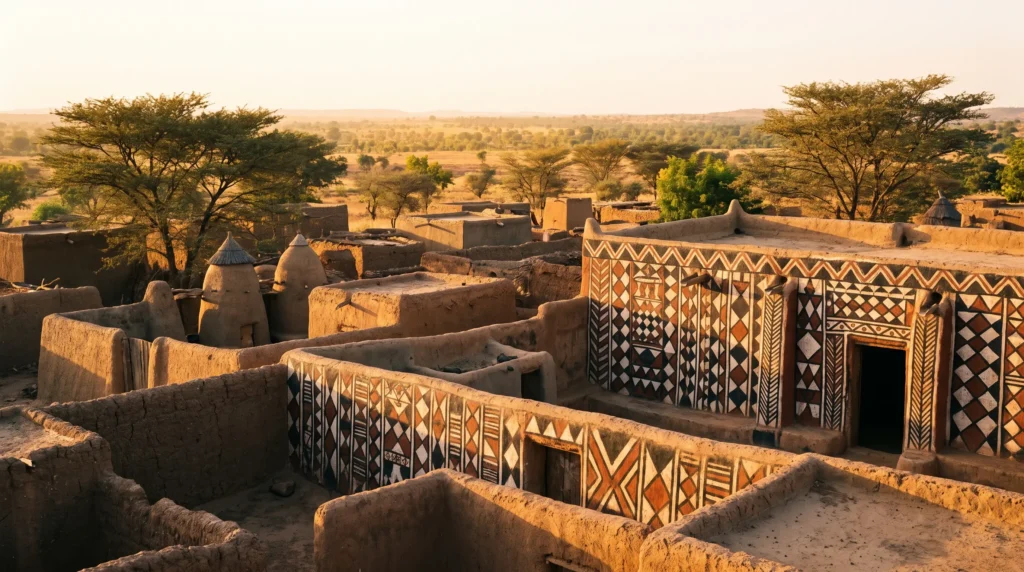
Home to the Royal Court of Tiébélé, UNESCO-inscribed in 2024: a Kassena royal complex of adobe courtyard houses covered in geometric murals painted exclusively by women, using natural pigments in patterns passed down through generations.
W-Arly-Pendjari Complex
Burkina Faso’s only natural World Heritage Site (2017), a transnational savanna wilderness shared with Niger and Benin covering over 1.7 million hectares — home to roughly 85% of West Africa’s savanna elephant population plus lion, cheetah and African wild dog. It’s also in the eastern border region flagged as among the highest-risk zones in the country, so treat this as the ecological case for why the region matters, not a wildlife-viewing recommendation.
Culture & People — Mossi, Mooré & a Cinema Tradition
The Mossi are Burkina Faso’s largest ethnic group at roughly half the population, with the Fula, Gurma, Bobo and Gurunsi peoples each contributing distinct languages, dress and craft traditions. Since January 2024, Mooré, Dyula and Fula hold official-language status, a deliberate move away from the colonial-era primacy of French, which is now classed as a working language alongside English.
Bronze casting, cotton weaving (faso dan fani cloth), leatherwork and mask-carving traditions run deep, especially among Bobo and Gurunsi communities, and feed the biennial SIAO craft fair. Cinema carries outsized cultural weight here: FESPACO, running since 1969, made Ouagadougou a genuine capital of African film, and Burkinabè directors — Idrissa Ouédraogo and Gaston Kaboré among them — helped define a golden age of West African cinema long before the country’s current troubles began.
A Food Lover’s Guide to Burkina Faso
The everyday staple is tô, a thick paste of millet or sorghum flour eaten with a sauce — often sauce gombo (okra) or a peanut-based sauce — much the way fufu or ugali anchor meals elsewhere in the region. Riz gras (“fat rice”) is a celebratory rice dish cooked in tomato and meat stock, and street-side brochettes (grilled meat skewers) are the default quick meal in Ouagadougou and Bobo alike.
Dolo, a traditional millet beer brewed and sold in dedicated dolo bars (“cabarets”), is a genuine social institution, particularly among Mossi and Bobo communities, and worth understanding even from a distance as part of how community life is organized here. Fresh mango, shea products and hibiscus (bissap) juice round out a food culture built around Sahelian staple grains rather than imported ingredients.
Off the Beaten Path
Ancient Ferrous Metallurgy Sites
UNESCO-inscribed in 2019: five sites — Tiwêga, Yamané, Kindibo, Békuy and Douroula — preserving iron-smelting furnaces and slag from as early as the 8th century BCE at Douroula, among the oldest evidence of ironworking found anywhere in West Africa.
Karfiguéla & the Domes de Fabédougou
Sandstone dome rock formations near Banfora, alongside the Karfiguéla waterfalls — a birdwatcher’s landscape as much as a hiking one, in the country’s greenest corner.
Laongo Sculpture Park
An open-air granite sculpture symposium site outside Ouagadougou, where international and Burkinabè sculptors have carved monumental works directly into exposed rock outcrops since the 1990s.
Practical Information
Safety — read this first. As of this writing, the US State Department rates Burkina Faso Level 4, “Do Not Travel,” citing terrorism, a very high kidnapping threat targeting foreigners (including tourists), violent crime, and severely limited medical care. The UK FCDO advises against all travel to the entire country, notes a very high kidnapping threat from JNIM and Islamic State-linked groups who consider tourists and aid workers legitimate targets, flags increasing terrorism risk even in Ouagadougou, and confirms there is no British Embassy in-country — support runs through Accra, Ghana. Two coups in 2022 and an ongoing junta government add political instability on top of the security picture. None of this is a guess or a vibe — it’s the standing position of two governments’ foreign services, and it should be the starting point for any real decision, not an afterthought.
Money. The West African CFA franc (XOF) is fixed at exactly 655.957 to the euro and shared across eight UEMOA states — Benin, Burkina Faso, Ivory Coast, Guinea-Bissau, Mali, Niger, Senegal and Togo. Cash-based economy outside a handful of Ouagadougou hotels; card acceptance is limited.
Health. Yellow fever vaccination is required for entry and recommended for all travelers 9 months and older; malaria chemoprophylaxis is recommended countrywide, dry-season meningitis risk applies across the Sahel belt, and the CDC also flags schistosomiasis risk in freshwater and generally limited medical infrastructure.
Connectivity. Mobile data coverage concentrates around Ouagadougou and Bobo-Dioulasso; expect it to thin out fast elsewhere. Time zone: UTC (GMT), no daylight saving. Plugs: mostly European two-pin (Type C/E), 220–230V.
Budget Breakdown — What Burkina Faso Costs, For Context
These figures describe typical Sahelian West Africa cost structures for reference and context only — they are not a recommendation to plan a trip under current advisories.
Budget: guesthouse rooms, street food (tô, brochettes), shared bush-taxi transport between towns — historically among the least expensive travel in West Africa by regional standards.
Mid-range: private hotel rooms in Ouagadougou or Bobo-Dioulasso, restaurant meals, hired driver for day trips to Banfora or Tiébélé.
Higher-end: the country has very little dedicated luxury tourism infrastructure — most higher spending goes toward private drivers, security arrangements and business-grade hotels rather than resort-style travel.
Regardless of tier, currently the biggest “cost” to plan around is logistical and security support (private, vetted drivers; verified accommodation; embassy registration where applicable) rather than sightseeing spend.
Planning Your First Trip to Burkina Faso
Honestly: don’t plan a first trip right now. If you have a professional reason to travel — NGO work, journalism, diplomatic posting — that’s a different risk conversation to have directly with your embassy and a specialist security briefing, not with a travel blog. For everyone else, the realistic “plan” is to follow the region’s advisories over time and revisit this guide if conditions change. In the meantime, our Ghana travel guide covers Burkina Faso’s calmer southern neighbor (and the city, Accra, that currently handles UK consular support for Burkina Faso), our Senegal guide covers another CFA-franc West African nation with a very different security profile, and our Chad guide looks at another Sahel country navigating similar regional pressures.
Frequently Asked Questions
Is it safe to travel to Burkina Faso right now?
No, according to both the US State Department (Level 4, Do Not Travel) and the UK FCDO (advises against all travel to the whole country), citing terrorism, a very high kidnapping threat to foreigners, violent crime and limited medical care. Take that as the baseline answer, not a footnote.
Can US citizens even get a visa?
Per current visa policy, entry and transit is refused to US passport holders, even for same-flight connections without leaving the aircraft. This kind of rule can change quickly, so anyone with an actual need to travel should confirm directly with a Burkinabè embassy or consulate rather than trust any guide, including this one.
What about UK, EU or Canadian citizens?
Visa-on-arrival access that used to be routine for many of these nationalities is now limited to exceptional circumstances rather than ordinary tourism. Combined with the blanket FCDO advisory, this isn’t a country UK travelers can currently visit on standard travel insurance either, since most policies exclude destinations under an “advise against all travel” rating.
Is Burkina Faso still politically stable?
No — the country has been under military junta rule since a second coup in September 2022, led by interim president Ibrahim Traoré, and formally exited the West African bloc ECOWAS in January 2024. Further political change is considered plausible by both advisory bodies cited above.
What’s actually worth knowing about, if not visiting?
FESPACO’s place in African cinema history, the painted Kassena courtyards at Tiébélé, the stone Ruins of Loropéni, and the sheer cultural density of a small Sahelian nation that built distinct official languages and a serious film industry out of independence — all genuinely remarkable, and all worth reading about even while the country isn’t a realistic booking.
When might this change?
Nobody can responsibly predict that, including us. The honest answer is to check current US State Department and UK FCDO advisories directly before any future trip, rather than rely on any fixed date or this guide’s framing staying accurate indefinitely.
Worth Knowing, Not (Yet) Worth Booking
Burkina Faso has genuinely rare cultural assets — a film festival that shaped a continent’s cinema, painted royal courtyards, iron-smelting sites older than most European history books acknowledge. Right now, though, the responsible move is to read, appreciate, and wait: check current government advisories before any West African Sahel trip, and treat this guide as background, not a booking prompt.
Explore More
- Ghana Travel Guide — Burkina Faso’s calmer southern neighbor
- Accra City Guide — the city currently handling UK consular support for Burkina Faso
- Senegal Travel Guide — another West African nation on the CFA franc, different security picture
- Chad Travel Guide — another Sahel country navigating similar regional pressures
How this guide was built
Published as part of Facts From Upstairs’ country guide series. Built from authoritative sources — the US State Department’s Burkina Faso international travel information page, the UK Foreign, Commonwealth & Development Office’s Burkina Faso travel advice, the US CDC’s Burkina Faso traveler health page, UNESCO World Heritage Centre listings for the Ruins of Loropéni and the W-Arly-Pendjari Complex, and Wikipedia entity pages for Burkina Faso, its UNESCO sites, its visa policy, the CFA franc, and FESPACO. Given the severity and fast-changing nature of the security and entry-policy situation, this guide leans on official government advisory pages rather than tourism-board or lifestyle sources, and numeric or checkable claims carry inline citations throughout.
Sources cited on this page
- US State Department — Burkina Faso travel advisory
- UK FCDO — Burkina Faso travel advice
- US CDC — Burkina Faso traveler health page
- UNESCO — Ruins of Loropéni
- UNESCO — W-Arly-Pendjari Complex
- UNESCO — Ancient Ferrous Metallurgy Sites of Burkina Faso
- Wikipedia — Burkina Faso
- Wikipedia — List of World Heritage Sites in Burkina Faso
- Wikipedia — Visa policy of Burkina Faso
- Wikipedia — CFA franc
- Wikipedia — Panafrican Film and Television Festival of Ouagadougou (FESPACO)
More country guides you might like

Plan your trip to Burkina Faso
The booking tools we use ourselves. FFU may earn a commission at no extra cost to you.
Plan & book your trip to Burkina Faso
Booking through these searches supports our guides at no extra cost to you.