
Dakar Travel Guide — Africa’s Westernmost Capital, Gorée Island & the Best Nightlife on the Continent
I landed in Dakar expecting a stopover city and left wondering why nobody had told me it was a destination. Senegal’s capital sits on the Cap-Vert peninsula, the westernmost point on mainland Africa, which means the Atlantic wraps around you on three sides and the sunsets over the ocean feel almost unfair. This is a city of roughly 1.28 million people packed into the peninsula proper, with the wider metro area holding closer to four million — loud, stylish, French-and-Wolof bilingual, and paced by a nightlife scene that West Africa’s musicians will tell you has no rival on the continent. Twenty minutes offshore by ferry sits Gorée Island, one of the first twelve places UNESCO ever inscribed as a World Heritage Site, a place that will rearrange how you think about a morning. None of this is secret exactly — Dakar has always mattered to musicians, surfers and diplomats — but it still isn’t on most people’s West Africa shortlist, and that gap between how good it is and how little it’s talked about is the whole reason to go now.
In This Guide
- Overview — Why Dakar Deserves More Than a Layover
- Dak’Art Biennale & Dakar’s Festival Calendar
- Best Time to Visit Dakar (Season by Season)
- Getting There — Blaise Diagne International (DSS) & the TER
- Getting Around — TER, BRT, Taxis & Car Rapides
- Neighborhoods — Plateau, Almadies, Ngor, Yoff & Médina
- Culture & People — Wolof, Mbalax & the Teranga Spirit
- A Food Lover’s Guide to Dakar
- Off the Beaten Path
- Day Trips — Gorée, Lac Rose & Beyond
- Practical Information
- Budget Breakdown — What Dakar Actually Costs in 2026
- Frequently Asked Questions
Overview — Why Dakar Deserves More Than a Layover
Dakar has been punching above its weight for over a century. It replaced Saint-Louis as the capital of French West Africa in 1902 and became Senegal’s capital at independence in 1960, and that colonial-then-postcolonial layering is still visible everywhere: wide boulevards and crumbling Art Deco facades in Plateau give way to the dense, market-loud streets of Médina, which give way to the glassy new towers and beach clubs of the Almadies peninsula. It is, by any honest measure, one of the most cosmopolitan cities on the continent — a francophone capital where Wolof is what you actually hear on the street, where the presidents of West African music (Youssou N’Dour is a Dakar native) built genres that now soundtrack the whole region.
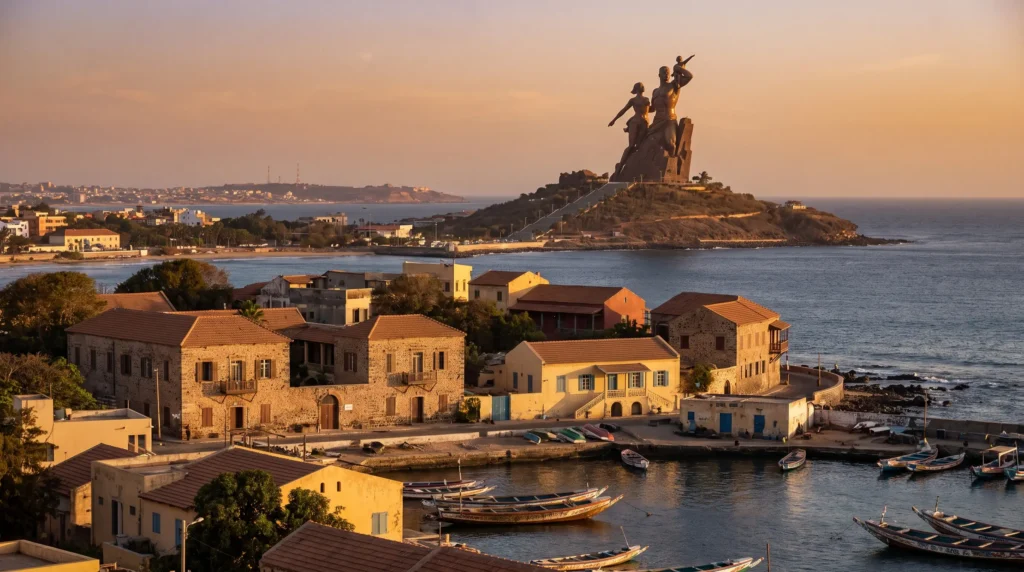
The headline sight sits just offshore: Gorée Island, a 20-minute ferry from the port, inscribed by UNESCO in 1978 as one of the first twelve World Heritage Sites in the world for its role in the Atlantic slave trade and its status as a place of memory for the African diaspora. On land, the 50-metre bronze African Renaissance Monument — taller than the Statue of Liberty’s pedestal-to-torch height and generally cited as the tallest statue in Africa — looks out from the Mamelles hills toward the Atlantic.
What Dakar doesn’t have is a polished tourism machine. Sidewalks are uneven, traffic is a genuine sport, and vendors on the Corniche can be persistent. That friction is real, and I’d rather tell you upfront than have you discover it cold — but it’s also the trade-off for a capital that still feels entirely like itself, not a stage set built for visitors.
Dak’Art Biennale & Dakar’s Festival Calendar
If your trip can flex, aim for a Dak’Art Biennale year. Established in 1989 and dedicated to contemporary African art since the mid-1990s, the Biennale of Contemporary African Art is the continent’s most important recurring art event, held in Dakar every two years with exhibitions scattered across Plateau’s galleries, the old Palais de Justice, and pop-up “OFF” shows in courtyards and cafés citywide. Editions have historically clustered around May, though scheduling has shifted in recent years — check the Biennale’s own announcements for exact dates before booking around it.
Outside Biennale years, Dakar’s calendar still runs hot: the Kaay Fecc dance and street-arts festival, an active live-mbalax circuit most weekends, and — if you’re willing to travel a few hours inland — the Grand Magal de Touba pilgrimage, one of the largest religious gatherings in West Africa, though that one is a Touba event, not a Dakar one, and hotel rooms citywide get scarce around it regardless.
Best Time to Visit Dakar (Season by Season)
Late November – April · Dry season (peak)
This is Dakar at its most comfortable: minimal rain, sea breezes keeping temperatures in the mid-to-high 20s°C, and the best window for Gorée day trips, beach time at Ngor and long Corniche walks. Some years bring a hazy harmattan wind off the Sahara in December–January that dulls the horizon for a few days at a stretch — annoying for photos, harmless for plans.
May – June · Shoulder season
Warmer, still mostly dry, thinner crowds, and — in Biennale years — the art world descends. A genuinely good value window before the rains arrive.
July – October · Rainy season
Dakar’s annual rainfall (roughly 400mm) lands almost entirely in this window, with August–September the wettest, most humid stretch. Rain tends to arrive in short, heavy afternoon bursts rather than washing out whole days, but low-lying neighborhoods can flood after the worst storms, and this is also when mosquito-borne illness risk peaks — pack repellent and consider malaria prophylaxis after talking to a travel clinic.
Getting There — Blaise Diagne International (DSS) & the TER
Blaise Diagne International Airport (DSS), roughly 45km east of central Dakar near Diass, is Senegal’s main international gateway, with direct flights from Paris, Brussels, Istanbul, several US East Coast cities, and hubs across West Africa. The Train Express Régional (TER) now runs directly from the airport into Gare Centrale in downtown Dakar, a ride of roughly 50–65 minutes for a few dollars — genuinely the best-value, most reliable airport transfer in West Africa and a strong argument for skipping the taxi rank entirely on arrival.
All visitors need a passport valid at least six months beyond arrival, and — this is the detail people miss — a yellow fever vaccination certificate is required for entry regardless of where you’re flying from. Sort that at least a couple of weeks before departure; it’s not the kind of thing you want to discover at the check-in counter.
Getting Around — TER, BRT, Taxis & Car Rapides
Dakar has quietly built some of the best public transit infrastructure in West Africa. The TER commuter rail connects the airport corridor through Diamniadio into downtown, and the Sunu BRT — an electric bus rapid transit network launched with around 144 articulated buses — now runs dedicated lanes across the peninsula. Both are clean, cheap and a genuinely pleasant surprise if you’ve traveled the region before.
For everything else, yellow-and-black taxis are everywhere; agree the fare before you get in or insist on the meter, since neither is a given. Car rapides — the hand-painted, wildly decorated minibuses that are practically a symbol of the city — are the classic, chaotic, dirt-cheap way to move around, best attempted once you’ve got your bearings. Ride-hailing apps (Yango and similar) work well in Dakar and remove the haggling entirely. Traffic on the peninsula’s few arteries is genuinely bad at rush hour; budget extra time for anything airport-adjacent or cross-town.
Neighborhoods — Plateau, Almadies, Ngor, Yoff & Médina
Le Plateau
The historic colonial-era core and Dakar’s downtown: government buildings, the Grande Mosquée, the cathedral, Sandaga Market’s chaos, and most of the city’s galleries and mid-range hotels. Walkable, dense, and the natural first stop.
Médina
Just inland from Plateau, denser and more residential, laid out on a grid after a 1914 plague relocation, and the neighborhood where Dakar’s street life — tailors, mechanics, corner mafé stalls, kids playing football in the road — feels most unfiltered.
Almadies
The peninsula’s westernmost tip and its most upmarket address: beach clubs, seafront restaurants, the pointe des Almadies (mainland Africa’s literal westernmost point), and most of Dakar’s newer hotels.
Ngor
A former fishing village turned surf-and-café enclave, launch point for the short pirogue crossing to Ngor Island, whose beach break is one of the best-known surf spots on this stretch of coast.
Yoff
A large, historic Lebou fishing community next to the airport’s old site, with a long working beach where the pirogue fleet comes in each afternoon — one of the best places to see Dakar’s fishing economy up close.
Ouakam
Home to the African Renaissance Monument and the striking Mosquée de la Divinité, built into the rocks above the Atlantic, plus a stretch of beach popular with local surfers.
Gorée Island
Technically one of Dakar’s 19 communes, but experienced as its own world — car-free, sandy-laned, and covered in detail in Day Trips below.
Culture & People — Wolof, Mbalax & the Teranga Spirit
Senegal is famous across West Africa for teranga — a word that translates loosely to hospitality but really means something closer to a whole social contract of welcome. You’ll feel it in Dakar as an easy, talkative warmth that can also read as forward if you’re not used to it: strangers strike up conversation, vendors negotiate with charm rather than pressure (mostly), and greetings are not optional small talk but a real social ritual worth learning a few lines of in Wolof.
Wolof is the practical common language of the street even though French remains official — an estimated 90% of Senegalese speak Wolof and it functions as the country’s lingua franca, alongside Pulaar, Serer, Diola and a dozen other national languages. Musically, Dakar is the home of mbalax, the percussion-driven pop genre Youssou N’Dour helped take global, and live mbalax nights are still one of the best reasons to stay out past midnight here. Islam shapes the rhythm of daily life for the large majority of the population, most visibly around Friday prayers and during the annual Grand Magal pilgrimage to Touba.
A Food Lover’s Guide to Dakar
Order thieboudienne (ceebu jën) at least once — Senegal’s national dish, a one-pot spread of fish, rice cooked in a tomato-tamarind sauce, and vegetables, said to have originated in Saint-Louis but perfected daily in Dakar’s home kitchens and gargotes. Yassa poulet (chicken marinated and simmered in onions, lemon and mustard) and mafé (a rich peanut stew) are the other two pillars of a home-cooked Senegalese table.
Street food runs on fataya (fried meat or fish pastries), grilled accara (black-eyed pea fritters), and skewers of dibiterie-style grilled lamb, best eaten standing at a roadside grill in Médina after dark. Wash it down with bissap (hibiscus juice), bouye (baobab fruit juice) or café Touba, a spiced, clove-and-djar-inflected coffee that’s as much a Senegalese institution as the tea ceremony (attaya) that follows most meals — three small, increasingly sweet glasses, poured with real ceremony. For a sit-down meal, Almadies and the Corniche have Dakar’s best seafood restaurants, working straight off the day’s catch from Yoff and Soumbédioune.
Off the Beaten Path
Soumbédioune Fish Market
A working fishing beach and market near Plateau where the wooden pirogue fleet unloads each morning — noisy, unglamorous, and one of the most honest slices of daily Dakar life you’ll find. The adjoining craft village sells woodwork and leather without Gorée’s tourist markup.
IFAN Museum of African Arts
Dakar’s oldest museum, a modest but rich collection of masks, textiles and ritual objects predating the flashier Musée des Civilisations Noires — worth an hour if you want context before Gorée.
Ngor Island
A five-minute pirogue hop from the mainland to a tiny, near-car-free island with a surf break, a couple of low-key guesthouses, and none of the crowds you’d expect this close to a capital city.
HLM Fabric Market
Dakar’s real wax-print fabric market, sprawling and almost entirely local — bring a tailor’s eye and expect to bargain hard, since almost no other tourists make it here.
Day Trips — Gorée, Lac Rose & Beyond
Gorée Island
Non-negotiable. Ferries run regularly from the port near Plateau (about 20–30 minutes each way ) to an island of roughly 1,800 residents, 18 hectares, and zero cars. The Maison des Esclaves (House of Slaves), built around 1780–84, holds the famous “Door of No Return” and stands as a memorial to the Atlantic slave trade — historians now debate how many people actually passed through this specific building versus the island’s other trading points, but its symbolic weight for the African diaspora is undisputed and worth understanding before you visit. Give it a half or full day; the sandy lanes, colonial-era houses and small galleries reward slow wandering.
Lac Rose (Lake Retba)
About 35km northeast of the city, this shallow lake turns a genuine bubblegum pink in the right light thanks to salt-loving algae, and its salinity — up to roughly 40% in places — lets you float the way you would in the Dead Sea. Salt harvesters still work the shallows by hand; ask before photographing them closely, and note the lake’s famous hue has faded in recent years after flood damage, so temper your expectations against the postcard photos.
Île de la Madeleine
A tiny protected national park island just off the Corniche, reachable by short boat trip, with sea birds, rugged cliffs and a quiet break from the city — a good half-day if Gorée’s crowds aren’t your speed.
Saint-Louis
Senegal’s other UNESCO-listed colonial city sits about three to four hours north by road — too far for a single day trip comfortably, but worth flagging if you have a spare night to extend the itinerary.
Practical Information
Money. The West African CFA franc (XOF) is fixed at 655.957 to the euro and issued by the BCEAO, headquartered right here in Dakar. Cards work in hotels, Almadies restaurants and supermarkets; carry cash for taxis, markets and car rapides. Non-resident travelers must declare cash sums above roughly 1,000,000 XOF on entry.
Safety. The US State Department rates Senegal Level 1 (Exercise Normal Precautions) overall, but flags real street crime concerns in Dakar itself — pickpocketing, scooter-borne bag snatching, and robberies specifically along the Corniche d’Ouest, a stretch popular with tourists. Avoid walking alone on beaches or the Corniche after dark, keep valuables out of sight, and don’t wander Médina’s back streets solo at night. The Casamance region in the south carries a higher Level 2 advisory over banditry and old landmines and is unrelated to a standard Dakar trip. The UK FCDO gives similar guidance and additionally flags the Mauritania and Mali border areas.
Health. A yellow fever certificate is required for entry; malaria risk exists citywide (higher after rains), so discuss prophylaxis with a travel clinic before you go, and drink bottled or filtered water. Medical facilities in Dakar itself are reasonable by regional standards but are far more limited outside the capital.
Connectivity. Local SIMs (Orange, Free) are cheap and easy to buy on arrival; an eSIM is a fine alternative if you’d rather skip the shop. Plugs: European-style two-pin, 230V. Time zone: GMT (UTC+0) year-round, no daylight saving.
Budget Breakdown — What Dakar Actually Costs in 2026
Dakar runs noticeably cheaper than European or North American capitals, but it’s also one of the pricier cities in West Africa for hotels and imported goods.
Budget (US$35–65/day): Guesthouse or budget hotel in Plateau or Médina, street food and gargote meals, BRT/TER/car rapides for transport, the Gorée ferry.
Mid-range (US$90–180/day): Comfortable hotel in Plateau or Ngor, restaurant meals mixing Senegalese and international, occasional taxis, a Lac Rose day tour with driver.
Luxury (US$300+/day): Almadies beachfront hotels, private driver for the day, Île de la Madeleine boat charter, Dakar’s better seafood tasting menus.
Tipping isn’t obligatory but is appreciated and increasingly expected in tourist-facing restaurants — 5–10% is generous. Bargaining is standard at markets and with unofficial taxis, less so everywhere else.
Planning Your First Trip to Dakar
Three to four nights covers Dakar properly: a day in Plateau and Médina, a half-day at the African Renaissance Monument and Ouakam, a full day on Gorée, and either Lac Rose or Île de la Madeleine for your last afternoon. Landing via Blaise Diagne, take the TER straight into town rather than negotiating an airport taxi fare on arrival. If you have more time, pair Dakar with a few nights up the coast in Saint-Louis, or extend the trip into wider West Africa — our Ghana travel guide and Accra city guide cover the region’s other major slave-trade memorial sites at Cape Coast and Elmina, a natural next stop after Gorée.
Frequently Asked Questions
Is Dakar safe for tourists in 2026?
Broadly yes — Senegal carries a Level 1 “Exercise Normal Precautions” advisory from the US State Department — but Dakar has real street crime, especially pickpocketing and scooter-borne bag snatching along the Corniche d’Ouest. Use normal city precautions: don’t flash valuables, take registered taxis or ride-hailing apps at night, and skip solo beach walks after dark.
Do I need a visa, and what about vaccinations?
US, UK, EU and Canadian passport holders can enter visa-free for up to 90 days, but a yellow fever vaccination certificate is required for entry regardless of your origin country. Get vaccinated at least ten days before travel and carry the certificate with your passport.
How many days do I need in Dakar?
Three to four nights is a comfortable minimum to cover the city plus Gorée Island properly without rushing either. Add a night if you want Lac Rose and Île de la Madeleine as separate outings rather than a packed single day.
Is Gorée Island worth the trip?
Yes — it’s one of the most significant historical sites in West Africa and a genuinely peaceful, car-free escape from the mainland’s traffic. Book the House of Slaves tour ahead if you can, and give the island at least half a day rather than a rushed hour between ferries.
Will English get me by, or do I need French?
French is the official language and Wolof the everyday lingua franca; English is limited outside upscale hotels and tour operators. A handful of French phrases plus a Wolof greeting or two (“Nanga def?”) go a long way and are genuinely appreciated.
Best time to avoid the rains?
Late November through April is dry-season Dakar — the safest bet for beach days, Gorée visits and comfortable walking weather, with July–October carrying nearly all of the city’s roughly 400mm of annual rainfall.
Ready to Explore Dakar?
Sunset over the Atlantic from the Mamelles hills, a slow ferry crossing to an island that holds real weight, thieboudienne eaten with your hands at a plastic table that beats any restaurant in town — Dakar delivers on all of it without pretending to be tidy about it. Go for the history, stay for the music, and don’t rush Gorée.
Explore More
- Senegal Travel Guide — Saint-Louis, the Sine-Saloum Delta and beyond the capital
- Accra City Guide — Ghana’s capital and its own slave-trade memorial coast
- Morocco Travel Guide — North Africa’s souks, medinas and coastline
- Cape Town City Guide — Africa’s other iconic coastal capital
How this guide was built
Published as part of Facts From Upstairs’ city guide series. Built from authoritative sources — Wikipedia’s Dakar, Gorée, Blaise Diagne International Airport, Lake Retba, CFA Franc, Dakar Biennale and Languages of Senegal entity pages, UNESCO’s Gorée Island World Heritage inscription, the US State Department Senegal travel advisory, the UK FCDO Senegal travel advice, and the US CDC traveler page for Senegal. Numeric claims carry inline citations.
Sources cited on this page
- Wikipedia — Dakar
- UNESCO — Island of Gorée
- Wikipedia — Gorée
- Wikipedia — African Renaissance Monument
- Wikipedia — Blaise Diagne International Airport
- Wikipedia — Lake Retba
- Wikipedia — CFA Franc
- Wikipedia — Dakar Biennale (Dak’Art)
- Wikipedia — Languages of Senegal
- US State Department — Senegal Travel Advisory
- UK FCDO — Senegal Travel Advice
- US CDC — Senegal Traveler Page
More city guides you might like

Plan your trip to Dakar
The booking tools we use ourselves. FFU may earn a commission at no extra cost to you.
Plan & book your trip to Dakar
Booking through these searches supports our guides at no extra cost to you.