
Languages of Gambia
All languages of Western Africa →fluent beta classical · classes by phone with Maya at ranas.ai/maya
The Gambia Travel Guide — Africa’s Smiling Coast, the River, and the Real Roots of “Roots”
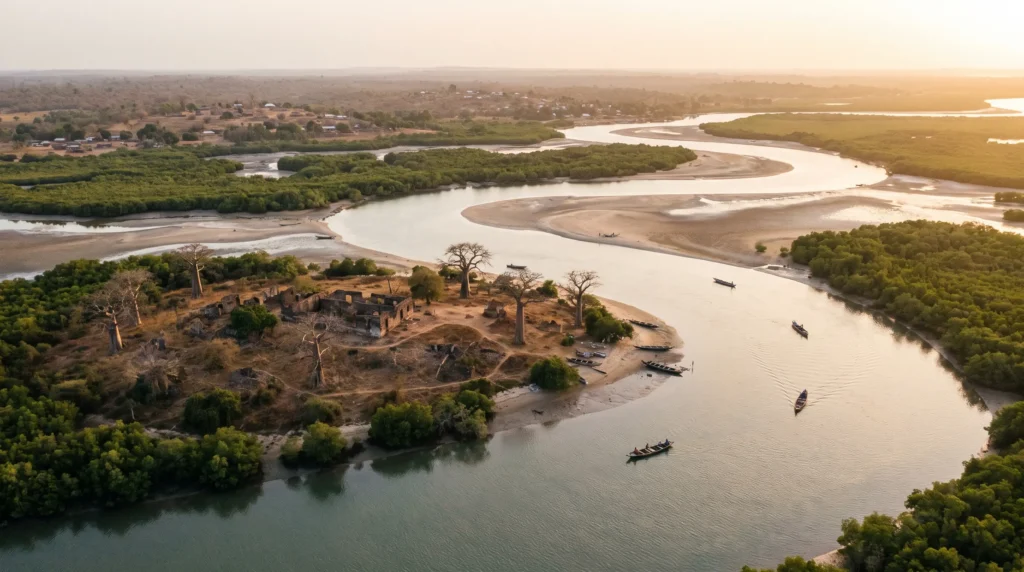
The Gambia is the smallest mainland country in Africa, a sliver of a nation wrapped around a single river, and it still manages to be one of the friendliest places I have ever put a backpack down in. Senegal surrounds it on three sides and the Atlantic closes the fourth, so the whole country is really just the Gambia River and the villages, forests and beaches that line it. You can be watching hippos from a wooden pirogue at breakfast, wandering a slave-trade fort by lunch, and drinking an Attaya tea with a Serekunda tailor by sunset — all inside a country you could drive end to end in a day if the ferries cooperated. It is also, unfashionably, an easy country to love: English is the official language, people wave from every compound gate, and six-ish hours from London or Brussels puts you on a beach with none of the jet lag. It is not a polished destination — the roads are rough, the visa paperwork is annoying, and tourist-zone hustle is real — but that rawness is exactly why it still feels like a discovery instead of a checklist.
In This Guide
- Overview — Why the Smiling Coast Punches Above Its Size
- Kankurang Season & the Roots Homecoming Festival
- Best Time to Visit The Gambia (Season by Season)
- Getting There — Banjul International & the Barra Ferry
- Getting Around — Bush Taxis, Gelly-Gellys & Pirogues
- Top Regions — Coast, River & the South Bank
- Culture & People — Mandinka, Fula, Wolof & Jola
- A Food Lover’s Guide to The Gambia
- Off the Beaten Path
- Practical Information
- Budget Breakdown — What The Gambia Actually Costs in 2026
- Frequently Asked Questions
Overview — Why the Smiling Coast Punches Above Its Size
The Gambia is a geographic oddity: a country defined entirely by a river, rarely more than 50 kilometres wide, poking into Senegal like a finger of land the British and French drew on a map and never quite reconciled. Independent from the United Kingdom since 18 February 1965, it kept English as its official language, which is the single biggest reason it is such an easy first African trip — menus, road signs and market banter all happen in a language you already read.
The tourism strip runs along a short, palm-lined stretch of Atlantic coast near the capital area — Kotu, Kololi, Senegambia and Bijilo — but that is a small fraction of the country. Head upriver and The Gambia turns into mangrove creeks, gallery forest and rice paddies, with the Gambia River itself as the highway. The country’s two UNESCO World Heritage Sites tell the deeper story: Kunta Kinteh Island and Related Sites, the fortified river outposts tangled up in three centuries of the Atlantic slave trade, and the Stone Circles of Senegambia, over a thousand megalithic monuments scattered along the river from as early as the 3rd century BC.
What The Gambia does not have is polish. Roads outside the coastal strip are patchy, power cuts happen, and the tourist zone has a well-earned reputation for “bumsters” — persistent unofficial guides working commission and scam angles. None of that erases what makes it worth the trip: genuinely warm people, a river ecosystem thick with birds and primates, and a slave-trade history you can stand inside rather than read about behind glass.
Kankurang Season & the Roots Homecoming Festival
Time a trip right and you might catch a Kankurang in the street — a masked bark-fibre spirit figure central to Mandinka and Manding initiation rites, whose ceremonial role UNESCO recognises on its Representative List of the Intangible Cultural Heritage of Humanity. Kankurang appearances cluster around circumcision and initiation ceremonies for young boys, traditionally held during school holiday periods in the dry season; they are sacred, not staged for tourists, so watch respectfully from a distance if you encounter one and never point a camera without clearly being invited to.
The other big date to watch for is the International Roots Festival, a heritage event first launched by the Gambian government in 1994 that culminates in Juffureh and Albreda — the villages tied to Alex Haley’s “Roots” and the Kunta Kinteh Island UNESCO site. It has not run on a fixed annual calendar in recent years, so check the Gambia Tourism Board’s current listings before building a trip around it — but if the dates line up, it is the single best week to be in the country for diaspora ceremony, drumming and dance.
Best Time to Visit The Gambia (Season by Season)
Late November – February · Peak dry season
Warm days, cool evenings, minimal rain and the best birdwatching and river-safari visibility of the year. This is also peak European charter season, so coastal hotels fill up and prices climb — book beach accommodation and river-lodge stays a couple of months out.
March – May · Hot dry shoulder
Still dry, noticeably hotter, and thinner crowds than the winter peak — a good value window if you can handle midday heat. This stretch also overlaps with school-holiday Kankurang and initiation season inland.
June – October · Rainy/green season
Short, heavy afternoon downpours, high humidity, and the country at its greenest — mangoes and cashews are in season and the river runs high. Some upcountry roads become genuinely rough going, a handful of smaller lodges close, and this is the low season for prices. Many operators still run trips, just plan around the rain rather than assuming clear skies.
Getting There — Banjul International & the Barra Ferry
Banjul International Airport, the country’s only commercial airport, sits just outside the capital and is served by European carriers including Brussels Airlines and TUI Airways (seasonal flights from Birmingham, Manchester and London Gatwick), TAP Air Portugal via Lisbon, Turkish Airlines via Istanbul, and regional West African carriers such as Air Peace and connections via Dakar and Conakry. There are no direct flights from North America; most travellers from the US or Canada route through a European or West African hub.
Overland, The Gambia is entirely wrapped by Senegal, and the classic border crossing pairs a Dakar trip with a run down to the coast — expect a slow, document-heavy crossing and budget extra time. Within the country, the Trans-Gambia ferry between Banjul and Barra links the capital area to the north bank and on to Senegal’s southern Casamance region; queues can run long, and the crossing has at times been affected by unrest in Casamance, so check current conditions before relying on it.
Getting Around — Bush Taxis, Gelly-Gellys & Pirogues
The Gambia is compact — you can cross its width in well under an hour near the coast — but road quality drops fast once you leave the tourist strip. Yellow-and-green shared taxis and minibus “gelly-gellys” run fixed routes for a few dalasi and are the way most Gambians travel, though they leave when full rather than on a schedule and are not always comfortable for a first-timer with luggage.
Private taxis (green plates for tourist-registered cars) are the easy option for coastal-strip trips and day tours; agree the fare before getting in, always. Upriver, hired boats and pirogues are the real transport network — reaching Kunta Kinteh Island, the stone circles region, and River Gambia National Park all involve time on the water, either as a standalone charter or as part of a multi-day upriver cruise. Self-driving is possible but rarely worth the hassle; a driver-guide is the standard, sensible choice for anything beyond the coastal resorts.
Top Regions — Coast, River & the South Bank
The Atlantic Coast — Kotu, Kololi & Senegambia
The tourism engine of the country: beach hotels, the Senegambia strip’s restaurants and nightlife, and easiest access to Kachikally Crocodile Pool and Bijilo Forest Park’s monkeys. Expect the most persistent bumster attention here — friendly but firm “no thank you” gets you through it.
Banjul
The small, low-key capital on Saint Mary’s Island, worth a half-day for Albert Market, Arch 22 and the old colonial quarter, but with limited tourist infrastructure of its own — most visitors base on the coastal strip and day-trip in.
Serekunda & Brikama
The Gambia’s real urban centre and its second city — Serekunda’s market is the country’s biggest, and this is where day-to-day Gambian life actually happens, away from the resort bubble.
Kunta Kinteh Island & the North Bank (Juffureh/Albreda)
The UNESCO-listed heart of the country’s slave-trade history: the fortified island itself, the ruined Portuguese chapel and CFAO warehouse at Albreda, the Maurel Frères building at Juffureh, and Fort Bullen guarding the river mouth. Reached by river cruise or road-and-boat combination from the coast.
Makasutu Culture Forest & Mandina
A community-run mangrove and palm forest reserve close to the coast, built around low-impact eco-lodges — the easiest taste of “upriver Gambia” without a multi-day commitment.
Janjanbureh & the Stone Circles Country
A full-day’s travel upriver, Janjanbureh (formerly Georgetown) is the gateway to the Wassu and Kerbatch stone circles, part of the wider Senegambian megalith complex that stretches across both countries.
River Gambia National Park & Kiang West
The country’s premier wildlife country: chimpanzee rehabilitation islands on the river, plus Kiang West National Park’s savanna and mangrove habitat for hippos, baboons, warthogs and a serious bird list. This is multi-day, lodge-based territory rather than a day trip.
Tanji & the South Coast
A working fishing village south of the resort strip with a lively fish market and access to the Tanji River (Karinti) Bird Reserve — a good half-day out of the tourist bubble.
Culture & People — Mandinka, Fula, Wolof & Jola
The Gambia’s roughly 2.4 million people break down mainly into Mandinka (largest group), Fula, Wolof, Jola and Soninke, alongside Serer and smaller communities — a mix that mirrors neighbouring Senegal more than it does anywhere further afield. Islam is overwhelmingly the majority religion, with a small Christian minority and long-standing interfaith coexistence; mosque calls to prayer are part of the daily soundtrack everywhere outside the resort strip.
Hospitality runs deep and is not performative — greetings matter, and taking a few minutes to exchange them properly (asking after family, health, the day) before getting to business is genuinely expected, not a tourist gimmick. Music culture centres on the kora, the 21-string bridge-harp associated with Mandinka griot (jali) families who carry oral history through song; a kora performance is one of the most worthwhile low-key evenings you can spend in the country.
A Food Lover’s Guide to The Gambia
The national dish is domoda — meat (often beef) slow-cooked in a rich peanut sauce over rice — alongside benachin (“jollof rice” by another name), the one-pot rice, vegetable and fish or meat dish found across the wider region. Superkanja, an okra-based stew, and plasas, made with cassava leaves, are other everyday staples worth seeking out away from the resort menus.
Fresh seafood is the coastal specialty — grilled butterfish (bonga) and lady fish turn up everywhere near the beach, and Tanji’s fish market is the place to see the catch land. For drinks, try wonjo (hibiscus/sorrel juice), baobab juice, and attaya — the thick, sweet, ceremonially poured green tea that punctuates Gambian afternoons and is as much a social ritual as a drink. JulBrew is the standard local lager.
Off the Beaten Path
Wassu & Kerbatch Stone Circles
Part of the wider Stone Circles of Senegambia UNESCO site — over a thousand laterite megaliths spread along roughly 350 kilometres of the river, with material dated between the 3rd century BC and 16th century AD, and still poorly understood by archaeologists. Wassu is the most accessible cluster; almost no other visitors make it this far upriver.
River Gambia National Park’s Chimpanzee Islands
A cluster of river islands used for chimpanzee rehabilitation and release, viewable only by boat from the water (no landing allowed) — a genuinely wild wildlife encounter far removed from a safari-park experience.
Kiang West National Park
Savanna, mangrove and tidal creek habitat with hippos, baboons and one of the country’s best bird counts, and almost no infrastructure — bring a guide and expect a rough access road.
Fort Bullen & Barra
The river-mouth counterpart to Kunta Kinteh Island, guarding the north bank where the Gambia River meets the Atlantic — usually visited as part of the Banjul-Barra ferry crossing rather than as its own trip, and worth the short detour.
Practical Information
Money. The Gambian dalasi floats against major currencies, trading at roughly 70-plus dalasi to the US dollar in 2026 — check the Central Bank of The Gambia’s daily rate before changing money, and note euros and pounds are also widely accepted for cash payments. Cards work at coastal hotels and some restaurants; carry cash dalasi for markets, bush taxis and upriver travel.
Safety. The US State Department rates The Gambia Level 2 — Exercise Increased Caution, citing petty crime and burglary in tourist areas plus periodic unrest and landmine risk near the southern border with Senegal’s Casamance region; the UK’s FCDO issues similar guidance. Watch for romance and “authority demands money” scams aimed at tourists, avoid walking alone after dark including on beaches, and check current advisories before travelling near the southern border.
Health. The CDC recommends malaria prophylaxis for all travellers (drug-resistant strains are present), yellow fever vaccination, and hepatitis A and typhoid vaccination for most visitors, especially those heading upcountry or staying with local families. A yellow fever certificate is required if arriving from a country with transmission risk. Avoid swimming in freshwater rivers and creeks (schistosomiasis risk) and drink bottled or treated water.
Connectivity. Local SIMs are cheap and easy to buy at the airport or in Serekunda; coastal Wi-Fi is decent, upriver lodges much less so. Plugs: UK-style three-pin, 230V. Time zone: GMT, no daylight saving, so no jet lag at all from the UK.
Budget Breakdown — What The Gambia Actually Costs in 2026
The Gambia is one of West Africa’s more affordable destinations, especially outside the peak-season European charter hotels.
Budget (US$30–60/day): Guesthouse or budget hotel near the coast, local eateries and street food (domoda, benachin), bush-taxi transport, self-guided coastal-strip sightseeing.
Mid-range (US$80–160/day): Coastal hotel with pool, restaurant meals, a private driver-guide for day trips, a Kunta Kinteh Island river excursion or a night at a Makasutu-area eco-lodge.
Upscale (US$250+/day): All-inclusive beach resorts, multi-day upriver cruises with full-board lodges, private chimpanzee-island river charters.
Fixed costs to budget for: the US visa fee (roughly $100–105 for American citizens, cash only) , the $20 airport security fee charged on both entry and exit for most nationalities , and modest UNESCO-site and national park entry fees. Tipping 10% is appreciated but not automatic; agree taxi fares up front.
Planning Your First Trip to The Gambia
The classic first-timer shape is coast + river: land at Banjul International, settle into the Kotu/Kololi/Senegambia strip for three or four nights (Kachikally Crocodile Pool, Bijilo Forest Park, Tanji fish market, an evening of live music), then head upriver for two or three nights — Makasutu or a lodge near Kiang West for wildlife, plus a river excursion out to Kunta Kinteh Island and Juffureh for the UNESCO history. A week covers the essentials comfortably; ten days lets you push all the way to Janjanbureh and the Wassu stone circles. Many visitors pair The Gambia with a run through neighbouring Senegal via the Barra ferry and Dakar, and the slave-trade heritage theme connects naturally to Ghana’s Cape Coast forts if you are building a longer West African circuit.
Frequently Asked Questions
Is The Gambia safe for tourists in 2026?
The US State Department rates it Level 2 — Exercise Increased Caution, mainly for petty crime and burglary in tourist areas and periodic unrest near the southern Casamance border; most visitors who stick to the coastal strip and licensed tour operators have straightforward, trouble-free trips. Avoid walking alone after dark, be firm with unofficial “guides” (bumsters), and stay alert to romance and cash-demand scams.
Do I need a visa?
It depends on your passport. UK, EU and most Commonwealth citizens can enter visa-free with a 28-day entry stamp, extendable twice. US citizens need a visa, obtainable in advance or on arrival for roughly $100–105 cash, plus a separate $20 airport security fee on both entry and exit. Always confirm current rules for your specific nationality before flying.
Do I need vaccinations before I go?
The CDC recommends malaria prophylaxis for essentially all travellers, plus yellow fever, hepatitis A and typhoid vaccination for most visitors. A yellow fever certificate is mandatory if you are arriving from a country with transmission risk, and may be needed for onward travel too. See a travel clinic six or more weeks out if you can.
The Gambia or Senegal?
They are practically one trip split by a colonial-era border — pair them if you have the time. The Gambia is smaller, cheaper and English-speaking with an easy, compact coastal base; Senegal (especially Dakar and Casamance) adds scale, French-speaking sophistication and its own UNESCO sites like Gorée Island.
What’s the biggest rookie mistake?
Never leaving the resort strip. The tourist bubble around Kololi and Senegambia is comfortable but shows you almost nothing of the country — the river, the stone circles and the wildlife parks upcountry are where The Gambia actually delivers.
Can I drink the tap water?
No — stick to bottled or properly treated water throughout the trip, including for brushing teeth in budget guesthouses, and avoid ice of uncertain origin outside established hotels.
Ready to Explore The Gambia?
A river you can cross by pirogue, a fort where history stops being abstract, a masked spirit dancing through a village lane if the timing is right — The Gambia packs an outsized trip into Africa’s smallest mainland country. It asks a little more patience than its polished neighbors, and rewards it generously.
Explore More
- Senegal Travel Guide — the country that wraps around Gambia on three sides
- Ghana Travel Guide — Cape Coast’s slave-trade forts, a parallel history
- Morocco Travel Guide — another gateway into West/North Africa
- Portugal Travel Guide — the colonial thread behind Kunta Kinteh’s Portuguese ruins
How this guide was built
Published as part of Facts From Upstairs’ country guide series. Built from authoritative sources — Wikipedia’s Gambia entity page, UNESCO’s World Heritage Centre listings for Kunta Kinteh Island and the Stone Circles of Senegambia, UNESCO’s Intangible Cultural Heritage listing for the Kankurang initiatory rite, the Central Bank of The Gambia’s currency data, the US State Department’s Gambia travel advisory, the UK FCDO’s Gambia entry requirements page, the US CDC’s Gambia traveler health page, the Gambia Tourism Board’s official site, Wikipedia’s Banjul International Airport entry, and AccessGambia’s International Roots Festival page. Numeric and checkable claims carry inline citations.
Sources cited on this page
- Wikipedia — The Gambia
- UNESCO — Kunta Kinteh Island and Related Sites
- UNESCO — Stone Circles of Senegambia
- UNESCO Intangible Cultural Heritage — Kankurang, Manding Initiatory Rite
- Central Bank of The Gambia
- US State Department — The Gambia Travel Advisory
- UK FCDO — The Gambia entry requirements
- US CDC — The Gambia traveler page
- Gambia Tourism Board — Visit The Gambia
- Wikipedia — Banjul International Airport
- AccessGambia — International Roots Festival
More country guides you might like
Plan your trip to The Gambia
The booking tools we use ourselves. FFU may earn a commission at no extra cost to you.
Plan & book your trip to The Gambia
Booking through these searches supports our guides at no extra cost to you.