
Languages of Togo
All languages of Western Africa →fluent beta classical · classes by phone with Maya at ranas.ai/maya
Togo Travel Guide — Voodoo Shrines, Mud Tower-Houses & West Africa’s Narrowest Surprise
Togo is a sliver of a country — a coastline just 56 kilometres wide wedged between Ghana and Benin — that somehow stretches 600 kilometres inland, so you cross from palm-lined lagoons to cocoa-covered hills to Sahelian savanna in the space of a single road trip. Lomé’s fetish market will sell you a crocodile skull for a love spell in the same afternoon you can order steak-frites at a French bistro two streets over, because Togo was German, then split between French and British administration, and never quite stopped being a crossroads. I won’t pretend this is an easy trip — French is close to essential, tourist infrastructure is thin outside Lomé, and the far north carries a real security advisory you need to respect. But if you want West Africa without the crowds, with living vodun tradition, wrestling rites of passage, and mud tower-houses UNESCO calls a masterpiece, Togo delivers all of it and asks very little of your itinerary in return.
In This Guide
- Overview — Why Togo Is West Africa’s Skinniest Surprise
- Evala Wrestling Season — Togo’s Wildest Rite of Passage
- Best Time to Visit Togo (Season by Season)
- Getting There — LFW, the E-Visa & Land Borders
- Getting Around — Zemidjans, Bush Taxis & the N1
- Top Regions — Coast, Plateaux & the Kara Highlands
- Culture & People — Ewe, Kabiye & the Vodun Heartland
- A Food Lover’s Guide to Togo
- Off the Beaten Path
- Practical Information
- Budget Breakdown — What Togo Actually Costs in 2026
- Frequently Asked Questions
Overview — Why Togo Is West Africa’s Skinniest Surprise
Look at Togo on a map and the first thing you notice is the shape: a narrow vertical strip about 56 kilometres of Atlantic coastline that runs roughly 600 kilometres north into the Sahel, squeezed between Ghana to the west and Benin to the east. That geography is the whole trip in miniature — you can start the day on a lagoon in Lomé and end it in savanna hill country a long day’s drive north.
The history explains the layered culture. Germany ran it as a protectorate from 1884, then after World War I the League of Nations split the territory between French and British mandates; French Togoland became independent on 27 April 1960. Around 9.6 million people live here today, spread across some 40 ethnic groups — the Ewe (about a third of the population) and the Kabiye (roughly a fifth) are the largest, alongside Ouatchis and dozens of smaller communities. French is the language of government and schooling, but Ewe and Kabiye carry official recognition of their own, and you’ll hear a rotating cast of local languages depending which region you’re in.
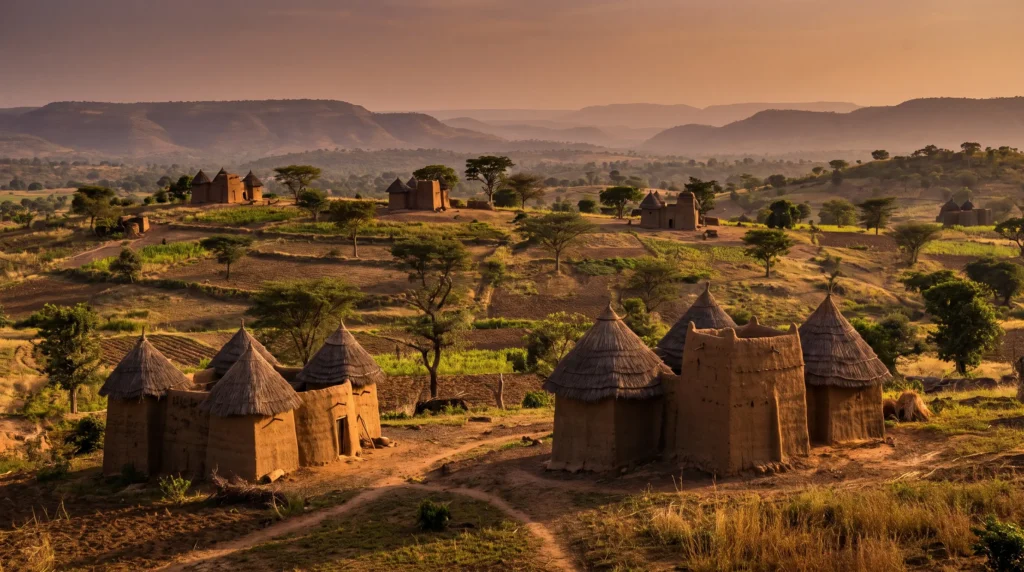
The headline sight, literally on UNESCO’s list since 2004, is Koutammakou in the far north: a cultural landscape of mud tower-houses called takienta, built by the Batammariba people, that double as home, granary, shrine and social diagram all at once. Closer to the coast, Togoville and the Lomé fetish market put you inside one of West Africa’s most active vodun traditions — not a tourist performance, a living religion roughly a third of the population still practises alongside or instead of Christianity and Islam. What Togo doesn’t have is polish: hotel options thin out fast once you leave Lomé, English is scarce, and the far north currently carries a real government travel advisory you should plan around rather than ignore. This is a country that rewards travelers willing to do it a little roughly — everyone else keeps driving through it on the way to somewhere else, which is exactly why it still feels undiscovered.
Evala Wrestling Season — Togo’s Wildest Rite of Passage
If you’re reading this in July, you’re in luck: mid-July is Evala season in the Kara region, when young men of the Kabiye ethnic group compete in a wrestling initiation that’s been practiced for generations. It’s a multi-year apprenticeship in disguise — initiates train and compete at neighborhood level, then village level, then inter-village level, building toward the week-long public contests that draw huge crowds to Kara every July. Passing Evala is how a Kabiye boy becomes recognized as a man, eligible for marriage and full standing in the community — this is not a show staged for visitors, it’s the real ceremony, and outsiders are welcome to watch respectfully from the crowd.
Down on the coast, the Guin community at Glidji near Aného holds its own major traditional event, the Epe-Ekpe new year festival, usually in September — worth building a September itinerary around if July doesn’t line up. Either way, if you can time a Togo trip to a festival, do it: this is a country where the calendar of traditional ceremonies is a far better guide to “what to see” than any list of monuments.
Best Time to Visit Togo (Season by Season)
November – February · Dry season (most comfortable)
This is the easiest window for most travelers: little rain, warm days, and cooler nights, though the Sahara’s harmattan wind can hazy up the skies with dust, especially in the north. Roads are at their best and Fazao-Malfakassa National Park’s wildlife-viewing is at its most reliable, since animals concentrate around the remaining permanent water.
March – June · Building heat, then the big rains
The south’s main wet season ramps up through April and peaks in May–June — expect heavy, sometimes daily downpours in Lomé, Kpalimé and the coastal region. The north follows a simpler single-wet-season pattern that builds later and runs into October.
July · Evala season, still fairly wet
Rain hasn’t fully broken in the south, but this is when Kara hosts Evala wrestling — worth the trade-off if the festival is the draw. Expect green, humid landscapes everywhere.
August · A short dry break
The south typically gets a brief dry spell (the “petite saison sèche”) — a good pocket for coastal travel if your dates are fixed to summer.
September – October · Short rains, then tapering off
A second, shorter rainy stretch hits the south while the north’s single wet season is winding down. This is Epe-Ekpe festival season at Glidji.
Getting There — LFW, the E-Visa & Land Borders
Gnassingbé Eyadéma International Airport (LFW), also known as Lomé–Tokoin, sits right on the edge of the capital and is Togo’s only real international gateway. ASKY Airlines, a regional carrier, hubs here with connections across West and Central Africa, while Ethiopian Airlines, Air France, Brussels Airlines and Royal Air Maroc add long-haul links via Addis Ababa, Paris, Brussels and Casablanca — there’s even an Ethiopian routing that reaches Newark and Washington–Dulles. A new terminal opened in 2016 with capacity for up to two million passengers a year, so arrivals are more comfortable than the airport’s modest size suggests.
Almost everyone now needs an e-visa arranged in advance through the official portal, voyage.gouv.tg — Togo no longer issues visas on arrival for most nationalities. Apply at least five business days before you fly; a single-entry tourist visa valid up to 15 days runs about 25,000 CFA francs (roughly US$40). Proof of yellow fever vaccination is a hard entry requirement for every visitor over one year old, so sort that well ahead of your trip. Overland, the Aflao crossing links Lomé directly to Accra, Ghana (a popular pairing), and Hillacondji connects south to Benin — both are straightforward border posts on paved coastal roads.
Getting Around — Zemidjans, Bush Taxis & the N1
Togo doesn’t have slick tourist transport, and it’s worth setting that expectation early. Around town, motorcycle taxis — called zemidjans or “zeds” — are the default way to get anywhere quickly and cheaply in Lomé, Kara and Sokodé; agree the fare before you climb on. For longer hops, shared bush taxis and minibuses run the N1 highway, the paved spine connecting Lomé to Kpalimé, Atakpamé, Sokodé, Kara and Dapaong in the far north.
Hiring a car with a driver is the most comfortable way to cover ground, especially for national park visits or reaching Koutammakou’s tower-house villages, and it’s the standard approach most visiting travelers take rather than self-driving. There’s no meaningful domestic flight network and no passenger rail to speak of, so road transport — however unglamorous — is genuinely how the whole country moves.
Top Regions — Coast, Plateaux & the Kara Highlands
Lomé & the coast
The capital is your entry point and biggest city, with the sprawling Grand Marché, the famous — and genuinely unsettling if you’re not prepared — Marché des Féticheurs (fetish market) selling the raw materials of vodun practice, and a beachfront where the swimming is better admired than attempted given strong currents.
Lake Togo & Togoville
A short lagoon crossing from Lomé’s outskirts, Togoville is a working pilgrimage site for Togo’s vodun communities and a place to understand the religion as lived practice rather than market curiosity — go with a local guide who can broker introductions respectfully.
Aného & the Guin coast
Togo’s former colonial capital, a quiet town between the Mono River and the Atlantic with a heavy, complicated history tied to the transatlantic slave trade. Nearby Glidji hosts the Guin community’s Epe-Ekpe new year festival.
Kpalimé & the Plateaux
The green heart of the south: coffee and cocoa-covered hills, butterfly-thick forest trails, and waterfalls like Womé and Kpimé within easy hiking range of town. This is Togo’s best base for a few unhurried days on foot.
Fazao-Malfakassa National Park
The country’s largest protected area, spanning roughly 192,000 hectares across the Kara and Centrale regions, with elephants, roan antelope, western hartebeest, buffalo and over 240 recorded bird species. Entry runs roughly US$10–20 per person, and the November–February dry season is by far the best window for sightings.
Kara & Koutammakou
The Kara region is home to both the Evala wrestling festival and Koutammakou, the Batammariba tower-house landscape UNESCO inscribed in 2004 and expanded in 2023 — a working cultural landscape, not a museum, spread across roughly 271,800 hectares straddling the Togo–Benin border. The mud takienta towers remain lived-in homes and are recognized as one of Togo’s national symbols.
Sokodé & the Centrale Region
Togo’s second-largest city and a center of Muslim culture and cotton commerce, with a lively market scene and far fewer visitors than the capital.
Dapaong & the Savanes (caution advised)
The far north’s Sahelian landscapes are genuinely striking, but this is currently the one region where you need to check government advisories closely — both the US State Department and UK FCDO flag the area near the Burkina Faso border for terrorism and kidnapping risk as of late 2025/early 2026, and advise against travel to most of the Savanes region outside Dapaong town itself and the main highway approach.
Culture & People — Ewe, Kabiye & the Vodun Heartland
Togo packs roughly 40 ethnic groups into a country the length of a long road trip, with the Ewe (about 32% of the population) concentrated in the south and the Kabiye (about 22%) centered on the Kara highlands, alongside Ouatchis and dozens of smaller communities each with their own language and customs. Religiously, the country splits roughly half Christian, a third practicing traditional/indigenous faiths, and about a sixth Muslim, with meaningful overlap between categories in daily life.
Vodun — the source religion behind what most outsiders call “voodoo” — is not folklore here; it’s an active, structured belief system with priests, shrines and calendar festivals, and Togo sits alongside neighboring Benin as one of its true heartlands. Evala wrestling in Kara each July functions as both sport and sacred initiation, transforming teenage boys into recognized men through a multi-year competitive apprenticeship. Visit fetish markets and shrine towns with a guide who can navigate etiquette for you, ask before photographing any ceremony, and treat these as living religious spaces rather than photo backdrops.
A Food Lover’s Guide to Togo
The backbone of Togolese cooking is pâte — a firm, smooth dough made from corn, cassava or millet flour, served with a range of sauces: tomato-and-onion, peanut (arachide), okra, or the leafy-green sauce feuille. Pair it with grilled fish along the coast — poisson braisé is everywhere in Lomé — or with chicken, goat or beef inland.
Fufu, pounded yam or cassava, shows up alongside pâte as the other great starch base, and street vendors across every town sell grilled corn, fried plantain and akara (bean fritters) as snacks. For a drink, try sodabi, a distilled palm wine spirit that’s essentially Togo’s answer to moonshine — potent, locally made, and a genuine point of national pride. Lomé’s restaurant scene, a legacy of the French administration, adds proper bakeries and bistro-style dining you won’t find as easily elsewhere in the region.
Off the Beaten Path
Koutammakou tower-house villages
Beyond the handful of most-visited takienta clusters, the wider Koutammakou landscape holds dozens of working villages where daily life continues largely unchanged — go with a local guide who can arrange respectful visits.
Akloa & Womé waterfalls
Forest hikes out of Kpalimé lead to a string of waterfalls that see a fraction of the visitors that comparable sites in Ghana or Benin attract, often with no one else on the trail.
Fazao-Malfakassa’s deep interior
Most safaris stick to the accessible fringes; a multi-day guided trip into the park’s interior reaches genuinely remote savanna with minimal other tourist traffic.
Aného’s slave-trade history
The former colonial capital’s quieter corners hold physical traces of West Africa’s darkest chapter, presented with far less tourist infrastructure — and far more raw honesty — than the well-trodden sites in Ghana.
Practical Information
Money. The West African CFA franc (XOF) is fixed at 655.957 to the euro and shared across eight West African nations. Cards work in a handful of Lomé hotels and banks; carry cash for pretty much everything else, including all inland travel.
Safety. The US State Department rates Togo Level 2 (“Exercise Increased Caution”), citing crime, unrest, kidnapping and health risks, with a firmer “do not travel” designation for the area near the Burkina Faso border and north of Kandé; the UK FCDO similarly advises against travel within 30km of that border and across most of the Savanes region. Lomé and the southern/central regions covered in this guide are the areas travelers actually visit; check current advisories before finalizing any itinerary that pushes further north than Kara.
Health. Yellow fever vaccination is mandatory for entry and malaria risk exists countrywide, so CDC recommends discussing prescription antimalarial medication with a travel clinic before you go, alongside routine, hepatitis A/B and typhoid vaccines. Avoid swimming in untreated freshwater (schistosomiasis risk), drink bottled or treated water, and get prompt medical attention for any animal bite given local rabies risk.
Connectivity & practicalities. French is essential outside the smallest tourist circuit — English gets you surprisingly little even in Lomé. An eSIM or local SIM covers most towns; expect patchy signal in rural Koutammakou and Fazao-Malfakassa. Time zone: UTC+0 (GMT) year-round, no daylight saving.
Budget Breakdown — What Togo Actually Costs in 2026
Togo is inexpensive by international standards but not as cheap as its profile suggests, since limited tourism infrastructure means fewer budget options to choose between outside Lomé.
Budget (US$25–45/day): guesthouses or budget hotels, street food and pâte-and-sauce meals, zemidjan motorcycle taxis and shared bush taxis.
Mid-range (US$70–140/day): a decent Lomé hotel or Kpalimé lodge, restaurant meals, a hired car and driver for day trips, guided national park or Koutammakou visits.
Luxury (US$250+/day): Lomé’s top international-standard hotels, private multi-day guided expeditions into Fazao-Malfakassa or the Kara highlands, dedicated drivers and interpreters.
Fixed costs to budget for: the e-visa (~US$40), yellow fever vaccination if you don’t already have it, and national park entry fees (roughly US$10–20). Tipping isn’t as deeply embedded as in some regions, but rounding up for drivers and guides is appreciated.
Planning Your First Trip to Togo
A workable first-timer route is coast to highlands: two or three nights in Lomé (fetish market, Grand Marché, a lagoon crossing to Togoville), then two nights in Kpalimé for waterfall hikes and coffee-hill scenery, then the long haul north to Kara for Koutammakou’s tower-house villages — timed to mid-July if you can catch Evala. Nine or ten days covers it comfortably without pushing into the Savanes region the advisories flag. Many travelers pair Togo with a longer West Africa loop through neighboring Ghana, crossing overland at Aflao to add Accra‘s far more built-out tourist circuit, or extend the trip with our Senegal guide for another angle on Francophone West Africa.
Frequently Asked Questions
Is Togo safe to visit in 2026?
Lomé and the central/southern regions covered by most visitor itineraries are generally manageable with normal precautions, but the US State Department rates the country Level 2 overall and specifically advises against travel near the Burkina Faso border and north of Kandé; the UK FCDO likewise flags most of the Savanes region. Check current advisories before finalizing any northern itinerary, use registered guides, and keep embassy contact details handy since assistance outside Lomé is limited.
Do I need a visa for Togo?
Almost everyone does — Togo now requires an e-visa arranged in advance through the official voyage.gouv.tg portal rather than issuing visas on arrival. Apply at least five business days ahead; a 15-day single-entry tourist visa costs roughly US$40. Proof of yellow fever vaccination is also mandatory for entry.
What’s the best time to visit Togo?
November through February is the most comfortable window countrywide — dry, warmer days, cooler nights, though the harmattan can haze the skies. If a festival is your priority, mid-July brings the Evala wrestling initiation to Kara, and September brings the Epe-Ekpe new year festival to Glidji near Aného, both worth trading a little rain for.
Is vodun (“voodoo”) something I can respectfully see as a tourist?
Yes, with the right approach. Vodun is a genuine, actively practiced religion in Togo, not a performance staged for visitors, so treat the Lomé fetish market and Togoville as living religious spaces: go with a local guide who can broker respectful introductions, ask before photographing anyone or any ceremony, and follow their lead on what’s appropriate.
Do I really need malaria pills and a yellow fever shot?
Yes to both. Malaria risk exists throughout Togo, so the CDC recommends discussing prescription antimalarial medication with a travel clinic before departure, and yellow fever vaccination is a mandatory, checked entry requirement, not just a recommendation.
Ghana or Togo?
Choose Ghana for a far more developed tourist circuit, English-language ease, and well-organized slave-trade heritage sites; choose Togo for a rawer, French-speaking experience with living vodun tradition, Koutammakou’s tower-houses, and noticeably fewer other visitors at every stop. Many travelers do both, crossing overland at the Aflao/Lomé border in a single day.
Ready to Explore Togo?
Mud tower-houses built by hand across centuries, a wrestling ritual that turns boys into men every July, and a coastline barely wide enough to notice before the country turns into savanna — Togo asks more legwork of you than its neighbors and gives back a West Africa that almost nobody else’s itinerary includes. Go with a guide, go with your French phrasebook, and go before the rest of the region catches up.
Explore More
- Ghana Travel Guide — cross the Aflao border for West Africa’s most visited coast
- Accra City Guide — Togo’s nearest big-city pairing
- Senegal Travel Guide — another angle on Francophone West Africa
- Morocco Travel Guide — for more French-influenced North African contrast
How this guide was built
Published as part of Facts From Upstairs’ country guide series. Built from authoritative sources — Wikipedia’s Togo, Koutammakou, West African CFA franc, Fazao-Malfakassa National Park, and Lomé–Tokoin International Airport entity pages; UNESCO’s World Heritage Centre listing for Koutammakou, the Land of the Batammariba; the US State Department’s Togo international travel information page; the US CDC’s Togo traveler health page; the UK FCDO’s Togo travel advice; Togo’s official e-visa portal (voyage.gouv.tg); and Africanews’ reporting on the Evala wrestling festival. Numeric and checkable claims carry inline citations.
Sources cited on this page
- Wikipedia — Togo
- UNESCO — Koutammakou, the Land of the Batammariba
- Wikipedia — Koutammakou
- Wikipedia — West African CFA franc
- Wikipedia — Fazao-Malfakassa National Park
- Wikipedia — Lomé–Tokoin International Airport
- US State Department — Togo
- US CDC — Togo traveler page
- UK FCDO — Togo travel advice
- Togo official e-visa portal (voyage.gouv.tg)
- Africanews — Evala wrestling as a rite of passage in Togo
More country guides you might like
Plan your trip to Togo
The booking tools we use ourselves. FFU may earn a commission at no extra cost to you.
Plan & book your trip to Togo
Booking through these searches supports our guides at no extra cost to you.