
Languages of Czechia
All languages of Eastern Europe →fluent beta classical · classes by phone with Maya at ranas.ai/maya
Czech Republic Travel Guide — Fairytale Castles, Cold Pilsner & Baroque Backstreets
Czech Republic Travel Guide
📋 In This Guide
- Overview — Why the Czech Republic Belongs on Every Bucket List
- 🎻 Prague Spring Festival 2026
- Best Time to Visit the Czech Republic (Season by Season)
- Getting There — Flights & Arrival
- Getting Around — Czech Railways & Prague Transit
- Top Cities & Regions
- Czech Culture & Etiquette
- A Food Lover’s Guide to the Czech Republic
- Off the Beaten Path
- Practical Information
- Budget Breakdown
- Planning Your First Trip to the Czech Republic
- Frequently Asked Questions
Overview — Why the Czech Republic Belongs on Every Bucket List
The Czech Republic — officially Czechia since 2016 — is the Central European country where Baroque spires, Gothic castles and cold pilsner beer share the same cobbled square. It sits landlocked at the geographic centre of Europe, sharing 2,143 kilometres of border with Germany, Poland, Slovakia and Austria, and packs seventeen UNESCO World Heritage sites into just 78,867 square kilometres of rolling Bohemian plateau, Moravian wine hills and pine-forested ridges.
Geography does a lot of the work here. The Czech lands are split into three historic regions — Bohemia in the west (Prague and Karlovy Vary), Moravia in the east (Brno and the wine country around Mikulov) and a tiny slice of Czech Silesia in the north-east. Rolling hills ring the country on every side: the Krušné hory on the German border, the Krkonoše (Giant Mountains) on the Polish border where Sněžka peaks at 1,603 metres, and the White Carpathians along the Slovak frontier. The Vltava and Elbe drain northward through sandstone canyons to the North Sea. You can cross the country end-to-end by train in about six hours and pass every one of those landscapes in a day.
Culturally, the Czech Republic runs on a productive contradiction: a small, famously private, Kafka-reading people, who also happen to drink more beer per capita than anyone else on Earth. Czechs out-drink the Germans, the Austrians and the Irish — beer is cheaper than bottled water in most pubs, and a 0.5 L glass of Pilsner Urquell costs less than a cappuccino. The country also gave us Franz Kafka, Milan Kundera, Bohumil Hrabal and Václav Havel — the playwright who negotiated the end of communism in the 1989 Velvet Revolution and then became the country’s first post-communist president. Czech is a Slavic language, Czech humour is dry, and a Czech hospoda is emphatically not an Austrian Kaffeehaus.
Practically, the Czech Republic is one of Europe’s easiest and best-value entry points. It is in the European Union and inside the Schengen border-free area — so the same ninety-day tourist rules as France, Germany and Italy — but it kept its own currency, the Czech koruna (CZK or Kč), which is why a Prague weekend costs roughly forty percent less than an equivalent one in Vienna or Munich. Safety is excellent, trains run nationwide, and every Old Town square still has a Gothic church, a plague column and at least two pubs pouring Pilsner Urquell from a copper tank. At the end of a long walking day, a plate of svíčková with six bread-dumpling slices, a Becherovka digestif and a 40-koruna half-litre of pivo is what every traveller ends up doing, regardless of what the itinerary said.
🎻 Prague Spring International Music Festival 2026 — Europe’s Oldest Classical Headline Act
Prague Spring (Pražské jaro) is the Czech classical-music event of the year — a three-week festival founded in 1946, always opening on the anniversary of composer Bedřich Smetana’s death, always closing with Beethoven’s Ninth Symphony. In 2026 the festival runs from Tuesday, May 12 through Tuesday, June 2, pulling the world’s leading orchestras into the Rudolfinum, the Municipal House, and St. Vitus Cathedral inside Prague Castle. Tickets for the opening and closing nights sell out six months ahead; mid-festival concerts often have seats two to three weeks out.
- Opening concert: Tuesday, May 12, 2026 — Smetana’s Má vlast (My Country) in Smetana Hall, Municipal House
- Peak window: May 12 – June 2, 2026 (22 days, more than 50 concerts)
- Closing concert: Tuesday, June 2, 2026 — Beethoven’s Symphony No. 9 at the Rudolfinum’s Dvořák Hall
- St. Vitus Cathedral: 2–3 sacred-music concerts inside Prague Castle — the only time of year this venue hosts ticketed performances
- Rudolfinum / Dvořák Hall: the Czech Philharmonic’s home stage and acoustically the festival’s crown
- Municipal House / Smetana Hall: Art Nouveau hall built 1912 — home of the Prague Symphony Orchestra and the festival’s ceremonial opening
Best Time to Visit the Czech Republic (Season by Season)
Spring (Mar–May)
The shoulder-season sweet spot. Daytime temperatures climb from 5°C in early March to 20°C by late May, tree blossom fills the Vltava embankments by mid-April, and Prague’s outdoor café tables reappear by Easter. Easter Monday is a public holiday — expect pomlázka whip-and-ribbon traditions in Moravian villages. Prague Spring Festival runs May 12 – June 2, 2026. Downsides: Krkonoše mountain trails stay muddy until late May.
Summer (Jun–Aug)
Peak season. Temperatures run 18–26°C in Prague and Brno, with heatwaves pushing past 32°C three or four times each summer. Český Krumlov, Kutná Hora and Prague Old Town are busy by 10am; pre-book castle tours six weeks ahead. Karlovy Vary International Film Festival runs the first ten days of July and pulls a celebrity crowd. Beer gardens (pivní zahrada) stay open until 11pm, Moravian wine harvest prep starts mid-August. Warnings: Prague hotels hit their annual peak and rural air-conditioning is still uncommon.
Autumn (Sep–Nov)
The underrated season. Dvořák Prague Festival fills the first half of September, Moravian wine harvest runs late September through October, and svatomartinské víno (St. Martin’s wine) is released at 11:11am on November 11 at pubs across the country. Temperatures drop from 20°C in early September to 4°C by late November. The forests of South Bohemia and the Krkonoše turn gold by mid-October, and Prague Castle is empty on weekday mornings after the summer crowds leave. Best-value travel window of the year.
Winter (Dec–Feb)
Christmas-market country. Prague’s Old Town Square and Wenceslas Square markets run from late November through early January; Brno, Olomouc and České Budějovice have their own quieter markets. Temperatures run −3°C to 4°C in the cities, with snow likely in December and January. Ski season in the Krkonoše (Špindlerův Mlýn, Pec pod Sněžkou) runs mid-December to mid-March; Czech skiing is a fraction of Alpine prices with comparable infrastructure. Short daylight (sunset 4pm) suits museum-and-café itineraries over long walking days.
Shoulder-season tip: Late April through mid-May (pre-festival crowds, first warm café terraces, Prague Spring opening week) and mid-September to mid-October (wine harvest, golden forests, empty castles, post-summer pricing) are the two windows most first-time travellers miss.
Getting There — Flights & Arrival
Prague handles almost all intercontinental arrivals; Brno and Ostrava are small regional airports used by European low-cost carriers. Direct flights from North America land only at Václav Havel Airport Prague (PRG); from Asia, most travellers connect via a European hub.
- Václav Havel Airport Prague (PRG) — Czech Republic’s primary hub, 13.8 million passengers in 2023. Airport Express (AE) bus to Prague main station (Hlavní nádraží) runs every 30 minutes in 33 minutes for 100 CZK; taxis to Old Town run 650–750 CZK.
- Brno–Tuřany Airport (BRQ) — Moravia’s regional airport, seasonal connections to London, Eindhoven and Munich; public bus E76 to Brno main station in 20 minutes.
- Ostrava Leoš Janáček Airport (OSR) — Eastern Moravia, mostly holiday charters plus Vienna connections; train directly from the terminal to Ostrava centre in 25 minutes.
Flight times: New York–Prague 8 hours 30 minutes nonstop; London–Prague 2 hours; Dubai–Prague 6 hours 30 minutes; Tokyo–Prague via Frankfurt or Doha 13–14 hours.
Carriers: Smartwings (Czech flag carrier), Ryanair (major PRG base), Wizz Air, plus Lufthansa, KLM, British Airways and Air France on European routes.
Visa / entry: The Czech Republic is a Schengen member — citizens of the US, UK, Canada, Australia, Japan, South Korea and 60+ other countries enter visa-free for up to 90 days in any 180-day window. Beginning late 2026, visa-exempt travellers will need a €7 ETIAS pre-authorisation applied for online.
Getting Around — Czech Railways & Prague Transit
The Czech Republic is small, flat-ish and dense with rail — České dráhy (ČD) runs the national network and connects every town a traveller is likely to visit. Pendolino SC services on the Prague–Ostrava corridor reach 230 km/h, the highest rail speed in the country; most intercity trains run at 160 km/h. Buses (RegioJet, FlixBus, Student Agency) fill in where rail doesn’t reach, particularly Český Krumlov and the Moravian wine villages.
- Pendolino SC (Prague–Ostrava): top speed 230 km/h; 3 hours 10 minutes city-to-city.
- Prague → Brno: approximately 2 hours 30 minutes by direct express train.
- Prague → Kutná Hora: approximately 55 minutes by direct regional train.
- Prague → Karlovy Vary: approximately 3 hours 15 minutes by direct express train.
- Prague → Český Krumlov: approximately 3 hours by RegioJet direct bus, or 3 hours 15 minutes by train via České Budějovice.
Rail tickets: There is no single Czech rail pass for tourists — point-to-point fares on bahn-style dynamic pricing are almost always cheaper than any pass. Prague–Brno runs 200–400 CZK in second class if booked a few days early. For buses, RegioJet and FlixBus both undercut the train on many routes with onboard WiFi and complimentary coffee.
City transit: Prague’s DPP metro / tram / bus network is one of Europe’s best — a single 90-minute ticket is 40 CZK, a 24-hour pass is 120 CZK, a 72-hour pass is 330 CZK. Brno uses DPMB, Ostrava uses DPO; both sell single fares under 30 CZK.
Apps: IDOS (nationwide timetables — the single most useful Czech travel app), PID Lítačka (Prague mobile tickets), Mapy.cz (Czech Google Maps, better offline hiking maps than Google).
Top Cities & Regions
📍 Map of Czech Republic: Every Place in This Guide
🏰 Prague
Bohemia’s capital and the country’s only genuinely international city — 1.3 million people inside one of Europe’s best-preserved Baroque and Gothic old towns. The whole historic centre is a single UNESCO World Heritage site.
- Prague Castle & St. Vitus Cathedral (largest ancient castle complex in the world by area)
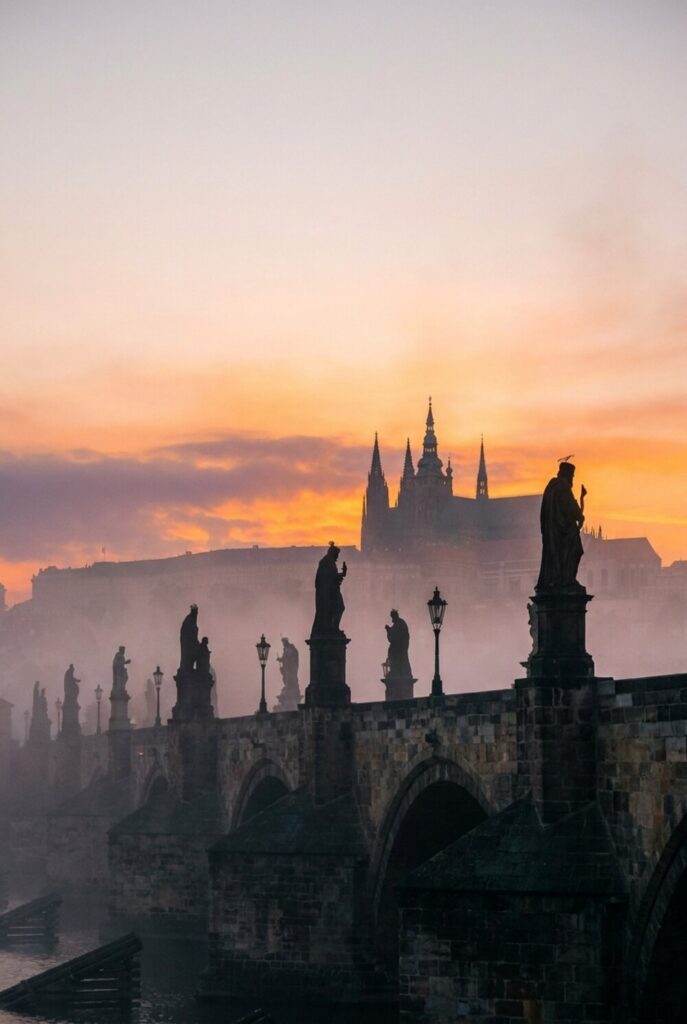
- Charles Bridge & the Astronomical Clock on Old Town Square (installed 1410, the world’s oldest still-operating)
- Jewish Quarter (Josefov) — Old-New Synagogue (1270) and the medieval Old Jewish Cemetery
Signature eats: svíčková and knedlíky at U Modré kachničky, tank Pilsner Urquell at U Medvídků, trdelník from any Old Town spit.
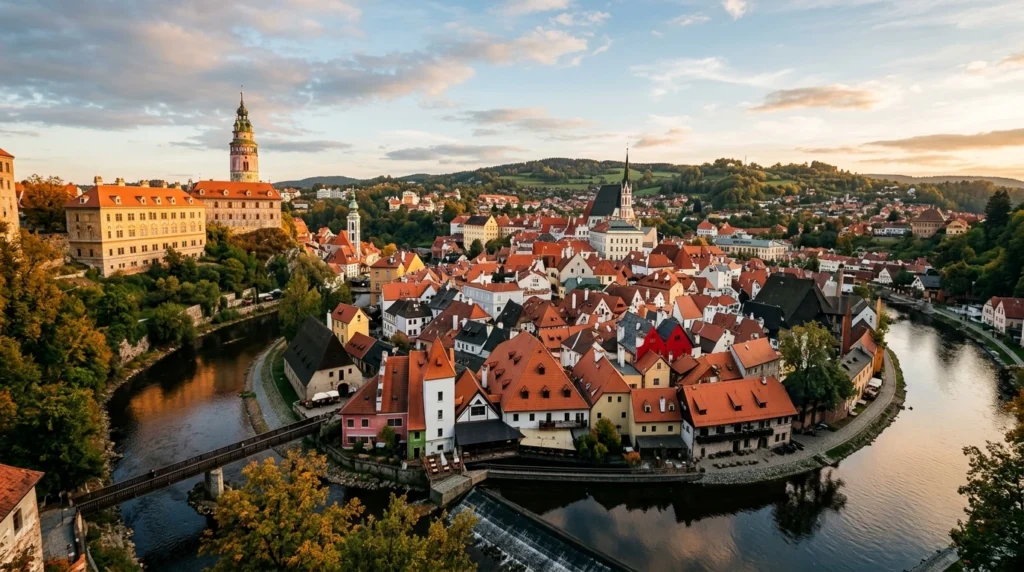
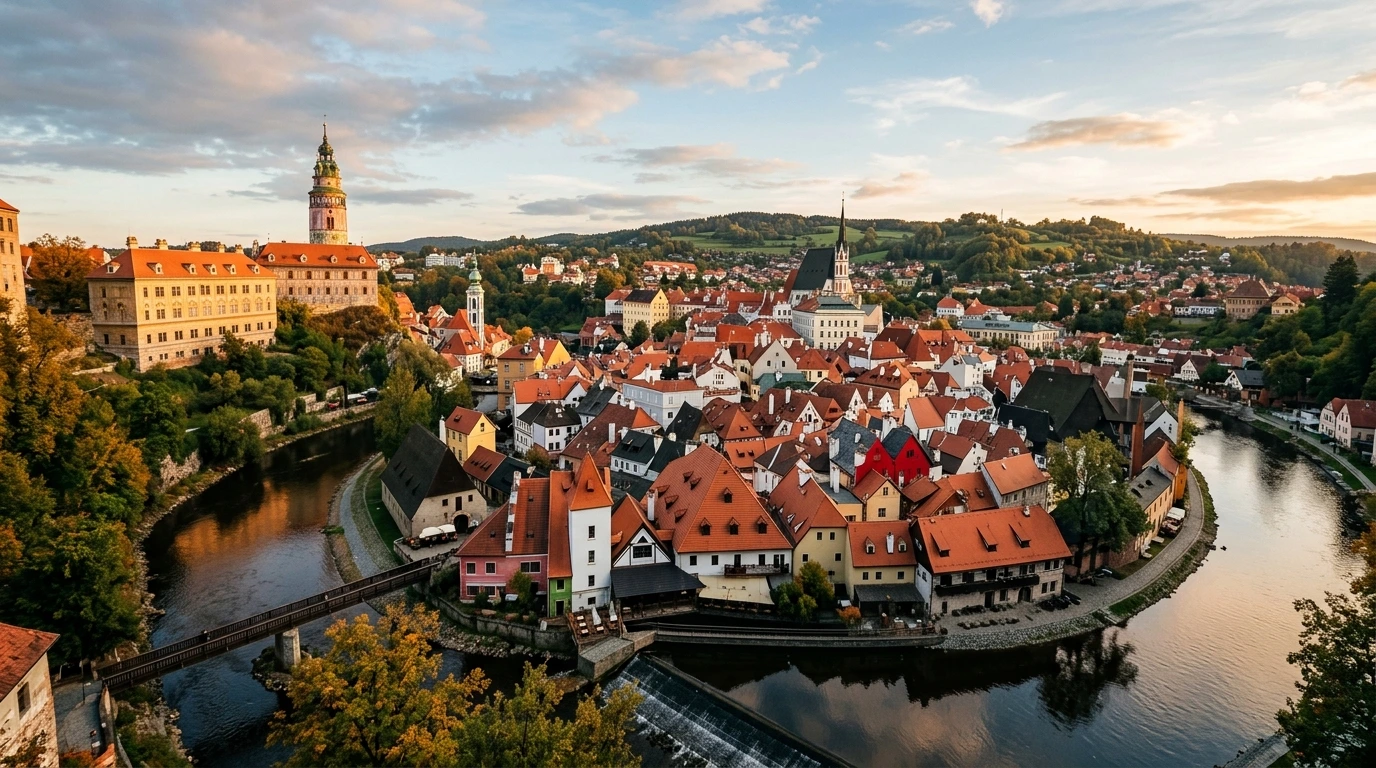
🎭 Český Krumlov
A fairytale UNESCO-listed South Bohemian town wrapped inside a horseshoe bend of the Vltava. The 13th-century castle complex — second largest in the country — towers over an Old Town of medieval and Renaissance houses.
- Český Krumlov Castle & its 1766 Baroque theatre (one of only three surviving with original stage machinery)
- Egon Schiele Art Centrum and the rotating castle tower observation deck
- Vltava river rafting, Latrán quarter walks, Eggenberg brewery (founded 1560)
Signature eats: svíčková na smetaně with cranberry, Budějovický Budvar lager, Třeboň carp from the South Bohemian fishponds.
♨️ Karlovy Vary
Bohemia’s grandest spa town, on the Teplá river. Founded 1370 on thirteen hot mineral springs, Karlovy Vary filled with Belle-Époque colonnades as Goethe, Beethoven, Tsar Peter the Great and Karl Marx arrived to take the waters.
- Mill Colonnade (1881) and the 72°C Vřídlo geyser that shoots 12 metres into the air
- Grandhotel Pupp (founded 1701 — the Casino Royale hotel in 2006) and the Diana Tower funicular
- Karlovy Vary International Film Festival (KVIFF) — early July, Eastern Europe’s biggest
Signature eats: oplatky (thin spa wafers), Becherovka herbal liqueur distilled here since 1807, knedlíky with roast duck.
🏛️ Brno
Moravia’s capital and the country’s second city — a young university town with functionalist architecture, Špilberk fortress and a beer culture to rival Prague’s. Unfussy, cheaper than Prague, a 2h 30min train ride east.
- Villa Tugendhat (Mies van der Rohe, 1930) — UNESCO-listed modernism
- Špilberk Castle and the Cabbage Market (Zelný trh)
- Capuchin Crypt with naturally mummified monks, plus the Brno MotoGP circuit 10 km west
Signature eats: moravian svíčková, Starobrno beer (1872 brewery), vepřo-knedlo-zelo (roast pork, knedlíky, sauerkraut).
💀 Kutná Hora
A 1-hour train east of Prague, Kutná Hora was the second wealthiest city in 14th-century Bohemia on the back of its silver mines. The UNESCO listing covers both the Cathedral of St. Barbara and the macabre Sedlec Ossuary.
- Sedlec Ossuary — bones of roughly 40,000 plague and war victims arranged as chandeliers and coats of arms
- Cathedral of St. Barbara — late Gothic, begun 1388, funded by the silver miners’ guild
- Italian Court medieval mint and the Czech Museum of Silver (tour a 15th-century mine shaft)
Signature eats: beef guláš with houskový knedlík at Dačický, svíčková, Kutná Hora pilsner on tap.
🍇 Moravian Wine Region (Mikulov, Lednice & Valtice)
South Moravia produces about 96% of Czech wine. Centred on Mikulov, Valtice and Znojmo, it combines working vineyards with the UNESCO-listed Lednice–Valtice Cultural Landscape — around 280 km², the largest designed landscape in Europe.
- Pálava hills wine trail — Veltlínské zelené, Ryzlink rýnský, Frankovka, Pálava
- Mikulov Castle, the Jewish cemetery of Mikulov, Lednice Château with its Moorish-Gothic garden minaret
- Valtice Wine Salon — underground vault with 100 of the country’s best wines on rotation
Signature eats: moravská klobása, pečená kachna (roast duck) with red cabbage, svatomartinské víno released at 11:11 on November 11.
Czech Culture & Etiquette — What to Know Before You Go
Czech culture rewards quiet politeness and a strong sense of private-versus-public space. Visitors notice trams that run almost silently, orderly queues, and strangers who do not smile without reason — not rudeness, just the Central European baseline. One note: Czechs are Czech, not Slovak. Czechoslovakia peacefully split on January 1, 1993 (the “Velvet Divorce”); the two nations still share mutually intelligible languages but distinct identities. The country’s communist period (1948–1989) ended with the non-violent Velvet Revolution led by playwright Václav Havel — a history Czechs discuss openly but without ceremony.
The Essentials
- Greet with Dobrý den (dough-bree den, “good day”) on entering a shop, restaurant or lift; Na shledanou (nah skhle-dah-noh) on leaving. Ahoj is informal for friends only.
- Prosím (please / you’re welcome / here-you-are) and Děkuji (thank you) are the non-negotiable polite vocabulary. Using them earns visible warmth.
- Remove shoes on entering a Czech home — slippers (papuče) are usually offered at the door. This is non-optional even in modern apartments.
- Keep voices low on public transit — phone calls on speakerphone are a clear faux pas, and laughter on a quiet tram draws glances.
- Cheers with eye contact — clink glasses, say Na zdraví (nah zdrah-vee, “to your health”), and never cross arms with another drinker when toasting.
Beer Hall (Hospoda) Etiquette
- Sit anywhere a beer coaster is free; shared tables are normal and expected at lunch and after work.
- The first pivo arrives by default when you sit down at most traditional pubs. A coaster placed on top of your empty glass means “no more” — otherwise servers keep pouring.
- Order rounds using fingers held up vertically — two fingers = two beers. Do not use the British peace-sign gesture.
- Tip by rounding up to the next 10–20 CZK and telling the server the total as they take payment (“dvě stě padesát” for a 240 CZK bill).
- Most hospodas pour a single house lager — choose by the pub, not the beer. A 0.5 L glass is 35–60 CZK; a Prague Old Town tourist bar is 80–110 CZK.
A Food Lover’s Guide to the Czech Republic
Czech food is the cooking of a landlocked, forested, winter-heavy country — rich, brown, centered on pork, beef, dumplings and cabbage, served in hospodas that have been pouring the same lager since their grandfather opened. Bohemia cooks roast pork and svíčková; Moravia leans toward wine, duck and sweeter sauces; South Bohemia adds carp from its centuries-old fishponds on Christmas Eve. The national drink is Pilsner Urquell, invented in Plzeň in 1842 — the original pale lager. Prague also has a fast-growing vegan scene and Michelin-starred restaurants at Field and La Degustation Bohême Bourgeoise.
Must-Try Dishes
| Dish | Description |
|---|---|
| Svíčková na smetaně | The national dish. Beef sirloin slow-braised with root vegetables, finished in a silky cream-and-root-vegetable sauce, served with houskový knedlík (sliced bread dumpling), a spoon of cranberry compote and a curl of whipped cream. How Czechs judge a new restaurant — order it first. |
| Guláš (Czech goulash) | Thicker and darker than its Hungarian cousin. Chunks of beef slow-stewed with onion, paprika, marjoram and caraway until the sauce is almost black, ladled beside six slices of houskový knedlík. The Moravian version adds red wine; the Prague pub version doubles the onion and serves it in a hollowed bread bowl. |
| Knedlíky (dumplings) | Not one dish but a national obsession — houskový (bread, sliced from a poached log), bramborový (potato), ovocný (plum or strawberry, served as dessert with melted butter and poppyseeds), and špekový (bacon). Every Czech grandmother’s recipe is non-negotiable and usually different from the next one. |
| Vepřo-knedlo-zelo | Roast pork with dumplings and sauerkraut — the Sunday-lunch trinity of Czech home cooking. The pork is roasted with caraway, the knedlíky slice the gravy, and the cabbage (red or white) is softened with vinegar, apple and sometimes a splash of beer. |
| Smažený sýr | Deep-fried Edam or hermelín cheese in golden breadcrumbs, served with tartar sauce and boiled potatoes or fries. A hospoda staple, a student staple, and the vegetarian’s main escape hatch in a country that otherwise runs heavily on pork. |
| Trdelník | A spit-roasted cinnamon-sugar pastry sold from every corner of Prague’s Old Town. Technically Hungarian-Slovak in origin, but the Prague version has become a symbol of the visitor experience — dust with cinnamon sugar, optionally fill with Nutella or ice cream. |
| Utopenec & Nakládaný hermelín | Pickled pub snacks. Utopenec (“the drowned man”) is a soft sausage floating in vinegar, onion and chilli; nakládaný hermelín is a whole Camembert-style cheese marinated in oil, garlic and peppers. Both arrive with a slice of rye bread and a cold Pilsner. |
Hospoda & Pivovar Beer Culture
The Czech Republic has roughly 550 active breweries for 10.9 million people — one of the world’s highest brewery-per-capita counts. A 0.5 L glass at a traditional hospoda is 35–60 CZK; Prague Old Town tourist bars run 80–110 CZK. Pilsner Urquell, Budvar (the original Budweiser), Kozel, Staropramen and Gambrinus are the national brands. The classic order is malé (0.3 L) or velké (0.5 L) svetlé (pale) or tmavé (dark) — draft only; bottled in a pub is a faux pas.
- Iconic Prague pubs: U Medvídků (Pilsner Urquell from the tank), U Fleků (brewing since 1499, own dark lager), Lokál (modern casual chain with perfect Pilsner pours)
- Signature non-beer drinks: Becherovka (Karlovy Vary herbal liqueur, 1807), slivovice (plum brandy), Moravian Ryzlink rýnský white wine, svařák (mulled wine, winter markets only)
Off the Beaten Path — The Czech Republic Beyond the Guidebook
Olomouc
Moravia’s second city and one of Central Europe’s most beautifully preserved old towns — six Baroque fountains in the main squares, a university founded in 1573, and the 35-metre UNESCO-listed Holy Trinity Column finished in 1754, the largest Baroque sculptural group in Central Europe. The cost of living is roughly half of Prague’s and the Astronomical Clock on the town hall is a rare Socialist-Realist 1955 remake of a 1422 original — with mural figures of heroic workers instead of saints. Local cheese Olomoucké tvarůžky has a designation of origin and a smell that clears train compartments.
Bohemian Switzerland (České Švýcarsko)
A compact sandstone national park on the German border, 90 minutes north of Prague by train via Děčín. The signature sight is Pravčická brána — the largest natural sandstone arch in Europe at 26.5 metres wide and 16 high, used as a filming location for Narnia in 2005. Marked trails thread through pine-cloaked sandstone towers, and the park connects directly across the border to Saxon Switzerland in Germany. Day trip from Prague works; two days with an overnight in Hřensko are better.
Telč
A UNESCO-listed South Moravian market town built around a single 500-metre-long Renaissance square lined with pastel-coloured arcaded houses. A 14th-century castle anchors one end, and two fishponds used to double as a moat around the historic centre. Small enough to see on foot in an afternoon, but the pre-dawn empty square before the day-trippers arrive is one of the quietest photographs in the country. Easiest access is by bus from Jihlava or Brno — rail connections exist but add 45 minutes of transfer time.
Plzeň (Pilsen)
The original home of pilsner. The Pilsner Urquell brewery has brewed on the same site since 1842, and the basement tasting rooms still pour unfiltered, unpasteurised lager directly from open wooden lagering barrels — the way every pale lager in the world was made until the 1990s. Plzeň was also European Capital of Culture in 2015, and sits on the main Prague–Munich rail line one hour west of the capital. Pair the brewery tour with the Patton Memorial (the US Army liberated Plzeň in 1945, a month before Prague did).
Krkonoše (Giant Mountains)
Czech Republic’s highest range, on the Polish border — Sněžka at 1,603 metres, a rack-railway ascent to the ridge, marked border hiking trails that cross between Czech Republic and Poland freely, and the country’s biggest ski resorts at Špindlerův Mlýn and Pec pod Sněžkou. Winter skiing costs a fraction of Alpine prices with comparable lift infrastructure; summer is hut-to-hut hiking with surprisingly few English-speaking visitors and a strong network of mountain chalets (bouda) serving goulash and svařák.
Practical Information
| Currency | Czech koruna (CZK / Kč); 1 USD ≈ 22.8 CZK, 1 EUR ≈ 25.2 CZK (April 19, 2026). NOT the euro, despite EU membership. |
| Cash needs | Cards are accepted in hotels and most Prague restaurants, but small pubs, bakeries and rural spots still run on cash. Keep 1,000–2,000 CZK in small notes. Avoid the tourist “exchange” kiosks in Prague Old Town — several post-2019 scandals involved headline rates with 20% hidden spreads. |
| ATMs | Bankomaty are ubiquitous at ČSOB, Komerční banka and Česká spořitelna branches. Always decline dynamic currency conversion — choose to be charged in CZK for the interbank rate. |
| Tipping | Not automatic. Round up 5–10% by telling the server the total as they take payment. No tipping in bakeries, takeaway or counter service. |
| Language | Czech is the national language. English is widely spoken in Prague, Brno and among under-40s; thinner in small towns and with older generations. Google Translate camera handles menus and rail signs. |
| Safety | Very safe overall — violent crime is rare. Pickpocketing is the main risk on Prague’s tram 22, Charles Bridge, the Astronomical Clock crowd, and Old Town Square. |
| Connectivity | 4G/5G blanket coverage from O2, T-Mobile and Vodafone. eSIMs (Airalo, Holafly) work nationwide from the moment you land. |
| Power | Type E plugs; 230V / 50 Hz. Standard Continental European fit. |
| Tap water | Safe and excellent nationwide. Restaurants will serve free tap water on request (“kohoutková voda, prosím”), though still or sparkling bottled water is more common at the table. |
| Healthcare | EU-standard public hospitals; EHIC cards work for EU visitors, others need travel insurance. Green-cross lékárny (pharmacies) rotate an after-hours pohotovostní service — the duty pharmacy is posted on every closed one’s door. |
Budget Breakdown — What the Czech Republic Actually Costs
💚 Budget Traveller
Hostels (Sophie’s, Mosaic House, Hostel Franz Kafka in Prague; Hostel Mitte in Brno), supermarket breakfasts from Albert or Billa, a Prague 72-hour transit pass at 330 CZK, and point-to-point ČD second-class trains. Doable at US$55–80 per day. A bakery breakfast is under 80 CZK (~US$3.50); a hospoda lunch menu (polední menu) is 150–220 CZK (~US$7–10) for soup, main and drink; a 0.5 L Pilsner at a neighbourhood pub is 35–60 CZK (~US$1.50–2.70). Brno, Plzeň and Olomouc are noticeably cheaper than Prague.
💙 Mid-Range
3-star or boutique hotel inside the Prague historic centre, one sit-down meal and one café/street-food meal a day, ČD express trains booked a few days early, and two or three paid sights (Prague Castle combined ticket: 450 CZK; Sedlec Ossuary: 160 CZK). Plan US$130–190 per day. A mid-range dinner for two with wine runs 1,400–2,200 CZK (~US$60–95). Prague Spring Festival tickets are 500–3,500 CZK depending on hall and performer.
💜 Luxury
5-star hotels (Four Seasons Prague, Grandhotel Pupp Karlovy Vary, Augustine Prague, Mandarin Oriental), first-class SC Pendolino tickets, Michelin-starred tasting menus with wine pairings, and private castle/brewery tours. Plan US$350+ per day. A tasting menu at Field or La Degustation Bohême Bourgeoise runs 3,500–5,500 CZK per person with paired wines. Grandhotel Pupp Presidential Suite and Four Seasons Vltava-view rooms run US$650–1,400+ per night in peak season.
| Tier | Daily (USD) | Accommodation | Food | Transport |
|---|---|---|---|---|
| Budget | $55–80 | Hostel 450–900 CZK / budget hotel 1,500–2,200 CZK | 300–500 CZK/day | Prague 72h pass 330 CZK or ČD 2nd class |
| Mid-Range | $130–190 | 3-star hotel 2,800–4,500 CZK | 900–1,600 CZK/day | ČD express 200–600 CZK intercity |
| Luxury | $350+ | 5-star hotel 8,000–18,000 CZK+ | 2,500–5,500 CZK/day | SC Pendolino 1st class / private transfer |
Planning Your First Trip to the Czech Republic
- Pick your route. The classic first-timer circuit is Prague plus one day-trip (Kutná Hora or Karlovy Vary). A week adds Český Krumlov for two nights; ten days opens Brno and Moravia.
- Book Prague accommodation early. Old Town hotels sell out 3–4 months ahead for Prague Spring Festival (May 12 – June 2, 2026) and the Christmas markets.
- Pay in Czech koruna, not euro. The Czech Republic is EU but NOT eurozone — shops that take euros use a worse rate. Use a bankomat for CZK and decline “charged in your home currency.”
- Buy point-to-point train tickets, not a pass. ČD dynamic pricing makes Prague–Brno or Prague–Český Krumlov cheaper as separate tickets than any rail pass.
- Learn five Czech words. Dobrý den, Prosím, Děkuji, Na shledanou, Na zdraví — every pub and tram interaction goes better with them.
Classic 7-Day Itinerary: Days 1–3 Prague · Day 4 Kutná Hora day trip · Day 5 train to Český Krumlov, overnight · Day 6 return via České Budějovice for a Budvar tour · Day 7 Karlovy Vary, fly home from PRG.
Frequently Asked Questions
Is the Czech Republic expensive to visit?
No — one of the best-value destinations in the EU. Budget travellers get by on US$55–80 per day with hostels and hospoda food; mid-range travellers plan US$130–190 per day. Prague Old Town is the priciest pocket of the country, but Brno, Olomouc, Plzeň and Český Krumlov are all meaningfully cheaper. A 0.5 L glass of Pilsner Urquell in a neighbourhood pub is routinely 35–60 CZK — about US$1.50–2.70.
Do I need to speak Czech?
No. English works almost everywhere among under-40s in Prague, Brno and tourist-facing businesses. A little Czech goes a long way — Dobrý den, Prosím, Děkuji and Na shledanou warm every interaction. In small towns in Moravia and Bohemia and with older generations, English thins out; Google Translate camera mode handles menus and rail signs effectively.
Is there a Czech rail pass worth buying?
No single-country rail pass makes financial sense — point-to-point tickets on cd.cz are almost always cheaper. Prague–Brno runs 200–400 CZK in second class if booked a few days early, and Prague–Český Krumlov is similar on RegioJet or FlixBus. A Eurail Global Pass is only worth it if the Czech Republic is one leg of a wider multi-country rail trip.
Is the Czech Republic safe for solo travellers?
Very — violent crime against visitors is rare and the country consistently ranks among the safest in Europe. Solo women regularly report feeling comfortable on urban transit late at night. The main risks are petty pickpocketing on Prague’s tram 22, at Charles Bridge, in the Astronomical Clock crowd and around Old Town Square. Keep phones out of back pockets and bags zipped on platforms.
When is the Prague Christmas Market?
Prague’s Old Town Square and Wenceslas Square Christmas markets run from late November through early January, with the biggest crowds December 15–26. The markets sell mulled wine (svařák), trdelník, grilled klobása sausage and handmade ornaments, and the Old Town Square tree is lit at 4:30pm daily. Brno, Olomouc and České Budějovice all have smaller, much less crowded markets on the same calendar.
Can I get by as a vegetarian or vegan?
Easily in Prague and Brno, with some effort elsewhere. Prague has become one of Central Europe’s strongest vegan cities, with dedicated vegan restaurants (Lehká hlava, Forky’s, Moment). Traditional menus offer smažený sýr (fried cheese), smažený květák (fried cauliflower) and Česnečka (garlic soup) as fallbacks. In small Moravian villages, the default is still pork-centric.
Czech Republic or Czechia — which name do I use?
Both are correct. “Czech Republic” is the formal political name; “Czechia” is the shorter English geographic name adopted in 2016 and used by the national tourism board VisitCzechia. Locals say “Česko” in Czech. Travellers use the two interchangeably.
Ready to Explore the Czech Republic?
The Czech Republic rewards travellers who slow down — pick Prague plus one or two towns, learn five Czech words, and let the cold pilsner and Baroque Old Town squares take care of the rest. Start in Prague for the history, Český Krumlov for the fairytale, Karlovy Vary for the spa, or Moravia for the wine.
Explore More
Cities we cover in Czech Republic
Cities to explore in Czech Republic
Deep-dive guides to specific cities, neighbourhoods, and food scenes — written with the same magazine voice.
More country guides you might like
Plan your trip to Czech Republic
The booking tools we use ourselves. FFU may earn a commission at no extra cost to you.
Plan & book your trip to Czech Republic
Booking through these searches supports our guides at no extra cost to you.