
Languages of Laos
All languages of Southeast Asia →fluent beta classical · classes by phone with Maya at ranas.ai/maya
Laos Travel Guide — Slow Mekong Days, Saffron Monks & Karst Mountain Dreams
Laos Travel Guide
📋 In This Guide
- Overview — Why Laos Belongs on Every Bucket List
- 💦 Pi Mai Lao New Year Water Festival 2026
- Best Time to Visit Laos (Season by Season)
- Getting There — Flights & Arrival
- Getting Around
- Top Cities & Regions
- Lao Culture & Etiquette
- A Food Lover’s Guide to Laos
- Off the Beaten Path
- Practical Information
- Budget Breakdown
- Planning Your First Trip to Laos
- Frequently Asked Questions
Overview — Why Laos Belongs on Every Bucket List
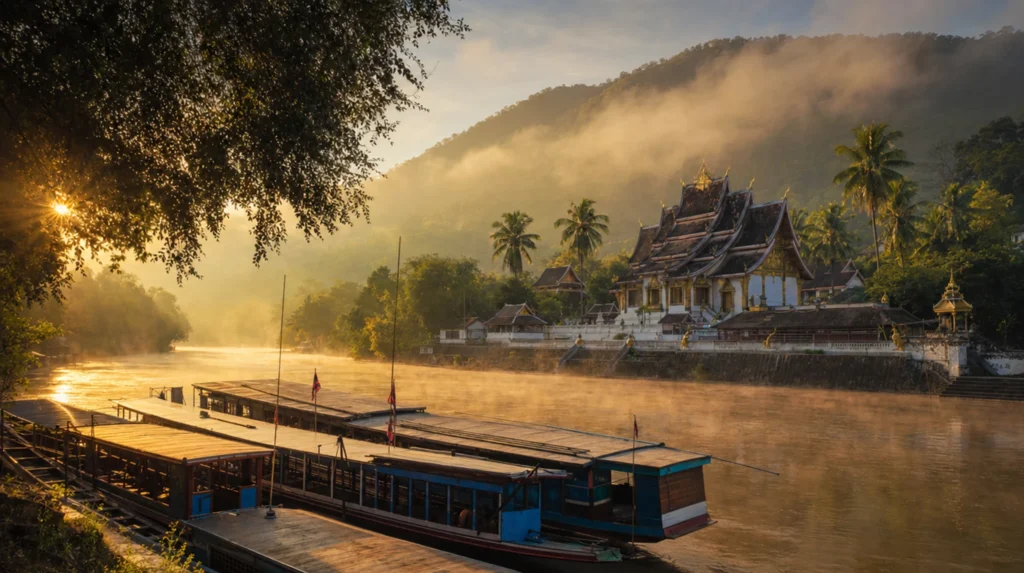
Laos is Southeast Asia’s quietest country — a landlocked, mountain-fringed ribbon along the middle Mekong where the pace moves at the speed of a longboat and the loudest sound most mornings is a temple gong. Roughly 7.6 million people share a country the size of the United Kingdom, and more than 70% of the national territory is mountainous, which is why the valley towns, river junctions, and the narrow Vientiane plain carry almost all of the travel infrastructure. Few destinations in the region reward slowing down this much.
Geography shapes every itinerary. The Mekong enters from China in the north and exits to Cambodia in the south, braiding at the border into the 4000 Islands archipelago; the Annamite Range forms the spine of the country’s eastern frontier with Vietnam, and the Bolaven Plateau lifts the far south into cool coffee-growing highlands. Around the fertile river valleys sit the three UNESCO World Heritage sites that anchor a classic trip: the 14th-century royal capital of Luang Prabang, the pre-Angkorian Khmer temple of Vat Phou in Champasak, and the Iron Age Plain of Jars on the Xieng Khouang plateau.
Cultural rhythm is the second unforgettable layer. More than 65% of Lao identify as Theravada Buddhist, and the country’s dawn ritual — Tak Bat, the silent procession of saffron-robed monks collecting sticky-rice alms — is still a lived daily practice in Luang Prabang, not a performance for cameras. French colonial legacy survives in the baguette-and-coffee breakfast tradition, the shutter-windowed shophouses of central Vientiane and Luang Prabang, and in a lingering fluency among older Lao in the language of the former protectorate.
The country is also quietly reinventing how visitors arrive and move. The Laos-China Railway, opened in December 2021, cuts a 414-km high-speed line from the Chinese border through Luang Prabang to Vientiane — a route that once took 10–12 hours by minivan now runs in under two hours to Luang Prabang. Expect food that rewards the trip: a bowl of khao piak sen noodle soup for around ₭30,000, a plate of laap with sticky rice at a night market for ₭40,000–60,000, and a bottle of Beerlao cold from the river for under US$2. Laos is where the rest of Southeast Asia goes when it needs to exhale.
💦 Pi Mai Lao New Year Water Festival 2026 — You’re Right on Time
If you are picking dates for Laos in 2026, the single biggest cultural draw is Pi Mai Lao — the Lao New Year — which runs 13–16 April across the country and turns Luang Prabang, Vientiane, and every provincial capital into a three-day water festival. Expect gentle buckets of scented water poured over Buddha images, temple pilgrimages, sand-stupa building along the Mekong, and cheerful roadside drenchings of anyone on foot or on a scooter. Luang Prabang is the emotional centre of the celebration, with the royal-era Phabang procession between Wat Mai and Wat Xieng Thong.
- Pi Mai Lao (New Year): 13–16 April 2026 (nationwide public holidays)
- Boun Bang Fai Rocket Festival: May 2026 (rural village festivals, petitioning the rain gods ahead of planting)
- Boun That Luang: November 2026 full-moon week in Vientiane — the national stupa festival
- Luang Prabang: Pi Mai’s most atmospheric host; the Phabang Buddha procession runs between Wat Mai and Wat Xieng Thong across three of the four days
- Vientiane: parades along Setthathirath Road and water blessings at Pha That Luang and Wat Si Saket
- Champasak & Pakse: quieter southern celebrations centred on Vat Phou and Mekong riverside villages
Best Time to Visit Laos (Season by Season)
Cool Dry Season (Nov–Feb)
The peak travel window — clear skies over the Mekong, daytime valley temperatures of 22–28°C, and pleasantly cool northern nights of 10–16°C in Luang Prabang, Phonsavan, and the Bolaven highlands. This is prime time for Mekong slow-boat trips, Luang Prabang’s Old Town, Kuang Si Falls hikes, and the Thakhek–Pakse motorbike loops. Expect the highest hotel prices between 20 December and 5 January in Luang Prabang and Vang Vieng; book Laos-China Railway tickets and domestic flights at least three weeks in advance as carriages sell out on the Vientiane–Luang Prabang legs.
Hot Dry Season (Mar–May)
The hottest stretch of the year, with the Vientiane plain and the southern lowlands regularly hitting 34–38°C and March-April visibility reduced by agricultural burning across the northern provinces. Pi Mai Lao (13–16 April) is the biggest domestic-travel surge and the reason most travellers time their visit to this window; the water festival doubles as the natural antidote to the heat. Escape to altitude — the Bolaven Plateau stays 5–8°C cooler than Pakse — or lean into the festival energy across Luang Prabang, Vientiane, and Savannakhet.
Southwest Monsoon (Jun–Aug)
The wet season begins, and in Laos it rarely ruins a trip. Expect short, intense afternoon downpours, daytime temperatures of 26–32°C, and markedly lower hotel rates across Luang Prabang, Vientiane, and Si Phan Don. Kuang Si Falls and the Bolaven waterfalls run at their highest volume of the year and the countryside is a vivid emerald. Khone Phapheng on the Cambodian border hits peak thunder. Roads in the far north (Luang Namtha, Nong Khiaw) can wash out occasionally; the Laos-China Railway runs on schedule year-round.
Late Monsoon (Sep–Oct)
The wettest stretch, particularly for Luang Prabang and the upper Mekong. Expect 25–30°C, heavy morning rain on many days, and savings of 30–40% on pre-peak hotel rates. River levels peak in mid-September and the 4000 Islands’ dolphins are easiest to spot as the Mekong recedes through late October. Boun Ok Phansa (end of Buddhist Lent) and the Luang Prabang boat-racing festival fall in this window and are underrated cultural spectacles with almost no foreign tour-bus presence.
Shoulder-season tip: Target late October or late May. You will catch green post-monsoon landscapes, pre-peak hotel rates, Khone Phapheng still thundering, and clear skies for the Luang Prabang peninsula walk — without the Christmas rush or the April heat wall.
Getting There — Flights & Arrival
Most visitors arrive at Vientiane’s Wattay International (VTE), but Laos has three meaningful international gateways and a newer overland option via the Laos-China Railway from Kunming or Bangkok. Flag carrier Lao Airlines runs most regional routes; Lao Skyway covers domestic short-hops.
- Wattay International (VTE) — Vientiane; 6 km to the city centre, 15–20 min by taxi (US$8–12) or minivan shuttle
- Luang Prabang International (LPQ) — 4 km to the UNESCO Old Town peninsula, 10–15 min by tuk-tuk (₭80,000–120,000)
- Pakse International (PKZ) — gateway to the Bolaven Plateau and 4000 Islands; 3 km to Pakse town, 10 min by tuk-tuk (US$5–8)
Flight times: Bangkok–Vientiane about 1 hr 10 min on Lao Airlines or Thai Airways; Singapore–Vientiane roughly 3 hr 15 min via a short Bangkok or Kuala Lumpur connection; Kunming–Vientiane around 2 hr on Lao Airlines or direct via the Laos-China Railway in under 10 hours.
Flag carrier: Lao Airlines (QV); regional connections on Thai Airways, Bangkok Airways, AirAsia, and Vietnam Airlines.
Visa / entry: Most nationalities qualify for visa-on-arrival (US$30–42 depending on passport) or the Lao eVisa (US$50) valid for up to 30 days. Submit the eVisa application at laoevisa.gov.la before travel.
Getting Around — The Laos-China Railway, Slow Boats & River Roads
Laos’s transport backbone has changed more in the past five years than in the previous fifty. The Laos-China Railway, opened in December 2021, links Vientiane to Luang Prabang and onward to the Chinese border at Boten in under four hours; Lao Airlines handles the domestic triangle between Vientiane, Luang Prabang, and Pakse; and the classic two-day Mekong slow boat between Huay Xai and Luang Prabang remains one of Southeast Asia’s great river journeys.
- Laos-China Railway (LCR): Vientiane ↔ Luang Prabang 1 hr 50 min, Vientiane ↔ Boten about 4 hr; second-class tickets roughly ₭324,000 (~US$15)
- Vientiane ↔ Luang Prabang: 1 hr 50 min by LCR, 45 min by Lao Airlines, or 9–11 hr by minivan on Route 13
- Vientiane ↔ Vang Vieng: 55 min by LCR or 3 hr 30 min by minivan
- Huay Xai ↔ Luang Prabang: 2-day Mekong slow boat with an overnight stop at Pakbeng (₭300,000–400,000 / US$14–19)
- Vientiane ↔ Pakse: 1 hr 10 min by Lao Airlines or 10–12 hr by overnight VIP bus
Rail / transit pass: No national pass — LCR tickets are sold one-way by route via the LCR Ticket app or station windows up to three days ahead. In cities, tuk-tuks and jumbos set the pace.
Ride-hailing & tuk-tuks: Loca is the local Lao ride-hail app for metered cars in Vientiane and Luang Prabang. Tuk-tuks and jumbo samlors remain ubiquitous — agree the fare before boarding (₭20,000–80,000 for most inner-city hops).
Apps: Loca, Google Maps, Maps.me (for offline Bolaven and northern loops), LCR Ticket.
Top Cities & Regions
📍 Map of Laos: Every Place in This Guide
🪷 Luang Prabang
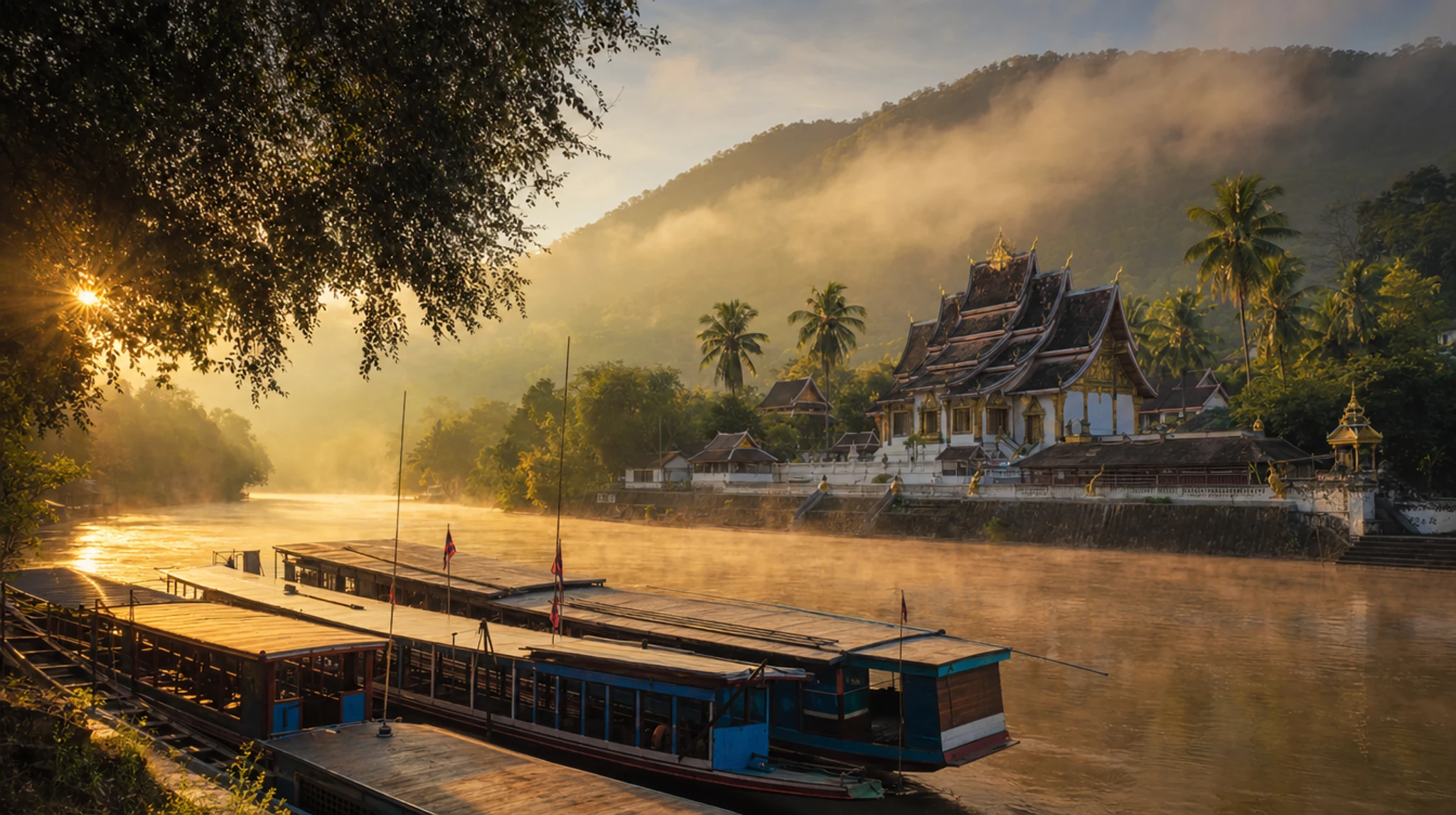
Laos’s UNESCO-listed former royal capital and the country’s emotional centre — a tranquil peninsula where the Mekong meets the Nam Khan, lined with gilded wats, French colonial shophouses, and Lao-Lanna teak palaces. Plan at least three days for the Tak Bat dawn alms-giving, the temple circuit, and a day trip up the Mekong to Pak Ou Caves. This is the single strongest reason most travellers book a Laos trip.
- Wat Xieng Thong, Wat Mai, and the Royal Palace Museum on Sakkaline Road
- Tak Bat dawn alms-giving, the Mount Phousi 328-step sunset climb, and the riverfront night market
- Kuang Si Falls tiered turquoise pools and Pak Ou Caves (2 hr upriver by longboat)
- Signature dishes: laap, or lam (Luang Prabang stew), khai pan (fried Mekong weed), Beerlao
🛕 Vientiane
Laos’s low-rise riverside capital — a Mekong-facing city of French shophouses, gilded stupas, and broad ceremonial boulevards that now doubles as the LCR railhead linking the country to China. Plan one and a half days for the main temple circuit; the city’s pace rewards walking the waterfront at sunset with a cold Beerlao.
- Pha That Luang national golden stupa and the Patuxai victory gate
- Wat Si Saket’s 6,840 miniature Buddhas and Haw Phra Kaew temple museum
- Mekong-front sunset promenade, Talat Sao morning market, and the COPE Visitor Centre (UXO awareness)
- Signature dishes: tam mak hoong (Lao papaya salad), khao soi Lao, sai oua (Lao herb sausage), Beerlao
🏞️ Vang Vieng
A karst-landscape adventure town on the Nam Song river, 155 km north of Vientiane, now 55 minutes away by the Laos-China Railway. Limestone towers rise straight out of the rice paddies; dawn brings hot-air balloons over the valley, and afternoons mean tubing, kayaking, or caving. The town’s reformation — from its early-2010s party reputation back to a cleaner adventure-tourism hub — is largely complete.
- Blue Lagoon 1 and Tham Phu Kham cave swim
- Hot-air-balloon sunrise and the Nam Xay viewpoint hike for the iconic karst panorama
- Kayaking and tubing the Nam Song, Pha Ngern Viewpoint, and Tham Chang cave
- Signature dishes: khao piak sen, laap, grilled Mekong river fish
🏝️ 4000 Islands (Si Phan Don)
The braided Mekong archipelago at the Cambodian border — thousands of islets, hammock-economy Don Det and Don Khon, and Khone Phapheng waterfall, the largest waterfall by volume in Southeast Asia. Allow two or three days: the rhythm here is bicycle, hammock, longboat repeat.
- Khone Phapheng Falls and Li Phi (Somphamit) Falls
- Bicycle loop across the old French colonial railway bridge between Don Det and Don Khon
- Irrawaddy-dolphin sunset boat trip near Ban Hang Khone
🏺 Plain of Jars (Xieng Khouang)
Laos’s third UNESCO site, inscribed in 2019 — thousands of Iron Age stone jars (2,500–500 BCE) scattered across the Xieng Khouang plateau around Phonsavan, set against the sobering legacy of the most heavily bombed province on Earth. Stay strictly on MAG/UXO-cleared paths marked with white and red markers.
- Jar Sites 1, 2, and 3 near Phonsavan (the three signposted UNESCO-accessible clusters)
- MAG Visitor Centre and UXO Information Centre in Phonsavan
- Muang Khoun old royal capital ruins and Hmong village homestays
☕ Bolaven Plateau
A cool 1,200-metre coffee highland above Pakse — Laos’s Arabica and Robusta belt, thundering waterfalls, and Katu and Alak ethnic-minority villages reached on the classic 3-day motorbike loop from Pakse.
- Tad Fane twin waterfalls (120 m drop) and Tad Yuang swimming hole
- Bolaven coffee-farm tours in the Paksong area
- Tad Lo village, Tad Champee, and Katu and Alak homestays
Lao Culture & Etiquette — What to Know Before You Go
The Essentials
- The nop is the greeting. Palms pressed together at chest level with a slight bow — the Lao equivalent of the Thai wai. Return one offered by an elder or a monk; you are not expected to initiate with service staff.
- Feet are the dirty end, head is sacred. Never point your feet at a person, a Buddha image, or a monk, and do not touch anyone on the head, including children.
- Remove shoes indoors. Entering temples, most homes, family guesthouses, and many shops means taking shoes off at the threshold. Slip-ons save friction.
- Dress modestly. Covered shoulders and knees are expected at all temples and strongly preferred in smaller towns. This matters especially during Tak Bat alms-giving.
- Keep the volume down. Lao culture is famously understated; raised voices, public arguments, and overt displays of frustration read as deeply impolite, even during scams or delays.
Tak Bat Alms-Giving Etiquette
- Stand at a respectful distance. Watch from across the street in silence if you are not participating — this is a religious ritual, not a photo op.
- Cover shoulders and knees, remove shoes if offering. A sash or sabai-style shoulder covering is appropriate if you are kneeling to offer.
- Buy sticky rice from vendors in advance. Do not buy low-quality rice from street hawkers directly in front of the monk procession; purchase the night before from your guesthouse or a daytime market.
- No flash, no selfies, no blocking the line. Keep your camera below eye level, do not step into the procession, and never touch a monk — women in particular should hand offerings via a male intermediary or place them within reach.
A Food Lover’s Guide to Laos
Lao cuisine is the quieter cousin of Thai and Vietnamese cooking — herb-forward, fermented, sticky-rice-centred, and still relatively under-documented outside the country. Meals are built around sticky rice eaten by hand, fresh herbs (coriander, mint, dill, saw-tooth coriander), padaek (fermented fish sauce), and chillies dialled lower than Isaan but higher than central Thailand. French colonial legacy survives in the excellent baguette-and-coffee breakfasts of Luang Prabang and Vientiane. Street food is the default — a full meal of laap, sticky rice, and tam mak hoong runs ₭40,000–70,000 (US$2–3) in any Lao town.
Must-Try Dishes
| Dish | Description |
|---|---|
| Laap (ລາບ) | Lao’s unofficial national dish — minced meat or fish tossed with toasted rice powder, fresh herbs, lime, fish sauce, and bird’s-eye chilli. Eaten with sticky rice by hand; milder and more herb-forward than Isaan larb. |
| Tam Mak Hoong | Lao green-papaya salad — pounded with padaek fermented-fish sauce (not Thai shrimp paste), palm sugar, lime, and chilli. Funkier, saltier, and more rustic than Thai som tam. |
| Khao Soi Lao | Not to be confused with Chiang Mai khao soi — the Lao version is a clear pork-and-tomato broth over rice noodles topped with a fermented soybean paste, native to Luang Prabang and the north. |
| Sai Oua | Grilled Lao-style herb sausage — pork, lemongrass, kaffir lime leaf, galangal, and chilli packed into a casing and grilled over charcoal; a standard night-market skewer. |
| Or Lam | Luang Prabang’s signature stew — a thick peppery broth of buffalo meat, Mekong weed, bitter eggplant, dill, and sa-khaan (a mildly numbing wood); the most distinctive regional dish in Laos. |
| Khao Niaw (Sticky Rice) | The genuine staple — steamed in bamboo baskets and eaten by hand, rolled into a small ball to scoop sauces and salads. Lao people consume the most sticky rice per capita of any nation on Earth. |
| Beerlao | The national lager — state-owned, rice-based, 5% ABV, and inescapably good with grilled Mekong fish and sticky rice on a riverside veranda. |
Night Market & Street Food Culture
The Lao street-food economy is the default eating mode, not a novelty. Every provincial capital has a morning market (talat sao) for noodle soup and a night market for grilled meats, som tam, and Mekong fish. Point, nod, and pay ₭20,000–80,000 per dish — a proper Lao dinner usually means four or five small plates shared family-style over a communal basket of sticky rice. Look for stalls with a line of locals and a narrow specialty menu rather than tourist-menu translations.
- Markets worth knowing: Luang Prabang Night Market (Sisavangvong Road), Vientiane Chao Anouvong Riverside Night Market, Phonsavan Night Market, Pakse Daoheuang Market
- Signature street items: khao jii pâté (Lao baguette sandwich with Lao pâté, pickled papaya, and coriander ₭20,000), ping gai (grilled chicken skewers ₭10,000–15,000 each), khao piak sen (rice-noodle soup ₭30,000), nem khao (crispy rice salad with fermented pork), and the “all-you-can-eat” ₭15,000 vegetarian buffets at the Luang Prabang night-market back alley
Regional food variation is worth planning around. Luang Prabang leans on or lam, khai pan (crispy Mekong weed with chilli paste), and a stronger French colonial pastry tradition. The south (Pakse, Bolaven, Champasak) goes heavier on Khmer-influenced fish curries, freshwater catches from the Mekong, and the country’s best coffee — single-origin Arabica from Paksong roasters like Sinouk and Dao. Vientiane sits between the two, with the strongest concentration of French bistros, modern Lao fine-dining (Doi Ka Noi, Kualao), and the widest variety of night-market food courts.
Off the Beaten Path — Laos Beyond the Guidebook
Nong Khiaw & Muang Ngoi
A twin pair of riverside villages on the Nam Ou river, 140 km north-east of Luang Prabang, cradled by sheer limestone karsts that outclass Vang Vieng’s. Nong Khiaw is reached by minivan in 3 hr 30 min from Luang Prabang; Muang Ngoi is another hour upstream by longboat and has no road access. Three nights is the right dose — viewpoint hikes, cave-walks, and hammocks over the river, with zero nightlife and patchy Wi-Fi.
The Thakhek Loop
A 450-km motorbike loop out of Thakhek (central Laos) through limestone karst, jungle, and the spectacular Kong Lor Cave — a 7-km river cave navigable by longtail boat through the heart of a mountain. Three to four days on a rented 110cc or 125cc scooter (about US$8–12 per day) is the classic itinerary. Best from November to February when the dirt sections stay dry and mornings run a cool 16–22°C.
Luang Namtha & Nam Ha NPA
The far north-western province on the Chinese border — a mosaic of Akha, Khmu, and Tai Dam ethnic-minority villages, with the Nam Ha National Protected Area offering two- and three-day community-based trekking homestays. Reach it via the LCR to Boten and 1 hr by minivan, or direct flights from Vientiane on Lao Skyway. This is where responsible trekking tourism in Laos was invented in the late 1990s and still runs well.
Savannakhet
Central Laos’s second city, on the Mekong opposite Mukdahan (Thailand) — a quiet French colonial town of mustard-yellow shophouses, Wat Sainyaphum, and a riverside with almost no tourists. Reachable by overnight bus from Vientiane (9 hr) or 45-minute Lao Airlines hop. Use it as a launch point for the That Ing Hang Stupa (one of Laos’s most sacred) and the Dong Natad dinosaur footprints west of town.
Vat Phou & Champasak
The pre-Angkorian Khmer temple complex 45 km south of Pakse — a 7th–11th-century Shiva sanctuary on the slopes of Phu Kao mountain, inscribed as Laos’s second UNESCO World Heritage site in 2001. Far quieter than Angkor Wat, with carved doorways, dvarapala guardians, and a crocodile-shaped ritual stone still visible. Pair with a slow Mekong longboat ride and a homestay in Champasak town.
Practical Information
| Currency | Lao Kip (LAK / ₭); 1 USD ≈ 21,600 LAK (April 2026) |
| Cash needs | USD and Thai baht are accepted alongside kip at hotels and tour operators; kip rules street food, tuk-tuks, and markets. Carry ₭500,000–1,500,000 daily outside Vientiane. |
| ATMs | Plentiful in Vientiane, Luang Prabang, Vang Vieng, and Pakse; BCEL and Lao Development Bank are most reliable. Max single withdrawal ₭2,000,000 with a ₭20,000 fee. |
| Tipping | Not obligatory. Tip porters ₭10,000–20,000 and leave 10% at sit-down restaurants without a service charge. |
| Language | Lao is the sole official language; French lingers among older Lao in the cities. English is widely used at hotels and railway stations. |
| Safety | One of Southeast Asia’s safest countries. The dominant hazard is UXO in Xieng Khouang and along the Ho Chi Minh Trail — never stray from marked paths. |
| Connectivity | Unitel and Lao Telecom lead; 4G is reliable in Vientiane, Luang Prabang, Vang Vieng, and Pakse; patchy in the Bolaven. SIMs run US$5–8 for 10 GB. |
| Power | Type A, B, C, E, and F plugs in rotation; 230V, 50Hz. |
| Tap water | NOT potable anywhere — drink sealed bottled, filtered, or boiled water. |
| Healthcare | Vientiane has the best private facilities (Alliance International Medical Centre); serious cases are evacuated to Bangkok or Udon Thani. Travel insurance with medevac is essential. |
Budget Breakdown — What Laos Actually Costs
💚 Budget Traveller
Around ₭540,000–1,080,000 (US$25–50) per day. Hostel dorm beds in Luang Prabang, Vientiane, and Vang Vieng run ₭150,000–250,000; street-food meals are ₭20,000–60,000; LCR second-class Vientiane–Luang Prabang ₭324,000 if booked three days ahead; scooter rental across the Bolaven loop is ₭150,000–250,000 per day. Two weeks of backpacker-pace Laos is achievable under US$650 per person, sleeper trains and slow boats included.
💙 Mid-Range
Around ₭1,600,000–3,800,000 (US$75–175) per day. Three- and four-star hotels in Luang Prabang and Vientiane run ₭1,200,000–3,000,000 a night; boutique Mekong-front stays in Luang Prabang’s Old Town ₭2,000,000–4,500,000; a sit-down restaurant dinner with drinks ₭250,000–500,000 per person; a full-day Kuang Si Falls + Pak Ou Caves private tour runs ₭800,000–1,500,000.
💜 Luxury
From ₭6,500,000 (US$300) per day upward. Iconic stays like Rosewood Luang Prabang, Amantaka, Sofitel Luang Prabang, and Settha Palace in Vientiane start at ₭6,500,000–21,000,000 a night; LCR first-class Vientiane–Luang Prabang runs ₭529,000; private longtail charters on the Mekong ₭1,500,000–3,000,000 a day; Luang Prabang fine dining at Manda de Laos or Tamarind lands at ₭650,000–1,000,000 per head with pairings.
What you’ll actually spend: Ten days of mid-range travel across Vientiane, Vang Vieng, and Luang Prabang typically costs US$900–1,700 per person excluding international flights, with LCR seats and boutique Old Town stays the biggest line items. A ten-day backpacker version is achievable at US$380–550 per person using second-class rail, guesthouse dorms, street food, and a Mekong slow-boat day. Add US$300–500 if you extend south to the Bolaven Plateau and 4000 Islands via Lao Airlines. Laos stretches the dollar further than almost anywhere else in mainland Southeast Asia.
| Tier | Daily (USD) | Accommodation | Food | Transport |
|---|---|---|---|---|
| Budget | US$25–50 | Hostel dorm ₭150,000–250,000 | Street food & night markets | LCR 2nd-class, slow boat, tuk-tuk |
| Mid-Range | US$75–175 | Boutique ₭1,200,000–3,000,000 | Restaurants & cafés | LCR, Lao Airlines, Loca |
| Luxury | US$300+ | 5-star ₭6,500,000+ | Fine dining ₭650,000+ | Private transfers & charters |
Planning Your First Trip to Laos
- Pick two regions, not four. The classic pairings are Luang Prabang plus Vientiane (with Vang Vieng in between on the LCR), or Vientiane plus the Bolaven Plateau and 4000 Islands. Trying to add Phonsavan and Luang Namtha in ten days usually ruins the pace.
- Sort the visa before you fly. Apply for the Lao eVisa (US$50, 30 days) at laoevisa.gov.la at least five days ahead, or budget US$30–42 cash for visa-on-arrival at Wattay or Luang Prabang.
- Book LCR tickets and Lao Airlines seats early. Laos-China Railway Vientiane–Luang Prabang sells out 3–5 days ahead in peak season; use the LCR Ticket app.
- Match season to region. November–February for the whole country; April if you want Pi Mai but can handle 35°C+; May–September for green Bolaven waterfalls; skip the far-north trekking in July–September when roads wash out.
- Respect the Tak Bat and UXO rules. Watch Luang Prabang’s alms-giving from a respectful distance, buy rice in advance from a vendor, never flash-photograph monks; in Xieng Khouang stay strictly on MAG/UXO-cleared paths.
Classic 10-Day Itinerary: Days 1–2 Vientiane (Pha That Luang, Wat Si Saket, COPE Centre); Day 3 LCR to Vang Vieng (karst lagoons, sunrise balloon); Days 4–6 Luang Prabang (Tak Bat, Kuang Si, Pak Ou); Days 7–9 fly to Pakse and the Bolaven Plateau loop (Tad Fane, Tad Yuang, coffee farms); Day 10 optional Vat Phou before flying home.
Frequently Asked Questions
Is Laos expensive to visit?
No — Laos is one of Southeast Asia’s best-value destinations and meaningfully cheaper than Thailand or Vietnam outside Luang Prabang’s boutique Old Town. Budget travellers spend US$25–50 a day, mid-range US$75–175, luxury from US$300+. Main cost drivers are Luang Prabang heritage hotels and international flights in.
Do I need to speak Lao?
No. English is widely used at hotels, tour operators, LCR stations, and tourist restaurants across Vientiane, Luang Prabang, Vang Vieng, and Pakse. A few phrases (sabaidee for hello, khop chai for thank you) earn warm treatment. French still works with older Lao. In rural Bolaven and the north, download an offline Google Translate Lao pack.
Is the Laos-China Railway worth it?
Yes — absolutely. Vientiane–Luang Prabang drops from 10–12 hours by minivan to 1 hr 50 min by train at ₭324,000 (US$15) in second class. Book via the LCR Ticket app three days ahead; Vang Vieng makes an easy 55-minute stopover.
Is Laos safe for solo travellers?
Yes, with one caveat. Violent crime is rare and solo women travel Laos widely. The real safety issue is UXO in Xieng Khouang and along the Ho Chi Minh Trail — never leave marked paths, never pick up metal objects.
When is Pi Mai Lao?
Pi Mai Lao — the Lao New Year water festival — runs 13–16 April every year. Luang Prabang is the most atmospheric host, with the Phabang Buddha procession; Vientiane offers the quieter official ceremonies at Pha That Luang. Boun That Luang in November is the other calendar anchor.
Can I get by as a vegetarian or vegan?
Easier in the cities than the countryside. Lao cooking leans on padaek fermented-fish sauce, so “no meat” does not default to vegan; learn “bor sai padaek” (no fish sauce). Luang Prabang and Vientiane have strong vegan scenes, and the Luang Prabang night-market back alley serves the famous ₭15,000 vegetarian buffet.
What should I know about UXO and the Plain of Jars?
Laos is the most heavily bombed country per capita in history. An estimated 80 million unexploded cluster submunitions still contaminate Xieng Khouang and the Ho Chi Minh Trail corridor. At the Plain of Jars visit only MAG-cleared Sites 1, 2, and 3, stay on white-and-red marked paths, and pair the visit with the MAG and UXO Information Centres in Phonsavan.
📘 Book Your Laos Trip — curated hotel, Laos-China Railway, and tour partners.
Ready to Explore Laos?
Laos rewards travellers who move at its pace rather than fighting it. Start with Luang Prabang and Vientiane linked by the Laos-China Railway for temples, river mornings, and the country’s UNESCO heart; add Vang Vieng’s karsts on the way through; and come back later for the Bolaven Plateau, 4000 Islands, and the Plain of Jars — this is a country built for a second and a third visit.
Explore More
More country guides you might like
Plan your trip to Laos
The booking tools we use ourselves. FFU may earn a commission at no extra cost to you.
Plan & book your trip to Laos
Booking through these searches supports our guides at no extra cost to you.