
☰ On this page
- 📋 In This Guide
- Overview — Why Nepal Belongs on Every Bucket List
- 🏔️ October & March-April — Why You’re Right in the Window
- Best Time to Visit Nepal (Season by Season)
- Getting There — Flights & Arrival
- Getting Around — Domestic Flights, Buses & the Trek-In
- Top Regions & Towns
- 🗓️ Sample Itineraries
- Nepali Culture & Etiquette
- A Food Lover’s Guide to Nepal
- 📸 Photography Notes
- Off the Beaten Path — Nepal Beyond the Standard Circuits
- Practical Information
- Budget Breakdown — What Nepal Actually Costs
- ✅ Pre-Trip Checklist
- 🤔 What Surprises First-Timers
- Frequently Asked Questions
- Ready to Explore Nepal?
Languages of Nepal
All languages of Southern Asia →fluent beta classical · classes by phone with Maya at ranas.ai/maya
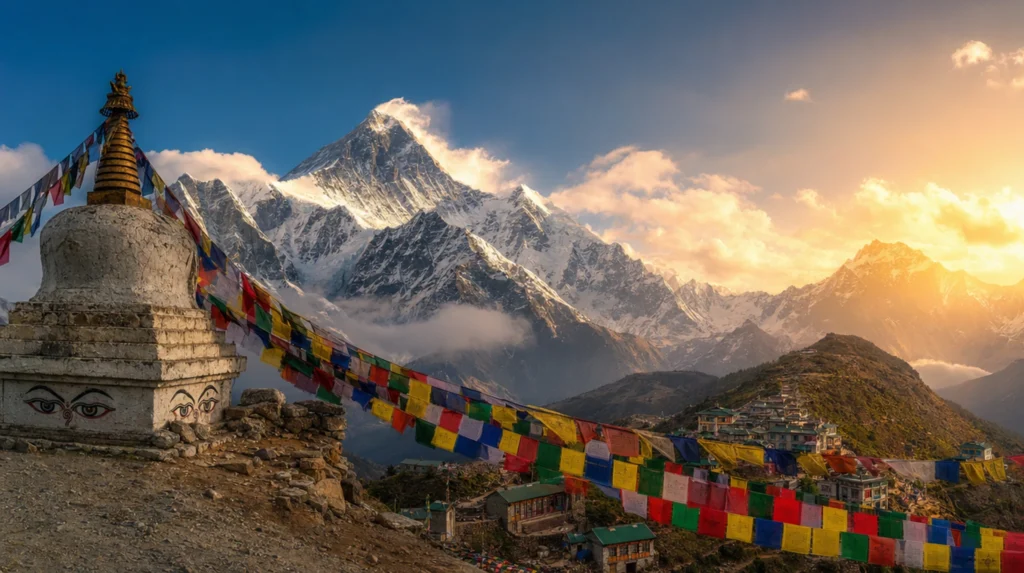
Nepal is the only country on Earth where you can stand at 5,545 metres in the morning, walk past a 12th-century stone Buddhist stupa at lunch, and eat momos in a Newar courtyard at dinner. The country squeezes the Himalaya, the Tibetan plateau, the subtropical Terai jungle and a continuous, intact medieval city culture into an area roughly the size of Tennessee — 147,516 square kilometres — split between 30 million people and the world’s eight tallest mountains. Eight of the planet’s 14 peaks above 8,000 metres sit on Nepal’s northern border. Mount Everest, at 8,848.86 metres, is one of them. The Annapurna massif, where Maurice Herzog and Louis Lachenal made the first-ever ascent of an 8,000-metre peak in June 1950, is another.
What makes Nepal different is the vertical compression. The country stretches only 200 km from north to south at most, but the altitude climbs from 60 metres at the Indian border to 8,848 metres at the Tibetan one — the steepest sustained altitude gradient on any inhabited terrain on Earth. The drive from Chitwan, where one-horned rhinos graze in elephant grass at sea level, to a Khumbu trailhead at 2,800 metres takes a single morning. From there a six-day walk reaches a glacier whose accumulation zone is in another country. Nowhere else does the planet stack its biomes so vertically.
This guide covers Nepal end to end — from the Kathmandu Valley’s three royal cities to the Annapurna and Everest trekking circuits, the Lumbini birthplace of the Buddha, and the rarely-visited far west. If you’re combining Nepal with the surrounding Himalayan region, see our India travel guide, our Bhutan travel guide and our China travel guide; for context on the capital itself our Kathmandu coverage at /travel-guide/nepal/#kathmandu picks up where this country guide hands off.
Heading to the city? Our Kathmandu city guide covers the temple-packed Himalayan capital in depth.
📋 In This Guide
- Overview — Why Nepal Belongs on Every Bucket List
- 🏔️ October & March-April — Why You’re Right in the Window
- Best Time to Visit Nepal (Season by Season)
- Getting There — Flights & Arrival
- Getting Around — Domestic Flights, Buses & the Trek-In
- Top Regions & Towns
- 🗓️ Sample Itineraries — 5, 10, 14 and 21 Days
- Nepali Culture & Etiquette
- A Food Lover’s Guide to Nepal
- 📸 Photography Notes
- Off the Beaten Path — Nepal Beyond the Standard Circuits
- Practical Information
- Budget Breakdown — What Nepal Actually Costs
- ✅ Pre-Trip Checklist
- 🤔 What Surprises First-Timers
- Frequently Asked Questions
- Ready to Explore Nepal?
Overview — Why Nepal Belongs on Every Bucket List
Nepal is a federal democratic republic of roughly 30 million people, wedged between India to the south, east and west and the Tibetan Autonomous Region of China to the north. The country was unified by Prithvi Narayan Shah in 1768 from a patchwork of Himalayan principalities, ruled as a Hindu monarchy until 2008, and is now a secular federal democracy with seven provinces. It has never been colonised. The Gurkha regiments — recruited from Nepal’s hill ethnic groups since the 1815 Treaty of Sugauli — still serve in the British Army and the Indian Army, and remittances from migrant workers across the Gulf and Malaysia underwrite roughly a quarter of the national economy.
The country splits into three horizontal bands by altitude. The Terai in the south is a continuation of the Indian Gangetic plain — flat, hot, agricultural, home to Chitwan and Bardia national parks where Bengal tigers, one-horned rhinos, gaur and gharial crocodiles persist in the elephant grass. The middle hills between 600 and 4,000 metres are the country’s cultural heartland — Kathmandu, Pokhara, Bandipur, the rice-terrace villages on the Annapurna foothills. The high Himalaya above 4,000 metres is the trekking and climbing zone, with the great valleys of Khumbu (Everest), Annapurna, Manaslu, Langtang, Mustang and Dolpo each carrying their own ethnic, linguistic and religious character.
For a traveller, the practical consequence is that Nepal is closer to a continent than a country in terms of ethnic and cultural variety. Officially recognised ethnic groups number 125; languages, 123. Buddhism and Hinduism overlap and intermingle in ways that confound textbook religious categories — many temples are visited by both faiths, and the Newar people of the Kathmandu Valley have a unique syncretic tradition that doesn’t map cleanly onto either. The reward is a country where a 30-minute walk from your hotel can carry you across two language families and three centuries of religious architecture.
🏛️ Historical Context
Lumbini, in Nepal’s southern Terai, is the birthplace of Siddhartha Gautama — the historical Buddha — born around 563 BCE according to traditional dating, with archaeological evidence at the Maya Devi temple site supporting an early 6th century BCE founding. The Mauryan emperor Ashoka the Great visited Lumbini in 249 BCE and erected a stone pillar still standing today, inscribed with the formal commemoration that “here the Buddha, the Sakyamuni, was born.” UNESCO recognised Lumbini as a World Heritage Site in 1997. The Kathmandu Valley itself contains seven UNESCO sites in an area of 220 square miles — including the medieval royal squares of Kathmandu, Patan and Bhaktapur, and the great stupas of Boudhanath and Swayambhunath. Few places on Earth concentrate such density of religious heritage in such a small area.
🎌 Did You Know?
Nepal is the only country in the world whose flag is not a rectangle. The double-pennant design — two stacked triangles representing the Hindu and Buddhist traditions, with the sun and crescent moon symbolising the royal family’s wish for the country to last as long as those celestial bodies — was formalised in 1962 and has its own constitutional construction diagram. The country is also the only one where the official calendar is the Bikram Sambat, which runs roughly 56–57 years ahead of the Gregorian — 2026 in the West is 2082–2083 in Nepal — and the new year falls in mid-April rather than January.
🏔️ October & March-April — Why You’re Right in the Window
Two narrow windows define the trekking calendar in Nepal: October through mid-November (post-monsoon, peak views, peak crowds) and mid-March through April (pre-monsoon, rhododendrons in bloom, slightly hazier afternoons but warmer overall). These two stretches account for roughly 80% of the country’s foreign trekking visits and almost all of the photogenic mountain weather. Outside them, the monsoon (June–September) closes most of the high passes, and the deep winter (December–February) makes Khumbu and Annapurna passes dangerous and the lower-altitude treks bone-cold at dawn.
October is the photographer’s month. The monsoon scrubs the air clean through September; by the first week of October the visibility from Pokhara to Annapurna routinely runs 100+ kilometres, the rhododendron forests on the Poon Hill route are amber and rust-coloured, and the skies above 4,000 metres are reliably blue from before dawn until late afternoon. Daytime temperatures at the Annapurna Base Camp (4,130 m) sit at 5–10°C with overnight lows around -5°C. Lukla flights — the gateway to the Everest region — operate at near-daily frequency through October before the winter weather window narrows them in November.
March-April is the wildflower window. By late March the rhododendrons in the Annapurna foothills are flushing red and pink at 2,500–3,500 metres — the country’s national flower, and arguably the world’s most photogenic forest understory in this region — and the Langtang valley’s blooms peak in mid-April. Mountain visibility softens compared to October because the pre-monsoon haze starts to build, but the afternoons are warmer at altitude and the trekking lodges are roughly 30% less crowded. The Tihar (Diwali) festival falls in late October–early November in 2026; Holi falls in March. Both transform the cities and add an unforgettable cultural overlay if you travel adjacent.
⚠️ Important — Altitude Sickness Is the Real Hazard
Acute mountain sickness (AMS) is the single largest medical risk on every Nepal trek above 3,500 metres. Symptoms (headache, nausea, loss of appetite, sleep disruption) appear in roughly 40–50% of trekkers above the Annapurna Base Camp altitude and become dangerous if ignored. The standard prophylactic is acetazolamide (Diamox) at 125 mg twice daily starting the day before ascent above 3,000 metres; consult your doctor 4–6 weeks before departure. Acclimatisation rules: above 3,000 m, sleep no more than 500 m higher than the previous night; build in one rest day every 1,000 m of altitude gained. Descent is the only treatment for High-Altitude Pulmonary Edema (HAPE) and High-Altitude Cerebral Edema (HACE) — descend 500–1,000 m immediately at first signs. Helicopter rescue is the realistic evacuation route and is covered only by trekking-specific insurance with a high-altitude rider.
Best Time to Visit Nepal (Season by Season)
Nepal has four genuine seasons but the trekking calendar collapses them into two go-now windows and two avoid-or-adjust ones. The country’s altitude band makes any single weather summary misleading; check the conditions for the specific elevation you’re targeting.
Autumn (October – mid-November)
The peak window. Skies are at their clearest, the monsoon dust has been washed out by August rain, and the temperature gradient is comfortable at every altitude — Kathmandu daytime highs of 22–25°C, Annapurna Sanctuary base camp around 0–5°C with -10°C overnight, Everest Base Camp at -5°C daytime and -15°C overnight. Tea-house lodges are full; book Annapurna and Everest accommodations 6–10 weeks ahead. October is the country’s biggest festival month — Dashain in early-to-mid October, Tihar (Diwali equivalent) in late October–early November.
Winter (December – February)
Cold, clear, quiet. Lower-altitude treks (Poon Hill, Mardi Himal, Mohare Danda) and the Kathmandu Valley sightseeing run on a smaller-crowds advantage; the high passes (Thorong La on the Annapurna Circuit, Cho La and Kongma La in Khumbu, Larkya La on Manaslu) are technically closed by snow from late December through February. Lukla flights cancel more often. Tea houses at altitude often shutter for the season. Trade-off is worth it for the lower-circuit traveller looking for solitude. Dawn visibility from Nagarkot toward the Himalaya is at its annual peak in the cold-clear December mornings.
Spring (March – mid-May)
The second-best window for trekking. March is shoulder-cool with rhododendrons blooming from mid-month onward; April is the warmer photographer’s month with peak rhododendron forests at 2,500–3,500 metres. The pre-monsoon haze starts to build by late April, reducing the long-distance views slightly compared to October — but the temperature is forgiving and the lodges are quieter. Spring is also the climbing season for the 8,000-metre peaks; expedition base camps are full from mid-April through mid-May. The new year (Bikram Sambat new year) falls April 13–14.
Monsoon (June – mid-September)
The avoid-or-adjust window. Monsoon rain falls overwhelmingly on the southern Himalayan slopes; landslides close hill roads weekly, leeches own the lower trails, and visibility shrinks to 100 metres on most afternoons. The exceptions are the rain-shadow regions north of the main range: Mustang, Dolpo and parts of Manaslu, which sit behind the Annapurna and Dhaulagiri massifs and see only 250 mm of annual rain. These regions are technically the only summer trekking destination in Nepal. Most travellers should plan around the monsoon entirely.
🧳 Travel Guru Tip
If you have one trip and want Nepal at its most photogenic with the smallest crowds, aim for the second half of October — the absolute peak — but build in 2 buffer days at each end of any Lukla-dependent itinerary. The trekkers who arrive on the first week of October hit unstable post-monsoon afternoon cloud; those who arrive after October 15 find the skies have stabilised, the temperatures have eased, and the lodges have absorbed the early-October surge. The Annapurna Sanctuary in late October and early November is the one window where the mountain photographs from your dining room window without you reaching for a polariser.
| Experience | Best months | Best regions | Notes |
|---|---|---|---|
| Everest region trekking | Oct – mid-Nov, mid-Mar – Apr | Khumbu (Lukla, EBC, Three Passes) | Lukla flights weather-sensitive; build 2-day buffer |
| Annapurna region trekking | Oct – mid-Nov, late Mar – Apr | Annapurna Sanctuary, Annapurna Circuit, Mardi Himal, Poon Hill | Mandatory guide for foreigners since Apr 2023 |
| Rhododendron blooms | Late Mar – Apr | Annapurna foothills, Langtang | Peak at 2,500–3,500 m elevation |
| Tiger and rhino viewing | Oct – Apr | Chitwan, Bardia | Bardia has higher tiger density; Chitwan more accessible |
| Mustang & Dolpo | Jun – Sep (only) | Lo Manthang, Phoksundo Lake | Rain-shadow regions; only summer-trekkable |
| Buddhist festivals at Boudha | Year-round | Boudhanath stupa, Kathmandu | Losar (Tibetan new year) Feb–Mar; Buddha Jayanti May |
Getting There — Flights & Arrival
Nepal has one international airport that handles the overwhelming majority of arrivals: Tribhuvan International (KTM), 6 km east of central Kathmandu. The newer Pokhara International (PKR, opened 2023) and Gautam Buddha International (BWA, near Lumbini, opened 2022) handle limited regional flights but very few currently operate; for practical purposes, Kathmandu is your point of entry. Nepal Airlines is the flag carrier; Qatar Airways, Etihad, Turkish, Air India, IndiGo, Cathay, Singapore Airlines and several regional carriers operate the major routes.
From Europe, expect a one-stop routing — London or Paris to Doha or Istanbul, then onward to Kathmandu — totalling 13–17 hours of flight time. Qatar Airways from Doha and Turkish from Istanbul are the standard combinations. From North America, two stops are typical: New York or Los Angeles to a Gulf or East Asian hub, then onward — 22–28 hours total. From Asia, direct flights run from Delhi (2 hrs), Kolkata, Bangkok (3h 30m), Singapore (5h), Hong Kong (5h), Kuala Lumpur, Dhaka and Doha. The shortest routing for most travellers from anywhere is via Delhi or Doha.
Tribhuvan is small, occasionally chaotic, and notoriously slow at peak arrival times. Visa-on-arrival is straightforward for most nationalities — fill the online form at nepaliport.immigration.gov.np in the 15 days before arrival, then pay $30 (15 days), $50 (30 days) or $125 (90 days) in cash USD or EUR at the visa desk. The arrival hall has functional ATMs, a Nepal Telecom SIM kiosk, and pre-paid taxi counters with fixed-rate cards to most central neighbourhoods (NPR 800–1,200 / $6–9 to Thamel). The drive from airport to Thamel takes 20–60 minutes depending on traffic, which can be brutal at rush hour.
✨ Pro Tip
If you’re combining Nepal with a wider South Asian itinerary, route Delhi to Kathmandu on Air India or IndiGo (2 hrs, multiple daily) — the cheapest and most flexible way in. For the Bhutan combination, fly Kathmandu to Paro on Drukair or Bhutan Airlines (1 hr, the only routing into Bhutan with mountain views over Everest, Kangchenjunga and Jomolhari from the right-hand window seat). Read our Bhutan travel guide and our India travel guide for adjacent context, and our trip-planning service for routing help.
Getting Around — Domestic Flights, Buses & the Trek-In
Nepal is the country where the journey is half the experience. The terrain compresses time: Kathmandu to Pokhara by road is 200 km but typically 7–8 hours on the winding Prithvi Highway; the same route by domestic flight (Buddha Air, Yeti Airlines) is 25 minutes. The Kathmandu–Lukla flight that drops trekkers at the Everest gateway is 35 minutes but is the most weather-cancellation-prone scheduled flight in the world; the alternative — driving to Salleri and walking in via Jiri — is six days of additional trail.
Domestic flights are the default for inter-city moves. Buddha Air, Yeti Airlines, Saurya and Shree are the operators; safety record is patchier than international carriers but the major routes (Kathmandu–Pokhara, Kathmandu–Bharatpur for Chitwan, Kathmandu–Bhairahawa for Lumbini, Kathmandu–Biratnagar) are workmanlike. Mountain flights — the dawn scenic flight from Kathmandu along the Himalayan range — run year-round in clear weather and are the single best Everest viewing experience for travellers not trekking ($240–280 / 1 hr).
Buses are the alternative — tourist buses on the major routes (Kathmandu–Pokhara, Pokhara–Chitwan, Kathmandu–Lumbini) are reasonably comfortable and run NPR 1,200–2,000 ($9–15) one-way; local buses are cheaper, slower and the cultural-experience option. The new Greenline tourist coaches and the Sajha Yatayat fleet are the more reliable choices. Driving-yourself is theoretically possible (international permit required) but practically discouraged — the Himalayan road switchbacks, monsoon-season landslides, and the local driving conventions make a hired car-and-driver the realistic option for most visitors. A car-and-driver runs roughly $80–120 per day all-in.
⚠️ Important — Lukla Flights and Buffer Days
The Lukla airstrip (officially Tenzing-Hillary Airport) sits at 2,860 m on a 460-metre runway pitched at an 11.7-degree incline, surrounded by mountains. It is widely regarded as the most demanding scheduled airport in the world. Visual flight rules only — flights cancel for cloud, wind, or low pressure, often on three hours’ notice. October–November sees roughly 75% on-schedule departures; March–April sees roughly 70%; the deeper winter months below 50%. Build 2 full buffer days at each end of any Khumbu trek; never connect tight to an international flight from Kathmandu. Helicopter charter ($500–800 per seat shared) is the standard backup when fixed-wing operations cancel. From 2019 onward Lukla flights have been routing through Manthali (Ramechhap) airport during peak seasons — a 4–5 hour pre-dawn drive from Kathmandu — so check your departure airport carefully when booking.
Top Regions & Towns
📍 Map of Nepal: Every Place in This Guide
Nepal is conventionally divided into seven federal provinces, but for a traveller the practical map is the Kathmandu Valley plus six branches: the Pokhara region (Annapurna gateway), the Khumbu (Everest), the Terai (Chitwan, Lumbini, Bardia), the Langtang region, the trans-Himalayan Mustang, and the remote west. Below are the bases worth building an itinerary around.
🏙️ Kathmandu Valley — Kathmandu, Patan, Bhaktapur
The country’s cultural heart and home to roughly 3.5 million people across three former kingdom cities. Kathmandu proper holds the Hanuman Dhoka palace square (Kathmandu Durbar Square), the bustling Thamel tourist quarter, the Newari neighbourhoods of Asan and Indrachowk, and a skyline that’s been steadily concrete-ing over the brick-and-tile heritage since the 1990s. The 2015 Gorkha earthquake damaged or destroyed many of the medieval temples in the three durbar squares; rebuilding is well-advanced but ongoing.
The two great Buddhist stupas — Boudhanath and Swayambhunath — sit on either side of the city. Boudha (38 m diameter, the largest spherical stupa in Nepal) is the spiritual centre of the Tibetan diaspora community since the 1959 Lhasa exodus, and the kora circuit around its base — clockwise, with butter lamps and prayer wheels — is the city’s most quietly meditative experience. Swayambhu, on the western hilltop, is older (founding traditionally dated to the 5th century, with substantial 13th-century construction) and reachable up 365 stone steps. The famous “monkey temple” macaques are real and aggressive about your snacks.
Patan (Lalitpur), 5 km south of central Kathmandu across the Bagmati river, has the densest concentration of Newari medieval architecture in the country — the Patan Durbar Square is a UNESCO site, and the Patan Museum (housed in the old palace) is widely regarded as the best museum in South Asia for Newari and Buddhist art. Bhaktapur, 13 km east, is the third royal city — pedestrianised, slower-paced, less touched by modern construction than Kathmandu, and home to the famous five-story Nyatapola pagoda (built 1702 by King Bhupatindra Malla). All three durbar squares charge entry fees for foreigners (NPR 1,000–1,800).
- What to do: Kora at Boudhanath at dawn and at dusk; climb Swayambhunath; walk the Patan Durbar Square; spend a half-day in Bhaktapur.
- Signature eats: Newari cuisine at Bhojan Griha or Honacha in Patan; momos at Yangling Tibetan in Thamel.
- Access: Tribhuvan airport 6 km from Thamel (20–60 min by taxi); Patan 5 km, Bhaktapur 13 km; tourist buses connect all three.
🏞️ Pokhara & the Annapurna Region
The country’s second-largest city and the gateway to the Annapurna treks. Pokhara sits at 822 metres on the shore of Phewa Lake, with the Annapurna massif (Annapurna I at 8,091 m, Machhapuchhre at 6,993 m, the Annapurna South at 7,219 m) rising directly to the north — the closest visual relationship between any city and an 8,000-metre peak on Earth. The lakefront strip (Lakeside, Baidam) is the trekker’s logistics centre; the World Peace Pagoda on the south ridge is the standard sunset viewpoint.
Annapurna trekking splits into four standard circuits: Poon Hill (Ghorepani–Poon Hill–Tadapani, 4–5 days, lower altitude, classic photographer’s introduction with the Annapurna sunrise from 3,210 metres); Mardi Himal (5–7 days, 4,500 m max, the boutique alternative with smaller crowds and the dramatic ridge approach to base camp); Annapurna Sanctuary / ABC (7–11 days, up to 4,130 m at the base camp); and the full Annapurna Circuit (10–18 days, crossing the Thorong La pass at 5,416 m, transitioning from rhododendron forest to trans-Himalayan desert in Mustang). All four require an ACAP permit (NPR 3,000) plus the new TIMS card (NPR 2,000) and, since April 2023, a registered Nepali guide.
- What to do: Sarangkot sunrise (1,592 m, 30 min from Lakeside); paragliding off Sarangkot ($95–115 for a 30-min tandem); kayak on Phewa Lake; trek Annapurna in any of the four standard configurations.
- Signature eats: Trout from Phewa Lake at any Lakeside restaurant; Newari thali at OR2K.
- Access: Buddha Air or Yeti from Kathmandu (25 min); tourist bus 7–8 hours; private car 6–7 hours.
🏔️ Khumbu & the Everest Region
The Sherpa heartland and the gateway to Mount Everest. The Khumbu region — administratively the Khumbu Pasang Lhamu rural municipality of Solukhumbu district — covers roughly 1,140 km² of high-altitude valleys and glaciers, with the main Sherpa villages at Namche Bazaar (3,440 m), Tengboche (3,860 m), Pangboche (3,985 m), Dingboche (4,410 m) and Lobuche (4,940 m). The standard Everest Base Camp trek is 12–14 days round-trip from Lukla via these villages to the EBC site at 5,364 m and the Kala Patthar viewpoint at 5,545 m.
The Three Passes Trek is the harder, longer, less-crowded alternative — a 18–21 day loop that crosses the Kongma La (5,535 m), Cho La (5,420 m) and Renjo La (5,360 m) passes, takes in the Gokyo Lakes valley and the EBC headwall, and is widely regarded as the most spectacular high-altitude circuit in the country. The Gokyo Ri (5,357 m) viewpoint at the head of the Gokyo lakes is, on a clear morning, the single best Everest panorama any non-climber will see — better than Kala Patthar by most accounts because of the unobstructed sweep across the Gyachung Kang and Cho Oyu massifs.
The region is in Sagarmatha National Park (UNESCO World Heritage). Permits required: TIMS NPR 2,000 + Sagarmatha NP entrance NPR 3,000 + the Khumbu Pasang Lhamu rural municipality fee USD 20 (introduced 2018). The new ACAP-style mandatory guide rule applies; independent foreign trekking is no longer permitted in the conservation areas.
- What to do: Standard EBC trek (12–14 days); Three Passes circuit (18–21 days); Gokyo Lakes side trek; Tengboche monastery service; rest day in Namche.
- Signature eats: Sherpa stew (shyakpa) and dal bhat at any tea house; bakery cinnamon rolls at Namche’s Everest Bakery — the highest bakery in the world.
- Access: Lukla flight 35 min from Kathmandu (or Manthali in peak season); helicopter charter $500–800 per seat shared.
🐅 Chitwan & the Terai
The southern lowlands. Chitwan National Park, established in 1973 as Nepal’s first national park, covers 932 km² of riverine grassland, sal forest and oxbow lakes between the Rapti and Reu rivers. The park holds roughly 700 one-horned rhinos (one of the largest concentrations in the world), 125+ Bengal tigers, gaur, gharial crocodiles, mugger crocodiles, sloth bears and 543 bird species. The standard activity menu — jeep safaris, canoe trips, walking safaris, elephant briefings — runs $50–120 per excursion depending on operator.
Bardia National Park, in the far west, is the larger and wilder alternative: 968 km² with a much higher tiger-density-per-visitor ratio (Bardia gets roughly 5,000 annual visitors versus Chitwan’s 200,000+). Tiger sightings on a 3-day Bardia trip run at roughly 40–50% — the best wild tiger odds in South Asia outside Ranthambore. Access is harder: a 14-hour drive from Kathmandu or a flight to Nepalganj plus 2-hour drive.
- What to do: Jeep safari at Chitwan (4-hour, $35–50 plus park fees); canoe on the Rapti for gharials at sunrise; elephant breeding centre visit; Tharu cultural village evening.
- Signature eats: Tharu thali (the local indigenous cuisine, with bamboo shoot pickle and gundruk fermented greens) at any Sauraha resort.
- Access: Flight Kathmandu–Bharatpur (25 min) plus 30-min drive; or 5-6 hour drive direct; Bardia 14-hour drive or fly Kathmandu–Nepalganj (1 hr).
🪷 Lumbini & the Buddhist South
The birthplace of the Buddha and one of the most sacred sites in world Buddhism. Lumbini sits in the Terai near the Indian border, 290 km southwest of Kathmandu. The core sacred area covers 770 hectares and contains the Maya Devi temple (built over the precise spot where, according to tradition, Queen Maya gave birth to Siddhartha around 563 BCE), the Ashoka Pillar (erected 249 BCE), the Sacred Pond where Maya is said to have bathed, and the ruined foundations of the Mauryan-era monasteries excavated since the 1970s.
Surrounding the sacred garden is the Lumbini Master Plan zone, designed by Japanese architect Kenzo Tange in the late 1970s, where 30+ countries have built their own monasteries — Thai, Burmese, Vietnamese, Korean, German, French, Cambodian — making Lumbini the only place on Earth where the world’s Buddhist traditions are represented side by side. A bicycle is the right way to see them; the loop takes a full day.
- What to do: Maya Devi temple at sunrise (open from 6 a.m., quiet); cycling tour of the international monasteries; visit Tilaurakot — the archaeological site of Kapilvastu, the Buddha’s childhood home — 27 km from Lumbini.
- Signature eats: Thali at the Korean monastery’s vegetarian canteen (open to visitors, donation basis).
- Access: Flight Kathmandu–Bhairahawa (40 min) plus 25-km drive; or 9-hour drive from Kathmandu; or 6-hour drive from Pokhara.
🏜️ Mustang & the Trans-Himalaya
The former Kingdom of Lo, sealed off to foreign visitors until 1992 and still under restricted-area permit ($500 for 10 days, plus the standard ACAP and TIMS). Upper Mustang sits north of the Annapurna range at 2,800–3,800 metres in the rain shadow of Dhaulagiri and Annapurna; the climate is cold, dry, and visually closer to the Tibetan plateau than to the rest of Nepal. The capital, Lo Manthang (3,840 m), is a walled medieval city of roughly 180 households, with three 15th-century Buddhist monasteries (Jampa, Thubchen and Chode) holding murals widely regarded as the finest pre-revolutionary Tibetan art still in situ outside the TAR.
Mustang is one of the few Nepal trekking regions where summer (June–September) is the optimal season — the rain shadow keeps the trails dry while the rest of the country is monsoon-soaked. The standard 12-day Lo Manthang trek starts from Jomsom (reached by 20-min flight from Pokhara) and proceeds north along the Kali Gandaki gorge. Recent road construction has made Mustang accessible by 4WD, a controversial change that’s eroding the trekking experience but has also opened the region to visitors who don’t have 12 days for the walk-in.
- What to do: Lo Manthang city wall walk; visit the three royal monasteries; Tiji festival (May, dates vary year to year — the three-day masked-dance ceremony is the cultural highlight); Chhoser cave complex with the cliffside lopa burial caves.
- Signature eats: Tibetan butter tea (po cha) and tsampa (roasted barley flour); thukpa noodle soup at any tea house.
- Access: Pokhara to Jomsom flight (20 min, weather-dependent), then trek or 4WD north 4 days/2 days respectively.
“It is not the mountain we conquer but ourselves.”
— Sir Edmund Hillary, on the 1953 first ascent of Everest with Tenzing Norgay Sherpa
🗓️ Sample Itineraries
Nepal rewards travellers who match their fitness and time budget to the right circuit. Below are four templates that have worked for thousands of trekkers; pick the one that matches your time and altitude tolerance, then adjust by region. All trekking itineraries assume the standard October or April windows; build a 2-day buffer at each end of every itinerary that uses Lukla flights.
5 Days — Kathmandu + Bhaktapur + Patan
The cultural-only introduction. Day 1: Arrive Tribhuvan, transfer to Thamel hotel, evening Boudhanath kora at sunset (the butter lamps light at 5:30 p.m. and the daily ritual circuit is the city’s most photogenic moment). Day 2: Kathmandu Durbar Square, Hanuman Dhoka palace, Asan market walk; afternoon Swayambhunath stupa (the climb is steep, take water). Day 3: Patan Durbar Square and Patan Museum (full morning); Mahaboudha temple, Golden Temple, lunch at Honacha; afternoon back to Thamel for shopping. Day 4: Bhaktapur full day — Durbar Square, Dattatreya Square, Pottery Square, the Nyatapola pagoda, juju dhau (king curd) at the village dairy. Sunset at Nagarkot (1 hour east) for the Himalayan view if weather permits. Day 5: Pashupatinath at sunrise (the Hindu cremation ghats — observe respectfully from the opposite riverbank, no flash, the cremation platforms are sacred and photographing the bodies is a serious cultural transgression). Mountain flight afternoon if not yet seen Everest. International departure.
10 Days — Annapurna Circuit
The classic Nepal trek and the country’s most varied single experience. The full circuit traditionally took 18–21 days but new road construction has shortened the practical trek to roughly 10 days. Day 1: Arrive Kathmandu. Day 2: Drive or fly to Pokhara, drive to Besisahar (8 hrs total), 4WD to Chame (1,800 m) — sleep Chame. Day 3: Trek Chame to Pisang (3,200 m). Day 4: Pisang to Manang (3,540 m) — rest day at Manang for acclimatisation. Day 5: Acclimatisation day, hike to Ice Lake (4,600 m). Day 6: Manang to Yak Kharka (4,050 m). Day 7: Yak Kharka to Thorong Phedi (4,540 m). Day 8: Cross Thorong La pass (5,416 m, the highest pass on the trek) to Muktinath (3,800 m). Day 9: Drive Muktinath to Pokhara via Jomsom (4WD). Day 10: Fly Pokhara to Kathmandu, international departure. Mandatory guide; ACAP NPR 3,000 + TIMS NPR 2,000.
14 Days — Everest Base Camp
The bucket-list Khumbu trek. Day 1: Arrive Kathmandu. Day 2: Kathmandu sightseeing + final trek prep. Day 3: Fly Lukla (35 min) — trek to Phakding (2,610 m, 3 hrs). Day 4: Phakding to Namche Bazaar (3,440 m, 6 hrs). Day 5: Acclimatisation day at Namche — hike to Everest View Hotel for first Everest sighting. Day 6: Namche to Tengboche (3,860 m, 5 hrs) — afternoon at Tengboche monastery. Day 7: Tengboche to Dingboche (4,410 m, 5 hrs). Day 8: Acclimatisation day at Dingboche — Nangkartshang viewpoint hike (5,083 m). Day 9: Dingboche to Lobuche (4,940 m, 5 hrs). Day 10: Lobuche to Gorak Shep (5,164 m, 3 hrs) — afternoon push to EBC (5,364 m, 4 hrs round-trip). Day 11: Pre-dawn Kala Patthar (5,545 m) for the iconic Everest panorama at sunrise; trek down to Pheriche (4,371 m). Day 12: Pheriche to Namche (7 hrs). Day 13: Namche to Lukla (8 hrs). Day 14: Lukla to Kathmandu (35 min, weather permitting). Build 2 buffer days at each end. Mandatory guide; TIMS NPR 2,000 + Sagarmatha NP NPR 3,000 + Khumbu rural municipality USD 20.
21 Days — Three Passes Trek
The serious trekker’s Khumbu — a circumnavigation that hits all the high lakes, all three of the major passes, and the EBC headwall, with much smaller crowds than the standard EBC route. Take the 14-day EBC template above as a baseline, then insert the additional pass days. From Lobuche, instead of returning south, cross the Kongma La (5,535 m) west to Chhukung — one of the harder pass days in Nepal. From Chhukung continue to Dzongla and over the Cho La (5,420 m) to Dragnag and Gokyo. Spend two nights at Gokyo (4,790 m) for the Gokyo Ri morning ascent (5,357 m, the best Everest panorama in the Khumbu) and the Fifth Lake / Cho Oyu base camp day-walk. From Gokyo cross the Renjo La (5,360 m) west to Lumde and Thame, and trek down to Namche and Lukla. Total 18–21 days from Lukla return. Strenuous, technical at the pass crossings, requires prior altitude experience. Helicopter rescue insurance and trekking guide non-negotiable.
🎯 Strategy
If you have one trip to Nepal and 10–14 days, do not try to combine Annapurna with Everest in the same itinerary — pick one. The Annapurna Sanctuary or the lower Annapurna Circuit gives you greater scenic variety per day, lower altitude risk, and easier road access; the Everest region gives you the singular high-altitude experience and the cultural depth of the Sherpa villages. Most first-time trekkers should pick Annapurna; second-time trekkers should pick Everest. The 21-day Three Passes is the only trek that’s worth the bigger time commitment if you’ve trekked at altitude before.
Nepali Culture & Etiquette
Nepal runs on a politely formal social register that takes most foreigners a couple of days to read correctly. Greetings are namaste (palms together at chest height, slight bow); the deeper the bow, the greater the deference, with full prostration reserved for elders, monks and deities. Pointing the soles of the feet at any person, religious icon, or sacred object is a serious cultural transgression — sit cross-legged or with feet tucked under, never with feet extended toward an altar or another person. Touching anyone’s head — even a child’s, in a friendly gesture — is similarly taboo, as the head is considered the most spiritually elevated part of the body.
Religious etiquette is layered. At Buddhist sites, walk clockwise around stupas, prayer wheels and chortens — counterclockwise is reserved for the pre-Buddhist Bön tradition and is the wrong way at Boudha or Swayambhu. Spin prayer wheels with your right hand only. Remove shoes before entering temple inner sanctums; some sites also require leather to be removed (belts, watch straps). At Hindu sites, non-Hindus are barred from entering certain inner sanctums (Pashupatinath’s main temple is the famous example). Photography of cremations at Pashupatinath is a serious offence even when no formal sign prohibits it; observe from across the river respectfully and put the camera away.
The dal bhat ritual is the food-culture equivalent. Most Nepali households eat dal bhat (lentil soup, rice, vegetable curry, achar pickle) twice a day — at 10 a.m. and 7 p.m. — and the meal is served with the right hand only. The “dal bhat power, 24 hour” trekking-tea-house joke is a real expression of how the carbohydrate-protein staple powers the country’s high-altitude porters. Free refills are universal; eating until truly full is the polite thing to do at someone’s home.
💬 The Saying
“Aasha le aakash bhandai bhayo” — Hope makes the sky bigger. The Nepali phrase carries the practical-spiritual register of a culture that has watched generations send sons to the Gulf, daughters to the cities, and trekking porters up the Khumbu to feed families — and survived on the conviction that the next horizon is wider than the last. Buddhist tradition has a related teaching: “All conditioned things are impermanent” (Anitya), the first of the three marks of existence. The mountains will be there tomorrow. So might you. Plan accordingly.
A Food Lover’s Guide to Nepal
Nepali food is a fusion of Indian, Tibetan and Newari traditions that produces some of the most distinctive carb-and-spice combinations in South Asia. Rice is the staple in the lowlands and middle hills; tsampa (roasted barley flour) and noodles take over above 3,000 metres. The standard meal grammar is dal bhat: lentil soup, rice, a vegetable curry, an achar pickle, and sometimes a meat or paneer side. The variations are endless.
Momos are the national snack. The Nepali version is a steamed or fried dumpling stuffed with minced buff (water buffalo), chicken, or vegetable filling, served with a tomato-sesame achar dip. The Tibetan-influenced version uses sha bhaley (fried meat-stuffed bread) and tingmo steamed bread. Yangling Tibetan in Thamel and Bota Momo in Boudha are the standard reference points; expect NPR 200–350 ($1.50–2.60) for a plate of 10.
Newari cuisine is the unsung Kathmandu Valley tradition — the food of the indigenous Newar people, eaten in their own homes for centuries before tourism existed. The signature dish is choila (spiced grilled buff or chicken), served with chiura (beaten rice) and bara (lentil patties), accompanied by a strong tomato-and-mustard achar. The full Newari thali at Bhojan Griha (Kathmandu) or Honacha (Patan Durbar Square) is one of the more memorable South Asian meals available anywhere; expect 12–15 small plates and 90 minutes at the table.
Dal bhat remains the central institution. The trekking-lodge version is rice + lentil + curry + pickle + papadum, with as many free refills as you want, for NPR 600–900 ($4.50–7) at altitude — the price climbs with elevation as everything has to be portered up. The home version varies by ethnicity (Brahmin/Chhetri vegetarian, Tamang and Sherpa with meat, Tharu with bamboo shoot pickle and gundruk fermented greens).
Thukpa — the Tibetan noodle soup — is the high-altitude warmer. Hand-pulled wheat noodles in a meat or vegetable broth with garlic, ginger and chilli oil. Standard at every Khumbu and Mustang tea house and at the Tibetan-run cafés in Kathmandu. Sherpa stew (shyakpa) is the heartier alternative: hand-rolled noodle dough in a thick mutton or vegetable stew with potato.
Sel roti is the festival ring-doughnut — sweet rice-flour batter deep-fried into a halo shape, eaten at Tihar and on long bus journeys. Juju dhau (“king curd”) from Bhaktapur is the Newari sweetened-yoghurt set in clay pots, sold cold from village dairies for NPR 80–120; widely regarded as the best yoghurt in South Asia.
Chiya (sweet milk tea) is the country’s universal hospitality drink — boiled black tea with milk, sugar, sometimes cardamom or ginger, served in small glasses at every roadside stall and tea house. Tibetan butter tea (po cha) is the high-altitude variant, made with yak butter and salt — an acquired taste, but the calorie load is genuinely useful at 4,000+ metres.
📸 Photography Notes
Nepal is one of the most photogenic countries on Earth and one of the trickiest to shoot well. The altitude compresses the light: above 4,000 metres the air is thin enough that midday colour temperature shifts blue, the contrast between snow and rock is brutal, and the dynamic range from a sunlit peak to a shaded valley exceeds the capability of most cameras. Plan around the early-morning and late-afternoon golden hour at altitude; midday is the time to be in the lodge eating dal bhat, not on the trail trying to shoot Everest.
Best light by month: October for the post-monsoon-clear-air panoramas (the air is at its annual cleanest in the first three weeks of October); March-April for the rhododendron forest at lower altitude with softer haze; December dawn for the cold-clear Nagarkot sunrise (the long-distance Himalaya visibility from the Kathmandu Valley rim is at its best). Avoid the monsoon months entirely except for Mustang and Dolpo, which sit in the rain shadow.
Five locations worth the detour:
- Mardi Himal sunrise from low base camp (28.4639°N, 83.9489°E, 3,580 m) — the boutique alternative to Annapurna Base Camp. The dawn light hits Machhapuchhre at roughly 6:15 a.m. in October, with the Annapurna South immediately to the right. Less than 5% of the trekker traffic of ABC.
- Annapurna sunrise from Poon Hill (28.4014°N, 83.6932°E, 3,210 m) — the classic Annapurna photographer’s introduction. Pre-dawn climb from Ghorepani, sunrise at 6:00–6:30 a.m. depending on month. Crowded in October but the panoramic sweep from Annapurna I to Dhaulagiri remains unmatched at the altitude.
- Boudhanath stupa at dawn (27.7215°N, 85.3620°E) — the white stupa and red-robed monks at first light is the country’s most quietly photogenic urban scene. The kora circuit fills with butter lamp-bearers from 6:00 a.m. onward; shoot from the western roof-cafés for the elevated angle.
- Pashupatinath cremation ghats (27.7104°N, 85.3489°E) — observe respectfully from the opposite (eastern) bank of the Bagmati, never with flash. The cremation platforms (ghats) operate continuously through daylight hours. This is a genuinely sacred space; ask before any photography, and put the camera down if family members signal discomfort.
- Lumbini Maya Devi temple (27.4710°N, 83.2756°E) — the white-washed temple over the Buddha’s birthplace, particularly evocative at first light when the surrounding sacred garden is empty. The Ashoka Pillar inscription is photographable from a respectful distance; the temple interior allows photography only of the outer markers, not the precise birth-spot stone.
Drone rules: Nepal requires drone registration with the Civil Aviation Authority (CAAN) and a permit from the Ministry of Home Affairs for any operation outside designated zones. Kathmandu Valley airspace, all national parks (Sagarmatha, Chitwan, Bardia, Langtang), and all areas within 5 km of an airport are no-fly zones without specific written permission. Practical experience: most travellers’ drones are confiscated at customs without prior CAAN clearance, and the recovery process is administratively expensive. Consider leaving the drone at home for Nepal.
✨ Pro Tip — Respectful Distance at Sacred Sites
Pashupatinath’s cremation ghats are the most-photographed-illegally site in South Asia. The cremation is a sacred final ritual for the deceased’s family — flash photography, close-range telephotos, and conspicuous tripod set-ups are deeply offensive even where there is no formal sign. The acceptable approach: stand on the opposite (eastern) bank of the Bagmati, use a long lens (200mm+), no flash ever, and stop immediately if any family member or attendant gestures discomfort. The same applies at Boudhanath during festivals and at any monastery service — observe first, photograph only after silently confirming you’re not interrupting.
Off the Beaten Path — Nepal Beyond the Standard Circuits
The Annapurna and Everest circuits between them account for roughly 75% of foreign trekking visits. The remainder is harder to reach, less-instagrammed, and much closer to the Nepal Nepalis themselves use.
🏔️ Manaslu Circuit
The 14–18 day circumnavigation of Mount Manaslu (8,163 m, the eighth-tallest peak in the world). The Manaslu Circuit was opened to organised trekking in 1991 and remains under restricted-area permit ($75 for the first week, $10/day after). The trek crosses the Larkya La pass at 5,160 m, drops into the Bimthang glacier valley, and links back to the Annapurna Circuit at Dharapani. Tea houses are simpler than Annapurna, the crowds are roughly 10% of the EBC traffic, and the cultural mix — Nubri and Tsum valleys hold the strongest preserved Tibetan Buddhist communities in Nepal — is the trek’s quiet draw.
🌲 Langtang Valley
The closest high-Himalaya trek to Kathmandu — a 6–8 day round trip from the trailhead at Syabrubesi (8 hours’ drive from the capital), reaching 4,984 m at Tserko Ri viewpoint above the Langtang Lirung peak. The 2015 earthquake devastated the Langtang Valley — a co-seismic landslide buried Langtang village, killing roughly 250 people — and the region has been rebuilding ever since. Tea houses are now functional throughout. The trek is shorter and lower-altitude than Annapurna or Everest, the rhododendron forests in spring are extraordinary, and the Tamang Heritage Trail extension adds 4–5 days of cultural villages on the way.
🌅 Bandipur
The 18th-century Newari hill town between Kathmandu and Pokhara, perched at 1,030 metres on a saddle ridge. Bandipur was an important trading post on the Tibet-India route until the highway was built in the 1970s and the trade dried up; the entire main street is preserved 19th-century Newari architecture, pedestrianised, and a 4–5 hour stop on the Kathmandu–Pokhara drive. Sunrise from the Thani Mai temple (1.5 km uphill) is one of the country’s most quietly atmospheric Himalayan vantage points. Two nights at the Old Inn or Gaun Ghar is the standard stay.
🐅 Bardia National Park
The far-western alternative to Chitwan. Bardia covers 968 km² and receives roughly 5,000 annual visitors versus Chitwan’s 200,000+. The trade-off is access — 14 hours’ drive from Kathmandu or a flight to Nepalganj — but the wildlife density is higher: tiger sightings on a 3-day stay run at roughly 40–50%, and the park holds gharial, Gangetic dolphins in the Karnali river, sloth bear and roughly 250 one-horned rhinos. Tiger Tops Karnali Lodge and Bardia Eco Resort are the standard properties.
🪦 Dolpo & the Phoksundo Lake
The deepest Tibetan Buddhist heartland in Nepal, accessible only by a 10-day trek from the Juphal airstrip in the far west. Dolpo sits in the rain shadow of the Dhaulagiri massif and is summer-trekkable. The high point is Phoksundo Lake (3,611 m) — the deep turquoise alpine lake made famous by the 1999 film “Himalaya: Caravan”, filmed entirely in Upper Dolpo with a local cast. Permits are restricted-area ($500 for 10 days). One of the most physically demanding and culturally rewarding regions in the country.
Nepal by Numbers
- 30 million — population (2025 estimate)
- 147,516 km² — total area (roughly the size of Tennessee)
- 8 — peaks above 8,000 metres on the country’s northern border
- 8,848.86 m — height of Mount Everest (re-measured 2020)
- 123 — officially recognised languages
- 10 — UNESCO World Heritage Sites (7 cultural in Kathmandu Valley alone)
Practical Information
Currency: Nepalese rupee (NPR), pegged informally to the Indian rupee at roughly 1.6 NPR per INR. Cash is the default in most of the country — credit cards are accepted at the upper-end Kathmandu and Pokhara hotels, restaurants and trekking agencies, but assume cash for trekking lodges, taxis, smaller shops and any rural travel. ATMs in Kathmandu, Pokhara, Bharatpur, Lukla, Namche, Manang and most regional capitals dispense rupees on Visa, Mastercard, and (less reliably) Maestro. Withdrawal limit is typically NPR 35,000 ($260) per transaction; trekking lodges in Khumbu charge cash-only at altitude (carry NPR 50,000–80,000 / $400–600 in cash for a 14-day EBC trek).
Visa & entry: Visa-on-arrival for most nationalities (US, UK, Canada, Australia, NZ, EU): $30 for 15 days, $50 for 30 days, $125 for 90 days, payable in cash USD or EUR at Tribhuvan. Fill the online form at nepaliport.immigration.gov.np in the 15 days before arrival to speed the queue. Indian nationals don’t need a visa. Yellow fever certificate required only if arriving from a yellow fever country.
Trekking permits: TIMS card (Trekkers’ Information Management System) NPR 2,000 for a foreigner, organised through your trekking agency. Conservation area permits: ACAP (Annapurna) NPR 3,000; Sagarmatha NP (Everest) NPR 3,000 + Khumbu Pasang Lhamu rural municipality fee USD 20; Langtang NP NPR 3,000; Manaslu restricted area $75 for week 1; Upper Mustang $500 for 10 days. Since April 2023, foreigners trekking in any conservation area must be accompanied by a registered Nepali guide.
Language: Nepali is the lingua franca and the language of administration. English is widely spoken in Kathmandu, Pokhara, the trekking circuits and the major hotel-restaurant scene; less reliably in rural Terai or Mustang. The 123 ethnic languages of the country (Tamang, Newari, Sherpa, Tharu, Maithili, etc.) are spoken at home in their respective regions. Learning “namaste” (hello), “dhanyabad” (thank you) and “kati ho?” (how much?) covers most transactional needs.
Connectivity: 4G covers Kathmandu, Pokhara, the major Terai cities, and most trekking lodges along the standard Annapurna and Everest circuits up to roughly 4,500 metres. Coverage drops to 2G or nothing above that altitude. Ncell and Nepal Telecom are the major networks; a local SIM costs NPR 200–500 with 10 GB of data for NPR 700 ($5). eSIM availability is limited; physical SIM with passport copy is the safer choice. Most trekking lodges offer Wi-Fi (paid, NPR 200–500 per session) but bandwidth is modest.
Tap water: Not safe to drink. Bottled water is universal in Kathmandu and Pokhara (NPR 25–50 / $0.20–0.40 for a litre). On trek, the standard practice is to refill your own bottle at SafeWater stations (NPR 60–120 per litre, treated and filtered, present in most major trekking villages) and treat the rest with a SteriPEN, Aquatabs, or LifeStraw to avoid the 5,000+ plastic bottles a typical EBC trek would otherwise generate.
Plug type: Type C, D and M (European two-pin and Indian-style three-pin, 230V/50Hz). Bring a universal adapter. Power supply is unreliable across most of the country — load-shedding (rolling blackouts) was the norm pre-2018, and while the situation has improved, expect generator power at most trekking lodges between 6 p.m. and 9 p.m. only. Charging electronics at altitude is paid (NPR 200–500 per device) at most lodges.
Budget Breakdown — What Nepal Actually Costs
Nepal is among the most cost-effective trekking destinations in the world by every measure. A daily budget of $30–50 covers a basic trekking stay; $80–150 covers a comfortable mid-range trip; the upper-end lodges and helicopter logistics push the daily into $400+. The biggest line items are flights (Lukla one-way NPR 19,000 / $145), the trekking permits, and the optional Lukla helicopter backup ($500–800 per seat shared). Food and bottom-end accommodation are genuinely cheap.
💚 Budget Trekker — $30–55 / day
Trekking tea house twin room NPR 500–1,000 ($4–8) at lower altitudes, NPR 1,500–3,000 ($11–22) at altitude. Dal bhat NPR 600–900. Basic guesthouses in Kathmandu and Pokhara NPR 1,000–2,000 per double. Public buses NPR 600–1,500 between major cities. Mandatory guide ($25–40/day plus their accommodation and food) bumps the budget. Achievable for a backpacker willing to walk in via Jiri, skip Lukla flights, and eat dal bhat exclusively.
💙 Mid-Range — $90–160 / day
3-star Kathmandu hotel double NPR 5,000–9,000 ($38–68); mid-tier trekking lodge NPR 3,000–6,000 ($22–45). Restaurant dinner with a beer NPR 1,500–2,500 ($11–19). Domestic flight Lukla one-way $145–180; Pokhara $90–110. Guide $30–50/day. One major activity per day (paragliding $95, mountain flight $250, Chitwan jeep safari $50). This is the realistic shoulder-season cost for a couple on the standard EBC or Annapurna trek.
💜 Luxury — $400+ / day
Nepal’s high-end is a small but distinctive set — Dwarika’s in Kathmandu (the heritage Newari property), Tiger Mountain Pokhara Lodge, the Pavilions Himalayas — runs $400–900 per night. The luxury trekking option is the helicopter-and-lodge combination: Mountain Lodges of Nepal operates premium tea houses on the Everest Panorama Trek, bypassing Lukla via private helicopter from Kathmandu ($800+ per seat). Tasting-menu dinners at Dwarika’s Krishnarpan run $80–120. Helicopter charter (Kathmandu–EBC return) $4,500–6,500.
| Item | Budget (NPR) | Mid-range (NPR) | Luxury (USD) |
|---|---|---|---|
| Bed (per night) | 500–2,000 | 3,000–9,000 | $400–900+ |
| Dinner | 600–900 (dal bhat) | 1,500–2,500 | $80–120 (tasting menu) |
| Daily transport | 600 (bus) or shared jeep | $25–40 (private car) | $800 (helicopter seat) |
| One activity | 1,200 (museum / kora) | $50 (jeep safari) | $4,500 (helicopter charter) |
| USD daily | $30–55 | $90–160 | $400+ |
🧳 Travel Guru Tip — The Permit Bundle
The smartest trekking dollar in Nepal is the all-inclusive package booked through a Kathmandu-based local agency rather than an international one. The local rate for an Annapurna Sanctuary 11-day all-in (guide, porter, permits, lodges, food, transport) is roughly $750–1,100; the equivalent international agency package runs $1,800–2,800. Trip Advisor and Lonely Planet’s accredited Kathmandu agencies (Nepal Hiking Team, Himalayan Glacier, Three Sisters Adventure for women-only treks) are the safe choices. Tip the guide $5–10/day and the porter $3–5/day at trip end as the local convention; carry small NPR notes for tea-house extras (charging electronics, hot showers, Wi-Fi).
✅ Pre-Trip Checklist
The minimum kit and admin to have sorted before you fly. Nepal punishes underprepared travellers harder than its reputation suggests — altitude, cold, and unreliable logistics all require more advance work than a typical South Asian itinerary.
- Documents: Passport valid 6 months past return date with at least 2 blank pages. Visa-on-arrival cash in USD or EUR ($30 for 15 days, $50 for 30 days). Online visa pre-form at nepaliport.immigration.gov.np. Print all bookings; offline copies on phone.
- Vaccinations: Confirm routine + Hepatitis A and B, typhoid, Japanese encephalitis (recommended for Terai), and rabies (recommended for rural travel). Yellow fever (only if arriving from a yellow fever country). Consult a travel medicine clinic 4–6 weeks ahead.
- Altitude prophylaxis: Acetazolamide (Diamox) at 125 mg twice daily, starting the day before ascent above 3,000 m. Consult your doctor before departure. Familiarise with the symptoms of AMS, HAPE and HACE; descent is the only treatment.
- Insurance: Travel insurance with cover for medical evacuation up to $250,000+, helicopter rescue (the standard EBC evacuation), and high-altitude trekking specifically (most generic policies exclude above 4,000 m). World Nomads Explorer Plan, Global Rescue, and IMG Patriot Adventure are the standard options.
- Trekking gear: Properly broken-in waterproof boots; merino base layers (top and bottom); fleece mid-layer; down jacket (rated to -10°C minimum for Khumbu); waterproof shell jacket and pants; gloves (light + heavy); wool hat; sun hat; sleeping bag rated to -15°C if your lodge sleeping setup is uncertain.
- Cash: USD cash for visa-on-arrival and back-up exchange. ATMs in Kathmandu and Pokhara dispense rupees; trekking-route ATMs (Namche, Lukla, Manang) are unreliable. Plan to carry NPR 50,000–80,000 ($400–600) in cash for a 14-day trek to cover lodges, food, charging, hot showers and tips.
- Footwear: Waterproof hiking boots with ankle support, broken in over at least 2 weeks of walking before departure. Camp slippers / sandals for tea-house evenings.
- Headlamp: Mandatory for pre-dawn pass crossings, evening tea-house power-outs, and emergency descents. Bring spare batteries.
- Medical kit: Diamox, oral rehydration salts, antibiotic for traveller’s diarrhoea (azithromycin standard), ibuprofen, blister kit, antihistamines, sunscreen SPF 50+, lip balm with SPF, water purification tablets or SteriPEN.
- Apps to download: Maps.me with offline Nepal package; Maps3D for terrain visualisation; Garmin or Gaia GPS for trail navigation; XE Currency; offline Nepali phrasebook.
- Camera kit: 24–105 mm zoom for trail and landscape; 70–200 mm for distant peaks; circular polariser for the high-altitude sky.
🤔 What Surprises First-Timers
- Kathmandu is busier and dirtier than the trekking photos suggest. The Thamel quarter is dense, smoggy, and visually closer to a south Indian city than to a Himalayan capital. The contrast between urban Kathmandu and the alpine clarity 30 minutes’ flight away is the country’s first surprise. Embrace the city’s chaos for two days, then escape to altitude.
- Lukla flights are not optional drama. They are genuinely unreliable. October sees roughly 75% on-schedule departures; November below 60%; deeper winter below 50%. Build the buffer or pay for the helicopter charter on the return.
- Mandatory guides are now the rule. Since April 2023, foreign trekkers in any conservation area (Annapurna, Everest, Langtang, Manaslu, Mustang, Dolpo) must be accompanied by a registered Nepali guide. Solo independent trekking is no longer permitted in these regions. The change is widely accepted now and most travellers find a good guide adds significantly to the experience.
- Dal bhat power is real. Two unlimited refills of dal bhat at altitude is genuinely the most calorie-dense, most affordable trekking meal available. Order it daily without shame.
- The country runs on Bikram Sambat, not Gregorian. Government dates, school terms and many private appointments use the Hindu calendar. Tourism contexts use Gregorian; bring the conversion in your head if travelling adjacent to Nepali New Year (April 13–14).
- Bargaining is expected at markets, not at restaurants. Thamel souvenir shops, Asan markets and tourist-zone street stalls are negotiable (start at 50–60% of the asking price); restaurants, taxis with meters, and hotel rates are fixed.
- The country is genuinely safe but politically volatile. Nepal is statistically very safe for tourists — violent crime against foreigners is rare. Political demonstrations and bandhs (general strikes) recur, particularly in election years, and can shut down road transport for a day at a time. Check local news the morning of any travel day.
- Tipping has become the norm in tourist contexts. Trekking guides $5–10/day, porters $3–5/day, hotel staff NPR 100–500 per service, restaurant 10% if no service charge. Less customary in non-tourist rural contexts.
Frequently Asked Questions
Is Nepal safe for tourists?
For most travellers, yes. Petty crime in Thamel and Lakeside is moderate (pickpocketing in crowded areas); violent crime against tourists is rare. Solo female travellers report Nepal as broadly comfortable with sensible precautions. The two genuine safety concerns are altitude (the dominant medical risk on every trek above 3,500 m) and political bandhs (general strikes that occasionally shut down road transport). Check your country’s foreign travel advisory before departure.
Do I need a guide for trekking?
Yes. Since April 2023, foreigners trekking in any conservation area (Annapurna, Everest, Langtang, Manaslu, Mustang, Dolpo) must be accompanied by a registered Nepali guide. Independent solo trekking in these regions is no longer permitted. Engage your guide through a Kathmandu-based agency; most trekkers add a porter as well to carry the heavier kit.
Should I take Diamox?
For any trek above 3,500 m, the standard medical advice is yes — acetazolamide at 125 mg twice daily, starting the day before the ascent. It accelerates acclimatisation by promoting bicarbonate excretion. Side effects (tingling fingers and toes, increased urination, mild nausea) are generally tolerable. Consult your doctor 4–6 weeks before departure. Diamox is not a substitute for proper acclimatisation rules — sleep no more than 500 m higher than the previous night above 3,000 m.
When are Lukla flights most reliable?
October has the highest on-schedule rate (~75%); March-April is similar (~70%); November and February drop below 60%; December and January below 50%. Build 2 buffer days at each end of any Khumbu itinerary. Helicopter charter ($500–800 per seat shared) is the standard backup. From peak season, flights typically depart from Manthali (Ramechhap) airport — a 4–5 hour pre-dawn drive from Kathmandu — rather than Tribhuvan; check your departure airport carefully when booking.
Is the tap water safe?
No. Drink bottled or treated water exclusively. On trek, refill at SafeWater stations (NPR 60–120 per litre, present in most major trekking villages) and treat with a SteriPEN, Aquatabs or LifeStraw to avoid the plastic bottle waste. Brush teeth with treated water in rural areas; in Kathmandu and Pokhara hotel taps, brushing is generally fine but drinking is not.
How long does an Everest Base Camp trek take?
The standard EBC trek is 12–14 days from Lukla return. Add 2 buffer days at each end for Lukla flight cancellations. The Three Passes circuit is 18–21 days. Express helicopter return options can shorten the trek to 10–11 days but at the cost of acclimatisation safety on the descent. Do not rush this trek; the most common reason for evacuations is travellers ignoring the rest-day schedule.
Can I do an EBC or Annapurna trek without prior trekking experience?
Yes for the lower Annapurna treks (Poon Hill, Mardi Himal at low base camp) — a moderately fit hiker with no altitude experience can complete these. For Annapurna Sanctuary, the full Annapurna Circuit, or Everest Base Camp, prior multi-day hiking experience and a moderate fitness baseline (capable of 6–8 hour walking days for several days running) are realistic prerequisites. The Three Passes Trek requires prior altitude experience and is not appropriate for first-time trekkers at altitude.
What’s the best mountain viewpoint for non-trekkers?
The dawn mountain flight from Kathmandu (Buddha Air or Yeti Airlines, $240–280, 1 hour) flies along the Himalayan range from west to east, with every passenger getting a window seat for the Everest sweep. Sarangkot above Pokhara (1,592 m, 30-min drive from Lakeside) is the standard sunrise viewpoint for the Annapurna massif. Nagarkot above the Kathmandu Valley (2,175 m, 1 hour east) gives the long-distance Himalaya panorama at sunrise on cold-clear winter days.
What’s the one thing first-timers regret skipping?
The Kathmandu Valley itself. Travellers fly in, spend two nights in Thamel, fly out to a trek and back to fly home — and miss Patan and Bhaktapur entirely. The three royal cities together are one of the densest concentrations of medieval architecture and living religious practice in Asia, and three full days walking them is the cultural counter-balance to the mountain experience. Skip the rush; spend a week.
Ready to Explore Nepal?
Nepal rewards travellers who train a little and improvise gracefully. The mountains, the monasteries, the Kathmandu Valley, the rhinos in the Terai — they will be there. The Lukla flights, the political bandhs, and the altitude decide the order. Build the itinerary, then build the buffers.
For a tailored Nepal trip — including 2026 trekking permit logistics, a vetted Kathmandu-based guide, or a custom Khumbu/Annapurna combination — start with our trip-planning service. We’ll pair you with the right local agency, the right window, and the right altitude profile.
More country guides you might like
Plan your trip to Nepal
The booking tools we use ourselves. FFU may earn a commission at no extra cost to you.
Plan & book your trip to Nepal
Booking through these searches supports our guides at no extra cost to you.