
Languages of Bhutan
All languages of Southern Asia →fluent beta classical · classes by phone with Maya at ranas.ai/maya
Bhutan Travel Guide — Tiger’s Nest, Masked Festivals & Gross National Happiness
Bhutan Travel Guide
📋 In This Guide
- Overview — Why Bhutan Belongs on Every Bucket List
- 🎭 Paro Tshechu 2026
- Best Time to Visit Bhutan (Season by Season)
- Getting There — Flights & Arrival
- Getting Around
- Top Cities & Regions
- Bhutanese Culture & Etiquette
- A Food Lover’s Guide to Bhutan
- Off the Beaten Path
- Practical Information
- Budget Breakdown
- Planning Your First Trip to Bhutan
- Frequently Asked Questions
Overview — Why Bhutan Belongs on Every Bucket List
Bhutan is a landlocked Himalayan kingdom wedged between India and Tibet, roughly the size of Switzerland but with a population of only about 780,000 — fewer residents than the San Francisco city limits. It is the last surviving Vajrayana Buddhist kingdom in the world, the only country on Earth that absorbs more carbon than it emits, and the place where Gross National Happiness — not GDP — is written into the 2008 constitution as the organising principle of government.
Geography explains a lot of what makes Bhutan feel different. The country stretches roughly 300 km east to west and 150 km north to south, rising from 100 m subtropical jungle on the Indian border to 7,570 m Himalayan peaks on the Tibetan one. About 71% of the land is forested — the constitution mandates a minimum of 60% forest cover in perpetuity — and roads thread a handful of valleys rather than crossing the country. A trip from Paro to Bumthang covers only 260 km but takes two days of switchback driving.
Two things strike almost every first-time visitor. The first is the architecture and the people in it — fortress-monasteries called dzongs at the head of every major valley, monks in deep-red robes, civil servants required by law to wear the national gho and kira at work, and a single capital city (Thimphu) with no traffic lights. The second is how radically Bhutan has chosen not to compete with mass tourism: international visitors must travel with a licensed guide and pay a Sustainable Development Fee of $100 per person per day on top of hotels and transport. The effect is few crowds and high-quality guiding at a cost that asks travellers to be deliberate.
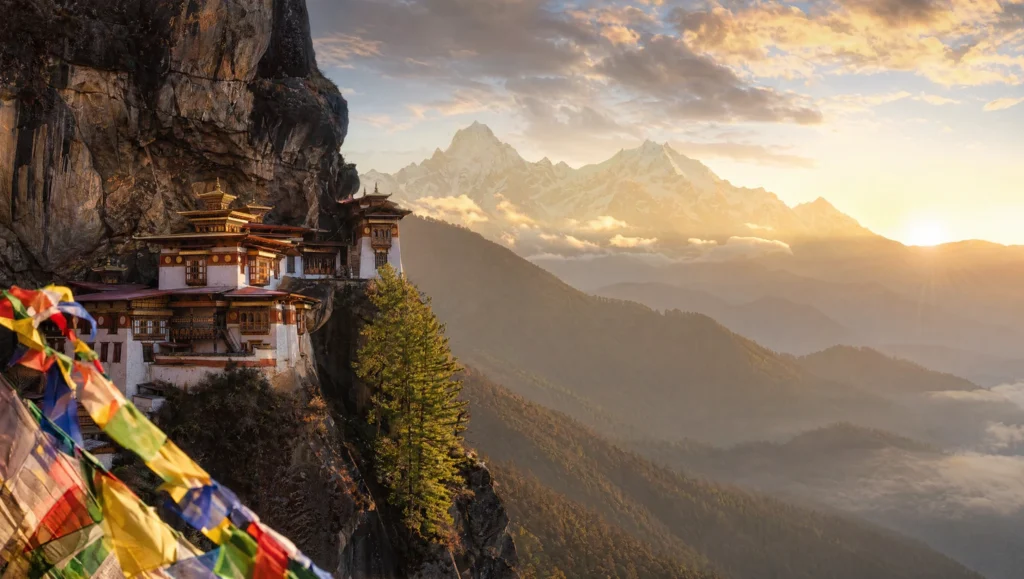
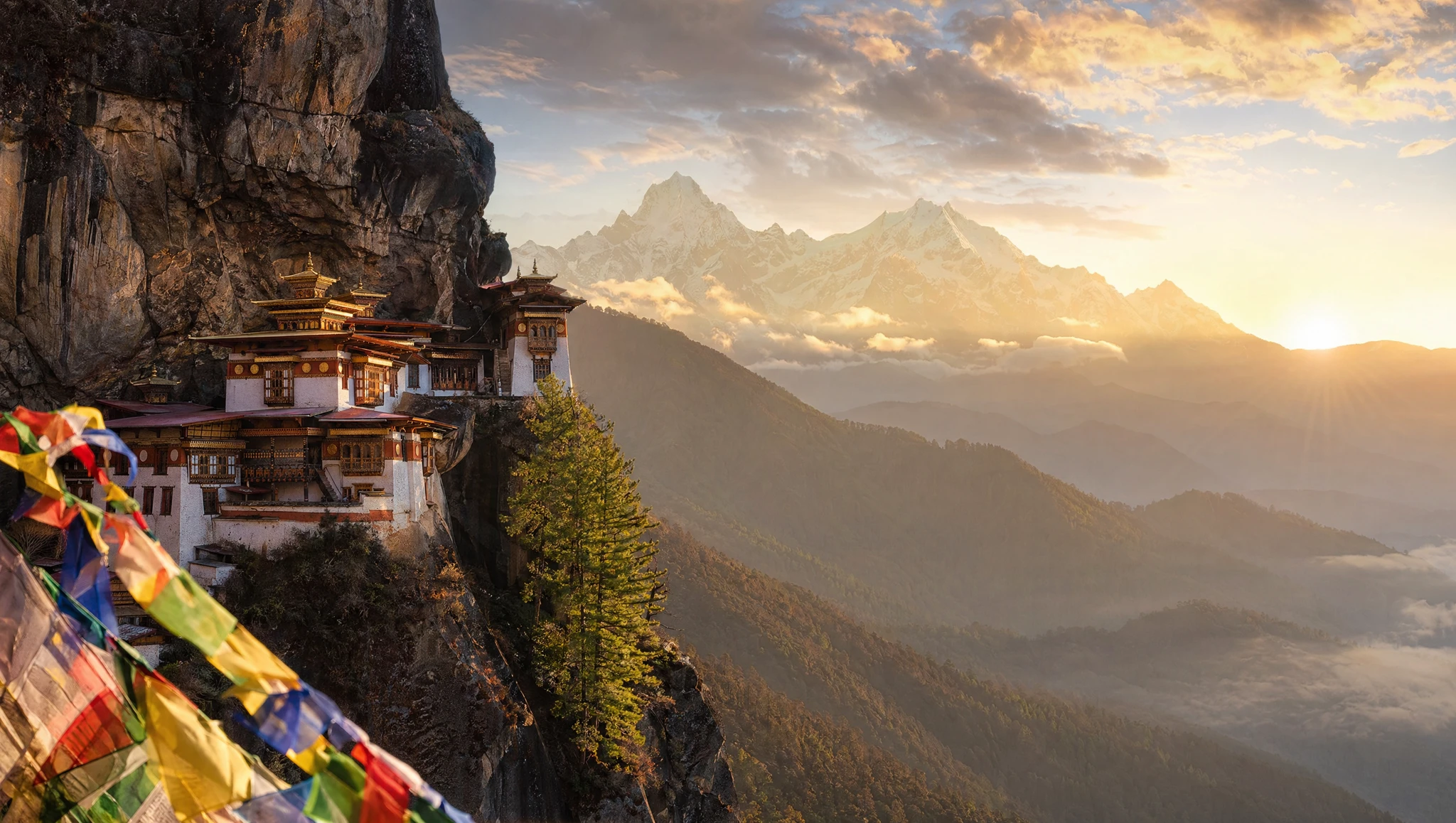
The payoffs are specific and large. Paro Taktsang (Tiger’s Nest) clings to a cliff at 3,120 m above the Paro valley; Punakha Dzong sits at the confluence of two rivers draped in jacaranda in April; Bumthang’s valley holds three temples founded between 659 and 1652; Phobjikha fills each winter with black-necked cranes migrating from Tibet; and the masked-dance tshechus at Paro, Thimphu, and Jambay Lhakhang are living religious theatre, not staged for tourists. A plate of ema datshi (chilli-cheese stew) with red rice costs about 200 ngultrum at a Thimphu canteen and will reset your tolerance for heat permanently. What follows is a practical primer for planning the country end to end.
🎭 Paro Tshechu 2026 — Spring Masked Dances at Rinpung Dzong
If you can time a single trip to Bhutan for one event, make it Paro Tshechu 2026. The festival runs 28 March – 1 April 2026 in the courtyard of Rinpung Dzong, and it is the largest and most photographed of the country’s spring tshechus — five days of cham (masked dance) performed by monks in silk brocade costumes and carved wooden masks depicting wrathful deities, guardian animals, and the eight manifestations of Guru Rinpoche. On the final dawn, the giant appliqué thongdrel is unfurled down the dzong’s entire façade; the belief is that merely seeing it liberates the viewer from the cycle of rebirth.
- Paro Tshechu 2026: 28 March – 1 April (five days) at Rinpung Dzong, Paro
- Thongdrel unveiling: dawn of the final day — arrive by 04:30; gates close when the dzong is full
- Punakha Drubchen & Tshechu: Feb–Mar 2026 at Punakha Dzong — warmer than Paro and visually spectacular at the river confluence
- Thimphu Tshechu: Sep–Oct 2026 at Tashichho Dzong — the autumn equivalent, three days, fills the capital
- Jambay Lhakhang Drup: Oct–Nov 2026 at Bumthang — includes the mewang fire blessing and the late-night tercham naked dance
- What to book: a Paro-valley hotel 4-6 months ahead; rates double and rooms sell out
Best Time to Visit Bhutan (Season by Season)
Spring (Mar–May)
The peak season by consensus. Paro and Thimphu sit at a comfortable 8-22°C, rhododendrons bloom between 2,400 m and 3,800 m from late March into May, and the Paro Tshechu (28 March – 1 April 2026) fills the valley with pilgrims. Punakha at 1,200 m runs warmer (14-28°C) and is subtropical by April; Bumthang at 2,600 m still frosts at night through March. Expect full hotels around the festival, higher package rates, and the best overall odds of clear Himalayan sightlines. Book 4-6 months ahead for any Paro-valley hotel covering the tshechu dates.
Summer (Jun–Aug)
Monsoon season in most of Bhutan. From mid-June through early September the southern slopes catch heavy rain — Paro receives about 650 mm annually, largely in these three months, and Punakha’s lower valley can double that. Roads between valleys are subject to landslide closures, especially the east-west Lateral Road beyond Trongsa. The upside is dramatic cloud-and-mist photography, emerald terraced rice paddies around Paro and Punakha, and the lowest package rates of the year. Haa Summer Festival in mid-July is a rare summer highlight. Build flexible days into any itinerary.
Autumn (Sep–Nov)
The quiet second peak and the other great season. Clear post-monsoon skies produce the sharpest Himalayan views of the year, daytime highs drop through 20-24°C in Paro and Thimphu, and the big autumn tshechus — Thimphu in Sep–Oct, Jambay Lhakhang Drup in Oct–Nov — fall within an easy 10-day trip. Black-necked cranes begin arriving in Phobjikha Valley from late October. Rates sit just below spring peak and hotels in Paro, Punakha, and Thimphu fill fastest. A very strong alternative for travellers who missed Paro Tshechu.
Winter (Dec–Feb)
Cold, clear, and under-travelled. Paro and Thimphu see frost most nights and can drop to -5°C; Bumthang at 2,600 m regularly hits -10°C and passes like Chele La (3,988 m) and Dochu La may close after heavy snow. Punakha at 1,200 m stays mild (5-18°C) and becomes Bhutan’s winter base — kings historically wintered at Punakha Dzong. Phobjikha holds its full black-necked crane population from November to mid-February. Package rates drop 25-30% and skies are often cloudless — a strong off-season pick for photographers and birdwatchers.
Shoulder-season tip: Late May (after the tshechu crowds, before monsoon) and late November (after the last tshechu, before the deep cold) are the sweetest windows — full menus, clear skies, and package rates roughly 15% below peak.
Getting There — Flights & Arrival
Bhutan has one international airport and a tightly controlled flight monopoly. Only two airlines are permitted to land at Paro: Drukair (the state-owned flag carrier since 1981) and privately held Bhutan Airlines. There is no other way to fly in.
- Paro International (PBH) — Bhutan’s only international airport, sitting at 2,235 m in a narrow Himalayan valley; only about 50 pilots in the world are certified to land there. All international arrivals route through Paro.
- Yonphula (YON) — small domestic airport in eastern Bhutan serving Trashigang; seasonal Drukair flights only.
- Bumthang / Bathpalathang (BUT) — central Bhutan domestic airport for the spiritual Bumthang valley; 30-minute flight from Paro.
Flight times: most travellers connect via Delhi (about 2 h 30 m to Paro), Kolkata (1 h), Kathmandu (1 h), Bangkok (4 h), Singapore (5 h 30 m), or Dubai (5 h). There are no direct flights from Europe, North America, or Australia.
Flag carrier: Drukair (Royal Bhutan Airlines) plus Bhutan Airlines — no other carrier operates into PBH.
Visa / entry: Every international visitor except nationals of India, Bangladesh, and the Maldives needs a visa arranged in advance through a licensed Bhutanese tour operator or the official bhutan.travel portal, plus the $100-per-day Sustainable Development Fee.
Getting Around — Licensed Guides, Mountain Roads & Drukair Hops
Bhutan has no passenger rail, no independent rental-car tourism, and no Uber. Every international visitor travels with a licensed guide and a driver arranged by a Bhutanese tour operator; it is not a bureaucratic hurdle but the default way the country receives guests. Distances look small on a map and are not — single-lane mountain roads switchback relentlessly between valleys and most days cover 150-250 km at an average of 35-40 km/h.
- National Highway 1 (Lateral Road): the single east-west spine connecting Paro, Thimphu, Punakha, Trongsa, Bumthang, and beyond.
- Paro → Thimphu: 54 km, about 1 h 15 m by road
- Thimphu → Punakha: 77 km over Dochu La pass (3,100 m), about 2 h 30 m
- Punakha → Bumthang: 210 km via Trongsa, 7-8 h of switchbacks (most itineraries split over two days)
- Paro → Bumthang by Drukair: 30 minutes — a genuine time-saver on longer trips
Guide & driver package: bundled into your tour operator rate — you will not book taxis, buses, or rental cars yourself. A private guide-and-driver costs the operator roughly $80-120 per day depending on season; this is folded into your package and is separate from the $100/day SDF.
Domestic flights: Drukair flies Paro–Bumthang and Paro–Yonphula on limited schedules (2-4 flights per week, weather-dependent). Useful for travellers wanting to reach eastern or central Bhutan without two days of driving each way.
Apps: Google Maps works for navigation but is often wrong on minor roads; your guide drives. eSIM or a Bhutan Telecom tourist SIM (500 Nu.) gives 4G in Thimphu and Paro; data is slow-to-absent in Phobjikha, Bumthang, and the east.
Top Cities & Regions
📍 Map of Bhutan: Every Place in This Guide
🏯 Thimphu
The capital and the country’s only proper city — a compact valley settlement of about 115,000 people, the only world capital without traffic lights, and the logical first or last stop on any itinerary. Thimphu is where modern Bhutan is most visible: cafés, weekend archery tournaments, a lively craft bazaar, and the seat of both government (Tashichho Dzong) and the monastic body. Plan 1-2 days.
- Buddha Dordenma — a 51.5 m bronze-and-gilt Shakyamuni overlooking the valley from Kuenselphodrang
- Tashichho Dzong — the joint seat of government and the Je Khenpo (chief abbot), open to visitors after 5 pm
- Memorial Chorten and the weekend Centenary Farmers’ Market for ema datshi, red rice, and fresh momos
🐅 Paro
The gateway valley, home to the country’s only international airport and the icon everyone comes to see. Paro sits at 2,235 m, ringed by paddy fields and the Pa Chhu river, and holds two of Bhutan’s three must-sees: Paro Taktsang (Tiger’s Nest) and the spring tshechu. Most trips start and end here. Plan 2-3 days.
- Paro Taktsang (Tiger’s Nest Monastery) at 3,120 m — a 2-3 hour uphill hike
- Rinpung Dzong and the National Museum (Ta Dzong) above the river
- Paro Tshechu in spring (28 March – 1 April 2026) — ema datshi, hoentay, and salted butter tea (suja) at rural farmhouses
🏰 Punakha
The old winter capital and one of Bhutan’s most visually striking valleys. Punakha sits at 1,200 m — subtropical and warm even in January — at the confluence of the Mo Chhu (“Mother”) and Pho Chhu (“Father”) rivers. Punakha Dzong, completed in 1637 and still the winter residence of the Je Khenpo, is arguably the country’s most beautiful fortress-monastery, draped in jacaranda in April. Plan 1-2 days.
- Punakha Dzong (Pungthang Dewa Chenbi Phodrang) at the two-rivers confluence
- Chimi Lhakhang — the “fertility temple” of the 15th-century Divine Madman, Drukpa Kunley
- Punakha Drubchen and Tshechu in Feb–Mar — red rice with ema datshi, kewa datshi, and ara
🕉️ Bumthang
Central Bhutan’s spiritual heartland — four valleys (Chokhor, Tang, Ura, Chhume) holding the country’s densest concentration of ancient temples. Bumthang sits at 2,600 m, runs colder than western Bhutan, and feels several centuries removed from Thimphu. Reached by a 30-minute Drukair flight from Paro or a 2-day drive via Trongsa.
- Jambay Lhakhang — one of 108 temples said to have been built in a single night by Songtsen Gampo in 659 CE
- Kurjey Lhakhang (1652) and Tamshing Lhakhang (1501) within a 10-minute drive
- Jambay Lhakhang Drup fire festival in Oct/Nov — buckwheat pancakes (khule), Bumthang cheese, Red-Panda wheat beer
🕊️ Phobjikha Valley
A U-shaped glacial bowl at 3,000 m north-east of Punakha, deliberately kept off the electricity grid for decades to protect the wetlands. Between late October and mid-February the valley is the wintering ground of the endangered black-necked cranes that migrate down from the Tibetan plateau.
- Black-Necked Crane Information Centre at Gangtey with Royal Society for the Protection of Nature hides
- Gangtey Goenpa — Nyingma monastery founded in 1613 above the valley floor
- Gangtey Nature Trail (5.5 km) along the valley — ema datshi, yak cheese, and butter tea
🌲 Haa Valley
A quiet, under-visited valley west of Paro, opened to foreign tourism only in 2002. Reached from Paro over Chele La pass at 3,988 m — Bhutan’s highest motorable road and a clear-day Jomolhari viewpoint. Haa is where to go when the Paro-Thimphu-Punakha loop feels too well-trodden.
- Lhakhang Karpo (White Temple) and Lhakhang Nagpo (Black Temple) — both 7th century foundations
- Chele La Pass at 3,988 m between Paro and Haa
- Haa Summer Festival in July — hoentay dumplings, ema datshi, and tongba millet beer
Bhutanese Culture & Etiquette — What to Know Before You Go
The Essentials
- Dress modestly, especially at dzongs and temples. Covered shoulders and knees for men and women; remove hats and sunglasses before entering any lhakhang. Many dzongs enforce long trousers or skirts plus covered shoulders — your guide will tell you when a shawl or kabney is required. Resort pools and hotel restaurants are relaxed.
- Walk clockwise around religious sites. Chortens (stupas), prayer wheels, mani walls, and temple inner sanctums are always circled to the left — clockwise as you face them. Spin prayer wheels with your right hand only, clockwise.
- Photography restrictions inside temples. Photos of exterior dzongs, courtyards, and cham dances at tshechus are fine; photos inside temple altar rooms and of monks in private practice are generally prohibited. Always ask your guide first and respect signage.
- Tipping is appreciated, not expected. A fair rule is $10-15 per traveller per day for your guide and $5-10 for your driver at the end of the trip, paid in USD cash. Restaurant tipping is not expected outside higher-end Thimphu venues.
- Do not touch heads or point feet at religious images. The head is spiritually highest, the feet lowest — do not pat a child’s head and do not stretch out toward an altar.
Dzongs & Religious Etiquette
- Remove shoes before temple altars. Leave them at the threshold; socks are fine.
- Do not point or photograph monks without asking. Young monks in red robes are extremely photogenic and used to polite requests; approach through your guide.
- Voices down. Many courtyards contain active administrative offices and monastic quarters — the dzong is a working building, not a museum.
- Accept butter tea (suja) and ara at farmhouse visits. Refusing outright is a slight; take one sip and set the cup aside if you cannot finish.
A Food Lover’s Guide to Bhutan
Bhutanese food is built on three ingredients: chilli, cheese, and red rice, applied with no compromise on heat. The national dish, ema datshi, is literally “chilli-cheese” — whole chillies stewed in melted local cheese — and appears at almost every meal. Hotel restaurants cook it mild by default; ask for Bhutanese-style heat once to understand what locals eat. Tour packages include all three meals, so independent restaurant exploration is limited — but Thimphu’s weekend Centenary Farmers’ Market is a superb stand-up snack run: momos, ezay dip, cheese rounds, and red rice by the bag.
Must-Try Dishes
| Dish | Description |
|---|---|
| Ema datshi | The national dish: whole green (or red) chillies stewed in melted local cheese, served with red rice. Eaten at nearly every meal. Heat level is not tourist-adjusted by default — ask for mild at hotel restaurants unless you genuinely mean Bhutanese spice. |
| Red rice | Bhutan’s staple grain: a short-grain red rice grown in terraced high-altitude paddies around Paro and Punakha. Nuttier and pinker than Indian rice, served alongside every datshi and typically the base of any Bhutanese plate. |
| Momos | Tibetan-style steamed dumplings filled with minced beef, cheese-and-cabbage, or potato-and-chilli. Served with fiery ezay chilli-tomato dip — a ubiquitous snack at Thimphu’s weekend market and a fixture of any good road lunch. |
| Suja (butter tea) | Salted tea churned with yak butter and a pinch of salt. Warming at altitude and offered in homes — accept at least one cup at a farmhouse visit; refusing outright is considered rude. Tastes more like a broth than a tea. |
| Shakam paa | Wind-dried beef stir-fried with dried red chillies and radish. A Paro and Thimphu staple born of Himalayan meat-preservation techniques, served over red rice with a spoonful of datshi on the side. |
| Hoentay | Half-moon buckwheat dumplings stuffed with turnip greens, spinach, and cheese — the signature dish of the Haa Valley, most commonly served at the Haa Summer Festival in July. |
| Ara | Home-distilled spirit made from rice, maize, millet, or wheat (typically 20-50% ABV). Often served warmed with butter and an egg cracked into it at rural homestays and tshechus — a single cup at a farmhouse welcome is polite; more than two is enthusiastic. |
Markets, Cafés & Coffee Culture
Sit-down restaurants outside Thimphu and Paro are almost entirely hotel dining rooms attached to your tour package, which means the best independent eating happens at markets and dedicated cafés. Thimphu’s Centenary Farmers’ Market runs Friday evening through Sunday afternoon — red rice by the kilo, yak cheese wheels from Bumthang, whole dried chillies, and hot momos with ezay dip from the upper food hall. Paro’s smaller weekend market sells buckwheat flour, local honey, and farmhouse arak. Coffee culture is small but real in Thimphu: the Ambient Café on Chang Lam, Karma’s Coffee near the clock tower, and Café de Tara in the craft bazaar each serve espresso-based drinks for 120-180 Nu. Alcohol is plentiful — Red Panda wheat beer is brewed in Bumthang; ara is the traditional home spirit; K5 whisky and Bhutan Glory rum are the local distilled options.
- Venues & institutions: Centenary Farmers’ Market (Thimphu), Ambient Café (Thimphu), Folk Heritage Restaurant (Thimphu), Bumthang Brewery
- Signature items: ema datshi, red rice, momos with ezay, suja butter tea, shakam paa, hoentay dumplings, ara
Off the Beaten Path — Bhutan Beyond the Guidebook
Gangtey & the Phobjikha Upper Valley
Most itineraries hit Phobjikha as a day trip from Punakha, which is a mistake — the valley rewards an overnight. The black-necked cranes arrive from the Tibetan plateau from late October and depart in mid-February, and dawn over the wetlands with only yak bells for soundtrack is a rare Himalayan experience. The Gangtey Nature Trail is an easy 5.5 km loop along the valley floor; the Gangtey Goenpa monastery above it, founded in 1613, is often empty outside its occasional tshechu.
Bumthang’s Kurjey–Tamshing–Jambay Triangle
Three of the oldest temples in Bhutan sit within a 10-minute drive of each other in Bumthang’s Chokhor valley: Jambay Lhakhang (659 CE) is one of 108 geomantic temples credited to the Tibetan king Songtsen Gampo, Kurjey Lhakhang (1652) stands over the cave where Guru Rinpoche subdued a local demon, and Tamshing Lhakhang (1501) holds some of the country’s earliest surviving wall paintings. Walkable in a single morning with time for butter tea between.
Trongsa Dzong & the Tower of Trongsa Museum
The ancestral seat of the Wangchuck dynasty, Trongsa Dzong straddles the central ridge that splits Bhutan east from west — every traveller crossing the country passes beneath it. The 2008 Tower of Trongsa Museum, housed in the restored Ta Dzong watchtower above the fortress, is the best single overview of Bhutanese royal and monastic history in the country.
Lhuentse & the Kurtoe Valley
Far north-east of Bumthang, Lhuentse Dzong (1654) sits above the Kuri Chhu gorge in one of Bhutan’s quietest corners. The nearby village of Khoma is the source of kishuthara, the country’s finest silk brocade — weavers produce pieces on back-strap looms over 6-18 months. Almost no organised tourism reaches here; it requires a specific request to your operator and a 2-day drive each way from Thimphu.
Chele La Pass & the Haa Ridge
At 3,988 m Chele La is Bhutan’s highest motorable pass, a 45-minute drive from Paro toward Haa. On a clear spring morning Jomolhari (7,314 m) fills the northern skyline, rhododendrons bloom between 3,200 m and 3,800 m from April to early May, and the roadside prayer flags make the most photographed pass in the country. A short ridge hike above the pass reaches 4,100 m.
Practical Information
Quick reference once your dates are locked. Values below were current as of April 2026.
| Currency | Ngultrum (Nu. / BTN); 1 USD ≈ 83.2 Nu. (19 Apr 2026). BTN is pegged 1:1 to the Indian Rupee (INR) and INR is accepted at par for most transactions. |
| Cash needs | Tour packages cover meals and transport — carry 3,000-5,000 Nu. per day cash for tips, market snacks, and souvenirs. USD cash (clean, post-2013 bills) is widely accepted at hotels. |
| ATMs | ATMs are common in Thimphu, Paro, and Phuentsholing; reliably accept Visa and Mastercard at Bhutan National Bank and Druk PNB. Patchy in Bumthang and the east. |
| Tipping | $10-15 per day for your guide, $5-10 per day for your driver, paid in USD cash at the end of the trip. |
| Language | Dzongkha is the official language; English is the medium of instruction in schools and widely spoken by guides and in hotels. |
| Safety | Bhutan is extremely safe for tourists; violent crime against visitors is effectively non-existent. Altitude (Tiger’s Nest at 3,120 m, Chele La at 3,988 m) is the main risk. |
| Connectivity | 4G in Thimphu and Paro; slow-to-absent in Phobjikha, Bumthang, and the east. Bhutan Telecom tourist SIM from 500 Nu.; Airalo eSIM also works at PBH. |
| Power | Type D/F/G/M plugs, 230V, 50Hz |
| Tap water | Not reliably potable. Hotels provide bottled or filtered water; refillable-bottle stations are increasingly common in Thimphu. |
| Healthcare | Public hospitals in Thimphu (JDWNRH) and Paro. Comprehensive travel insurance with evacuation cover to Bangkok or Delhi is strongly recommended. |
Budget Breakdown — What Bhutan Actually Costs
💚 Budget Traveller
Bhutan does not have a true backpacker tier. Every international visitor pays the $100/day Sustainable Development Fee and must travel with a licensed guide and driver, so “budget” means 3-star hotels, fixed-menu Bhutanese meals included in the package, and shared transport. Realistic per-day: SDF $100 + package $150-200 = $250-300 per person per day, roughly halved if you are travelling as a couple sharing a guide and driver. Children 6-12 pay a reduced $50/day SDF; under-6 are exempt, which meaningfully reshapes family budgeting.
💙 Mid-Range
The tier most independent visitors actually book. Plan $400-550 per person per day: SDF $100 + package $300-450 covering 4-star hotels (Zhiwa Ling, Hotel Druk, Dewachen in Phobjikha), a private guide and driver, three meals daily, and valley-to-valley transfers. This is the standard “package” rate advertised by most licensed operators, and it delivers the full classic Paro–Thimphu–Punakha loop without compromise. Add $200-300 per Drukair domestic-flight segment if including Bumthang without the 2-day drive.
💜 Luxury
$900+ per person per day at the country’s three luxury chains: Amankora across five lodges, Six Senses across five lodges, and &Beyond Punakha River Lodge. Rooms start around $1,500 per night all-inclusive; a classic 7-night Amankora journey prices around $12,000-16,000 per person excluding flights — butler service, hot-stone baths, in-room yoga, and gastronomic takes on ema datshi.
| Tier | Daily (USD) | Accommodation | Food | Transport |
|---|---|---|---|---|
| Budget | $250-300 | 3-star hotel (included) 2,500-4,500 Nu. | Package meals ema datshi, red rice | Shared guide + driver (included) |
| Mid-Range | $400-550 | 4-star hotel 6,000-10,000 Nu. | Package meals + a la carte ($15-30) | Private guide + driver (included) |
| Luxury | $900+ | Amankora / Six Senses ($1,500+) | Gastronomic Bhutanese all-inclusive | Private 4×4 + Drukair hops ($200+/hop) |
Planning Your First Trip to Bhutan
A first trip to Bhutan works best at 7-10 days. That window covers the classic Paro–Thimphu–Punakha western loop with Tiger’s Nest on the final day, or adds Phobjikha and Bumthang for a second week.
- Choose a licensed Bhutanese tour operator. Every itinerary must be booked through a government-licensed operator or the official bhutan.travel portal. Shortlist 2-3 and compare daily package rates (separate from the $100 SDF).
- Lock festival dates if that is the trip. Paro Tshechu 2026 runs 28 March – 1 April; book Paro-valley hotels 4-6 months ahead.
- Apply for your e-visa through your operator. Processing is typically 5-7 working days once the SDF and package balance are paid. Carry the e-visa PDF and QR code.
- Book Drukair or Bhutan Airlines flights early. Only two airlines serve Paro; seats sell out 6-8 weeks ahead for spring festival dates. Request a left-hand window seat for Himalayan views.
- Acclimatise for Tiger’s Nest. The monastery sits at 3,120 m with a 700 m gain over 2-3 hours. Schedule it for day 4 or 5, not day 1.
Classic 8-Day Itinerary: Paro 1 night (arrival) → Thimphu 2 nights → Punakha 2 nights → Phobjikha 1 night → Paro 2 nights (Tiger’s Nest on final full day).
Frequently Asked Questions
Is Bhutan expensive to visit?
Yes, deliberately. The $100/day Sustainable Development Fee plus a mandatory tour-operator package put the realistic floor at about $250-300 per person per day and a comfortable mid-range trip at $400-550. There is no backpacker option and no independent travel permitted; the cost is how Bhutan funds free healthcare, free education, and the 60% forest-cover mandate. Indian, Bangladeshi, and Maldivian nationals pay lower or no SDF.
Do I need to speak Dzongkha?
No. Dzongkha is the official language, but English has been the medium of instruction in Bhutanese schools since the 1960s and is spoken fluently by every licensed tour guide and by staff at most hotels and restaurants in Thimphu, Paro, Punakha, and Bumthang. Learn kuzuzangpo la (hello/respectful greeting) and kadrin chhe la (thank you) and you will be welcomed warmly.
Do I need to book a guided tour?
Yes — it is not a recommendation, it is the law. Every international visitor except nationals of India, Bangladesh, and the Maldives must travel on an itinerary pre-booked through a licensed Bhutanese tour operator, with a guide and driver provided for the duration of the trip. Independent travel — rental cars, backpacker hostels, unguided trekking — is not permitted.
Is Bhutan safe for solo travellers?
Extremely. Bhutan is one of the safest countries in Asia for tourists — violent crime against visitors is effectively non-existent, and because every itinerary is guided, solo travellers are never actually alone on the ground. The main practical risks are altitude (Tiger’s Nest at 3,120 m, Chele La at 3,988 m) and mountain-road switchbacks. Female solo travellers report Bhutan as one of their easiest Asian destinations.
When is Paro Tshechu 2026?
28 March – 1 April 2026, at Rinpung Dzong in the Paro valley. Five days of masked cham dance by monks in silk costumes, culminating in the dawn unveiling of the giant appliqué thongdrel on the final morning. Book Paro-valley hotels 4-6 months ahead — it is the busiest week of the year in Paro.
Can I get by as a vegetarian or vegan?
Yes, easily. Traditional Bhutanese cuisine is heavy on cheese, chilli, rice, potatoes, and greens; ema datshi, kewa datshi (potato-cheese), shamu datshi (mushroom-cheese), and red rice are all vegetarian by default. Vegans should specify no cheese, no butter, and no ghee in advance — dairy is omnipresent.
What is Gross National Happiness?
Gross National Happiness is the four-pillar development philosophy written into Bhutan’s 2008 constitution — equitable economic development, environmental conservation, cultural preservation, and good governance. It is why Bhutan runs a high-value, low-volume tourism model (the $100 SDF, licensed guides), mandates 60% forest cover, and requires national dress for civil servants.
Ready to Explore Bhutan?
Start with our city guides to Thimphu, Paro, and Punakha, or jump straight to the full Bhutan trip-cost breakdown — including SDF, package, and Drukair-flight math for a realistic 8-day first trip.
Explore More
More country guides you might like
Plan your trip to Bhutan
The booking tools we use ourselves. FFU may earn a commission at no extra cost to you.
Plan & book your trip to Bhutan
Booking through these searches supports our guides at no extra cost to you.