
City Guide · Thimphu Dzongkhag · Western Bhutan
Thimphu, Bhutan: The Traffic-Light-Free Himalayan Capital of Gross National Happiness, the Buddha Dordenma & the Tashichho Dzong
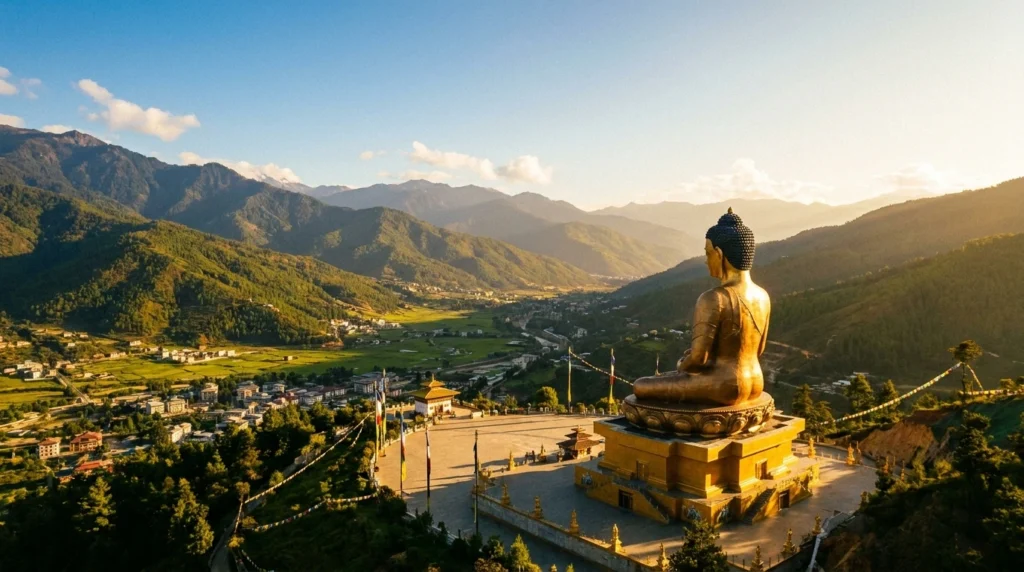
I arrived in Thimphu expecting a remote Himalayan outpost and got handed something stranger — a working national capital of roughly 114,000 people that genuinely has no traffic lights (one was installed, locals hated it, and a white-gloved policeman in a glass pavilion took the junction back within days) , sits between 2,248 and 2,648 metres up the Wang Chhu valley as the highest capital in Asia and the only one in the world with this no-signal quirk. This is the seat of a country that measures itself by Gross National Happiness rather than GDP, runs carbon-negative as the first nation on Earth to do so, and charges every foreign visitor a US$100-per-night Sustainable Development Fee on top of their costs. The 51.5-metre golden Buddha Dordenma looks down on the whole valley from Kuensel Phodrang hill, the Tashichho Dzong houses both the throne room and the central monastic body under one fortress roof, and the ngultrum in your wallet trades at exact parity with the Indian rupee. Treat this guide as the brief I would hand my own family before they boarded the white-knuckle Drukair approach into Paro — and for the wider Kingdom frame (the SDF, the licensed-guide rule, the Tiger’s Nest) read it alongside our Bhutan country guide.

Table of Contents
Why Thimphu?
Thimphu is the only national capital on Earth without a single traffic light — a white-gloved police officer directs Norzin Lam from a glass pavilion, and when the authorities once installed an actual signal, residents complained it was impersonal and it was gone within days. It is also the highest capital in Asia, strung out along the Wang Chhu (Thimphu Chhu) river between roughly 2,248 and 2,648 metres in a steep-sided Himalayan valley. The city became the permanent capital of Bhutan in 1961 under the third king, Jigme Dorji Wangchuck, taking over from the old winter seat at Punakha.
The scale is deliberately small. With a population of around 114,000 in the city proper, Thimphu holds roughly an eighth of Bhutan’s national population yet feels more like a large market town than a metropolis — a single main valley axis, a strict building code requiring traditional Bhutanese architecture with painted timber windows and rammed-earth or whitewashed walls, and no structure allowed to overshadow the dzong. This is the capital of a kingdom that measures its progress by Gross National Happiness rather than GDP, the first carbon-negative nation in the world, and a country that admitted its first tourists only in 1974.
What makes Thimphu the single best urban day in the Himalaya is the density of icons inside one valley: the 51.5-metre golden Buddha Dordenma on Kuensel Phodrang hill, the riverside Tashichho Dzong that houses both the throne room and the Je Khenpo’s central monastic body, the whitewashed National Memorial Chorten where elderly pilgrims circumambulate from dawn, and the weekend Centenary Farmers’ Market where the whole valley comes to trade chillies and yak cheese. This guide covers all of those, plus the Dochula Pass day trip and the practical realities of the SDF and the licensed-guide rule.

Neighborhoods: Finding Your Thimphu
📍 Thimphu Map: Every Place in This Guide
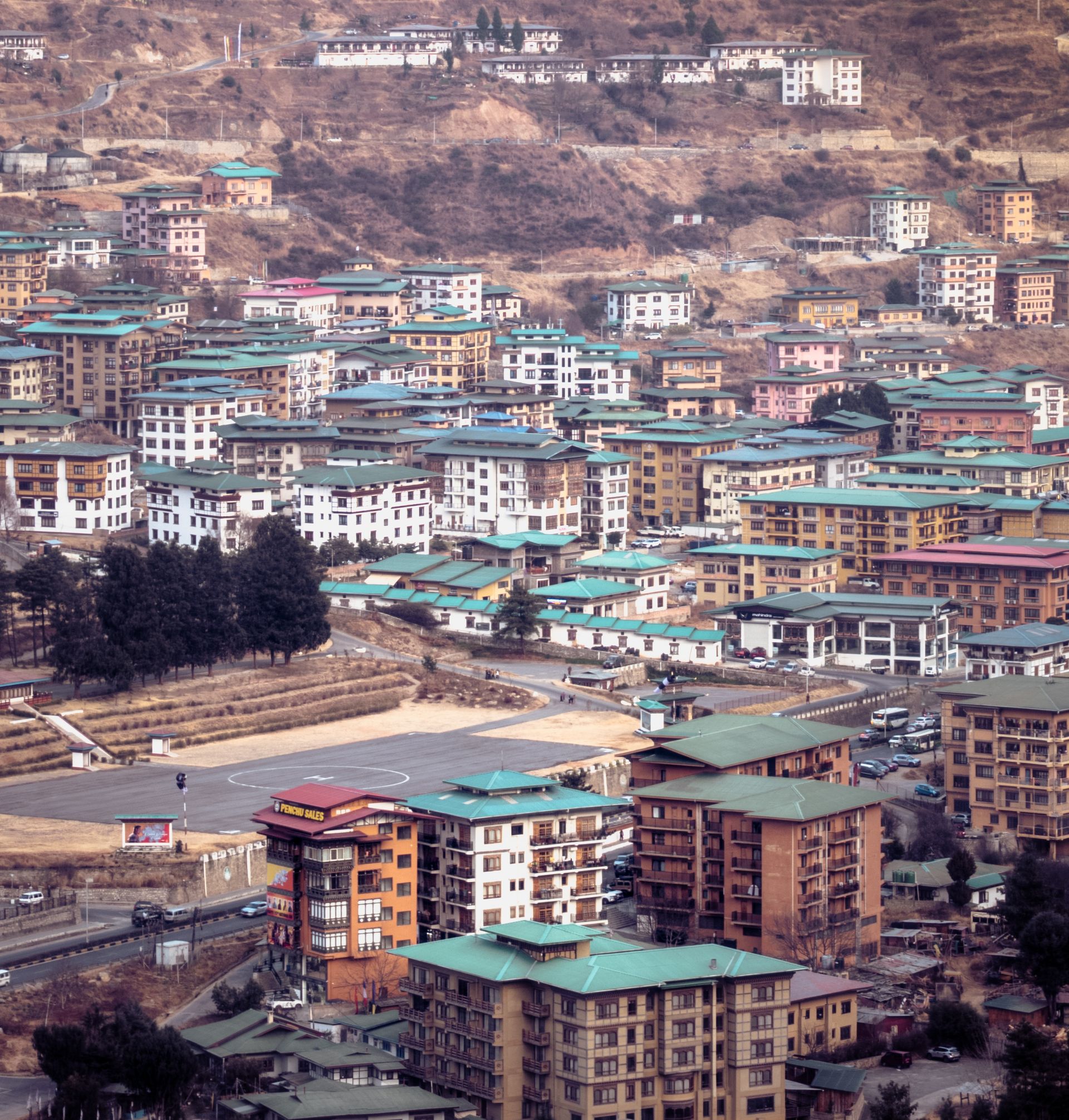
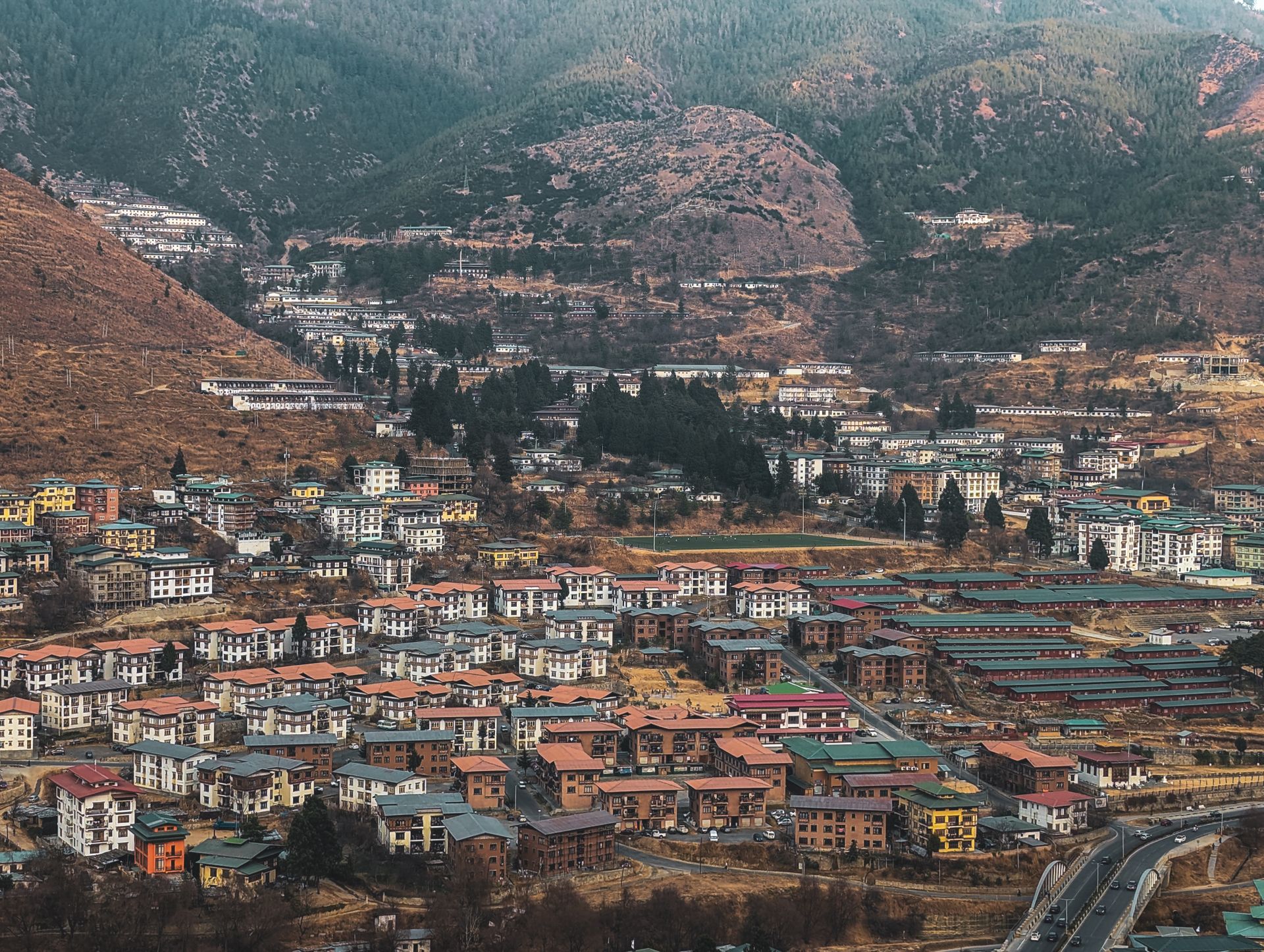
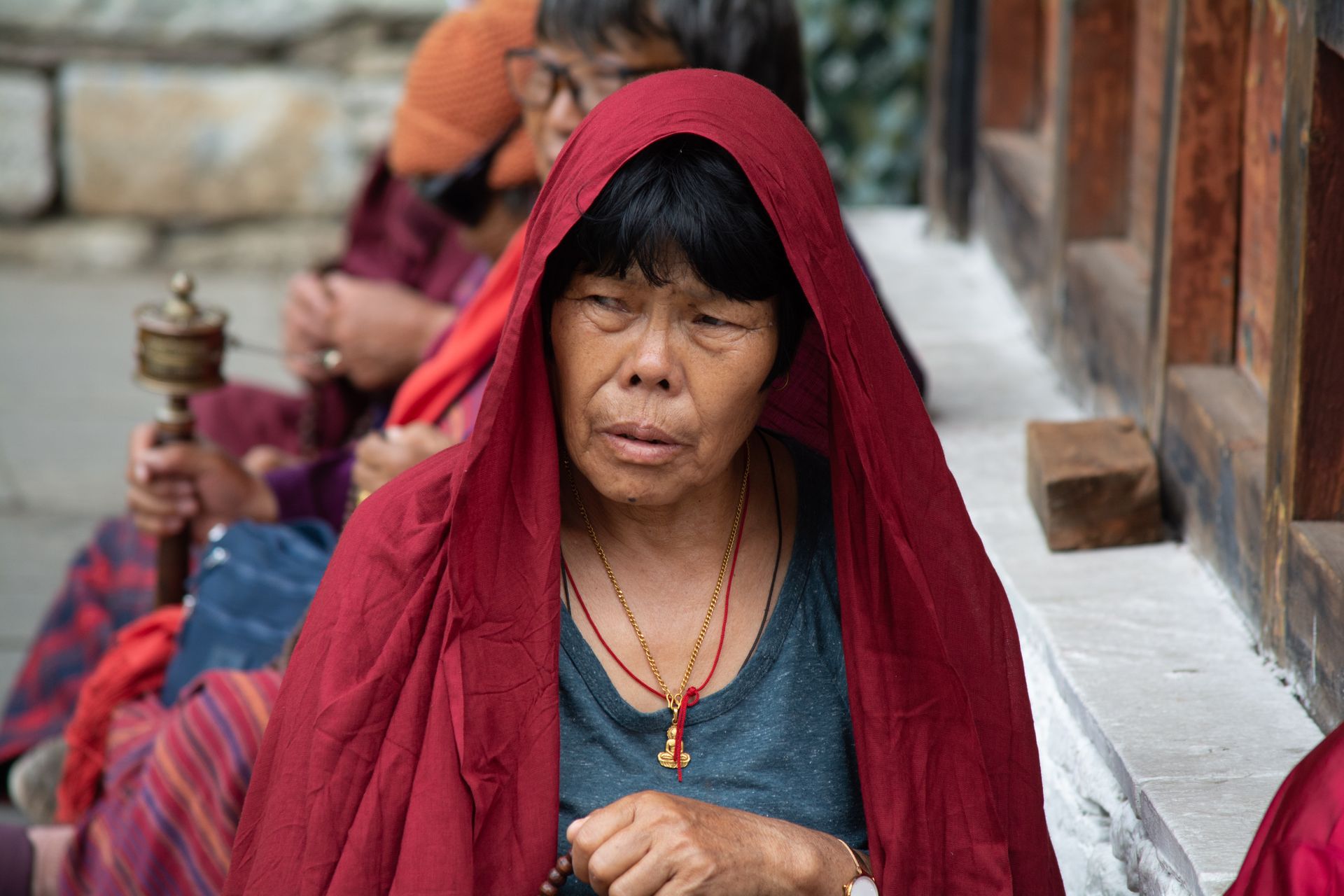
Thimphu is a single long valley town, not a sprawl — the whole city is stitched along the west bank of the Wang Chhu (Thimphu Chhu) river, climbing the slopes on either side, and you can cross the built-up core end to end in well under an hour on foot. Because the strict national building code caps height and mandates traditional Bhutanese facades — painted timber windows, sloping roofs, whitewashed or rammed-earth walls, and nothing tall enough to overshadow the dzong — there is no glass-tower business district to orient by. Instead you navigate by the river, the Norzin Lam spine, the Clock Tower and the hills. The practical division below is the one your guide will use: a flat, walkable commercial core in the valley floor, and a ring of hillside districts — craft, residential, civic and recreational — that you reach by short taxi hops. Knowing which is which is the difference between a tight, well-sequenced two days and a lot of doubling back.
Norzin Lam & the City Centre
Norzin Lam is Thimphu’s spine — the main commercial street where the famous traffic-directing pavilion stands, lined with shops, banks, cafes, travel agencies, handicraft emporia and the painted-timber facades the building code mandates. This is the heart of walkable Thimphu, and almost everything in the centre is ten minutes apart on foot. The street runs roughly north–south parallel to the river; the white-gloved traffic policeman works the main junction at the southern end, where a signal was once installed and removed within days after residents complained it was impersonal. Mornings here are for banks, SIM cards and money-changing; afternoons and evenings for browsing thangka shops, textile boutiques and bookshops. Most three- and four-star hotels sit on or just off Norzin Lam, which makes it the obvious base for a first visit.
- The traffic-circle police pavilion on Norzin Lam
- The Clock Tower Square pedestrian plaza one block east
- Hotel, cafe and craft-shop strip along Norzin Lam and Chang Lam
- The central taxi stand for hillside-sight runs
Best for: first-timers and anyone wanting to walk everywhere. Access: the central taxi stand and most hotels sit within a few minutes’ walk.
Chang Lam & Clock Tower Square
One block east toward the river, Clock Tower Square is the social hub — an ornate carved-and-painted clock tower decorated with dragons and lotus motifs, open paving used for festivals, concerts and craft fairs, and a ring of restaurants, coffee houses and bars. It is the best evening anchor in the city: as the shopfront lights come up and the after-work crowd gathers, the square becomes the closest thing Thimphu has to a piazza. Chang Lam, running parallel toward the river, carries more of the casual dining and the city’s modest bar-and-karaoke scene. The square is also where seasonal events — the winter craft bazaar, national-day gatherings, the occasional open-air film — tend to land.
- Clock Tower Square’s carved-and-painted tower
- Evening restaurant, coffee-house and bar cluster
- Pedestrian-friendly festival and event space
- Easy walk to the riverside and Changlimithang
Best for: evenings, people-watching, festival timing. Access: a five-minute walk from Norzin Lam.
Kuensel Phodrang (Buddha Point)
The hill on the southwestern edge of the valley crowned by the giant Buddha Dordenma, set in the 943-acre Kuensel Phodrang Nature Park. The viewpoint terrace gives the single best panorama over the whole capital, framing the dzong, the river and the grid of green-roofed houses against the forested ridges. The 51.5-metre gilded bronze statue dominates the skyline from almost everywhere in the city, so this is both a destination and the orientation point you keep glancing back at. The surrounding park has gentle, well-marked walking trails through blue-pine forest, popular with local families at weekends, and a network of paths that connect down toward the city — a good gentle acclimatisation walk on your first morning.
- The 51.5-metre Buddha Dordenma statue
- Valley-panorama viewing terrace
- Kuensel Phodrang Nature Park forest trails
Best for: sunrise/sunset photography and the city panorama. Access: a 10–15 minute taxi ride uphill from the centre.
Motithang
The leafy, higher-elevation residential and hotel district on the western slope, home to the Motithang Takin Preserve. The air is noticeably cooler and the streets quieter than the valley floor; several upscale hotels, guesthouses and diplomatic residences sit among the pines here, making it a calm, scenic base if you would rather wake to birdsong than traffic. The takin enclosure — protecting Bhutan’s improbable national animal, a goat-antelope tied to the legend of the “Divine Madman” — is the district’s headline draw and an easy, family-friendly stop. Forested walking paths thread above the houses toward the ridge, and the elevation makes Motithang a sensible place to spend your first night while you adjust to the altitude.
- Motithang Takin Preserve (Bhutan’s national animal)
- Forested walking paths above the city
- Upscale hotels and quiet guesthouses
Best for: quiet stays, families, wildlife. Access: a short taxi from the centre; uphill walk if you are acclimatised.
Chubachu & the North End
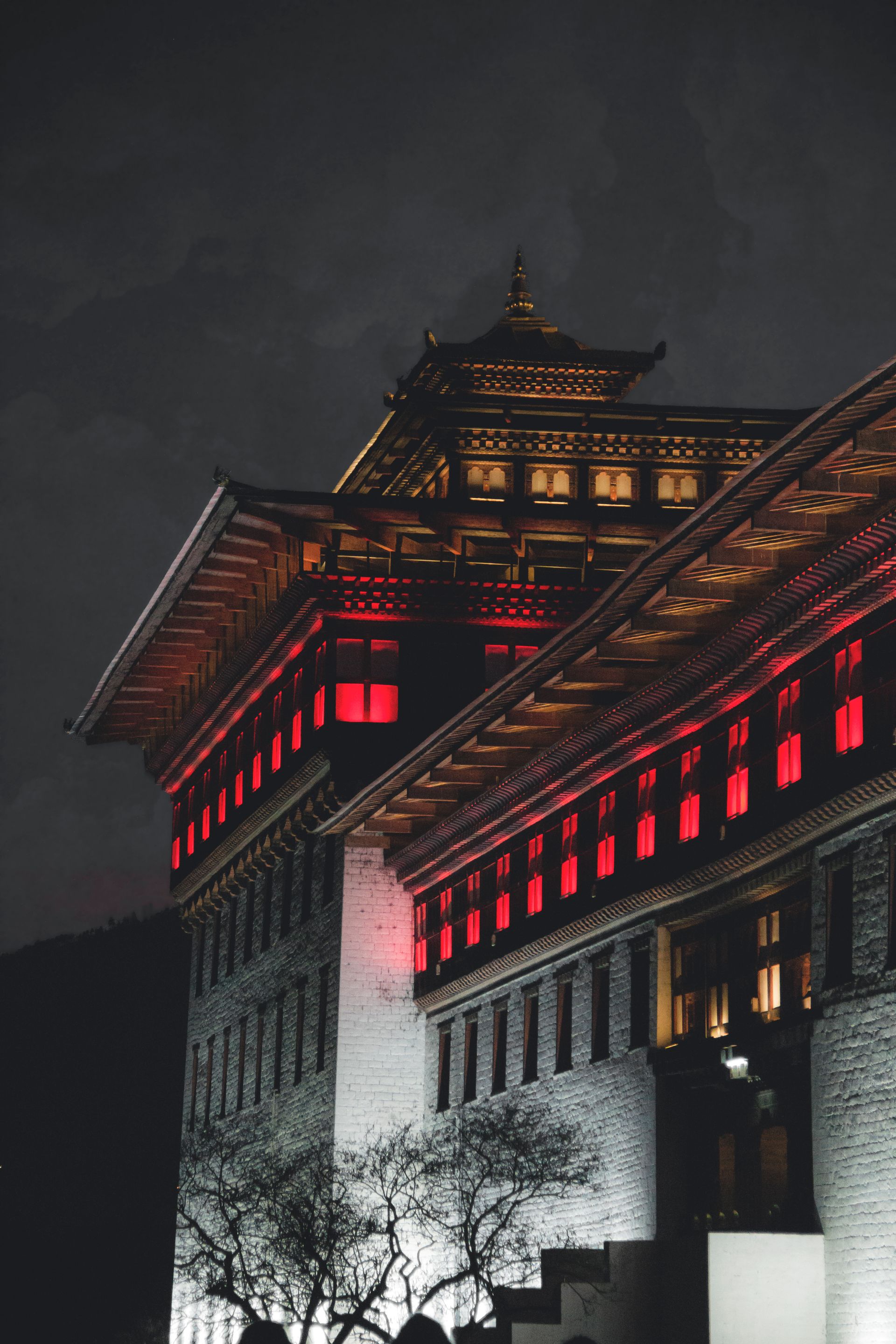
The northern quarter toward the Tashichho Dzong and the government district, with the National Memorial Chorten nearby. This is institutional Thimphu — ministries, the dzong, the national referral hospital and the riverside promenade along the Wang Chhu. The great fortress-monastery of the Tashichho Dzong dominates the north end, housing the throne room, government offices and the summer residence of the Je Khenpo and the central monastic body under one roof. The riverside path here is one of the most pleasant flat walks in the city, especially in the late-afternoon light when the dzong opens to visitors after government hours. Chubachu itself is a workaday residential and office district that fills the slope behind.
- Tashichho Dzong, the seat of government
- National Memorial Chorten
- Wang Chhu riverside promenade
Best for: sightseeing the civic monuments on foot. Access: a 10-minute taxi north from Norzin Lam.
Changlimithang & the Stadium District
Built on the site of the decisive 1885 battle that helped unify Bhutan, the Changlimithang area centres on the national stadium — the venue for archery (the national sport), football and the big national-day events. Watching an archery tournament here, with teams in traditional gho robes loosing arrows at targets set 145 metres apart while opponents sing ribald songs and dance to put them off, is the most authentically Bhutanese spectacle in the capital. The ground is named for the battle in which Ugyen Wangchuck consolidated the power that made him Bhutan’s first hereditary king in 1907, so the stadium is also, in effect, a foundation site of the modern monarchy. It sits within easy walking distance of Clock Tower Square.
- Changlimithang National Stadium and archery ground
- National archery tournaments and football matches
- Central, walkable from the city core
Best for: archery spectating, sport, national events. Access: walkable from the centre and Clock Tower Square.
Babesa & the Expressway South
The expanding southern districts along the Thimphu–Babesa Expressway, where newer apartment blocks, the Simply Bhutan living-museum and the road to the Dochula Pass and Punakha all begin. Most onward day trips launch from here, so if your itinerary moves east to Punakha or you are doing the Dochula half-day, you will pass through Babesa on the way out. The Simply Bhutan museum is a purpose-built cultural attraction where you can try on traditional dress, taste ara (the home-distilled spirit) and watch craft demonstrations — touristy but genuinely useful as a fast primer on the day you arrive. The southern districts are where Thimphu’s growth is most visible, with newer hotels and the Babesa Village Restaurant, a well-regarded spot for a family-style Bhutanese spread.
- Simply Bhutan cultural living museum
- The expressway south toward Dochula and Punakha
- Newer residential and hotel development
Best for: launching day trips, modern stays. Access: on the main southern artery; 10–15 minutes by taxi from the centre.
Kawajangsa & the Craft Quarter
The northwestern slope home to the National Institute for Zorig Chusum (the school of the thirteen traditional arts), the Folk Heritage Museum and the National Library of Bhutan. This is where Thimphu keeps its living crafts and old-Bhutan domestic life on display. At Zorig Chusum you can watch students train in painting, sculpture, woodcarving, embroidery and the other traditional disciplines, classes in full session behind open workshop doors. A few minutes away, the Folk Heritage Museum recreates rural Bhutanese household life in a restored 19th-century rammed-earth farmhouse, and the National Library holds the country’s collection of Buddhist texts and the famously oversized printed volumes. It is the best district for a slow, culture-focused morning, easily combined into a single uphill taxi loop.
- National Institute for Zorig Chusum (the thirteen traditional arts)
- Folk Heritage Museum (a restored 19th-century farmhouse)
- National Library of Bhutan
Best for: crafts, art students, slow cultural mornings. Access: a short taxi uphill from the centre.
Put together, the smartest base for most visitors is on or just off Norzin Lam — walkable to the centre, the Clock Tower and Changlimithang, and a five-to-fifteen-minute taxi from every hillside sight. Choose Motithang instead if you want quiet, cooler air and a gentler altitude adjustment, or the southern Babesa stretch if your itinerary is pushing on to Punakha the next day. Whichever you pick, the valley’s small scale means no neighbourhood is ever truly far from another, and you can comfortably cover the civic core, the craft quarter and the Buddha point in a single day with a taxi on standby. The one thing to keep in mind is verticality rather than distance: Thimphu climbs its slopes steeply, so a sight that looks close on the map may be a stiff uphill haul at 2,300-plus metres, which is exactly why the taxi-and-walk combination beats trying to do everything on foot. A good rule of thumb: walk the flat valley-floor core, and take a taxi the moment the road tilts uphill toward the Buddha, Motithang, Changangkha or the craft quarter. Your guide will sequence these into a logical loop so you climb once and descend once rather than zig-zagging across the valley.
The Food

Bhutanese food is unlike anything else in the Himalaya, and Thimphu is the best place to meet it because the capital concentrates both authentic local kitchens and the milder tourist-facing restaurants. The defining fact is chilli: in Bhutan the chilli is treated as a vegetable in its own right, not a seasoning, and the national palate runs to a heat level that genuinely startles unaccustomed visitors. The other constant is cheese — datshi, a soft farmer’s cheese made from cow or yak milk — which is melted into almost everything. Add nutty red rice, dried and preserved meats, buckwheat from the central valleys, and the Tibetan-influenced momo and thukpa, and you have the full Thimphu menu. Many restaurants are vegetarian in line with Buddhist sensibilities, and meat is often imported and seasonal. Prices below are indicative; the US$100 nightly Sustainable Development Fee aside, eating in Thimphu is inexpensive by Western standards if you eat where locals eat.
Ema Datshi & the Datshi Family
Ema datshi — whole or sliced green and red chillies stewed in a sauce of local datshi cheese made from cow or yak milk — is the national dish of Bhutan and treated as a vegetable course rather than a condiment. It is the single dish you must try, and the one that most defines the national table. Thimphu kitchens serve a whole datshi family beyond the original: kewa datshi (potato and cheese), shamu datshi (mushroom and cheese), and milder cheese-forward versions cooked for foreign palates. In its authentic form ema datshi is genuinely, eye-wateringly hot — the chillies are the body of the dish, not a garnish — so first-timers are wise to start with the potato or mushroom variants and ask for it “mild.” Served over red rice, a good datshi is rich, sharp and warming, perfectly suited to the cool mountain climate, and it appears on every menu from street stalls to luxury lodges.
For the most atmospheric introduction, the Folk Heritage Restaurant in Kawajangsa serves a traditional ema datshi set meal cooked over a wood fire in a restored farmhouse, the food matching the museum next door (Nu 600–900, ~US$7–11). South of the centre, the Babesa Village Restaurant lays out a generous family-style Bhutanese spread — red rice, several datshi dishes, dried meats and seasonal vegetables — in another heritage building (Nu 700–1,000, ~US$8–12). And for a cheap, busy, thoroughly local meal in the heart of town, Zombala 2 on Norzin Lam is a long-standing favourite for momos and ema datshi at a fraction of hotel prices (Nu 200–400, ~US$2–5).
- Folk Heritage Restaurant (Kawajangsa) — traditional ema datshi set meal in a restored farmhouse (Nu 600–900, ~US$7–11)
- Babesa Village Restaurant — family-style Bhutanese spread including red-rice and datshi dishes (Nu 700–1,000, ~US$8–12)
- Zombala 2 (Norzin Lam) — local-favourite momos and ema datshi (Nu 200–400, ~US$2–5)
Momos & Tibetan-Influenced Dishes
The Himalayan momo — steamed or fried dumplings stuffed with cheese, cabbage, or minced meat and served with a fiery ezay chilli dip — is the everyday Thimphu street and cafe staple, reflecting the deep Tibetan culinary influence that runs through Bhutanese cooking. Cheese momos are the local favourite and a safe, delicious entry point for anyone wary of the chilli. Alongside them, thukpa (a hearty noodle soup with vegetables and sometimes meat) is the go-to comfort dish on a cold Thimphu evening, and the buckwheat dishes of the central Bumthang valley — puta (buckwheat noodles) and khule (buckwheat pancakes) — round out the roster. You will find momos everywhere from the weekend market stalls, where they are steamed to order by the plate, to the casual cafes around Clock Tower Square. They are the cheapest, friendliest and most reliable way to eat well in the capital, and a plate makes an ideal light lunch between sights.
Around the Clock Tower, The Zone is a relaxed cafe-restaurant good for cheese and beef momos and Western comfort food when you need a break from chilli (Nu 250–450, ~US$3–5). On Norzin Lam, the Ambient Cafe is a reliable all-day spot for momos, thukpa and decent coffee with Wi-Fi and a young crowd (Nu 200–500, ~US$2–6). And the cheapest, freshest momos of all come from the stalls at the weekend Centenary Farmers’ Market, steamed to order by the plate while you watch the trade (Nu 100–250, ~US$1–3).
- The Zone (Clock Tower area) — cheese and beef momos, casual cafe setting (Nu 250–450, ~US$3–5)
- Ambient Cafe (Norzin Lam) — momos, thukpa and coffee (Nu 200–500, ~US$2–6)
- Weekend-market momo stalls — freshly steamed momos by the plate (Nu 100–250, ~US$1–3)
Beyond Ema Datshi and Momos
Bhutanese cooking goes well past its two headline dishes. The staple grain is the distinctive nutty, pinkish red rice grown in the valleys, which has a firmer bite and earthier flavour than white rice and accompanies almost every meal. The protein dishes lean on dried and preserved meats — a practical legacy of a mountain country with a short growing season and limited refrigeration historically — so pork, beef and yak often arrive dried, then rehydrated and stewed hard with chillies and radish. Phaksha paa, a rich stew of pork belly with dried red chillies and white radish, is a winter favourite, while jasha maru is a lighter, gingery minced-chicken stew. To drink, suja (salted butter tea, churned and faintly savoury) is the traditional welcome, and ara — a home-distilled spirit made from rice, maize, wheat or barley — is the celebratory drink of the villages. None of these are difficult to find in Thimphu, and a guide can point you to the kitchens that cook them properly rather than blanding them down for tourists.
The dishes to seek out beyond the headliners give you the fuller picture of Bhutanese cooking — the earthy red rice that grounds every plate, the hard-stewed dried meats that reflect the country’s mountain practicality, and the traditional drinks that punctuate village life. Order a couple of these alongside your datshi and you will eat the way Bhutanese families actually do.
- Red rice — the nutty, pinkish high-altitude staple grain served with almost every meal (Nu 100–200)
- Phaksha paa — pork belly stewed with dried chillies and white radish (Nu 400–700)
- Jasha maru — spicy minced-chicken stew with ginger, garlic and coriander (Nu 350–600)
- Suja & ara — salted butter tea and the home-distilled rice or maize spirit (Nu 50–200)
Food Experiences You Can’t Miss
The capital’s best food experiences are as much about place and ritual as flavour. Top of the list is the Centenary Farmers’ Market on the west bank of the Wang Chhu, the largest in Bhutan, where from Friday to Sunday the whole valley comes to trade: pyramids of fresh and dried chillies, rounds of datshi cheese, fiddlehead ferns, river fish, incense, butter and red rice fill the covered halls, and the momo stalls steam dumplings to order. Set aside a Saturday morning for it. Equally worth booking is a traditional set meal in the restored 19th-century farmhouse at the Folk Heritage Museum restaurant in Kawajangsa, where the dishes are cooked over a wood fire much as they would have been a century ago. And no food tour of Bhutan is complete without a cup of suja, the salted butter tea shared with a Bhutanese family or your guide — an acquired but essential taste that is offered as a gesture of hospitality everywhere you go.
- The Centenary Farmers’ Market by the Wang Chhu on a Friday–Sunday — mountains of dried chillies, datshi cheese, ferns and incense
- A traditional set meal in the restored farmhouse at the Folk Heritage Museum restaurant
- A cup of suja (butter tea) shared with a Bhutanese family or guide — an acquired but essential taste
- Fresh cheese momos by the plate, steamed to order at a weekend-market stall
A few practical notes for eating in Thimphu. Meal times skew early by Western standards — dinner is often served from around 6.30 to 8.30pm, and many kitchens wind down by nine. Vegetarians are exceptionally well catered for, since a great deal of Bhutanese cooking is meatless by Buddhist custom and the datshi dishes are built around cheese and vegetables; conversely, committed meat-eaters should know that beef and pork are often imported, dried and seasonal rather than fresh. Tap water is not safe to drink, so stick to bottled, boiled or filtered water, which hotels and your guide supply as standard. Alcohol is widely available except on Tuesday, the national dry day, when bars and shops do not serve it. And if you want to take the flavours home, the weekend market sells bags of dried red chillies and packets of red rice that travel well. Above all, pace your chilli intake: the single most common mistake first-time visitors make is ordering authentic ema datshi at full strength on night one and spending the rest of the meal in tears — ease in with the milder potato and mushroom datshi and a plate of cheese momos, and let your palate adjust over a couple of days. By the end of a Thimphu stay, many visitors find they have come round to the chilli entirely, ordering their datshi medium and reaching for the ezay dip without flinching — the food, like the city, rewards a little patience and an open mind, and a shared meal of red rice, datshi and momos with your guide is one of the warmest, most memorable parts of any trip to the Bhutanese capital. Make a point, too, of trying the seasonal vegetables that appear on local tables — nakey (fiddlehead ferns) in spring, wild mushrooms in the monsoon, and the ubiquitous white radish through the colder months — because eating with the seasons is the surest way to taste Thimphu as its own people do.
Cultural Sights

Thimphu’s sights are tightly clustered for a capital, and almost all of them are devotional or civic rather than commercial — this is a city built around a fortress-monastery, a giant Buddha and a much-loved memorial stupa, not around museums and galleries. Two well-planned days cover everything below. A licensed guide is mandatory for foreign visitors and will sequence the dzong (open to tourists only outside government hours), the hillside Buddha and the early-morning chorten into a workable rhythm, and entry fees are modest. Walk clockwise around all chortens, stupas and prayer wheels, dress modestly with covered shoulders and long trousers or skirts for temple visits, and expect photography to be prohibited inside most temple interiors.
Tashichho Dzong
The great riverside fortress-monastery on the northern edge of the city is Thimphu’s single most important building, housing the throne room and offices of the King, several government ministries, and the summer residence of the Je Khenpo (the chief abbot) and the central monastic body. The current whitewashed structure, with its gilded multi-tiered roofs and vast paved courtyards, was rebuilt and enlarged in the 1960s when Thimphu became the permanent capital, on a site whose dzong tradition stretches back to 1216. It is also the venue for the autumn Thimphu Tshechu festival. Admission Nu 1,000 (~US$12); open to tourists outside government hours, typically late afternoon on weekdays and all day on weekends, which makes the golden-hour visit both practical and beautiful.
Buddha Dordenma
The 51.5-metre gilded bronze Shakyamuni Buddha on Kuensel Phodrang hill is one of the largest seated Buddha statues in the world, and Thimphu’s defining landmark — visible from almost everywhere in the valley and floodlit at night. Remarkably, 125,000 smaller gilded Buddha statues are sealed inside its three-storey throne hall, and the statue fulfils an ancient prophecy said to bestow blessings on the whole region. The terrace below offers the best panorama over the entire capital. Admission Nu 300 (~US$3.60). Come at sunrise or late afternoon for the soft light on the valley and the fewest crowds.
National Memorial Chorten
The whitewashed Tibetan-style stupa built in 1974 in memory of the third king, Jigme Dorji Wangchuck, is the single most active devotional site in the city — not a museum piece but a working place of daily worship. From before dawn, elderly pilgrims circle it clockwise spinning the large copper prayer wheels and telling their beads, and the scene — the murmured mantras, the smell of butter lamps, the steady shuffle of the faithful — is the most moving everyday spectacle in Thimphu. Admission Nu 500 (~US$6). Open daily; arrive at first light for the most atmospheric visit, when the morning circumambulation is in full swing.
Motithang Takin Preserve
The wooded enclosure on the western slope protects the takin — Bhutan’s improbable national animal, a shaggy goat-antelope the size of a small cow, with a moose-like muzzle and a body that looks assembled from spare parts. Bhutanese legend attributes its creation to the 15th-century “Divine Madman” Drukpa Kunley, who is said to have fashioned it from the bones of a goat and a cow. The animals were originally kept in a city mini-zoo, which a later king disbanded as un-Buddhist, after which they refused to leave and were given this preserve instead. Admission Nu 300 (~US$3.60). Open daily; come in the morning when the animals are most active near the fence.
National Institute for Zorig Chusum
The government art school in Kawajangsa where students undertake long apprenticeships in the thirteen traditional Bhutanese crafts (zorig chusum) — painting, sculpture, woodcarving, embroidery, weaving, metalwork, papermaking and more — keeping these skills alive for the temples and dzongs. Visitors can walk between the open workshops and watch the classes in session, an absorbing window into how Bhutan sustains its visual culture, and buy student work at the attached showroom. Modest entry fee; closed during student holidays, so check the calendar with your guide.
Changangkha Lhakhang
The oldest temple in Thimphu, a 12th–13th-century fortress-temple founded by descendants of the Tibetan lama Phajo Drugom Zhigpo, perched on a ridge above the city. It remains a deeply local place of worship: Thimphu parents bring their newborns here to be blessed and to receive an auspicious name from the resident astrologer-monk. The prayer-flag-draped courtyard offers some of the best valley views in the city, and the atmosphere — old murals, the smell of butter lamps, families with babies — is intimate rather than touristic. Free or by donation.
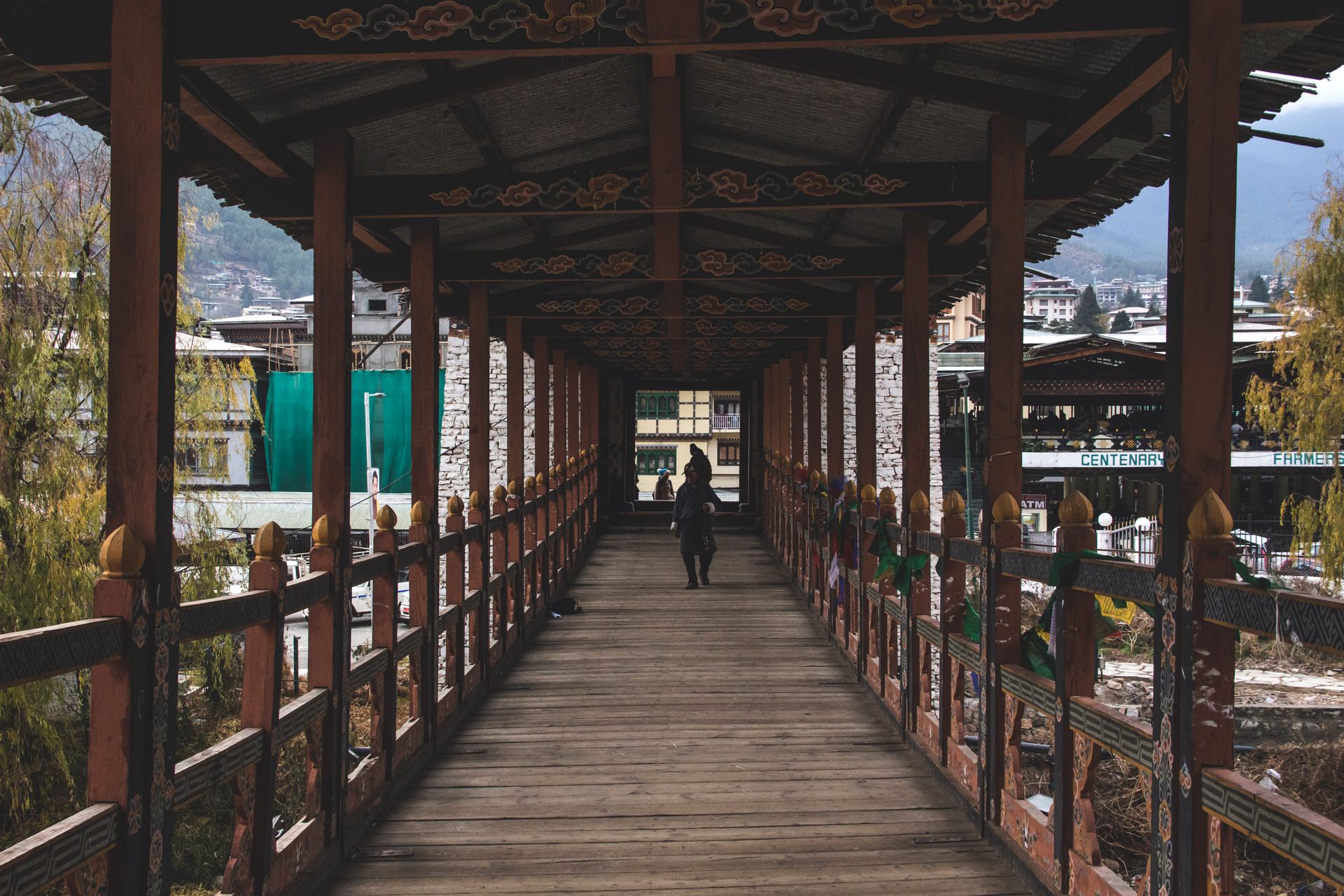
Centenary Farmers’ Market
The large covered weekend market on the west bank of the Wang Chhu is the biggest in Bhutan, where valley farmers and traders from across the country converge from Friday to Sunday to sell fresh and dried chillies, rounds of datshi cheese, fiddlehead ferns, red rice, incense, dried fish and handicrafts. It is the best place in the capital to see ordinary Bhutanese life at full tilt and to photograph the produce that defines the national kitchen. Free to enter; come Saturday morning for the full crush, and cross the cantilever footbridge to the handicrafts stalls on the far bank.
If you only have time for the essentials, prioritise the dzong at golden hour, the Buddha Dordenma for the panorama, and the Memorial Chorten at dawn — those three deliver the heart of Thimphu in a single well-paced day, leaving the takin preserve, the craft school and the temples to fill a relaxed second.
Entertainment

Thimphu’s entertainment is not the nightlife of a Western capital — it is quieter, more cultural and more participatory, built around sport, festival and ritual rather than clubs. The headline experiences are an archery tournament and, if your timing is lucky, the great autumn tshechu festival; the evenings are for cafe culture, a modest bar scene and the singular pleasure of a traditional hot-stone bath. Everything here can be folded into a two-day stay with a little planning, and your guide will know the current schedules.
Archery (Datse)
Archery is the national sport of Bhutan, and watching a tournament at Changlimithang Stadium is the most authentically Bhutanese spectacle in the city. Teams in traditional gho robes loose arrows at slim wooden targets set an astonishing 145 metres apart, while the opposing team stands near the target singing ribald songs and dancing to break the archer’s concentration; a hit triggers a victory dance and song. The atmosphere is festive, competitive and deeply social. Typical cost: free to watch. Tournaments run most weekends; ask your guide for the schedule.
Thimphu Tshechu Festival
The capital’s biggest annual event is the Thimphu Tshechu — three days of masked cham dances, costumed monks, sacred ritual and the dawn unfurling of a giant appliqué thangka in the Tashichho Dzong courtyard, held in autumn (usually September or October, set by the lunar calendar). Thousands of Bhutanese attend in their finest traditional dress; the dances re-enact Buddhist teachings and are believed to bestow merit on those who watch. It is the single best cultural spectacle in the country. Typical cost: included in your SDF-covered itinerary, but it spikes hotel demand citywide, so book months ahead.
Clock Tower Square Nightlife
The bars, lounges and the occasional live-music venue around Clock Tower Square and Chang Lam form Thimphu’s modest nightlife scene — low-key by Western standards but genuinely friendly, with karaoke spots (a national obsession), a few clubs busiest from Wednesday to Saturday, and a growing handful of craft-beer bars pouring Bhutan’s own Red Panda and Druk lagers. Remember that Tuesday is a national dry day when bars do not serve alcohol. Typical cost: Nu 200–500 a drink.
Cinema & Bhutanese Film
Bhutan has a small but surprisingly lively film industry, and central Thimphu cinemas screen Dzongkha-language films — a genuine window into modern Bhutanese popular culture, with their own stars, musicals and melodramas. Catching a screening is an offbeat, very local way to spend an evening, even without subtitles, and a reminder that this small Himalayan kingdom has a thoroughly modern popular culture sitting alongside its monasteries and dzongs. Typical cost: Nu 150–300 a ticket.
Live Music & Cafe Culture
The cafe scene along Norzin Lam and around the Clock Tower doubles as the city’s informal live-music and arts circuit, with acoustic sets, poetry nights, art openings and a young, creative, English-speaking crowd. These cafes are the easiest place to fall into conversation with Thimphu’s twenty-somethings and get a feel for where the country is heading. Typical cost: Nu 100–400 for coffee and a snack.
Traditional Hot-Stone Bath
A signature Bhutanese wellness ritual and the perfect end to a day of sightseeing — river stones are heated until red-hot in a fire, then dropped into a wooden tub of water steeped with medicinal artemisia leaves, releasing minerals and a herbal steam said to ease aches and improve circulation. The hiss of the stones hitting the water and the herbal warmth are unforgettable after a day at altitude. Several Thimphu hotels, spas and farmhouse-stays offer it, and it is well worth booking ahead for an evening slot. Typical cost: Nu 1,500–3,000 (~US$18–36).
Taken together, Thimphu’s entertainment rewards travellers who lean into the local rhythm rather than hunting for a Western-style night out: an afternoon at the archery, an evening coffee that turns into a conversation, a hot-stone soak before bed, and — if the calendar aligns — the once-in-a-trip spectacle of the tshechu. It is quieter than most capitals, and all the better for it: the entertainment here is about taking part in the life of the place rather than being entertained by it, which is precisely what makes an evening in Thimphu memorable.
Day Trips

Thimphu sits at the hub of western Bhutan’s tourist circuit, so the day trips are some of the best in the country — and because the Sustainable Development Fee is charged per night wherever you sleep, the efficient move is to do the near trips as half-days from a Thimphu base and to fold the farther ones (Punakha, Paro) into onward overnight stops rather than backtracking. A licensed guide and registered vehicle are mandatory for all of these, and your tour operator will sequence them into the itinerary. Below, in rough order of distance and popularity, are the trips worth your time.
Dochula Pass (45 min by car)
The 3,100-metre pass on the road east toward Punakha is the classic half-day from Thimphu, crowned by the 108 Druk Wangyal Chortens — a cluster of memorial stupas built in 2004 by the eldest queen mother to honour Bhutanese soldiers — and offering, on a clear autumn or winter morning, a sweeping panorama of the snow-capped eastern Himalaya. A roadside cafe, the colourful Druk Wangyal Lhakhang temple and prayer-flag-draped ridges complete the scene. Go early, before the cloud builds, for the mountain views.
Punakha (2.5 hr by car)
The old winter capital and site of the spectacular Punakha Dzong, set at the confluence of the Pho Chhu (father) and Mo Chhu (mother) rivers — arguably the most beautiful dzong in all of Bhutan, especially when the jacaranda trees bloom lilac around it in spring. Nearby are one of the longest suspension footbridges in the country and the Chimi Lhakhang fertility temple, reached across terraced rice fields. It makes a long but deeply rewarding day from Thimphu, though it is better still as an overnight on the way deeper into central Bhutan.
Paro & the Tiger’s Nest (1.5 hr by car)
Bhutan’s gateway valley holds the country’s most famous sight — the Paro Taktsang, or Tiger’s Nest, a monastery clinging improbably to a sheer cliff 900 metres above the valley floor, where Guru Rinpoche is said to have meditated after flying there on a tigress. Reaching it is a steep 2–3 hour uphill hike each way through pine forest, rewarded by one of the great views in the Himalaya. Most visitors base in Paro for this rather than day-tripping from Thimphu, but it is doable, and Paro also holds the national museum and its own historic dzong.
Cheri & Tango Monasteries (40 min + hike)
Two historic hillside monasteries at the northern head of the Thimphu valley, reached by short but steep forest hikes — Cheri (founded 1620 by Zhabdrung Ngawang Namgyal) was the first monastery established in Bhutan, while Tango is a major Buddhist college with a striking curved facade. The walks up through the trees are peaceful and only mildly demanding, making this the best quiet half-day in nature within easy reach of the capital.
Phajoding Monastery (hike from Thimphu)
A day hike straight up the western ridge above Thimphu leads to Phajoding, a cluster of temples and meditation retreats founded in the 13th century at around 3,600 metres, with sweeping views back down over the whole capital. The climb through blue-pine and rhododendron forest is steep but rewarding, and it is the most accessible serious acclimatisation hike from the city itself — ideal if you want to stretch your legs and test the altitude before tackling the Tiger’s Nest later in the trip. Allow most of a day for the round trip and go with your guide, carrying water and warm layers for the exposed upper ridge.
Seasonal Guide
Thimphu sits above 2,300 metres in a temperate Himalayan valley, so the climate is mild in the warm months and genuinely cold in winter, with sharp day-to-night temperature swings year-round. The two shoulder-and-peak windows — spring and autumn — are far and away the best for clear skies, comfortable temperatures and the big festivals, but they are also the busiest and priciest. Note that the US$100 nightly Sustainable Development Fee is fixed regardless of season, so the only cost that moves is your land package; the green seasons (monsoon summer and deep winter) bring lower hotel rates and thinner crowds for travellers who can work around the weather.
Spring (March – May)
The prime window. Daytime highs climb to 18–22°C, the rhododendrons and magnolias bloom across the surrounding ridges, and skies are largely clear before the monsoon arrives. Thimphu is comfortable in light layers, the Dochula Himalaya views are reliable on a clear morning, and the city’s craft and market life is in full swing. Down in Punakha the jacarandas turn the dzong lilac. This is the busiest and priciest tourist season alongside autumn, so book hotels and your operator’s itinerary well ahead.
Summer (June – August)
The monsoon season. Daytime temperatures sit around 20–25°C, but the afternoons bring heavy rain, leeches on the forest trails, and haze that frequently hides the high peaks from Dochula. On the upside, the valley is at its lushest and greenest, the rivers run full, hotel rates dip noticeably, and the crowds thin right out — a fine, good-value time for culture-focused visitors who care more about the dzong and the markets than about Himalayan panoramas. Roads can wash out or be delayed by landslides, so build buffer days into any itinerary that crosses the passes.
Autumn (September – November)
The second peak window and arguably the best of all — the post-monsoon air is at its clearest, the Thimphu Tshechu festival fills the dzong courtyard (usually late September/October), and daytime highs of 15–20°C are crisp and dry. Book months ahead; this is the single most popular festival-and-photography stretch of the year.
Winter (December – February)
Cold, dry and quiet. Thimphu nights drop below freezing and daytime highs hover around 8–12°C, with hard frost and occasional snow dusting the higher ridges, but the trade-off is superb: the skies are at their most spectacularly clear for Himalayan views from Dochula, and tourist numbers are at their lowest of the year, so land costs and hotels are cheapest. Pack serious layers and a warm coat, as heating in older buildings is limited and rooms can be chilly. Following an old seasonal tradition, the central monk body and much of officialdom decamp from the cold capital toward the warmer Punakha valley for the winter, so a winter trip pairs naturally with a Punakha overnight.
Getting Around

Getting around Thimphu is refreshingly simple. The city is a single compact valley, the centre is flat and walkable, and there are no traffic lights to negotiate — the white-gloved policeman in his glass pavilion directs the main junction by hand. In practice most foreign visitors travel in their licensed operator’s vehicle with a guide and driver, walking the centre and taking the occasional taxi up to the hillside sights. Here is how each mode works.
On Foot
The Thimphu city centre is genuinely walkable — Norzin Lam, Clock Tower Square, Changlimithang and the riverside path are all within 10–15 minutes of each other on the flat valley floor. The famous lack of traffic lights means crossings are managed by the police pavilion or by simple courtesy, and traffic is light and slow. Walking is by far the best way to take in the centre, browse the craft shops and feel the human scale of the only no-signal capital on Earth.
Taxis
Metered and shared taxis are the workhorse of Thimphu transport, plentiful around the central taxi stand and Clock Tower Square and easily flagged on the main streets. They are the only practical way up to the hillside sights — the Buddha Dordenma, the Motithang takin preserve, Changangkha Lhakhang — where the climbs are too steep to walk comfortably at altitude. Fares are cheap, but carry small ngultrum notes, as drivers rarely break large bills, and agree the fare or confirm the meter before you set off.
City Buses
Thimphu runs a basic public bus network on the main valley routes, operated with a fleet of green city buses; it is cheap but infrequent and aimed squarely at residents rather than tourists, with limited English signage. Most visitors skip it and stick to taxis and their guide’s vehicle, but it is a perfectly safe and authentic option if you have time and patience.
Airport Access
- Private car / guide transfer from Paro International Airport (PBH) — ~1.5 hours, 54 km, included in your tour-operator package
- Shared taxi Paro–Thimphu — ~1.5 hours, around Nu 500–800 per seat for independent travellers (rare, as most arrive on a guided itinerary)
The Guide & Driver Rule
Under Bhutan’s tourism policy, foreign visitors (except Indian, Bangladeshi and Maldivian nationals) must travel with a licensed guide and a registered vehicle arranged through a Bhutanese tour operator — you cannot simply rent a car and roam. In practice this means your day-to-day “getting around” for the sights and the day trips is largely your operator’s car with a driver, leaving taxis and walking to fill the independent gaps in the city centre when you want an hour to yourself. It also means you never have to worry about navigation, parking or mountain-road driving — a genuine relief on the switchbacks up to Dochula.
Navigation Tips
Useful apps include Google Maps and the offline-friendly Maps.me. Mobile coverage and mapping in central Thimphu are good, so on-foot navigation in the city is easy. But signal drops away quickly once you climb to the passes, the hillside monasteries and the head of the valley, so download an offline map before you head out to Dochula, Cheri, Tango or Phajoding. Street addresses in Thimphu are loosely used — locals navigate by landmarks (the Clock Tower, the dzong, the Buddha point), so learning those reference points is more useful than memorising street names, and any taxi driver will know them instantly.
Budget Breakdown: Making Your Ngultrum Count
| Tier | Daily | Sleep | Eat | Transport | Activities | Extras |
|---|---|---|---|---|---|---|
| Budget | ~US$180–220 | US$30–50 (3-star) | US$10–20 | US$10–20 taxis | Nu 300–1,000 entries | +US$100 SDF/night |
| Mid-Range | ~US$280–380 | US$80–150 (boutique) | US$25–45 | Included guide car | Guided sights | +US$100 SDF/night |
| Luxury | ~US$600–1,400+ | US$400–1,200 (Amankora/Six Senses) | US$60–120 | Private 4×4 + guide | Hot-stone bath, private tshechu seats | +US$100 SDF/night |
Budgeting for Thimphu is unlike anywhere else, because the single biggest line is fixed and unavoidable: the US$100-per-night Sustainable Development Fee that every adult foreign visitor (except Indian, Bangladeshi and Maldivian nationals) pays for every night spent in Bhutan, on top of all other costs. Children aged 6–12 pay half and under-5s are exempt. Once you accept that floor, the rest of your daily spend — room, food, guide, transport and activities — is what flexes by tier, and Bhutan can be done relatively affordably or extremely luxuriously depending on where you sleep. The table above shows realistic all-in daily ranges including the SDF; below is where the money actually goes and how to keep it down.
Where Your Money Goes
The single largest fixed cost is the US$100-per-night Sustainable Development Fee, charged on top of everything else and non-negotiable; it funds free healthcare, free education and conservation for Bhutanese citizens, which is why the government frames it as “high value, low impact” tourism. Beyond the SDF, your daily land cost (room, food, guide and transport) is what varies most by tier — a clean three-star room runs US$30–50, a boutique hotel US$80–150, and the Amankora or Six Senses lodges from US$400 well into four figures. Monument entries are modest — Nu 300–1,000 each — and meals are cheap by Western standards, from a few dollars at a momo joint to US$20–30 at a hotel restaurant. Tipping your guide and driver at the end of the trip is customary and appreciated.
Money-Saving Tips
- Keep your Thimphu leg tight — every night adds US$100 in SDF, so two well-planned nights beat four loose ones.
- Eat where locals eat — momo and datshi joints off Norzin Lam cost a fraction of hotel restaurants.
- Travel in the green season (summer monsoon or deep winter) when land costs and demand are lowest, even though the SDF stays fixed.
- Choose a three-star city hotel over a luxury lodge; the SDF is the same either way, so the room is the lever.
- Travel as a family — the half-price SDF for children and the exemption for under-5s makes Bhutan far cheaper per head with kids.
One thing worth understanding clearly: Bhutan deliberately positions itself as a “high value, low volume” destination, and the SDF is the mechanism. It is not a tourist trap or an arbitrary surcharge — it is a sovereign policy choice to keep visitor numbers sustainable and to fund the social spending that underpins Gross National Happiness. For a Thimphu-focused trip, the practical upshot is simple arithmetic: decide how many nights you genuinely need (two in the capital is plenty), accept the SDF as a fixed floor, and then choose your hotel tier to set the rest of the budget. A couple doing two Thimphu nights at three-star level should budget roughly US$360–440 all-in for the city leg before international flights, rising sharply if you opt for the luxury lodges.
Practical Tips

Thimphu is one of the easiest and safest Himalayan capitals to visit, in large part because the licensed-operator system means a guide handles most of the logistics for you. Still, a handful of practical realities — the cash economy, the altitude, the temple etiquette and Bhutan’s distinctive rules on tobacco and alcohol — are worth understanding before you arrive. The essentials below cover what trips up most first-time visitors.
Language
Dzongkha is the national language — a Tibeto-Burman tongue written in a script related to Tibetan — but English is the medium of instruction in Bhutanese schools and is spoken almost everywhere in tourism, hotels and government. You will rarely struggle to communicate, and your licensed guide will be fluent. A few words of Dzongkha — kuzuzangpo la for hello, kadrinchey la for thank you — are warmly received.
Cash vs. Cards
Carry cash. The ngultrum (Nu) is the currency, pegged exactly 1:1 to the Indian rupee, and Indian rupee notes are widely accepted in Bhutan (though ngultrum is not accepted in India). Cards work at upscale hotels and some larger shops, but most shops, taxis, restaurants and the markets are cash-only, and ATMs can be unreliable for foreign cards. Change money at a bank or your hotel on arrival and keep a stock of small notes for taxis and stalls.
Safety
Bhutan is very safe, and the US State Department advises travellers to exercise only normal precautions; crime against tourists is rare and violent crime almost unheard of. The real risks are environmental rather than criminal — the altitude, the winding mountain roads, and the weather on the high passes — so the sensible precautions are about acclimatising, buckling up and building buffer time, not about personal security.
What to Wear
Dress modestly, especially at religious sites — long trousers or skirts and covered shoulders are expected for temple and dzong visits, and hats and shoes come off inside temple buildings. Beyond that, pack layers for the big day-to-night temperature swings at 2,300-plus metres: pleasant in the sun, cold once it drops behind the ridge, and properly freezing on winter nights. A warm fleece, a windproof layer and comfortable walking shoes cover most of the year.
Cultural Etiquette
Always walk clockwise around chortens, stupas and prayer wheels, and spin prayer wheels clockwise too. Ask before photographing people, and note that photography is often prohibited inside temple interiors. The King and royal family are deeply and genuinely revered, so avoid any disrespectful comment about the monarchy. Bhutan takes its Buddhist tradition seriously; following your guide’s lead on when to remove shoes, where to stand and what not to touch keeps you on the right side of local sensibilities.
Connectivity
Bhutan Telecom (B-Mobile) and TashiCell SIMs are easy to buy and give decent 4G coverage across Thimphu, and Wi-Fi is standard in hotels and cafes. Coverage thins noticeably on the high passes and remote monastery hikes, so download offline maps before you head to Dochula, Cheri or Phajoding.
Health & Medications
Thimphu sits above 2,300 metres, so mild altitude effects — headache, breathlessness, broken sleep on the first night — are possible; ascend gently, hydrate well and avoid overexertion on day one. Drink only bottled, boiled or filtered water, never the tap. Carry any personal medications you need, as pharmacy stock is limited and specific brands may be unavailable. The national referral hospital is in the capital, and travel insurance with medical evacuation cover is strongly advised for a remote mountain country.
Tobacco & Alcohol
Bhutan had the world’s strictest tobacco laws; sale was banned outright until a 2021 amendment legalised limited retail sale. Smoking in public places remains restricted, and Tuesday is a national “dry day” when bars do not serve alcohol.
Frequently Asked Questions
How many days do I need in Thimphu?
Two full days is the sweet spot — enough for the Tashichho Dzong, the Buddha Dordenma, the National Memorial Chorten, the Motithang Takin Preserve and the weekend Centenary Farmers’ Market, plus the half-day Dochula Pass trip. Add a third day only if you want a slower pace, the Kawajangsa craft workshops, or a hike up to Cheri and Tango monasteries. Because the US$100 Sustainable Development Fee is charged per night, a tight, well-sequenced Thimphu leg keeps the whole trip more affordable, and most itineraries pair two Thimphu nights with onward overnights in Punakha and Paro.
Is Thimphu good for solo travellers?
Yes, with one important caveat: all foreign tourists (except Indian, Bangladeshi and Maldivian nationals) must travel on a licensed-operator itinerary with a guide, so you are never fully independent in the backpacker sense. That structure, though, is exactly what makes Bhutan one of the easiest and safest Himalayan destinations for a first-time solo visitor — transport, permits and accommodation are all arranged, your guide handles the logistics and language, and crime against tourists is extremely rare. Solo women travellers in particular report feeling very secure in Thimphu.
Do I have to pay the Sustainable Development Fee for Thimphu?
Yes. The US$100-per-night SDF applies to every single night you spend anywhere in Bhutan, including Thimphu, charged on top of all your other costs and non-negotiable. Children aged 6–12 pay half the rate and under-5s are exempt; Indian nationals pay a reduced rate in rupees. The fee funds free healthcare, free education and conservation for Bhutanese citizens, and the current rate is fixed through 31 August 2027. There is no way to visit and avoid it.
What about the language barrier?
Minimal. Dzongkha is the national language, but English is the medium of instruction in Bhutanese schools and is spoken right across tourism, hotels, restaurants and government. Your licensed guide is fluent in English, so practical communication — ordering food, asking directions, understanding the sights — is almost never an issue. Signage in the centre is frequently bilingual.
When is the Thimphu Tshechu festival?
The Thimphu Tshechu is held in the autumn on the Bhutanese lunar calendar — typically late September into October — over three days in the Tashichho Dzong courtyard, with masked cham dances, costumed monks and the dawn unfurling of a giant thangka. Because the dates are set by the lunar calendar they shift every year, so confirm the exact days with your tour operator and book well ahead: the tshechu is the capital’s single biggest peak-demand window and hotels fill months in advance.
Can I use credit cards everywhere in Thimphu?
No — carry cash. Upscale hotels and some larger shops take Visa and Mastercard, but taxis, the markets and most restaurants are cash-only, and foreign-card ATMs can be unreliable. Bring or change into ngultrum (or Indian rupees, which trade at exact parity and are accepted everywhere) for day-to-day spending, and keep a stock of small notes for taxis and stalls.
Is it true Thimphu has no traffic lights?
Yes — Thimphu is the only national capital in the world without a single traffic light. A signal was once installed at the main Norzin Lam junction, but residents found it impersonal and ugly, so it was removed within days and a white-gloved policeman directing traffic from a small glass pavilion took the junction back. He has become a minor city icon and a perfect emblem of how Thimphu does things its own, human-scaled way.
How do I get from Paro airport to Thimphu?
Bhutan’s only international airport is at Paro, around 54 km west of the capital, and the drive up to Thimphu takes about an hour and a half on a winding mountain road. For nearly all foreign visitors this transfer is handled by the tour operator as part of the package — your guide and driver meet you at arrivals and take you straight up. The flight into Paro itself is famous as one of the most dramatic commercial approaches in the world, threading between Himalayan ridges, and is flown only by Drukair and Bhutan Airlines pilots specially certified for the airport.
What is the best time of year to visit Thimphu?
Spring (March–May) and autumn (September–November) are the two best windows — clear skies, comfortable daytime temperatures of 15–22°C, blooming rhododendrons in spring and the great tshechu festival in autumn. These are also the busiest and priciest seasons, so book ahead. The summer monsoon is lush but wet and hazy, while winter is cold but offers the clearest mountain views and the lowest prices and crowds. Your choice comes down to whether you prioritise festivals and flowers, mountain panoramas, or value and quiet.
Ready to Experience Thimphu?
Thimphu is the gentlest possible introduction to the most unusual country in the Himalaya — a traffic-light-free, carbon-negative capital where a giant golden Buddha looks down on a valley that still measures success in happiness. For the full country context — the Sustainable Development Fee, the Tiger’s Nest, the masked festivals — read the Bhutan Travel Guide.
Explore More City Guides
- Kathmandu City Guide
- Delhi City Guide
- Bangkok City Guide
- Bhutan Country Guide — the wider Kingdom frame: the SDF, the Tiger’s Nest, the carbon-negative pledge and the licensed-guide rule (see also the Bhutan guide)
- All City Guides
Alex the Travel Guru
Alex has spent two decades chasing the world’s most distinctive capitals, and Thimphu — the only one on Earth without a traffic light — sits near the top of the list. This guide draws on the Department of Tourism’s official rules, on-the-ground reporting from the Norzin Lam markets and the Dochula Pass, and the hard logistics of the Sustainable Development Fee, so you arrive in the Wang Chhu valley knowing exactly how the Kingdom works.
More city guides you might like
Plan your trip to Thimphu
The booking tools we use ourselves. FFU may earn a commission at no extra cost to you.
Plan & book your trip to Thimphu
Booking through these searches supports our guides at no extra cost to you.