
Languages of South Africa
All languages of Southern Africa →fluent beta classical · classes by phone with Maya at ranas.ai/maya
South Africa Travel Guide — Big Five Safari, Cape Winelands & Two-Ocean Coastlines
South Africa Travel Guide
📋 In This Guide
- Overview — Why South Africa Belongs on Every Bucket List
- 🐋 Whale Season 2026 — Hermanus & the Southern Right Migration
- Best Time to Visit South Africa (Season by Season)
- Getting There — Flights & Arrival
- Getting Around — Flights, Car Hire & the Gautrain
- Top Cities & Regions
- South African Culture & Etiquette
- A Food Lover’s Guide to South Africa
- Off the Beaten Path
- Practical Information
- Budget Breakdown
- Planning Your First Trip to South Africa
- Frequently Asked Questions
Overview — Why South Africa Belongs on Every Bucket List
South Africa packs more distinct landscapes, cultures and wildlife into its borders than any country in sub-Saharan Africa. In a fortnight a traveller can track leopards on a dawn game drive in the Kruger bushveld, swim in the warm Indian Ocean off Durban, surf under Table Mountain on the cold Atlantic, and then taste Cape Dutch chenin blancs in a 300-year-old Stellenbosch cellar. Few destinations offer this range, and none pair it with infrastructure this developed.
Geographically, South Africa covers roughly 1,221,037 km² at the southern tip of the continent, with two oceans meeting along a 2,798 km coastline. The interior plateau rises to 3,482 m at Mafadi in the Drakensberg, then falls through bushveld to subtropical KwaZulu-Natal. The country’s population of about 62 million speaks 11 official languages — isiZulu, isiXhosa, Afrikaans, English, Sepedi, Setswana, Sesotho, Xitsonga, siSwati, Tshivenda and isiNdebele — and sign language was added as a twelfth in 2023.
Culturally, modern South Africa was forged by the peaceful end of apartheid in 1994 and by the unlikely political decency of Nelson Mandela. The new democracy preserved the physical infrastructure of an industrialised economy while opening it to the majority, and the resulting country is a study in contrast: high-end wineries and game lodges sit alongside townships still waiting on basic services. Load-shedding — scheduled rolling blackouts managed by the state power utility Eskom — has been a daily fact of life since 2007, and most hotels and restaurants now run on inverters and generators. Visitors barely notice, but it explains why battery packs and flashlight apps are standard packing.
The bucket-list draws deliver. Kruger and the surrounding private reserves hold Africa’s densest Big Five population outside fenced parks; Cape Town’s Table Mountain National Park is a UNESCO World Heritage site within the city limits; Robben Island prison where Mandela spent 18 of his 27 years is a half-day ferry trip from the V&A Waterfront. Food is built around the weekend braai (barbecue), bobotie from the Cape Malay kitchen, Durban’s bunny chow, biltong from the road-trip deli, and chenin blanc that costs R120 in the supermarket and R250 at the cellar door. It is a country that consistently costs a third of what Western Europe does, and usually rewards travellers who stay a week longer than planned.
🐋 Whale Season 2026 — Hermanus & the Southern Right Migration
Every year from June to November, southern right whales migrate from their Antarctic feeding grounds to the sheltered bays of South Africa’s southern Cape to calve and mate. The town of Hermanus, an hour and a half east of Cape Town, is the undisputed world capital of land-based whale-watching — the only place on Earth that employs a designated whale crier who sounds a kelp horn from the cliff path when southern rights surface within a few dozen metres of shore.
Peak sightings run from late August to early October, when cow-calf pairs loiter within 20 m of the Walker Bay cliffs and the Hermanus Whale Festival draws tens of thousands of visitors on the last weekend of September. The festival is free, the cliff path is free, and a pair of binoculars is enough equipment for a full day of viewing. Humpbacks, Bryde’s whales and orcas also appear along the coast in smaller numbers.
- Season window: 1 June – 30 November 2026
- Peak viewing: 20 August – 10 October 2026
- Hermanus Whale Festival: 25–27 September 2026
- Walker Bay cliff path (Hermanus): land-based, free; whale crier active daily
- De Hoop Nature Reserve: up to 100 whales at Koppie Alleen in September
- False Bay & Simon’s Town: combine boat trips with the Boulders Beach penguin colony
- Plettenberg Bay (Garden Route): charter boats from Central Beach; dolphin mega-pods common
Best Time to Visit South Africa (Season by Season)
South Africa sits in the Southern Hemisphere, so seasons are reversed from North America and Europe: December through February is summer, June through August is winter. Just as important, the country is climatically split in two. Cape Town and the Western Cape have a Mediterranean climate (wet winters, dry summers); Kruger, Johannesburg and the eastern provinces have a subtropical climate (dry winters, wet summers). A trip that hits both requires packing for both.
Spring (Sep–Nov)
Temperatures climb from about 15–25°C and the Namaqualand wildflower bloom carpets the West Coast with daisies from mid-August into September — one of the country’s great natural spectacles. Whale season is peaking at Hermanus, the Kruger bushveld is still dry enough for excellent game viewing, and Cape Town begins to shed its winter rain. The Cape Town International Jazz Festival (late March in the Cape autumn) is the earlier cultural anchor, while spring offers the J&B Met horse racing in Cape Town and the Hermanus Whale Festival in late September.
Summer (Dec–Feb)
Peak season along the coast, with temperatures of 20–35°C and 14 hours of daylight on the Cape. The Garden Route, Durban beaches and Cape Town’s Camps Bay are at their liveliest; New Year in Cape Town books out a year in advance. Kruger is hot, humid and green — harder for game viewing because the thick vegetation hides animals — and most private lodges discount. Afternoon thunderstorms hit the Highveld around Johannesburg. School holidays mid-December to mid-January push prices 40–80% above winter.
Autumn (Mar–May)
The best-balanced window. Temperatures ease to 15–27°C, the Cape harvest season fills the Winelands with cellar events, and the bushveld begins drying out for excellent game viewing from April. Rainfall drops sharply, mosquitoes thin, and crowds evaporate after the first week of March. The Cape Town International Jazz Festival lands in late March or early April and is one of Africa’s great music weekends.
Winter (Jun–Aug)
Cold, clear and dry inland (5–20°C). This is the single best window for a Kruger safari — sparse vegetation and receding waterholes concentrate wildlife, and malaria risk drops dramatically. Cape Town is wet and green, but the wine country is at its most atmospheric, and Hermanus whale sightings are routine. Snow falls in the high Drakensberg and on Matroosberg for a day or two each winter.
Shoulder-season tip: Late April to early June and again late August to September combine good-value rates with excellent game viewing, flat-calm seas along the Garden Route and reduced rainfall at the Cape.
Getting There — Flights & Arrival
South Africa is served by three international hubs. Johannesburg’s O.R. Tambo handles the bulk of long-haul arrivals; Cape Town International is the stronger choice for travellers starting with the Winelands and whale coast; Durban’s King Shaka is the default for KwaZulu-Natal and the Zulu heartland.
- O.R. Tambo International (JNB) — Africa’s busiest airport; the Gautrain runs to Sandton in 15 minutes for R204 one-way.
- Cape Town International (CPT) — MyCiTi A01 airport bus reaches the CBD in 25 minutes for R120.
- King Shaka International (DUR) — shuttle to Umhlanga or the Durban beachfront in about 35 minutes.
Flight times: London to Johannesburg is about 11 hours non-stop with British Airways and Virgin Atlantic; New York to Johannesburg is about 15 hours with United or South African Airways; Sydney to Johannesburg is 13h 50m with Qantas.
Flag carriers: South African Airways plus the fast-growing low-cost domestics FlySafair, Airlink and Lift.
Visa / entry: Around 78 countries — including the US, UK, EU Schengen, Canada, Australia and Japan — receive a visa-free stay of up to 90 days on arrival. Unabridged birth certificates are required for travelling minors.
Getting Around — Flights, Car Hire & the Gautrain
South Africa is a driving country. Distances between major sights are large — Cape Town to Kruger is a two-day drive across the full width of the country — so most itineraries combine a rental car for regional loops with a domestic flight for the longest hop. Drivers keep left, the road network is excellent on national routes, and tollgates accept both cash and card. Intercity rail exists but is slow; the Gautrain serves only the Johannesburg–Pretoria corridor.
- Gautrain: Johannesburg–Pretoria rapid rail; max speed 160 km/h.
- Johannesburg → Cape Town: 2h flight on FlySafair / SAA, or a scheduled 27h Shosholoza Meyl overnight train.
- Cape Town → Stellenbosch: 50 minutes / 50 km on the N1 and R310
- Johannesburg → Kruger (Hoedspruit Eastgate): 1h Airlink flight, or a 5h 30m drive via Lydenburg.
Domestic flights: FlySafair, Airlink, Lift and SAA connect the major cities. A one-way JNB–CPT fare typically costs R900–1,500 (USD $48–80) when booked 2–4 weeks ahead.
Car hire: Avis, Bidvest, Europcar and First Car Rental all operate at the major airports. A compact automatic runs R450–650 per day including basic insurance. Petrol was R23.50 per litre in early 2026.
Transit cards: Gautrain Gold Card (Johannesburg & Pretoria), MyCiTi MyConnect (Cape Town), and Muvo (Durban’s People Mover).
Apps: Uber and Bolt both run in every major city; Google Maps handles navigation; Plugshare for EV routes on the N1 and N2.
Top Cities & Regions
📍 Map of South Africa: Every Place in This Guide
🏔️ Cape Town
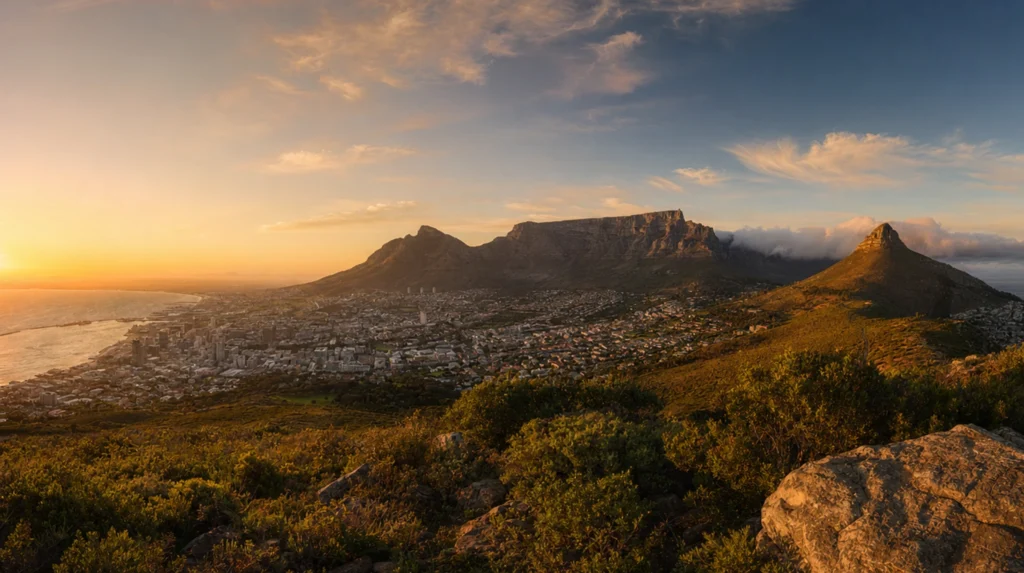
The Mother City is cradled between the 1,086 m Table Mountain plateau and the cold Atlantic seaboard. Consistently ranked among the world’s most beautiful cities, it is South Africa’s most-visited destination and the logical base for whales, wine and a first-time trip. The food leans on the Cape Malay kitchen — bobotie, bredies, koeksisters — and the weekend braai culture is at its most relaxed.
- Table Mountain cableway to the flat summit — a UNESCO World Heritage site
- V&A Waterfront and the Robben Island ferry to Mandela’s former cell
- Cape Point and the Cape of Good Hope at the southwestern tip of Africa
🏙️ Johannesburg
Africa’s financial capital was built on the 1886 Witwatersrand gold rush and reshaped by the end of apartheid in 1994. It is rough, energetic and the country’s most essential history lesson. Jozi (or Joburg) gets under-visited because of its safety reputation, but the Maboneng precinct, Braamfontein and Rosebank are as lively as any African downtown and the cultural institutions are world-class. Food here is about kota street sandwiches, bunny chow and weekend shisanyama braai.
- Apartheid Museum documenting the system and its fall
- Constitution Hill, a former prison turned Constitutional Court
- Soweto tours — Vilakazi Street hosts both Mandela and Tutu’s former homes
🏖️ Durban
Africa’s busiest port and the cultural heart of South Africa’s 1.3 million-strong Indian community — the largest diaspora outside India itself. The Indian Ocean is warm enough to swim year-round; the surf scene is legendary; and the food is a hybrid of Zulu, Indian and colonial influences. The Golden Mile promenade stretches 6 km along the beachfront.
- Golden Mile beachfront promenade and uShaka Marine World aquarium
- Victoria Street Market spice halls in the city centre
- Moses Mabhida Stadium SkyCar, Big Swing and arch walk
🍷 Stellenbosch & Cape Winelands
Oak-lined university town at the centre of the Cape Winelands — more than 200 wineries sit within 45 minutes of Cape Town. Stellenbosch itself dates to 1679 and its Dorp Street is one of the world’s best-preserved Cape Dutch architectural ensembles. Neighbouring Franschhoek is the fine-dining capital; Paarl has the oldest working winery; and Constantia inside the Cape Town city limits has the oldest vines. The weekend routine is simple: wake up, taste at three estates, eat long lunch, repeat.
- Franschhoek Wine Tram hop-on-hop-off cellar circuits
- Spier, Babylonstoren and Delaire Graff working farms with tastings
- Dorp Street Cape Dutch walking route and the Stellenbosch University Botanical Garden
🦁 Kruger National Park
South Africa’s flagship game reserve covers 19,485 km² of bushveld along the Mozambique border — roughly the size of Israel. Kruger holds the continent’s densest Big Five population outside fenced parks, and the adjoining private reserves (Sabi Sand, Timbavati, Klaserie) drop the fence for shared traversing rights. Self-drivers use SANParks rest camps; luxury travellers base at lodges like Singita or MalaMala. May to September is dry-season peak, when the bush thins and water concentrates game at pans.
- Southern Kruger self-drive circuits from Skukuza and Lower Sabie rest camps
- Sabi Sand private reserves for off-road leopard sightings
- Panorama Route: Blyde River Canyon, God’s Window, Bourke’s Luck Potholes
🌊 Garden Route
A 300 km Indian Ocean coastline from Mossel Bay east to Storms River, threading through indigenous forest, lagoons, fynbos heath and beaches. The N2 highway runs its length and links four of the country’s most photographed towns — Knysna, Plettenberg Bay, Wilderness and Nature’s Valley. The route is the safest and most family-friendly of the country’s road trips.
- Tsitsikamma National Park suspension bridge and coastal forest trails
- Knysna Heads, lagoon oyster farms and the annual July oyster festival
- Bloukrans Bridge 216 m bungee jump — the world’s highest from a bridge
South African Culture & Etiquette — What to Know Before You Go
South African culture is genuinely plural. Eleven official languages, four main ethnic traditions (Zulu, Xhosa, Afrikaans and English, alongside Sotho, Tsonga, Venda, Tswana, Ndebele and the 1.3 million-strong Indian community) and a dominant Christian faith tradition that coexists with substantial Hindu, Muslim and traditional African beliefs all shape daily life. The country is also one of the most openly religious in the OECD and one of the most constitutionally progressive — same-sex marriage has been legal since 2006. Apartheid ended in 1994 but shapes almost every conversation about city geography, schooling, economics and land; visitors are welcome to ask, but ask gently and listen more than you speak.
The Essentials
- Greet in the local language where you can — Sawubona (isiZulu), Molo (isiXhosa), Goeie dag (Afrikaans) or a simple “Howzit” in English. A handshake is standard; many Black South Africans use the three-step thumb-lock greeting.
- A 10–15% tip is expected at restaurants; petrol attendants (pump jockeys) receive R5–10 per fill; car-guards in any parking lot expect R5–10 when you leave.
- Discuss apartheid and politics only when invited, and avoid generalising across communities — this is a country of minorities, not a majority.
- “Now-now” means soon, “just now” means later, and “now” means never — the national time vocabulary is its own dialect.
- Dress smart-casual for game lodges and fine dining; beachwear belongs at the beach.
Safari & Game Lodge Etiquette
- Stay inside the vehicle at all times — predators read the outline of a 4×4 as one large non-prey animal, but treat a standing human as a target.
- Whisper around a sighting and keep phones on silent; clicking shutters are fine.
- Tip the ranger/tracker team R150–250 per guest per day, paid in a single envelope on the final morning.
- Bring neutral clothing (khaki, brown, olive); avoid bright white and dark blue (tsetse-attractant).
A Food Lover’s Guide to South Africa
South African cuisine reflects every chapter of its history — indigenous Khoi-San foraging, Dutch colonial stews, Malay slave cooking brought from Java, Indian indenture in Natal, British colonial high tea, and modern African grill. The result is more varied than any other national table on the continent. Expect to pay R120–180 for a casual meal, R280–450 for a bistro dinner with wine, and R1,200 or more per person at a fine-dining leader like La Colombe, Wolfgat or FYN. A R120 supermarket chenin blanc is routinely excellent; a R60 boerewors roll at a petrol-station braai is a national institution.
Must-Try Dishes
| Dish | Description |
|---|---|
| Bobotie | Cape Malay minced beef or lamb casserole baked beneath an egg-and-milk custard, spiced with curry and studded with raisins. Often considered South Africa’s national dish; pairs with yellow rice and blatjang chutney. |
| Braai (boerewors, sosaties, chops) | More a weekly social institution than a dish — hardwood coals, boerewors farm sausage, lamb chops and sosatie (apricot-marinated kebabs), served with pap (maize porridge) and chakalaka relish. |
| Biltong & droëwors | Air-dried, vinegar-and-coriander cured beef, kudu or springbok sliced thinly — the national road-trip snack. Droëwors is the dried-sausage cousin. Typical roadside price R250/kg. |
| Bunny chow | A hollowed-out half loaf of white bread filled with Durban mutton or bean curry — invented by Indian labourers in Natal in the 1940s and the signature dish of Durban. |
| Cape Malay curry / bredie | Mildly spiced, subtly sweet Cape Malay stews anchored by dried fruit, cinnamon and turmeric. Tomato bredie and waterblommetjie bredie (made from a Cape wetland flower) are the classics. |
| Pap en vleis & potjiekos | Maize-meal porridge served alongside braaied meat is the everyday township plate. Potjiekos is everything slow-cooked for hours in a cast-iron three-legged pot over coals — layered, never stirred. |
Supermarket Delis, Petrol Stations & Braai Culture
South Africa’s four big food retailers — Woolworths Food, Pick n Pay, Spar and Shoprite/Checkers — punch well above their weight and are the default lunch stop on any long drive. Woolworths Food is the closest thing to Marks & Spencer or Whole Foods the continent has, with ready meals, artisan bread and an excellent own-label wine range. Every Engen, Shell and Sasol petrol station on the N1 and N2 runs a Wimpy or Steers fast-food counter and — more importantly — a deli case stocked with boerewors rolls, biltong and samoosas. The Sunday braai is the week’s structural event: four or five families, a fire lit by 11 am, and meat served around 3 pm with the sides out from noon.
- Chains: Woolworths Food, Pick n Pay, Spar, Shoprite/Checkers
- Signature items: boerewors roll, Nando’s peri-peri chicken, koeksister (syrup-soaked plaited pastry), Ouma rusks, rooibos tea, Simba chips, Cadbury Lunch Bar
- Classic roadside order: boerewors roll + biltong + rooibos (around R80)
Wine country deserves its own itinerary. South Africa is the world’s ninth-largest producer, chenin blanc is the signature white (the country holds the largest plantings of chenin on Earth) and pinotage is the indigenous red cross-bred in Stellenbosch in 1925. Tasting flights of four to six wines cost R80–150 at most cellars, usually refundable against a bottle purchase. Franschhoek does the fine dining, Hemel-en-Aarde (outside Hermanus) does pinot noir, and Swartland has become the country’s most exciting experimental region over the past decade.
Off the Beaten Path — South Africa Beyond the Guidebook
The Drakensberg
The Maloti-Drakensberg Park is a joint UNESCO World Heritage site shared with Lesotho, covering 2,420 km² of basalt escarpment up to 3,482 m at Mafadi. The range’s best-known walks are the Amphitheatre from Royal Natal, Cathedral Peak’s Bell Traverse, and the chain-ladder ascent to Tugela Falls — the world’s second-highest waterfall at 948 m. The uKhahlamba range also holds more than 35,000 prehistoric San rock paintings, some dated to 3,000 BCE, making it one of the densest rock-art regions on Earth.
iSimangaliso Wetland Park
South Africa’s first UNESCO World Heritage site covers 332,000 hectares of KwaZulu-Natal wetland, estuary and subtropical coast. Hippos and crocodiles share the St Lucia estuary with marine turtles that nest on the Cape Vidal beaches from November to February; humpback whales cruise offshore in winter; and the Eastern Shores loop is a self-drive safari with giraffe, zebra and kudu against dune-forest scenery unlike any other park in the country.
Wild Coast (Eastern Cape)
The former Transkei coastline between East London and Port Edward is 300 km of undeveloped Indian Ocean cliff, river-mouth and village. The Hole in the Wall natural arch near Coffee Bay is the headline image; the five-day Wild Coast Meander hike strings together Xhosa village homestays; and Port St Johns is the take-off point for sardine run dives (June–July) that rival any marine spectacle on Earth. Infrastructure is thin and that is the point.
Cradle of Humankind
An hour west of Johannesburg, this UNESCO-listed complex of limestone caves has produced roughly 40% of the world’s hominin fossils, including Mrs Ples, Little Foot and the 2013 Homo naledi discovery in the Rising Star cave. The Maropeng visitor centre is excellent; the Sterkfontein Caves guided tour descends into the working dig; and the surrounding Magaliesberg is a short country drive rarely on day-trip itineraries.
Namaqualand Wildflower Route
Every August and September, the semi-desert of the Northern Cape bursts into a carpet of daisies, gazanias and vygies that covers hundreds of kilometres between Springbok and the Namibian border. The spring rains trigger the bloom, Skilpad Nature Reserve and the Goegap Reserve are the most dependable concentrations, and the season lasts only three to four weeks. Book Kamieskroon or Nieuwoudtville guesthouses months ahead.
Practical Information
The table below gathers the quick answers travellers ask most often. Every row cites an official government or industry source, and currency and safety rows in particular should be rechecked the week of departure. Load-shedding and rand volatility are the two moving targets — budget a power bank and read the Eskom status before you leave.
| Currency | South African rand (R / ZAR); 1 USD ≈ R18.90 (April 2026) |
| Cash needs | Card-first economy in cities; cash still useful for car-guards, petrol stations in rural areas and informal markets. Carry R200 in small notes. |
| ATMs | Standard Bank, Absa, FNB and Nedbank ATMs are widespread. Withdraw inside bank branches or malls, not on the street, and cover the PIN. |
| Tipping | Restaurants 10–15%; petrol pump attendants R5–10; car-guards R5–10; safari ranger + tracker R200–250/guest/day combined. |
| Language | 11 official languages; English is the lingua franca and every tourist-facing worker speaks it. |
| Safety | US State Department Level 2 (Exercise Increased Caution); crime concentrates in specific Johannesburg neighbourhoods and at night in Cape Town. |
| Connectivity | Vodacom/MTN SIM R150 for 10 GB; Airalo eSIM from USD $7. 4G/5G covers all cities; patchy inside Kruger. |
| Power | Type M plugs (three large round pins, SANS 164-1); 230V / 50Hz. Type D and N adapters also found in newer hotels. |
| Tap water | Safe in Cape Town, Johannesburg and Stellenbosch; bottled water recommended in rural areas and during drought restrictions. |
| Healthcare | Private hospitals (Netcare, Mediclinic, Life) offer world-class care for travellers with insurance; public system is overstretched. Malaria prophylaxis required for Kruger and iSimangaliso in summer. |
Budget Breakdown — What South Africa Actually Costs
💚 Budget Traveller
USD $55–85 (R1,040–1,600) per day covers a hostel-and-backpacker-bus trip comfortably. Dorm beds run R300–450 in Cape Town and R200–320 in smaller cities. Baz Bus hop-on-hop-off fares cost R5,600 for the full Cape Town–Johannesburg loop. Self-catering from Shoprite or Pick n Pay keeps food to R150–200 per day, and Kruger’s SANParks camping sites start at R310 per person. Shared game drives cost R600–900.
💙 Mid-Range
USD $180–320 (R3,400–6,000) per day is a realistic couple’s mid-range budget. A 3★ guesthouse in Cape Town, Stellenbosch or Knysna runs R1,600–2,800 per room, restaurant dinners with wine come in at R500–800 per head, and a rental car adds R550–750 per day plus fuel at roughly R23.50/litre. A shared open-vehicle Kruger safari from a mid-range lodge is R4,500–7,000 per person per night all-inclusive.
💜 Luxury
From USD $700 (R13,200) per day upward, with no real upper limit. Lodge rates at Singita, Londolozi or Royal Malewane start at R28,000–55,000 per couple per night all-inclusive, covering game drives, all meals, imported spirits and laundry. A Cape Winelands stay at Delaire Graff or Leeu Estates runs R12,000–22,000 per night with cellar privileges and Rolls-Royce transfers to dinner. Chartered helicopter transfers between Cape Town and a Kruger lodge cost R80,000+ per couple one-way and save a full day of driving. Fine dining at La Colombe, Wolfgat or FYN is R2,400–3,200 per person before matched wines, which run another R1,800–2,600.
| Tier | Daily (USD) | Accommodation | Food | Transport |
|---|---|---|---|---|
| Budget | $55–85 | Hostel dorm R300–450 | Self-catering + pie R150–200 | Baz Bus R5,600 loop |
| Mid-Range | $180–320 | 3★ guesthouse R1,600–2,800 | Restaurant mains R180–350 | Rental R550–750/day |
| Luxury | $700+ | Lodge R14,000–55,000 | Fine dining R2,400+ | Charter flight / helicopter |
Planning Your First Trip to South Africa
First trips to South Africa stumble in predictable ways — visitors underestimate distances, skip malaria prophylaxis for Kruger, or try to self-drive at night on rural roads. Work through the five steps below in order and the rest of the planning clicks into place.
- Confirm visa-free eligibility for your passport — US, UK, EU Schengen, Canadian, Australian and Japanese travellers receive 90 days on arrival. If travelling with children, carry an unabridged birth certificate.
- Pick the loop: Cape Town + Winelands + Garden Route is the classic 10-day trip; add Kruger for a 14-day “Big 5 + Cape” combination; add KwaZulu-Natal (Durban, iSimangaliso) for 21 days.
- Book domestic flights and lodges 3–6 months ahead for December–February and for the dry-season safari peak May–September. Kruger private reserves often fill a year out.
- Speak to a travel clinic about malaria prophylaxis for Kruger, Limpopo and iSimangaliso from November to April. Cape Town and the Winelands are malaria-free year-round.
- Rent a car with a proper insurance excess for intercity loops; use Uber or Bolt within Johannesburg and at night in all cities. Avoid self-driving after dark on unfamiliar rural roads.
Classic 14-Day Itinerary: 4 days Cape Town & Winelands → 2 days Hermanus / whale coast → 3 days Garden Route (Knysna / Tsitsikamma) → 1 day Johannesburg (Apartheid Museum, Soweto) → 4 days Kruger & Panorama Route departure.
Cities & Regions to Explore
Frequently Asked Questions
Is South Africa expensive to visit?
No — South Africa is one of the best-value premium destinations on Earth. The weak rand means restaurant meals, wine and car rental cost roughly a third of Western European equivalents. Mid-range couples plan on R3,400–6,000 per day; backpackers manage under R1,600. Big-ticket splurges — a Singita suite, a La Colombe tasting menu, a helicopter transfer — are where dollar budgets finally start to bite.
Do I need to speak Afrikaans or Zulu?
No — English is the working language of business, signage and tourism, spoken fluently by almost everyone in the travel industry. Learning a few greetings is warmly received: Sawubona (isiZulu hello), Molo (isiXhosa hello), Goeie dag (Afrikaans good day), Baie dankie (thank you very much, Afrikaans) and Enkosi (thank you, isiXhosa).
Is the Gautrain worth it?
Yes, for two specific use cases: the 15-minute link between O.R. Tambo and Sandton, and commuting between Johannesburg and Pretoria. It does not serve Soweto, the Apartheid Museum or most of the tourist neighbourhoods. A Gold Card loaded with R200 covers most airport trips; Uber and Bolt are better for everything else in Jozi.
Is South Africa safe for solo travellers?
It is more nuanced than most destinations. The US State Department rates South Africa Level 2 — Exercise Increased Caution. Cape Town, Stellenbosch and the Garden Route are comparable to any European city. Johannesburg’s CBD and parts of Durban need more care: use Uber after dark, avoid walking alone at night, and keep valuables out of sight. Solo female travellers report comfortable trips on the main circuit.
When is the best time for a safari?
Mid-May to September — the dry winter months. Thin vegetation and receding waterholes concentrate wildlife, malaria risk drops, and temperatures are pleasant (5–25°C). December–February offers green landscapes and newborn animals but denser bush hides game.
Can I get by as a vegetarian or vegan?
Yes, especially in Cape Town, Stellenbosch and Johannesburg, which have dense vegan café scenes — Plant, Scheckter’s Raw and The Kind Kitchen are anchors. Rural pub menus remain meat-heavy but a veggie stack, vetkoek with curry beans or a Cape Malay vegetable bredie are nearly always on offer. Durban’s Indian restaurants are a vegetarian paradise.
What about load-shedding?
Scheduled rolling blackouts run by Eskom have been a daily fact since 2007. Nearly every hotel and restaurant runs on an inverter or generator, so travellers rarely notice beyond a flicker. Download the EskomSePush app for the current schedule, and pack a small power bank.
Ready to Explore South Africa?
From Table Mountain sunsets to Kruger dawn game drives and Hermanus whale seasons, South Africa delivers more variety per fortnight than any country in sub-Saharan Africa. Plan around the Southern Hemisphere seasons, budget for one domestic flight, and leave room in the itinerary for the long lunch you didn’t see coming.
Explore More
Cities we cover in South Africa
Cities to explore in South Africa
Deep-dive guides to specific cities, neighbourhoods, and food scenes — written with the same magazine voice.
More country guides you might like
Plan your trip to South Africa
The booking tools we use ourselves. FFU may earn a commission at no extra cost to you.
Plan & book your trip to South Africa
Booking through these searches supports our guides at no extra cost to you.