Languages of Australia
All languages of Australasia →fluent beta classical · classes by phone with Maya at ranas.ai/maya
Australia Travel Guide — Reefs, Red Centre & a Continent of Adventures
Australia Travel Guide
📋 In This Guide
- Overview — Why Australia Belongs on Every Bucket List
- ✨ Vivid Sydney 2026
- Best Time to Visit Australia (Season by Season)
- Getting There — Flights & Arrival
- Getting Around
- Top Cities & Regions
- Australian Culture & Etiquette
- A Food Lover’s Guide to Australia
- Off the Beaten Path
- Practical Information
- Budget Breakdown
- Planning Your First Trip to Australia
- Frequently Asked Questions
Overview — Why Australia Belongs on Every Bucket List
Australia is a country, a continent, and an island all at once, a landmass the size of the contiguous United States scattered with reefs, deserts, rainforests, and twenty-seven million people clinging mostly to its edges. It is a place where cities hum with espresso machines and café philosophy while two hours inland the kangaroos outnumber the people and the night sky shows the Milky Way as a silver smear.
Geographically, Australia stretches roughly 4,000 km from Perth in the west to Brisbane in the east and nearly 3,700 km from the tropical tip of Cape York down to Tasmania. That scale is the single most important thing to understand before you book anything: a Sydney–Perth flight takes five hours, longer than London to Moscow, and even the drive from Melbourne to Cairns covers more ground than Lisbon to Helsinki.
The cultural contrasts are just as stark. Melbourne invented the flat white and argues about coffee with the intensity other cities reserve for politics, while the Northern Territory is home to Aboriginal communities whose cultural continuity stretches back more than 65,000 years — the oldest continuous living culture on Earth. Beach suburbs run on flip-flops and sunscreen; the Red Centre runs on four-wheel drive and respect for sacred land.
Australia holds 20 UNESCO World Heritage sites including the Great Barrier Reef, Uluru-Kata Tjuta, the Sydney Opera House, Kakadu National Park, and the Gondwana rainforests. Expect Modern Australian menus that casually combine Thai herbs, Italian technique, and native ingredients like finger lime, saltbush, lemon myrtle, and wattleseed; expect to pay around A$5–6 for a flat white, A$6–9 for a classic meat pie, A$18–28 for a brunch main, and A$25–40 for a restaurant dinner. It is not cheap, but few destinations deliver this much variety — reef snorkel at breakfast, desert sunset at dinner — inside a single country.
Add to that a wildlife roll-call you will not find together anywhere else on Earth. Australia is home to roughly 50 million kangaroos, more than 830 species of birds, six of the world’s ten most venomous snakes, the platypus, the wombat, and around 100 koalas still clinging to the eucalypts of Victoria and New South Wales. It is one of only 17 “megadiverse” countries on the planet and the only one that is also a developed, English-speaking democracy with reliable espresso, which is why first-time visitors consistently describe Australia as feeling both completely familiar and entirely new at the same time.
✨ Vivid Sydney 2026 — The World’s Largest Festival of Light, Music & Ideas
If you’re planning an Australia trip for late autumn 2026, Vivid Sydney is the single biggest reason to anchor your dates. Each night from dusk onward, the sails of the Opera House, the pylons of the Harbour Bridge, and the sandstone façades of The Rocks become canvases for projected light art, and Circular Quay turns into a slow-moving river of families, couples, and photographers. In 2025 the festival drew more than three million attendees across 23 nights, making it the largest festival of its kind in the Southern Hemisphere. Beyond the lights, Vivid now carries three parallel programs: Vivid Light (the projections), Vivid Music (gigs at the Sydney Opera House and across the city), and Vivid Ideas (a festival of talks, panels, and creative workshops) — so the event rewards a three- or four-day stay rather than a single evening drop-in.
- First light-on: 22 May 2026, 6:00 pm at Circular Quay
- Festival dates: 22 May – 13 June 2026 (23 nights)
- Lighting hours: nightly from 6:00 pm to 11:00 pm
- Circular Quay / Opera House: the flagship Lighting of the Sails projection
- Darling Harbour: family-friendly light play areas and drone shows
- Barangaroo & The Rocks: large-scale sculpture walks
- Taronga Zoo: “Lights for the Wild” illuminated animal silhouettes
- Chatswood & Darling Square: quieter precincts with shorter queues
Best Time to Visit Australia (Season by Season)
Spring (Sep–Nov)
Australian spring is the country’s sweet spot: jacarandas bloom purple over Sydney’s eastern suburbs in late October, wildflowers carpet Western Australia’s Coral Coast from September, and both the south and the tropical north are pleasant at the same time. Sydney and Melbourne average between 15 and 25°C in spring. Events worth timing: the Melbourne Cup horse race (first Tuesday of November) and Floriade in Canberra. Downside: spring storms can roll through Queensland suddenly.
Summer (Dec–Feb)
High season along the southern and eastern coasts. Sydney hits around 26°C by day in January and inland heatwaves can push past 40°C. The Sydney New Year’s Eve fireworks on 31 December draw more than one million spectators. Avoid the tropical north — Cairns, Darwin, and Broome — from December to April because of monsoon rain, stingers (box jellyfish) in the water, and cyclone risk.
Autumn (Mar–May)
Arguably the best season overall. The south stays warm enough for beach days into April, while the tropical north dries out and becomes accessible again from May for reef trips, Kakadu, and the Kimberley. Tasmania glows orange with the deciduous beech (fagus) in late April. Wine regions — Barossa, Yarra Valley, Margaret River — are harvesting, so cellar doors are at their most lively.
Winter (Jun–Aug)
The best window for the Top End, the Red Centre, and the reef. Days in Uluru average 20°C and nights drop near freezing. Cairns is dry and reaches about 26°C by day. The southern cities are cool, with Melbourne winters between 6 and 14°C and occasionally rainy, but ski resorts in the Snowy Mountains and Victorian Alps open from June. Humpback whales migrate along the east coast from May to November.
Shoulder-season tip: Target late April or late September — you’ll get mild weather in every major region at the same time, dodge summer cyclones up north, and still catch shoulder-season airfares before the December holiday spike. April also threads the needle between the last of the southern beach weather and the opening of the dry season up in Darwin and Cairns, meaning you can realistically pair Melbourne with the Top End in a single two-week trip.
One more scheduling note: the Australian school holidays — late December to late January, two weeks in April, two in July, and two in late September — push up domestic flight and accommodation prices sharply, especially on the Gold Coast, Cairns, and ski fields. If your dates are flexible, avoid these windows.
Getting There — Flights & Arrival
Australia is a long-haul destination from almost anywhere except New Zealand and Southeast Asia. Most intercontinental flights land at Sydney, Melbourne, or Brisbane, with Perth the closest gateway from Europe via the Qantas direct service to London.
- Sydney Kingsford Smith (SYD) — Australia’s busiest airport; 13 km to the city, 25 min by Airport Link train
- Melbourne Tullamarine (MEL) — 22 km from the CBD; SkyBus to Southern Cross takes 25 min
- Brisbane (BNE) — Airtrain reaches central Brisbane in about 20 min
- Perth (PER) — direct Qantas flights to London via QF9; 17 km from the CBD
- Cairns (CNS) — main gateway for Great Barrier Reef trips; 7 km to the city
Flight times: Los Angeles–Sydney runs about 15 hours nonstop; London–Perth is roughly 17 hours on QF9; Singapore–Sydney about 8 hours.
Flag carrier: Qantas, with Virgin Australia, Jetstar, and Rex as major domestic operators.
Visa / entry: There is no fully visa-free list — almost every visitor needs either an ETA (subclass 601, A$20 for eligible passports including US, Canada, Japan, Singapore) or an eVisitor (subclass 651, free, for EU/UK passports). Both allow multiple visits of up to 90 days within 12 months. Apply online before flying.
Getting Around — Domestic Flights, Road Trips & Big Distances
Forget trains as an intercity backbone — Australia is too big and too empty for that. Domestic flying is the default between capital cities, and self-drive is the right answer for everything coastal or regional. Expect that most trips involve at least one or two internal flights.
- Domestic air network: Qantas, Virgin Australia, Jetstar, Rex; more than 600 airports licensed nationally
- Sydney ↔ Melbourne: 1 hr 30 min by air; the world’s second-busiest passenger route
- Sydney ↔ Cairns: 3 hr direct; the overnight drive is 24+ hr
- Sydney ↔ Perth: 5 hr nonstop; the Indian Pacific train takes 4 days
Rail passes: There is no single national rail pass. Long-distance rail is a slow, scenic experience — the Indian Pacific (Sydney–Perth) and The Ghan (Adelaide–Darwin) are journeys, not transport. The Ghan Gold Service from Adelaide to Darwin (3 days) starts around A$3,295 (~US$2,130) in 2026.
City transit cards: Opal (Sydney & NSW), Myki (Melbourne & Victoria), Go Card (Brisbane & SE Queensland), Metrocard (Adelaide), SmartRider (Perth).
Apps: Google Maps works well in cities; for regional driving use Hema Explorer or the Emergency+ app for fuel, water, and emergency points. Uber, DiDi, and Ola operate in every capital, and taxi apps like 13cabs are ubiquitous.
Self-drive and campervans: Road-tripping is how most travellers see the east coast between Sydney and Cairns, the Great Ocean Road out of Melbourne, and Tasmania. Campervan hire from Britz, Jucy, or Apollo runs A$120–250 per day, and the country has an extensive network of free or cheap council-run campgrounds documented on the WikiCamps Australia app.
Buses: Greyhound Australia runs backpacker-oriented routes along the entire east coast, with hop-on-hop-off passes from Sydney to Cairns priced around A$450. For shorter urban trips within each capital, local bus networks integrate with the city transit cards above.
Top Cities & Regions
📍 Map of Australia: Every Place in This Guide
🌉 Sydney
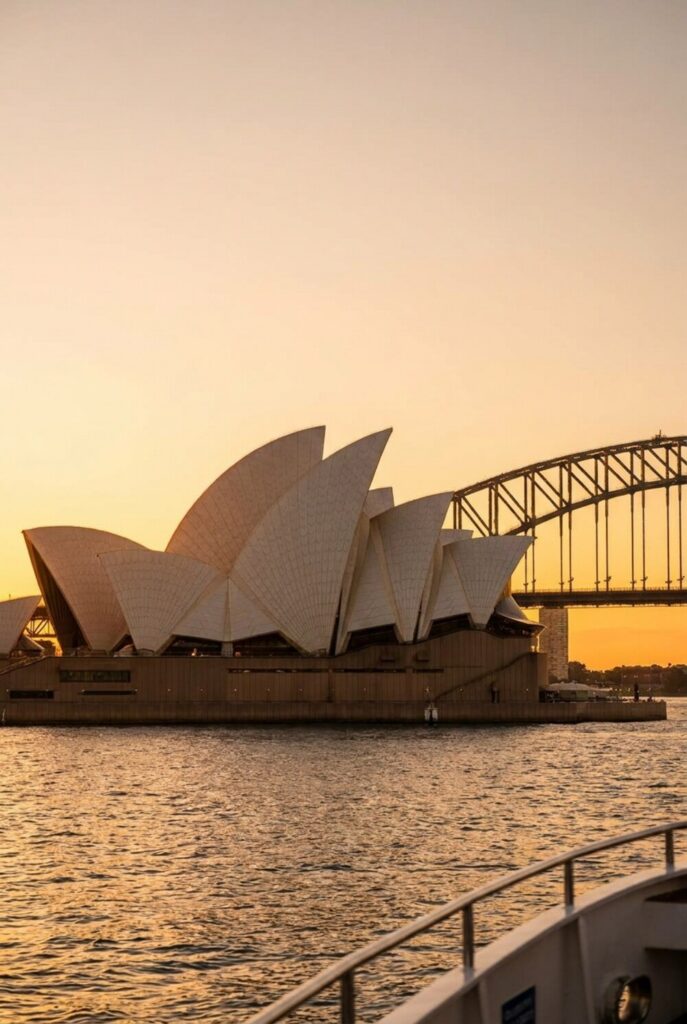
Australia’s largest city and the one most visitors start with — a harbour city of 5.4 million people built around one of the world’s most photogenic waterways. Sydney is where the Opera House, Bondi Beach, and the Harbour Bridge cluster inside a 20-minute radius, which is why it consistently ranks among Australia’s top tourist destinations.
- Sydney Opera House and Circular Quay — UNESCO-listed since 2007
- Bondi to Coogee coastal walk (6 km, 2 hours)
- Blue Mountains day trip — Three Sisters, Scenic World, Katoomba
- Signature: fresh oysters at the Sydney Fish Market; flat whites in Surry Hills
☕ Melbourne
Australia’s culture capital, famous for laneway bars, third-wave coffee, and a rivalry with Sydney it takes more seriously than Sydney does. Melbourne has topped the Economist’s “world’s most liveable city” rankings repeatedly through the 2010s.
- Federation Square, Flinders Street Station, and the graffiti of Hosier Lane
- Queen Victoria Market and the Italian strip of Lygon Street
- Great Ocean Road day trip — Twelve Apostles, Loch Ard Gorge
- Signature: dim sum in Chinatown; AFL football at the MCG
🌴 Brisbane
Queensland’s subtropical capital, a river city of 2.7 million that hosts the 2032 Summer Olympics. Warmer, slower, and more outdoor-oriented than Sydney or Melbourne, with easy access to the Gold Coast, Sunshine Coast, and Fraser Island.
- South Bank Parklands and the Streets Beach city lagoon
- Mt Coot-tha Lookout and the Brisbane City Botanic Gardens
- Moreton Island ferry — dolphin feeding at Tangalooma
- Signature: Moreton Bay bugs (a local crustacean); XXXX brewery tour
🦘 Perth & Western Australia
The most isolated capital city in the world, closer to Bali than to Sydney, and the gateway to Margaret River wine country, the Coral Coast, and Ningaloo Reef. Perth enjoys around 3,200 hours of sunshine a year — among the sunniest capital cities in the world.
- Kings Park and Cottesloe Beach
- Rottnest Island — day trip to meet the quokka
- Margaret River wineries and surf coast (3 hr drive)
🐠 Cairns & the Great Barrier Reef
The tropical reef gateway. Cairns itself is small (≈150,000 residents) but the departure point for the world’s largest coral reef system, stretching over 2,300 km and containing 900+ islands. The surrounding Wet Tropics rainforest is also UNESCO-listed.
- Outer Reef snorkel/dive day trip from Cairns or Port Douglas
- Daintree Rainforest and Mossman Gorge
- Kuranda scenic railway and skyrail
🔴 Uluru-Kata Tjuta & the Red Centre
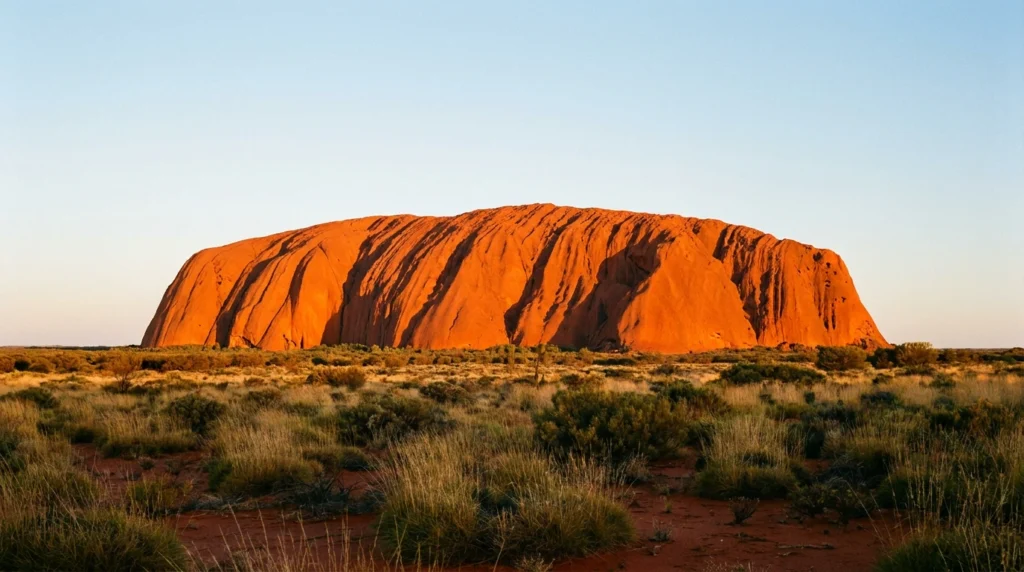
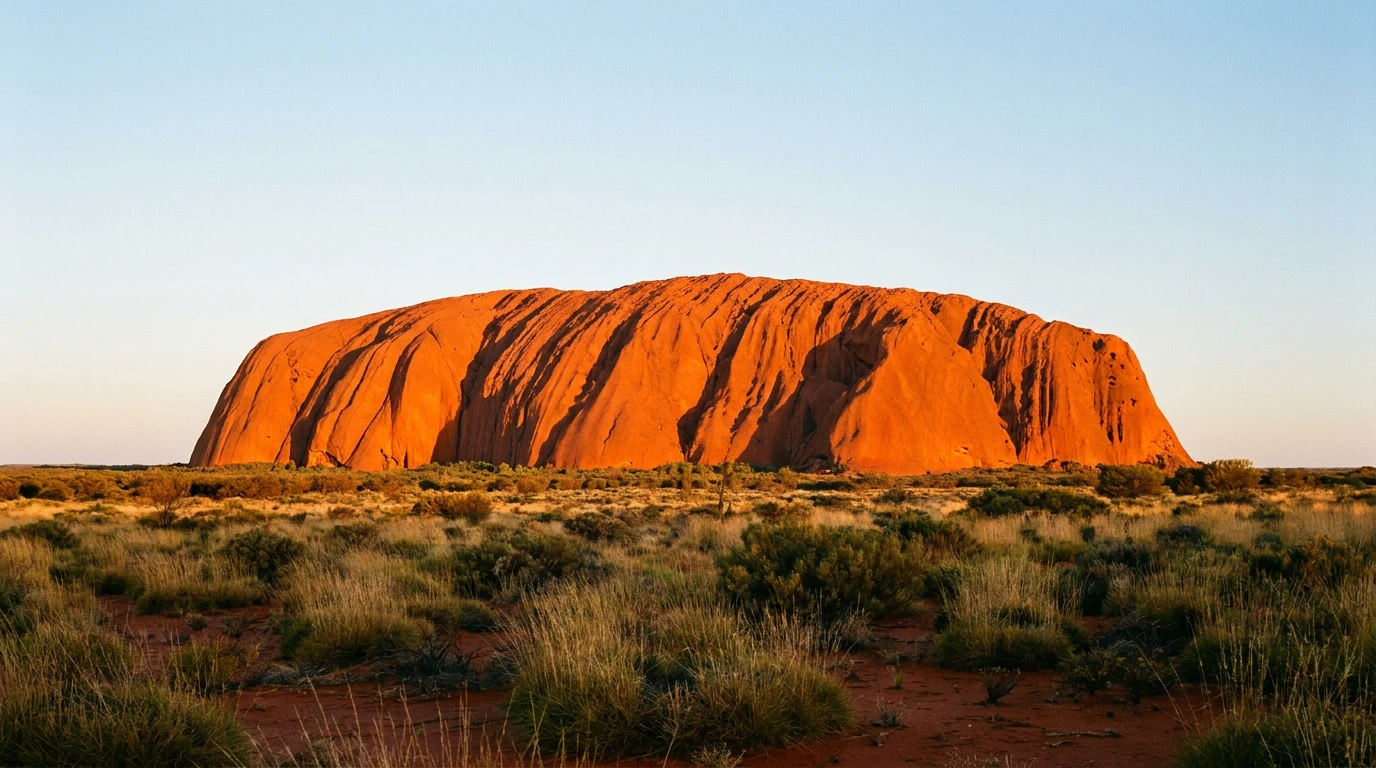
The spiritual heart of the continent. Uluru is a sandstone monolith rising 348 m from the surrounding desert floor, sacred to the Anangu people, and climbing it has been prohibited since 26 October 2019 out of respect for Traditional Owners. Visit Uluru-Kata Tjuta National Park with guided Anangu-led walks to understand the site in its cultural context rather than just as a photograph. Most visitors base themselves at Yulara, the resort village 20 km from the rock, and combine Uluru with Kings Canyon and the MacDonnell Ranges on a Red Centre loop.
- Uluru base walk — a 10.6 km loop at sunrise
- Kata Tjuta’s Valley of the Winds circuit (7.4 km)
- Bruce Munro’s Field of Light installation (extended through 2027)
- Signature: Sounds of Silence dinner under the stars; Anangu-guided Kuniya walk
Australian Culture & Etiquette — What to Know Before You Go
The Essentials
- Tipping is not customary. Hospitality staff are paid a statutory minimum wage (about A$24.95/hour in 2025), so a 10–15% tip is reserved for genuinely exceptional service.
- “G’day” is real. First names are used almost immediately, including with much older strangers, and shortening words (arvo for afternoon, servo for service station) is a sign of warmth, not laziness.
- Sun protection is non-negotiable. Australia has the highest skin-cancer rate in the world; local mantra is “Slip, Slop, Slap, Seek, Slide.”
- BYO culture. Many restaurants outside the CBD allow “Bring Your Own” bottle (usually wine) for a small corkage fee of A$5–15 per bottle.
- Drive on the left. Same side as the UK and Japan; seatbelts compulsory and random breath tests are routine.
Aboriginal & Torres Strait Islander Cultural Respect
- Acknowledgement of Country. Public events, meetings, and some businesses open with an acknowledgement that the land belongs to specific Aboriginal nations; listen rather than treat it as a formality.
- Do not climb sacred sites. Climbing Uluru has been prohibited since 26 October 2019 at the request of the Anangu people; similar restrictions apply at several other sites.
- Ask before photographing people or art. Some ceremonies, rock art, and designs have specific cultural protocols; when in doubt, ask the Traditional Owners or a guided operator.
- Buy authentic art. Look for the Indigenous Art Code label to ensure your purchase supports the artist and their community.
A few everyday touches worth absorbing: Australians queue politely, front seats are the norm in taxis for solo travellers (sitting in the back can read as standoffish), and “How are you going?” is the standard greeting and does not actually require a health update — “good, thanks, you?” will do. Humour is dry and self-deprecating; over-praising Australian things draws a sceptical eyebrow. Strict liquor-licensing means bottle shops (“bottle-o”) close earlier than expected — around 10 pm in NSW, 11 pm in Victoria.
A Food Lover’s Guide to Australia
Australian food is less “national cuisine” and more a multicultural collage. Waves of Italian, Greek, Vietnamese, Lebanese, Chinese, and Indian migration have produced a dining scene where the average suburban food court offers a better cross-section of Asia than you’ll find in most European capitals, and where “Modern Australian” (Mod Oz) at the high end combines native ingredients — finger lime, saltbush, wattleseed, Davidson plum — with European and Southeast Asian technique.
Must-Try Dishes
| Dish | Description |
|---|---|
| Meat pie | Hand-size pastry filled with minced beef and gravy; the unofficial national snack, at roughly A$6–9 at a bakery. |
| Flat white | An Australian (and New Zealand) invention — espresso with steamed microfoam milk, smaller and stronger than a latte; A$5–6 standard. |
| Lamington | A cube of sponge cake dipped in chocolate and rolled in desiccated coconut, often split and filled with cream or raspberry jam. |
| Barramundi | A native saltwater fish with flaky white flesh, often served crisp-skinned with native pepperberry or grilled with lemon myrtle. |
| Chicken parmigiana (“parma”) | A schnitzel topped with napolitana sauce and melted cheese; the standard Australian pub dinner, usually served with chips and salad for A$22–28. |
| Pavlova | Crisp-shelled meringue dessert topped with whipped cream and fresh fruit — usually passionfruit, kiwi, and strawberry. The ownership is disputed with New Zealand. |
| Vegemite on toast | Dark yeast-extract spread, salty and umami, on hot buttered toast — spread thinly, not like Nutella. |
Café Culture & the Australian Breakfast
Australia arguably exports its café culture more successfully than its cuisine. Melbourne alone has more than 5,000 cafés, and both cities treat brunch as a ritual that lasts well past noon. Expect to pay A$18–28 for a brunch main and A$5–6 for a flat white. Good supermarket chains for self-catering include Woolworths, Coles, and IGA.
- Café chains worth knowing: Gloria Jean’s, The Coffee Club, San Churro
- Signature brunch items: smashed avocado on sourdough, Bircher muesli, bacon and egg roll, ricotta hotcakes, shakshuka
Beyond brunch, regional food is worth planning a trip around. Tasmania has world-class oysters, cheese, and single-malt whisky (Lark Distillery helped trigger Tasmania’s whisky boom). South Australia’s Barossa Valley produces some of the world’s great Shiraz; Western Australia’s Margaret River is the country’s premium Cabernet region and doubles as a surf coast. Sydney and Melbourne both have thriving Cantonese yum cha and Vietnamese pho scenes, and Darwin’s Mindil Beach Sunset Market showcases laksa, satay, and Top End bush foods every dry-season Thursday and Sunday from May to October.
For an authentic Indigenous food experience, look for “bush tucker” tours led by Aboriginal-owned operators — Maruku Arts near Uluru, Walkabout Cultural Adventures in the Daintree, and Bungoolee Tours in the Kimberley all include foraging walks with traditional ingredients such as green ants, kangaroo, quandong, and bush tomato. It’s a different dinner than a Melbourne degustation, but often a more memorable one.
Off the Beaten Path — Australia Beyond the Guidebook
Ningaloo Reef, Western Australia
Ningaloo is the less-famous, less-crowded cousin of the Great Barrier Reef and the only place in the world where you can reliably snorkel with whale sharks (March–August) and humpback whales (August–October). The reef runs 260 km along the Coral Coast near Exmouth and is UNESCO-listed. Because Ningaloo is a fringing reef, you can swim out directly from the beach at Turquoise Bay rather than book a boat.
Lord Howe Island, New South Wales
A UNESCO-listed volcanic island 600 km off the NSW coast that caps tourism at 400 visitors on the island at any one time, making it feel like an entire national park reserved for you. Snorkel the world’s southernmost coral reef, hike Mount Gower (one of the world’s best single-day climbs), and cycle between all the restaurants because cars are almost non-existent.
Karijini National Park, Pilbara
Three and a half billion years of geology carved into the iron-red cliffs of Western Australia’s Pilbara region. Karijini’s narrow gorges — Hancock, Weano, Dales — contain some of the oldest rock on Earth, and you swim, scramble, and rope-climb between permanent plunge pools. Fly into Paraburdoo and self-drive.
Kangaroo Island, South Australia
A day’s drive and ferry ride south-west of Adelaide, Kangaroo Island is a self-contained wildlife refuge with sea lions at Seal Bay, koalas in the Flinders Chase gum canopy, and the weathered granite of Remarkable Rocks. Large sections burnt in the 2019–2020 bushfires but wildlife populations and eco-lodges have largely rebuilt.
Cradle Mountain & Tasmania’s Overland Track
Tasmania’s six-day Overland Track (65 km) traverses the Cradle Mountain-Lake St Clair National Park, crossing buttongrass plains, cool-temperate rainforest, and the foot of Cradle Mountain itself. The park is part of the Tasmanian Wilderness UNESCO site, and wombats, pademelons, and echidnas are routinely seen on the trail. Permit numbers are capped from October to May with staggered start times, so book six or more months ahead. For a softer version, stay at Cradle Mountain Lodge and walk the Dove Lake Circuit (6 km) as a day hike.
Practical Information
| Currency | Australian Dollar (A$ / AUD); 1 USD ≈ 1.55 AUD (April 2026) |
| Cash needs | Card is accepted almost everywhere including market stalls; carry A$100–150 cash as backup for regional Outback fuel stops. |
| ATMs | Widespread and reliable in cities; the Big Four (CBA, Westpac, NAB, ANZ) no longer charge ATM fees on domestic cards. Overseas cards typically pay A$2–5 per withdrawal. |
| Tipping | Not customary; round up the bill or leave 10% only for exceptional service. |
| Language | English. Expect Aussie slang that shortens nearly everything (breakfast = brekkie; afternoon = arvo). |
| Safety | Ranked 13th on the 2024 Global Peace Index; violent crime against tourists is rare. The real risks are sun, surf (swim between the red-and-yellow flags), and dehydration in the Outback. |
| Connectivity | Telstra has the widest regional coverage; Optus and Vodafone are cheaper in cities. 5G in every capital. |
| Power | Type I plugs, 230V, 50Hz. |
| Tap water | Safe to drink across all cities and most regional towns. |
| Healthcare | World-class; reciprocal Medicare agreements exist with the UK, Ireland, New Zealand, Italy, Sweden, and others. Travel insurance strongly recommended for everyone else. |
Biosecurity: Australia has some of the strictest quarantine rules in the world. Declare all food, plant material, wooden items, and outdoor gear on your Incoming Passenger Card — undeclared items can result in on-the-spot fines of A$2,664 or more.
Emergencies: Dial 000 for police, fire, or ambulance anywhere in Australia; 112 also works on mobile phones.
Budget Breakdown — What Australia Actually Costs
💚 Budget Traveller
Around A$120–180 (US$78–116) per day. Hostel dorm beds run A$40–55 in Sydney and Melbourne, a supermarket lunch or bakery pie and coffee is about A$15, and an urban day pass on Opal or Myki caps at roughly A$10. Backpacker-style travel works well on the east-coast Greyhound routes and around Cairns.
💙 Mid-Range
Around A$280–450 (US$180–290) per day. Three-star hotels or apartment rentals cost A$180–280 per night in the capital cities, restaurant mains sit at A$25–40, and a reef day tour from Cairns or a Blue Mountains day trip from Sydney is roughly A$180–260 per person.
💜 Luxury
From A$800 (US$515) per day upward. Iconic stays like Qualia on Hamilton Island, Longitude 131° at Uluru, Saffire Freycinet in Tasmania, or the Park Hyatt Sydney start at A$1,400–1,900 per night, and helicopter reef or outback tours run A$700–2,000 per person. Fine dining at Attica in Melbourne or Quay in Sydney is around A$300 per head, and private charter flights in the Kimberley or Great Barrier Reef can easily hit A$5,000 per day.
Across every tier, the single biggest hidden cost is internal flights. A last-minute Sydney–Cairns one-way can jump from A$180 to A$450 in the final fortnight, so book domestic legs 3–6 months ahead and use Qantas, Virgin, and Jetstar price-tracker tools. Alcohol is also a shock: a pint of local beer in a Sydney pub is A$12–14 and a bottle of mid-range wine in a restaurant is A$55–75, so BYO-corkage dinners save serious money for mid-range travellers.
| Tier | Daily (USD) | Accommodation | Food | Transport |
|---|---|---|---|---|
| Budget | US$78–116 | Hostel dorm A$40–55 | Bakery, supermarket, food courts | City transit card + Greyhound bus |
| Mid-Range | US$180–290 | 3-star hotel A$180–280 | Cafés and casual restaurants | Domestic flights + rideshare |
| Luxury | US$515+ | 5-star / iconic lodge A$1,400+ | Fine dining, degustation A$250–350 | Private transfers, helicopter tours |
Planning Your First Trip to Australia
- Pick two regions, not five. The classic first-trip pairing is Sydney plus the Great Barrier Reef; the second-most common is adding Melbourne and the Great Ocean Road, or swapping the reef for Uluru.
- Apply for your ETA or eVisitor online before you fly. Both are processed electronically within hours in most cases and linked to your passport.
- Book internal flights early. Qantas, Virgin, and Jetstar run flash sales 3–6 months ahead; waiting until the final month can double the Sydney–Cairns fare.
- Match your season to your region. Tropical north = May–October. Southern cities and Tasmania = October–April. Uluru = April–September.
- Pack reef-safe sunscreen, a hat, and a power adapter. Australia uses Type I plugs and enforces strict biosecurity — declare all food, plant material, and wooden items on your Incoming Passenger Card.
Classic 14-Day Itinerary: Days 1–4 Sydney & Blue Mountains; Day 5 fly to Cairns; Days 6–8 Great Barrier Reef & Daintree; Day 9 fly to Uluru; Days 10–11 Uluru-Kata Tjuta & Field of Light; Day 12 fly to Melbourne; Days 13–14 Melbourne & Great Ocean Road day trip.
Cities & Regions to Explore
Frequently Asked Questions
Is Australia expensive to visit?
Yes, by global standards — Australia consistently ranks among the world’s most expensive tourist destinations for food, accommodation, and internal flights. Expect around US$180–290 per day on a mid-range budget. You can blunt the cost by self-catering from Woolworths or Coles, using hostel YHA dorms, and booking domestic flights 3–6 months ahead.
Do I need to speak English?
English is the national language and functionally universal, but Australian English is spoken at high speed and shortens almost every word (brekkie = breakfast, arvo = afternoon, servo = service station). Non-native speakers usually adjust within a day or two; no other language skills are required to travel the country.
Is a domestic rail pass worth it?
No, unlike Japan or Europe. Australia has no unified national rail pass, and distances make trains impractical as transport — the Indian Pacific (Sydney–Perth) takes four days. Treat long-distance trains as experiences, not as transit. For moving between cities, domestic flights on Qantas, Virgin, and Jetstar are faster and usually cheaper.
Is Australia safe for solo travellers?
Very. Australia ranks 13th on the 2024 Global Peace Index, and violent crime against tourists is rare. The genuine risks are environmental: strong UV, strong surf (always swim between the red-and-yellow lifeguard flags), and dehydration or vehicle breakdowns in the Outback.
When is the best time to visit Australia?
Late April or late September–October. These shoulder windows give you pleasant weather across the tropical north, the Red Centre, and the southern capitals at the same time, with fewer crowds than the December–January domestic summer holidays and lower flight prices.
Can I get by as a vegetarian or vegan?
Easily in every capital city and most regional towns. Melbourne and Sydney both have thriving dedicated vegan scenes, supermarkets carry strong plant-based ranges (notably the Australian brand v2food), and nearly every café menu marks vegetarian and vegan items. The Outback and very small country towns are harder — stock up before you leave a capital.
Do I need an ETA or eVisitor to enter?
Yes. Almost every traveller needs an Electronic Travel Authority (ETA, A$20 for most passports including US, Canada, Japan, Singapore) or eVisitor (free, for EU/UK passports). Both allow multiple stays of up to 90 days per visit across 12 months. Apply online through Home Affairs before you fly.
Ready to Explore Australia?
Australia rewards slow travel and big road trips — come hungry for both adventure and brunch, and plan two regions rather than trying to see a whole continent in two weeks.
Explore More
Cities we cover in Australia
Cities to explore in Australia
Deep-dive guides to specific cities, neighbourhoods, and food scenes — written with the same magazine voice.
More country guides you might like
Plan your trip to Australia
The booking tools we use ourselves. FFU may earn a commission at no extra cost to you.
Plan & book your trip to Australia
Booking through these searches supports our guides at no extra cost to you.