
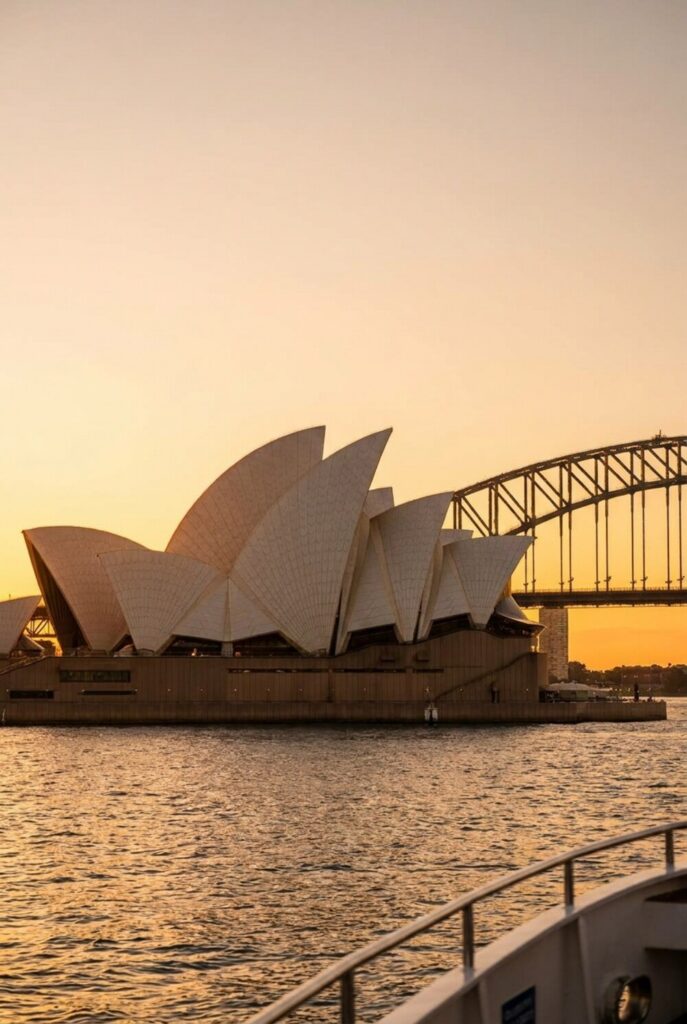
Sydney, Australia: Harbour Sails, Surf Beaches and Vivid Lights
Part of our Australia travel guide.
Sydney City Guide
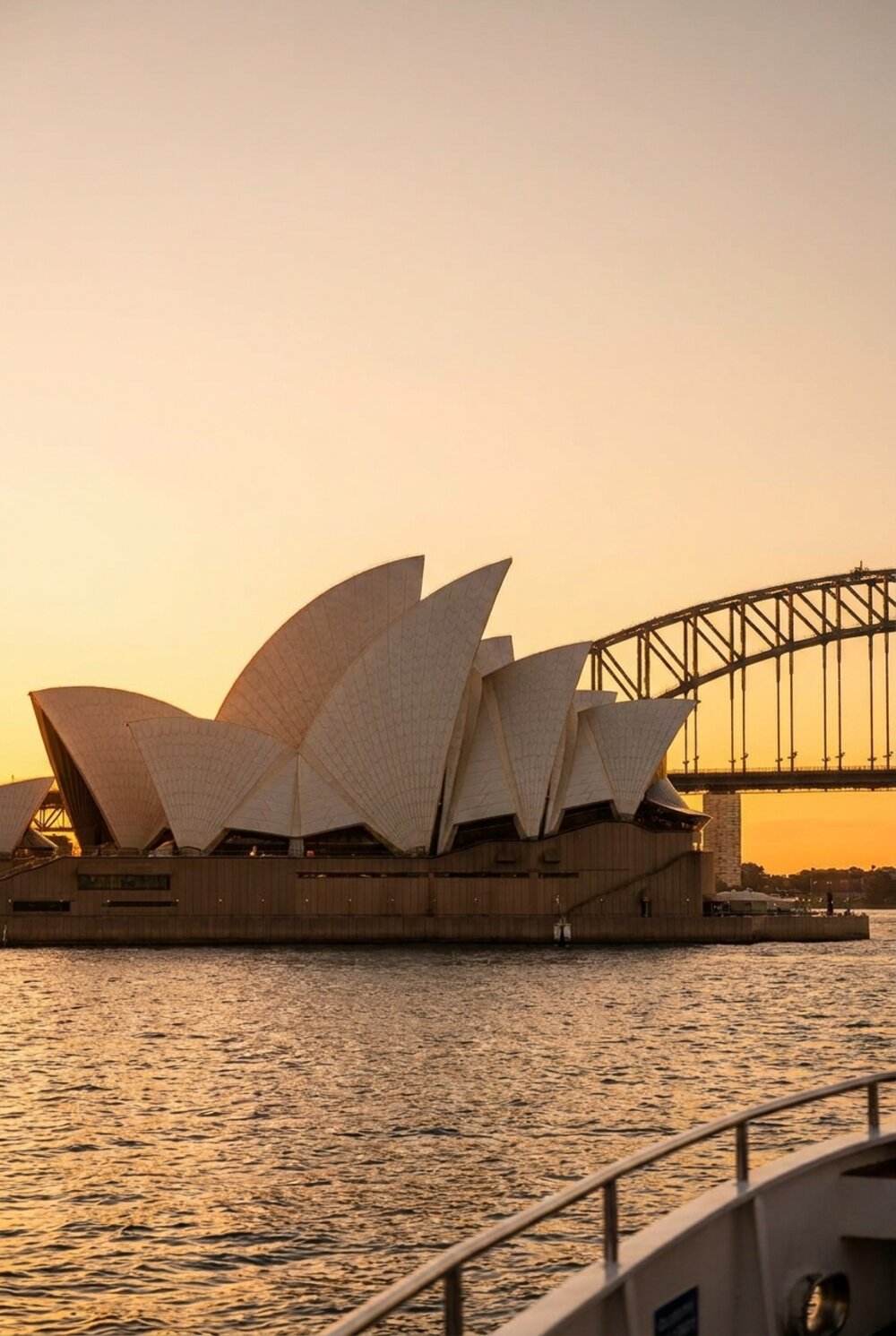
Table of Contents
Why Sydney?
Sydney is the kind of capital-of-nothing that behaves like the capital of everything — it is not the seat of Australia's government (Canberra is), nor even the largest by square kilometre of urban footprint (Melbourne's metro is close), but its 5.4 million residents, sandstone harbour and UNESCO-listed Opera House make it the country's unchallenged front door. A seven-minute ferry ride from Circular Quay to Kirribilli will carry you past the single most photographed postcard on the continent: the white Jorn Utzon sails of the Opera House (completed 1973, UNESCO-listed 2007) against the grey arch of the 1932 Harbour Bridge, framed by a deep-water harbour that European settlement reached in 1788 and Aboriginal Gadigal people had called home for at least 60,000 years before that.
Sydney's geography is the city's most durable selling point. The Greater Sydney metropolitan area counts more than 100 ocean and harbour beaches within the local-government boundary, from Bondi and Manly to the quieter coves of the North Shore, and the Sydney Harbour National Park preserves 393 hectares of bushland along the foreshore inside a city of 12,000 km². The contradiction that every first-time visitor notices is how casually the city toggles between the global-metropolis vocabulary (Barangaroo's International Towers, Martin Place's investment-bank glass) and the almost-suburban ritual of a 06:00 ocean swim at Bondi Icebergs followed by smashed avocado at a Bronte café. You can watch the Sydney Symphony perform Mahler inside a UNESCO building one night and at 10:00 the next morning be standing on the 134-metre apex of the Harbour Bridge arch with a safety tether, staring back down at the sails you sat underneath.
Sydney also holds the top line of Australian gastronomy: more than 60 restaurants have held hats (the Good Food Guide's local equivalent of Michelin stars) across the city and state in recent years, including three-hat institutions Quay, Sixpenny and Bennelong inside the Opera House itself. The city's Asian-Australian pantry — Cantonese at Mr. Wong, Vietnamese at Marrickville Pork Roll, Thai at Chat Thai — is as deep as any outside the source country, and the Sydney Fish Market at Blackwattle Bay is the largest seafood market in the Southern Hemisphere. Over the course of this guide you will get our pick of the ten neighbourhoods worth structuring a visit around, a full tour of Mod Oz cooking and brunch culture, practical routes to the Opera House, the Harbour Bridge, the Royal Botanic Garden and the Art Gallery of NSW's free Aboriginal-art wing, and a full 2026 seasonal calendar anchored by Vivid Sydney (22 May to 13 June 2026) and the Sydney New Year's Eve fireworks.
Neighborhoods: Finding Your Sydney
📍 Sydney Map: Every Place in This Guide
Greater Sydney sprawls over roughly 12,368 km² and 33 local government areas, but the travel-facing city compresses into a walkable horseshoe around Sydney Harbour, with the CBD on the southern shore, the North Shore (Kirribilli, Lavender Bay, Neutral Bay) connected by the Harbour Bridge and a fleet of green-and-yellow ferries, and the eastern beaches arc (Bondi, Bronte, Coogee) reachable by the 333 bus in 20-25 minutes. Inner-west neighbourhoods like Newtown, Marrickville and Chippendale are a short ride on the T2 line, and the villagey bays of Balmain and Rozelle are a scenic F7 ferry hop away. The following ten neighbourhoods cover every itinerary from a four-night first visit to a two-week deep-dive. Each one anchors to a specific train station, ferry wharf or bus stop so you can drop it into your route without a map, and together they touch the Opera House, Harbour Bridge, Royal Botanic Garden, the Bondi-to-Coogee coastal walk, Manly surf beach, the Sydney Fish Market, Centennial Parklands and the three major museum precincts.
Sydney CBD
The Sydney CBD is the peninsula between Circular Quay, Central Station, Darling Harbour and Hyde Park, and holds a surprising amount of the city's sightseeing. Martin Place is the pedestrianised civic spine with the Reserve Bank of Australia. The Queen Victoria Building (QVB), a restored 1898 Romanesque department store, houses around 170 boutiques under a copper dome. Sydney Tower Eye at 309 m is the tallest structure in the CBD, with a 360-degree deck admission of A$39 (~$25 USD). Hyde Park, Sydney's oldest public park laid out in 1810, bisects the CBD with Moreton Bay figs and the Archibald Fountain. Most four- and five-star hotel stock — Park Hyatt, Four Seasons, Shangri-La, Pullman Quay Grand and Hilton Sydney — sits within a ten-minute walk of Circular Quay.
- Circular Quay — ferries, trains and a 10-minute walk to the Opera House and Royal Botanic Garden.
- Queen Victoria Building — 1898 Romanesque landmark with 170 boutiques under a copper dome.
- Martin Place — pedestrianised civic spine, Reserve Bank and the Cenotaph.
- Sydney Tower Eye — 309-metre observation deck, A$39 (~$25) admission.
Best for: first-timers, harbour sights, business travellers. Access: Trains to Town Hall, Wynyard, Martin Place or Circular Quay stations.
The Rocks
The Rocks is the sandstone wedge between Circular Quay and the Harbour Bridge and the oldest European-settled neighbourhood in Australia, dating to the 26 January 1788 arrival of the First Fleet. Cobbled lanes are lined with 1840s-era pubs including the Hero of Waterloo Hotel (1843) and the Lord Nelson Brewery Hotel (licensed 1841, the longest continuously licensed pub in NSW). Cadman's Cottage (1816) is the oldest surviving residence in the city. The Rocks Discovery Museum (free, 10:00-17:00 daily) covers colonial and pre-colonial history in a restored sandstone warehouse. The Rocks Markets run Saturday-Sunday 10:00-17:00 along George Street with around 170 stalls. Observatory Hill, a five-minute walk uphill, has one of the best free views of the Harbour Bridge.
- Hero of Waterloo Hotel (1843) — sandstone pub with live folk and jazz seven nights.
- Cadman's Cottage (1816) — oldest surviving residence in Sydney.
- The Rocks Markets — Saturday-Sunday craft and produce strip along George Street.
- Observatory Hill Park — free elevated viewpoint over the Harbour Bridge.
Best for: colonial history, harbour-front pubs, weekend markets. Access: Circular Quay Station, 5-minute walk north under the Cahill Expressway.
Darling Harbour
Darling Harbour is the west-facing CBD waterfront redeveloped from the 1980s, and it is the city's family-and-convention pocket. The SEA LIFE Sydney Aquarium holds 700+ species including a 100-metre shark tunnel and a dugong habitat (A$55 adult, ~$36 USD). The WILD LIFE Sydney Zoo next door is the indoor native-wildlife counterpart (combo ticket A$75, ~$49 USD). The Australian National Maritime Museum at Pyrmont (free) includes HMAS Vampire and HMAS Onslow, both boardable. The ICC Sydney is the main event venue, Tumbalong Park hosts festivals year-round, and Cockle Bay Wharf restaurants are the reliable family dinner option. Early morning (09:00-10:30) is the quietest aquarium window.
- SEA LIFE Sydney Aquarium — 700+ species with a 100-metre shark tunnel, A$55 (~$36).
- Australian National Maritime Museum — free entry, HMAS Vampire and HMAS Onslow boardable.
- ICC Sydney — convention and concert venue, up to 35,000 delegates.
- Tumbalong Park — outdoor festival lawn and family play space.
Best for: families, indoor rainy-day options, waterfront dining. Access: Light rail to Convention Stop or a 10-minute walk from Town Hall Station.
Surry Hills
Surry Hills, on the eastern flank of Central Station, has been the city's brunch, coffee and small-bar capital since roughly 2010. Crown Street is the main dining artery, with Bourke Street Bakery (founded 2004) as the reference address for sourdough and the pork-and-fennel sausage roll (A$8, ~$5). Single O Surry Hills is one of Australia's flagship third-wave coffee roasters, at A$5.50-7 per cup. Paramount House Hotel, the boutique-within-a-1940s-film-studio conversion, is a weekend set-piece with its rooftop gym, mezzanine bar and 29 rooms. The Crown Street-to-Cleveland Street corridor holds most of the city's cocktail and natural-wine bars (Door Knock, Dear Sainte Éloise, Love, Tilly Devine). Hotels here lean boutique rather than chain.
- Bourke Street Bakery (original 2004 shop) — sourdough and pork-and-fennel sausage roll benchmark.
- Single O Surry Hills — third-wave coffee roaster and café on Reservoir Street.
- Paramount House Hotel — boutique hotel inside the 1940s Paramount Pictures building.
- Crown Street — fashion boutiques, small bars and dessert shops.
Best for: brunch, independent boutiques, cocktail bars. Access: Central Station (10-minute walk east) or 308 bus along Cleveland Street.
Newtown
Newtown sits on the T2 Inner West & Leppington line, 15 minutes from Central Station, and is the long-established LGBTQ+, alternative-arts and student nightlife strip. King Street is the 2 km retail-and-food spine, and its density of Thai restaurants (Thai Pothong, Sabbaba, Newtown Thai) is unmatched north of the airport. The Enmore Theatre (opened 1908, capacity 2,500) on Enmore Road is one of the most-loved live-music venues in Australia and hosts everything from touring indie rock to stand-up comedy on most nights of the week. Dendy Newtown on King Street is the boutique art-cinema anchor. Young Henrys brewery in nearby Surry Hills Road runs a daily public taproom pouring beers brewed metres from the bar. King Street's mural corridor (including the "I Have a Dream" memorial painted 1991) is one of the longest continuous street-art strips in the country. The neighbourhood is still one of Sydney's visible queer centres after the Oxford Street scene contracted; the Imperial Erskineville (a ten-minute walk) hosts the long-running Friday and Saturday drag shows.
- King Street — 2 km retail-and-food strip with independent shops and Thai restaurants.
- Enmore Theatre (1908) — 2,500-capacity live-music hall.
- Dendy Newtown — boutique art-cinema.
- Young Henrys brewery — public taproom and brewery tours.
Best for: LGBTQ+ nightlife, live music, vegan and Thai food. Access: Newtown Station on the T2 Inner West & Leppington line, 15 minutes from Central.
Bondi
Bondi Beach is the eastern-suburbs crescent of sand that has done more global marketing for Sydney than any single other image; it is a 1 km patrolled beach with consistent swell for surfing the southern end and calmer water at the northern end by Ben Buckler headland. Bondi Icebergs Club at the southern tip has the country's most photographed ocean pool (A$12 adult entry, ~$8 USD), built on the rocks in 1929 and flushed by each wave. The 6 km Bondi to Coogee Coastal Walk hugs the sandstone clifftops past Tamarama, Bronte, Clovelly and Gordons Bay, and is the setting for the annual Sculpture by the Sea exhibition in late October to early November. Bondi Markets at Bondi Beach Public School run Sundays 10:00-16:00. The old Bondi Pavilion bathing-house (1929, renovated 2022) now runs theatre, cinema and a weekend café. Accommodation is a mix of boutique (QT Bondi, the Bondi) and youth-hostel-dense Campbell Parade runs; expect beach-premium room rates January-March.
- Bondi Icebergs ocean pool — 1929 rock-cut pool, A$12 (~$8) entry.
- Bondi to Coogee Coastal Walk — 6 km clifftop path, site of Sculpture by the Sea.
- Bondi Markets — Sundays 10:00-16:00 at Bondi Beach Public School.
- North Bondi cafés — Speedos and Bondi Tratt for morning brunch.
Best for: beach culture, coastal walk, brunch. Access: Bondi Junction Station then 333 bus (20 minutes total from CBD).
Manly
Manly sits on a narrow isthmus at the entrance to Sydney Harbour, with Manly Cove on the harbour side and Manly Beach on the ocean side linked by the 200-metre pedestrian strip known simply as The Corso. The F1 Manly Ferry from Circular Quay is itself a 30-minute sightseeing cruise past Fort Denison, Taronga Zoo and the North Head cliffs (included in the standard A$9.44 Opal ferry fare, ~$6 USD, and capped daily). Manly Beach holds reliable 1-2 metre surf year-round and hosts the Australian Open of Surfing every February; Shelly Beach at the southern end is the sheltered snorkelling cove reachable by a 15-minute cliff-path walk. North Head, at the eastern edge of the suburb, sits inside Sydney Harbour National Park and offers the best single long-range view back across the harbour to the Opera House and the city skyline. The Corso's fish-and-chip shops, in particular Manly Fish Market and the Seadog, are the default ferry-and-lunch combo.
- Manly Beach — ocean-side surf beach with year-round 1-2 metre swell.
- Shelly Beach — sheltered snorkelling cove 15 minutes south of Manly Beach.
- North Head — Sydney Harbour National Park clifftop with Opera House panorama.
- Manly Wharf — F1 ferry terminal with hotels and restaurants along the promenade.
Best for: ferry ride, surfing, ocean-side family day. Access: F1 Manly Ferry from Circular Quay (30 minutes).
Chippendale
Chippendale is the inner-south neighbourhood wedged between Central Station and Broadway, and it has quietly become Sydney's contemporary-art and laneway-dining headquarters. The White Rabbit Gallery on Balfour Street is a free contemporary Chinese art space (10:00-17:00 Wednesday-Sunday) with one of the largest collections of post-2000 mainland Chinese work anywhere outside China, operated by the White Rabbit Collection. Central Park on Broadway is the Ateliers Jean Nouvel and Norman Foster mixed-use tower and mall complex whose One Central Park building carries the world's tallest vertical garden (38 storeys of Patrick Blanc-designed plantings) and was recognised by the Council on Tall Buildings and Urban Habitat in 2014 as the Best Tall Building Worldwide. Spice Alley on Kensington Street is a collection of five Southeast Asian hawker stalls (Malaysian, Thai, Japanese, Vietnamese) with shared outdoor seating and A$15-22 mains; Kensington Street itself has been remade into a heritage-restored dining lane of 19th-century terrace houses.
- White Rabbit Gallery — free contemporary Chinese art collection.
- One Central Park — world's tallest vertical garden, 38 storeys.
- Spice Alley — five Southeast Asian hawker stalls on Kensington Street.
- Old Rum Store — restored 19th-century warehouse now a wine-and-events venue.
Best for: contemporary art, laneway dining, university-district drinking. Access: Central Station, 10-minute walk south-west through Central Park.
Paddington
Paddington, east of the CBD above Centennial Parklands, is the Victorian-terrace residential quarter that became the city's fashion boutique capital in the 1980s and has now matured into a weekend market and art-gallery district. The Paddington Markets at Paddington Uniting Church (Oxford Street, Saturdays 10:00-16:00) have run since 1973 and remain one of the country's most respected design-and-fashion outdoor markets, with about 150 stalls across craft, vintage, ceramics and emerging Australian designers. Oxford Street between Victoria Barracks (1848, still an active Australian Army base) and Five Ways (the angled intersection at the neighbourhood's heart) is the boutique strip, leaning toward Australian labels like Zimmermann, Camilla and KitX. Centennial Parklands, 360 hectares of open parkland laid out in 1888, is the city's largest single green space and the weekend jogging and picnic hub, with a large pond at its centre used for model-yacht sailing.
- Paddington Markets — 1973-established Saturday design and fashion market.
- Oxford Street boutique strip — Zimmermann, Camilla and other Australian designers.
- Five Ways — five-way pub-and-café intersection at Paddington's heart.
- Centennial Parklands — 360 hectares of 1888-laid parkland, weekend jogging hub.
Best for: Saturday markets, fashion boutiques, Victorian terraces. Access: 380 or 333 bus from the city (15 minutes).
Kirribilli
Kirribilli is the small peninsula on the North Shore directly opposite the Opera House, and it is the best free photography perch for the classic Harbour Bridge-and-Opera-House composition. Kirribilli House is the Prime Minister's Sydney residence (grounds open for one heritage weekend per year, normally September); adjacent Admiralty House is the Sydney residence of the Governor-General. Milsons Point Station on the T1 North Shore line is the first stop after the Harbour Bridge and drops you 100 metres from Luna Park (the 1935 heritage-listed harbourside amusement park under the bridge, free entry, pay-per-ride from A$12). Bradfield Park and Jeffrey Street Wharf are the photographer's viewpoints, and the Sunday-running Kirribilli General Markets at Burton Street Tunnel add 200+ craft and food stalls on the fourth Saturday of every month. The McDougall Street jacaranda canopy (peak bloom early-to-mid November) is the single most-photographed Sydney street scene after the bridge itself.
- Luna Park (1935) — heritage-listed harbourside amusement park under the bridge.
- Bradfield Park — photographer's viewpoint for the Opera House and Harbour Bridge.
- McDougall Street — jacaranda-lined avenue, peak bloom early November.
- Kirribilli General Markets — fourth-Saturday-of-month craft and food market.
Best for: harbour viewpoints, Harbour Bridge photography, Sunday markets. Access: Milsons Point Station (first stop across the Harbour Bridge).
The Food
Sydney's food culture sits at the intersection of three traditions: a colonial pub counter inherited from Britain, an Asian-Australian pantry built by Cantonese, Vietnamese, Thai and Lebanese migration waves since the 1970s, and the produce-led Modern Australian ("Mod Oz") fine-dining movement pioneered by chefs like Tetsuya Wakuda, Neil Perry and Peter Gilmore from the 1990s. The city does not have a Michelin Guide, but the Good Food Guide — published annually by the Sydney Morning Herald since 1984 — awards one-, two- and three-hat ratings that function as the local equivalent, with roughly 60 restaurants holding hats in any given year and three-hat status reserved for the country's top dozen or so rooms. Sydneysiders eat brunch more seriously than arguably any city on earth (the smashed-avocado meme originated at Bills Darlinghurst in 1993), queue for Cantonese yum cha on Sunday morning as a family ritual, and treat the A$9 meat pie from Harry's Cafe de Wheels in Woolloomooloo as a civic monument. Below is the city's food in the order most first-time visitors actually encounter it.
Modern Australian (Mod Oz) & Hat Restaurants
Modern Australian cuisine is the broad umbrella for produce-led cooking that uses local ingredients (Spencer Gulf kingfish, Tasmanian wagyu, native spices like finger lime, wattleseed, lemon myrtle and saltbush) plated with technique borrowed from French, Japanese and Italian traditions. Mod Oz tasting menus typically run three to four hours and A$180-310 per head before pairings, with wine matches adding another A$120-180. Reservations at the top rooms open 30-90 days out on the restaurant's own site. The Good Food Guide 2025 awarded three hats to Quay, Sixpenny and Bennelong; 18 restaurants carried two hats including Oncore by Clare Smyth, Saint Peter and Rockpool Bar & Grill. The dress code at three-hat rooms is smart-casual at a minimum; no thongs (flip-flops), no singlets (tank tops), covered shoes required in the evening. Sydney's Mod Oz rooms make a particular feature of the harbour view — Quay and Bennelong both command floor-to-ceiling windows on the Opera House or the Harbour Bridge, which is priced into the tasting menu.
- Quay — Peter Gilmore's three-hat harbour-view tasting at Overseas Passenger Terminal, Circular Quay. Degustation A$310 (~$202).
- Bennelong (inside the Opera House) — Peter Gilmore's Mod Oz three-course under the sails, A$210-245 (~$137-159).
- Aria — Matt Moran's contemporary Australian, East Circular Quay. Chef's tasting A$220 (~$143).
- Sixpenny (Stanmore) — paddock-to-plate three-hat destination, tasting A$205 (~$133).
- Ester (Chippendale) — wood-fired Mod Oz in a warehouse setting, shared plates A$95 (~$62) per head.
- Oncore by Clare Smyth — Barangaroo, tasting A$275 (~$179), the chef's first restaurant outside the UK.
Asian-Australian — Cantonese, Thai, Vietnamese, Japanese
Sydney's Asian-Australian kitchens are deep enough to be the city's headline cuisine rather than a supporting act. The Cantonese scene centres on Mr. Wong (Merivale Group, Bridge Lane CBD) for modernised yum cha, and Golden Century — the institutional seafood Cantonese that ran on Sussex Street from 1989 to 2021 — has reopened in Chippendale as The Century at Inner West in 2023 under the original Wong family. Chinatown's Haymarket base, south of Central, houses Chat Thai's Campbell Street flagship, where lunchtime queues can be long on weekends for A$18-28 noodles and curries. The Vietnamese corridor has moved west since the 2010s: Cabramatta and Marrickville are the suburbs to know, with Marrickville Pork Roll serving the city's reference A$8 banh mi and Cabramatta's Thanh Binh and Pho Tau Bay carrying the pho benchmark. Japanese cooking in Sydney is led by Tetsuya Wakuda's Tetsuya's (Kent Street since 2000) — Japanese-French tasting at A$295, one of the country's founding fine-dining restaurants — and on the casual end by the Devon and Yakitori Jin for late-night skewers. Korean barbecue has bloomed in the Strathfield and Eastwood corridors; Madang at CBD and Arisun in Haymarket are the city-centre references.
- Mr. Wong (CBD) — yum cha and modern Cantonese, A$15-28 (~$10-18) per dim sum plate.
- Golden Century / The Century at Inner West — Cantonese live seafood, mud crab A$140-180 (~$91-117).
- Chat Thai Haymarket — original Campbell Street store, noodles and curries A$18-28 (~$12-18).
- Marrickville Pork Roll — Vietnamese banh mi reference, A$8-10 (~$5-7).
- Tetsuya's — Japanese-French tasting, Kent Street since 2000. A$295 (~$192).
- Yakitori Jin (Haymarket) — late-night skewers, A$6-9 (~$4-6) per stick.
Seafood & Sydney Rock Oysters
Sydney is the largest seafood market in the Southern Hemisphere and the only major Australian city where the local native oyster (the Sydney rock, Saccostrea glomerata) is the default rather than the imported Pacific. Sydney Fish Market at Blackwattle Bay is the working auction floor Monday-Saturday from 05:30 to wholesale buyers only, with a public retail hall open 07:00-16:00 daily and in-house restaurants serving grilled barramundi, sashimi platters and A$24-per-dozen rock oysters at the cheapest price point in the city. The market is undergoing a A$836 million redevelopment (due for completion in 2025-26) that moves the retail hall to a new waterfront building directly on Blackwattle Bay. Saint Peter, the Paddington restaurant opened by Josh Niland in 2016 — the chef who wrote the book on whole-fish cookery and nose-to-tail fish butchery — holds two hats and runs an A$175 tasting menu where every course is a single fish species rendered in a different cut. Rockpool Bar & Grill by Neil Perry on Hunter Street pairs dry-aged steaks with a seafood section; Nick's Seafood at Cockle Bay is the waterfront-platter default with A$120 seafood platters for two.
- Sydney Fish Market (Blackwattle Bay) — A$24 (~$16) dozen oysters, A$30 (~$19) sashimi platter.
- Saint Peter (Paddington) — Josh Niland whole-fish tasting, A$175 (~$114).
- Rockpool Bar & Grill (CBD) — Neil Perry dry-aged steaks and seafood, mains A$90 (~$59).
- Nick's Seafood (Cockle Bay) — A$120 (~$78) waterfront platter for two.
- Coogee Pavilion — Merivale casual seafood on the beach, A$38 (~$25) fish and chips.
Brunch Culture & Third-Wave Coffee
The Australian breakfast ritual is Sydney's single most-copied cultural export. Smashed avocado on toast with a poached egg, sourdough and feta was popularised at Bills Darlinghurst by Bill Granger in 1993 and now appears on nearly every café menu in the country at an A$22-32 price point. Sydney's coffee culture is defined by the flat white (espresso with steamed milk, about 160 ml, barely distinguishable from a latte to outsiders but a matter of religious conviction to locals), and the city's serious third-wave roasters include Single O (Surry Hills and Redfern), Campos (Newtown and Darling Quarter), Mecca (Ultimo) and Toby's Estate (Woolloomooloo). A flat white runs A$5-7 (~$3-5). The Sydney-Melbourne coffee rivalry is genuine and defended with civic pride: Melburnians insist Sydney uses too much milk, Sydneysiders counter that Melbourne over-extracts, and both cities regularly place in the World Barista Championship finals. For the full brunch experience allow around an hour or more at peak weekend times (09:30-11:30) and expect a queue at Bondi, Bronte and Surry Hills flagships. Most cafés are cashless and impose a 1.5% card surcharge; bring a card not a wallet full of notes.
- Bills (Darlinghurst, original 1993) — ricotta hotcakes, signature scrambled eggs, A$26-32 (~$17-21).
- Single O Surry Hills — third-wave coffee flagship, flat white A$5.50-7 (~$4-5).
- Reuben Hills (Surry Hills) — Latin-leaning brunch, breakfast tostada A$24-28 (~$16-18).
- Speedos Cafe (North Bondi) — beachside brunch, smashed avocado A$22-28 (~$14-18).
- Bronte Road Bistro — Bronte Beach brunch benchmark, A$26 (~$17) avocado plate.
- Paramount Coffee Project (Surry Hills) — rooftop coffee lab, A$6 (~$4) filter brews.
Beyond the Headlines — Pies, Parmis, Pavlova and Pub Counters
Sydney's everyday food is as distinctive as its tasting menus, and the pub-counter meal — order at the bar, pay upfront, sit down with a paper number — is the city's most democratic dining format at A$22-32 per plate. The "chicken parmi" (a chicken schnitzel topped with tomato napoli sauce and melted cheese, served with chips and salad) is the default order and appears on nearly every pub menu in New South Wales. Harry's Cafe de Wheels on Cowper Wharf Road in Woolloomooloo has served its signature "Tiger" meat pie (A$9, ~$6, mushy peas and mashed potato and gravy on top of the crust) from a caravan since 1945, and the list of autographed celebrities on the wall runs from Frank Sinatra to Colonel Sanders. Sydney's most photographable dessert is the pavlova — meringue base, whipped cream, passionfruit pulp, kiwifruit and strawberries — whose name-of-origin argument with New Zealand has been running for a century without resolution. The lamington (a sponge cube dipped in chocolate and rolled in desiccated coconut) is the country's other civic cake, invented at Government House in Brisbane in 1901 and now a fixture of every local bakery at A$5-7 per piece. Sydney rock oysters, Moreton Bay bug (a flat-tailed lobster relative), and barramundi complete the short list of "only-in-Australia" dishes.
- Harry's Cafe de Wheels (Woolloomooloo, since 1945) — "Tiger" meat pie, A$9 (~$6).
- Chicken parmi — pub-counter schnitzel-napoli-cheese staple, A$26-32 (~$17-21).
- Lamington — sponge-chocolate-coconut cube, A$5-7 (~$3-5) at most bakeries.
- Pavlova — meringue with cream and passionfruit, A$12-14 (~$8-9) slice.
- Moreton Bay bug — flat-tailed lobster relative, grilled at seafood restaurants, A$45-65 (~$29-42).
- Sydney rock oysters — native species, A$24-36 (~$16-23) per dozen.
Markets, Food Halls & Night-Market Culture
Beyond the fine-dining and brunch tiers, Sydney's markets and food halls are where first-time visitors get the widest single-stop cross-section of the city's cooking. Carriageworks Farmers Market in Eveleigh (Saturdays 08:00-13:00) runs 70+ NSW-based producers including Pepe Saya butter, Pecora Dairy sheep cheese and Block 11 coffee, and the attached Carriageworks arts precinct keeps the weekend flow into lunch. Spice Alley in Chippendale is the hawker-style lane with five Southeast Asian stalls (Malaysian, Thai, Japanese, Vietnamese, Hong Kong) and shared outdoor seating, most mains A$15-22. The Rocks Foodie Market on Friday lunchtimes is the white-collar weekday pick on George Street, with artisan produce and hot plates from around 20 vendors. For Cantonese yum cha on Sunday morning, arrive by 10:30 at The Eight in Haymarket or Golden Century's Chippendale successor — both run trolley service and queue past 11:30. Chinatown's Dixon Street runs the seasonal Friday Night Market with 60+ Asian street-food stalls from 16:00 until late, April through October.
Cultural Sights
Sydney Opera House
The Sydney Opera House, designed by Danish architect Jorn Utzon, opened on 20 October 1973 and was inscribed on the UNESCO World Heritage List on 28 June 2007 — the youngest site to ever earn the listing at the time, and still one of only a handful of twentieth-century buildings on the World Heritage register. The building's 1,056,006 ceramic "Sydney tiles" clad the 14 shell roofs, and the five performance venues inside (Concert Hall, Joan Sutherland Theatre, Drama Theatre, Playhouse and Studio) host around 1,800 performances a year drawing 10.9 million visitors. A guided tour at A$49 adult (~$32 USD) covers the Concert Hall and Joan Sutherland Theatre most days (09:00-17:00), and the Opera Bar at the eastern forecourt is a pay-nothing way to drink and photograph the sails from underneath. The Tarpeian Lawn next door is the best free photography perch at sunset. For an actual performance, tickets to the Sydney Symphony and Opera Australia start at A$80 and rise to A$330 for the front-stall opera.
Sydney Harbour Bridge & BridgeClimb
The Sydney Harbour Bridge opened on 19 March 1932 after nine years of construction and remains the widest long-span steel arch bridge in the world, at 1,149 metres total length with a 134-metre-high arch apex. The Pylon Lookout at the south-east pylon gives a less-demanding A$24.95 (~$16 USD) self-guided version of the summit experience, with 200 steps to a 87-metre viewpoint and a small in-pylon museum about the bridge's construction. The full BridgeClimb runs A$298-398 (~$194-259 USD) depending on day, time of day and route (twilight is the premium slot), takes roughly 3.5 hours including safety briefing and kit-up, and all personal items including phones are locked away — the on-climb photography is handled by the guide. The free alternative is the pedestrian walkway on the eastern side of the bridge, which is open 24 hours and runs from Cumberland Street at The Rocks to Milsons Point Station on the north shore.
Royal Botanic Garden Sydney & Mrs Macquarie's Chair
The Royal Botanic Garden Sydney sits immediately east of the Opera House, on the foreshore of Farm Cove, and has been a public botanical garden since 1816. Entry is free and the garden is open daily from 07:00 to sunset. The 30-hectare grounds include the Rare and Threatened Plants Garden, the Succulent Garden, and the Herb Garden; guided walks run at 10:30 daily for A$10 per person. Mrs Macquarie's Chair, the sandstone seat hand-carved in 1810 for the governor's wife, sits at the eastern promontory and frames the classic Opera-House-to-Harbour-Bridge postcard view from a single vantage. The garden was the site of the country's first farm in the 1788 colonial era and the stone walls of that original enclosure are still traceable in the lower lawn.
Art Gallery of NSW (Naala Badu & Naala Nura)
The Art Gallery of New South Wales on Art Gallery Road, east of the CBD inside The Domain parkland, opened in 1874 as a public collection of Australian and European painting. Permanent-collection entry is free; special exhibitions run A$22-30 (~$14-20 USD). The gallery doubled in footprint in December 2022 with the A$344 million Naala Badu building designed by Japanese firm SANAA, which sits 15 metres downhill from the original Naala Nura 1909 sandstone structure and is connected by a subterranean link. The Yiribana Gallery is one of the country's largest permanent collections of Aboriginal and Torres Strait Islander art, with more than 300 works on rotation, and the Grand Courts display the Australian colonial and impressionist collection including Tom Roberts, Arthur Streeton and Frederick McCubbin.
Taronga Zoo & Sky Safari
Taronga Zoo opened in 1916 on a sloping 21-hectare site on Bradleys Head Road, Mosman, on the north shore of Sydney Harbour, and is unusual for a big-city zoo in having — from its upper terraces — one of the best postcard views of the CBD skyline and the Opera House across the water. Adult admission is A$53 (~$34 USD) and the on-site Sky Safari cable car carries visitors from the harbour wharf entrance to the top entrance in about five minutes. The Australian Walkabout enclosure is the reliable koala-and-kangaroo experience; the Seal Theatre and the free-flight bird show run twice daily. The best approach for a full day is the F5 Taronga Zoo ferry from Circular Quay, which gives the photograph-from-the-water view of the zoo's hillside terraces.
Hyde Park Barracks & Australian Museum
Hyde Park Barracks on Macquarie Street was designed by convict architect Francis Greenway and completed in 1819 as accommodation for male convicts assigned to Sydney town, and was inscribed by UNESCO in 2010 as one of 11 sites forming the Australian Convict Sites serial listing. Admission is A$18 (~$12 USD) and the preserved second-floor sleeping hammocks — restored to their 1840s configuration — are the single most evocative convict-era interior still standing in the country. The Australian Museum on College Street, opposite Hyde Park, is the country's oldest museum (established 1827) and runs free permanent-collection entry with the First Nations Gallery and the Surviving Australia dinosaur hall as the anchor draws. Both are within a 10-minute walk of St James or Museum stations.
Queen Victoria Building & Sydney Tower Eye
The Queen Victoria Building (QVB) on George Street, completed in 1898 and restored in the 1980s to function as a shopping centre again, is a Romanesque sandstone-and-copper-dome landmark that occupies the entire city block between Market and Druitt streets. Free entry; the trading hours are 09:00-18:00 Monday-Wednesday and Friday-Saturday, 09:00-21:00 Thursday, and 11:00-17:00 Sunday. The suspended Great Australian Clock and the 1,000-kg hanging chandelier inside the central atrium are the architectural set-pieces. Sydney Tower Eye at 100 Market Street is the city's tallest structure for observation purposes at 309 metres, and the 360-degree observation deck at A$39 adult (~$25 USD) includes the optional Skywalk glass-floor outdoor walk. Both are five minutes apart on Pitt Street and make an obvious architecture-of-commerce pairing in a single afternoon.
Entertainment
Opera, Symphony & Ballet at the Opera House
The Sydney Opera House is not only the city's defining sight but a working, heavily-booked performance venue with around 1,800 performances a year across its five theatres. Opera Australia runs a full February-November season at the Joan Sutherland Theatre with tickets from A$90 to A$330 (~$58-215 USD) depending on seat, and the summer Handa Opera on Sydney Harbour (staged on a purpose-built outdoor pontoon at Mrs Macquaries Point, late March-April 2026) sells out three months ahead. The Sydney Symphony plays the Concert Hall (re-opened July 2022 after a A$150 million renovation) with Thursday-Saturday evening concerts from A$80. The Australian Ballet runs a Sydney season in April and November, and the Bangarra Dance Theatre, the country's flagship Aboriginal and Torres Strait Islander contemporary dance company, performs at the Opera House Drama Theatre most August-September windows. Tickets open online 9 months out for the headline shows.
Rugby, AFL & Cricket at the SCG
The Sydney Cricket Ground (SCG) has staged first-class cricket since 1854 and Test-level matches since 1882, and the annual New Year Test — Australia vs. a touring side, starting 3 January — is the single largest sporting event on the Sydney calendar, drawing crowds of up to 48,000 a day across five days. Tickets run A$30-120 (~$19-78 USD). Allianz Stadium (rebuilt 2022 on the neighbouring site) is the rugby and football pitch used by NSW Waratahs (Super Rugby), Sydney FC (A-League) and occasional Wallabies and Socceroos internationals. The NRL (National Rugby League) winter season runs March-October with the State of Origin Blues-vs-Maroons series mid-year as the marquee fixture. Pricing for a Super Rugby game starts at A$30, an NRL regular-season ticket at A$30-45, and a State of Origin seat at A$90-250. The precinct is reached by bus 374 or 396 from the CBD in 15 minutes, or a 10-minute walk from Moore Park light-rail stop.
Live Music — Enmore, Metro Theatre & Oxford Art Factory
Sydney's mid-sized live-music circuit centres on three key venues. The Enmore Theatre in Newtown (opened 1908, capacity 2,500) has hosted everyone from Radiohead to Stormzy on its sprung wooden floor. The Metro Theatre on George Street in the CBD (capacity 1,200) is the default mid-tier tour stop for international indie and rock. Oxford Art Factory on Oxford Street Darlinghurst (capacity 500) is the late-night small-band and DJ room. Pricing typically runs A$45-110 (~$29-71 USD) depending on artist and slot. Tickets are handled mostly by Ticketmaster and Moshtix; the Enmore's own online system opens most Big Thursdays with a first-access presale. The free Sydney Festival runs early-late January each year with 150+ shows across open-air and indoor venues (Domain stage, Hyde Park) and forms the summer backbone of the live-music calendar.
Rooftop Bars & Harbour Cocktails
Sydney's summer rooftop season runs roughly October through April, and the best harbour-facing rooftops line up in a two-kilometre corridor from Barangaroo to the Rocks. Smoke at Barangaroo House (third floor of the 2015 Collins-and-Turner-designed plant-wrapped tower) runs late-afternoon cocktails with an Opera-House-view angle from A$22-28 (~$14-18 USD) per drink. Opera Bar at the Opera House forecourt is the civic cocktail venue and reopens every evening after the last Circular Quay ferry with queues until about 23:30 (no bookings at the outdoor tables; arrive 16:00 on weekends). Hotel Palisade in Millers Point has a 4th-floor rooftop bar in an 1892 heritage-listed sandstone hotel with the most complete panorama of the harbour and the Harbour Bridge. Bar Topa inside the Palisade Hotel, The Glenmore in The Rocks (also a 1921 hotel building with a rooftop above the front bar), and the Shangri-La's 36th-floor Blu Bar on 36 round out the top picks.
LGBTQ+ Nightlife (Oxford Street / Newtown)
Sydney is one of the most LGBTQ+-friendly cities in the world and hosts the Sydney Gay and Lesbian Mardi Gras, the largest Pride event in the Southern Hemisphere, each year in late February to early March — the 2026 parade is scheduled for Saturday 28 February 2026 along Oxford Street from Hyde Park to Moore Park, with an audience of around 500,000 and roughly 12,500 parade participants. The Stonewall Hotel, ARQ Sydney and Universal on Oxford Street are the historical nightlife core, while Newtown (The Imperial Hotel Erskineville and the Bank Hotel) has taken over much of the late-night queer scene since the 2014 lockout laws. Cover charges at venues run A$15-30 (~$10-20 USD). Drag shows, cabaret and community nights are run throughout the week; Wednesday and Thursday are the quieter nights with more local crowds.
Cinema — State Theatre & Moonlight Cinema
The State Theatre on Market Street, completed in 1929 as a 2,000-seat Gothic-Art-Deco cinema palace, is the flagship of the Sydney Film Festival (early June) and runs year-round boutique screenings and live events under a 20,000-piece chandelier. Standard cinema tickets are A$22-28, festival tickets A$25-35 (~$14-23 USD). Moonlight Cinema at Centennial Parklands is the city's outdoor summer cinema, operating December-March with nightly screenings on a 10-metre inflatable screen from a bring-your-own-picnic lawn; tickets run A$22-28 with bean-bag upgrades at A$35. Dendy Newtown, Hayden Orpheum (1935 Cremorne) and Palace Central (Chippendale) round out the boutique-cinema options outside the multiplex chains.
Day Trips
Blue Mountains (90 minutes by T1 Blue Mountains Line train)
The Greater Blue Mountains Area was inscribed on the UNESCO World Heritage List in 2000 for its eucalypt-forest biodiversity (more than 90 species of eucalypt across 1.03 million hectares) and the blue haze the leaves exhale from their eucalyptus oil, visible on any clear day from Sydney. The T1 Blue Mountains Line from Central Station runs hourly to Katoomba in 90 minutes-2 hours for a capped A$9.44 (~$6 USD) off-peak Opal fare. Echo Point at Katoomba is the three-minute-walk viewpoint for the Three Sisters sandstone pinnacles (free); Scenic World adjacent runs the steepest passenger railway in the world (52-degree incline, A$59 adult all-rides, ~$38 USD) plus a Skyway cable car across the Jamison Valley. Leura village, a 10-minute train ride back toward the city, is the cafe-and-antique-shop anchor for a late lunch. The last return train from Katoomba runs just before 22:00; day trips are feasible but an overnight stay is the better option for sunrise at Echo Point.
Hunter Valley Wine Country (2.5 hours by car or tour bus)
The Hunter Valley, 160 km north of Sydney and reached in 2 to 2.5 hours by car up the M1 Pacific Motorway, is the oldest wine-growing region in Australia — continuously planted since the 1820s — and today runs 150+ cellar doors across the Pokolbin and Lower Hunter sub-regions. The flagship grapes are Semillon (the region's most distinctive white, developed specifically for the humid climate) and Shiraz. Tyrrell's (founded 1858) is the oldest family-run winery still operating, and Audrey Wilkinson, McGuigan and Brokenwood are the other three reference cellar doors, with tasting flights typically A$15-25 per person. Day-tour operators including Hunter Valley Wine Tasting Tours (from A$180, ~$117 USD) run round-trip bus pick-up from Sydney CBD hotels at 08:00 with return by 18:30. The region has no passenger rail service; self-driving is the only independent option, and Australia's 0.05% drink-driving limit makes the tour-bus the sensible choice if you actually plan to taste.
Port Stephens (2.5 hours by car via the M1)
Port Stephens, the large tidal inlet 210 km north of Sydney, is the bottlenose-dolphin capital of New South Wales with a resident pod of around 150 dolphins in the estuary system. Dolphin-watching cruises out of Nelson Bay run A$45-55 (~$29-36 USD) and are close to a 90%-sighting-guaranteed experience from April to October. The Stockton Sand Dunes at Stockton Bight — 32 km long, some of the largest moving coastal dunes in the Southern Hemisphere — are the 4WD tour-and-sandboard destination (Sand Dune Adventures, around A$55 per person), and Shoal Bay at the mouth of the estuary is the sheltered swimming beach for the family half-day. Self-driving is the only way to properly cover the region in a day; the M1 Pacific Motorway is a fast 2-hour run in off-peak traffic but can take considerably longer on Friday and Sunday evenings.
Royal National Park (1 hour by T4 train to Otford or Waterfall)
The Royal National Park, gazetted in 1879, is the world's second-oldest national park after Yellowstone and sits 30 km south of Sydney CBD, reached in 1 hour on the T4 Eastern Suburbs & Illawarra Line to Otford or Waterfall station. Park entry is A$12 (~$8 USD) per vehicle or free if you arrive by train on foot. The Figure 8 Pools on the coastal cliff platform south of Burning Palms Beach are the park's most-photographed natural feature but are tide-dependent and dangerous in swell — the NSW Government actively discourages visits during any sea state above calm because of fatal accidents since 2015. The 26-km Coast Track from Otford to Bundeena is the reference multi-day walk; day-trippers typically do the Otford-to-Burning-Palms 10-km half. Wedding Cake Rock, the white sandstone promontory near Marley Beach, has been fenced off since 2015 due to the risk of collapse. Ferry-back from Bundeena to Cronulla (Line F5, A$4.80, ~$3 USD, 30 minutes) closes the loop.
Central Coast (1 hour by Central Coast & Newcastle Line to Gosford)
The Central Coast, 75 km north of Sydney, is reachable in 1 hour on the Central Coast & Newcastle Line from Central Station to Gosford for an A$9.44 (~$6 USD) off-peak Opal fare. Terrigal beach, 20 minutes east of Gosford by bus, is the dining-and-swimming anchor with the Crowne Plaza hotel, the Terrigal Rock Pool and the 3 km beachfront walk. Bouddi National Park north of Killcare preserves a string of near-empty surf beaches and the Bouddi Coastal Walk (8 km, half-day). The Australian Reptile Park at Somersby runs the most important snake-venom-extraction programme in the country (the one that supplies NSW Health with antivenom for eastern brown, tiger and king brown snakes) and has a daily 12:00 spider-milking demonstration open to the public (A$47 adult, ~$31 USD). Return trains run to 23:30; the Central Coast makes a clean day trip with late dinner at Terrigal and the last train back into Central by 22:00.
Seasonal Guide
Spring (September – November)
Daytime temperatures climb from 14°C in early September to 23°C by mid-November, rainfall is moderate, and the jacaranda canopy peaks early-to-mid November along McDougall Street Kirribilli — the single most-photographed Sydney streetscape after the Opera House itself. The headline 2026 spring event is Sculpture by the Sea along the Bondi-to-Tamarama coastal walk (23 October-9 November 2025 in the most recent edition, with 2026 dates expected late October), an outdoor exhibition of 100+ large-format sculptures free to walk past on the cliff-path. Whale-watching season winds down through October and the humpback migration finishes by November. Crowds are moderate and accommodation rates are stable outside the Sculpture by the Sea and Melbourne Cup weekends (first Tuesday of November).
Summer (December – February)
Summers are warm to hot (19-27°C daytime, with occasional 35°C+ days during westerly wind events) and bracketed by two set-piece summer festivals. The Sydney NYE Fireworks on 31 December 2026 launch 8.5 tonnes of pyrotechnics from seven positions across the Harbour Bridge and harbour barges to an audience of around 1.5 million people on the foreshore. The Sydney Festival runs early-late January 2026 across 150+ indoor and outdoor shows. Australia Day is 26 January; expect a large crowd along the harbour from 10:00 for the annual ferrython. Beach culture peaks — Bondi, Bronte and Manly fill from 09:00 on any 28°C+ day — and humidity spikes in late January as the monsoon trough drifts south. Accommodation rates are highest mid-December to mid-January.
Autumn (March – May)
Autumn is the widely-agreed best travel season in Sydney. Temperatures fall from 23°C in March to 15°C by mid-May, humidity drops, and the ocean stays warm enough for swimming until mid-April. The Sydney Gay and Lesbian Mardi Gras parade runs Saturday 28 February 2026 along Oxford Street — the largest Pride event in the Southern Hemisphere with around 500,000 spectators and 12,500 parade participants. The season finale is Vivid Sydney 2026, running 22 May-13 June 2026 with three weeks of large-scale light projections on the Opera House sails, Customs House, Barangaroo and Taronga Zoo. 2024 Vivid drew 3.3 million attendees. Crowds moderate outside Mardi Gras weekend; accommodation rates rise 20-30% during Vivid at hotels within walking distance of Circular Quay.
Winter (June – August)
Winters are mild by global standards (8-17°C), rainfall peaks in June, and night-time temperatures rarely drop below 4°C in the inner city. The payoff is the whale-watching peak season (July-August) with an estimated 40,000+ humpbacks migrating north past the NSW coast; Cape Solander in Kamay Botany Bay National Park is the reference free viewpoint, and harbour-based whale-watching cruises out of Circular Quay run A$110-140 (~$71-91 USD). The NRL rugby league season runs March-September with the Grand Final in early October, and the AFL regular season runs March-August. Winter is also the low tourist-density season with the best accommodation rates of the year and the smallest queues at the Opera House and the Art Gallery of NSW.
Getting Around
Sydney Trains & Metro
Sydney Trains runs the suburban double-deck heavy-rail network with 8 lines, 175 stations and around 1 million weekday passenger trips. The Sydney Metro, the city's driverless rapid-transit layer, opened its first stage in 2019 (Metro Northwest) and completed the City & Southwest extension in August 2024, connecting Chatswood on the North Shore through central Sydney to Sydenham and on to Bankstown. Trains run 05:00-00:30 weekdays with reduced Sunday overnight service on some lines. Station signage is in English only and every platform has an audio announcement in English. The T1, T2, T3, T4 and T8 lines cover the airport, inner west, inner south and eastern suburbs; the Intercity network (Blue Mountains Line, Central Coast & Newcastle Line, South Coast Line) extends to day-trip distance. The Opal off-peak fare structure (09:00-16:00 weekdays and all weekend) offers a 30% discount on the standard fare.
Opal Card & Contactless Payment
Opal is the universal contactless prepaid fare card used for trains, metro, light rail, buses and ferries across the Greater Sydney area and extending as far as Newcastle, the Central Coast and the Illawarra. Adult base fare off-peak is A$2.99 (~$1.95 USD); peak cap is A$18.70/day (~$12 USD), the 7-day cap is A$50 (~$33 USD), and the Sunday cap is A$2.50 (~$1.65 USD) across the whole network — one of the single best public-transit deals of any major city. An Adult Opal card is free at any station machine and tops up in A$10 increments at convenience stores or the app. Even simpler for short visits: contactless Visa, Mastercard or Amex can be tapped directly at any Opal reader (called "Opal Pay") at the same fare, without the need for a physical card. Apple Pay and Google Pay are supported the same way.
Ferries & Light Rail
The Sydney Harbour ferry network (F1 to F10) radiates from Circular Quay to Manly, Taronga Zoo, Watsons Bay, Parramatta and the inner-west suburbs, and the 30-minute F1 Manly Ferry is arguably the best-value sightseeing cruise in any capital city — all rides are capped inside the Opal daily fare and start at A$4.80 (~$3.10 USD) for short hops. The light rail network runs three lines: L1 Dulwich Hill (from Central through Chinatown and the inner west), L2 Randwick (CBD to the eastern suburbs via the SCG and Randwick) and L3 Kingsford. All three are fully Opal-integrated at the same fare structure as buses and trains.
Airport Access — Sydney Kingsford Smith (SYD)
Sydney Airport (IATA: SYD, ICAO: YSSY) sits just 8 km south of the CBD, making it the closest major-city airport to its downtown in the Southern Hemisphere.
- Airport Link train (T8 East Hills line) — 13 minutes to Central, A$22.38 (~$14.55 USD) including the A$17.84 station access fee.
- Airport bus 400 to Bondi Junction — 45 minutes, A$4.80 (~$3.10 USD), standard Opal fare (no station access fee).
- Taxi to CBD — 20-30 minutes, A$55-65 (~$36-42 USD) plus A$4.50 airport departure toll.
- Uber / DiDi / Ola rideshare to CBD — 20-30 minutes, A$45-60 (~$29-39 USD) including airport toll.
Taxis, Uber & DiDi
Sydney taxis flag-fall at A$4.20 during the day and A$6.50 between 22:00-06:00 with a 20% late-night surcharge, and charge A$2.19/km thereafter. 13CABS is the dominant radio fleet and operates the 13CABS app for bookings. Uber is the most-used rideshare, typically 15-25% cheaper than a metered taxi for equivalent distance on the same route. DiDi and Ola are the Asian-origin competitors with slightly cheaper rates but thinner driver networks. All rideshare fares automatically include the A$4.50 airport pickup toll where relevant, and most accept Apple Pay and contactless cards without a separate sign-up.
Navigation Tips
Google Maps and Apple Maps both handle Sydney transit natively with real-time arrivals. The local apps TripView (by Grofsoft) and Opal Travel (the Transport for NSW official) are the insider tools for real-time delay reporting and Opal balance checks. Sydney is a compact CBD and a walkable central city; the average distance between a Circular Quay ferry and a Town Hall train is under 2 kilometres. Bicycles are available via the Lime and Neuron e-bike share (A$1 unlock plus A$0.45/minute).
Budget Breakdown: Making Your Australian Dollar Count
The Australian dollar sits around A$1.54 to USD 1 in early 2026 (equivalently, 1 AUD = 0.65 USD); all dollar figures below use that rate . Sydney is generally more expensive than comparable Asian cities (Seoul, Osaka) but cheaper than Tokyo and broadly comparable to Singapore at equivalent quality tiers. Accommodation is the single biggest spend variable: a Sydney CBD hostel dorm is A$55, but a harbour-view room at the Park Hyatt or Capella can run above A$650 in high season. Food, drink and transit are the areas where Sydney rewards the savvy traveller — the A$2.50 Sunday Opal cap, the A$9 Harry's meat pie and the A$22 brunch plate make it possible to have a full day out without breaking A$100 if you stay off the harbour-view dining circuit.
| Tier | Daily | Sleep | Eat | Transport | Activities | Extras |
|---|---|---|---|---|---|---|
Budget |
A$120 (~$78) | A$55 hostel dorm (YHA Sydney Central) | A$35 (bakery breakfast, counter lunch, dumpling dinner) | A$12 Opal | A$18 (free museums, Royal Botanic Garden) | A$0-10 |
Mid-Range |
A$350 (~$228) | A$220 3-star hotel (Veriu Central) | A$75 (brunch + pub counter + one mid restaurant) | A$16 Opal + one rideshare | A$39 (Opera House tour OR Taronga Zoo) | A$0 |
Luxury |
A$900+ (~$585+) | A$650 Park Hyatt The Rocks or Capella | A$310 Quay tasting | A$70 taxi / water taxi | A$298 BridgeClimb summit | A$0 |
Where Your Money Goes
Accommodation dominates the budget curve: a Park Hyatt harbour-view suite in high season is 12 times a YHA Sydney Central bunk, but the food, transit and attractions budgets scale only 3-4x across the same tiers. A mid-range couple typically lands at A$400-500 per day for a private 3-star room, three solid meals with one restaurant splurge, full-day Opal transit and one ticketed attraction (Opera House tour A$49, Harbour Bridge Pylon A$25, Taronga Zoo A$53). The heaviest non-accommodation line items are BridgeClimb (A$298-398), three-hat restaurant tasting menus (A$205-310), and ticketed harbour cruises (A$110-140). For families with children under 15 the Family Opal cap on Sundays (A$2.50 per adult, A$1.25 per child) and the combo ticket at Darling Harbour (SEA LIFE + WILD LIFE + Madame Tussauds at A$95) are the reliable savers.
Money-Saving Tips
- Travel on a Sunday if possible — the A$2.50 Opal day-cap covers the whole network including a Blue Mountains day trip.
- Swap the BridgeClimb (A$298+) for the Pylon Lookout (A$24.95) — same view, 200 stairs, a twelfth of the price.
- Eat lunch at the restaurant where you'd otherwise have dinner — Quay, Bennelong and Aria run 30-40% cheaper three-course lunches than the dinner tasting menu.
- Time the F1 Manly Ferry for late afternoon and use the fare as both transit and a 30-minute harbour cruise; it is capped inside the Opal daily fare.
- Skip the CBD for dinner and eat in Newtown, Marrickville or Haymarket Thai/Vietnamese/Cantonese for A$18-28 mains rather than A$40-55 in the tourist strip.
- Use the free permanent collections at the Art Gallery of NSW, Australian Museum and Maritime Museum rather than the paid Darling Harbour aquarium triple.
Practical Tips
Language & Australian English
English is the only official language; all signs, menus, emergency services and transit information are English-only. Australian English retains a distinctive lexicon of shortenings that tourists quickly learn to decode: "arvo" is afternoon, "brekkie" is breakfast, "servo" is a petrol station, "bottle-o" is a liquor shop, "sunnies" are sunglasses, "thongs" are flip-flops (not underwear), and "how ya going" is the standard greeting rather than a literal question. Spelling follows British conventions (colour, centre, metre, harbour). Major attractions and visitor-information centres stock printed guides in Mandarin, Japanese, Korean, French and Spanish.
Cash vs. Cards
Australia is one of the most cashless economies in the world, with contactless card-and-phone tap universally accepted including at market stalls, taxis and most public toilets with paid turnstiles. Carry a small A$50 reserve in A$5-A$20 notes only for tips at pubs, farmers' markets and some tiny laneway cafés that add a 1.5-2% card surcharge. ATMs at the big four banks (Commonwealth, Westpac, ANZ, NAB) accept foreign cards with a Global logo; avoid the "Travelex" and "Ezi-FX" machines at the airport and tourist strips, which charge much higher currency-conversion spreads.
Safety
Sydney ranks among the ten safest megacities globally on most indices, and petty street crime is rare even late at night in nightlife districts like Oxford Street and Kings Cross. The main hazards are environmental: extreme sun/UV, ocean rips, and flash summer storms on the harbour. The national emergency number is 000 (police, fire, ambulance); 106 is the text-only emergency line for hearing-impaired users, and 112 works on any GSM mobile as a back-up.
Sun & UV Safety
The UV index in Sydney regularly hits 11+ ("extreme") between 10:00 and 16:00 from October to March. Australia has the highest skin-cancer rate in the world, and the Cancer Council's slip-slop-slap-seek-slide campaign is taken seriously: slip on a shirt, slop on SPF50+ sunscreen, slap on a broad-brimmed hat, seek shade, slide on sunglasses. Reapply sunscreen every two hours and immediately after swimming. The ozone layer is thinner over the Southern Hemisphere and sunburn happens faster in Sydney than in equivalent latitudes north of the equator.
Swimming & Beach Safety (Swim Between the Flags)
Surf Life Saving Australia runs patrolled beaches from October to April at most ocean beaches in Sydney, and year-round at Bondi, Manly, Coogee and Bronte. Always swim between the red-and-yellow flags — the area the lifeguards consider the safest on that day's conditions. Rips (rip currents) kill more people in Australia than sharks, snakes, crocodiles and box jellyfish combined; if caught in a rip, do not swim against it — swim parallel to the beach until you are out of the current, then swim back. Rock-fishing and cliff-edge selfies at locations like Figure 8 Pools, Wedding Cake Rock and North Bondi rock shelf have killed dozens of visitors since 2015.
ETA Visa & Entry
Most visa-waiver nationals (US, UK, Canada, EU, Japan, Singapore, Korea, Malaysia and roughly 30 other passports) require an Australian Electronic Travel Authority (ETA, subclass 601) before boarding, lodged via the Australian ETA app. The visa itself is A$20 (~$13 USD) plus a separate A$20 service charge, is valid for 12 months from issue, and allows multiple stays of up to 90 days each. Most applications are approved in minutes through the app, but allow 72 hours to be safe before your flight. An Incoming Passenger Card is also still required at immigration on landing; this is a physical paper form handed out during the flight and must declare food, plant material and currency over A$10,000.
Cultural Etiquette
Tipping is not expected in Australia; service-industry workers are paid an hourly minimum wage (A$24.10/hour from 1 July 2025) that already includes service. A 10% tip at mid-range and fine-dining restaurants is generous and appreciated but rarely mandatory; at the pub counter no tip is expected. Queue etiquette is strict — the bar "shouting a round" (one person buys for the group, then the next round is bought by someone else) is standard in Australian drinking culture. First names from introduction onward. "Mate" is a universal friendly term and can be used man-to-man, woman-to-woman or across; "G'day" is genuine, not ironic.
Connectivity & Power
Telstra, Optus and Vodafone are the three main mobile networks; Telstra has the best regional coverage, Optus is comparable in metro Sydney, Vodafone is cheaper. Prepaid tourist SIMs from A$30 (~$19 USD) for 30 GB / 30 days at Sydney Airport arrivals or any Woolworths, Coles or Australia Post. eSIMs via Airalo and Holafly start at around $10 USD for 7 GB / 15 days. Free public Wi-Fi at major stations, ferry terminals and most cafés. Australia uses Type-I plugs (three flat pins) at 230 V / 50 Hz — US, Canadian, Japanese and EU devices need an adapter, but most modern laptop and phone chargers handle 100-240 V automatically.
Health & Luggage
Pharmacies are labelled "chemist" in Australia; no prescription is needed for most over-the-counter medications but some standard EU/US OTC drugs (pseudoephedrine, certain strong painkillers) are pharmacy-only or prescription-only. Australia has reciprocal health-care agreements with the UK, Ireland, NZ and several EU countries that cover emergency public-hospital treatment. Travel insurance is strongly recommended. Luggage storage is available at Central Station (A$15/day, 06:00-22:00), Circular Quay and the airport terminals (A$12-18/day, 24 hours).
Frequently Asked Questions
How many days do I need in Sydney?
Four full days is the minimum for a first visit that covers the Opera House and Harbour Bridge, a Bondi-to-Coogee coastal walk, a harbour ferry to Manly, a day at Darling Harbour or the Art Gallery of NSW, and one serious Mod Oz or Cantonese dinner. Five to six days is more comfortable and allows for a Blue Mountains day trip by train, a Surry Hills-Newtown inner-west afternoon, and a deeper Paddington-markets-plus-Centennial-Parklands Saturday. Seven days unlocks Hunter Valley (preferably overnight, 2.5 hours by car), a Royal National Park coastal walk, and a Central Coast or Port Stephens extension. Most first-time visitors underestimate how much time the Circular Quay-Opera House-Botanic Garden-Rocks corridor consumes on day one — it is easily a full six-hour walking block.
Is Sydney good for solo travellers?
Sydney is one of the most comfortable solo-travel cities in the world, with a high baseline of public safety, universal English-language signage and a strong tradition of solo diners at the pub counter and at café brunches. The hostel scene at YHA Sydney Central, Wake Up! and Sydney Harbour YHA (the last with genuine harbour views at hostel prices) makes it easy to find travel companions. Solo female travellers specifically report Sydney as one of the easiest global cities for night walks in nightlife areas like Newtown, Surry Hills and Oxford Street, though standard precautions apply after 01:00. The ferry network is solo-friendly by design; the F1 Manly is a 30-minute cruise that functions as both sightseeing and transit.
Do I need an Opal card or will a credit card work?
A contactless Visa, Mastercard or Amex works directly at every Opal reader in the network (train, metro, ferry, light rail, bus) at the exact same fare as the Opal card — this is called "Opal Pay" and it is the simplest option for short visits. Apple Pay and Google Pay via the phone tap work identically. The physical Opal card is free at any station machine or convenience store and makes sense only if you want to use cash rather than card. No separate registration is required for Opal Pay; the card you tap on day one is the card all your caps (daily, weekly, Sunday) are calculated against.
What about the language barrier?
There is none; English is universal. The only adjustment is the Australian-English slang vocabulary (arvo, brekkie, servo, sunnies, thongs-meaning-flip-flops) which most tourists absorb in the first day. All transit, attractions, emergency services and restaurants operate in English with no concession needed.
When is the best time to visit Sydney?
Autumn (March-May) is the consensus best travel season: warm enough to swim in March, cool enough for walking by May, and the smallest crowd numbers outside the Mardi Gras weekend (late February-early March) and Vivid Sydney (22 May-13 June in 2026). Spring (September-November) is close behind, with the jacaranda bloom in November and Sculpture by the Sea in late October/early November. Summer (December-February) is beach season and the highest-crowd period with peak accommodation rates mid-December to mid-January. Winter (June-August) is the low-density season with the best hotel rates and the whale-watching peak in July-August, but the sea is too cold for swimming without a wetsuit.
Can I use credit cards everywhere?
Yes. Australia is one of the most card-forward economies in the world, and Visa and Mastercard (both contactless and chip) are accepted at virtually every restaurant, convenience store, café, bus tap and taxi. American Express is slightly less universal (accepted at hotels and major restaurants but not every small café). The exceptions are some farmers' markets, some tiny laneway cafés (which add a 1.5-2% card surcharge anyway), and small-note tipping at pubs; carry A$50 in cash for those scenarios. Most venues are contactless-only for transactions below A$100.
What about sharks, spiders and snakes?
Australia's reputation for dangerous wildlife is statistically overblown for Sydney city visitors, and the real hazards are different. Fatal shark attacks in Sydney waters have averaged under 1 per year over the past decade, with most patrolled metropolitan beaches (Bondi, Manly, Coogee) using shark nets or SMART drumlines. Funnel-web spiders are present in Sydney's eastern suburbs and the Blue Mountains but antivenom has been effective since 1981 and there has been no funnel-web fatality in Australia since then. Snake encounters in the CBD are essentially zero; they are possible on bushwalks in Royal National Park and the Blue Mountains. Far more visitors are injured each year by rip currents at beaches than by any wildlife; swim between the flags, stay off exposed rock shelves in swell, and do not reach into bushes on trails.
Is Sydney a walkable city?
The CBD and harbour foreshore are highly walkable: Circular Quay to Darling Harbour is a 20-minute flat walk, Circular Quay to the Opera House is five minutes, and the Royal Botanic Garden to the Art Gallery of NSW is 10 minutes through parkland. The Bondi-to-Coogee coastal walk (6 km, 2-3 hours) is one of the best free sightseeing walks in any harbour city worldwide. Outside the CBD and inner-ring suburbs, Sydney is car- and transit-dependent: Paddington, Newtown, Bondi and Surry Hills are all within 15 minutes of the CBD by train or bus but not comfortably walkable from the city centre. The hop-on-hop-off ferry network is the best way to see the harbour itself and the F1 Manly Ferry functions as a 30-minute sightseeing cruise.
Ready to Experience Sydney?
Sydney rewards travellers who arrive without a rigid itinerary and let the harbour do the work — one morning walking the Royal Botanic Garden to Mrs Macquarie's Chair, one afternoon on the F1 Manly Ferry, one evening at Opera Bar under the sails, one sunrise swim at Bondi Icebergs, and the city's contradictions start to resolve themselves. For the full country context, routes to Melbourne, Cairns, Uluru and the 2026 seasonal calendar, read the Australia Travel Guide. Pair Sydney with a 3-4 night extension north to the Great Barrier Reef or south to Melbourne for a complete east-coast trip.
Explore More City Guides
Where to Stay
Sydney hotels guide — neighbourhood-by-neighbourhood picks from the Park Hyatt at The Rocks to Surry Hills boutique stays and Bondi beachside YHA hostels.
- Melbourne City Guide — laneway cafes, AFL and the Yarra Valley.
- Cairns City Guide — Great Barrier Reef gateway in tropical Queensland.
- Brisbane City Guide — Queensland capital on the sub-tropical Brisbane River.
- Australia Country Guide — continent-wide travel planning.
- All City Guides — the full FFU city index.
Alex the Travel Guru
Alex has spent 18 years building travel guides for first-time and repeat visitors to the Asia-Pacific, with a particular focus on Australia's capital cities and their rapidly evolving food, transport and cultural scenes. On the Sydney brief alone he has cross-referenced Destination NSW data, Australian Bureau of Statistics population figures, the Sydney Morning Herald Good Food Guide 2025, UNESCO World Heritage Centre records, Transport for NSW Opal fare tables and on-the-ground staff reports from the Sydney Opera House box office, the Sydney Fish Market and the Royal Botanic Garden ranger desk. If a figure changes — and in Sydney they change quickly — he updates the page. The goal of every FFU city guide is a plan you can actually follow on the morning you land.
More city guides you might like

Plan your trip to Sydney
The booking tools we use ourselves. FFU may earn a commission at no extra cost to you.
Plan & book your trip to Sydney
Booking through these searches supports our guides at no extra cost to you.