
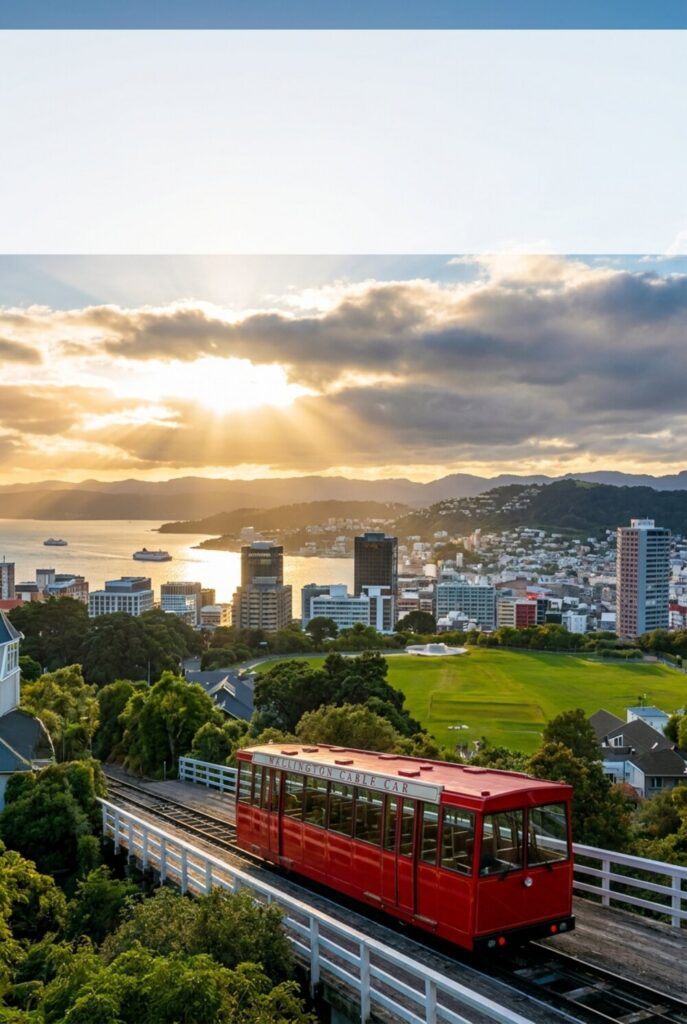
Wellington, New Zealand: Windy Capital of Coffee, Craft Beer & Middle-earth
Part of our New Zealand travel guide.
Wellington City Guide
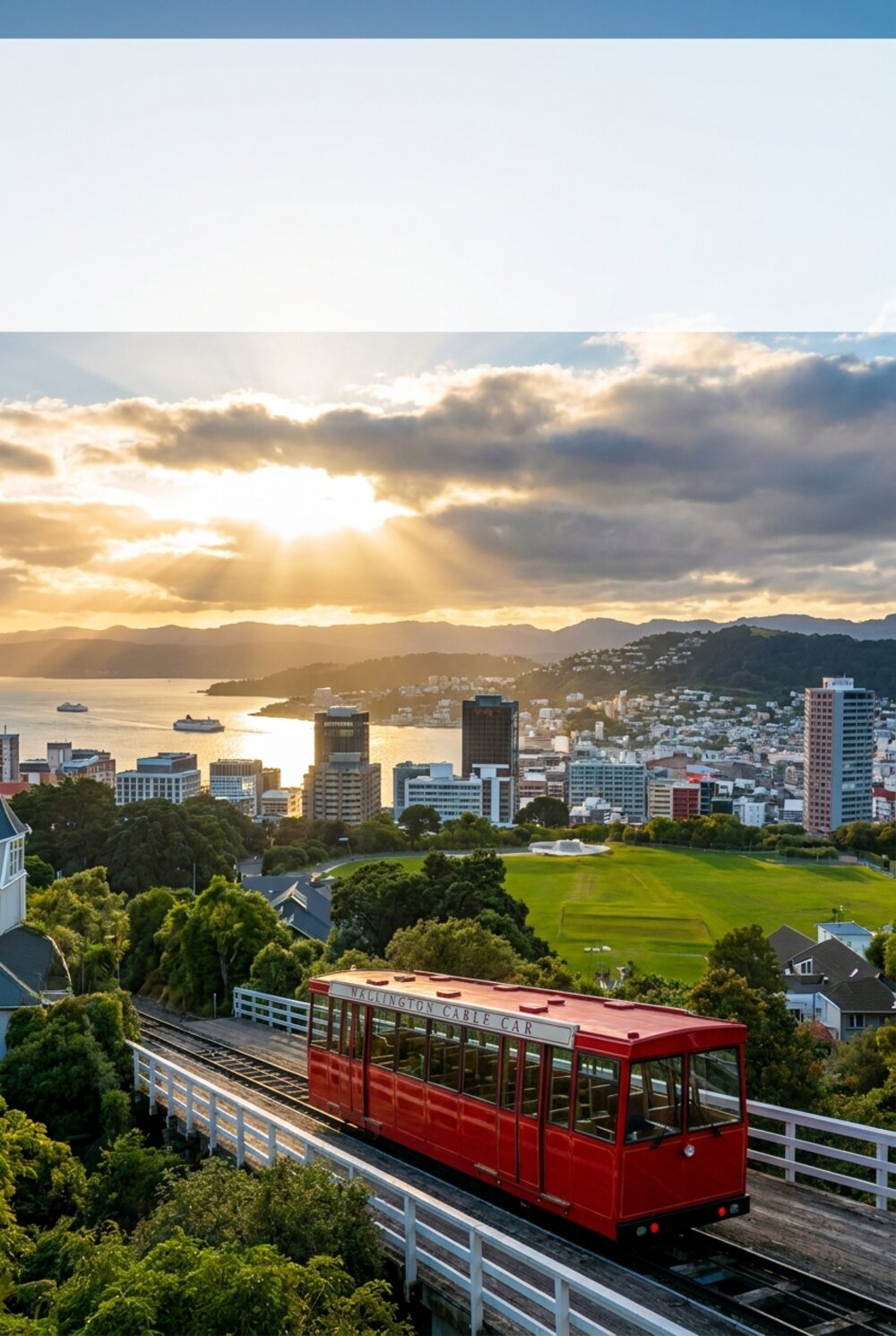
Table of Contents
Why Wellington?
Wellington is New Zealand’s capital and the smallest, wildest, most culturally concentrated city the country has. Roughly 215,000 people live in the city itself and about 415,000 across the greater Wellington region — less than a third of Auckland’s footprint — and yet Wellington punches above that weight on almost every cultural metric: the national museum Te Papa, the national symphony orchestra, the national parliament, Peter Jackson’s Weta Workshop, and a café-per-capita density New Zealanders argue about in every city bar. In te reo Māori the city is Te Whanganui-a-Tara, “the great harbour of Tara,” and you never forget that you are on the harbour — the CBD wraps a horseshoe of deep water with hills rising straight up behind it.
The signature fact is the wind. NIWA records an average of 173 days per year in Wellington with gusts above 60 km/h — more than any other national capital on Earth. Locals call the city “Windy Wellington” and mean it affectionately; the city’s entire urban design — the arcades, the covered laneways, the lee-facing café terraces — is a 170-year-long adaptation to southerly gales. Pack a wind-and-rain shell even in February, forget the umbrella (they invert within seconds), and lean into the theatre of it.
The compensations are everything a traveller wants from a capital city. Te Papa Tongarewa on the waterfront is the country’s flagship museum and it is entirely free, covering six floors of Māori taonga, natural history, the Gallipoli: Scale of Our War exhibit that Weta Workshop co-created with the museum, and a colossal squid. The film industry centred in Miramar has turned Wellington into the permanent production base for Middle-earth — Weta Workshop, Stone Street Studios and Park Road Post all sit within walking distance of each other — and Weta’s visitor experience (NZ$65 adult) is the single best behind-the-scenes tour in the country.
Wellington is also New Zealand’s undisputed food-and-drink capital. The city is widely rated the world’s best coffee metro by international roaster rankings, Garage Project on Aro Street is the country’s most-awarded craft brewer, and the annual Wellington on a Plate festival in August runs NZ$15 Burger Wellington specials across 200+ venues. Three out of five fine-dining rooms on the Cuisine Good Food Awards top ten for 2025 are Wellington addresses.
This guide covers the ten neighbourhoods where visitors actually spend time, the four food cultures that define the city (coffee, craft beer, food trucks, fine dining), and the five day-trip destinations — Kapiti Island, Martinborough wine country, the Wairarapa coast, Rimutaka Forest Park and the in-city ZEALANDIA eco-sanctuary — that make Wellington an unusually complete short-stay city.
Neighborhoods: Finding Your Wellington
📍 Wellington Map: Every Place in This Guide
Te Aro
Te Aro is Wellington’s densest creative quarter, stretching south-west from Courtenay Place through Cuba Street to the Taranaki Street Wharf on the harbour. It is the entertainment, music, theatre and late-night-eating heart of the city — a grid of Victorian warehouses rebuilt into live-music rooms, ramen bars, vintage shops and a cluster of hostels. Most visitors end up sleeping here: the Te Aro accommodation belt is a ten-minute walk from Te Papa, five minutes from Cuba Street, and at most fifteen minutes from any Metlink bus stop in the CBD.
- Courtenay Place theatre strip — BATS, The Embassy and Downstage venues
- Cuba Street heritage shops and the 1969 Bucket Fountain
- Te Papa Tongarewa on Cable Street, five minutes’ walk north-east
- Taranaki Street Wharf with Circa Theatre and Waitangi Park
Best for: first-timers who want to walk to everything and night-owl travellers. Access: every Metlink bus route passes through Courtenay Place or Manners Street; the Airport Express stops at Te Aro in both directions.
Cuba Street
Cuba Street is the heritage-listed pedestrianised spine running north–south through Te Aro — and also, in local parlance, a whole neighbourhood unto itself. The 450-metre strip carries Wellington’s alt-culture DNA: the 1969 Bucket Fountain in the middle of Lower Cuba, a string of indie bookshops and record stores, tattoo studios in the old Bank of New Zealand chambers, and the 24-hour Midnight Espresso that has anchored the street since 1989. The biennial Cuba Dupa street festival returns to the street in late March 2026; book accommodation for that weekend eight weeks out.
- Bucket Fountain (installed 1969, still randomly soaking passers-by)
- Midnight Espresso — 24-hour café institution since 1989
- Matterhorn cocktail bar and adjacent Logan Brown
- San Fran live-music venue at the top end of the street
Best for: indie shoppers, vinyl hunters and late-night snack chasers. Access: Upper and Lower Cuba Street are both fully pedestrianised; all Metlink bus routes stop within 300 m on Manners Street or Ghuznee Street.
Mt Victoria
Mt Victoria is both a 196-metre hill east of the CBD and the villa-lined residential suburb that climbs its western slope. The summit lookout delivers the postcard Wellington view — CBD, harbour, Miramar Peninsula and the Remutaka Range in a single frame — and the 15-minute walk up through the Town Belt passes several Lord of the Rings filming locations, including the bank where the hobbits hide from the Black Rider. Below the lookout, Majoribanks Street and the surrounding villa-lined lanes hold Wellington’s densest concentration of restored 1880s–1920s weatherboard houses.
- Mt Victoria Lookout (196 m, free, open 24 hours in fair weather)
- Rā Cafe on Majoribanks Street — residents’ favourite brunch spot
- Mt Victoria Town Belt walking tracks with Lord of the Rings locations
- Roseneath and Hataitai tram tunnels from the 1900s
Best for: sunset photographers and travellers who like a villa-street wander. Access: walk 25 minutes up from Courtenay Place through the Town Belt; Metlink route 20 runs to the summit turnaround.
Oriental Bay
Oriental Bay is the crescent of golden sand that curves east from Te Papa along Oriental Parade — the closest swimmable beach to the CBD and, in summer, Wellington’s promenade-of-record. The sand here was shipped in from Golden Bay at the top of the South Island to top up a natural shingle beach, and the result is genuinely beach-town in a way that Wellington otherwise is not. The 2.8-km Oriental-Bay-to-Evans-Bay walk along the waterfront is the city’s single most-used jogging route, and the heated Freyberg Pool (33 m lap pool, open year-round) sits at the eastern end of the parade.
- Oriental Parade beach and promenade (sand shipped from Golden Bay)
- Freyberg Pool — heated 33-metre outdoor pool, open year-round
- St Gerard’s Monastery and Church above the bay on Hawker Street
- Carter Fountain offshore in the middle of the bay
Best for: a swim-and-flat-white morning or a February sunset stroll. Access: flat 15-minute walk east along the waterfront from Te Papa, or Metlink route 14 from the railway station.
Thorndon
Thorndon is Wellington’s government, diplomatic and heritage quarter — the district north-west of Wellington Railway Station where the Beehive, Parliament Buildings, the Supreme Court, Old St Paul’s Anglican cathedral and the New Zealand National Library all sit within a three-block radius. Tinakori Road is the shopping-street spine of the suburb — a string of antique dealers and heritage cafés running up the hill from Parliament — and it is also where the novelist Katherine Mansfield was born in 1888; her childhood home on Tinakori Road is open as a museum.
- Parliament Buildings and the Beehive — free guided tours every hour
- Old St Paul’s — 1866 Gothic Revival timber church, free entry
- Katherine Mansfield House & Garden on Tinakori Road
- Tinakori Road heritage shops and cafés
Best for: history, politics and heritage-architecture travellers. Access: Wellington Railway Station sits at the southern edge of Thorndon — every Metlink commuter rail line terminates there; ten-minute walk from Lambton Quay.
Kelburn
Kelburn is the leafy university suburb crowning the hill west of the CBD, reached most famously by the 1902 red Wellington Cable Car. The Cable Car runs every ten minutes along a 628-metre track, climbing 120 metres in five minutes and depositing you at the Kelburn Lookout directly above the 25-hectare Wellington Botanic Garden. Victoria University’s Kelburn campus sits next door, and the small free Cable Car Museum at the top station houses two restored 1902 grip cars. The gardens fall back down toward the CBD through Bolton Street Memorial Park — an easy 45-minute downhill walk ending at the Beehive.
- Wellington Botanic Garden (25 hectares, free entry)
- Cable Car Museum at the Kelburn terminus (free)
- Victoria University of Wellington Kelburn campus
- Space Place planetarium at Carter Observatory in the gardens
Best for: a gentle half-day combining Cable Car, gardens and a city-view lunch. Access: Wellington Cable Car from Lambton Quay — NZ$6 one-way adult, departs every ten minutes.
Newtown
Newtown is the working-class inner-south suburb that has quietly become Wellington’s most multicultural food belt. Ethiopian, Somali, Indian, Malaysian, Syrian and Filipino kitchens line a 600-metre stretch of Riddiford Street between the Wellington Zoo and the hospital, most of them run by first-generation owners and none of them fussy. Adelaide Road on the eastern side is where Heyday Beer Co opened its taproom; behind Newtown to the west is the walk-in gate to the ZEALANDIA eco-sanctuary and its fenced valley of native forest.
- Wellington Zoo on Manchester Street — Aotearoa’s oldest, founded 1906
- Newtown Park live-music grounds (Homegrown-era venue)
- Riddiford Street ethnic-food strip — 20+ global cuisines
- ZEALANDIA visitor gate via Waiapu Road, Karori (15 min west)
Best for: low-key ethnic eating and a zoo-plus-sanctuary family day. Access: Metlink routes 1 and 3 run every ten minutes from Lambton Quay and Courtenay Place to the heart of Newtown.
Miramar
Miramar is the peninsular suburb south-east of the airport that doubles as the film-production capital of New Zealand. Peter Jackson’s Weta Workshop, Stone Street Studios, Park Road Post and Weta Digital all sit within walking distance of each other — a 40-minute bus ride from the CBD or a ten-minute taxi from Wellington Airport. Weta’s visitor experience on Camperdown Road (NZ$65 adult, 90 minutes) is the single best behind-the-scenes industry tour in the country, and the restored 1928 Roxy Cinema on Park Road — co-owned by Jackson and Weta — is the bonus cultural stop for any film traveller. Stone Street Studios itself is not open to the public.
- Weta Workshop visitor experience on Camperdown Road (NZ$65)
- Stone Street Studios — Lord of the Rings sets (not publicly open)
- Roxy Cinema — restored art-deco 1928 venue
- Shelly Bay waterfront and the Miramar Coastal Walk
Best for: film and VFX nerds booking the Weta Workshop tour. Access: Metlink route 2 from Courtenay Place (~25 min), or a ten-minute taxi from Wellington Airport.
Island Bay
Island Bay is the wind-exposed fishing village on Wellington’s wild south coast, ten kilometres south of the CBD. A small fleet of owner-operated fishing boats still launches from the beach, the protected Taputeranga Marine Reserve offshore makes for some of the best snorkelling on the North Island, and the long-running Italian-heritage Island Bay Festa is held every February in recognition of the Stromboli-island families who settled here in the 1890s. The Parade is the main street, and the fish-and-chip shops along it serve the freshest moki, gurnard and trevally in the city.
- Island Bay beach and boat ramp — working fishing fleet
- The Parade cafés and fish-and-chip shops
- Taputeranga Marine Reserve snorkel trail
- Berhampore Italian community hall on the hill above the bay
Best for: a half-day escape to fresh fish and rugged southerly coastline. Access: Metlink route 1 from Lambton Quay terminates at Island Bay (~30 min).
Seatoun
Seatoun is the quiet village at the eastern entrance to Wellington Harbour — past Miramar, around the airport and along the coast road to the harbour heads. The beach here is uniquely sheltered from the southerly wind and the cross-strait views toward the Marlborough Sounds are the best in the city. The East-by-West inner-harbour ferry runs from Seatoun Wharf to Queens Wharf and Days Bay, which means you can make the return trip a boat loop rather than a bus backtrack. The Pass of Branda walking track climbs from the village to a scenic ridge above the harbour entrance in about 45 minutes return.
- Seatoun Beach — Wellington’s most sheltered swim spot
- Pass of Branda bush walk above the village
- Seatoun Wharf East-by-West ferry stop (to Queens Wharf and Days Bay)
- Wellington harbour heads lookout at Point Dorset
Best for: a sheltered sea swim and the inter-bay harbour ferry loop. Access: Metlink route 24 from Courtenay Place (~30 min) or the East-by-West ferry from Queens Wharf.
The Food
Coffee Culture (World-Class)
Wellington is routinely ranked among the world’s best coffee cities — and it is the one claim on this page that locals will actually defend in an argument. The city hosts the highest density of independent specialty roasters per capita in the Southern Hemisphere, and the flat white — invented in Sydney or Wellington, depending on whose story you believe — is treated as a default civic language. Five roasters form the backbone of the scene: Flight Coffee, Coffee Supreme, Havana Coffee Works, Peoples Coffee and Mojo. Between them they supply the vast majority of Wellington cafés, which is why you are regularly asked at the counter which bean you want.
The pricing band is narrow: NZ$5.50–7 buys a flat white at essentially any café in the city. The quality floor is extraordinarily high. A single-origin filter flight at Flight Coffee Hangar on Dixon Street runs NZ$12 for three mini-pour-overs — the cheapest coffee-nerd education you can buy in New Zealand. Midnight Espresso on Cuba Street is the 24-hour institution (opened 1989) that serves students, shift workers and post-gig night owls. Customs by Coffee Supreme on Ghuznee Street is the flagship of the country’s best-known roaster and the morning commute stop for half the public service.
- Flight Coffee Hangar — single-origin filter flight and flat white; roaster-direct on Dixon Street (NZ$6, ~$3.60 USD)
- Customs by Coffee Supreme — Coffee Supreme’s flagship café on Ghuznee Street (NZ$5.50, ~$3.30 USD)
- Midnight Espresso — 24-hour Cuba Street institution since 1989 (NZ$5.50, ~$3.30 USD)
- Havana Coffee Works — Tory Street roaster with a Cuban-themed café (NZ$6, ~$3.60 USD)
- Peoples Coffee — fair-trade specialist roaster on Constable Street, Newtown (NZ$5.50, ~$3.30 USD)
Craft Beer (Capital of New Zealand Beer)
If coffee is Wellington’s morning language, craft beer is its evening one. The city is widely considered the craft-beer capital of New Zealand: Garage Project on Aro Street is the country’s most-awarded craft brewery by festival-medal count, Parrotdog on Vivian Street is a staple of supermarket chillers nationwide, and Fortune Favours, Heyday and Rogue & Vagabond round out a density that means you can walk the “craft-beer mile” — Leeds Street, Hannahs Laneway and Tory Street — and hit six independent taprooms in an 800-metre loop. Beervana in early August is the country’s flagship craft-beer festival; over two weekends it takes over Sky Stadium with 80+ breweries pouring.
Typical pints run NZ$12–16 across the city’s taprooms. The house styles tilt modern: fresh-hopped New Zealand IPAs using Nelson Sauvin, Motueka and Riwaka hops; sours; and barrel-aged stouts. Garage Project’s Hapi Daze pale ale and Fortune Favours’ The Ragamuffin IPA are the two single pints you order before learning the rest of the menu. Wellington also has a robust natural-wine scene — Noble Rot and Puffin are the best-known bars — and a slow-burning but strong spirits line-up led by Leap Gin and Thomson Whisky Wellington.
- Garage Project Cellar Door — flagship taproom of NZ’s most-awarded craft brewery on Aro Street (NZ$13 pint, ~$7.80 USD)
- Fortune Favours — three-level brewpub on Leeds Street with small-batch IPAs and wood-fired pizza (NZ$14, ~$8.40 USD)
- Parrotdog — Vivian Street taproom for Birdseye pilsner and BloodHound red ale (NZ$12, ~$7.20 USD)
- Heyday Beer Co — small Newtown brewery and taproom on Adelaide Road (NZ$12, ~$7.20 USD)
- Rogue & Vagabond — hop-garden taproom on Garrett Street — the original Hannahs Laneway anchor (NZ$13, ~$7.80 USD)
Food Trucks, Markets & Street Food
Wellington does not have a headline street-food tradition like Osaka’s kuidaore or Taipei’s night markets, but a strong cluster of food trucks and weekend markets has emerged around the waterfront, Frank Kitts Park, Pipitea Street and Cuba Street over the last decade. The biggest fixture is the Sunday Harbourside Market beside Te Papa — running continuously since 1920 — with roughly 60 stalls selling fresh produce, Wellington bread, South Pacific-caught oysters and cooked breakfasts under the open sky of Frank Kitts Park. The Saturday Wellington Underground Market in the same park runs in the evenings with roughly 40 food stalls and a pan-global street-food lineup from Korean fried chicken to Venezuelan arepas.
Mid-week, the Pipitea Street food-truck cluster behind Wellington Railway Station turns into the public-service lunch block (Mon–Fri 11 am – 2 pm), with rotating trucks — Smith & Deli, Houseboat Bowls, Grill Meats Beer — pulling in the parliamentary workforce. Mt Vic Chippery on Majoribanks Street is the best fish-and-chips in the country by common agreement, serving eight fish varieties including gurnard, hapuka and blue cod at NZ$22 a plate. And the biennial Cuba Dupa street festival returning to Cuba Street in late March 2026 is when the street itself becomes one giant open-air food hall for a weekend.
- Mt Vic Chippery — eight fish varieties, Majoribanks Street (NZ$22, ~$13 USD)
- Pipitea Street food trucks — rotating weekday cluster behind Wellington Railway Station 11 am – 2 pm (NZ$15, ~$9 USD)
- Wellington Underground Market — Saturday evenings at Frank Kitts Park (NZ$14, ~$8.40 USD)
- Harbourside Market — Sunday producer market since 1920 beside Te Papa (NZ$12, ~$7.20 USD)
- Moore Wilson’s Fresh — independent grocer and food hall on College Street
Fine Dining (Cuisine Good Food Awards)
New Zealand does not participate in the Michelin Guide system; the equivalent benchmark is the annual Cuisine Good Food Awards and their Hat rating. Wellington holds a disproportionate share of three- and two-hat rooms for its size. Hiakai in Mt Cook, run by chef Monique Fiso, is the country’s flagship indigenous-Māori tasting room and a two-hat Cuisine awardee — the menu rotates around kawakawa, horopito, tuatua and other native ingredients. Logan Brown on Cuba Street, open continuously since 1996 inside a 1920s former banking chamber, is the city’s longest-running fine-dining room; Shepherd on Leeds Street runs a seasonal fire-cooked menu; and Whitebait on Chaffers Dock does the classic Wellington waterfront-seafood formula with whitebait fritter and paua ravioli as signature plates.
Expect a long lead time and a set-menu commitment at the high-end rooms. Hiakai takes bookings 60 days out and sells its Friday and Saturday seatings within a week of release; the single seating is at 6:30 pm and cancellations are charged in full. Logan Brown and Shepherd are the two rooms most likely to have last-minute weeknight seats; both accept walk-ins at the bar with a shortened menu. Wine pairings typically add NZ$95–160 on top of the food price — Martinborough pinot noirs from Ata Rangi and Dry River are the most distinctive flights you can take. Budget NZ$130–250 per head for the food alone across the city’s top tier.
- Hiakai — Monique Fiso’s indigenous-Māori tasting menu in Mt Cook; two-hat Cuisine awardee (NZ$245, ~$147 USD)
- Logan Brown — heritage bank-chamber fine-dining room on Cuba Street since 1996 (NZ$135, ~$81 USD)
- Shepherd Restaurant — seasonal fire-cooked menu on Leeds Street, part of the Hannahs Laneway precinct (NZ$130, ~$78 USD)
- Whitebait — Chaffers Dock waterfront seafood room; signature whitebait fritter (NZ$115, ~$69 USD)
- Noble Rot — wine bar + small-plates room on Swan Lane; the country’s best natural-wine list (NZ$85, ~$51 USD)
Beyond Coffee and Beer — Wellington on a Plate and the Festival Economy
Wellington organises its food year around a handful of festivals that push the city’s eating culture into the national spotlight. Wellington on a Plate (Visa WOAP) runs for fifteen days every August and is the single most important food event in the country. During the festival, 200+ restaurants run NZ$15 Burger Wellington plates (the competition-style festival burger, often invented for the fortnight and often featuring venison, pāua or green-lipped mussels), NZ$25 Cocktail Wellington competitions, and NZ$50-ish Dine Wellington fine-dining set menus. Beervana in early August overlaps the first weekend, and the Wellington Night Market runs pop-ups citywide for the entire fortnight. Outside of August, the Cuba Dupa street festival every second March turns Cuba Street into a food-and-performance hall for a weekend.
The dish you will see most often as a local signature is the whitebait fritter — a small, intensely-flavoured egg omelette loaded with native whitebait caught in the Wellington rivers during a short August–November season. Expect NZ$22–38 a plate at waterfront restaurants. Wellington is also arguably the capital of the New Zealand brunch — Floriditas on Cuba Street, Nikau Cafe in Civic Square, Loretta on Cuba Street and Prefab on Jessie Street run lines out the door on weekend mornings. The mid-range dinner scene pivots on Ombra (Italian, Cuba Street), Olive (French-Med, Cuba Street), Field & Green (British-modern, Wakefield Street) and Egmont Street Eatery.
- Wellington on a Plate (Visa WOAP) — August food festival with 200+ venues running NZ$15 burgers and NZ$25 cocktails
- Beervana — early August craft-beer festival at Sky Stadium (80+ breweries)
- Cuba Dupa — biennial street festival, next edition March 2026
- Floriditas — Cuba Street brunch institution (NZ$22–28 a plate)
- Ombra — Venetian small-plates on Cuba Street (NZ$55 banquet, ~$33 USD)
Food Experiences You Can’t Miss
Wellington rewards food travellers who build a full day around a single theme as much as grazers. A craft-beer mile loop, a coffee-roaster crawl, a Sunday morning at the Harbourside Market, a Wellington on a Plate burger itinerary in August — each is a coherent experience rather than a tasting menu.
- Wellington on a Plate festival (15 days every August) — NZ$15 Burger Wellington and NZ$25 Cocktail Wellington menus citywide
- Self-guided craft-beer mile along Leeds Street, Hannahs Laneway and Tory Street — six taprooms in 800 m
- Cuba Street dumpling-and-ramen crawl between Dumpling House, House of Dumplings and Kazu Yakitori
- Zealandia twilight tour followed by craft beer at Garage Project (40 min by bus or car between them)
- Weta Workshop visitor experience paired with a Roxy Cinema art-house screening in Miramar (NZ$65 + NZ$20)
- Harbourside Market Sunday breakfast at 8:30 am — fresh South Pacific oysters from NZ$3 each
- Moore Wilson’s Fresh self-catering run for apartment-rental travellers — the single best deli counter in the country
Cultural Sights
Te Papa Tongarewa
Te Papa Tongarewa (“our container of treasures”) is New Zealand’s national museum and the country’s single most-visited attraction. Founded in 1998 on reclaimed harbour land on Cable Street, its six floors are entirely free to enter — a NZ$20 (~$12 USD) donation is suggested for international adults but not required. Hours are 10 am – 6 pm daily (closed 25 December). The single must-see is the Gallipoli: Scale of Our War exhibit on Level 2, co-created with Weta Workshop — eight 2.4-times-life-size figures of New Zealand soldiers at the 1915 landings, with full Weta-calibre prosthetics and hyper-detailed uniforms. The Te Marae on Level 4 is a full contemporary Māori meeting house where you can hear a welcome in te reo; the Level 1 Te Taiao Nature zone covers earthquakes, the colossal squid (the only intact specimen on public display in the world) and the country’s endemic species. Budget 3 hours minimum.
Weta Workshop Unleashed
Weta Workshop is the Miramar-based creature-design and special-effects company founded by Peter Jackson, Richard Taylor and Tania Rodger in 1987 — the workshop behind the prosthetics for Lord of the Rings, King Kong, District 9, Avatar and dozens of other films. The Weta Workshop Unleashed visitor experience on Camperdown Road runs 90-minute small-group tours covering sculpting, armour fabrication, miniatures and creature prosthetics, led by current or recent Weta designers. Adult tickets NZ$65 (~$39 USD), 9 am – 5:30 pm daily, book online at least 48 hours ahead because weekend slots fill quickly. Miramar is 25 minutes by Metlink route 2 from Courtenay Place, or 10 minutes by taxi from Wellington Airport. Combine with a Roxy Cinema screening afterwards for a full film-capital afternoon.
Wellington Cable Car and Kelburn Lookout
The Wellington Cable Car has been running since 1902 — a 628-metre funicular line rising 120 metres from Lambton Quay in the CBD to the Kelburn Lookout above the Botanic Garden. The red cars depart every ten minutes and the ride takes five minutes. Tickets NZ$6 one-way / NZ$11 return adult (~$3.60 / $6.60 USD); open Mon–Fri 7:30 am – 10 pm and weekends 8:30 am – 10 pm. The small Cable Car Museum at the top station is free and houses two restored 1902 grip cars. The best strategy is to ride up, walk around Kelburn Lookout for the harbour panorama, then wander back down through the 25-hectare Wellington Botanic Garden and Bolton Street Memorial Park to the Beehive — a 45-minute mostly-downhill walk.
Parliament Buildings & The Beehive
New Zealand’s national Parliament sits on Molesworth Street in Thorndon. The complex mixes three distinct buildings: the 1922 neoclassical Parliament House, the 1899 Gothic Parliamentary Library, and the modernist Beehive executive wing designed by British architect Basil Spence and completed in 1981. Free guided tours run every hour Mon–Fri 10 am – 4 pm with a reduced weekend schedule; booking ahead online is recommended in summer. The tour covers the Debating Chamber, the Select Committee rooms and the Beehive’s Cabinet Room where Sir John Key, Jacinda Ardern and Christopher Luxon all sat. Parliament House is base-isolated on 500 lead-rubber bearings — the largest retrofit of its kind in the world and a direct response to Wellington’s earthquake risk.
ZEALANDIA Te Māra a Tāne
ZEALANDIA is the 225-hectare fully-fenced urban eco-sanctuary in Karori, 20 minutes west of the CBD — the world’s first of its kind when it opened in 1999. A purpose-built 8.6-kilometre predator-proof fence surrounds the valley, and inside it breeds populations of kākā, takahē, tīeke, tuatara and little spotted kiwi have been restored on land where they were locally extinct for a century. Day entry NZ$24 (~$14 USD); the Twilight Tour (NZ$95 adult, 2.5 hours) is the best chance to see wild kiwi anywhere in the North Island. Hours 9 am – 5 pm daily (last entry 4 pm). The visitor centre has a strong exhibition on the country’s 500-year project of predator-free ecological restoration and the Predator Free 2050 national programme.
City Gallery Wellington Te Whare Toi
City Gallery Wellington is Aotearoa’s flagship contemporary-art institution, housed since 1980 in the heritage 1940 Public Library building on Civic Square. Entry is free (charges apply to some blockbuster temporary exhibitions). The gallery runs a strong Pasifika and Māori contemporary programme alongside international touring shows, and its Civic Square location pairs with the Wellington Library next door, the Michael Fowler Centre and the Te Ngākau Civic Square plaza for a half-day arts loop. Hours 10 am – 5 pm daily. The gallery’s café, Nikau, is one of the city’s best brunch stops.
Wellington Museum (Bond Store)
Wellington Museum occupies the 1892 Bond Store on Queens Wharf — a heritage brick-and-timber warehouse originally used for customs-bonded goods and now a free city-history museum. Entry is free, hours 10 am – 5 pm daily. The two essential floors are the Level 2 Wahine Ferry Disaster exhibit (the 1968 wreck of the Cook Strait ferry Wahine on Barrett Reef during a 275 km/h southerly — 51 passengers died in Wellington Harbour) and the top-floor Attic, a deliberately quirky cabinet of Wellington-history curiosities. Allow 90 minutes.
Mt Victoria Lookout
Mt Victoria is the 196-metre summit on the eastern side of the CBD, reached by a 15-minute walk up from Majoribanks Street or a winding summit road. The lookout delivers Wellington’s signature panorama — CBD, harbour, Miramar Peninsula, Remutaka Range and Cook Strait in a single sweep — and is free, open 24 hours in fair weather. The surrounding Town Belt carries several Lord of the Rings filming locations including the bank where the four hobbits hide from the Nazgûl (signposted on the Charles Plimmer Park loop track).
Entertainment
Sky Stadium (Rugby, Cricket, Hurricanes, All Blacks)
Sky Stadium — the 34,500-capacity harbourside ground on Waterloo Quay (formerly Westpac Stadium, also known as “the Cake Tin”) — is Wellington’s home of big-ticket sport. It hosts the Hurricanes Super Rugby franchise (season runs March through June), the Black Caps in cricket tests during December and January, and roughly 1–2 All Blacks test matches each year. Tickets run NZ$35 (general admission cricket) to NZ$169 (premium All Blacks tests), ~$21–$101 USD. Test-match tickets sell out within days of release — buy 3–4 months ahead via Ticketmaster. Sky Stadium also hosts the Beervana craft-beer festival over the first weekend of August and the main concert programme when international tours route through Wellington. The walk from Wellington Railway Station to the South Stand turnstiles is 400 metres flat — plan an extra 20 minutes on game day because the concourse becomes a crush.
BATS Theatre & Circa Theatre (Live Theatre)
Wellington is the country’s theatre capital, disproportionate to its population. BATS Theatre on Kent Terrace is the flagship of New Zealand fringe — founded in 1989, it runs 200+ shows a year across two black-box spaces and is the main pipeline for emerging Aotearoa playwrights. Tickets NZ$25–45 (~$15–$27 USD). Circa Theatre on Taranaki Street Wharf is the more mainstream counterpart, programming established NZ playwrights plus international work in two theatres (tickets NZ$35–70). The St James Theatre in the CBD is the heritage touring venue for Broadway-style musicals; the New Zealand Portrait Gallery runs regular talks in the same block. For a distinctly Wellington evening, pair a 6 pm pre-theatre dinner at Shepherd or Olive with a 7:30 pm curtain and a post-show walk back along the waterfront.
San Fran & Meow (Live Music)
Wellington’s live-music culture sits in a handful of mid-sized rooms rather than one dominant arena. San Fran on Cuba Street is the 400-capacity upstairs venue that hosts most touring Aotearoa acts — Aldous Harding, Reb Fountain, Marlon Williams all play here. Meow on Edward Street leans jazz, cabaret and soul in a cosier 200-cap room. Tickets NZ$15–40 at the door (~$9–$24 USD). Bodega on Ghuznee Street, The Rogue & Vagabond garden and Valhalla on Vivian Street cover the indie, electronic and metal tiers respectively. The annual Homegrown music festival on the waterfront every first Saturday of February is the country’s biggest one-day all-NZ-acts event — 50+ artists across five harbourside stages, tickets NZ$140.
Hannahs Laneway Craft-Beer Mile
Wellington’s so-called craft-beer mile is not actually a mile — it is an 800-metre walking loop from Leeds Street through Eva Street and Hannahs Laneway to Tory Street, within which Fortune Favours, Garage Project’s Aro Street cellar door (a 10-minute walk west), Rogue & Vagabond, Heyday’s satellite pop-up bar, and half a dozen smaller taprooms cluster. Typical pints NZ$12–14 (~$7–$8.40 USD). Walk-up is standard — Friday and Saturday nights fill the beer-gardens but rarely the whole venue. The biggest single craft-beer night of the year is Beervana’s opening Friday in early August, when 80+ breweries pour at Sky Stadium and spillover venues run specials into the small hours.
Roxy Cinema (Miramar)
The Roxy Cinema on Park Road in Miramar is the 1928 art-deco single-screen (plus later second theatre) cinema that Peter Jackson and Weta restored and co-own. Ticket prices run NZ$20 general admission / NZ$28 premium (~$12–$17 USD). The programme blends first-run arthouse, Hollywood wide releases and film-festival retrospectives; the main auditorium carries a restored gilded ceiling and painted curtain. The attached Coco at the Roxy restaurant is a legitimate dinner stop on its own, and the cinema’s gift shop carries exclusive Weta Collectibles merchandise. Combine with a Weta Workshop Unleashed tour in the afternoon for a full Miramar day.
New Zealand Symphony Orchestra & Michael Fowler Centre
The NZSO is the country’s national orchestra and is based at the Michael Fowler Centre on Wakefield Street. Subscription season runs March through November; tickets NZ$35–110 (~$21–$66 USD). The Michael Fowler Centre is also the primary venue for the biennial New Zealand Festival of the Arts (next edition 20 February – 15 March 2026), the country’s flagship high-culture festival with three weeks of international theatre, dance, music and spoken-word programming across a dozen Wellington venues. Pair with a pre-concert visit to City Gallery on Civic Square next door, and hold the night for a post-concert drink at Noble Rot on Swan Lane — the walk between the two venues is under five minutes and the natural-wine list is the best pairing for a classical programme.
Day Trips
Martinborough Wine Region (1 hour by Metlink Wairarapa train + shuttle)
Martinborough is the compact wine-country village at the southern end of the Wairarapa, 80 km north-east of Wellington over the Remutaka Hill. The Metlink Wairarapa train runs from Wellington Railway Station to Featherston in 55 minutes (NZ$16 each way with Snapper), where a local shuttle covers the final 20 minutes to Martinborough village. Around 20 boutique wineries cluster within a 3-km-radius of the central village square — most are within cycling distance of each other. Ata Rangi, Palliser Estate, Escarpment and Dry River are the four signature cellar doors; all do cellar-door tastings and most run restaurants for lunch. Rent an e-bike from Martinborough Wine Tours (NZ$60/day) and ride between four cellars in an afternoon. Toast Martinborough wine festival in mid-November is the single biggest day in the village’s calendar; book the festival train weeks ahead.
Kapiti Island Nature Reserve (1 hour 15 minutes by train + boat)
Kapiti Island is the 1,965-hectare predator-free island off the Kāpiti Coast north of Wellington — one of the most successful kiwi-conservation projects in the country, and home to takahē, kākā, little spotted kiwi and Hihi stitchbirds. Access is restricted to 160 day-visitors via two permit-holding operators (Kapiti Island Nature Tours and Kapiti Island Eco Experience), so book 4–6 weeks ahead. Metlink’s Kapiti Line train runs from Wellington to Paraparaumu in 55 minutes (NZ$12 with Snapper); the boat crossing from Paraparaumu Beach takes 15–20 minutes. Guided ranger walks cover the island’s lowland bush and beach sections; the Tuteremoana summit walk climbs 521 metres to the North End lookout. Boat crossings cancel in heavy southerlies, so keep a flexible day in reserve.
Wairarapa Coast & Castlepoint (2 hours by rental car)
The Wairarapa Coast is the wind-battered eastern shore north-east of Wellington — 185 kilometres of single-lane rural road ending at the 1913 Castlepoint Lighthouse and Castle Rock sea stack. Allow 2 hr 30 each way, fuel up in Masterton, and avoid the return drive after dark (no road lighting and wandering stock). The 40-minute Castle Rock summit walk delivers one of the North Island’s best coastal photo compositions, and the Deliverance Cove fur-seal colony is a rare NZ south-coast seal haul-out within 15 minutes’ walk of the lighthouse car park. The Ngawi fishing village halfway there — with its fleet of beach-launched fishing boats on bulldozers — is the most photogenic single stop on the route. Combine with Martinborough on a two-day loop for best value.
Rimutaka Forest Park & Catchpool Valley (45 minutes by rental car)
Rimutaka Forest Park is the 22,860-hectare regenerating-native-forest park on the eastern rim of the Hutt Valley — Wellington’s closest serious bush walking. The Catchpool Valley entrance, 45 minutes from the CBD on SH2 and Coast Road, is the main day-use gateway. The flagship walk is the Orongorongo Track (5 hours return), a gently-graded 9 km loop through beech and rimu forest with swimming holes in summer. The Butcher Track and Turere Stream day loop is shorter. DOC backcountry huts are bookable online. Entry is free and no booking is required for day use, but Catchpool Valley car park fills by 10 am on summer weekends — start early and carry 2 L of water per person.
ZEALANDIA Te Māra a Tāne (20 minutes by bus — in-city eco-sanctuary)
ZEALANDIA is technically within the Wellington city limits but its scale and content earn it day-trip status. The 225-hectare predator-fenced valley in Karori (20 minutes west of the CBD on Metlink bus route 3, or via the ZEALANDIA shuttle from the i-SITE on Lambton Quay) holds breeding populations of kākā, takahē, tīeke, tuatara and little spotted kiwi. Day entry NZ$24 (~$14 USD); budget 3 hours for a self-guided walk. The 2.5-hour Twilight Tour starting 30 minutes before sunset (NZ$95 adult) is the single best chance in the North Island to see wild kiwi in the wild — guides carry red torches and walk the track after dusk when the birds emerge to forage. Book 1–2 weeks ahead for twilight slots in summer.
Seasonal Guide
Wellington sits in the Southern Hemisphere — seasons are reversed from North America and Europe. Summer runs December through February; winter runs June through August. The climate is cool-temperate and genuinely windy year-round: NIWA data records an average of 173 days per year with gusts above 60 km/h. Carry a wind-and-rain shell at any time of year; umbrellas are effectively useless.
Summer (December – February)
Daily highs 13–20°C (occasionally 25°C); sea temperature peaks at 17–18°C. The headline events are Homegrown festival on the waterfront (first Saturday of February), Laneway Festival (late January) and the two-week Wellington Fringe Festival. This is the busiest domestic-visitor window — accommodation climbs 30–45% from late December to mid-January — but less internationally crowded than Auckland or Queenstown. Late February is the calmest weather window of the year and the best time to swim at Oriental Bay and Scorching Bay. Book Cuba Dupa and Homegrown weekends six weeks ahead.
Autumn (March – May)
Daily highs 10–18°C; sea 15–17°C. The biennial Cuba Dupa street festival returns to Cuba Street in late March 2026, and the New Zealand Festival of the Arts (20 February – 15 March 2026) fills the Michael Fowler Centre and St James Theatre with international programming every second autumn. Wellington’s famously calmest month is March — southerlies ease, accommodation prices soften back to baseline, and the shoulder-season restaurant pricing kicks in. The autumn colours through the Botanic Garden and Bolton Street Memorial Park in April and May are underrated.
Winter (June – August)
Daily highs 6–12°C with frequent southerlies and occasional sub-alpine sleet on Mt Victoria. Matariki, the Māori New Year, is the public holiday on Friday 19 June 2026 — Te Papa runs free dawn ceremonies and kapa haka performances for the entire week, and many restaurants run native-ingredient menus. Wellington on a Plate (15 days in August) and Beervana (first weekend of August at Sky Stadium) together make winter the city’s best-value food-and-drink season despite the weather. Hotel rates drop 25–35% versus summer.
Spring (September – November)
Daily highs 9–16°C; peak wind season — expect 60 km/h-plus southerlies several days a month. The headline event is the World of WearableArt at the TSB Arena over late September and mid-October — 60,000+ visitors across 18 performances, the most distinctive cultural event the city runs. Diwali festival on the waterfront in late October, Toast Martinborough wine festival in mid-November, and the Oriental Parade pohutukawa trees flowering crimson in late November round out the calendar. Spring is shoulder-season pricing with the year’s busiest cultural programme — book WOW tickets 3–4 months ahead.
Getting Around
Snapper Card and Metlink Fares
The Snapper card is Wellington’s prepaid transit card — used on every Metlink bus in the region and most ferries. A blank card costs NZ$10 (NZ$5 for the card plus NZ$5 initial balance) and can be topped up at Wellington Railway Station, most dairies and 7-Elevens, and in the Snapper Mobile app. Cash fares run roughly 25% more per trip than Snapper fares — always tag on and off with Snapper. Unlike Auckland, Wellington does not have a daily fare cap, but Metlink does run off-peak fares (Mon–Fri 9 am – 3 pm and after 6:30 pm, plus all weekends) with roughly a 30% discount — worth timing your sightseeing rides around. Wellington is transitioning to the national integrated ticketing system “Motu Move” from late 2025; Snapper remains valid through 2026.
Buses, Trains and Ferries
Metlink operates 60+ urban bus routes plus five commuter rail lines radiating from Wellington Railway Station — Kapiti (north), Hutt Valley (east), Melling (east), Johnsonville (north-west) and the Wairarapa line over the Remutaka Hill. The Airport Express bus runs every 20 minutes to Wellington Airport from Wellington Railway Station, Lambton Quay and Courtenay Place for NZ$10 — the fastest and cheapest airport option. East-by-West harbour ferries connect Queens Wharf with Days Bay, Seatoun and Matiu/Somes Island — a genuinely useful sightseeing loop rather than a commuter route. Buses run from roughly 5:30 am to midnight on weekdays and until 11 pm on weekends; the After Midnight weekend bus service covers the late Friday and Saturday slots. Wellington’s compact CBD means most visitor journeys are short — budget 15–25 minutes for any bus ride within the city grid.
Rental Cars
Rental cars run NZ$55–85 per day for a compact in shoulder season and NZ$100+ in December–February (~$33–$51 USD base). The major rental desks (Avis, Hertz, Budget, Europcar) sit on-site at Wellington Airport plus at a downtown Thorndon depot; Jucy and Apex run airport-adjacent lots with a free shuttle. New Zealand drives on the left. Most rentals are manual transmission; automatics cost roughly NZ$10/day more. Do not rent a car just to stay in central Wellington — the CBD is tight, parking runs NZ$5–9/hour, and public transit reaches every visitor neighbourhood. Rent only for Martinborough, the Wairarapa Coast or Rimutaka Forest Park day trips.
Airport Access (WLG)
Wellington International Airport (WLG) is 8 km south-east of the CBD on a peninsula between Evans Bay and Lyall Bay — one of the closest airport-to-capital distances in the world. Three transit options cover the journey:
- Airport Express (Metlink) — 25–35 minutes, NZ$10 with Snapper (~$6 USD)
- Taxi or rideshare — 15–20 minutes off-peak, NZ$30–45 (~$18–$27 USD)
- On-site rental car — free shuttle from the rental lot; fastest option for a day-trip start
Taxis and Rideshare
Uber, Didi, Ola and Zoomy all operate in Wellington. Uber’s minimum fare is NZ$10 and a typical Courtenay-Place-to-Kelburn ride runs NZ$12–16 off-peak. Standard taxis charge a flag-fall of roughly NZ$3.50 plus NZ$2.80/km and are widely available at the Wellington Railway Station rank. Rideshare pickup at Wellington Airport is in the dedicated zone at the ground-floor main entrance — follow the green Rideshare signs, not the main taxi rank.
Navigation Tips
Apps: Metlink Commuter (real-time transit), Google Maps (surface route planning), Snapper Mobile (card top-ups by phone). Metlink Commuter is the key download — it shows live arrivals for every bus, train and ferry, and lets you top up your Snapper card without queuing at a station machine. Google Maps surfaces all three modes (bus, train, ferry) and understands the East-by-West harbour ferry network, unusually.
Budget Breakdown: Making Your NZ Dollar Count
Wellington is notably cheaper than Auckland for accommodation — expect hotel rates roughly 15–20% below equivalent Auckland properties — but restaurant and attraction prices are broadly comparable between the two cities. The figures below assume FX of 1 USD ≈ NZ$1.67 and are per person per day.
| Tier | Daily | Sleep | Eat | Transport | Activities | Extras |
|---|---|---|---|---|---|---|
| Budget | NZ$110–160 ($66–$96) | Hostel dorm NZ$38–55 (YHA, Base) | Bakery pie + supermarket NZ$25–32 | Snapper fares NZ$12–18 | Free — Te Papa, Parliament, Museum, City Gallery | NZ$10 Snapper card + NZ$20 Te Papa donation |
| Mid-Range | NZ$290–480 ($174–$287) | 3–4★ hotel NZ$195–330 (QT, Naumi, Travelodge) | Café lunch + bistro dinner NZ$80 | Snapper + Airport Express NZ$25 | Weta NZ$65 + ZEALANDIA NZ$24 + Cable Car NZ$11 | NZ$45 Martinborough train day |
| Luxury | NZ$820+ ($491+) | 5★ hotel NZ$480–1,200 (InterContinental, Sofitel, QT Museum) | Hiakai or Logan Brown NZ$135–245 | Private transfer NZ$220 | Private Martinborough wine tour NZ$550 | Cook Strait scenic helicopter NZ$850 |
Where Your Money Goes
Accommodation remains the single biggest line in a Wellington budget, but it is meaningfully cheaper than Auckland. Three-star CBD hotels start around NZ$195/night in shoulder season and climb past NZ$280 in the December-January and WOW-festival peaks. Restaurant meals run NZ$22–35 for a casual café lunch and NZ$45–85 for a mid-range dinner; the fine-dining tier (NZ$115–245 tasting) is a specific night-out decision. Transport is cheap: a typical visitor day of Snapper fares runs NZ$12–18, and the Airport Express at NZ$10 is the cheapest airport-to-capital ride in any OECD country. Activities divide into the signature free attractions (Te Papa, Parliament tour, Wellington Museum, City Gallery, Mt Victoria walk-up) and the paid anchors — Weta Workshop Unleashed at NZ$65, ZEALANDIA at NZ$24, and the Cable Car at NZ$11 return. Coffee is the sleeper line: Wellington runs on NZ$5.50–7 flat whites, and three-a-day adds up fast over a week.
Money-Saving Tips
- Te Papa, Wellington Museum, City Gallery and the Parliament Buildings are all free — plan two half-days of free cultural content before opening the wallet
- Ride the Wellington Cable Car one-way (NZ$6) and walk back through the Botanic Garden and Bolton Street Memorial Park — saves NZ$5 on the return fare
- Book Wellington on a Plate’s Burger Wellington specials in August for NZ$15 burgers at fine-dining rooms that normally charge NZ$28+
- Metlink off-peak fares (Mon–Fri 9 am – 3 pm and after 6:30 pm, all weekend) apply a ~30% discount — time sightseeing rides accordingly
- Eat lunch from the Pipitea Street food trucks (NZ$12–15) or Harbourside Market stalls (NZ$12) and hold the sit-down meal for dinner
- Stay in Te Aro or Mt Cook rather than the Lambton Quay corporate strip — 5 minutes’ walk further but NZ$30–60/night cheaper
- Book the Airport Express for NZ$10 rather than a NZ$40 Uber — the difference funds an extra flat white a day for the entire trip
When Prices Move
Wellington hotel pricing is broadly flatter than Auckland. Rates peak roughly 30–45% above baseline from late December through to mid-January and during the World of WearableArt run (late September to mid-October). They ease back to baseline in February, stay flat March through May, drop 25–35% through winter (June–August) — except the Beervana and Wellington on a Plate week when rates spike again — and creep back up through September and October. Cuba Dupa weekends (biennial, March 2026) also sell out accommodation. Interislander ferry and Metlink rail fares are stable year-round.
Practical Tips
Kiwi English and Te Reo Māori
English is universal — no language barrier for visitors from any Anglophone country. Te reo Māori is highly visible in Wellington: every Metlink station carries bilingual signage, announcements are dual-language, and the Wellington region is widely considered the strongest te reo revival city in the country. Common greetings worth knowing: “kia ora” (hello and thanks), “tēnā koe” (formal greeting one person), “tēnā koutou” (formal greeting group), “ka kite” (see you later), “aroha mai” (sorry). Kiwi slang: a “dairy” is a convenience store, “sweet as” means all good, “jandals” are flip-flops, “chur” is thanks, and “yeah, nah” is a polite no. Using “Te Whanganui-a-Tara” as the city’s name is increasingly common and widely appreciated.
NZeTA and International Visitor Levy
Most Western travellers (UK, EU, US, Canada, Australia and 60+ visa-waiver nationalities) need an NZ Electronic Travel Authority before boarding. NZeTA costs NZ$17 via the official app or NZ$23 online, and is valid for two years / multiple visits of up to 90 days. A separate NZ$100 International Visitor Conservation and Tourism Levy (IVL) was increased from NZ$35 on 1 October 2024 and is collected at the same time. Apply at least 72 hours before departure. You will also need to file an online New Zealand Traveller Declaration (NZTD) within 24 hours of landing — it replaces the old paper arrival card.
Cash vs. EFTPOS
Wellington is a card-first economy. Visa, Mastercard and EFTPOS are accepted at virtually every café, restaurant, supermarket and transport point. Contactless payWave is the default; some independent cafés apply a 2–3% surcharge. American Express is patchier outside hotels and fine-dining rooms. ATMs are plentiful but charge NZ$5–8 for foreign cards. Carry NZ$30–50 in cash for Harbourside Market stallholders, honesty boxes at DOC trailheads in Rimutaka Forest Park, and a handful of older cafés that still price-preference cash.
Safety
Wellington is a safe city by international standards — New Zealand ranked #4 on the 2024 Global Peace Index and violent crime against tourists is extremely rare. The practical risks are petty theft from rental cars parked at remote trailheads (never leave valuables in sight at the Mt Victoria Lookout, Rimutaka trailheads or the South Coast wind-turbine car park), and the alcohol-heavy Courtenay Place strip late Friday and Saturday nights. Call 111 for police, fire or ambulance — all three share the single emergency number.
What to Wear (Wind)
Layered and windproof is the Wellington uniform. Wellington averages 173 days a year with gusts above 60 km/h — more than any other capital on Earth. A genuine rain-and-wind shell is essential year-round, plus a beanie and gloves June–August. Umbrellas are effectively useless (they invert within seconds of a southerly gust). The city is semi-formal — restaurants rarely require jackets, but Wellingtonians dress up for the craft-beer and theatre scene. UV levels are extreme in summer; reef-safe sunscreen and a wide-brim hat are essentials, not optional.
Cultural Etiquette (Māori Tikanga)
On a marae (Māori meeting grounds), observe the tikanga (protocols): wait for the pōwhiri welcome ceremony before entering; remove shoes before stepping into the wharenui (meeting house); never sit on tables, pillows or food-preparation surfaces (heads are tapu, food is noa); photos inside the wharenui require explicit permission; hongi (pressing noses) is the traditional greeting — match your host’s pace. Te Papa’s Te Marae on Level 4 is the most accessible introduction to marae etiquette for visitors. In everyday contexts, tipping is not customary in New Zealand — hospitality wages are set above the minimum wage and service charges do not appear on bills.
Connectivity / SIM
Three mobile operators — One NZ, Spark and 2degrees — all sell prepaid travel SIMs at Wellington Airport arrivals. NZ$49 for 30 days with 15 GB is the most common traveller bundle. eSIMs (Airalo, Holafly) start around USD $6.50 for 1 GB. 5G coverage is complete across the CBD, Miramar and the Hutt Valley; the Wairarapa side of the Remutaka Hill is 4G only. Free public Wi-Fi is available at Wellington Railway Station, Te Papa, the Michael Fowler Centre and all Wellington City libraries.
Earthquakes and Biosecurity
Wellington sits directly across the active Wellington Fault and is the most earthquake-exposed capital in the world. Drop, cover and hold during shaking; if the shake is long or strong, walk uphill past the blue tsunami-evacuation lines painted on the Te Aro, Te Papa and Oriental Parade waterfront streets — do not wait for a siren. Biosecurity New Zealand inspects every international arrival — declare all food, honey, outdoor gear, tents, muddy boots and plant material on the NZTD. Undeclared items carry an instant NZ$400 infringement fine; serious breaches reach NZ$100,000.
Frequently Asked Questions
How many days do I need in Wellington?
Two full days covers the essential checklist: Te Papa, the Cable Car and Botanic Garden, the Parliament Buildings free tour, an evening on Cuba Street, and the Weta Workshop Unleashed visitor experience in Miramar. Add a third day for a Martinborough wine trip or a Kapiti Island nature reserve visit; add a fourth if you want to slow down for ZEALANDIA’s twilight tour and the Wairarapa Coast. Most international itineraries treat Wellington as a 2-to-3-day city stop between Auckland and the South Island — often aligned with the Interislander ferry crossing to Picton, which leaves from Wellington Harbour at 2:30 pm daily. If you have exactly two days, do Day 1 in the CBD (Te Papa, Parliament, Cable Car, dinner on Cuba Street) and Day 2 in Miramar (Weta Workshop, Roxy Cinema, lunch in the village).
Is Wellington good for solo travellers?
Exceptionally so. The CBD is walkable end-to-end in 25 minutes, violent crime is rare, and solo dining is normal at counter-service spots like Fortune Favours, Flight Coffee Hangar and the Pipitea Street food trucks. The hostel-and-pod-hotel cluster around Te Aro and Cuba Street makes it easy to meet other travellers; the craft-beer mile on Hannahs Laneway is designed for bar-hopping in either direction without a plan. Free group activities — Parliament tours, Te Papa’s 11:30 am highlights tour, Sunday morning at the Harbourside Market — give you structured social contact without committing to a full tour.
Do I need a rental car if I’m only staying in Wellington?
No. Metlink buses, trains and ferries cover every visitor neighbourhood (Te Aro, Mt Victoria, Oriental Bay, Thorndon, Kelburn, Newtown, Miramar, Island Bay and Seatoun are all reachable by standard Snapper fares), and the Airport Express runs every 20 minutes between the CBD and WLG for NZ$10. Rent only for a Martinborough, Wairarapa Coast or Rimutaka Forest Park day trip. The Wellington CBD is not car-friendly — parking runs NZ$5–9/hour downtown, and most hotels charge NZ$35+ per night for parking on top of room rates.
What about the language barrier?
There isn’t one. English is universal. Te reo Māori is highly visible on signage and in bilingual Metlink announcements — Wellington is arguably the strongest te reo revival city in the country — but no spoken te reo is required to navigate. Learning “kia ora” (hello and thanks), “tēnā koe” (formal greeting) and “ka kite” (see you later) will be met with genuine appreciation. Using “Te Whanganui-a-Tara” as the city’s Māori name is increasingly common in government documents and on Metlink signage, and bilingual place-names are the standard across the Wellington region.
Is Wellington really that windy?
Yes — and it is the single most common question visitors ask. NIWA’s long-term climate data records an average of 173 days per year with gusts above 60 km/h — more than any other national capital on Earth. The southerly picks up fastest in October and November, when three-day wind events are common. Practical effects: umbrellas are useless, Cook Strait ferries to Picton occasionally delay, and the Airport Express takes a longer inland route in severe wind. It is rarely dangerous — just genuinely windy, and locals are affectionate about it. Pack a genuine wind-and-rain shell even in February.
When is the best time to visit for the weather?
February and March deliver Wellington’s warmest and calmest days — 18–22°C with notably less wind than spring. November is also strong for the Toast Martinborough wine festival. Avoid June through early August if you want sunshine: southerlies are frequent, temperatures hover at 6–12°C, and the harbour can turn grey for days. Winter does bring Wellington on a Plate, Matariki and Beervana — compelling reasons to pack layers and come anyway. If you are travelling for WOW (World of WearableArt), late September and October are peak wind but also peak cultural programming — book accommodation 3–4 months ahead.
Can I use credit cards everywhere?
Almost. Visa, Mastercard and EFTPOS are accepted at virtually every café, restaurant, supermarket and transport point. Some independent cafés add a 2–3% payWave surcharge; Metlink stations and Snapper top-up machines prefer debit cards. American Express is patchier outside hotels and fine-dining rooms. Carry NZ$30–50 in cash for Harbourside Market, honesty boxes at DOC trailheads in Rimutaka Forest Park, and a handful of older Newtown cafés that still price-preference cash. Most rental-car companies require a credit card (not debit) for the hold.
What do I do if there’s an earthquake?
Drop, cover and hold. If the shaking lasts longer than one minute or makes it hard to stand, treat it as a tsunami warning — walk uphill past the blue tsunami-evacuation lines painted on the Te Aro, Te Papa, Oriental Parade and Thorndon Quay waterfront streets. Do not wait for a siren. Do not use a car. Wellington sits directly across the active Wellington Fault and is the most earthquake-exposed capital in the world. GeoNet and the national Emergency Mobile Alert system push warnings directly to phones with any New Zealand SIM, and most modern Wellington hotels are seismically retrofitted or purpose-built to post-2016 Kaikōura standards.
Ready to Experience Wellington?
Wellington rewards the traveller who comes for a specific slice of it — the coffee, the craft beer, the film-industry infrastructure, the theatre, the Matariki programme. Time your trip around Wellington on a Plate in August or the biennial New Zealand Festival of the Arts in February if you want the city at its most alive. For the full country context, read the New Zealand Travel Guide, or browse the rest of our city guides for the next stop on your itinerary.
Explore More City Guides
Where to Stay
Alex the Travel Guru
Alex the Travel Guru has spent two decades turning far-flung field notes into bite-sized advice for independent travellers. For this Wellington guide Alex leaned on Tourism New Zealand’s latest data, Wellington NZ’s neighbourhood records, NIWA’s climate long-run averages, and the Metlink 2026 timetable updates to make sure every figure, fare and ferry time is current for the year ahead.
Sibling Cities
Other city guides we recommend for oceania-focused trip planning around Wellington:
- Sydney city guide — Australia
- Amsterdam city guide — Netherlands
- Bali city guide — Indonesia
- Barcelona city guide — Spain
More city guides you might like
Plan your trip to Wellington
The booking tools we use ourselves. FFU may earn a commission at no extra cost to you.
Plan & book your trip to Wellington
Booking through these searches supports our guides at no extra cost to you.