
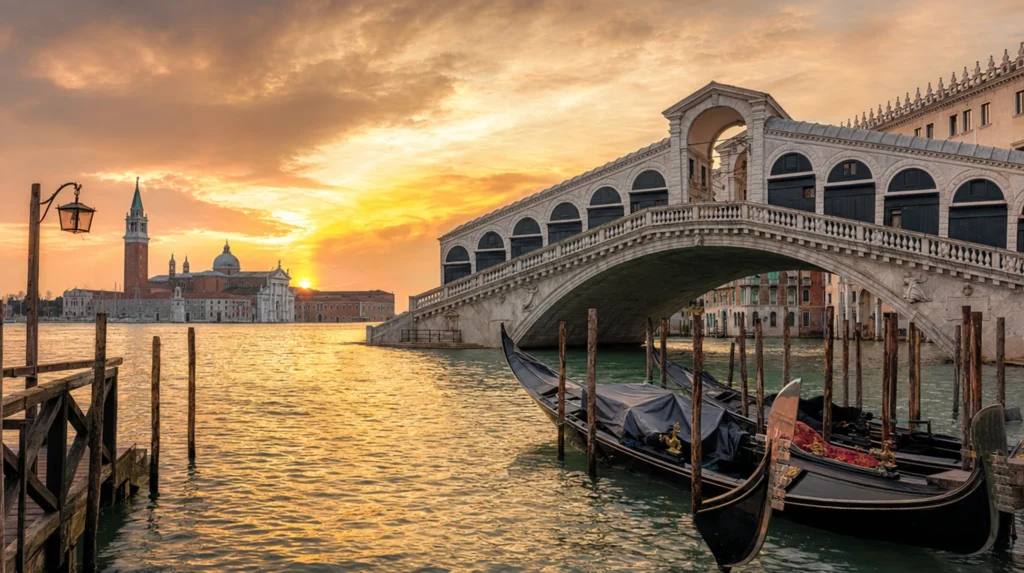
Venice, Italy: 118 Islands, 400 Bridges and a City That Refuses to Sink
Part of our Italy travel guide.
Venice City Guide
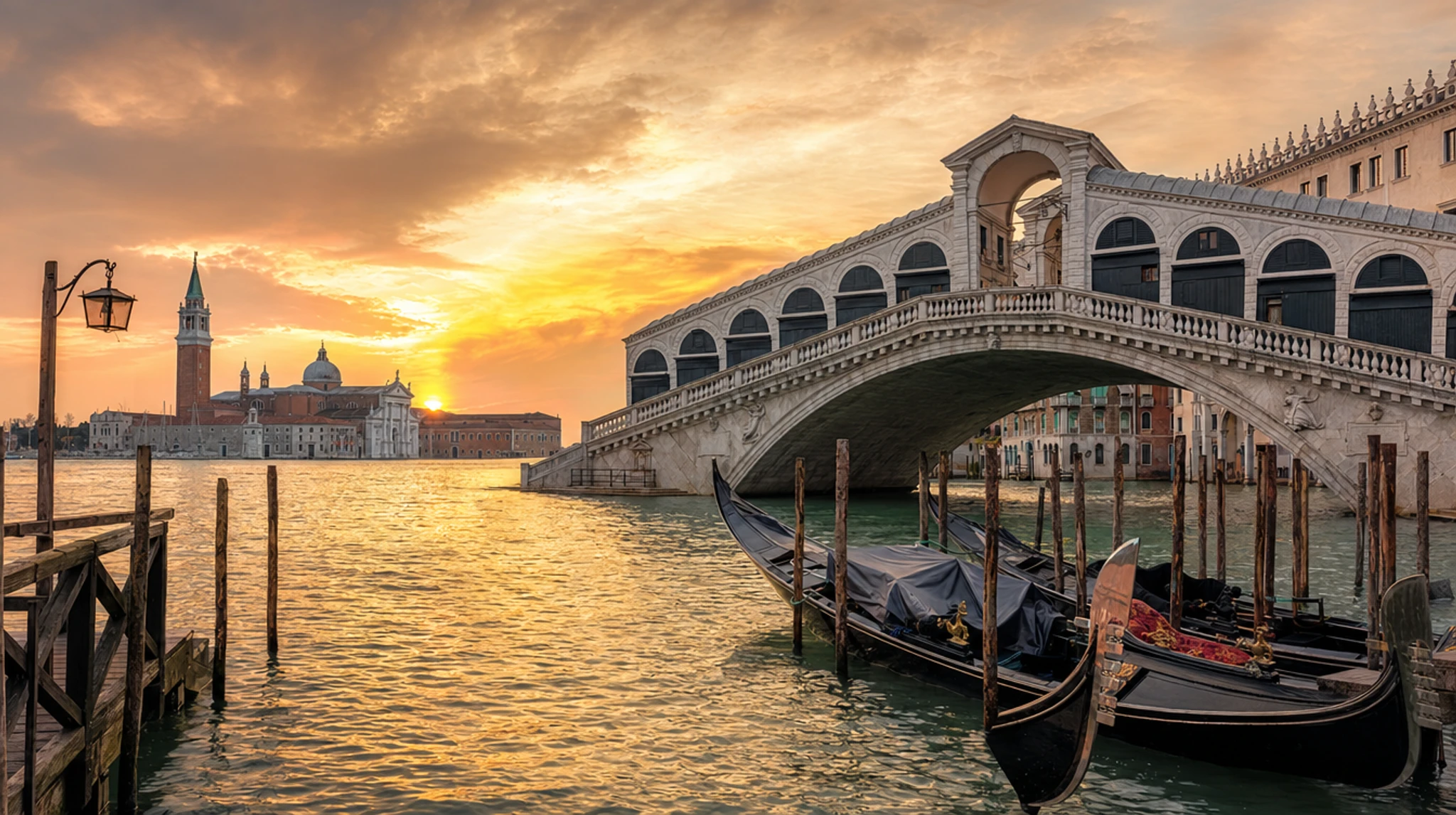
Table of Contents
Why Venice?
Venice is a city that shouldn’t exist. For 1,300 years it has held itself together on wooden piles driven into the mud of a shallow Adriatic lagoon, on 118 small islands stitched by more than 400 bridges and cut by 177 canals, with no cars, no metro, no modern grid and an economy that survived chiefly on salt, shipbuilding and long-distance trade. UNESCO inscribed the whole lagoon city on its World Heritage List in 1987, noting that Venice is a single, integrated architectural masterpiece — one where every square inch of rendered plaster, Istrian stone and Gothic quatrefoil window does a job.
The contradiction at the heart of a 2026 visit is the people count. The historic centre (centro storico) now holds roughly 50,000 residents, down from more than 170,000 in 1951; the Comune di Venezia administrative total including the mainland suburb of Mestre sits around 260,000. Annual visitor arrivals, by contrast, run well over 20 million. That asymmetry is the reason the city introduced a €5 day-entry fee in April 2024 — the first of its kind for a major European city — and the reason a mid-afternoon stroll off the San Marco–Rialto axis will often feel completely empty even in August.
What the page ahead lays out: the six historic sestieri of the main island group (San Marco, Castello, Cannaregio, Dorsoduro, San Polo and Santa Croce), the three headline lagoon islands (Murano for glass, Burano for lace and colour, Lido for cinema and beach), the daily rhythm of cicchetti and spritz, a Grand Canal lined with 170 palazzi, and a 2026 calendar anchored by Carnevale (February 7–17), the Venice Biennale of Architecture (May–November) and the 83rd Venice Film Festival at the Lido in early September.
Venice is also one of the most legible travel experiences in Europe if you let it be. You cannot really get lost — the lagoon is small, every calle eventually meets water, and yellow wayfinding signs on cornerstones point to Rialto, San Marco, Accademia or the Ferrovia from almost anywhere in the centre. You cannot speed through the city either, because there are no cars and no shortcuts, and every canal-edge detour adds a quarter of an hour. Walk slowly, look up often, eat standing at the bar, take the vaporetto the long way for the view, spend an evening on a cicchetti crawl on the Fondamenta della Misericordia, and assume the first route you took between your hotel and the Rialto will never work the same way a second time. That slowness — unhurried, sensory, stubbornly analog — is the point of a visit here and the reason the city has outlasted seven of the empires that built around it.
Neighborhoods: Finding Your Venice
Choosing between Venice, Rome and Florence for your base? Our guide to where to stay in Italy compares them all.
📍 Venice Map: Every Place in This Guide
Venice divides its historic centre into six sestieri (literally “sixths”): San Marco, Castello, Cannaregio, Dorsoduro, San Polo and Santa Croce. To these, any useful travel map adds Giudecca (the long island south of Dorsoduro), the glass-blowing island of Murano, the colour-block fishing village of Burano, and the 11-kilometre barrier beach of the Lido. Addresses use the sestiere name plus a number (e.g. “San Marco 3210”) because the historic street naming never took.
San Marco
The smallest sestiere and the one every first-timer photographs: the political, religious and ceremonial heart of the former Serenissima Republic, wrapped around Piazza San Marco. The square is the only piazza in Venice — every other open space is a campo — and Napoleon reportedly called it the “drawing room of Europe”. It is also the lowest ground in the city (about 64 cm above the tidal datum), which is why it floods first whenever acqua alta is forecast. Expect density from 09:00 until sunset; the square is different at dawn and at midnight.
- Piazza San Marco with the Basilica di San Marco (founded 829 CE, present basilica consecrated 1094)
- Palazzo Ducale (Doge’s Palace), the seat of Venetian government for a thousand years, and the Bridge of Sighs that links it to the prisons
- Campanile di San Marco — 99 m, rebuilt identically in 1912 after the 1902 collapse
- Caffè Florian (under the Procuratie Nuove arcades, opened 1720) and its rival Caffè Quadri opposite
- Teatro La Fenice on Campo San Fantin, three blocks west
Best for: first-timers who want the iconic checklist and are willing to get up at 06:30 for an empty Piazza. Access: Vaporetto Line 1 or 2 to San Marco Vallaresso or San Zaccaria.
Castello
Venice’s largest sestiere occupies the tail of the fish-shaped city. It was always the shipyard district — the Arsenale, founded in 1104, was the world’s largest industrial complex before the Industrial Revolution and could build a fully-armed galley in a single day at peak capacity. Today Castello is where most Biennale pavilions live (the Giardini and the Arsenale rope-walks), and, beyond the tourist perimeter, remains genuinely residential: laundry strung over narrow calli, kids kicking footballs against 16th-century walls, old men playing briscola in the bars.
- Arsenale and Giardini della Biennale — the main Biennale venues, open every year from May to November
- Basilica di San Pietro di Castello — the city’s cathedral until 1807, when the title moved to San Marco
- Via Garibaldi — the widest street in Venice, filled in from a canal in 1807
- Scuola di San Giorgio degli Schiavoni with Carpaccio’s St George and Dragon cycle (1502–1507)
- Riva degli Schiavoni waterfront promenade connecting to San Marco
Best for: slow walkers, Biennale-year travellers and anyone who wants a neighbourhood trattoria lunch. Access: Vaporetto Line 1, 4.1 or 4.2 to Arsenale or Giardini.
Cannaregio
The long northern sestiere running from the train station to the tip at Fondamente Nove. Cannaregio is working-class Venice — the one place in the city where you can still walk for fifteen minutes without encountering a souvenir shop — and it holds the Ghetto Ebraico, the world’s first Jewish Ghetto, established by Senate decree on March 29, 1516 as a walled, gated district where the Jewish community was required to live. The word “ghetto” itself comes from the Venetian dialect for the foundries that had occupied the site before.
- Jewish Ghetto with five surviving synagogues (three scuole tedesca, canton and italiana plus two Sephardic, levantina and spagnola) and the Jewish Museum
- Fondamenta della Misericordia and Fondamenta degli Ormesini — the best bacaro crawl strip in the city
- Ca’ d’Oro (1428), Venetian Gothic at its most florid, now a gallery
- Madonna dell’Orto — Tintoretto’s parish church, where he and his children are buried
- Strada Nova — the arterial walking route from the station to Rialto
Best for: cicchetti crawls, evening spritzes and travellers who want to escape the crowds. Access: Vaporetto Line 1, 4.2 or 5.2 to Ca’ d’Oro or Madonna dell’Orto.
Dorsoduro
The “hard back” — so named because its ground is slightly firmer than elsewhere — runs along the south of the city and ends at the Punta della Dogana, where the Grand Canal meets the Giudecca Canal. This is Venice’s museum corridor and university quarter (Ca’ Foscari University occupies a 15th-century palazzo on the Grand Canal), with long sunlit fondamente that fill with students in the late afternoon and the best sunset vantage points in the city along the Zattere.
- Gallerie dell’Accademia — the definitive collection of Venetian painting from the 14th to 18th century
- Peggy Guggenheim Collection at Palazzo Venier dei Leoni, the American heiress’s modernist stronghold on the Grand Canal
- Basilica di Santa Maria della Salute (1631), the Baroque octagon at the entrance of the Grand Canal
- Punta della Dogana — the former customs-house now housing François Pinault’s contemporary-art collection
- Zattere promenade and Campo Santa Margherita (student nightlife)
Best for: art lovers, photographers and anyone who wants to stay up past 22:00. Access: Vaporetto Line 1 to Accademia or Salute; Line 2 to Zattere.
San Polo
The smallest sestiere by area and the merchant heart of medieval Venice: the Rialto has been the market and financial district since at least the 11th century, when the Ponte della Moneta (later rebuilt in stone in 1591 as the Ponte di Rialto we know today) was the only crossing of the Grand Canal. Fish is still sold at the Mercato di Rialto six mornings a week, and the bacari tucked behind the market produce some of the best cicchetti in the city precisely because their ingredients came off a boat at 04:00.
- Rialto Bridge — completed 1591 by Antonio da Ponte, the only stone bridge across the Grand Canal for 263 years
- Mercato di Rialto — fish and produce markets, Tuesday–Saturday mornings (fish market closed Mondays)
- Basilica dei Frari — Titian’s Assumption of the Virgin (1518) is the altarpiece; Titian himself is buried here
- Scuola Grande di San Rocco with Tintoretto’s 60+ canvases (1564–1588) covering every surface
- Campo San Polo — the largest campo in Venice after Piazza San Marco
Best for: market photography, Titian and Tintoretto pilgrims, and bacari veterans. Access: Vaporetto Line 1 or 2 to Rialto Mercato or San Tomà.
Santa Croce
The sestiere that handles arrivals. Piazzale Roma (the only car terminus in the historic centre) and the Tronchetto parking island are both in Santa Croce, and the train station Venezia Santa Lucia sits just across the Ponte degli Scalzi from its eastern edge. Beyond the arrival infrastructure, Santa Croce hides some of the quietest campi in Venice and two excellent museums on the Grand Canal.
- Fondaco dei Turchi — 13th-century palazzo, now the Natural History Museum
- Ca’ Pesaro — Baroque palazzo housing the International Gallery of Modern Art and the Oriental Museum
- Campo San Giacomo dell’Orio — a locals’ campo with an 11th-century church on an uneven plan
- San Stae church on the Grand Canal
- Piazzale Roma — vehicle terminus, People Mover to Tronchetto, Ponte della Costituzione (Calatrava, 2008)
Best for: arrivals, departures and uncrowded evenings on a local campo. Access: Bus to Piazzale Roma; train to Venezia Santa Lucia; vaporetto Line 1 or 2 to Ferrovia / Piazzale Roma.
Giudecca
The long crescent-shaped island across the Giudecca Canal from Dorsoduro. Giudecca was industrial for most of the 20th century (flour mills, shipyards, the massive neo-Gothic Molino Stucky that now operates as a Hilton) and is rapidly becoming residential and design-forward without having lost its quiet. Staying here means a two-minute vaporetto ride to Zattere and the single best panoramic view of the historic city across the canal, especially at sunrise.
- Il Redentore — Andrea Palladio’s 1592 votive church, built as thanksgiving after the 1577 plague; Festa del Redentore is the third Saturday of July
- Molino Stucky — former 1895 flour mill at the western tip, now a 379-room Hilton
- Fortuny factory still producing Mariano Fortuny’s hand-printed cotton textiles on the original patents
- Zitelle church (Palladio, completed 1586 after his death) with the Cipriani hotel next door
- Harry’s Dolci — the patisserie offshoot of Harry’s Bar, with a waterside terrace
Best for: skyline photographers and travellers who want quiet stays with easy centre access. Access: Vaporetto Line 2, 4.1 or 4.2 to Giudecca Zitelle, Redentore or Palanca.
Murano
Seven interconnected islets 1.5 km north of Venice, home to the glass-blowing industry since 1291, when the Republic moved the furnaces here to reduce the fire risk to the wooden-heavy historic centre. Every piece of Venetian glass is technically Murano glass if it was made on the island — and the consorzio trademark (Vetro Artistico Murano) is how you distinguish it from imported imitations. Morning visits catch fornaci demonstrations; afternoons are for shopping.
- Museo del Vetro (Glass Museum) at Palazzo Giustinian
- Basilica dei Santi Maria e Donato — 12th-century mosaic floor rivalling San Marco
- Orsoni Mosaici — the last handmade smalti mosaic furnace in the world, tours by appointment
- Fondamenta dei Vetrai — the main shopping street lined with furnaces and galleries
- Colonna vaporetto stop — the best place to watch gondola-making boatyards across the canal
Best for: glass shoppers and industrial-heritage fans on a half-day circuit. Access: Vaporetto Line 3, 4.1 or 4.2 to Murano Colonna, about 10 minutes from Fondamente Nove.
Burano
Forty-five minutes by vaporetto from central Venice, Burano is a fishing village of roughly 2,400 residents where the houses are painted in saturated Crayola colours — a tradition that (so the legend goes) allowed returning fishermen to spot their own home through lagoon fog. Cheerful for photographers, stubbornly working-class for everyone else, and home to a leaning campanile that was already listing when Tintoretto was painting.
- Museo del Merletto (Lace Museum) — Burano lace has been made on the island since at least the 16th century; the Venetian needle-lace technique (punto in aria) was documented in 1558
- Chiesa di San Martino with the 53-metre leaning campanile (roughly 1.8 metres off vertical)
- Via Baldassare Galuppi — the main street, named for the Baroque composer born here in 1706
- Colour-coded house rows — tradition requires residents to request permission from the Comune to repaint, and the authorised palette is fixed
- Trattoria al Gatto Nero — the classic Burano lunch stop for risotto di gò (a lagoon-fish risotto)
Best for: photographers and travellers on a half-day lagoon circuit. Access: Vaporetto Line 12 from Fondamente Nove (roughly 45 minutes).
Lido
The 11-kilometre barrier island that separates the Venetian lagoon from the Adriatic. Unlike every other part of Venice, the Lido has cars — it is the only island in the municipality with road traffic — and it is where Venetians went in the belle époque to swim. Today it’s best known internationally as the host of the Venice Film Festival at the Palazzo del Cinema every early September.
- Palazzo del Cinema on Lungomare Marconi — the Venice Film Festival main venue since 1937
- Grand Hôtel des Bains (1900) — setting of Thomas Mann’s Death in Venice, currently redeveloped
- Spiaggia del Lido — public beach sections; most of the sand is divided into concession stabilimenti
- Hotel Excelsior — Moorish-revival 1908 palace hotel, the Film Festival celebrity hub
- Via Lepanto and the Lungomare Marconi promenade
Best for: late-summer beach days, Film Festival cinephiles in early September, and anyone wanting to rent a bicycle for the day. Access: Vaporetto Line 1, 2, 5.1 or 5.2 to Lido S.M.E.
The Food
Venetian cooking is a lagoon cuisine dressed in Eastern trade goods. Centuries as a maritime republic meant access to spices, salt cod from the North Sea, sugar, raisins, pine nuts and rice — risotto is Venetian before it is Milanese — at a scale no other Italian city-state matched. The daily result is less pasta than the rest of Italy and more seafood, rice, polenta and quietly spiced sauces that still taste faintly of the Levant. Carpaccio, in fact, was invented here in 1950 by Giuseppe Cipriani at Harry’s Bar for a countess whose doctor forbade her cooked meat, and the name came from an exhibition of the Venetian painter Vittore Carpaccio running across the city at the same time. Almost every dish you eat in the centre has a backstory of that kind.
The city also has its own eating format: the bacaro. A bacaro is a small neighbourhood wine bar serving cicchetti, the Venetian equivalent of Spanish tapas — typically small plates or single bites on slices of baguette (crostini), meant to be eaten standing at the counter with a glass of Raboso, Prosecco, Soave or a spritz. The verb is andar per ombre — to go for a “shade” of wine — because the wine merchants of Piazza San Marco used to move their stalls around the Campanile to keep the bottles in the shade. A proper cicchetti crawl ends at three or four bacari, with a different wine at each, and will set a couple back €40–€60 including four bites, four glasses and the walk between them.
A few meta rules before the specifics. First, do not order a cappuccino after 11:00 and do not order one after a meal — both are done, but Venetian waiters will register the order, charge you for it, and quietly decide you are from out of town. Second, never ask for cream in a carbonara or Parmesan on any seafood pasta — either ask will usually earn a pained pause and a polite no. Third, the Venetian lunch window is roughly 12:30–14:30 and the dinner window 19:30–22:30; outside those hours, a bacaro is your best option and a tourist-trap pizzeria is likely to be the only alternative. Fourth, never eat sitting on a bridge or a church step — it is both a bylaw (fines from €25 upward) and a local decorum rule.
Cicchetti & the Bacaro Crawl
A cicchetto costs €1.50–€3, an ombra (roughly 80 ml of house wine) €1.50–€2.50, a spritz €3.50–€5 at a neighbourhood bacaro and €18 and up at a tourist bar on Piazza San Marco. The best bacaro strips in the city, in rough order of quality and atmosphere, are Fondamenta della Misericordia and Fondamenta degli Ormesini (Cannaregio), the warren of streets behind the Rialto fish market (San Polo and San Marco sides), Campo Santa Margherita (Dorsoduro — student-heavy) and Campo Santa Maria Formosa (Castello). Expect to stand at the counter, expect it to be loud, expect the fried seafood platter to go first, and expect the barman to refuse to take your order until the person next to you has finished theirs.
- Cantina Do Mori — cicchetti and ombra at the San Polo bacaro in business since 1462, behind the Rialto market (cicchetti ~€2–€3 per bite, ~$2.15–$3.25, FX_DATE 2026-04-19)
- All’Arco — the San Polo standard-bearer for fresh-daily cicchetti, closes by 14:30 most days (~€2.50 per cicchetto, ~$2.70)
- Cantina Do Spade — sit-down or counter, a few doors from Do Mori (cicchetti ~€2.50; plated pasta ~€14, ~$15.10)
- Al Timon — Cannaregio canal-side institution with a barge-bench moored on the Fondamenta degli Ormesini (cicchetti ~€2.50; grigliata mista ~€16, ~$17.30)
- Osteria alla Vedova (Ca’ d’Oro) — Cannaregio fixture famous for its polpette meatballs (~€1.80 each)
- Vino Vero — natural-wine bacaro on Fondamenta della Misericordia; cicchetti ~€2.50–€4, natural wines by the glass €5–€8
- Paradiso Perduto — Cannaregio canal-side, live jazz Thursdays, full dinner available ~€28 (~$30.30)
- Bacaro Risorto — Castello, near Campo Santi Filippo e Giacomo, excellent baccalà cicchetto (~€2.50)
Lagoon Seafood & Venetian Risotti
The lagoon produces the raw material of the region’s flagship dishes: risotto al nero di seppia (cuttlefish-ink risotto, black and saline), sarde in saor (sardines marinated with onions, raisins, pine nuts and vinegar — a 14th-century sailors’ preservation trick), bigoli in salsa (thick whole-wheat spaghetti-like pasta dressed with slow-cooked onion and anchovy) and the rarer moeche (soft-shell crabs caught only during their spring and autumn molts). Classic Venetian trattorie keep the list short and the fish specials handwritten; expect the daily catch to be ordered whole and priced by the etto (100 g), which lets a portion for two run anywhere from €28 to €80 depending on the species.
- Osteria Alle Testiere — nine-table seafood trattoria in Castello; set menu ~€65 (~$70.30) and you book a week ahead
- Trattoria Corte Sconta — Castello institution since 1976; seafood antipasti ~€25 (~$27.00), primi ~€22 (~$23.80)
- Antiche Carampane — San Polo fish specialist, no-photos house rule, full dinner ~€70 (~$75.70)
- Trattoria Al Gatto Nero (Burano) — risotto di gò (lagoon-fish risotto) ~€22 (~$23.80); worth the 45-minute vaporetto from Fondamente Nove
- Vini da Gigio — Cannaregio, Grand Canal-side trattoria with an impressive natural-wine list; primi ~€18, secondi ~€28
- Osteria da Fiore — San Polo, 1-Michelin fish restaurant with long Venetian provenance; tasting ~€140 (~$151.40)
Beyond Cicchetti and Risotto
Venetian cuisine runs well past the headlines. A 3–4 day stay leaves room for the supporting cast: baccalà mantecato (the whipped-stockfish spread that shows up on every cicchetti plate), fegato alla veneziana (a slow-cooked-onion-and-liver dish that has travelled further than any other Venetian recipe), polenta in all three of its forms (morbida, soft; grigliata, grilled; and bianca, white corn and slightly sweet), tiramisù (a source of decades-long Treviso–Veneto dispute; Venetian trattorie serve it and do not argue), gelato on a warm calle (the canonical three scoops are pistacchio, stracciatella and a fruit sorbet), and Carnevale-only fritters called frittelle and galani. Prices below are typical restaurant portions, with USD equivalents at the April 19, 2026 XE.com reference rate.
- Baccalà mantecato — whipped stockfish cream, served on polenta squares or crostini (~€3 per cicchetto, ~$3.25)
- Fegato alla veneziana — liver with slow-cooked sweet onions on soft polenta (~€18 at a trattoria, ~$19.45)
- Bigoli in salsa — whole-wheat spaghetti with onion-anchovy sauce (~€14, ~$15.10)
- Risotto al nero di seppia — cuttlefish-ink risotto (~€20, ~$21.60)
- Sarde in saor — marinated sardines, usually served cold as antipasto (~€9, ~$9.70)
- Moeche fritte — fried soft-shell crab (spring and autumn molts only, ~€24, ~$25.95)
- Tiramisù — typically €7–€9 at a trattoria (~$7.60–$9.70)
- Frittelle and galani — Carnival fritters, late January to mid-February, ~€1.50 each at a pasticceria
- Zaeti — cornmeal-and-raisin biscuits dipped in coffee (~€1.20 each at Rosa Salva)
- Bussolai buranelli — ring-shaped Burano butter biscuits (~€18 per kg at Carmelina Palmisano)
Food Experiences You Can’t Miss
A full cicchetti crawl — three or four bacari, one bite and one ombra at each — is the single definitive Venetian food experience and the best way to meet the city’s daily rhythm. Outside that, a handful of set pieces earn their own lunch or evening slot. Tickets for the Michelin-star tables want a month of notice in the busy months (May–October plus Carnevale); the Rialto morning market is free and needs only an alarm clock.
- Rialto fish market (Pescheria) at 08:00 — under the 1907 neo-Gothic arcade, a working wholesale and retail market since at least the 14th century; Tuesday through Saturday, closed Mondays and Sundays
- A full cicchetti crawl on Fondamenta della Misericordia — start at Paradiso Perduto, work along Vino Vero and Al Timon, and finish at Osteria alla Vedova; four bacari, four ombre and about €35 per person across two hours
- Spritz at sunset on the Zattere — Dorsoduro’s south-facing promenade catches the day’s best light; the local aperitivo runs €3.50–€5 at a standing bar and €12–€18 seated
- Counter espresso at Caffè Florian (€4.50 standing at the bar vs €11 seated on the square) for the 1720 room with Giuseppe Ponga frescoes; Caffè Quadri across the Piazza is the 2-Michelin alternative for lunch upstairs
- A Michelin-starred tasting menu — Ristorante Quadri (2★) on Piazza San Marco runs €225+ (~$243.30); Glam (1★) at the Palazzo Venart hotel runs around €180 for 7 courses; Osteria da Fiore (1★) in San Polo, around €140
- A Bellini at Harry’s Bar — the Cipriani family bar off Piazza San Marco where the cocktail (Prosecco + white peach purée) was invented in 1948; ~€22 a glass
- A half-day in a glass-blowing furnace on Murano — many Murano fornaci run hands-on one-hour glass-blowing workshops (€90–€150) that finish with a piece you can ship home; booking is essential and most only operate Monday–Friday
- The Zaia or Venissa kitchen on Mazzorbo — the Bisol family’s walled-vineyard hotel-restaurant on a small lagoon island next to Burano, growing the near-extinct Dorona grape; Venissa tasting menu ~€180 (~$194.40), lunch at the casual Osteria Contemporanea ~€65
Venetian Wines & the Spritz
Venice sits inside the Veneto DOC region, one of the most productive wine zones in Italy. The house-wine glass at a bacaro will almost always be a Veneto pour: Prosecco DOC from the hills around Valdobbiadene, Soave DOC from just east of Verona, Valpolicella and its Amarone and Ripasso variations, or the darker Raboso from the Venetian mainland. Pour sizes are standard: the ombra at 80 ml runs €1.50–€2.50, a calice (full glass, ~150 ml) €4–€7, and a mezzo (half-litre carafe) from €8.
The Venetian spritz is its own subject and the city’s unofficial aperitivo. The local 1-part-bitter, 3-parts-Prosecco, splash-of-soda formula was codified in the 1920s when Aperol (invented 1919 in Padua) became the Veneto’s default bitter. Three 2026 recipes you will see daily: the classic Aperol spritz (~€3.50–€5), the stronger Campari variant (~€4–€5.50), and the local Select spritz — Select is a Venetian bitter first produced in Castello in 1920 and it is markedly less sweet than either Aperol or Campari. A garnish of one olive and a slice of orange is standard. Spritzes served on Piazza San Marco at a seated table can exceed €18; the same cocktail at a standing Cannaregio bacaro is €3.50. The differential is the floor service and the view, not the liquid.
Cultural Sights
Venice’s sight density is among the highest of any city on earth — roughly 170 palazzi on the Grand Canal alone, 139 churches inside the historic centre, and a UNESCO inscription that covers the entire lagoon rather than any single building. The eight entries below are the fixed points of a first-time visit; any Venetian will point out a dozen more they think you should have included. Advance-purchase timed tickets are now standard at the Basilica di San Marco, Palazzo Ducale and the Peggy Guggenheim Collection — book 48–72 hours ahead during the Biennale season (May–November) to skip queues of 45 minutes or more. Admissions listed below are the 2026 standard adult rates published by VisitVenezia.
Basilica di San Marco
Founded 829 CE to hold the remains of St Mark the Evangelist, smuggled back from Alexandria by two Venetian merchants who (per the 9th-century hagiography) hid the body under layers of pork to discourage Muslim customs inspectors from examining the cargo. The current basilica was consecrated in 1094 and is the most important surviving example of Italo-Byzantine architecture in the West; its interior carries roughly 8,000 m² of gold-ground mosaics laid between the 12th and 19th centuries. Admission to the nave is free; the Pala d’Oro gold altarpiece (1,927 gems) is €5, the museum loggia (bronze horses) is €7, the skip-the-line reservation is €3. Opening hours 09:30–17:15 Mon–Sat, 14:00–17:15 Sun.
Palazzo Ducale (Doge’s Palace)
The seat of the Venetian Republic’s government for a thousand years. The current façades are 14th-century Gothic; the interior was rebuilt after fires in 1483 and 1574 and contains Tintoretto’s Paradiso (1588) at 22 by 7 metres, the largest oil painting on canvas in the world. The Secret Itineraries tour accesses the Piombi (lead-roofed attic prison cells), the Avogaria magistrates’ offices, and the torture chamber — and includes the cell from which Giacomo Casanova escaped in 1756. Admission €30 adult (combined Musei di Piazza San Marco ticket, covering Correr, Archaeology and Marciana libraries). Open 09:00–19:00 daily.
Gallerie dell’Accademia
Founded as an art academy in 1750 and converted to a gallery in 1817, the Accademia holds the single most important collection of Venetian painting from the 14th to 18th centuries: Giorgione’s La Tempesta (c. 1508), Titian’s late Pietà (1576), Tintoretto’s Miracle of the Slave, Veronese’s enormous Feast in the House of Levi (1573 — originally a Last Supper, renamed after the Inquisition objected to the dogs and dwarfs), and Leonardo da Vinci’s Vitruvian Man (shown rotationally to protect the paper). Admission €15. Open 08:15–19:15 Tue–Sun, 08:15–14:00 Mon.
Basilica di Santa Maria della Salute
The Baroque votive church at the entrance of the Grand Canal, commissioned in 1630 to thank the Virgin for ending the plague that had killed roughly a third of the city’s population and completed in 1681 to Baldassare Longhena’s octagonal plan. The sacristy holds Titian’s ceiling panels of the Old Testament (1542–1544) and Tintoretto’s Marriage at Cana. Every November 21, Venice still celebrates the Festa della Salute by opening a temporary pontoon bridge across the Grand Canal for a civic pilgrimage. Free entry; sacristy €6. Open 09:00–12:00 and 15:00–17:30 daily.
Scuola Grande di San Rocco
One of six surviving Venetian confraternity houses, and the one Tintoretto decorated top to bottom. Between 1564 and 1588 he painted 60-plus large canvases for the Sala dell’Albergo, Sala Superiore and Sala Terrena — a single-painter cycle on this scale is unmatched in Europe. John Ruskin called the Crucifixion in the Sala dell’Albergo the most powerful painting in existence. Admission €10; the Scuola provides hand-mirrors so you can view the ceiling without wrecking your neck. Open 09:30–17:30 daily.
Peggy Guggenheim Collection
The American heiress’s Venice residence from 1949 until her death in 1979; the Palazzo Venier dei Leoni is an unfinished 18th-century palace on the Grand Canal between the Accademia and the Salute. The collection is a Who’s Who of first-generation modernism: Picasso’s On the Beach, Pollock’s Alchemy, Magritte’s Empire of Light, Ernst, Duchamp, Mondrian, Brancusi, Calder. Marino Marini’s Angel of the City faces the Grand Canal from the terrace. Admission €16. Open 10:00–18:00 Wed–Mon (closed Tuesdays).
Teatro La Fenice
Literally “the Phoenix”, and it has burned down three times — 1774, 1836 and most recently in 1996 — and has twice been rebuilt to exact historical specification, reopening in 2003. Verdi’s La Traviata and Rigoletto both premiered here; the current season is the city’s premier classical-music fixture. Self-guided audio tours €12 (09:30–18:00 daily, schedule subject to rehearsals); opera tickets run €30 (upper gallery) to €250 (stalls) depending on production.
Campanile di San Marco
The 99-metre bell tower of St Mark’s is 12th century in origin but the current structure is a 1912 reconstruction after the 1902 collapse; the rebuild preserved the original five bells, each with its role (the Marangona rang to open the shipyards; the Trottiera called senators to work). An elevator lifts visitors to the loggia for the best single panorama over the lagoon. Admission €12. Open 09:30–21:15 in summer and shorter hours in winter.
Entertainment
Evening Venice is quieter than Rome, less rowdy than Florence and more improvisational than both. The headliners are opera at La Fenice, year-round Baroque chamber concerts in 17th-century churches, the Biennale’s two annual anchors (architecture and art) and — every early September — the Venice Film Festival at the Lido. Below those sit the everyday options: cicchetti at a bacaro, a rowing lesson, a gondola in the quiet canals after 21:00, a spritz on a fondamenta terrace, and, occasionally, a student-filled late-night campo. The city shuts early by mainland Italian standards — most bars are closed by 01:00 — but that only forces the evenings to be better scheduled.
La Fenice Opera & Classical Concerts
Venice’s opera house Teatro La Fenice runs a full season from late October through mid-July, plus summer chamber concerts in the adjoining Sale Apollinee. The house seats 1,126 and skews heavily toward the 19th-century Italian canon — a given season will typically include three or four Verdi operas, one Puccini, a Rossini or Donizetti comedy and a 20th-century modernist. Tickets €30 (upper gallery, obstructed view) to €250+ (palco stalls); gallery single tickets often remain available day-of. Evening dress is not required but most regulars wear jacket and tie.
Venice Biennale (Biennale di Venezia)
The world’s oldest and most prestigious international arts exhibition has been running biennially since 1895. The schedule alternates art (odd years) with architecture (even years), so 2026 is the Architecture Biennale — the 20th International Architecture Exhibition opens in May and runs into late November at the Giardini (30 national pavilions) and the Arsenale (thematic exhibition plus overflow pavilions). A single day pass is ~€25 adult; a season pass ~€50 allows unlimited entry for the full run. Pair it with the Film Festival on the Lido in early September for a full autumn cultural sweep.
Vivaldi & Baroque Concert Series
Antonio Vivaldi was born in Venice in 1678 and spent most of his career at the Ospedale della Pietà as violin master and composer for the female orphans’ choir and orchestra. A dozen Venetian ensembles now perform his work nightly in 17th- and 18th-century churches: Interpreti Veneziani at San Vidal (nightly 20:30), I Musici Veneziani in costume at the Scuola Grande di San Teodoro, and the Venice Baroque Orchestra at La Pietà (the restored Vivaldi church on the Riva degli Schiavoni). Tickets €30–€40. Quality varies but the acoustic of the churches is the draw.
Gondola, Water Taxi & Row-Your-Own
The official Comune-set gondola tariff in 2024 was €90 for 30 minutes during the day and €110 for 30 minutes after 19:00 — any gondolier quoting €150+ for a standard tour is overcharging. Six passengers maximum. Singing is extra and negotiated in advance (the singer-accordion duo is typically €40–€60 on top). For a quieter option, book a traditional rowing lesson with Row Venice (Cannaregio, €95 for 90 minutes for up to four people) — you learn the forward-facing voga alla veneta technique on a 9-metre batela coda di gambero.
Nightlife & Late-Night Cicchetti
Venice does not have a club scene by mainland-Italian standards — most bars close by 01:00 and there is no tube home — but Campo Santa Margherita (Dorsoduro) fills with university students on weeknights and Fondamenta della Misericordia (Cannaregio) turns into an open-air bacaro crawl. Recommended stops: Bacaro Risorto (Castello, open till 22:00), Paradiso Perduto (Cannaregio, live jazz Thursdays), Il Santo Bevitore (Cannaregio craft-beer bar), El Sbarlefo (two locations; wine-bar, open late). For dancing you go to the mainland (Mestre/Marghera) or the Lido in summer.
Shopping: Glass, Lace, Marbled Paper & Masks
The four souvenirs with genuine Venetian provenance are Murano glass (look for the Vetro Artistico Murano trademark), Burano lace (the Museo del Merletto shop guarantees provenance), Venetian marbled papers (Il Papiro and Legatoria Polliero are long-standing producers), and handmade Carnevale masks in leather or papier-mâché. For masks, Ca’ Macana in Dorsoduro and Kartaruga near San Zaccaria are the artisans most Venetians point tourists toward; expect €50 for a simple volto mask and €300+ for a fully decorated ballroom-quality piece. Avoid the 3-for-€10 souvenir racks — those are imported almost without exception. For textiles, the Fortuny factory on Giudecca still prints hand-dyed cotton on the original Mariano Fortuny patents (cushion covers from €350), and Bevilacqua has woven Venetian silk velvet on 18th-century looms since 1875.
Day Trips
Murano + Burano (45 minutes combined by ACTV vaporetto)
The classic lagoon-island half-day from Fondamente Nove on the north edge of Cannaregio. Vaporetto Line 3 or 4.1 to Murano Colonna in about 10 minutes, then the same line to Murano Faro, where Line 12 continues to Burano in a further 35 minutes across open water. Spend the morning in Murano among the fornaci and the Glass Museum, lunch in Burano at Trattoria al Gatto Nero or Trattoria da Primo on the main canal, and consider adding Torcello (another 5 minutes by Line 9 from Burano Nord) for the 7th-century cathedral of Santa Maria Assunta with its Byzantine Last Judgement mosaics. The 24-hour ACTV pass at €25 pays for itself on the first three rides; last return from Burano is roughly 22:30. Bring cash — the Gatto Nero kitchen is famously slow to take cards.
Padua / Padova (30 minutes by Trenitalia Regionale from Venezia Santa Lucia)
A standing-room-only short-hop on the regional train (€4.55 advance, ~30 min) or about the same on a Frecciarossa if the timing lines up (€9–€15, 25 min). Padua holds three substantial draws: Giotto’s Scrovegni Chapel (1305, UNESCO-inscribed 2021) with 38 frescoed panels of the life of Christ — book timed entry in advance, the chapel allows 25 visitors per 15-minute slot; the Basilica di Sant’Antonio with Donatello’s bronze high altar (1444–1450); and the University of Padua (1222, Europe’s second-oldest after Bologna) with its 1594 anatomical theatre, the oldest surviving in the world. Caffè Pedrocchi, the 1831 “café without doors” where Stendhal drank, is one piazza away.
Verona (1 hour 15 minutes by Frecciarossa or Italo)
UNESCO-inscribed since 2000 and a proper stand-alone Roman city. Verona’s 1st-century Roman amphitheatre (the Arena) seats 15,000 for its summer opera festival (late June to early September — Aida is the signature production), ticket prices €30 stone seats to €250 stalls. Walk the Ponte Pietra Roman bridge (rebuilt after Nazi demolition in 1945), climb to Castel San Pietro for the skyline shot at golden hour, pilgrimage to Casa di Giulietta (the 13th-century palazzo retro-fitted with a balcony in 1936, admission €12), and finish in Piazza delle Erbe for spritz and tramezzini. Trains run hourly and the last Frecciarossa back to Venice departs around 21:30.
Dolomites via Cortina d’Ampezzo (1.5 hours by Cortina Express coach from Venezia Tronchetto / Mestre)
The Dolomiti were UNESCO-inscribed in 2009 for their unmatched geological and landscape value — pale limestone pinnacles above alpine meadows. Cortina d’Ampezzo hosted the 1956 Winter Olympics and is co-hosting Milano–Cortina 2026 (February 6–22 of this year) with Milan. The Cortina Express coach runs several daily services from Venezia Mestre station and Tronchetto to Cortina in roughly 1 hour 45 minutes for €30–€35 round trip; in summer (June–September) continue by local bus or rental car to Lago di Misurina, the Tre Cime di Lavaredo viewpoint or Lago di Braies. Avoid a winter day trip if you do not ski — the road can close on weather.
Chioggia (1 hour by ACTV bus + ferry from the Lido, or 25 minutes by car)
The “little Venice” at the southern tip of the lagoon — a working fishing port of 50,000 that looks like Venice with wider canals, a fraction of the tourists and the everyday rhythm Venice had before the cruise ships. ACTV Line 11 connects the Lido across the Pellestrina barrier island and then by ferry, running roughly hourly; alternatively SITA coaches leave Piazzale Roma for the mainland route. Chioggia’s fish market runs Monday through Saturday mornings (except Italian national holidays); Corso del Popolo is the 1 km main promenade; the Torre dell’Orologio clock (1386) claims to house one of the oldest tower clocks in the world. Lunch at Osteria Penzo for lagoon-style cuttlefish in its own ink.
Seasonal Guide — Carnevale & Biennale 2026
Venice runs on two seasonal rhythms. Between November and Carnevale the city is low and cold and quiet, good for museums and bacari and acqua alta. Between May and late November the Biennale is on and the city fills with architecture students, gallerists, cinephiles (early September) and the long afternoon sun on the water Canaletto spent his career painting. The sweet spots are the shoulders — late October, early May — when everything is open, the crowds are half what August produces, and a hotel that would be €350 in July drops to €180.
Spring (March – May)
Highs 13–22°C, lows 5–13°C, more sun than rain by mid-April. Easter (April 5, 2026) is a short surge; the week before and after is the best balance of weather and crowds. The Architecture Biennale opens in the second week of May and instantly changes the city’s tone — hotel rates in Castello double, every bacaro in Cannaregio is full at 19:00, and the Giardini reopen after six months of grass-recovery. La Festa della Sensa (Feast of the Ascension, May 17, 2026) revives the 12th-century “Marriage of the Sea” ceremony with the Bucintoro ceremonial barge heading out to San Nicolò del Lido.
Summer (June – August)
Highs 27–30°C, lows 18–21°C, humid, and thunderstorms most afternoons in late July and August. This is also peak cruise-ship season and peak day-entry-fee season — you will be charged €5 if you arrive on one of the roughly 54 gazetted peak days without an overnight booking. The compensation is two nights of evening festivals: Festa del Redentore (third Saturday of July — July 18, 2026 — with 40 minutes of fireworks over the Bacino di San Marco from 23:30) and Ferragosto (August 15). Biennale is in full swing. Avoid midday in Piazza San Marco; do the Lido beach before 11:00 or after 17:00.
Autumn (September – November)
Highs 18–26°C, lows 10–17°C. Early September is the 83rd Venice Film Festival (Lido, 10-day run, dates confirmed each April by La Biennale — exact 2026 dates to be announced); late September to early November is the quietest four weeks of the year in the centre. November 21 is the Festa della Salute with its pontoon bridge across the Grand Canal. Acqua alta risk begins rising from mid-October onward, with the highest tides historically in late October and November.
Winter (December – February)
Highs 5–10°C, lows 0–3°C, often misty at dawn, occasionally snowing. The city is at its quietest in January, and rates for a canal-view room can fall 60% below July. Carnevale di Venezia 2026 runs Saturday February 7 through Shrove Tuesday February 17, with the opening water parade in Cannaregio, the Volo dell’Angelo at noon on the following Sunday in Piazza San Marco, and a finale of costume-contest judging and fireworks on Martedì Grasso.
Getting Around
Walking: The Default
Venice’s historic centre is roughly 7 km² from end to end. Walking is almost always faster than the vaporetto for distances under 1.5 km — San Marco to Santa Lucia train station takes about 35 minutes on foot and 45–55 minutes on the Line 1 vaporetto including the wait. Yellow wayfinding arrows on cornerstones point to Rialto, San Marco, Accademia and Ferrovia (the station), but they are suggestive more than literal. Google Maps is approximate inside the centre; a paper map or the downloadable Venezia Unica sestiere map is more reliable. Pack soft-soled shoes, pack light, and accept that 400+ bridges are a workout with a rolling suitcase.
Vaporetto (ACTV Water Bus)
ACTV runs more than 20 vaporetto lines across the lagoon and along the Grand Canal. The two workhorses for tourists are Line 1 (local, all 20 Grand Canal stops, ~45 min Piazzale Roma → San Marco) and Line 2 (express, 8 stops, ~35 min). The outer lines 4.1, 4.2, 5.1 and 5.2 loop the city perimeter and connect Murano to the Lido. A single ride is €9.50 valid for 75 minutes on any line. Multi-day tourist passes: 24 hours €25, 48 hours €35, 72 hours €45, 7 days €65. If you are a visitor aged 14–29, the Rolling Venice card (€6) reduces the 72-hour pass to €33.
Traghetto (Gondola Ferry)
Short, standing-up gondola crossings of the Grand Canal at seven points where there is no bridge for a long stretch. It is the only way many locals “ride” a gondola: €2 per crossing, roughly 90 seconds, cash to the gondoliere. The most useful traghetto runs are at Santa Sofia (Cannaregio → Rialto market), San Tomà (San Polo → San Samuele) and Santa Maria del Giglio (San Marco → Salute). Service times are typically 09:00–18:00 and shorter in winter.
Water Taxi (Motoscafo)
The 10-metre varnished mahogany speedboats moored at every major vaporetto stop. Tariff: flag ~€15 plus ~€2 per minute, with surcharges for luggage and night. A ride from Marco Polo Airport to a central hotel runs around €140 one-way by official Consorzio Motoscafi taxi; splitting the fare between four passengers is the point at which it becomes economical. Beautiful, expensive, fast — and the only practical way to move a full suitcase into a centre hotel without walking.
Marco Polo Airport (VCE) & Treviso Airport (TSF)
- Alilaguna water bus from Marco Polo Airport — ~€15 one-way, ~60 min to San Marco via blue/orange/red routes
- ATVO / ACTV Line 5 bus from Marco Polo to Piazzale Roma — €10 one-way, ~20 min
- Water taxi from Marco Polo to central hotels — ~€140 fixed route, ~30 min
- Barzi / ATVO bus from Treviso Antonio Canova Airport (TSF) to Piazzale Roma — €12, ~75 min
Taxis on Land (Mestre Only)
There are no street-hail taxis inside the historic centre — only water taxis. On the mainland (Mestre and Marghera), land taxis operate with a flag-fall around €5.40 and roughly €1.60 per km; book by phone through Radio Taxi (041 5952080) rather than flagging. Ride-share apps like Uber do not operate inside the comune.
Navigation Apps & Tips
Apps: Google Maps (imperfect inside centro storico, occasionally routes across canals that have no bridge), AVM Venezia Official (ACTV live vaporetto arrivals and pontile status), Maps.me (offline; better on calli than Google) and the Venezia Unica app for the day-entry registration and museum combined tickets. Allow 50% more walking time than a mapping app suggests — the 400+ bridges, the dead-end calli (marked ramo or corte), the indirect routing around canals and the sheer human density on the Rialto–San Marco corridor all add up. If you are lost, walk to the nearest canal edge and look for a yellow sign; every yellow sign eventually connects to the Rialto, San Marco, Accademia or the Ferrovia. If you want to skip the map entirely, Venice is genuinely a city where asking the nearest person for “Rialto? San Marco?” will produce a reliable finger-point.
Budget Breakdown: Making Your Euros Count
Venice is the single most expensive city in Italy for accommodation and one of the cheapest cities in Western Europe for a glass of drinkable wine. The spread between the two creates a simple planning rule: spend the accommodation money on location and room size; claw it back on standing-bar meals and bacaro dinners. A visitor who eats cicchetti for lunch and trattoria for dinner, uses a 48-hour ACTV pass instead of single tickets, and books accommodation in Cannaregio or Dorsoduro rather than in the San Marco canal-view zone saves around 40% of an otherwise identical three-day bill without noticing a drop in quality.
Accommodation rates in Venice also move on a remarkable seasonal curve: a canal-view 3★ double that runs €350 in mid-June can drop to €150 in late January and pop back to €450 for Carnevale weekends (February 7–8 and February 14–15, 2026). Mestre, on the mainland, is consistently 40–60% cheaper than the historic centre and is connected to Piazzale Roma by a 10-minute train ride (€1.35) every ten minutes. For a budget first visit, Mestre sleep plus centro storico days is a viable strategy; for a mid-range or luxury stay, the case for sleeping on the water itself is hard to argue against.
All prices quoted in euros (EUR); USD equivalents shown at the April 19, 2026 XE.com reference rate.
| Tier | Daily | Sleep | Eat | Transport | Activities | Extras |
|---|---|---|---|---|---|---|
| Budget | €90–€120 (~$97–$130) | €60 dorm / Mestre B&B | €18 (bakery + cicchetti + tavola calda) | €25 (24-hr ACTV pass) | €15 (one church / one museum) | €5 day-entry fee on peak days |
| Mid-Range | €220–€320 (~$238–$346) | €150 (3★ in Cannaregio or Dorsoduro) | €55 (trattoria lunch + osteria dinner + 2 spritz) | €25 (48-hr ACTV pass) | €30 (Palazzo Ducale + Accademia) | €20 (Murano half-day) |
| Luxury | €600+ (~$650+) | €450+ (Aman, Gritti Palace, Cipriani) | €150+ (Quadri tasting menu / Harry’s Bar) | €80 (private water-taxi charter) | €80 (Secret Itineraries + private guide) | €250 (private gondola with musicians) |
Where Your Money Goes
Accommodation is the single largest line item — a canal-view double in June sits at €350 even at a 3-star standard, and the luxury band (Aman Venice, Gritti Palace, Hotel Cipriani on Giudecca, Belmond Hotel Cipriani, the St. Regis) starts at €1,200 a night and has no ceiling. Food is genuinely flexible: a €6 cicchetto lunch standing at a bacaro and an €18 trattoria primo are both good days; the €225+ tasting menu at 2-star Quadri is the occasional splurge. Museum admissions run €12–€30 apiece and add up fast — the Musei di Piazza San Marco combined ticket (€30) covers four museums and effectively halves the per-attraction cost.
Money-Saving Tips
- Stay in Cannaregio, Dorsoduro or Castello rather than San Marco — rooms 30–40% cheaper, 10 minutes on foot to the Piazza
- Buy the 48-hour or 72-hour ACTV pass on arrival rather than single €9.50 rides; break-even is three rides
- Eat cicchetti standing at a bacaro (€2–€3 each, no coperto) instead of a restaurant lunch; the wine glass is €1.50–€2.50
- Skip the seated Piazza San Marco coffee; an espresso at the bar banco is €1.10–€1.50 anywhere in the city, same liquid
- Book trains (Trenitalia / Italo) to Verona and Padua 30+ days ahead for the €9–€19 advance fare
- Use the Chorus Pass (€14) if you plan to visit four or more churches — it covers 18 churches including the Frari and Salute, a single-church ticket is €5
- If you are 14–29 years old, buy the Rolling Venice card (€6) — it drops the 72-hour ACTV pass to €33 and gives museum discounts
Practical Tips
The €5 Day-Entry Fee
Since April 25, 2024, Venice has charged a €5 Contributo di Accesso for day-trippers on approximately 54 peak days per year (weekends and holiday periods from mid-April through late July). Overnight hotel guests, residents of the Veneto, workers, university students and children under 14 are exempt. You register online at cda.comune.venezia.it at least the night before your visit, pay by card, and carry the QR-code receipt on your phone; random inspectors on foot at Piazzale Roma and Santa Lucia check compliance, and the fine for non-payment on a peak day is €50–€300. If you book a hotel inside the Comune di Venezia, the exemption is automatic.
Overtourism Reality Check
Venice’s historic centre holds fewer than 50,000 full-time residents and receives more than 20 million visitors a year — the most visitor-to-resident-skewed ratio of any major European city. The practical traveller implications: do not stop on narrow bridges or at Calle Larga XXII Marzo to photograph during commuter hours, do not eat gelato while walking through Piazza San Marco (a long-standing local decorum rule and a city bylaw), do not picnic on the steps of any church, and do not climb or sit on the Bridge of Sighs balustrade. The fines start at €25 and rise sharply for repeat behaviour.
Acqua Alta & MOSE
Acqua alta — the seasonal high tide that floods the lowest parts of the city, especially Piazza San Marco — runs roughly October through March. The MOSE barrier (Modulo Sperimentale Elettromeccanico), completed in 2022 after decades of construction and approximately €6 billion of spend, closes the three Adriatic inlets (Lido, Malamocco, Chioggia) when a tide above 110 cm is forecast, and has kept Piazza San Marco largely dry since late 2020. On forecast-high days the city still deploys wooden passerelle walkways. Tide forecasts appear at Venezia Unica vaporetto stops and on the free Hi!Tide app.
Vaporetto Passes & No-Car Rule
There are no cars, mopeds, bicycles or electric scooters permitted inside the historic centre — even pushing a bicycle is fined. The only vehicle terminus is Piazzale Roma (cars and buses) and Tronchetto (parking garage with People Mover shuttle). Rolling-luggage-plus-400-bridges is the single most common traveller complaint; soft duffles are better than four-wheel spinners. Use an ACTV multi-day pass — see §8 — because single rides add up at €9.50 each.
Getting Lost Is Normal
The calli (streets) of Venice do not follow any grid and do not repeat — there are six different Calle del Forno, three Campi San Giacomo, and two Calle Larga by the San Marco exit alone. Locals navigate by campo name and landmark, not street number. Assume you will not find the same route twice on a three-day stay and build 20 extra minutes of walking buffer into every dinner reservation.
Schengen / ETIAS
Italy is a Schengen Area member. Visa-exempt travellers (US, Canada, UK, Australia, NZ and most Latin American citizens) get 90 days of visa-free stay within any 180-day Schengen window. The EU’s ETIAS authorisation system is scheduled for a phased rollout from late 2026; when it launches, visa-exempt non-EU travellers will need to apply online (€7, valid 3 years) before travel. Check the official EU ETIAS portal in the weeks before you depart, as the launch date has been adjusted several times.
Cash vs. Cards
Cards (Visa, Mastercard, and — less consistently — Amex) are accepted almost everywhere including most bacari; contactless tap is universal at vaporetto machines and shops. Keep €50–€100 in cash for the traghetto, the gondola, neighbourhood bakeries and tips. Italian law requires any restaurant to issue a printed receipt (scontrino), and receiving one protects you in the rare case of a dispute — you can in theory be fined if you are stopped by the Guardia di Finanza leaving a premise without one.
Michelin, Connectivity & Luggage Storage
Venice holds 2 Michelin-starred restaurants in the latest Michelin Venice guide: Quadri (2★) on Piazza San Marco and Glam (1★) at Palazzo Venart in Santa Croce, plus several Bib Gourmand listings. Eurozone roaming works for EU SIMs; US/UK travellers can use an eSIM (Airalo, Holafly) for €10–€20 per week. Luggage storage at Venezia Santa Lucia station (KiPoint) is €6 for the first 5 hours and €1 per hour after; Piazzale Roma has a similar left-luggage counter for day visitors arriving by car.
Frequently Asked Questions
How many days do I need in Venice?
Three full days is the comfortable minimum: day one for central Venice (San Marco and the Basilica, Palazzo Ducale, Rialto bridge and market, an evening cicchetti crawl in Cannaregio); day two for the lagoon islands (Murano in the morning, Burano after lunch, optional Torcello); day three for a museum circuit (Accademia + Peggy Guggenheim + Santa Maria della Salute in Dorsoduro, Scuola Grande di San Rocco in San Polo) or a mainland day trip to Padua or Verona. Two days is feasible for a first taste but leaves no room for the Biennale if you are visiting between May and November. Five days is where you start eating at neighbourhood trattorie without a reservation and learning your landlord’s coffee order.
Is Venice good for solo travellers?
Yes, unusually so. Venice is compact, extremely safe for a European capital-level city (violent crime against tourists is rare; pickpocketing on crowded vaporetti and at San Marco at peak hour is the main risk), walkable at any hour, and the bacaro format — stand at the counter, order one cicchetto and one ombra, talk to the next person in line — is built for solo dining. Women travellers report Venice as one of Italy’s easier cities for eating alone at dinner. Cannaregio and Dorsoduro are the easiest sestieri to base yourself in as a solo traveller for the neighbourhood feel and evening density.
Do I need the Venezia Unica pass or an ACTV multi-day pass?
They are two different products. The ACTV multi-day pass (€25/24h, €35/48h, €45/72h, €65/7d) covers vaporetti only and almost always pays for itself on the second ride. The Venezia Unica city pass bundles ACTV plus selected museums (Palazzo Ducale, Correr, Accademia and the 18 civic museums) plus churches (Chorus Pass covering 18 churches including the Frari and Salute). For a three-day first visit that includes the lagoon islands, the combined product usually saves €20–€40 over buying each admission separately.
What about the language barrier?
Venice is one of the easiest Italian cities for English-language tourists. Hospitality and museum staff are almost uniformly fluent; restaurant menus in the central sestieri are printed in English; vaporetto announcements are bilingual. Knowing the basics — buongiorno, buonasera, grazie, prego, vorrei, il conto per favore — and pronouncing Italian vowels properly opens doors and earns better tables. Venetian dialect itself is spoken at home and in the bacari but no tourist is expected to use it.
Is Carnevale the best time to visit, or should I skip it for the crowds?
Carnevale (February 7–17, 2026) is a remarkable eleven days in the city’s cultural calendar and worth planning around if you can get a hotel four to six months in advance. Expect doubled room rates, 200,000+ day visitors on the busiest weekends, masked balls from €350 to €1,500 per person at the palazzi (Pisani Moretta, Ca’ Vendramin, Ca’ Sagredo), and most daytime events open to the public at no charge. If you want Venice quiet-and-winter without the costume crowds, skip Carnevale and come in mid-January or early December.
Can I use credit cards everywhere?
Yes, with two small asterisks. Cards (Visa, Mastercard, and — less consistently — Amex) work everywhere including most bacari, supermarkets, museums, vaporetto machines and gondolas. The traghetto crossings (€2 each) are cash-only; the Burano and Murano smaller family-run restaurants occasionally run cash-only; and the gondola singer supplement is cash. Keep €50–€100 in a day-pocket for these cases. ATMs (bancomat) are frequent in Cannaregio and around Rialto; avoid the Euronet/Travelex standalone machines (heavy dynamic-conversion fees) in favour of Italian bank ATMs (Intesa, Unicredit).
What exactly is acqua alta, and does MOSE work?
Acqua alta is the seasonal high-tide inundation of the city’s lowest-lying points (Piazza San Marco, Fondamenta dei Santi Apostoli) driven by sirocco winds pushing Adriatic water into the lagoon, normally from mid-autumn through early spring. MOSE — the 78-gate mobile barrier at the three lagoon inlets, completed in 2022 after roughly €6 billion of spend and operational in partial form since October 2020 — now closes whenever a tide above approximately 110 cm is forecast, and has kept Piazza San Marco largely dry through the worst forecast events of the last four winters. Tide forecasts appear at every vaporetto stop and on the city’s free Hi!Tide app; on a forecast-high day the city still deploys wooden passerelle walkways, and you will see waterproof knee-high boots on sale at every newsstand for €10.
Is the €5 day-entry fee worth worrying about?
Only if you are a day-tripper arriving on a peak day without a hotel booking. The Contributo di Accesso applies on roughly 54 gazetted days per year (weekends and holiday periods from mid-April through late July) and requires online registration (cda.comune.venezia.it) the night before your visit. Overnight guests at any accommodation inside the Comune di Venezia — including Giudecca, Lido and Murano — are exempt automatically, as are residents of the Veneto region, workers commuting to Venice, students, and children under 14. If you are staying overnight you will not pay; if you are cruise-shipping in or driving from the mainland for a day visit, build the €5 into your budget and register the night before on your phone.
Ready to Experience Venice?
A first visit to Venice is less a checklist than an adjustment of pace. Book accommodation in Cannaregio or Dorsoduro, buy a 48-hour ACTV pass at Piazzale Roma, walk more than you think you should, and plan the day around a sunset spritz on the Zattere and a cicchetti crawl along Fondamenta della Misericordia. For the full country context on visas, rail passes, regional food and seasonal planning, read the Italy Travel Guide.
Explore More City Guides
Where to Stay
Venice hotels guide — a sestiere-by-sestiere breakdown of where to sleep, from Cannaregio B&Bs to Gritti Palace on the Grand Canal.
Alex the Travel Guru
Alex has been writing Facts From Upstairs’ city and country guides for six years, with a specialisation in European rail routes, UNESCO-inscribed old towns and the kind of neighbourhood food scenes that don’t make the first-page Google results. Recent ground-truth trips include Kyoto’s Gion machiya (spring 2025), Porto’s wine cellars (autumn 2025) and Venice during the 2025 Biennale dell’Arte. Every Facts From Upstairs guide is ground-truthed on foot, every numeric claim is sourced, and every restaurant named has had at least one meal eaten at it within the last 18 months. Questions or a correction? Reach the team at factsfromupstairs.com/contact.
More city guides you might like
Plan your trip to Venice
The booking tools we use ourselves. FFU may earn a commission at no extra cost to you.
Plan & book your trip to Venice
Booking through these searches supports our guides at no extra cost to you.