Languages of New Zealand
All languages of Australasia →fluent beta classical · classes by phone with Maya at ranas.ai/maya
New Zealand Travel Guide — Glaciers, Geysers & Middle-earth Landscapes
I have crossed the Cook Strait three times and still find New Zealand harder to summarise than any country I cover. We tell first-time travellers it compresses an entire continent into two slender islands, and that is not marketing — it is geography. My favourite drive on Earth is still the Milford Road on a clear morning, and I argue regularly with friends that Wellington has the best flat white in the world. Treat this guide as the brief I would give my own family before they boarded the long-haul flight south.

In This Guide
- Overview — Why New Zealand Belongs on Every Bucket List
- Matariki 2026 — Witness the Māori New Year
- Best Time to Visit New Zealand (Season by Season)
- Getting There — Flights & Arrival
- Getting Around — Cars, Ferries & Scenic Trains
- Top Cities & Regions
- Kiwi Culture & Etiquette
- A Food Lover’s Guide to New Zealand
- Off the Beaten Path
- Practical Information
- Budget Breakdown
- Planning Your First Trip to New Zealand
- Frequently Asked Questions
Overview — Why New Zealand Belongs on Every Bucket List
New Zealand compresses an entire continent’s worth of landscape into two long, slender islands in the South Pacific. In a single morning a traveller can drive from a subtropical beach to an alpine glacier, pass through rainforest and vineyard country, and finish the day soaking in a geothermal pool surrounded by active volcanoes. Few countries of its size offer such variety, and fewer still make it so easy to move between extremes.
The country stretches roughly 1,600 km from the kauri forests of the subtropical Far North to the sub-Antarctic waters off Stewart Island, yet its total land area of 268,021 km² is only slightly larger than the United Kingdom. A population of just 5.34 million people is outnumbered roughly four-to-one by sheep, which means large tracts of the country feel genuinely empty. Most of it is accessible via the 11,000 km State Highway network; there is no high-speed rail and very little domestic passenger rail, which makes the road trip the default mode of travel.
Culturally, New Zealand is shaped by two living traditions. Māori have been present for roughly 700 years and their language, te reo Māori, has been an official language since 1987; place names, government agencies and even passport pages are bilingual. Over the European half of the country’s 180-year modern history, Aotearoa New Zealand has developed an outdoorsy, understated culture where bare feet at the supermarket are unremarkable and tipping is genuinely not expected. The country consistently ranks in the top five of the Global Peace Index, and solo travellers of any profile move around safely.
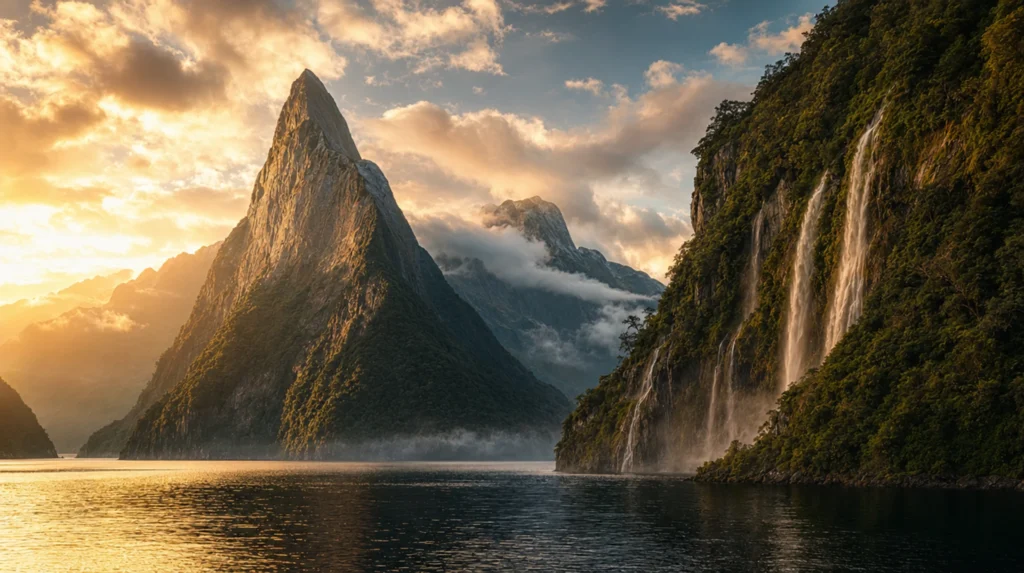
The bucket-list draws are familiar but deliver: Milford Sound’s 1,200-metre walls of black rock dropping into fjord water; the steaming silica terraces of Rotorua; bungee jumping from the bridge where the sport was commercialised in 1988; and the Great Walks — ten multi-day tracks curated by the Department of Conservation through landscapes that doubled for Middle-earth. Food is built around world-class lamb, Marlborough Sauvignon Blanc, green-lipped mussels and a flat white coffee culture invented in Wellington. Expect NZ$4.50 for a flat white, NZ$22 for a mince-and-cheese pie and a salad, and NZ$35 for fish and chips and a craft beer on the waterfront. The two islands — the subtropical North and the alpine South — are separated by the 22 km-wide Cook Strait, bridged by the Interislander ferry that is itself a bucket-list journey.

Matariki 2026 — Witness the Māori New Year
Matariki — the Māori name for the Pleiades star cluster — rises above the northeastern horizon in midwinter and signals the start of the traditional Māori new year. In 2022 Matariki became the first uniquely indigenous public holiday in New Zealand, and 2026 marks the fifth national observance. The official public holiday falls on Friday 10 July 2026, with iwi-led ceremonies running from dawn that day and cultural programming spread across the preceding week.
Matariki is observed nationally rather than at one location, which makes it an unusually accessible festival to weave into a July itinerary. Each region centres the holiday on local tikanga (custom), so programming varies, but dawn hautapu ceremonies and light installations are nearly universal. The three core values of the public holiday are remembrance (honouring those who have died since the last rising), celebrating the present, and looking to the future — a framing that shapes both state ceremonies and whānau (family) dinners across the country.
For first-time visitors the most approachable programming sits in Wellington and Rotorua, where ceremonies are preceded by explanatory talks in English. Evenings in most cities feature light trails and night-market kai stalls.
- Official public holiday: Friday 10 July 2026
- Peak cultural window: 4–12 July 2026 (nine days of events)
- Te Papa, Wellington: free Matariki exhibitions and nightly kapa haka performances
- Rotorua & Mokoia Island: Te Arawa dawn hautapu ceremony on Lake Rotorua
- Auckland Domain: Manu Aute Kite Day with hundreds of traditional kites flown at the museum
- Lake Taupō: large-scale Matariki light projection across the lake edge
- Hawke’s Bay: Matariki ki Te Matau-a-Māui region-wide programme

Best Time to Visit New Zealand (Season by Season)
New Zealand sits in the Southern Hemisphere, so seasons are reversed from North America and Europe. December through February is summer; June through August is winter. This seasonal flip is the single most important planning fact for northern-hemisphere travellers — a July trip is not a tropical beach holiday but a ski season, and Christmas is a beach-and-BBQ affair rather than a snowy one.
Spring (Sep–Nov)
Temperatures climb from around 10°C to 18°C and lambs fill the paddocks. Westland’s rivers run high with snowmelt — prime season for whitewater rafting on the Shotover and Kaituna rivers. Expect four-seasons-in-a-day weather, especially in the South Island alpine zone. Spring flower festivals run in Alexandra and Hastings, the Hawke’s Bay F.A.W.C! food and wine weekend lands in early November, and Queenstown holds its shoulder-season pricing until mid-November. Watch for sandflies once rivers warm up.
Summer (Dec–Feb)
Peak travel season with temperatures of 20–30°C and up to 15 hours of daylight in the far south. Great Walks are at their driest; the Abel Tasman Coast Track, Tongariro Northern Circuit and Routeburn are all at peak condition. Downsides: Great Walk huts book out the moment the season opens in May, accommodation prices rise 30–60% above winter rates, and Queenstown in January can feel like every town’s main street is a one-way queue. Book everything at least three months ahead.
Autumn (Mar–May)
The local secret. Temperatures ease to 10–20°C, Central Otago’s poplars and willows turn brilliant gold, and the Wanaka and Arrowtown Autumn Festivals (mid-April) celebrate the harvest. Wine country — Marlborough, Hawke’s Bay and Central Otago — runs vintage tours in March. Rainfall is lower than in spring or winter, and crowds thin markedly after the first week of March. Hiking on the Queen Charlotte and Heaphy tracks is often better than at Christmas.
Winter (Jun–Aug)
Cold and wet outside the mountains (2–12°C), but ski season at Coronet Peak, The Remarkables, Cardrona and Mount Ruapehu opens in mid-June. The Queenstown Winter Festival (late June) and Matariki (Māori New Year, July) are the cultural highlights. Milford Sound is at its most dramatic with waterfalls thundering after winter rain, and the Southern Lights (aurora australis) are occasionally visible from Stewart Island and the Catlins. Book a 4WD or chains-ready rental for alpine passes.
Shoulder-season tip: Mid-March to mid-April and late October offer the best balance of weather, price and availability — Great Walk huts have openings, rental cars drop to NZ$55–70 a day, and the low southern light is spectacular for photography.
Getting There — Flights & Arrival
New Zealand is one of the most geographically isolated countries on Earth, so arriving means a long-haul flight. Auckland handles around 75% of international arrivals and is the default landing point, though long-haul flights also serve Christchurch and Wellington.
- Auckland International (AKL) — largest airport; 45 min to CBD by SkyDrive bus (NZ$18) or 30 min by taxi (~NZ$75).
- Christchurch International (CHC) — South Island gateway; 25 min to city centre by Purple Line bus (NZ$8.50).
- Wellington International (WLG) — short coastal runway; 20 min to CBD by Airport Express (NZ$14).
- Queenstown (ZQN) — adventure hub; 15 min to town by Orbus route 1 (NZ$4).
Flight times: Los Angeles to Auckland 12h 30m non-stop; Sydney 3h 20m; London via Singapore or Dubai about 24h (no non-stop service in 2026).
Flag carriers: Air New Zealand and Jetstar operate domestically; Qantas, Singapore Airlines, United and Qatar fly key long-haul routes.
Visa / entry: Around 60 countries are eligible for the NZeTA, granting visits of up to 90 days. NZeTA costs NZ$17 via the official app. A separate NZ$100 International Visitor Conservation and Tourism Levy is collected at the same time.
Getting Around — Cars, Ferries & Scenic Trains
New Zealand has no national high-speed rail and limited intercity bus service, so the rental car or campervan is the default mode of transport. Drivers keep left, mountain roads are often single-lane with passing bays, and GPS routing consistently underestimates travel time on rural roads. Add roughly 25% to any mapped estimate. A standard Class 1 overseas licence is accepted for up to 12 months.
- State Highway network: 11,000 km of sealed road; open-road speed limit 100 km/h, urban 50 km/h.
- Auckland → Wellington: 8–9 hours / 640 km drive, or 1h flight
- Christchurch → Queenstown: 6 hours / 485 km drive via Lake Tekapo
- Wellington → Picton (Cook Strait): 3h 30m on the Interislander ferry, from NZ$64.
Scenic trains: the TranzAlpine (Christchurch–Greymouth, 4h 45m, from NZ$219) is regularly ranked one of the world’s great rail journeys. Other Great Journeys services include the Northern Explorer (Auckland–Wellington, 11h) and Coastal Pacific (Picton–Christchurch, 6h). Book seats on the open-air viewing carriage when available.
Bus pass: InterCity’s FlexiPass is the backpacker standard — NZ$129 buys 15 hours of travel credit valid 12 months. Routes cover every sizable town and include the Cook Strait ferry at pass rates.
Urban IC cards: AT HOP (Auckland), Snapper (Wellington) and Metrocard (Christchurch). None are interoperable, so buy a fresh card in each city or tap contactless bank cards where accepted. Kids under 5 ride free on all systems.
Apps: Google Maps for driving routes, CamperMate for free campsites and dump stations, Rome2Rio for multi-modal planning, and MetService for mountain-pass weather.
Top Cities & Regions
📍 Map of New Zealand: Every Place in This Guide


Auckland
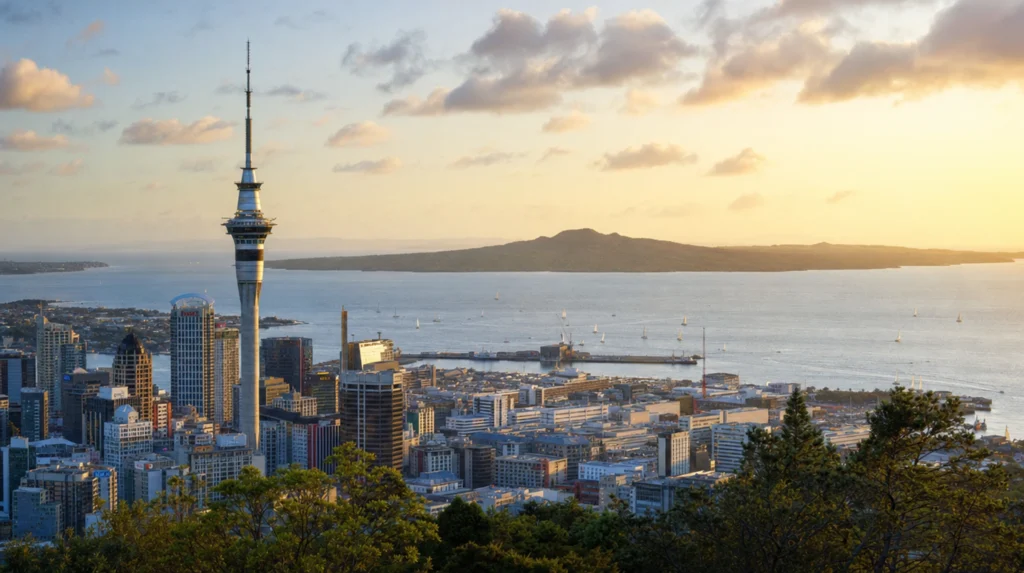
New Zealand’s largest city and the main international gateway, Auckland sprawls across an isthmus between two harbours and is built on 53 dormant volcanoes. Home to roughly a third of the country’s population, it is also the most Polynesian city in the world by absolute population. The city feels subtropical — swimmable beaches sit near the CBD, and the Hauraki Gulf is dotted with 50 islands accessible by ferry. The food scene leans heavily on Pacific and Asian influences, and the sailing culture earned it the nickname ‘City of Sails’.
- Sky Tower — 328 m observation deck with SkyJump and SkyWalk
- Waiheke Island — 40-minute ferry, 30+ boutique vineyards and beaches
- Mount Eden (Maungawhau) crater summit with 360° city views
Wellington
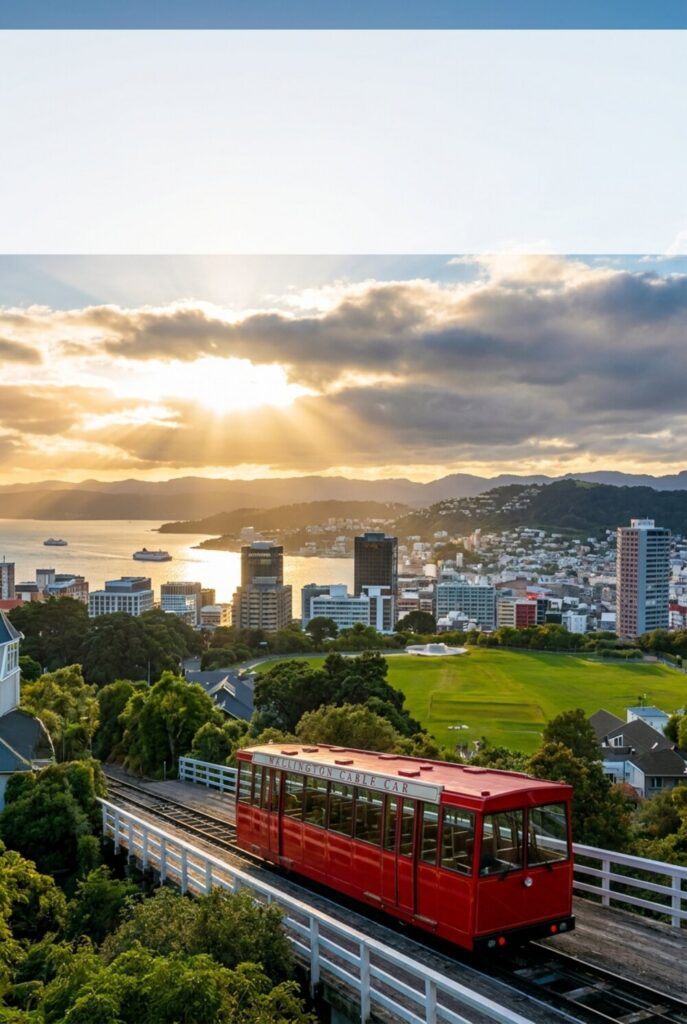
The compact, creative capital is the country’s political seat and film-production hub — ‘Wellywood’ is the nickname earned by Weta Workshop’s role in Lord of the Rings, Avatar and The Hobbit. Wellington packs more cafés per capita than New York City, hosts the WellyWOW and CubaDupa festivals, and is reliably windy enough to have earned its own nickname, ‘Windy Welly’. The whole downtown is walkable end-to-end.
- Te Papa Tongarewa — free national museum on the waterfront
- Mount Victoria Lookout (40 min walk from Courtenay Place)
- Cuba Street — coffee, street art and the iconic Bucket Fountain
Queenstown
The self-described adventure capital of the world sits on Lake Wakatipu beneath the Remarkables range. AJ Hackett commercialised bungee jumping here in 1988 at the Kawarau Bridge, and the town’s year-round menu of skiing, jet-boating, skydiving, via ferrata and canyon swings is unrivalled in the Southern Hemisphere. Central Otago pinot noir is the evening reward.
- Skyline Gondola & Luge above Bob’s Peak
- Kawarau Bridge Bungy — 43 m original commercial bungee site
- Shotover Jet — jet-boat runs through Shotover Canyon
Christchurch
The Garden City is the largest urban area on the South Island and the transport hub for Canterbury, the TranzAlpine and the journey south to Mount Cook and Queenstown. The city has been extensively rebuilt since the 2011 earthquake, and its central-city transitional architecture — including the Cardboard Cathedral by Shigeru Ban — is a draw in its own right. The Avon River still threads through the CBD with punting tours.
- Christchurch Botanic Gardens and Hagley Park
- Cardboard Cathedral designed by Shigeru Ban
- New Regent Street tram loop and the Re:START container mall history
Rotorua
Rotorua is the cultural heart of Te Arawa iwi and New Zealand’s most visited Māori destination. The town sits on an active geothermal field — the sulphur smell is free — and Te Puia’s Pōhutu Geyser erupts up to 20 times a day, shooting water up to 30 metres. Evening hāngī and concert performances at Mitai Māori Village and Tamaki Māori Village are the standard cultural-evening choices.
- Te Puia — Pōhutu Geyser, silica terraces and the National Carving School
- Whakarewarewa Living Māori Village with evening hāngī and concert
- Redwoods Treewalk — 700 m elevated walk through Californian redwoods
Fiordland & Milford Sound
Fiordland National Park covers 1.2 million hectares of the South Island’s southwest corner — a UNESCO World Heritage site since 1990 with 14 fjords carved by glaciers. Rainfall here exceeds 7,000 mm a year, which is what keeps the waterfalls pouring off Mitre Peak even in summer. Gateway town Te Anau is the base for Milford and Doubtful Sound day trips and all three Great Walks in the park.
- Milford Sound two-hour cruise beneath Mitre Peak (1,692 m)
- Doubtful Sound — quieter, deeper, overnight cruises from Manapōuri
- Milford Track — 53.5 km four-day Great Walk, booked in May for the following summer
Kiwi Culture & Etiquette — What to Know Before You Go
New Zealand culture blends laid-back Anglo-Kiwi informality with an increasingly visible Māori presence. Te reo Māori has been an official language since 1987, and visitors will encounter it on road signs, official correspondence, school names and daily greetings. Respect for the land — kaitiakitanga, or guardianship — is taken seriously and underpins the national Tiaki Promise that all visitors are encouraged to make on arrival. The country also has an egalitarian streak: prime ministers regularly do their own grocery shopping and expect to be addressed by first name.

The Essentials
- Greet with kia ora — it covers hello, thanks and good wishes, and is used daily by all New Zealanders, not only Māori speakers.
- Take your shoes off when entering a home or a wharenui (meeting house); it is also common at some yoga studios and independent cafés.
- Tipping is not customary. Hospitality staff earn at least the NZ$23.15/hour minimum wage and service charges do not appear on menus.
- Make the Tiaki Promise — a pledge to care for land, sea and culture that you can read in full at arrival.
- Arrive on time but dress down; business casual rarely requires a tie, and bare feet at the supermarket are unremarkable.
Marae Etiquette (Tikanga)
- Wait for the pōwhiri (welcome ceremony) before entering marae grounds; the karanga (call) and whaikōrero (speeches) may take 15–30 minutes.
- Remove shoes before stepping inside the wharenui (carved meeting house).
- Do not sit on tables or pass food over heads — kai (food) is noa and heads are tapu, and mixing the two breaches fundamental tikanga.
- Hongi — pressing noses once — is the traditional greeting. Match the host’s pace and hold briefly.
- Photography inside the wharenui generally requires explicit permission.
A Food Lover’s Guide to New Zealand
New Zealand cuisine is built on extraordinary raw materials — grass-fed lamb, cold-water seafood, pasture dairy and the new-world wines of Marlborough and Central Otago — served in a style that rarely takes itself seriously. The country invented the flat white (Wellington claims priority over Sydney) and still wraps its fish and chips in paper for eating on the beach. Expect to pay NZ$25–35 for a casual café meal, NZ$45–70 for a bistro dinner, and NZ$4.50 for a flat white. Modern Pacific and Māori-influenced fine dining is increasingly the signature experience at top addresses like Amisfield, Hiakai and Ahi.

Must-Try Dishes
| Dish | Description |
|---|---|
| Hāngī | Traditional Māori feast of lamb, chicken and kūmara slow-cooked over hot stones in an earth oven — best experienced at a Rotorua cultural village concert. |
| Pavlova | Crisp-shelled meringue dessert topped with whipped cream, kiwifruit and passionfruit — origin contested with Australia but the national dessert regardless. |
| Green-lipped mussels | Perna canaliculus native to the Marlborough Sounds; served steamed with white wine along Havelock’s wharves from NZ$18/kg. |
| Lamb roast | Sunday staple from NZ’s 23.6-million-strong sheep flock, served with kūmara, mint sauce and gravy. |
| Whitebait fritter | Tiny translucent inanga fry bound in egg batter and fried; a West Coast delicacy sold only August–November. |
| Hokey pokey ice cream | Vanilla ice cream studded with honeycomb toffee — the second best-selling flavour nationwide after plain vanilla. |
Dairies, Pie Carts & Fish-and-Chip Culture
The ‘dairy’ is the New Zealand corner shop — part convenience store, part ice-cream counter, part newsagent. Every small town has at least one, and they are where travellers grab a pie on the run. The mince-and-cheese pie is the national fast food (typical price NZ$5–7), usually eaten over the paper bag it came in. Fish-and-chip shops open around 5pm and still wrap orders in newsprint; grease spots are part of the experience. Four Square (the red-and-yellow rural grocer), Night ‘n Day and the larger Countdown/Woolworths chain cover almost every town with a population above 500 — useful for road-trip lunches and road-trip coffee.
- Chains: Four Square, Night ‘n Day, Countdown/Woolworths
- Signature items: mince-and-cheese pie, L&P (Lemon & Paeroa soft drink), Pineapple Lump candy, Whittaker’s chocolate, fish and chips wrapped in paper
- Classic café order: flat white + bacon-and-egg pie + hash brown (around NZ$20)
Wine country deserves its own day. Marlborough produces roughly 77% of the country’s wine by volume and is the global home of Sauvignon Blanc; Central Otago, near Queenstown, is the world’s southernmost commercial wine region and the source of New Zealand’s best Pinot Noir. Hawke’s Bay does the Bordeaux-style reds and syrah; Martinborough (an hour from Wellington) specialises in small-lot pinot. Both the famous regions and the smaller ones offer cellar-door tastings from NZ$10 per flight, usually refundable against a bottle purchase. Craft beer is equally strong — Wellington, Nelson and Christchurch have dense brewery-tap networks.
Off the Beaten Path — New Zealand Beyond the Guidebook

Coromandel Peninsula
Two hours east of Auckland, the Coromandel feels a generation older than the big city. Cathedral Cove is the iconic sea arch (reachable by a 45-minute walk since the 2023 landslide closed the short track); Hot Water Beach is the low-tide stretch of sand where visitors dig their own 60°C thermal spa pools with a rented shovel. The peninsula’s old-growth kauri forests around Coromandel Town and Port Jackson are best explored on the Coromandel Coastal Walkway, and the Driving Creek Railway is a quirky hand-built narrow gauge line.
Stewart Island / Rakiura
The third island — 30 km south of Bluff, home to 400 people and 85% national park. Rakiura is one of the few places on Earth where wild kiwi birds routinely appear on the beach at dusk, and its International Dark Sky Sanctuary status means the aurora australis is visible on clear winter nights. The Rakiura Track (three-day Great Walk) is the gentlest of the ten Great Walks, and the Ulva Island bird sanctuary is a predator-free ferry ride from Oban.
Aoraki / Mount Cook
New Zealand’s highest peak at 3,724 m sits inside a UNESCO-designated International Dark Sky Reserve. The Hooker Valley Track (three-hour return) ends at an iceberg-studded glacial lake and is wheelchair-accessible on gravel; the Tasman Glacier terminal-lake boat tour runs November–April. The village of 250 residents has one hotel, one hostel and the Sir Edmund Hillary Alpine Centre. The access road from Lake Pukaki is one of the most photographed stretches of bitumen in the country.
The Catlins
The remote southeast corner of the South Island — a 2–3 day coastal detour between Dunedin and Invercargill. Surat Bay hosts a resident sea-lion colony; Nugget Point lighthouse is the country’s most-photographed clifftop; Purakaunui Falls drops through silver beech forest in three neat tiers. Accommodation is limited to farm stays and the village of Owaka, which is exactly the point. Cathedral Caves are accessible only at low tide.
Waiheke Island
A 40-minute ferry from downtown Auckland delivers a different country — 30 boutique vineyards, olive groves and cliff-edge art walks. The Headland Sculpture Trail (summer only) threads outdoor sculpture across a two-kilometre coastal path; Mudbrick, Cable Bay and Te Motu are the destination wineries. Many Aucklanders commute from here by passenger ferry, but it still feels rural and olive-green.
Practical Information
The table below consolidates the quick answers travellers ask most often. Every row is sourced to either an official NZ government agency, an authoritative industry body, or a current exchange-rate feed. Read through it once during pre-trip planning and once again the week of travel — ATM and currency details in particular can shift.
| Currency | New Zealand dollar (NZ$); 1 USD ≈ NZ$1.67 (April 2026) |
| Cash needs | Card-first economy; contactless payWave accepted almost everywhere. Carry NZ$50 in small notes for rural petrol stations, DOC honesty boxes and farmers’ markets. |
| ATMs | Kiwibank, ANZ, ASB and BNZ ATMs are in every town. Foreign cards typically pay NZ$5–8 per withdrawal plus home-bank FX. |
| Tipping | Not customary. No service charge on restaurant bills; round up for exceptional service only. |
| Language | English (95.4%) and te reo Māori (4.0%) are official; NZ Sign Language is the third official language. |
| Safety | Global Peace Index rank #4 (2024). Main hazards are weather and unfamiliar mountain driving, not crime. |
| Connectivity | 4G/5G covers all major towns. Travel SIMs NZ$49 for 30 days / 15 GB; eSIMs from Airalo start at USD$6.50 for 1 GB. |
| Power | Type I plugs, 230V / 50Hz; the same as Australia. |
| Tap water | Safe to drink nationwide; bring a refillable bottle to cut plastic. |
| Healthcare | ACC covers accident-related treatment for all visitors; travel insurance still essential for illness. Pharmacies marked with a green cross; public hospital EDs are free for accident cases. |
Budget Breakdown — What New Zealand Actually Costs
💚 Budget Traveller
Roughly USD $70–100 (NZ$120–170) a day keeps a backpacker on the road comfortably. Hostel dorm beds run NZ$40–55 in Auckland and Queenstown; prices drop meaningfully in smaller towns like Nelson, Napier and Dunedin. Most backpackers rely on supermarket-based self-catering from Countdown or Pak’nSave (NZ$20–30/day in groceries), supplemented by a NZ$7 bakery pie for lunch and a flat white out. Intercity travel is via InterCity’s FlexiPass (15 hours for NZ$129). Free DOC campsites and conservation huts cut sleep costs to zero with a tent.
💙 Mid-Range
Mid-range couples plan on USD $180–300 (NZ$300–500) a day. That covers a 3★ hotel or motel (NZ$180–260), café and pub meals (NZ$25–40 per main), and a shared rental car at NZ$60–90/day plus fuel. Fuel is the recurring surprise — petrol was NZ$2.80–3.10/litre in early 2026, which pushes a long drive from Auckland to Queenstown to around NZ$400 in fuel alone. Paid activities (jet boat, gondola, wine tour) add NZ$80–180 per person per day.
💜 Luxury
From USD $450 (NZ$750) upward, with no real upper limit. Lodge properties like Huka Lodge, Blanket Bay and Helena Bay start at NZ$1,800–2,800 per couple per night including dinner. A chartered scenic flight over Milford Sound runs NZ$500–700; heli-skiing above Wānaka costs NZ$1,350 per day for four runs. Fine dining at Amisfield, Rātā or The Grove sits around NZ$140 per person for the tasting menu before matched wines.
| Tier | Daily (USD) | Accommodation | Food | Transport |
|---|---|---|---|---|
| Budget | $70–100 | Hostel dorm NZ$40–55 | Supermarket + pie NZ$25/day | InterCity FlexiPass NZ$129 |
| Mid-Range | $180–300 | 3★ hotel NZ$180–260 | Café meals NZ$25–40 | Rental NZ$60–90/day |
| Luxury | $450+ | Lodge NZ$600–2,800 | Fine dining NZ$140+ | Private transfer or helicopter |
Planning Your First Trip to New Zealand
First trips to New Zealand stumble in predictable ways — visitors underestimate drive times, leave Great Walk huts unbooked, or miss the fact that the ferry crossing itself is a highlight. Work through the five steps below in order and the rest of the planning sorts itself out.
- Apply for the NZeTA online at least 72 hours before departure — NZ$17 via the official NZ Immigration app, which also collects the NZ$100 International Visitor Conservation and Tourism Levy.
- Choose North, South or both. Two weeks comfortably covers one island plus a sampler of the other via the Interislander ferry (3h 30m) or a 1h 55m internal flight.
- Book rental cars and campervans 3+ months ahead for December–February travel. One-way drop-off fees apply for cross-island hires and can reach NZ$250.
- Reserve Great Walk huts the moment DOC bookings open (early May for the following summer season). Milford, Routeburn and Kepler regularly sell out within hours of opening.
- Pack layers and waterproofs. Alpine weather can shift 15°C in an hour even at the height of summer; travellers underestimate how wet the South Island west coast is.
Classic 14-Day Itinerary: 3 days Auckland & Bay of Islands → 2 days Rotorua → 2 days Wellington + ferry → 2 days Abel Tasman/Nelson → 3 days Queenstown/Wānaka → 1 day Milford Sound → 1 day Christchurch departure.
Frequently Asked Questions
Is New Zealand expensive to visit?
Yes — New Zealand sits among the pricier OECD destinations, largely because of its isolation and small domestic market. Budget travellers can manage at roughly NZ$150 a day with hostels and supermarket meals; mid-range trips run NZ$300–500 a day. The biggest cost shocks for North American visitors are rental-car fuel, restaurant meals and domestic flights. Booking accommodation and rental vehicles three months ahead is the single biggest money-saver for summer.
Do I need to speak Māori?
No — English is the everyday language and understood universally. Learning a few te reo Māori greetings is appreciated: kia ora (hello/thanks), tēnā koe (formal greeting), ka kite (see you later) and ngā mihi (thanks/regards). Bilingual signage appears in government buildings, museums and national parks.
Is the InterCity FlexiPass worth it?
For solo travellers without a driver’s licence, yes. A 15-hour FlexiPass covers most Auckland-to-Wellington combinations and unlocks the ferry-and-bus network. Travellers with any interest in off-the-main-road places (Catlins, West Coast, Coromandel) will find the bus network too restrictive — a rental car or campervan is the better tool, even for a solo trip.
Is New Zealand safe for solo travellers?
Extremely. The country ranks in the top five on the Global Peace Index and violent crime against tourists is near zero. The genuine risks are environmental: alpine weather, river crossings on the Great Walks, and driving on unfamiliar mountain roads. Always file an intentions card with the Department of Conservation for multi-day hikes and rent a personal locator beacon for back-country trips.
When is the best time to visit?
Mid-February to early April balances warm stable weather, thinning crowds and autumn colour in Central Otago. December–January is peak summer but peak price too. June–September is winter and ski season in Queenstown and Wānaka. Remember the Southern Hemisphere flip: a ‘summer holiday’ in the NZ sense means Christmas.
Can I get by as a vegetarian or vegan?
Yes. Auckland, Wellington and Queenstown all have dedicated vegan cafés; supermarket chains Countdown and New World carry extensive plant-based sections. Rural pub menus remain meat-heavy but a veggie burger or hot chips are universally available. Hāngī and lamb, obviously, are not vegetarian options.
Do I need an NZeTA?
Most Western travellers do. The NZeTA costs NZ$17 via the official app, is valid two years for multiple visits of up to 90 days, and is collected alongside the NZ$100 International Visitor Conservation and Tourism Levy. Apply three days before travel.
Ready to Explore New Zealand?
From Matariki ceremonies to Milford Sound cruises, New Zealand rewards travellers who plan ahead and travel slowly. Start with one island, leave room for weather delays, and build your itinerary around the Great Walks and ferry crossing.
Explore More
Cities we cover in New Zealand
Cities to explore in New Zealand
Deep-dive guides to specific cities, neighbourhoods, and food scenes — written with the same magazine voice.
More country guides you might like
Plan your trip to New Zealand
The booking tools we use ourselves. FFU may earn a commission at no extra cost to you.
Plan & book your trip to New Zealand
Booking through these searches supports our guides at no extra cost to you.