
☰ On this page
- 📋 In This Guide
- Overview — Why Saudi Arabia Belongs on Every Bucket List
- 🇸🇦 The Opening Up — What Vision 2030 Means for Visitors
- Best Time to Visit Saudi Arabia (Season by Season)
- Getting There — Flights & Arrival
- Getting Around — Domestic Flights, the Haramain & Rental Cars
- Top Regions & Cities
- 🗓️ Sample Itineraries
- Saudi Culture & Etiquette
- A Food Lover’s Guide to Saudi Arabia
- 📸 Photography Notes
- Off the Beaten Path — Beyond AlUla
- Practical Information
- Budget Breakdown — What Saudi Arabia Actually Costs
- ✅ Pre-Trip Checklist
- 🤔 What Surprises First-Timers
- Frequently Asked Questions
- Ready to Explore Saudi Arabia?
- Explore More
Languages of Saudi Arabia
All languages of Western Asia →fluent beta classical · classes by phone with Maya at ranas.ai/maya
Saudi Arabia is the only country in the world where you can dive among 200 unmapped Red Sea reefs in the morning, walk past 2,000-year-old Nabataean tombs hewn from sandstone after lunch, and have dinner in a futuristic neon-lit Riyadh restaurant the same evening. It is the largest country in the Middle East — 2.15 million square kilometres, roughly a third the size of the lower 48 US states — and contains the Arabian Peninsula’s most varied landscapes: the Red Sea coast and its 1,800-kilometre coral barrier, the volcanic harrats of the western highlands, the Asir mountains rising to 3,000 metres in the southwest, the Empty Quarter in the south, the date oases of the central Najd plateau, and the rolling sand seas of the Nafud desert in the north. About 95% of the country is desert by some classification.
What makes Saudi Arabia different right now is timing. The country was effectively closed to leisure tourism until September 2019, when it launched a tourist e-visa programme accessible to passport holders from 49 countries. Vision 2030 — the national plan announced by Crown Prince Mohammed bin Salman in 2016 — set tourism diversification as a pillar of the post-oil economy, and the resulting investments have transformed access in five years. AlUla and Hegra (the country’s first UNESCO site, inscribed 2008) opened to scheduled flights from Riyadh in 2020. The Red Sea Project’s first three resorts came online in 2023. Diriyah, the founding capital of the Saudi state on the western edge of Riyadh, opened to public visitors in 2022 after extensive restoration. The country is in active flux; visiting now is a meaningfully different experience than it was even three years ago.
This guide covers Saudi Arabia end to end — from the AlUla tombs to the Asir highlands, with a clear-eyed look at the rules and the recent reforms. If you’re combining the country with neighbouring destinations, see our Jordan travel guide for the natural Petra-to-Hegra Nabataean continuation and our UAE travel guide for the Gulf complement. For the linked Petra coverage, our Petra city guide picks up the cross-border story.
Basing yourself in the capital? Our Riyadh city guide covers the fast-changing Saudi capital in depth.
📋 In This Guide
- Overview — Why Saudi Arabia Belongs on Every Bucket List
- 🇸🇦 The Opening Up — What Vision 2030 Means for Visitors
- Best Time to Visit Saudi Arabia (Season by Season)
- Getting There — Flights & Arrival
- Getting Around — Domestic Flights, the Haramain & Rental Cars
- Top Regions & Cities
- 🗓️ Sample Itineraries — 5, 7, 10 and 14 Days
- Saudi Culture & Etiquette
- A Food Lover’s Guide to Saudi Arabia
- 📸 Photography Notes
- Off the Beaten Path — Beyond AlUla
- Practical Information
- Budget Breakdown — What Saudi Arabia Actually Costs
- ✅ Pre-Trip Checklist
- 🤔 What Surprises First-Timers
- Frequently Asked Questions
- Ready to Explore Saudi Arabia?
Overview — Why Saudi Arabia Belongs on Every Bucket List
Saudi Arabia occupies most of the Arabian Peninsula — a landmass that has been continuously inhabited since the late Pleistocene and that gave the world the Arabic language, Islam, and the cultural foundation of much of the modern Middle East. The country was unified in stages between 1902 and 1932 by Abdulaziz Ibn Saud, who consolidated the Najd, the Hejaz (the western coastal region containing Mecca and Medina), and the eastern Al-Hasa oases into a single kingdom. Oil was discovered at Dammam in 1938; the resulting wealth funded a 80-year transformation that has urbanised what was, at independence, predominantly a tribal-pastoralist society. The country today has a population of about 36 million, of whom roughly 38% are foreign workers (mostly South Asian and Egyptian) drawn by the oil and construction economies.
For most of its modern history, Saudi Arabia was effectively closed to non-religious foreign visitors. Pilgrims travelled to Mecca and Medina under the Hajj and Umrah systems; business visitors required sponsored work-visas; tourists, in any meaningful sense, did not exist. The September 2019 launch of the e-visa programme, alongside parallel Vision 2030 reforms — women allowed to drive (June 2018), public entertainment legalised (2017), the morality police’s powers curtailed (2016), public concerts and festivals normalised (2018 onward) — has fundamentally reshaped the visitor experience. The country welcomed 27 million international visitors in 2023 (most still pilgrims, but a rapidly growing leisure share), and the Vision 2030 target is 150 million annual visits by 2030.
For a traveller, the practical consequence is unusual breadth at low traveller density. The headline natural and cultural sites — AlUla and Hegra in the northwest, Riyadh’s Diriyah district, the Asir mountains, the Red Sea coast — are still under-visited by global standards. Many of the country’s archaeological treasures are barely fenced, and tour-operator infrastructure is rapidly developing rather than fully mature. The result is a country where you can stand alone at a 2,000-year-old tomb in early morning light, with no other visitor in sight, in a way that no longer happens at Petra or the Pyramids of Giza. That window is closing — visitor numbers are doubling year-on-year — but for now it remains genuinely open.
🏛️ Historical Context
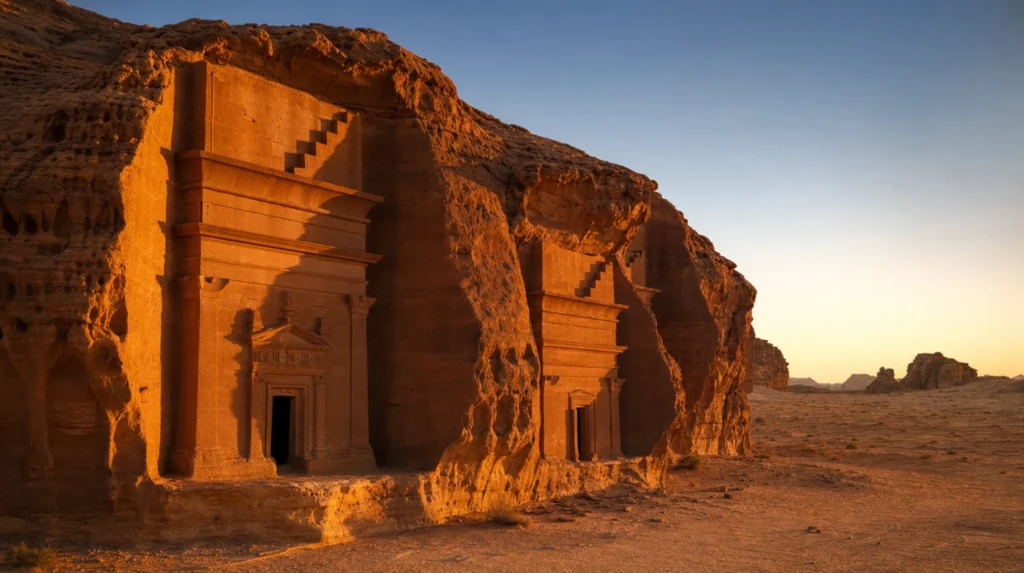
Hegra (Mada’in Salih), in the AlUla region, was the southern capital of the Nabataean kingdom — the same Arab civilisation that built Petra in modern Jordan. Active from roughly the 4th century BCE through the early 1st century CE, Hegra was a major caravan-trade stop on the incense routes between southern Arabia and the Mediterranean. The city declined after Roman annexation in 106 CE and was abandoned by the 4th century. Hegra contains 111 tombs hewn into sandstone outcrops, with elaborately carved facades echoing those at Petra, plus inscriptions in Nabataean Aramaic, Arabic, Greek and Latin. The site was off-limits to non-Muslim visitors until 2019 because of an Islamic tradition associating the Thamud people with divine punishment in this region. The opening of Hegra to tourists is one of the single most significant cultural-access shifts of the past decade.
🎌 Did You Know?
About 70% of the Saudi population is under 35 years old, and the country has one of the youngest demographic profiles of any major economy. The under-30 generation has grown up alongside the Vision 2030 reforms — they are the most digitally engaged in the Middle East (94% smartphone penetration, the highest YouTube viewership per capita on Earth) and form the backbone of the new domestic-tourism market. Riyadh Season — the four-month winter entertainment festival running roughly October through February in 2025–26 — sells most of its 60-million tickets to Saudi residents under 30. The traveller-perception of Saudi Arabia as conservative is increasingly out of step with the lived experience in the major cities.
🇸🇦 The Opening Up — What Vision 2030 Means for Visitors
Visiting Saudi Arabia in 2026 is a meaningfully different experience than visiting in 2019, and most older guidebooks describe rules that no longer apply. The most relevant changes for a traveller include: women travel solo without a male guardian (the male-guardianship system was substantially rolled back in 2019); women drive (since June 2018); women are not required to wear an abaya in public, although modest dress is still expected; restaurants no longer have separate “family” and “single men” sections (though some traditional venues retain them by choice); cinema, public concerts and live entertainment are legal and widely operating (Riyadh now has a Boulevard World district hosting major international acts); and unmarried foreign couples can share hotel rooms (a long-standing point of confusion that was officially clarified in October 2019).
What has not changed: alcohol remains illegal countrywide, with no exceptions for hotels or restaurants (Saudi Arabia is one of about a dozen alcohol-prohibition countries in the world, alongside Iran, Kuwait, Libya, Yemen and several others). Public displays of affection are restricted; holding hands is generally fine for married couples, beyond that draws attention. Drug penalties are extremely severe — including capital punishment for trafficking, and prison for any possession. The non-Muslim restriction on Mecca and Medina remains absolute — non-Muslims may not enter the cities; this is enforced at military checkpoints on the approach roads. Modesty norms still apply in dress, especially outside the major cities — women generally wear long sleeves and trousers/skirts, men long trousers and shirts.
The pace of change is uneven by region. Riyadh and the Eastern Province (Khobar, Dammam) feel substantially more cosmopolitan than the Najd interior or the Asir mountains. Jeddah’s older Al-Balad district is conservative-traditional in dress; the Red Sea coast resort areas operate in a notably more international register. AlUla, designed as a flagship cultural-tourism destination, runs an open dress-and-conduct policy within the resort and visitor zones. Travellers should plan dress and behaviour to match the most conservative location they’ll visit on a given day.
⚠️ Important — Mecca & Medina Access
The cities of Mecca and Medina are restricted to Muslims only. This is enforced at fixed military checkpoints on every approach road, and drivers carrying non-Muslim passengers will be turned around. The restrictions extend to the entire city of Mecca and the central area of Medina (the area known as the Haram boundary, which includes the airport and central Medina; the outer city has limited non-Muslim access). For non-Muslim travellers, Jeddah is the closest base to the western coast and is fully open to all visitors. If you intend to perform Hajj or Umrah, separate visa types and procedures apply via the Nusuk platform — these are not the same as the e-visa, and pilgrims should plan via licensed agencies. Do not attempt to enter the holy cities without the appropriate visa class; consequences include detention and deportation.
Best Time to Visit Saudi Arabia (Season by Season)
Saudi Arabia has two functional seasons — pleasant and hostile — and the dividing line is unusually sharp. Most of the country sits at 17°N to 32°N latitude with a continental desert climate, and the summer months from May through September are genuinely brutal across the interior and the eastern coast. The south-western Asir mountains buck this pattern with monsoon-influenced summer rainfall and significantly cooler temperatures.
High Season (October – April)
The window everyone targets. Daytime temperatures in Riyadh and the central plateau sit 20–30°C; AlUla runs a few degrees cooler thanks to elevation; the Red Sea coast at Jeddah and the Red Sea Project runs 24–32°C. Evenings are cool — desert nights in AlUla and the Empty Quarter can drop to 8–12°C in January, prompting mandatory layered clothing for any overnight desert experience. The Riyadh Season festival (October to February) and AlUla’s Winter at Tantora (December to February) are scheduled within this window. Hotel rates run 30–80% above the summer floor; the Saudi National Day (September 23) and the December–February peak are the most expensive periods.
Shoulder Spring (March – April)
The narrow window when temperatures climb but remain manageable. Riyadh runs 26–34°C, AlUla 22–30°C, the Asir mountains a perfect 18–25°C. Spring brings the country’s only significant wildflower bloom in the Asir highlands — the rose harvest at Taif (February to early April) is one of the country’s seasonal cultural events, with the world’s only commercial rose-water and rose-oil production in the region. Hotel rates drop 20–30% off the December peak; this is the savvy traveller’s window.
Brutal Summer (May – September)
Daytime temperatures across the interior regularly exceed 45°C, with peaks above 50°C recorded in Riyadh and the Eastern Province most years. Coastal humidity adds heat-index overshoot of another 10°C. Outdoor activity beyond pool-and-air-conditioning becomes genuinely difficult during the hottest hours. The Asir mountains in the southwest are the exception — Abha, Habala, and the Soudah peak run 20–28°C through the summer with monsoon-influenced afternoon thunderstorms. Most international visitors to Saudi Arabia in summer are pilgrims (Hajj is on the lunar Islamic calendar and rotates through the year; Hajj 2026 falls in late May). Hotel rates drop 40–60% off peak; the exception is the immediate Hajj period in Mecca and Medina, where rates spike on the religious-tourism market.
Shoulder Autumn (October)
Temperatures drop sharply through the month — early October still runs 35°C in Riyadh, late October about 25°C. The Riyadh Season festival launches mid-October and runs through February. This is the start of the country’s outdoor-event calendar, and the rapid cooling makes for genuinely pleasant evenings. Hotel rates remain 20–25% below December peak through most of October.
🧳 Travel Guru Tip
If you only have one trip to Saudi Arabia and want the best balance of weather, events and crowds, target mid-November to mid-December. Riyadh Season is in full swing, AlUla’s Winter at Tantora cultural festival has launched, the desert nights are cool but not yet cold, the Red Sea diving conditions are at their best, and hotel rates haven’t yet hit the New Year’s peak. Avoid the immediate Saudi National Day (September 23) and the actual Hajj period (lunar calendar — check the year). January–February is colder than expected in the desert; pack a fleece for AlUla nights.
| Experience | Best months | Best regions | Notes |
|---|---|---|---|
| AlUla & Hegra | Nov – Mar | Madinah Province, AlUla county | Daytime 18–25°C; nights 8–12°C |
| Red Sea diving | Mar – May; Sep – Nov | Yanbu, Jeddah, Al Wajh, Farasan | Visibility 25–40 m; reefs largely unmapped |
| Riyadh urban | Oct – Apr | Riyadh, Diriyah | Riyadh Season Oct – Feb |
| Asir mountains | Year-round (best Apr – Oct) | Abha, Habala, Soudah | Cool summer alternative; monsoon rains |
| Empty Quarter (Rub’ al Khali) | Nov – Feb | Eastern Province, Najran | Specialist tour operators only |
| Taif rose harvest | Feb – early Apr | Taif, Al-Shafa | World’s only commercial rose oil |
Getting There — Flights & Arrival
Saudi Arabia has three primary international airports and a growing list of regional ones. King Abdulaziz International (JED) in Jeddah is the country’s busiest by passenger volume — the gateway for Mecca pilgrims and the western coast. King Khalid International (RUH) in Riyadh is the capital airport and the most relevant for leisure visitors entering for AlUla, Diriyah, and the central plateau. King Fahd International (DMM) in Dammam serves the Eastern Province (Khobar, Bahrain bridge access). AlUla’s regional airport (ULH) opened to scheduled flights in 2020 and now receives direct services from Riyadh, Jeddah, Doha and (seasonally) Paris.
From Europe, expect 5h45m direct from London to Riyadh on Saudia or BA, 5h30m from Paris CDG, 5h15m from Frankfurt, 4h45m from Rome, 3h30m from Athens. From North America, all routings connect — expect 16–22 hours total via London, Paris, Frankfurt or Doha from the US east coast. From the Gulf, 90 minutes from Dubai, 80 minutes from Doha, 2 hours from Kuwait. Round-trip fares from London or New York to Riyadh in shoulder season typically land between £550–900 / $850–1,500 if booked 6–12 weeks ahead.
The Saudi e-visa launched in September 2019 covers leisure tourism for citizens of 49 nationalities (including the US, UK, EU, Canada, Australia, NZ, Japan, Korea, China, and most Latin American countries). Apply at visa.visitsaudi.com — single-entry one-year visa SAR 535 (about USD 142), multi-entry one-year visa SAR 535. Processing is typically same-day to 24 hours. Visa-on-arrival is also available at the major airports for the same nationalities; the e-visa is recommended for faster processing. Indian, Pakistani, Bangladeshi and several African passports require sponsored or pilgrimage-class visas.
✨ Pro Tip
If you’re combining Saudi Arabia with Jordan to follow the Nabataean trail (Petra → Hegra), the cleanest routing is fly into Amman, road or fly to Petra, then fly Amman or Aqaba to AlUla via Riyadh (3 hours total with one stop). The Jordan-Saudi land border at Al-Haditha is open to drivers but not commonly used by tourists; flights are simpler. Saudi Arabia recently launched its first direct AlUla–Paris route on Saudia/Air France for the 2025 winter season — check whether direct routes apply for your year. Also: Saudi e-visa holders are allowed transit through the country to Bahrain via the King Fahd Causeway, useful if combining a quick Bahrain or Eastern Province visit.
Getting Around — Domestic Flights, the Haramain & Rental Cars
Saudi Arabia is a big country and the distances between headline destinations are substantial — Riyadh to AlUla is 1,100 km, Jeddah to Riyadh is 950 km, Riyadh to the Empty Quarter is 1,300 km. Most travellers combine domestic flights with rental cars or private drivers within each region.
Saudia (the national carrier) and Flynas (the budget option) operate dense domestic networks linking Riyadh, Jeddah, Dammam, AlUla, Tabuk, Abha, Taif, Yanbu and Najran. Typical Riyadh–AlUla fares run SAR 400–700 one-way; Jeddah–AlUla SAR 450–800. Book 4–6 weeks ahead for the lowest fares. The 2-hour Riyadh–AlUla flight is the country’s single most useful domestic route for leisure visitors.
The Haramain High Speed Railway connects Mecca, Jeddah, KAEC (King Abdullah Economic City) and Medina — the country’s first high-speed line, operational since 2018, running at 300 km/h. The Jeddah-to-Medina journey takes 2 hours 20 minutes (vs 4 hours by road); economy fare SAR 75. Note: the railway operates within the Hejaz, and access to Mecca and Medina stations is restricted to Muslims; non-Muslims can use Jeddah and KAEC stations only.
Rental cars are widely available — Hertz, Avis, Sixt and reputable local operators (Theeb Rent A Car is the largest domestic chain) operate from every major airport. A compact petrol car runs SAR 120–200 per day; SUVs (necessary for desert tracks) SAR 300–500. Fuel is cheap (SAR 2.33 per litre as of early 2026, roughly $2.40 per US gallon). The country’s road network is excellent — multi-lane highways connect all major cities, and rest-stop infrastructure has been substantially upgraded since 2018. Foreign drivers can use their home licence for up to 3 months; an International Driving Permit is recommended.
Within Riyadh, the new Riyadh Metro launched its first lines in late 2024 — six lines, 176 km of track, the largest metropolitan rail network built from scratch in the past decade. Lines 1, 2 and 5 are operational at time of writing; the full network completes through 2026. Within Jeddah, Uber and Careem are the practical urban options. Within AlUla, the Sharaan Visitor Centre and the Old Town are accessible by free shuttles; private taxis from the airport to the resorts are arranged.
⚠️ Important — Driving Conduct
Saudi Arabia’s road safety record has historically been among the worst in the developed world, although it has improved substantially since 2017 with the introduction of camera enforcement (the SAHER system) and stricter licensing rules. Drink-driving carries severe penalties including imprisonment. Speed limits are strictly enforced — cameras every 5–10 km on highways. Follow GPS routings carefully — some old paper maps show roads through restricted military zones or holy-city perimeters. Avoid driving at night across long desert sections in the Empty Quarter or northern Hijaz; sandstorms and stray camels are real hazards. The kingdom’s roadside-assistance number is 993; for emergencies dial 911 (yes, the same number).
Top Regions & Cities
📍 Map of Saudi Arabia: Every Place in This Guide
Saudi Arabia divides into broad cultural-geographic regions: the Najd (central plateau, Riyadh, Diriyah), the Hejaz (western coast, Jeddah, Mecca, Medina, Taif), AlUla and the northwest, the Eastern Province (Khobar, Dammam, Hofuf), the Asir highlands (southwest), and the southern Empty Quarter and Najran. For most leisure visitors, the practical itinerary spans Riyadh, AlUla, Jeddah, and one or two of the smaller regions.
🏙️ Riyadh — The Capital & Diriyah
The country’s capital and largest city, with about 7 million residents on the Najd plateau at 600 metres of elevation. Riyadh has transformed visibly since 2017 — new restaurants, a metro under construction, the Boulevard World entertainment district, the King Abdullah Financial District (KAFD) towers, and the post-Vision 2030 push toward becoming a regional cultural and business hub. The headline visitor sites cluster in three areas: the modern downtown around the Kingdom Centre and the Faisaliah Tower, the historic Diriyah district on the western edge of the city, and the Riyadh Front and Boulevard World entertainment zones in the north.
Diriyah, the original capital of the first Saudi state founded in 1727, is the country’s most significant cultural-historical project. The At-Turaif district (UNESCO-listed since 2010) contains 18th-century mud-brick palaces, the Salwa Palace ruins, and the al-Bujairi mosque, all extensively restored and now open to visitors with an evening lighting that has become a Riyadh-must. Boulevard World, the entertainment district, hosts replicas of seven world cities (Tokyo, Marrakech, Mexico City, Mumbai, Paris, Cancun and Rio) plus a roller-coaster, virtual-reality experiences, and 250+ restaurants. Tickets SAR 95 weekday, SAR 145 weekend. Riyadh Season runs October to February with concerts, festivals, and a Formula 1-week-equivalent buzz across the city.
The Edge of the World (Jebel Fihrayn) is a 90-minute drive from Riyadh — a 300-metre escarpment dropping abruptly into a flat desert plain, with one of the most dramatic geological viewpoints in the country. 4WD required for the last 20 km of dirt track; sunrise visit recommended. Multiple tour operators in Riyadh run guided day trips for SAR 350–550 per person.
- What to do: Diriyah evening tour with At-Turaif lighting (book ahead via diriyah.sa); Kingdom Centre Sky Bridge observation deck (302 m, SAR 130); Boulevard World evening; National Museum at the King Abdulaziz Historical Centre; Edge of the World day-trip.
- Signature experiences: A Riyadh Season concert (the calendar shifts each year — major international acts now book the city); dinner at Najd Village restaurant for traditional Najdi cuisine.
- Access: RUH airport 35 km north of downtown; Riyadh Metro lines 1 and 2 connect downtown and KAFD; Uber/Careem for general transit.
🪨 AlUla & Hegra — The Nabataean Heart
The country’s flagship cultural-tourism destination, in the northwest desert about 1,100 km from Riyadh and 350 km north of Medina. AlUla is a 22,500 km² county containing four major archaeological sites — Hegra (UNESCO-listed), Dadan (the capital of the Lihyanite kingdom), Jabal Ikmah (the open-air library of pre-Islamic inscriptions), and AlUla Old Town (a 12th-century Islamic settlement). The landscape itself is the country’s most photogenic — towering red sandstone mountains carved by wind into elephant arches, hidden canyons, and the iconic 50-metre Elephant Rock that has become AlUla’s signature image.
Hegra contains 111 monumental tombs hewn into sandstone outcrops, with Nabataean-style facades closely echoing Petra. The site is reached via guided tour only — book through experiencealula.com — at SAR 95 per person for a 3-hour tour. The most photographed individual tomb is Qasr al-Farid (“the lonely castle”), a single magnificent unfinished tomb sitting in isolation in a wide desert plain. Dadan and Jabal Ikmah are reached on the same multi-site tour. The Sharaan Nature Reserve, on the AlUla county’s western edge, is being developed as a luxury-conservation destination with the Banyan Tree AlUla and the upcoming Sharaan resort designed by Jean Nouvel inside a sandstone cliff.
AlUla’s Old Town, a 12th-century mud-brick settlement that was inhabited until the 1980s, has been extensively restored and reopened in 2022 with cafés, artisan shops and the Madrasat Addeera school for traditional crafts. Maraya, the world’s largest mirrored building (a 9,740 m² mirrored concert hall in the Ashar Valley), is the country’s emblem of the new AlUla aesthetic — book a tour or attend a Winter at Tantora festival concert (December–February) for the full experience.
- What to do: Hegra guided tour at sunrise; Dadan and Jabal Ikmah inscription tour; Old Town walk; hot-air balloon over the Ashar Valley (SAR 1,200 per person); helicopter tour of Sharaan and Hegra (SAR 2,500 for 30 minutes).
- Signature experiences: Sunrise at Elephant Rock; a sundowner at the Maraya mirrored hall; overnight at Habitas AlUla or Banyan Tree AlUla in the Ashar Valley.
- Access: Direct flights from Riyadh (75 min) and Jeddah (90 min) to ULH airport; private transfer to AlUla town 35 km / 35 min; rental car or guided tour for site access.
🌊 Jeddah & the Red Sea Coast
The country’s commercial gateway and second-largest city, with about 5 million residents on the Red Sea. Jeddah is the historical entry point for Mecca pilgrims and has consequently been a cosmopolitan trading port for 1,500 years. The Al-Balad historic district (UNESCO-listed since 2014) contains the country’s best surviving Hejazi-style coral-stone architecture — multi-storey houses with carved wooden lattice screens (rawashin), narrow alleys, and the Naseef House (the 1881 home where King Abdulaziz stayed during his 1925 capture of Jeddah). The district is best walked at evening; the Jeddah Season summer festival (mid-June to August) lights up the alleys with music and food markets.
The 30-kilometre Jeddah Corniche is the city’s social spine — a beachfront promenade with parks, art installations, the King Fahd Fountain (the world’s tallest at 312 metres), and a string of waterfront restaurants. The new North Corniche extension and the Red Sea Mall area host the city’s most contemporary dining and shopping. The city’s modesty norms remain notably more conservative than Riyadh’s; women are not legally required to wear an abaya, but visible modesty is expected, particularly in Al-Balad.
The Red Sea coast north of Jeddah — the Red Sea Project area, around the Al-Wajh and Yanbu coastlines — is the country’s flagship tourism investment. The first three Red Sea Global resorts (St Regis Red Sea, Six Senses Southern Dunes, Nujuma a Ritz-Carlton Reserve) opened through 2023 and 2024. The 90-island archipelago has been ecologically surveyed and zoned to limit development to 22 of the 90 islands; the rest remain protected. Diving here is the country’s hidden treasure — 200+ unmapped reefs, visibility routinely 30+ metres, and a complete absence of the dive-tourism crowding of the Egyptian Red Sea coast. Most diving is run from liveaboard boats out of Yanbu and Al-Wajh; expect SAR 8,000–18,000 per person for a 5–7 day liveaboard.
- What to do: Al-Balad walking tour at evening; King Fahd Fountain at sunset; Jeddah Tower viewing (the unfinished 1,000-metre+ tower under construction); Red Sea diving liveaboard from Yanbu; day-trip to Taif and the rose farms (March–April).
- Signature experiences: A traditional dahab (sailing dhow) sunset cruise off the Corniche; coffee at the rooftop of one of the restored Naseef houses in Al-Balad.
- Access: JED airport 30 km from city; the Haramain High Speed Rail (Jeddah-Medina) for cross-Hejaz travel; private transfer or rental for the Red Sea Project resorts (3-hour drive north).
🏔️ Asir Mountains — Abha & Habala
The southwestern highlands rising to 3,000 metres along the Yemen border, the country’s coolest summer destination and one of the most distinctive cultural regions. Abha, the regional capital, sits at 2,200 metres — temperatures rarely exceed 28°C even in July, and the town is fog-prone in the late monsoon. The historic flowered men of Asir (the “Flower Men of Habala,” who wear coronets of flowers and herbs in their headdresses as a tribal tradition) live in villages clinging to the cliffs around Habala — a 90-minute drive from Abha through dramatic switchback roads.
The Soudah Peaks resort (opening in phases through 2025–26) is being developed as the country’s first mountain destination resort, with the Saudi answer to a Switzerland-style alpine experience. The pre-resort experience — driving the King Khalid Coastal Road from Abha down to the Tihama coast through the dramatic Tihama escarpment — remains the under-discovered Saudi route. The Asir National Park is one of only two formal national parks in the country.
- What to do: Habala Valley cliff villages and cable-car descent (the village was historically reachable only by rope and basket); Asir National Park hike to Jebel Sawda; the Tuesday souk at Bisha; the Tihama coastal descent.
- Signature experiences: Sunset over the Asir from the Soudah peak (3,015 m, the country’s third-highest); the rose harvest at Taif (90 km west of Abha) in February–April.
- Access: AHB airport at Abha receives daily flights from Riyadh (90 min) and Jeddah (75 min); rental car essential for moving around the highlands.
🏜️ Empty Quarter (Rub’ al Khali) & Najran
The Rub’ al Khali — the world’s largest contiguous sand desert — sweeps across the country’s southern third, sharing a vast unmarked frontier with Yemen and Oman. The desert is mostly closed to independent travel; specialist tour operators (Husaak Adventures and Saudi Tours are the main two) run multi-day expeditions from Abu Dhabi, the Sharurah border crossing, or from Najran. Expect 4–7 days of driving across red sand, overnight Bedouin camps, and the sense of remoteness available in only a handful of places on Earth.
Najran, near the Yemeni border, has its own distinctive identity — historically connected to the Yemeni cultural sphere with mud-brick castle architecture (Al-Aan Palace and the Najran Fort) and the country’s largest concentration of pre-Islamic petroglyphs. The Najran-AlUla axis covers most of Saudi Arabia’s archaeological depth.
- What to do: Multi-day Empty Quarter expedition with Husaak or similar; Najran’s Al-Aan Palace and Najran Fort; Bir Hima petroglyphs (UNESCO-listed since 2021).
- Signature experiences: Star photography from the Empty Quarter centre — the darkest skies south of the Empty Quarter rim are among the world’s best; a Bedouin coffee ceremony at a desert camp.
- Access: Specialist operators only for the Empty Quarter; Najran airport (EAM) receives daily flights from Riyadh (90 min) and Jeddah (110 min).
“He who has no patience has no wisdom — and the desert is the longest teacher of patience.”
— Bedouin saying, recorded in Arabian Sands by Wilfred Thesiger (1959)
🗓️ Sample Itineraries
Saudi Arabia’s distances reward longer trips. A 5-day Saudi visit can fit Riyadh and AlUla; a 10-day trip can build the full Riyadh-AlUla-Jeddah triangle plus a single regional add-on. Below are four templates that work for first-time visitors.
5 Days — Riyadh + AlUla Express
Day 1: Arrive RUH, check in to Four Seasons or Ritz-Carlton Riyadh, evening at Diriyah At-Turaif lit-up tour, dinner at Najd Village. Day 2: Morning National Museum, afternoon Edge of the World 4WD trip with sunset return, dinner at the Boulevard World. Day 3: Morning flight Riyadh → AlUla (75 min), afternoon arrival at Habitas AlUla or Banyan Tree, evening Old Town walk and dinner. Day 4: Sunrise at Elephant Rock, mid-morning Hegra guided tour, afternoon Dadan + Jabal Ikmah, evening at Maraya. Day 5: Sunrise hot-air balloon over the Ashar Valley, return flight AlUla → Riyadh (or onward to Jeddah/Doha for international connection).
7 Days — Triangle (Riyadh + AlUla + Jeddah)
Run the 5-day above through Day 4, then: Day 5: Morning visit Sharaan Nature Reserve and afternoon flight AlUla → Jeddah (90 min). Day 6: Morning Al-Balad walking tour and Naseef House, afternoon Jeddah Corniche and King Fahd Fountain, evening dinner at one of the seafood restaurants on the North Corniche. Day 7: Optional Taif day-trip (90-min flight or 2-hour drive — check status of road) for rose harvest in February–April, or stay in Jeddah for shopping and beach. JED departure.
10 Days — Comprehensive North & Centre
Run the 7-day above, then: Day 8: Drive Jeddah → Yanbu (3 hours) or fly to a Red Sea Project resort. Days 9–10: Two nights at St Regis Red Sea, Six Senses Southern Dunes, or Nujuma — diving, snorkel, beach, and the country’s quietest contemporary luxury experience. Direct return flight Yanbu → Riyadh or international connection. This is the trip for first-timers who want the whole new-Saudi experience.
14 Days — Saudi Beyond the Headlines
For travellers willing to commit. Use the 7-day triangle as the spine, then add: Days 8–10: Asir mountains — fly Jeddah → Abha (75 min), 3 nights based in Abha for Habala Valley, Asir National Park, the Tihama coastal descent, and the Soudah peak. Days 11–13: Fly Abha → Najran (1 hour), 2 nights for Al-Aan Palace and Bir Hima petroglyphs, then optional Empty Quarter expedition or fly to Riyadh. Day 14: Riyadh departure. This is the deeper Saudi trip you take if you’ve been before, or if you want to see more than the new flagship destinations.
🎯 Strategy
If you only have one trip and a 7-day window, the Riyadh-AlUla-Jeddah triangle is the gold-standard introduction — you get the country’s most modern city, its archaeological flagship, and its historic Hejazi commercial port, all linked by 75–90 minute domestic flights. Avoid the urge to shoehorn a Red Sea Project resort into a 7-day trip; it deserves 3+ days standalone. The 10-day version is the optimal length for a single Saudi trip without revisiting; the 14-day version is for the country’s growing list of return visitors.
Saudi Culture & Etiquette
Saudi Arabia is the spiritual heart of the Muslim world — Mecca and Medina are the holiest two cities in Islam, and the country’s daily rhythm is built around the five times of prayer. The cultural posture is a mix of deep tribal hospitality (rooted in the pre-Islamic Bedouin code), formal Islamic religious observance, and a rapidly modernising urban life that, in Riyadh and the Eastern Province particularly, is now strikingly cosmopolitan. The country’s reputation in Western media often lags the lived experience; visitors arriving expecting strict closure are usually surprised by the warmth and openness of everyday encounters.
The single most useful cultural skill is greeting properly. The standard Saudi greeting is “As-salamu alaykum” (peace be upon you), with the response “Wa alaykumu as-salam” (and upon you peace). For mixed company, use the formal greeting; you’ll often see hand-on-heart gestures and follow-up questions about health and family. For men, handshakes are the norm; for opposite-sex greetings, do not initiate a handshake — wait for the other person to extend their hand or else greet verbally with hand on heart. This protocol is loosening rapidly in Riyadh and major cities; it remains stricter in the interior and the Asir.
Prayer times structure the day. Five daily prayers — Fajr (dawn), Dhuhr (noon), Asr (afternoon), Maghrib (sunset), Isha (evening) — are signalled by the call to prayer (azan) from mosques and on phones. During prayer times (typically 15–30 minutes each), most shops, restaurants and government offices close. Larger malls and tourism venues now stay open through prayer time, but expect quieter periods and reduced staff. Plan your day around prayer times — the apps Muslim Pro, Salatuk, and the Visit Saudi app all show prayer-time schedules in any city.
Hospitality is the country’s deepest cultural value. Saudis offer Arabic coffee (gahwa) and dates as a near-universal welcome gesture; refusing politely (with hand on heart) is fine, but accepting one cup is the standard courtesy. Dinner at a Saudi home or a traditional restaurant (in the family section if such designation exists) involves communal seating on the floor, eating with the right hand only (the left is considered impure), and finishing the meal with one final cup of coffee that signals readiness to leave. The traditional kabsa (spiced rice with lamb or chicken) is the mid-tier hospitality dish; more elaborate mansaf (Jordanian-influenced lamb-on-rice with yogurt sauce) and jareesh (cracked-wheat porridge) appear at formal gatherings.
💬 The Saying
“Al-bayt baytak.” Roughly: “My house is your house.” It is the Saudi formula for hospitality — said when a host welcomes a guest, when a stranger asks directions, when a shopkeeper invites you in for coffee. The phrase predates modern Arabic and traces back to the Bedouin honour code where hosting a stranger for three days was a sacred duty. In contemporary Saudi Arabia the phrase is sometimes ceremonial, often genuine, and almost always sincere when offered to a foreign visitor. The country is genuinely proud of its visiting-foreigner moment after decades of closure; the warmth you’ll experience as a leisure traveller now is meaningfully more than what most Western media has prepared you for.
A Food Lover’s Guide to Saudi Arabia
Saudi Arabian cuisine is regionally distinct — Najdi (interior), Hejazi (western, with Indian Ocean and pilgrimage influence), Eastern (with Iraqi and Persian influences from Al-Hasa), Asiri (highland, with Yemeni-influenced grains and chillis). The shared backbone is a rice-and-meat tradition deriving from pre-Islamic Bedouin cooking, with the long Hajj-pilgrimage history bringing Indonesian, Indian, Pakistani, Egyptian and Sub-Saharan flavours into the food map.
Kabsa is the national dish — long-grain rice cooked with whole spices (saffron, dried lime, black pepper, cardamom, cinnamon), tomato, and slow-cooked lamb, chicken, or fish. Each Saudi family has its own recipe, and regional variations differ noticeably (Najdi kabsa is drier; Hejazi kabsa is more aromatic). The rice is mounded on a large communal platter, the meat sits at the centre, and diners share with hands. Najd Village in Riyadh and Bait Naseef in Jeddah’s Al-Balad serve the country’s best traditional versions.
Mandi is the slow-cooked rice-and-meat dish from the Yemeni-Saudi border region — meat (typically lamb) cooked in a tandoor-style pit above a saffron-laden rice for several hours. The flavour is more smoky and less spice-forward than kabsa. Mandi al Mosafer in Riyadh and the Yamani-style restaurants in Jeddah are the benchmarks.
Margoog (Najdi) is a vegetable-and-meat stew with hand-rolled flatbread torn into the broth. Jareesh is cracked wheat slow-cooked with meat into a dense porridge, traditionally a winter dish in the Najd. Saleeg is the Hejazi white rice cooked in milk and meat broth — closer to a risotto, often served at celebrations.
Hejazi street food is the country’s most accessible food culture for visitors. Foul (fava-bean stew with olive oil, lemon, cumin and fresh bread) is the universal breakfast — the foul stalls of Al-Balad in Jeddah serve it from 5 a.m. for SAR 10–20. Sambusas (fried triangular pastries with meat, cheese or vegetable filling) are the standard pilgrimage-month snack. Mutabbak (filled crisp bread with ground beef, eggs and parsley) is the Hejazi variation. Falafel and shawarma are everywhere, often very good.
Coffee, dates, and gahwa are the universal hospitality trio. Saudi-style Arabic coffee is light, unsweetened, cardamom-and-saffron-flavoured, served from the dallah pot in tiny finjān cups. Dates — the country grows world-class varieties at Qassim and Al-Ahsa — are eaten with the coffee. The Khalas, Sukkari, Ajwa and Mabroum date varieties are the prestige choices; expect SAR 60–250 per kg depending on grade. Gahwa-and-dates is the standard welcome at every hotel, every business meeting, and every meal opener.
Important note: Alcohol is illegal countrywide. There is no exception for hotels, restaurants, or international visitors. Non-alcoholic mocktails (“Saudi Champagne” — apple juice, soda water, mint and pomegranate seeds) are universal. The five-star hotels run extensive non-alcoholic cocktail programmes; some are genuinely good. Cardamom-flavoured Arabic coffee, Saudi tea (with mint and sometimes saffron), karak chai (Indian-influenced milky spiced tea) and fresh juices are the typical drink options.
📸 Photography Notes
Saudi Arabia is a photographer’s destination still under-represented in global travel imagery. The desert light is unusually warm because of the regional dust — the air carries a constant trace of fine particulate that makes for spectacular sunrises and sunsets but slightly hazy mid-day light. AlUla in particular is becoming the country’s most-photographed region, and tour operators have positioned guided photography tours with timed access at the best vantage points.
Best light by month: November–February dawn between 6:30–8:00 a.m. for the warmest, most directional light on the AlUla sandstone; March–April dawn 6:00–7:30 a.m. for the desert-bloom moments and slightly higher humidity producing better-defined cloud formations; October–November sunsets 5:30–6:15 p.m. for the deepest amber light. Avoid summer entirely for outdoor photography unless you’re shooting the Asir highlands.
Five locations worth the detour:
- Elephant Rock at AlUla sunrise (26.7222°N, 38.0556°E) — the iconic 50-metre arch silhouetted against pink dawn light. Best 6:30 a.m. November–February with a 24–70mm lens. The “elephant” is photographed best from the southwest viewpoint.
- Qasr al-Farid (Hegra) (26.7969°N, 37.9478°E) — the lonely tomb in its desert plain. Best mid-morning when sun illuminates the carved facade; tripod permitted in the official tour groups.
- Diriyah At-Turaif evening (24.7361°N, 46.5750°E) — the mud-brick palaces under sunset and floodlight. Best at 6:00–6:30 p.m. with a 35–85mm lens; bring a fast prime for the dim post-dusk shots.
- Edge of the World (Jebel Fihrayn) (24.9389°N, 45.6486°E) — the 300-metre escarpment over the desert plain. Best at sunrise; 4WD access required, and the cliff itself has no railing — keep 3 metres back.
- Habala Valley (Asir) (17.9417°N, 42.7833°E) — the cliff-perched villages and the cable-car descent. Best in afternoon light for the village rooftops; the morning fog adds drama December–February.
Drone rules: Drone use in Saudi Arabia is regulated by GACA (General Authority of Civil Aviation) — recreational drones require pre-approval via gaca.gov.sa, typically declined for visitors. Commercial drone photography for film and tourism is permitted with separate licences. Some AlUla and Red Sea Project tour operators have secured drone permits and offer drone-photography included in package experiences. Flying without permit risks confiscation, fines, and legal consequences. Most “drone footage of AlUla” you see online is shot under official Royal Commission for AlUla approvals.
✨ Pro Tip — People Photography
Photographing people in Saudi Arabia, particularly women and especially without permission, is a sensitive issue with legal implications under the country’s privacy and anti-cyber crime laws. Never photograph women in public without explicit permission; this includes incidental background figures in public photos. Photographing men is generally easier but still requires a courtesy ask. Avoid photographing security personnel, military installations, government buildings (other than known monuments), and mosque interiors during prayer. The Heritage Village events at Diriyah, AlUla Old Town, and the Janadriyah cultural festival explicitly welcome photography and are the best opportunities for cultural portraits. When in doubt, ask. The country’s privacy norms are stricter than most international destinations.
Off the Beaten Path — Beyond AlUla
The headline Saudi Arabia tour covers Riyadh, AlUla and Jeddah. The under-visited rest of the country — at this stage of the country’s tourism opening — is genuinely under-the-radar.
🏝️ Farasan Islands
The Farasan archipelago, 50 km off Jizan in the country’s southwest, comprises about 80 islands designated as a national protected area. Coral reefs surround the islands; the population of 18,000 is concentrated on Farasan Al Kubra. The annual whale shark aggregation (April–May) draws marine biologists from around the world. Reached by 60-minute ferry from Jizan; basic accommodation only.
🏛️ Al-Hasa Oasis (Al-Ahsa)
The largest oasis in the world, in the Eastern Province — UNESCO-listed in 2018 for its 2.5-million date palms across 8,500 hectares, sustained by an ancient falaj-style irrigation system that has run for at least 2,000 years. The oasis cities of Hofuf and Mubarraz contain the Qaisariah Souk (the historic covered market) and the Ibrahim Palace. The Jawatha Mosque is the oldest in the region (built in 629 CE), and the Al-Ghar caves on the oasis edge contain pre-Islamic Mesopotamian-influenced inscriptions. A 4-hour drive east of Riyadh; one or two nights is the right amount.
🏞️ Hima Cultural Area (Najran)
UNESCO-listed in 2021, the Hima Cultural Area in the south near Najran contains tens of thousands of pre-Islamic petroglyphs and inscriptions across a 557 km² area, dating from the Neolithic period through the early Islamic era. The site documents continuous human passage along the southern Arabian incense routes for 7,000 years. Reached by a 2-hour drive from Najran city; permit access only via the Saudi Heritage Commission.
🛤️ The Hejaz Railway Route
The 1,300-km Ottoman-era railway that connected Damascus to Medina (built 1900–1908) was famously sabotaged by T.E. Lawrence and Arab tribal forces during World War I. Surviving stretches of track and several stations remain visible across the western desert; the Tabuk-to-Madain Saleh segment is most accessible. Madain Saleh itself sits on the line. The railway’s history is told in good detail at the Hejaz Railway Museum in Madinah and at AlUla’s Hijaz Railway Station, which has been restored as a heritage site.
🌋 Harrat Khaybar & the Volcanic Fields
The Hejazi mountains and Najd plateau contain about 2,500 volcanic fields (harrats), most last erupted within the past 2,000 years. The Harrat Khaybar — north of Medina, accessible from AlUla — is the country’s most photographed volcanic landscape, with the spectacular Jebel Bayda white-pumice volcano contrasting against red-and-black basalt fields. The drive from AlUla to the harrat takes 2.5 hours one way, and the scenery is the country’s most lunar.
Saudi Arabia by Numbers
- 36.4 million — country population (2024 estimate)
- 2.15 million km² — total area, the largest country in the Middle East
- 49 — nationalities eligible for the Saudi e-visa launched September 2019
- 111 — monumental tombs at Hegra (UNESCO 2008)
- 200+ — unmapped reefs along the Red Sea coast
- 2030 — target for 150 million annual visitors under Vision 2030
Practical Information
Currency: Saudi Riyal (SAR). Pegged to the US dollar at SAR 3.75 = USD 1.00 since 1986, so the rate is effectively fixed. ATMs are abundant in cities and reliable; foreign Visa and Mastercard work everywhere. Cash is rarely needed beyond small markets and tipping. Tipping is appreciated but modest — 10% at restaurants if not on the bill, SAR 10–20 for hotel bellhops, SAR 10–20 for taxi drivers who help with luggage.
Visa & entry: The Saudi e-visa at visa.visitsaudi.com applies for 49 nationalities including the US, UK, EU, Canada, Australia, NZ, Japan, Korea, China — one-year multi-entry, SAR 535 (about $142), processing typically same-day. Visa-on-arrival also available at major airports for the same nationalities. Pilgrimage visas (Hajj and Umrah) are separate and managed via the Nusuk platform; do not confuse with leisure e-visas. Passport must be valid 6 months past entry. The e-visa includes mandatory health insurance.
Language: Arabic is the official language and the country’s daily language. English is widely spoken in tourism, business, and major cities; fluency is generally lower than the UAE but rising rapidly. Outside the major cities, English fluency drops sharply. Learn “shukran” (thank you), “as-salamu alaykum” (greeting), “min fadlak” (please), and “kam?” (how much) for basic courtesy. Hotel and restaurant staff in Riyadh and Jeddah are typically multilingual.
Connectivity: 5G is rolling out across major cities; 4G coverage is universal in urban areas and reliable along major highway routes. STC (Saudi Telecom Company), Mobily and Zain are the three operators; tourist SIM cards (SAR 50–150 for 7–30 days, 10–30 GB) are sold at airport arrivals. eSIM via Airalo runs $7–25 for 1–10 GB. Free Wi-Fi is universal at hotels and most cafés. Note: VoIP services (WhatsApp voice/video, FaceTime, Skype) are increasingly unblocked but check current operator status; some networks still restrict.
Tap water: Generally drinkable in major cities (desalinated and treated), but locals typically use bottled or filtered. Bottled water is cheap (SAR 1–3 for 1.5 litres). Refill where filtration is available.
Plug type: Type G (UK 3-pin, 220V/60Hz). Bring a UK-style adapter; most hotels supply universal sockets.
Budget Breakdown — What Saudi Arabia Actually Costs
Saudi Arabia is broadly comparable to the UAE on cost — slightly cheaper for everyday food, comparable for hotels in the major cities, more expensive for the new flagship destinations (AlUla, Red Sea Project resorts) which command premium pricing. The country’s tourism economy is still maturing; mid-range options outside Riyadh and Jeddah are limited, and budget options are similarly scarce in the new flagship destinations.
💚 Budget Traveller — $90–160 / day
3-star hotel doubles in Riyadh or Jeddah SAR 250–500 per night, dorm/budget hotels in Al-Balad SAR 150–250. Eat at South Asian and Egyptian restaurants in Olaya district Riyadh or Tahlia Street Jeddah (SAR 25–50 per meal), shawarma stands and food courts (SAR 15–30). Use Uber/Careem for short trips, intercity bus (SAR 90–150 Riyadh to Jeddah), avoid AlUla in this tier (no real budget options there). Free experiences: Diriyah At-Turaif evening, the Corniche, Al-Balad walking tour.
💙 Mid-Range — $250–500 / day
4-star hotel doubles SAR 600–1,400 per night (mid-tier Hilton, Marriott, Crowne Plaza), restaurant dinner SAR 200–500 per person at Najd Village or upscale Hejazi restaurants. Compact rental car SAR 130–220 per day. Domestic flights for inter-city movement (SAR 400–700 each way). One mid-range AlUla resort night SAR 1,200–2,500 (Cloud7, Banyan Tree budget rooms). Hegra guided tour SAR 95. This is the realistic mid-range cost for a couple seeing Riyadh, AlUla and Jeddah over 7 days.
💜 Luxury — $900+ / day
Saudi Arabia’s high-end — Habitas AlUla, Banyan Tree AlUla, Six Senses Southern Dunes, the Ritz-Carlton Riyadh, the future Sharaan resort by Jean Nouvel — runs SAR 2,500–18,000+ per night. Private guide-driver SAR 800–1,500 per day. Helicopter Hegra-and-Sharaan tour SAR 9,000 for 30 minutes. Hot-air balloon AlUla SAR 1,200 per person. Red Sea Project resorts run SAR 5,000–25,000 per night with mandatory inclusive packages. The country’s luxury tier is expanding rapidly; expect new resorts and price points through 2026 and 2027.
| Item | Budget (SAR) | Mid-range (SAR) | Luxury (SAR) |
|---|---|---|---|
| Bed (per night) | 250–500 | 600–1,400 | 2,500–18,000+ |
| Dinner | 25–50 (kabsa house) | 200–500 (mid restaurant) | 800–2,000 (resort dining) |
| Daily transport | 50 (Uber/bus) | 180 (rental + fuel) | 1,200 (private driver) |
| One activity | 0 (Diriyah free) | 95–300 (Hegra tour) | 1,200–9,000 (balloon/helicopter) |
| USD daily | $90–160 | $250–500 | $900+ |
🧳 Travel Guru Tip — The Tabuk Loophole
Tabuk, the regional capital between AlUla and Jordan, is consistently 30–40% cheaper for hotels and dining than AlUla itself, and the airport (TUU) receives daily flights from Riyadh and Jeddah. A 2-day Tabuk-and-AlUla combo using Tabuk as the cheaper base saves meaningful budget for travellers happy to drive 250 km between the cities. The Tabuk Castle and the Hejaz Railway Station in Tabuk are themselves worth a half-day. Similarly, Yanbu (the cheaper Red Sea base) is 30% less expensive than the Red Sea Project resorts and offers similar diving access.
✅ Pre-Trip Checklist
Saudi Arabia rewards careful pre-trip preparation more than most destinations — the rules are real, the consequences for breaking them are severe, and the tourism infrastructure is still developing. The list below is the minimum.
- Documents: Passport valid 6 months past entry, with 2+ blank pages. Saudi e-visa printed and saved offline (apply at visa.visitsaudi.com). Hotel and tour bookings printed. The mandatory health insurance is included in the e-visa.
- Insurance: Travel insurance with medical evacuation up to $1m, adventure-activity coverage if you’re planning desert tours, dune-bashing, Red Sea diving, or Asir hiking.
- Medications: Bring prescription medications in original packaging with a doctor’s letter. Saudi customs treats certain medications strictly — check the Saudi FDA’s controlled-substances list 30+ days ahead. Some over-the-counter medications in Western countries (codeine-based painkillers, certain decongestants, CBD products) are restricted or prohibited.
- Clothing — general: Modest clothing for both sexes. Women: long sleeves, ankle-length skirts or trousers, no need for an abaya or headscarf in most leisure contexts but bring a scarf for mosques and conservative areas. Men: long trousers, shirts with sleeves, no shorts in conservative areas. Lightweight, breathable cotton/linen for the heat. Layers for desert evenings (8–12°C in winter at AlUla).
- Footwear: Walking shoes or hiking boots for archaeological sites and desert walking; sandals for hotel pools and Red Sea coast.
- Sun protection: Strong sunscreen (SPF 50), wide-brim sun hat, polarised sunglasses. The Saudi sun is intense year-round.
- Modest swimwear: The major hotels and Red Sea Project resorts allow standard swimwear at private beaches and pools. Public beaches have stricter modest-dress norms; bring a rash-guard top and longer board shorts as a default.
- Apps to download: Tawakkalna (the official Saudi government app — required for some venues and residents; tourists may install for QR-code event entry); Visit Saudi (official tourism app); Uber and Careem (the country’s two main rideshares); Hungerstation and Talabat (food delivery); Salatuk (prayer times); Maps.me for offline navigation.
- Cash: SAR 500–1,000 in small denominations for tips, taxis and small markets. ATMs are abundant in cities; cards work everywhere modern.
- Credit card: Visa/Mastercard with no foreign-transaction fees. Amex acceptance is widespread at top hotels but limited elsewhere. Apple Pay and Mada Pay are commonly accepted.
🤔 What Surprises First-Timers
- Saudi Arabia is much more open than most Western media suggests. Solo female travellers report Riyadh and AlUla as comfortable and welcoming; the warmth of everyday encounters surprises most first-timers. Public concerts, festivals, mixed-gender restaurants, women driving, women in entertainment industries — all visibly part of the modern Saudi experience.
- It is also still meaningfully more conservative than the UAE. Modesty norms are stricter, alcohol is prohibited, public displays of affection are limited, and the lived experience outside Riyadh and the Red Sea coast is more traditional. Plan dress and behaviour to the strictest place you’ll visit on a given day.
- The country shuts down for prayer five times a day. Stores, restaurants, government offices close for 15–30 minutes at each prayer. Larger malls and tourism venues remain open through prayer time but at reduced staffing. Plan errands around prayer schedules; the apps Salatuk and Muslim Pro show the day’s times.
- Distances are bigger than they look on maps. Riyadh to AlUla is 1,100 km — about the same as Edinburgh to Geneva. Domestic flights are not optional; they’re how the country actually moves.
- Friday and Saturday are the weekend. Shifted from Thursday-Friday to Friday-Saturday in 2013 and now harmonised regionally. Friday morning is quietest (most prayer attendance); afternoon is the family social peak.
- Cash usage is dropping fast. Mada (the Saudi domestic card scheme) is universal; almost everywhere accepts contactless cards or Apple Pay. Cash is needed only at very small markets and for tipping.
- The food is meaningfully better than the reputation. Hejazi cuisine in Jeddah’s Al-Balad, Najdi traditional restaurants in Riyadh, and the new wave of Saudi-fusion fine dining (the Boulevard at Riyadh’s Boulevard World, the contemporary Saudi-Italian restaurants in AlUla) collectively make a strong food destination for visitors paying attention.
- Construction and change are constants. The country is genuinely under construction in ways that change visiting experience year-on-year. Some announced projects (NEOM city, Trojena ski resort, Qiddiya entertainment city) remain in early phases or under revision — verify current operating status of any specific attraction within 30 days of your trip.
Frequently Asked Questions
Can non-Muslims visit Mecca and Medina?
No. The cities of Mecca and central Medina are restricted to Muslims only, enforced at military checkpoints on every approach road. For non-Muslim travellers, Jeddah is the closest base — fully open to all visitors. The restriction has been in place for centuries and is a religious boundary, not a tourism choice.
Is Saudi Arabia safe to visit as a solo female traveller?
Yes — much more than the country’s reputation suggests, and increasingly comparable to other Gulf destinations. Solo female travellers report Riyadh and AlUla as comfortable. Modesty in dress is appreciated; not legally required outside religious sites. Use the same precautions you would in any unfamiliar destination — hotels with strong reputations, daytime travel where possible, careful evening transport. The country has a low rate of violent street crime.
Do I need to wear a hijab or abaya?
No. Since 2019, foreign women are not required to wear abaya or hijab in public. Modest dress (long sleeves, ankle-length skirts or trousers) is expected. Carry a scarf for mosque visits and traditional districts. In leisure contexts in Riyadh, Jeddah, and AlUla, Western attire that is broadly modest is fine.
Can I drink alcohol?
No, anywhere in the country. Alcohol is prohibited countrywide with no exceptions. Hotels and restaurants serve only non-alcoholic alternatives. Importing alcohol is illegal and customs enforce strictly. Saudi Arabia is one of about a dozen prohibition countries worldwide.
Can unmarried foreign couples share a hotel room?
Yes, since October 2019. Foreign couples are not asked for marriage certificates at hotel check-in.
When is Hajj 2026?
Hajj falls on the lunar Islamic calendar and rotates through the year. Hajj 2026 is scheduled for late May 2026 (specific dates depend on moon sighting). During Hajj, Mecca and Medina see massive pilgrim influx (2+ million pilgrims). Avoid Mecca-region travel during Hajj unless you are performing it.
How do I get to AlUla?
The fastest route is a direct domestic flight from Riyadh (75 minutes) or Jeddah (90 minutes) to AlUla International Airport (ULH). Saudia and Flynas operate daily services. The AlUla airport is 35 km from the resort areas; private transfers are arranged via your hotel. Direct international flights to ULH from Doha and (seasonally) Paris also exist.
Is it expensive?
Comparable to the UAE in major cities, more expensive in the flagship destinations (AlUla and Red Sea resorts command premium pricing). A mid-range 7-day Riyadh-AlUla-Jeddah trip averages $250–500 per person per day. Budget options exist in major cities; flagship destinations have minimum tier of $400+ per night accommodation.
Is the e-visa easy to get?
Yes, for the 49 eligible nationalities. Apply at visa.visitsaudi.com — typically same-day processing, SAR 535 (about $142) for one-year multi-entry. Includes mandatory health insurance.
What’s the one thing first-timers always regret skipping?
Diriyah at evening. Many first-timers focus on AlUla and skip the original founding capital of the Saudi state on Riyadh’s western edge. The At-Turaif district under sunset and floodlight is the country’s most evocative cultural site after Hegra, and most travellers spend only a hurried lunchtime there. Build a full evening: dinner at the Bujairi Terrace, the heritage walk, and the lit-up palace tour.
Ready to Explore Saudi Arabia?
Saudi Arabia rewards travellers who arrive informed. The Hegra tombs, the AlUla canyons, the Red Sea reefs, the Asir mountains, the Diriyah palaces — they will be there. The seasons, the prayer schedule, and the rapid pace of new openings decide the rest. Build the itinerary, then leave room for what’s been added since you booked.
For a tailored Saudi Arabia trip — including 2026 AlUla cultural-festival routing, a Red Sea liveaboard, or a deeper Asir-and-Najran extension — start with our trip-planning team. We can match you with the right hotel tier, archaeological access, and domestic-flight routing.
Explore More
🇯🇴 Jordan travel guide
Petra, Wadi Rum, the Dead Sea — the natural Nabataean prequel or sequel to a Hegra trip, with direct flights from Amman to AlUla.
🇦🇪 UAE travel guide
Saudi Arabia’s modern Gulf neighbour — Dubai, Abu Dhabi, the Empty Quarter dunes — for the contemporary-Arabia complement.
🏛️ Petra city guide
The Jordanian Nabataean capital — the most natural cultural pairing with Hegra, just across the Saudi border.
🇪🇬 Egypt travel guide
The Pharaonic civilisation across the Red Sea — for travellers building a multi-week Middle Eastern circuit.
🇴🇲 Oman travel guide
The southern Arabian Peninsula’s slower, more historic neighbour — wadis, fjords, frankincense routes.
🗺️ Plan a custom trip
Tell us when you’re going and we’ll design a Saudi Arabia itinerary that respects the seasons, the religious calendar, and your interests.
More country guides you might like
Plan your trip to Saudi Arabia
The booking tools we use ourselves. FFU may earn a commission at no extra cost to you.
Plan & book your trip to Saudi Arabia
Booking through these searches supports our guides at no extra cost to you.