
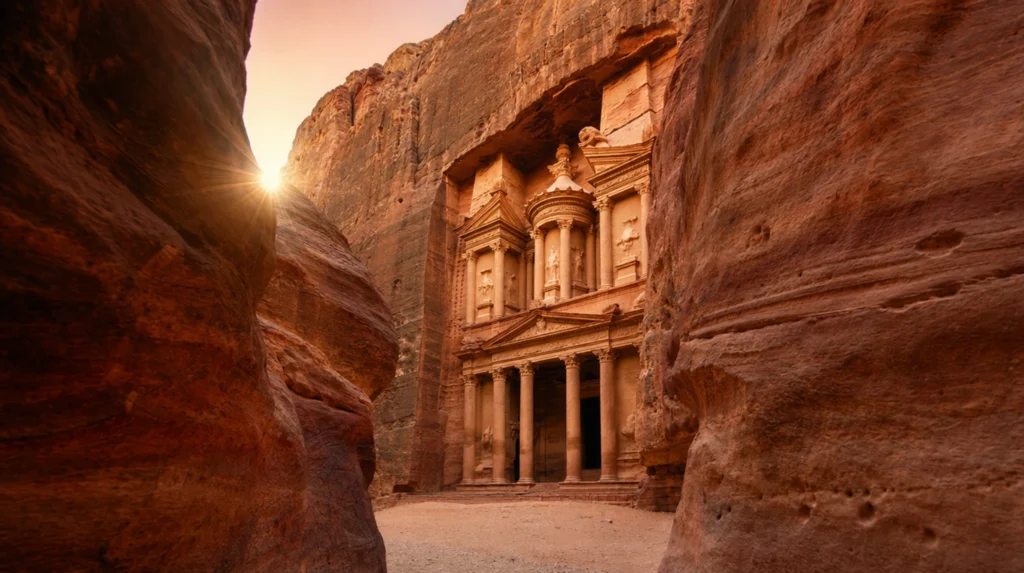
Petra, Jordan: The Rose-Red Nabataean Capital Carved Into the Cliffs
Part of our Jordan travel guide.
Petra City Guide
Table of Contents
Why Petra?
Petra is the rose-red city where a civilisation of desert merchants carved an entire capital out of sandstone cliffs and then vanished so completely that the outside world forgot it existed for more than a thousand years. The Nabataean capital was rediscovered for Western audiences by Swiss explorer Johann Ludwig Burckhardt in 1812, inscribed on the UNESCO World Heritage List in 1985 as “one of the most precious cultural properties of man’s cultural heritage,” and elevated to one of the New 7 Wonders of the World by a global public vote in 2007. Nothing else in Jordan — nothing else in the wider Levant — pulls travellers quite this hard.
The archaeological park is vast in a way first-time visitors rarely expect. It covers roughly 264 km² of protected landscape (of which 102 km² forms the core monument zone), and the main walking route from the Visitor Centre down to the Monastery runs about 8 kilometres one-way — meaning a fit visitor who does the full headline loop will cover 16–20 km in a day. The Treasury façade you know from the Indiana Jones films is just the start: behind it, scattered across a warren of canyons and ridges, are more than 800 individual tombs, temples, triclinia and rock-cut chambers, a 4,000-seat amphitheatre, a Byzantine church with surviving 5th-century mosaics, and the high-altitude Monastery that most day-trippers never reach. The 2023 peak season brought roughly 1.1 million visitors through the gate, but the park is large enough to absorb them — walk 20 minutes past the Treasury and the crowds thin dramatically.
The contradictions are what make the place strange. A Hellenistic-style façade carved by Arab desert merchants sits at the bottom of a natural slot canyon; a Roman amphitheatre shares a kilometre of trail with a Neolithic village 7,000 years older than anything Nabataean; the Bdoul Bedouin who lived inside the tombs until UNESCO inscription triggered their resettlement in 1985 still run most of the in-park tourism from the purpose-built village of Umm Sayhoun next door. This guide walks through all eight areas of the archaeological park and the adjacent town of Wadi Musa where you’ll sleep and eat, the surprising breadth of the food scene, the cultural sights beyond the obvious ones, day trips to Wadi Rum and the Dead Sea, and the practical calculus — Jordan Pass, water, heat management, Bedouin merchant etiquette — that separates travellers who leave exhilarated from travellers who leave with heatstroke and buyer’s remorse. The Treasury, the Monastery, and an overnight in a Wadi Rum Bedouin camp are the three non-negotiables of any first visit. Give it two full days minimum; three if you can spare them.
Areas & Trails of Petra
📍 Petra Map: Every Place in This Guide
Petra’s “neighborhoods” are not residential quarters but the physical zones of the archaeological park itself plus the service town of Wadi Musa above the Visitor Centre. The park layout is linear — one long descending trail from the Visitor Centre through the Siq to the Treasury, then along the Colonnaded Street to Qasr al-Bint, with side-trips to the High Place, Royal Tombs and ultimately the Monastery. Nine areas matter, and how you sequence them is the single most consequential planning decision you’ll make. Two days gives you time for all nine; one day means picking five.
The Siq
The Siq is the 1.2-kilometre slot canyon that forms Petra’s only natural entrance — sheer sandstone walls rising 80–180 metres overhead, narrowing in places to just 3 metres wide, with the Nabataean water channels still visible carved along both sides at shoulder-height. The approach from the Visitor Centre is an 800-metre downhill walk past Bab as-Siq, after which the canyon proper begins with a modern reconstructed dam on the Nabataean original that once protected the city from Wadi Musa floodwaters. Arrive at 06:00 to walk the Siq in full shadow and near-silence; by 09:30 the tour groups arrive. The approach is itself one of the monuments of Petra — half an hour of slow narrowing anticipation before the Treasury appears through a 3-metre-wide crack at the canyon’s end.
- Bab as-Siq — the approach lined with djinn blocks and the Obelisk Tomb
- The dam at the Siq entrance — a modern reconstruction on the Nabataean original
- Nabataean water channels cut into both walls — part of the city’s ancient hydraulic system
- The carved camel caravan bas-reliefs half-way through
- The first glimpse of Al-Khazneh through the narrow crack at the canyon’s end
Best for: every first-time visitor; arrive at 06:00 for the full shadow-and-silence experience. Access: 800-metre walk downhill from the Visitor Centre; horse carriage is available for 20 JD (~$28) one-way but optional.
Al-Khazneh (The Treasury)
The 40-metre-high Hellenistic-style façade carved directly into rose sandstone at the end of the Siq is the single most famous monument in the Middle East outside the Pyramids. Al-Khazneh was probably commissioned in the 1st century BCE as a royal tomb for King Aretas IV (9 BCE – 40 CE); the local name “Treasury” comes from a Bedouin legend that a pharaoh hid gold in the urn at the top (the bullet-marks on the urn are the consequence). The photogenic plaza in front of the façade fills fast between 08:30 and 16:00; arrive either 06:00–08:00 for empty frames or 16:00–17:00 for warm golden-hour light. The newer Al-Khubtha Trail (650+ steps from the Royal Tombs) delivers you to the legal upper viewpoint above — worth the climb for the overhead perspective.
- Al-Khazneh façade — 40 m tall with classical columns, winged Victories, and the urn on top
- The small interior chamber (now closed to visitors) where the Nabataean royal tombs were
- The Indiana Jones filming plaza — the façade appeared as the entrance to the Grail temple in 1989
- Al-Khubtha Trail upper viewpoint — 650+ steps up for the legal overhead perspective
- Bedouin stalls on the plaza selling bracelets, scarves and Petra guidebooks
Best for: icon-hunters, photographers, first-timers. Access: end of the Siq; about a 30–40-minute walk from the Visitor Centre at a normal pace.
The Street of Façades and Royal Tombs
Turn left from the Treasury and the canyon widens into the Outer Siq and the sweeping cliff-face called the Street of Façades — dozens of rock-cut tomb façades in ascending tiers over 200 metres, more than 40 of them in Nabataean and classical styles. At the far end, the Royal Tombs themselves loom on the upper cliff of Jebel al-Khubtha: the Urn Tomb (converted to a Byzantine church in 447 CE as confirmed by its Greek dedicatory inscription), the Silk Tomb (famed for its swirling multi-coloured sandstone), the Corinthian Tomb, and the 49-metre-wide Palace Tomb — the largest single façade in Petra. Climbing up to the Royal Tombs themselves is a 15-minute hike above the main trail and rewards you with the best alternative view of the Treasury and the Outer Siq. The Al-Khubtha Trail continues up from here to the overhead-Treasury viewpoint; it’s a serious 650-step climb and takes 2 hours round-trip.
- Street of Façades — more than 40 tombs in Nabataean and classical styles
- The Urn Tomb — converted to a Byzantine church in 447 CE
- The Silk Tomb — famed for its swirling multi-coloured sandstone façade
- The Corinthian Tomb and the 49-metre-wide Palace Tomb
- Al-Khubtha Trail viewpoint above the Treasury — 650+ steps up
Best for: travellers with a half-day who want a single dense concentration of monuments plus the overhead Treasury view. Access: 10-minute walk past the Treasury along the main archaeological route, then 15 minutes up the ramp to the tombs themselves.
The City Centre (Colonnaded Street & Qasr al-Bint)
Past the Royal Tombs the trail descends into the flat heart of the Nabataean city along a 1st-century-CE Roman-style colonnaded street. The 4,000-seat Theatre is cut into the hillside to the south, originally Nabataean and later Roman-expanded; the Nymphaeum public fountain, the Great Temple complex (a 7,000 m² precinct excavated by Brown University from 1993), and Qasr al-Bint Far’un — the only major free-standing building in Petra still substantially upright — line the route. Qasr al-Bint’s 23-metre-high walls survived two major earthquakes (363 CE and 551 CE) thanks to a timber-reinforced masonry technique that pre-dates modern seismic engineering by two millennia. This is the natural lunch break on a full-day itinerary: the Basin Restaurant and the Crowne Plaza operation here are the only sit-down meal options inside the park.
- The Theatre — 4,000-seat amphitheatre cut into the hillside
- The Great Temple — 7,000 m² complex excavated by Brown University since 1993
- Qasr al-Bint Far’un — 1st-century-BCE Nabataean temple, only free-standing building still upright
- The Nymphaeum — public fountain fed by the city’s aqueducts
- The Colonnaded Street — 6 m wide, Roman paving, with column bases running 240 m
Best for: history-minded visitors, and the logical lunch stop on a full-day route. Access: 15–20-minute walk past the Royal Tombs on the main trail.
High Place of Sacrifice
The High Place of Sacrifice is a hilltop Nabataean altar reached by 800 rock-cut steps from the Theatre — the classic “short but intense” climb and the alternative to the Monastery for half-day visitors. The summit delivers a rock-cut obelisk, a main altar, and a drainage channel for sacrificial blood, plus a 360-degree panorama across the city centre, the Royal Tombs and down to Wadi Araba. Operational from the 2nd century BCE through the 2nd century CE, the site is a reminder that Nabataean religion predated their Hellenistic veneer. The descent via Wadi Farasa is the more interesting option — past the Garden Triclinium, the Lion Fountain and the Roman Soldier Tomb before rejoining the main trail, making a satisfying loop rather than an out-and-back.
- The summit altar platform — rock-cut obelisk and sacrificial drainage channel
- The twin obelisks on the approach — 6-metre pillars carved from the bedrock
- Lion Fountain — a relief lion that once gushed water into a rock-cut basin
- Garden Triclinium and Roman Soldier Tomb on the Wadi Farasa descent
- Sextius Florentinus Tomb at the base of the alternative descent
Best for: fit travellers with a half-day who want the second-biggest view. Access: 800 steps up from the Theatre; 45-minute ascent, 30-minute descent direct, or a full 2-hour loop via Wadi Farasa.
Ad-Deir (The Monastery)
Petra’s largest rock-cut monument — a 47-metre-wide, 48-metre-tall façade at 1,100 metres elevation — is reached by about 800 rock-cut steps from the city centre. Ad-Deir was carved in the 1st century CE, probably as a Nabataean temple, and later reused by Byzantine Christian monks — the likely source of its modern name “the Monastery.” The climb takes 45–60 minutes on foot at a moderate pace, or 20 JD one-way by donkey if your knees need the help. The pay-off is dramatic: a façade at larger scale than the Treasury, in a setting at the summit of the world rather than at the bottom of a canyon. The Bedouin tea tent directly opposite the façade serves hot sweet cardamom tea for 1 JD (~$1.40), and the two “end of the world” viewpoints beyond — short scrambles to panoramas across Wadi Araba towards the Dead Sea and Israel — are the logical next move. Plan the Monastery as your afternoon objective, 14:00–16:00, when the façade catches full frontal light.
- The Monastery façade — 47 × 48 m, carved 1st century CE
- The urn atop the monument — same classical form as the Treasury but at larger scale
- The small interior chamber (likely a Nabataean sacred banqueting hall)
- The two “end of the world” viewpoints — panoramas across Wadi Araba
- Bedouin tea tent directly opposite the façade — 1 JD Bedouin tea
Best for: every fit visitor with a full day. Access: 800 rock-cut steps from Qasr al-Bint; 45–60-minute climb, or 20 JD by donkey one-way.
Byzantine Church and the Petra Papyri
Climb up the ridge north of Qasr al-Bint and you reach the Byzantine Church, a 5th–6th-century basilica with three apses and extraordinary surviving floor mosaics that almost every rushed tour bypasses. Excavated 1992–1998 by the American Center of Research, the nave pavement depicts 70+ figures including personifications of the seasons and a porpoise. In 1993 the adjoining room yielded 140 carbonised 6th-century Greek papyrus scrolls — the Petra Papyri — which have rewritten scholarly understanding of late-antique Petra as a still-functioning provincial centre. The adjacent blue chapel is built around four imported Egyptian granite columns. The protective roof over the mosaics makes the church one of the few genuinely shaded rest stops — a detail worth knowing at 13:00 in August.
- Central nave floor mosaic — 70+ figures including the seasons and a porpoise
- The Petra Papyri discovery site — 140 carbonised 6th-century Greek scrolls
- The adjacent blue chapel with four imported Egyptian granite columns
- The Ridge Church and Pharaoh’s Column further up the ridge
- Shaded protective roof — a welcome midday rest stop
Best for: second-day visitors and travellers interested in the post-Nabataean Byzantine phase. Access: 10-minute climb from Qasr al-Bint up the ridge north of the city centre.
Little Petra (Siq al-Barid) & Al-Beidha
Nine kilometres north of Petra proper sits Little Petra — a 450-metre slot canyon with carved façades, dining triclinia used as caravan rest-houses, and the Painted House, which preserves the only surviving Hellenistic-style painted ceiling in Petra: vines, putti and Dionysian figures in restored pigment. Little Petra is free to enter, usually near-empty, and makes an ideal half-day. The adjacent Neolithic village of Al-Beidha — a Pre-Pottery Neolithic B settlement dated to roughly 7000 BCE — is one of the oldest settled sites in the Near East, predating Petra by 7,000 years. The Beidha Bedouin Heritage Centre at the entrance runs natural-dye and weaving workshops. Combining Little Petra with a zarb dinner at Seven Wonders or Ammarin Bedouin Camp makes a strong slow-day after two intense days in the park.
- Siq al-Barid — 450-metre canyon with rock-cut triclinia
- The Painted House — restored Hellenistic ceiling with vines and putti
- The rock-cut stairway to the upper viewpoint
- Al-Beidha — 9,000-year-old Pre-Pottery Neolithic B settlement
- Beidha Bedouin Heritage Centre — natural-dye and weaving workshops
Best for: second-time visitors or travellers with a half-day to spare. Access: 9 km north of Wadi Musa; taxi ~10 JD each way, or drive 15 minutes from the main Visitor Centre.
Wadi Musa (Town)
Wadi Musa is the small hill-town of roughly 17,000 people that sits directly above the Petra Visitor Centre — an unshowy service town of hotels, shawarma stands, supermarkets and an archaeological museum. Moses’ Spring (Ain Musa), the traditional site where Moses struck the rock, is preserved at the head of the wadi in a small three-domed shrine. The Petra Archaeological Museum, opened April 2019 at the Visitor Centre, displays 280+ artefacts across five chronological galleries and is included in the Petra ticket. The Mövenpick’s Cave Bar is set inside a 2,000-year-old Nabataean rock-cut tomb and claims to be the world’s oldest bar; drinks start at 8 JD. The main Tourism Street strip is where you’ll eat, buy water, and get a SIM card.
- Moses’ Spring (Ain Musa) — traditional site where Moses struck the rock
- Petra Archaeological Museum — 280+ artefacts, opened 2019, included in Petra ticket
- Cave Bar at the Mövenpick — world’s oldest bar, inside a Nabataean tomb
- Main Tourism Street — shawarma stands, pharmacies and souvenir shops
- The public viewpoint at the top of the town with park panoramas
Best for: all visitors — this is where you sleep, eat, and stage for the park every morning. Access: every hotel in town is within a 1.5 km walk or a 2 JD taxi from the Visitor Centre.
The Food
Wadi Musa is a small service town rather than a foodie capital, but the Jordanian standards are reliably well-done here and the scene is more varied than the town’s size suggests. Expect three tiers: cheap shawarma and falafel along the Tourism Street strip at 3–5 JD (~$4–7) per plate; mid-range sit-down at the big hotels and a cluster of independent family-run operations at 10–18 JD (~$14–25) mains; and a small but genuine high-end tier led by the Mövenpick’s Cave Bar and the Petra Guest House’s Nabataean-tomb restaurant. Local specialties to seek out: mansaf (Jordan’s national dish), zarb (Bedouin pit-roasted lamb), galayet bandora (tomato-onion skillet), and knafeh for dessert. Tap water is not reliably potable; a 1.5 L bottle runs 0.35–0.70 JD (~$0.50–1) at supermarkets and 1–2 JD (~$1.40–2.80) at hotel kiosks. Alcohol is sold at hotel bars and a handful of licensed restaurants; there is no real wine list outside the Mövenpick, Petra Moon, and Marriott tier. Budget 25–50 JD (~$35–70) per person per day for food at the mid-range tier — about one-third of European-capital prices.
Jordanian Classics and Mansaf
Every Wadi Musa sit-down restaurant does mansaf, maqluba, and grilled chicken or lamb, with a quality band running from very good (at the named restaurants below) to acceptable (at the hotel buffets). Mansaf — lamb simmered in fermented dried-yoghurt sauce called jameed, served over saffron rice and shrak flatbread, traditionally eaten communally with the right hand — is best ordered 24 hours ahead at smaller places because it takes four hours to cook properly; at buffets it appears nightly but is often dialled-down on jameed tanginess to suit international palates. Zarb, the Bedouin underground barbecue, is most authentically eaten at Seven Wonders Bedouin Camp or Ammarin Bedouin Camp outside town — 40–55 JD (~$56–77) for the full set menu with transport. In town proper the best stand-alone restaurants are My Mom’s Recipe and Beit Al Barakah, both small family-run operations on the hill above the Visitor Centre; both use jameed from their own family stocks, reconstituted the same day rather than bought in powder form. Galayet bandora — a tomato-onion-garlic skillet served with fresh shrak bread — is the standard 3 JD (~$4) breakfast across the strip and is how most Petra-day mornings start. Maqluba, the “upside-down” rice-and-meat pot layered with fried aubergine, cauliflower and potato, then dramatically flipped upside-down at the table onto a communal platter, is the other headline dish and every Wadi Musa restaurant has a Thursday maqluba night. Chicken msakhan (roasted chicken on sumac-drenched bread with caramelised onions piled high) is the Levantine-wide classic; the version at Three Steps is particularly good at 12–15 JD (~$17–21). Fatteh — layered chickpeas, toasted flatbread, yoghurt and pine nuts — is the Sunday breakfast standard and a 4–6 JD (~$6–8) bargain at any of the small family spots. Portions run large — one main and a mezze platter easily feeds two moderate eaters, and Jordanian hospitality culture means leftover food on the table is a signal to the kitchen that you’re not happy. Order slightly less than you think you need.
- My Mom’s Recipe (Petra Kitchen) — home-style mansaf and maqluba set menu (22–30 JD, ~$31–42)
- Beit Al Barakah — rotating Jordanian daily menu (mansaf Tuesdays, maqluba Thursdays) (10–18 JD, ~$14–25)
- Al Wadi Restaurant — grilled mixed kebab and mezze spread (12–18 JD, ~$17–25)
- Three Steps Restaurant — maqluba and chicken msakhan (8–15 JD, ~$11–21)
- Petra Kitchen cooking-school dinners — hands-on 6-course Jordanian tasting (40 JD, ~$56)
- Al Saraya (Mövenpick) — hotel-buffet mansaf and maqluba nightly (35 JD, ~$49)
- The Basin Restaurant (inside the park) — Crowne Plaza lunch buffet at Qasr al-Bint (20–25 JD, ~$28–35)
Shawarma, Falafel and Street Food
Tourism Street (Shari’a al-Siyaha) is a five-minute walk from the Petra Visitor Centre and the cheapest reliable food in town. The strip runs from the Mövenpick roundabout up to the central mosque and is lined with 10–15 near-identical shawarma joints, a couple of falafel stands, a pair of manousheh (Levantine flatbread) bakeries, and a dozen supermarkets stocking water, fresh fruit and packets of local flatbread. Shawarma sandwiches — chicken or lamb wrapped in khubz with garlic sauce, pickles and fries — run 1.50–2.50 JD (~$2–3.50); a full plate with rice and salad is 4–6 JD (~$6–8). Falafel sandwiches are 1–1.50 JD (~$1.40–2), and the falafel ball at Al Qantarah is a specific recommendation — the cumin-forward recipe has a small cult following among Petra guides and drivers. A reliable 3 JD (~$4) breakfast is foul medames — stewed fava beans with lemon, olive oil, cumin and torn bread — at any of the early-opening spots. Manousheh (flatbread topped with za’atar and olive oil, or cheese, baked in a cone oven) runs 0.70–1.50 JD (~$1–2) at Sanabel Bakery and is the ideal morning fuel before the Siq. Pack your Petra-day lunch from the strip: a shawarma wrap, two bananas, a sleeve of dates, a bag of Jordanian mixed nuts, and two 1.5 L water bottles will cost about 8 JD (~$11) and carry you through a full day in the park. Most shops open from 06:00 — early enough to provision before a 07:00 park entry. During Ramadan 2026 (17 February – 19 March) daytime hours on the strip are dramatically reduced; most shawarma places shut from 11:00 to 18:30, though a handful stay open to serve tourists, and the post-sunset Iftar buffets at the larger hotels (Mövenpick, Marriott, Petra Guest House) are open to paying non-Muslim visitors at 20–35 JD (~$28–49) per head. Sweet shops along Tourism Street shift to qatayef and atayef (stuffed pancakes dipped in syrup) for the entire month — a uniquely seasonal sugar hit. Cash-only at every single vendor on the strip.
- Sanabel Bakery — manousheh za’atar and cheese flatbread (0.70–1.50 JD, ~$1–2)
- Al Afandi Shawarma — chicken shawarma wrap (1.50 JD, ~$2)
- Al Qantarah — falafel and hummus breakfast plate (3–4 JD, ~$4–6)
- Red Cave Restaurant — Bedouin tea and maqluba (10–15 JD, ~$14–21)
- Mystic Pizza — wood-fired pizza and pasta for the carb-craving traveller (8–14 JD, ~$11–20)
- Oriental Restaurant — cheap sit-down with a wide Jordanian menu (6–12 JD, ~$8–17)
Beyond Mansaf and Shawarma
Four other dishes are worth hunting down in Wadi Musa. Zarb, the Bedouin pit-roasted lamb and chicken cooked for four hours in a sand oven with charcoal and desert herbs, is the signature 40–55 JD (~$56–77) feast at desert camps; many Wadi Musa hotels arrange a shuttle to Little Petra camps (Seven Wonders, Ammarin) for the evening, making it the single most memorable dinner in town. Knafeh — warm cheese pastry under crisp shredded filo, drenched in orange-blossom syrup and crowned with ground pistachios — is the Jordanian national dessert; the best in town is at Al Qantarah (2–3 JD, ~$3–4 per slice) and is worth a dedicated late-afternoon walk up Tourism Street for. Sayadieh — Red Sea grilled fish served over caramelised-onion spiced rice, an import from Aqaba — appears on hotel menus and draws on the Aqaba fishing tradition; expect 18–30 JD (~$25–42) at the Mövenpick and Marriott. Qatayef, the stuffed pancake served during Ramadan, is a seasonal treat found only from mid-February to mid-March in 2026. A Bedouin tea at the Monastery tea tent (1 JD, ~$1.40) — strong sweet black tea with cardamom and sometimes sage from the surrounding hills — counts as a meal experience in its own right, particularly after 800 steps up the mountain. Arak Haddad, the Jordanian aniseed spirit, is the local evening drink; 5–8 JD (~$7–11) per glass at the Cave Bar and hotel bars, best taken with ice and water added in a 1:2 ratio, which turns the spirit cloudy-white. Finally, don’t miss the local olive oil sold by village cooperatives along the King’s Highway — 10–15 JD (~$14–21) per litre of last-season oil and a genuine highlight of the Jordanian pantry.
- Zarb — Bedouin pit-roasted lamb and chicken, four-hour sand-oven cook (40–55 JD set menu, ~$56–77)
- Knafeh — warm cheese pastry, shredded filo, orange-blossom syrup, pistachios (2–3 JD, ~$3–4)
- Sayadieh — Red Sea grilled fish over caramelised-onion rice (18–30 JD, ~$25–42)
- Galayet bandora — tomato-onion skillet with fresh shrak bread (3–5 JD, ~$4–7)
- Arak Haddad — Jordanian aniseed spirit served cloudy with ice (5–8 JD per glass, ~$7–11)
- Qatayef — Ramadan-only stuffed pancakes, mid-February to mid-March 2026 (1–2 JD, ~$1.40–3)
Food Experiences You Can’t Miss
Five experiences turn Wadi Musa meals into memories. First, the Petra Kitchen cooking school on Al-Qusabaiah Street runs an evening three-hour group class covering six classic Jordanian dishes (maqluba, a mezze spread, soup, salad, main and dessert), ending with everyone sitting down to eat together; 40 JD (~$56) per person, book 24 hours ahead via your hotel. Second, a Bedouin dinner at Seven Wonders Bedouin Camp or Ammarin Bedouin Camp outside Little Petra — zarb unearthed dramatically from the sand oven after four hours of slow cooking, mezze spread on low tables, campfire sweet tea, and for overnighters, a goat-hair tent and the quietest night sky within two hours of Amman. Third, the Cave Bar at the Mövenpick — a genuinely historic Nabataean rock-cut tomb turned cocktail bar, drinks from 8 JD inside 2,000-year-old sandstone walls; arrive at 19:30 for a table against the rock, and don’t skip the arak sour. Fourth, the Monastery tea tent at the end of the 800-step climb — 1 JD (~$1.40) for hot sweet cardamom tea that tastes like victory earned. Fifth, a lunch at the Basin Restaurant inside the archaeological park (Crowne Plaza’s buffet operation at Qasr al-Bint) — convenient rather than remarkable at 20–25 JD (~$28–35); pack your own shawarma and dates for better value and less time queuing. Beyond these five, two quick honourable mentions: a morning at the Beidha Bedouin Heritage Centre natural-dye workshop (25 JD, 2 hours) , and an evening at My Mom’s Recipe where the owner, Samar, still insists on explaining every spice in her mansaf before she lets you taste it. Tipping in Wadi Musa restaurants is 10% where no service charge is added; the Mövenpick and Cave Bar add 16% service plus 10% sales tax automatically, so don’t double-tip. Reservations are not generally needed except at the Mövenpick’s Al Saraya on Friday nights and at Petra Kitchen cooking classes during peak season (March–May, September–November).
- Petra Kitchen cooking class — 40 JD / person / 3 hours, book 24 hours ahead
- Seven Wonders Bedouin Camp zarb dinner + overnight — 80–120 JD / person with transport
- Cave Bar at the Mövenpick — cocktails inside a 2,000-year-old Nabataean tomb (drinks 8–15 JD)
- Monastery tea tent — 1 JD Bedouin tea after the 800-step climb
- Basin Restaurant inside the park at Qasr al-Bint — lunch buffet 20–25 JD
- Ammarin Bedouin Camp — Little Petra zarb dinner with live rababa music
Cultural Sights
Al-Khazneh (The Treasury)
The 40-metre-tall Hellenistic-style tomb façade at the end of the Siq, probably commissioned in the 1st century BCE for King Aretas IV (9 BCE – 40 CE) and Petra’s most photographed monument. The local name “Treasury” comes from a Bedouin legend that a pharaoh hid gold in the urn at the top — generations of bullet marks on the urn are the consequence. Founded 1st century BCE. Admission included in the Petra ticket (50 JD one-day, or 70–80 JD Jordan Pass covering 1–3 Petra days). Best viewed 06:00–08:00 for empty frames or 16:00–17:00 for golden-hour light; the plaza fills fast between 08:30 and 16:00.
Ad-Deir (The Monastery)
Petra’s largest monument at 47 × 48 metres, carved in the 1st century CE into the top of Jebel Ed-Deir at 1,100 metres elevation. Originally a Nabataean temple, later reused by Byzantine Christian monks — the likely source of the modern name. Admission included in the Petra ticket. Access is 800 rock-cut steps from Qasr al-Bint (45–60-minute climb) or 20 JD one-way by donkey. Visit 14:00–16:00 for full frontal light on the façade; crowds thin after 14:30 as day-trippers head back to the Visitor Centre for the Siq return walk.
The Theatre
A 4,000-seat amphitheatre cut directly into the hillside, originally Nabataean in the early 1st century CE and expanded by the Romans after their annexation of Nabataea in 106 CE — the only rock-cut theatre of its scale in the Middle East. Founded early 1st century CE. Admission included in the Petra ticket; always accessible on the main trail with no gate. The best photo angle is from above on the Royal Tombs ridge, which puts the scale of the rock cut against the main trail below.
Qasr al-Bint Far’un
The “Palace of Pharaoh’s Daughter” — a 1st-century-BCE Nabataean temple, possibly dedicated to Dushara, and the only major free-standing building in Petra still substantially upright. Its 23-metre-high walls survived two major earthquakes (363 CE and 551 CE) thanks to a timber-reinforced masonry technique that predates modern seismic engineering by two millennia. Founded 1st century BCE. Admission included in the Petra ticket; always accessible on the main trail. Pair with the Great Temple precinct immediately opposite for a 30-minute detour into Nabataean civic architecture.
Byzantine Church (Petra Church)
A 5th–6th-century basilica with three apses and extraordinary surviving floor mosaics, excavated 1992–1998 by the American Center of Research. The nave floor mosaic is among the best-preserved Byzantine pavements in the Middle East, depicting 70+ figures including personifications of the seasons, local flora and fauna, and a porpoise. In 1993 the adjoining room yielded 140 carbonised 6th-century Greek papyrus scrolls — the “Petra Papyri” — which have rewritten scholarly understanding of late-antique Petra. Founded 5th century CE. Admission included in the Petra ticket. Best late morning when sun lights the mosaics through the open roof.
High Place of Sacrifice
A Nabataean hilltop altar reached by 800 rock-cut steps from the Theatre, with a main altar, a rock-cut obelisk hewn from the bedrock, and a drainage channel for sacrificial blood. Operational from roughly the 2nd century BCE through the 2nd century CE. Founded 2nd century BCE. Admission included in the Petra ticket. Climb 06:00–14:00 to avoid midday heat; descend via Wadi Farasa past the Garden Triclinium, Lion Fountain, and Roman Soldier Tomb to loop back to the city centre rather than retracing your steps.
Royal Tombs (Urn, Silk, Corinthian, Palace)
The four monumental tombs carved into the upper cliff of Jebel al-Khubtha above the Street of Façades. The Urn Tomb was converted to a Byzantine church in 447 CE as confirmed by its Greek dedicatory inscription; the Silk Tomb is famed for its multi-coloured sandstone; the Corinthian Tomb takes its name from its pilaster capitals; and the 49-metre-wide Palace Tomb is the largest façade in Petra. Founded 1st century CE. Admission included in the Petra ticket. Morning light for the Urn and Silk Tombs (which face west), afternoon light for the Corinthian and Palace (which face north-west).
Petra Archaeological Museum
Opened April 2019 at the Visitor Centre, the purpose-built museum was funded by Japanese development assistance and displays 280+ artefacts from Petra and the surrounding region across five chronological galleries. Highlights include Nabataean coinage, Petra Papyri facsimiles, and bilingual inscriptions in Nabataean Aramaic and Greek. Founded 2019. Admission included in the Petra ticket. Open 08:00–18:00 daily; a 45-minute visit either before entering the park or at the end of a hot day works equally well, and the air-conditioning is a welcome late-afternoon reset before a Cave Bar evening.
Great Temple Precinct
A 7,000 m² Nabataean civic complex south of the Colonnaded Street, excavated continuously by Brown University since 1993 — one of the largest ongoing archaeological projects in Jordan. The precinct includes a small theatron (a covered 600-seat audience hall, unusual for the region), propylaea with red-and-white floor tiles, and a hexagonal pavement. Founded 1st century BCE. Admission included in the Petra ticket. Best visited with a local guide who can interpret the ongoing excavation notes pinned to the site boards — otherwise it reads as rubble rather than architecture.
Entertainment
Petra by Night
The candlelit evening walk from the Visitor Centre through the Siq to the Treasury, illuminated by roughly 1,500 paper luminarias, with Bedouin musicians playing the rababa (a one-stringed bowed instrument) and storytellers holding court at the Treasury plaza. Runs Monday, Wednesday and Thursday evenings year-round, departing the Visitor Centre at 20:30 and returning by 22:30. Typical cost 17 JD (~$24) per person; not included in the Jordan Pass or the regular Petra ticket. Booking: buy same-day at the Visitor Centre box office by 19:30; bring a light jacket and a small torch (the luminarias light the way, but the canyon floor is uneven in shadow). If your trip’s dates align with a Mon/Wed/Thu, this is the single most distinctive evening in Jordan.
Bedouin Desert Camps
Overnight camps in Little Petra, Beidha, or pushing south to Wadi Rum — goat-hair tents, pit-roasted zarb dinner, stargazing with near-zero light pollution, and campfire storytelling. The camps are operated by multi-generation Bedouin families — the Bdoul, Ammarin and Zalabia tribes — who still descend from the groups that lived inside Petra’s tombs until the 1985 resettlement to Umm Sayhoun. Typical cost 70–150 JD (~$99–212) per person for dinner, overnight in a goat-hair tent (or a modern “bubble” tent in Wadi Rum), and breakfast. Booking: direct with the camp 24–48 hours ahead; most Wadi Musa hotels arrange transfers. Seven Wonders Bedouin Camp and Ammarin Bedouin Camp, both near Little Petra, are the two most reliable options for travellers basing in Wadi Musa.
Live Music at the Cave Bar
The Mövenpick’s Cave Bar, set inside a 2,000-year-old Nabataean rock-cut tomb, runs occasional oud and traditional Jordanian live-music evenings plus a regular DJ set at weekends. The setting alone — dinner-plate-sized tombs in the rear wall, sandstone ceilings still carrying carved inscriptions, and the claim (printed on the menu) to be the world’s oldest bar — justifies a single drink even on a rest night. Typical cost: no cover; drinks 8–15 JD (~$11–21), cocktails at the higher end. Booking not needed; arrive at 19:30 for a table near the rock wall. The arak sour and the local Barhan red wine by the glass are the two standout orders.
Stargazing at Little Petra
On the three evenings of Petra by Night — and increasingly on quiet non-Petra-by-Night evenings — the upper reaches of the park and the surrounding desert have some of the cleanest night skies within two hours of Amman, rated Bortle 2 across the wider region. A handful of Bedouin guides run private star-walks from Little Petra (Siq al-Barid), often paired with a zarb dinner at the adjacent camp. Typical cost 20–35 JD (~$28–49) per person for a 1.5-hour guided walk with a telescope. Booking via your hotel or directly with Ammarin Bedouin Camp; bring warm layers, as desert nights drop to 5–10°C even in April.
Horse, Donkey and Camel Rides
A 2 JD (~$2.80) horse ride from the Visitor Centre to the Siq entrance is notionally included in your Petra ticket — with a tip of 3–5 JD expected from the handler. Donkeys up to the Monastery cost 20 JD (~$28) one-way; the animal does the 800 steps so you don’t have to, which is a real proposition after 14 km of walking. Camels loiter near the Treasury plaza charging 5–10 JD (~$7–14) for photos or short walks along the Colonnaded Street. Animal welfare has improved since Jordan Tourism Board interventions in the 2010s, but the price haggling culture is aggressive: agree the price and the destination before you get on the animal, and verify your animal looks healthy — well-fed, hoof-sound, no visible sores.
Cooking Classes and Hands-On Workshops
Petra Kitchen on Al-Qusabaiah Street runs a three-hour evening group class covering six classic Jordanian dishes for 40 JD (~$56) per person. The Beidha Bedouin Heritage Centre (at the entrance to Al-Beidha, next to Little Petra) runs daytime natural-dye workshops using indigenous plants, and a weaving workshop using a traditional ground-loom; 25 JD (~$35) per person for a 2-hour session. Several of the town’s hotels offer informal bread-making and jameed demonstrations — the Petra Moon’s is recommended — typically 10–15 JD (~$14–21) and frequently bundled with a themed dinner. All bookings 24–48 hours ahead in peak season (October–April).
Day Trips
Wadi Rum (1.5 hours by car south on Desert Highway 15)
The “Valley of the Moon” is a 720 km² UNESCO Mixed Heritage Site 100 km south of Petra and the essential desert counterpart to a Petra visit. A 4×4 jeep tour (55–80 JD per person, ~$77–113, roughly 4 hours) covers Lawrence’s Spring, the Khazali Canyon petroglyphs, the 2nd-millennium-BCE Anfishiyyeh inscriptions, sand dune climbs, and the Burdah rock bridge. Most travellers pair the jeep tour with an overnight in a Bedouin bubble camp or goat-hair tent (120–200 JD per person including dinner and breakfast, ~$170–282), and the resulting stargazing — Bortle 1–2 sky with the Milky Way clearly visible — is the trip’s other headline. Pack layers for the return: desert nights drop to 5–10°C even in April, and summer days run 38–45°C. Practicality tip: book the camp before you book the jeep; the camps organise the jeep as part of the package at 20–30% less than booking direct.
Dead Sea (3 hours by car north via the Kings’ Highway)
The Dead Sea is the lowest point on Earth at 430 metres below sea level, and the standard day from Petra takes in the hypersaline float (you cannot sink), a Dead Sea mud bath, and a sunset at the resort strip of Sweimeh (Mövenpick, Kempinski, Dead Sea Marriott). The detour via the Kings’ Highway takes in Mount Nebo — the biblical summit where Moses viewed the Promised Land — and the 6th-century St George’s Church mosaic map of the Holy Land in Madaba on the way up, for a genuine full-loop day. A public-beach day costs 20–30 JD (~$28–42) at the Amman Tourist Beach; resort day passes run 50–80 JD (~$70–113) and include pool, shower, and lunch buffet. Practicality tip: shave within 24 hours before floating is a bad idea — the hypersaline water will find every nick. Rinse off immediately after the float; the salt leaves a crust on skin and hair.
Aqaba (2 hours by car south on Desert Highway 15)
Aqaba is Jordan’s only Red Sea port — 125 km south of Petra — and a natural add-on if you’re arriving from or going to Israel via the Wadi Araba border, or flying home via King Hussein International (AQJ). Shore-entry diving at the Cedar Pride wreck and the Japanese Gardens reef, snorkelling at the 2019-installed underwater Military Museum (tanks, aircraft and a helicopter sunk as artificial reef), and the Mamluk-era Aqaba Castle fill a full day easily. Day rate for shore dives 35–55 JD (~$49–77) including equipment; Aqaba Marine Park entry is 2 JD (~$2.80). Practicality tip: the JETT bus from Petra to Aqaba runs daily at 17:00, takes 2 hours, and costs 7 JD (~$10) one-way — a cheap add-on if you’re not returning to Amman.
Dana Biosphere Reserve (1 hour by car north on the King’s Highway)
Dana is a 292 km² RSCN-managed reserve spanning 1,500 metres of sandstone cliffs down to 50 metres below sea level — one of the most biodiverse protected areas in the Middle East, home to more than 800 plant species, wild caracals, Nubian ibex and 215 bird species. Day hikers do the Rummana Campground to Feynan Ecolodge trail (16 km one-way, 6 hours downhill) or the shorter White Dome trail (2 hours). Entrance fee 8 JD (~$11) per day. Practicality tip: the Feynan Ecolodge — lit entirely by candlelight, accessible only by 4×4 or a 30-minute donkey ride — is the regional icon and books out 2+ weeks ahead in peak season; if you want the candlelit overnight, reserve before you fly to Jordan.
Shobak Castle (45 minutes by car north on the King’s Highway)
Shobak is a 1115 CE Crusader fortress built by Baldwin I of Jerusalem on a desert bluff 30 km north of Petra — far less visited than the bigger Kerak Castle further north, and often near-empty at sunset when the pink light hits the walls. Entrance fee 1 JD (~$1.40) and included in the Jordan Pass. Practicality tip: combine Shobak with Dana in a single long day if you’re pushing north — the two are 20 minutes apart on the King’s Highway, and the combined 1 JD + 8 JD entry plus a 30 JD taxi makes for an efficient half-day add-on.
Seasonal Guide
Spring (March – May)
Daytime 18–28°C and evening 8–15°C make spring the peak season for Petra. April in particular sees wildflowers carpeting the wadis around the archaeological park — red poppies, yellow mustard and wild iris across the terraces above Wadi Musa — a brief but genuinely spectacular window that many repeat visitors deliberately time their trips for. Hotel rates are at the year’s highest; book 30–60 days out. Petra by Night runs Mon/Wed/Thu. Ramadan 2026 (17 February – 19 March) overlaps early spring: daytime restaurants in Wadi Musa operate reduced hours, but the archaeological park itself runs normally and the Iftar meals at sunset — qatayef pancakes, lentil soup, dates breaking the fast — are a memorable cultural bonus for travellers prepared to respect daylight fasting norms.
Summer (June – August)
Summer is brutal: 30–40°C in Petra and often 42°C+ in the lower canyons, which become radiant ovens by mid-morning. Walking the full park without a 05:30 start and 4–5 litres of water per person crosses into genuine heat-stroke territory by 11:00, and the emergency evacuation count inside the park peaks each August. Locals call summer the off-season for a reason. The flip side: hotel rates drop to 40–60% of spring pricing, the park is visibly quieter, the Siq and Monastery trails are mercifully uncrowded at dawn, and the 22:30 Petra by Night walk home is the most pleasant outdoor hour of the entire day. If you must come in summer, pre-dawn starts, shaded clothing and constant hydration are non-negotiable.
Autumn (September – November)
Autumn is the second peak season — 22–32°C sliding to 15–25°C by late November, still warm enough for comfortable walking but without the April crush. Olive harvest runs across October in the surrounding villages, and the terraces above Wadi Musa turn gold; many hotel restaurants run seasonal olive-oil tasting menus through October. Petra by Night runs Mon/Wed/Thu. This is the recommended window for pairing Petra with a Wadi Rum overnight — the desert days are warm without being punishing, and the nights are crisp without being cold enough to spoil stargazing.
Winter (December – February)
Winter in Petra is genuinely cold — 5–15°C daytime, 0–8°C overnight — and the park occasionally sees a dusting of snow (notably January 2022, which closed the Siq for safety for two days and made global news). Rooftop nights in Wadi Musa drop below zero. Hotel rates bottom out at 30–50% of peak pricing; a packable down jacket and a waterproof shell are essential, and many older hotels have under-powered heating. Petra by Night still runs but you’ll want the jacket through the whole walk. Ramadan 2026 starts 17 February, which is late-winter — plan accordingly for restaurant hours in the last two weeks of your Petra stay.
Getting Around
There Is No Train
Jordan has no passenger rail service connecting Petra to Amman or Aqaba — the historic Hejaz Railway, built under the Ottomans in 1908 to carry pilgrims to Medina and famously dynamited by Lawrence of Arabia during the 1916–18 Arab Revolt, now runs only occasional excursion trains for tour groups. Every intercity movement in Jordan is by road; budget accordingly. The main roads out of Petra are the Desert Highway (Highway 15, for Amman and Aqaba) and the King’s Highway (Highway 35, the slower scenic route north via Shobak, Karak and Madaba).
JETT Intercity Bus
JETT is Jordan’s reliable intercity coach operator and the standard way to move between Amman, Petra and Aqaba without a car or driver. The Amman–Petra daily service departs Amman’s 7th Circle JETT terminal at 06:30 and returns from the Petra Visitor Centre at 17:00, takes roughly 3 hours 30 minutes each way on the Desert Highway, and costs 11 JD (~$15) one-way. The Petra–Aqaba route runs once daily at 17:00 southbound and takes 2 hours for 7 JD (~$10) — a cheap and reliable alternative to a taxi. Book online at the JETT website or at the JETT desk on Amman’s Abdali street the day before; buses in peak season (March–May, September–November) sell out 24 hours ahead.
Walking and Local Taxis
Wadi Musa is small — every hotel is within 2 km of the Visitor Centre, and most are within 1 km walkable downhill. Taxis are yellow with green plates; a ride anywhere within the town is a flat 2 JD (~$2.80). Agree the fare before getting in; meters exist but are rare and unreliable, and the “flat 2 JD” convention is widely understood among both drivers and hotels. No ride-hailing app operates in Wadi Musa — Uber and Careem cover Amman and Aqaba only — so taxis are the only app-free option.
Inside the Park: Your Own Two Feet
The archaeological park is walking-only beyond the Visitor Centre, with three optional animal-assist segments. A horse ride from the Visitor Centre to the Siq entrance (800 metres) is notionally included in your Petra ticket; a 3–5 JD tip to the handler is expected. Horse carriages through the Siq to the Treasury (2 km) cost 20 JD (~$28) per carriage one-way; useful for mobility-limited travellers but rough on the ankles of anyone walking near them. Donkeys up the 800 steps to the Monastery or to the High Place of Sacrifice cost 20 JD (~$28) one-way. Expect to walk 14–20 km on a full-day visit regardless of which animals you use; the animals are supplements, not replacements.
Airport Access
- Queen Alia International (AMM) → Petra by private car — 3 hours, 55–70 JD (~$77–99)
- Queen Alia (AMM) → Amman Sariyah Express + JETT bus to Petra — 4 hours total, 3.30 JD + 11 JD
- King Hussein International Aqaba (AQJ) → Petra by private car — 1.5 hours, 40–55 JD (~$56–77)
- Aqaba (AQJ) → JETT bus — 2 hours, 7 JD (~$10)
Taxis and Private Drivers
In-town taxis are flat 2 JD. Chartering a taxi for a day of regional sights (Shobak, Little Petra, and a Dead Sea drop, for example) runs 60–90 JD (~$85–127) for the day with no fuel surcharge. Full multi-day private drivers — popular for travellers piecing together Petra + Wadi Rum + Dead Sea — cost 80–120 JD (~$113–170) per day including fuel, and can be arranged through every hotel in town. A 5–10% tip at the end of the day is expected. For navigation: Google Maps is accurate for Wadi Musa streets and the main park trails; MapsMe has better offline coverage of the park’s side trails (Al-Khubtha, Wadi Farasa, High Place loop) where cell signal drops out.
Budget Breakdown: Making Your Jordanian Dinar Count
The Jordanian Dinar has been pegged to the US Dollar at roughly 1 JD = $1.41 since 1995 — one of the most stable currencies in the region, and the reason you can quote prices in USD without dodging FX swings between planning and arriving. Prices in Petra are mid-range by regional standards: more expensive than Egypt, cheaper than the UAE or Israel, roughly on par with coastal Turkey. The single biggest line item on any Petra budget is park entry — 50 JD / 1 day (~$71) without the Jordan Pass, or 70–80 JD (~$99–113) as part of a 3-night-minimum Jordan Pass — and for most travellers sleep and food together cost less than park entry does. Tip budgeting: a typical two-day Petra visit at the mid-range tier runs 180–320 JD (~$254–452) per person, of which park entry accounts for roughly a quarter, hotel 40%, food 15%, transport 10%, and the rest split between Petra by Night, a cooking class, and Bedouin tea. All figures below use the exchange rate of 1 USD = 0.709 JD as published on XE.com for 19 April 2026.
| Tier | Daily | Sleep | Eat | Transport | Activities | Extras |
|---|---|---|---|---|---|---|
| Budget | 35–60 JD (~$50–85) | Dorm at Valentine Inn or Petra Gate (10–18 JD, ~$14–25) | Shawarma + supermarket picnic (8–12 JD, ~$11–17) | JETT bus + 2 JD taxis (2–5 JD, ~$3–7) | Jordan Pass 70 JD / 3 days amortised (~23 JD/day, ~$33) | Bedouin tea + trinkets (0–5 JD, ~$0–7) |
| Mid-Range | 90–160 JD (~$127–226) | Petra Palace or Old Village Hotel (55–95 JD, ~$78–134) | Three Steps + My Mom’s Recipe (25–40 JD, ~$35–56) | Private Aqaba transfer (40–55 JD, ~$56–77) | Petra by Night 17 JD + Petra Kitchen 40 JD (~57 JD, ~$80) | Souvenirs, Bedouin tea (5–10 JD, ~$7–14) |
| Luxury | 260–500 JD (~$367–706) | Mövenpick Petra or Petra Marriott (180–320 JD, ~$254–452) | Cave Bar + hotel fine dining (45–80 JD, ~$64–113) | Private driver all day (80–120 JD, ~$113–170) | Private Petra guide 80 JD + Wadi Rum bubble camp 200 JD | Tips, rugs, Bedouin silver (20–40 JD, ~$28–56) |
Where Your Money Goes
On a typical mid-range Petra stay the largest single cost is the Jordan Pass at 70–80 JD (~$99–113), amortised across 3–7 Jordan days. Sleep accounts for roughly 40–50% of the remaining daily spend, food 15–25%, transport 10–15%, and activities (Petra by Night, cooking class, a Wadi Rum overnight) the remainder. The biggest avoidable expenses are horse carriages through the Siq (20 JD one-way, not worth it unless mobility-limited), the Basin Restaurant lunch buffet inside the park (20–25 JD for a mediocre plate when a 6 JD packed shawarma from the strip works better), and private taxis between Amman, Petra and Aqaba when the JETT coach makes the same run for one-fifth the price. Luxury travellers should be aware that the Mövenpick Petra quoted rate jumps roughly 60% in the March–May peak, and that the Cave Bar’s 16% service + 10% sales tax add-on turns an advertised 10 JD cocktail into an actual 12.60 JD.
Money-Saving Tips
- Buy the Jordan Pass online before you fly — it waives the 40 JD visa fee on arrival and bundles Petra entry; break-even is instant for any 3-night trip.
- Pack your own park lunch from Tourism Street (shawarma, fruit, nuts, water, 6–8 JD total) rather than eating at the Basin.
- Take the JETT bus between Amman, Petra and Aqaba rather than private drivers unless you’re splitting the cost three or more ways.
- Walk the Siq rather than paying for the horse carriage (20 JD, 2 km — a 30-minute walk for free).
- Book Bedouin camps direct (Seven Wonders, Ammarin) rather than through hotels or aggregators; the markup is 20–30%.
Practical Tips
Language
Arabic is Jordan’s official language; English is widely spoken at every hotel, restaurant and guide operation in Wadi Musa, and park signage is trilingual (Arabic, English, and often Japanese or French). A few Arabic courtesies earn goodwill and better bargaining floors: shukran (thank you), min fadlak (please), la shukran (the essential merchant-fending phrase), and kam seri? (“how much?”). The Bdoul Bedouin who run most in-park tourism speak a local Hijaji dialect at home but switch to English fluently with visitors.
Cash vs. Cards
Bring cash. JD is accepted everywhere; USD and EUR are accepted at hotels and dive shops. ATMs at the Mövenpick and on Tourism Street (Arab Bank, Cairo Amman Bank, Housing Bank) reliably dispense JD; international cards are accepted at hotels and larger restaurants but not at the shawarma strip, tea tents or Bedouin merchants. American Express is rarely accepted. Budget 100–150 JD (~$141–212) cash per traveller per day at the mid-range tier.
Safety
Wadi Musa and Petra are among the safest destinations in the Middle East; petty crime is rare and violent crime virtually unheard-of. The real hazards inside the park are environmental: loose scree on the Monastery and High Place descents, 40°C+ heat-stroke risk from June through August, and flash floods in the Siq during rare but serious rain events. Check Petra Development Tourism Region Authority alerts the morning of your visit, especially October–March when Mediterranean storms push south.
What to Wear
Jordan is Muslim-majority and socially conservative outside resort zones. Shoulders and knees covered for both men and women in Wadi Musa and outside your hotel. The standard woman’s kit is a loose long-sleeve shirt, lightweight trousers or mid-length skirt, and a scarf. Inside the park you’ll see everything from modest hiking gear to tank tops; the Bedouin workers are unbothered, but the town you return to every night will notice. Good walking shoes with grip are the single most important item — loose sandstone dust is slippery on descents, and the 800 steps at the Monastery are rock-cut and uneven.
Cultural Etiquette
Bedouin merchants inside the park run a hard sell on bracelets, scarves, sand bottles and “just look” invitations to their caves. The friendly “la shukran” with a hand on your heart is the polite refusal. If you buy, haggle: the first price is typically 2–3x the floor. Tipping norms: 1–2 JD (~$1.40–2.80) for horse handlers, 3–5 JD for guides, 10% in restaurants where no service charge is added. Refusing offered Bedouin tea is a minor rudeness; accept at least one cup. Photographing people — especially women — requires explicit permission.
Connectivity
Zain and Orange both sell tourist SIMs at Queen Alia (AMM) and Aqaba (AQJ) airports for 10–15 JD (~$14–21) per 7-day / 20 GB package. Coverage is strong in Wadi Musa and generally holds on the main park trail; the Monastery summit and back-country wadis drop to roaming-only. Most hotels and all major cafés have free Wi-Fi.
Heat and Water
Bring a 1.5–3-litre water bottle and refill at your hotel before entering the park. A full-day visit in spring requires 3–4 litres per person; summer requires 5–6 litres and a 05:30 start. Electrolyte sachets (Tourism Street pharmacies, 0.50 JD per sachet) and a wide-brim hat are non-negotiable May–September. Sunscreen and sunglasses are essential year-round — the pale sandstone reflects intensely, and sunburn on the Monastery climb is the most common traveller injury after twisted ankles.
Health & Medications
No routine vaccinations required beyond standard travel shots (Hep A, typhoid, tetanus). Pharmacies on Tourism Street stock rehydration salts, painkillers and most travel medicines without prescription. The closest modern hospital is Princess Haya Hospital in Aqaba (2 hours) or King Hussein Medical Centre in Amman (3 hours); Wadi Musa has a basic clinic only. Travel insurance with medical evacuation cover is strongly recommended.
Luggage & Storage
Hotels store luggage free for post-checkout day-visits. The Visitor Centre has a paid locker room (1–2 JD per bag per day) for travellers not yet checked in. Day-packs of any reasonable size are permitted inside the park. A 20–30 L pack with water, snacks, sunscreen, a hat, a light jacket for the Monastery breeze, and a headlamp for Petra by Night is the standard kit.
Frequently Asked Questions
How many days do I need in Petra?
Two full days is the right answer for most visitors — and it’s what the Jordan Pass 2-Day Petra option is built around. Day one covers the headline route: Siq → Treasury → Street of Façades → Royal Tombs → Theatre → Qasr al-Bint → Monastery, with lunch at the Basin. Day two goes deeper and quieter: High Place of Sacrifice via the Theatre steps, descent through Wadi Farasa, the Byzantine Church and its mosaics, the Al-Khubtha overhead-Treasury viewpoint, and the Al-Beidha Neolithic village + Little Petra in the afternoon. A single day is enough for a first taste — you’ll make it to the Treasury, the Theatre and back, but not to the Monastery — while three days lets you add a Petra by Night on a Mon/Wed/Thu, a pace-adjusted itinerary and the full back-country trails. More than three days is reasonable only if you’re specifically here to hike the back routes; most travellers peak at two full days in the park.
Is Petra good for solo travellers?
Yes — Petra is one of the friendliest sites in the Middle East for solo travellers, including solo women. Wadi Musa is tiny, safe and full of other solo travellers doing the same rotation. The hostels — Valentine Inn, Petra Gate, Rocky Mountain Hotel — are explicitly set up for solo-traveller mixers and run shared 4×4 trips to Wadi Rum as a standard add-on, which is both the cheapest way to do Wadi Rum and a guaranteed way to meet people. The one thing to be ready for: Bedouin merchants inside the park are more persistent with solo women than with couples, and the “come see my cave” lines escalate to cups of tea and informal marriage proposals. A polite “la shukran” with a hand on your heart and continuous walking is the expected answer, and the merchants back off immediately.
Is the Jordan Pass worth it?
Almost always yes. The Jordan Pass (70 JD for 1 Petra day, 75 JD for 2, 80 JD for 3) covers Petra entry and waives the 40 JD tourist visa fee for anyone staying 3+ nights, meaning the break-even is effectively instant for any standard Jordan itinerary. Over a typical 7–10-day trip covering Petra, Wadi Rum, Jerash and a couple of castles, the Pass saves 40–80 JD beyond the visa waiver. The only travellers who should think twice: day-trippers from Israel or Egypt who are not staying 3 nights — the visa-waiver condition won’t trigger for them, and the direct Petra ticket at 50 JD for one day may be cheaper.
What about the language barrier?
There isn’t much of one. English is standard in Wadi Musa — every hotel, every guide, most restaurants, and all of the major Bedouin camps. You’ll rarely need Arabic in practice. At the shawarma strip and with some of the older Bedouin merchants inside the park, English still works but a few Arabic words — shukran, la shukran, kam seri, min fadlak — earn warmer service and softer opening prices. The park’s trilingual signage (Arabic, English, and often Japanese or French) means wayfinding in English is fine throughout.
When is peak season in Petra?
Spring (March–May) and autumn (September–November) are the peak seasons — moderate temperatures, strong light on the sandstone, wildflowers in April. Summer (June–August) is brutally hot and half-price but requires pre-dawn starts and careful heat management. Winter (December–February) can be surprisingly cold (0–15°C) and occasionally snowy, with January 2022’s snow day the reference event. Petra by Night runs Mon/Wed/Thu year-round; if it’s a non-negotiable, plan your itinerary to include one of those nights in Wadi Musa. Ramadan 2026 runs 17 February – 19 March, overlapping late winter and early spring; the archaeological park operates normally but daytime restaurant hours in Wadi Musa are dramatically reduced.
Can I use credit cards everywhere?
No. Hotels, the Mövenpick Cave Bar and the larger sit-down restaurants take Visa and Mastercard; American Express is rarely accepted. Everything else — the shawarma strip, taxis, park tea tents, Bedouin merchants, horse and donkey handlers, even some mid-range restaurants — is cash only. Bring 100–150 JD cash per traveller per day at the mid-range tier. ATMs on Tourism Street (Arab Bank, Cairo Amman Bank, Housing Bank) reliably dispense JD with international debit cards.
Is Petra family-friendly for kids?
Surprisingly so. Kids under 15 enter Petra free with a paying adult, and children respond strongly to the scale of the Treasury, the animals (horses, donkeys, camels), and the tunnel-like approach through the Siq. The real constraints are distance and heat. For under-8s, plan to do the Siq-to-Treasury-and-back as a single 2-hour outing rather than attempting the full 14–20 km day, and take a horse carriage at least one way. Skip the Monastery — 800 steps is a long day for small legs. Strollers don’t work inside the park: the terrain is cobbled, sandy and stepped throughout. A child-carrier backpack is the practical alternative for under-3s.
Is Petra by Night worth the 17 JD?
Worth doing once if your dates align with a Monday, Wednesday or Thursday evening. The candlelit walk through the Siq, the 1,500 luminarias, the Bedouin musicians playing the rababa at the Treasury plaza, and the 22:30 walk back — it’s a genuinely distinctive experience and one you cannot replicate elsewhere. It is not a substitute for a daytime visit (you only see the first kilometre and the Treasury exterior) and travellers split roughly evenly into “magical” and “overrated.” If you have only one full day in Petra and it happens to be a Mon/Wed/Thu, doing the full day plus Petra by Night the same evening makes that 24 hours the most concentrated memory of any Jordan itinerary.
Ready to Experience Petra?
Petra rewards travellers who arrive with a plan and plenty of water. Two full days, a Jordan Pass bought online before you fly, and a Wadi Rum overnight booked before you leave home are the three moves that turn a good visit into a great one. For the full country context — visa rules, regional itineraries linking Petra to the Dead Sea and Jerash, and the long history that connects Petra to the rest of the Hashemite Kingdom — read the Jordan Travel Guide. For more of the region’s desert-and-ruin icons, continue with our Morocco and Israel guides.
Explore More City Guides
Where to Stay
Alex the Travel Guru
Alex the Travel Guru has walked Petra’s trails in four different seasons — including a snow day in January 2022 that closed the Siq for safety — logged more than 120 km inside the archaeological park across multiple visits, and tested the Jordan Pass calculus on back-to-back trips with and without. Based out of Amman for the Jordan research window, Alex compiled this guide in partnership with local Bdoul guides from Umm Sayhoun village and cross-referenced every admission price and opening hour with the Petra Development Tourism Region Authority, Visit Jordan, and UNESCO’s 1985 inscription documentation.
Sibling Cities
Other city guides we recommend for africa me-focused trip planning around Petra:
- Cape Town city guide — South Africa
- Nairobi city guide — Kenya
- Zanzibar City city guide — Tanzania
- Marrakesh city guide — Morocco
More city guides you might like

Plan your trip to Petra
The booking tools we use ourselves. FFU may earn a commission at no extra cost to you.
Plan & book your trip to Petra
Booking through these searches supports our guides at no extra cost to you.