
Marrakech, Morocco: The Red City Where Souks, Sufis and the Atlas Meet
Part of our Morocco travel guide.
Marrakech City Guide
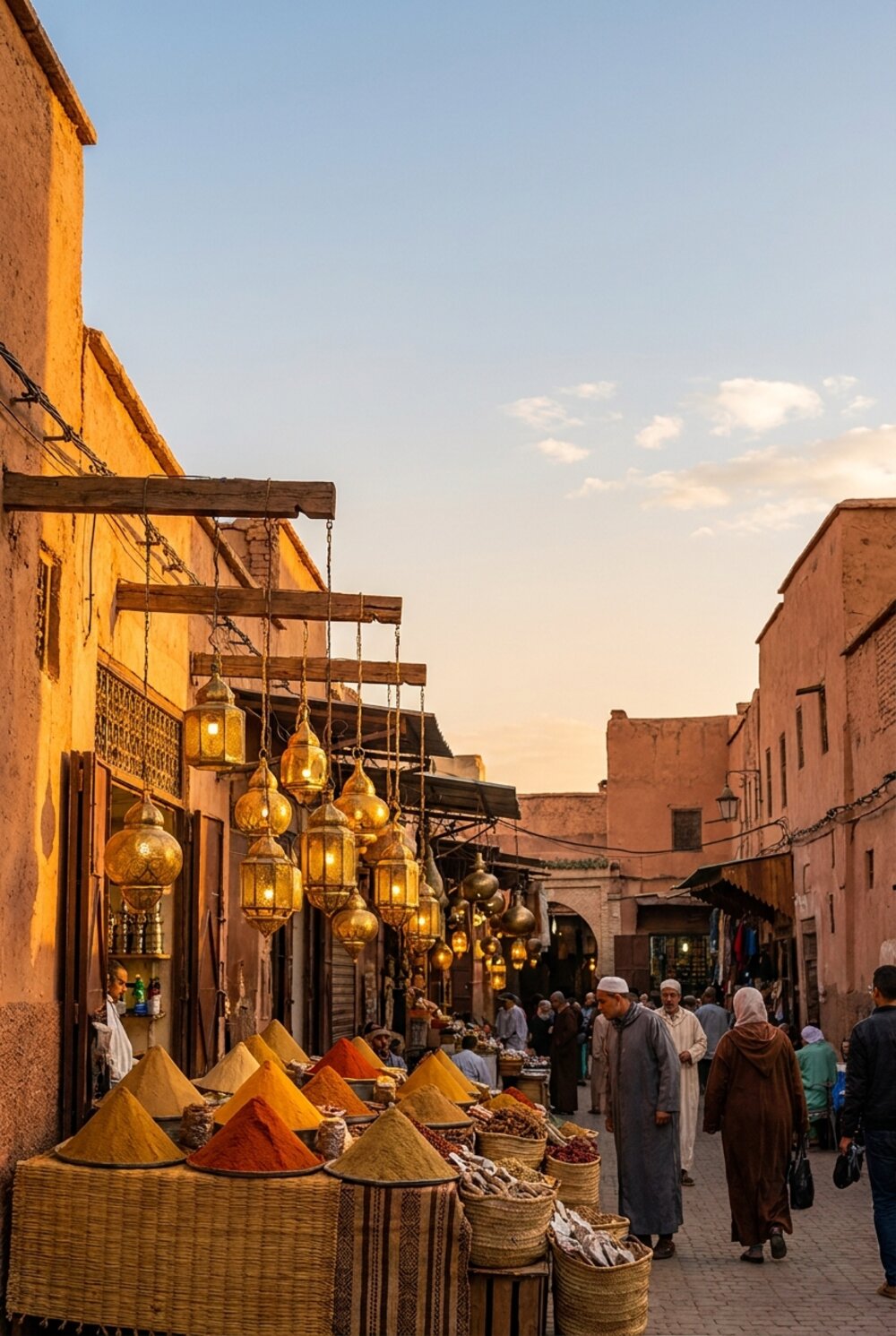
Table of Contents
Why Marrakech?
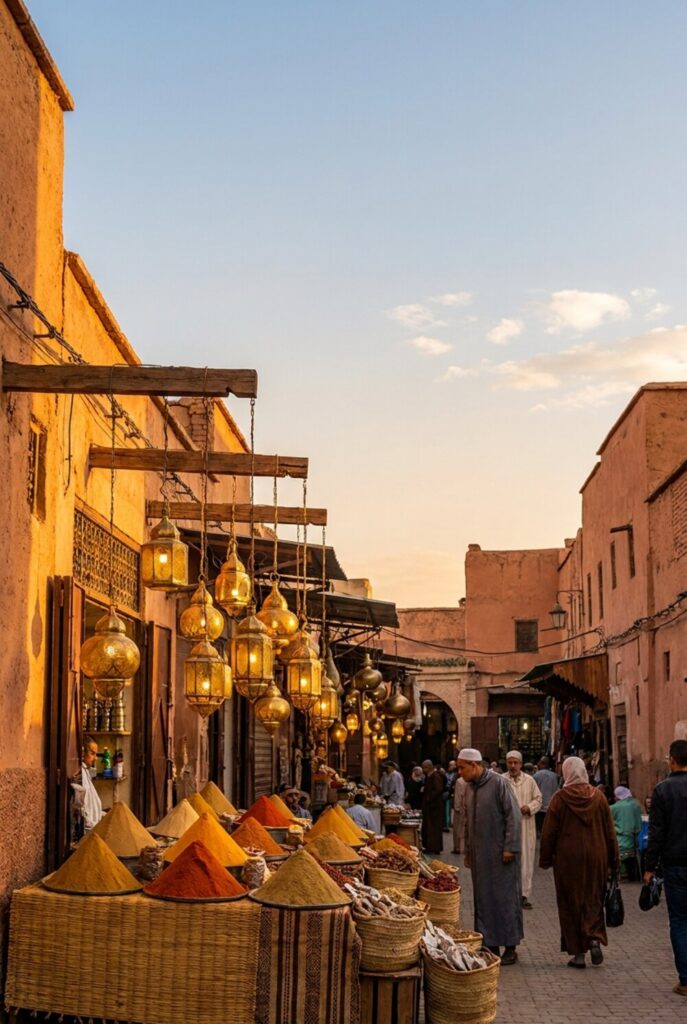
Marrakech is the city where a thousand years of caravan trade still exhales onto a single square at sunset. Founded in 1062 CE by the Almoravid leader Abu Bakr ibn Umar as a trans-Saharan staging post, it became the imperial capital of four successive Moroccan dynasties and lent its name to the country itself — Marrakech is where the European word “Morocco” comes from. Its old city, a lattice of rose-red pisé walls, courtyard riads and tight derbs, was inscribed on the UNESCO World Heritage List in 1985. Locals call it the Red City for the pinkish clay that tints every facade from the airport to the souks. First-time visitors usually call it sensory overload, then they book the next trip.
The numbers still surprise travellers who assume Marrakech is a boutique destination. Roughly 930,000 people live inside the city proper and about 1.5 million across the wider metro area, putting it in the same weight class as Amsterdam or Warsaw. UNESCO lists both the Medina itself (1985) and separately the cultural space of Jemaa el-Fnaa square — proclaimed in 2001 as a Masterpiece of the Oral and Intangible Heritage of Humanity for protecting halqa, the centuries-old tradition of public storytelling, Gnaoua music and street theatre. It’s an unusual double-listing that hints at what makes Marrakech strange. You can visit a 12th-century mosque and a purpose-built contemporary-art museum inside the same kilometre, walk from a silk dyers’ souk into a cobalt-blue garden designed by a Parisian painter, and eat a lamb tanjia cooked twelve hours in a hammam’s ember pit for the price of a London lunch.
The city is defined by its contradictions. The Koutoubia minaret, at 77 metres and completed in 1199 under the Almohad caliphs, has been the architectural benchmark for North Africa and Andalusia for eight centuries; five kilometres away, Yves Saint Laurent’s restored Majorelle Garden and the purpose-built Musée Yves Saint Laurent Marrakech (mYSLm, opened October 2017) pull fashion pilgrims past lemon trees and bleu-Majorelle walls. Three days are enough for a first taste; five let you add an Atlas village, a cooking class and a proper hammam afternoon. This guide walks through eight neighborhoods, more than a dozen restaurants and food experiences, the five landmark sights every itinerary needs, and the practical rules — Ramadan hours, taxi negotiation, souk scams, dress-code expectations — that separate travellers who leave smitten from travellers who leave sunburnt and scammed. Jemaa el-Fnaa at sunset, the Majorelle at opening time, and a day-trip to either Imlil or Essaouira are the three non-negotiables of any first visit.
Neighborhoods: Finding Your Marrakech
📍 Marrakech Map: Every Place in This Guide
Marrakech is really two cities glued together at the ramparts. Inside the 19-kilometre circuit of 12th-century pisé walls is the Medina — the UNESCO-inscribed old town of souks, madrasas and palaces, where cars cannot fit and Google Maps routinely lies. Outside the walls is Gueliz, the Ville Nouvelle laid out by French planners in the 1910s with cafés, galleries and grid avenues, plus the hotel belts of Hivernage and the garden estates of the Palmeraie. Where you base yourself decides your entire trip: the Medina delivers immersion at the cost of sleep and quiet, Gueliz and Hivernage deliver comfort at the cost of atmosphere, the Palmeraie delivers pools at the cost of a 20-minute taxi every time you want dinner. Eight neighborhoods matter for travellers, and which one you pick is the single most consequential planning decision.
The Medina
The walled old city is the Marrakech of the imagination — a lattice of 600-plus derbs (dead-end alleys), shaded souks, hidden riads and working artisans’ workshops. It was inscribed by UNESCO in 1985 for its intact Almoravid and Almohad urban fabric. Nothing inside is straight, and nothing is signed consistently: the best approach is to pick a landmark — Koutoubia, Bahia Palace, Ben Youssef Madrasa — and navigate by minaret and by asking shopkeepers. Most riads send a porter with a wheelbarrow to meet you at the nearest gate; accept the service, it saves tears. Expect call-to-prayer at 05:00, scooter horns at 07:00, and rooftop mint tea by 17:00. The Medina is dense in a way that European old towns rarely are: an entire guild of tanners, another of dyers, another of blacksmiths, each occupying its own named souk.
- Rahba Kedima — the spice and apothecary square north of Jemaa el-Fnaa
- Souk Semmarine — the Medina’s main commercial spine, textiles and lanterns
- Dar el Bacha — restored pasha’s palace now housing the Musée des Confluences
- Mouassine Fountain and Mouassine Mosque district
- Le Jardin Secret — restored 16th-century riad-garden open to visitors
Best for: first-time visitors who want the full Marrakech sensory immersion. Access: walking only inside the walls; taxis stop at Bab Doukkala, Bab Agnaou or Place des Ferblantiers depending on your riad.
Jemaa el-Fnaa Area
The 2-hectare main square at the southern edge of the Medina is Marrakech’s stage. Its cultural space was proclaimed by UNESCO in 2001 as a Masterpiece of the Oral and Intangible Heritage of Humanity for preserving halqa — the circle of listeners around storytellers, Gnaoua musicians, snake charmers and preachers that has gathered here since the 12th century. By day it’s a juice-cart, henna-hustler and monkey-handler plaza; avoid the monkeys, they are poorly treated and the handlers’ tip demands are aggressive. At dusk a hundred numbered food stalls roll into the square, the charcoal smoke rises, and the square becomes a single outdoor theatre that draws tens of thousands of people a night in peak season. Staying next to the square is loud but unbeatable for first-timers.
- Jemaa el-Fnaa square (free; best viewed from a rooftop at sunset)
- Café de France — cheap rooftop directly over the food stalls
- Le Grand Balcon du Café Glacier — the widest square-view terrace
- Koutoubia Mosque — bordering the square to the west
- Souk Cherratine (leather-workers’ souk) — just north of the square
Best for: travellers who want sensory overload and a living oral tradition. Access: central Medina; petits taxis stop at the edges — drivers cannot enter the square itself.
Mellah
South-east of Jemaa el-Fnaa, the Mellah is the historic Jewish quarter, established in the 16th century when Saadian sultans walled off a distinct zone next to the royal kasbah. Marrakech’s Jewish population has shrunk to a few hundred families since the mid-20th-century emigration to France and Israel, but the neighborhood’s taller, window-out buildings — Jewish houses were allowed exterior windows where Muslim Medina houses faced inward onto courtyards — and its distinct spice market still feel different from the rest of the Medina. It’s noticeably quieter than Souk Semmarine and a good place to start a souk day before the tour groups arrive at 10:30. The 16th-century Lazama Synagogue still operates and welcomes respectful visitors; the nearby Miâara Jewish Cemetery stretches over several whitewashed hectares.
- Lazama Synagogue — still-active 16th-century synagogue with small museum
- Miâara Jewish Cemetery — whitewashed tombs over several hectares
- Mellah Spice Market — Marrakech’s most saffron-intense souk
- Place des Ferblantiers — lantern-makers’ square at the Mellah edge
- El Badi Palace ruins — immediately west of the Mellah
Best for: travellers interested in Morocco’s Jewish heritage and calmer shopping. Access: 10-minute walk south-east from Jemaa el-Fnaa, or petit taxi to Place des Ferblantiers.
Kasbah
The Kasbah quarter at the southern end of the Medina was the royal citadel — the sultan’s fortified palace compound — from the Almohad era through the Alaouite dynasty. Today it concentrates the city’s headline palace sights within a fifteen-minute walking radius, making it the most efficient half-day for sight-focused travellers. The Bahia Palace, completed 1900 and charging 100 MAD admission, and the Saadian Tombs, 16th century and 70 MAD, bookend a walking loop that also takes in the sun-bleached ruins of El Badi Palace. Crowds peak 10:30–13:00; arriving at 09:00 at opening cuts waits by more than half and gets you the best light for courtyard photographs. Several excellent Medina riads cluster on the fringe — Riad Kniza, Riad Jardin Secret, Riad Yasmine — if you want to stay within the sights.
- Bahia Palace — 150-room late-19th-century palace with painted-cedar ceilings
- Saadian Tombs — rediscovered 1917; Carrara-marble mausoleum of Ahmad al-Mansur
- El Badi Palace ruins — sun-bleached 16th-century pleasure palace with stork nests
- Kasbah Mosque — red-brick minaret (exterior only for non-Muslims)
- Rue Riad Zitoun el Jdid — main walking street connecting the Kasbah to Jemaa el-Fnaa
Best for: sight-focused itineraries and architecture lovers. Access: 10–15-minute walk from Jemaa el-Fnaa via Rue Riad Zitoun el Jdid.
Gueliz (Ville Nouvelle)
Gueliz is Marrakech’s European grid — laid out by French planner Henri Prost after the 1912 Protectorate, with wide boulevards, shaded pavements, Art Deco villas and a sensibility closer to Nice than to the Medina. It’s where locals with office jobs eat lunch, where contemporary galleries show work that Medina tourists never see, and where bars and bistros actually have wine lists. A stay here swaps the rooftop drum-circle soundtrack for traffic noise — the trade-off many second-time visitors make. Avenue Mohammed V, the 2-kilometre main boulevard, cuts the district in half and runs straight to the Koutoubia, giving you a useful navigation spine and a genuinely walkable route back to the Medina if the taxis are refusing the meter. Gueliz is also where you find the city’s cinema, the biggest supermarkets (Carrefour, Label’Vie) and most of the banks.
- Avenue Mohammed V — main boulevard, 2 km to Jemaa el-Fnaa
- Plaza 16 Novembre — central roundabout, café-lined
- Marché Central de Gueliz — daily produce and fish market
- MACMA and David Bloch Gallery — contemporary-art anchors
- Jardin El Harti — European-style public park
Best for: travellers who want European-style cafés, wine lists and shopping between Medina days. Access: 15-minute petit taxi from Jemaa el-Fnaa; bus #1 runs the length of Avenue Mohammed V.
Hivernage
Pressed between Gueliz and the Medina walls, Hivernage is Marrakech’s luxury strip — leafy avenues lined with five-star hotels, the Royal Theatre, the conference palace and the city’s densest concentration of spas and nightclubs. La Mamounia, the 1923 grande-dame hotel that hosted Winston Churchill, Alfred Hitchcock and Edith Piaf, sits on the edge where Hivernage meets the Medina. Rooms at the flagship properties run 4,500–25,000 MAD per night (~$450–2,500). Its streets are quieter than the Medina and easier to walk after dark. Hivernage is also where the city’s nightclub scene lives — Theatro, So Lounge and Pacha all sit within a 15-minute walk of each other, which matters after midnight when petits taxis thin out.
- Théâtre Royal — neoclassical opera house (exterior viewing)
- Palais des Congrès — conference complex
- La Mamounia — 1923 palace hotel with 8-hectare gardens
- Menara Mall — Western-style shopping centre
- Royal Theatre Ramparts Walk — scenic tree-lined boulevard
Best for: luxury travellers, spa-focused trips, and nightlife. Access: 10–15-minute petit taxi from Medina; walkable to Jemaa el-Fnaa in 25 minutes via the ramparts.
Palmeraie
Seven kilometres north-east of the centre, the Palmeraie is a historic palm grove — local lore says it was planted where Almoravid soldiers spat out their date stones in the 11th century, and while that’s a myth, the grove is genuinely old. Today it’s Marrakech’s resort belt: boutique hotels, golf courses, Nobu-flagged restaurants and a quieter, flatter landscape that families with kids tend to prefer to the Medina’s density. The trade-off is a 20-minute taxi ride back to the Medina every time you want to eat street food or shop the souks. Many Palmeraie hotels run complimentary shuttle service to Jemaa el-Fnaa two or three times a day; confirm before booking. The Musée de la Palmeraie, a private contemporary-art museum set in a working garden, is an overlooked half-day for art fans who want something calmer than the Medina galleries.
- Musée de la Palmeraie — private contemporary-art museum in a working garden
- Nobu Marrakech — Japanese-Peruvian restaurant and hotel
- Royal Palm Golf Club — 18-hole Cabell Robinson course
- Palmeraie Resort — family resort with water park
- Beldi Country Club — pastoral hotel with rose gardens and pools
Best for: couples and families who want pool days and space. Access: grand taxi or hotel transfer; ~20 minutes from the centre, budget 80 MAD each way.
Sidi Ghanem
The industrial-design district six kilometres north of the Medina isn’t on most first-time itineraries, and that’s precisely its value for repeat visitors and design buyers. Sidi Ghanem houses the warehouses and showrooms of Moroccan design brands that sell wholesale to European boutiques — ceramicist LRNCE (Laurence Leenaert’s studio), homeware label Chabi Chic, children’s-fashion house Topolina, plus dozens of rug dealers and furniture makers — and it delivers better-quality, fixed-price goods than the souks for travellers who prefer not to haggle. Showrooms generally keep Monday–Saturday, 10:00–18:00 hours, and most are shuttered Sundays. Allow at least 20 minutes between stops because the district is spread over several hundred metres of warehouse park. Combine a Sidi Ghanem morning with a Palmeraie lunch to make a full half-day out of the north of the city.
- LRNCE — Laurence Leenaert’s ceramics, textiles and leather studio
- Chabi Chic — colourful Moroccan tableware and homewares
- Topolina — playful children’s and women’s fashion
- Mustapha Blaoui warehouse (nearby in Bab Doukkala)
- Atelier Nihal — handmade lighting and metalwork
Best for: interior-design shoppers and fixed-price buyers. Access: petit or grand taxi, ~20 minutes from the centre; budget half a day.
The Food
Marrakech cooking sits at the intersection of Amazigh (Berber) mountain traditions, Arab caravan routes that brought saffron and preserved lemons from the Middle East, Andalusian refugee refinement after 1492, and — more recently — French colonial technique absorbed over the 44-year Protectorate. The staples you’ll eat daily: tagine (slow-cooked stew in a conical clay pot, named after the pot itself), couscous (steamed semolina traditionally served Fridays), harira (tomato-lentil soup that breaks the Ramadan fast), pastilla (sweet-savoury pigeon or chicken pie dusted with cinnamon and powdered sugar), and mechoui (pit-roasted lamb shoulder). Prices run an order of magnitude below European capitals: a sit-down tagine is 70–120 MAD (~$7–12), a Jemaa el-Fnaa stall dinner for one is 50–100 MAD (~$5–10), and a full tasting menu at a top riad is 780–1,500 MAD (~$78–150). The Michelin Guide does not currently publish a selection for Morocco, so the “high-end” tier below is curated by peer reputation and cookbook-author mentions rather than stars. Budget 150–400 MAD per person per day for food at the mid-range tier.
Tagines, Couscous and Street Food
Tagine is the default lunch and dinner across the city. Chicken-with-preserved-lemon-and-olives, lamb-with-prunes-and-almonds, and kefta-with-egg are the three most-ordered variants — the chicken tagine is the best entry-level order because the preserved lemon does the heavy lifting. Couscous is traditionally Friday-only; at home and in most Medina restaurants, the steamer only comes out at the end of the week, when families gather and neighborhood markets close early. Street food anchors itself on Jemaa el-Fnaa after 19:00, when the numbered food stalls roll into the square, each with aggressive barkers competing for customers. Ignore the sales pitch, pick a stall with a long local queue, and confirm prices before you sit. The tanjia — slow-cooked lamb or beef shoulder braised in a conical urn buried in the ember pit of a neighborhood hammam for up to twelve hours — is the Marrakech specialty that tagine-hunters miss; Mechoui Alley north of the square is where the carvers set up from 11:00. Breakfast belongs to harcha (semolina cornbread, 5–10 MAD, ~$0.50–1), msemen (folded flatbread, 8–15 MAD, ~$1), and beghrir (a thousand-hole pancake, 10 MAD, ~$1) served with honey, argan oil and amlou (almond paste). Juice stalls in Jemaa el-Fnaa press fresh orange at 10 MAD per glass (~$1), with pomegranate, avocado and banana variants at 15–25 MAD (~$1.50–2.50). Soup culture is strong: harira and bessara (fava bean soup) run 10–20 MAD per bowl (~$1–2) at neighborhood spots and are the cheapest filling meal in the city.
- Al Bahriya — grilled fish and fried calamari in the Medina (60–120 MAD, ~$6–12)
- Chez Lamine Hadj Mustapha — mechoui (slow-roasted lamb shoulder) by the kilo (140 MAD/half-kilo, ~$14)
- Mechoui Alley (Souk Ablouh) — pit-roasted lamb with cumin and salt (80–150 MAD, ~$8–15)
- Jemaa el-Fnaa stalls — harira, merguez, tanjia, snail broth (15–60 MAD per portion, ~$1.50–6)
- Café Clock Marrakech — camel burger and Friday couscous (95–120 MAD, ~$10–12)
- Chez Hassan — tanjia (slow-cooked lamb in an urn) for 90 MAD (~$9)
- Mechoui el Badi — alternative mechoui stand near El Badi Palace (120 MAD/half-kilo, ~$12)
Markets and Street-Side Buying
Shopping for your own ingredients is part of Marrakech food culture, and the markets below each offer a different register. The Mellah Spice Market runs the best saffron, cumin, ras el hanout (the house spice blend, literally “head of the shop”) and preserved-lemon selections in the Medina — vendors sell saffron by the gramme at 20–40 MAD (~$2–4) per gramme and loose spice blends from 20 MAD per 100 g. The Marché Central de Gueliz is where French-style expats and home cooks shop daily for fish, produce, French cheeses and imported wine; prices are fixed and printed. Souk Semmarine is the tourist-facing main drag for leather, lanterns, rugs and argan oil — expect a starting price four to five times the floor and negotiate down to one-third. The secondary souks hidden off Semmarine — the dyers’ souk, the blacksmiths’ souk, the spice apothecary at Rahba Kedima — are where locals actually shop, with softer prices and less hustle. A fair test: argan oil should cost 80–120 MAD (~$8–12) for 250 ml of cooking grade and 150–250 MAD (~$15–25) for 100 ml of cosmetic grade; anything higher is tourist pricing. Saffron sold by the gramme at under 20 MAD is almost certainly turmeric or safflower; genuine Moroccan saffron is 30 MAD per gramme (~$3) at the floor, and the threads should snap cleanly rather than crumble. Olives sold loose in the Mellah and at Marché Central range 15–40 MAD per 100 g (~$1.50–4) depending on variety; the city’s olive market off Rue Riad Zitoun is worth a visit for the green-olive-and-preserved-lemon breakfast alone.
- Mellah Spice Market — saffron, cumin, ras el hanout (20–200 MAD, ~$2–20 depending on spice)
- Marché Central de Gueliz — produce, fish, French cheeses (fixed prices)
- Souk Semmarine — textiles, leather, lanterns, argan oil (50–800 MAD, ~$5–80)
- Souk des Teinturiers — the dyers’ souk with wool hanging in skeins overhead
- Souk Haddadine — blacksmiths’ souk for wrought-iron lanterns
- Rahba Kedima — spice apothecary square (oils, herbs, natural cosmetics)
- Souk des Tapis — rug souk between Rahba Kedima and Ben Youssef
High-End, Hotel and Destination Restaurants
The Michelin Guide has not yet extended coverage to Morocco, so Marrakech’s fine-dining landscape is ranked by peer reputation, cookbook-author mentions (Paula Wolfert, Yotam Ottolenghi, Claudia Roden) and hotel prestige. The top tier clusters inside the flagship hotel properties — La Grande Table Marocaine at the Royal Mansour, Nobu Marrakech, and the restaurants inside La Mamounia. A tier below, long-standing Medina institutions (Dar Yacout, La Trattoria, Le Tobsil, Dar Moha) trade on 25-plus years of consistency and the atmosphere of restored 18th- and 19th-century riads. The newest generation — Nomad, Café Clock, Limoni — serves modernised Moroccan on Medina rooftops at roughly one-third the price of hotel fine dining. Expect to book 48 hours ahead for hotel restaurants and Dar Yacout; Nomad takes walk-ins before 19:30 most nights. Tipping at these tiers is 10–15% and often expected in cash on top of the bill rather than added to the card.
- La Grande Table Marocaine (Royal Mansour) — Moroccan tasting menu by a French-trained kitchen (~1,200 MAD set, ~$120)
- Nobu Marrakech — Japanese-Peruvian omakase (800–1,500 MAD, ~$80–150)
- Le Grand Café de la Poste — French-Moroccan bistro in a 1918 post-office building (200–400 MAD main, ~$20–40)
- Dar Yacout — diffa-style Moroccan feast in a classic riad (780 MAD prix fixe, ~$78)
- La Trattoria — Northern Italian in a Bill Willis-designed villa (300–500 MAD main, ~$30–50)
- Nomad — modern Moroccan on a Medina rooftop over Rahba Kedima (150–220 MAD main, ~$15–22)
- Le Jardin — leafy courtyard café-restaurant off Souk Semmarine (120–180 MAD, ~$12–18)
- Le Tobsil — long-running riad dining with set menu (650 MAD, ~$65)
Food Experiences You Can’t Miss
Eating in Marrakech is also something you do, not only something you order. The experiences below range from non-profit lunches to cooking workshops to rooftop mint-tea rituals, and together they do more to explain Moroccan cuisine than any single meal will. Cooking classes in particular are a solid half-day investment — most include a guided souk walk with the chef, so you learn spice-buying and basic bargaining at the same time you learn a tagine. Reserve at least 48 hours ahead in peak season (October through April); La Maison Arabe books 7–14 days out during film-festival week. The food-tour option is worth considering for first-time visitors nervous about stall selection: a good guide takes the risk out of the Jemaa el-Fnaa experience and adds context — which stall specialises in which dish, which are the Marrakech classics versus Moroccan classics generally, what’s worth ordering and what’s tourist-bait. If you prefer self-directed eating, the Nomad rooftop, Terrasse des Épices, Café des Épices and Le Jardin form a four-stop “Medina rooftop crawl” inside a single walkable kilometre that covers breakfast, lunch, tea and sunset cocktails, and between them represent the three generations of Medina dining — the 1990s riad classics, the 2010s modern-Moroccan wave, and the latest 2020s hybrid. A final food experience many travellers miss: buying your own tanjia urn from a potter at Rahba Kedima (30–50 MAD, ~$3–5), filling it with lamb, spices and preserved lemon from the Mellah, and paying a hammam ember-pit man 20 MAD (~$2) to bury and cook it for you all afternoon. Dinner cost: under 200 MAD (~$20) for a feast that serves three.
- Amal Women’s Training Center — lunch at a non-profit that trains disadvantaged women as professional cooks (~120 MAD, ~$12). Booking recommended 2 days ahead.
- La Maison Arabe cooking workshop — half-day tagine or pastilla class starting at ~700 MAD (~$70), including market visit and lunch of your own cooking.
- Souk Semmarine argan oil co-op tasting — free entry, argan bottles from 100 MAD (~$10); Tigmi-la-Kasbah and women’s cooperatives on the Essaouira road are more authentic than souk shops.
- Rooftop mint-tea break at Café des Épices, Le Jardin or Nomad — 25–40 MAD per pot (~$2.50–4) and a 360° view of the Medina rooftops.
- Marrakech Food Tours evening crawl of Jemaa el-Fnaa — four-hour guided eat-through of six stalls (~$80 per person), worth it for first-timers nervous about stall selection.
- Tanjia dinner at a local hammam — order a tanjia urn at your riad in the morning; the hammam ember pit cooks it all day and it’s carved open at dinner (~200 MAD per urn, ~$20, serves 3).
- Terrasse des Épices — iconic Medina rooftop for a slow lunch after souks (mains 130–180 MAD, ~$13–18).
- Café des Épices — first-wave rooftop café in Rahba Kedima (mint tea 20 MAD, ~$2)
Cultural Sights
Marrakech’s headline sights cluster in two walkable loops — the Kasbah palaces (Bahia Palace, Saadian Tombs, El Badi) south of Jemaa el-Fnaa, and the Ben Youssef and Koutoubia axis north and west of it — plus the Majorelle Garden and YSL Museum about 3 km north-west in Gueliz, which together make a half-day on their own. A sensible two-day culture itinerary pairs the Kasbah on morning one, Ben Youssef Madrasa and Jemaa el-Fnaa on afternoon one, and Majorelle plus mYSLm Museum on morning two. Admission tickets are paid in cash MAD at the gate; most sights do not accept cards, and queues at Majorelle and Bahia can exceed 60 minutes after 10:30. Arriving at opening time (08:00 for Majorelle, 09:00 for most palaces) saves hours across a two-day itinerary.
Jemaa el-Fnaa
The Medina’s main square has been Marrakech’s public theatre since the 12th century and was proclaimed by UNESCO in 2001 as a Masterpiece of the Oral and Intangible Heritage of Humanity for its halqa — the tradition of storytellers, Gnaoua musicians, snake charmers and water-sellers performing in circles of listeners. Founded in the 12th century in its current form. Admission free. Best time: arrive around 17:30 for the transition from day market to night food stalls; watch the square transform from Le Grand Balcon du Café Glacier rooftop with a mint tea.
Koutoubia Mosque
The city’s largest mosque and its architectural template — its 77-metre minaret, completed in 1199 under the Almohad caliph Yacoub al-Mansour, set the pattern for Seville’s Giralda and the Hassan Tower in Rabat. Non-Muslims cannot enter the prayer hall, but the gardens around the minaret are open and free. Founded 1147 CE; current minaret completed 1199 CE. Admission free (exterior only). Best time: sunset, when the red stone glows gold against the Atlas skyline; or just after the call to prayer, when the square below fills.
Bahia Palace
A 150-room late-19th-century palace built for Grand Vizier Si Ahmed ben Moussa (“Ba Ahmed”). Eight hectares of courtyards, zellige tilework and painted-cedar ceilings, completed in 1900. It’s the clearest example of late-Alaouite craftsmanship in the city — every painted ceiling panel in the grand courtyard is hand-done, and the harem wing retains its original stucco. Founded completed 1900. Admission 100 MAD (~$10). Hours 9:00–17:00 daily. Expect 45-minute waits 11:00–13:00 in peak season; go at opening.
Ben Youssef Madrasa
Morocco’s largest Islamic college from the 16th to the 20th centuries, housing up to 900 students in 132 small dormitory cells around a central marble courtyard. The current building was rebuilt by the Saadian sultan Abdallah al-Ghalib in 1564–65 CE and reopened to the public in 2022 after a multi-year restoration. Founded 14th century; current form 1564–65. Admission 60 MAD (~$6). Hours 9:00–18:00 daily (reduced hours during Ramadan). Allow 45 minutes for the courtyard and first-floor dormitory cells.
Majorelle Garden
Painter Jacques Majorelle opened these 1-hectare botanical gardens in 1923, cladding the villa and fountains in a custom cobalt blue (“bleu Majorelle”) that is now trademarked. Yves Saint Laurent and Pierre Bergé bought the garden in 1980 and restored it; Saint Laurent’s ashes were scattered here in 2008. Founded 1923. Admission 170 MAD garden + 60 MAD Berber Museum (~$17 + $6). Hours 8:00–18:00 daily. Arrive at opening — queues regularly exceed 90 minutes by 10:30.
Yves Saint Laurent Museum (mYSLm)
A purpose-built 4,000 m² museum designed by Studio KO, opened October 2017 immediately adjacent to the Majorelle Garden. The permanent gallery holds roughly 50 haute-couture pieces rotating from Saint Laurent’s archive; temporary exhibits on North African influence and 20th-century fashion rotate twice yearly. Founded 2017. Admission 140 MAD (~$14). Hours 10:00–18:30, closed Wednesdays. A combination ticket with Majorelle saves ~40 MAD; buy online in advance during festival week and peak autumn.
Saadian Tombs
A 16th-century royal mausoleum built by Saadian sultan Ahmad al-Mansur to house his dynasty’s dead, sealed off by Sultan Moulay Ismail after 1672 and rediscovered by French authorities in 1917 via aerial survey. The Chamber of Twelve Columns, with Carrara marble and gilded cedar, is the star. Founded 16th century; rediscovered 1917. Admission 70 MAD (~$7). Hours 9:00–17:00 daily. Arrive at opening — the narrow access corridor creates 30-person queues by 10:00.
El Badi Palace
Commissioned in 1578 by Ahmad al-Mansur after his victory at the Battle of the Three Kings and funded by the Songhai gold captured in the Timbuktu campaign, El Badi was once a 360-room pleasure palace clad in Italian marble, Sudanese gold and Indian onyx. Sultan Moulay Ismail stripped it bare in 1696 to build Meknes. Today it’s a sun-bleached ruin of stork-topped walls and sunken orchards — still one of Marrakech’s most atmospheric sites. Founded 1578. Admission 70 MAD (~$7). Hours 9:00–17:00 daily.
Entertainment
Marrakech after dark divides into three worlds that rarely overlap. The Medina’s courtyard-riad and rooftop scene is alcohol-scarce but atmospherically dense, with Gnaoua drumming, mint-tea terraces and storytellers’ halqa circles; the Hivernage and Gueliz hotel-bar and nightclub belt, where the cocktails, DJ sets and late-night dancing live; and the Palmeraie and Agafay desert-dinner circuit, which packages folk music, horsemen and camp fires for out-of-town experience-seekers. Seven categories cover what travellers actually book. Booking through your riad saves roughly 10–20% on commission versus apps for most of these experiences.
Riad Stays as an Experience
A riad (courtyard house converted to guesthouse) is more than accommodation — the architecture itself, with the cool central courtyard, dipping pool and roof terrace, defines the Marrakech evening for most visitors. More than 1,000 riads operate inside the Medina, ranging from five-room family-run properties to 30-room boutique hotels converted from merchant palaces. Typical cost 500–6,000 MAD per night (~$50–600) across the budget-to-luxury range. Booking tip: riads with 8+ rooms have staffed hammams and 24-hour concierge; under 5 rooms are more intimate but service hours can be patchy and late check-in may require notice. Breakfast (crêpes, harcha cornbread, honey, fresh juice) is almost always included.
Traditional Hammams and Spa Rituals
The hammam ritual — steam room, black-soap scrub, ghassoul clay mask, warm-water rinse — is the standard Marrakech half-day afternoon. Three tiers exist. Public neighborhood hammams (Hammam Mouassine, Hammam Dar el Bacha) cost roughly 20 MAD entry (~$2) plus a 30–50 MAD tip for the scrubber; expect gender-segregated hours, tile benches, no photos, and bring your own towel. Mid-range tourist hammams (Hammam de la Rose, Les Bains de Marrakech) charge 350–900 MAD (~$35–90) for a 90-minute package with robes and tea. Five-star hotel spas (Royal Mansour, La Mamounia) run 1,500–3,000 MAD (~$150–300). Book the 17:00 slot — you come out glowing and it becomes your predinner ritual.
Gnaoua and Live Music
Gnaoua is trance-inflected music brought to Morocco by Sub-Saharan enslaved peoples, built around the hajhouj bass lute, iron qraqeb castanets and call-and-response vocals. Jemaa el-Fnaa’s halqa circles feature Gnaoua daily from dusk — stand and watch and tip 10–20 MAD (~$1–2) if you enjoy it. Le Comptoir Darna in Hivernage stages nightly live Gnaoua and oriental-fusion performances with a dinner menu (500–700 MAD set, ~$50–70); Café Clock runs weekly hikayat (storytelling) sessions free with dinner. Typical cost free–700 MAD. Reservations essential at Comptoir Darna; arrive 20:00 for the 21:30 show.
Rooftop Bars and Alcohol Venues
Alcohol service is concentrated in licensed venues — virtually all in Hivernage, Gueliz, or inside riads and hotels with alcohol licenses. Kabana (opposite Koutoubia), Sky Bar at La Mamounia, and the Nobu rooftop deliver Koutoubia views with cocktails at 120–200 MAD (~$12–20). Beer in Gueliz bistros runs 50–80 MAD (~$5–8), wine by the glass 60–120 MAD (~$6–12). Typical cost 50–200 MAD per drink. Dress code smart-casual after 20:00 at all the above; flip-flops and shorts turned away at Mamounia and Royal Mansour.
Nightclubs
Marrakech’s club scene is concentrated in Hivernage. Theatro, housed in a former opera interior with neon saints on the walls; So Lounge at Sofitel with live bands between DJ sets; and Pacha Marrakech, once billed as one of Europe’s largest clubs, anchor the late scene. Clubs open around midnight and run until 4 AM. Covers run 200–400 MAD (~$20–40); bottle service 1,500–5,000 MAD (~$150–500). Typical cost 200–5,000 MAD. Uber and Careem don’t operate in Marrakech; book your return ride through the bar before you leave, or the price of a waiting taxi at 3 AM triples.
Desert Dinner Shows
The folkloric dinner-and-show formula — Fantasia horsemen firing antique muskets, belly dancers, folk troupes, communal couscous — runs at Chez Ali just north of the city and at several Agafay Desert camps 45 minutes out. Packages bundle transport, welcome mint tea, a three-course dinner and a 90-minute show. Typical cost 450–1,200 MAD (~$45–120) per person. Book through your riad to avoid commission-heavy booking apps. Not subtle cuisine but memorable if you’re travelling with kids or first-time visitors.
Hot-Air Balloon Rides
Dawn balloon flights launch from the plains north-east of the city, drifting for 45–60 minutes over the Palmeraie and Atlas foothills as the sun comes up behind Mount Toubkal. Ciel d’Afrique, Marrakech by Air and Atlas Ballooning are the three established operators. Typical cost 2,000–3,000 MAD (~$200–300) per person including hotel pickup at 05:00 and a post-flight breakfast. Book at least 72 hours ahead; cancellations happen when wind exceeds 15 km/h, so leave yourself buffer days in the itinerary rather than booking on your last morning.
Day Trips
Marrakech is unusually well-placed for day trips: in a single day out of the city you can stand on a 4,000-metre Atlas peak, swim in an Atlantic harbour, watch a 110-metre waterfall cascade, ride a camel in pre-Sahara stone desert, or walk through a mud-brick UNESCO ksar that doubled as Yunkai in Game of Thrones. Five destinations cover the full 360° around Marrakech. Drivers and guides bookable through your riad cost 1,000–1,500 MAD (~$100–150) per day for a full-size vehicle with English or French-speaking driver; shared minibus tours bookable through Jemaa el-Fnaa kiosks or GetYourGuide run 300–700 MAD (~$30–70) per person and are the budget option. Grand-taxi DIY is possible for Imlil and Ourika but not for Essaouira or Ait Ben Haddou.
Imlil & the High Atlas (1 hr 30 min by grand taxi)
Imlil is the trailhead village for Jebel Toubkal (4,167 m), North Africa’s highest peak, and the classic Marrakech Atlas day trip. A half-day itinerary includes a mule walk to the waterfalls above the village and a Berber lunch at a home-stay cooperative; a full day adds Armed village and a visit to the Kasbah du Toubkal hotel for mint tea on its terrace. Grand taxis run from Bab er Robb gate for 30 MAD per seat (~$3) and take 1 hr 30 min, leaving only when full (six passengers). Return before 18:00 — the pass road is unlit and hairpin-heavy. Toubkal summit itself requires two days and a certified guide.
Essaouira (2 hr 45 min by Supratours bus)
The fortified Atlantic port 190 km west of Marrakech was inscribed by UNESCO in 2001 for its well-preserved 18th-century European-style military architecture — the medina inside Vauban-derived ramparts. Its wind-beaten sea walls, working fishing harbour, grilled-sardine shacks and Gnaoua-music scene make it Morocco’s easiest coastal breather. Supratours bus runs eight return services daily for 90 MAD one-way (~$9); CTM is comparable. Book online the night before or early morning. Leave Marrakech 08:00, walk the ramparts before lunch, eat grilled fish at the harbour stalls, stroll the medina, return 17:30 on the evening bus.
Ouzoud Falls (2 hr 30 min by organised tour minibus)
At 110 metres, Ouzoud is Morocco’s tallest waterfall cascade, in the Middle Atlas 150 km north-east of Marrakech. Resident Barbary macaques (non-aggressive but persistent; keep bags closed) share the paths; boat rides under the falls cost 20 MAD (~$2) and the spray in July is genuinely cooling. Most visitors take an organised 12-hour minibus tour from Jemaa el-Fnaa pick-ups (~300 MAD per person, ~$30) rather than driving the switchbacks themselves. Bring waterproofs — the spray reaches the upper paths. Return by 20:00.
Agafay Desert (45 min by 4×4 or private transfer)
The Agafay is not technically Sahara — it’s a stony pre-Saharan plateau 35 km west of Marrakech — but for travellers without time for the 9-hour drive to the true Erg Chebbi dunes at Merzouga, it delivers a convincing desert-lite experience with an Atlas backdrop. Camel trains, quad biking, sunset camps and overnight glamping run out of dozens of camps (La Pause, Inara Camp, Terre des Étoiles, Scarabeo Camp). Typical half-day package 600–900 MAD (~$60–90) including transport; overnight camps 1,200–2,500 MAD per person (~$120–250). Closest “desert” to Marrakech for a short trip and the best option for travellers with only three days.
Ait Ben Haddou (3 hr 30 min by shared 4×4 tour)
This 11th-century fortified ksar on the edge of the Sahara was inscribed by UNESCO in 1987 and has served as a filming location for Gladiator, The Mummy, Lawrence of Arabia and Game of Thrones. The drive crosses the Tizi n’Tichka pass at 2,260 m — a three-hour winding ascent with hairpin turns, best avoided by travellers prone to motion sickness. Day trips combine Ait Ben Haddou with Telouet Kasbah and lunch in Ouarzazate, Morocco’s film-industry town. Shared minibus tours run ~450 MAD per person (~$45); private 4×4 costs 1,400–2,000 MAD (~$140–200). Overnight in Ouarzazate is the gentler alternative to a 14-hour return day trip.
Seasonal Guide
Marrakech has four distinct seasons despite its proximity to the Sahara, and picking the right one shapes every other planning decision. Shoulder seasons — March to May and September to November — are the sweet spots for sightseeing; summer is punishingly hot but cheap; winter is clear and cool with Atlas skiing an hour away. The 2026 seasonal hooks worth planning around are Ramadan (17 February – 19 March 2026), spring wildflowers in the High Atlas from late March, the Rose Festival in Kelaat M’Gouna in mid-May, and the 22nd Marrakech International Film Festival scheduled for late November/early December 2026. Hotel rates peak around Christmas, the film festival and Easter week; rates trough in July and August.
Spring (March – May)
Daytime 15–28°C, bearable desert light, wildflowers carpeting the Atlas foothills and Ourika Valley from late March through early May. It’s the strongest overall window: the Medina is walkable mid-day without heat stroke, palaces aren’t packed, and the Rose Festival in Kelaat M’Gouna (mid-May) draws distillery tours and parades. Hotel rates sit mid-range. Ramadan 2026 falls 17 February – 19 March 2026, overlapping early spring — restaurant hours shift and alcohol service contracts during the fast; plan meals at your riad and time sightseeing for morning.
Summer (June – August)
Daytime 22–42°C with frequent 40°C-plus afternoons in July and August, especially between 13:00 and 17:00 when the Medina’s narrow lanes trap heat and reflect off the red walls. Hotel rates drop 25–40% as Europeans avoid the heat. Locals shift life to early morning (06:00–10:00) and late evening (20:00–02:00); mid-day is for riad pools, iced mint tea and dark air-conditioned shops. Summer is when Marrakech rewards Palmeraie or Hivernage basing — pool access matters more than Medina proximity, and lunch in the Medina is genuinely unpleasant.
Autumn (September – November)
Daytime 15–32°C, clear skies, slightly warmer than spring in September and cooling through October–November. It’s the second-best overall window and the highest-booked: reserve riads 6–8 weeks ahead of travel. The Marrakech International Film Festival typically stages in late November or early December with red-carpet events at the Palais des Congrès — expect hotel-rate spikes in Hivernage for the festival week and a sharp rise in Medina restaurant bookings. Early October is underrated.
Winter (December – February)
Daytime 6–19°C, clear, cold nights that can drop below 5°C. Riads without good heating get uncomfortable after 22:00 — check reviews carefully before booking in this season and ask specifically about room heaters. Atlas skiing at Oukaïmeden resort (2-hour drive) opens in peak-snow years December–February and makes a good single-day trip. Christmas and New Year are Marrakech’s most expensive weeks — La Mamounia rates can exceed 8,000 MAD per night (~$800). January is the quietest month after New Year and the best for photography.
Getting Around
Walking the Medina
The Medina’s 600-plus derbs are not driveable, signed consistently, or mapped accurately on Google Maps. Your riad will send a porter to the nearest gate on arrival, and porters with wheelbarrows (tip 20–30 MAD, ~$2–3) are worth it on the way in with luggage. After that, orient by the Koutoubia minaret at 77 metres to the south-west and Ben Youssef Mosque to the north. Maps.me offline OpenStreetMap data is noticeably more accurate than Google Maps inside the walls — download Morocco before arrival. Keep your riad’s business card printed on paper, because showing it to a local is faster than reading out coordinates, and phones get pickpocketed in crowds. Women walking alone after 22:00 report more hassle; take a petit taxi to your riad gate at night.
Petit Taxis
Petits taxis are beige (in Marrakech specifically; they’re red in Casablanca and blue in Rabat), limited by law to 3 passengers, and have meters starting at 7 MAD (~$0.70) daytime. In practice, most drivers refuse the meter with tourists and negotiate a flat fare: 20–40 MAD (~$2–4) for any ride within the city walls, 50–60 MAD to Gueliz or Palmeraie. A legal 50% surcharge applies after 20:00 and on holidays. Always agree the price before you get in, and insist on small bills — “I have no change” is a standard upcharge move. If a driver quotes more than double the honest fare, walk to the next taxi; in central Marrakech there’s one every 30 seconds.
Grand Taxis
Grand taxis are older Mercedes sedans shared between six passengers (two in the front seat, four squeezed into the back) running fixed routes out of town — Imlil, Ourika, Setti Fatma, the airport. Per-seat fares run 30–80 MAD (~$3–8) and the taxi only leaves when full, which can mean a 10–45 minute wait in the shade. Privatising the whole taxi (“course privé”) costs 200–400 MAD (~$20–40) for typical day-trip distances. The grand taxi stand for Imlil and Ourika is at Bab er Robb gate in the Medina’s south-west corner. Drivers generally don’t speak English; basic French or Arabic helps.
Calèches
Horse-drawn carriages — a Moroccan equivalent of the Central Park cliché — queue at Place de Foucauld between the Koutoubia Mosque and Jemaa el-Fnaa. The official tariff is 150 MAD per hour (~$15), but drivers routinely quote 250–300 MAD and count on tourist confusion. Point to the tariff sign at the stand if needed; they’ll usually accept the posted rate once challenged. Best for a sunset loop around the 19-kilometre ramparts, roughly 60 minutes.
Scooters
50cc scooters dominate Medina lane traffic — every derb mixes pedestrians, donkey carts and 50 km/h motorbikes with indifferent mufflers. Rentals run 200–350 MAD per day (~$20–35), but unless you have serious experience in chaotic traffic, it’s not recommended: helmet use is optional in practice, traffic rules are treated as suggestions, and medical evacuation from a scooter crash is expensive. Stick to petits taxis unless you’re doing a full two-week Morocco trip with scooter as your main vehicle.
Airport Access
Marrakech Menara Airport (IATA: RAK) sits 6 kilometres south-west of the Medina. It’s Morocco’s second-busiest international airport after Casablanca Mohammed V, handling direct flights from Paris, London, Madrid, Amsterdam, Dubai and several North American hubs. Three ground-transport options cover arrivals and departures:
- Petit taxi with official airport tariff — 70 MAD daytime, 100 MAD after 20:00 (~$7–10); queue at the signed tariff desk immediately outside arrivals, don’t follow touts inside the hall
- Airport bus #19 to Jemaa el-Fnaa / Gueliz — 30 MAD one-way (~$3), roughly 30 minutes, running every 20 minutes 06:30–21:30
- Hotel transfer (pre-booked) — 150–300 MAD (~$15–30); most riads arrange this with 48 hours’ notice
Budget Breakdown: Making Your Dirham Count
Marrakech runs 30–50% cheaper than equivalent European cities across every tier — a decent Medina riad at 600 MAD (~$60) compares to a basic Paris hostel, and a 1,500 MAD (~$150) dinner at Dar Yacout with wine would cost 350 euros or more in Paris or London. FX rate used below: 10 MAD ≈ 1 USD (FX_DATE 2026-04-19 ). All figures exclude international flights and visa costs; see the Morocco country guide for those. The three tiers below are daily per-person budgets assuming double occupancy on accommodation, a standard tourist cadence of two sights and one meal out per day, and normal petit-taxi use.
| Tier | Daily | Sleep | Eat | Transport | Activities | Extras |
|---|---|---|---|---|---|---|
| Budget | 400–650 MAD (~$40–65) | Hostel dorm 100–180 MAD; budget riad 250–400 MAD | Jemaa stalls 50–100 MAD/meal | Walking + petit taxi ~30 MAD/day | 1 paid sight (60–100 MAD) + free wanders | Mint tea 15 MAD, public hammam 20 MAD |
| Mid-Range | 1,000–1,800 MAD (~$100–180) | Mid-range riad 600–1,200 MAD | Nomad / Café Clock 150–250 MAD | Taxis + 1 guided day 400–600 MAD | 2 sights + cooking class 700 MAD | Mid-hammam 350 MAD, wine 60 MAD/glass |
| Luxury | 4,500+ MAD (~$450+) | La Mamounia / Royal Mansour 4,500–25,000 MAD | Nobu / Dar Yacout 800–1,500 MAD | Private driver 1,500 MAD/day | Balloon 3,000 MAD, Atlas 4×4 2,000 MAD | Royal Mansour spa 1,500–3,000 MAD |
Where Your Money Goes
Accommodation dominates the Marrakech budget at both the middle and upper ends — a riad is roughly 50–60% of daily spend at mid-range and 70%+ at the luxury tier, which is why downgrading accommodation by one tier saves more than downgrading every other line put together. Food is cheap across all tiers: a good Medina meal rarely exceeds 200 MAD (~$20) unless you book a hotel restaurant. Transport barely moves the needle inside the city since everything walkable is walkable and petit taxis are 20–40 MAD per ride. The most variable line is activities — cooking classes (700 MAD), hot-air balloon rides (3,000 MAD), private Atlas tours (2,000 MAD) and hammam packages (350–3,000 MAD) are what turn a $40-a-day trip into a $200-a-day trip. Budget two “splurge days” and cover the rest with free Medina wandering.
Money-Saving Tips
Five tactical moves that cut a Marrakech trip’s cost by 15–25% without lowering the experience tier, mostly by shifting spending off tourist-marked-up channels.
- Eat lunch at the stalls, dinner at a riad rooftop — the stalls are cheaper and Medina rooftops don’t charge more at night than at lunch
- Book palace sights as a combined ticket if your riad sells them (Bahia + Saadian + El Badi bundled at ~200 MAD saves 40 MAD versus buying separately)
- Withdraw MAD at a BMCE or Attijariwafa ATM, not a hotel desk — bank ATMs charge ~20 MAD per withdrawal versus hotel commission of 3%+
- Take airport bus #19 (30 MAD) instead of the official taxi (70 MAD) — it’s 30 minutes vs. 15 minutes but saves 40 MAD each way
- Buy a combined Majorelle + YSL Museum ticket (270 MAD) instead of separate entries (310 MAD total)
- Eat at lunch menus in Gueliz bistros — Le Grand Café de la Poste offers a 180 MAD set lunch that’s half the dinner price
- Pay for souk purchases in MAD cash, not card — many shops add a 3–5% card fee, and others quote in euros then convert at a bad rate
- Use your riad’s in-house driver for day trips (negotiated 1,000–1,200 MAD) rather than a GetYourGuide booking (typically 1,500–1,800 MAD)
Practical Tips
Language: Darija, Arabic, Amazigh and French
Modern Standard Arabic and Amazigh (Tamazight) are Morocco’s two co-official languages, but the everyday spoken language on Marrakech streets is Moroccan Darija — a colloquial Arabic laced with Amazigh, French and Spanish loan-words. French is the working language of higher education, commerce and most Medina signage, a legacy of the 1912–1956 French Protectorate. English is widely spoken in tourism-facing jobs (riads, museums, airport) but drops sharply in the souks and with taxi drivers. Five phrases buy you significant goodwill: salam aleikum (hello), shukran (thank you), la shukran (no thanks — your anti-tout phrase), bshhal? (how much?), and bslama (goodbye). Greeting shopkeepers in Darija or French before asking prices genuinely shifts the bargaining.
Cash, Cards and the Closed Dirham
The Moroccan dirham (MAD) is a closed currency — it is illegal to export in significant quantities and you cannot buy it outside Morocco. Withdraw from an ATM at RAK airport on arrival (BMCE, Attijariwafa, Société Générale — fee ~20 MAD, ~$2) or change euros or USD at licensed Bureaux de Change in Gueliz. Cards (Visa and Mastercard) work at riads, Gueliz restaurants, museum ticket counters and supermarkets; Amex acceptance is patchy. The entire Medina souk — stalls, petit taxis, public hammams, tip-based services — is cash-only. Keep small bills (20, 50 and 100 MAD notes) because change is mysteriously unavailable at critical moments.
Scams and Aggressive Touts
Violent crime against tourists is rare in Marrakech; aggressive touting is the main daily nuisance. Common plays: self-appointed “guides” who attach themselves as you walk and demand 100–200 MAD at the destination; “the square is closed, come this way” redirections to tannery or carpet shops that pay the tout a 20–30% commission; false claims that a sight has closed for prayer or renovation. Firm “la, shukran” without eye contact works; walk with purpose. Licensed official guides wear a numbered brass badge on a lanyard — anyone without one is unlicensed.
What to Wear: Modest, Not Covered
Marrakech is tourist-tolerant but modest dress eases souk navigation and meaningfully reduces harassment. Shoulders and knees covered is the practical rule for women — lightweight long trousers, linen shirts or maxi skirts over shorts and tank tops. Men get more latitude but long shorts plus a T-shirt is the floor; muscle vests attract comment. Mosque interiors are closed to non-Muslims in any event, so exterior-respectful dress is all that’s required. Rooftop bars in Hivernage, nightclubs and riad pools are the exceptions where swimwear and sleeveless tops are fine. Sturdy walking shoes with good grip for Medina cobblestones are non-negotiable.
Ramadan 2026 (17 February – 19 March)
Ramadan 2026 runs from 17 February to 19 March 2026. Many Medina restaurants close during daylight or serve iftar only after roughly 18:30; alcohol service contracts at mixed venues; Jemaa el-Fnaa is quiet before sunset, explosively busy after. Avoid eating, drinking or smoking in public streets during daylight out of respect. Hotel and riad restaurants serve guests normally. Sights keep reduced hours (9:00–16:00 common).
Alcohol Rules
Alcohol is legal for non-Muslims in Morocco and sold in licensed restaurants, hotels and supermarket chains (Carrefour, Atacadão, Label’Vie). Drinking in public streets, parks or squares is illegal and occasionally prosecuted. Some supermarket chains suspend alcohol sales on Fridays during Ramadan and on national religious holidays. Beer in licensed bars runs 50–80 MAD (~$5–8), local wine by the glass 60–120 MAD (~$6–12). Riads with alcohol licenses stock a basic wine list; most unlicensed riads will let you bring your own from Carrefour with a small corkage.
Connectivity and SIMs
Maroc Telecom (IAM), Orange and Inwi sell tourist SIMs at RAK airport from 50 MAD (~$5) with 10 GB valid 30 days. 4G is strong across Medina, Gueliz and Hivernage; weaker in Palmeraie and Atlas villages. eSIMs work on iPhone 12+ and recent Android. Riad Wi-Fi is solid in courtyards, patchier in upper rooms due to thick pisé walls.
Health and Tap Water
No vaccinations are required from most countries, but hepatitis A and typhoid are recommended for longer Medina stays. Tap water is technically potable but visitor stomach upsets are common — bottled water (8 MAD for 1.5 L, ~$0.80) or a filter bottle is the practical answer for the first two days. Pharmacies (green cross) are plentiful in Gueliz and rotate 24-hour duty shifts. Bring prescription medications in original packaging with a copy of the prescription.
Frequently Asked Questions
How many days do I need in Marrakech?
Three full days is the practical minimum for a first visit: day one for the Medina (Jemaa el-Fnaa, Souk Semmarine, a Medina riad-rooftop sunset), day two for the Kasbah palace loop (Bahia Palace, Saadian Tombs, El Badi Palace) plus the Majorelle Garden and YSL Museum in Gueliz, and day three for a single day trip — Imlil, Essaouira, or the Agafay Desert. Five days unlock a comfortable pace: add a half-day cooking class, a hammam afternoon, and a proper Atlas overnight in Imlil rather than a rushed day-trip return. Seven days let you pair Marrakech with a Sahara loop via Ait Ben Haddou, the Dades Valley and Merzouga. Less than three days is possible but means choosing between the Medina and the palaces — you won’t see both properly.
Is Marrakech safe for solo female travellers?
Yes, with caveats that are worth taking seriously. Violent crime against tourists is rare and solo women travel to and around Marrakech routinely. Verbal harassment — catcalling, persistent touts, “friendly guide” attach-ons — is common, particularly in Souk Semmarine, around Jemaa el-Fnaa and on the main Medina walking routes. Modest dress (shoulders and knees covered), firm body language, a “la, shukran” without eye contact, and returning to your riad before midnight handle most situations without issue. Pre-book petit taxis via your riad at night rather than flagging them in quiet streets. Stay in an established riad with 24-hour staff — a small factor in daytime but useful for late-evening re-entry.
Do I need cash or do cards work?
Bring cash for the Medina. Souks, street-food stalls, petit taxis, public hammams and tip-based services are cash-only across the board. Cards (Visa and Mastercard widely; Amex patchy) work at riads, Gueliz restaurants and bars, supermarket chains, museum ticket counters and the Majorelle Garden gate. Withdraw from a BMCE or Attijariwafa ATM on arrival at RAK airport to get the mid-market rate; avoid hotel-lobby currency-exchange desks, which charge 3%+ commission. Have small bills — 20 and 50 MAD — on hand for taxis, tips and purchases under 100 MAD, because drivers and stall-holders rarely carry change and “I have no change” is a standard soft-upcharge play.
What’s the deal with Ramadan 2026?
Ramadan 2026 runs 17 February – 19 March 2026. The city keeps running but rhythms shift: many restaurants close during daylight or serve only the iftar sunset meal after ~18:30; alcohol service contracts at mixed venues; sights reduce opening hours (9:00–16:00 is common). Jemaa el-Fnaa after sunset is spectacular — the contrast with the daytime quiet makes it unforgettable — but first-timers expecting normal restaurant access during the day will be frustrated. Respectful visitors do not eat, drink or smoke in public streets during daylight. If your trip is flexible, book around Ramadan (late March onward) for the smoothest Marrakech experience.
Do I need to negotiate taxi fares?
Yes. Petit taxis have meters that start at 7 MAD (~$0.70) daytime with a 50% surcharge after 20:00, but in practice most drivers refuse the meter with foreign tourists. Agree the price before you get in the car. Fair fares: 20–40 MAD (~$2–4) within the city, 70 MAD to the airport daytime, 100 MAD to the airport after 20:00. If a driver quotes 80+ MAD for a city ride, walk to the next taxi; there’s always one within 30 seconds on any main street. Uber and Careem do not operate in Marrakech, so ride-share is not an option. Your riad can pre-book trusted drivers for airport runs at a fixed 80–120 MAD.
Can I visit mosques?
No — non-Muslims cannot enter active mosques in Morocco, including the Koutoubia. This is a national rule rather than Marrakech-specific. The exceptions are the Hassan II Mosque in Casablanca (open to non-Muslim guided tours in English or French) and the Tin Mal mosque ruin in the High Atlas (currently closed for post-earthquake reconstruction). You can admire the Koutoubia’s 77-metre minaret from the surrounding gardens, and the Ben Youssef Madrasa (a former Islamic college rather than an active mosque) is fully open to non-Muslim visitors. Mosque exteriors are photograph-friendly; ask before photographing worshippers entering.
Is the tap water safe to drink?
Locals drink Marrakech tap water without issue, and the city’s water supply is treated to WHO standards. That said, stomach upsets are common in visitors — the variable is usually bacterial profile rather than contamination. Practical answer: bottled water (8 MAD for 1.5 litres, ~$0.80) or a LifeStraw-type filter bottle for the first 48 hours, then transition to tap if you’re staying longer. Brush teeth with bottled water for the first two days, then switch to tap. Ice in hotel and riad bars is made from filtered water and is safe; ice in Jemaa el-Fnaa juice carts is a gamble and worth skipping unless the cart is visibly high-turnover.
Is Marrakech too touristy now?
Jemaa el-Fnaa and Souk Semmarine are undeniably tourist-heavy and feel like a commercial performance — expect aggressive touts, inflated starting prices and photo-ops that are also tip-ops. But step fifteen minutes north into the Medina’s quieter derbs (around Bab Doukkala and the Mouassine district), south into the Mellah, or out to Sidi Ghanem’s design district, and the crowds drop sharply. Locals still live and work inside the Medina walls — the tourist zone is a tight ring around Jemaa el-Fnaa rather than the whole old city. Dawn walks (07:00–09:00) show an entirely different Medina: baker ovens firing, vegetable deliveries by donkey cart, and empty alleys you can finally photograph.
Ready to Experience Marrakech?
Marrakech rewards travellers who plan two layers — the famous ring of sights around Jemaa el-Fnaa, and the quieter second-day itinerary of Mellah, Sidi Ghanem, the Majorelle Garden and the Atlas. Book a Medina riad for the atmosphere, budget a Gueliz dinner for the contrast, and give yourself at least one full day out of the city (Imlil in the mountains or Essaouira on the coast) to see how sharply the Red City and its surrounding landscape differ. For the full country context — visa rules, inter-city trains, regional etiquette — read the Morocco Travel Guide.
Explore More City Guides
Where to Stay
Marrakech hotels and riads guide
About This Guide
Written by the FFU Editorial Team · AI-assisted research, human-verified. Facts From Upstairs city and country guides skip the fluff and get you to the real calls: which riad, which tagine, which day trip, and which common tourist mistake to avoid. The Medina’s maze-like layout means even seasoned visitors get lost occasionally — which is, as any Marrakchi will tell you, the entire point of the place.
More city guides you might like
Plan your trip to Marrakech
The booking tools we use ourselves. FFU may earn a commission at no extra cost to you.
Plan & book your trip to Marrakech
Booking through these searches supports our guides at no extra cost to you.