
Languages of Morocco
All languages of Northern Africa →fluent beta classical · classes by phone with Maya at ranas.ai/maya
☰ On this page
- 📋 In This Guide
- Overview — Why Morocco Belongs on Every Bucket List
- 🌵 Late-April / Early-May 2026 — Why You’re Right in the Window
- Best Time to Visit Morocco (Season by Season)
- Getting There — Flights & Arrival
- Getting Around — Trains, Grand Taxis & the Rental Car Question
- Top Regions & Cities
- 🗓️ Sample Itineraries
- Moroccan Culture & Etiquette
- A Food Lover’s Guide to Morocco
- 📸 Photography Notes
- Off the Beaten Path — Morocco Beyond Marrakech
- Practical Information
- Budget Breakdown — What Morocco Actually Costs
- ✅ Pre-Trip Checklist
- 🤔 What Surprises First-Timers
- Frequently Asked Questions
- Ready to Explore Morocco?
- Explore More
- Cities we cover in Morocco
Morocco Travel Guide — Medinas, Sahara Sands & a Crossroads of North Africa
Morocco is the only country in the world where you can walk through a 1,200-year-old medina in the morning, ski on a 3,200-metre Atlas peak in the afternoon, and watch the sun set over the Sahara from the back of a camel — all within a single day’s drive. It is a country of 37 million people occupying the northwestern corner of Africa, just 14 kilometres from Spain across the Strait of Gibraltar at its closest point, and stretching 1,800 kilometres south along the Atlantic coast to the disputed Western Sahara. Onto that geography sit four imperial capital cities (Marrakech, Fez, Meknes and Rabat), four mountain ranges (the Rif, the Middle Atlas, the High Atlas and the Anti-Atlas), nine UNESCO World Heritage Sites, and a culture that has been a Mediterranean-African-Arab-Berber crossroads for 2,000 years.
What makes Morocco different is the saturation. You don’t visit Moroccan culture — you wade through it. The call to prayer five times a day from a thousand minarets; the smell of mint tea and grilling lamb at every street corner; the geometric patterns of zellige tile that fractal across walls, fountains and ceilings; the layered Arabic-Berber-French-Spanish linguistic mix; the afternoon souk haggling that takes 40 minutes for a leather bag. Marrakech is the most photographed city in Africa for a reason. Fez has 9,000 alleys in a medina that has been continuously inhabited since 789 AD. The country runs on a sensory density that travellers either lean into immediately or never quite acclimate to.
This guide covers Morocco end to end — from the Mediterranean north through the imperial cities and Atlantic coast to the High Atlas and the Sahara dunes. If you’re pairing it with neighbouring regions, see our Spain travel guide, our Egypt travel guide and our Portugal travel guide. For the Red City specifically, our Marrakech city guide picks up where this country guide hands off.
Heading to the city? Our Fez city guide covers the ancient imperial medina of Fès in depth.
📋 In This Guide
- Overview — Why Morocco Belongs on Every Bucket List
- 🌵 Late-April / Early-May 2026 — Why You’re Right in the Window
- Best Time to Visit Morocco (Season by Season)
- Getting There — Flights & Arrival
- Getting Around — Trains, Grand Taxis & the Rental Car Question
- Top Regions & Cities
- 🗓️ Sample Itineraries — 5, 7, 10 and 14 Days
- Moroccan Culture & Etiquette
- A Food Lover’s Guide to Morocco
- 📸 Photography Notes
- Off the Beaten Path — Morocco Beyond Marrakech
- Practical Information
- Budget Breakdown — What Morocco Actually Costs
- ✅ Pre-Trip Checklist
- 🤔 What Surprises First-Timers
- Frequently Asked Questions
- Ready to Explore Morocco?
Overview — Why Morocco Belongs on Every Bucket List
Morocco sits at the meeting point of the Mediterranean, Atlantic and Sahara — geographically European to Tangier, North African to Marrakech, sub-Saharan to Merzouga. The country has been ruled in succession by Phoenicians, Carthaginians, Romans, Vandals, Byzantines, Arabs (the 7th-century conquest brought Islam, which 99% of modern Moroccans follow as Sunni), the Almoravid and Almohad Berber dynasties (the 11th-13th centuries when Morocco controlled most of the western Mediterranean), the Saadis, the Alaouites (the current royal dynasty, since 1631), French and Spanish protectorates (1912-1956), and the modern independent kingdom under King Mohammed VI since 1999. Each layer left an architectural and cultural deposit; the headline tourist sites are the visible record of those layers.
The cultural foundation of Morocco is dual: Arab and Berber (or more accurately, Amazigh — the indigenous North African people whose presence predates the 7th-century Arab conquest by at least two millennia). Roughly 30-40% of Moroccans speak one of three Amazigh languages (Tarifit, Tashelhit, Tamazight) as a mother tongue; Arabic and the local Darija dialect are the lingua franca; French is widely spoken (a legacy of the 1912-1956 protectorate) particularly in business and government; Spanish is spoken in the northern Rif region. The 2011 constitution gave Tamazight co-official status with Arabic — a landmark recognition of Berber cultural identity that travellers see in the bilingual signage in Fez, Tangier and Marrakech.
For a traveller, the practical consequence is a country that delivers an extraordinary range of experience for the time invested. A 10-day trip can include the Marrakech medina, a High Atlas trek, a Sahara overnight, the Fez old city, the Atlantic coast at Essaouira, and the Roman ruins at Volubilis. The infrastructure is mostly excellent — modern motorways, an Africa-only-second-to-Egypt rail network including a 320 km/h high-speed line, and tourist infrastructure that has matured dramatically over the last 15 years. The cultural learning curve is real — the medina sensory overload, the bargaining culture, the pace difference — but the rewards are equally real.
🏛️ Historical Context
The University of al-Qarawiyyin in Fez was founded in 859 AD by a wealthy Tunisian woman, Fatima al-Fihri, as a mosque-and-madrasa complex. UNESCO and Guinness World Records recognise it as the oldest continuously operating university in the world, predating the University of Bologna by 229 years and Oxford by roughly 250 years. The library at al-Qarawiyyin holds 4,000 manuscripts including a 9th-century Quran on gazelle parchment and one of the earliest surviving copies of Ibn Khaldun’s Muqaddimah. The library was restored and reopened to the public in 2017 by the Canadian-Moroccan architect Aziza Chaouni. The university itself remains a working institution offering Islamic legal education in Arabic — non-Muslims cannot enter the mosque core but can visit the courtyard and library.
🎌 Did You Know?
The medina of Fez el-Bali — the old walled city of Fez — has roughly 9,000 named alleys (derbs) and is the largest car-free urban area in the world. Donkeys remain the primary delivery vehicle inside the walls, ferrying gas cylinders, building materials, and the famous Chouara tannery hides. The medina was inscribed by UNESCO in 1981 and has roughly 200,000 residents living within walls that haven’t moved since the 13th century. GPS doesn’t work reliably inside; even Google Maps gets confused by the multi-storey passages. The locals navigate by memory, by the call of the muezzin, and by the colour of the doors. First-time visitors who venture in alone almost universally get lost — and that’s fine, the medina is small enough that any street eventually leads to a recognisable square or gate.
🌵 Late-April / Early-May 2026 — Why You’re Right in the Window
Late April through mid-May is the textbook spring shoulder window in Morocco — and arguably the most pleasant three weeks of the entire calendar for travellers planning a multi-region itinerary that includes Marrakech, the Atlas, and the Sahara. Daytime highs in Marrakech sit at a near-perfect 25-28°C (versus 38-42°C in July-August, when even locals avoid the souks at midday), nights drop to a cool 13-16°C, and the harsh summer brilliance hasn’t arrived yet. The Atlas range still has snow on its highest peaks (Toubkal at 4,167 m holds snow until June), the High Atlas valleys are at their lushest with new green, and the wildflowers along the Tizi-n-Test pass road are at their peak.
The Sahara is the critical part of the calendar. Merzouga and the Erg Chebbi dunes sit on a temperature schedule that punishes summer travellers brutally — daytime highs in July touch 48°C, the sand can reach 70°C, and overnight in a desert camp becomes uncomfortable rather than magical. Late April pairs daytime Sahara temperatures of 26-31°C with overnight lows of 12-16°C — cool enough that the camp blankets are needed, warm enough to make the dawn camel ride genuinely pleasant. Spring rains have settled the sand into more photogenic windswept ridges. The summer wind storms (sirocco / chergui) haven’t started.
A practical Ramadan note: Ramadan in 2025 was February 28 to March 30, and in 2026 falls February 17 to March 18. By late April 2026, Ramadan has been over for roughly six weeks; the Eid al-Fitr celebrations are well past, and Moroccan tourist services have returned to their normal full operating rhythm. This matters because Ramadan can dramatically affect daytime restaurant operations and tour-guide availability — late April catches the country at its post-Ramadan, pre-summer prime. Hotel rates are roughly 25-30% below the July-August peak, and crucially below the December-January North-American Christmas-tourist peak that has reshaped Marrakech rates over the last few years.
⚠️ Important — Bargaining Culture & the Souk Reality
Morocco’s medina commerce runs on a haggling culture that travellers from fixed-price societies find startling. The first quoted price in any souk is 2-4x the realistic selling price. Counter at 30-40% of the opening offer, expect a slow back-and-forth across mint tea, and aim to settle around 50-60% of the initial ask. This is not aggressive — it is the cultural norm and not bargaining is read as either strange or insulting. That said, smaller items (a 50-dirham keychain) need only minimal haggling; the serious negotiation is reserved for carpets, leather, jewellery and major textiles. Don’t haggle in fixed-price stores (clearly marked) or on basic necessities (water, taxi fare with meter running). The most-mocked tourist behaviour is paying the first price asked. The second-most is haggling in places that are not bargain venues.
Best Time to Visit Morocco (Season by Season)
Morocco runs on three climate zones — coastal (Atlantic-moderated, mild year-round), mountain (Atlas — alpine, with snow December-April), and continental/desert (Marrakech and points south, harsh summer heat). The shoulder windows on either side of summer are when the country is at its most photogenic and least heat-punishing.
Spring (March – May)
The peak shoulder window. Daytime highs climb from 22°C in early March to 28°C by late May in Marrakech, and remain a gentler 18-23°C on the Atlantic coast. The mountains are at their lushest, the High Atlas snow line retreats up the slopes, the wildflowers carpet the foothills. The Sahara is at its most pleasant. Crowds are 30-40% lower than the July-August or December-January peaks, prices follow. Late April through mid-May is the textbook prime — the post-Ramadan window with full tourist services and pre-summer pricing.
Summer (June – August)
The brutal interior season and the prime coastal one. Marrakech daytime highs run 38-42°C in July with regular heat-dome events pushing 45°C; Fez and Meknes are similar. The Sahara is genuinely dangerous at midday — guided desert tours run only sunrise and sunset windows. The Atlantic coast stays moderate (Essaouira tops out at 24-28°C with the famous afternoon Atlantic wind that has made it a windsurfing capital), and the Atlas mountains are at their best for trekking — Toubkal summit treks run May to October. Domestic tourism floods the coastal resorts; book Essaouira, Asilah and Tangier 2-3 months ahead. Marrakech and Fez accommodation prices drop sharply in summer because international tourists avoid the heat.
Autumn (September – November)
The other prime shoulder window, often slightly preferred over spring by veteran Morocco travellers. The summer heat eases through September into a pleasant 26-32°C in Marrakech by October. The Sahara is back in its prime October-November window. The Atlantic coast remains warm and the wind has eased. November is the olive harvest in the Middle Atlas — a working agricultural season worth witnessing if you’re driving through Sefrou or the foothills around Fez. By mid-November the High Atlas is starting to receive snow on the highest peaks; by late November the trekking season closes for serious peaks like Toubkal.
Winter (December – February)
The unexpected season. Marrakech daytime highs run a pleasant 18-22°C, nights drop to 5-10°C (cooler than most travellers expect — many riads have inadequate heating, bring layers). The Sahara at night drops to 0-5°C, occasionally below freezing — desert camps in winter can be properly cold. The High Atlas receives genuine snow December through March, and Oukaïmeden hosts North Africa’s only ski resort (a small operation, but the only place on the African continent where you can ski). The Atlantic coast stays cool and grey; Essaouira is uncomfortable in January. Christmas-New Year is one of the year’s two highest-pricing peaks in Marrakech as European and North American travellers head south for warmth. February is the cheapest month for everything except the late-month run-up to Ramadan.
🧳 Travel Guru Tip
If you have one trip to Morocco and want the optimal balance of weather, Sahara comfort and crowd avoidance, aim for the second half of October or the second half of April. Both windows give you pre- or post-summer temperatures, the Sahara at its best, the Atlas accessible, and roughly 30% lower prices than the December-January or July-August peaks. October is the marginally better photographic month (clear skies after the rain-free summer); April is the marginally lusher one with wildflowers. Avoid Ramadan (mid-February to mid-March in 2026, mid-February to mid-March in 2027) unless you’re specifically interested in the cultural experience — daytime restaurants close, the rhythm shifts, and tour services run on partial schedules.
| Experience | Best months | Best regions | Notes |
|---|---|---|---|
| Marrakech medina exploration | Mar–May, Oct–Nov | Marrakech, Fez, Meknes | Avoid Jul–Aug heat (40°C+) |
| Sahara overnight | Mar–May, Oct–early Nov | Merzouga, M’Hamid, Erg Chigaga | Summer dangerous; winter nights freeze |
| Atlas trekking | May – Oct | Toubkal, Mgoun, Sirwa | Toubkal needs winter mountaineering kit Dec–Apr |
| Atlantic coast / surf | Apr – Oct | Essaouira, Taghazout, Imsouane | Wind strongest Jun–Aug; surf season Sep–Apr |
| Skiing | Dec – early Mar | Oukaïmeden | The only ski operation on the African continent |
| Olive & argan harvest | Oct – Nov | Middle Atlas, Souss valley | Working agricultural season; visit cooperatives |
Getting There — Flights & Arrival
Morocco has four major international gateways — Casablanca Mohammed V (CMN, 30 km southeast of Casablanca and the country’s main hub), Marrakech Menara (RAK, 5 km from Marrakech medina, the most-used tourist airport), Rabat-Salé (RBA, the diplomatic capital), and Tangier Ibn Battouta (TNG, gateway to the north and the Spanish ferry routes). Smaller airports at Fez (FEZ), Agadir (AGA), Oujda (OUD) and Ouarzazate (OZZ) handle some seasonal European service. For most first-time visitors, Marrakech RAK is the right entry point — direct service from most major Western European cities and increasingly from North America via Casablanca.
From North America, direct flights run year-round from New York JFK and Newark to Casablanca (7h30m on Royal Air Maroc), Montreal (6h45m), and seasonally from Washington Dulles, Boston, Miami and Toronto. Onward connections to Marrakech via Casablanca add 50 minutes. From Europe, expect 3h15m from London Heathrow (or 3h30m to Marrakech direct on EasyJet/British Airways), 3h from Paris CDG, 3h15m from Frankfurt, 1h45m from Madrid, 2h45m from Brussels. Round-trip economy fares from London or New York in shoulder season typically land between £130–280 / $550–950 if booked 8–12 weeks ahead; the December-January and Easter peaks run 50%+ higher.
Marrakech airport is small, modernised in 2008 and 2024, and famously efficient. From gate to ground transport runs 25-40 minutes including immigration. Three options into the city: the airport bus (#19, MAD 30 to Jemaa el-Fnaa, runs every 30 minutes, 35-minute journey), a taxi (the official airport rate is MAD 100-150 daytime, MAD 150-200 night-time — agree the price before getting in), or a hotel transfer (most riads will arrange one for MAD 200-300). The taxi-mafia approach of refusing to use the meter is normal — agree the fare verbally before boarding rather than insisting on the meter.
✨ Pro Tip — The Casablanca Train Hub
If you’re arriving via Casablanca Mohammed V (often the cheapest international option), don’t bother with Casablanca itself — the city is industrial, and most travellers find one day there sufficient at most. Walk straight from arrivals to the airport rail station (it’s directly under the terminal) and take the ONCF train to either Marrakech (3 hours direct, MAD 140 second class, runs roughly hourly) or Rabat-Fez (the high-speed Al Boraq line to Tangier was extended to connect at Casablanca in 2018 — Tangier in 2h10m from Casa-Voyageurs). The trains are clean, comfortable, with first and second class options, and dramatically cheaper than the equivalent flight. ONCF tickets are bookable online at oncf.ma or at the station; advance booking is rarely required outside major holidays.
Getting Around — Trains, Grand Taxis & the Rental Car Question
Morocco’s domestic transport runs on three main modes — train, grand taxi, and rental car — each with distinct strengths. The ONCF rail network is excellent on the major north-south corridor (Tangier-Rabat-Casablanca-Marrakech) and on the Casablanca-Fez line. The high-speed Al Boraq train (Africa’s first true high-speed line, opened 2018, top speed 320 km/h) runs Tangier-Kenitra-Rabat-Casablanca, with second-class fares around MAD 224 (US$22) for the full Tangier-Casablanca run. South of Marrakech and east of Fez, the rail network ends — getting to the Sahara, the Atlas, or the Atlantic coast south of Casablanca requires a different mode.
Grand taxis (the long-distance shared taxi network, typically old Mercedes 240D sedans crammed with six passengers) are the deeply local option. They run fixed routes between specific cities for fixed fares, leave when full (4-6 passengers depending on the route), and are dramatically cheaper than tourist alternatives — Marrakech to Imlil (Atlas trailhead) is MAD 30 per seat in a shared grand taxi versus MAD 800-1,200 for a private transfer. The catch is the discomfort and the language — most grand taxi drivers speak only Arabic and Berber. For most travellers, a hired private driver or a chartered grand taxi (where you pay for all six seats, typically 3-4x the per-seat price) is the right compromise.
Rental cars are the headline option for southern-Morocco multi-region itineraries — Marrakech-Atlas-Sahara-Atlantic loops are dramatically easier with your own vehicle. Rates run MAD 350-700 (US$35-70) per day for a small car like a Renault Clio or Dacia Sandero, more for 4WD which is genuinely useful for off-road desert access. The road network has improved dramatically — the A7 motorway connects Tangier-Casablanca-Agadir, and the recently-completed expansion to Marrakech-Beni Mellal and the south. Rural roads (especially the Tizi-n-Tichka pass to Ouarzazate) are paved but include dramatic switchbacks; allow more time than the distance suggests. Driving in medina cities (Fez, Marrakech) is impossible — park outside the walls. Many travellers do a hybrid: train between major cities, hire a driver-and-vehicle for the southern Sahara loop, and walk inside the medinas.
⚠️ Important — Faux Guides & Medina Navigation
Morocco’s medina cities operate with an entrenched “faux guide” subculture — local young men (often quite charming) who attach themselves to obvious tourists and offer to guide them to a destination, often steering them through commission-paying carpet shops or restaurants en route. The cultural norm: ignore politely if you’re confident in your direction; hire an officially-licensed guide (badge clearly displayed, MAD 200-400 for a half-day) for serious medina exploration in Fez especially. Avoid the “helpful” volunteer who insists they’re not a guide — they will expect a tip after delivering you somewhere. The rule of thumb: if someone approaches you unsolicited and starts walking with you, you will pay them 50-100 dirhams whether you wanted the service or not. Use Google Maps or Maps.me offline navigation and confidently say “non, merci” or “la shukran” (Arabic) if approached.
Top Regions & Cities
📍 Map of Morocco: Every Place in This Guide
Morocco is conventionally divided into 12 administrative regions, but for a traveller the practical map is the imperial cities (Marrakech, Fez, Meknes, Rabat), the Atlantic coast (Tangier, Casablanca, Essaouira, Agadir), the Atlas mountains, the Sahara (Merzouga and M’Hamid), and the Mediterranean north (Chefchaouen and Tetouan). Below are the bases worth building an itinerary around.
🏛️ Marrakech & the Red City
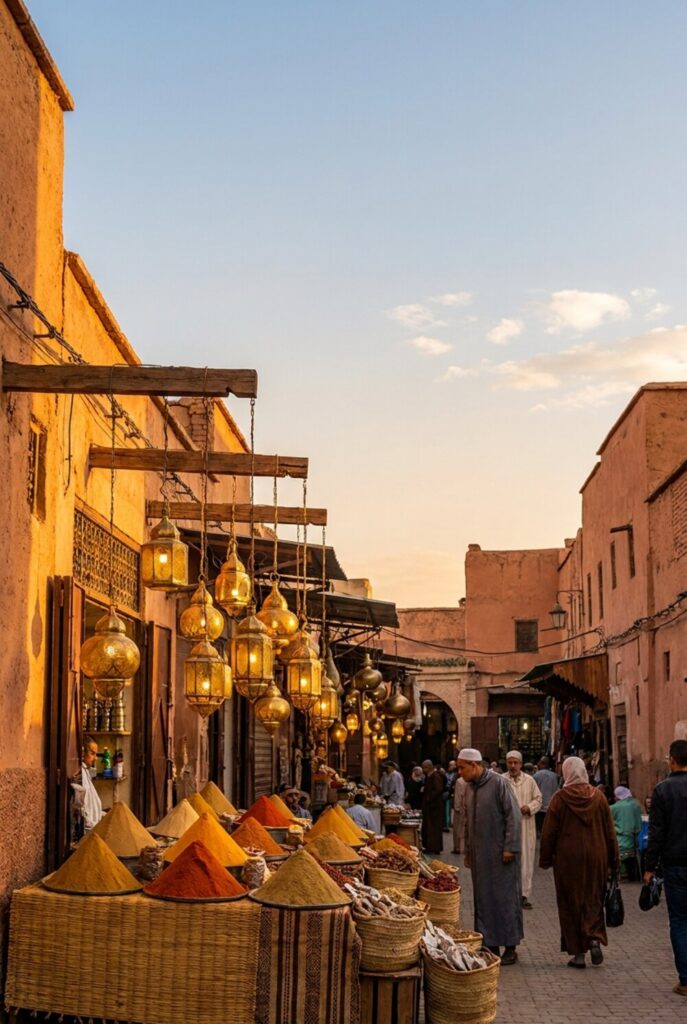
The fourth-largest Moroccan city (population 940,000) and the most-visited destination in Africa. Marrakech is built around the Jemaa el-Fnaa — the central square that operates as a working open-air theatre of food stalls, snake charmers, storytellers, henna artists, and Gnawa musicians, running essentially nonstop from morning to midnight. The medina, walled in 1126 by the Almoravids, contains the Koutoubia mosque (the 12th-century Almohad minaret that became the architectural template for the Giralda in Seville), the Saadian Tombs (sealed in 1672 and rediscovered in 1917 by aerial photography), the Bahia Palace (a 19th-century vizier’s residence with the country’s most photographed zellige tilework), and the souks (organised by craft — leather, dyers, brass, carpets, spices). The deeper Marrakech guide is in our Marrakech city guide.
Beyond the medina, Gueliz (the modern French-built quarter) and Hivernage offer the international-restaurant scene, the boutique-hotel concentration, and the contemporary art galleries. The Yves Saint Laurent Museum and the Majorelle Garden (acquired by Saint Laurent and Pierre Bergé in 1980) anchor the modern Marrakech cultural offering. The Palmeraie — a vast oasis of date palms north of the city — has been increasingly developed for golf resorts and luxury hotels but retains pockets of working agriculture and the ruins of the original Almoravid hydraulic system that made the oasis possible 900 years ago.
- What to do: Jemaa el-Fnaa at sunset (the food stalls assemble around 17:30 and the storytellers start by 19:00); medina souks walk; Bahia Palace; Majorelle Garden and YSL Museum; cooking class at Café Clock or La Maison Arabe.
- Signature eats: Tagine at any honest medina restaurant (try Nomad or Le Jardin for upmarket tourist-friendly versions, or the food stalls of Jemaa el-Fnaa for the street version); pastilla (the savoury-sweet meat-and-pastry pie) at Al Fassia; the lamb mechoui at Mechoui Alley near the Bab Doukkala spice souk.
- Access: Marrakech RAK airport 5 km from medina; ONCF train from Casablanca 3 hours.
🕌 Fez & the Spiritual Capital
The country’s spiritual and intellectual capital, founded in 789 AD by Idris I and home to the world’s oldest continuously operating university (al-Qarawiyyin, see Historical Context above). Fez has the largest medieval Islamic urban complex still functioning as a living city — Fez el-Bali, the original 9th-century medina, contains roughly 9,000 named alleys, 200,000 residents, and a UNESCO listing since 1981. The city’s three main attractions sit close together: the Bou Inania Madrasa (a 14th-century theological school with the most photographed cedar-and-stucco ceiling in Morocco), the Chouara tannery (operational since the 11th century, the famous bird’s-eye view from the leather shops surrounding it), and the al-Qarawiyyin complex itself.
Fez has a markedly more conservative, more religiously-observant atmosphere than Marrakech — the medina is genuinely working rather than tourist-optimised, the cultural register is more traditional, and the call to prayer carries weight here in a way that the Marrakech version does not. Most travellers find Fez harder to navigate than Marrakech (the alleys are more confusing, the faux-guide pressure higher) but ultimately more rewarding. Hire an official guide for at least the first day — the medina layout genuinely defeats Google Maps. The Mellah (the historic Jewish quarter, with the 17th-century cemetery and the partially restored synagogue) is a quieter alternative neighbourhood worth a half-day.
- What to do: Hire a licensed guide for medina day 1 (essential); Bou Inania Madrasa; Chouara tannery viewing terrace (be prepared for the smell — they’ll give you mint to hold); al-Qarawiyyin courtyard; Mellah quarter; Borj Sud viewpoint at sunset for the panoramic medina view.
- Signature eats: Pastilla (Fez is the dish’s hometown); chicken or lamb tagine with preserved lemon at Café Clock or Dar Hatim; Fez cherries in season (May-June).
- Access: Fez FEZ airport 15 km from medina; ONCF train from Casablanca 3h45m, from Marrakech 7h via Casablanca change.
🌊 Essaouira & the Atlantic Coast
The 18th-century Portuguese-built harbour city on the Atlantic, 175 km west of Marrakech (3 hours by car or bus). Essaouira is the country’s most pleasant warm-weather coastal escape — the persistent afternoon Atlantic wind keeps summer temperatures at a steady 22-26°C while inland Morocco bakes, and the medina (UNESCO 2001) is small, walkable, and substantially less commercially aggressive than Marrakech or Fez. The harbour has the country’s main sardine fishing fleet (visible at the morning fish auction), the city walls offer dramatic Atlantic surf views (Orson Welles filmed his 1952 Othello here, with the cannon-ramparts standing in for Cyprus), and the surrounding beaches stretch for 10 km north and south.
The wind is the practical caveat. Essaouira is the African continent’s premier windsurfing and kitesurfing destination precisely because it is windy 250+ days per year, with the strongest winds in summer (June-August, often 25+ knots). Lounge-on-the-beach travellers find this tedious; surfers and kiters find it ideal. For non-water activity, the medina, the Skala fortress, and the Mellah quarter are all walkable in a long afternoon; argan oil cooperatives outside town offer authentic visits to working co-ops where Berber women hand-process the oil. South of Essaouira, the surf villages of Imsouane and Taghazout (closer to Agadir) are the dedicated surf-camp scene.
- What to do: Walk the medina and the Skala fortress; harbour and morning fish auction; argan oil cooperative visit; horseback ride along the beach; surfing/kitesurfing lessons; day trip to the Sidi Kaouki beach south of town.
- Signature eats: Grilled sardines at the harbour (MAD 30-60 per kg, picked from the catch and grilled in front of you); seafood pastilla at Restaurant La Decouverte; the Berber omelette with argan oil at Café Triskala.
- Access: 3-hour drive or bus from Marrakech; CTM bus runs MAD 90 each way.
🏔️ The High Atlas & Toubkal
The mountain spine running 750 km diagonally across Morocco from the Atlantic coast to the Algerian border, with peaks above 4,000 metres. The High Atlas is the country’s water tower (snowmelt feeds Marrakech and the southern oases), the cultural homeland of the Tashelhit-speaking Berber population, and the country’s premier hiking destination. The headline trek is Mount Toubkal (4,167 m, the highest peak in North Africa), a 2-day round-trip from the trailhead village of Imlil with an overnight at the 3,200 m Refuge du Toubkal. The summit day involves 1,000 metres of vertical gain on scree and a final scramble; no technical climbing needed in summer (May-October), but winter (November-April) requires crampons, ice axe and mountaineering experience.
Beyond Toubkal, the High Atlas offers a network of multi-day treks through Berber villages — the Mgoun massif (4,071 m, the second-highest, in central Morocco) and the Aït Bouguemez valley (the “Happy Valley” of terraced fields and stone hamlets) are the alternative trekking bases. Imlil itself sits at 1,740 m and is genuinely lovely as a 2-3 night retreat from Marrakech heat. The Kasbah du Toubkal hotel — a converted 19th-century citadel with views straight up the valley toward Toubkal — is the country’s most atmospheric mountain stay.
- What to do: Imlil-based day-hikes (the Tamatert Pass, the Aroumd village walk); 2-day Toubkal summit trek (May-Oct); 7-day Mgoun traverse for serious trekkers; Tizi-n-Test mountain pass drive from Marrakech to Taroudant.
- Signature eats: Berber tagine cooked over wood embers at any village home-stay; tea served from height (the high-pour mint tea ritual is a Berber thing); fresh bread baked daily in stone hearths.
- Access: 90-minute drive from Marrakech to Imlil (MAD 600-800 by chartered taxi, MAD 30 by shared grand taxi).
🏜️ The Sahara — Merzouga & M’Hamid
The Moroccan Sahara begins where the Atlas mountains end and stretches south across the Algerian and Mauritanian borders. Two main desert bases serve travellers: Merzouga (the eastern gateway, accessing the Erg Chebbi dunes — a 50 km² field of golden sand dunes up to 150 metres high, and the most photographed desert in Morocco), and M’Hamid (the western gateway, accessing the Erg Chigaga dunes — slightly smaller and less developed, requiring more time to reach but quieter). The standard Sahara experience is a 2-3 day overland trip from Marrakech: drive over the Tizi-n-Tichka pass (2,260 m), through Aït Benhaddou (the famous mud-brick kasbah, UNESCO 1987, used as filming location for Game of Thrones, Gladiator, Lawrence of Arabia and Prince of Persia), to Ouarzazate (“the Hollywood of Morocco,” with the Atlas Studios film complex), through the Dadès and Todra gorges, then onward to Merzouga.
The Sahara overnight is the classic Morocco experience: arrive at the dunes in late afternoon, switch to camel for the 90-minute ride into the Erg, watch sunset from a high dune, sleep in a Berber tent camp (the standard tier has shared toilets and basic mattresses; the luxury tier has en-suite Bedouin tents with proper beds), wake before dawn for the sunrise camel ride back. Star-gazing is exceptional — the desert sky away from Merzouga village light pollution shows the Milky Way clearly. The temperature swing is dramatic — 28°C daytime, 12°C overnight in late April, with the desert wind picking up after dark.
- What to do: 3-day overland Marrakech-Sahara loop (Aït Benhaddou-Ouarzazate-Dadès-Todra-Merzouga); Erg Chebbi dune climbing at sunrise/sunset; sandboarding; camel trek into the dunes; Berber camp dinner with drumming around the fire.
- Signature eats: Berber pizza (medfouna — the stuffed flatbread baked in sand); harira soup; the slow-cooked tanjia (Marrakech meat stew) packed in clay jars and cooked overnight in dune coals.
- Access: 9-10 hours by car from Marrakech to Merzouga (most travellers split the drive into 2 days); chartered desert tour MAD 2,000-4,500 per person for 3-day all-inclusive.
🌬️ Chefchaouen & the Northern Rif
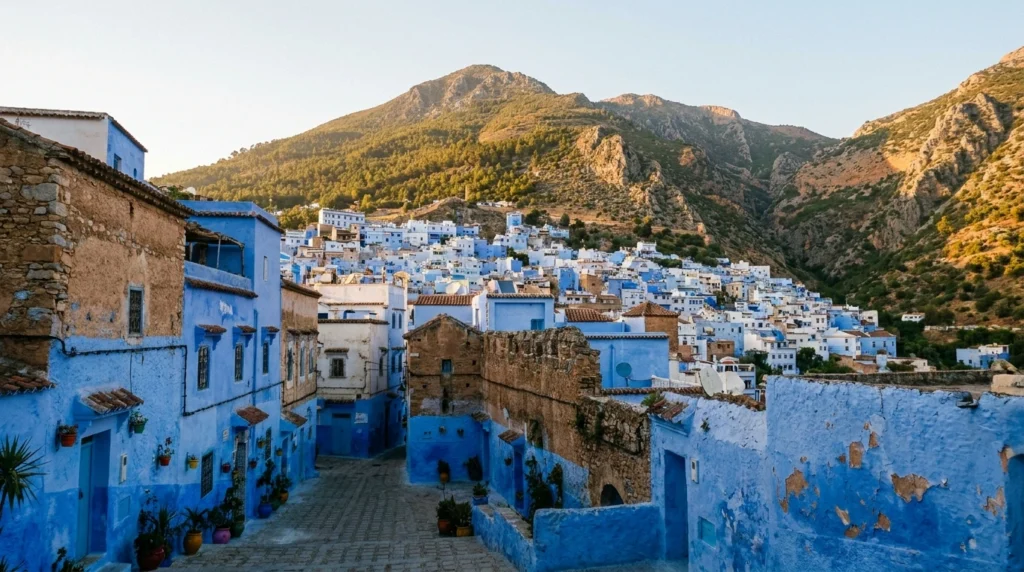
The blue-painted mountain town in the Rif, north of Fez and east of Tangier — population 43,000 and one of the most photographed small towns in North Africa. Chefchaouen was founded in 1471 as a Moorish-Jewish refuge from Spanish reconquest forces; the famous blue-washing of houses and walls began in the 1930s, possibly as a Jewish symbolic mark, possibly as a mosquito repellent (mosquitos avoid blue), possibly as a marketing accident that has now become the town’s defining visual signature. Either way, the medina is genuinely small (40 minutes to walk corner to corner), comparatively un-aggressive in commerce, and a pleasant 2-3 day stop on a northern Morocco itinerary.
The northern Rif more broadly is the country’s quietest tourism region — Tangier (the Mediterranean ferry port to Spain, the historic international zone of the early 20th century, now significantly gentrified with the new TGV station and beach development) and Tetouan (the UNESCO-listed Andalusian-influenced medina, a 4-hour drive east of Tangier) are the regional anchors. The Rif is also the country’s hashish-producing region — agriculture you’ll see openly in the hills around Chefchaouen, a tolerated grey-zone activity that travellers are advised not to engage with given the legal complexity.
- What to do: Walk the blue alleys of Chefchaouen (especially early morning before tour buses arrive); hike to the Spanish Mosque viewpoint at sunset; day-trip to Akchour waterfalls in the Talassemtane National Park; Tangier kasbah and the American Legation Museum.
- Signature eats: Goat cheese (the Rif’s specialty); rural-style harira; Tangier fish-market lunches.
- Access: 2.5 hours by bus from Fez to Chefchaouen; 3 hours by bus from Tangier; no direct train.
“Tea must be black as night, sweet as love, and hot as hell.”
— Berber proverb on the preparation of mint tea, the country’s universal hospitality ritual
🗓️ Sample Itineraries
Morocco rewards travellers who pick a focus rather than try to cover the whole country. Below are four templates calibrated to typical first-trip itineraries; pick the one that matches your time, then adjust by region. All distances assume a mix of train, car and chartered driver.
5 Days — Marrakech & the Atlas
Day 1: Arrive Marrakech, check into riad, evening Jemaa el-Fnaa walk and dinner at the food stalls. Day 2: Marrakech medina full day — Bahia Palace, Saadian Tombs, souks walk, Koutoubia Mosque exterior. Day 3: Majorelle Garden and YSL Museum morning, hammam afternoon, dinner at Le Jardin or Café Arabe. Day 4: Day trip to Imlil and Atlas foothills (90-min drive each way) — Berber village walk, lunch at Kasbah du Toubkal, afternoon return. Day 5: Last morning in medina, depart afternoon. This is the minimum viable Morocco trip — fine for a first taste but doesn’t include the Sahara.
7 Days — Marrakech + Sahara Loop
Days 1–2: Marrakech (as above, condensed). Day 3: Drive Marrakech to Aït Benhaddou via Tizi-n-Tichka pass (5h with stops), explore the kasbah, sleep Ouarzazate. Day 4: Drive Ouarzazate to Merzouga via Dadès and Todra gorges (6h), arrive late afternoon for camel into the dunes, Berber camp overnight. Day 5: Sunrise from a high dune, drive back via Skoura palm grove, sleep Aït Benhaddou or Ouarzazate. Day 6: Drive back to Marrakech (4h), evening last walk through medina. Day 7: Depart. This is the textbook short Morocco trip — Marrakech bookends with the Sahara as the cultural-and-landscape centrepiece.
10 Days — The Imperial Cities + Sahara + Coast
The classic full Morocco trip. Days 1–2: Marrakech. Days 3–5: Sahara loop (as in 7-day version). Day 6: Marrakech to Essaouira drive (3h), afternoon medina walk, dinner at La Decouverte. Day 7: Essaouira full day — Skala fortress, harbour, beach, argan cooperative. Day 8: Train Casablanca-Fez (6h via change in Casablanca; or fly direct from Essaouira airport) — late evening arrival in Fez. Days 9–10: Fez full day with licensed guide; final morning in Fez before flight from Fez airport. This is the right shape for a serious 10-day trip that hits all four major ecological and cultural zones.
14 Days — North + Centre + South Loop
For travellers willing to add the Mediterranean north. Take the 10-day template as the spine, then insert: Days 11–13 (Northern extension): Train Fez to Tangier via Casablanca (5h on Al Boraq high-speed line), Tangier full day with kasbah and the Cap Spartel lighthouse; bus to Chefchaouen (3h), 1-2 nights in the blue town with day-walk to Akchour waterfalls. Day 14: Bus Chefchaouen to Tangier (3h) for departure flight. Alternative: fly Fez direct to onward destination if the northern route doesn’t fit. Two-week trips give you the cultural depth that 7-day trips can only sample.
🎯 Strategy
If you only have one trip to Morocco, do the 10-day Marrakech + Sahara + Essaouira + Fez version in late April or late October. The 5-day version misses the Sahara, which is the country’s defining landscape moment. The 7-day version misses Fez, which is the country’s defining cultural moment. The 10-day version covers both with comfortable pacing, and uses internal flights or trains rather than long drives where possible. The 14-day version is the right shape if you specifically want the Mediterranean coast and Chefchaouen, otherwise the marginal gain over 10 days is modest.
Moroccan Culture & Etiquette
Morocco operates on a hospitable, generous, and multilingual cultural register that travellers find warm but occasionally overwhelming. The country is officially Muslim (99% of the population), with Sunni Islam practised in the moderate Maliki school. Religious observance is publicly visible — the call to prayer five times a day, Friday afternoon mosque attendance, the Ramadan fasting calendar, the broader rhythm of Islamic holidays. Travellers are expected to respect these norms (modest dress especially during Ramadan, no eating on the street during daylight hours of Ramadan, no alcohol in public except at licensed establishments) but are not expected to participate.
Modest dress is the most-violated cultural norm by travellers and the one most worth getting right. Both men and women should cover shoulders and knees in public, especially in conservative cities (Fez especially), at religious sites, and outside obvious tourist zones. Marrakech and Essaouira are markedly more relaxed — shorts and tank tops are common in the modern Gueliz district and on Essaouira beaches — but the medina core in Fez, Meknes and Rabat operates on more conservative norms. Loose-fitting cotton or linen clothing is both modest and practical for the heat. Headscarves are not required for non-Muslim women but are appreciated when entering working mosques (most mosques in Morocco are closed to non-Muslims, with the exception of the Hassan II Mosque in Casablanca).
The mint tea ritual is the cornerstone of Moroccan hospitality. A guest in any Moroccan home, riad, carpet shop, or rural-village tea-house will be offered the sweet green-tea-and-mint mixture poured from a pot held high above the small glass to create a foamy head. Refusing the tea is considered rude. Drinking three glasses (the “first is bitter as life, second sweet as love, third gentle as death” rhythm) is the polite norm. The same culture extends to bread, which is sacred — never throw bread away, never put it on the floor, never step over it. The flatbread (khobz) at every Moroccan meal is the universal utensil, and the universal token of hospitality.
💬 The Saying
“Inshallah.” Roughly: “If God wills it.” The phrase appears in essentially every Moroccan conversation that touches on the future — when the bus will arrive, when you’ll meet again, when the rain will come. It’s the religious-fatalistic acknowledgment that humans propose and God disposes. Travellers initially read it as evasive (“when will the carpet be ready? — inshallah”) but learn quickly that it’s a cultural mode rather than a deflection. The corollary phrase is “labas” — “no harm / fine, fine” — the universal greeting response that absorbs any small complaint or query into a generic acknowledgment of well-being. Travellers who deploy both phrases at appropriate moments earn instant warmth.
⚠️ Important — Solo Female Travel Notes
Morocco is generally safe for solo female travellers but operates on cultural norms that take adjustment. Verbal harassment (catcalling, persistent attention from young men) is common on the street, particularly in medina cities and outside tourist hotels — usually annoying rather than threatening, but the cumulative effect is wearing. Mitigation: dress modestly even when other travellers don’t, walk confidently, ignore approaches, partner up where possible for evening medina exploration, use registered taxis at night, stay in respected riads where the staff genuinely look out for solo female guests. Many female travellers wear a wedding ring (real or fake) which dramatically reduces unwanted attention. Choose accommodation with women on staff if comfort is a priority. Avoid public beaches in skimpy swimwear — Essaouira and Agadir tolerate Western beach attire but rural beaches do not. Riad-based women’s hammam visits are an excellent and welcoming way to engage with local female culture.
A Food Lover’s Guide to Morocco
Moroccan food is one of the great Mediterranean cuisines and has been recognised as such by international food media for decades. The country sits at the crossroads of Arab, Berber, Andalusian (the post-1492 expulsion brought sophisticated Iberian-Muslim cooking), French (the protectorate-era pastry and bistro tradition), and sub-Saharan African influences, producing a cuisine of layered spice, slow-cooked meat-and-vegetable preparations, and a remarkable range of breads. The Moroccan kitchen is known for its restraint with chili (most dishes are aromatic rather than hot), its use of preserved lemon and olives, its complex spice mixes (ras el hanout — “head of the shop” — can contain 20-40 ingredients), and its position as one of the world’s great vegetarian-friendly cuisines (the meatless tagines and salad spreads are extraordinary).
Tagine is the country’s signature cooking vessel — a conical clay pot whose tall lid traps steam and condenses it back onto the slow-cooking meat-and-vegetable mixture below. The dish bearing the same name is the variety of stews cooked in it: chicken with preserved lemon and olives (the textbook version), lamb with prunes and almonds (the wedding classic), kefta meatballs with eggs (the lunch staple), and the meatless seven-vegetable tagine. Tagines are slow food, taking 90 minutes to 3 hours to cook; they’re the dish to order when you have time. Every Moroccan family has its own variations and the cooking class circuit (try Café Clock in Marrakech, Souk Cuisine in Marrakech, La Maison Arabe) is the right way to learn the technique.
Couscous is the Friday meal — every Moroccan household traditionally eats couscous on Fridays after midday prayer, with seven vegetables on a steamed semolina base and a slow-cooked broth poured over at table. The dish is part of UNESCO’s Intangible Cultural Heritage list (jointly recognised in 2020 with Algeria, Tunisia and Mauritania). The Moroccan version typically uses lamb or chicken; the seven-vegetable variation includes carrots, courgettes, turnips, pumpkin, cabbage, chickpeas and onions. Tourist restaurants serve couscous daily; locals reserve it for Fridays. Try the Friday couscous at any working family-run restaurant for the genuine version.
Pastilla (also spelled bastilla or b’stilla) is the Fez-region invention that fuses sweet and savoury — a multi-layered phyllo pie filled traditionally with shredded pigeon (modern versions use chicken), almonds, eggs and saffron, dusted with cinnamon and sugar on top. The dish is medieval Andalusian in origin, refined in Fez over the last 400 years, and is served at weddings and ceremonial dinners. The seafood version with prawns and squid (most common in Essaouira and the Atlantic coast) is the modern variant. A serious pastilla takes hours to layer and is worth seeking out at Al Fassia in Marrakech or Dar Hatim in Fez.
Mechoui and tanjia are the slow-roast classics. Mechoui is whole lamb roasted in an underground oven, the cuisine of celebration and the speciality of the Mechoui Alley near the Bab Doukkala spice souk in Marrakech (you order by weight from the open-air pits, MAD 80-150 per 250g). Tanjia is the Marrakech-specific clay-jar slow stew — packed with lamb shanks, preserved lemon and spices, sealed and cooked overnight in the embers of the local hammam ovens. It’s a bachelor’s dish historically (men-only meal-prep) and one of the country’s most distinctively local foods. Order it at Le Trou au Mur or Tanjia restaurants in the medina.
Street food is genuinely accessible and cheap. The Jemaa el-Fnaa food stalls assemble around 17:30 and serve until midnight — choose a busy stall (locals queueing is the only quality-control signal), point at what you want, sit on the bench. MAD 30-80 (US$3-8) gets you a substantial meal of grilled meat, harira soup, and bread. Other street-food classics: msemen (a layered flat-pancake breakfast bread, served with honey and butter), bissara (the breakfast fava-bean soup of working-class Morocco, dressed with olive oil and cumin), msemmen au khlii (a savoury cured-meat-and-egg version), and the orange juice stalls that line every medina (MAD 5-10 per glass, freshly squeezed).
Mint tea and coffee are the hospitality bookends. The atay bi naânaâ — sweet green tea with fresh mint — is the universal Moroccan welcome drink, served from a pot held high to create a foamy head. Cafes culture is massive: every neighbourhood has working-class café-terraces where men spend 2-3 hours over a single coffee or tea. Argan-oil-flavoured coffee is the Berber speciality. Espresso quality is uneven — the French legacy has produced surprisingly average coffee at most cafes, with notable exceptions in the high-end riads and modern Gueliz cafes. Spice-rich coffees with cardamom, ginger and pepper (qahwa nous nous) are the regional alternatives.
📸 Photography Notes
Morocco is one of the most photographically rich countries in Africa — the medinas, Sahara, Atlas, and Atlantic coast offer fundamentally different visual subjects, and the country’s light is exceptional in the cooler months. The challenge is the cultural one: Morocco operates on a stricter consent norm around photography than most Western countries, and unauthorised people-photography in medina cities is a meaningful cultural breach.
Best light by season: April-May gives the country its softest, most diffused light — sunrise and sunset still flexible, midday sun manageable. Summer (June-August) is harshly bright; shoot only first and last 90 minutes of daylight. October-November is the photographers’ favourite — clear post-monsoon air, soft warm light, autumn agricultural landscapes. Winter (December-February) offers high-contrast clear-sky days with low-angle light all day in the south.
Five locations worth the dawn alarm:
- Aït Benhaddou kasbah, Atlas foothills (31.0479°N, 7.1297°W) — the postcard mud-brick fortified village. Best at sunrise from the modern bridge across the Mellah river; warm light hits the kasbah walls from the east. The afternoon shot from the hilltop is the alternative.
- Erg Chebbi dunes, Merzouga (31.1497°N, 4.0125°W) — the rolling sand dunes east of the village. Best at sunrise/sunset from the highest accessible dune (about 150 m above the surrounding plain); the wind ribs reset themselves overnight, giving fresh patterns each morning.
- Chouara tannery, Fez (34.0668°N, 4.9697°W) — the medieval leather-dyeing pits viewed from the surrounding leather-shop terraces. Best at late morning when the sun is high enough to illuminate the colour-pit grid clearly. Shop owners will let you up for a pretence of looking at goods; tipping MAD 20-50 is appropriate.
- Chefchaouen blue alleys (35.1714°N, 5.2697°W) — the painted-blue old town. Best 6:30-8:00 a.m. before the day-tripper buses arrive from Tangier. The Spanish Mosque viewpoint at sunset gives the alternative panoramic shot.
- Jemaa el-Fnaa, Marrakech (31.6258°N, 7.9892°W) — the central square. Best at blue hour (19:00-19:30 in late April, 20:30-21:00 in summer) when the food-stall lights begin and the sky still holds colour.
Drone rules: Morocco has effectively banned drones for tourist use. Bringing a drone into the country requires advance authorisation from the Moroccan civil aviation authority (DAC) and the Ministry of Interior; without it, drones are routinely confiscated at customs at Casablanca and Marrakech airports. Even with authorisation, flying at archaeological sites, royal palaces, military installations and major monuments is prohibited. For most travellers the realistic answer: don’t bring a drone. Confiscation is the rule, not the exception, and recovering one through bureaucratic channels is impractical.
✨ Pro Tip — People Photography Etiquette
The cultural norm in Morocco is to ask permission before photographing any individual, particularly in medinas. Many people will say no, particularly older women in traditional dress; respect this without negotiation. Many others will say yes and expect a small tip (MAD 5-20). The Jemaa el-Fnaa snake charmers, water-sellers in traditional dress, and Gnawa musicians work explicitly as photo subjects and expect MAD 20-50 per photo session. Children should never be photographed without explicit parental consent. Shooting from a long lens at a distance is read as exploitative. The respectful approach: engage briefly, ask, accept the answer, tip if you got the shot, move on. The Berber women weaving rugs at rural cooperatives are usually happy to be photographed working — but ask the cooperative manager first.
Off the Beaten Path — Morocco Beyond Marrakech
The Marrakech-Sahara-Fez axis accounts for roughly 75% of foreign visits and about 5% of the country’s surface area. The remaining 95% is harder to reach, less Instagrammed, and much closer to the Morocco that Moroccans themselves spend their lives in.
🏛️ Volubilis & the Roman North
The 2nd-century AD Roman city near Meknes — the southwesternmost outpost of the Roman Empire and Morocco’s most extensive Roman ruin (UNESCO 1997). The site includes a 1,300-year-old triumphal arch (commemorating Caracalla, 216 AD), the basilica, the capitol, and remarkable mosaic floors that remain in situ. Volubilis was the capital of the Roman province Mauretania Tingitana and continued to be inhabited as a Berber-Roman-Christian city until the 11th century. The site sits at the foot of the Zerhoun mountain alongside Moulay Idriss — a sacred Berber pilgrimage town that’s the burial site of Idris I (founder of the first Moroccan dynasty in 789 AD). A combined Volubilis-Moulay Idriss-Meknes day trip from Fez is one of the most rewarding day-trips in northern Morocco.
🏰 Taroudant & the Souss Valley
The “grandmother of Marrakech” — a smaller, slower, walled city in the Souss valley south of the High Atlas, 80 km east of Agadir. Taroudant retains its 16th-century Saadian ramparts (10 km of walls, photogenic at sunset), a gentler souk culture than Marrakech, and the medieval rhythm that Marrakech has lost to mass tourism. The Souss valley around it is the country’s main argan tree forest — the gnarled, drought-tolerant Argania spinosa is endemic to southwestern Morocco and produces the argan oil that’s the regional culinary and cosmetic specialty. Visit a working argan cooperative (Cooperative Marjana, Cooperative Tigmi) where Berber women hand-grind the kernels and the production process is genuinely artisanal.
⛰️ The Aït Bouguemez “Happy Valley”
The terraced agricultural valley deep in the central High Atlas, 6 hours by 4WD from Marrakech and a different country from the headline tourist circuit. The valley is 30 km long, dotted with 27 Berber villages of stone-and-mud houses, walnut groves, and irrigated fields of barley, alfalfa and saffron. Multi-day treks from the valley climb the Mgoun massif (4,071 m, the second-highest peak in Morocco) or descend through the rose-growing Dadès canyon. Local home-stays cost MAD 200-350 per night including meals; the Berber hospitality is extraordinary, the rhythm fundamentally pre-modern, and the scenery genuinely Alpine. Allow 4-7 days for a meaningful Aït Bouguemez visit.
🏝️ Sidi Ifni & the Atlantic South
The Spanish-built coastal town on the southern Atlantic — Sidi Ifni was a Spanish enclave from 1934 to 1969 and retains a strange Andalusian-Moroccan hybrid character with art deco buildings, Spanish church architecture, and a quietly retired feel. The southern Atlantic coast more broadly (Tan-Tan, Tarfaya, the gateway to the Western Sahara) is the country’s least-visited coastal stretch — windswept beaches, fishing villages, and the start of the Sahara desert proper as you head south. Tarfaya was where Antoine de Saint-Exupéry served as the airmail pilot in 1927-28 and which inspired The Little Prince; the small Saint-Exupéry museum honours the connection.
🏞️ The Dadès & Todra Gorges
The two parallel canyons in the eastern High Atlas, between Ouarzazate and Merzouga, that most travellers blow through on the way to the Sahara. The Dadès gorge is famous for its “monkey fingers” rock formations and the dramatic switchback road that climbs above the canyon walls; the Todra gorge is narrower, with sheer red walls 300 metres tall and just 10 metres apart at its narrowest, and is one of Morocco’s premier rock-climbing destinations. Both gorges deserve more than a 2-hour drive-through; spend a night at one of the riad-hotels in Boumalne Dadès or Tinerhir for proper exploration. The walking trails through the gorges’ agricultural valleys offer some of the country’s most striking landscapes.
Morocco by Numbers
- 37 million — country population (2025)
- 9 — UNESCO World Heritage Sites
- 9,000 — alleys in the Fez el-Bali medina
- 4,167 m — Mount Toubkal (highest in North Africa)
- 14 km — distance from Spain across the Strait of Gibraltar
- 1,166 years — age of al-Qarawiyyin University (founded 859 AD)
Practical Information
Currency: Moroccan dirham (MAD or DH). The dirham is a closed currency — it cannot be obtained outside Morocco and can only be re-exchanged at airports on departure with a receipt of original purchase. Exchange small amounts on arrival at the airport bureau (rates are competitive); ATMs at major Moroccan banks (Attijariwafa, BMCE, Banque Populaire) accept foreign cards 24/7 with MAD 30-50 transaction fees. Card acceptance is universal in major hotels, restaurants, and supermarkets in Marrakech, Casablanca, Fez and Tangier; rural areas, medina shops, and grand-taxis remain heavily cash-based. Carry MAD 500-1,000 cash for daily incidentals.
Visa & entry: US, UK, Canadian, Australian, NZ, EU and most other passport-holders enter visa-free for up to 90 days. Passports must be valid for 6 months past arrival. There’s currently no electronic travel authorisation requirement. Morocco has rolled out electronic landing forms at major airports — fill out at airport kiosks before queueing. Officially, you cannot bring more than MAD 2,000 in or out of the country (though enforcement is light); foreign currency is unrestricted but amounts above €10,000 must be declared. Tourist activities only on the visa-waiver — paid work is not permitted.
Language: Arabic is the official language; Berber (Tamazight) is co-official since 2011. The local Arabic dialect (Darija) is markedly different from Modern Standard Arabic — even Arabic speakers from the Gulf find it challenging. French is widely spoken (a legacy of the 1912-1956 protectorate) and is genuinely useful as a tourist; Spanish in the north (Tangier, Tetouan, Chefchaouen). English fluency is rapidly improving in the tourism sector but is far from universal. Learning basic French phrases (bonjour, merci, s’il vous plaît, combien) goes a long way; basic Arabic (salaam aleikum, shukran, la shukran) earns warmth.
Connectivity: 4G covers Marrakech, Casablanca, Fez, Tangier and most major towns. Maroc Telecom and Inwi sell prepaid SIMs at MAD 100-200 (US$10-20) for 10-20 GB at the airport on arrival or any phone shop in town. eSIMs from Airalo, Ubigi or other international providers also work. Free Wi-Fi is universal in cafes, hotels, and most restaurants in tourist areas. Coverage drops in the High Atlas, the Sahara, and the rural southern oases — don’t rely on connectivity for navigation in remote areas.
Tap water: Not recommended for travellers, even in major cities. Stick to bottled or filtered water. Morocco produces and sells its own bottled water brands (Sidi Ali, Oulmès) cheaply. Mid-range and upmarket riads usually provide complimentary bottled water.
Plug type: Type C and Type E (European, two round pins, 220V/50Hz). North American travellers need an adapter and possibly voltage converter; UK travellers need an adapter.
Budget Breakdown — What Morocco Actually Costs
Morocco is one of the better-value destinations on the African continent for international travellers. Daily costs run roughly 25-35% below southern European destinations like Spain or Italy, comparable to Turkey or Tunisia, and notably above Egypt or sub-Saharan equivalents. The luxury end has emerged sharply over the last decade — Royal Mansour Marrakech, La Mamounia, the Amanjena resort, the desert luxury camps — but mid-range and budget tiers remain affordable.
💚 Budget Traveller — $35–70 / day
Hostels or basic riads, food-stall meals at Jemaa el-Fnaa, public buses, occasional shared grand taxi. Hostel dorm bed MAD 100-180 (US$10-18). Riad single MAD 280-450. Food-stall dinner at Jemaa el-Fnaa MAD 40-80. ONCF train Marrakech-Casablanca second class MAD 140 (US$14). Free entry to most public squares; medina sites MAD 30-100. The trick is to base in one or two medina riads and explore on foot rather than chase multi-region itineraries.
💙 Mid-Range — $110–190 / day
Three-star riad or hotel double MAD 600-1,200 (US$60-120). Restaurant dinner with one drink MAD 200-350. Chartered grand taxi for half-day MAD 600-900. Sahara overnight package (camel, camp, meals, all-inclusive) MAD 800-1,500 per person. One major activity per day (cooking class MAD 600, hammam treatment MAD 350-700, guided medina tour MAD 300-500). This is the realistic shoulder-season cost for a couple following a Marrakech-Sahara-Essaouira-Fez circuit.
💜 Luxury — $400+ / day
Morocco’s high-end runs at international prices for genuinely irreplaceable experiences. Royal Mansour Marrakech, La Mamounia, Selman Marrakech — MAD 6,500-25,000+ per night. Tasting menu at Le Grand Café de la Poste or La Maison Arabe MAD 800-1,500 per person. Private 4WD desert tour with luxury Bedouin tent (Erg Chigaga Luxury Camp, Sahara Desert Luxury Camp Yasmina) MAD 4,500-12,000 per person per night. Helicopter from Marrakech to Atlas valleys MAD 25,000+. Morocco scales beautifully at the top end and the experiences are genuinely irreplaceable — a luxury hammam at Royal Mansour or a private dinner served on a Sahara dune are among travel’s great single-night experiences.
| Item | Budget (MAD) | Mid-range (MAD) | Luxury (MAD) |
|---|---|---|---|
| Bed (per night) | 100–280 (hostel/basic riad) | 600–1,200 | 6,500–25,000+ |
| Dinner | 40–100 (food stall / cheap restaurant) | 200–350 (sit-down restaurant + drink) | 800–1,500 (high-end tasting + drinks) |
| Daily transport | 30–60 (shared grand taxi) | 600–900 (chartered) | 3,500+ (private 4WD with driver) |
| One activity | 30–100 (medina site entry) | 300–700 (guided tour, hammam) | 4,500+ (luxury desert camp night) |
| USD daily (MAD 10/$1) | $35–70 | $110–190 | $400+ |
🧳 Travel Guru Tip — The Riad Distinction
“Riad” specifically means a traditional Moroccan house built around a central courtyard with internal-facing rooms — the architectural form unique to medina cities. A proper riad has 4-12 rooms, an interior fountain or plunge pool, a roof terrace with city views, and serves breakfast on the courtyard. A “hotel” called a riad is sometimes just a hotel using the marketing term. The distinction matters: an authentic riad is a property of intimacy, traditional hospitality, and architectural detail (zellige tile, carved cedar, stucco) that no modern hotel can replicate. Marrakech and Fez have genuine riads at every price point — research properties on Marrakech-Riads.com, Riad-Catalonia, or via boutique-hotel platforms like Mr & Mrs Smith. A multi-night riad stay is the experience that converts first-time Morocco visitors into returning enthusiasts.
✅ Pre-Trip Checklist
The minimum kit and admin to have sorted before you fly. Morocco rewards travellers who pack appropriately for the climate range, plan the time-sensitive items (Sahara tour, riad bookings) in advance, and budget for the cultural learning curve.
- Documents: Passport valid 6+ months past arrival. Print or save offline copies of all hotel and tour confirmations — many smaller riads still ask for printed reservations on arrival. Save a copy of the Sahara tour itinerary including driver contact details.
- Insurance: Travel insurance with cover for adventure activities (Atlas trekking, camel rides, dune-buggy excursions) and medical evacuation up to $500K. Moroccan healthcare is decent in private clinics in major cities but rural areas need air evacuation in serious cases.
- Modest dress kit: Loose-fitting cotton or linen long-sleeved tops and trousers/long skirts for medina walks, conservative cities, and religious sites. Lightweight scarf for women (useful as headcovering when entering mosque courtyards or Berber homes). Even in summer heat, the sun-and-dust protection is genuinely useful.
- Layers: Late April runs 14-28°C across the day in Marrakech and the Sahara. Lightweight fleece or wool layer for desert nights and Atlas evenings. The Atlas in May still has snow on Toubkal — proper kit for serious treks.
- Footwear: Comfortable walking shoes or sandals for medina cobblestones; closed-toe shoes essential for the Chouara tannery (the smell will saturate sandals); sturdy hiking boots for any Atlas trek.
- Sunscreen and head cover: The Moroccan sun is intense year-round. SPF 50+ minimum; brimmed hat or chèche (the local long head-cloth, doubles as scarf and turban — buy one in Merzouga before the desert) is genuinely useful.
- Apps to download: Maps.me (offline maps, essential in medinas), Careem (the Uber-equivalent in Marrakech and Casablanca), ONCF (train booking and schedules), Google Translate (Arabic and French offline packs), XE Currency (offline rates), WhatsApp (the universal Moroccan communication tool — your driver, riad owner and tour guide will all WhatsApp you).
- Cash: Bring €100-200 in clean euros for emergency exchange or small fees. Once in Morocco, keep MAD 500-1,000 in small notes (10s, 20s, 50s) for tips, taxi fares, and souk transactions. Big notes (200, 500 MAD) often can’t be broken at small shops.
- Toilet paper / hand sanitiser: Many medina cafes and rural-route public toilets don’t supply paper. A small pack of tissues plus hand sanitiser is genuinely useful.
- Power adapter: Type C or E (European). North Americans need an adapter; UK travellers need an adapter.
🤔 What Surprises First-Timers
- How sensory-overwhelming the medinas are. The first day in the Marrakech or Fez medina is genuinely disorienting — the alley density, the noise, the smell, the constant approaches from sellers and faux-guides. By day three, you’ve adjusted and the same medina feels welcoming. Build a quiet riad-stay around the medina days specifically.
- How seriously the bargaining is taken. The first quoted price is 2-4x the realistic price. Counter at 30-40% of the opening offer. This is not aggressive — it’s the cultural norm. Travellers who pay first-quoted prices are seen as either rich foreigners or naive ones, and gossiped about.
- How affectionate Moroccan greetings are. Cheek-kisses (one or two depending on relationship and region), warm hand-shaking, and lengthy “how are you, your family, your work, your health” exchanges before any business. Rushing past these greetings reads as cold and strange.
- How seriously bread is treated. Bread (khobz) is sacred. Never throw it away, never put it on the floor, never step over it. Stale bread goes into a separate small basket which is collected daily for animal feed.
- How variable taxi fares are. Petite taxis (city taxis, smaller cars) have meters that drivers sometimes refuse to use; agree the fare verbally before getting in. Grand taxis (intercity) operate on fixed-route fixed-fare or chartered basis. Uber doesn’t operate in Morocco; Careem (the regional alternative) does in Marrakech and Casablanca only.
- How much haggling depletes energy. A serious carpet purchase can take 90 minutes of negotiation including 3-4 rounds of mint tea. By day 5 of a Morocco trip most travellers have bargaining fatigue and start paying more just to end the conversation. That’s normal; pace yourself.
- How early evening dinners are by Western European standards. Most Moroccan families eat dinner 19:30-21:00; tourist restaurants run from 19:00 to about 23:00. The Spanish/southern-European late-dinner rhythm doesn’t apply.
- How private/public-space conventions differ. Public hammams are gendered, deeply social, and a different cultural register from European spas — the bathing happens in shared pools, you’re scrubbed by another patron or the attendant, modesty norms are looser than expected. The riad-based luxury hammam is the gentler tourist version.
Frequently Asked Questions
Is Morocco really safe?
Yes, by international standards. Violent crime against tourists is genuinely rare; Morocco ranks well on the Global Peace Index. The realistic risks are pickpocketing in the medinas (particularly Jemaa el-Fnaa at peak crowd times), faux-guide nuisance, occasional taxi over-charging, and the cultural-overwhelm fatigue that catches first-timers off guard. The September 2023 Atlas earthquake affected mountain villages south of Marrakech but the major tourist infrastructure was unaffected and recovery has been strong.
When are the best times to visit Morocco?
Late April through May, and late October through November. Both windows give pleasant weather across all four ecological zones (medina cities, Atlas, Sahara, coast), pre- or post-summer pricing, and reasonable crowds. Avoid July-August (interior heat is brutal) and the December-January Christmas/New Year peak (peak prices in Marrakech particularly).
Is Morocco safe for solo female travellers?
Generally yes, with cultural adjustment. Verbal harassment (catcalling, persistent approaches) is common but usually annoying rather than threatening. Mitigation: dress modestly, walk confidently, ignore approaches, partner up at night, stay in respected riads, use registered taxis after dark. Many female travellers wear a wedding ring (real or fake) which significantly reduces unwanted attention. Solo female travel works particularly well with a structured itinerary and pre-booked accommodation rather than wing-it improvisation.
Can I drink the tap water?
Not recommended. Stick to bottled (Sidi Ali, Oulmès brands are local and cheap) or filtered water everywhere, including in major cities. Most riads provide complimentary bottled water for guests.
How do I pick a Sahara desert tour?
Three tiers: budget (shared 4WD with strangers, basic camp, MAD 800-1,200 per person 3 days all-inclusive), mid-range (smaller group, en-suite tents, MAD 1,500-3,000 per person), and luxury (private vehicle, deluxe Bedouin camp with proper beds and en-suite bathrooms, MAD 4,500-15,000+ per person). Avoid the cheapest 1-day Marrakech-to-desert tours — the round-trip drive (9-10 hours each way) leaves only 2 hours at the dunes. The 3-day version is the minimum sensible duration.
Should I learn French or Arabic?
French is more practically useful — it’s widely spoken in tourism services and gets you through 90% of interactions. Basic Arabic phrases (salaam aleikum, shukran, la shukran) earn warmth but aren’t essential. The local Darija dialect is hard for foreign Arabic learners. English fluency in tourist services is improving rapidly but isn’t yet universal.
How much should I tip?
Tipping is part of Moroccan service culture. Restaurants 10% (often unincluded). Riads MAD 50-100 per night for housekeeping. Tour guides MAD 100-200 per day for half-day, MAD 300-500 for full-day. Drivers MAD 100-200 per day. Camel-tour camp staff MAD 50-100 per person. Hammam attendants MAD 50-100. Carry small-denomination notes — MAD 10s, 20s, 50s — for the constant low-level tipping that the cultural register expects.
What’s the one thing first-timers always regret skipping?
A proper hammam visit. Travellers who skip the hammam (either the public neighbourhood version or the upscale riad spa version) miss the country’s most distinctive bodily-cultural experience. The full traditional sequence — black soap exfoliation, ghassoul clay treatment, scrub with the kessa glove, tea afterward — is unlike any spa treatment elsewhere and the relaxation effect is genuine. Try it twice if you can — once at a riad spa for comfort, once at a public neighbourhood hammam for the cultural experience.
Ready to Explore Morocco?
Morocco rewards travellers who plan a little and surrender a lot. Marrakech, Fez, the Sahara, the Atlas, the Atlantic coast — they will be there. The bargaining culture, the call to prayer rhythm, and the medina maze decide the order. Build the itinerary, then let “inshallah” take over.
For a tailored Morocco trip — including 2026 post-Ramadan routing, Sahara overnight options, or a deeper imperial-cities-and-coast circuit — start with our trip-planning team. We can match you with the right riad, driver, Sahara camp, and medina guide to suit your party rather than the package-tour default.
Explore More
🏛️ Marrakech city guide
The Red City — neighbourhood by neighbourhood, with the medina, Gueliz, Hivernage, and the right walking order through the souks.
🇪🇸 Spain travel guide
The natural Morocco pairing across the Strait of Gibraltar — Andalusia, Granada’s Alhambra, and the shared Moorish architectural inheritance.
🇪🇬 Egypt travel guide
The other great North African civilisation — Cairo, the Pyramids, and the Nile. The natural Morocco follow-up for Arab-world travellers.
🇵🇹 Portugal travel guide
The Atlantic Iberian neighbour — Lisbon, the Algarve, and a similar mix of Moorish and European architectural layers.
🗺️ Plan a custom trip
Tell us when you’re going and we’ll design a day-by-day Morocco itinerary that respects the medina rhythm, the desert windows, and the seasonal calendar.
Cities we cover in Morocco
Cities to explore in Morocco
Deep-dive guides to specific cities, neighbourhoods, and food scenes — written with the same magazine voice.
More country guides you might like
Plan your trip to Morocco
The booking tools we use ourselves. FFU may earn a commission at no extra cost to you.
Plan & book your trip to Morocco
Booking through these searches supports our guides at no extra cost to you.