
☰ On this page
- 📋 In This Guide
- Overview — Why Pakistan Belongs on the Serious Traveller’s List
- 🛫 Current Travel Window — Why 2026 Is Different
- Best Time to Visit Pakistan (Season by Season)
- Getting There — Flights & Arrival
- Getting Around — Domestic Flights, the GT Road and the Karakoram Highway
- Top Regions & Cities
- 🗓️ Sample Itineraries
- Pakistani Culture & Etiquette
- A Food Lover’s Guide to Pakistan
- 📸 Photography Notes
- Off the Beaten Path — Pakistan Beyond the Cities
- Practical Information
- Budget Breakdown — What Pakistan Actually Costs
- ✅ Pre-Trip Checklist
- 🤔 What Surprises First-Timers
- Frequently Asked Questions
- Ready to Explore Pakistan?
- Explore More
Languages of Pakistan
All languages of Southern Asia →fluent beta classical · classes by phone with Maya at ranas.ai/maya
Pakistan is the only country on Earth where you can stand below five of the world’s fourteen 8,000-metre peaks, walk a Mughal-era garden built for an empress, eat biryani that was carried west on the Grand Trunk Road, and read a 12th-century Persian couplet carved into a Lahore mosque wall — sometimes within the same week. It is the world’s fifth-most-populous country, with roughly 240 million people, and the second-largest Muslim-majority nation after Indonesia. Its territory stretches from the Arabian Sea coastline at Karachi to the high glaciers of the Karakoram, an altitude range of more than 8,500 vertical metres in a country roughly twice the size of California.
What makes Pakistan unusual is the layering. The same country contains the Indus Valley sites of Mohenjo-daro and Harappa (4,500 years old, contemporaneous with Sumer and Pharaonic Egypt); Gandharan Buddhist monasteries from the 1st century AD where Greco-Roman sculpture met Indian devotional art; Mughal capitals built for Akbar, Jahangir and Shah Jahan; British colonial railway stations and cantonments; and a modern federal capital, Islamabad, that was master-planned by a Greek architect and inaugurated in 1967. Few travellers see more than a slice of this. Those who do come back changed.
This guide covers Pakistan end to end — from the Mughal cities of the plains to the Karakoram peaks the rest of the world calls the world’s third pole. If you’re crossing from a neighbour or comparing notes on the Silk Road, see our India travel guide for the partition cousin, our Nepal travel guide for the trekking comparison, our China travel guide for the country at the other end of the Karakoram Highway, and our Iran travel guide for the western neighbour with shared Persianate culture. For trip planning, our trip-planning team can advise on current conditions and routing.
Heading to the city? Our Lahore city guide covers the Mughal-era cultural capital in depth.
📋 In This Guide
- Overview — Why Pakistan Belongs on the Serious Traveller’s List
- 🛫 Current Travel Window — Why 2026 Is Different
- Best Time to Visit Pakistan (Season by Season)
- Getting There — Flights & Arrival
- Getting Around — Domestic Flights, the GT Road and the Karakoram Highway
- Top Regions & Cities
- 🗓️ Sample Itineraries — 7, 10, 14 and 21 Days
- Pakistani Culture & Etiquette
- A Food Lover’s Guide to Pakistan
- 📸 Photography Notes
- Off the Beaten Path — Pakistan Beyond the Cities
- Practical Information
- Budget Breakdown — What Pakistan Actually Costs
- ✅ Pre-Trip Checklist
- 🤔 What Surprises First-Timers
- Frequently Asked Questions
- Ready to Explore Pakistan?
Overview — Why Pakistan Belongs on the Serious Traveller’s List
Pakistan was created in 1947 from the partition of British India, the largest and most violent population transfer in modern history — roughly 14 million people crossed the new border in both directions, and an estimated 1 million did not survive the journey. The country’s modern shape was set in 1971 when East Pakistan separated to become Bangladesh, leaving four provinces — Punjab, Sindh, Khyber Pakhtunkhwa, Balochistan — plus the federal capital territory and the autonomous administrative regions of Gilgit-Baltistan and Azad Kashmir. The dominant language is Urdu, though Punjabi is spoken at home by close to half the population, and English remains a co-official language used in courts, universities and most road signage.
For a traveller, three things define Pakistan. First, the geography: the country contains five of the fourteen 8,000-metre peaks on Earth — K2 (8,611m, the world’s second-highest and considered its hardest), Nanga Parbat (8,126m), Gasherbrum I (8,080m), Broad Peak (8,051m) and Gasherbrum II (8,035m), all in the Karakoram and western Himalaya of Gilgit-Baltistan. Second, the depth of human history: the Indus Valley civilisation flourished from roughly 2,600 to 1,900 BCE in what is now Sindh and Punjab, with Mohenjo-daro and Harappa pre-dating most of the temples and pyramids modern travellers associate with antiquity. Third, the Mughal layer: from 1526 to the early 18th century, the Mughal emperors made Lahore, Agra and Delhi their imperial triangle, and the architectural inheritance — the Lahore Fort, Badshahi Mosque, Shalimar Gardens, the tomb of Jahangir — is concentrated almost entirely on the Pakistani side of the modern border.
The practical consequence for a traveller is that Pakistan rewards a two-week minimum. A week is enough for a Lahore-Islamabad-Hunza loop with shallow exposure to each. Two weeks lets the Karakoram open up. Three weeks gets you to Karachi and the Sindh sites and pulls together a country that is often described, accurately, as four very different countries sharing a passport.
🏛️ Historical Context
The Indus Valley civilisation is the oldest of the three river-valley urban cultures (alongside Mesopotamia and Egypt) and was the largest by area — its planned cities at Mohenjo-daro and Harappa featured covered drainage, standardised brick sizes, and grid streetplans by 2,500 BCE. Roughly 1,500 sites have been catalogued across modern Pakistan and northwest India. The script remains undeciphered. By 1900 BCE the cities were abandoned, possibly due to monsoon shifts and tectonic changes to the Indus, leaving a 4,000-year archaeological gap before the Gandharan Buddhist period revived the region as a centre of learning. Both Mohenjo-daro and the rock carvings of Bhimbetka-style petroglyphs along the upper Indus survive as UNESCO World Heritage Sites.
🎌 Did You Know?
Pakistan’s national poet, Allama Muhammad Iqbal (1877–1938), is credited as the philosophical originator of the idea of a separate Muslim state on the subcontinent — the 1930 Allahabad address in which he sketched the political case is still studied as a founding document. Iqbal wrote the bulk of his philosophical poetry in Persian (Farsi), not Urdu, because he considered Persian the language of Islamic civilisation and a wider audience across Iran, Afghanistan and Central Asia. His tomb sits in a small white-marble mausoleum at the entrance to the Badshahi Mosque courtyard in Lahore, where it is visited by uniformed military guards every hour on the hour.
🛫 Current Travel Window — Why 2026 Is Different
Pakistan has been in a structural tourism upswing since 2018, when the country introduced an online tourist visa system covering 175 nationalities and removed the No Objection Certificate (NOC) requirement for most northern areas. The British Foreign Office downgraded its blanket “advise against all travel” warning for Gilgit-Baltistan and Hunza in 2019. Visitor numbers from Western Europe, North America and East Asia have risen each year since, with 2024 and 2025 setting post-2008 highs. The country was named by several travel publications as the “best emerging destination” in 2020 and again by separate lists in 2023.
That said, the security and political situation in Pakistan remains genuinely fluid and not uniform across regions. Punjab, Islamabad Capital Territory, Sindh’s main urban areas and most of Gilgit-Baltistan are routinely visited by independent foreign travellers in 2026; parts of Khyber Pakhtunkhwa close to the Afghan border, much of Balochistan, and the former Federally Administered Tribal Areas continue to carry “advise against all travel” warnings from most Western foreign ministries. Conditions can change quickly, and a deterioration in one province does not necessarily affect another — but the headlines do not always make that distinction.
The practical reality is that the routes most independent travellers take — Lahore, Islamabad/Rawalpindi, Karakoram Highway to Hunza, optional flight to Skardu — have been operating with foreign visitors for years and have a layer of trekking agencies, jeep operators and guesthouses geared specifically to Western tourists. Police checkpoints along the way are routine and generally welcoming; foreign visitors are sometimes asked to register passport details. None of this is a substitute for checking your government’s current travel advisory the week before you book.
⚠️ Important — Check Travel Advisories Before Booking
Pakistan’s security situation can shift on a province-by-province and even valley-by-valley basis. Before booking flights or trekking permits, check the current advisories from your country’s foreign ministry — the UK Foreign, Commonwealth & Development Office (gov.uk/foreign-travel-advice/pakistan), the US State Department (travel.state.gov), Global Affairs Canada and the Australian DFAT smartraveller site all publish region-specific guidance. Also check with a Pakistan-based operator (Adventure Tours Pakistan, Hindukush Heights, Mountain Hunza Trek and similar) for ground-truth conditions in your specific region a week before departure. Travel insurance frequently excludes regions under “advise against all travel” status — read the policy wording before paying.
Best Time to Visit Pakistan (Season by Season)
Pakistan effectively has three climate zones running on different calendars — the plains of Punjab and Sindh (hot subtropical), the northern mountains of Gilgit-Baltistan and Khyber Pakhtunkhwa (alpine, with the Karakoram Highway closed in winter at the Khunjerab Pass), and the coastal Sindh-Balochistan strip (Arabian Sea, mild year-round). The Indian summer monsoon affects the eastern half of the country from late June to mid-September; western and northern regions are largely outside the monsoon belt.
Spring (March – May)
The window most experienced travellers prefer for the plains, and the early window for the lower northern valleys. Lahore in March averages 22°C and bursts into the cherry-blossom and bougainvillea season; the Mughal gardens are at their most photogenic. By April the heat is building (28°C average). May becomes uncomfortable in the south — Karachi and Multan can hit 42°C — but the lower Karakoram valleys (Naran, Kaghan, lower Hunza) come alive as the snow recedes. The Khunjerab Pass to China typically reopens for vehicles in early April.
Summer (June – August)
Punishing in the plains — Lahore and Karachi average 35°C+ daytime, with humidity in the post-monsoon weeks pushing the heat index above 45°C. Almost all serious travellers move north for these months. This is the high season for the Karakoram and Himalaya: Hunza Valley averages 25°C in July, Skardu 28°C, and the trekking trails to K2 base camp, Concordia, Fairy Meadows, and the Snow Lake circuit are open from late June to early September. Monsoon rain affects the southern slopes — landslides on the Karakoram Highway between Besham and Chilas are common from mid-July to early September and can close the road for 24–72 hours.
Autumn (September – November)
The single best window for a comprehensive Pakistan trip. The plains cool from 32°C in early September to a perfect 22°C by early November. The Hunza Valley turns gold and crimson in mid-October as the apricot, walnut and poplar leaves change — locals call this the “golden autumn” and the photography is genuinely otherworldly against the white peaks of Rakaposhi (7,788m) and Diran (7,266m). Trekking in the Karakoram remains feasible into early October at lower elevations; Fairy Meadows and the Nanga Parbat base-camp window typically closes by mid-October. By November the high passes start closing and the lower-altitude itineraries (Lahore, Multan, Sindh) come fully into season.
Winter (December – February)
The plains are at their most pleasant — Lahore and Karachi average 18–22°C daytime with cold nights, and this is the right season for the Mughal cities, the Sindh archaeological circuit (Mohenjo-daro, Makli necropolis, the Sufi shrines of Sehwan and Bhit Shah), and the coastal strip. The Karakoram Highway is open as far as Hunza in mild winters but closes at Khunjerab Pass from roughly late November to early April. Skardu and the upper Hunza valleys are accessible by air and the road remains in use, though jeep-track side valleys get snowed in. Skiing at Malam Jabba (Khyber Pakhtunkhwa) and Naltar (Gilgit-Baltistan) operates from December to early March.
🧳 Travel Guru Tip
If you have one trip and want both the Mughal cities and the Karakoram, aim for the second half of September through mid-October. The plains have cooled to comfortable, the monsoon landslide season is over, the Karakoram Highway is reliably open, and the autumn colour in Hunza is at peak. Hotels in Karimabad and Skardu drop 20–30% from August prices, and the trekking permits that take weeks to organise in summer can be processed in 48 hours. Local guides will tell you this is the window they take their own families.
| Experience | Best months | Best regions | Notes |
|---|---|---|---|
| Mughal cities (Lahore, Multan) | Oct – Mar | Punjab | Avoid Apr – Sep heat in plains |
| Karakoram Highway end-to-end | May – Oct | Khyber Pakhtunkhwa, Gilgit-Baltistan | Khunjerab Pass closed in winter |
| K2 / Concordia trekking | Late Jun – early Sep | Skardu / Baltoro Glacier | Permits required; full peak season is Jul |
| Hunza autumn colour | Mid-Sep – mid-Oct | Karimabad, Gulmit, Passu | Single best photographic window |
| Fairy Meadows / Nanga Parbat | May – early Oct | Diamir, Gilgit-Baltistan | Last 12 km on jeep track only |
| Sindh archaeology | Nov – Feb | Mohenjo-daro, Thatta, Sehwan | Hot from March; brutal Apr – Sep |
| Skiing | Dec – early Mar | Malam Jabba, Naltar | Limited infrastructure; rental gear basic |
Getting There — Flights & Arrival
Pakistan has three major international airports — Karachi (KHI), Lahore (LHE) and Islamabad (ISB) — plus secondary airports at Peshawar, Multan, Faisalabad and Quetta. For most travellers the right entry is Islamabad, which is the closest to the northern mountains and has the cleanest airport experience. Lahore makes sense if you’re starting with the Mughal cities. Karachi is the country’s commercial hub and the right choice if you’re combining Pakistan with a Sindh or Balochistan focus.
Direct flights to Pakistan are limited compared to the country’s size. From the UK, Pakistan International Airlines (PIA), British Airways and Virgin Atlantic operate London-Islamabad, London-Lahore and London-Karachi (8h–9h). From the Gulf, Emirates and Etihad fly daily from Dubai and Abu Dhabi to all three major airports (3h). Turkish Airlines via Istanbul is the most reliable European routing for North American travellers (Istanbul-Islamabad is 4h45m). Qatar Airways via Doha and Saudia via Jeddah are alternatives. Direct flights from North America were suspended for years; PIA’s New York and Toronto routes have come and gone, and as of 2026 most travellers connect via the Gulf or Istanbul.
All three major airports have e-visa kiosks and immigration counters that handle the online tourist visa (which most travellers should obtain before flying via visa.nadra.gov.pk). Arrival at Islamabad’s New Islamabad International is generally efficient — a 45-minute taxi to the city centre costs roughly PKR 3,500. Lahore’s Allama Iqbal International is closer to downtown (20 minutes, PKR 2,000). Karachi Jinnah International is 20 minutes from Clifton, PKR 2,500. Uber and Careem (the Dubai-based ride-hailing app, more widely used in Pakistan than Uber) operate from all three.
✨ Pro Tip
The Pakistan e-visa process changed in 2021 to a fully online system with a 7–10 working-day standard turnaround for most nationalities. Apply at visa.nadra.gov.pk (the official portal — there is no other) at least three weeks before travel. Required documents are a passport scan, hotel booking, a return flight, a brief itinerary, and a passport-style photo. For trekking permits in restricted zones, you also need a “Letter of Invitation” from a registered Pakistani tour operator — Adventure Tours Pakistan, Hunza Tours and Hindukush Heights are among the established ones. The 30-day single-entry tourist visa is free for British, US, Canadian, Australian and many EU passport-holders; the 90-day multiple-entry costs around $35.
Getting Around — Domestic Flights, the GT Road and the Karakoram Highway
Pakistan is large — Karachi to Gilgit is 1,800 km by road, roughly the distance from London to Athens — and the road network outside the motorway corridor is mixed in quality. The rule of thumb for a first-time visitor is to fly the long legs and drive the scenic ones. Domestic flights between Islamabad, Lahore, Karachi and Skardu are operated by PIA, Airblue and Serene Air, with one-way fares typically PKR 18,000–35,000 ($65–125) and flight times of 90 minutes to 2 hours.
The motorway network — M1, M2, M3, M4, M5 — is genuinely modern and connects Islamabad, Lahore, Multan, Karachi, Faisalabad and Peshawar with European-standard tolled expressways. The Lahore-Islamabad M2, completed in 1997, is six lanes for most of its 367 km length and is patrolled by a dedicated Motorway Police known for being incorruptible (drivers genuinely cannot bribe their way out of speeding tickets here, which makes the M2 the safest road in the country). Driving Lahore-Islamabad takes 4 hours; the bus is faster than the parallel Daewoo coach service which runs hourly.
The Karakoram Highway (KKH) — the 1,300 km road from Hasan Abdal near Islamabad to the Khunjerab Pass on the Chinese border — is the country’s most famous single road and one of the engineering marvels of the 20th century. Built jointly by Chinese and Pakistani crews from 1959 to 1979, it crosses three mountain ranges (Karakoram, Hindu Kush, Pamir), follows the upper Indus for hundreds of kilometres, and is essential for any Hunza or Skardu itinerary. The full drive Islamabad to Hunza takes 14–16 hours non-stop and is normally split over two days with an overnight in Chilas or Besham. Most travellers fly Islamabad-Skardu (PIA, weather-permitting, 60 minutes) and drive only the Skardu-Hunza-Khunjerab section, which keeps the spectacular sections without the duller plains stretches.
⚠️ Important — KKH Conditions and Jeep Tracks
The KKH is paved end-to-end but landslides during the monsoon (July–September) and avalanches in winter (December–March) can close sections for hours to days. Check road status with the Frontier Works Organisation or local hotels the morning of travel. Side valleys off the KKH — Fairy Meadows, Naltar, Hopper Glacier, Ghizer — require 4WD jeeps with experienced drivers. The Fairy Meadows access road is a famously narrow 12 km jeep track climbing 1,500m with no guardrails; do not drive it yourself. Local jeep stands at Raikot Bridge charge a fixed PKR 8,000–12,000 round-trip per vehicle. Travel insurance often excludes “non-standard mountain roads,” so check your policy.
Top Regions & Cities
📍 Map of Pakistan: Every Place in This Guide
Pakistan’s four provinces and the autonomous regions each have a distinct character. For a traveller, the practical map is six regions: Punjab (Lahore and the GT Road cities), Islamabad and the capital area, Sindh (Karachi and the lower Indus), Khyber Pakhtunkhwa (the Hindu Kush and Swat), Gilgit-Baltistan (the Karakoram), and Balochistan (largely off-limits but worth understanding).
🏛️ Lahore — The Mughal Capital
Pakistan’s cultural capital and the most rewarding city for first-time visitors. Lahore was the imperial seat of the Mughal Empire from 1584 to 1635 and again under Aurangzeb’s later reign, and the architectural inheritance is concentrated within an easy walking radius of the Walled City. The Lahore Fort (Shahi Qila), built by Akbar in 1566 and expanded by Jahangir, Shah Jahan and Aurangzeb, holds the Sheesh Mahal (Hall of Mirrors, completed 1631) and the Naulakha Pavilion. The Badshahi Mosque, completed by Aurangzeb in 1673 with a courtyard that holds 100,000 worshippers, sits across the Hazuri Bagh from the fort and remained the largest mosque in the world until 1986. Both are UNESCO World Heritage Sites.
The Walled City beyond the fort is a living medieval district — the haveli houses, the spice markets of Akbari Mandi, the Wazir Khan Mosque (1635, considered Lahore’s most beautiful for its faience tilework), and the food street at Fort Road where the rooftop restaurants face the floodlit Badshahi Mosque after dark. The Shalimar Gardens, built by Shah Jahan in 1641 with 410 fountains spread over three terraces, sit 5 km east of the old city. The British added the Mall (a 19th-century colonial avenue), Aitchison College and the Lahore Museum (where Rudyard Kipling’s father was curator and where the Gandhara Buddha collection is the best in South Asia).
- What to do: Lahore Fort and Badshahi Mosque (allow half a day); Wazir Khan Mosque; Shalimar Gardens; Tomb of Jahangir at Shahdara (5 km from the fort); food street walk after dark; Friday night attendance at the Wagah border closing ceremony.
- Signature eats: Nihari (slow-cooked beef stew, breakfast dish) at Waris Nihari near Lakshmi Chowk; the Andaaz rooftop restaurant on Fort Road for Mughlai with Badshahi Mosque view; Gawalmandi food street for paye (trotter soup) and lassi.
- Access: Lahore Allama Iqbal International (LHE), 20 min from city centre. Train from Karachi takes 18 hours; M2 motorway from Islamabad is 4 hours.
🏙️ Islamabad & Rawalpindi — The Twin Cities
Islamabad is one of the world’s most consciously planned capitals. Master-planned in 1960 by the Greek firm Doxiadis Associates and inaugurated in 1967 to replace Karachi as the federal capital, the city is laid out in a grid of numbered sectors (E-7, F-6, G-9, etc.) at the foot of the Margalla Hills. It is greener, quieter, and more middle-class than any other major Pakistani city; the population is roughly 1.2 million in the city proper and 5 million in the wider Rawalpindi-Islamabad metropolitan area. Rawalpindi, 15 km south, is the older garrison city — chaotic in the way Islamabad is not, and where most travellers stay if they want food markets, the army GHQ neighbourhood, and the Saddar Bazaar.
The signature sights are the Faisal Mosque (Saudi-funded, completed 1986, designed by Turkish architect Vedat Dalokay as a stylised Bedouin tent — courtyard capacity 100,000, the second-largest mosque on Earth by capacity); Daman-e-Koh and Pir Sohawa viewpoints in the Margalla Hills (10–15 minute drive from F-6, panoramic city view); the Pakistan Monument and museum on Shakarparian Hill; and the Lok Virsa folk-heritage museum. Rawalpindi’s Raja Bazaar, around the Bohr neighbourhood, is the antidote — narrow lanes, brass and copper workshops, and the city’s most famous biryani at the original Savour Foods.
- What to do: Faisal Mosque (free, open to non-Muslim visitors except during prayer); Daman-e-Koh viewpoint at sunset; Saidpur Village (Mughal-era spring village restored as art-and-food district); Lok Virsa museum; Raja Bazaar walk in Rawalpindi.
- Signature eats: Kababjees Tandoor (BBQ chain, locally beloved); Monal restaurant on Pir Sohawa for the city panorama; Savour Foods Rawalpindi for biryani; chapli kebabs at Namak Mandi-style joints in Pindi.
- Access: Islamabad New International (ISB), 20 km from F-6 sector. Daewoo Express bus to Lahore (4 hours, PKR 2,000); PIA flight to Skardu (1 hour, weather-dependent).
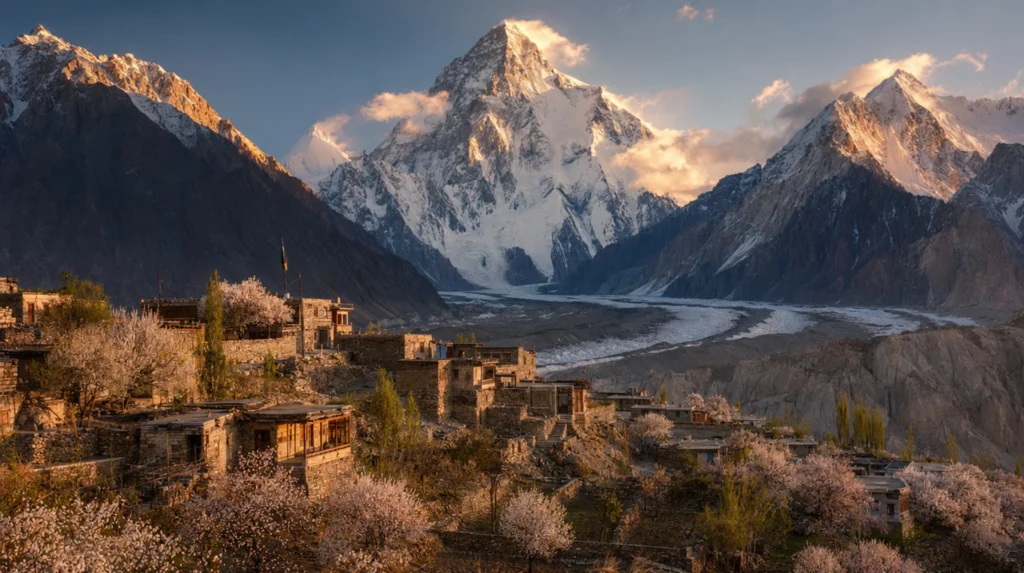
🏔️ Hunza Valley & Karimabad
The single most photographed region of Pakistan and the natural finishing point for any Karakoram itinerary. Hunza is a 100 km long valley running northeast from the Karakoram Highway between roughly Aliabad and Sost, with three major settlement clusters: central Hunza (Karimabad and Aliabad, the population centre at around 30,000), upper Hunza (Gulmit, Passu, Hussaini — Wakhi-speaking villages near the Chinese border), and the side valley of Hopper. The valley sits at 2,500m elevation and is overlooked by Rakaposhi (7,788m), Ultar Sar (7,388m) and Diran (7,266m). The local population is predominantly Ismaili Muslim (followers of the Aga Khan), which is reflected in unusually high literacy rates (above 95%, the highest in Pakistan), gender equality in education, and a consistently welcoming attitude to foreign visitors.
Karimabad is the tourist hub. Baltit Fort (700 years old, restored by the Aga Khan Trust for Culture in the 1990s) sits above the village on a spur with sweeping valley views; Altit Fort, 3 km below, is older still (around 900 years) and the original seat of the Mir of Hunza. The Eagle’s Nest viewpoint at Duikar, 20 minutes by jeep above Karimabad, is the dawn photography spot — the sunrise on Rakaposhi from here is the cover image of most Pakistan tourism material. Upper Hunza has the Attabad Lake (formed in 2010 when a landslide dammed the Hunza River, now a 22 km turquoise lake the KKH crosses on a Chinese-engineered tunnel-and-bridge system), the Passu Cones (the iconic jagged peaks visible from the road), and the Hussaini suspension bridge (a tourist-friendly version of the actual cable-and-plank bridges Wakhi villagers use).
- What to do: Baltit and Altit Forts; Eagle’s Nest sunrise; jeep day-trip to Hopper Glacier; cherry-blossom (April) or autumn (October) photography circuit; jeep to Khunjerab Pass and the Chinese border (PKR 12,000 round-trip from Karimabad).
- Signature eats: Hunza Pamir cuisine — chapshuro (meat-stuffed flatbread), giyaling (yak butter pancake), apricot soup. Café de Hunza in Karimabad has the walnut cake locals call “the world’s best.” Wild apricot and mulberry products are everywhere.
- Access: 14 hours by road from Islamabad on the KKH; or fly Islamabad-Gilgit (1 hour) and drive 2.5 hours from Gilgit to Karimabad.
⛰️ Skardu & the Baltoro Glacier — Gateway to K2
Skardu, the regional capital of Baltistan, is a high-altitude town (2,228m) in a wide bend of the Indus where the river loses its mountain valley and momentarily flows through a gravelly plain. From here the Karakoram opens — Skardu is the staging post for K2 (8,611m), Broad Peak, Gasherbrum I and II, and the Concordia trek that delivers four 8,000m views from a single point. Most independent travellers come for the lake circuit (Sheosar, Kachura, Satpara, Sadpara) and the four-hour drive to Shigar Valley, where the Shigar Fort (Fong Khar, the “Palace on the Rock,” 17th century, now an Aga Khan-restored heritage hotel) sits below the Karpogoro peak. Beyond Shigar, the road climbs to Khaplu Valley and the Khaplu Palace, the second of the Aga Khan-restored heritage forts.
The K2 base-camp trek itself is an 80–100 km round-trip from Askole (the road-head village a 6-hour jeep from Skardu) over the Baltoro Glacier, taking 14–18 days, requiring a registered guide and a permit, and crossing serious altitude (Concordia at 4,650m, K2 base camp at 5,150m). The trek is considered one of the great walks of the world and one of the more demanding non-technical objectives outside Nepal. A shorter, less committing alternative is the Hushe Valley trek to Masherbrum base camp (8 days). Both run only from late June to early September.
- What to do: Shigar Fort heritage hotel and Karpogoro lookout; Khaplu Palace; Sheosar Lake (Deosai Plains, the world’s second-highest plateau at 4,114m, July-September only); Concordia / K2 base camp trek for the committed.
- Signature eats: Balti cuisine — the original “balti” cooking that gives Birmingham’s Balti houses their name. Mantu (steamed lamb dumpling), prapu (apricot kernel sauce), and the Hushe trout grill.
- Access: PIA Skardu daily 1-hour flight from Islamabad (weather-dependent — about 65% reliable). Road from Gilgit is 7 hours via Jaglot Junction and the Skardu Road branch off the KKH.
🌅 Karachi — The Megacity
Pakistan’s largest city — population variously estimated at 17–22 million depending on the source — and the country’s commercial, industrial and port capital. Karachi was the first capital after partition (until 1959, when it was moved to Rawalpindi pending Islamabad’s completion), and the city’s architectural layers reflect every phase of that history: 19th-century British colonial buildings on Burns Road, art deco apartment blocks in PECHS, the 1960s state-architecture of the Quaid-e-Azam Mausoleum (Mohammad Ali Jinnah’s white-marble tomb, designed by Yahya Merchant), and the Clifton beachfront with its concrete-and-glass new wave. The city is loud, hot, sprawling, and the most cosmopolitan place in Pakistan — Karachi has historically been the country’s centre for English-language print media, contemporary art, and music.
For travellers, the practical Karachi is concentrated in three areas: Saddar (the colonial-era downtown, the Empress Market, the Frere Hall, and the Pakistan Chowk literary cafés), Clifton-Defence (the leafy upmarket districts where most decent hotels and restaurants are), and the harbour-and-Mohatta-Palace circuit. The Mohatta Palace, built in 1927 in a Rajasthani-Mughal hybrid style, is now a museum that hosts rotating exhibitions of Pakistani contemporary art. The harbour at Keamari is the embarkation point for the boat to Manora Island and its 19th-century lighthouse. The Sufi shrine of Abdullah Shah Ghazi at Clifton draws the city’s faithful on Thursday nights for qawwali performances.
- What to do: Quaid-e-Azam Mausoleum (Jinnah’s tomb, free, daily); Mohatta Palace; Frere Hall and the surrounding colonial Saddar quarter; Empress Market; sunset walk on Clifton Beach (camel rides offered, watch valuables); Thursday qawwali at Abdullah Shah Ghazi shrine.
- Signature eats: Burns Road for the original Karachi street food — bun kebabs, gola kababs, fresh juice. Café Aylanto and Okra are the upscale standards in Clifton. Chai parathas at the night-stalls of Boat Basin or Burns Road.
- Access: Karachi Jinnah International (KHI), 20 min from Clifton. PIA and Airblue have hourly flights to Islamabad and Lahore. Hyderabad is 2 hours by motorway, Mohenjo-daro 6 hours.
🏯 Multan, Bahawalpur & the Sufi Plains
The southern half of Punjab — overlooked by most international itineraries, but the heart of subcontinental Sufi tradition. Multan, often called the “city of saints,” holds the tomb of Bahauddin Zakariya (13th century), the Shah Rukn-e-Alam mausoleum (a 14th-century octagonal brick tomb that is one of the masterpieces of Tughlaq-period architecture), and a network of smaller shrines that draw qawwali singers from across the region. The city has a 4,000-year continuous urban history and one of the oldest mosques in South Asia at the Mahmud Ghaznavi-era Sun Temple ruins. Bahawalpur, 100 km south, was a princely state until 1955 and retains the Noor Mahal palace (built 1875 in a Italianate-meets-subcontinental style for Nawab Subah Sadiq Muhammad IV) and the Derawar Fort in the Cholistan Desert (a square 30m-walled bastion the Abbasi rulers maintained as a desert outpost).
- What to do: Shah Rukn-e-Alam tomb; Bahauddin Zakariya shrine; Multan Bazaar (the brassware and blue-pottery district); Noor Mahal in Bahawalpur; Derawar Fort sunrise (4WD only, 4 hours from Bahawalpur).
- Signature eats: Multani sohan halwa (the city’s signature sweet, available at Anwar Sweets); Bahawalpuri seekh kebabs.
- Access: 4-hour M5 motorway drive from Lahore to Multan; 1-hour onward to Bahawalpur. Flights from Karachi and Islamabad to Multan available.
“Khudi ko kar buland itna ke har taqdeer se pehle / Khuda bande se khud poochhe, bata teri raza kya hai.” (Raise yourself so high that before each fate is decided, God Himself asks the servant: tell Me, what is your wish?)
— Allama Muhammad Iqbal, Bal-e-Jibril (1935)
🗓️ Sample Itineraries
Pakistan rewards longer trips. Below are four templates that have worked for thousands of travellers in recent seasons; pick the one that matches your time, then adjust by season. All distances assume the M2 motorway plus paved branches; mountain side-valleys add 25–40% to drive times.
7 Days — Lahore + Islamabad + Hunza Sampler
Day 1: Arrive Lahore evening. Walk the Walled City, dinner on Fort Road with Badshahi Mosque view. Day 2: Lahore Fort, Badshahi Mosque, Wazir Khan Mosque, Shalimar Gardens. Day 3: Daewoo Express to Islamabad (4 hours), evening Faisal Mosque and Daman-e-Koh. Day 4: PIA flight Islamabad-Gilgit (1 hour), drive to Karimabad (2.5 hours). Day 5: Karimabad — Baltit Fort, Altit Fort, Eagle’s Nest sunset. Day 6: Day-trip to Attabad Lake, Passu Cones, Hussaini Bridge. Day 7: Drive to Gilgit, fly to Islamabad and onward departure. This is the absolute minimum that gives you a real taste of the country; do not extend below 7 days unless you’re cutting either the Mughal half or the Karakoram half.
10 Days — Punjab + Capital + Hunza Full
Day 1: Arrive Lahore. Day 2: Lahore Mughal sites. Day 3: Lahore Walled City and food street day. Day 4: Daewoo to Islamabad. Day 5: Islamabad and Rawalpindi. Day 6: PIA flight to Gilgit, drive to Karimabad. Day 7: Karimabad sights. Day 8: Upper Hunza day — Attabad, Passu, Hussaini. Day 9: Khunjerab Pass jeep day-trip (or Hopper Glacier alternative). Day 10: Drive to Gilgit, fly Islamabad, depart. The realistic shoulder-season trip for a couple seeing both halves.
14 Days — Adding Skardu
The full Karakoram experience. Days 1–5: Lahore + Islamabad as above. Day 6: PIA Islamabad-Skardu (or fallback bus/jeep over Babusar Pass via Naran). Day 7: Skardu — Shangrila Resort and Lower Kachura Lake. Day 8: Shigar Fort and the Shigar Valley. Day 9: Khaplu Palace (3 hours each way, sleep Khaplu). Day 10: Drive Skardu to Karimabad via Jaglot (7 hours). Days 11–13: Karimabad / Upper Hunza / Khunjerab as above. Day 14: Fly Islamabad and depart.
21 Days — End-to-End Pakistan
The serious trip. Days 1–4: Karachi (Quaid-e-Azam, Mohatta, Burns Road, optional flight to Mohenjo-daro). Day 5: Fly Karachi to Multan, M5 motorway plus side-trip to Bahawalpur and Derawar Fort. Days 7–9: Lahore Mughal cities. Days 10–11: Islamabad and Taxila (1st-c. Buddhist UNESCO site, 35 km from Islamabad). Days 12–17: Skardu and Hunza on the 14-day template above. Days 18–20: Fairy Meadows and Nanga Parbat base camp (3 nights at the meadow alpine huts). Day 21: Return Islamabad and depart. Reserve a 4WD with experienced driver for the Fairy Meadows segment, and check current security advisories for the Chilas-Raikot corridor a week before flying.
🎯 Strategy
If you only have one trip to Pakistan, do the 14-day version in late September through mid-October. The plains have cooled, the Karakoram is still open and at peak autumn colour, the monsoon landslide risk is over, and the Babusar Pass overland alternative to the Skardu flight is reliable in case PIA is weather-grounded. Spring (April–early May) is a viable second window with cherry blossom but more weather variability. Avoid mid-July to mid-August unless you specifically want to trek to K2 base camp; the plains will be brutal and the KKH landslide-prone.
Pakistani Culture & Etiquette
Pakistan is a Muslim-majority country (97% Muslim, with a Sunni majority and a significant Shia minority of around 15–20%, plus Ismaili, Christian, Hindu and Sikh communities), and the rhythm of daily life follows the five daily prayers and the Friday noon prayer. For travellers, this means most businesses pause briefly five times a day, Friday afternoon is unofficially weekend (Friday and Saturday are the official weekend days in much of the country, though offices keep different schedules), and Ramadan — the lunar month of fasting — affects restaurant hours during daylight. Travellers can eat and drink discreetly during Ramadan but should not do so visibly in public during fasting hours.
Pakistani hospitality is a cultural cornerstone in a way few visitors expect. The phrase “mehman Allah ki rehmat hai” — “the guest is the mercy of God” — is taken seriously, and travellers regularly report being invited to homes for tea, lunch or weddings within hours of meeting strangers. Refusing politely twice before accepting tea is the conventional rhythm; refusing entirely can read as rude. Conversely, paying for one’s own meal in a Pakistani’s company often becomes a genuinely competitive struggle that should be lost gracefully a few times before quietly insisting on the next one.
Dress is more conservative than in most travel destinations. Shalwar kameez (the loose tunic-and-trouser combination that is the unofficial national dress) is universal for men and women in most of the country, though Western dress is normal in Islamabad’s diplomatic enclave, Karachi’s Defence and Clifton districts, and Lahore’s Gulberg restaurants. Female travellers are advised to keep arms covered to the elbow, legs covered, and to carry a dupatta or scarf for shrine and mosque visits. Women’s hair-covering is not required by law and not enforced in most places; it is required for entry to most mosques and shrines, where dupattas are usually provided. Photographing women without permission is genuinely culturally inappropriate; ask first.
💬 The Saying
“Mehman khuda ki rehmat hai.” Roughly: “The guest is the mercy of God.” This is not a tourist platitude — it is an operating principle, especially in the rural and northern areas. Travellers who have stayed in Hunza homestays describe being treated as honored visitors by entire extended families, and refusing food or repeated cups of tea reads as a serious slight. The cultural muscle around hospitality is strongest in the north (Pashtun, Wakhi, Burushaski-speaking communities) and in rural Punjab; it is more transactional in the urban centres of Karachi and Lahore.
A Food Lover’s Guide to Pakistan
Pakistani food is one of the great underappreciated cuisines of the world. The country’s geographic position — between the Persianate west, the Indian east, the Central Asian north, and the Arabian Sea south — means the food has absorbed influences from each direction, and Punjabi cooking in particular is the source of the cuisine that Western diners associate with “Indian food” (most pre-1947 Punjabi chefs migrated either west to Lahore and Karachi or east to Delhi and Bombay; the Lahori half stayed home).
Biryani is the country’s most famous dish and the regional rivalries are intense. Sindhi (Karachi) biryani uses potatoes, more chilli, more aroma — the local Student Biryani and Madni chains are the gold standard. Punjabi biryani is drier, richer in saffron, and milder. Hyderabadi-style biryani (named for Hyderabad in Sindh, not the Indian city) uses raw meat layered with par-cooked rice and dum-cooked sealed for two hours.
Nihari is the slow-cooked beef shank stew that is breakfast for old-Lahore and old-Karachi. Cooked overnight in a sealed pot with marrow, ginger, garlic and a dozen spices, served with naan and a sprinkle of fresh ginger and lime. The original Waris Nihari in Lahore (since 1928) and Javed Nihari in Karachi are the institutions. Eat it before noon.
Karahi is the wok-cooked dish — chicken karahi, mutton karahi — that is the national restaurant standard in the way pasta is in Italy. Cooked tableside in a flat-bottomed iron wok with tomato, ginger, green chilli and a final flourish of fresh coriander. Order with garlic naan and yoghurt raita.
Chapli kebab is the Pashtun open-pancake-shaped beef kebab — minced beef pressed with pomegranate seeds, fresh coriander, green chilli and tomato into a wide round patty, deep-fried in tallow. The Charsadda and Mardan versions in Khyber Pakhtunkhwa are the source; Namak Mandi in Peshawar (still serving) is the temple. Islamabad’s Kababjees Tandoor chain offers the safer urban version.
Northern Pakistan cuisine is its own thing — Hunza, Gilgit and Baltistan have a Central Asian inflection. Chapshuro (meat-stuffed flatbread, called “Hunza pizza” in tourist menus), giyaling (yak-butter pancake), gushtaba (meatball curry), thukpa (noodle soup, Tibetan origin), and the wild apricot products (apricot kernel oil, dried apricots, apricot leather) are unlike anything in the southern cuisine. The Café de Hunza walnut cake in Karimabad has become a mini-pilgrimage for Pakistani travellers.
Chai (tea) is genuinely a national addiction. The default order is dudh patti — strong black tea boiled with milk, cardamom and sugar, drunk from morning to midnight. Kashmiri pink chai (noon chai), made with green tea, baking soda, salt and milk for a startling pink colour, is the regional speciality of Lahore and the north. Shahi haleem stalls and chai dhabas (roadside tea stops) serve as social hubs in every city.
Sweets (mithai) are a dedicated category — gulab jamun, jalebi, ras malai, and especially Multani sohan halwa (a slow-cooked saffron-and-pistachio fudge that is Multan’s signature). Anwar Sweets in Multan and Khoaja Sweets in Lahore are the country’s reference shops.
📸 Photography Notes
Pakistan offers two completely different photography portfolios: the dense Mughal architectural inheritance of the plains and the empty alpine grandeur of the Karakoram. The country’s golden hours are particularly forgiving — the dust haze of the plains diffuses light beautifully into long warm windows, and the high mountains catch alpine glow on the white peaks well before and after the actual sunrise.
Best light by season: November-February for Lahore and the Mughal cities — the haze is at its thinnest, the gardens at their greenest, and the morning light on Badshahi Mosque between 7:30 and 9:00 a.m. is unmatched. May and October for the Karakoram — the snow is at minimum (May) or the autumn colour at maximum (October), and the mountain shadows are at their longest. Avoid June-August in the plains (too hot, too hazy).
Five locations worth the detour:
- Eagle’s Nest at Duikar, Hunza (36.3251°N, 74.6707°E) — the dawn shot of Rakaposhi (7,788m) catching first light over Karimabad village. 20 minutes by jeep above Karimabad. Best in October for autumn colour foreground.
- Badshahi Mosque from the Hazuri Bagh, Lahore (31.5881°N, 74.3097°E) — symmetrical red-sandstone facade with the Lahore Fort entry behind. Best at 8:00 a.m. or 4:30 p.m. before sunset; ramp up the dynamic range.
- Passu Cones from Husaini Bridge approach (36.4548°N, 74.8736°E) — the jagged peaks above the upper Hunza valley. The classic angle is from the KKH viewpoint 4 km north of Passu village.
- Concordia / K2 from the Baltoro Glacier (35.7406°N, 76.5174°E) — for those committed to the trek. The classic K2 panorama is from a small rise 200m southeast of the Concordia camp, where K2 itself dominates a frame that also holds Broad Peak and Gasherbrum IV.
- Derawar Fort, Cholistan Desert (28.7700°N, 71.3300°E) — the square-walled brick desert fort. Sunrise approach from the southwest gives the best shadow definition; late afternoon offers the best red glow on the brickwork.
Drone rules: Pakistan currently requires a No Objection Certificate (NOC) from the Pakistan Civil Aviation Authority (PCAA) and the Ministry of Defence for any drone operation by foreign nationals — this is a significant bureaucratic barrier and most independent travellers do not pursue it. Drones are also explicitly prohibited near military installations, airports, the Line of Control with India, and many heritage sites. Cameras smaller than DJI Mini class can be confiscated at customs without an NOC. Check current PCAA regulations before bringing a drone, and assume the answer is no for most casual photography.
✨ Pro Tip — Photographing People
Photographing strangers without permission is poor practice anywhere and especially in Pakistan, where conservative norms apply to women in particular and to shrine settings universally. The exception is when locals genuinely volunteer to be photographed — this happens often in the north (Wakhi villages, Hunza guesthouses) where children and elders enjoy the interaction. The right protocol is to ask, show the back-of-camera result, and offer to send the image (a WhatsApp number is the universal trade). Mosque interior photography during prayer times is genuinely inappropriate; outside prayer hours it is usually permitted but ask the imam first. Government installations, military checkpoints, bridges and border posts should never be photographed.
Off the Beaten Path — Pakistan Beyond the Cities
The standard Lahore-Islamabad-Hunza loop covers maybe 5% of the country’s surface area. The remaining 95% is harder to reach, less-photographed, and contains some of the most remarkable archaeological and natural sites in South Asia.
🏛️ Mohenjo-daro & the Indus Valley Sites
The 4,500-year-old Bronze-Age city in upper Sindh, designated UNESCO World Heritage in 1980 and considered the most preserved Indus Valley urban site. Excavated since 1922, the city covers 2.5 km² of grid-planned streets, drainage systems, the “Great Bath” (a 12m by 7m sunken brick pool that may be the world’s oldest public bath), and the granary platform. The summer heat in Larkana district is genuinely brutal (45°C+ from May to September); visit November-February only. Reach via Sukkur airport (1 hour from Karachi by plane) plus a 2-hour drive, or 6 hours by road from Karachi.
🏛️ Taxila — Gandharan Buddhist Heartland
Just 35 km from Islamabad, the UNESCO-listed archaeological complex covers six major sites of the 1st-5th century Gandhara civilisation, where Hellenistic Greek artistic traditions met Indian Buddhist devotional practice to produce some of the most distinctive sculpture of the ancient world. The Dharmarajika stupa (3rd c. BCE), the Jaulian monastery (2nd-5th c. CE), the Sirkap city ruins, and the Taxila Museum collection are the priorities. Easily a long day-trip from Islamabad. The site featured prominently in Buddhist pilgrim Xuanzang’s 7th-century travel account.
🌌 Fairy Meadows & Nanga Parbat Base Camp
The grass plateau at 3,300m looking directly across at Nanga Parbat (8,126m, the world’s ninth-highest mountain and the “killer mountain” with one of the highest fatality rates among 8,000m peaks). Reached via the Raikot Bridge jeep stand on the KKH between Chilas and Gilgit — a 12 km jeep track on a famously narrow road, then a 4 km uphill walk or pony ride to the meadow itself. Wooden alpine huts (PKR 4,000–8,000/night) provide shelter; the Beyal Camp 2-hour onward hike puts you directly under the Nanga Parbat north face. Open roughly mid-May to mid-October.
⛰️ Kalash Valleys — The Pre-Islamic Pocket
Three small valleys (Bumburet, Rumbur, Birir) in Chitral district of Khyber Pakhtunkhwa, home to the Kalash people — a roughly 4,000-strong indigenous community whose religion is the only surviving polytheistic tradition in this part of the world. The valleys host three annual festivals (Joshi in May, Uchal in August, Choimus in December) that draw participating travellers and are some of the most distinctive cultural events in the country. Access requires a permit, a registered guide, and 8 hours of mountain driving from Islamabad via Lowari Tunnel. Check current security advisories carefully — Chitral has been variable over the years.
🌅 Makli Necropolis & the Sindh Sufi Circuit
The 10 km² necropolis at Makli, near Thatta (90 km east of Karachi), contains roughly half a million tombs from the 14th to 18th centuries — one of the largest funerary sites in the world and a UNESCO World Heritage Site. The carved-stone tombs of the Samma, Arghun, Tarkhan and Mughal-era Sindhi nobility represent four centuries of evolving regional Islamic architecture. A 30-minute drive away is Shah Jahan Mosque (built 1647 in red brick with 93 domes for unique acoustics that allow a single muezzin to be heard across the courtyard without amplification). Continue 200 km north to Sehwan Sharif for the Lal Shahbaz Qalandar shrine — every Thursday night brings the dhamaal Sufi trance dance, an atmosphere unlike any other in South Asia.
Pakistan by Numbers
- 5 — of the world’s 14 8,000m peaks (K2, Nanga Parbat, Gasherbrum I & II, Broad Peak)
- 240 million — population (2025 estimate, world’s 5th largest)
- 881,913 km² — total area, roughly twice California
- 1,300 km — length of the Karakoram Highway, Hasan Abdal to Khunjerab
- 4,500 years — age of Mohenjo-daro, contemporary with Sumer and Old Kingdom Egypt
- 6 — UNESCO World Heritage Sites currently inscribed
Practical Information
Currency: Pakistani rupee (PKR). Pakistan is largely a cash economy outside Islamabad, Karachi and Lahore — credit cards are accepted at upscale restaurants, hotels and motorway petrol stations, but cash is still the default for jeep drivers, rural guesthouses, shrine donations, and most bazaar transactions. ATMs are common in cities; HBL, UBL and Standard Chartered cash points reliably accept foreign cards. Carry crisp small notes (PKR 100, 500) for change. Tipping is not formalised — round-up is appreciated, 10% is generous in restaurants.
Visa & entry: The Pakistan e-visa is the standard route for nearly all foreign tourists (175 nationalities eligible) — apply at visa.nadra.gov.pk at least 3 weeks before travel. The standard tourist visa is 30 days single-entry, free or low-cost depending on nationality. Multiple-entry up to 1 year is available for around $35. Photocopies of your passport’s main page should be carried at all times — police checkpoints will sometimes ask. The traditional “no objection certificate” requirement for Gilgit-Baltistan and Hunza was lifted in 2018.
Language: Urdu is the national language; English is widely spoken in cities and is the language of higher education, courts, and most road signage. Punjabi, Sindhi, Pashto, Balochi, Saraiki, Burushaski and Wakhi are the major regional languages. Urdu phrases worth learning: salam alaikum (hello), shukria (thanks), kitna hai? (how much?), bohot acha (very good).
Connectivity: 4G covers all major cities and most towns; 5G is rolling out in Islamabad and Lahore as of 2026. Local SIM cards from Jazz, Telenor, Zong or Ufone require passport registration and cost PKR 500–1,000 with 10–20 GB data. Foreign SIMs work but roaming costs are steep. WiFi is universal in hotels and most restaurants; rural mountain valleys (upper Hunza, Skardu side-valleys, Fairy Meadows) have spotty coverage at best.
Tap water: Not safe in most of the country. Use bottled water (PKR 60-100 per litre) or a Steripen / SteriPen UV / LifeStraw equivalent. Boiled tea is safe everywhere. Bottled water is sold even in remote valleys.
Plug type: Type C and D (European-style two-pin and Indian three-pin), 230V/50Hz. Universal travel adapters cover both.
Budget Breakdown — What Pakistan Actually Costs
Pakistan is one of the most affordable destinations in Asia for a Western traveller — the rupee has weakened consistently against the dollar over the past five years, food and accommodation costs are roughly a third of comparable Indian cities, and the only categories that approach Western pricing are international flights and the heritage hotels (Aga Khan-restored forts at Shigar, Khaplu, the Pearl Continental brand). The good news is that travel within the country is genuinely cheap. The bad news is that getting there is not.
💚 Budget Traveller — $25–45 / day
Backpacker hostels in Lahore, Islamabad and Karimabad ($8–15/night), bus and Daewoo Express transport, dhaba (roadside) meals at PKR 300–600, mosque and shrine entries free or PKR 500. The Hunza Valley has a particularly strong homestay network — local families offer rooms for $10–15 including breakfast and dinner. The trick is to avoid domestic flights and use the Daewoo motorway buses, which are genuinely comfortable and run hourly between major cities.
💙 Mid-Range — $80–140 / day
Three-star hotel or boutique guesthouse $40–80/night, mid-range restaurant dinner PKR 1,800–3,500, hired car and driver $40-60/day, occasional domestic flight ($65–125 one-way). A driver-and-vehicle is the realistic upgrade — the difference between bouncing between bus stations and being driven door-to-door. Pakistani drivers are also unofficial guides who add significant context. This is the right tier for a couple on a 14-day comprehensive trip.
💜 Luxury — $300+ / day
Aga Khan heritage hotels (Shigar Fort, Khaplu Palace, Serena Faisalabad) $200-450/night; private 4WD with English-speaking guide $120-180/day; chartered helicopter to Concordia $4,500-8,000 each way (a small operator market exists for trekkers who want the K2 view without the 14-day walk). Top-end Pakistani hospitality scales beautifully — a Shigar Fort dinner with a private terrace overlooking the Karakoram is an experience that has no real equivalent elsewhere on this budget.
| Item | Budget (PKR) | Mid-range (PKR) | Luxury (PKR) |
|---|---|---|---|
| Bed (per night) | 2,500–4,500 | 11,000–22,000 | 55,000–125,000+ |
| Dinner | 400–700 | 1,800–3,500 | 6,000–14,000 |
| Daily transport | 500 (bus) or shared | 10,000–17,000 (driver+car) | 33,000+ (private 4WD) |
| One activity | 500 (museum entry) | 2,500 (Hunza jeep tour) | 50,000+ (helicopter) |
| USD daily | $25–45 | $80–140 | $300+ |
🧳 Travel Guru Tip — The Driver-and-Vehicle Sweet Spot
The single biggest practical upgrade for a Pakistan trip is hiring an English-speaking driver with their own vehicle for the entire trip rather than booking individual transfers. The going rate in 2026 is PKR 12,000–17,000 per day ($45–60) for a Toyota Corolla and a competent driver, who will also act as informal guide, language facilitator at police checkpoints, hotel-finder, and food-recommendation source. Adventure Tours Pakistan, Hunza Tours, and Mountain Hunza Trek all maintain rosters; ask for English-speakers specifically. Budget around 25% extra for fuel, tips and the driver’s own meals (the driver will usually arrange their own lodging at no charge in roadside inns). The math works for any trip 7+ days.
✅ Pre-Trip Checklist
The minimum kit and admin to have sorted before you fly. Pakistan is a high-altitude, high-contrast country — daytime in Lahore in May is 38°C and nighttime in Hunza is 5°C, often within 24 hours of each other.
- Documents: Passport valid 6 months past return date, with at least 2 blank pages. E-visa printout (not just digital). Photocopies of passport main page x10 (police checkpoints will ask). Hotel booking confirmation for the visa application.
- Insurance: Comprehensive travel insurance with high-altitude trekking cover (some policies exclude above 4,000m), medical evacuation, and rural-mountain road exclusions checked. Read the policy on whether your specific regions are excluded as “advise against all travel” zones. World Nomads, Global Rescue, and BUPA Global are common standards.
- Health: Hepatitis A and Typhoid vaccinations are recommended; consult your travel clinic. No yellow fever requirement. Anti-malarial prophylaxis is rarely needed except for the southern lowlands during monsoon. Bring a basic first-aid kit, oral rehydration salts, and altitude-sickness medication (acetazolamide / Diamox) if going above 3,500m. Carry the SteriPen or LifeStraw for water; iodine tablets as backup.
- Layers: Lightweight long-sleeve shirts and trousers for the plains; full set of warm layers (fleece, down jacket, hat, gloves) for the north regardless of season — Hunza nights drop below freezing in October-April. Loose-fitting clothing that can be respectful of conservative norms; women should pack at least one dupatta or scarf.
- Footwear: Comfortable walking shoes plus proper hiking boots if Hunza/Skardu trekking is planned. Sandals for in-room and shrine entries (shoes must come off at all mosques and shrines).
- Apps to download: Careem (the dominant ride-hailing app), Google Maps (offline maps for the regions you’ll visit), Pak Wheels (for understanding road quality), WhatsApp (universal communication tool — drivers, guides and hotels all use it), XE Currency, Maps.me (better offline coverage in mountain valleys than Google).
- Cash: Bring $300-500 USD in clean small notes for emergency exchange — the rupee can move 5-10% in a week and ATMs occasionally fail in rural areas.
- Connectivity: Download offline Google Translate Urdu pack, OsmAnd offline maps, and any reading material. The Karakoram has hours-to-days of no signal.
- Cultural prep: Read at least one Pakistani novelist (Mohsin Hamid, Mohammed Hanif, or Kamila Shamsie are starting points); skim a basic Urdu phrasebook; know that Friday is the Muslim day of prayer and many businesses pause for the noon prayer.
🤔 What Surprises First-Timers
- The hospitality is real and constant. Travellers expecting the standoffishness of London or the transactional warmth of Bangkok are unprepared for being invited to lunch by people they met 20 minutes ago. Accept gracefully when you can — it is the country at its best.
- The English-language fluency is higher than expected. In Islamabad and Lahore particularly, urban professionals, university students and most hotel staff speak English at near-native level. The country has the third-largest English-speaking population in the world after the US and India.
- Police checkpoints are routine and welcoming. On the KKH and in Khyber Pakhtunkhwa, foreign visitors will be asked for passport details a half-dozen times a day. The encounters are short, generally friendly, and serve a real protective function — the police are tracking foreign visitors specifically to ensure none go missing on their watch. Keep photocopies handy.
- The food is much spicier than restaurant Indian outside South Asia. Even mild dishes carry significant chilli. “Kam mirch” (less chilli) is the phrase to know if you can’t tolerate heat.
- Friday is the unofficial weekend day. Government offices, banks and many businesses run half-days or close on Fridays. Plan accordingly.
- Alcohol is legally restricted but practically discreet. Pakistan is officially “dry” for Muslims — alcohol cannot be sold in supermarkets or restaurants outside specific permitted-zones — but foreign passport-holders can purchase from the licensed Pearl Continental and Marriott hotel “Foreigner Lounges” at significant markup. Most travellers simply skip it; the country is genuinely fine without.
- The internet works better than expected. 4G in cities is reliably fast, and the reach into rural areas is better than India’s in many places. The exception is the upper Hunza valleys above Gulmit, where coverage is patchy.
- Hunza isn’t actually remote — Hopper is. Karimabad in 2026 has cafes, fibre-optic internet, and yoga retreats catering to international visitors. The genuinely remote experience is in the Hopper Valley side-canyon (a 2-hour jeep from Karimabad) or in Phander and Yasin valleys past Gilgit, both of which require committed travel.
Frequently Asked Questions
Is Pakistan safe for tourists?
Conditions vary by region. Punjab, Islamabad Capital Territory, Sindh’s main urban areas and most of Gilgit-Baltistan are routinely visited by foreign travellers in 2026 with normal precautions. Parts of Balochistan, the former Federally Administered Tribal Areas, and pockets of southern Khyber Pakhtunkhwa carry “advise against all travel” warnings. Always check your government’s current travel advisory the week before booking, and use a reputable Pakistan-based operator for routes outside the standard tourist circuit.
Do I need a visa, and how do I apply?
Yes — visa-free entry is not available. Apply for the e-visa at visa.nadra.gov.pk (the only legitimate portal). Standard turnaround is 7-10 working days; allow at least 3 weeks. The 30-day single-entry tourist visa is free or very low-cost for most Western nationalities. The 90-day multiple-entry visa runs around $35.
Can solo female travellers visit Pakistan?
Yes, with appropriate cultural preparation. Many solo female travellers visit successfully each year, particularly to Lahore, Islamabad, Hunza and Skardu. Wear modest dress (loose tunics covering arms and legs, dupatta scarf for shrine and mosque visits), avoid travelling at night between cities, and use trusted hotels in established neighbourhoods. Hunza and Gilgit-Baltistan are widely considered the most comfortable areas for women travellers in the country. The Pakistan-based Travel Group “She Explores Pakistan” and similar operators cater specifically to female travellers.
Should I book a tour or travel independently?
Hybrid is the answer for most first-time visitors. Use a Pakistan-based operator to handle the trekking permits, the Skardu logistics, and the driver-with-car arrangement; explore the cities independently. Adventure Tours Pakistan, Hunza Tours, Hindukush Heights, and Apricot Tours are among the established names. Prices are roughly half of equivalent Nepal trekking operators and a quarter of comparable Western-run South Asia operators.
Is the Karakoram Highway safe to drive?
Generally yes for the section from Hasan Abdal to Hunza, with normal cautions for mountain roads. The Chilas-Raikot section has historically had the highest security advisory; conditions have improved in recent years. Most travellers either fly Islamabad-Skardu or hire a vetted local driver rather than self-driving. Monsoon-season landslides (July-September) and winter avalanches are the bigger practical risks; check road status with local hotels the morning of travel.
Can I drink the tap water?
No — not in most of the country. Use bottled water (universally available, PKR 60-100 per litre) or a UV/filter purifier. The exception is Hunza, where local glacial-fed springs are generally safe to drink in upper Hunza villages, though even there visiting travellers usually stick with bottled water for a settled stomach.
How does Pakistan compare to India for travellers?
Quieter, less commercialised, considerably less expensive, and with a hospitality culture that is more pronounced. Pakistan has roughly one-fifth the international visitors of India and corresponding lower density at heritage sites — Lahore Fort gets a fraction of Taj Mahal-level crowds despite being its architectural rival. The Mughal sites are concentrated more on the Pakistani side of the modern border (Lahore, Multan), and the Karakoram offers high-mountain experiences that India’s Ladakh approaches but does not match. The flip side is that infrastructure is rougher, English-language tourist-facing services are thinner outside the major cities, and the visa process is more involved.
What about Ramadan?
Ramadan in 2026 falls roughly mid-February to mid-March (the lunar calendar shifts each year). During Ramadan most restaurants close during daylight hours though hotels still serve foreign guests; locals do not eat, drink or smoke during fasting hours. Travellers can eat discreetly in hotel rooms but should not do so visibly in public during fasting hours. The post-sunset iftar meals are a remarkable cultural experience — many restaurants and roadside iftar tables welcome foreign visitors for shared meals at sunset.
Can I cross overland to/from China or India?
The Khunjerab Pass to China is open for foreign tourists from roughly April to early November, but a Chinese visa is required and the Pakistan-China Sost-Tashkurgan bus is the only legal mode (cars cannot self-drive across). The Wagah crossing to India is open for foreign tourists with valid visas for both countries; opening hours are limited and the closing ceremony at sunset is a tourist spectacle in itself. Iran and Afghanistan border crossings are not currently advisable for foreign travellers.
What’s the one thing first-timers always regret skipping?
Lahore’s old city food street at Fort Road on a weekend night, or the Friday qawwali at Sufi shrines (Bibi Pak Daman in Lahore, Lal Shahbaz Qalandar in Sehwan, Bari Imam in Islamabad). Both are uniquely Pakistani experiences that don’t appear on most international itineraries and are essentially free. Also: the local Hunza homestays. Travellers who book the heritage hotels miss the family-meal experience that is the core of the region’s hospitality.
Ready to Explore Pakistan?
Pakistan rewards travellers who plan thoroughly and stay open. The Mughal cities, the Karakoram peaks, the Sufi shrines, the Hunza valleys — they will be there. The political weather and the seasonal mountain access decide the order. Build the itinerary, check the advisories, and let the country surprise you.
For a tailored Pakistan trip — including current security-aware routing, Skardu logistics, the right driver-with-vehicle pairing, or a Lahore-Hunza compressed first visit — start with our trip-planning team. We can match you with the right operator, guesthouse circuit, and trekking-permit timing.
Explore More
🇮🇳 India travel guide
The partition cousin and southern neighbour. Compare Mughal sites at Lahore versus Delhi-Agra, and South Asian cuisine traditions across the border.
🇳🇵 Nepal travel guide
The Himalayan trekking comparison. Pair Pakistan’s Karakoram with Nepal’s Khumbu and Annapurna for a complete view of the world’s high mountains.
🇨🇳 China travel guide
The country at the other end of the Karakoram Highway — Tashkurgan, Kashgar and the wider Xinjiang Silk Road context.
🇮🇷 Iran travel guide
The Persianate-cultural neighbour to the west. Both countries share Sufi traditions, Persian-language poetry, and the cuisines that gave the world biryani and pilaf.
🗺️ Plan a custom trip
Tell us when you’re going and we’ll design a day-by-day Pakistan itinerary that respects the season, the security advisories, and the trekking calendar.
More country guides you might like
Plan your trip to Pakistan
The booking tools we use ourselves. FFU may earn a commission at no extra cost to you.
Plan & book your trip to Pakistan
Booking through these searches supports our guides at no extra cost to you.