
Languages of South Korea
All languages of Eastern Asia →fluent beta classical · classes by phone with Maya at ranas.ai/maya
South Korea Travel Guide — Palaces, KTX Speed & Kimchi Country
South Korea Travel Guide
📋 In This Guide
- Overview — Why South Korea Belongs on Every Bucket List
- 🌸 Cherry Blossom Season 2026
- Best Time to Visit South Korea (Season by Season)
- Getting There — Flights & Arrival
- Getting Around
- Top Cities & Regions
- Korean Culture & Etiquette
- A Food Lover’s Guide to South Korea
- Off the Beaten Path
- Practical Information
- Budget Breakdown
- Planning Your First Trip to South Korea
- Frequently Asked Questions
Overview — Why South Korea Belongs on Every Bucket List
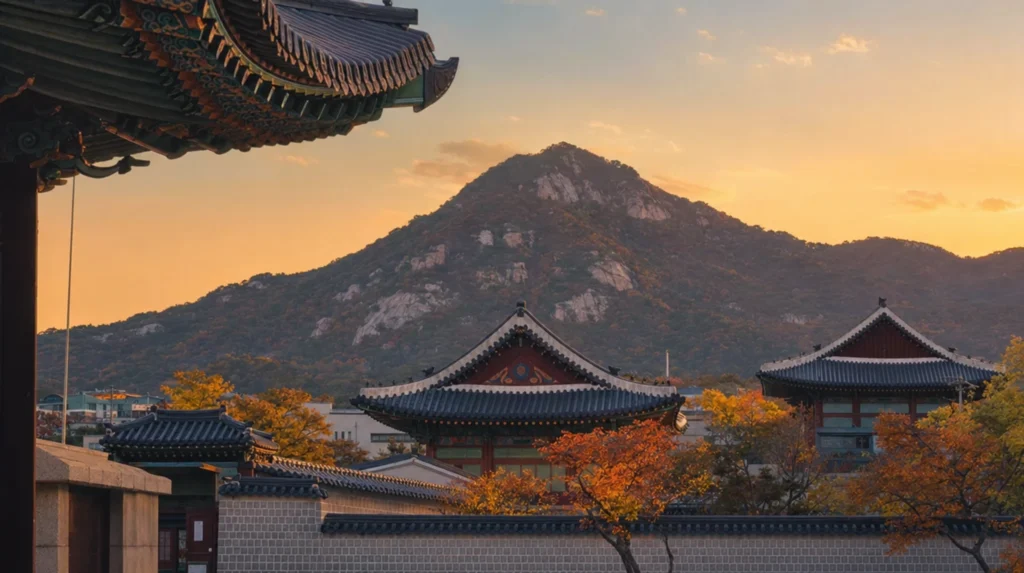
South Korea occupies the southern half of a peninsula roughly the size of Iceland, wedged between the Yellow Sea, the East Sea, and one of the most fortified borders on Earth. In a country of 100,363 km² and 51.7 million people the traveller moves, within a single afternoon, between a 14th-century Joseon palace and a subway platform with platform-screen doors, 5G reception, and vending machines selling hot corn-silk tea.
The country spans roughly 500 kilometres north to south and 300 kilometres east to west. From Seoul in the northwest, the KTX high-speed train reaches the port city of Busan on the south coast in 2 hours 15 minutes. Jeju Island, a dormant volcano and South Korea’s only UNESCO natural heritage site, sits 85 kilometres off the south coast, reached by the world’s busiest air route — Gimpo-Jeju carried more than 14 million passengers in 2023 alone. The peninsula is 70% mountainous, and this terrain shapes everything from soup to subway lines.
Two things strike most first-time visitors. The first is operational precision. Seoul Metro runs 23 lines, trains arrive within 30 seconds of their scheduled time, and station signage is consistently quadrilingual (Korean, English, Chinese, Japanese). The second is the density of cultural layering: within Seoul alone, five royal palaces, a hanok village, a drone show over the Han River, a Michelin-starred tasting counter, and a 24-hour fried-chicken delivery service can all sit inside the same neighbourhood. South Korea ranks 43rd on the 2024 Global Peace Index, and violent crime against visitors is statistically rare.
South Korea also happens to be the only country where the cultural export economy — K-pop, film, drama, cosmetics, webtoons — is openly tracked as a line item in state policy. The country received 16.37 million international visitors in 2024, a level that now exceeds pre-pandemic arrivals. Meals remain affordable: a bowl of kalguksu noodles costs around ₩9,000 (~$6.50), a tray of samgyeopsal for two runs ₩30,000, and a 7-Eleven triangle kimbap sits at ₩1,200. What follows is a practical primer for the whole country.
🌸 Cherry Blossom Season 2026 — You’re Right on Time
Cherry-blossom season on the Korean peninsula moves as a rolling wave from south to north. In 2026, first bloom begins on Jeju Island in the final week of March, reaches the mainland south coast by April 1st, and crests in Seoul during the first full week of April. Individual locations hold peak colour for only 7-10 days before wind and rain drop the petals, so planning the route — not just the date — is what separates a good cherry-blossom trip from a missed one.
Korea’s dominant cherry variety is the wangbeotnamu (king cherry) tree, larger-flowered than Japan’s Somei Yoshino and a source of ongoing botanical debate between the two countries. Most of the peninsula’s iconic cherry-lined avenues were planted in the 1960s and 1970s, and several festivals trace their origins to the same era.
- First bloom: late March 2026 (Jeju Island)
- Peak window: 28 March – 12 April 2026 (south to centre)
- Peak duration: 7-10 days per location
- Jinhae Gunhangje Festival (Changwon): the country’s largest cherry-blossom festival, usually 28 March – 6 April, with 360,000 trees along the Yeojwacheon stream
- Seoul — Yeouido Yunjung-ro: 1,800 king cherry trees flanking the National Assembly, peaking 5-10 April
- Gyeongju — Bomun Lake: mid-April, combining Silla-era tombs with pink petals over water
- Hwagae Cherry Blossom Road, Hadong: roughly 10 km of flowering trees between Ssanggyesa Temple and the Seomjingang River, early April
Best Time to Visit South Korea (Season by Season)
Spring (Mar–May)
Daytime temperatures in Seoul rise from around 7°C in early March to 17°C by late May, with the cherry-blossom front sweeping the country late March through mid-April. May brings the Lotus Lantern Festival (Yeondeunghoe) in Seoul, a UNESCO-listed celebration of Buddha’s Birthday that fills Jongno’s streets with paper lanterns. Fine dust pollution (hwangsa) can spike in March and April on prevailing winds from mainland China — check the Air Korea app before committing to full-day outdoor plans. Spring is peak tourism season; hotel rates climb 30-50% above winter low.
Summer (Jun–Aug)
Summers are hot and humid: Seoul averages 22-30°C with frequent July-August rain during the East Asian monsoon (jangma), which delivers roughly 60% of the country’s annual rainfall in under two months. Busan, Gangneung, and Jeju open beach season; the Boryeong Mud Festival runs for two weeks in mid-July on the Yellow Sea coast. Typhoons occasionally brush the south coast from August to early September. This is the lowest-price tourism season for hotels — if heat is tolerable, summer is a bargain.
Autumn (Sep–Nov)
Autumn is widely considered South Korea’s finest season: clear skies, low humidity, 8-20°C daytime highs, and maple/ginkgo foliage that peaks late October in the north (Seoraksan, DMZ) and early-to-mid November further south (Naejangsan, Gyeongju). Chuseok, the harvest thanksgiving, falls in September or early October and closes many businesses for 3 days — check calendars carefully. Book Seoraksan and Naejangsan accommodation 2-3 months ahead during foliage peak.
Winter (Dec–Feb)
Winters are dry, cold, and sunny in Seoul: -6 to 3°C daytime with wind chill often 5-8°C colder than the thermometer suggests. Gangwon-do hosts Korea’s ski industry — Yongpyong and Alpensia both served the 2018 Pyeongchang Winter Olympics — and Seoul’s jjimjilbang bathhouses are at their best in January. Lunar New Year (Seollal) falls in late January or February and causes the biggest internal-travel crunch of the year; book KTX weeks ahead.
Shoulder-season tip: Early October and late April deliver the best weather-to-crowds ratio — warm enough for shorts by day, cool enough for street-food soju at night, with hotel prices 20-30% below peak.
Getting There — Flights & Arrival
South Korea has one dominant international gateway and three secondary airports handling international traffic. All four connect into the national rail and bus networks within an hour of landing.
- Incheon International (ICN) — the primary gateway, 48 km west of Seoul; AREX Express train to Seoul Station in 43 minutes, ₩11,000.
- Gimpo International (GMP) — Seoul’s secondary airport, 15 km from the city centre; direct Seoul Metro Line 5 + 9 access; handles domestic and limited international (Tokyo, Osaka, Taipei, Shanghai).
- Gimhae International (PUS) — Busan’s airport, light-rail link to Busan Metro in about 20 minutes.
- Jeju International (CJU) — the island hub; the Gimpo–Jeju air corridor is one of the world’s busiest routes.
Flight times: New York JFK–ICN is about 14 hours non-stop; Los Angeles–ICN is 13 hours; London Heathrow–ICN runs 11-12 hours; Singapore–ICN is roughly 6 hours 30 minutes; Tokyo Narita–ICN is 2 hours 30 minutes.
Flag carriers: Korean Air and Asiana Airlines, plus low-cost subsidiaries Jin Air, Air Busan, and T’way.
Visa / entry: Visa-free entry for citizens of about 112 countries for up to 90 days. Most other travellers need a K-ETA (Korea Electronic Travel Authorisation) before boarding; apply at least 72 hours in advance.
Getting Around — KTX, T-money & the Korean Art of Rail
For a country the size of Indiana, South Korea runs one of the world’s densest intercity networks. KTX high-speed trains, operated by Korail, link all major cities and reach a top operating speed of 305 km/h. Trains are electronically ticketed, often sold at small-discount weekday rates, and almost never late. Inside cities, subways in Seoul, Busan, Daegu, Incheon, Gwangju, and Daejeon cover nearly every commercial zone.
- KTX (Korail): high-speed rail, top speed 305 km/h
- Seoul → Busan: 2 h 15 m by KTX
- Seoul → Gyeongju (Singyeongju): 2 h by KTX
- Seoul → Gangneung: 2 h by KTX
Rail pass: The tourist-only Korail Pass costs approximately ₩197,000 (~$146) for 3 consecutive days and ₩301,000 (~$221) for 5 consecutive days. The pass covers unlimited KTX, ITX, Saemaul, and Mugunghwa trains but not the Seoul-Busan SRT operator. Buy online before arrival and redeem at major stations.
IC cards: T-money (nationwide, best default), Cashbee (also nationwide, originated in Busan), and WOWPASS (tourist-focused, doubles as FX card). A single T-money card works on every subway, bus, and most taxis country-wide.
Apps: Naver Map and KakaoMap are the two navigation standards — Google Maps is partially blocked from providing driving directions by South Korean geospatial law, so downloading either of the Korean alternatives is essential.
Top Cities & Regions
📍 Map of South Korea: Every Place in This Guide
🏙️ Seoul
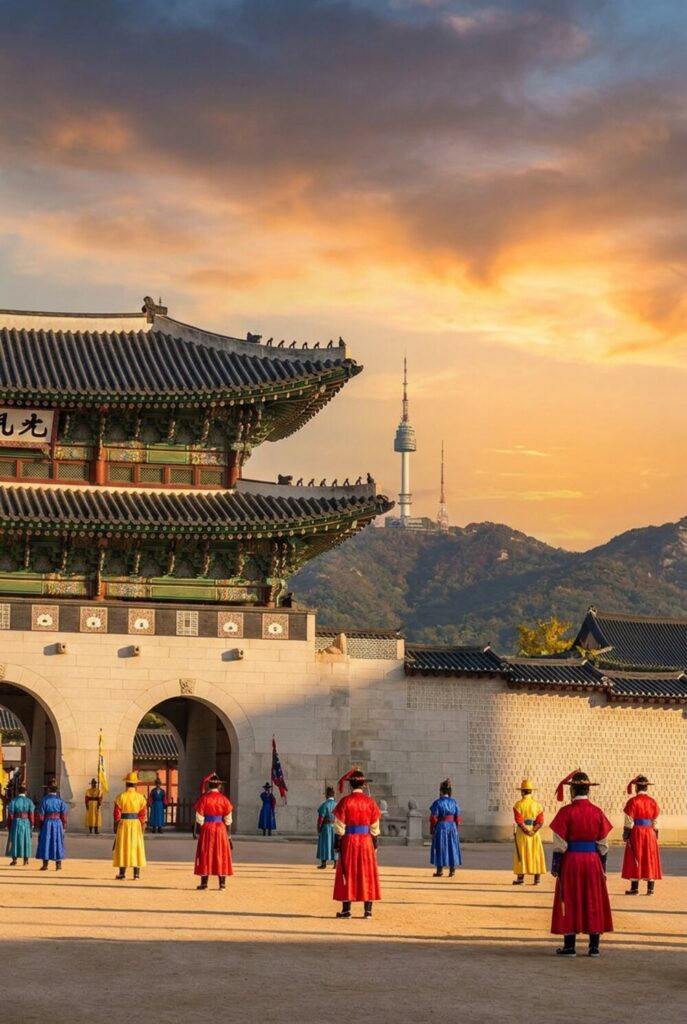
The capital and cultural engine, home to roughly 9.6 million residents and the seat of five royal Joseon palaces. Seoul is where the country’s contradictions are sharpest: hanbok-clad visitors photographing each other at Gyeongbokgung in the morning, underground coffee roasters in Seongsu-dong by afternoon, and neon-lit pojangmacha tents serving tteokbokki past midnight. Plan 4-5 days minimum to do the city justice.
- Gyeongbokgung Palace and the surrounding Bukchon Hanok Village
- Myeongdong shopping, Gangnam nightlife, and the Han River parks
- N Seoul Tower on Namsan, best reached by the Namsan cable car
- Signature dishes: Korean BBQ (samgyeopsal, galbi), tteokbokki, kalguksu knife-cut noodles
🌊 Busan
The country’s second city and largest port, wrapped around a crescent of beaches and backed by coastal mountains. Busan’s personality is looser and more seafaring than Seoul’s — it hosts the Busan International Film Festival each October, retains a strong regional dialect (Busan satoori), and has an unmistakable maritime air thanks to its fish markets, container port, and the ferry terminal connecting Japan. Two days is the minimum; three allows a proper day in Gijang or a temple hike.
- Haeundae and Gwangalli beaches
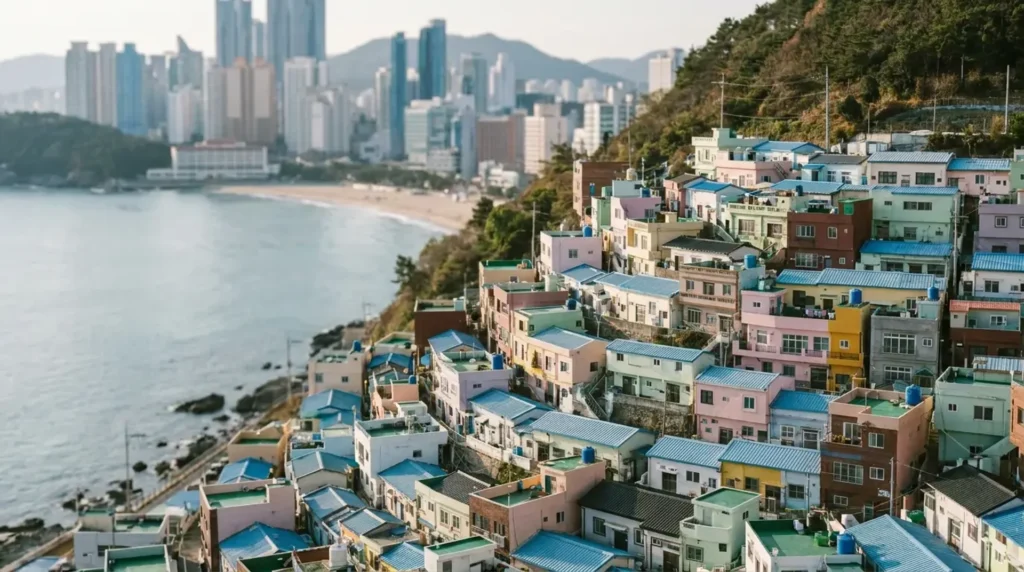
- Gamcheon Culture Village — terraced pastel houses on a steep hillside
- Jagalchi Market — the country’s largest seafood market
- Signature dishes: dwaeji gukbap (pork rice soup), ssiat hotteok seed-stuffed pancakes, raw hagfish
🍊 Jeju
A volcanic island 85 km off the south coast, designated a UNESCO natural heritage site for its lava tubes and shield volcano. Jeju is South Korea’s only subtropical province — palm trees, citrus groves, and black-pebble beaches — and the traditional home of the haenyeo free-diving grandmothers, also recognised by UNESCO. Rent a car; public transport exists but is slow outside the main ring road.
- Hallasan National Park, the country’s tallest mountain at 1,947 m
- Seongsan Ilchulbong — a tuff cone climbed for sunrise
- Manjanggul lava tube, part of the UNESCO listing
- Signature dishes: black pork BBQ, abalone porridge, hallabong citrus
🛬 Incheon
West of Seoul and best known to travellers as the airport, Incheon is also a historic port city with Korea’s only official Chinatown and the country’s most ambitious smart-city experiment in Songdo. It is the home of jajangmyeon (black-bean noodles), invented by Chinese dockworkers here in the late 19th century, and of the Incheon International Cable Car that climbs to Wolmisan for a skyline panorama.
- Songdo Central Park and the Incheon Bridge skyline
- Chinatown, the Incheon Open Port Area, and the painted staircase of Songwol-dong Fairy Tale Village
- Wolmido seafront promenade and the Sinpo International Market
⛩️ Gyeongju
An open-air museum of the Silla dynasty, which ruled the peninsula for nearly a thousand years with Gyeongju as its capital. The city centre is dotted with grass-covered royal burial mounds; the surrounding hills hold temples and hermitages that predate most of Europe’s cathedrals. Two nights is enough to cover the UNESCO-listed monuments at a non-rushed pace.
- Bulguksa Temple and Seokguram Grotto (UNESCO World Heritage)
- Daereungwon royal tomb complex and Cheomseongdae — East Asia’s oldest surviving astronomical observatory
- Donggung Palace and Wolji Pond, spectacular after dark with floodlit reflections
🕊️ DMZ Region
The 4 km-wide Demilitarised Zone separating the two Koreas runs roughly along the 38th parallel, about an hour north of Seoul. It has been untouched farmland and forest since 1953 and is now one of the region’s most unusual wildlife reserves, visitable only through government-approved tour operators with advance booking and passport verification.
- Dora Observatory, looking into Kaesong, North Korea
- Third Infiltration Tunnel, discovered in 1978
- Joint Security Area (Panmunjom), subject to political opening/closure
Korean Culture & Etiquette — What to Know Before You Go
The Essentials
- Shoes off indoors. Homes, many guesthouses, temples, some traditional restaurants, and most fitting rooms are no-shoe zones. Wear easy-off footwear and clean socks.
- Two hands for giving and receiving. When handing over money, a business card, a gift, or pouring a drink for an elder, use two hands (or support your right forearm with your left hand). It is a gesture of respect.
- Age and hierarchy matter. It is normal for a new acquaintance to ask your age within minutes — this is not rudeness but a way to set the right speech level.
- Tipping is not practised. Don’t tip taxi drivers, waitstaff, or hotel porters. Service charges are already included where relevant.
- Trash is owner-carry. Public bins are rare; most Koreans carry rubbish to a convenience store or back to their home/office. Don’t litter.
Dining & Drinking Etiquette
- Don’t start eating before the eldest. The senior person at the table picks up chopsticks first; only then does everyone else begin.
- Never stick chopsticks upright in rice. It resembles incense at a funeral and is a serious taboo.
- Pour for others, not yourself. Especially with soju or beer — watch for empty glasses and refill them, and your companion will return the favour.
- Turn your face away when drinking alcohol in front of an elder. A slight turn to the side is standard deference.
A Food Lover’s Guide to South Korea
Korean food is built on contrast: fermented against fresh, searing heat against cold broth, iron-grilled against simmered. Meals arrive as a central dish surrounded by banchan — small side plates of kimchi, pickled radish, seasoned spinach, marinated anchovies — all refilled for free as the meal progresses. Dining is communal by design, with shared grills, shared stews, and shared bottles of soju. The single best budget spend in Korea is a trip to a traditional market (Gwangjang in Seoul, Jagalchi in Busan, Dongseong-ro in Daegu) and a pure tasting hour with no fixed agenda, picking from rows of jeon pancakes, tteok rice cakes, and hot dumplings pulled straight from the steamer.
Must-Try Dishes
| Dish | Description |
|---|---|
| Korean BBQ (samgyeopsal / galbi) | Pork belly or marinated beef short rib grilled at the table, wrapped in lettuce with ssamjang paste and raw garlic. Typical price: ₩14,000-25,000 per person. |
| Bibimbap | Mixed rice bowl with sautéed vegetables, beef, a raw or fried egg, and gochujang. The Jeonju regional version, served in a brass bowl, is the gold standard. |
| Kimchi jjigae | A sour, spicy stew of aged kimchi, tofu, and pork or tuna, simmered and eaten communally with rice. |
| Bulgogi | Thin-sliced beef marinated in soy, pear, sesame, and garlic — sweeter than galbi and often served over cellophane noodles. |
| Tteokbokki | Chewy cylindrical rice cakes simmered in a sweet-spicy gochujang sauce — the signature Korean street food, typically ₩4,000-6,000 per portion. |
| Naengmyeon | Cold buckwheat noodles: either in iced beef broth (mul) or tossed with chilli sauce (bibim). A Pyongyang-origin summer specialty, most famous at Ojang-dong in Seoul. |
| Korean fried chicken | Double-fried, thin-crust chicken glazed with soy-garlic or gochujang. Invented in Korea, exported globally; pairs canonically with draft beer (chimaek). |
Convenience Store (Pyeonuijeom) Culture
South Korea’s convenience-store density rivals Japan’s and the menu is wider. The three dominant chains — CU, GS25, and 7-Eleven Korea — operate roughly 50,000 stores nationwide, most open 24 hours. Stores stock hot-water dispensers for instant ramyeon (which you can eat at the counter, seated at a small indoor ledge), microwaveable dosirak lunch boxes for ₩4,500-6,000, triangle gimbap, packaged ready-cooked galbi, and glass bottles of banana milk and makgeolli rice wine. Coffee brands often sell ice cups for ₩800 — buy one, add the canned americano, and you have an iced coffee for under $2. Korean convenience stores are also where most locals top up T-money, pay utility bills, and pick up parcel deliveries, so they function as a neighbourhood hub rather than a last resort.
- Chains: CU, GS25, 7-Eleven Korea (plus Emart24 and Ministop)
- Signature items: triangle gimbap (samgak-gimbap), banana milk, instant ramyeon at the counter, ice cups for iced americano, convenience-store dosirak lunch boxes
Off the Beaten Path — South Korea Beyond the Guidebook
Andong & Hahoe Folk Village
In the mountainous interior of North Gyeongsang province, Andong protects one of the best-preserved Confucian clan villages on the peninsula. Hahoe, a UNESCO World Heritage site since 2010, is ringed by a looping bend in the Nakdong River and holds thatched-roof homes continuously inhabited by the Ryu clan since the 16th century. The Andong Mask Dance festival each October revives byeolsin-gut ritual performances that were formally suppressed under colonial rule.
Tongyeong
A coastal city in South Gyeongsang sometimes nicknamed the Naples of Korea. Tongyeong faces an archipelago of 151 islands; ferries run to Somaemuldo, Bijindo, and Yokjido for day-hikes and beaches with a fraction of Jeju’s crowds. The Hallyeo Waterway Cable Car climbs Mireuksan for a panoramic view that, on clear days, stretches to Hansan-do — site of Admiral Yi Sun-sin’s 1592 naval victory.
Boseong Tea Fields
In South Jeolla province, the Daehan Dawon plantation cultivates terraced rows of green tea across a contoured hillside. Boseong supplies around 40% of Korea’s green tea production and is visually striking from spring through autumn. The Boseong Green Tea Festival runs each May, and the nearby town of Yulpo has a seawater-tea hot-spring that combines both local specialties.
Damyang Bamboo Forest
Juknokwon (죽녹원) protects a 310,000 m² bamboo grove planted in 2003 and now mature enough to create a continuous green tunnel. Damyang town is famous for tteokgalbi — grilled patties of minced beef short rib and rice — and for bamboo-steamed rice served in a hollow stem of bamboo. The combination of forest walk and regional lunch makes an easy day trip from Gwangju.
Ulleungdo
A remote volcanic island 120 km east of the Korean mainland in the East Sea, reached by a 3-hour ferry from Pohang or Donghae. With a permanent population under 10,000, Ulleungdo has no international flights and almost no English infrastructure, but it rewards effort with steep coastal cliffs, pumpkin-taffy villages, and some of the best squid in Korea. From Ulleungdo, the disputed Dokdo islets are accessible on weather-dependent boat trips.
Practical Information
Use this as a quick reference once you’ve decided on dates. Values below were current as of April 2026 and should be double-checked against official sources before long-haul departure, especially exchange rates, visa requirements, and operator-specific transit fares.
| Currency | South Korean Won (₩ / KRW); 1 USD ≈ ₩1,370 (19 Apr 2026) |
| Cash needs | Card accepted almost everywhere, including street vendors and buses. Keep ₩50,000-100,000 cash for traditional markets and rural taxis. |
| ATMs | Look for “Global” ATMs at banks, Incheon airport, 7-Eleven, and GS25. Non-global machines often reject foreign cards. |
| Tipping | Not practised. Don’t tip taxi drivers, waitstaff, or porters; service charges are included. |
| Language | Korean is the sole official language. English signage is standard on transit. Download Naver Papago for translation and menu scans. |
| Safety | South Korea ranks 43rd on the 2024 Global Peace Index. Seoul has among the lowest violent-crime rates of any megacity. Standard urban precautions apply. |
| Connectivity | 5G nationwide; tourist SIMs and eSIMs (KT Roaming, SK Telecom, Airalo) at airport kiosks; rentable pocket Wi-Fi “eggs” from ₩3,300/day. |
| Power | Type C/F plugs, 220V, 60Hz |
| Tap water | Officially potable and safe for brushing, cooking, and drinking. Most residents still prefer filtered or bottled. |
| Healthcare | High-quality; international clinics in Seoul (Severance, Samsung Medical Center, Seoul National University Hospital) with English-speaking staff. Pharmacies (yak-guk, 약국) are widespread and usually open 9am-9pm. Travel insurance strongly recommended for tourists as public health insurance does not cover non-residents. |
| Emergencies | Dial 112 for police, 119 for fire and ambulance, and 1330 for the 24-hour Korea Tourism Helpline (English, Japanese, Chinese, Russian). |
Budget Breakdown — What South Korea Actually Costs
💚 Budget Traveller
Expect to spend roughly $40-70 per day with hostel dorms or jjimjilbang stays (₩20,000-40,000), convenience-store breakfasts, street-food lunches, and subway + bus travel on T-money. A bowl of Gwangjang Market bindaetteok runs about ₩5,000 and a triangle gimbap is ₩1,200. Free cultural attractions — public palaces on designated free days, outdoor markets, the Han River parks, and most mountain trails — stretch the budget further. Wearing a rented hanbok gets you free palace entry, which is the single best budget hack in Seoul.
💙 Mid-Range
Plan on $100-180 per day for a well-reviewed 3-star hotel or a modern motel (₩90,000-180,000), two sit-down meals including one Korean BBQ dinner, a cafe stop, and a mix of subway, KTX intercity travel, and occasional taxis. This is the most common visitor tier and the one where the Korail Pass tends to pay for itself on a Seoul-Busan-Gyeongju loop. Add ₩30,000-50,000 per day for experiences — cooking class, hanbok rental, night palace tour.
💜 Luxury
$300+ per day unlocks 5-star hotels in Gangnam or Myeongdong (Four Seasons Seoul, Shilla, Josun Palace from ₩350,000), Michelin-listed dining (Korea had 33 Michelin-starred restaurants in the 2024 Seoul & Busan guide), premium KTX first class, and private-driver day trips to the DMZ or Gyeongju.
| Tier | Daily (USD) | Accommodation | Food | Transport |
|---|---|---|---|---|
| Budget | $40-70 | Hostel dorm / jjimjilbang ₩20-40k | Street food, gimbap, ramyeon ($3-8/meal) | T-money subway + bus ($6-10/day) |
| Mid-Range | $100-180 | 3-star hotel / boutique motel ₩90-180k | Korean BBQ, cafes, casual restaurants ($15-35/meal) | Subway + KTX + occasional taxi ($20-40/day) |
| Luxury | $300+ | 5-star hotel in Gangnam/Myeongdong ₩350k+ | Hanjeongsik, Michelin ($100+/person) | Private driver, KTX first class ($150+/day) |
Planning Your First Trip to South Korea
A first trip to South Korea works best at 10-14 days. That window fits Seoul, a KTX run south, and at least one off-mainland detour without feeling rushed.
- Confirm visa and K-ETA status. About 112 countries get 90-day visa-free entry; most still need a K-ETA applied for at least 72 hours before departure. Do this first.
- Book ICN flights and internal transport. KTX opens 30 days out at the cheapest rates; the Korail Pass (3 or 5 days, from about $146) is worth it if you are doing Seoul + Busan + Gyeongju.
- Install the essentials. Naver Map, KakaoMap, Papago, and the official Visit Korea app before you land. Google Maps cannot provide driving directions in Korea.
- Pre-arrange connectivity. Buy a tourist eSIM or pick up a T-money + WOWPASS combo at the airport arrivals hall. Tap-to-pay transit from your first station.
- Draft your route, then build in one gap day. Plan 4-5 days in Seoul, 2 days in Busan, 1-2 in Gyeongju, 2-3 in Jeju, and one unscheduled buffer day for weather, recovery, or an extra meal you didn’t plan for.
Classic 12-Day Itinerary: Seoul 4 days → Gyeongju 2 days → Busan 2 days → Jeju 3 days → return to Seoul 1 day buffer.
Cities & Regions to Explore
Frequently Asked Questions
Is South Korea expensive to visit?
By developed-Asia standards South Korea sits between Taiwan and Japan. Street food, public transit, and mid-range restaurants are cheaper than Tokyo; hotels in Seoul and taxis to Incheon run closer to Tokyo prices. A realistic all-in daily budget is about $70 at the low end and $180 mid-range. Compared with Western Europe or North America, most meal categories are noticeably cheaper.
Do I need to speak Korean?
No, but a handful of phrases and an offline translator are strongly recommended. English signage is consistent on subways, KTX, airports, and in major tourist zones; outside those zones, staff may speak limited English. Download Papago, learn to read Hangul (it can be done in a weekend — the alphabet was scientifically designed in the 15th century), and you’ll navigate menus independently.
Is the Korail Pass worth it?
If your itinerary is Seoul-only or Seoul + one nearby city, no. If you are doing Seoul + Busan + Gyeongju (plus any return legs), the 3-day Korail Pass at roughly $146 usually breaks even or saves money. Remember the pass does not cover the separate SRT operator on the Seoul-Busan line.
Is South Korea safe for solo travellers?
Yes. South Korea ranks 43rd on the 2024 Global Peace Index and Seoul consistently records very low violent-crime rates compared with other megacities. Solo female travellers report Seoul and Busan as among the most comfortable major-city destinations in Asia. Standard urban precautions apply around nightlife districts.
When is cherry blossom season?
Late March to mid-April, moving south to north. Jeju first (around 24-28 March), followed by Busan and the south coast, Seoul in the first full week of April, and the Seoraksan foothills around mid-April. Individual locations peak for 7-10 days.
Can I get by as a vegetarian or vegan?
Yes, with planning. Temple cuisine (sachal eumsik) is fully plant-based and excellent. Bibimbap, kimchi, pajeon (when fish-cake-free), and banchan offer solid defaults, but fish sauce and anchovy stock appear in many dishes. Apps like HappyCow map dedicated vegetarian and vegan restaurants in Seoul, Busan, and Jeju.
What is K-ETA and do I need it?
K-ETA is Korea’s electronic travel authorisation, required for most visa-free nationals before boarding a flight. It costs ₩10,000, is valid for multiple entries within two years, and should be applied for at least 72 hours in advance. Some nationalities are temporarily exempt — check the official site before booking.
Ready to Explore South Korea?
Start with our city guides to Seoul, Busan, and Jeju, or jump straight to the full Korea trip-cost breakdown.
Explore More
Cities we cover in South Korea
Cities to explore in South Korea
Deep-dive guides to specific cities, neighbourhoods, and food scenes — written with the same magazine voice.
More country guides you might like

Plan your trip to South Korea
The booking tools we use ourselves. FFU may earn a commission at no extra cost to you.
Plan & book your trip to South Korea
Booking through these searches supports our guides at no extra cost to you.