
Languages of Belgium
All languages of Western Europe →fluent beta classical · classes by phone with Maya at ranas.ai/maya
Belgium Travel Guide — Medieval Cities, Trappist Beer & the Heart of the EU
Belgium Travel Guide
📋 In This Guide
- Overview — Why Belgium Belongs on Every Bucket List
- 🌸 Brussels Flower Carpet 2026
- Best Time to Visit Belgium (Season by Season)
- Getting There — Flights & Arrival
- Getting Around — SNCB, STIB & the 3,600 km Rail Spine
- Top Cities & Regions
- Belgian Culture & Etiquette
- A Food Lover’s Guide to Belgium
- Off the Beaten Path
- Practical Information
- Budget Breakdown
- Planning Your First Trip to Belgium
- Frequently Asked Questions
Overview — Why Belgium Belongs on Every Bucket List
Belgium is the small country the rest of Europe quietly relies on. It occupies 30,689 square kilometres on the North Sea coast — roughly the size of Maryland — and yet it hosts the European Commission, the Council of the European Union, a working seat of the European Parliament, and the political headquarters of NATO. A population of roughly 11.83 million, recorded on January 1, 2025, lives inside three constitutionally defined regions that speak three different official languages.
That linguistic geography is the single most important thing to understand before you land. Flanders in the north speaks Dutch, Wallonia in the south speaks French, Brussels-Capital is officially bilingual, and a small German-speaking community of roughly 77,000 people sits in nine eastern municipalities on the German border. Train announcements change language as you cross the boundary; the same town can carry two names (Mons in French, Bergen in Dutch); and Belgians navigate the divide with a cheerful, self-deprecating humour that is entirely their own.
The cultural payoff for the visitor is enormous. Within a one-hour train ride of Brussels you can stand under Van Eyck’s Ghent Altarpiece, walk the 12th-century canals of Bruges, shop the fashion district of Antwerp, climb the 1469 Gothic Town Hall tower of Leuven, and drink a Trappist ale brewed inside a working Cistercian monastery. Belgium has 16 UNESCO World Heritage sites packed into that small territory — belfries, béguinages, Neolithic mines, Art Nouveau townhouses and the Grand-Place itself.
And then there is the food, which deserves every bit of its reputation. Belgium claims the invention of the double-fried chip, the filled praline (Jean Neuhaus, Brussels, 1912), and the modern waffle — both the light rectangular Brussels style and the dense pearl-sugared Liège style. Moules-frites is the unofficial national dish, and a cone of frites from Maison Antoine on Place Jourdan runs about €4. The country also produces more than 1,500 distinct beers across roughly 200 breweries, and Belgian beer culture was inscribed on the UNESCO Intangible Cultural Heritage list in 2016. You can fit the whole country into a week and still eat different at every meal.
🌸 Brussels Flower Carpet 2026 — You’re Right on Time
The Brussels Flower Carpet is the single biggest time-sensitive draw in the Belgian calendar, and it only happens in even-numbered years — which means August 2026 is one of exactly two windows this decade when you can see it. Every two years since 1971, volunteers hand-lay roughly 500,000 cut begonias into an intricate 1,680 m² design across the cobblestones of the UNESCO-listed Grand-Place in central Brussels. The carpet is assembled in about four hours by more than 100 volunteers and remains on display for three days before the flowers wilt.
- Dates: Thursday, August 13 — Sunday, August 16, 2026 (biennial, even years only)
- Location: Grand-Place, 1000 Brussels — directly in front of the Hôtel de Ville
- Carpet size: 1,680 m² of flowers hand-laid in under four hours
- Balcony view: paid access to the Hôtel de Ville balcony gives the only top-down view of the full design — book online the moment tickets release
- Evening sound-and-light show: free, 22:00 nightly, with the Town Hall façade illuminated above the carpet
- 2026 theme: announced each spring on the official Flower Carpet website
Best Time to Visit Belgium (Season by Season)
Spring (Mar–May)
Cool and frequently wet, but the shoulder season most Belgians prefer. Temperatures climb from about 8°C in March to around 17°C by late May, and daylight stretches past 21:00 by Victoria Day weekend. The Tour of Flanders (Ronde van Vlaanderen) runs on Sunday, April 5, 2026 — the year’s biggest Flemish one-day bike race, starting in Bruges and finishing on the Oudenaarde hellingen with roadside crowds 500,000 strong. The Hallerbos bluebell woods south of Brussels peak in mid-to-late April. Rain is constant; pack a waterproof shell and consider travelling by train rather than bike.
Summer (Jun–Aug)
Mild, with average highs of 18–23°C and occasional heat spikes into the low 30s. The season peaks with two big events: the Gentse Feesten take over Ghent’s medieval core for 10 days in mid-to-late July (July 17–26 in 2026), and the Brussels Flower Carpet occupies the Grand-Place for three days in mid-August in even years. The North Sea coast (Ostend, Knokke-Heist, De Haan) fills on sunny weekends, and Bruges is at its most crowded and most expensive. Brussels partially empties in August as residents decamp to France and Italy — restaurant reservations are easier, museums quieter.
Autumn (Sep–Nov)
The quietly perfect window. Temperatures drop from about 18°C in early September to 7°C by late November, Ardennes forests turn copper through mid-October, and the tourist crowds thin sharply after the first week of September. Ghent’s 24-hour September heritage weekend, the Antwerp Diamond District flea markets, and early Trappist release days at Westvleteren sit in this season. October and early November see frequent rain; pack layers. Hotel rates in Bruges, Brussels and Antwerp drop 20–30% from summer peak.
Winter (Dec–Feb)
Short, grey days — and Belgium’s great underrated season. Bruges stages Wintergloed from late November through early January, with the Markt covered in a Christmas market, ice rink and illuminated canals, and Brussels answers with Plaisirs d’Hiver (Winter Wonders) on Place Sainte-Catherine and Grand-Place: 200+ wooden chalets, a 1,400 m² ice rink and a sound-and-light show projected onto the Town Hall façade. Temperatures run 0–7°C; snow is rare but the wind off the North Sea bites. Eurostar arrivals pick up on December weekends.
Shoulder-season tip: Mid-September and late April are the two windows most travellers overlook — warm enough for outdoor café life, cheap enough that Bruges hotels drop to mid-range rates, and quiet enough that Van Eyck’s Ghent Altarpiece doesn’t come with a 40-minute queue.
Getting There — Flights & Arrival
Brussels Airport (Zaventem) handles almost all intercontinental traffic, with two regional alternatives for European budget routes. Pick by route: BRU for long-haul, CRL for Ryanair, Eurostar for London and Paris.
- Brussels Airport (BRU) — Belgium’s primary gateway, with 23.6 million passengers in 2024. Brussels Airport Express trains reach Brussels-Central in 17 minutes, Brussels-Midi in 20 minutes, and Antwerp in about 30 minutes.
- Brussels South Charleroi (CRL) — the Ryanair and Wizz Air hub 60 km south of Brussels; Flibco shuttle bus to Brussels-Midi in about 55 minutes.
- Antwerp (ANR) and Liège (LGG) — small regional airports with limited schedules; Antwerp’s bus 51/52 reaches Antwerpen-Centraal in about 15 minutes.
Flight times: New York–Brussels is roughly 7 hours 30 minutes nonstop on United or Brussels Airlines; London–Brussels 1 hour 10 minutes by air or about 2 hours city-centre to city-centre on Eurostar; Toronto–Brussels 7 hours 45 minutes; Dubai–Brussels 7 hours.
Flag carriers: Brussels Airlines (Lufthansa Group; direct successor to Sabena), TUI fly Belgium for leisure routes.
Visa / entry: Schengen rules apply — citizens of the US, UK, Canada, Australia, Japan, South Korea and 60+ other countries enter visa-free for up to 90 days in any 180-day window. From late 2026, visa-exempt travellers will need a €7 ETIAS pre-authorisation online.
Getting Around — SNCB, STIB & the 3,600 km Rail Spine
Belgium is so small that the national rail network (SNCB in French, NMBS in Dutch) reaches essentially every town on the visitor itinerary, and the longest domestic journey — Ostend on the North Sea to Arlon on the Luxembourg border — is under four hours. Most intercity legs radiate from Brussels in under an hour. Cars are generally slower than the train between big cities and parking in Brussels, Bruges and Ghent centres is either expensive, banned to non-residents, or both.
- SNCB / NMBS Intercity: dense half-hourly frequencies on main lines; top speed 300 km/h on the HSL high-speed line to Liège used by Eurostar, ICE and former Thalys services.
- Brussels-Midi → Antwerp-Central: 35–45 minutes by IC.
- Brussels-Central → Bruges: about 1 hour by IC.
- Brussels-Midi → Ghent-Sint-Pieters: about 30 minutes by IC.
- Brussels-Central → Leuven: about 25 minutes by IC.
SNCB Standard Multi pass: 10 single journeys anywhere on the domestic 2nd-class network within 1 year for €88 — the best multi-city value if you plan more than four intercity legs. Under-26s and over-65s get further discounts. Day-return tickets are typically the cheapest single option on weekends.
City transit: three regional operators handle buses and trams — STIB-MIVB in Brussels (metro, tram, bus), De Lijn in Flanders and TEC in Wallonia. A Brussels MOBIB smartcard covers metro and tram seamlessly.
Apps: SNCB (national rail), STIB-MIVB (Brussels), De Lijn (Flanders), TEC (Wallonia).
Top Cities & Regions
📍 Map of Belgium: Every Place in This Guide
🇪🇺 Brussels
The capital of Belgium and the de facto capital of the European Union — officially bilingual, institutionally multilingual, and far more layered than its grey-bureaucrat reputation suggests. The UNESCO-listed Grand-Place is the showpiece, ringed by guild houses rebuilt after the 1695 French bombardment. Victor Horta’s Art Nouveau townhouses and the Royal Museums of Fine Arts sit within walking distance of the European Quarter.
- Grand-Place and the Town Hall tower (illuminated every night)
- Atomium — the 102 m 1958 World’s Fair monument in Heysel
- Magritte Museum, Musical Instruments Museum, and the Horta Museum Art Nouveau house
Signature eats: moules-frites at a Rue des Bouchers brasserie, Liège waffles from a street cart, Neuhaus and Pierre Marcolini pralines, Cantillon gueuze at the working brewery in Anderlecht.
🌉 Bruges
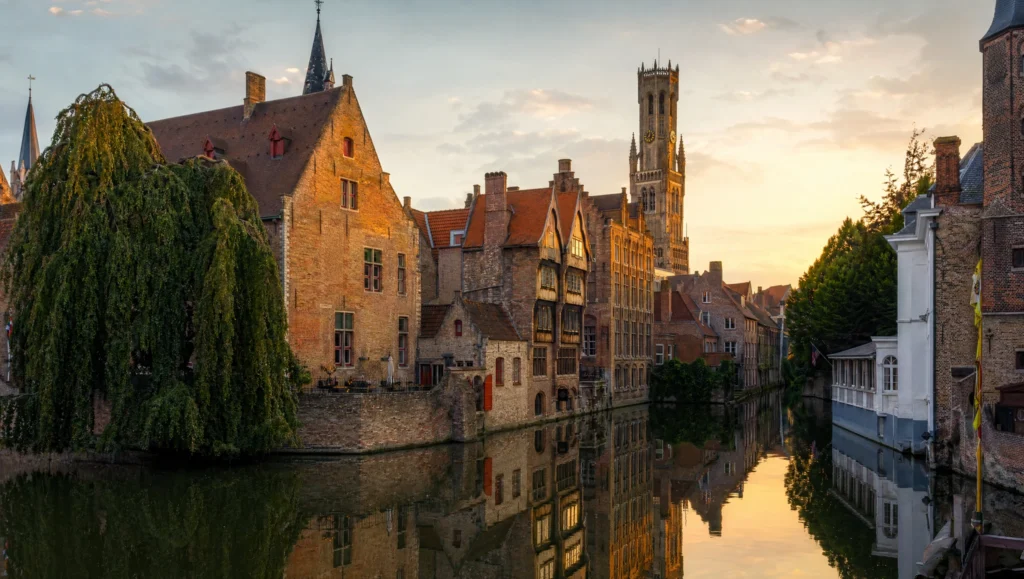
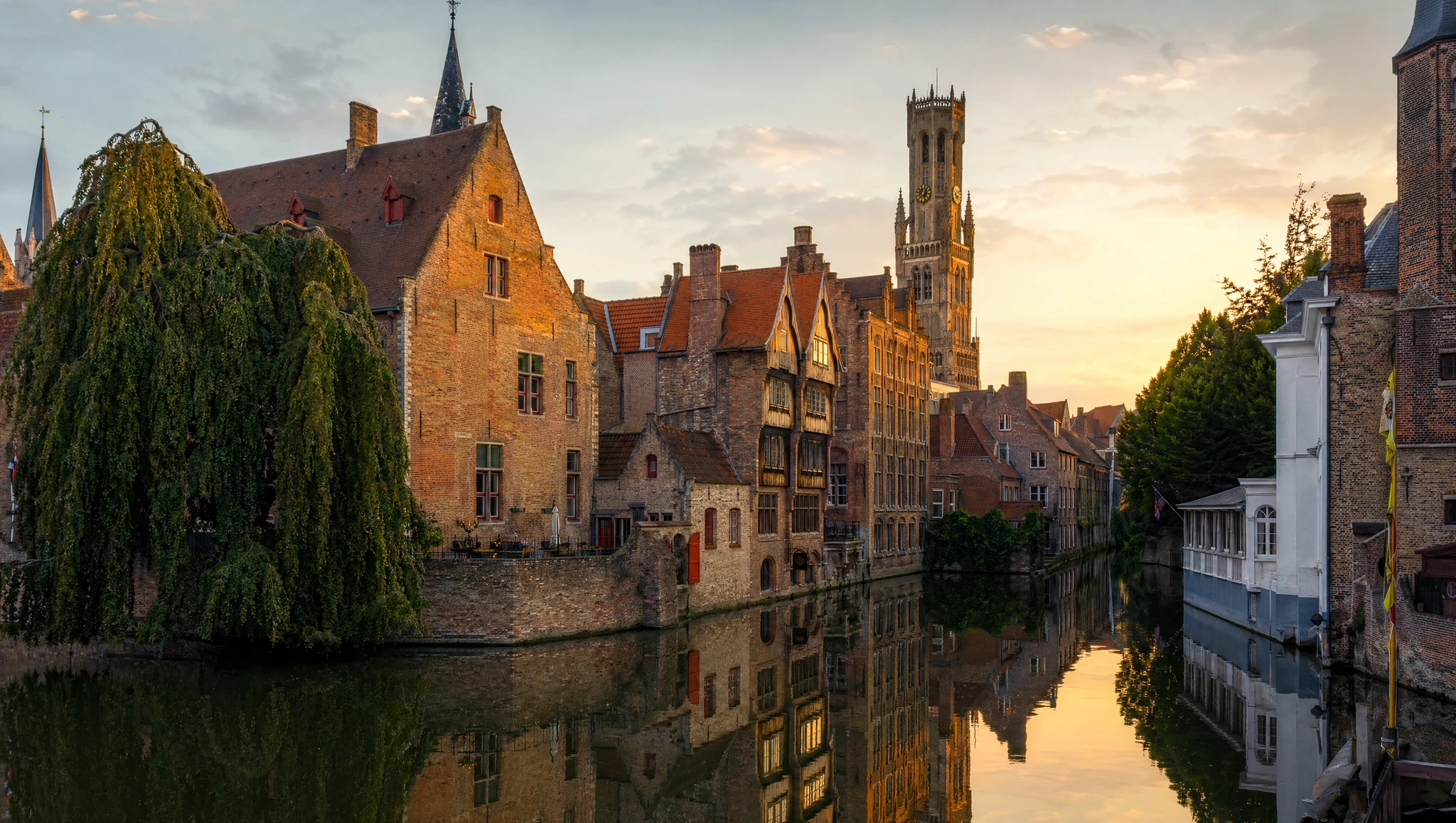
The medieval canal city often called the Venice of the North — the historic centre is UNESCO-listed in its entirety, and a horse-drawn carriage or a canal boat is the traditional way to see it. Arrive early or stay overnight, because the day-tripper coaches clear by 17:00 and the city becomes genuinely quiet.
- Markt square and the 83 m Belfry — climb the 366 steps for the view
- Michelangelo’s Madonna at the Church of Our Lady (the only Michelangelo sculpture to leave Italy in his lifetime)
- Groeningemuseum for Flemish Primitives, plus a 30-minute canal boat cruise
Signature eats: carbonnade flamande at De Halve Maan brewery tap, North Sea shrimp croquettes, Brugse Zot blonde on tap, speculoos biscuits from Maison Dandoy.
🏰 Ghent
Flanders’ youthful university town with a medieval core that genuinely rivals Bruges but without the cruise-ship crowds. The Gravensteen Castle of the Counts (1180) sits on the water, and Saint Bavo’s Cathedral houses Jan van Eyck’s Adoration of the Mystic Lamb — the most-stolen artwork in history.
- Gravensteen Castle of the Counts — a proper moated fortress in the city centre
- Saint Bavo’s Cathedral and the Ghent Altarpiece (1432) in a dedicated climate-controlled chapel
- Graslei and Korenlei waterfronts at sunset, then a beer at Waterhuis aan de Bierkant
Signature eats: waterzooi stew, Gentse neuzekes (cuberdon cone sweets from a barrow on the Groentenmarkt), and vegetarian menus on every corner — Ghent declared itself Europe’s first “Veggie Day” city.
💎 Antwerp
Flanders’ fashion and diamond capital on the Scheldt river, 35–45 minutes from Brussels by Intercity. Rubens lived, worked and died here, and four of his altarpieces still hang in the Cathedral of Our Lady.
- Cathedral of Our Lady with four Rubens altarpieces (including The Descent from the Cross)
- MAS Museum aan de Stroom — a stacked-red-sandstone harbour museum with a free rooftop view
- Antwerp-Centraal Station (1905), known as the Railway Cathedral, routinely voted the world’s most beautiful station
Signature eats: Antwerpse handjes (hand-shaped almond biscuits), De Koninck bolleke amber ale, frites at Frites Atelier, Elixir d’Anvers herbal liqueur.
🍺 Leuven
A compact Flemish university town 25 minutes east of Brussels by Intercity — home to KU Leuven (founded 1425, the oldest Catholic university still operating) and the global headquarters of brewing giant AB InBev. The Grote Markt centres on the 1469 Gothic Town Hall, arguably the finest late-medieval civic building in Europe.
- Grote Markt and the Town Hall (1469) with 236 carved statues
- KU Leuven Central Library and the Oude Markt — often described as the longest bar in Europe
- Stella Artois brewery tour with a tasting of the unpasteurised version
Signature eats: stoofvlees (beef-and-beer stew) with frites, Stella Artois pilsner and kriek cherry lambic.
🌲 The Ardennes (Dinant & Bastogne)
Wallonia’s forested, river-carved plateau — Belgium’s hiking, kayaking and WWII battlefield region, and a completely different country in feel and language from Flanders.
- Dinant citadel above the Meuse — birthplace of Adolphe Sax, inventor of the saxophone
- Bastogne War Museum and the star-shaped Mardasson Memorial to the Battle of the Bulge
- Kayaking the Lesse river from Houyet to Anseremme, plus a stop at Rochefort or Chimay Trappist abbey shops
Belgian Culture & Etiquette — What to Know Before You Go
Belgian culture runs on quiet pride, regional loyalty and a disarming willingness to laugh at itself. The country has been independent since 1830, but its three linguistic communities — Dutch-speaking Flemings, French-speaking Walloons and the small German-speaking community in the east — maintain distinct media, school systems and political parties. Travellers who assume Belgium is simply “French-speaking” or “Dutch-speaking” will occasionally feel the temperature in the room drop. The respectful move is to greet in the local language of the region you are in, and let your host switch to English if they prefer.
The Essentials
- Match the local language. In Flanders, open with “goedemorgen” or “hallo”; in Wallonia and Brussels, “bonjour”. Using French in central Flanders or Dutch in Wallonia is read as tone-deaf, not charming.
- Shake hands on first meeting. Three cheek kisses (right, left, right) among friends and family; one for close colleagues. Men shaking hands with men almost universally; women offer the cheek first.
- Punctuality is expected. Dinner invitations and train connections run to the minute; arriving more than five minutes late without warning needs an apology.
- Tipping is not expected. Service is included by law. Rounding up at a café or adding 5–10% at a nice restaurant is appreciated but never obligatory.
- Keep political and linguistic teasing gentle. Belgians joke constantly about the Flemish/Walloon divide; outsiders should stay out of it.
Language Boundary Etiquette
- Place names change across the boundary. Mons is Bergen, Liège is Luik, Antwerp is Antwerpen, Courtrai is Kortrijk. Road signs and train-board announcements switch with them.
- In Brussels (officially bilingual), default to “bonjour” — most locals will answer in either French or English.
- Ask for the “menu in English” rather than assuming which language the local menu is printed in.
- Do not mix languages mid-sentence unless you speak all three fluently — it reads as mocking.
A Food Lover’s Guide to Belgium
Belgian food is often under-sold abroad and genuinely world-class at home. The country claims the invention of the double-fried chip, the filled praline (Jean Neuhaus, Brussels, 1912) and the modern waffle. It brews more than 1,500 distinct beers across roughly 200 breweries — the most per capita of any country on Earth — and Belgian beer culture itself was inscribed on the UNESCO Intangible Cultural Heritage of Humanity list in 2016. Pair any of the below with a Chimay, a Westmalle Tripel or a Cantillon gueuze and you will understand why Belgians take their food seriously while pretending not to.
Must-Try Dishes
| Dish | Description |
|---|---|
| Moules-frites | Mussels cooked with white wine, celery and shallots (marinière), served with a pile of double-fried chips and mayonnaise — the unofficial national dish. Typical portion €22–32 at a Brussels brasserie, and the mussels are usually Zeeland rather than Belgian. Chez Léon on the Rue des Bouchers has been serving it since 1893. |
| Frites | Belgium claims the invention of the double-fried chip — always fried in beef fat at a friterie or frietkot, served in a paper cone with mayonnaise, samouraï, andalouse or Surinamese peanut sauce. Maison Antoine on Place Jourdan in Brussels is the benchmark. A standard cone runs €3.50–5 and two friteries can have queues 20 deep. |
| Carbonnade flamande / Stoofvlees | Flemish beef-and-beer stew braised slow in dark Trappist or brown ale, with a slice of mustard-coated bread stirred into the sauce for body — always served with frites. Heartier and more rustic sibling of French boeuf bourguignon, and the default winter dish north of the language boundary. |
| Waterzooi | Ghent-style creamy stew — originally made with Scheldt river fish, now almost always chicken — built on a broth of leeks, carrots, celery and egg-yolk, served with boiled potatoes. A 15th-century Flemish dish that pre-dates half the rest of Belgian cuisine. |
| Waffles (gaufres / wafels) | Two entirely distinct styles. Brussels waffles are rectangular, light, crisp and dusted with powdered sugar or topped with whipped cream and fresh strawberries. Liège waffles are denser, oval and studded with pearl sugar that caramelises on the iron. Never the same thing. €2–6 from a street kiosk. |
| Belgian chocolate & pralines | Jean Neuhaus invented the filled praline in 1912 at his Brussels shop in the Galeries Royales Saint-Hubert. Pierre Marcolini, Mary, Wittamer, Neuhaus and Godiva are the storied names; 100 g of artisan pralines runs €10–18. Avoid the airport-chain chocolatiers — the real shops are downtown. |
| Speculoos | Crisp, lightly caramelised spice biscuit flavoured with cinnamon, cloves, cardamom and brown sugar — served free with coffee at most Belgian cafés, and turned into Speculoos spread (Lotus Biscoff) for export worldwide. Maison Dandoy in Brussels has been baking them since 1829. |
Friterie & Brown Café Culture
Belgium does not have konbini, but it has two better things: the friterie or frietkot (a freestanding fry shack, often family-run, cooking chips in beef fat and open late) and the bruine kroeg or estaminet (wood-panelled neighbourhood bar pouring 20+ beers on tap). Between them, you can eat and drink around the clock for €15–25.
- Chains and benchmarks: Maison Antoine (Brussels friterie, since 1948), Frites Atelier (Antwerp, founded by 3-star chef Sergio Herman), Delhaize and Colruyt supermarkets, and Fnac / HEMA café counters.
- Signature items: frites with andalouse or samouraï sauce, Liège waffles from a cart, Cuberdon cone sweets (Gentse neuzekes), Couque de Dinant (honey biscuit), speculoos, Antwerpse handjes, Mechelse koekoek roast chicken.
Off the Beaten Path — Belgium Beyond the Guidebook
Dinant, Wallonia
A citadel-topped town on the Meuse in southern Wallonia where Adolphe Sax invented the saxophone in 1846 — painted saxophones representing the EU member states line the Pont Charles de Gaulle, and the Sax House museum on the Rue Adolphe Sax occupies his birthplace. The citadel is reached by a 408-step staircase or a cable car, and the couque de Dinant honey biscuit is so hard it is traditionally broken against the table edge rather than bitten. About 1 hour 30 minutes from Brussels-Midi by train via Namur.
Mechelen
A quiet Flemish cathedral city halfway between Brussels and Antwerp that most travellers skip — and should not. Saint Rumbold’s Tower (97 m) is one of Belgium’s most beautiful belfries and climbable via 538 steps, with a 49-bell carillon that still plays live concerts. Kazerne Dossin, the former Nazi SS-Sammellager transit barracks, is now a national Holocaust and human-rights museum commemorating the 25,843 Jews and 352 Roma deported from Belgium between 1942 and 1944. A 25-minute train from Brussels.
Tournai, Wallonia
One of Belgium’s oldest cities (founded as Roman Turnacum) sitting close to the French border, with a UNESCO-listed five-towered Romanesque-Gothic cathedral and the oldest belfry in Belgium (also UNESCO-listed, as part of the Belfries of Belgium and France group site). Tournai tapestries were once traded across Europe alongside those of Brussels; the Musée de la Tapisserie preserves the tradition. About 1 hour from Brussels-Midi by IC.
Spa, Wallonia
The Ardennes town whose name became the English word for any thermal resort — the 18th-century Pouhon Pierre-le-Grand mineral spring (where Tsar Peter the Great took the waters in 1717) still flows in a dedicated pavilion, and the modern Thermes de Spa on the hill above town reaches the original source by funicular. Formula 1’s Spa-Francorchamps circuit, including the legendary Eau Rouge corner, is a short drive east.
Durbuy, Wallonia
Often marketed as “the smallest city in the world” (a charter granted by Count Henry III of Luxembourg in 1331), Durbuy is a 400-resident stone village wrapped in a river loop of the Ourthe in the northern Ardennes. Its topiary park, medieval centre, chocolate factory and adventure-kayak outfits pack into about 1 square kilometre. A 90-minute drive from Brussels; the closest train is Barvaux.
Practical Information
| Currency | Euro (€ / EUR); 1 USD ≈ 0.94 EUR (April 19, 2026) |
| Cash needs | Low. Belgium is overwhelmingly card-based, with contactless Visa and Mastercard accepted in almost all shops, restaurants and transit systems. Carry €30–50 in small notes for friteries, street markets and smaller Wallonian cafés. |
| ATMs | Bancontact ATMs are widely available at BNP Paribas Fortis, ING, KBC and Belfius branches. Some merchant PIN-only terminals do not accept US-issued credit cards — carry one contactless credit card plus a backup. |
| Tipping | Not expected. Service is included. Round up to the nearest euro at a café; 5–10% at an upscale restaurant is appreciated but never obligatory. |
| Language | Dutch in Flanders, French in Wallonia, German in a small eastern community, with Brussels officially bilingual. English is widely spoken in major cities and tourist areas. |
| Safety | Safe — Belgium ranked 18th in the 2024 Global Peace Index. Main risks are pickpocketing at Brussels-Midi station, on Brussels trams 3 and 4, and around the Grand-Place. |
| Connectivity | Nationwide 4G/5G coverage on Proximus, Orange and Base. eSIMs (Airalo, Holafly) work from landing. Free WiFi in SNCB stations, most cafés and Eurostar trains. |
| Power | Type E (French) plugs, 230V / 50 Hz |
| Tap water | Safe everywhere — Belgian tap water meets EU drinking-water standards. Restaurants will charge for bottled by default; ask for “une carafe d’eau” or “kraantjeswater” to request tap. |
| Healthcare | Universal EU-standard public system; EHIC cards work for EU visitors, others need travel insurance. Emergency number: 112. |
Budget Breakdown — What Belgium Actually Costs
💚 Budget Traveller
Hostels (Generator Brussels, Jacques Brel, St Christopher’s Bruges), supermarket runs at Delhaize and Colruyt, the SNCB Standard Multi pass for intercity travel and walking or a day tram pass inside cities. Doable at €80–130 per day (~US$85–140), with Ghent and Leuven the best-value Flemish bases and Bruges the most expensive. A bakery breakfast for €4, a friterie cone dinner for €5, a draft Jupiler for €3, and a Belfry climb for €16.
💙 Mid-Range
3-star hotel or trusted Airbnb, one sit-down brasserie meal and one café meal a day, SNCB Intercity tickets booked via the SNCB app, and two to three paid sights daily (Magritte Museum €13; Saint Bavo’s Altarpiece €16). Plan €170–280 per day (~US$180–300). Bruges and Brussels during the Flower Carpet push the top of that range — Ghent, Antwerp and Leuven settle around €170.
💜 Luxury
5-star hotels (Hotel Amigo Brussels, Hotel Dukes’ Palace Bruges, Botanic Sanctuary Antwerp), SNCB first class, Michelin-starred tasting menus with Belgian beer or wine pairings, and private canal or vintage-car tours. Plan €430+ per day (~US$450+). A one-star Michelin dinner in Brussels with wine is around €200; the three-star Hof van Cleve and Zilte tasting menus run €280–380 per person. Add €100–150 per hour for a private driver-guide on a day-trip into the Ardennes, and expect to pre-book Westvleteren 12 beer runs or Dinant citadel tours through a concierge at this tier.
| Tier | Daily (USD) | Accommodation | Food | Transport |
|---|---|---|---|---|
| Budget | $85–140 | Hostel €30–50 / budget hotel €80–120 | €20–35/day | STIB day pass + walking €8/day |
| Mid-Range | $180–300 | 3-star hotel €140–220 | €55–85/day | SNCB IC €20–35 intercity |
| Luxury | $450+ | 5-star hotel €350–700+ | €150–300/day | SNCB first class / private transfers €150–300/day |
Planning Your First Trip to Belgium
- Pick your season. August in an even year means the Brussels Flower Carpet; April means the Tour of Flanders and Hallerbos bluebells; late November and December mean Bruges Wintergloed and Brussels Winter Wonders. September is the quietest sweet spot.
- Base yourself in Brussels, Ghent or Antwerp. All three put Bruges, Leuven and the others within an hour by train. Bruges as a base works too, but Brussels is cheaper and better connected for day trips into Wallonia.
- Pre-book the Ghent Altarpiece and any Trappist brewery tours. Saint Bavo’s Cathedral sells timed tickets for the Van Eyck chapel, and the Westvleteren abbey gate requires a phone reservation weeks ahead if you want to buy beer.
- Buy a SNCB Standard Multi pass if you plan 5+ intercity legs. At €88 for 10 journeys it beats single tickets on any Brussels–Bruges–Ghent–Antwerp loop.
- Match the local language when you greet. Dutch in Flanders, French in Wallonia, either in Brussels. Five local words open every conversation.
Classic 7-Day Itinerary: Days 1–2 Brussels (Grand-Place, Magritte, Atomium) · Day 3 day-trip to Leuven · Day 4 Intercity to Ghent (Gravensteen, Altarpiece, Graslei) · Day 5 Bruges (Belfry, canals, Halve Maan) · Day 6 Antwerp (Cathedral, MAS, diamond district) · Day 7 Dinant or Mechelen before flying home from Brussels Airport.
Frequently Asked Questions
Is Belgium expensive to visit?
Cheaper than Switzerland or Scandinavia and roughly on par with France or Germany. Budget travellers manage €80–130/day with hostels and supermarket food; mid-range €170–280/day. Bruges in peak summer and Brussels during the Flower Carpet are priciest — Ghent, Leuven and the Ardennes run 15–25% cheaper year-round.
Do I need to speak French or Dutch?
No — English is widely spoken in Brussels, Bruges, Ghent, Antwerp and other tourist centres. That said, which language you open with matters. In Flanders greet in Dutch (“goedemorgen”); in Wallonia and Brussels in French (“bonjour”); German in the small eastern community. Locals will usually switch to English after the greeting.
Is the SNCB Standard Multi pass worth it?
Yes, if you plan five or more intercity train legs. At €88 for 10 single journeys anywhere on the domestic 2nd-class network within 1 year, it beats single tickets on any Brussels–Bruges–Ghent–Antwerp loop. Under-26s and over-65s should check the discount fares first.
Is Belgium safe for solo travellers?
Yes — Belgium ranked 18th in the 2024 Global Peace Index and violent crime against visitors is rare. Solo women generally report feeling comfortable on public transit late at night. The real risks are pickpocketing at Brussels-Midi station, on trams 3 and 4, and around the Grand-Place on busy summer evenings.
When is the Brussels Flower Carpet?
The Flower Carpet is biennial, happening only in even-numbered years. In 2026 it runs Thursday, August 13 to Sunday, August 16 on the Grand-Place, with a free nightly sound-and-light show at 22:00 and paid Town Hall balcony access for the top-down view. Book balcony tickets the moment they release.
Can I get by as a vegetarian or vegan?
Easily in Flanders — Ghent declared itself Europe’s first “Veggie Day” city in 2009 and has dedicated vegan butchers, bakeries and fine-dining restaurants. Brussels and Antwerp have strong plant-based scenes. Wallonia and the Ardennes are more traditionally meat-focused, but any café kitchen can produce a decent salad or omelette.
Is Belgian chocolate really better?
Genuinely yes, but buy from named chocolatiers — Pierre Marcolini, Neuhaus, Mary, Wittamer, Leonidas and Godiva at their downtown shops rather than airport chains. Look for the Belgian Chocolate Code sticker (minimum 35% cocoa, no vegetable fat, produced in Belgium). 100 g of artisan pralines runs €10–18 and a gift box of 20 pieces €25–45.
Ready to Explore Belgium?
Belgium rewards travellers who let the trains do the work and the beer do the talking — pick Brussels, Ghent or Antwerp as a base, line up a SNCB Standard Multi pass, learn five words in the local language of each region, and let the zwans take care of the rest. Start in Brussels for the EU and the Grand-Place, Bruges for the canals, or Ghent for the Van Eyck altarpiece.
Explore More
Cities we cover in Belgium
More country guides you might like

Plan your trip to Belgium
The booking tools we use ourselves. FFU may earn a commission at no extra cost to you.
Plan & book your trip to Belgium
Booking through these searches supports our guides at no extra cost to you.