
☰ On this page
- 📋 In This Guide
- Overview — Why Tunisia Belongs on the Mediterranean Traveller’s List
- 🌊 Current Travel Window — Why 2026 Is Different
- Best Time to Visit Tunisia (Season by Season)
- Getting There — Flights & Arrival
- Getting Around — Louages, Trains and Saharan 4WD
- Top Regions & Cities
- 🗓️ Sample Itineraries
- Tunisian Culture & Etiquette
- A Food Lover’s Guide to Tunisia
- 📸 Photography Notes
- Off the Beaten Path — Tunisia Beyond the Coast
- Practical Information
- Budget Breakdown — What Tunisia Actually Costs
- ✅ Pre-Trip Checklist
- 🤔 What Surprises First-Timers
- Frequently Asked Questions
- Ready to Explore Tunisia?
- Explore More
Tunisia is the only North African country where you can stand on the ruins of Carthage in the morning, walk a UNESCO-listed medina in the afternoon, swim in the Mediterranean before sunset, and sleep in a Berber troglodyte house at the edge of the Sahara — all within a single day’s drive. It is the smallest of the Maghreb states (163,610 km², roughly the size of England and Wales together), the most ethnically homogeneous, and historically the most outward-facing. The country has been variously Phoenician, Roman, Vandal, Byzantine, Arab, Ottoman, and French; each layer remains visible in stone, language and cuisine.
What makes Tunisia different is the compression. The country is a thousand kilometres long and never more than 250 kilometres wide, with a Mediterranean coast running 1,300 km, a chain of mountainous interior, and a Saharan south that begins where the date palms thin out. You can swim with snorkellers at La Marsa in the morning and stand on the dune crest at the Algerian frontier by nightfall. The drive between the capital Tunis and the southernmost desert town of Douz is 500 km — manageable in a single intense day or stretched across three with intervening Roman ruins and Star Wars filming locations.
This guide covers Tunisia end to end — from the Phoenician layer at Carthage to the Saharan edges at Douz and Tozeur. If you’re planning a wider Maghreb or Mediterranean loop, see our Morocco travel guide for the western Maghreb comparison, our Egypt travel guide for the eastern Mediterranean and pyramidal heritage, our Turkey travel guide for the Ottoman cultural cousin to the east, and our Italy travel guide for the country across the Strait of Sicily that has shaped Tunisian history for three thousand years. For trip planning, our trip-planning team can advise on routes, festivals and weather windows.
📋 In This Guide
- Overview — Why Tunisia Belongs on the Mediterranean Traveller’s List
- 🌊 Current Travel Window — Why 2026 Is Different
- Best Time to Visit Tunisia (Season by Season)
- Getting There — Flights & Arrival
- Getting Around — Louages, Trains and Saharan 4WD
- Top Regions & Cities
- 🗓️ Sample Itineraries — 5, 7, 10 and 14 Days
- Tunisian Culture & Etiquette
- A Food Lover’s Guide to Tunisia
- 📸 Photography Notes
- Off the Beaten Path — Tunisia Beyond the Coast
- Practical Information
- Budget Breakdown — What Tunisia Actually Costs
- ✅ Pre-Trip Checklist
- 🤔 What Surprises First-Timers
- Frequently Asked Questions
- Ready to Explore Tunisia?
Overview — Why Tunisia Belongs on the Mediterranean Traveller’s List
Tunisia sits on the Mediterranean coast of North Africa between Algeria to the west and Libya to the southeast, with the Italian island of Sicily 140 km north across the Strait of Sicily. The country has a population of roughly 12 million, almost entirely Arab-Berber, with a Sunni Muslim majority (98%), a small Jewish community concentrated on the island of Djerba (one of the oldest continuous Jewish communities in the diaspora, dating to roughly 586 BCE), and a French-speaking professional class that uses French in business and government alongside Arabic. The Tunisian dialect of Arabic (Tunsi) is mutually intelligible with Algerian and Moroccan dialects but uses a substantial French and Berber vocabulary unfamiliar to Eastern Arabic speakers.
For a traveller, three things define Tunisia. First, the archaeological depth: the Phoenician city of Carthage (founded 814 BCE, destroyed by Rome in 146 BCE, rebuilt as Roman Colonia Junonia, sacked by Vandals in 439 CE, retaken by Byzantines in 533 CE, and largely destroyed by the Arab conquest in 698 CE) lies under and around the modern Tunis suburb of the same name, with a UNESCO-inscribed archaeological zone that runs to over a hundred separate Roman sites. Second, the medina culture: Tunis, Sousse, Kairouan, Sfax and Mahdia all have substantially intact Islamic-period medina cores with covered souks, Hafsid- and Ottoman-era mosques, and continuous resident populations that have lived in the same warrens for centuries. Third, the desert: the Sahara begins at Tozeur and Douz, with date-palm oases, salt-flat depressions (Chott el Jerid is 70 km of dazzling white in the dry season), Star Wars filming sites that became sand-buried again, and Berber troglodyte villages at Matmata that George Lucas turned into Tatooine.
The practical consequence for a traveller is that Tunisia rewards a one- to two-week trip focused either on the coast (Tunis, Sidi Bou Said, Hammamet, Sousse, Mahdia, Djerba) or on a coast-and-Sahara loop (Tunis, Carthage, Kairouan, El Jem, Tozeur, Douz, Matmata). Three weeks lets you do both plus the mountainous northwestern interior. The country is small enough that no single drive is exhausting; large enough that you cannot rush the medina afternoons.
🏛️ Historical Context
Carthage was founded around 814 BCE by Phoenician colonists from Tyre (modern Lebanon), reportedly led by the legendary Queen Dido. By 300 BCE it was the dominant Mediterranean naval power, controlling Sardinia, Corsica, the Balearic Islands, the southern Iberian peninsula, and the western Sicilian cities. The three Punic Wars with Rome (264–146 BCE) ended with Carthage’s complete destruction — the city was burned for 17 days and Roman accounts of “salting the earth” appear to be a much later embellishment. Roman Carthage rose on the same site as the third-largest city of the Roman Empire, with public baths, an amphitheatre, and the largest grain port in the western Mediterranean. The Vandals took the city in 439 CE; the Byzantines retook it in 533 CE; the Arab conquest of 698 CE essentially ended Carthage’s continuous urban history. Modern Tunis grew from the small inland town of Tunes that took on Carthage’s role.
🎌 Did You Know?
Tunisia produced both the Arab world’s first formal constitution (1861, predating the Ottoman constitutional movement) and the Arab world’s first abolition of slavery (1846, predating most European nations). The country was the first in the Arab Spring of 2010-11, with the Sidi Bouzid uprising of December 2010 leading to the resignation of long-time president Ben Ali in January 2011 — the only revolution of the Arab Spring to end with a sustained democratic transition. The 2014 constitution gave Tunisia the most progressive personal-status law in the Arab world, with full equal rights in inheritance and divorce that remain unmatched in much of the region. The Tunisian quartet of civil-society organisations that brokered the 2013-14 constitutional consensus was awarded the Nobel Peace Prize in 2015.
🌊 Current Travel Window — Why 2026 Is Different
Tunisian tourism collapsed after the 2015 Bardo Museum and Sousse beach attacks, when international visitor numbers fell from 7 million per year to under 4 million. Recovery was steady through 2018-19, interrupted by the pandemic, and has accelerated since 2022 — the country recorded over 9 million international visitors in 2024 and again in 2025, comfortably above pre-attack levels and driven by the same European package-tourist market (French, Italian, German, British, Polish) that has anchored Tunisian tourism for fifty years.
The security improvements have been substantial — the country invested heavily in tourist-zone protection after 2015, and the routine British, French and German foreign ministry advisories now treat Tunisia comparably to Morocco. Most western Foreign Ministries continue to advise against travel to specific border zones (Algerian frontier, Libyan frontier south of Remada), the Chaambi Mountains of the central interior, and the southern military zone, but these are not areas the standard tourist itinerary touches.
The practical reality for a traveller in 2026 is that Tunisia is one of the most accessible Mediterranean destinations for European travellers — Tunis is a 2-3 hour flight from London, Paris, Rome, Madrid or Frankfurt, the visa-free regime applies to most Western nationalities for 90 days, and the country offers Mediterranean prices roughly 30-40% below Italy or Spain with comparable archaeological depth. The package-tourism overlay (large hotel resorts at Hammamet, Sousse and Djerba) means infrastructure is well-developed; independent travel through the medinas and desert south remains genuinely off-the-package-circuit.
⚠️ Important — Border Zones and the Southern Military Zone
Tunisia’s standard tourist circuit (Tunis, Carthage, Sidi Bou Said, Hammamet, Sousse, Mahdia, Kairouan, El Jem, Sfax, Djerba, Tozeur, Douz) is routinely visited by foreign tourists in 2026 with normal precautions. Most Western foreign ministries continue to advise against travel near the Algerian and Libyan land borders, the Chaambi Mountains, and the southern military zone (south of the Tozeur-Douz line, off the standard tourist routes). Always check your government’s current travel advisory the week before booking. Travel insurance frequently excludes “advise against all travel” zones — read the policy wording before paying.
Best Time to Visit Tunisia (Season by Season)
Tunisia has two distinct climate zones running on the same calendar: the Mediterranean north (Tunis, Hammamet, Sousse, Djerba — mild winters, hot dry summers, classic Mediterranean rhythm) and the Saharan south (Tozeur, Douz — cold winter nights, brutally hot summers, almost no rainfall). Plan around the southern desert temperatures rather than the coastal ones; the gap between the two zones in mid-summer is nearly 20°C.
Spring (March – May)
The single best window for a comprehensive Tunisia trip. The Mediterranean coast averages 18-25°C with comfortable nights; the Saharan south is in its warm-but-not-brutal phase (28-32°C daytime, cool desert nights). The countryside is at its greenest after winter rains, the wildflower display along the inland steppe is genuinely spectacular in April, and the medinas of Tunis and Sousse are at their most pleasant for walking. Hotel prices are 20-30% below summer peak and tour operators have full availability. May is when the date harvest in Tozeur and Douz reaches market, with palm-grove festivals running through early June.
Summer (June – August)
The European package-tourism peak. Coastal hotels at Hammamet, Sousse and Djerba run at 90%+ capacity; prices triple from shoulder rates. Daytime highs along the coast settle at 30-33°C with high humidity; the Saharan south reaches 42°C+ and is genuinely uncomfortable for sightseeing — most desert tour operators wind down June-September and reopen in October. The compensations are the long evenings (sunset around 8 p.m. in July), the warm Mediterranean (24-26°C for swimming), and the festival calendar (Carthage International Festival in July-August at the Roman amphitheatre, Hammamet International Festival in the same window). If your trip is coast-only and you don’t mind crowds, summer works; if you’re going to the Sahara, avoid this window.
Autumn (September – November)
The shoulder season favoured by experienced independent travellers. September brings the package crowds home and reduces hotel rates 25-35%; October and November see daytime highs along the coast settle at 22-26°C, the Saharan south becomes pleasant again (28-32°C daytime, cool nights), and the Mediterranean stays warm enough for swimming through October. The October date harvest brings new-season Deglet Nour dates to markets — Tozeur is the supply centre and the freshly harvested fruit is a different product from the year-old export grade. Olives ripen in November and oil-press visits become possible. Hotel rates and the lack of crowds make this the best window for couples and independent travellers.
Winter (December – February)
The Mediterranean coast averages 14-18°C daytime with cool nights and occasional rain — pleasant for medina walking and Roman site visits, too cool for swimming. The Saharan south is the surprise: cold-night-warm-day conditions (4-8°C nights, 18-22°C daytime) make this the optimal window for dune walking, sand sleeping under stars, and the Tozeur-Douz photographic light. Mountain northwestern Tunisia (Aïn Draham, Beja, Kalâat Senan) gets occasional snow and the rural pace slows. Hotel prices on the coast drop 40-50% from summer peak; desert lodge prices stay relatively flat as this is the southern peak season.
🧳 Travel Guru Tip
If you have one trip and want both the medinas and the Sahara, aim for the second half of October through mid-November. The summer crowds have left, the Saharan temperatures have dropped to optimal sightseeing range, the date harvest is in markets, the wildflower successor (the desert Erica blooms) is at peak, and hotels in Hammamet and Sousse are 30-40% below summer peak. Spring (March-April) is a viable second window with cooler coast temperatures and less reliable desert weather. Avoid mid-June to mid-September unless you specifically want package-tour beach tourism.
| Experience | Best months | Best regions | Notes |
|---|---|---|---|
| Mediterranean coast and beach | May – Oct (peak Jun – Aug) | Hammamet, Sousse, Mahdia, Djerba | Avoid Jul-Aug for crowds; May-Jun and Sep-Oct are sweet spot |
| Roman ruins (Carthage, El Jem, Dougga) | Mar – May, Oct – Nov | Tunis, Sousse hinterland, Beja | Avoid summer noon heat at El Jem amphitheatre |
| Saharan south (Tozeur, Douz, Matmata) | Oct – early Apr | Tozeur, Douz, Matmata, Ksar Ghilane | Brutal Apr-Sep heat; winter is optimal |
| Medinas (Tunis, Kairouan, Sousse) | Mar – May, Oct – Dec | Tunis, Kairouan, Sousse, Sfax | Closed-roof souks remain pleasant in summer; outdoor squares too hot |
| Carthage Festival | July – Aug | Carthage Roman amphitheatre | Major regional music and theatre festival |
| Star Wars filming sites | Oct – Apr | Tozeur, Matmata, Tataouine | Sand-buried in summer; better visibility in winter |
| Date harvest | Late Oct – mid-Dec | Tozeur, Kebili, Nefta | Deglet Nour variety, freshly harvested |
Getting There — Flights & Arrival
Tunisia has three major international airports — Tunis-Carthage (TUN), Djerba-Zarzis (DJE) and Enfidha-Hammamet (NBE) — plus secondary international airports at Monastir, Sfax and Tabarka. For most independent travellers Tunis-Carthage is the right entry, since it gives the easiest access to the capital, the Carthage archaeological zone, and the train and louage network to the rest of the country. Djerba-Zarzis is the right choice if you’re starting on Djerba island; Enfidha is the package-tour airport for Hammamet and Sousse hotels.
From Europe, expect 2h30m from Paris (CDG and Orly), 2h30m from Rome (Fiumicino), 2h45m from London (Heathrow and Gatwick), 2h45m from Madrid, 3h from Frankfurt, 3h from Amsterdam. The Tunisian flag carrier Tunisair operates from all major European hubs, plus Air France, British Airways, Lufthansa, Ryanair (low-cost from London Stansted, Manchester, and several European secondary airports), and Nouvelair (low-cost Tunisian carrier). Round-trip fares from London or Paris in shoulder season typically run £100-180 / €120-220 if booked 6-10 weeks ahead — among the cheapest North African destinations from Europe.
From North America, no direct flights are available. Most travellers connect via Paris CDG (Air France or Tunisair), Rome (Tunisair) or Frankfurt (Lufthansa). Star Alliance, SkyTeam and Oneworld all offer one-stop routings from major US gateways. Round-trip fares from New York or Toronto typically run $700-1,100 booked 8-12 weeks ahead.
Tunis-Carthage is small, modern (renovated 2019-2020), and reasonably efficient. Visa-free entry is available for most Western nationalities for stays up to 90 days; the immigration stamp is the formality. Tunis-Carthage to central Tunis is 8 km — a 20-minute taxi for around TND 12-18 ($4-6) if metered, or a fixed TND 25-30 with the booking-counter taxis. The TGM light rail from L’Aéroport station goes to Tunis-Marine in 25 minutes for TND 0.7 (a fraction of the taxi price) but baggage handling is minimal. Most hotels arrange airport transfers.
✨ Pro Tip
If you’re flying Tunisair and want to break up a longer Mediterranean trip, the airline offers competitive Tunis-Rome-Tunis and Tunis-Paris-Tunis circulars with stopover options. The same applies to the budget Nouvelair, which has expanded routes from London Stansted, Lyon, and Brussels in 2024-25. The summer charter market (TUI, Marmara, Thomas Cook successors) offers all-inclusive package deals from £350-500 per person for a 7-night Hammamet or Sousse hotel resort plus return flights — a particularly good deal if you want some beach days bundled with a few independent inland day-trips. Decline the all-inclusive food package if you want to eat in town; it’s usually ungenerous.
Getting Around — Louages, Trains and Saharan 4WD
Tunisia’s transport network is genuinely usable for independent travellers — the country is small, the road network is among the better in North Africa, and a half-decent train system connects the major Mediterranean coast cities. Tunis to Sousse is 2h15m by train, Sousse to Sfax is 2h, and the entire Tunis-Sfax-Gabes coastal axis can be done by SNCFT trains for under TND 30 ($10) one-way. The Lézard Rouge, a restored Beylical luxury train running from Métlaoui to the Selja Gorge in the southwest, is a tourist attraction in itself.
The louage — a 8-passenger Mercedes Vito or VW shared minivan that operates as a fixed-route taxi between cities — is the workhorse of Tunisian intercity travel. Stations exist at every major town and louages depart when full (typically every 15-45 minutes between major cities), with fixed government-set fares posted at the station. Tunis to Kairouan is TND 12 ($4) and takes 2h30m; Tunis to Tozeur is TND 35-40 ($12-13) and takes 6-7 hours. The system runs reliably from 6 a.m. to 8 p.m. daily.
Renting a car is the standard for travellers who want to combine multiple regions on their own schedule. Hertz, Avis, Europcar and the Tunisian-owned Locatour all operate from Tunis-Carthage airport with rates of TND 80-150/day ($26-50) for a compact economy car including basic insurance. Tunisian roads are generally good (Italian-style asphalt on the major A1, A3, A4 motorways and most national routes) but driving culture is aggressive — overtaking on blind corners, livestock and pedestrian traffic on rural roads, and occasional police speed traps. The 4WD upgrade is worth considering only for off-road desert excursions; most “Sahara” sites are on paved roads.
For the genuine Saharan experience — overnight on dunes at Ksar Ghilane, the Erg Oriental sand sea south of Douz, or the chott crossings — book a 4WD with experienced driver through a registered Tozeur or Douz operator. Standard 1-2 day desert tours run TND 200-400 ($65-130) per person and include the camel ride, dune drive, sandboarding, sunset photography, and a Berber-camp dinner.
⚠️ Important — Driving and Border-Zone Roads
Self-driving in Tunisia works best on the major coastal motorways and the inland tourist circuits (Tunis-Kairouan-Sousse-Sfax-Tozeur). Avoid driving the Algerian and Libyan border zones, the Chaambi Mountains, and the southern military zone unaccompanied. Police checkpoints are routine on the inland and southern routes; foreign visitors should keep passport, driving licence, rental contract and insurance documents accessible. Driving at night in rural areas is genuinely dangerous due to unlit livestock crossings and aggressive overtaking; complete inter-city travel before sunset where possible.
Top Regions & Cities
📍 Map of Tunisia: Every Place in This Guide
Tunisia’s standard tourist map covers six regions: the Tunis area (the capital, Carthage, Sidi Bou Said, La Marsa); the Cap Bon peninsula (Hammamet, Nabeul, Kelibia); the central coast (Sousse, Monastir, Mahdia, El Jem); the holy city of Kairouan; the southern coast and Djerba island; and the Saharan south (Tozeur, Douz, Matmata, Ksar Ghilane). Below are the bases worth building an itinerary around.
🏛️ Tunis & Carthage
The capital is Tunisia’s largest city (population around 700,000 within the city proper, 2.7 million in the metropolitan area) and the country’s economic, political and cultural centre. The Tunis medina is one of the most substantial in North Africa — UNESCO inscribed in 1979 — and covers roughly 270 hectares of covered souks, mosques, madrasas, palaces and houses largely intact since the Hafsid period (13th-16th centuries). The Zitouna Mosque (Olive Tree Mosque, founded around 698 CE, current structure 9th century) is the medina’s spiritual centre and one of the oldest mosques in the western Islamic world. The Bardo Museum, in a 19th-century palace 4 km from the medina, holds the world’s largest collection of Roman mosaics — the rooms of mosaics from El Jem alone justify the visit.
Carthage, 12 km north of central Tunis along the TGM light rail, is the archaeological zone covering the ruins of both Punic and Roman Carthage across nine separately ticketed sites. The most rewarding for first-time visitors are the Antonine Baths (the largest Roman bath complex outside Italy), the Punic Ports (the round and rectangular harbours that held the Carthaginian war fleet), the Byrsa Hill museum and crypt, and the Roman amphitheatre. A one-day combined ticket (TND 12 / $4) covers all sites — allow a full day, ideally starting at the Byrsa Hill museum to orient yourself.
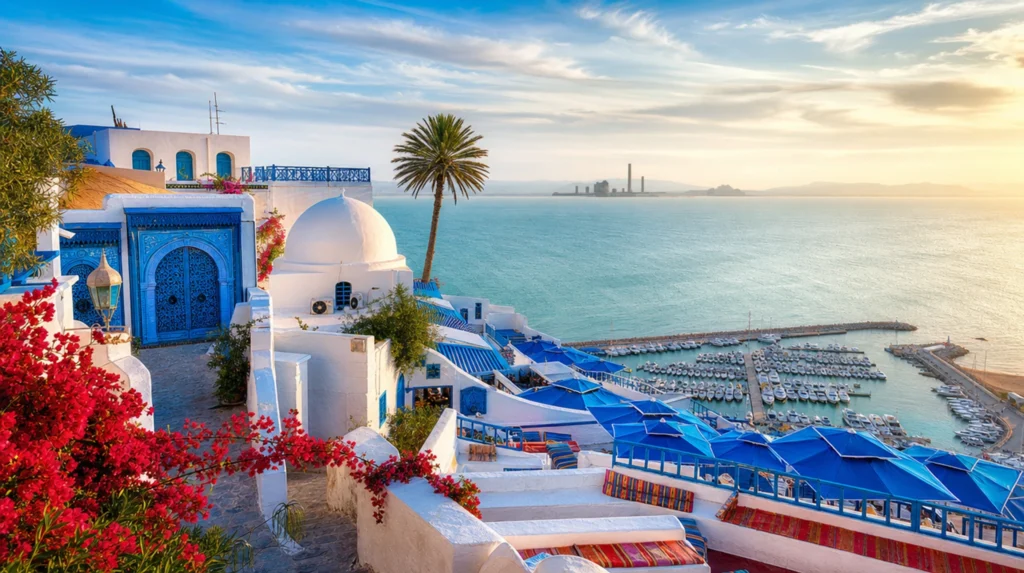
Sidi Bou Said, on the cliff above the Bay of Tunis 3 km north of Carthage, is the famously photographed blue-and-white village — every house in the historic core is whitewashed with cobalt-blue door and window frames, a colour code formalised in the 1920s by the French baron Rodolphe d’Erlanger who lived there. The village is touristy but genuinely beautiful, with the Café des Nattes (since 1900, frequented by André Gide and Paul Klee) and the d’Erlanger palace-museum as the cultural anchors. Combine with the Carthage half-day for the classic Tunis day-trip rhythm.
- What to do: Tunis medina half-day walking tour; Bardo Museum (allow 3-4 hours); Carthage archaeological circuit; Sidi Bou Said sunset; La Marsa beach (the locals’ beach, north of Sidi Bou Said).
- Signature eats: Dar El Jeld (Hafsid palace restaurant in the medina, formal Tunisian cuisine); Le Slow Food in La Marsa; Café des Nattes for mint tea with pine nuts in Sidi Bou Said; brik a l’oeuf (the classic Tunisian filo-pastry triangle with egg) from any medina café.
- Access: Tunis-Carthage International Airport (TUN), 8 km from city centre. TGM light rail covers the entire Tunis-Carthage-Sidi Bou Said-La Marsa axis from Tunis-Marine station.
🌅 Hammamet & the Cap Bon Peninsula
The country’s premier beach resort area, 65 km southeast of Tunis on the Cap Bon peninsula. Hammamet was Tunisia’s first beach destination — discovered by European writers and artists in the 1920s, with George Sebastian’s villa (now Centre Culturel International) hosting Frank Lloyd Wright, Paul Klee and André Gide between the wars. Modern Hammamet is two distinct areas: the small whitewashed historic medina (a working fishing-and-craft town with a small kasbah and a beach) and Yasmine Hammamet, the purpose-built tourist zone 4 km south with around 50 large hotel resorts, a Mediterranean theme park (Carthage Land), the largest waterpark in North Africa, and the artificial Yasmine Marina.
Beyond Hammamet, the Cap Bon peninsula extends 80 km northeast to the strait facing Sicily, with quieter beach towns (Nabeul, the country’s pottery capital; Kelibia, the small fishing port and 6th-century Byzantine fort; El Haouaria with its Roman quarry caves; Sidi Daoud with the spring tuna-fishing fleet). The peninsula’s interior is dotted with citrus orchards, olive groves and the largest concentration of Roman villa archaeological sites outside Carthage. Korbous, on the Gulf of Tunis side, has thermal springs that have been continuously used since Roman times and a small hot-pots-by-the-sea complex that locals favour over the Hammamet hotel zone.
- What to do: Hammamet old medina and beach (free, public); Centre Culturel International villa; Nabeul Friday pottery market; Kelibia Byzantine fort; Korbous thermal springs; tuna fishing in Sidi Daoud (May-June).
- Signature eats: Restaurant L’Olivier in Hammamet medina (Mediterranean-Tunisian, garden setting); Nabeul ceramic-grilled fish (poisson au sel) at any harbour seafood restaurant.
- Access: Enfidha-Hammamet International Airport (NBE), 35 km from Hammamet. Train and louage from Tunis (1h30m by louage). Easy 1-hour rental car from Tunis-Carthage.
🕌 Kairouan — The Holy City
The fourth-holiest city in Sunni Islam (after Mecca, Medina and Jerusalem) and one of the most rewarding cultural day-trips from Tunis. Founded in 670 CE by the Arab general Uqba ibn Nafi as the launching base for the conquest of the Maghreb, Kairouan was North Africa’s first Islamic capital and produced the architectural and intellectual model that the rest of the western Islamic world followed for centuries. The Great Mosque of Kairouan (built and rebuilt 670-880 CE), with its 80m-tall minaret and 414 ancient marble columns reused from Roman and Byzantine sites across North Africa, is one of the great early Islamic mosques — the architectural prototype for the mosques of Cordoba, Marrakesh and Fez.
The medina of Kairouan, UNESCO inscribed in 1988, is the most intact medieval Islamic urban core in North Africa — 4 km² of covered souks, the Mosque of the Three Doors (one of the oldest Islamic structures with a decorated facade), the Aghlabid Basins (9th-century reservoirs that supplied the city’s water), and the Zaouia of Sidi Sahab (the “Barber of the Prophet” mausoleum, an 8th-century Islamic shrine). Kairouan is also the centre of the Tunisian carpet industry; the National Carpet Office in the medina is the certified outlet. Allow a full day to do justice to the mosques, medina and carpet workshops, with a sunset return to Sousse 60 km east.
- What to do: Great Mosque of Kairouan (allow 90 minutes); medina walking tour; Aghlabid Basins; Zaouia of Sidi Sahab; National Carpet Office for the certified carpet circuit; Bir Barouta (the medina’s mythical well powered by a blind camel walking circles).
- Signature eats: Roi du Couscous (the city’s traditional couscous house); makroud (the local date-and-semolina sweet, sold from open-fire street stalls in the medina at TND 5-10 per kilo).
- Access: Louage from Tunis (2h30m, TND 12) or rental car. Day-trip from Sousse (60 km, 1h drive) or as a stop on the Tunis-Tozeur drive.
🏛️ El Jem — Africa’s Roman Amphitheatre
The 3rd-century CE Roman amphitheatre at El Jem is the third-largest Roman amphitheatre in the world (after the Colosseum in Rome and the Capua amphitheatre near Naples), the largest in North Africa, and one of the most visually intact Roman buildings outside Italy. The amphitheatre was built by Emperor Gordian I around 238 CE on the back of the city’s wealth from Roman olive oil exports, with capacity for around 35,000 spectators in three tiers. The structure is largely complete — visitors walk the underground galleries where animals and gladiators were held before fights, climb the upper galleries for the panoramic interior, and stand on the arena floor for the cinematic look used in Ridley Scott’s Gladiator and other Roman films.
The El Jem Archaeological Museum, 1 km from the amphitheatre, houses 2nd-3rd century Roman mosaics excavated from the surrounding villas — the 60-square-metre Triumph of Bacchus mosaic and the Nine Muses pavement are the highlights. The town itself (population 21,000) is small enough to walk corner-to-corner in 20 minutes; allow 3 hours for the amphitheatre, museum and lunch. The summer Carthage International Festival’s parallel El Jem Symphony Festival uses the amphitheatre as its venue (July-August).
- What to do: Amphitheatre (allow 90-120 minutes, including underground galleries); El Jem Archaeological Museum.
- Signature eats: The town has limited restaurants; most travellers eat at the small cafés near the amphitheatre or wait until Sousse or Mahdia.
- Access: Train from Sousse (45 minutes, TND 4) or Sfax (1h, TND 4). Rental car works as a 1.5-hour drive from Sousse on the way to Sfax.
🌊 Djerba — Mediterranean Island Heritage
The 514-square-kilometre island in the Gulf of Gabès off the southeast coast — Tunisia’s largest island, connected to the mainland by the Roman-era Chaussée of El Kantara causeway and the modern Ajim ferry. Djerba’s Mediterranean climate is milder than the mainland (average winter highs 18°C, summer 30°C), making it the country’s year-round beach destination. The package-tourism zone of Houmt Souk, Midoun and the Zone Touristique on the east coast holds roughly 50 large hotels; the rest of the island is genuinely traditional — date palm groves, fishing villages, and the world’s oldest continuously functioning synagogue.
The El Ghriba Synagogue at Hara Sghira is reportedly the oldest synagogue in Africa — Jewish tradition holds it was founded in 586 BCE by refugees from the destruction of the First Temple in Jerusalem, with a stone from the Temple incorporated into the building. The current structure dates to the 19th century, and the annual pilgrimage on the 33rd day after Passover (Lag B’Omer, May) draws Jewish pilgrims from across the diaspora. The wider Djerbi Jewish community of around 1,500 people is one of the oldest continuous Jewish communities in the Diaspora and produces a distinct Tunisian-Jewish cuisine and craft tradition.
- What to do: El Ghriba Synagogue; Houmt Souk medina (the largest in Djerba, with the Borj el Kebir 16th-century Spanish fort); Midoun donkey market (Friday); Erriadh village street art (“Djerbahood” project, 250+ international murals); flamingo viewing at Ajim lagoon (winter).
- Signature eats: Djerba seafood (octopus tagine, local grouper grilled at any harbour restaurant); Djerbi-Jewish cuisine (the “matzo ball” that is the local boulettes, served at Houmt Souk family restaurants).
- Access: Djerba-Zarzis International Airport (DJE), 10 km from Houmt Souk. Ferry from Ajim mainland (15 minutes, TND 1 per car) or El Kantara causeway (free).
🏜️ Tozeur, Douz & the Saharan South
The southern desert circuit. Tozeur is the gateway oasis — a town of 35,000 at the edge of the Chott el Jerid salt flat, with a distinctive Tozeur-style brick architecture (interlocking patterned brickwork that originated in the 14th-century medina), 200,000 date palms in the surrounding palmeraie, and a small but growing artisanal cheese, oil and date industry. The Chott el Jerid itself is a 7,000-square-kilometre seasonal salt lake that crystallises into white-pink dazzling crusts in the dry season (October-May) and refloods during winter rains; the main paved road (P15 between Tozeur and Kebili) crosses the chott on a 70-km causeway with viewpoints that have become Star Wars filming legend (the Mos Eisley spaceport scenes were filmed here in 1976).
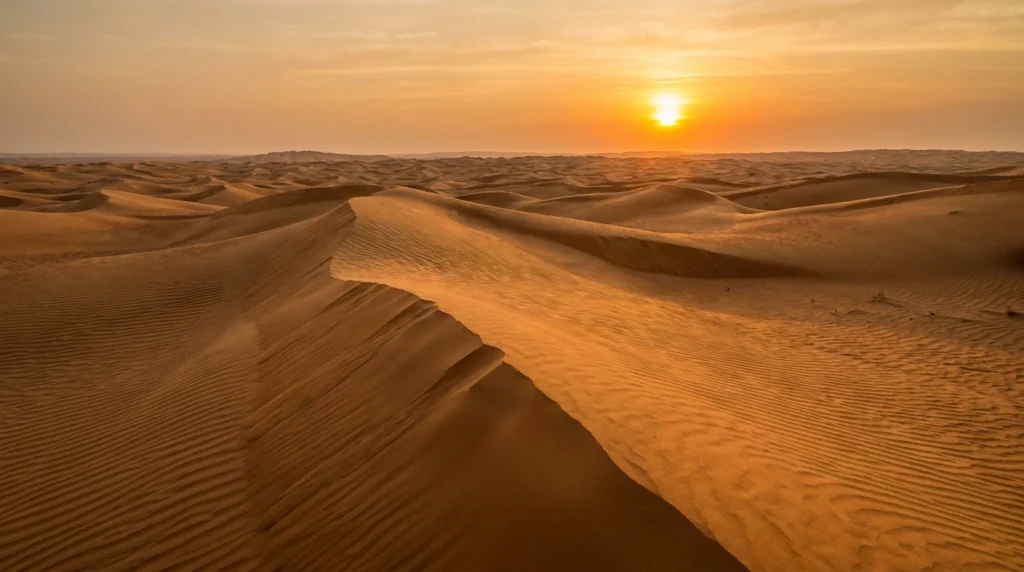
Douz, 130 km south of Tozeur, is the “gateway to the Sahara” and the staging point for the Erg Oriental sand sea south of town. Camel-and-4WD desert excursions run from 4-hour sunset trips to multi-day treks deep into the dunes; the four-day classic “Douz to Ksar Ghilane” expedition crosses 200 km of Saharan terrain via Berber-camp overnight stops. The annual International Festival of the Sahara at Douz (late December) brings camel races, Berber dance troupes and traditional Bedouin music for 4 days. Matmata, 80 km east of Douz on the way to the coast, is the troglodyte village famous for its underground Berber dwellings carved into the soft sandstone — Hotel Sidi Driss in Matmata was the original Lars homestead in the 1976 Star Wars: A New Hope and remains a working hotel where you can stay in Luke Skywalker’s bedroom for TND 30-40 per night.
- What to do: Tozeur old medina and palmeraie walk; Chott el Jerid sunset crossing; Star Wars set at Mos Espa (8 km west of Tozeur, 80% restored after 2019 sand-burial); Douz camel sunset and overnight desert camp; Matmata underground Berber houses; Ksar Ghilane oasis with Roman fort ruins and natural hot spring (4WD only, 4 hours from Douz).
- Signature eats: Tozeur date-stuffed lamb shoulder at any palmeraie restaurant; Douz bedouin tagine at the festival camp; Matmata bread baked in underground ovens.
- Access: Tozeur-Nefta International Airport (TOE), seasonal flights from Paris and Tunis. Louage Tunis-Tozeur (6-7h) or rental car (5h via Kairouan and Gafsa). Internal Tunis-Tozeur Tunisair flight 1h.
“The colonised must understand that the colonialist’s truth is the colonised’s lie.”
— Albert Memmi, The Colonizer and the Colonized (1957)
🗓️ Sample Itineraries
Tunisia rewards short trips (the country is small) and longer trips (the depth is real). Below are four templates that work for most first-time travellers; pick the one that matches your time, then adjust by season.
5 Days — Tunis Long Weekend
Day 1: Arrive Tunis-Carthage. Settle in central Tunis or La Marsa hotel. Evening medina walk and dinner at Dar El Jeld. Day 2: Bardo Museum morning; Tunis medina afternoon; sunset at Café Sidi Chebaane in La Marsa. Day 3: Carthage archaeological circuit (Antonine Baths, Punic Ports, Byrsa Hill, amphitheatre). Sidi Bou Said sunset and dinner at Café des Nattes. Day 4: Day-trip to Hammamet (1h drive); old medina, Sebastian villa, beach lunch. Return Tunis evening. Day 5: Day-trip to Dougga (the best-preserved Roman city in Africa, 110 km west of Tunis, allow 4 hours each way) or Cap Bon (Nabeul-Kelibia coast). Evening departure. Compact urban-and-coastal trip suited to European weekenders.
7 Days — Tunis + Coast + Kairouan
Day 1: Arrive Tunis. Day 2: Tunis medina and Bardo Museum. Day 3: Carthage and Sidi Bou Said. Day 4: Drive Tunis to Kairouan (2h), Great Mosque, Aghlabid Basins, medina. Drive to Sousse evening (1h). Day 5: Sousse medina morning; train to El Jem (45 min) for amphitheatre; return Sousse evening. Day 6: Sousse beach morning; afternoon Hammamet drive (45 min). Day 7: Hammamet morning; return Tunis-Carthage for departure. The realistic week-long trip combining the cultural and beach halves.
10 Days — Adding the Sahara
The full-loop trip. Days 1-5: Tunis-Kairouan-Sousse-El Jem as in the 7-day template. Day 6: Drive Sousse to Tozeur (5h via Gafsa) or fly Tunis-Tozeur (1h). Day 7: Tozeur palmeraie and old medina; Star Wars sets day-trip to Mos Espa and Mos Eisley. Day 8: Drive Tozeur to Douz (1h30m) via Chott el Jerid causeway; afternoon camel sunset at Douz dunes. Day 9: Drive Douz to Matmata (3h) via Berber villages; afternoon at Hotel Sidi Driss troglodyte. Drive Matmata to Sfax or Sousse (4h). Day 10: Return Tunis (3h drive) for departure. The recommended Tunisia first-trip itinerary if you have the time.
14 Days — End-to-End Tunisia
For travellers willing to drive and explore. Take the 10-day template above as the spine, then insert: Days 6-7: A 2-day extension to Djerba via the Ajim ferry — beach day, Houmt Souk medina, El Ghriba synagogue, Erriadh street art. Day 8: Ferry back, drive to Tozeur via Tataouine and the southern ksour (fortified Berber granaries) at Ksar Ouled Soltane and Chenini. Days 9-12: Saharan loop as the 10-day template Tozeur-Douz-Matmata. Days 13-14: Drive back via the eastern coast — Mahdia (the small port town with the most photographed seafront café terrace in Tunisia) and Monastir (Bourguiba’s hometown, with his mausoleum). Return Tunis evening Day 14. Reserve a 4WD for the Ksar Ghilane optional and check current border-zone advisories before booking the southern ksour circuit.
🎯 Strategy
If you only have one trip to Tunisia, do the 10-day version in late October through mid-November. The plains have cooled to perfect daytime temperatures, the Saharan south is in its dry-season optimum, the date harvest is in markets, the package-tour summer crowds have left, and hotel rates are 25-35% below summer peak. Spring (March-April) is a viable second window with cooler coast temperatures and fresher landscapes. Avoid mid-June to mid-September unless you specifically want package-tour beach tourism — the Sahara is impassable for sightseeing in those months.
Tunisian Culture & Etiquette
Tunisia is the most culturally cosmopolitan and politically liberal of the Arab Maghreb states, with a long tradition of openness to Mediterranean and European influence dating to the Phoenician and Roman periods. The post-1956 Bourguiba reforms produced personal-status laws unmatched elsewhere in the Arab world (banning polygamy, allowing female-initiated divorce, equalising inheritance), and the 2014 post-revolution constitution maintained and extended these. Tunisian women hold roughly 31% of parliamentary seats, work professionally in every sector, and dress in a wider range — from full hijab to entirely Western — than is common in most Arab countries. Public displays of affection are restrained but not actively prohibited; alcohol is legally available at most restaurants and supermarkets.
Tunisian hospitality follows the Mediterranean rhythm — long meals, animated conversation, multiple rounds of mint tea after a meal. The phrase “ahla wa sahla” (welcome) is constant. Travellers in rural areas, especially the Saharan south and the central interior, will often be invited for tea by households on a casual basis; the convention is to accept once, decline politely a second time, and accept a third invitation if pressed. Gift-giving is appropriate but should be modest and culturally calibrated — small chocolates from your home country, or perhaps a pen for a child, work better than expensive items.
Dress is moderate. In Tunis, Hammamet, Sousse and Djerba, female travellers can wear short sleeves, knee-length skirts and modest beachwear without comment. Inland (Kairouan, Tozeur, Douz, Matmata) the local dress code is more conservative; long sleeves and skirts or trousers below the knee are appropriate, and a scarf is appreciated for mosque visits (sometimes provided at the entrance). Men should avoid shorts inside mosques and shrines. The exception across the country is the all-inclusive resort interior and the beaches themselves, where European beachwear is standard.
💬 The Saying
“Al-baraka fi al-sabr.” Roughly: “Patience holds the blessing.” The phrase appears across Tunisian conversation when something doesn’t work as expected, when a louage takes longer than scheduled, or when a market negotiation runs longer than feels comfortable. The cultural register is Mediterranean — patience as practical philosophy rather than fatalism — and travellers who learn to deploy it earn instant rapport with shopkeepers, drivers and guides. The phrase is also the way most older Tunisians frame the post-2011 democratic transition: it has been long, contradictory, and the patient work continues.
A Food Lover’s Guide to Tunisia
Tunisian food is the spiciest of the Maghreb cuisines and the most influenced by sub-Saharan trade — chilli (in the form of harissa, the country’s signature condiment) appears in essentially every savoury dish, sometimes subtly and sometimes brutally. The cuisine is built around lamb, fresh Mediterranean seafood, olives, tomato, semolina (couscous), and the country’s exceptional olive oil (Tunisia is one of the world’s top three olive oil producers and frequently the leading single-country exporter to the European Union).
Couscous is the national dish. Friday lunch couscous (with lamb, vegetables, chickpeas and a meat broth) is the universal family meal across Tunisia, served in family restaurants every Friday afternoon. Variations include couscous bel hout (with fish, the coastal speciality at Mahdia and Sfax), couscous belboula (with barley couscous, a southern-rural variant), and couscous bel kadid (with sun-dried lamb, the Berber winter dish).
Harissa is the national condiment — a paste of dried red chillies, garlic, caraway, coriander, olive oil and salt, fermented for several days. It appears alongside bread at the start of every meal, in tagines, in shakshuka, and as a marinade for grilled fish. The Cap Bon variety is the most flavourful (Nabeul harissa); the Sfax variety is the most chilli-forward. The branded export Belazu and Carrefour Bio versions are decent approximations but the local market product is better.
Brik is the country’s signature snack — a triangular pastry of malsouqa (paper-thin filo dough) stuffed with egg, tuna, parsley and capers, deep-fried briefly so the egg yolk stays runny. Eat it carefully — bite into the pastry while holding the brik over a plate, since the yolk runs out. Available everywhere from morning until late evening at TND 1-3 ($0.30-1).
Mechouia is the cold-charred pepper salad — green peppers, tomatoes, garlic and onions roasted directly over fire until the skins blacken, peeled, hand-mashed with olive oil, harissa, capers and tuna or hard-boiled egg. The summer staple. Fresh ingredients matter; the difference between a great mechouia and a mediocre one is entirely the char and the harissa.
Lablabi is the breakfast soup. A bowl of cooked chickpeas in a chickpea broth, with stale bread torn into the bowl, harissa stirred in, a poached egg cracked on top, capers, olive oil and cumin. Eaten fast and hot at street stalls. The Khartoum stall in Tunis medina (since 1957) is the conventional reference. TND 4-7 a bowl. Filling, regionally specific, and unlike anything you’ll have elsewhere.
Tunisian seafood is the underrated category. The Mediterranean produces white grouper (mérou), red mullet (rouget), octopus (poulpe), squid (calamar), and the tuna of the Cap Bon spring season. Mahdia restaurants serve the most authentic seafood; Sidi Bou Said and La Marsa serve the most expensive. The poisson au sel (salt-baked fish) at coastal restaurants is the regional speciality.
Olive oil is genuinely worth bringing home. The certified single-estate oils from Sfax, Cap Bon and the Nabeul region are competitive with Tuscan or Andalusian estates at a fraction of the price (TND 25-50 per litre at the source, $8-16). The duty-free at Tunis-Carthage stocks the better-known brands; the Friday souk in Nabeul is the source.
Mint tea (athay) is the social glue. Boiled green tea infused with fresh spearmint, served with pine nuts in the glass on top, sweetened heavily. The Café des Nattes in Sidi Bou Said is the famous cultural reference; every neighbourhood has its own café-teteria where the same beverage is served at TND 1-3.
📸 Photography Notes
Tunisia offers two completely different photographic palettes — the cobalt-blue-and-whitewashed Sidi Bou Said Mediterranean, and the orange-pink-and-gold Saharan south. The light is genuinely Mediterranean: clean, low-haze, and reliably golden in the autumn and spring shoulder seasons. Roman ruins photograph well in either direction (sunrise or sunset), with the long shadows defining the columns and bricks.
Best light by season: March-May for the Mediterranean coast and the medina interiors (the wildflower season adds colour to the Roman site exteriors); October-November for the desert south (the air is at its clearest, the dunes have softened, and the early-morning photography window is genuinely cold and crisp); January-February for the Saharan dunes (cold mornings, golden afternoons, almost no other tourists).
Five locations worth the detour:
- Sidi Bou Said hilltop, sunset (36.8716°N, 10.3450°E) — the cliff-edge view of the Bay of Tunis with whitewashed houses and cobalt frames. Late October-November for the clearest Mediterranean light. Café Sidi Chebaane is the access point.
- El Jem amphitheatre, golden hour (35.2961°N, 10.7070°E) — the late-afternoon shot from the upper galleries with arena floor below. October-November for clean shadows and minimal crowds.
- Chott el Jerid causeway, midday (33.7000°N, 8.4400°E) — the white salt crystallisation on either side of the road creates a horizon-less photograph that looks otherworldly. October-March only (the chott floods in late winter rains and recedes by April).
- Mos Espa Star Wars set (33.9956°N, 7.8400°E) — 8 km west of Tozeur. The igloo-domes of Tatooine were partially restored after the 2019 sand-burial. Best at dawn for the long shadows and the absent crowds.
- Hotel Sidi Driss troglodyte courtyard, Matmata (33.5395°N, 9.9690°E) — Luke Skywalker’s Tatooine homestead courtyard. Mid-morning for the soft light filtering down from the open central well.
Drone rules: Tunisia requires a permit from the Ministry of National Defence and the Ministry of Interior for any drone operation by foreign nationals — a process that takes weeks and is not realistic for casual tourists. Drones are explicitly prohibited near military sites, ports, airports, and government buildings, and at all UNESCO heritage sites (Carthage, Tunis medina, Kairouan, Dougga, El Jem, Sousse medina). Customs may confiscate drones at entry without prior permits. Bringing a drone is not advisable for most tourists.
✨ Pro Tip — Photographing People and Mosques
Tunisia’s photographic ethics are middle-of-the-road for North Africa — generally more permissive than Morocco, less commercial than Egypt. In medinas and souks, ask before photographing shopkeepers and craft workers; most will agree happily for a small purchase or for the social interaction. Photographing women without permission is genuinely culturally inappropriate; ask first or shoot wide enough that no individual is identifiable. Mosque interior photography is generally permitted for non-prayer-time tourist visits at the Great Mosque of Kairouan, the Zitouna Mosque in Tunis, and most others; the Aghlabid Basins and Roman sites are entirely open. Government installations, military checkpoints, ports, bridges and the airport tarmac should never be photographed.
Off the Beaten Path — Tunisia Beyond the Coast
The standard tourist circuit covers maybe 60% of what Tunisia offers. The remaining 40% is harder to reach, less photographed, and contains some of the most distinctive cultural and natural sites in the country.
🏛️ Dougga — The Best-Preserved Roman City in Africa
The 70-hectare UNESCO-inscribed archaeological site of Roman Thugga, 110 km southwest of Tunis on a hilltop overlooking olive plains, is the most architecturally complete Roman city in North Africa. The 6,000-seat theatre (3rd c. CE), the Capitol Temple, the Licinian Baths, the House of the Trefoil, and the Numidian-period Mausoleum of Ateban (one of the only pre-Roman Berber funerary monuments still standing) reward 3-4 hours of walking. Easily a day-trip from Tunis. The drive through the Mejerda Valley and the small town of Téboursouk is itself attractive.
⛰️ Aïn Draham & the Khroumirie Mountains
The forested mountains of northwestern Tunisia near the Algerian border — the country’s coolest, greenest and most underrated landscape. Aïn Draham, at 800m altitude, is the small Alpine-style hill station built by French colonial administrators in the 1880s; surrounding cork-oak forest still produces about 5% of global cork supply. Tabarka, on the coast 30 km north, has the 16th-century Genoese fort on a small island connected to the mainland by a causeway, and the country’s best diving (good underwater visibility, soft corals, occasional dolphin pods). Bulla Regia, 35 km southeast of Aïn Draham, has Roman houses with underground bedroom chambers built specifically to escape the summer heat — unique to this site.
🏰 The Southern Ksour
The fortified Berber granary villages south of Tataouine — Ksar Ouled Soltane, Ksar Hadada, Chenini Tataouine, Douiret, Guermessa, Ouled Debbab — are a network of multi-storey hilltop or canyon-edge granary complexes built between the 13th and 18th centuries to store the seasonal harvest of nomadic Berber tribes. The architecture is unique to this region and to a smaller area of Libyan Tripolitania. Star Wars: A New Hope filmed Anchorhead at Chenini and used Ksar Hadada as Mos Espa slave quarters. Most ksour are accessible by paved road from Tataouine; allow a full day from Tataouine. Currently dependent on Libyan-border advisory status — check before travelling.
🌊 Mahdia — The Quiet Mediterranean Port
Tunisia’s most underrated coastal town. Mahdia (population 65,000) was the Fatimid capital of the Maghreb from 921 to 973 CE before they moved their court to Cairo to found modern Cairo. The walled harbour-medina retains 10th-century gates, the Skifa El Kahla fortified entrance, and a small but rewarding souk. The Café Sidi Salem on the harbourside is the most photographed café terrace in Tunisia for good reason — sunset over the Mediterranean with the kasbah behind. The town’s beach is wider and less crowded than Sousse, and the seafood restaurants are some of the country’s best. Reach by train from Sousse (1h, TND 4) or rental car.
🐪 Ksar Ghilane — The Saharan Oasis
The desert oasis 100 km south of Douz is the staging point for the deepest accessible Saharan experience in Tunisia. The site has a Roman fort (Tisavar) ruins, a natural hot spring (38°C year-round), date-palm groves, and access to genuine erg (sand sea) terrain. Standard 2-day 4WD trips run TND 250-400 ($82-130) per person from Douz, with overnight in tented Berber camps. Optional camel-riding extensions of 2-4 nights cross the western dune fields toward the Algerian border. The genuinely remote desert experience that doesn’t require multi-day expedition logistics.
Tunisia by Numbers
- 814 BCE — founding date of Carthage by Phoenician colonists
- 8 — UNESCO World Heritage Sites
- 1,300 km — length of Mediterranean coastline
- 3rd — world ranking among olive oil producers (some years 1st)
- 200,000 — date palms in the Tozeur palmeraie alone
- 1,500 — approximate population of the Djerbi Jewish community, one of the world’s oldest continuous diaspora
Practical Information
Currency: Tunisian dinar (TND), pegged loosely to a basket of Euro and US dollar. The dinar is technically a closed currency — you cannot legally import or export TND, and exchange must happen inside the country. ATMs are widespread in cities, accept Visa and Mastercard reliably, and usually dispense TND 100 and 50 notes. Credit cards are accepted at upscale restaurants, hotels and supermarkets; cash is preferred for medina shops, louages, taxis and rural areas. Tipping is appreciated — round-up at restaurants, TND 5-10 per day for guides and drivers.
Visa & entry: Visa-free entry for stays up to 90 days for nationals of the UK, US, Canada, Australia, EU member states, and most other Western nationalities. Passport must be valid for at least 3 months past the planned departure date. The departure tax (TND 30 for stays under 30 days, TND 60 for longer) is now usually included in air ticket pricing.
Language: Arabic (Tunisian dialect, Tunsi) is the daily language; French is the second language and used widely in business, government, road signage and university education. English is increasingly spoken by the under-30 generation but is still less prevalent than in Morocco. Learn “marhaba” (hello), “shukran” (thanks), “barakallah” (thank you generously, used for service workers), and “marra okhra” (one more time, useful in cafés).
Connectivity: 4G covers all major cities and most tourist routes. Local SIMs from Ooredoo or Orange Tunisia cost TND 10-25 for the card plus 10GB-30GB monthly packages. WiFi is universal in hotels and cafés; rural Saharan oases have spotty coverage. The Tozeur-Douz desert circuit has limited signal beyond the towns themselves.
Tap water: Generally safe in Tunis, Hammamet, Sousse, Sfax and the major cities, but most travellers stick with bottled water for a settled stomach. The desert south’s tap water is genuinely not advisable. Bottled water is universally available at TND 0.5-1.5 per litre.
Plug type: Type C and E (European-style two-pin), 230V/50Hz. North American travellers need an adapter; UK travellers also.
Budget Breakdown — What Tunisia Actually Costs
Tunisia is one of the most affordable Mediterranean destinations for a Western traveller — accommodation, restaurants, transport and entry fees run roughly 30-50% below comparable Italian, Spanish or Greek standards, and the country’s package-tourism market keeps mid-range hotel prices structurally low. The good news is that the things that matter — Roman archaeology, medina walking, Mediterranean swimming, Saharan dunes — are universally accessible across budget tiers. The bad news is that the desert south has pricing distortions due to the 4WD-and-driver requirement.
💚 Budget Traveller — $35–55 / day
Budget hotels and pensions in Tunis medina or coastal towns ($15-25/night), louage transport between cities, restaurant meals at TND 8-15 ($3-5), Roman site entries at TND 8-12 ($3-4) per site. The trick is to base out of one or two cities and day-trip rather than hotel-hop, and to use the louage and train rather than rental cars (which work out per-day). Airbnbs in Tunis La Marsa or Sousse are $25-40/night and significantly more comfortable than budget hotels.
💙 Mid-Range — $90–160 / day
Three-star hotel or boutique guesthouse $50-100/night, restaurant dinner with one drink TND 30-60 ($10-20), rental car TND 80-130/day ($26-43) plus fuel, occasional desert tour TND 200-400 ($65-130). The realistic shoulder-season cost for a couple driving the country at independent pace. The Dar Said boutique hotel circuit (in Sidi Bou Said, Hammamet, Mahdia and Djerba) provides the country’s signature riad-style mid-range stays at TND 200-350 per night.
💜 Luxury — $300+ / day
Four-Seasons-equivalent properties — La Badira in Hammamet, the Four Seasons Tunis, the Anantara Tozeur — run TND 700-2,500 per night ($230-820). Tasting-menu dinner at Dar El Jeld TND 280-380 plus wine pairing TND 200. Private 4WD with English-speaking guide TND 600-900/day ($200-300). The genuine top-end Tunisia experience is the desert lodge at Anantara Tozeur plus a Tunis riad plus a Djerba island stay, which can run $400-600/day per person but delivers a Mediterranean luxury experience few destinations match for the price.
| Item | Budget (TND) | Mid-range (TND) | Luxury (TND) |
|---|---|---|---|
| Bed (per night) | 40–80 | 150–300 | 700–2,500+ |
| Dinner | 10–20 | 30–60 | 120–280 |
| Daily transport | 15 (louage/train) or shared | 80–130 (rental car) + fuel | 600+ (private 4WD + driver) |
| One activity | 8 (Roman site entry) | 200 (sunset Saharan tour) | 1,800 (helicopter Sahara overflight) |
| USD daily | $35–55 | $90–160 | $300+ |
🧳 Travel Guru Tip — The Tunisia Pass
The Tunisian National Heritage Institute offers a multi-site combined pass (Carte Permis Multi-Sites) at TND 25 ($8) that covers all major Roman archaeological sites — Carthage, Dougga, El Jem, Bulla Regia, Sbeitla, Thuburbo Majus, Maktar — for a 30-day window. Buy at the entry gate to the first site you visit. The Bardo Museum is separately ticketed (TND 12). For travellers visiting more than 3 Roman sites, the pass pays for itself; for travellers visiting all 7, the saving is significant. A similar but separate pass exists for the medina mosques and madrasas, available from the Tunis medina ticket office.
✅ Pre-Trip Checklist
The minimum kit and admin to have sorted before you fly. Tunisia is a relatively small, well-developed country with European-standard tourism infrastructure, so the pre-trip burden is light compared to many other African destinations.
- Documents: Passport valid 3 months past return date. No visa needed for most Western nationalities for stays up to 90 days. Print rental car voucher and hotel bookings. Save offline copies of bookings to your phone.
- Insurance: Travel insurance with cover for Mediterranean adventure activities (diving, riding, hiking) and rental car damage. World Nomads, SafetyWing, IMG Patriot are the standard options. Confirm whether your specific regions are excluded as advisory zones (the Algerian and Libyan border zones, the Chaambi Mountains).
- Health: No special vaccinations required. Tetanus and routine vaccinations should be up-to-date. Bring a basic first-aid kit. Anti-malarial prophylaxis is not needed.
- Layers: For spring/autumn travel: lightweight long-sleeve shirts and long trousers; light jacket for evenings; modest dress for medinas and mosques. For winter Saharan travel: a fleece, light down jacket, and warm hat for cold desert nights. Female travellers should pack at least one scarf for mosque visits.
- Footwear: Comfortable walking shoes for the medinas (cobblestones can be hard); a pair of sandals for hotel rooms and beaches; waterproof hiking shoes only if doing the Khroumirie or Saharan trekking.
- Swimsuit: Yes for May-October Mediterranean travel; the all-inclusive resorts have heated pools year-round.
- Apps to download: Bolt (the dominant ride-hailing app in Tunisia, replacing Uber), Maps.me (better offline coverage in rural Tunisia than Google), Google Translate Arabic and French offline packs, Tunisair (mobile boarding passes), WhatsApp (universal communication tool).
- Cash: Bring €100-200 in clean small notes for emergency exchange (USD also works). The TND is a closed currency so most travellers exchange €50-100 on arrival at the airport for initial taxi fare and tips.
- Connectivity: Download offline Google Translate Arabic and French packs, Maps.me offline maps for the regions you’ll visit, and any reading material. The Saharan south can have hours of no signal beyond the major towns.
- Cultural prep: Read at least one Tunisian-author novel (Albert Memmi’s The Pillar of Salt, or contemporary Shukri al-Mabkhout’s The Italian) for cultural context; learn the basic Arabic and French greetings; know that Friday lunch is the family-couscous time and many businesses close early.
🤔 What Surprises First-Timers
- The country is more European than expected. The French-speaking professional class, the Mediterranean architecture, the secular dress code in cities, and the open availability of alcohol surprise travellers expecting Morocco’s level of cultural distance. Tunisia is the most “European” of the Maghreb states — the colonial influence ran deeper, the post-independence reforms went further, and the day-to-day life rhythms feel closer to coastal Italy than to Marrakesh.
- The food is genuinely spicier than expected. Tunisian harissa appears in essentially every savoury dish; even mild restaurants serve dishes with significant chilli heat. “Bidoun harissa” (without harissa) is the phrase to learn if you can’t tolerate heat.
- The medinas are more livable than the package brochures suggest. Tunis, Sousse and Kairouan medinas all have residential populations, working artisanal shops, and authentic cultural rhythms — they are not Disneyland reconstructions. Walking them at non-tourist hours (early morning before 9 a.m., or in the dinner hour) reveals the working town beneath the souk veneer.
- The Saharan south is genuinely cold at night in winter. Tozeur and Douz nights drop to 4-8°C in December-February. Travellers expecting “desert” warmth are unprepared and miss the dawn photography window for lack of warm layers.
- Star Wars filming sites are mostly authentic remains, not theme parks. Mos Espa, Mos Eisley, the Lars homestead at Hotel Sidi Driss — these are the actual sets from the 1976-77 productions, partially eroded, partially restored, and entirely accessible. Hotel Sidi Driss still rents Luke Skywalker’s bedroom for TND 30-40/night.
- The language register is French as much as Arabic. Most road signs are bilingual; many young Tunisian professionals are more comfortable in French than in formal Arabic; and many medina shopkeepers will switch to French with European visitors. Travellers with even rudimentary French have a significantly easier time than those with only English.
- Tipping is genuinely modest. Round-up is the convention; 10% in restaurants is generous. Tour drivers expect TND 10-20 per day per traveller. The aggressive tipping culture of Egypt or Morocco is largely absent.
- The package-tour and independent-travel circuits barely overlap. Travellers staying at the all-inclusive Hammamet, Sousse or Djerba zones rarely interact with the Tunis medina culture or the Saharan south — and the opposite is also true. The country offers two genuinely different visit experiences depending on which mode you choose.
Frequently Asked Questions
Is Tunisia safe for tourists in 2026?
Yes, with normal precautions. The standard tourist circuit (Tunis, Carthage, Sidi Bou Said, Hammamet, Sousse, Mahdia, Kairouan, El Jem, Sfax, Djerba, Tozeur, Douz, Matmata) is routinely visited by foreign travellers in 2026 with no special concerns. Most Western foreign ministries continue to advise against travel to specific border zones (Algerian frontier, Libyan frontier, Chaambi Mountains, southern military zone) but these are not areas the standard tourist itinerary touches. Always check your government’s current travel advisory the week before booking.
Do I need a visa?
Not for most Western nationalities. UK, US, Canadian, Australian and EU passport-holders enter visa-free for stays up to 90 days. Passport must be valid for at least 3 months past planned departure date.
Is Tunisia good for solo female travellers?
Yes, with cultural calibration. Tunisia has the most liberal personal-status law in the Arab world and women in Tunis, Hammamet, Sousse and Djerba dress and move freely in a way comparable to Mediterranean Europe. Inland (Kairouan, Tozeur, Douz, Matmata) the local dress code is more conservative; long sleeves, knee-length or longer skirts, and a scarf for mosque visits are appropriate. Solo female travellers report Tunisia as one of the most comfortable Arab destinations and significantly easier than Morocco or Egypt for independent travel. The standard precautions (no walking alone after dark in unfamiliar neighbourhoods, polite refusal of unwanted advances) apply.
Should I rent a car or use public transport?
For the standard tourist circuit (Tunis, Hammamet, Sousse, El Jem, Kairouan, Sfax, Mahdia), the louage and train network works well and is significantly cheaper than rental cars. For the Saharan south (Tozeur, Douz, Matmata), a rental car gives you flexibility but the louage system also works. For genuine off-road desert experiences (Ksar Ghilane, Erg Oriental), you must book a 4WD with experienced driver through a local operator regardless of your overall transport choice.
Can I drink the tap water?
Generally safe in Tunis, Hammamet, Sousse and major coastal cities, though most travellers stick with bottled water (universally available, TND 0.5-1.5 per litre) for a settled stomach. Tap water in the Saharan south is not advisable.
How does Tunisia compare to Morocco?
Different focus. Morocco offers more dramatic geographic variety (Atlas Mountains, Atlantic coast, deeper Sahara), richer souk culture in Marrakesh and Fez, and more luxury hotel inventory. Tunisia offers a more secular cultural register, deeper Roman archaeological inheritance, and significantly cheaper prices across categories. Tunisia is generally easier for first-time North Africa travellers — French is more widely spoken, the medinas are smaller and less overwhelming, and the all-inclusive resort layer provides a soft entry. Morocco is the deeper trip for travellers who want the more dramatic version.
When is the Carthage Festival?
July-August annually, with main performances at the restored Roman amphitheatre in Carthage. The 2026 lineup typically combines major Tunisian and Arabic-world musical artists with international acts (jazz, classical, world music). Tickets cost TND 25-150 ($8-50) and sell quickly for the headline names. The parallel El Jem Symphony Festival uses the El Jem amphitheatre for classical music in the same window.
Can I visit Tunisia during Ramadan?
Yes, with adjustments. Ramadan in 2026 falls roughly mid-February to mid-March (lunar calendar shifts annually). Most restaurants close during daylight hours; tourist-zone hotels still serve foreign guests; cafés and bars remain open. Locals do not eat, drink or smoke during fasting hours. Travellers can eat in hotel rooms or at tourist-zone restaurants but should not eat or smoke visibly in the medina or rural areas during fasting hours. The post-sunset iftar meals and the late-night cafés are remarkable cultural experiences.
What about the Star Wars filming sites?
Multiple sites remain accessible. Mos Espa (8 km west of Tozeur) is the most photographed and was partially restored after a 2019 sand-burial; Mos Eisley scenes were filmed at Chott el Jerid causeway; Hotel Sidi Driss in Matmata is the original Lars homestead (still operating as a working hotel where you can sleep in Luke Skywalker’s bedroom); Anchorhead at Chenini and other Tatooine scenes used the southern ksour. A “Star Wars itinerary” combining all major sites runs 4-5 days and is best done with a local guide who knows the access points.
What’s the one thing first-timers always regret skipping?
Dougga. Travellers do Carthage and El Jem and skip the inland Roman city that is genuinely the best-preserved in Africa, has dramatically fewer crowds, and reveals the rural prosperity that supported the urban Roman Maghreb. Either as a half-day trip from Tunis or as a stop on the Tunis-Tozeur drive, Dougga delivers a Roman experience few Mediterranean destinations match. Allow 3-4 hours; bring water and proper walking shoes.
Ready to Explore Tunisia?
Tunisia rewards travellers who plan a little and improvise a lot. The Roman archaeology, the medinas, the Saharan dunes, the Mediterranean coast, the Star Wars filming sites — they will be there. The seasons, the festivals, and the regional advisories decide the order. Build the itinerary, time the festival or harvest, and let the country surprise you.
For a tailored Tunisia trip — including the autumn date harvest, a focused medinas-and-Sahara loop, a Star Wars filming-sites circuit, or a luxury Mediterranean coast week — start with our trip-planning team. We can match you with the right rental car, riad circuit, and desert operator.
Explore More
🏙️ Tunis city guide
Tunis is Tunisia’s flagship city guide — start here for the on-the-ground capital experience before heading out to the wider country.
🇲🇦 Morocco travel guide
The western Maghreb cousin — bigger Atlas mountains, deeper souks at Marrakesh and Fez, and the Atlantic coast. Pair Tunisia with Morocco for a complete North African comparison.
🇪🇬 Egypt travel guide
The eastern Mediterranean cousin — pyramids, the Nile, ancient Egyptian heritage on a deeper scale. Both countries give a full Roman, Phoenician and Islamic-era story.
🇹🇷 Turkey travel guide
The Ottoman cultural cousin to the east. Both countries share Ottoman architectural inheritance and Mediterranean orientations; pair them for a deeper Mediterranean Islamic story.
🇮🇹 Italy travel guide
The country across the Strait of Sicily that has shaped Tunisian history for three thousand years. Both share Roman archaeological depth, Mediterranean cuisine, and complementary cultural inheritance.
🗺️ Plan a custom trip
Tell us when you’re going and we’ll design a day-by-day Tunisia itinerary that respects the seasons, the festivals, and the cultural rhythms.
More country guides you might like
Plan your trip to Tunisia
The booking tools we use ourselves. FFU may earn a commission at no extra cost to you.
Plan & book your trip to Tunisia
Booking through these searches supports our guides at no extra cost to you.