
Languages of Türkiye
All languages of Western Asia →fluent beta classical · classes by phone with Maya at ranas.ai/maya
☰ On this page
- 📋 In This Guide
- Overview — Why Turkey Belongs on Every Bucket List
- 🌷 Late-April / Early-May 2026 — Why You’re Right in the Window
- Best Time to Visit Turkey (Season by Season)
- Getting There — Flights & Arrival
- Getting Around — Buses, Domestic Flights & the Bosphorus Ferries
- Top Regions & Cities
- 🗓️ Sample Itineraries
- Turkish Culture & Etiquette
- A Food Lover’s Guide to Turkey
- 📸 Photography Notes
- Off the Beaten Path — Turkey Beyond the Headline Stops
- Practical Information
- Budget Breakdown — What Turkey Actually Costs
- ✅ Pre-Trip Checklist
- 🤔 What Surprises First-Timers
- Frequently Asked Questions
- Ready to Explore Turkey?
- Explore More
- Cities we cover in Turkey
Turkey is the only country in the world where you can swim in the Aegean before lunch, watch the sun set over the Bosphorus from a continent it doesn’t belong to, sleep in a 4th-century cave hotel that looks down on a fleet of dawn hot-air balloons, and eat a kebab whose recipe was written down in cuneiform — all in the same week. The country straddles two continents — 97% of its land mass in Asia, 3% in Europe — and the seam between them runs through the heart of Istanbul as a 31-kilometre saltwater strait. It is the world’s 36th largest country by area, the 19th largest economy, and the only one of those that contains both a 12,000-year-old neolithic temple complex (Göbekli Tepe, 7,000 years older than Stonehenge) and a 21st-century space launch site under construction in the southeast.
What makes Turkey different is the depth of stratigraphy. You don’t visit one Turkey — you walk through twelve overlapping ones, none of which has fully erased the last. A Hittite gateway, a Phrygian rock-cut tomb, a Lycian sarcophagus, a Greek theatre, a Roman aqueduct, a Byzantine fresco, a Seljuk caravanserai, an Ottoman mosque, a republican-era boulevard, and a 21st-century shopping mall can all share the same kilometre of road in Antalya or Konya — and frequently do. The country has been the seat of three world-historical empires (Hittite, Byzantine, Ottoman), home to two of the seven ancient wonders, the western terminus of the Silk Road, the eastern terminus of the Roman Empire, and the bridge through which Christianity travelled from Jerusalem to Europe. Visitors who treat the place as “just Istanbul plus the beaches” miss what’s actually on offer: 12 civilisations stacked into a single national archaeology, with most of them still legible.
This guide covers Turkey end to end — from the chimney-rock landscapes of Cappadocia to the Lycian Way south coast. If you’re starting in the city or pairing the country with an eastern Mediterranean neighbour, see our Istanbul city guide and our Greece travel guide; for the wider eastern-Med loop, our Jordan travel guide and Egypt travel guide pick up where this country guide hands off.
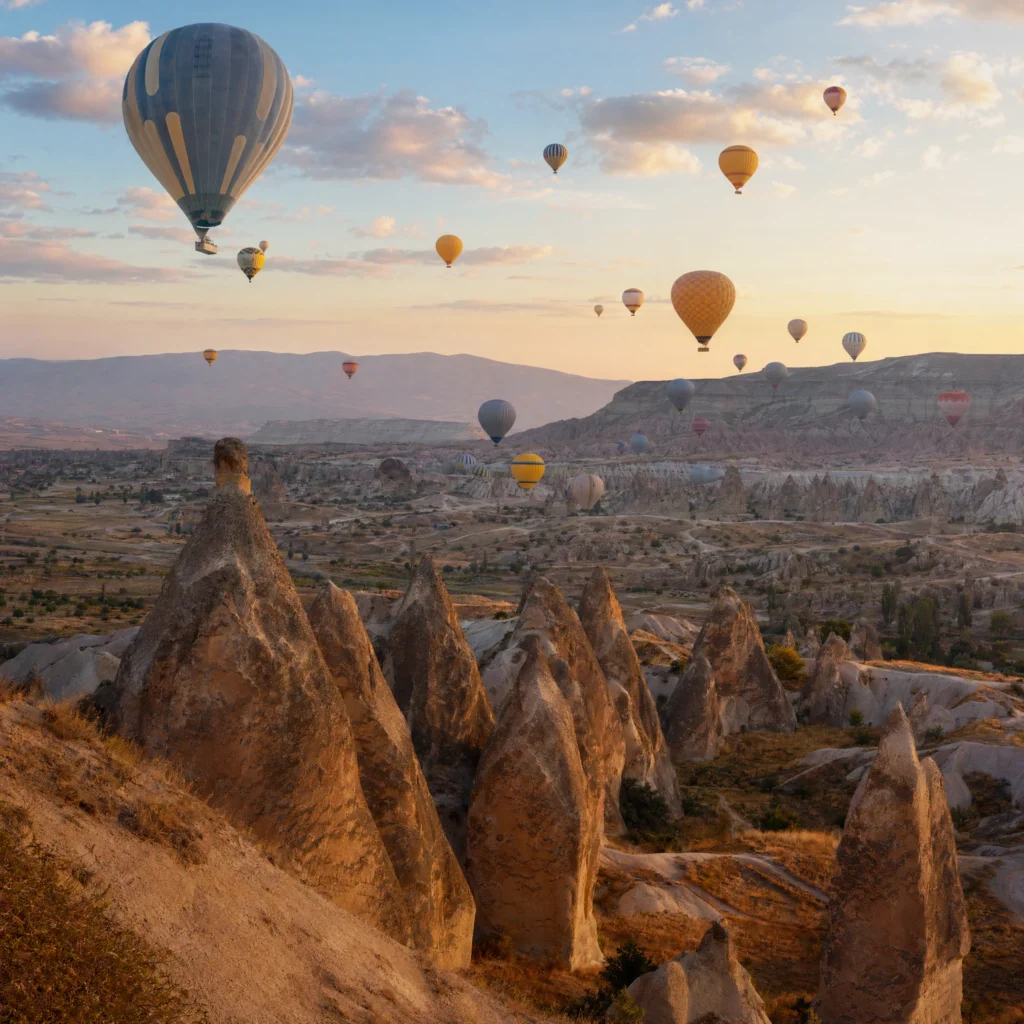
Beyond Istanbul, our Cappadocia city guide covers the fairy chimneys, cave hotels and dawn balloon flights of central Anatolia.
📋 In This Guide
- Overview — Why Turkey Belongs on Every Bucket List
- 🌷 Late-April / Early-May 2026 — Why You’re Right in the Window
- Best Time to Visit Turkey (Season by Season)
- Getting There — Flights & Arrival
- Getting Around — Buses, Domestic Flights & the Bosphorus Ferries
- Top Regions & Cities
- 🗓️ Sample Itineraries — 5, 10, 14 and 21 Days
- Turkish Culture & Etiquette
- A Food Lover’s Guide to Turkey
- 📸 Photography Notes
- Off the Beaten Path — Turkey Beyond the Headline Stops
- Practical Information
- Budget Breakdown — What Turkey Actually Costs
- ✅ Pre-Trip Checklist
- 🤔 What Surprises First-Timers
- Frequently Asked Questions
- Ready to Explore Turkey?
Overview — Why Turkey Belongs on Every Bucket List
Turkey sits at the eastern end of the Mediterranean, sharing land borders with Greece and Bulgaria in the west, Georgia and Armenia in the northeast, Iran in the east, and Iraq and Syria in the southeast. Its 7,200 kilometres of coastline trace the Black Sea in the north, the Aegean in the west, and the Mediterranean in the south — three completely different climatic and cultural zones held together by a high Anatolian central plateau that averages 1,000 metres of elevation. The country is mostly mountainous; the eastern provinces of Erzurum and Kars stay above 2,000 metres for most of their length, and Mount Ararat in the far east at 5,137 metres is the highest peak between the Alps and the Hindu Kush. Modern Turkey contains 85 million people, three-quarters in the western half of the country, and a striking demographic gradient that goes from European-secular along the Aegean coast to conservative-religious on the Iraqi-Syrian border.
The modern country dates, in the form most travellers experience it, from October 29, 1923 — the day Mustafa Kemal Atatürk proclaimed the Republic from the ruins of the Ottoman Empire. The republican project radically reshaped what had been a 600-year sultanate: the Arabic alphabet was replaced with a Latin one in 1928, the caliphate was abolished, women got the vote in 1934 (before France or Switzerland), and the new capital was moved 450 km east from Istanbul to the small Anatolian town of Ankara. The result, a century later, is a country in continual negotiation with its own identity — Western enough to be a NATO founding member and EU candidate, Eastern enough to be the modern centre of the Sufi Muslim world. Walk through Istanbul’s Beyoğlu district at 9 p.m. and you see the consequence: a city of 16 million people where call to prayer and electronic dance music share the same air.
For a traveller, the practical consequence is that Turkey is one of the great-value destinations on Earth in 2026 — the lira’s collapse from 5 to the dollar in 2018 to 39 in early 2026 means a $7 lunch in Istanbul, a $3 mid-morning coffee with a Bosphorus view, and a four-star Cappadocia hotel under $90. The wider context is that Turkey is now one of the most-visited countries on the planet, ranked fourth globally with 60 million arrivals in 2024 (behind France, Spain and the US), and the tourism infrastructure has matured at every tier. The whole country is roughly the population of Germany, slightly larger in area than Texas, and you feel the geography in every internal flight.
🏛️ Historical Context
Anatolia is the birthplace of recorded human civilisation in three separate phases. Göbekli Tepe in the southeast (Şanlıurfa province) was built around 9600 BCE — 7,000 years older than Stonehenge and 6,500 years older than the pyramids — by hunter-gatherer societies whose existence challenges every previous theory of how civilisation began. Çatalhöyük near Konya, occupied 7400-5700 BCE, was the world’s first city. The Hittite empire (1600-1178 BCE) ruled most of Anatolia from a capital at Hattusa, fought the Egyptians at Kadesh in 1274 BCE in the world’s first recorded peace treaty, and left behind the cuneiform tablets that revolutionised our understanding of bronze-age diplomacy. Add the Phrygians, Lydians, Lycians, Greeks (Troy was here), Persians, Romans, Byzantines, Seljuks and Ottomans, and you have the densest archaeological stratigraphy on Earth. Turkey contains 21 UNESCO World Heritage Sites — more than any country except Italy, China and Spain — with another 80+ on the tentative list awaiting nomination. Roughly 70% of Turkish-soil archaeological sites remain unexcavated.
🎌 Did You Know?
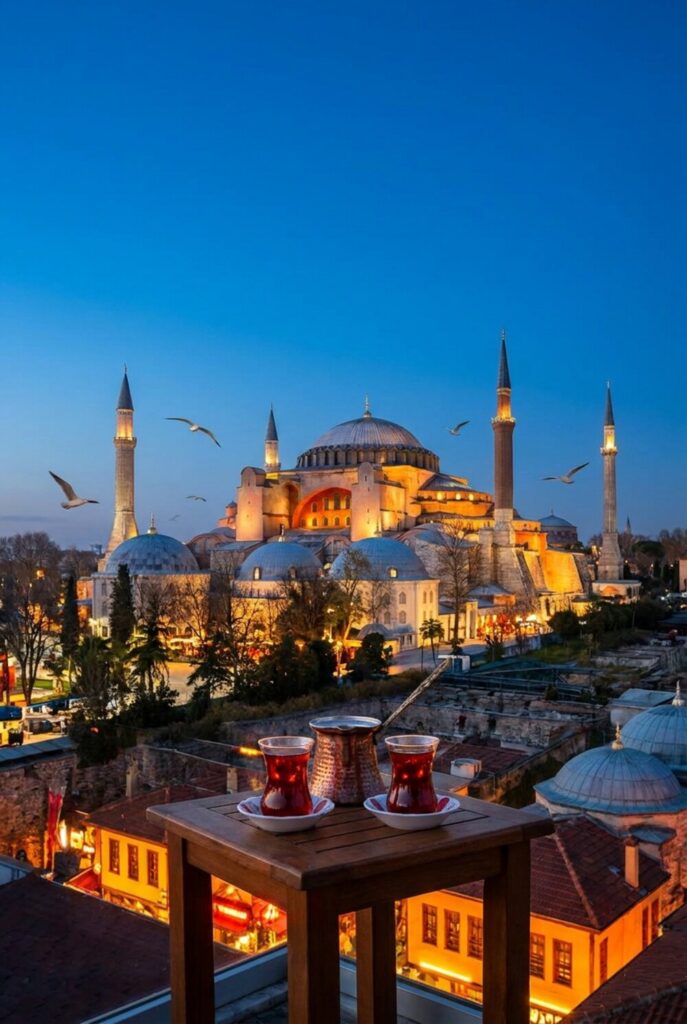
The Hagia Sophia in Istanbul has been continuously in use as a religious building for the longest stretch of any building on Earth. Built by Byzantine emperor Justinian I in 537 CE as a Christian cathedral, it remained the world’s largest building for nearly 1,000 years, was converted to a mosque after the 1453 Ottoman conquest, became a museum in 1934 under Atatürk’s secularising project, and was reconverted to a working mosque in 2020. The dome — 31 metres in diameter, 55 metres above the floor — was an engineering miracle for its era and partially collapsed in earthquakes three times before stabilising. The Christian mosaics on the upper galleries (some uncovered, some discreetly veiled during prayer) and the giant medallions of Islamic calligraphy share the same wall — a visual compression of 1,500 years of religious history that has no parallel in any other working sacred building.
🌷 Late-April / Early-May 2026 — Why You’re Right in the Window
Late April through mid-May is the most underrated three-week stretch on the Turkish calendar — and possibly the single best time of the entire year to be in Istanbul. The capital of the Ottoman Empire becomes, briefly, a tulip city. The Istanbul Tulip Festival (Lale Festivali), held every April since 2005, plants 30 million tulip bulbs across Emirgan Park, Gülhane Park, Sultanahmet Square, the gardens of Topkapı Palace, and the central reservation of half the boulevards in Beyoğlu — the festival peaks in the third and fourth weeks of April and runs through about May 8. The tulip is, contrary to popular Western assumption, a Turkish flower: it was domesticated in Anatolia, carried to the Ottoman court in the 16th century, exported to the Netherlands by the diplomat Ogier Ghiselin de Busbecq in 1554, and has since been the silent symbol of the Ottoman heritage from which Holland’s tulip mania derived. The Turkish word “lale” written in Arabic script contains the same letters as “Allah” — the flower carries explicit religious resonance in Ottoman culture and appears on tile-work in every imperial mosque.
You also get the country at its weather peak. The Aegean coast (Bodrum, Çeşme, Selçuk for Ephesus) sits at 22-25°C daytime highs in late April with sea temperatures climbing to 19-21°C — swimmable for hardy bathers, perfect for ruin-walking and beachside lunches. The Mediterranean coast (Antalya, Kaş, Olympos) is already at 25-28°C with the Lycian Way wildflowers blooming across the cliffs and the karst-pool village of Pamukkale at its photogenic best. Cappadocia at 1,200 metres is in its bluebird hot-air-balloon weather peak — the morning thermals are reliable, the afternoon haze is minimal, and the launch-success rate climbs from 60% in March to 92% in late April through May. Istanbul itself averages 17°C with 8 hours of clear sunshine and the long evenings that turn the Bosphorus into a 31 km running track of golden water at sundown.
The catch is that Turkey is a peak shoulder-season destination, and the late-April window is when international visitors discover it together. Cappadocia hotel prices climb 25-40% over March, and the headline cave-room properties (Sultan Cave Suites, Museum Hotel, Argos in Cappadocia) book out 6-8 weeks ahead. Ephesus and Pamukkale day-trip slots sell out 3-4 weeks ahead. The tulip festival itself draws domestic and Gulf-region tourism that spikes weekend hotel prices in Istanbul’s Sultanahmet district. The strategy is to book the high-pressure segments early, avoid the Easter long weekend if it falls in your dates (April 12 in 2026, manageable), and use weekdays for the headline sites.
⚠️ Important — Visa, Lira and the Cash Reality
Three things to know before you fly. First: Turkey’s e-Visa system at evisa.gov.tr remains the standard entry route for citizens of most countries — US, UK, Canada, Australia get the multiple-entry 90-day version for $35-50 in 5-10 minutes online; EU passport-holders enter visa-free for 90 days within 180. Apply 48 hours before flying minimum, print one copy. Second: the Turkish lira has lost roughly 80% of its value against the dollar since 2018 and is in continued double-digit annual inflation. Use cash where possible — the unofficial street rate at PTT post offices and reputable döviz exchange offices in Istanbul beats the airport rate by 8-12%. Quote prices in dollars or euros if you’re paying for a tour or a hotel directly with the operator. Third: tap water is technically treated to drinking standard but is universally considered “shower-and-cooking” rather than “drink-from-the-tap” by Turks themselves; bottled water is cheap (5-15 lira / $0.15-0.40 per litre) and is the local norm.
Best Time to Visit Turkey (Season by Season)
Turkey is climatically four countries — Mediterranean coast, Aegean coast, central Anatolian plateau, Black Sea coast — plus a fifth in the eastern highlands. The shoulder seasons (April-May and September-October) are the only stretches when most of the country is simultaneously pleasant. The summer months are punishingly hot in central and southeastern Anatolia (Şanlıurfa regularly hits 42°C in July) and crowded on the southern coasts; winter shuts down most of Cappadocia and the Black Sea coast.
Spring (April – May)
The best time to travel the country end-to-end. Daytime highs run 17-22°C in Istanbul and central Anatolia, 22-26°C on the coasts, with the Lycian Way wildflowers in full bloom from Antalya to Fethiye between April 10 and May 15. The Tulip Festival peaks in Istanbul in the last two weeks of April. Cappadocia balloon launch rates are at their seasonal high. Crowds are 35% lower than July, prices 20-25% lower except in the absolute peak Istanbul tulip days. This is the closest the Turkish calendar gets to a single national consensus window.
Summer (June – August)
Heat. Real heat. Istanbul climbs to 30-32°C with high humidity from the Bosphorus; Antalya and Bodrum reach 35-38°C; central Anatolia and the southeast become genuinely difficult between noon and 4 p.m. with temperatures regularly above 40°C. The compensation is the Aegean and Mediterranean coasts at peak swimming weather — sea temperatures of 24-27°C, the gulet-cruise (Turkish wooden-yacht) charter season at full force from Bodrum east to Antalya, and the Greek-island day-trip ferries running. July and August are also peak European-and-Russian tourism: Marmaris, Bodrum and Antalya hotels run 90%+ occupancy. Cappadocia is hot but tolerable in the early morning balloon hours and late-evening dinner courtyards.
Autumn (September – October)
The other shoulder window, and the locals’ preferred season. The summer crowds have thinned, the heat has eased, the Mediterranean is at its warmest of the year (sea temperatures peak in late August / early September around 26-28°C), and the harvest comes in across central Anatolia. Cappadocia in October is arguably the photographic peak — golden poplar trees in the valley floors, the rock chimneys saturated in low autumn light, and dawn balloons against improbably blue skies. Black Sea coast is cool and damp by mid-October but still walkable. The tea harvest in Rize peaks in early September.
Winter (November – March)
Istanbul gets cold and grey but stays photogenic — the Bosphorus mist on the dome of the Süleymaniye is a wholly different city. Cappadocia gets snow (typically December-February) and the snow-on-fairy-chimney photographs are its own genre, though balloons fly only on clear days. The southern coasts are cool but mostly dry — Antalya in January averages 11-15°C and stays open for ruin walks at the empty beaches. Central Anatolia and the eastern highlands are cold and snowy; Mount Erciyes near Kayseri is Turkey’s main ski resort. Domestic flights are cheap, hotels are cheap, and the country offers up its January cultural side — opera, classical concerts, Ottoman-era cuisine — for travellers willing to wear coats.
🧳 Travel Guru Tip
If you have two weeks and want to see Turkey at its most photogenic with the smallest crowds, target the second half of September through mid-October. The summer mass-tourism wave has receded, the sea is at its warmest of the year, the central Anatolian heat has dropped, the Cappadocia balloons are at the autumn-light peak, and prices have eased 15-25% off August. Most international guides default to April-May or August; the late-September fortnight is the locals’ season.
| Experience | Best months | Best regions | Notes |
|---|---|---|---|
| Cappadocia balloons | Apr – May, Sep – Oct | Göreme, Uçhisar, Avanos | 92% launch success in May; cancellations refunded |
| Tulip Festival | Mid-Apr – early May | Istanbul (Emirgan, Gülhane) | Peak two weeks; 30 million bulbs planted |
| Aegean ruins | Apr – Jun, Sep – Oct | Ephesus, Pergamon, Aphrodisias | Avoid Jul-Aug 38°C+ heat |
| Mediterranean beaches | Jun – Sep | Antalya, Kaş, Ölüdeniz | Sea peaks late Aug 27°C |
| Lycian Way trekking | Mar – May, Oct – Nov | Fethiye to Antalya | 540 km waymarked; spring wildflowers |
| Eastern Anatolia | May – Jun, Sep | Van, Kars, Doğubayazıt | Snow blocks some passes Oct-Apr |
Getting There — Flights & Arrival
Turkey has two international airports that matter — both in Istanbul. Istanbul Airport (IST) on the European side, opened in October 2018 and now the busiest airport in Europe by passenger traffic (76 million in 2024), is the global hub of Turkish Airlines and the connection point for almost every long-haul into the country. Sabiha Gökçen (SAW) on the Asian side, smaller and budget-airline-skewed, handles 41 million passengers and serves Pegasus Airlines, the Turkish low-cost carrier. Ankara, Antalya, Izmir, Bodrum, Dalaman and Adnan Menderes (the secondary Izmir airport) handle direct international flights from European cities; the deep-east airports (Trabzon, Erzurum, Van) are domestic-only.
From North America, Turkish Airlines operates direct flights to Istanbul from New York (JFK and Newark, 10h), Boston, Washington Dulles, Atlanta, Chicago, Houston, Miami, Los Angeles, San Francisco, Seattle and Toronto. The airline’s signature long-haul product (lie-flat business class, the Istanbul transit lounge that’s been called the best in the world by some surveys) is well-used by travellers connecting onward to Athens, Tel Aviv, Tbilisi, Cairo or any one of 130 connecting Turkish destinations. From Europe, expect 3h45m direct from London (Heathrow, Gatwick, Stansted on Pegasus), 2h45m from Paris CDG, 2h45m from Frankfurt, 2h30m from Rome and 2h from Athens. Round-trip fares from London or New York in shoulder season typically land between £280–480 / $580–950 booked 6-10 weeks ahead.
Istanbul Airport is large, modern and famously efficient at the centre but slow at the edges — passport control queues for the 5-9 a.m. peak run 30-50 minutes; the all-electric e-gates for some passport types are dramatically faster. Plan an hour from gate to taxi. The airport is 35 km from Sultanahmet (the historic peninsula) — the Havaist airport-shuttle bus to Sultanahmet runs every 30 minutes, takes 75 minutes, costs 200 lira ($5); a metered yellow taxi or BiTaksi/Uber-app booking runs 750-950 lira ($19-24). The new M11 metro line (opened 2023) connects the airport to Gayrettepe in 35 minutes for 70 lira ($1.80) — the budget winner. Sabiha Gökçen on the Asian side is more awkward — 50 km from Sultanahmet, the Havabus shuttle takes 90 minutes; allow extra connection buffer if your itinerary lands on SAW.
✨ Pro Tip — Turkish Airlines Stopover Programme
If you’re flying Turkish Airlines and want to break the Atlantic-or-Asian crossing, the Stopover programme genuinely costs nothing extra and includes a free hotel night for layovers over 20 hours (one night for economy, two for business). You book the long-haul ticket as if Istanbul were a layover and pick a layover length up to 7 days. A New York to Athens or Cairo round-trip with a 4-day Istanbul stop costs the same as a non-stop. Use the multi-city search on turkishairlines.com directly — the offer is rarely visible on third-party engines. Combine with a few days in Istanbul and you essentially get a free European city stop on your way to a Mediterranean or Asian destination.
Getting Around — Buses, Domestic Flights & the Bosphorus Ferries
Turkey’s domestic transport network is one of the most developed in the eastern Mediterranean. The intercity bus system (otobüs) is the historic backbone — air-conditioned reclining-seat coaches run between every major city on hourly schedules, served by Kamil Koç, Pamukkale, Metro Turizm and Varan as the main operators. Istanbul-Cappadocia is 11-12 hours overnight (around $25-35); Istanbul-Izmir 8 hours; Antalya-Cappadocia 10 hours overnight. Buses include free water and tea, free Wi-Fi, and a male attendant who refills coffee from a back-of-bus thermos on long routes — a national signature. Book at the company’s website or any small office in the otogar (bus terminal); seats are assigned and women travelling alone are seated next to women by default.
Domestic flights are the time-saving alternative for crossing the country. Turkish Airlines and Pegasus connect every regional airport; the cheap routes (Istanbul-Kayseri for Cappadocia, Istanbul-Izmir, Istanbul-Antalya) run at 1h15-1h30 flight times for $30-90 depending on advance booking. Internal flight pricing is consistently lower than the equivalent European route — Pegasus’s economy-only carrier model is a Ryanair-style lean operation but a noticeably better passenger experience. Book online or through the airline app; the airport security queues for domestic flights at IST are typically faster than international.
For shorter regional movements, the high-speed rail (Yüksek Hızlı Tren, YHT) connects Istanbul, Ankara, Konya and Eskişehir — Istanbul-Ankara is 4h15m and a comfortable alternative to flying. The Eastern Express (Doğu Ekspresi) from Ankara to Kars in the far east is a 24-hour spectacular sleeper-train journey that has become a domestic Instagram phenomenon; tourist tickets sell out 3 months ahead in winter. For Bosphorus and Aegean coast travel, ferries operated by Şehir Hatları and BUDO connect Istanbul to the Princes’ Islands (Adalar), the Bosphorus villages, and across the Sea of Marmara to Bursa. Greek-island ferries from the Aegean coast (Bodrum-Kos, Çeşme-Chios, Kuşadası-Samos) run April through October. Renting a car is straightforward — international agencies operate at all major airports, prices run $30-60/day for a compact, and Turkish drivers are aggressive but predictable. The Lycian coast highway from Fethiye to Antalya (the D400) is one of the world’s great driving routes.
⚠️ Important — The Lira Inflation Reality & Cash Strategy
The Turkish lira has lost roughly 80% of its value against the dollar in the past seven years and inflation runs above 40% annualised as of early 2026. Practical implications for travellers: prices in lira on small-establishment menus, market signs, and bus tickets reset every few weeks — the printed lira amount may be 20-30% out of date. Most tourist-facing operators (hotels, balloon companies, tour agencies) quote in USD or EUR to insulate themselves; pay them in USD or EUR cash directly when offered, as their card-machine rates pass through the bank’s punitive currency conversion. ATMs work but charge $5-10 fees per transaction; withdraw the maximum (4,000-12,000 lira / $100-300 depending on bank) per visit. Carry $200-500 in clean US dollar notes ($50s and $100s, no marks or tears) and convert at PTT post offices or established döviz exchange houses in Istanbul’s Sultanahmet, Taksim or Kadıköy — never at the airport (rate is 8-12% worse). Tipping is 10% in restaurants when service charge isn’t included; small notes in lira for porters, taxi-driver round-ups, and hotel staff.
Top Regions & Cities
📍 Map of Turkey: Every Place in This Guide
Turkey is conventionally divided into seven geographic regions, but for a traveller the practical map is six clusters: Istanbul and the Marmara region, the Aegean coast, the Mediterranean (Turquoise) coast, central Anatolia and Cappadocia, the southeast, and the Black Sea coast. Below are the bases worth building an itinerary around.
🕌 Istanbul & the Bosphorus
The only city in the world that sits on two continents — and one of the few where you genuinely cross between them on a daily commute. Istanbul (population 16 million in the metropolitan region, the largest city in Europe by some definitions) was Byzantium under the Greeks, Constantinople under the Romans and Byzantines for 1,123 years, and Istanbul under the Ottomans and the Republic. The city contains four UNESCO-inscribed historic zones: the Sultanahmet peninsula with the Hagia Sophia, the Blue Mosque, the Topkapı Palace and the Basilica Cistern; the Süleymaniye and surrounding Ottoman quarter; the Zeyrek mosque area; and the land walls of Theodosius II. Walk Sultanahmet’s pedestrian core in three hours and you’ve crossed 1,500 years of imperial architecture.
The other Istanbul is across the Galata Bridge in Beyoğlu — the 19th-century European quarter, the rooftop bars, the Istiklal pedestrian boulevard, the historic Pera district where the Pera Palace Hotel hosted Agatha Christie writing Murder on the Orient Express in 1934. Below Beyoğlu the Bosphorus opens north toward the Black Sea — the strait separating Europe from Asia, with traditional yalı (waterside Ottoman mansion) architecture along both shores and the Asian side’s Üsküdar and Kadıköy districts increasingly the city’s coolest residential zones.
For deeper neighbourhood-level coverage including the Grand Bazaar circuit, the Kadıköy food market, the Ortaköy waterfront, and the Princes’ Islands, see our Istanbul city guide.
- What to do: Sultanahmet’s “big four” (Hagia Sophia, Blue Mosque, Topkapı, Basilica Cistern) in a single morning; Bosphorus full-strait ferry (1.5 hours each way); Galata Tower and a Beyoğlu rooftop drink at sunset; cross to Kadıköy for an Asian-side dinner; Tulip Festival in Emirgan Park if your dates align.
- Signature eats: Pide (Turkish flatbread pizza) at Pizdoz Karaköy; balık ekmek (mackerel sandwich) from a boat at Eminönü; the best baklava in the country at Karaköy Güllüoğlu (since 1949); a slow Turkish breakfast at Van Kahvaltı Evi in Beyoğlu.
- Access: Istanbul Airport 35 km — M11 metro 35 min, Havaist bus 75 min, taxi 45 min; Sabiha Gökçen on the Asian side, 50 km, less convenient for Sultanahmet.
🎈 Cappadocia — Göreme, Uçhisar & the Fairy Chimneys
The most photographed landscape in Turkey, and possibly in mainland Asia. Cappadocia is a 250 km² volcanic landscape in central Anatolia where the soft tuff rock, eroded by 30 million years of wind and water, has formed thousands of conical “fairy chimneys” (peri bacaları). Christians fleeing Roman persecution carved entire cities into the soft rock from the 4th century onwards — Derinkuyu underground city descends 18 storeys and could shelter 20,000 people; the Göreme open-air museum preserves dozens of chapels with 10th-12th century Byzantine frescoes still intact on the carved-out walls.
The visual signature is the dawn balloon flight. Cappadocia hosts roughly 250 hot-air balloons that launch from valleys around Göreme on every clear morning between sunrise and 8 a.m. — the largest commercial ballooning operation on Earth. A standard one-hour flight runs $180-280 per person depending on basket size and operator (Royal Balloon, Butterfly Balloons, Voyager Balloons are the established names). Launch success in late April through May runs at 92%; cancelled flights are refunded fully. The view from a basket at 600 metres looking down on 200 other balloons against the chimney landscape is the country’s most reliably spectacular tourist moment.
Sleep in a cave hotel — the local rock is soft enough to carve into bedrooms with stone walls and vaulted ceilings, and dozens of historic cave properties have been converted at every price tier. Sultan Cave Suites and Museum Hotel are the headline luxury options; Kelebek Cave Hotel and Mithra Cave Hotel are the mid-range standouts; cheap caves run $40-60. Book 6-8 weeks ahead in shoulder season.
- What to do: Dawn balloon flight (book first night to allow weather buffer); Göreme open-air museum frescoes; Derinkuyu or Kaymaklı underground city; Pigeon Valley to Uçhisar walk at sunset; ATV or horse ride through the Love Valley at golden hour.
- Signature eats: Testi kebab (slow-cooked lamb stew sealed in a clay pot, broken open at the table) at Topdeck Cave Restaurant in Göreme.
- Access: Kayseri (ASR) airport 75 km / 1 hr by shuttle, Nevşehir (NAV) closer at 40 min — Pegasus and Turkish Airlines run 4-6 daily flights from Istanbul; overnight bus from Istanbul 11 hours.
🏛️ Aegean Coast — Ephesus, Pergamon & Bodrum
The western coast of Turkey from Çanakkale (the Dardanelles, near Troy) south to Bodrum is the country’s classical archaeological heartland. Ephesus, near the modern town of Selçuk, was the second-largest city of the Roman empire after Rome itself — population 250,000 at peak — and the marble-paved Curetes Street, the Library of Celsus facade and the 25,000-seat theatre that hosted Saint Paul’s preaching are the most spectacular Roman ruins anywhere outside Italy. The site is most photographed on a low-angle morning sun in shoulder season; midday in July is genuinely punishing. Pergamon north of Izmir gives you a hilltop acropolis with the steepest theatre in the ancient world (78°), and Aphrodisias 100 km inland holds the most intact Greek stadium in existence.
Bodrum is the modern Aegean’s resort flagship — a town of 35,000 that swells to 200,000 in summer, with a 15th-century Crusader castle on the harbour built from the marble of the Mausoleum of Halicarnassus (one of the original Seven Wonders, now reduced to its foundations 200 metres up the hill). The wider Bodrum peninsula has 20+ beach communities at every price tier, the Mandarin Oriental’s Bodrum property at the high end, and the gulet-cruise (traditional Turkish wooden yacht) charter season running Apri through October. A four-day “Blue Cruise” from Bodrum east to Marmaris with stops at hidden coves and Greek-island anchorages is the country’s signature luxury experience. Çeşme, near Izmir, is the cooler-tempo alternative to Bodrum.
- What to do: Ephesus (early morning, half-day with the Terrace Houses extra ticket); Pamukkale travertines and Hierapolis ruins; Bodrum castle and gulet day-cruise; Aphrodisias if archaeology is the focus; Greek-island day-trip from Bodrum to Kos or Çeşme to Chios.
- Signature eats: Whole sea bass or sea bream at any harbour-front restaurant in Bodrum; the herb-stuffed pastries called börek at Selçuk’s Saturday market.
- Access: Izmir (ADB) is the main hub — direct flights from Istanbul (1h15m) and most European capitals; Bodrum (BJV) seasonal direct from Europe; Selçuk for Ephesus 80 km south of Izmir.
🏖️ Mediterranean (Turquoise) Coast — Antalya, Kaş & Olympos
The 1,000-kilometre Mediterranean coast from Marmaris east to the Syrian border is Turkey’s premier beach destination — turquoise water against pine-forested mountains, ancient Lycian cities crumbling into the surf, and the Lycian Way long-distance trail running the length of the coast. Antalya, the regional capital and Turkey’s third-largest urban area, has a beautifully preserved Ottoman old town (Kaleiçi) with a yacht harbour at its centre and a half-hour drive to the Roman ruins of Aspendos (the most intact Roman theatre in the world, still hosting opera in summer) and Termessos (the ruined Pisidian city where Alexander the Great was rebuffed). The Antalya Museum is one of the best in the country.
The 200 km of coast between Fethiye and Antalya is the photographic Turquoise Coast. Ölüdeniz beach with its enclosed lagoon is the headline beach of southwestern Turkey; the Kaş peninsula has paragliding and kayaking over the sunken Lycian city of Kekova; Olympos has the eternal flame of the Chimaera (natural methane vents that have burned continuously for 2,500 years) and the Lycian Way trailhead. The Lycian Way itself — 540 km waymarked from Fethiye to Antalya — is one of the world’s great long-distance hiking routes, walkable in segments of 3-7 days each. Patara, between Kaş and Fethiye, has the longest sandy beach in Turkey (18 km) and the ruins of the ancient Lycian capital running directly behind the dunes.
- What to do: Kaleiçi old town walk in Antalya; day-cruise from Kaş to Kekova sunken city; Lycian Way 3-day segment from Olympos to Adrasan; paragliding from Babadağ over Ölüdeniz; Aspendos theatre evening opera (July-August).
- Signature eats: Tandır kebab (slow-roasted lamb in a clay oven) at Hisar Suzuki Antalya; the spicy ezme paste with grilled fish at any Kaş harbour restaurant.
- Access: Antalya (AYT) is Turkey’s busiest summer airport with direct seasonal flights from across Europe; Dalaman (DLM) for Fethiye; the D400 coastal drive from Fethiye to Antalya is one of the world’s great road trips.
🕯️ Konya & the Sufi Heartland
Konya, the central Anatolian city of 2.3 million, is the spiritual capital of Sufi Islam — the home of Mevlana (Jalal ad-Din Rumi), the 13th-century Persian-language poet whose mystical poetry is the most-translated body of religious verse in the modern world after the Bible and the Quran. The Mevlana Museum, formerly the Sufi lodge where Rumi taught and was buried in 1273, is the country’s most visited religious-pilgrimage site outside Istanbul, drawing roughly 2 million visitors a year. The whirling-dervish ceremony (sema) at the Mevlana Cultural Center every Saturday evening is the public form of the Sufi spiritual practice; the genuine devotional ceremonies in private lodges are not open to tourists but the public Saturday performance is unironically moving.
Konya is also the seat of the Seljuk Sultanate of Rum (1077-1308), the Turkic-Islamic state that preceded the Ottomans and built much of central Anatolia’s signature architecture — the Alâeddin Mosque on the citadel hill, the Karatay Madrasa with its blue Iznik-tile dome, the Ince Minare Madrasa with its theological library. A day-trip 80 km north to Çatalhöyük takes you to one of the world’s first cities — occupied 7400-5700 BCE, with houses entered through holes in the ceiling and rooms stacked above buried ancestors. The site is partially open and the visitor centre tells one of the more unsettling origin-of-civilisation stories you can hear.
- What to do: Mevlana Museum (allow 2 hours); Saturday evening sema ceremony (free, arrive 60 minutes early); Karatay Madrasa tile museum; Çatalhöyük day-trip.
- Signature eats: Etli ekmek (the long Konya version of pide); fırın kebabı (oven-roasted lamb shoulder) at any local restaurant in the old quarter.
- Access: Konya is on the Istanbul-Ankara high-speed rail line (Istanbul-Konya 4h45m); local airport with daily flights from Istanbul (1h15m); often combined with Cappadocia as a 3-hour drive.
“Istanbul’s fate is my fate: I am attached to this city because it has made me who I am.”
— Orhan Pamuk, Istanbul: Memories and the City (2003)
🗓️ Sample Itineraries
Turkey rewards long trips and punishes rushed ones. Below are four templates that have worked for thousands of travellers; pick the one that matches your time and the season. Istanbul plus Cappadocia is the irreducible minimum; everything else is a layer on top of that core. All distances assume internal flights for the long-haul segments and rental car or driver for the regional clusters.
5 Days — Istanbul + Cappadocia
Day 1: Arrive Istanbul morning, settle in Sultanahmet. Walk Hagia Sophia, Blue Mosque, sunset rooftop drink at Seven Hills Hotel. Day 2: Topkapı Palace and Basilica Cistern morning, Grand Bazaar afternoon, Bosphorus ferry sunset, dinner across the bridge in Karaköy. Day 3: Tulip Festival in Emirgan Park (April-May only) or Princes’ Islands ferry day-trip; evening flight to Kayseri or Nevşehir for Cappadocia. Sleep in cave hotel. Day 4: Dawn balloon flight; Göreme open-air museum; Pigeon Valley walk to Uçhisar; sunset at Sunset Point. Day 5: Underground city (Derinkuyu) morning; flight back to Istanbul or directly to international departure.
10 Days — Istanbul + Cappadocia + Aegean
Days 1-3: Istanbul as above. Day 4: Flight to Cappadocia, settle in cave hotel, Pigeon Valley sunset walk. Day 5: Dawn balloon, Göreme museum, ATV ride through the valleys. Day 6: Underground city, Avanos pottery workshop. Day 7: Flight Kayseri to Izmir, drive 1 hr to Selçuk. Day 8: Ephesus dawn entry, Terrace Houses, House of the Virgin Mary, late afternoon to Pamukkale. Day 9: Pamukkale travertines and Hierapolis ruins morning, drive to Bodrum (3 hours), evening on the harbour. Day 10: Bodrum castle morning, gulet day-trip, evening flight from Bodrum to Istanbul or international departure. This is the highest-impact 10-day Turkey itinerary; skip Pamukkale and add Antalya if you’d rather do beaches over travertines.
14 Days — Istanbul + Cappadocia + Mediterranean Coast
The classic. Days 1-3: Istanbul. Days 4-6: Cappadocia. Day 7: Flight Kayseri-Antalya, settle in Kaleiçi old town. Day 8: Aspendos theatre and Termessos ruins day-trip. Day 9: Drive Antalya to Kaş along the D400 coastal highway (3.5 hours with stops at Olympos and Çıralı); sleep Kaş. Days 10-11: Kaş — Kekova boat trip, paragliding, Lycian Way segment day-hike. Day 12: Drive Kaş to Fethiye via Patara beach and Saklıkent gorge; sleep Fethiye or Ölüdeniz. Day 13: Ölüdeniz lagoon swim, Butterfly Valley boat trip. Day 14: Drive to Dalaman airport (45 min) for international departure or flight back to Istanbul.
21 Days — Add Eastern Anatolia & the Black Sea
For travellers willing to commit to long internal-flight days. Take the 14-day template above as the spine, then insert: Days 15-17: Eastern Anatolia — fly Istanbul to Şanlıurfa for Göbekli Tepe (the 12,000-year-old neolithic temple complex, the world’s oldest known monumental architecture); drive 3 hours to Mardin (the honey-coloured Aramaic-Christian-Kurdish hill town overlooking the Mesopotamian plain); fly Mardin to Van for Lake Van and Akdamar Island. Days 18-19: Black Sea — fly Van or Istanbul to Trabzon, drive to the Sumela Monastery (a 13th-century Greek Orthodox monastery built into a cliff face), and the green-tea hills of Rize. Day 20: Fly back to Istanbul for one final day. Day 21: Departure. Reserve internal flights for the eastern legs at least three weeks ahead — Pegasus and Turkish Airlines both fly to Şanlıurfa, Mardin, Van and Trabzon several times daily but the small jets fill in shoulder season.
🎯 Strategy
If you only have one trip to Turkey, do the 14-day Istanbul-Cappadocia-Mediterranean route — that gives you the city, the country’s most photogenic landscape, and the coast in a clean three-act structure. The 21-day extension is only worth doing if you’ve been to Turkey before or you have a specific archaeological interest in Göbekli Tepe and Mesopotamia. The 5-day Istanbul-Cappadocia is the irreducible minimum; trying to do less than that is the trip Turkey rewards least.
Turkish Culture & Etiquette
Turkish society runs on a hospitality structure that’s possibly the deepest in the eastern Mediterranean — guests (misafir) hold near-sacred status, hosts are expected to provide tea, food and conversation regardless of advance notice, and the social pressure to refuse hospitality is real but not insurmountable. Foreigners often misread this as casual Mediterranean warmth; it’s actually a structured cultural obligation with deep Islamic and Anatolian roots, and travellers who reciprocate (accept the tea, accept the second tea, ask about family) earn instant trust. The post-Atatürk republican project layered a self-consciously European civic identity on top of this, and the result is a country where formal-secular and religious-traditional codes coexist in ways that depend on neighbourhood, generation and class.
Address conventions matter. “Bey” (after a man’s first name) and “Hanım” (after a woman’s first name) are the formal honourifics — “Mehmet Bey” not “Mr Mehmet”. The hospitality terms abi (older brother) and abla (older sister) are used widely between strangers based on apparent age difference. Greet older men with a handshake and slight bow; older women with a verbal greeting (no handshake unless offered first). Take shoes off when entering a home; cover shoulders and knees when entering a mosque (women cover their hair as well, scarves are provided at the entrance of the major Istanbul mosques). The “no” gesture in Turkey is a quick upward head-tilt with a small tongue-click — uniquely Mediterranean and easy to misread as a yes.
Tea (çay) is the social glue. Turkey is the world’s largest per-capita tea consumer (10 cups per day per adult on average) and tea is offered at every shop visit, every meeting, every casual encounter that lasts more than five minutes. Refusing the tea is mildly impolite; refusing the second tea is socially fine. Coffee (kahve) is a more ceremonial drink served in small cups with the grounds at the bottom — never stir, never drink the bottom inch. The “fortune-reading” tradition of flipping the cup onto its saucer to read the patterns is real and often offered to foreigners as a friendly party trick; treat it with the same humour your hosts do.
💬 The Saying
“Bir fincan kahvenin kırk yıl hatırı vardır.” Roughly: “A cup of coffee creates a forty-year obligation.” It’s the Turkish hospitality proverb — a reminder that small acts of generosity bind people across generations. The phrase is taught in primary school, painted on café walls, and quoted by elderly relatives when accepting any small kindness. It captures the Turkish social architecture better than any single explanation: the country runs on a thousand-year-old assumption that you remember the people who fed you, even if it was just a cup of coffee three decades ago.
A Food Lover’s Guide to Turkey
Turkish cuisine is, by most credible measures, one of the world’s three great culinary traditions alongside French and Chinese — and the only one of those built on a continental imperial geography that integrates Balkan, Mediterranean, Caucasian, Persian and Arabian influences in a single national kitchen. The Ottoman court at Topkapı employed up to 1,300 cooks at peak and was the experimental laboratory where many of the dishes now considered Greek, Lebanese, Israeli or Bulgarian were standardised. Modern Turkish cuisine fragments by region: Aegean is olive-oil-and-fish-and-herbs Mediterranean; central Anatolian is meat-and-bread-and-yoghurt steppe; southeastern is pomegranate-and-pistachio-and-spice borderland; Black Sea is corn-bread-and-anchovy oddity; Istanbul is the synthesis of all of them.
Kebab in Turkey is the umbrella term for a spectrum of meat preparations that has nothing to do with the doner-on-a-spit Western export. The Adana kebab (long minced-lamb skewer with chilli) and Urfa kebab (the same without chilli) are the southeastern grilled standards; the Iskender kebab (sliced döner over butter-soaked pide bread with tomato sauce and yoghurt) is the Bursa specialty; the Testi kebab (lamb stew sealed in a clay pot, broken open at the table) is the Cappadocian theatre meal; the Şiş kebab is the simple skewered cube of marinated lamb. A proper kebab restaurant (kebapçı) cooks over charcoal and serves with pilaf, grilled tomatoes and chillies, and yoghurt drink (ayran) on the side.
Meze is the small-plate tradition that anchors any Turkish dinner of consequence — 15-30 cold dishes arrayed on a table for grazing while drinking rakı (the anise-flavoured spirit, the Turkish national drink, served diluted with water in a separate glass alongside). Standard meze: ezme (chilli-tomato paste), haydari (yoghurt-and-mint), patlıcan salatası (smoky aubergine), dolma (stuffed grape leaves), lakerda (cured bonito), kalamar (fried squid), Russian salad (yes, really, Soviet-era influence). A proper meyhane (Turkish tavern) dinner runs 4-6 hours, takes 15-20 dishes across the table, and is the country’s signature social ritual.
Turkish breakfast (kahvaltı) is the global gold standard. A proper one is a tableful of small plates — multiple cheeses (white, kaşar, halloumi-like), olives in three varieties, cucumber and tomato slices, sucuk (spicy beef sausage) and pastırma (cured beef), honey with kaymak (clotted buffalo cream), various jams, fresh bread, simit (sesame-seeded ring bread), an omelette with sucuk (menemen), and tea — refilled endlessly. Van Kahvaltı Evi in Istanbul’s Beyoğlu and the breakfast street in Beşiktaş are the headline venues. Allow 90 minutes minimum.
Baklava is the southeastern Anatolian sweet at the apex of the country’s pastry tradition — paper-thin yufka pastry, ground pistachios from the Antep (Gaziantep) region, sugar syrup, butter from the Şanlıurfa hills, baked in a stone oven. The Antep version uses 40 layers; the Istanbul version uses 35; the Aleppo version uses 60. Karaköy Güllüoğlu in Istanbul (since 1949), Imam Çağdaş in Gaziantep (since 1887), and Hafız Mustafa (since 1864) are the canonical houses. Eat fresh from the tray, never reheated.
Turkish coffee is on UNESCO’s intangible cultural heritage list. The unfiltered grounds-and-water-and-sugar method, brewed in a copper cezve over hot sand or low flame, produces a thick small cup that you sip the top inch of and abandon the bottom inch (the grounds settle into the iconic patterns “read” by fortune-tellers). Order it sade (no sugar), az şekerli (little sugar), orta (medium) or çok şekerli (sweet) at the moment of brewing — it cannot be sweetened later. Mandabatmaz in Istanbul’s Beyoğlu is the city’s most famous traditional coffeehouse.
Lokum (Turkish delight) is the country’s sweet-souvenir staple. Real lokum is made from rosewater, mastic and sugar with chopped pistachios, hazelnuts or walnuts; the dyed-cube tourist version sold in the Grand Bazaar at $15 a kilo is industrial. Hacı Bekir in Istanbul (since 1777, the original lokum shop, on Hamidiye Caddesi) and Ali Muhiddin Hacı Bekir on Istiklal are the houses to visit.
📸 Photography Notes
Turkey is one of the most photographable countries in the eastern Mediterranean — Cappadocia’s balloon-and-chimney landscape, Istanbul’s mosque-and-Bosphorus skyline, the Lycian coast’s turquoise-and-pine cliff edges, and the eastern Anatolian villages of Mardin and Şanlıurfa are all genuinely as photogenic as their Instagram feeds suggest. The light is more usable than in tropical destinations because the latitude (36-42°N) gives you longer golden hours, and the coastal climates have lower haze than the central plateau in summer.
Best light by month: April-May is the country-wide cleanest light, with low haze and strong directional sun for golden hours; September-October gives you warm autumn light against the harvest landscape; November-March in Istanbul gives you dramatic Bosphorus mist and snow on Hagia Sophia’s dome; June-August on the coasts gives you the deepest sea-and-sky blues but punishing midday glare in central Anatolia.
Five locations worth the detour:
- Cappadocia balloon launch from Sunset Point (38.6431°N, 34.8311°E) — the dawn shot looking down on 200 balloons over the Göreme valley. Best in late April through mid-May at 92% launch success.
- Istanbul Galata Tower at sunset (41.0257°N, 28.9742°E) — the Bosphorus, the historic peninsula, the call to prayer overlapping across the dome cluster of Sultanahmet. Better from the Tower’s external balcony than the official viewing platform.
- Pamukkale travertines at sunset (37.9203°N, 29.1208°E) — the white calcite terraces glowing pink in low light. Enter through the south gate to walk down through the terraces in the late afternoon.
- Ölüdeniz lagoon from Babadağ paragliding launch (36.5552°N, 29.1367°E) — the enclosed turquoise lagoon from 1,960 metres elevation. You don’t need to fly the paraglider; the Babadağ cable car takes regular tourists to the upper viewing platform.
- Mardin old town (37.3122°N, 40.7350°E) — the honey-coloured Aramaic-Syriac hilltop town overlooking the Mesopotamian plain. Best at golden hour from the Mardin Castle viewpoint.
Drone rules: Turkey enforces national drone regulations through the Civil Aviation Directorate (SHGM). Drones under 500g require online registration; drones 500g+ require a flight permit submitted at least 2 weeks in advance. Cappadocia, Istanbul historic peninsula, all military zones, all border zones (within 30 km), and most archaeological sites prohibit drones outright. Cappadocia’s airspace is restricted during balloon-flight hours (4 a.m. to 9 a.m.) and balloon companies have priority. The realistic stance: travel with a sub-250g drone, fly only in clearly rural Mediterranean coast areas at non-balloon hours, and accept that Cappadocia drone footage from 2024-26 is mostly captured by licensed operators only.
✨ Pro Tip — Photographing Mosques and the Tipping Imam
Turkey’s working mosques are open to non-Muslim visitors outside the five daily prayer times and the Friday noon prayer. Photography inside the prayer hall is generally permitted (no flash, no people praying in the frame, shoes removed); the hanging chandeliers and Iznik tile-work make for spectacular wide-angle shots. The Blue Mosque, Süleymaniye and the Rüstem Pasha (the smallest of the imperial mosques but the most heavily tiled) are the headline shooting venues. A small tip (10-20 lira / $0.30-0.60) to the imam or attendant who lets you photograph quietly is normal courtesy. For full coverage including neighbourhood walking circuits and the Bosphorus ferry photography routes, see our Istanbul city guide.
Off the Beaten Path — Turkey Beyond the Headline Stops
The headline route — Istanbul, Cappadocia, Ephesus, Pamukkale, the southern coast — accounts for roughly 85% of foreign visits and about 20% of the country’s geography. The other 80% is harder to reach, less-instagrammed, and much closer to the Turkey Turks actually inhabit.
🏛️ Göbekli Tepe & Şanlıurfa
The 12,000-year-old monumental temple complex in southeastern Anatolia, discovered in 1994, is the world’s oldest known place of worship — 6,500 years older than Stonehenge, predating agriculture, pottery and writing. The 200+ T-shaped megaliths carved with foxes, lions, vultures and snakes have rewritten our understanding of how human civilisation began. Şanlıurfa, the modern city 18 km away, is the wider regional centre — the legendary birthplace of the prophet Abraham, with a sacred carp-filled pool (Balıklıgöl) at its heart, an old-town bazaar that’s still a working caravanserai network, and a museum holding the world’s earliest known life-size human statue (the 11,000-year-old “Urfa Man”). Direct flights from Istanbul (1h45m).
🏔️ Mount Nemrut
The 2,134-metre summit of Mount Nemrut in southeastern Adıyaman province holds the most enigmatic monumental sculpture site in the country — the 1st-century BCE tomb-sanctuary of King Antiochus I of Commagene, with 8-metre-tall stone heads of Greek and Persian gods toppled by earthquake and now arranged on the eastern and western terraces of an artificial mountain peak. Sunrise and sunset visits are the staple — the heads in low light against a 360° plateau view are the country’s most surreal photograph. Reach via 4WD shuttle from the regional centre of Kahta or Adıyaman (a 1.5-hour drive plus 1 km uphill walk to the summit). Open May to October only — the road is snow-blocked in winter.
🌊 Black Sea Coast — Trabzon & Sumela
The Black Sea coast is Turkey’s wettest, greenest, and most genuinely off-circuit region — culturally distinct (Pontic Greek, Laz and Hemşin minorities, with their own languages, cuisine and music), climatically odd (the only part of Turkey that grows tea, hazelnuts and kiwifruit), and visually spectacular in the highland yaylas (summer pastures) above 1,500 metres. Trabzon, the historic Pontic Greek capital, holds the Hagia Sophia of Trabzon (a smaller version of the Istanbul building, with Byzantine frescoes) and is the gateway to the Sumela Monastery — a 13th-century Greek Orthodox monastery built into a 300-metre cliff face, abandoned in 1923, partially restored and reopened to visitors in 2019 after a five-year stabilisation project. Direct flights from Istanbul (1h45m).
🏝️ Princes’ Islands & Bursa
The 9-island archipelago in the Sea of Marmara, an hour’s ferry from Istanbul, is the city’s traditional summer-retreat zone — Büyükada (the largest, with no cars allowed, only horse-carts and bicycles), Heybeliada and Burgazada are the visitable trio. Pine-shaded carriage rides, 19th-century timber mansions, and the Aya Yorgi monastery on Büyükada’s highest hill are the staples. Bursa, the first Ottoman capital and a 90-minute fast ferry across the Marmara to the Asian shore, holds the Green Mosque (Yeşil Cami), the iconic Iskender kebab houses where the dish was invented in 1867, and the Uludağ ski resort 2,500 metres above the city for late-winter day-trips.
🐎 Eastern Anatolia — Van & Doğubayazıt
The far-eastern Anatolian highlands centred on Lake Van — Turkey’s largest lake at 3,755 km², an alkaline closed-basin lake at 1,640 metres elevation. Akdamar Island in the lake holds a 10th-century Armenian church with intact relief carvings. Doğubayazıt at the foot of Mount Ararat (5,137 m, the highest peak in Turkey, the legendary landing-place of Noah’s ark) holds the spectacular 18th-century Ishak Pasha Palace, an Ottoman-Persian-Armenian architectural fusion 4 km from the Iranian border. Van itself is famous for its breakfast culture (the kahvaltı here may be the country’s most extravagant) and the Van cat — a domestic breed with one blue eye and one amber.
Turkey by Numbers
- 85 million — country population (2025 estimate, world’s 18th most populous)
- 21 — UNESCO World Heritage Sites (most in Europe except Italy)
- 9600 BCE — Göbekli Tepe construction (world’s oldest monumental architecture)
- 250 — daily hot-air balloons launching in Cappadocia
- 30 million — tulip bulbs planted in Istanbul each spring
- April 23 — National Sovereignty & Children’s Day public holiday
Practical Information
Currency: Turkish lira (TRY, ₺). The exchange rate has hovered around USD 1 = TRY 35-40 for most of 2025-26 with significant fluctuation; bring a currency converter app and check daily. Turkey is increasingly cashless in tourist zones — Visa and Mastercard accepted at most hotels, mid-range restaurants and shops in Istanbul, Cappadocia and the resort coasts — but cash is essential for street food, market shopping, taxi tips, balloon-tour gratuities, and the entire eastern Anatolia. ATMs are everywhere; Garanti, İşbank and Yapı Kredi have the highest withdrawal limits and the lowest fees for foreign cards. Carry a mix of small and large lira notes — vendors often can’t change a 500-lira note (about $13) on a small purchase. Tipping is 10% in restaurants when service charge isn’t included.
Visa & entry: Turkey’s e-Visa system at evisa.gov.tr is the standard route for citizens of around 100 countries. US, UK, Canadian, Australian, NZ passport-holders pay $35-50 for a 90-day multiple-entry e-Visa, processed in 5-10 minutes online. EU passport-holders enter visa-free for 90 days within 180. Apply at least 48 hours before flying minimum, print one copy. The Turkish e-Visa is one of the most efficient digital visa systems in the world.
Language: Turkish is the official language and uses a Latin alphabet introduced in Atatürk’s 1928 reforms — a small godsend compared to Arabic-or-Cyrillic-script destinations. The language is structurally agglutinative (suffixes pile up to modify words) and challenging to learn but easy to read at the menu level. English fluency is high in Istanbul, Cappadocia and the Mediterranean resort towns, moderate in the Aegean coast and central Anatolia, and low in the eastern provinces. German is widely spoken in Antalya due to historic German tourism. Google Translate’s Turkish offline pack handles 90% of needs outside the major cities.
Connectivity: 4G covers essentially the entire country. 5G has been progressively rolled out in Istanbul, Ankara and Izmir since 2025. eSIMs from Turkcell, Vodafone Turkey or Türk Telekom cost 700-1,500 lira ($18-38) for 30 GB / 30 days and work instantly on arrival; Turkcell has the widest rural coverage. Free Wi-Fi is universal in cafés, hotels and restaurants. Note the legal restriction: Turkish law requires foreign-purchased phones to be registered with a local SIM within 120 days, after which the device is blocked from local networks — short-stay travellers are unaffected, but expats and long-stayers should plan around it.
Tap water: Officially treated to drinking standard but universally avoided by Turks themselves due to old plumbing in many buildings, particularly in Istanbul’s older districts. Bottled water is cheap (5-15 lira / $0.15-0.40 per litre) and ubiquitous. Brush teeth with bottled water in older hotels; ice in reputable establishments is commercially supplied and safe.
Plug type: Type F (European, two round pins, 220V/50Hz). North American travellers need a step-down transformer for hair-dryer-class loads; phone and laptop chargers are universal voltage. UK travellers need a simple adapter.
Budget Breakdown — What Turkey Actually Costs
Turkey is one of the great-value destinations in 2026 — the lira’s collapse from 5 to the dollar in 2018 to 39 in early 2026 has produced an exchange-rate windfall for foreign visitors that has not yet been fully absorbed by the tourism economy. Budget travellers eat well, mid-range travellers feel pampered, and luxury travellers find tier-jumping prices that European or American equivalents would charge double. The catch is that lira inflation runs above 40% annualised, so prices reset every few weeks — and tour operators, hotels and balloon companies in tourist zones increasingly quote in USD or EUR to insulate themselves from the volatility.
💚 Budget Traveller — $30–55 / day (TRY 1,170–2,150)
Hostel dorm bed TRY 400-700 ($10-18). Street-food breakfast (simit and tea) TRY 50 ($1.30), kebab lunch TRY 200-350 ($5-9), meyhane meze dinner shared TRY 400 ($10). Intercity buses for movement. One major activity per few days. Cappadocia balloon flight ($180) is the one budget-buster you can’t avoid; bury it in a 5-day Cappadocia stay where everything else is cheap.
💙 Mid-Range — $90–170 / day (TRY 3,500–6,600)
Three- or four-star hotel double TRY 2,500-5,000 ($65-130). Restaurant dinner with rakı TRY 1,500-2,500 ($40-65). Domestic flights as needed. One major activity per day (Cappadocia balloon, Bosphorus dinner cruise, gulet day-trip). Cave hotel in Cappadocia at this tier runs $90-160 and is the country’s signature mid-range experience.
💜 Luxury — $400+ / day (TRY 15,600+)
Turkey’s high-end — Four Seasons Bosphorus, Çırağan Palace Kempinski, Argos in Cappadocia, the Mandarin Oriental Bodrum, the Six Senses Kaplankaya — runs $400-1,500+ per night with the city flagships at the top end. Tasting menu at Mikla or Neolokal in Istanbul $150-220 with wine. Private gulet charter on the Mediterranean $1,200-3,500 per day for 6-8 guests. Turkey’s luxury scene punches well above its price tier; the same dollar buys roughly 35-50% more in Istanbul than in any major Western European capital, and the city’s restaurants now feature in global dining-circuit lists at half the New York or London prices.
🧳 Travel Guru Tip — The Lira Cash Strategy
The single best-value move on any Turkey trip is to bring $300-500 in clean US dollar bills (50s and 100s, no tears or marks) and convert them at a reputable döviz exchange office — never the airport. The PTT post offices and the established döviz houses in Sultanahmet, Taksim, Beyazıt and Kadıköy run rates 8-12% better than airport kiosks. Hotels and tour operators that quote in USD or EUR want to be paid in those currencies directly, in cash, because their card-machine bank rate is punitive — a $300 cave hotel paid in cash dollars often runs $260-280 settled in lira at the daily rate. Carry the dollars in two separate stashes, ATM-withdraw lira for daily expenses, and use the card only for hotels you’ve prepaid. The savings across a 10-day trip can run into hundreds of dollars.
✅ Pre-Trip Checklist
The minimum kit and admin to have sorted before you fly. Turkey rewards prepared travellers — the e-Visa is fast, the ATMs work, the buses run on time. The friction points are the lira inflation, the Cappadocia balloon-booking lead time, and the modest dress requirements for mosque entry.
- Documents: Passport valid 6 months past return date. e-Visa printed (apply at evisa.gov.tr at least 48 hours ahead). Print rental-car or balloon-tour vouchers. Save offline copies of all bookings.
- Insurance: Travel insurance with cover for adventure activities (ballooning, paragliding, hiking), medical evacuation up to $250,000+, and the lira-volatility clauses for trip cancellation. World Nomads, Allianz, SafetyWing are the standard options. Confirm hot-air-balloon coverage explicitly — some policies exclude.
- Vaccinations: Routine ones up to date; no tropical disease vaccinations required for the standard tourist circuit. Hepatitis A and typhoid recommended for eastern Anatolia. No yellow fever requirement.
- Layers: Light cottons and a sun hat for daytime on the coasts. Long sleeves and trousers for mosque entry. A light fleece for Cappadocia overnights any month and Istanbul evenings October-April. A waterproof shell for Black Sea coast and any winter travel.
- Footwear: Walking sandals or trainers for the cities; trail-running shoes for the Cappadocia valleys and Lycian Way; flip-flops for the beaches.
- Headscarf: Women entering working mosques must cover hair and shoulders. Most major mosques provide cover-ups at the entrance, but bringing a light scarf saves the queue.
- Reusable water bottle: Tap water unsafe but bottle-refill stations now common in mid-range and luxury hotels.
- Apps to download: BiTaksi (the local taxi app, more reliable than Uber for Istanbul), Uber (works in Istanbul), Pegasus and Turkish Airlines apps, Maps.me for offline navigation, XE Currency, Google Translate with the Turkish offline pack, Istanbulkart app for transit top-up.
- Cash: Bring $300-500 in clean US dollar bills as backup and for hotel/tour direct payments. Withdraw lira at airport ATMs as needed.
- Credit card: A no-foreign-transaction-fee Visa or Mastercard. Amex acceptance is patchy outside premium hotels.
🤔 What Surprises First-Timers
- Turkey is not a Middle Eastern country in the way Western media implies. Istanbul is a 16-million European-Mediterranean city with a metro, an opera house, a wine industry and a bar density comparable to Madrid or Athens. The conservative-religious east is real but geographically distant from the standard tourist circuit; visitors who arrive expecting bazaar-and-veil clichés are recalibrating within an hour.
- The lira inflation is genuinely disorienting. Restaurant menus get reprinted every few weeks; museum admission prices are sometimes posted in lira and sometimes in USD; even Turks can struggle to remember “the right” price for a coffee. Treat all lira figures as approximate and confirm with the cashier before ordering.
- Turkish breakfast will redefine your calibration of breakfast. The 90-minute, 25-plate Turkish breakfast experience is unlike any other food event — expect the first plates at the table within 5 minutes of arrival, and be prepared to commit. Skip lunch on Turkish-breakfast days.
- Turkish tea is everywhere, including the bus. Long-distance intercity buses have an attendant who serves tea, coffee and cake from a back-of-bus thermos at no charge. The cup is small and the refill rate is generous. This is the country’s most underrated standard service.
- Turks smoke. Tobacco is woven into Turkish café and meyhane culture in a way few European countries match. Outdoor restaurant terraces fill with smoke at meal-times; reserve indoor non-smoking sections if you’re sensitive. The 2009 indoor smoking ban is well-enforced inside, less so on the patios.
- The bargaining culture is real but smaller than rumoured. Grand Bazaar shops, carpet dealers and souvenir stalls expect bargaining (start at 40-50% of the opening price). Restaurants, hotels, supermarkets and most fixed-price retail do not. The line is generally clear.
- Sunday mornings are open. Unlike much of the eastern Mediterranean, Turkish shops, restaurants, museums and tourist sites operate on a Saturday-Sunday weekend with most attractions open seven days. Friday is the religious day but the workday continues.
Frequently Asked Questions
Is Turkey safe for solo travellers?
Yes — among the safer destinations in the eastern Mediterranean. Violent crime against tourists is rare; the genuine risks are pickpocketing in Istanbul’s tourist zones (Sultanahmet, Grand Bazaar, Taksim), occasional taxi-meter scams (use BiTaksi or Uber), and the carpet-shop pitch that funnels you from a casual coffee invitation to a high-pressure sales floor. The political-stability situation has been calm in tourist zones in 2024-25 despite earlier years of unrest. Solo female travellers consistently report Istanbul, Cappadocia and the Aegean coast as comfortable; the southeastern provinces require more research, and the immediate Syrian and Iraqi border zones should be avoided.
How long should I spend in Turkey?
Two weeks for a satisfying Istanbul-Cappadocia-Aegean overview. Three weeks if you want to add the Mediterranean coast and Lycian Way properly. Five days for the irreducible Istanbul-plus-Cappadocia minimum. One week is enough for Istanbul alone with Princes’ Islands and a Bosphorus day. The country is large, internal flights are cheap, and the geographic compression rewards longer visits.
Is the Cappadocia balloon flight safe?
Statistically yes — the Turkish Civil Aviation Directorate enforces strict licensing on Cappadocia balloon operators after a fatal 2013 incident, and the 250+ daily balloons fly under tighter regulation than equivalent operations in most countries. Cancellations for wind or weather are common and refunded fully. Royal Balloon, Butterfly, Voyager and Kapadokya Balloons are the established operators; verify the licence and the basket size (smaller 8-12 person baskets give better photographs). The single point of risk is launch turbulence in unsettled spring weather; trust the operator’s go/no-go call.
Can I drink the tap water?
Officially yes, practically no. Turkish municipal water is treated to drinking standard but the older plumbing in many Istanbul and Anatolian buildings is suspect, and Turks themselves universally drink bottled water. Bottled water is cheap (5-15 lira a litre) and refill stations are increasingly common in newer hotels.
Do I need a visa?
EU passport-holders enter visa-free for 90 days within 180. US, UK, Canadian, Australian, NZ passport-holders need an e-Visa at evisa.gov.tr — $35-50, processed in 5-10 minutes online, valid for 180 days from issue and good for 90 days of stay. Apply at least 48 hours before flying. The Turkish e-Visa system is one of the most efficient in the world.
Should I worry about earthquakes?
Turkey sits on the North Anatolian Fault and the East Anatolian Fault — both active. The February 2023 earthquake in southeastern Anatolia killed more than 50,000 people, mostly in Hatay, Kahramanmaraş and Adıyaman provinces. The standard tourist circuit (Istanbul, Cappadocia, Aegean coast) is on different fault systems with lower current activity, but Istanbul itself is overdue for a major event according to seismologists. The realistic stance is to know your hotel’s earthquake-safety information, which buildings in your visit are reinforced, and to avoid the immediate post-2023 reconstruction zones.
Is Turkey expensive compared to Greece or other Mediterranean destinations?
Turkey is currently 35-50% cheaper than Greece at every tier due to the lira’s depreciation. Compared to Jordan and Egypt, Turkey is roughly comparable on accommodation but cheaper on restaurants and significantly cheaper on internal flights. The country has structurally low food costs, modest accommodation costs, and competitive activity costs — the only line items where Turkey approaches European pricing are the headline luxury hotels in Istanbul and Bodrum.
Can I combine Turkey with Greece, Jordan or Egypt?
Yes — Turkey is the natural eastern Mediterranean hub. The Aegean island ferries connect Bodrum-Kos, Çeşme-Chios and Kuşadası-Samos for an easy Greek island add-on. Direct Turkish Airlines flights from Istanbul reach Amman (for Petra and Wadi Rum) in 2h and Cairo (for the pyramids) in 2h — both are common 4-7 day Turkey extensions. The Istanbul stopover programme makes any of these combinations cheaper than the direct route.
What’s the one thing first-timers always regret skipping?
The Turkish bath (hamam). The historic Cağaloğlu Hamamı (since 1741) and Çemberlitaş Hamamı (since 1584) in Istanbul are the headline experiences — a 90-minute ritual of marble platforms, soap-suds full-body scrub, and tea on a divan afterwards that is the country’s most authentic relaxation tradition. $40-90 per session. Travellers who skip it always wish they hadn’t, and travellers who do it always book a second.
Ready to Explore Turkey?
Turkey rewards travellers who plan a little and improvise a lot. The Cappadocia balloons, the Bosphorus crossings, the Lycian coast, the Ottoman bazaars, the kebab houses and the ancient ruins — they will all be there. The e-Visa is fast, the lira is generous to dollar-and-euro-holders, the country is safer and easier than most first-timers expect.
For a tailored Turkey trip — including Tulip Festival timing, Cappadocia balloon-buffer planning, or a 5-day Istanbul-and-Cappadocia weekend — start with our trip-planning team. We can match you with the right cave hotel, the right Bosphorus ferry circuit, and the right hamam at the right price tier.
Explore More
🕌 Istanbul city guide
The two-continent city — neighbourhood by neighbourhood, with the Sultanahmet circuit, the Bosphorus ferries, and the Beyoğlu rooftop circuit.
🇬🇷 Greece travel guide
The Aegean neighbour — Athens, the islands, and the natural ferry-hop pairing with Bodrum, Çeşme or Kuşadası.
🇯🇴 Jordan travel guide
Petra, Wadi Rum and the Dead Sea — a 4-7 day Turkey extension via direct flights from Istanbul to Amman.
🇪🇬 Egypt travel guide
The pyramids, the Nile and the Red Sea — the natural archaeological-stratigraphy companion to Cappadocia and Göbekli Tepe.
🗺️ Plan a custom trip
Tell us when you’re going and we’ll design a day-by-day Turkey itinerary that respects the seasons, the lira and the balloon weather.
Cities we cover in Turkey
Cities to explore in Turkey
Deep-dive guides to specific cities, neighbourhoods, and food scenes — written with the same magazine voice.
More country guides you might like
Plan your trip to Turkey
The booking tools we use ourselves. FFU may earn a commission at no extra cost to you.
Plan & book your trip to Turkey
Booking through these searches supports our guides at no extra cost to you.