
☰ On this page
- 📋 In This Guide
- Overview — Why Lebanon Belongs on Every Bucket List
- 🇱🇧 The Current Context — What Travellers Need to Know
- Best Time to Visit Lebanon (Season by Season)
- Getting There — Flights & Arrival
- Getting Around — Servees, Rental Cars & the Coastal Highway
- Top Regions & Cities
- 🗓️ Sample Itineraries
- Lebanese Culture & Etiquette
- A Food Lover’s Guide to Lebanon
- 📸 Photography Notes
- Off the Beaten Path — Lebanon Beyond Beirut
- Practical Information
- Budget Breakdown — What Lebanon Actually Costs
- ✅ Pre-Trip Checklist
- 🤔 What Surprises First-Timers
- Frequently Asked Questions
- Ready to Explore Lebanon?
- Explore More
Languages of Lebanon
All languages of Western Asia →fluent beta classical · classes by phone with Maya at ranas.ai/maya
Lebanon is the only country in the Middle East where you can ski 2,500 metres above the Mediterranean in the morning and swim in the same sea by afternoon, eat at one of the world’s longest-running family-owned restaurants, and walk through Roman ruins, Crusader castles, Phoenician ports and Ottoman-era souks all in a single 200-kilometre coastal strip. It is a small country — 10,452 square kilometres, roughly the size of Connecticut — but contains four UNESCO World Heritage Sites (Anjar, Baalbek, Byblos and Tyre), 18 officially recognised religious communities, and a cultural density that has made it the literary, culinary, and intellectual capital of the Arab world for the past century.
What makes Lebanon different is the layering. Most countries are built on one civilization at a time. Lebanon stacks them — Phoenician temples beneath Roman colonnades beneath Byzantine basilicas beneath Umayyad palaces beneath Crusader citadels beneath Mamluk mosques beneath Ottoman caravanserais beneath French Mandate boulevards beneath modern downtown towers. The Roman temple complex at Baalbek, with its 22-metre columns and 85-metre platform, sits four kilometres from a 2,000-year-old continuously cultivated grape valley still producing the country’s signature wines. The cedars that gave Lebanon its name and its flag are mentioned in the Epic of Gilgamesh (around 2100 BCE) and still grow on the slopes of Bcharre, four hours’ drive from Beirut.
This guide covers Lebanon end to end — the obvious Beirut-Byblos-Baalbek triangle plus the Bekaa Valley wines, the Qadisha gorge, the southern Roman ruins, and the Tripoli souks most travellers never see. If you’re combining Lebanon with neighbouring destinations, see our Jordan travel guide for the Petra complement, our Turkey travel guide for the Anatolian context, or our Israel travel guide for the regional comparison.
Basing yourself in the capital? Our Beirut city guide covers the resilient Lebanese capital in depth.
📋 In This Guide
- Overview — Why Lebanon Belongs on Every Bucket List
- 🇱🇧 The Current Context — What Travellers Need to Know
- Best Time to Visit Lebanon (Season by Season)
- Getting There — Flights & Arrival
- Getting Around — Servees, Rental Cars & the Coastal Highway
- Top Regions & Cities
- 🗓️ Sample Itineraries — 4, 7, 10 and 14 Days
- Lebanese Culture & Etiquette
- A Food Lover’s Guide to Lebanon
- 📸 Photography Notes
- Off the Beaten Path — Lebanon Beyond Beirut
- Practical Information
- Budget Breakdown — What Lebanon Actually Costs
- ✅ Pre-Trip Checklist
- 🤔 What Surprises First-Timers
- Frequently Asked Questions
- Ready to Explore Lebanon?
Overview — Why Lebanon Belongs on Every Bucket List
Lebanon sits on the eastern edge of the Mediterranean, with a 225-kilometre coast running roughly north-south, the Mount Lebanon range rising sharply just inland (Qornet es Sawda, the highest peak, is 3,088 metres), the Bekaa Valley in the rain shadow, and the Anti-Lebanon range forming the Syrian border. The country has been continuously inhabited for at least 7,000 years; the Phoenician city-states of Byblos, Sidon, Tyre and Berytus (modern Beirut) were among the earliest urban civilisations in the Mediterranean and gave the world the alphabet (the 22-letter Phoenician script of around 1050 BCE is the direct ancestor of every alphabet still used today). Christianity spread in Lebanon from the 1st century CE; Islam arrived with the Umayyad conquest in the 630s. The country’s distinctive identity emerged from the long Maronite Christian community in Mount Lebanon, the Druze community of the Chouf mountains, and the Sunni and Shia Muslim communities of the coast and Bekaa, all of whom have continuously inhabited their respective regions for at least 1,000 years.
Modern Lebanon emerged from the French Mandate (1920–1943) and gained full independence in 1943 under a confessional power-sharing pact (the National Pact) that distributed political offices proportionally among the country’s 18 officially recognised religious communities. The country’s golden age ran roughly 1950–1975, when Beirut was widely called “the Paris of the East” and was the regional capital of finance, education, publishing, and tourism. The 1975–1990 civil war ended that era; reconstruction through the 1990s and 2000s rebuilt downtown Beirut and substantial infrastructure. The August 4, 2020 port explosion — the largest non-nuclear blast in human history, equivalent to 1.1 kilotons of TNT — killed 218 people and damaged a third of Beirut’s housing stock. The country has been navigating a severe economic crisis since 2019, with the Lebanese pound losing more than 95% of its value against the US dollar.
For a traveller, the practical consequence is a country of extraordinary cultural and natural depth currently operating in challenging economic conditions. The food is among the best in the Middle East. The archaeological sites — Baalbek’s Roman temples, Byblos’s continuous 7,000-year urban occupation, Tyre’s Roman hippodrome — are world-class and notably less crowded than equivalent sites elsewhere. The mountain landscapes (the Qadisha valley, the Cedars of God, the Chouf reserve) are spectacular. The Beirut nightlife scene, when active, is widely considered the most vibrant in the Arab world. The country is open for travel and welcomes visitors, but situational awareness around regional events is genuinely necessary in a way it is not in most destinations.
🏛️ Historical Context
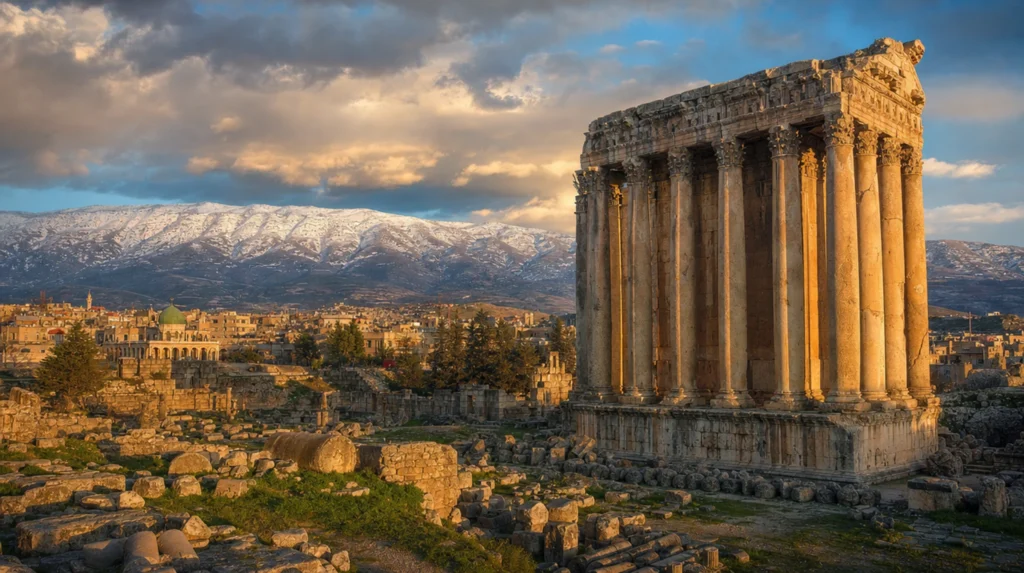
The Roman temple complex at Baalbek (ancient Heliopolis) is among the most spectacular surviving Roman religious sites in the world. The Temple of Jupiter, completed in the 1st century CE, stood on a 12-metre platform and had 54 columns each 22 metres tall and 2.5 metres in diameter — six of the original columns remain standing and represent the largest free-standing columns from the ancient world. The Temple of Bacchus, built around 150 CE on the same complex, is one of the best-preserved Roman temples anywhere — better-preserved than anything in Rome itself, including the Pantheon. The Trilithon, three carved limestone blocks each weighing approximately 800 tonnes, sits in the foundation and remains one of the largest worked stones from antiquity. UNESCO inscribed Baalbek in 1984; the site receives a fraction of the visitor numbers of Petra or the Roman Forum.
🎌 Did You Know?
Lebanon recognises 18 distinct religious communities under its constitutional confessional system — including Maronite Christians, Greek Orthodox, Greek Catholic, Armenian Orthodox, Armenian Catholic, Syriac Orthodox, Syriac Catholic, Roman Catholic, Assyrian Church of the East, Chaldean Catholic, Coptic, Protestant, Sunni Muslim, Shia Muslim, Druze, Alawite, Ismaili, and Jewish. The president must be a Maronite Christian, the prime minister a Sunni Muslim, the speaker of parliament a Shia Muslim, and the deputy prime minister a Greek Orthodox Christian. The system is unique in the world — no other country structures political offices around such a fine-grained religious distribution. A 1932 census remains the last official population count by religion; updating it is politically untouchable.
🇱🇧 The Current Context — What Travellers Need to Know
See the exact advisory wording, dated, in our companion post. Lebanon’s situation is unusual among Middle Eastern destinations and warrants more careful pre-trip research than most countries. The country has been navigating a severe economic crisis since the late 2019 banking collapse — the Lebanese pound has lost more than 95% of its value against the US dollar, the formal banking system has restricted withdrawals heavily, and a substantial cash dollar economy now operates in parallel. Public services (electricity, water, fuel) have been intermittent for several years; private generators and water-tank deliveries fill the gaps. The August 2020 Beirut port explosion compounded an already difficult moment.
For a traveller, the practical consequences are: bring enough US dollars in cash to cover your trip (most hotels and many restaurants now charge in dollars; ATMs frequently do not work for foreign cards or impose punishing exchange rates); accept that electricity will cut several hours a day at most accommodation that doesn’t run private generators; expect mobile data to work slower than in neighbouring countries; and verify the situational status of any specific destination within the week before you travel. The country has no “no-go” rule that applies uniformly — the central regions (Beirut, Mount Lebanon, the coast from Tripoli to Tyre, the Bekaa Valley north of Anjar) are routinely travelled by foreign visitors. The southern border with Israel and certain neighbourhoods near refugee camps are generally avoided; check current foreign-office advisories from your home country before booking.
What is unchanged: the country’s people remain among the most genuinely warm hosts in the region. The food, the culture, the archaeology, and the natural beauty are all undiminished. Many returning visitors describe Lebanon’s current moment as a time when the country’s hospitality is at its most generous — a national openness toward outside visitors who choose to come. Tourism remains an important part of the economy, and visitor spending matters tangibly. The Beirut hotel industry, the wine producers of the Bekaa, the small family-run restaurants of the mountain villages, and the archaeological-site guides all benefit directly from foreign travellers. Lebanon is open and welcoming; arrive informed.
⚠️ Important — Travel Advisories & Insurance
Before booking, check your home country’s foreign-office travel advisory for Lebanon — these are routinely updated and reflect current security assessments. Major Western governments (US, UK, Canada, Australia) maintain advisories that change frequently. Confirm your travel insurance covers Lebanon — many standard policies have geographic exclusions or “do not travel” clauses tied to advisory levels. Specialist providers (World Nomads, Allianz, IMG Patriot) offer Middle East-specific products. Have your embassy contact details saved offline, register your trip with your home country’s traveller registration service (STEP for US citizens, ROAM for UK), and keep family informed of your itinerary. Standard travel precautions apply — but the importance of pre-trip diligence is higher here than in most destinations.
Best Time to Visit Lebanon (Season by Season)
Lebanon has four distinct seasons — closer to a Mediterranean climate than to the desert pattern of its Arab neighbours. The country’s small size combined with its sharp elevation gradient (sea level to 3,000+ metres in 30 km) means temperatures vary significantly by location on any given day. Beirut in summer sits 25–32°C; the mountain villages above 1,000 metres run 18–25°C in the same week. The Bekaa Valley behind the mountains is drier and cooler at night.
Spring (April – June)
The most under-rated season, and arguably the country’s best for a single visit. Daytime temperatures climb from 18°C in early April to 28°C by late June; mountain villages remain cool and the Bekaa Valley peaks for visiting (the wineries, Anjar, Baalbek) before the summer heat. Wildflowers carpet the high meadows; the Cedars of God are accessible (the snowmelt clears the access road by late April). Easter weekend, when celebrated, is a major Lebanese cultural event with both Christian and Orthodox communities marking it across overlapping calendars. Hotel prices are 25–35% below summer peak.
Summer (July – August)
The Lebanese diaspora’s homecoming season. Daytime coastal temperatures sit 28–34°C with high humidity; mountain villages run 22–28°C. Beirut’s beach clubs (Saint George, BO18, Sporting) are at peak; the Baalbek International Festival (typically last week of July through second week of August) brings world-class music to the Roman temple complex. The mountain resort towns (Faraya, Bcharre, Faqra) fill with returning Lebanese expatriates from the Gulf, France and the Americas. Crowds peak; hotel rates run 40–80% above the spring shoulder. The diaspora-summer atmosphere is genuine — a warmth-and-celebration energy that transforms the country’s social life. Plan around the major holidays: Eid al-Adha (lunar calendar, falls in late spring or summer most years).
Autumn (September – November)
The country’s other strong shoulder window. September remains warm (28°C coast, 22°C mountains) but with the diaspora having returned home, hotel rates drop sharply and crowds disappear. October is the wine harvest in the Bekaa Valley — the major producers (Chateau Ksara, Chateau Musar, Massaya, Domaine des Tourelles) run open-house weekends through the month. The mountain forests turn copper and gold; the Qadisha valley in October is one of the country’s most photogenic moments. November sees the first rain and the beginning of the wet season; mountain peaks may receive their first snow. October–early November is the connoisseur’s choice.
Winter (December – March)
The country’s quietest season for archaeological tourism but its busiest for skiing. Coastal Beirut runs 10–15°C with frequent rain. The Mount Lebanon range receives heavy snow above 1,200 metres; ski resorts (Mzaar Kfardebian, Faraya Mzaar, the Cedars at Bcharre, Faqra Club) run December through April. The mid-elevation mountain roads can become impassable during storms — verify access before travel. Christmas (Western and Orthodox calendars) is a major festive period; the Beirut downtown has illuminated festivities, and the mountain Christian villages are particularly atmospheric. Hotel rates are at the year’s lowest in coastal Beirut, highest at the ski resorts.
🧳 Travel Guru Tip
If you can travel only once, target late September through mid-October. Daytime temperatures coastal 22–28°C, mountain 18–24°C, the diaspora has departed, the wine harvest is underway, hotel rates have dropped 25–35% from peak, and the archaeological sites (Baalbek, Tyre, Byblos) are at their quietest. Combine with the Bekaa Valley wine-harvest weekends. The first cool mountain mornings of October make the Qadisha valley hike the year’s most spectacular outdoor experience.
| Experience | Best months | Best regions | Notes |
|---|---|---|---|
| Roman ruins | Apr – Jun, Sep – Nov | Baalbek, Tyre, Anjar | Avoid Aug peak; quiet in shoulder |
| Skiing | Late Dec – early Mar | Mzaar, Faraya, the Cedars | Snow heavy above 1,500 m |
| Wine harvest | Mid-Sep – mid-Oct | Bekaa Valley | Open-house weekends at major châteaux |
| Mountain hiking | May – Jun, Sep – Oct | Qadisha, Cedars, Chouf | Lebanon Mountain Trail 470 km north-south |
| Beach clubs | Jun – Sep | Beirut, Batroun, Tyre coast | Sporting, BO18, Iris peak summer |
| Cultural festivals | Jul – Aug | Baalbek, Beiteddine, Byblos | Headline music in Roman ruins |
Getting There — Flights & Arrival
Lebanon has one international airport that matters (see our companion post, Can You Fly to Beirut in 2026?, for current carrier status and the insurance implications of flying under a Do Not Travel advisory) — Beirut–Rafic Hariri International (BEY), 9 km south of downtown Beirut. The country’s national carrier is Middle East Airlines (MEA, founded 1945, the country’s flag carrier and one of the longest-operating airlines in the Middle East). MEA operates dense networks to Europe, the Gulf, North Africa, and select transatlantic routes (Paris CDG and New York JFK direct). Other major carriers serving BEY include Air France, Lufthansa, Turkish Airlines, Qatar Airways, Emirates, Etihad, EgyptAir, Royal Jordanian, and budget carriers Pegasus and Wizz Air.
From Europe, expect 4h45m direct from London Heathrow on MEA or BA, 4h30m from Paris CDG on MEA or AF, 3h45m from Frankfurt on MEA or LH, 3h15m from Athens, 2h30m from Istanbul. From North America, expect 11h non-stop from Paris CDG on MEA via codeshare with Air France, or routing via Istanbul, Frankfurt, London or Doha for 14–18 hours total from the US east coast. From the Gulf, 3 hours from Dubai, 3 hours from Doha, 2 hours from Kuwait, 90 minutes from Cairo. Round-trip fares from London or New York to Beirut in shoulder season typically land between £450–700 / $750–1,300 if booked 6–12 weeks ahead.
Visa-on-arrival is available at BEY for most Western nationalities — a free 30-day or 90-day stamp on entry for US, UK, EU, Canadian, Australian and NZ passports. Other nationalities may require pre-arranged visas; check with the Lebanese General Directorate of General Security or your nearest Lebanese embassy. Important (see also Is Beirut Safe to Visit Right Now? and Can You Fly to Beirut in 2026?): passports containing Israeli stamps or evidence of Israeli border crossings will be refused entry — Lebanon does not have diplomatic relations with Israel. If you have an Israeli stamp from a previous trip, you will need a fresh passport before visiting Lebanon.
✨ Pro Tip
If you’re combining Lebanon with Jordan or Egypt, the cleanest routing is fly into Amman or Cairo, regional flight to Beirut, then onward. The land border with Syria is open at Masnaa but rarely used by tourists in current conditions; the southern border with Israel is closed. The Beirut to Cyprus ferry — once a tourist favorite — is currently not running on a passenger schedule; check with Visem Shipping for any restored services. Most travellers fly in and out of Beirut on a single direct or one-stop ticket. Avoid carrying Israeli currency, products marked from Israel, or social-media evidence of Israeli travel; immigration screens for these.
Getting Around — Servees, Rental Cars & the Coastal Highway
Lebanon is small enough to traverse end-to-end in a single day. Beirut to Tripoli is 80 km / 90 minutes; Beirut to Tyre is 80 km / 90 minutes; Beirut to Baalbek (via the Bekaa) is 90 km / 2 hours including the mountain pass. The coastal highway connects most of the country’s major cities; the Beirut-Damascus highway (closed at the Syrian border for most travellers) crosses the mountains at the Dahr el Baidar pass. Most travellers combine a Beirut hotel base with day-trips, or do a 7-10 day circuit anchored on Beirut and one mountain or Bekaa overnight.
The traditional shared taxi — the servees — is the country’s cheapest urban transport. Servees operate as roving shared minicars on fixed routes around Beirut and between cities; flag one down by sticking out an arm and calling your destination. Local rides cost LBP 50,000–100,000 (about $0.50–1.00 USD), inter-city LBP 200,000–500,000 ($2–5). The servees system is genuinely useful but assumes basic Arabic for destination communication; tourists usually default to apps.
Uber operates in Beirut but with more limited coverage than in Gulf cities; Bolt and Careem also operate. Taxis (the white “Allo Taxi” cars or “Charlie” taxis) are metered in theory, negotiated in practice — agree on the fare before getting in, expect $5–15 USD for typical Beirut rides. Private day-driver hires from any hotel run $80–150 USD for a full day’s driving with a knowledgeable local guide; this is genuinely the best way to see the country if you don’t want to drive yourself.
Self-drive rentals from the airport and downtown Beirut are widely available — Hertz, Avis, Sixt and reputable local operators (Advanced Car Rental, Lebanon Car Rental). A compact petrol car runs $35–55 USD per day; SUVs $70–120 USD per day. Lebanese driving culture is energetic — lane discipline is variable, urban traffic is intense, and parking in central Beirut is genuinely difficult. Foreign drivers can use their home licence for up to 90 days; an International Driving Permit is recommended. Petrol prices fluctuate substantially with the regional market and Lebanese currency conditions; check current rates with the rental company.
⚠️ Important — Cash Economy & ATM Limits
Lebanon currently operates a parallel cash dollar economy due to the ongoing banking crisis. Many hotels, restaurants, taxis and tour operators charge directly in US dollars; some accept Lebanese pounds at locally-determined rates that change daily. Foreign-card ATMs frequently fail to dispense cash, and even when they work, the exchange rate may be punitive (you withdraw at the official Banque du Liban rate, but most pricing operates at the market or “lollar” rate). Bring sufficient US dollars in cash for your trip — rough budget guideline is $80–250 USD per person per day depending on tier, in clean small denominations ($1, $5, $10, $20, $50, $100). Lebanese-issued debit cards from local banks work for residents only. Check current conditions at your specific hotel before arrival; some have accepted Visa/Mastercard for foreign cards, others have not.
Top Regions & Cities
📍 Map of Lebanon: Every Place in This Guide
Lebanon’s compactness means most travellers visit the major regions on a single trip. The country’s tourism map breaks into four broad zones: Beirut and the central coast, Mount Lebanon and the Maronite heartland (Qadisha valley, the Cedars), the Bekaa Valley and Baalbek, and the southern coast (Tyre, Sidon). Below are the bases worth building an itinerary around.
🏙️ Beirut — The Mediterranean Capital
The country’s capital and primary city, with about 2.4 million in the metropolitan area. Beirut is built around the central downtown (rebuilt extensively in the 1990s after the civil war and damaged again by the August 2020 port explosion), the historic Hamra district (the country’s intellectual centre during the golden age, with the American University of Beirut at its heart), the Achrafieh Christian quarter (with the cobbled streets of Mar Mikhael and Gemmayzeh hosting the city’s nightlife), the Ras Beirut peninsula and Manara lighthouse, and the Verdun and Hazmieh modern shopping districts. The corniche promenade — a 4-kilometre seafront walk from Manara to Ramlet el-Bayda beach — is the city’s main social spine.
The headline visitor experiences are layered. The National Museum of Beirut on Damascus Road has the country’s best archaeological collection (Phoenician sarcophagi, Roman mosaics, Byzantine glass — the museum’s cellar storeroom famously survived the civil war intact when staff sealed treasures behind concrete walls in 1975). The Mohammed Al-Amin Mosque and the adjacent Saint George Maronite Cathedral on Martyrs’ Square are the city’s signature interfaith architecture, sitting side by side with their respective minaret and bell tower. Pigeon Rocks at Raouché — twin natural sea-stacks just off the corniche — are the city’s most photographed natural feature. The Sursock Museum in Achrafieh houses Lebanese contemporary art in a restored 19th-century mansion (heavily damaged in the 2020 explosion, fully reopened in 2023).
Beirut’s food scene is the country’s most concentrated, with Mezze restaurants like Em Sherif and Liza, the legendary Tawlet (a producer-led pop-up restaurant rotating regional Lebanese chefs every day), and the long-running Le Chef in Gemmayzeh which has fed locals for over 50 years. The Mar Mikhael and Gemmayzeh nightlife strip — its bars, restaurants, and rooftop terraces — is widely regarded as the most vibrant in the Arab world when it is operating at full energy.
- What to do: National Museum of Beirut; Sursock Museum; Mohammed Al-Amin Mosque + Saint George Cathedral; corniche walk to Pigeon Rocks; the AUB campus; Mar Mikhael and Gemmayzeh evening.
- Signature experiences: Sunset from Achrafieh’s high terraces; the live entertainment at Music Hall (variable schedule, check local listings); a meal at Tawlet for the regional Lebanese rotation.
- Access: BEY airport 9 km from downtown; taxi 15–25 minutes airport-to-downtown; rental car for the rest of the country from BEY desks.
⛩️ Byblos (Jbeil) — The 7,000-Year Continuous City
40 km north of Beirut, Byblos (modern Jbeil) is one of the oldest continuously inhabited cities in the world, with archaeological strata documenting human occupation from about 5000 BCE through the present day. The city’s name is the etymological source of “Bible” — Byblos was the trading port that exported papyrus to Greece and Rome, and the Phoenician alphabet was first recorded here on the Sarcophagus of Ahiram (around 1200 BCE). The archaeological site (UNESCO-listed since 1984) contains a Phoenician temple, Roman colonnade, Byzantine basilica, Crusader castle (built around 1115 CE by Hugh I of Embriaco), and Ottoman caravanserai, all on adjacent ground. The Crusader castle has commanding views over the harbour.
The old town of Byblos itself is one of the country’s most charming — a restored Ottoman-era harbour district with narrow stone alleys, traditional cafés, the Bayrout family-run Byblos Old Souk (the kebab and traditional sweets are widely regarded as benchmark), and Restaurant Pepe Abed (a long-running Italian-Lebanese restaurant that has fed Lebanese politicians, French presidents and foreign celebrities since 1963). The harbour itself has small fishing boats, a sea-wall walking path, and excellent sunset views.
Byblos is best as a day-trip from Beirut or a single overnight; the Edde Sands resort at the northern edge is a popular summer beach club for Beirutis. Combine Byblos with Batroun (35 km further north — the country’s most charming small Mediterranean town, with the iconic Phoenician sea-wall) for a half-day coastal extension.
- What to do: Byblos archaeological site and Crusader castle; the old souk; the harbour walk; Pepe Abed for lunch.
- Signature experiences: Sunset over the harbour from the Crusader castle ramparts; a fish lunch at the harbour-side restaurants.
- Access: 40-minute drive north from Beirut on the coastal highway; servees and bus services available.
🏛️ Baalbek & the Bekaa Valley
The Roman temple complex at Baalbek is the country’s most spectacular archaeological site and arguably the best-preserved Roman religious complex in the world. The 1st-century CE Temple of Jupiter, the 2nd-century Temple of Bacchus, the smaller Temple of Venus, and the foundation Trilithon (three carved limestone blocks each weighing approximately 800 tonnes) sit on a 12-metre platform that itself was likely built on Phoenician and earlier foundations. The site is genuinely overwhelming — the surviving columns of the Temple of Jupiter are 22 metres tall and 2.5 metres in diameter, the largest free-standing columns from the ancient world. Visit at opening (8 a.m.) for the cleanest light; the site receives perhaps a tenth of the visitor numbers of Petra. The annual Baalbek International Festival (last week of July through second week of August) stages world-class music inside the temple complex.
The Bekaa Valley, the broad plain between the Mount Lebanon and Anti-Lebanon ranges, is the country’s wine and fertile-agriculture heartland. The major wineries are concentrated around Zahlé and Aana — Chateau Ksara (the country’s oldest, founded 1857 by Jesuit monks; now Lebanon’s largest producer at 2.5 million bottles annually), Chateau Musar (the country’s most internationally-known, founded 1930, producing distinctive long-lived wines from the Aana plain at 1,000 metres elevation), Chateau Kefraya (founded 1979, with a striking modern winery and the country’s most-visited tasting room), Massaya (founded 1998 by the Brun and Ghosn families, signature blend of cabernet sauvignon, syrah, mourvèdre), and Domaine des Tourelles (founded 1868, the country’s first commercial winery). Most run paid tasting tours from $20–60 USD per person; book ahead through the winery websites or via local tour operators.
Anjar, an Umayyad-era city dating to around 705 CE, is also in the Bekaa near the Syrian border (UNESCO-listed since 1984). The site is unusual because it represents the Umayyad caliphal urban planning at its most clearly visible — a planned grid city with a tetrapylon at the centre, two columned cardo and decumanus streets, and a great mosque, all on a single compact ruin. Best combined with Baalbek on a single day-trip from Beirut.
- What to do: Baalbek temple complex; Anjar Umayyad ruins; winery tour at Chateau Ksara, Chateau Musar or Chateau Kefraya; lunch at Massaya for the on-site Italian-Lebanese restaurant.
- Signature experiences: Sunrise at Baalbek with no other visitors; an evening Baalbek International Festival concert (when the festival is operating).
- Access: Beirut to Baalbek 90 km / 2 hours via the Dahr el Baidar mountain pass; full-day private tour with driver $120–180 USD covers Baalbek + Anjar + winery in a single day.
🌲 Qadisha Valley & the Cedars of God
The Qadisha (Holy) Valley in northern Mount Lebanon is one of the most spectacular landscapes in the eastern Mediterranean — a 35-kilometre limestone gorge cut by the Qadisha River, with thousand-metre-tall cliffs flanking ancient Maronite Christian monasteries hewn directly into the rock face. UNESCO-listed since 1998. The valley has been a refuge for Maronite Christians since the 7th century — communities sheltered here through Mamluk persecution, Ottoman pressure, and Lebanese civil-war disruption — and the surviving monasteries (Saint Anthony of Qozhaya, Saint Elisha, Notre-Dame de Qannoubine, Mar Lichaa, Mar Sarkis) remain functioning religious sites with tiny resident communities.
The Cedars of God (Arz al-Rabb) on the slopes above Bcharre — about 2,000 metres in elevation — are the country’s most iconic natural site and the symbol on the national flag. The grove contains roughly 400 mature Cedrus libani, including individual trees estimated at 1,500–3,000 years old. The cedars are mentioned in the Epic of Gilgamesh, in Sumerian texts from 2100 BCE, and provided the timber for King Solomon’s Temple. The grove is small (about 1.5 hectares) but the trees are old — these are the visible heirs of a forest that once covered Mount Lebanon and was mostly cut for shipbuilding by the Phoenicians, Romans and Ottomans. UNESCO-listed jointly with the Qadisha valley.
Bcharre, the village above the Qadisha valley, is the birthplace of Khalil Gibran (1883–1931), the Lebanese-American poet and author of The Prophet (1923) — one of the best-selling books of the 20th century. The Gibran Museum in Bcharre, in a former 14th-century monastery purchased by Gibran’s sister with royalties, contains his manuscripts, paintings (Gibran trained as a visual artist before becoming a writer), and the rock tomb where he is buried. The museum is small but moving.
- What to do: Cedars of God grove; Gibran Museum in Bcharre; Qadisha valley hike from Bcharre to Saint Anthony of Qozhaya monastery (5 hours one-way, dramatic switchback trail); Hawqa monastery cave church.
- Signature experiences: A guided hike with one of the local Maronite monastic guides who can interpret the religious history; sunset at the Cedars with the Mediterranean visible 50 km below.
- Access: 130 km / 2.5 hours from Beirut via the Tripoli-Bcharre road; 4WD recommended December–March (snow at the Cedars elevation).
🏛️ Tyre & Sidon — The Southern Phoenician Cities
Tyre (modern Sour), 80 km south of Beirut, was the most powerful of the Phoenician city-states from roughly 1200 BCE — the city that founded Carthage in the 9th century BCE and dominated Mediterranean shipping for centuries. The archaeological site (UNESCO-listed since 1984) contains a 480-metre Roman hippodrome (one of the largest surviving in the world), the colonnaded street with surviving Roman columns, the Phoenician harbour ruins, and the Crusader-era cathedral remains. The site receives a fraction of the visitors that comparable Mediterranean Roman ruins do; you can have it almost to yourself outside summer peak.
Sidon (modern Saida), 45 km south of Beirut, has a beautifully restored 13th-century Crusader sea castle (Qalaat al-Bahr) connected to the mainland by a stone causeway, plus the Khan al-Franj caravanserai (rebuilt by Emir Fakhreddine II in the 17th century) and the Soap Museum (in a 17th-century soap factory documenting the city’s traditional industry — Sidon was famous for its tallow-and-olive-oil soaps for centuries). The old souk of Sidon is one of the country’s most authentic surviving traditional markets.
- What to do: Tyre archaeological site (Al-Mina and Al-Bass sectors); Tyre’s harbour and the small Christian quarter; Sidon sea castle and old souk; the Maghdouché shrine to Our Lady of Awaiting (Sayidat al-Mantara) en route.
- Signature experiences: Sunset from the Tyre Roman hippodrome rim; lunch at Tannourine restaurant on the Tyre harbour; the Sidon old souk on Saturday morning.
- Access: Coastal highway south from Beirut — Sidon at 45 km, Tyre at 80 km. Avoid travel south of Tyre at present (Israeli border zone).
🏛️ Tripoli & the Northern Coast
Lebanon’s second-largest city, 80 km north of Beirut, with about 500,000 residents. Tripoli has a strong Mamluk-era architectural heritage — the Citadel of Raymond de Saint-Gilles (rebuilt by the Mamluks in the 13th century), the Great Mosque of Mansour Qalawun (1294), the Khan al-Saboun caravanserai (the soap-makers’ khan, still operating), and one of the country’s largest covered souks (Souk al-Haraj, the rope and copper souk). The city has a rougher edge than Beirut — less restored, more workaday — but for visitors interested in Mamluk and Ottoman Islamic architecture it is among the country’s most rewarding stops. Tripoli’s historic centre has been undergoing slow restoration through partnerships with international conservation organisations.
The city is famous for traditional sweets and pastries — the Hallab brothers’ Rafaat Hallab pastry shop (founded 1881, on Tell Square) is widely regarded as the country’s benchmark for kunafa, baklava, and the cream-filled halawat al-jibn. The Tripoli food culture is genuinely distinctive — more Levantine-Egyptian than the Beirut Mediterranean style, with spice patterns from across the eastern Mediterranean.
- What to do: Citadel; Great Mosque; the souks (Khan al-Khayyatin / tailors’ souk, Khan al-Saboun / soap khan, Souk al-Haraj); Hallab for traditional sweets; Mina (Tripoli’s harbour district) for fish lunch.
- Signature experiences: A guided walking tour of the Mamluk monuments (the city’s tour offices have local guides); breakfast at Hallab; the Saturday craft market at the Khan al-Khayyatin.
- Access: 80 km / 90 minutes from Beirut via coastal highway.
“You give but little when you give of your possessions. It is when you give of yourself that you truly give.”
— Khalil Gibran, The Prophet (1923)
🗓️ Sample Itineraries
Lebanon rewards both short and longer trips. A 4-day visit can fit Beirut and the headline day-trips. A 7-10 day trip lets you cover the full geographic and cultural spread. Below are four templates that work for first-time visitors.
4 Days — Beirut + Headline Day-Trips
Day 1: Arrive BEY, hotel check-in, evening Mar Mikhael walk and dinner at Tawlet or a Mar Mikhael bistro. Day 2: Morning National Museum, afternoon Mohammed Al-Amin Mosque + Saint George Cathedral + downtown walk, sunset corniche to Pigeon Rocks, dinner at Em Sherif. Day 3: Day-trip to Byblos (Crusader castle, archaeological site, harbour lunch), continue to Batroun for late afternoon, return Beirut for evening. Day 4: Day-trip to Baalbek + Anjar with a winery stop at Chateau Ksara or Kefraya, return Beirut, late departure or final evening dinner.
7 Days — Comprehensive Lebanon
Run the 4-day above through Day 3, then: Day 4: Drive Beirut → Bcharre via Tripoli (4 hours including a 90-minute Tripoli stop). Sleep Bcharre. Day 5: Cedars of God morning, Gibran Museum, Qadisha valley short hike (3-hour version to Saint Anthony of Qozhaya). Sleep Bcharre or drive back to Beirut for the night. Day 6: Day-trip to Baalbek + Anjar + winery (as in the 4-day plan). Day 7: Day-trip south — Sidon old souk and sea castle, Tyre Roman hippodrome and harbour, return Beirut for late departure.
10 Days — Lebanon at Depth
Run the 7-day above, then: Day 8: Chouf mountains day — Beiteddine Palace (the country’s most spectacular Ottoman-era palace, summer residence of the early Lebanese presidents), the Chouf Cedars Reserve, lunch at Mir Amin Palace. Day 9: Beirut neighbourhoods deep dive — Mar Mikhael galleries, Sursock Museum, Hamra district walking tour, AUB campus, evening Achrafieh dinner. Day 10: Day-trip Tripoli for the Mamluk citadel and Hallab pastries, with a stop at the Phoenician sea wall at Anfeh on return; late departure.
14 Days — Lebanon & the Lebanese Diaspora
For travellers willing to commit. Use the 10-day above as the spine, then add: Days 11–12: Multi-day Lebanon Mountain Trail hike — pick a section like the Niha-to-Ehden segment for the cedar forests and traditional Maronite villages. Two nights in mountain guesthouses. Day 13: Wine and food day in the Bekaa — multiple winery visits, lunch at Massaya, dinner at a Zahlé arak distillery. Day 14: Final Beirut day, last shopping/eating, departure. This is the trip you take to genuinely understand Lebanon’s depth.
🎯 Strategy
If you only have one trip and a 7-day window, the Comprehensive Lebanon version above is the right template — it covers Beirut, the coastal Phoenician cities (Byblos, Sidon, Tyre), the Roman complex at Baalbek, the Bekaa wineries, and the Maronite mountain heartland (Cedars, Qadisha) without rushing. Build the itinerary around a private day-driver for the day-trips ($120–180 USD per day with a knowledgeable guide) — the country is small enough that this works as a hub-and-spoke structure from Beirut, with a single overnight in Bcharre as the only night outside the capital.
Lebanese Culture & Etiquette
Lebanon is the most religiously diverse country in the Middle East — and the most cosmopolitan in everyday cultural texture. The 18 officially recognised religious communities live in genuine geographic and social proximity; the same village often has Maronite Christian, Greek Orthodox, Sunni, Shia, and Druze families occupying adjacent streets, and the social code prioritises generosity-without-imposition across communal lines. Visitors are welcomed warmly. The country’s reputation for hospitality is genuinely earned — invitations to homes, meals, and family gatherings happen with surprising frequency for foreign visitors who show curiosity and respect.
The single most useful cultural skill is participating in the food rituals. Lebanese hospitality runs through food — the mezze opening (15+ small dishes covering the table), the slow rhythm of conversation, the multiple coffee rounds, the date-and-pastry conclusion. Refusing food is genuinely understood as social distance; the polite move is to accept small portions of everything offered. The phrase “sahteen” (to your health) is used at the start of meals; “shukran” (thank you) for any kindness. The host typically pays for any meal or coffee they invited you to; offering to split is sometimes accepted, often refused with mild offence.
Religious identity in Lebanon is the dominant social fact, but the cultural posture toward foreign visitors is broadly secular and welcoming. Christians are visible (Maronite churches’ bells are part of the urban soundtrack), Muslims are visible (mosque calls to prayer overlap), Druze villages have their own distinctive customs, and the Beirut night life is consciously religion-blind. Foreign visitors are not expected to navigate the religious distinctions; observing local social codes (modest dress in religious sites, head covering for women in mosques and Maronite cathedrals during services, removal of shoes in mosques) is sufficient.
Language is layered. Arabic is the official language; Lebanese Arabic specifically (a dialect notably different from Standard Arabic and somewhat closer to Levantine Aramaic in some inflections). French is widely spoken, particularly among Christian communities and the educated classes (Lebanon was a French Mandate from 1920 to 1943, and French education remains common). English is widely spoken in tourism, business, and among younger generations. Most educated Lebanese speak all three fluently; the Beirut conversational style routinely switches mid-sentence between Arabic, French and English, which can be disorienting for foreign visitors and is genuinely just how language works there.
💬 The Saying
“Hayda Lebnan.” Roughly: “This is Lebanon.” It is the country’s universal phrase for the everyday paradoxes — power cuts in a country exporting electricity to neighbours, gridlock around an empty roundabout, brilliant food in a chef’s kitchen with a leaking ceiling, joy in the middle of difficulty. The phrase carries equal parts pride and resignation. Lebanese say it constantly, sometimes laughing, sometimes sighing. Travellers who use it correctly (with an accepting shrug rather than a complaint) earn instant rapport. The country runs on a current of resilient humour that visitors often find more affecting than any single attraction.
A Food Lover’s Guide to Lebanon
Lebanese food is widely regarded as the most refined cuisine in the Arab world and one of the great cuisines of the Mediterranean. The food culture is built around mezze — a meal opening of 15 or more small dishes shared from the centre of the table — followed by grilled meats, fish, or rice-based mains, with a final round of coffee and pastries. The cuisine draws on Phoenician traditions (the use of olive oil, wheat, lamb), Ottoman influences (kebabs, pilafs, the broader spice palette), French Mandate inflections (the patisserie tradition, certain wine styles), and centuries of trade with Egypt, Syria, Turkey and Persia.
Mezze is the foundation. A standard mezze opening includes hummus (chickpea-and-tahini dip), baba ghanouj (smoked aubergine dip), tabbouleh (parsley, mint, bulgur, tomato salad), fattoush (the bread-and-vegetable salad), kibbeh nayyeh (raw spiced lamb tartare, the Lebanese steak tartare), warak inab (stuffed grape leaves), sambousek (small fried meat or cheese pastries), labneh (strained yogurt), olives, and several types of bread. Em Sherif (the famous Achrafieh restaurant), Liza (the elegant Achrafieh townhouse), and Kalei Coffee Co. (the contemporary Mar Mikhael fusion) serve the upmarket version; Le Chef in Gemmayzeh (founded 1967) the everyday classic; the small kitchens of Mar Mikhael and Hamra a hundred others.
Main courses centre on grilled meats — kafta (spiced ground meat skewers), shish tawook (marinated chicken cubes), shish kebab (lamb skewers), and the Lebanese mixed grill. Fish on the coast is excellent — sea bass, red mullet, calamari, octopus, all grilled simply with olive oil, lemon and parsley. Sayyadiyeh (spiced rice with fish) is the classic coastal dish.
Manakish is the everyday breakfast — a flatbread topped with za’atar (the wild thyme-and-sesame mix), cheese, or minced meat (lahmeh bi’ajeen), baked in a wood-fired oven, served folded with lemon, olives and cucumber. Manakish at the corner bakery costs LBP 30,000–80,000 (about $0.50–1.50 USD depending on topping). Arz al-Lubnan, La Mie Dorée and the small bakery chains around Beirut are reliable; the genuinely best are the unsigned village bakeries you find on day-trips.
Sweets and pastries are a country in themselves. Baklava (filo-and-nut layered with honey), kunafa (cheese-filled crispy semolina pastry, served warm with rose-water syrup), maamoul (date-or-nut-stuffed shortbread), namoura (semolina cake with rose-water), halawat al-jibn (the cream-filled cheese pastry from Tripoli). The traditional sweet shops — Hallab in Tripoli, Patchi in Beirut, Yildizlar in Achrafieh, the small village shops everywhere — are where Lebanese sweet culture happens. Kunafa for breakfast is genuinely a Lebanese tradition.
Lebanese wine is the country’s distinctive alcoholic beverage. The Bekaa Valley’s high elevation (900–1,400 metres) and low rainfall produce concentrated fruit; the country’s wine-making history runs continuously from the Phoenicians through the Romans (who also planted heavily on the same plains) through the Maronite monasteries (the Jesuits at Ksara) into the modern commercial industry. Chateau Musar’s reds — particularly the Hochar family’s distinctive long-aged blends — have international cult following. Massaya, Domaine des Tourelles and Chateau Ksara represent the contemporary range. Expect $15–60 USD per bottle for the better wines at restaurants. Arak (the anise-flavoured grape spirit, served diluted with water and ice — turns milky on dilution) is the traditional companion to mezze. The Domaine des Tourelles arak is a benchmark.
Coffee is taken seriously — Lebanese kahweh is unfiltered, dark, often cardamom-scented, served small with a glass of cold water. The morning routine for many Lebanese is two cups of kahweh and a manakish at the corner bakery before work. The third-wave coffee scene in Beirut (Sip, Kalei, the small Mar Mikhael cafés) operates the modern alternative; both coexist comfortably.
📸 Photography Notes
Lebanon is photographed less than its quality warrants — the country has been off the global tourist circuit for stretches of recent decades, and the result is that the major archaeological sites and natural landscapes are notably less crowded with photographers than equivalent destinations elsewhere in the Mediterranean. The light is excellent year-round; the spring and autumn shoulders give the cleanest atmospheric conditions, with summer producing more haze along the coast.
Best light by month: April–June dawn between 6:00–8:00 a.m. for the warmest, most directional light on archaeological sites; September–early November sunsets 5:30–6:30 p.m. for the warmest harvest-season tones; January–February for the snow-line photography on the Mount Lebanon range. Avoid August midday for outdoor archaeological work — the sun is harsh and the haze lifts only by late afternoon.
Five locations worth the detour:
- Baalbek Temple of Bacchus interior (34.0073°N, 36.2031°E) — the best-preserved Roman temple anywhere, with the carved Corinthian capitals at human-eye level. Best at 8:30 a.m. before tour groups; 16-35mm wide angle with a tripod (permitted at site).
- Pigeon Rocks at Raouché, sunset (33.8908°N, 35.4842°E) — Beirut’s twin sea-stacks. Best at sunset; 24-70mm; the corniche viewpoint at the western end.
- Cedars of God (34.2517°N, 36.0481°E) — the ancient cedar grove against the Mount Lebanon snowline. Best in late afternoon when the sun rakes the trees; 35-85mm lens.
- Qadisha valley from Bcharre (34.2417°N, 36.0103°E) — the deep limestone gorge with the monasteries embedded in cliffs. Best mid-morning; 16-50mm; the view from the Bcharre overlook just below the Gibran Museum.
- Byblos Crusader castle and harbour (34.1208°N, 35.6481°E) — the medieval ramparts above the small Phoenician harbour. Best at sunset; 24-70mm; access via the archaeological site entrance.
Drone rules: Lebanon’s drone regulations are technically under the General Directorate of Civil Aviation, but enforcement varies and rules have shifted in recent years. As of early 2026, recreational drones generally require Civil Aviation approval and are routinely declined for visitors. Flying near the airport, military installations, and certain security-sensitive zones (Hezbollah areas in southern Lebanon, port facilities) is strictly prohibited and can lead to detention. Most archaeological sites prohibit drones; some private locations may permit with operator consent. Default to no drone use unless you have explicit written permission.
✨ Pro Tip — People Photography & Sensitive Sites
Lebanon is generally relaxed about street photography — Beirut’s social atmosphere welcomes cameras, and the older quarters (Hamra, Mar Mikhael, Achrafieh, the Tripoli souks) reward patient observation. Always ask before photographing individuals, particularly women and at religious sites. Avoid photographing security personnel, military installations, government buildings, the airport, and the immediate aftermath of any visible incident. The southern parts of the country, the Bekaa near the Syrian border, and certain Beirut neighbourhoods (the southern suburbs known as Dahiyeh) require additional sensitivity — defer to local advice. Most Lebanese are warmly receptive to thoughtful photographers; the social atmosphere is much closer to Mediterranean Europe than to Gulf reserve.
Off the Beaten Path — Lebanon Beyond Beirut
The headline Lebanon trip covers Beirut, Byblos, Baalbek, the Cedars, and the southern coast. The under-visited rest of the country offers some of the region’s most distinctive experiences for travellers willing to drive, hike, or accept simpler accommodation.
🥾 The Lebanon Mountain Trail
A 470-kilometre marked hiking trail running the length of Mount Lebanon from Andqet in the north to Marjaayoun in the south, completed in 2007 by the Lebanon Mountain Trail Association. The trail passes through 75 villages and 25 nature reserves, crossing all the country’s major ecological zones. Most thru-hikers complete it over 30–35 days; weekend hikers select segments. The Niha-to-Ehden segment (4 days) covers the cedar forests and the most spectacular Maronite mountain villages; the Chouf segment passes through the Druze heartland and the Chouf Cedar Reserve. Local guesthouses in trail villages run $25–60 USD per night with breakfast.
🏰 Beiteddine Palace & the Chouf Mountains
The 19th-century Beiteddine Palace, the early summer residence of the Lebanese presidency, is the country’s most spectacular surviving Ottoman-era palace — a Mamluk-Ottoman fusion built between 1788 and 1820 by Emir Bashir Shihab II. The palace contains the country’s best collection of Byzantine mosaics (rescued from coastal sites and reassembled in the palace stables), the lavishly tiled hammam, and ornately carved cedar ceilings. The Beiteddine Festival each summer (typically July–August) stages classical music in the palace courtyards. The surrounding Chouf mountains contain the largest cedar reserve in the country (the Chouf Cedars Reserve, 550 km², with cedars older than the Cedars of God grove but in a less concentrated formation).
🏖️ Batroun — The Phoenician Sea Wall Town
50 km north of Beirut, Batroun is one of the country’s most charming small Mediterranean coastal towns — an old town of pale stone houses, a harbour with restored fishing boats, and the surviving Phoenician sea wall (a 225-metre limestone barrier built by the Phoenicians around 1000 BCE, still functioning as the harbour’s breakwater). Batroun is the country’s small-batch lemonade capital — Hilmi’s, the original lemonade stand on the main road, has been serving fresh lemonade for decades and is the unofficial pilgrimage stop on a coastal drive north. The town has become a small-scale weekend escape for Beirut’s creative class and has a notably international restaurant scene for its size.
🪨 Faraya & the Faqra Roman Ruins
Faraya, in the Mount Lebanon range about 50 km northeast of Beirut, is the country’s main winter ski resort (Mzaar Kfardebian). Above Faraya, at 1,800 metres, sit the Faqra Roman ruins — a small but spectacular 1st-century BCE temple complex (the Temple of Adonis, the Great Altar, and several rock-cut tombs) sitting at the foot of the natural arch known as Jisr al-Hajar. The combination of Roman archaeology, alpine landscape, and ski-resort access makes Faraya unusual in the Middle East. Best as a full day-trip from Beirut, ideally combined with the Jeita Grotto (a spectacular limestone cave system 18 km north of Beirut, the country’s most-visited natural attraction).
🌊 Jeita Grotto
20 km north of Beirut, the Jeita Grotto is a two-tiered limestone cave system — an upper dry gallery 6.2 km long with spectacular stalactites and stalagmites, and a lower wet cave 9 km long traversed by a small electric boat. The grotto was a finalist in the 2011 New 7 Wonders of Nature global vote. The dry cave’s largest stalactite is over 8 metres long and is widely cited as the world’s longest. Best as a half-day trip from Beirut, often combined with the nearby Harissa shrine (the 19th-century Notre-Dame du Liban statue 600 metres above sea level, with a teleferique cable car and panoramic views over the Bay of Jounieh).
Lebanon by Numbers
- 5.6 million — country population (2024 estimate)
- 10,452 km² — country area, smaller than Connecticut
- 4 — UNESCO World Heritage Sites (Anjar, Baalbek, Byblos, Tyre)
- 18 — officially recognised religious communities
- 3,088 m — height of Qornet es Sawda, the highest peak
- 22 m — height of the surviving Roman columns at Baalbek’s Temple of Jupiter
Practical Information
Currency: Lebanese pound (LBP), now operating in parallel with a substantial cash US dollar economy. The pound’s official rate set by Banque du Liban is significantly different from the actual market rate; pricing in shops and restaurants now often uses the “lollar” parallel rate or charges directly in US dollars. Bring sufficient US dollars in cash for your trip — clean small denominations preferred, no torn or marked bills. ATMs frequently fail to dispense cash for foreign cards and impose punishing exchange rates when they do. Tipping: 10% at restaurants if not on the bill, $1–3 USD for most service interactions.
Visa & entry: Most Western nationalities (US, UK, EU, Canadian, Australian, NZ) receive a 30-day or 90-day visa-on-arrival stamp at BEY airport, free or with a small fee. Other nationalities may require pre-arranged visas; check with the Lebanese General Directorate of General Security or your nearest Lebanese embassy. Critical: passports containing Israeli stamps will be refused entry. Passport must be valid 6 months past entry.
Language: Arabic is the official language. French is widely spoken. English is increasingly common, particularly among younger generations and in tourism contexts. Most educated Lebanese speak all three. Learn “shukran” (thank you), “marhaba” (hello), “kifak” (how are you, masculine) / “kifik” (feminine), and “yaani” (the universal verbal-pause word).
Connectivity: 4G coverage is universal in cities and most towns; speeds are generally lower than neighbouring countries due to infrastructure constraints. Touch and Alfa are the two operators; tourist SIM cards are sold at the airport ($20–50 USD for 7–30 days, 5–15 GB). eSIM via Airalo runs $10–30 for 1–10 GB. Free Wi-Fi is universal at hotels and most cafés. WhatsApp is the everyday communication standard; international SMS charges apply otherwise.
Tap water: Not potable. Bottled water is universal and cheap (LBP 25,000–60,000 / about $0.30–0.80 USD for 1.5 litres). Most hotels supply complimentary bottled water; some have point-of-use filtration systems where bottles can be refilled. Brushing teeth with tap water is generally fine but be cautious in older buildings.
Electricity: Lebanon has had intermittent state electricity for years — most accommodation runs private generators that bridge the cuts. Expect 2–6 hours of state electricity per day plus generator power; air conditioning, hot water, and Wi-Fi typically remain functional thanks to generators. The cuts are usually scheduled and predictable. Plug type C/D (European 2-pin and Indian 3-pin), 220V/50Hz. Bring a universal adapter.
Budget Breakdown — What Lebanon Actually Costs
For an itemised 2026 price list — man’oushe to hotel tiers — see our companion post, What Beirut Costs in 2026. Lebanon’s pricing is unusual in the current moment. Many things are surprisingly affordable in US-dollar terms — particularly food, taxis, and budget hotels — while imported items, fine dining, and luxury hotels run roughly comparable to European prices. The cash-dollar economy means pricing is often direct in USD; LBP pricing changes daily with the parallel rate. The result is a country where a couple can travel comfortably on $80–150 USD per person per day or splurge meaningfully at $300+ per day.
💚 Budget Traveller — $60–110 / day
Hostel or budget guesthouse $20–40 USD per night (Saifi Urban Gardens hostel in Beirut, basic guesthouses in Byblos and Bcharre). Eat at small Lebanese restaurants and bakery counters ($4–10 USD per meal — manakish, falafel sandwich, kebab plate, mezze platter shared). Servees and shared taxis ($1–3 USD per ride within Beirut, $3–8 for inter-city). Free experiences: AUB campus, the corniche, downtown walking, beach access at Ramlet el-Bayda. Paid attractions are generally cheap ($5–10 USD for archaeological sites and museums).
💙 Mid-Range — $130–250 / day
Mid-tier hotel doubles $80–180 USD per night (Le Gray Beirut, the Albergo, mid-range guesthouses in Bcharre and Byblos). Restaurant dinner $20–50 USD per person at quality Lebanese restaurants. Private day-driver $120–180 USD per day for Bekaa, Byblos, or Cedars day-trips. Winery tasting $20–60 USD per person. This is the realistic mid-range cost for a couple seeing the country comfortably over 7 days.
💜 Luxury — $400+ / day
Beirut’s high-end — Le Gray, Phoenicia InterContinental, Four Seasons Beirut, the Albergo — runs $250–600 USD per night. Tasting-menu dinner at Em Sherif or Liza $80–180 USD per person plus wine. Private guide-driver-and-vehicle $200–350 USD per day. Helicopter transfer to mountain or coast $1,500+ USD. The Phoenicia InterContinental’s classic afternoon tea overlooking the marina is the country’s most accessible luxury-tier indulgence.
| Item | Budget (USD) | Mid-range (USD) | Luxury (USD) |
|---|---|---|---|
| Bed (per night) | $20–40 | $80–180 | $250–600 |
| Dinner | $4–10 (small restaurant) | $20–50 (mid restaurant) | $80–180 (Em Sherif/Liza) |
| Daily transport | $3–10 (servees/bus) | $120–180 (private day-driver) | $200–350 (private chauffeur) |
| One activity | $5–10 (museum/site) | $30–60 (winery tour) | $200+ (helicopter) |
| USD daily | $60–110 | $130–250 | $400+ |
🧳 Travel Guru Tip — The Cash-Dollar Strategy
Bring more US dollars in cash than you think you’ll need — many travellers underestimate. Rough budget: $80–250 USD per person per day in cash, depending on tier, all in clean small denominations ($1, $5, $10, $20, $50; avoid $100s for retail use as many shops resist them). Foreign-card ATMs in Lebanon are unreliable; do not depend on them. Hotels typically accept credit cards but with a 2–4% surcharge. The cash-dollar approach is the safest, simplest strategy. Bring funds in a money belt or hotel safe; the country has very low rates of opportunistic theft against tourists, but standard precautions still apply.
✅ Pre-Trip Checklist
Lebanon rewards thorough pre-trip preparation. The list below is the minimum admin and kit to have sorted before you fly.
- Documents: Passport valid 6 months past entry, with no Israeli stamps. Print hotel and tour confirmations. Save offline copies. Register your trip with your home country’s traveller registration service (STEP for US, ROAM for UK, ROC for Australia).
- Travel advisories: Check your home country’s foreign-office travel advisory within 7 days of departure and again 24 hours before flying. Set up SMS alerts where available.
- Insurance: Travel insurance with Lebanon coverage (verify the country isn’t excluded), medical evacuation up to $1m, terrorism and political-unrest clauses where available. World Nomads, Allianz, and IMG Patriot offer Lebanon-coverage products.
- Cash USD: $80–250 USD per person per day in clean small denominations. Money belt or pouch for safekeeping.
- Medications: Bring prescription medications in original packaging with a doctor’s letter. Pharmacy supply in Lebanon can be patchy; bring extras.
- Clothing — general: Layered clothing — coastal Beirut and mountain regions can differ by 15°C in the same week. Modest cover for religious sites (knees and shoulders covered for both genders, headscarf for women in mosques and Maronite cathedrals during services).
- Footwear: Walking shoes with good grip for archaeological sites (Baalbek, Byblos, Tyre have uneven stone surfaces); hiking boots if you plan Qadisha valley or Lebanon Mountain Trail walking; sandals for hotel and beach.
- Power: Universal travel adapter; portable power bank (the intermittent state electricity makes phone-charging less reliable than in neighbouring countries).
- Apps to download: WhatsApp (the country’s de facto messaging standard), Bolt and Uber for Beirut transit, Maps.me with Lebanon downloaded for offline navigation, Currency Converter, your home country’s traveller registration app.
- Contacts: Save offline your embassy’s emergency contact, your hotel’s WhatsApp number, your tour operator’s mobile, and a trusted local contact if you have one.
- Family: Share your itinerary with someone at home. Establish a daily check-in cadence (e.g., a brief WhatsApp note each evening).
🤔 What Surprises First-Timers
- The hospitality is genuine and disarming. Lebanese routinely invite foreign visitors to homes, meals, and family gatherings. The instinct to welcome rather than charge runs deep; accept invitations graciously and bring a small thank-you (sweets, flowers).
- The food beats the reputation. Even the lowest-end Lebanese street food tends to be excellent. The country’s food culture has been celebrated globally for decades, but the lived experience still surprises first-time visitors.
- The country is much smaller than maps suggest. Beirut to Tripoli is 80 km. Beirut to Tyre is 80 km. Beirut to Baalbek is 90 km. Most of the country can be visited as day-trips from a single base. The compact geography is one of Lebanon’s underappreciated strengths.
- The diaspora is everywhere. Lebanese-French, Lebanese-American, Lebanese-Brazilian — the global Lebanese diaspora is roughly 13 million people, more than triple the country’s resident population. Returning expatriates are visible in summer and around major holidays. The country has a diaspora-host atmosphere that other places match rarely.
- Power cuts are routine and don’t disrupt visitor experience much. Most accommodation runs private generators. Air conditioning, hot water, and Wi-Fi typically remain functional. The state-grid cut is part of daily life, planned and predictable.
- Religious diversity is a lived everyday fact, not a curiosity. The same village will have a Maronite church, a Sunni mosque, a Druze majlis, and a Greek Orthodox church on adjacent streets. Multilingual code-switching (Arabic / French / English in a single sentence) is normal among the educated classes.
- Beirut has a notable contemporary art scene. The Sursock Museum, the galleries of Mar Mikhael (Galerie Tanit, Marfa, Saleh Barakat), and the alternative spaces (Beirut Art Center, Ashkal Alwan) make Beirut a meaningful destination for contemporary Middle Eastern art.
- Wine is a serious, distinctive industry. Lebanese wine is not a curiosity — it is genuinely interesting to wine-lovers, with the Bekaa terroir producing distinctive ageable reds. Chateau Musar’s Hochar reds in particular have international cult status.
Frequently Asked Questions
Is Lebanon safe to visit right now?
The situation is dynamic and changes faster than guidebook updates. Check your home country’s foreign-office travel advisory before booking and again 24 hours before flying — these reflect the latest security assessments. Major Western governments maintain advisories that can shift between “exercise normal precautions” and “do not travel” depending on regional events. The central regions of Lebanon (Beirut, Mount Lebanon, the Bekaa from Anjar northward, the coastal cities) are routinely travelled by foreign visitors. The southern border with Israel and certain refugee camp areas are generally avoided. Buy travel insurance that covers Lebanon and verify the policy doesn’t have geographic exclusions.
Will I have problems if my passport has Israeli stamps?
Yes. Lebanon does not have diplomatic relations with Israel, and any evidence of Israeli border crossings will result in entry refusal. If you have an Israeli stamp, you’ll need a fresh passport before visiting Lebanon. Most travellers asking Israel for stamp-only-on-loose-paper have stopped this approach since Israel started stamping electronically anyway; the cleanest route is two separate passports if you visit both countries.
Should I bring cash USD?
Yes, in substantial quantity — see our companion post, What Beirut Costs in 2026, for the full itemised price list. Foreign-card ATMs in Lebanon are unreliable and impose punishing exchange rates. Many hotels, restaurants, taxis and tour operators charge directly in USD. Bring $80–250 USD per person per day in cash, in clean small denominations.
Is Beirut the right base?
Yes — Lebanon’s small size means most major destinations are 1–2 hour drives from Beirut, and a single Beirut hotel can serve as the hub for day-trips to Byblos, Baalbek, Bcharre/Cedars, the Bekaa, Sidon and Tyre. The exceptions are Bcharre (worth a single overnight if combining with the Cedars and Qadisha hike) and the Lebanon Mountain Trail (which requires multi-day hiking accommodation).
Can I drink alcohol?
Yes. Lebanon is a non-prohibition country with a substantial domestic wine industry and a developed bar scene. Alcohol is sold in supermarkets, served in restaurants and bars, and broadly available outside conservative communities (some Sunni and Shia areas have lower availability locally).
Is Lebanon a good destination for solo female travellers?
Yes, with normal travel precautions. Lebanon’s social atmosphere is closer to Mediterranean Europe than to most Arab countries, and solo female travellers report Beirut as comfortable. Use standard precautions: modest dress in religious sites, daytime travel where possible, careful evening transport via apps. Avoid late-night travel alone in unfamiliar neighbourhoods.
When are the cultural festivals?
The Baalbek International Festival typically runs the last week of July through the second week of August (subject to current security conditions). The Beiteddine Festival runs in parallel, July–August. The Byblos International Festival also runs summer. Check their official websites and Lebanese tourism updates within 30 days of your trip for current festival operations.
How much should I tip?
10% at restaurants if not on the bill; $1–3 USD for hotel bellhops; $1–3 USD for taxi drivers if helpful with luggage; tour guides $20–40 USD per day for excellent service.
Do I need a 4WD?
No, for most of the country in spring through autumn. The roads to all major destinations are paved. December–March, a 4WD or AWD vehicle is recommended if visiting the Cedars or higher Mount Lebanon (snow and icy switchbacks). Most travellers don’t drive themselves and use private day-drivers or taxis.
What’s the one thing first-timers always regret skipping?
The Qadisha valley hike. Most visitors see the Cedars of God grove (a 30-minute walk-around) but skip the multi-hour hike into the Qadisha gorge to one of the rock-cut Maronite monasteries. The valley is the country’s most spectacular natural-and-cultural landscape, and the hike (3 hours one-way to Saint Anthony of Qozhaya) is the country’s most rewarding outdoor experience.
Ready to Explore Lebanon?
Lebanon rewards travellers who arrive informed and stay flexible. Baalbek’s columns, Byblos’s harbour, the Cedars on the mountain, the Bekaa wineries, the Beirut night — they will be there. The current moment, the seasons and the cash-dollar economy decide the rest. Build the itinerary, check the latest, then let the country’s hospitality do the rest.
For a tailored Lebanon trip — including current-conditions-aware routing, a Bekaa wine-harvest week, or a Lebanon Mountain Trail multi-day extension — start with our trip-planning team. We can match you with the right hotel tier, day-driver, and seasonal calendar.
Explore More
🇯🇴 Jordan travel guide
Petra, Wadi Rum, the Dead Sea — the natural Levantine companion to a Lebanon trip, with direct flights from Beirut to Amman.
🇹🇷 Turkey travel guide
Istanbul, Cappadocia, the Aegean coast — the broader eastern Mediterranean context for Lebanon’s Roman and Ottoman layers.
🇮🇱 Israel travel guide
The neighbouring Mediterranean — note the visa restrictions; cannot be combined with Lebanon on a single passport.
🇪🇬 Egypt travel guide
Cairo, the Nile, the pyramids — the deeper Mediterranean civilisation context for the Phoenician story.
🇨🇾 Cyprus travel guide
The Mediterranean island 240 km west of Beirut — the natural Lebanon escape, with cultural and culinary parallels.
🗺️ Plan a custom trip
Tell us when you’re going and we’ll design a Lebanon itinerary that respects current conditions, the seasons, and your interests.
More country guides you might like
Plan your trip to Lebanon
The booking tools we use ourselves. FFU may earn a commission at no extra cost to you.
Plan & book your trip to Lebanon
Booking through these searches supports our guides at no extra cost to you.