
Languages of Cyprus
All languages of Western Asia →fluent beta classical · classes by phone with Maya at ranas.ai/maya
Cyprus Travel Guide — 9,251 km² of Aphrodite’s Coastline, Halloumi, Commandaria & a Divided Capital
I have flown into Larnaca four times for very different reasons — a wedding in a Limassol hill village, a halloumi-and-Commandaria deep dive, an Easter week in a Troodos guesthouse where the snow on Mount Olympus was still knee-deep on Good Friday, and a sea-kayak weekend off Cape Greco — and Cyprus has rearranged its personality on me every single visit. My favourite Cyprus argument with travel friends is whether the goddess Aphrodite would actually recognise the foam-flecked Petra tou Romiou today (I think yes, just barely), and my second-favourite is whether you should base in Paphos for the archaeology or Limassol for the food. Treat this as the brief I would hand my own brother before he boards his first flight to LCA, with a hire car already booked, a passport stamped for both sides of the Green Line and a head torch tucked into his hand luggage for an unscheduled cave swim.

In This Guide
- Overview — Why Cyprus Belongs at the Top of Every Eastern Mediterranean Shortlist
- From Khirokitia to the Eurozone — A Pocket History
- Best Time to Visit Cyprus (Season by Season)
- Halloumi & Wine Festival Calendar — Limassol & the Commandaria Heritage
- Getting There — Larnaca (LCA), Paphos (PFO) & the Piraeus Ferry
- Getting Around — Drive on the Left, Buses, North/South Crossing
- Top Cities & Regions — Nicosia, Limassol, Paphos, Larnaca, Ayia Napa, Troodos & the North
- Cultures & Customs — Greek & Turkish Heritage on One Island
- A Food Lover’s Guide — Halloumi, Meze, Souvla & Commandaria
- Off the Beaten Path — Akamas, Lefkara & the Karpaz
- Practical Information
- Budget Breakdown
- Planning Your First Trip to Cyprus
- Frequently Asked Questions
Overview — Why Cyprus Belongs at the Top of Every Eastern Mediterranean Shortlist
Cyprus is a 9,251 km² island wedged into the far eastern corner of the Mediterranean — 65 km south of Turkey, 100 km west of Syria, and 240 km long by 100 km wide at its broadest point — making it the third-largest island in the inland sea after Sicily and Sardinia. Roughly 1.55 million people live here as of Britannica’s 2026 estimate, with a density of 167 persons per km², and the population is split historically and constitutionally into two main communities: a Greek-Cypriot majority of about four-fifths and a Turkish-Cypriot minority of about one-fifth, plus small Maronite-Christian and Armenian communities recognised as minority groups under the 1960 constitution. The capital, Nicosia (Lefkosia in Greek, Lefkoşa in Turkish), sits on the Mesaoria plain at 220 m elevation and has been continuously inhabited for more than 5,500 years.
The first story of Cyprus is geological theatre. The island is essentially a 90-million-year-old slice of ocean crust pushed clear of the sea — geologists call the Troodos Massif the most complete and most-studied “ophiolite” sequence on Earth — and you can climb its highest point, Mount Olympus (Chionistra in Greek), to 1,952 m of serpentinised harzburgite that rains 41 inches of precipitation a year on its summit, including reliable snow from December to March. Drop down 2,000 metres in 90 minutes of driving and you are on a 640 km coastline of red-cliff sea-arches, sandy Blue-Flag bays and Cape Greco caves where the water hits 25 °C every August. The Mesaoria plain in between is a flat dry-farming landscape that gets a frankly meagre 14 inches of rain a year — and Cyprus’s classic Mediterranean climate of “hot, dry summers (June to September) and rainy winters (November to March)” is what makes the island habitable in the way it is.
The second story is the layered Mediterranean inheritance that shapes the streets, the alphabet on the road signs, and the menu in the village taverna. Greek-speaking settlers arrived around 1200 BCE and established six classical kingdoms — Curium, Paphos, Marion, Soli, Lapithos and Salamis — and the Greek language has been continuously spoken on Cyprus for some 3,200 years. Three centuries of Ottoman administration (1571–1878) added the Turkish Cypriot community, the Hala Sultan Tekke mosque on the Larnaca salt lake, and the caravanserais of Buyuk Han in north Nicosia. Britain leased the island in 1878 and formally annexed it in 1914; independence came on 16 August 1960. A Turkish military intervention on 20 July 1974 — triggered by an Athens-backed coup against President Makarios — divided the island; the self-declared Turkish Republic of Northern Cyprus (TRNC) was proclaimed in 1983 and is still recognised only by Turkey. The Republic of Cyprus joined the European Union on 1 May 2004 and adopted the euro on 1 January 2008.
The third story is heritage at international depth. Cyprus carries three UNESCO World Heritage inscriptions: the Paphos archaeological park (#79, inscribed 1980, with the House of Dionysos mosaic floors that survived 16 centuries underground); the ten Painted Churches of the Troodos Region (#351bis, inscribed 1985 and extended in 2001, with steep-pitched timber roofs over Byzantine fresco cycles); and the Neolithic settlement of Khirokitia (#848, inscribed 1998, dating from roughly 7000–3500 BCE with stone “tholos” houses 2.5 m thick at the foot). A fourth UNESCO recognition arrived in December 2025 when Commandaria — the amber-coloured dessert wine made on the southern slopes of the Troodos for at least 2,800 years — was inscribed on the Intangible Cultural Heritage list.
The fourth story is the modern recovery. Cyprus’s economy was hammered by a 2013 banking crisis but has since rebuilt around financial services, shipping, and a tourism sector that posted a record 4,040,200 international arrivals in 2024 — a 5.1% jump on 2023 and the first time the four-million ceiling was broken. Tourism revenue topped €3.2 billion the same year, with Paphos emerging as the single highest-earning destination and the United Kingdom (33%), Israel, Poland, Greece and Germany leading the source-market table. Per-capita GDP sits at $38,674 (World Bank, 2024) and life expectancy at 82 years, both EU-average figures that lock Cyprus firmly inside the developed European travel league. Independent reporting from the BBC, the Guardian, the New York Times, the Financial Times, Reuters, Xinhua, Al Jazeera, Euronews, CNN, Argophilia, Buy Cyprus, Time Out and the Cyprus Employers and Industrialists Federation tracks the recovery curve in detail.
Practically, Cyprus in 2026 is the most legible Mediterranean island for first-timers. English is near-universal in tourism (a deliberate British-colonial legacy that survives on the road signs and the menus), the currency is the euro, you drive on the left (the only EU country other than Ireland and Malta to do so), the plugs are British Type G, and a 90-minute drive will take you from a snow-dusted Troodos kafenion to a beach umbrella on Larnaca’s Finikoudes promenade. Lonely Planet, National Geographic, Condé Nast Traveler, Travel + Leisure, AFAR and Rough Guides all maintain dedicated Cyprus desks with up-to-2026 itinerary recommendations. Pack walk-in sandals for the Paphos archaeological park’s mosaic floors, a fleece for any pre-dawn Troodos hike, and at least one nice shirt — the Limassol marina dress code is sneakier than you would expect.

From Khirokitia to the Eurozone — A Pocket History of Cyprus
Cyprus’s prehistory begins astonishingly early. The Neolithic settlement of Khirokitia, 30 km south of Nicosia, was occupied from roughly 7000 to 3500 BCE — its 2.5 m-thick perimeter wall and beehive-shaped “tholos” houses are 9,000 years old, predating Stonehenge by 4,000 years and the pyramids of Giza by 2,500. The Bronze Age (roughly 2500–1100 BCE) turned Cyprus into a Mediterranean trading hub whose copper mines on the slopes of the Troodos supplied the Aegean, Anatolia, the Levant and the Nile delta — the Linear-B tablets at Pylos record Cypriot copper as a strategic commodity, and the very word for the metal in most European languages comes from the island’s Latin name.
Mycenaean and Achaean Greek settlers arrived around 1200 BCE, founding six classical Greek city-kingdoms — Curium, Paphos, Marion, Soli, Lapithos and Salamis — alongside the indigenous Eteo-Cypriot kingdom of Amathus. Old Paphos (modern Kouklia) became the dominant cult centre of Aphrodite, with the Sanctuary of Aphrodite Paphia operating from the 12th century BCE until Roman emperor Theodosius I outlawed pagan worship in 391 CE — almost 1,500 years of unbroken cultic continuity. Cyprus passed in succession through Persian, Hellenistic (Ptolemaic from 294 BCE), Roman (from 58 BCE), and Byzantine rule (from 330 CE); the Apostle Paul preached at Paphos in 45 CE and converted the Roman governor Sergius Paulus, making Cyprus the first Roman province to be governed by a Christian.
The medieval sequence reads like a museum-room of Mediterranean dynasties. Richard the Lionheart conquered the island en route to the Third Crusade in 1191, sold it to the Knights Templar, who promptly resold it to the French Lusignan dynasty (1192–1489). The Lusignan kings built the Gothic cathedrals of Nicosia (Saint Sophia, now the Selimiye Mosque) and Famagusta (Saint Nicholas, now the Lala Mustafa Pasha Mosque); they made Famagusta — by the mid-14th century — the wealthiest city in the eastern Mediterranean. The Republic of Venice took over in 1489 and built the kilometre-long star-shaped land walls that still ring the old city of Nicosia. The Ottoman Empire conquered the island in 1570–71 after a brutal 13-month siege of Famagusta, and Ottoman administration ran from 1571 until Britain leased the island in 1878 in return for protecting the Ottomans against Russian advance.
The British formally annexed Cyprus in 1914 and ran it as a Crown Colony from 1925; left-side driving, three-pin plugs, the bicameral parliament tradition and a deeply embedded English language all date from this period. A Greek-Cypriot guerrilla campaign for enosis (union with Greece) led by EOKA between 1955 and 1959 ended in negotiated independence on 16 August 1960 under a complex three-guarantor treaty (Britain, Greece, Turkey). The constitution allocated specific quotas of public-sector jobs to Greek and Turkish Cypriots; intercommunal violence broke down the system within three years, and a UN peacekeeping force (UNFICYP) has been deployed continuously on the island since March 1964 — making it one of the longest-running UN peacekeeping missions in history.
The summer of 1974 changed everything. A 15 July military coup organised by the Athens junta and EOKA-B against President Makarios III triggered a Turkish military intervention five days later — Operation Atilla, 20 July 1974 — that within a month occupied roughly 36% of the island, displaced about 162,000 Greek Cypriots from the north and 48,000 Turkish Cypriots from the south, and sealed the abandoned coastal resort of Varosha behind a Turkish military fence where it largely remained until October 2020. The self-declared Turkish Republic of Northern Cyprus was proclaimed unilaterally on 15 November 1983 and remains recognised only by Turkey; United Nations Security Council Resolution 541 of the same month declared the declaration “legally invalid.” The most ambitious reunification plan — the Annan Plan — was put to a simultaneous referendum on 24 April 2004; Turkish Cypriots approved it 65–35, Greek Cypriots rejected it 76–24, and the Republic of Cyprus joined the European Union one week later, on 1 May 2004, with the EU acquis suspended in the north. The euro replaced the Cyprus pound on 1 January 2008.
For deeper-dive history, the British Museum’s Cyprus collection, the Smithsonian Magazine archive, JSTOR’s open-access classical-studies portal, the EU institutions, the Council of Europe heritage portal, Bradt Guides Europe, Fodor’s, TripAdvisor, the official Cyprus tourism portal Cyprus Highlights, the Hermes Airports passenger statistics, Cyprus Airways destination network, and the wider Mediterranean travel-press desks (NPR, DW, the Atlantic, the Economist, AFP, Al Jazeera) all maintain authoritative material that is updated more often than a printed Bradt edition. Two practical hangovers from this history are worth flagging: first, you will be stamped on entering and leaving the north at any of the seven Green Line crossings (Ledra Street is the famous walking one in central Nicosia), and second, the Republic of Cyprus considers only Larnaca, Paphos and the southern seaports as legal entry points — flying into Ercan in the north on a TRNC stamp can complicate later Republic-side travel.

Best Time to Visit Cyprus (Season by Season)
Cyprus delivers the most reliably sunny climate in the European Union — the local tourist board’s claim of “330 days of sunshine a year” is a slight rounding of the World Meteorological Organization’s data, which puts Cyprus at roughly 3,400 sunshine hours annually. The pattern is canonical Mediterranean: hot, dry summers from June to September; rainy winters from November to March; and short, intense transitional shoulders in April–May and October–November where temperatures rebalance and the sea stays bath-warm well into the autumn. The country is small enough that you can ski Mount Olympus in the morning and swim at Larnaca by mid-afternoon between January and early March.
Spring Shoulder (April–early June) — Best Overall Window
The single best window for first-time visitors. Daytime highs sit at 22–28 °C in the lowlands, the orange-blossom and wild-anemone bloom turns the Akamas Peninsula into a botanical garden, sea temperatures climb from 18 °C in early April to a swimmable 22 °C by late May, and the Easter long weekend (Greek Orthodox Easter, which usually falls one or several weeks after the Western Easter) is the country’s biggest cultural festival of the year. The Anthestiria flower festivals run through Limassol, Paphos, Larnaca and Polis in the first weeks of May; the Paphos Aphrodite Festival (open-air opera in front of the medieval castle) takes place in early September but bookings open in the spring. Lodge prices sit roughly 25–35% below July–August peaks, archaeological-site queues stay civil, and the Troodos snow line has retreated by mid-April so you can hike the Caledonia Falls trail comfortably.
High Summer (Late June–August) — Heat, Sea, Crowds
This is the postcard window — and the brutal one. Nicosia averages 37 °C (98 °F) every July day with overnight lows around 21 °C; the inland Mesaoria plain regularly tops 40 °C; the coast is moderated by sea breezes to 32 °C. The Mediterranean hits 27 °C, water-park crowds peak in Ayia Napa, and the European school-summer-holidays compress UK, German, Polish and Israeli demand into a brutal mid-July to late-August window. Hotel prices double versus shoulder-season; flagship Limassol marina suites and Paphos boutique hotels routinely sell out 6–9 months ahead. The trade-off is the Limassol Carnival is over for the year and the inland archaeological sites (Salamis, Kourion, Kato Paphos) become genuinely uncomfortable to walk between 11:00 and 16:00 — start at sunrise, retreat to a beach taverna for the long lunch, then tackle Choirokoitia at 17:00. Forest fires in the Troodos in late July and August are an increasing climate risk; the 2021 Arakapas fire burned 55 km² of pine forest.
Autumn Shoulder (September–October) — Sea Still Warm, Wine Festival, Best Light
The most underrated stretch on the calendar. September daytime temperatures drop to a manageable 30 °C, October to 26 °C; the sea retains its August warmth (25 °C through October) because the Mediterranean is a slow thermal mass; and the Limassol Wine Festival (late September into early October, in the Public Gardens established 1888) sets the social pace for the back half of the year. The light is at its most photogenic — the same low pre-winter angle that drew British landscape painter Roger Hilton to Paphos in the 1960s. Olive harvest runs through October, the village kafenia start serving zivania (the Cypriot grape-marc spirit) again, and the Akamas Peninsula’s resident green-and-loggerhead-turtle hatchlings make their last runs to the sea. Hotel prices have come back down by mid-October; this is when European retiree visitors quietly take over for a six-week sweet spot. December 2024 saw a record 133,063 December arrivals, suggesting this autumn momentum is now spilling into early winter.
Winter (November–March) — Two Climates in One Day
Cyprus’s quiet superpower is its winter. Coastal daytime temperatures stay at 16–18 °C, sunshine remains generous, the Troodos Mountains catch reliable snow from December to early March, and the Mount Olympus Ski Resort (Sun Valley + North Face, four runs total, T-bar plus chairlift) opens for a season that typically runs eight to twelve weeks. Several weeks of below-freezing nights at 1,500 m+ produce a snow line that drops to about 1,200 m in cold spells; rainfall on the summit averages 41 inches a year against Nicosia’s 14. The Larnaca Salt Lake fills with winter rain and the resident flamingo flock — typically 10,000 to 15,000 greater flamingos — arrives from November and stays until March. Coastal towns are quiet, hotel prices drop 50% from peak, and the typical day looks like Troodos snowshoe in the morning, Limassol seafront lunch in the afternoon, and a Commandaria nightcap by an open kafenion fire. The trade-off is shorter daylight (sunset around 16:50 in late December), some boutique hotels and seasonal restaurants close for January–February, and the rain cluster in late January can knock out one or two days running.

Halloumi & Wine Festival Calendar 2026 — Limassol’s Late-Summer Heritage Window
If you can pick only one cultural week in 2026, pick the Limassol Wine Festival — Saturday 26 September through Sunday 4 October — and frame it as a gateway into 2,800 years of Cypriot wine tradition. The festival runs in the 60,000 m² Limassol Public Gardens, established in 1888 along the seafront, and was first staged in 1961 by the Limassol Development Association to promote Cypriot wines and absorb annual surplus production. Suspended during the 1964 intercommunal violence and again from 1974 to 1977 after the Turkish invasion, it has run annually since 1978 under municipal management. The seven-metre-tall vrakas figure (a moustachioed Cypriot wearing the traditional baggy breeches), introduced in 1962, remains the festival’s emblem.
What you actually do at the festival is unlimited tastings of Cypriot wines from a dozen producers (KEO, ETKO, SODAP, LOEL, plus a growing roster of small mountain estates), plate after plate of grilled halloumi and souvla, live folkloric dancing on the open-air stage, and — the photogenic centrepiece — barefoot grape-treading demonstrations in old wooden vats. Entry fees are nominal (around €7), the souvenir clay drinking-cup is included, and the gardens open daily from 18:00 to midnight across the nine days. Plan to arrive after 19:00 once the heat has broken; expect 30,000+ attendees on the closing weekend.
The headline wine to seek out is Commandaria — UNESCO inscribed it on the Intangible Cultural Heritage list in December 2025, recognising it as the world’s oldest named wine still in continuous production. Hesiod’s eighth-century-BCE poetry already mentioned a sun-dried Cypriot wine, and during the Crusades the wine took its modern name from the Knights Templar’s “Grande Commanderie” estate at Kolossi outside Limassol; King Richard the Lionheart is said to have toasted the wine at his 1191 wedding to Berengaria of Navarre at Limassol Castle, calling it “the wine of kings and the king of wines.” Modern Commandaria is a sweet amber wine made exclusively from sun-dried Xynisteri (white) and Mavro (red) grapes grown in 14 designated mountain villages on the southern Troodos slopes, fermented to about 15% ABV and aged in oak. The PDO is recognised in the EU, US and Canada.
The companion product is halloumi, the squeaky high-melting-point cheese that became a Protected Designation of Origin under EU law in 2021 — a 14-year campaign that finally restricted the “Halloumi” label to cheese made in Cyprus from goat and sheep milk (with a permitted minority of cow’s milk for industrial production). The cheese now generates 13.4% of all Cypriot export earnings, with the United Kingdom alone importing 18,000 tonnes a year (most of it grilled and sold in supermarket salad packs). The Traditional Sheep & Goat Halloumi Festival in May complements the autumn wine festival; together they bracket the Cypriot food-and-drink calendar at both ends of the warm season.
The practical play for 2026 is to anchor four nights in Limassol over the closing weekend (Wed 30 Sept–Sun 4 Oct), spend day one and the gardens-by-night opening, take a half-day Commandaria estate tour up to Doros, Kalo Chorio or Zoopigi on day two (most estates run €20–35 tasting flights with the winemaker on site), spend day three at Kolossi Castle and the Sanctuary of Apollo Hylates above Kourion, then wrap with the closing ceremony grape-treading parade. Limassol marina hotel rates jump 40% across these dates and Larnaca-airport rental cars sell out three weeks ahead — book before mid-July if September is on your itinerary.

Getting There — Larnaca (LCA), Paphos (PFO) & the Piraeus Ferry
Almost every visitor enters the Republic of Cyprus through Larnaca International Airport (IATA: LCA), 4 km south-west of central Larnaca on the south-east coast and operated under a 25-year concession by Hermes Airports Ltd, the French-led consortium (Bouygues, Dublin Airport Authority and Cypriot partners) that won the international tender in 2006 and rebuilt the terminal in 2009. Larnaca handled 9.9 million passengers in 2025, a 14.4% jump on 2024, and is now the busiest airport in the eastern Mediterranean outside Istanbul; the single 3,000 m runway (04/22) and the 16-jetway terminal are operating well above their 7.5 million-passenger design capacity, and a third pier expansion is under planning.
Paphos International (IATA: PFO) is the secondary gateway, 6.5 km south-east of Paphos city in Timi/Acheleia, opened to civil traffic in 1982 and rebuilt by Hermes Airports in November 2008 alongside Larnaca. PFO handled 3,837,155 passengers in 2025 (up 5.5%) on a single 2,700 m runway and is operated by Ryanair as a focus city, which gives it the cheapest UK and continental low-cost-carrier connectivity on the island. Flying directly into PFO and out of LCA (or vice versa) saves an awkward 130 km motorway transfer at the start or end of the trip and is genuinely worth the open-jaw fare premium, especially for a 7–10 day Paphos–Limassol–Troodos–Nicosia–Larnaca itinerary.
Long-haul access is short, predictable and dominated by Europe. Cyprus Airways (the rebooted national flag carrier) flies from Athens, Brussels, Dubai, London Heathrow, Tel Aviv and Yerevan; British Airways and easyJet offer multiple daily London rotations; Wizz Air, Ryanair and Eurowings cover Eastern Europe and Germany at low cost; Aegean and SKY express link the Greek archipelago; Israir and Arkia deliver the strong Israeli market that made Israel Cyprus’s second-largest 2024 source country at 17.4% of December arrivals. Onward connections to Asia and the Americas typically transit through Athens, Frankfurt, Vienna, Zurich, Doha or Dubai. Emirates flies direct from Dubai daily, Qatar Airways direct from Doha, and Etihad direct from Abu Dhabi on a five-times-weekly schedule.
The 2022 reopening of regular passenger ferries from Greece restored a long-lost option for travellers without a direct flight: the Piraeus–Limassol service runs on a 30-hour schedule, around three times a month between June and September, on the modernised Cyprus–Greece state-subsidised line. The ferry is most useful if you want to combine Cyprus with the Greek islands or take a vehicle across; one-way passenger fares start around €100 plus cabin/vehicle supplements. Sea travel from Israel, Lebanon and Egypt is freight-only at the time of writing.
Visa policy for the Republic of Cyprus is among the most generous in the EU. EU/EEA/Swiss citizens enter on a national ID card with no passport required; UK, US, Canadian, Australian, New Zealand, Israeli and most Latin American citizens enter visa-free for stays up to 90 days within any 180-day period; passports must have at least three months of validity beyond the intended stay. Cyprus is an EU member but not in the Schengen Area (the 2004 accession treaty postponed Schengen entry pending the Cyprus problem), so passports are stamped on arrival regardless of EU origin and the 90-day Schengen clock does not apply. The US State Department considers only Larnaca, Paphos, Limassol port, Larnaca port and Paphos port as legal entry points to the Republic; entering through Ercan airport in the north on a TRNC stamp can complicate later Republic-side travel.
Getting Around — Drive on the Left, Public Buses & Crossing the Green Line
Cyprus is one of only four countries in the EU where you drive on the left — a holdover of British colonial administration alongside Ireland and Malta — and the rental-car culture is the most natural way to see the island. The Republic-side road network is short and modern: roughly 250 km of A-grade motorway connecting Paphos–Limassol–Larnaca–Nicosia (A1, A5, A6) plus four-lane expressways into Ayia Napa and Polis, with rural mountain B-roads paved up to the highest Troodos villages. The motorway speed limit is 100 km/h, the rural-road limit is 80 km/h and the urban limit is 50 km/h; speed cameras are now ubiquitous around Limassol and Larnaca and the typical fine for 10–25 km/h over is €100.
Hire-car rates start around €25 a day for a manual Group A hatchback in low season and rise to €60+ for an automatic SUV in August, with full insurance roughly €10–15 a day extra. The major chains (Hertz, Sixt, Europcar, Avis) operate at both LCA and PFO, alongside reliable Cypriot operators like Petsas, Astra and Citer; book ahead in July–August because the fleet sells out. Rental cars carry red number plates beginning with “Z” — a distinguishing mark that used to single you out for opportunistic local petty fines but which now mainly means lower deposit requirements at petrol stations. Driving standards are aggressive (Wikivoyage’s verdict is that “driving standards are poor” with frequent tailgating and use of mobile phones at the wheel), so leave more following distance than you would at home; the official traffic-police hotline is 1460.
Public bus networks are run by district consortia: OSEL in Larnaca and Famagusta, EMEL in Limassol, Capital Buses in Nicosia and OSYPA in Paphos. Single-trip urban fares are €1.50, day passes €5; the inter-city service (Intercity Buses) connects all five district capitals on a one-hour schedule for €4–9 a leg, with nine routes operated by 40 newer buses; new ticket pricing took effect on 1 April 2025. Apps to install before you fly: Cyprus by Bus and Pame (the Cyprus government’s official transit app) for live timetables and the Cyprus Maps app for offline routing through villages with sketchy signal. The TaxiAround app is the local Bolt/Uber substitute; Bolt itself launched in Cyprus in 2023 and now covers all four major cities with metered fares from €1.20/km.
Long-distance rail is non-existent — the colonial-era Cyprus Government Railway closed in 1951 — and inter-village taxis (service taxis, shared minibus 4–8 seater) ran until the 1990s but are now replaced by intercity buses. There is no internal civil aviation; the island is too small to justify it. The most-used long-distance taxi service for airport transfers is Travel & Express, which runs door-to-door fixed-rate shuttles between LCA, Limassol marina and the Troodos resorts at €15–60 per seat depending on distance.
Crossing the Green Line — North/South Etiquette
Crossing into the north (TRNC) is straightforward and one of the more memorable experiences on the island. Seven official checkpoints are open to international visitors: Ayios Dhometios (Nicosia, vehicle), Ledra Palace (Nicosia, foot/vehicle), Ledra Street (Nicosia, foot only — the famous walking crossing reopened in 2008), Pergamos and Strovilia (Famagusta district), Astromeritis/Zodhia, and Limnitis/Yeşilırmak (Polis district). You must show a passport (the EU ID-card option that works for entry to the Republic does not apply at the Green Line). The Republic stamps you out, the TRNC slips a separate paper insert (so you avoid an ECMA-stamped passport that some Republic-side authorities refuse). Day visits are unrestricted; stays of more than 90 consecutive days in the north are flagged by the Republic as a residency-permit issue.
Driving across the line is allowed but rental contracts vary: most Cypriot rental companies do not insure their vehicles in the north, so the standard practice is to park your hire car at Ledra Palace (free parking) and walk across, or to buy a separate per-day TRNC insurance policy at the booth on the north side (€25 for a day, €60 for a week). The TRNC uses the Turkish lira but accepts euros at virtually every restaurant, museum and petrol station; ATMs dispense both. The single most common rookie error is to fly home through Ercan in the north — the Republic does not consider Ercan a legal entry/exit point, and an Ercan exit stamp can complicate later Republic-side visits. Always exit through Larnaca or Paphos.

Top Cities & Regions of Cyprus — Nicosia, Limassol, Paphos, Larnaca, Ayia Napa, the Troodos & the North
📍 Map of Cyprus: Every Place in This Guide


Cyprus is small enough that a 10-day road trip covers everything that matters and a 14-day itinerary lets you actually relax into each stop. The standard counter-clockwise loop flies into Larnaca, swings west through Limassol and Paphos, climbs into the Troodos for two nights of mountain villages, drops into Nicosia for the divided-capital day, then finishes in Ayia Napa or the Karpaz Peninsula in the north. Distances are short — Paphos to Larnaca is 130 km on motorway, Limassol to Mount Olympus is 60 km — so even an ambitious itinerary leaves time for proper meze lunches.
Map of Cyprus — Nicosia (centre, divided capital), Limassol (south coast), Paphos (south-west, UNESCO archaeological park), Larnaca (south-east, main airport), Ayia Napa & Cape Greco (far south-east), Troodos Mountains (central highland), Kyrenia & Famagusta (north coast, TRNC). Loads as Leaflet + OpenStreetMap on mount.
Nicosia (Lefkosia / Lefkoşa) — The Last Divided Capital in Europe
Most travellers under-allocate Nicosia and arrive intending to spend less than a day. Resist that instinct: the only divided capital in Europe deserves two full days minimum — one inside the 16th-century Venetian star walls on the Greek-Cypriot south side, one across the Green Line in the Ottoman north. The Lusignan-era Cathedral of Saint Sophia (now the Selimiye Mosque) is the architectural surprise of the north, a French Gothic cathedral begun in 1209 with twin minarets bolted onto the Norman façade in 1571; Buyuk Han, the Ottoman caravanserai of 1572, is now a craft and café quarter where you can buy Lefkara lacework directly from the makers. On the Republic side, the Cyprus Museum, the Leventis Municipal Museum, the Archbishopric and Saint John’s Cathedral (1665) cluster inside the Pafos Gate. The Ledra Street crossing — the famous walking-only checkpoint that reopened in April 2008 after 44 years of closure — is the simplest way to do both halves on the same day. Nicosia is also Europe’s “least green” capital, with only 3% tree coverage as of 2023; bring a hat.

Limassol (Lemesos) — The Marina, Carnival & the Ancient Cities Either Side
Limassol is the south coast’s beating heart and Cyprus’s most populous municipality, with 108,105 residents inside the city itself and 198,558 in the urban area. The town historically grew up between two ancient Greek city-kingdoms — Amathus (8 km east, with the Temple of Aphrodite on its acropolis) and Kourion (16 km west, with a Greco-Roman theatre carved out of the cliff above the sea, in continuous use since the 2nd century BCE) — and the modern marina built in 2014 has reshaped the central waterfront with 650 berths, a fleet of superyachts and a Michelin-recommended restaurant strip. The medieval Limassol Castle is where Richard the Lionheart married Berengaria of Navarre on 12 May 1191; the Cyprus Wine Museum at Erimi traces 5,500 years of viticulture. The ten-day Limassol Carnival in February (with origins in the ancient Dionysian Anthestiria spring festival) and the September Wine Festival bracket the cultural calendar. The Port of Limassol is Cyprus’s largest, handling all cruise and most container traffic since the 1974 closure of Famagusta to Republic-side shipping.

Paphos (Pafos) — UNESCO Archaeological Park & Aphrodite’s Coast
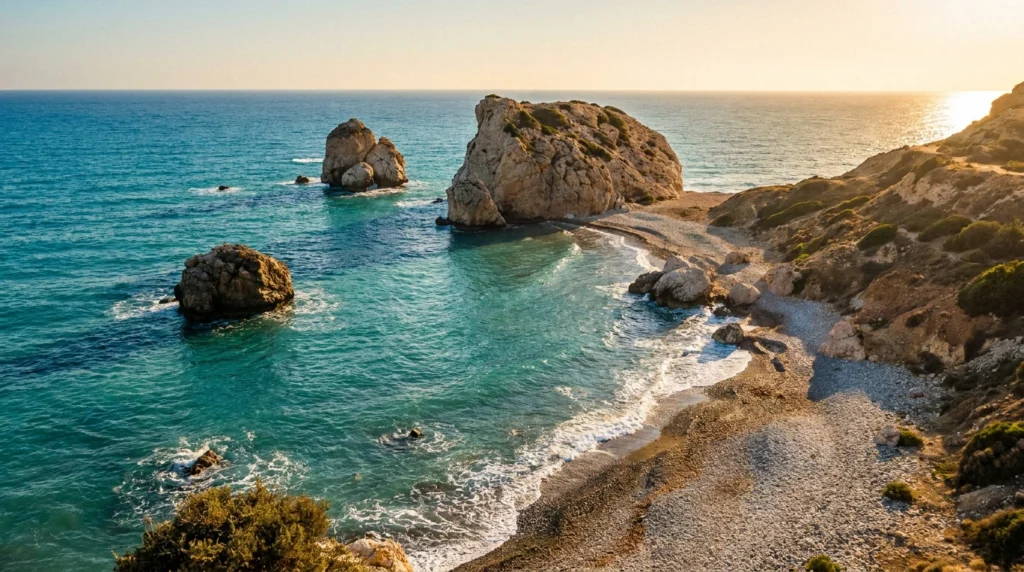
Paphos is the archaeological capital of the island and Cyprus’s first UNESCO World Heritage inscription (#79, 1980). The 280,000 m² archaeological park inside Kato Paphos contains four Roman villas with mosaic floors that survived 16 centuries underground — the House of Dionysos, the House of Aion, the House of Theseus and the House of Orpheus — alongside a Hellenistic-era theatre, a Byzantine basilica, the Tombs of the Kings (carved into living rock from the 4th century BCE) and the medieval Saranta Kolones castle. Old Paphos at modern Kouklia (16 km east) was the ancient cult centre of Aphrodite, the goddess’s main worship site for nearly 1,500 years until pagan worship was outlawed in 391 CE. Paphos was European Capital of Culture in 2017 (jointly with Aarhus, Denmark) and emerged as Cyprus’s highest-earning tourism destination in 2024 — its share of the €3.2 billion total revenue made it the single most lucrative district. Petra tou Romiou (Aphrodite’s Rock), a foam-flecked sea stack 25 km east of Paphos along the coast road, marks the goddess’s mythological birthplace; climbing the rock is now prohibited but the pebble beach below offers an evocative dusk swim.
Larnaca (Larnaka) — Salt Lake Flamingos, Saint Lazarus & the Beach Promenade
Larnaca is the country’s third-largest urban area (district population 155,000) and the most underrated of the major cities — the airport gets you to your hotel in 12 minutes and the Finikoudes seafront promenade is the most relaxed of the four resort towns. The city sits on top of ancient Kition, the Greek city-kingdom that was the birthplace of Zeno of Citium, founder of Stoic philosophy in 334 BCE; the modern name comes from the Greek larnax (“coffin”), a reference to the 3,000+ tombs uncovered in the area. The 9th-century Church of Saint Lazarus inside the old town claims to hold the saint’s second tomb (after his post-resurrection move to Cyprus, where he served as Bishop of Kition for 30 years). Just outside the city, the Larnaca Salt Lake fills with winter rain from November to March and hosts a resident flock of 10,000+ greater flamingos that draw in birders from across Europe; the Hala Sultan Tekke mosque on the lake’s edge — believed to mark the burial site of Umm Haram, an aunt of the Prophet Muhammad — is one of Islam’s most venerated sites in the eastern Mediterranean.

Ayia Napa & Cape Greco — Beaches, Caves & the Easternmost Tip of the EU
Ayia Napa is Cyprus’s largest tourist resort by bed-count — 27,000-person capacity, more than 175 hotels, and 14 Blue Flag-rated beaches (more than any other Cypriot resort). Nissi Beach was voted top European beach by TripAdvisor in 2011 and ranked third-most-Instagrammed beach in the world by 2018; the medieval Ayia Napa Monastery in the town centre, founded under Venetian rule in 1500, is the cultural counterweight to the resort strip. The cape itself, Cape Greco — the easternmost point of the Republic of Cyprus and, de facto, of the European Union — is a 384-hectare National Forest Park managed by the Cyprus Forestry Department, with sea-arch caves, a 1209-designated Important Bird Area for migrating raptors (red-footed falcons, pallid harriers, honey buzzards, kestrels), and the world-class scuba site at the Liopetri estuary. Hire a kayak from the Ayia Napa marina; the sea-cave network is 90 minutes of paddling and the water is dolphin-clear in early summer.
Troodos Mountains — Mount Olympus, Painted Churches & Kykkos Monastery
The Troodos Massif covers about a third of the island and is the highest, wettest, coolest part of Cyprus — a 90-million-year-old slice of ancient ocean crust pushed clear of the sea, geologically the most-studied “ophiolite” sequence on Earth. Mount Olympus (Chionistra), at 1,952 m, hosts the small but charming Mount Olympus Ski Resort with four named runs (Sun Valley + North Face) operated by the Cyprus Ski Club; the season runs roughly mid-December to mid-March. The Painted Churches of the Troodos UNESCO inscription (#351bis, 1985 + 2001 extension) covers ten Byzantine churches and monasteries scattered through villages like Kakopetria, Pedoulas, Kalopanagiotis, Galata, Asinou and Lagoudera, all roofed in the steep-pitched timber-shingle vernacular unique to Cyprus. Kykkos Monastery, founded around the end of the 11th century by Byzantine emperor Alexios I Komnenos at 1,318 m elevation in the western Troodos, houses an icon of the Virgin Mary traditionally attributed to the Apostle Luke and is the wealthiest monastery on Cyprus; Archbishop Makarios III, the country’s first president, began his religious career here in 1926 and is buried at nearby Throni.

Northern Cyprus — Kyrenia (Girne) & Famagusta (Gazimağusa)
The northern third of the island, administered de facto by the TRNC since 1974 and recognised internationally only by Turkey, is a different country experientially — Turkish lira (with euros widely accepted), Turkish-style breakfast spreads, and a much quieter beach scene. Kyrenia (Girne) is the tourism capital, with a horseshoe medieval harbour ringed by 17th-century Ottoman warehouses (now boutique hotels and seafood restaurants), the Roman-era Kyrenia Castle (with a shipwreck museum holding a fully reconstructed 4th-century-BCE Greek merchant ship), and the 13th-century Cistercian Bellapais Abbey on the slope above town. Saint Hilarion, Buffavento and Kantara — three Crusader-era mountain castles strung along the Kyrenia ridge — are reachable on a single half-day road circuit. Famagusta (Gazimağusa) holds the strangest sight on the island: Varosha, the modern Greek-Cypriot beach resort fenced off by the Turkish military immediately after the August 1974 invasion and only partially reopened in October 2020. The medieval walled city next door holds Othello Castle (the inspiration for Shakespeare’s play) and the Lala Mustafa Pasha Mosque, formerly the Cathedral of Saint Nicholas (1298–1326). The ancient ruins of Salamis, 6 km north of Famagusta, are the most extensive classical archaeological site on Cyprus — the gymnasium, theatre and royal tombs justify a half-day on their own.

Ayia Napa Resort Coast — Lightbox Gallery


Cultures & Customs — Greek & Turkish Heritage on One Island
Cyprus is the eastern Mediterranean’s most culturally bilingual country: Greek and Turkish are the two official languages of the Republic, the constitution recognises Maronite Christians and Armenians as additional minority communities, and English is an effective lingua franca everywhere tourism touches. The Greek-Cypriot dialect (Kypriaka) is its own creature — about as different from Standard Modern Greek as Brazilian Portuguese is from Lisbon Portuguese — with archaic vocabulary, an Italian-tinged intonation and the famous “γκ” hard-G sound that gives away a Cypriot speaker the moment they greet you. Turkish-Cypriot dialect (Kıbrıs Türkçesi) is similarly distinct from Istanbul Turkish, with looser grammar and a heavy borrowing of Greek nouns.
Religion divides the island along community lines: roughly 78% of the population (the Greek-Cypriot majority) belongs to the autocephalous Church of Cyprus, an Eastern Orthodox church whose self-governing status was confirmed by the Council of Ephesus in 431 CE, making it one of the oldest in Christendom; the Turkish-Cypriot community is overwhelmingly Sunni Muslim of the Hanafi school. The Apostle Paul preached at Paphos in 45 CE, converting the Roman governor Sergius Paulus and making Cyprus the first Roman province to be governed by a Christian; Saint Lazarus served as Bishop of Kition (modern Larnaca) for 30 years after his resurrection at Bethany and is buried in the city’s eponymous 9th-century church.

Greetings, Hospitality & Coffee Culture
Cypriots greet with a warm handshake on first meeting and a kiss on each cheek between friends — left then right, the same as the Greek mainland. Time-keeping is more relaxed than northern Europe: a “see you at 8” social plan typically resolves around 8:30. The unifying ritual is the village kafenion, where the day’s coffee (kafés, served in tiny cups, sweetened with three levels — sketo unsweetened, metrios medium, glykos sweet — and always accompanied by a glass of cold water) anchors the male social hierarchy from 07:00 to 23:00. The female equivalent in Greek-Cypriot communities is the home filoxenia (“love of strangers”) tradition: arrive at someone’s house and you will be fed within seven minutes, no exceptions.
Easter, Carnival & the Cycle of Festivals
Greek Orthodox Easter is the cultural high-point of the year — bigger than Christmas — and the entire week leading up to it (Holy Week, Megali Evdomada) is observed across the Republic. The Resurrection liturgy on Holy Saturday at midnight is the night to be in a village square: church bells, fireworks, candles passed from the priest’s flame to every congregant, and an effigy of Judas burned in a community bonfire. The Anthestiria spring flower festival in early May is the secular counterpart, with carnival floats covered in flowers parading through Limassol, Paphos, Larnaca and Polis. The ten-day pre-Lenten Limassol Carnival in February descends from the ancient Dionysian rites and features masquerade balls, nightly costume parties and a giant float-parade on the final Sunday. The Kypria International Festival in late summer brings opera, theatre and concert performances to ancient venues; the Paphos Aphrodite Festival turns the medieval Paphos castle courtyard into an open-air opera stage for three nights in early September.
Lefkara Lacework, Silversmithing & Living Crafts
Lefkara village in the Larnaca foothills has produced its eponymous embroidery and lacework — a needlework technique called lefkaritika — since at least the 14th century, when local women adapted Venetian noble-house designs into geometric patterns built around the Cypriot symbol of the lazaros (a stylised four-petalled flower). UNESCO inscribed lefkaritika on its Intangible Cultural Heritage list in 2009, only the second piece of Cypriot heritage to receive that recognition. Leonardo da Vinci is said (with thin documentary evidence but firm local tradition) to have visited the village in 1481 to commission an altar cloth for Milan Cathedral. The companion craft is silver filigree from the same village; the workshops along the central street still produce by hand, and a half-day visit on the way between Larnaca and the Troodos is one of the unsung highlights of any Cyprus loop.
Etiquette Across the Green Line
Crossing into the north as a tourist is welcomed and easy; the etiquette differences are subtler than the political weight suggests. On the Republic side, do not refer to the north as “Northern Cyprus” in the singular without context — local convention uses “the occupied areas” (katechómena) or “the Turkish-occupied area.” On the TRNC side, do not refer to it as “Northern Cyprus” without “Turkish Republic of” if you want to engage the political conversation; locals are otherwise relaxed about it. Photographing UN buffer-zone military installations or the fenced sections of Varosha is technically prohibited and occasionally enforced. Mosque entry on the TRNC side requires shoes off, head-cover for women in active prayer halls, and modest shoulders/knees for both genders; the Selimiye Mosque in north Nicosia and the Lala Mustafa Pasha Mosque in Famagusta both supply free wraps at the entrance. Tipping in restaurants on either side is not strictly expected (a 10% service charge is often added) but a small round-up of the bill is appreciated.
A Food Lover’s Guide to Cyprus — Halloumi, Meze, Souvla & Commandaria
Cypriot cuisine is the eastern Mediterranean’s most underrated drinking-and-eating tradition: a layered Levantine-Anatolian-Greek inheritance refined over 9,000 years of continuous occupation, with a roster of dishes that rarely escape the island and a wine industry that has been making the world’s oldest named wine since at least Hesiod’s eighth-century-BCE poetry. The signature ingredients are the same Levantine palette as Lebanon and Syria — chickpeas, lentils, courgettes, tomatoes, okra, bulgur (boiled cracked wheat, called pourgouri locally), yoghurt, sheep’s-milk cheese, mint, oregano, coriander seed and cumin — but the cooking techniques borrow Greek charcoal-grilling and Anatolian slow-baking.
The Cypriot Meze — A Two-Hour Lunch
The traditional Cypriot meze is a 20–30 small-plate marathon, served in two waves (meze tis psarokratos for fish, meze tou kreatos for meat, and the full “mixed” meze for the all-in version) and designed to last two hours minimum. The opening dips set the tone: tahini (sesame paste with lemon), taramasalata (cured roe with potato and lemon), tzatziki (yoghurt-cucumber-mint), melitzanosalata (smoked aubergine), and the unique-to-Cyprus tashi (a thicker tahini variant) — eaten with house pita and pickles. The middle wave brings louvi (black-eyed beans with chard), koupepia (stuffed vine leaves), moungra (pickled cauliflower), kolokasi (taro root sautéed with celery and lemon), and the iconic halloumi saganaki (the squeaky cheese pan-fried in lemon). The grilled finale brings sheftalia (lamb-and-pork sausage wrapped in caul fat — the all-time Cypriot benchmark dish), souvla (forearm-sized lamb skewers, slow-charcoal-grilled), souvlaki (smaller skewer cousin) and afelia (red-wine-braised pork with coriander seed). Expect to pay €18–28 per person for a full meze in a village taverna and €35–55 in a Limassol-marina restaurant.

Halloumi — The Squeaky Cheese That Built an Industry
Halloumi is the country’s national cheese — a semi-hard, unripened, brined cheese made from goat’s and sheep’s milk (with a permitted minority of cow’s milk for industrial production), shaped into folded half-moons and stored in salted brine with spearmint leaves for one to three days for the fresh version, or 40+ days for the mature variant. Its high melting point — a property created by scalding the curd in whey before brining — means it can be grilled or pan-fried without losing shape, the magic trick that turned it into a global vegetarian protein staple. The European Union granted halloumi Protected Designation of Origin status in April 2021 after a 14-year campaign, restricting the “Halloumi” name to cheese made in Cyprus to traditional specifications. Production now exceeds 450,000 tonnes a year, the United Kingdom alone imports 18,000 tonnes (the largest external market), and halloumi accounts for 13.4% of all Cypriot export earnings. The Traditional Sheep & Goat Halloumi Festival in early May, in the Pano Lefkara region, is the production showcase.
Sweet Things — Loukoumades, Daktyla, Glyko & Pourekia
The dessert canon revolves around honey, rosewater, semolina and nuts. Loukoumades are the Cypriot doughnut: yeasted dough deep-fried, drenched in pine-honey syrup, and dusted with cinnamon and crushed walnuts — best eaten 30 seconds after frying. Daktyla (“ladies’ fingers”) are pastry tubes stuffed with almonds, sugar and orange-blossom water and fried; pourekia are the savoury sweet-cheese-and-mint version. The truly Cypriot tradition is glyko tou koutaliou (“spoon sweet”) — whole pieces of fruit, vegetable or even baby walnut preserved in heavy sugar syrup, served on a tiny plate with a glass of ice water and a thimble of zivania to a guest’s first visit to a home. Bergamot, watermelon-rind, sour-cherry and the famous green-walnut versions are the village classics. Lokmades from the Turkish-Cypriot tradition are essentially the same doughnut under a different name; the Turkish-Cypriot specialty macun (rose-petal preserve) is the cross-Green-Line dessert pairing.
Drink — Commandaria, Zivania, Cypriot Wine & KEO Beer
Commandaria is the headline wine of the island and, at 2,800+ years of continuous production, the world’s oldest named wine still in commercial production; UNESCO inscribed it on the Intangible Cultural Heritage list in December 2025. Made exclusively from sun-dried Xynisteri (white) and Mavro (red) grapes from 14 designated mountain villages on the southern Troodos slopes, fermented to about 15% ABV, and aged in oak, it pairs with daktyla, mature halloumi or simply a slab of sun-dried fig and walnuts. Beyond Commandaria, the indigenous Cypriot dry-wine roster runs to 12 native grape varieties, with KEO, ETKO, SODAP and LOEL the four big commercial brands and a growing roster of small mountain estates (Tsiakkas, Kyperounda, Vasilikon, Vouni Panayia, Vlassides, Aes Ambelis) doing the serious work. Zivania is the post-meal grape-marc spirit (the Cypriot answer to grappa or tsipouro), distilled to 40–49% ABV and traditionally aged in oak; the village kafenion drinks it neat with a splash of cold water as the evening turns. KEO and Carlsberg dominate the beer market; Aphrodite Brewery, Pivo and Smoking Frog represent the craft-beer revival.
Cypriot Dishes Quick-Reference
| Dish | What it is | Where to try it first |
|---|---|---|
| Halloumi (saganaki) | Squeaky brined sheep/goat cheese, grilled or pan-fried | Any village kafenion; the old-town tavernas of Lefkara |
| Sheftalia | Lamb-and-pork sausage wrapped in caul fat, charcoal-grilled | Karatello in Limassol; Skinos in Larnaca |
| Souvla | Forearm-sized lamb skewers slow-grilled over olive-wood | Sunday lunch in any Troodos village |
| Kleftiko | Lamb shoulder slow-baked overnight in sealed clay oven | Omodos and the wine villages |
| Koupepia | Vine leaves stuffed with rice, herbs and pork mince | Any meze table |
| Afelia | Red-wine-braised pork with coriander seed | Old-town Nicosia tavernas |
| Loukoumades | Honey-soaked yeasted doughnuts, dusted with cinnamon | Street stalls, especially after Sunday liturgy |
| Glyko tou koutaliou | Whole-fruit “spoon sweet” preserved in syrup | Welcomed at any village home visit |
| Commandaria | Sweet amber wine from sun-dried Xynisteri + Mavro | Doros, Kalo Chorio, Zoopigi (the 14 PDO villages) |
| Zivania | Grape-marc spirit, 40–49% ABV, often oak-aged | The village kafenion at 21:00 |

Off the Beaten Path — Akamas, Avakas, Lefkara & the Karpaz Peninsula
Cyprus has the kind of off-piste richness most Mediterranean islands can only fake — five distinct micro-regions where you can spend a day or three and rarely see another non-Cypriot. The trick is to leave the southern coastal motorway by mid-morning and to keep going past the obvious archaeological labels.
Akamas Peninsula — The Last Wild Coastline
The Akamas Peninsula, jutting out from the north-western tip of the island beyond Polis Chrysochous, is Cyprus’s largest undeveloped coastal wilderness — 230 km² of garrigue, juniper-and-olive forest, freshwater springs, and a rocky coastline that holds the country’s most important green-and-loggerhead-turtle nesting beaches at Lara and Toxeftra. Get there via the dirt-track-only network from Neo Chorio (a high-clearance 4×4 is essential after rain) or hike the E4-marked Aphrodite Trail — a 7.5 km loop from the Baths of Aphrodite (a freshwater grotto where the goddess is said to have bathed before meeting Adonis) up through wild thyme to the abandoned Pyrgos tis Rigainas tower, then down via Smigies. Avakas Gorge, on the southern flank, cuts a 3 km defile through limestone walls that narrow to two metres at the head; the trail is technical but not difficult, and the endemic centaurea akamantis flower grows nowhere else on Earth.
Lefkara Village — UNESCO Lacework on the Larnaca Foothills
Lefkara is a 700-resident hill village 30 km east of Limassol, perched at 600 m on the southern slopes of the Troodos foothills, that has produced its eponymous embroidery — lefkaritika — since at least the 14th century, when local women adapted Venetian noble-house designs into geometric patterns. UNESCO inscribed lefkaritika on its Intangible Cultural Heritage list in 2009. Local tradition holds that Leonardo da Vinci visited the village in 1481 to commission an altar cloth for Milan Cathedral — the documentary evidence is thin but the village holds the claim with absolute confidence and the Leonardo connection now anchors the local museum. The companion craft is silver filigree from the same workshops; you can sit at a craftswoman’s table for an hour, watch the embroidery emerge under the needle, and buy direct from the maker for less than half what you would pay in a Limassol gift shop.
Bellapais Abbey & the North Coast Mountain Castles
Bellapais Abbey, on the cliff above the village of the same name 5 km east of Kyrenia in the north, is the most architecturally complete medieval Cistercian monastery in the eastern Mediterranean — founded in 1198–1205 by Aimery de Lusignan, expanded under Hugh III in the 13th century, and today preserved in spectacular Gothic ruin with intact refectory, chapter house and cloister. Lawrence Durrell’s Bitter Lemons of Cyprus (1957) is set in the village below; the “Tree of Idleness” cafe under the sycamore that Durrell celebrated is still there. From Bellapais, drive the spine of the Kyrenia mountain ridge to three Crusader-era mountain castles — Saint Hilarion (10th c., the inspiration for Disney’s Snow White castle), Buffavento (“buffeted-by-wind”, at 950 m the highest of the three) and Kantara (the easternmost, with a clear-day view across to Anatolia) — all reachable on a single half-day road circuit out of Kyrenia.

The Karpaz Peninsula — The Empty Eastern Finger
The Karpaz Peninsula — Cyprus’s narrow north-eastern panhandle stretching 80 km out into the Mediterranean toward Anatolia — is the emptiest, most lyrical part of the island. Driving the spine of the peninsula from Bafra past the Apostolos Andreas Monastery to the Cape Apostolos Andreas at the very tip is a 90-minute one-way commitment past wild donkey herds (about 1,500 free-roaming animals descended from agricultural draft stock abandoned in 1974), undeveloped 18 km Golden Beach, and the 6th-century mosaic floor of the Agia Trias basilica at Sipahi. The Apostolos Andreas Monastery, the Greek Orthodox pilgrimage site at the tip, was renovated in 2014–2018 with joint Greek-and-Turkish-Cypriot funding and is one of the most heart-warming bicommunal projects on the island. Lodging is sparse but excellent: a handful of small boutique inns in Dipkarpaz village deliver fresh seabream, village halloumi and views over genuinely empty beaches.
Kourion & Sanctuary of Apollo Hylates — Greco-Roman Theatre on the Cliff
Kourion, 16 km west of Limassol on a cliff above Episkopi Bay, is the most theatrically sited classical archaeological complex on the island — a Greco-Roman city-kingdom whose 2nd-century-BCE theatre is carved out of the limestone bedrock and still stages summer performances of Greek tragedy. Adjacent are the House of Eustolios mosaics (with the famous “ΚΤΙΣΙΣ” personification mosaic), an early-Christian basilica, and the Roman agora. A 1.5 km drive west takes you to the Sanctuary of Apollo Hylates (“Apollo of the Woodlands”), a major regional cult centre from the 7th century BCE to the 4th century CE, with a partially restored temple, palaestra and treasury. The sound of the sea below the theatre during a summer Aeschylus performance is the sort of cultural moment Cyprus delivers without trying. Sea caves carved into the rocky coastline below Kourion offer some of the clearest snorkel diving on the south coast.

Practical Information
Cyprus is one of the easiest European countries for an English-speaking traveller to land cold in: signage is bilingual or trilingual, ATMs and card payments are universal, and the digital infrastructure (4G/5G coverage, eSIM provisioning, Bolt taxis) ranks at EU average. The only routinely awkward category is the Green Line crossing, which is unique among EU countries and adds a small pile of edge cases.
| Topic | Detail |
|---|---|
| Currency | Euro (€) since 1 January 2008 in the Republic; Turkish lira (TL) in the TRNC, with euros widely accepted. ATMs throughout both halves; Visa and Mastercard ubiquitous; American Express patchier. |
| Plug type | Type G (UK-style 3-pin), 240 V / 50 Hz — bring a UK adapter, not a continental two-pin. |
| Drives on | The LEFT — one of only four EU members (with Ireland, Malta and the UK historically) to do so, a holdover of British colonial administration. |
| Tap water | Officially potable across the island. Most locals drink filtered or bottled because the limestone bedrock leaves a heavy mineral taste; some visitors get short-lived stomach upsets in the first 24 hours. |
| Languages | Greek and Turkish (both official); English near-universal in tourism (British colonial inheritance); Armenian and Cypriot Arabic recognised as minority languages. |
| Calling code | +357 for the Republic (mobile 99/96 prefixes); +90 392 for the TRNC (operating on Turkish telecom infrastructure). EU roaming applies on the Republic side; check your carrier for TRNC. |
| Time zone | UTC+2 (EET) winter, UTC+3 (EEST) summer; daylight saving observed last Sunday of March to last Sunday of October, in line with EU. |
| Tipping | Not strictly expected — service charge of 10% is often added in restaurants. Round up taxi fares; €1–2 per bag for hotel porters. Café tipping is unusual. |
| Smoking | Banned indoors in restaurants, bars, public buildings and workplaces since 2010 (Republic side); enforcement is real and fines up to €500. |
| Emergency numbers | 112 (universal EU emergency, both communities); 199 (Republic ambulance/fire); 1499 (police hotline); 1460 (traffic police). |
Budget Breakdown — What Cyprus Actually Costs in 2026
Cyprus sits in the upper half of European Mediterranean pricing — comfortably more expensive than Greece’s mainland or Portugal, comfortably less expensive than the French Riviera or the Italian Amalfi coast. Wikivoyage’s blunt summary is that “the cost of living in Cyprus is comparable to Central Europe, especially in the tourist areas.” Per-capita GDP of $38,674 (World Bank, 2024) tracks the EU average, and the 2024 inflation rate of 1.8% has stabilised after the 2022–23 European energy spike. Budget travellers can do a comfortable trip on €60–95/day; mid-range couples land around €130–220/day; luxury Limassol marina–weekend types start at €450/day and can climb without limit.
Backpacker / Budget — €60–95 per person per day
A hostel dorm bed in Larnaca, Paphos or Limassol runs €18–28 in shoulder season (€30–40 in July–August); a small private room at a family-run guesthouse in a Troodos village runs €40–55 with breakfast. Public buses cost €1.50 a single, €5 a day-pass; intercity buses are €4–9 per leg. Eating “kalamarakia + Greek salad + house wine carafe” lunch at a village taverna averages €15; a sandwich-from-bakery breakfast and a gyros-pita street dinner can pin daily food spend below €25. Beach access is free at every public beach (which is to say, every beach by Cypriot law); the major archaeological sites cost €4.50–8 entry; the museum-pass card (€8.50 for one day, €17 for three) covers most state museums.
Mid-Range / Comfort — €130–220 per person per day
A three-star coastal hotel with breakfast runs €80–130 per double in shoulder season, €130–230 in peak summer; a fly-drive package out of London or Frankfurt can bring this down 20% versus à-la-carte booking. A small hire car (Group A manual) runs €25–35 a day off-season; budget €50 a day in July–August. A two-hour mixed Cypriot meze for two with a bottle of mountain rosé lands around €60–80 in a village taverna and €90–130 in a Limassol-marina restaurant. The wine-village half-day driving loops are typically free of admission; the Paphos archaeological park (€4.50), Kourion (€4.50), Khirokitia (€2.50), Kykkos Monastery (€5) and the Tombs of the Kings (€2.50) are individually cheap. Add €40–60 a day for the boutique-experience extras (a wine-estate tasting, a sunset Akamas boat trip, a half-day kayak rental at Cape Greco).
Luxury / Premium — €450+ per person per day
The top of the Cypriot accommodation market sits in the Limassol marina (the Amara, the Parklane, the Royal Apollonia), the Paphos seafront (the Annabelle, the Almyra, the Anassa at Latchi), and a handful of restored Troodos boutique villas (Casale Panayiotis at Kalopanagiotis, Linos Inn at Kakopetria). Suite rates run €350–700 a night in shoulder season and €700–1,400 in mid-summer; the Anassa’s signature suite tops €2,800 in August. Michelin-recommended restaurants (Caprice at the Almyra, Akakiko’s Akakiko at the Limassol Sheraton) start at €120 per person for tasting menus before wine. A private sailing day from Latchi to the Akamas with a five-course beach-grill lunch lands at €600–900 per couple. Helicopter transfers from LCA to Anassa run €700–1,100 one-way. The luxury market is the fastest-growing segment of the 2024 €3.2 billion tourism revenue figure.
| Category | Backpacker | Mid-Range | Luxury |
|---|---|---|---|
| Bed (per night) | €18–28 dorm / €40–55 guesthouse | €80–230 hotel double | €350–1,400+ marina suite |
| Food (per day) | €20–30 self-cater + village taverna | €45–80 meze + wine | €150–300+ Michelin tasting |
| Transport | €5–10/day buses | €25–50 hire car (incl. fuel) | €80+ private driver / charter |
| Activities | €10–15 archaeological sites | €40–60 wine tour / boat day | €600–1,200 private sail / heli |
| Daily total (per person) | €60–95 | €130–220 | €450+ |
Planning Your First Trip to Cyprus — Five Steps
-
1. Pick Your Window — and Build Around the Cultural Calendar
Mid-April to mid-June is the strongest first-time window — warm but not punishing, sea swimmable from late May, hotel prices 25–35% below July–August. Late September to mid-October is the runner-up: the Limassol Wine Festival anchors the social scene and the sea is still 25 °C. Avoid Greek Orthodox Easter weekend unless you’ve booked three months ahead — it’s the country’s biggest festival and accommodation triples in price. Avoid mid-July to mid-August unless you’re committed to beaches: inland archaeological sites become genuinely uncomfortable above 35 °C and Limassol marina hotel rates double.
-
2. Decide Your Loop — Counter-Clockwise from LCA Is the Default
For a 7-day first trip, fly into Larnaca, drive to Paphos via Lefkara and Khirokitia (3 nights Paphos for the archaeological park + Aphrodite’s Rock), continue to Limassol (2 nights for the marina + Kourion + Kolossi), climb to Troodos for a one-night village stay, and return via Nicosia and the Ledra Street crossing on the way back to LCA. For a 14-day trip, add three nights in Ayia Napa/Cape Greco, two extra Troodos nights, and a Karpaz Peninsula loop into the north.
-
3. Book the Hire Car at the Same Time as the Flight
Petsas, Astra, Hertz and Sixt all sell out their automatic-transmission and SUV fleets 4–6 weeks ahead in July–August; budget chains routinely double their prices when fleet capacity drops below 20%. The seasonal premium is roughly €15/day, so an early booking can save €100+ on a week-long rental. If you plan to cross the Green Line, ask explicitly about TRNC insurance coverage; many smaller rental companies still exclude it (you can buy a separate per-day TRNC policy at the checkpoint for €25).
-
4. Pre-Book the Highlights, Improvise the Rest
Pre-book: Paphos archaeological park entry on a hot day (the queue at 11:00 in August is 45 minutes), the Anassa or Annabelle if you want one luxury night, a Commandaria estate tour at Tsiakkas or Kyperounda (these are small 8-pax visits and sell out), Limassol marina restaurants for Saturday nights in season, and the Mount Olympus ski lifts in winter. Improvise: meze tavernas (the village ones are better than the marina ones, and they don’t take reservations), Akamas Aphrodite Trail hike (just turn up at the Baths of Aphrodite trailhead), and the Ledra Street Green Line crossing (no booking needed, just a passport). The best Cypriot meals tend to be the unplanned ones at a village kafenion ten kilometres off your route.
-
5. Pack for Three Climates in One Suitcase
Cyprus’s small geography means a single trip can include 35 °C beach days, 8 °C Troodos mountain evenings, and 12 °C archaeological-park starts. The packing list is cumulative: lightweight long-sleeve shirts and a brimmed hat for the sites; a light fleece and waterproof for the mountains (essential in shoulder season); UK-standard Type G plug adapters; reef-safe sunscreen for Akamas turtle beaches; a microfibre travel towel for the Cape Greco sea-cave swims; a head torch if you’re staying in mountain villages with patchy street lighting; and at least one nice shirt — Limassol marina dress codes are sneakier than you’d expect. Quality walking sandals beat hiking boots for 90% of itineraries.
Frequently Asked Questions
Do I need a visa to visit Cyprus?
For most western travellers, no. EU/EEA/Swiss citizens enter on a national ID card. UK, US, Canadian, Australian, New Zealand, Israeli, Japanese, South Korean and most Latin American passport-holders enter visa-free for stays up to 90 days within any 180-day period; passports must have at least three months of validity beyond the intended stay. Cyprus is an EU member but not in the Schengen Area, so the 90-day Schengen clock does not apply, and your passport will be stamped on entry regardless of nationality.
Is it safe to cross to Northern Cyprus (TRNC) as a tourist?
Yes — and it’s one of the more memorable experiences on the island. Seven official Green Line checkpoints are open to international visitors, including the famous Ledra Street walking crossing in central Nicosia (reopened 2008). You show a passport on each side, the Republic stamps you out, and the TRNC slips a separate paper insert. Day visits are unrestricted; the practical caveats are that you should not exit the island via Ercan airport in the north (the Republic does not consider it a legal exit point) and that you should buy separate TRNC vehicle insurance (€25/day) at the checkpoint if your hire car contract excludes the north — most do.
What’s the plug type and voltage?
Cyprus uses Type G (UK-style 3-pin) plugs at 240 V / 50 Hz across the entire island, including the TRNC — a holdover of the British colonial period that still surprises European travellers expecting the continental two-pin Type C/F. Bring a UK-style adapter, not a continental one. Most modern phone, laptop and camera chargers handle 240 V automatically; older curling irons or US-100V hairdryers will need a step-down transformer or a dual-voltage replacement.
Is Cypriot halloumi different from Greek halloumi?
“Greek halloumi” is now a misnomer — since April 2021, Halloumi is a Protected Designation of Origin in EU law and the name can only legally be applied to cheese made in Cyprus from goat’s and sheep’s milk (with a permitted minority of cow’s milk for industrial production). Greek-Cypriot and Turkish-Cypriot producers both make halloumi/hellim, on essentially identical specifications, and both are now covered by the PDO. The traditional Greek-mainland equivalent is graviera or kefalotyri, neither of which has the same high melting point.
What’s the best month to visit Cyprus?
May. Daytime temperatures sit at 25–28 °C, the sea has warmed to 22 °C, the Akamas Peninsula is still flowering, the orange-blossom is in full perfume, the Anthestiria flower festivals run through the major coastal towns, and prices haven’t yet hit their July–August peak. October is a strong second choice — the Limassol Wine Festival anchors the calendar, the sea is still 25 °C, and the light is at its photogenic best. December–February is a quirky third choice if you want Troodos snow and coastal sun in the same day. Avoid mid-July to mid-August unless you are specifically there for the beach scene.
Does it really snow on the Troodos? Can I ski?
Yes, reliably from December to early March — Mount Olympus catches 41 inches of precipitation a year (versus Nicosia’s 14 inches), and “considerable” snowfall is documented on the summit zone with several weeks of below-freezing nights. The Mount Olympus Ski Resort runs four named slopes (two areas: Sun Valley with T-bar lifts for beginners and intermediates; North Face with chairlift access for advanced runs), all operated by the volunteer Cyprus Ski Club. The season is short (typically eight to twelve weeks), the snow base is modest by Alpine standards, and the experience is more about the novelty than the runs — but the contrast with the coastal sun 60 km away is genuinely memorable.
Is Cyprus in the Schengen Area?
No. Cyprus joined the European Union on 1 May 2004, but the 2004 accession treaty postponed Schengen entry pending a settlement of the Cyprus problem (Schengen would require an open external border, and the Green Line through Nicosia complicates that). The Republic met all Schengen technical criteria years ago and has applied repeatedly; the latest realistic target window is the late 2020s. In the meantime, your Cyprus stay does not count toward the 90-day Schengen clock, and your passport gets a separate Cyprus stamp on entry and exit.
Can I drive my Republic-side rental car into the TRNC?
Technically yes, practically usually no. Most major Cypriot rental companies (Hertz, Sixt, Petsas, Avis) explicitly exclude the TRNC from their insurance coverage; cross with their car and you are uninsured. The pragmatic solution is to park at Ledra Palace (free) and walk across, then take a taxi or a TRNC-side rental on the other side. If you want to drive your hire car across, you need to buy separate TRNC vehicle insurance at the checkpoint booth — €25 for a single day, €60 for a week — and you should phone your rental company first to confirm they don’t void the underlying contract. The Limnitis/Yeşilırmak crossing in the north-west is the most relaxed for vehicle entry; Ledra Palace and Pergamos are the busiest.
Are tap water, beaches and food safe?
Tap water is officially potable across the whole island; most locals filter or buy bottled because of mineral taste rather than safety, and Wikivoyage notes some travellers get short-lived stomach upsets on the first day. Beaches are excellent — Cyprus has the most Blue Flag beaches per capita in the EU, with Ayia Napa alone holding 14 Blue Flag certifications. Food safety is at EU-average standard; CDC’s only specific health note for Cyprus is a Hepatitis A vaccine recommendation for unvaccinated travellers, since 2024 outbreaks of leptospirosis (avoid swimming in stagnant freshwater) and rare leishmaniasis from sand-fly bites in the rural summer evenings. Standard MMR/Tdap/polio coverage should be current; rabies risk is low.
Ready to Explore Cyprus?
Three UNESCO World Heritage sites, the world’s oldest named wine still in production, the only divided capital left in Europe, a 1,952 m peak that catches snow eight weeks a year and a 640 km coastline of Blue Flag beaches with 25 °C water through October — all on an island you can self-drive end-to-end on a tank of petrol. Book your Larnaca arrival the same week as your hire car, time the trip for May or late September, and let the meze plates come out two-by-two.
Explore More
Mediterranean & European city guides
- Rome City Guide — the classic Eastern-Med pairing
- Istanbul City Guide — just across the water, where East meets West
- Barcelona City Guide — Mediterranean city-and-beach energy
- Paris City Guide — a natural add-on for a longer Europe trip
- London City Guide — Cyprus’s old Commonwealth link
- Tokyo City Guide — for the long-haul contrast
- Cyprus Trip Cost Guide
- All Country Guides
More country guides you might like
Plan your trip to Cyprus
The booking tools we use ourselves. FFU may earn a commission at no extra cost to you.
Plan & book your trip to Cyprus
Booking through these searches supports our guides at no extra cost to you.