
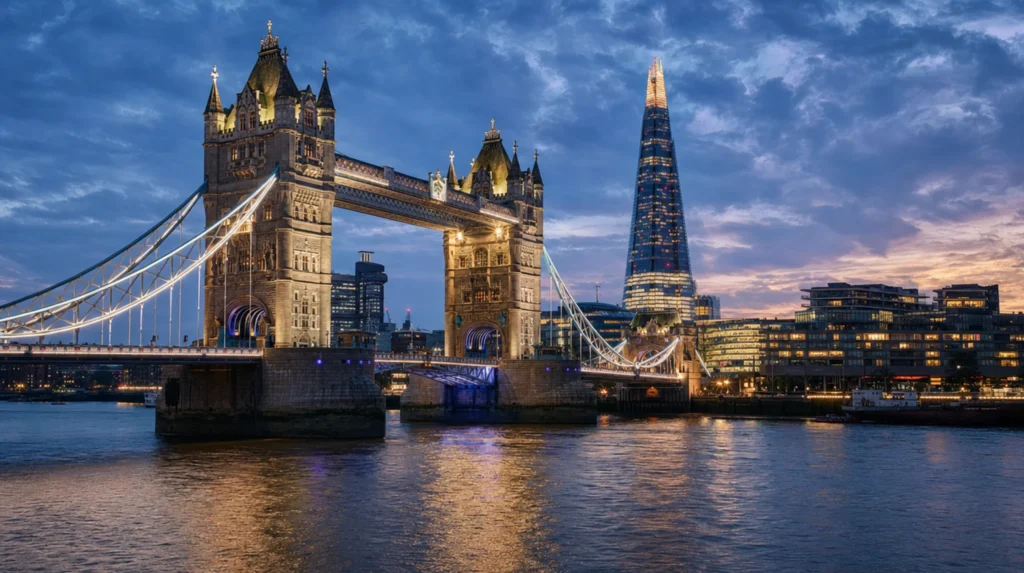
England · 32 boroughs, one Underground
London, England: Two Millennia, Eight Royal Parks, One Tube Map
Part of our England travel guide.
I have lost more weekends to London than any other city, and I still find a new corner every visit. We tell first-timers that London is not one city — it is roughly eighty villages welded together by an Underground map that took 162 years to draw. My favourite London ritual is a 9 a.m. coffee at Borough Market, a slow walk west along the South Bank to the Tate Modern, and the Northern line back up to a museum I have not been to in two years. Treat this guide as the brief I would hand my own family before they boarded the Heathrow Express.

Table of Contents
Why London?
London is the United Kingdom’s capital and Europe’s largest city by metropolitan population — roughly 8.9 million people inside the Greater London boundary at the most recent ONS mid-year estimate and around 14 million across the wider commuter belt. The city sits on a tidal stretch of the River Thames roughly 80 km from the North Sea, and has grown continuously around that river since the Romans founded Londinium on the north bank in around AD 47.
What makes London feel infinite is the layering. Roman wall, medieval church, Tudor palace, Georgian terrace, Victorian arcade, post-war housing estate, glass tower — all four are usually visible from the same pavement. The British Museum, the National Gallery, Tate Modern, the V&A and the Natural History Museum are all free to enter, by long-standing UK government policy on national collections. No other capital concentrates so much without a turnstile.
The city is also the country’s transport spine. Six international airports serve it, the rail network fans out from fourteen central terminals, the eleven-line London Underground carries roughly 1.3 billion passenger journeys a year, and the 2022 Elizabeth line cut a Heathrow-to-the-City crossing from over an hour to 39 minutes. Plan five full days here as a minimum; ten and you have barely scratched it.
Neighborhoods: Finding Your London
📍 London Map: Every Place in This Guide


Westminster & St James’s (SW1)
The political and ceremonial core: the Palace of Westminster (Houses of Parliament), Westminster Abbey, Whitehall, Trafalgar Square, Buckingham Palace and the four-mile St James’s Park spine. Almost every first-time visitor starts here. The Abbey has hosted every English coronation since 1066 and Charles III’s took place there in May 2023.
- Westminster Abbey — adult admission £30 in 2026, free for worship
- Houses of Parliament UK Parliament tours from £33
- Changing the Guard at Buckingham Palace, Mon/Wed/Fri/Sun 11.00 (subject to weather and ceremonial calendar)
Best for: first-time London, ceremonial walks, free park time. Access: Westminster (Jubilee, Circle, District), St James’s Park (Circle, District), Charing Cross (Northern, Bakerloo).
The City of London (EC)
The original square mile — the Roman walled city, today the financial district. St Paul’s Cathedral, the Bank of England, the Tower of London, the Gherkin and Walkie-Talkie towers, and the Roman wall fragments around Tower Hill. Quiet on weekends, packed Mon–Fri lunchtimes.
- St Paul’s Cathedral, Wren’s masterpiece, dome 111 m, adult £25 in 2026
- Tower of London — Crown Jewels & Yeoman Warder tours, £35 adult
- Sky Garden free roof terrace at 20 Fenchurch (book ahead)
Best for: history layers, river walks, free panoramic views. Access: St Paul’s (Central), Tower Hill (District, Circle), Bank (Central, Northern, Waterloo & City).
South Bank & Southwark (SE1)
The cultural mile on the Thames south side — Tate Modern, Shakespeare’s Globe, Borough Market, the Shard, the London Eye, the Royal Festival Hall, the Southbank Centre. A continuous riverside walk runs from Lambeth Bridge to Tower Bridge.
- Tate Modern — free entry; Switch House extension Tower Bridge views
- Shakespeare’s Globe — open-air performances Apr–Oct, £5 yard standing tickets
- The View from the Shard, 244 m observation deck, £32 in 2026
Best for: riverside walks, free art, evening culture. Access: Waterloo (Jubilee, Northern, Bakerloo), London Bridge (Jubilee, Northern), Southwark (Jubilee).
Bloomsbury & Fitzrovia (WC1, W1)
The intellectual quarter — University College London, the British Museum, the British Library at St Pancras, the original Bloomsbury Group squares (Russell Square, Bedford Square, Tavistock Square). Quietly residential between the squares; lively pubs in Fitzrovia.
- British Museum — free entry, ~6 million annual visitors
- British Library treasures gallery — free; Magna Carta, Lindisfarne Gospels, Beatles manuscripts
- The Wellcome Collection — free, medical-history museum on Euston Road
Best for: museums, bookshops, quiet squares. Access: Russell Square (Piccadilly), Tottenham Court Road (Central, Northern, Elizabeth), Goodge Street (Northern).
Soho & Covent Garden (W1, WC2)
The entertainment district — theatres, restaurants, the Royal Opera House, Chinatown along Gerrard Street, and Carnaby Street. London’s gay village runs along Old Compton Street. Most West End shows sit inside this rectangle.
- The Royal Opera House — opera, ballet, £10–£250 tickets
- TKTS Leicester Square — same-day West End tickets up to 50% off
- Covent Garden Piazza — street performers, the London Transport Museum
Best for: theatre, late dinners, people-watching. Access: Leicester Square (Piccadilly, Northern), Covent Garden (Piccadilly), Tottenham Court Road (Central, Northern, Elizabeth).
Kensington & Chelsea (SW3, SW7, W8)
Three flagship national museums in a row on Exhibition Road — V&A, Natural History, Science Museum, all free — plus Kensington Palace, Hyde Park’s western edge, and the boutique-and-Georgian-terrace cluster running south to the Thames.
- V&A Museum — free, the world’s largest decorative-arts collection
- Natural History Museum — free, Hintze Hall blue whale skeleton
- Kensington Palace — Diana exhibition and the State Apartments
Best for: museum binge, Kensington Gardens picnic, formal dinners. Access: South Kensington (Piccadilly, Circle, District), High Street Kensington (Circle, District).
Notting Hill & Holland Park (W11)
The pastel-terrace photo set — Lancaster Road and Westbourne Park Road around Portobello — anchors a wider Notting Hill that includes the Saturday antiques market, the Notting Hill Carnival’s August parade, and Holland Park’s Kyoto Garden.
- Portobello Road Market — Saturday antiques, daily fruit/veg
- Notting Hill Carnival — last weekend of August, around 1 million attendees
- Holland Park — Kyoto Garden, free open-air opera in summer
Best for: photo walks, antiques, Saturday brunch. Access: Notting Hill Gate (Central, Circle, District), Ladbroke Grove (Hammersmith & City, Circle).
Shoreditch & Hackney (E1, E2, E8)
The east-end creative belt — street art around Brick Lane, Spitalfields Market, the Old Truman Brewery, Columbia Road Sunday Flower Market, Hackney’s Broadway Market on Saturdays, and the warehouse clubs around Hackney Wick.
- Old Spitalfields Market — Mon–Fri food & vintage, Sunday antiques
- Columbia Road Flower Market — Sunday 8am–3pm
- Brick Lane — curry houses, vintage shops, Sunday markets
Best for: street art, late nights, weekend markets. Access: Liverpool Street (Central, Circle, Elizabeth), Old Street (Northern), Hackney Central (Overground).
Greenwich (SE10)
The maritime quarter and a UNESCO World Heritage site since 1997 — the Old Royal Naval College, the Cutty Sark, the National Maritime Museum, Greenwich Park climbing to the Royal Observatory and the Prime Meridian. The DLR or a 30-minute Thames Clipper from Westminster gets you here.
- Royal Observatory — Prime Meridian Line, £20 adult
- National Maritime Museum — free, Nelson collection
- Cutty Sark — restored 1869 tea clipper, £20 adult
Best for: half-day from central London, river-trip pairing. Access: Cutty Sark DLR; Greenwich (Southeastern rail); Thames Clippers from Westminster Pier.
The Food

British Classics, Done Properly
London is not a cuisine in itself — it is the densest food city in Europe. The British canon (Sunday roast, fish and chips, pie and mash, full English breakfast, afternoon tea) is widely available; the trick is finding venues that still cook these properly, which usually means the gastropubs, not the tourist traps off Leicester Square.
- St. JOHN, Smithfield — Fergus Henderson’s nose-to-tail pioneer, bone marrow on toast and roast bone marrow with parsley salad
- Rules, Covent Garden — London’s oldest restaurant, est. 1798, traditional game and pies
- The Harwood Arms, Fulham — Britain’s only Michelin-starred pub, modern game cooking
The Curry & South Asian Spine
Britain’s so-called “national dish” is a London-engineered hybrid — chicken tikka masala — and the city’s South Asian cooking is among the world’s best outside the subcontinent. Brick Lane has the historical Bengali curry strip; Tooting and Southall have the genuine modern pioneers.
- Dishoom (multiple locations) — Bombay-Irani café modern classic, breakfast bacon naan a London ritual
- Tayyabs, Whitechapel — open since 1972, charcoal lamb chops and karahi
- Gymkhana, Mayfair — Karam Sethi’s Indian, Michelin two stars
Markets & Street Food
London’s modern food culture lives at the markets. Borough is the historic anchor (operating on the Southwark site since the 13th century, with a covered market since 1851); Maltby Street is the Saturday Bermondsey rail-arch sister; Mercato Mayfair sits inside a deconsecrated church.
- Borough Market — Tue–Sat 10am–5pm, ~120 traders
- Maltby Street Market — Saturday 10am–4pm, Bermondsey rail arches
- Old Spitalfields Market — daily food hall, Sunday antiques
Beyond the British Canon
London’s restaurant landscape is shaped by its diaspora communities — Cypriot in Green Lanes, Vietnamese in Kingsland Road’s “Pho Mile”, Polish in Hammersmith, West African in Peckham, Caribbean in Brixton. The 80+ Michelin-starred restaurants give a sense of scale; the city beyond the stars is far larger.
- Padella, Borough — fresh hand-rolled pasta, walk-in queue, mains £8–13
- Smoking Goat, Shoreditch — Thai drinking food, £40–50 a head
- Brunswick House, Vauxhall — antiques-hall dining, modern British
Pub Culture & Afternoon Tea
The traditional pub remains the cheapest, most authentic London evening. Expect cask ales £5.50–£7 a pint in central, £4.50–£5.50 in Zone 2. Afternoon tea (a Victorian invention) sits at the other end — the Ritz, Claridge’s, Fortnum & Mason and the Wolseley are the institutional benchmarks at £75–£110 a head.
- The Lamb & Flag, Covent Garden — 17th-century alley pub
- The George Inn, Borough — National Trust-owned coaching inn, the only galleried pub left in London
- Fortnum & Mason afternoon tea — Diamond Jubilee Tea Salon
Food Experiences You Cannot Miss
- A 9 a.m. breakfast at Borough Market — Brindisa toasted chorizo roll, Monmouth coffee
- Pie and mash at one of the surviving traditional shops — F. Cooke (Hoxton) or Manze’s (Walthamstow)
- Sunday lunch at a London gastropub — Harwood Arms, Anchor & Hope, the Camberwell Arms
Cultural Sights

The British Museum
Founded 1753, the world’s first national public museum and the most-visited site in London — around 6 million visitors a year before 2020 and steadily climbing back. Free entry to the permanent collection, 8 million objects across two million years of human history, with the Rosetta Stone, the Parthenon Marbles, the Sutton Hoo treasures and the Mildenhall Treasure as the headline highlights. Allow at least three hours; a full day is realistic.
The National Gallery & National Portrait Gallery
The National Gallery on Trafalgar Square holds Western European painting from c. 1250 to 1900 — Van Eyck, Botticelli, Leonardo, Caravaggio, Turner, Van Gogh’s Sunflowers — across 2,300 works, free to enter. The National Portrait Gallery reopened in 2023 after a £41 million Inskip + Jenkins redesign and remains free.
Tate Modern & Tate Britain
Tate Modern (Bankside, free) holds international modern and contemporary art from 1900 onward in a converted Bankside Power Station; the Switch House extension opened 2016. Tate Britain (Pimlico, free) holds the British canon from 1500 to today — Hogarth, Constable, Turner (the Clore Gallery has the world’s biggest Turner collection), Bacon, Hockney.
The V&A, Natural History & Science Museum (Exhibition Road)
The three South Kensington nationals are all free and all sit within five minutes’ walk on Exhibition Road. The V&A holds 2.8 million decorative-arts objects across textiles, fashion, ceramics, sculpture, photography and design ; the Natural History Museum’s Hintze Hall is now anchored by Hope, the 25.2 m blue whale skeleton hung in 2017 ; the Science Museum holds Stephenson’s Rocket, an Apollo 10 command module and the world’s oldest steam locomotive. Allow a full day for any one of the three.
The Tower of London
Begun by William the Conqueror in 1078 and continuously occupied since, the Tower is the four-UNESCO-site collection’s London anchor (with Westminster, Maritime Greenwich and Kew). The Crown Jewels, the Yeoman Warder (“Beefeater”) tours, the White Tower armoury and the resident ravens are the headline draws. Adult admission £35 in 2026 (verify on site).
Westminster Abbey & St Paul’s Cathedral
The Abbey (1090s, present church largely 13th-century) has hosted every English coronation since William the Conqueror in 1066, including Elizabeth II in 1953 and Charles III in May 2023. St Paul’s (1675–1710, Wren) is the only English cathedral built to a single designer’s plan; the Whispering Gallery in the dome remains the engineering signature.
The Royal Parks & Kew Gardens
Eight Royal Parks cover roughly 5,000 acres in central and west London: Hyde Park, Kensington Gardens, Green Park, St James’s Park, Regent’s Park, Richmond Park, Bushy Park and Greenwich Park. Kew Gardens (Royal Botanic Gardens, Kew), a separate UNESCO site since 2003, holds the world’s most diverse plant collection and the Victorian Palm House. Adult admission £22 in 2026.
Entertainment

The West End (Theatre)
London’s West End is one of two global theatre capitals (Broadway is the other). 39 mainstream theatres host long-running musicals (Les Misérables since 1985, Phantom of the Opera in revised form, Hamilton at the Victoria Palace), Shakespeare at the Globe and the National, and new straight plays at the Royal Court and the Almeida. The Society of London Theatre’s TKTS booth in Leicester Square offers same-day discounted seats up to 50% off.
Live Music: Royal Albert Hall to Brixton Academy
The Royal Albert Hall (1871, ~5,300 seats) is the city’s grand-occasion concert hall — the BBC Proms run there mid-July to mid-September every year. The O2 Arena (20,000+) anchors stadium tours; Brixton Academy and Hammersmith Apollo (~5,000) handle tier-one rock and indie; Roundhouse (Camden), KOKO (Mornington Crescent) and the Lexington (Pentonville Road) cover the smaller end. The Royal Opera House (Covent Garden) and the English National Opera at the Coliseum cover opera and ballet at the institutional level.
Pubs & Late-Night London
Most London pubs close at 23.00 mid-week and 00.00 weekends; bars serving alcohol past 02.00 generally need a “late licence”. The Soho late-night strip (between Old Compton Street and Frith Street) and the Shoreditch / Hackney warehouse-club belt run the latest. The night Tube serves the Central, Jubilee, Northern, Piccadilly and Victoria lines all night Friday and Saturday.
Markets, Festivals & Major Events
The annual London calendar has more dates than any other European capital — Notting Hill Carnival (last August weekend, ~1 million attendees), the BBC Proms (Jul–Sep, Royal Albert Hall), the Boat Race (Putney–Mortlake, late March, free riverside spectator), Chelsea Flower Show (RHS Chelsea, late May), Wimbledon (Jun–Jul), and Trooping the Colour (King’s official birthday, mid-June, free on the Mall).
Sport
London hosts six Premier League clubs (Arsenal, Chelsea, Tottenham, West Ham, Crystal Palace, Fulham, Brentford), three rugby Premiership clubs, three England Test cricket grounds (Lord’s, the Oval, Wembley) and the All England Lawn Tennis Club at Wimbledon. Match-day tickets sell weeks ahead; the matchday-experience pubs around each ground (the Tollington at Arsenal, the Atlas at Chelsea) are the cheaper alternative.
Free Entertainment
An astonishing share of London’s culture remains free. All national museums (British Museum, V&A, Natural History, Science, Tate Modern, Tate Britain, National Gallery, NPG, Wallace Collection, Royal Air Force Museum) are free for the permanent collection. Free outdoor music runs in the Royal Parks all summer; Speakers’ Corner at Hyde Park’s north-east edge runs Sunday mornings for the curious.
Day Trips

Windsor & Eton (35 min by train, by GWR)
Windsor Castle, founded by William the Conqueror around 1070, is the world’s oldest and largest occupied castle and the official weekend residence of the British monarch. Adult admission £33 in 2026; allow a full day for the castle, St George’s Chapel and the Long Walk. Eton across the Thames bridge has the famous public school. Trains from London Paddington (via Slough) or London Waterloo direct to Windsor & Eton Riverside; 35–55 minutes either way.
Oxford (60 min by train, by GWR/Chiltern)
The university city of dreaming spires — 38 colleges, the Bodleian Library, the Radcliffe Camera, the Ashmolean Museum (Britain’s first public museum, 1683). Christ Church College has the Tudor Great Hall used in Harry Potter; the Bodleian’s Divinity School is the Hogwarts infirmary. Trains from Paddington (60 min) or Marylebone (Chiltern, 65 min).
Cambridge (50 min by train, by Greater Anglia)
Sister university and the architectural rival — King’s College Chapel, Trinity Great Court, Mathematical Bridge, the Backs and a guided punt down the River Cam. The Fitzwilliam Museum (free) is the underrated stop. Trains from London King’s Cross (50 min) or Liverpool Street (75 min).
Bath (90 min by train, by GWR)
Roman baths atop the only natural hot spring in Britain, Georgian crescents (the Royal Crescent and the Circus), and Jane Austen territory. A UNESCO World Heritage site. Trains from London Paddington direct, 90 minutes; doable as a long day or a one-night stop.
Brighton & the South Coast (70 min by train, by Southern/Thameslink)
The Regency seaside resort with the Royal Pavilion (George IV’s exotic 1815–1822 fantasy palace), the Brighton Palace Pier, the Lanes antique quarter and the i360 viewing tower. Trains from London Victoria (70 min) or London Bridge (75 min). A genuine one-day round trip.
Stonehenge & Salisbury (90 min + bus, or coach)
Britain’s most-visited prehistoric site — the c. 3000–2000 BC stone circle on Salisbury Plain. Train to Salisbury (90 min from Waterloo), then the Stonehenge Tour bus (~25 min). Salisbury Cathedral has the tallest medieval spire in Britain (123 m) and one of the four surviving original copies of Magna Carta.
Seasonal Guide

Spring (Mar–May)
Average highs climb from 9°C in March to 17°C in May; rain is steady at around 50 mm a month but rarely heavy. Daffodils take over Hyde Park and St James’s in late March; Kew Gardens’ Cherry Blossom walk peaks the first week of April; the Boat Race (Putney–Mortlake, late March or early April) is free riverside spectator sport for around a quarter of a million people. Hotel rates climb sharply for Easter and again for the Chelsea Flower Show in the third week of May. The London Marathon (last Sunday of April) closes streets across central London and is worth planning around either way.
Summer (Jun–Aug)
Peak season — average highs 21–23°C, occasional 30°C+ heat-spikes. Wimbledon runs late June into early July; the BBC Proms run from mid-July; Trooping the Colour is mid-June; Notting Hill Carnival peaks the August bank holiday weekend. Hotel rates 25–40% above winter and Tube carriages can reach 35°C+ on the deeper lines (Central, Bakerloo) where there is no air conditioning.
Autumn (Sep–Nov)
The genuine sweet spot — September days remain warm (avg 19°C) and queues collapse after the school holidays end. October colour in Hyde Park, Kensington Gardens and Richmond Park is spectacular; rain picks up by November. The Lord Mayor’s Show (early November) and Bonfire Night (5 November) run free public events.
Winter (Dec–Feb)
Cold but rarely snowy — avg highs 8°C in December, 6°C in January. Daylight shrinks to 8 hours around the 21 December solstice. Christmas-market season (Hyde Park Winter Wonderland from mid-November, Southbank Centre Winter Market) runs through 1 January; Mayfair lights, Regent Street lights and Trafalgar Square’s Norwegian-gifted Christmas tree are free walks. Late January–February is the cheapest week in central London hotels all year.
Getting Around
National Rail (regional & intercity)
Fourteen central terminals serve the rest of Britain — Paddington (west, GWR), King’s Cross (north-east, LNER), Euston (north-west, Avanti), St Pancras (Eurostar to Paris/Brussels/Amsterdam, plus East Midlands), Liverpool Street (East Anglia, Greater Anglia), Waterloo (south-west, SWR), Victoria (south-east, Southern), London Bridge (south-east, Southeastern).
The London Underground (Tube), Elizabeth line, DLR & Overground
11 Tube lines plus the Elizabeth line, the DLR, the London Overground (now branded into six named sub-lines from late 2024) and the trams in south London. Single Tube fare in Zone 1 £2.80 in 2026 with contactless or Oyster, capped at £8.90/day. The Elizabeth line cuts Heathrow to Bond Street to 28 minutes; the Jubilee, Victoria and Central are the fastest east-west / north-south spines.
Contactless & Oyster — IC Cards
Use any contactless bank card or smartphone (Apple Pay / Google Pay) directly at the gates — no separate ticket purchase needed, and daily and weekly capping is automatic. Visitors who want a physical card can buy a Visitor Oyster (£5 deposit) at any Tube station ticket machine.
Airport Access
- Heathrow (LHR) — Elizabeth line to Paddington 30 min, £12.80; Heathrow Express to Paddington 15 min, £25
- Gatwick (LGW) — Gatwick Express to Victoria 30 min, £20.20; Thameslink to St Pancras 45 min, £15
- Stansted (STN) — Stansted Express to Liverpool Street 50 min, £20.70
- Luton (LTN) — Luton Airport Express bus + Thameslink, 45–55 min total to St Pancras
- London City (LCY) — DLR to Bank in 22 min, £3.20 contactless
Black Cabs & Ride-Hail
The licensed black-cab fleet remains the safest option for late nights and accessibility — drivers pass “The Knowledge” (a 3–4 year examination on every street within six miles of Charing Cross). Flag-fall £3.20; £15–25 for most central trips; tip 10%. Uber, Bolt and FreeNow operate citywide.
Cycling & Santander Cycles
The Santander Cycles bike-share scheme (~12,000 bikes, 800+ docking stations) costs £1.65 for a 30-minute ride. The Cycleway network has expanded sharply since 2020 — CS3 (East–West along the Embankment), CS6 (North–South via Blackfriars) and CS7 (Stockwell–City) are the safest segregated routes for visitors.
Navigation Tips
Apps: TfL Go (official transport app, live disruptions), Citymapper (multimodal routing, brilliant for visitors), National Rail (intercity), Google Maps (works fine). The Tube map is geographically wrong (a deliberate Harry Beck 1933 abstraction); for short journeys check distances on Citymapper before riding two stops you could walk in seven minutes.
Budget Breakdown: Making Your Pound Count
| Tier | Daily | Sleep | Eat | Transport | Activities | Extras |
|---|---|---|---|---|---|---|
| Budget | USD $90–140 | Hostel dorm £25–40 | Borough/Tesco £15–25 | Daily cap £8.90 contactless | Free national museums + Royal Parks | £5 Globe yard ticket |
| Mid-Range | USD $200–340 | 3-star hotel £130–220 | One sit-down dinner £35–55 | Daily cap + occasional cab | Tower of London £35, Westminster Abbey £30, theatre £40–80 | Set lunch tasting £40–75 |
| Luxury | USD $600+ | 5-star hotel £400–1,200+ | Tasting menu £150–250 | Black-cab + chauffeured tour | Royal Box theatre, private museum tour | Afternoon tea at the Ritz £75–95 |
Where Your Money Goes
London is one of the world’s most expensive cities for hotels and restaurants but one of the cheapest for culture — the British Museum, the V&A, Tate, the Nationals and the Royal Parks are free, and the West End has the £5 Globe yard ticket and the £10 National Theatre Friday Rush scheme that releases tickets at 13.00 every Friday for the following week. The biggest line-item killer for most mid-range travellers is dinner at sit-down restaurants in Zone 1 — switching one of three dinners to a Borough Market or Maltby Street lunch saves around £25–35 a day. The second-biggest is taxis from Heathrow — the Elizabeth line saves £80–100 over the cab fare to a central hotel and is faster door-to-door for any address inside the Circle line. Hotel pricing is the third-biggest pressure: rates in Zone 1 (Mayfair, Soho, Westminster, Kensington) typically run 30–50% above identical-quality rooms in Zone 2 (Hammersmith, Bermondsey, Stoke Newington, Bethnal Green) for what is, on the Tube, a 10-minute commute either direction.
Money-Saving Tips
- Use contactless for transport — automatic daily and weekly capping.
- Book West End shows via TKTS Leicester Square or theatre Friday Rush schemes — £10–25 vs face value £60–125.
- Set lunch instead of dinner at fine-dining — typically half the price.
- Stay in Zones 2–3 (Hammersmith, Bermondsey, Stoke Newington, Bethnal Green) — hotels run 30–50% cheaper than Zone 1 for a 10-minute Tube ride.
- The London Pass covers most paid attractions if you intend to do 4+ in 24 hours; otherwise pay-as-you-go is cheaper.
Practical Tips
Language
English. Around 250 languages are spoken in London on a daily basis — every major language is audible on the Tube — but English fluency is universal among service staff. The British register is famously indirect (“Would you mind awfully if you …”). “Cheers” doubles as thanks and goodbye in pubs.
Cash vs. Cards
London is essentially cashless. Contactless cards work at every café, bus, Tube gate, parking meter, market stall and most pubs. Decline dynamic currency conversion and always pay in GBP. Some traditional pubs and the smaller market traders still prefer cash — keep £20 in coins and notes for those.
Safety
London is generally safe by major-capital standards but crowded — pick-pocketing on busy Tube lines (Central, Piccadilly, Northern), at Oxford Street and around tourist sights is the main risk. Phone snatches by moped riders surged 2022–2024 and remain the city’s biggest visitor-property crime — keep phones inside, not in hand at the kerb. Emergency 999; non-emergency 101.
What to Wear
London dress is casual and practical. Layering for rain is essential year-round; a light waterproof jacket, jumper and umbrella will handle 80% of weather days. Theatres do not require formal dress; even the Royal Opera House seats guests in jeans. Pack waterproof shoes for autumn and winter.
Cultural Etiquette
Queue for everything — bus stops, ticket gates, market stalls. Stand on the right of escalators (Tube convention; left lane is for walking). Tip 10–12.5% in restaurants if a discretionary service charge is not already on the bill; never tip in pubs. Mind the gap between train and platform.
Connectivity
4G/5G blanket coverage from EE, Vodafone, O2 and Three. The Tube has 4G + WiFi at every station and on most lines underground (Jubilee, Elizabeth, Northern roll-out completed 2024–2025). Most cafés, pubs, hotels and museums have free WiFi. EE roaming for EU visitors capped per UK law.
Health & Medications
Pharmacies (chemists) are everywhere — Boots, Superdrug, independents — and stock standard EU medications. 24-hour pharmacy at Zafash, Earl’s Court Road. EHIC/GHIC valid for EU visitors; non-EU visitors should carry travel insurance — the NHS treats emergencies but bills non-residents for ongoing care.
Luggage & Storage
All major rail terminals and most airports have left-luggage; King’s Cross, Paddington, Euston and St Pancras are open daily 06.00–23.00. Bounce and Stasher app networks operate at 200+ shops and hotels. Useful if your flight is late evening and you have checked out of the hotel.
Frequently Asked Questions
How many days do I need in London?
Five days as a minimum first-time visit. The classic anchor pattern: Day 1 Westminster + South Bank, Day 2 British Museum + Bloomsbury + a West End show, Day 3 Tower of London + the City + Borough Market, Day 4 V&A + Hyde Park + Notting Hill, Day 5 Greenwich or Hampstead Heath. Ten days is genuinely better; most visitors who allow ten leave still wanting more.
Is London good for solo travellers?
Yes. The city is enormous, anonymous and well-served by public transport at all hours; the night Tube runs Friday and Saturday. Solo female travellers report London as one of the easier major capitals — the late-evening risks are pickpocketing and phone snatches, not violence. Hostel and co-living scenes are strong; the museum and theatre culture is genuinely solo-friendly.
Is the London Pass worth it?
Only if you intend to visit four or more paid attractions in 24 hours. The 1-day London Pass at £89 in 2026 covers Tower of London (£35), Westminster Abbey (£30), the View from the Shard (£32), St Paul’s (£25) and 70+ others — break-even at three of those. If your itinerary leans on the free national museums (British Museum, V&A, Tate, the Nationals) and the Royal Parks, skip the Pass entirely.
What about the language barrier?
None for English-speakers. Every sign, menu, museum label, app and government form is in English. London accents range across received pronunciation, Estuary, Cockney and dozens of diaspora variations — the only real difficulty is following a fast-paced cabbie or a Geordie tourist. “Cheers” is thanks; “you alright?” is hello.
When are the busiest weeks?
Mid-July through mid-August (school holidays + Wimbledon + Proms), Christmas Eve to 2 January (markets + lights), the Notting Hill Carnival weekend in late August. The shoulder windows of mid-September to mid-October and late February through mid-March are the best price-quality trade-off. Avoid the first week of January (everything reopens slowly after New Year) for cultural visits.
Can I use credit cards everywhere?
Yes. London is one of the most cashless cities on Earth. Visa, Mastercard and Amex (Amex acceptance now well above 95%) work at every venue including bus single-fares (no cash on London buses since 2014), parking meters, public toilets and market stalls. Decline dynamic currency conversion.
Do I need a UK visa or ETA in 2026?
Most non-UK / non-Irish visitors need an Electronic Travel Authorisation (ETA) — including EU/EEA citizens since 2 April 2025. ETA costs £16, is valid for two years and multiple entries, and is applied for online via gov.uk in 10 minutes. Standard visit visa rules apply for nationalities not on the ETA list.
Ready to Experience London?
Five days in the capital, three free national museums, one West End show, one half-day in Greenwich — that is the London rhythm. For the full country context, read the England Travel Guide; for the sister Scottish capital, see our Edinburgh City Guide.
Explore More City Guides
Where to Stay
- Edinburgh City Guide — Scotland’s UNESCO capital, the festival city
- Manchester City Guide — England’s industrial-heritage second city
- Bath City Guide — Roman baths and Georgian crescents
- York City Guide — Roman walls, the Minster and the Shambles
- England Country Guide
- All City Guides
Alex the Travel Guru
Alex has been writing destination guides for FFU since 2019, with London as the city he returns to more than any other in Europe. The British Museum is the museum he has visited most often in his life, and Borough Market is his Saturday morning ritual. For the full country context, read the England Travel Guide.
More city guides you might like

Plan your trip to London
The booking tools we use ourselves. FFU may earn a commission at no extra cost to you.
Plan & book your trip to London
Booking through these searches supports our guides at no extra cost to you.