
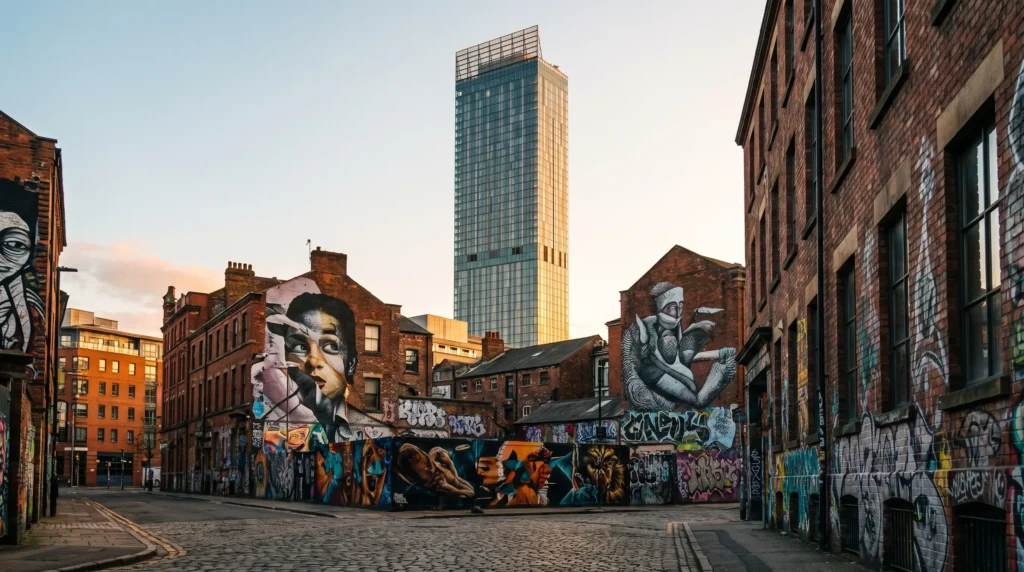
Manchester Travel Guide — Where the Industrial Revolution Met the Best Music Scene in Britain
I keep meeting travelers who treat Manchester as a layover on the way to the Lake District, and I keep telling them the same thing: stop doing that. This is the city that industrialized the entire planet — the original “Cottonopolis,” the place where the factory system was invented and then exported everywhere — and it never quite stopped reinventing itself afterward. It gave the world the Haçienda, Joy Division, Oasis and the Smiths; it split its football soul between two clubs that fill stadiums on opposite sides of the city every other weekend; and it now runs the largest tram network in the UK through a downtown thick with Victorian warehouses turned into restaurants. It rains more than London, the accent takes visitors a day to tune into, and nobody here will pretend the weather is a selling point — but the food scene, the music, and the sheer unpretentious warmth of the place make up for every grey afternoon.
In This Guide
- Overview — Why Manchester Is More Than a Football Postcode
- Summer in the City — Castlefield Bowl & Festival Season
- Best Time to Visit Manchester (Season by Season)
- Getting There — MAN Airport, Piccadilly & the Skylink
- Getting Around — Metrolink, Buses & Walkability
- Neighborhoods — Northern Quarter, Ancoats, Castlefield & Beyond
- Culture & People — Madchester, Football & Student City
- A Food Lover’s Guide to Manchester
- Off the Beaten Path
- Day Trips — Peak District, Liverpool & Beyond
- Practical Information
- Budget Breakdown — What Manchester Actually Costs in 2026
- Frequently Asked Questions
Overview — Why Manchester Is More Than a Football Postcode
Manchester sits about 160 miles northwest of London, wedged between the Pennines and the Cheshire Plain, and its roughly 590,000 residents make it England’s third-largest city proper — though the wider Greater Manchester conurbation, stitched together from ten boroughs, holds closer to 2.87 million people. During the Industrial Revolution it became “Cottonopolis,” the world’s first industrialized city, processing raw cotton from across the British Empire into cloth shipped everywhere; that boom cooled after the First World War, and what came next is the more interesting story.
The old cotton wealth left behind an astonishing stock of Victorian architecture — the Gothic Revival Town Hall, the John Rylands Library, a skyline of red-brick warehouses — that the city has spent the last three decades converting into apartments, breweries, galleries and one of the best independent restaurant scenes in the UK. Manchester Piccadilly, the main rail station, is the second-busiest in Great Britain outside London, which tells you how central this city still is to the country’s economy.
What actually sells Manchester to visitors, though, is culture rather than commerce: the music scene that produced Joy Division, the Smiths, the Stone Roses and Oasis; two Premier League football clubs with a genuine, sometimes prickly, civic rivalry; a huge student population that keeps the nightlife and the ideas circulating; and a food and drink scene that has quietly become one of the most interesting in Britain, from the UK’s largest concentration of South Asian restaurants to a serious craft-beer boom. It’s a city built for a long weekend that keeps finding ways to justify a week.
Summer in the City — Castlefield Bowl & Festival Season
If you’re reading this in July, you’re in luck: Sounds of the City, Manchester’s open-air summer concert series at Castlefield Bowl, runs through the month, tucked into a sunken amphitheatre beside the canal basin in the shadow of Roman-era walls and Victorian railway viaducts. It’s one of the most atmospheric small-scale gig settings in the country, and it anchors a summer calendar that also includes Manchester Pride in August and the build-up to a busy autumn arena season at Co-op Live and the AO Arena, two of the city’s biggest indoor venues.
Manchester International Festival, the city’s flagship arts event, runs biennially rather than every summer — check ahead if that’s the draw — but between Castlefield Bowl gigs, football season kicking back off in August, and the Northern Quarter’s bar terraces finally getting some sun, July is genuinely one of the liveliest windows to be here.
Best Time to Visit Manchester (Season by Season)
Late May – September · Peak season
The driest, warmest, longest-daylight stretch of the year, and the one where the outdoor festival and beer-garden culture actually gets to happen. Manchester still averages around 806.6mm of rain annually, so pack a layer regardless — this is an oceanic climate, not a Mediterranean one. Book city-centre hotels well ahead for football weekends and big concerts at Co-op Live or the AO Arena.
March – May & October – November · Shoulder season
Cooler and wetter, but with thinner crowds and lower hotel rates, and the football and gig calendars are both in full swing. This is the value window locals themselves prefer.
December · Christmas markets
Manchester’s Christmas Markets, spread across several city-centre squares, are among the largest in the UK and worth a dedicated weekend on their own, though expect crowds, mulled wine queues and cold, damp evenings.
January – February · Off-season
Cold, grey, and cheap. Fine for museum-hopping and football fixtures if you don’t mind the short days and near-constant drizzle.
Getting There — MAN Airport, Piccadilly & the Skylink
Manchester Airport (MAN) sits about 7 miles southwest of the city centre and is the UK’s third-busiest airport, handling roughly 32.1 million passengers in 2025 across two operating terminals. It’s the only UK airport outside London with a genuinely global long-haul network — direct flights reach Dubai, Doha, Hong Kong and Toronto alongside the full spread of easyJet, Ryanair, Jet2 and TUI routes across Europe. A dedicated Metrolink tram line and a mainline rail station sit right at the terminal complex, so you can be in the city centre in about 20 minutes without a taxi.
By rail, Manchester Piccadilly is a genuine national hub — direct trains from London Euston take a little over two hours, and there are fast, frequent links to Liverpool, Leeds, Edinburgh, Birmingham and beyond, which makes Manchester a sensible base for a wider England or Scotland itinerary rather than a one-stop city break.
Getting Around — Metrolink, Buses & Walkability
The city centre itself is compact and very walkable — most of the sights between Piccadilly, the Northern Quarter, Deansgate and Castlefield sit within a twenty-minute walk of each other. For anything further out, the Manchester Metrolink is the backbone of the system: the UK’s most extensive light rail network, with 99 stops across roughly 64 miles (103km) of route on eight lines radiating out to Altrincham, Bury, Ashton-under-Lyne and the airport. It opened in 1992 as Britain’s first modern street-running tram system and carried around 46 million passenger journeys in the 2024/25 financial year.
Buses fill in the gaps under the integrated Bee Network ticketing scheme, and contactless tap-in/tap-out works across trams and buses the same way it does on London’s Oyster system, so there’s rarely a need to fumble with paper tickets. Taxis and rideshare apps are widely available and inexpensive by UK standards; renting a car is genuinely unnecessary unless you’re heading out to the Peak District or Lake District independently.
Neighborhoods — Northern Quarter, Ancoats, Castlefield & Beyond
Northern Quarter
Manchester’s alternative-culture heart, defined and branded as a district in the 1990s regeneration push, centred on Oldham Street between Piccadilly and Victoria stations. Richard Arkwright opened the city’s first cotton mill here in 1783, and the Victorian warehouses that followed now house independent record shops, vintage stores, street art and the city’s densest concentration of bars and small-plates restaurants.
Ancoats
Once the world’s first industrial suburb, packed with cotton mills; now Manchester’s most talked-about dining strip, anchored around Cutting Room Square, with a wave of acclaimed restaurants inside converted mill buildings.
Castlefield & Deansgate
Built on the site of a Roman fort, Castlefield’s canal basins and railway viaducts now frame the Science and Industry Museum, set inside the 1830 Liverpool Road station — the world’s first inter-urban passenger railway station. Deansgate next door is the retail and business spine, home to Beetham Tower and John Rylands Library.
Spinningfields
The glassy financial district, all law firms and upmarket chain restaurants — useful for a business trip, skippable for most leisure visitors.
Salford Quays & MediaCityUK
A regenerated dockland across the water from the city centre, home to BBC and ITV studios, the Imperial War Museum North, and The Lowry arts centre and gallery — reachable by its own Metrolink line.
Chorlton & Didsbury
Leafy, café-heavy residential districts a short tram ride south, popular with locals for Sunday brunch, independent bookshops and a slower pace than the city centre.
Rusholme & the Curry Mile
A stretch of Wilmslow Road holding the largest concentration of South Asian restaurants in the United Kingdom, busy well into the night and popular with the huge nearby student population.
Old Trafford & Trafford Park
Manchester United’s stadium — “the Theatre of Dreams” — holds 74,500 fans, the largest capacity of any club ground in the UK, and sits alongside Lancashire Cricket Club’s Emirates Old Trafford ground and the Trafford Centre shopping complex. Manchester City’s Etihad Stadium sits on the opposite side of the city, in East Manchester near the Etihad Campus.
Culture & People — Madchester, Football & Student City
Manchester’s cultural export punches wildly above its population. The late-1980s and early-1990s “Madchester” scene, built around the Haçienda nightclub and Factory Records, gave the world Joy Division, New Order, the Stone Roses and the Happy Mondays, and the city kept producing generation-defining bands through Oasis and beyond. Live music remains central to civic identity — Co-op Live, opened as the UK’s largest indoor arena by floor space, and the long-running AO Arena both anchor a heavy touring schedule.
Football is the other civic religion, split — sometimes fiercely — between Manchester United and Manchester City, and a stadium tour at either ground is a legitimate half-day activity even for casual fans. The city’s large student population, drawn by the University of Manchester and Manchester Metropolitan University, keeps the nightlife young and the independent culture scene constantly refreshed, while decades of immigration from South Asia, the Caribbean, Ireland, Poland and beyond make Manchester one of England’s most genuinely multicultural cities outside London.
A Food Lover’s Guide to Manchester
Start with the Curry Mile in Rusholme for the country’s densest run of South Asian restaurants, kebab houses and shisha bars — go for the biryani and stay for the late-night energy. For a more contemporary scene, Ancoats’ restaurant row and the Northern Quarter’s small-plates spots represent the city’s fine-dining and modern-British boom, much of it in converted cotton mills.
Don’t skip the classics: proper fish and chips, a Sunday roast in a converted Victorian pub, and Manchester tart — a shortcrust pastry case of raspberry jam, custard and desiccated coconut that’s a genuine regional specialty. Vimto, the purple fruit cordial found in every UK corner shop, was invented in Manchester in 1908 and is still something of a local point of pride. Manchester’s craft beer scene has grown fast too, with a cluster of breweries and taprooms around Ancoats and the Northern Quarter worth an afternoon of their own.
Off the Beaten Path
Chetham’s Library
Founded in 1653, this is reputed to be the oldest public library in the English-speaking world, and it’s free to visit — Karl Marx and Friedrich Engels reportedly used a corner table here while researching Manchester’s factory conditions.
Islington Mill, Salford
An artist-run former cotton mill just across the river in Salford, packed with studios, gig nights and a genuinely underground creative scene most tourists never find.
The John Rylands Library
A neo-Gothic reading room on Deansgate that looks like a cathedral built for books — free entry, and one of the city’s most photogenic interiors, yet regularly skipped in favor of the bigger museums.
Manchester Jewish Museum
Housed in a restored Spanish and Portuguese synagogue on Cheetham Hill Road, telling the story of Manchester’s long-established Jewish community, one of the largest outside London.
Rochdale Canal towpaths
A quiet, mostly overlooked way to see the city’s industrial bones on foot — follow the towpath out from Castlefield and watch the warehouses thin into suburbs.
Day Trips — Peak District, Liverpool & Beyond
Peak District National Park
The UK’s first designated national park, established in 1951, covers 555 square miles of moorland, limestone dales and gritstone edges just under an hour from the city by train or car, drawing around 13 million visitor days a year. Base a day trip around Bakewell (of Bakewell tart fame), the show caves at Castleton, or Chatsworth House, seat of the Dukes of Devonshire and one of England’s grandest stately homes.
Liverpool
A fast, frequent train ride away, Liverpool brings Beatles history, the Albert Dock waterfront and its own distinct culture and accent — genuinely easy to pair with Manchester on the same trip.
Chester
A compact Roman-founded city with intact medieval walls, black-and-white Tudor architecture and a well-preserved cathedral, easily done as a half-day loop.
The Lake District
England’s most celebrated national park is a longer haul — figure on a full day at minimum — but Windermere and the fells are within striking distance for travelers with a car or a booked coach tour.
Practical Information
Money. The currency is the Pound Sterling (GBP); contactless card payment is close to universal in shops, restaurants, taxis and on Metrolink trams and buses, so carrying much cash is rarely necessary. Check the current exchange rate before you travel rather than relying on a fixed figure, since GBP floats against the dollar.
Entry requirements. Since 2025 the UK has been rolling out an Electronic Travel Authorisation (ETA) requirement for visa-exempt visitors, including US, Canadian, Australian and EU passport holders, who must apply online before departure; your passport must also remain valid for your whole stay. The US State Department rates the UK a Level 2 advisory — “exercise increased caution” — citing terrorism and crime risk broadly consistent with other major European cities, not anything specific to Manchester.
Safety. Manchester’s city centre, Northern Quarter and main tourist areas are generally safe to walk in the evening; use normal city precautions on quieter streets late at night and around football match days, when crowds and rival-fan tension can spike briefly.
Health. No special vaccinations are required for the UK; the CDC’s routine recommendations (MMR, routine boosters, staying current on COVID-19 vaccination) apply as they would for any international trip, and UK tap water is safe to drink everywhere.
Connectivity. An eSIM with UK/EU coverage is the easiest option; city-centre Wi-Fi and 4G/5G coverage are both strong. Plugs: UK Type G, 230V. Time zone: GMT, with British Summer Time (UTC+1) from late March to late October.
Budget Breakdown — What Manchester Actually Costs in 2026
Manchester runs noticeably cheaper than London — figure on saving 20–30% across hotels and restaurants for a comparable standard.
Budget (US$70–110/day): Hostel dorm or budget hotel in the Northern Quarter or near Piccadilly, Curry Mile or market-hall meals, Metrolink and bus day pass, free museum entry (the Science and Industry Museum, Manchester Museum and the Whitworth are all free to enter).
Mid-range (US$150–250/day): Boutique hotel in Ancoats or Deansgate, a mid-range restaurant dinner, a football stadium tour, a night out around the Northern Quarter’s bars.
Luxury (US$400+/day): Design hotel or serviced apartment in Spinningfields or Deansgate, tasting-menu dinners in Ancoats, match-day hospitality at Old Trafford or the Etihad, a private Peak District day tour with driver.
Tipping around 10% is appreciated but not obligatory in restaurants where service isn’t already added to the bill; it’s not expected in pubs or for counter service.
Planning Your First Trip to Manchester
Three nights is enough for the essentials: a day split between Castlefield’s museums and the Northern Quarter’s shops and bars, an evening of live music or a football match, and a Curry Mile dinner in Rusholme. Add a fourth day for a Peak District day trip, or extend to a week and pair it with a couple of nights in Liverpool by fast train, or push north to see Edinburgh for a full Northern England-and-Scotland itinerary. Manchester also makes a sensible single base for a broader look at England beyond London, given how fast and frequent its rail connections are.
Frequently Asked Questions
Is Manchester safe for tourists in 2026?
Yes, broadly — the city centre, Northern Quarter and main visitor areas are well-trodden and generally relaxed, with the same everyday-city caution you’d use anywhere. The US State Department rates the whole UK a Level 2 advisory for terrorism and crime, not a Manchester-specific warning.
Do I need a visa or ETA to visit Manchester?
If you’re a US, Canadian, Australian or EU passport holder, you don’t need a visa for a short tourist visit, but you now need to apply online for a UK Electronic Travel Authorisation (ETA) before you fly. Check current requirements for your nationality before booking.
How do I get from Manchester Airport to the city centre?
Take the train or Metrolink tram directly from the airport’s own station — both reach the city centre in roughly 15–25 minutes, faster and cheaper than a taxi in most traffic conditions.
Manchester or Liverpool?
They’re close enough by train to do both. Choose Manchester for music history, football and a bigger food and nightlife scene; choose Liverpool for the Beatles trail and its waterfront. Most visitors end up doing a few days of each.
Can I tour Old Trafford or the Etihad Stadium?
Yes — both Manchester United and Manchester City run regular stadium and museum tours on non-match days, and they’re a genuinely worthwhile half-day even if you don’t follow English football closely.
Is the Peak District doable as a day trip?
Easily — Bakewell and Castleton are both under an hour from central Manchester by train or car, which makes a full national park day trip realistic even on a short city break.
Ready to Explore Manchester?
Manchester doesn’t try to be pretty in the way York or Bath are pretty — it’s a working city that turned its industrial scars into music, food and football culture, and it wears all three with real pride. Bring an umbrella, book a stadium tour, and leave at least one evening free for wherever the Northern Quarter’s bars take you.
Explore More
- England Travel Guide — the country Manchester calls home
- Edinburgh City Guide — pair Manchester with a run north into Scotland
- Dublin City Guide — a short flight across the Irish Sea
- Cardiff City Guide — Wales’ compact, walkable capital
How this guide was built
Published as part of Facts From Upstairs’ city guide series. Built from authoritative sources — Wikipedia entity pages for Manchester, Manchester Airport, the Manchester Metrolink, Old Trafford, the Science and Industry Museum, the Northern Quarter, the Curry Mile and the Peak District; the official Visit Manchester tourism site; the UK government’s visa/ETA checker; the US State Department’s UK travel advisory; and the US CDC’s UK traveler health page. Numeric claims carry inline citations.
Sources cited on this page
- Wikipedia — Manchester
- Wikipedia — Manchester Airport
- Wikipedia — Manchester Metrolink
- Wikipedia — Old Trafford
- Wikipedia — Science and Industry Museum
- Wikipedia — Northern Quarter, Manchester
- Wikipedia — Curry Mile
- Wikipedia — Peak District
- Visit Manchester — official tourism site
- GOV.UK — Check if you need a UK visa
- US State Department — United Kingdom travel advisory
- US CDC — United Kingdom traveler health page
More city guides you might like

Plan your trip to Manchester
The booking tools we use ourselves. FFU may earn a commission at no extra cost to you.
Plan & book your trip to Manchester
Booking through these searches supports our guides at no extra cost to you.