
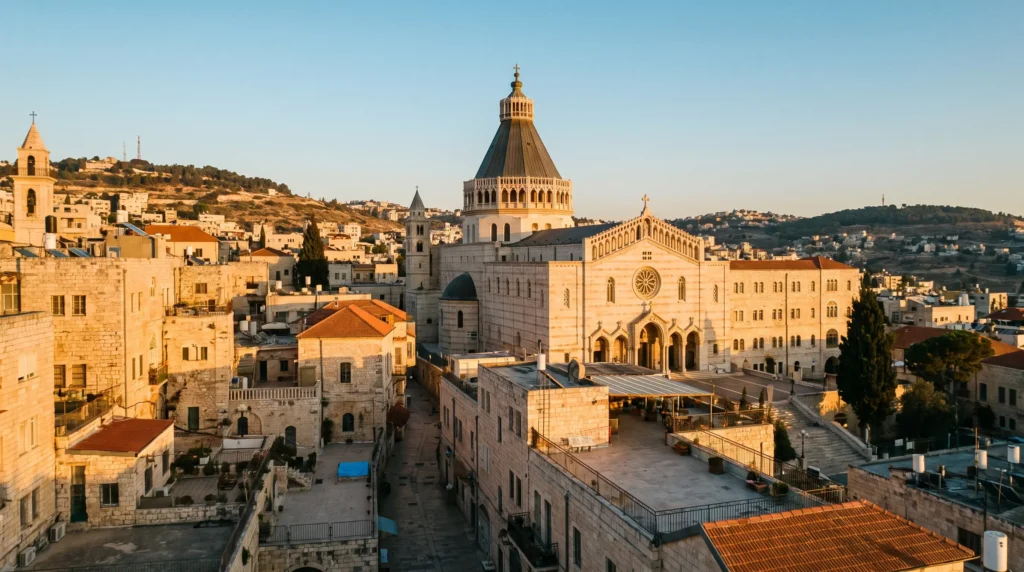
Nazareth Travel Guide — Jesus’s Hometown, the Arab Capital of Israel, and the Holy Land’s Best Meal
I went to Nazareth expecting a shrine and left thinking mostly about the food. That’s not a knock on the shrine — the Basilica of the Annunciation is genuinely one of the great churches of the Middle East — it’s just that nobody warns you Nazareth is also the best place in Israel to eat, because it’s the largest Arab city in the country and its old souq has been perfecting knafeh and katayef since long before “Holy Land tourism” was a category. This is a working Arab-Israeli city of about 76,000 people, roughly two-thirds Muslim and a third Christian, where church bells and the call to prayer share the same square. It rewards a slow half-day more than a rushed tour-bus stop, and — unlike a lot of the rest of the country right now — it’s a part of Israel where the ordinary rhythm of markets, church courtyards and coffee stalls has largely carried on. I’ll get to what “largely” means, because with Nazareth in 2026 the honest travel advice matters more than the postcard version.
In This Guide
- Overview — Why Nazareth Is More Than a Pilgrimage Stop
- Christmas in Nazareth — the Middle East’s Biggest Parade
- Best Time to Visit Nazareth
- Getting There — Ben Gurion, Buses & the Nearest Train
- Getting Around Nazareth
- Neighborhoods — Old City, Mary’s Well & Beyond
- Culture & People — the Arab Capital of Israel
- A Food Lover’s Guide to Nazareth
- Off the Beaten Path
- Day Trips — Sea of Galilee, Mount Tabor & Haifa
- Practical Information
- Budget Breakdown — What Nazareth Actually Costs in 2026
- Frequently Asked Questions
Overview — Why Nazareth Is More Than a Pilgrimage Stop
Nazareth is the largest city in Israel’s Northern District and, by tradition, the town where Jesus grew up — a fact that has drawn Christian pilgrims here for close to two thousand years and still shapes the town’s biggest church, biggest festival and biggest tour-bus problem. But Nazareth today is defined just as much by being the unofficial “Arab capital of Israel” — its majority-Arab population makes it the country’s cultural, commercial and political center for Arab citizens of Israel, a role distinct from anywhere else in the country.
The city sits at 347 metres in the Nazareth Range, the southernmost ridge of Lower Galilee, about 25 kilometres inland from the Sea of Galilee. Its layered history runs from a small Jewish and later Byzantine settlement, through a stint as capital of the Crusader Principality of Galilee under Tancred in 1099, to an 18th-century revival under the Arab ruler Daher al-Umar, before being incorporated into Israel in 1948.
What you actually come for is a compact, walkable Old City built around the Basilica of the Annunciation — one of the largest Christian churches in the Middle East — plus a souq that still functions as a real market rather than a tourist set piece, and a restaurant scene locals and Israeli day-trippers alike consider some of the best Arab cooking in the country. Most people do Nazareth as a half-day stop between Tel Aviv or Haifa and the Sea of Galilee. That undersells it. Give it an overnight and the town empties of tour groups by early evening, leaving you the souq, the church courtyards and dinner to yourself.
Christmas in Nazareth — the Middle East’s Biggest Parade
Time a December trip around one date: December 24, when Nazareth runs an annual Christmas parade through Mary’s Well Square — scouts, brass bands and dancers in bright costume, often billed as the largest Christmas procession in the Middle East. It makes sense once you remember Nazareth has the largest concentration of Arab Christians in Israel, so this isn’t a token light display for tourists — it’s the town’s actual Christmas.
Alongside the parade, a Christmas market fills the streets near the Basilica with baked goods, crafts and roasted nuts through the second half of December, and the Old City strings up lights that make the evening souq genuinely beautiful. Celebrations had been muted for a couple of years amid the wider regional war, and their full return has been treated as good news locally — a sign of the city’s tourism economy coming back. If you’re weighing a December trip, book Old City accommodation early — rooms near Mary’s Well Square sell out well ahead of the 24th.
Best Time to Visit Nazareth
March – May · Spring
Comfortable daytime temperatures, wildflowers across the Galilee hills, and Easter week draws a second wave of Christian pilgrims to the Basilica — book well ahead if your dates overlap.
June – August · Summer
Hot and dry, often into the mid-30s°C by afternoon. Mornings in the Old City are the move; the souq and churches offer shade the open plazas don’t.
September – November · Autumn
The best shoulder window — cooling temperatures, thinner crowds than spring, and good light for the Old City’s stone lanes.
December · Christmas season
Cool and occasionally wet, but this is Nazareth’s showcase month: the parade, the market, and church services that draw visitors from across Israel and abroad. Book early.
Getting There — Ben Gurion, Buses & the Nearest Train
Ben Gurion International Airport (TLV), near Tel Aviv, is the country’s only major international gateway and the practical starting point for almost every Nazareth trip. It’s about 100 kilometres from Nazareth — roughly a 75-minute drive by rental car or private transfer, longer with traffic around Tel Aviv or Afula.
There’s no direct train into Nazareth itself; the nearest station is in Afula, about 8 kilometres south, with rail connections toward Haifa and a shuttle bus running roughly every 30 minutes between Afula and central Nazareth. Bus is the more direct option: Egged’s bus 331 runs from Haifa every 15 minutes straight to the Basilica of the Annunciation, and bus 955 connects Jerusalem with about five trips a day. By road, Nazareth is roughly 102 kilometres from Tel Aviv and 131 kilometres from Jerusalem.
Entry requirements have tightened recently: visa-exempt nationalities, including US, UK, EU and Canadian passport holders, now need an approved Electronic Travel Authorization (ETA-IL) before flying, applied for online with a small entry fee, rather than a stamp on arrival. Apply several days ahead of travel — don’t leave it for the airport.
Getting Around Nazareth
Central Nazareth — the Old City, the Basilica, Mary’s Well Square and the souq — is compact and easily covered on foot; most first-time visitors never need a car once they’ve arrived. Streets in the Old City are narrow, stepped and largely pedestrian, which is part of the charm and also why cars struggle there.
If you’re driving in or renting to continue on to the Galilee, be ready for heavy traffic and roads that are not always well signed — a GPS app that works offline is genuinely useful here, not just a nicety. Local buses and shared taxis (sherut) link Nazareth to Nazareth Illit/Nof HaGalil (the separate, mostly Jewish city on the hill above) and onward to Afula, Tiberias and Haifa; fares are cheap but schedules thin out on Saturdays in the wider region, since Nazareth’s own bus 331 to Haifa is one of the few that keeps running through Shabbat.
Neighborhoods — Old City, Mary’s Well & Beyond
The Old City & the Souq
The historic core, built uphill from the Basilica of the Annunciation, is a restored market quarter of vaulted stone lanes, spice stalls, sweet shops and small workshops — still a working souq rather than a reconstruction. This is where you’ll spend most of your time: churches, coffee stops and the best food are all within a ten-minute walk of each other.
Mary’s Well Square
A lively plaza built around a spring long associated with the Virgin Mary in local tradition, anchored by the Greek Orthodox St. Gabriel’s Church nearby; the current fountain is a symbolic reconstruction from the city’s millennium celebrations in 2000. It’s also the staging ground for the Christmas parade and a natural people-watching stop any time of year.
Bishop’s Square & the Christian Quarter
Home to Greek Orthodox and Melkite Greek Catholic institutions and some of the Old City’s oldest residential architecture, this quieter quarter is worth a wander for the stonework alone, away from the main pilgrim routes.
Nazareth Illit / Nof HaGalil
A separate, largely Jewish municipality built on the hills directly above Nazareth from the 1950s onward — a reminder that “Nazareth” on a map covers two adjacent but administratively distinct cities. Most visitors have no reason to base here, but it’s a common reference point in directions and bus routes.
The Southern Approach & Nazareth Village
On the edge of town, Nazareth Village recreates a first-century Galilean farming settlement with costumed guides, olive presses and period buildings — a useful, hands-on complement to the church-focused sites in the Old City, and a good option with kids.
Culture & People — the Arab Capital of Israel
Nazareth’s roughly 76,000 residents are overwhelmingly Arab, split about 69% Muslim and 31% Christian — the highest concentration of Arab Christians anywhere in Israel — and the city functions as the de facto cultural, commercial and political hub for Arab citizens of the country. That mix is visible everywhere: mosque minarets and church bell towers share the skyline, Arabic is the dominant street language alongside Hebrew, and shopfronts switch between the two without much thought.
Church life runs deep and denominationally varied — Latin (Roman Catholic, via the Franciscan Custody of the Holy Land), Greek Orthodox, Melkite Greek Catholic and Maronite communities all maintain historic sites in the Old City, most notably the Basilica of the Annunciation, the Synagogue Church, and St. Joseph’s Church built over what tradition holds was Joseph’s carpentry workshop. Dress modestly for church interiors — shoulders and knees covered is the safe default — and ask before photographing worshippers during services.
A Food Lover’s Guide to Nazareth
Nazareth’s souq is widely considered one of the best places in Israel to eat, and the signature sweet is katayef — a folded, griddle-cooked pancake filled with either sweetened nuts or soft cheese, sold hot from stalls through the Old City, especially thick on the ground around Ramadan and Christmas. For the everyday classic, seek out Falafel Abu Hani Gabaly, generally cited as the city’s oldest and most famous falafel counter.
Beyond street food, sit-down Arab-Israeli cooking here runs to knafeh (a syrup-soaked cheese-and-shredded-pastry dessert, with Nazareth holding its own against Nablus’s more famous version), maqluba (an upside-down rice, meat and fried-vegetable dish), and musakhan (sumac-roasted chicken over flatbread with caramelized onions). Arabic coffee — cardamom-spiced, served thick in small cups — is the constant thread through the souq’s cafés, and it’s worth timing a coffee stop for late afternoon, when the market is at its most atmospheric and least crowded.
Off the Beaten Path
The Synagogue Church
A modest Melkite Greek Catholic church tucked in the souq, built on a site local tradition holds was the synagogue where Jesus preached — quieter and far less visited than the Basilica a few minutes’ walk away.
The White Mosque
One of the Old City’s oldest mosques, notable for its calm courtyard and its role as a symbol of the city’s Muslim community; a useful counterpoint if you’ve spent the morning church-hopping.
Nof HaGalil’s viewpoints
The hills of neighboring Nazareth Illit/Nof HaGalil give a wide panorama back down over Nazareth’s Old City and out toward the Jezreel Valley — a good sunset stop that almost no tour bus makes time for.
The souq after dark
Day-trippers clear out by early evening; an after-dinner walk through the lit-up market lanes, with shops shuttering and cafés just getting going, is a different — and much less crowded — version of the same streets.
Day Trips — Sea of Galilee, Mount Tabor & Haifa
Nazareth’s real advantage is its position: the Galilee’s best sites ring it within an hour or two. Mount Tabor, traditional site of the Transfiguration, is reachable via a roughly one-hour approach and hike up to the Church of the Transfiguration at its summit. The Sea of Galilee and Tiberias sit east, covering Capernaum, the Mount of Beatitudes and boat rides on the lake — an easy full-day loop by car or organized tour.
Haifa, with the terraced Bahá’í Gardens and its port-city energy, is about 90 minutes away by the direct Nazareth–Haifa bus. Cana of Galilee (Kafr Kanna), traditional site of Jesus’s first miracle, is a short hop northeast and easily paired with a Nazareth Village or Mount Tabor day. For a longer trip, both Jerusalem and Tel Aviv are feasible day excursions by bus, though the drive each way (roughly 90 minutes to two hours) makes an overnight more comfortable if your schedule allows it.
Practical Information
Money. The Israeli New Shekel (₪, ILS/NIS) floats freely and has strengthened against the dollar in recent years, trading somewhere in the ₪3.2–3.7 per US$1 range historically — check a live rate before you go rather than relying on a fixed number. Cards are widely accepted in restaurants and shops in the Old City; carry some cash for small souq stalls.
Safety — read this carefully. The security picture across Israel has been genuinely volatile through 2026, including a direct Israel–Iran exchange of fire in early June that briefly halted flights at Ben Gurion. The US State Department currently rates Israel at Level 3, “Reconsider Travel,” citing terrorism and civil unrest, with a hard “Do Not Travel” zone within about 4 kilometres of the Lebanese and Syrian borders — well north of Nazareth. The UK FCDO advises against all travel to areas north of Route 89 between Nahariya and Dalton and to the Golan Heights, and against any travel near the Gaza border — none of which includes Nazareth or the core Galilee tourist circuit, but both advisories change quickly and should be checked again in the days before you fly, not weeks ahead. Day-to-day street safety within Nazareth itself is unremarkable by regional standards; the real risk factor right now is macro-level regional escalation, not petty crime.
Health. Routine vaccines (MMR, Tdap) should be current, and CDC notes hepatitis A is commonly recommended for travelers along with an up-to-date polio booster, since poliovirus has been reported circulating in Israel in the past year. Tap water in Nazareth is generally treated and safe to drink.
Connectivity & practicalities. An eSIM or local SIM gives good 4G/5G coverage through the Old City. Plugs: Type C and Type H (the Israel-specific three-round-pin plug), 230V/50Hz — US travelers need both an adapter and, for non-dual-voltage devices, a converter. Time zone: UTC+2 standard, UTC+3 during Israel Daylight Time. Friday afternoon through Saturday (Shabbat) sees reduced transit and closed businesses across much of Israel, though Nazareth’s own Arab-run shops and the 331 bus keep going.
Budget Breakdown — What Nazareth Actually Costs in 2026
Israel overall is one of the pricier destinations in the region, but Nazareth itself runs noticeably cheaper than Tel Aviv or Jerusalem hotels once you’re off the main pilgrim circuit.
Budget (US$50–90/day): Old City guesthouse or hostel bed, souq falafel and katayef meals, local buses and shared taxis, self-guided church visits (most are free to enter).
Mid-range (US$120–220/day): Boutique hotel or restored Old City guesthouse, sit-down Arab-Israeli restaurant dinners, a half-day private guide for the Basilica and souq, one day-trip taxi or tour to the Sea of Galilee or Mount Tabor.
Luxury (US$350+/day): Upscale Galilee boutique properties, private multi-day guides covering Nazareth, Sea of Galilee and Jerusalem, chauffeured transfers from Ben Gurion.
Fixed costs to expect: the ETA-IL entry fee before arrival, and modest optional donations at some church sites. Tipping around 10–15% is standard in restaurants where service isn’t already included.
Planning Your First Trip to Nazareth
The classic itinerary treats Nazareth as a Galilee base: fly into Ben Gurion, spend two nights in Nazareth covering the Basilica, the souq and Nazareth Village, then day-trip to Mount Tabor and the Sea of Galilee before continuing to Haifa or back south. If your route includes the wider Holy Land circuit, pair this guide with our Jerusalem guide and our broader Israel travel guide; travelers extending east toward Petra can also check our Jordan guide and Petra guide for the border-crossing logistics.
Frequently Asked Questions
Is Nazareth safe to visit right now?
Nazareth itself sits well outside the border-zone “Do Not Travel” areas that both the US State Department and UK FCDO flag, and day-to-day conditions in the Old City are unremarkable by regional standards. The bigger issue in 2026 is regional volatility — check both advisories again in the days before you fly, since the situation has shifted quickly this year.
Do I need a visa for Israel?
US, UK, EU and Canadian passport holders don’t need a traditional visa for short tourist stays, but as of January 2025 all visa-exempt visitors must apply for an ETA-IL online before travel — it’s not a visa-on-arrival system anymore, so apply at least a few days ahead.
How much time do I need in Nazareth?
Half a day covers the Basilica, Mary’s Well and a souq meal; a full day lets you add Nazareth Village or a short Mount Tabor trip. An overnight is worth it for the souq after the tour buses leave.
Is Nazareth a good base for the Sea of Galilee?
Yes — it’s roughly 25 kilometres from the Sea of Galilee, closer than Tel Aviv or Jerusalem, and well connected by bus and car for day trips to Tiberias, Capernaum and Mount Tabor.
What should I wear to visit the churches?
Modest dress — shoulders and knees covered — is expected at the Basilica of the Annunciation and other active churches, consistent with most religious sites across the Holy Land.
Nazareth or Bethlehem for a Holy Land trip?
They’re not really substitutes — Bethlehem (in the West Bank) covers the Nativity story and requires separate logistics and current advisory checks, while Nazareth covers Jesus’s childhood and adult life and sits inside Israel proper with easier access from Haifa or the Galilee. Most serious itineraries include both, on separate legs.
Ready to Explore Nazareth?
A Byzantine grotto under a modern basilica, a souq that still smells like katayef and cardamom coffee rather than souvenir shops, and a Christmas parade that fills the streets with the whole town rather than tourists. Nazareth rewards travelers who slow down enough to eat there — just check the current advisories before you book, and build the rest of the Galilee around it.
Explore More
- Jerusalem City Guide — the rest of the Holy Land’s essential stop
- Israel Travel Guide — plan the wider country trip
- Jordan Travel Guide — cross the border for Petra and Amman
- Petra City Guide — the Rose City, a natural add-on itinerary
How this guide was built
Published as part of Facts From Upstairs’ city guide series. Built from authoritative sources — Wikipedia’s Nazareth, Ben Gurion Airport, Basilica of the Annunciation and Israeli new shekel entity pages, the Franciscan Custody of the Holy Land’s official Basilica of the Annunciation page, Wikivoyage’s Nazareth travel guide for logistics and food detail, Israel’s official Ministry of Foreign Affairs visa page, the US State Department’s Israel, the West Bank and Gaza travel advisory, the UK FCDO’s Israel travel advice, the US CDC traveler page for Israel, and a plug/voltage reference for electrical standards. Numeric and checkable claims carry inline citations; the safety section was checked against both the US and UK advisories current as of this guide’s publish date and should be re-verified before travel given how quickly the regional situation has shifted in 2026.
Sources cited on this page
- Wikipedia — Nazareth
- Wikipedia — Ben Gurion Airport
- Wikipedia — Israeli new shekel
- Custodia di Terra Santa — Basilica of the Annunciation
- Wikivoyage — Nazareth
- Israel Ministry of Foreign Affairs — Entry Visa Information
- US State Department — Israel, the West Bank and Gaza Travel Advisory
- UK FCDO — Israel Travel Advice
- US CDC — Israel traveler page
- World Standards — Israel power plugs & voltage
- Travelmath — TLV to Nazareth driving distance
- Tourist Israel — Christmas in Nazareth
- Crux — Christmas Celebrations Return to Nazareth
More city guides you might like
Plan your trip to Nazareth
The booking tools we use ourselves. FFU may earn a commission at no extra cost to you.
Plan & book your trip to Nazareth
Booking through these searches supports our guides at no extra cost to you.