
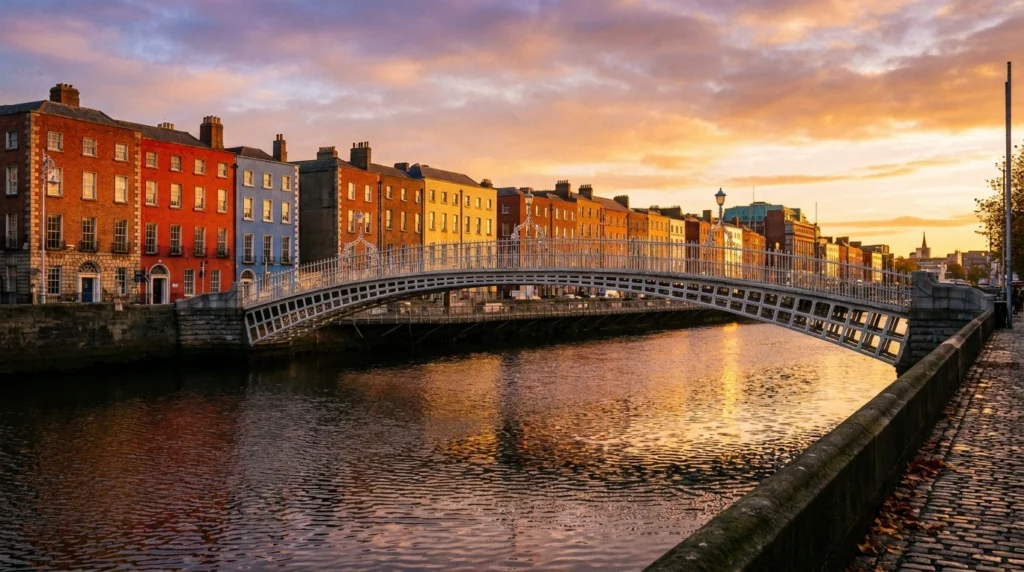
Dublin, Ireland: Georgian Doors, Trinity Library, Guinness Brewery & UNESCO City of Literature
Part of our Ireland travel guide.
I have walked into Dublin half a dozen times now — off Aer Lingus from JFK, off Ryanair from anywhere, off the Stena ferry from Holyhead — and the sensation that defines the city is the immediate small-town feel of a national capital. We tell first-time travellers that Dublin is the only EU capital where you can walk from the airport bus to the Long Room of Trinity College in 25 minutes and be drinking your first Guinness within the hour. My favourite hour is the late-evening pint at Mulligan’s on Poolbeg Street where the Joyce blue plaque sits above the door. Treat this guide as the brief I would hand my own family before they boarded the flight from London.

Table of Contents
Why Dublin?
Dublin is the capital of Ireland and home to roughly 30% of the country’s population — about 1.45 million people in the Greater Dublin Area. The city sits at the mouth of the River Liffey on Ireland’s east coast and was founded around 988 CE by Viking settlers (the original name ‘Dyflin’ comes from Old Norse).
The city’s pitch to first-time visitors is the unusual concentration of cultural firepower in a small walkable centre. Trinity College’s Long Room library and the 9th-century Book of Kells are inside a 5-minute walk of the Guinness Storehouse, the National Museum’s Iron-Age bog bodies, the Chester Beatty’s manuscript collection, and the Georgian door rows of Merrion Square. UNESCO designated Dublin a City of Literature in 2010 — the only one in the English-speaking world along with Edinburgh, in recognition of its four Nobel laureates (Yeats, Shaw, Beckett, Heaney) and the Joyce / Wilde / Swift inheritance.
Practically, Dublin is the easiest English-language Europe long-weekend — 1h25 flight from London, 1h45 from Manchester, 90 minutes from Edinburgh, and 8h transatlantic from New York. The Aircoach airport bus runs every 15 minutes to the city centre; English is universal; tipping conventions are British (10% if not service-included). Plan two to three days here, then either rural Ireland (the Wild Atlantic Way) or hop a 50-minute flight to Galway.
Neighborhoods: Finding Your Dublin
📍 Dublin Map: Every Place in This Guide


City Centre & Trinity (District 2)
The historic core south of the Liffey — Trinity College and the Long Room library, the Bank of Ireland (the original 1729 Parliament House), Grafton Street pedestrian shopping, the National Museum, and the Georgian doors of Merrion Square. The textbook first-time-visitor base.
- Trinity College & the Long Room — 1592 university, the Book of Kells exhibition + Long Room library, €25 timed entry
- Grafton Street — the pedestrian shopping street running south from College Green to St Stephen’s Green
- St Stephen’s Green — the Victorian park at the head of Grafton, free entry, daily 7:30am–dusk
- Merrion Square & the Georgian doors — the famous rainbow of fanlight 18th-century townhouses
- National Museum of Ireland – Archaeology — Iron Age bog bodies, Tara brooch, free entry
Best for: first-time base, daytime walking, museums. Access: the Luas Green Line stops at St Stephen’s Green; Tara Street DART station is 3 minutes’ walk from Trinity.
Temple Bar (District 2)
The cobbled riverside district between Trinity College and the Christ Church Cathedral — medieval lanes lined with painted-front pubs, the original tourist nightlife strip. The Temple Bar pub itself is a tourist trap; the surrounding pubs (The Stag’s Head, The Auld Dubliner, The Brazen Head) are the genuine articles.
- Temple Bar (the actual pub) — the photograph spot, but the most expensive Guinness in the city
- The Brazen Head — Ireland’s oldest pub (1198), still pouring
- The Old Library Brewery (Galway Bay Brewery) — craft-beer alternative to the Diageo monopoly
- Saturday Temple Bar food market on Meeting House Square
- The Irish Film Institute (IFI) cinema and bistro
Best for: a 90-minute pub-crawl introduction. Access: walk south from the Liffey across the Ha’penny Bridge.
The Liberties & Guinness
The historic working-class district south-west of the city centre — the Guinness Storehouse, the Teeling Whiskey Distillery, St Patrick’s Cathedral and Christ Church, and the rapidly-gentrifying restaurant scene around Francis Street.
- Guinness Storehouse — the 1904 fermentation building, €30 ticket includes a fresh Gravity Bar pint
- St Patrick’s Cathedral — 1191 cathedral, Jonathan Swift was Dean here, €9 entry
- Christ Church Cathedral — 1030 Viking-era foundation, Strongbow’s tomb, €9 entry
- Teeling Whiskey Distillery — the first distillery to open in Dublin in 125 years (2015)
- The Liberty Market on Meath Street — the working-class Saturday market
Best for: Guinness, whiskey, the cathedrals. Access: 15-minute walk from Trinity, or the 13/40/123 buses.
Stoneybatter & Smithfield (Northside)
The hipster district immediately north-west of the Liffey — Smithfield’s Generator Hostel and the Cobblestone pub for trad-music sessions, Stoneybatter’s independent restaurants and the Glasshouse Liffey gin bars.
- The Cobblestone (Smithfield) — the headline trad-music pub, sessions every night
- Smithfield Square — the Saturday horse-fair grounds, now event-and-restaurant plaza
- Jameson Distillery Bow Street — the heritage distillery building (no longer the working distillery, now a museum)
- Stoneybatter’s independent dining — L. Mulligan Grocer, Mulligan’s on Poolbeg, The Glimmerman
Best for: trad music, indie food, mid-range hotels. Access: Luas Red Line to Smithfield.
Docklands (Silicon Docks)
The redeveloped 1970s docks east of the centre — Google’s Dublin HQ, Facebook EU base, Airbnb European HQ, the Convention Centre, and the Bord Gáis Energy Theatre. Daniel Libeskind’s blue prismatic theatre and the 3 Arena are the architectural showpieces.
- EPIC The Irish Emigration Museum — the world’s 2019 best museum, on the docklands quay
- Bord Gáis Energy Theatre — Daniel Libeskind’s 2010 prismatic theatre
- 3Arena (former Point) — the city’s 13,000-capacity concert arena
- Jeanie Johnston Famine Ship replica on the North Wall Quay
Best for: EPIC museum, Famine-era history, modern architecture. Access: Luas Red Line to The Point or Spencer Dock.
Dun Laoghaire & the Coastal South
The Victorian seaside town 15 km south of central Dublin — the East Pier walk (a Dublin tradition), the National Maritime Museum, the James Joyce Tower at Sandycove (the opening of Ulysses), and the Forty Foot bathing place. Reachable in 25 minutes by DART.
- James Joyce Tower & Museum — the Martello tower at Sandycove, free entry
- Forty Foot Bathing Place — the all-weather sea-swimming spot
- Dun Laoghaire East Pier — the 1.5 km Victorian harbour walk
- National Maritime Museum (in the Mariners Church)
Best for: a half-day coastal escape. Access: DART suburban train, 25 minutes from Pearse or Tara Street.
The Food

Irish Anchors
Irish stew, Dublin coddle (the city’s native dish — sausages, bacon, potatoes, onions in a thin broth), boxty (potato pancakes), full Irish breakfast (the headline meal), and the seafood chowder of the west coast that has migrated to every Dublin pub.
- The Brazen Head — Ireland’s oldest pub (1198), Irish stew on every visit, trad-music sessions
- Beshoff’s (multiple locations) — the city’s historic fish-and-chips counter
- The Winding Stair (Liffey north bank) — modern Irish bistro, the seasonal seafood the order
- Boxty House (Temple Bar) — the boxty (potato-pancake) specialist
Pubs & Stout
Dublin’s most-loved Guinness pours come from old wood-aged-pipe systems at small local pubs — not at the Storehouse Gravity Bar (excellent view, marketing-grade pint).
- Mulligan’s of Poolbeg Street — James Joyce drank here, three reigns of Guinness barrels in the cellar, the textbook pint
- Kehoe’s (South Anne Street) — Victorian-era snug bar, untouched 1894 fittings
- Toner’s (Baggot Street) — W.B. Yeats famously visited (once); the city’s second-best stout
- The Stag’s Head (Dame Court) — 1894 Victorian pub with original stained glass
- The Cobblestone (Smithfield) — trad-music sessions every night
Modern & Fine Dining
- Chapter One (Parnell Square) — Michelin two-star, Irish ingredients, modern technique
- Bastible (South Circular Road) — modern Irish bistro, no-table-reservation walk-ins
- Mulberry Garden (Donnybrook) — Sunday-brunch institution
- Aniar-style alumni now in Dublin — hyper-local Irish
Coffee & Bakeries
- Bewley’s of Grafton Street — the 1840 Quaker-founded coffee house, restored 2017
- 3FE (Grand Canal Street) — the city’s third-wave coffee pioneer
- Bread 41 (Pearse Street) — sourdough cult bakery, queue at lunch
Cultural Sights
Trinity College & the Book of Kells
Trinity is Ireland’s oldest university (founded 1592 by Elizabeth I) and its central courtyard is a medieval-cinematic photograph anchor. The Old Library’s Long Room (65 m of barrel-vaulted oak) houses 200,000 of the library’s oldest volumes; the adjacent Treasury holds the 9th-century Book of Kells. Adult timed-entry tickets €25, book online ahead in summer.
Guinness Storehouse
The 1904 fermentation building at the St James’s Gate brewery has been a museum since 2000. Seven-storey glass-pint-shaped atrium, the brewing-history exhibition, the Gravity Bar 360-degree city panorama, and your €30 ticket includes a fresh pint. Allow 2–3 hours. Book online to skip the queue.
Kilmainham Gaol
The 1796 prison on the Liberties side held leaders of every Irish rebellion from 1798 through the 1916 Easter Rising (the leaders of which were executed in the Stonebreakers’ Yard in May 1916). One of the most affecting historical sites in Western Europe; €8 timed-entry tickets, book online weeks ahead.
National Museum of Ireland (Archaeology)
The Kildare Street wing of the National Museum holds the country’s archaeology collection — the Tara brooch, the Ardagh chalice, and the haunting Iron Age bog bodies (Old Croghan Man, Clónycavan Man), preserved by anaerobic peat-bog conditions for 2,000 years. Free entry, closed Mondays.
Chester Beatty Library
In the gardens of Dublin Castle — the bequest of Alfred Chester Beatty’s collection of illuminated Qur’ans, Buddhist sutras, Egyptian papyri and Western manuscript art. Twice-named European Museum of the Year. Free entry, closed Mondays.
Entertainment
Dublin’s entertainment is anchored by the pub-and-trad-music scene — from polished tourist sessions in Temple Bar to genuine Cobblestone-style sessions where the musicians play for themselves. The literary heritage shows up in walking tours and pub-crawl tours; the modern music scene runs through Whelan’s and the 3Arena.
Live Music & Theatre
- Abbey Theatre — Ireland’s national theatre, founded 1904 by W.B. Yeats
- The Gaiety Theatre — the 1871 South King Street theatre, opera and musicals
- Whelan’s (Wexford Street) — the legendary indie-rock venue (P.S. I Love You was filmed here)
- National Concert Hall — classical music, RTÉ National Symphony Orchestra resident
Pubs & Trad Music
- The Cobblestone (Smithfield) — the trad-music headline pub, no plug-ins
- The Brazen Head — Ireland’s oldest pub (1198), nightly trad sessions
- O’Donoghue’s (Merrion Row) — the Dubliners founded here, ongoing sessions
- The Auld Dubliner — Temple Bar trad pub for tourists
Day Trips
Howth & the Cliff Walk (30 min DART)
The Victorian fishing village on the northern peninsula — the 8 km Howth Cliff Walk loop, the seafood lunch at Aqua or The House, and the Saturday farmers’ market at the harbour. Easiest day-trip from Dublin — 30 minutes by DART.
Glendalough & the Wicklow Mountains (90 min)
The 6th-century monastic site of St Kevin in the Wicklow valley — round tower, ruined cathedral, two glacial lakes for hiking. Combine with the Sally Gap mountain drive. By car or organised day-tour from Dublin city centre.
Newgrange & the Boyne Valley (60 min)
Newgrange is older than the Egyptian pyramids and Stonehenge — a 5,200-year-old passage tomb 60 minutes north of Dublin. The 1.30 December solstice morning when sun penetrates the inner chamber is the world-famous spectacle (lottery-allocated). Visitor centre and bus shuttle from Brú na Bóinne.
Belfast (2 hr by Enterprise train)
The capital of Northern Ireland, two hours north on the Belfast–Dublin Enterprise train — Titanic Belfast (the 2012 museum at the Harland and Wolff slipway), the Crumlin Road Gaol, the Cathedral Quarter for nightlife, and the political-mural taxi tours of the Falls and Shankill Roads.
Galway (50 min flight or 2h30 train)
Galway on the Atlantic west coast is 2h30 by direct train or a 50-minute Aer Lingus flight; combine with the Cliffs of Moher and the Aran Islands for a 3-day west-coast loop.
Seasonal Guide
Dublin has a maritime temperate climate — mild winters, cool summers, rain possible any day of the year. Long evenings (sunset 22:00) in midsummer are the city’s defining seasonal feature; St Patrick’s Day on 17 March is the year’s biggest event.
Spring (Mar–May)
Daytime highs 9–15°C, daffodils in St Stephen’s Green and the Phoenix Park, and St Patrick’s Festival 17 March (parade, four-day weekend, hotels at full occupancy). May is the photographer’s month with low rain and long evenings.
Summer (Jun–Aug)
Daytime highs 17–22°C (Dublin’s ‘summer’ is European spring weather), sunset 22:00 in mid-June. Bloomsday on 16 June is the Joyce-themed festival; the Dublin Horse Show in early August fills the city.
Autumn (Sep–Nov)
Daytime highs 11–18°C, golden Phoenix Park, the Dublin Theatre Festival in late September. October is the photographer’s window for the Wicklow Mountains.
Winter (Dec–Feb)
Daytime highs 6–9°C, occasional snow but rare. Christmas markets at Dublin Castle and the German market on Wolfe Tone Square. The pub culture is at its peak; the cheapest hotel window is mid-January to mid-February.
Getting Around
Dublin Bus, the Luas tram, the DART suburban rail and the new MetroLink in development run as a combined network with the Leap Card — pay-as-you-go contactless €3 deposit, top up at any newsagent. Single cash bus fare €2.60; with the Leap Card €1.55. The compact city centre is walkable; transit is most useful for Howth, Dun Laoghaire, the Phoenix Park and the airport.
From Dublin Airport (DUB)
- Aircoach — €9 (~$10) one-way to D2 hotels, every 15 minutes
- Dublin Bus 16/41/41B — €3.30 with Leap Card to the city centre, the cheapest option
- Free Now (Hailo) — the local taxi-app, €25–35 to D2; legal, regulated, no surge pricing
- MetroLink (under construction, 2030+) — the dedicated airport-to-city Metro line in development
Luas, DART & Buses
The Luas is the city’s tram — two unconnected lines (Red runs east-west from Tallaght to The Point; Green runs north-south through the centre to Bríd). The DART is the suburban-rail electric service running along the coast Howth–Bray; the easiest day-trip transport. The DublinBikes scheme (200+ docks, €5/day) is a fast-and-cheap city-centre alternative.
Budget Breakdown
Dublin is one of Europe’s more expensive capitals — on par with London and Paris at the mid-range, well above Berlin or Madrid. Hotel rooms in particular are expensive (Dublin’s tourism boom plus tech-corporate-housing have pushed mid-range rooms to €200–280 per night). Pub prices are competitive: a Guinness pint runs €6.20–7.50.
Daily Budgets (per person)
- Hostel / shoestring: EUR €90–130 (dorm bed, pub stew, Leap Card, one museum)
- Mid-range: EUR €200–320 (3-star D2 hotel, Trinity + Guinness, Stoneybatter dinner, three pubs)
- Luxury: EUR €460+ (Westbury or Merrion, Chapter One tasting, Abbey Theatre stalls, town-car driver)
Sample Costs (2026)
- Single bus fare with Leap Card: €1.55
- Coffee in a café: €3.20–4.50
- Pint of Guinness: €6.20–7.50
- Pub Irish stew: €15–20
- Mid-range dinner: €30–45 per person without wine
- Trinity Long Room + Book of Kells: €25
- Guinness Storehouse: €30 incl. one pint
- Kilmainham Gaol: €8
Practical Tips
EU but not Schengen
Ireland is a member of the EU and the eurozone, but is NOT a member of the Schengen Area. There are immigration controls when you fly in from Schengen countries (e.g. Paris, Amsterdam, Berlin); the Common Travel Area means no controls between Ireland and the UK.
Money & Tipping
Currency is the euro (€). Card payment is universal; Apple Pay and Google Pay work everywhere. Tipping: 10% at restaurants if not pre-included (‘service charge’), round up taxi fares; pubs do not expect tips for drinks at the bar.
Safety
Dublin is statistically one of the safer European capitals. The standard precautions apply — pickpockets work O’Connell Street and Henry Street markets, bag-snatching can happen on the Liffey quays at night. Avoid the late-night spillover from Temple Bar between 1am and 3am; central areas (D2, Liberties, Stoneybatter) are walkable any hour.
SIM & Connectivity
Vodafone, Three and eir sell prepaid SIMs at Dublin Airport; €15–25 for 25–100 GB / 30 days. EU roaming for any EU SIM works at no extra cost. Free public wifi at Dublin Airport, Heuston Station and most cafés.
Etiquette
Irish pub etiquette: order at the bar, pay as you go (no tabs unless asked). Round-buying is the social glue — if a local buys you a pint, you buy them one back. Conversation is the universal currency; sitting silently at the bar is unusual.
Frequently Asked Questions
How many days do I need in Dublin?
Two to three days — one for Trinity College, the National Museum and a literary walk, one for the Guinness Storehouse + Kilmainham Gaol + a Liberties dinner, and one for Howth or Glendalough.
Is Dublin worth the trip if I’m doing the rest of Ireland?
Yes — one full day minimum. The Long Room of Trinity, the Book of Kells, the Guinness Storehouse and Kilmainham Gaol have no rural-Ireland equivalents. Most travellers spend 2 nights in Dublin (often the first and last) on a 7–10 day Ireland loop.
Is Dublin safe for solo travellers?
Yes, with normal big-city precautions. The D2 tourist core, the Liberties and Stoneybatter are walkable at any hour. Pickpocket risk on O’Connell Street and Henry Street; avoid the Temple Bar spillover between 1am and 3am for groups of stag-do drinkers, not for personal safety.
Do I need a visa or special border check?
Ireland is in the EU but NOT in Schengen. US/UK/Canadian/Australian/NZ passport holders get 90 days visa-free. Schengen-area travellers (e.g. flying in from Paris) clear Irish passport control on arrival; from the UK there is no border check (Common Travel Area).
Can I drink the tap water?
Yes city-wide. Dublin tap water is sourced from the Wicklow Mountains and is soft (low-mineral); the city has been chlorinated since the Vartry Reservoir scheme of the 1860s.
Should I book the Guinness Storehouse online?
Yes, especially for weekends or summer afternoons. Walk-up queues can be 60–90 minutes; online tickets give you a timed entry slot. The 17:30 last-entry slot is usually quietest and gives a sunset Gravity Bar pint.
Is Temple Bar worth visiting?
Yes for a 90-minute photo walk and one pint — but not as your home base. The cobbled lanes are atmospheric, the live music in many pubs is good, but the prices are tourist-rate and the noise carries until 3am every night.
Map
More city guides you might like
Plan your trip to Dublin
The booking tools we use ourselves. FFU may earn a commission at no extra cost to you.
Plan & book your trip to Dublin
Booking through these searches supports our guides at no extra cost to you.