
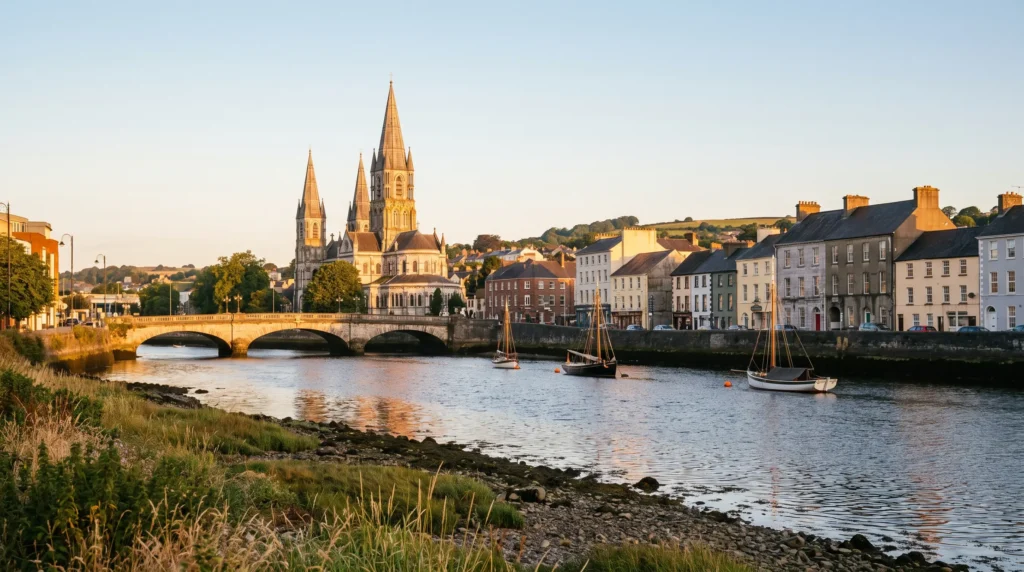
Cork Travel Guide — Ireland’s Rebel City, the English Market & the Real Capital of Craic
Every Corkonian will tell you, usually within the first five minutes of meeting you, that Cork is the “real capital” of Ireland — a joke that started during the Irish Civil War and never stopped being repeated, because there’s just enough truth in it to sting Dublin a little. I love Dublin, but Cork is the city I’d actually want to live in: it’s small enough to walk end to end in an afternoon, built on an island between two channels of the River Lee, and stitched together by hills, steps and quays that make it feel more like a miniature Lisbon than anything else in Ireland. It has one of the best covered food markets in Europe, a pub culture that doesn’t perform for tourists because it doesn’t need to, and a hinterland — Kinsale, Cobh, Blarney — that most visitors treat as day-trip footnotes to Dublin when they deserve to be the main event. The catch is that Cork doesn’t sell itself the way Dublin does, so you have to actually plan for it rather than stumble into it, and this guide is here to make sure you do.
In This Guide
- Overview — Why Cork Is Ireland’s Best-Kept Open Secret
- Guinness Cork Jazz Festival — Late October
- Best Time to Visit Cork (Season by Season)
- Getting There — Cork Airport & the Dublin Rail Link
- Getting Around — Walking, Buses & Hills
- Neighborhoods — From the Marsh to Montenotte
- Culture & People — Rebels, Rugby & the Cork Accent
- A Food Lover’s Guide to Cork
- Off the Beaten Path
- Day Trips — Kinsale, Cobh & Blarney
- Practical Information
- Budget Breakdown — What Cork Actually Costs in 2026
- Frequently Asked Questions
Overview — Why Cork Is Ireland’s Best-Kept Open Secret
Cork was founded, reputedly by Saint Finbarr, as a monastic settlement in the sixth century, urbanized by Norse traders in the early 900s, and chartered as a city by Prince John in 1185 — which makes it older than most of the countries whose flags fly over its harbour today. With around 224,000 people in the city proper, it’s Ireland’s second city and the largest in Munster province, though talking to locals you’d think it outranks Dublin on every metric that matters.
The physical shape of the place is what makes it fun to walk: the historic core sits on an island formed by two channels of the River Lee, so you’re constantly crossing bridges, and the surrounding hills mean half the city is looking down at the other half. Two nicknames tell you everything — “the Rebel City,” a name that stuck from Cork’s support of the Yorkist cause in the Wars of the Roses centuries before it took on new meaning during the Irish War of Independence and Civil War, and “the Real Capital,” a tongue-in-cheek dig at Dublin from that same civil-war era that Corkonians have never once let go of.
What Cork doesn’t have is Dublin’s crowds or Dublin’s prices, and that’s the whole pitch. You get an internationally famous food market, a genuinely excellent university city energy from University College Cork, live trad and jazz most nights of the week, and a coastline — Kinsale, Cobh, the harbour itself, one of the largest natural harbours in the world — that most Dublin-based itineraries only glimpse from a coach window.
Guinness Cork Jazz Festival — Late October
Time an October trip around the last weekend of the month for the Guinness Cork Jazz Festival, Ireland’s biggest jazz event, running since 1978 and drawing performers of the calibre of Dizzy Gillespie, Wynton Marsalis, Herbie Hancock and B.B. King over the decades. The festival began almost by accident — a cancelled bridge tournament left the Metropole Hotel with empty rooms over Ireland’s newly created October bank holiday weekend in 1978, and a hotel marketing manager with a jazz-musician friend turned the gap into a festival.
Nearly fifty years on, it spills out of ticketed venues into free gigs in dozens of pubs across the city centre, and it reliably draws crowds well beyond 40,000. Book accommodation months ahead if you’re aiming for this weekend — it’s the one time of year Cork’s hotels genuinely sell out.
Best Time to Visit Cork (Season by Season)
May – September · The main window
Cork’s mild oceanic climate means temperatures rarely climb above 25°C even at the height of summer, and rarely fall below 0°C in winter — this isn’t a place chasing extremes. May through September gives you the longest daylight, the best odds of dry stretches, and the fullest calendar of outdoor events. July and August are busiest and priciest; late May, June and September thin the crowds without losing the weather.
Late October · Jazz season
The Guinness Cork Jazz Festival takes over the last weekend of October — brilliant atmosphere, but book well ahead.
November – April · Green, grey and quiet
Cork’s average annual rainfall runs to about 1,239mm, and it’s spread fairly evenly across the year, so don’t expect a genuine dry season — pack a proper rain jacket whenever you go. Winter brings short days and wet pavements, but also the lowest hotel prices, a cosy pub-and-fireplace charm, and St. Patrick’s Day in March if you time it right.
Getting There — Cork Airport & the Dublin Rail Link
Cork Airport (ORK) sits about 6.5 kilometres south of the city centre in Farmers Cross and is Ireland’s second-busiest airport after Dublin, handling roughly 3.46 million passengers in 2025. Aer Lingus and Ryanair both run significant operations from here, with the busiest routes connecting to London Heathrow, London Stansted and Málaga, plus a growing list of European and UK links. A €200 million investment plan announced in 2025 — a new pier, extra gates, a solar farm and expanded parking — signals the airport expects to keep growing. Taxis into the city centre take about 15–20 minutes; airport buses run regularly and cost far less.
If you’re arriving from Dublin instead, Irish Rail’s Dublin–Cork main line covers around 267 kilometres between Dublin Heuston and Cork Kent Station, with the fastest scheduled service completing the run in as little as 2 hours 15 minutes. It’s a genuinely pleasant way to bridge the two cities — comfortable, scenic past Portlaoise and the Golden Vale, and far less hassle than driving into either city centre. Ferries also connect Cork’s port at Ringaskiddy to Roscoff and Santander for anyone road-tripping in from France or Spain.
Getting Around — Walking, Buses & Hills
Cork’s compact city centre — the island between the two channels of the River Lee — is entirely walkable, and honestly the best way to experience it, since half the character is in the bridges, steep side streets and sudden harbour views you’d miss from a bus window. Bus Éireann and Cork’s local city bus network cover the suburbs and outlying attractions like Blarney and the airport reasonably well, with single fares a few euro and day tickets available for heavier use.
Taxis are plentiful and metered fairly; ride-hailing apps have limited coverage compared to bigger European cities, so it’s worth having a local taxi firm’s number saved. If you’re planning day trips to Kinsale, Cobh or further into West Cork, renting a car for a day or two is the easiest option — just remember Ireland drives on the left, and Cork’s older streets were not designed with modern cars in mind, so be ready for tight turns and confident parallel parking.
Neighborhoods — From the Marsh to Montenotte
The City Centre & the English Market
The historic core, on the island between the Lee’s two channels, is where you’ll spend most of your time: Patrick Street’s shopping, St. Peter’s and St. Paul’s laneways, and the covered English Market, founded in 1788 and one of Europe’s oldest continuously operating municipal food markets. It survived a devastating 1980 fire and reopened fully restored by the end of 1981, and its ornamental Princes Street entrance still dates to 1862.
Shandon & the Northside
Climb the hill north of the river to Shandon, home to St. Anne’s Church and its famous bells, which visitors are invited to climb up and ring themselves — a rare hands-on landmark. The Butter Exchange nearby recalls Cork’s centuries as a global butter-export hub.
The Marsh & South Parish
The oldest part of the city, anchored by St. Finbarre’s Cathedral, a Gothic Revival spire visible from most of the surrounding hills, and quieter residential streets that feel a world away from Patrick Street’s bustle.
University College Cork & the Western Road
UCC’s leafy quadrangle and riverside grounds give the western end of the city its student energy, with good cafes and a genuinely lovely campus worth a wander even if you have no reason to be there.
Montenotte & Tivoli
Steep, leafy hillside suburbs east of the centre with some of Cork’s best harbour views and grand Georgian and Victorian houses — a good half-day wander for anyone who likes a hill-climb reward.
Docklands
Cork’s dockside quays, where the Lee’s channels open toward the harbour, are undergoing major redevelopment and are worth a walk for a sense of the city’s maritime scale and its ambitions for the next decade.
Culture & People — Rebels, Rugby & the Cork Accent
Corkonians have a reputation, entirely self-applied and entirely accurate, for civic pride bordering on the theatrical — the “Rebel City” and “Real Capital” nicknames aren’t tourist-board branding, they’re how people actually talk about their own city. The accent is distinctive even by Irish standards — a lilting, sing-song rhythm that locals will happily perform for you if you ask nicely, and gently mock you for trying to imitate.
Cork’s identity leans hard on food, music and sport: hurling and Gaelic football matter enormously here, GAA county colours (red and white) show up everywhere, and traditional and jazz music both have deep roots that show up in pub sessions most nights of the week, not just during festival weekends. Cork was also a European Capital of Culture in 2005, a designation that funded a wave of arts venues and public spaces still in use today.
A Food Lover’s Guide to Cork
Start at the English Market, where stalls have sold meat, fish and produce since 1788, and where tripe and drisheen, spiced beef, and fresh Atlantic seafood sit alongside artisan cheese and olive stalls. It survived the Famine years fully open and a devastating 1980 fire, and it remains the single best introduction to what Cork eats.
Cork’s food identity is built on a butchery and dairy heritage that once made it a global butter-export capital, and that shows up today in exceptional charcuterie, farmhouse cheese and, unavoidably, spiced beef around Christmas. Seafood is the other pillar — Cork Harbour and the coast supply the restaurants of Cork city and neighbouring Kinsale (more on that gourmet-capital reputation in the day-trips section below) with some of the best oysters, mussels and fresh fish in Ireland.
Pair meals with Irish stout, obviously, but also seek out Cork’s own microbreweries and gin distilleries, which have multiplied over the last decade. A proper Irish breakfast — rashers, sausages, black and white pudding, eggs — is worth doing at least once, ideally the morning after a jazz-festival night out.
Off the Beaten Path
Fota Wildlife Park
A 100-acre park on Fota Island, opened in 1983 as a joint project between the Zoological Society of Ireland and University College Cork, where giraffes, cheetahs and ring-tailed lemurs roam with minimal barriers between you and them. It’s home to nearly 30 mammal and 50 bird species and runs genuine conservation breeding programmes, not just a petting zoo with a gift shop.
Shandon Bells & the Butter Museum
Most visitors skip Shandon entirely, which is a mistake — climbing St. Anne’s tower to ring the bells yourself is the kind of hands-on landmark experience that’s disappeared from most European cities.
The Lee Fields & Marina Walk
A flat, riverside walking and running route favoured by locals rather than tour groups, with none of the crowds of the city centre and some of the best sunset views over the water.
West Cork’s Backroads
Push further west past Kinsale toward Clonakilty, Skibbereen and the Mizen Head peninsula for a slower, more rural Ireland than anything the city itself offers — fewer tour buses, more actual farms.
Day Trips — Kinsale, Cobh & Blarney
Kinsale
A compact harbour town about 30 minutes south of Cork by car, Kinsale has spent decades building a reputation as Ireland’s gourmet capital, with a “Good Food Circle” of quality restaurants that grew out of just two eateries into dozens today. Its history runs deeper than the food scene: the pivotal 1601 Battle of Kinsale was fought here, and the star-shaped Charles Fort, built from 1677, still guards the harbour mouth alongside the earlier James Fort. Narrow streets, painted cottages and a yacht-filled harbour make it one of the most photogenic towns in the south of Ireland.
Cobh
Formerly Queenstown — renamed in 1849 after a visit from Queen Victoria, then renamed again to Cobh after independence in 1920 — this harbourside town of around 14,000 people was the departure point for roughly 2.5 million of the six million Irish people who emigrated to North America between 1848 and 1950. It was also the Titanic’s final port of call on 11 April 1912; of the 123 passengers who boarded there, only 44 survived. Three years later, victims of the torpedoed RMS Lusitania, sunk off nearby Old Head of Kinsale in 1915, were brought back to Cobh, and many are buried there still. The Cobh Heritage Centre, in the former White Star Line ticket office, covers both stories well.
Blarney Castle
About 20 minutes northwest of the city, Blarney Castle’s current keep dates to 1446, built by Cormac Láidir MacCarthy, standing roughly 90 feet tall over grounds that include a poison garden and rock formations nicknamed the Druid’s Circle. The famous Blarney Stone sits among the battlements at the top, and kissing it — while hanging backward over a real drop, held by a castle attendant — is supposed to grant the “gift of eloquence.” It’s touristy and the queue can be long in summer, but it’s touristy for a reason: the grounds alone are worth the trip even if you skip the stone.
Practical Information
Money. Ireland uses the euro; US dollars and UK sterling are not accepted as currency, so change or withdraw euro on arrival. Cards are widely accepted, including contactless, but carry some cash for markets and smaller pubs.
Safety. The US State Department rates Ireland Level 1 — Exercise Normal Precautions, its lowest advisory tier, though it notes rising rates of theft and petty crime targeting tourists, including thefts from rental cars, plus romance and bail-money scams to watch for. The UK Foreign Office’s guidance for Ireland is similarly low-key, with no significant current warnings. Remember Ireland drives on the left — this catches out more visitors than any actual crime does.
Health. No special vaccinations are required for Ireland; the CDC’s standard advice is to be current on routine immunizations (MMR, Tdap, influenza), with hepatitis A worth considering if you’ll be eating a lot of street food or visiting rural areas. Tap water is safe to drink throughout Cork city.
Connectivity. An eSIM or local SIM gives solid 4G/5G coverage in Cork city and most day-trip towns; coverage thins out on rural West Cork backroads. Plugs: Type G, 230V/50Hz, the same three-pin plug used across the UK. Time zone: Irish Standard Time (UTC+1 in summer, UTC in winter), the same zone as the UK.
Budget Breakdown — What Cork Actually Costs in 2026
Cork runs noticeably cheaper than Dublin for accommodation and comparable for food and drink — a good-value base if you’re splitting time between the two.
Budget (US$70–110/day): Hostel dorm or budget guesthouse, English Market lunch or pub grub, city bus fares, one museum or the Shandon bells climb.
Mid-range (US$150–250/day): Boutique B&B or three-star hotel, a proper restaurant dinner, entry to Blarney Castle or Fota Wildlife Park, a half-day Kinsale or Cobh trip by rail or organized tour.
Splurge (US$350+/day): Kinsale gourmet tasting menu, a countryside manor stay, a private guide for Cobh’s Titanic and emigration history, premium jazz-festival tickets if your dates line up.
Tipping isn’t obligatory the way it is in the US — 10% for a good restaurant meal is generous and appreciated, and rounding up is normal in pubs and taxis.
Planning Your First Trip to Cork
The classic first-timer split is city plus coast: two nights in Cork city itself for the English Market, Shandon and pub life, then a night or two based in Kinsale for the gourmet scene and forts, with Cobh and Blarney worked in as half-day trips by rail, bus or rental car. Four to five nights covers the essentials comfortably; a week lets you push further into West Cork’s backroads. Pair it with a few days in Dublin for the classic two-city Ireland itinerary, or use Cork as your base for the rest of our full Ireland travel guide covering the whole country.
Frequently Asked Questions
Is Cork safe for tourists in 2026?
Yes — Ireland sits at the US State Department’s lowest advisory level, Level 1, and Cork is generally relaxed and easygoing. Standard city-centre precautions apply — watch belongings in busy pubs and don’t leave valuables visible in rental cars, since thefts from cars have been rising.
Do I need a visa to visit Cork?
US, UK, EU and Canadian passport holders don’t need a visa for tourist stays of up to 90 days; just bring a passport valid for your full trip.
How many days do I need in Cork?
Two full days covers the city centre itself — English Market, Shandon, St. Finbarre’s Cathedral, a night out for music. Add a third or fourth day for Kinsale, Cobh or Blarney, since each is a genuine half-day trip rather than a quick stop.
Is Cork better than Dublin?
Ask a Corkonian and you already know the answer. Realistically: Dublin has more sights, nightlife density and direct flights; Cork has better food-market culture, an easier pace, cheaper accommodation, and a coastline Dublin can’t match. Most visitors are glad they did both.
Can I do Cork as a day trip from Dublin?
Technically yes — the fastest direct train covers the roughly 267 kilometres in about 2 hours 15 minutes each way — but it wastes the point of the place. Stay at least one night if you can.
What’s the cheapest way to see Kinsale, Cobh and Blarney?
Public transport handles all three affordably: local trains and buses reach Cobh and Kinsale directly from Cork city, and Blarney is a short, cheap bus ride northwest. Renting a car for a single day is worth it only if you want to link two or three stops without waiting on timetables.
Ready to Explore Cork?
A food market older than most nations, a harbour town that watched the Titanic sail to its end, a castle stone that promises eloquence, and a city that will absolutely tell you it’s the real capital of Ireland whether you asked or not. Cork rewards travelers willing to slow down for a few days rather than tick it off between Dublin and the airport — go before everyone else figures that out too.
Explore More
- Ireland Travel Guide — the full country beyond Cork
- Dublin City Guide — pair Cork with Ireland’s capital
- Edinburgh City Guide — more Celtic history across the water
- London City Guide — the easiest gateway city for a UK-Ireland trip
How this guide was built
Published as part of Facts From Upstairs’ city guide series. Built from authoritative sources — Wikipedia entity pages for Cork city, Cork Airport, Cobh, Blarney Castle, Fota Wildlife Park, the Cork Jazz Festival and the Dublin–Cork railway line; Cork City Council’s official history of the English Market; the official Kinsale.ie town site; the US State Department and UK FCDO travel advisory pages for Ireland; the US CDC traveler page for Ireland; and World Standards’ plug-and-voltage reference for Ireland. Numeric claims carry inline citations.
Sources cited on this page
- Wikipedia — Cork (city)
- Wikipedia — Cork Airport
- Cork City Council — History of the English Market
- Wikipedia — Cobh
- Wikipedia — Blarney Castle
- Wikipedia — Fota Wildlife Park
- Wikipedia — Cork Jazz Festival
- Wikipedia — Dublin–Cork railway line
- Kinsale.ie — About Kinsale
- US State Department — Ireland
- UK FCDO — Ireland
- US CDC — Ireland traveler page
- World Standards — Ireland plug & voltage
More city guides you might like
Plan your trip to Cork
The booking tools we use ourselves. FFU may earn a commission at no extra cost to you.
Plan & book your trip to Cork
Booking through these searches supports our guides at no extra cost to you.