
☰ On this page
- 📋 In This Guide
- Why Lisbon — Why It Belongs on Every Europe List
- 🌳 Late-April 2026 — Jacaranda Bloom & the Carnation Revolution
- Best Time to Visit Lisbon (Season by Season)
- Getting There — Flights & Arrival
- Getting Around — Trams, Metro, Funiculars
- Neighbourhoods — Where to Base Yourself
- Cultural Sights — Belém, Alfama & the Tile Museum
- A Food Lover’s Guide to Lisbon
- Entertainment, Fado & Late Nights
- 🗓️ Sample Itineraries — 2, 3 and 5 Days
- Day Trips — Sintra, Cascais, Évora
- 📸 Photography Notes
- Practical Information
- Budget Breakdown — What Lisbon Actually Costs
- ✅ Pre-Trip Checklist
- 🤔 What Surprises First-Timers
- Frequently Asked Questions
- Ready to Experience Lisbon?
- Explore More
Lisbon, Portugal: Seven Hills, Tile Façades & the Atlantic at the End of Europe
Part of our Portugal travel guide.
Lisbon is the only Western European capital that faces the open Atlantic — the city sits on the north bank of the Tagus estuary, eleven kilometres east of where the river meets the ocean, and on a clear afternoon you can stand on the Miradouro de Santa Catarina and see container ships heading west toward nothing but Brazil. For five centuries this orientation defined the city. The Portuguese caravels that sailed from Belém in the 1490s opened the maritime route to India, then to Brazil, then to Macao and Nagasaki, and the Manueline-style monastery they built on their return is still there at the river’s mouth. Lisbon is the place where Europe ran out of road.
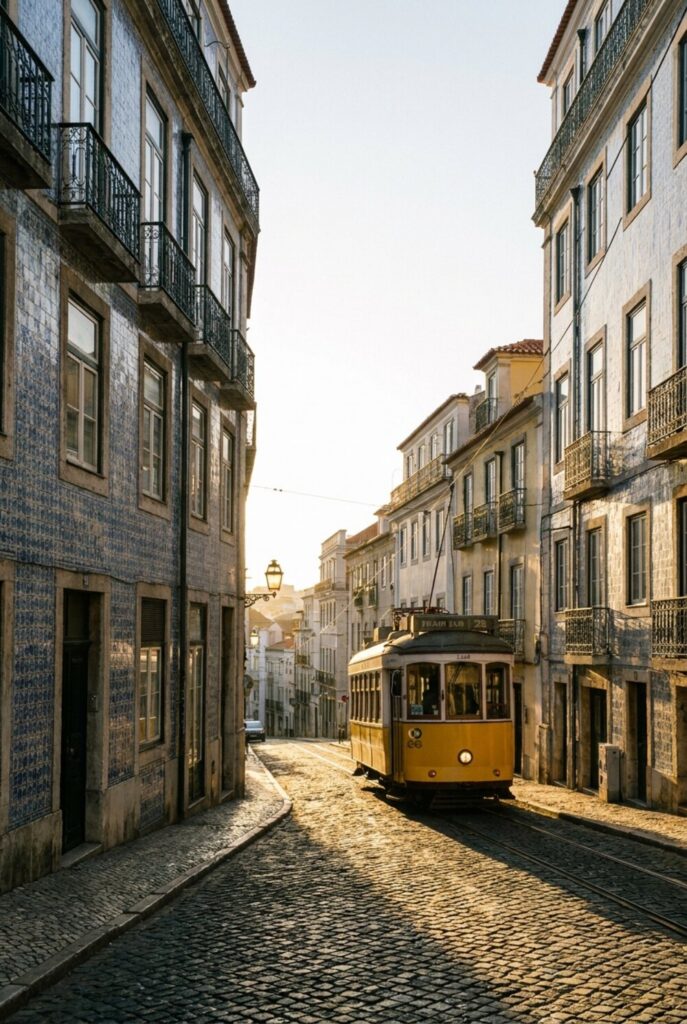
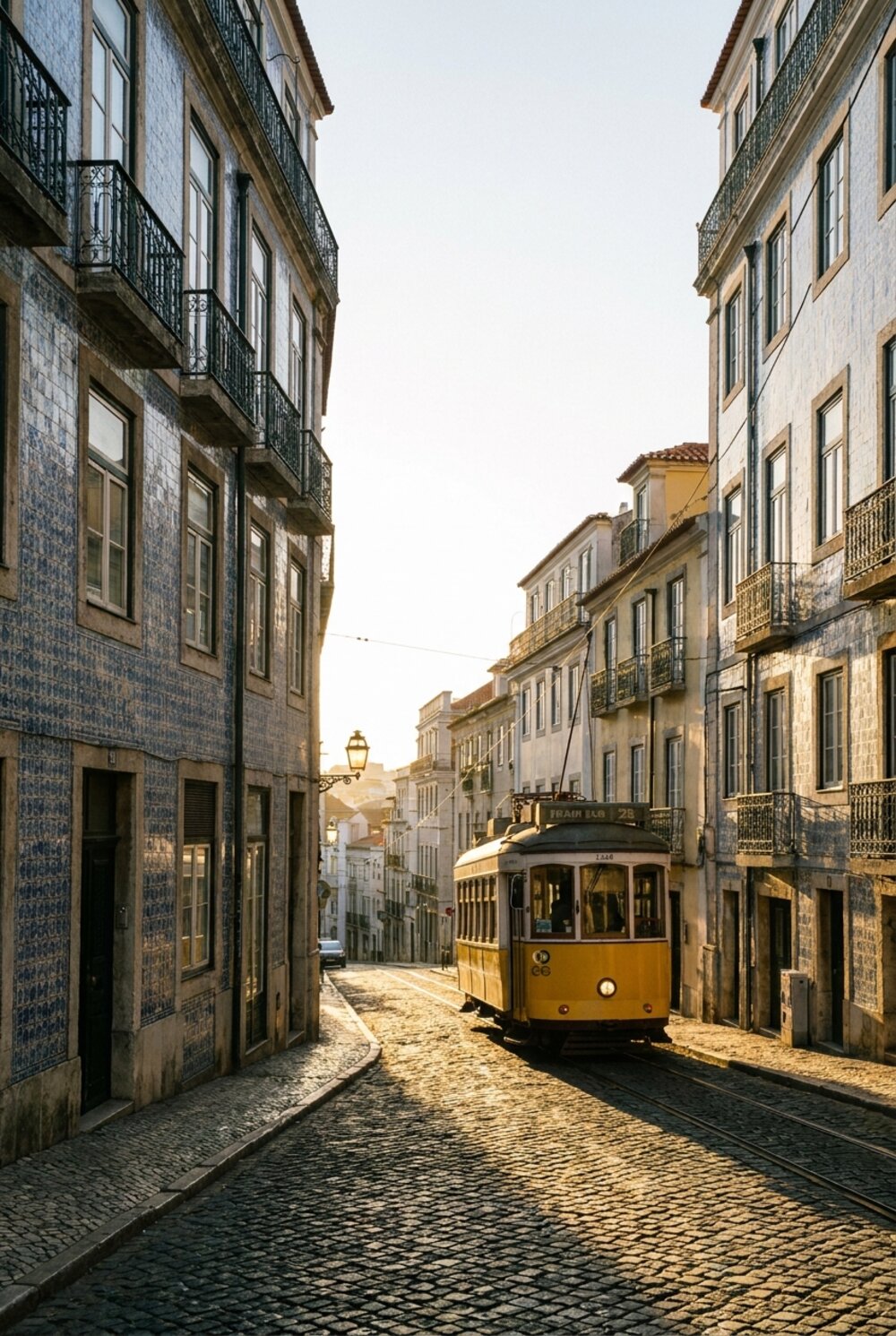
What makes the city extraordinary on a first visit is not the monuments. It is the texture. Seven hills rise from the river — the locals will count more, depending on whether they include the southerly ones across the Tagus — and almost every street between them is paved in calçada portuguesa, the small white-and-black limestone cubes laid by hand into geometric patterns since the 1840s. The walls are clad in azulejos, the glazed tiles imported from Moorish North Africa in the 13th century and adapted into a national art form by the 17th. The trams that climb the hills are wooden, yellow, and so steep on the Bica funicular line that you stand against the back wall to keep level. The light, when it falls in late April, is the soft, opal-white of an ocean city that hasn’t fully committed to summer.
This guide covers Lisbon end-to-end — from the Alfama at dawn to the Bairro Alto after midnight, from a €1.40 pastel de nata at Manteigaria to a €180 tasting menu at Belcanto. If you’re working a wider Iberian or Atlantic itinerary, see our Portugal travel guide, our Madrid city guide for the inland cousin, our Barcelona city guide for the Mediterranean counterweight, and our Marrakech city guide for the trans-Mediterranean trading partner that shaped Portuguese material culture. For broader trip mechanics, the trip planner handles the moving parts.
📋 In This Guide
- Why Lisbon — Why It Belongs on Every Europe List
- 🌳 Late-April 2026 — Jacaranda Bloom & the Carnation Revolution
- Best Time to Visit Lisbon (Season by Season)
- Getting There — Flights & Arrival
- Getting Around — Trams, Metro, Funiculars
- Neighbourhoods — Where to Base Yourself
- Cultural Sights — Belém, Alfama & the Tile Museum
- A Food Lover’s Guide to Lisbon
- Entertainment, Fado & Late Nights
- 🗓️ Sample Itineraries — 2, 3 and 5 Days
- Day Trips — Sintra, Cascais, Évora
- 📸 Photography Notes
- Practical Information
- Budget Breakdown — What Lisbon Actually Costs
- ✅ Pre-Trip Checklist
- 🤔 What Surprises First-Timers
- Frequently Asked Questions
- Ready to Experience Lisbon?
- Explore More
Why Lisbon — Why It Belongs on Every Europe List
Lisbon was a quiet, slightly faded capital for most of the 20th century — emptied by emigration during the Salazar dictatorship (1933–1974), bypassed by the European tourist economy that built up Barcelona and Rome, and so cheap by the late 1990s that whole districts of the Baixa stood with shop fronts boarded shut. Then four things happened in succession: Portugal joined the Eurozone (1999), Lisbon hosted the European Football Championship (2004), the global financial crisis sent Northern Europeans south for cheaper housing (2008–2014), and the Web Summit moved here from Dublin in 2016. The city tipped. Today’s Lisbon is the most visited capital in Europe by year-on-year growth rate, the European headquarters of more startup capital than any other city of comparable size, and the home of three Michelin two-star restaurants.
It is also a city of compression. The historic centre — Baixa, Chiado, Bairro Alto, Alfama, Mouraria — fits inside a 2.4 km² rectangle you can walk corner to corner in 45 minutes if you ignore the hills. The hills make it slower. Lisbon’s “seven hills” (the locals will tell you they’re more like nine, but seven is the canonical count) are not gentle suburban rises. The grade on Calçada do Combro reaches 22% in places. The historic Tram 28 climbs three of them on a single 8-kilometre route, which is why every guidebook in the world recommends it and why every guidebook in the world also warns about pickpockets on it. Both warnings are true.
The other thing nobody tells you: Lisbon is loud, social, and stays out late in a way that has nothing to do with the cliché of melancholy fado. The Bairro Alto on a Friday night looks like a single bar that has overflowed onto every street within a kilometre — and it has, because Portuguese law allows you to take your drink onto the street, and the bars price beer at €1.50 to €3 specifically because they expect you to drink it standing up outside. The fado clubs in the Alfama do open at 9 p.m. and run until 1 a.m., but the dance clubs at Cais do Sodré don’t start until 1:30. Lisbon’s night runs on Atlantic time.
🏛️ Historical Context
On the morning of November 1, 1755 — All Saints’ Day — at 9:40 a.m., a magnitude 8.5–9.0 earthquake struck off the coast of Cape St Vincent. Three shocks lasting six minutes total demolished most of central Lisbon. A 6-metre tsunami hit the Tagus 40 minutes later, drowning thousands who had fled to the riverfront for safety. Fires from cooking hearths and All Saints’ candles burned for five days. Total dead: 30,000 to 50,000 of the city’s 200,000 residents — somewhere between 15% and 25% of the population. The Marquis of Pombal, the king’s chief minister, organised the response within 48 hours (“bury the dead and feed the living”), then rebuilt the central Baixa as the world’s first earthquake-engineered urban grid: standardised four-storey buildings on wooden cage-frame foundations (the gaiola pombalina) designed to ride a quake out. The grid you walk in central Lisbon today is the result. Every street name and every building height was set in 1758–1762.
🎌 Did You Know?
Pastéis de Belém — the original 1837 pastry shop in the western Belém district that produced the prototype of the now-globally-famous custard tart — bakes more than 20,000 individual pastéis de nata every day. The recipe is a 19th-century secret that descends from the lay brothers of the Jerónimos Monastery next door, who used surplus egg yolks left over from starching their habits. Three master pastry chefs hold the recipe; it has never been written down in full. The shop has been continuously owned by the same family since 1837.
🌳 Late-April 2026 — Jacaranda Bloom & the Carnation Revolution
Late April in Lisbon is the most photogenic two-week stretch on the city’s calendar. The jacaranda trees — imported from Brazil in the 19th century, planted in long ranks down Avenida da Liberdade and around Praça do Império in Belém — bloom violet for roughly three weeks beginning in the third week of April. The exact timing varies year to year; 2025 was an early year (peak around April 18), 2024 a late year (peak around May 5). For 2026, expect peak bloom in the last week of April. The corridor of purple flowers along the Avenida is one of the great urban tree-displays of the European year, comparable to the cherry blossoms in Tokyo or the linden bloom in Berlin — only without the crowds, because nobody outside Portugal seems to know this is happening.
The other thing that happens in late April is the Carnation Revolution anniversary on April 25. Fifty-two years after April 25, 1974 — the morning a column of left-wing army officers drove tanks down the Avenida da Liberdade and ended 41 years of fascist dictatorship without firing a shot, while flower-sellers handed soldiers red carnations to put in their rifle barrels — Portugal still treats the date as the most important national holiday after Christmas. Avenida da Liberdade closes to traffic. Tens of thousands of Lisbon residents walk down it singing “Grândola, Vila Morena,” the Zeca Afonso song whose midnight broadcast on April 24, 1974 was the signal for the coup. Bars are full. Restaurants serve free carnations with dessert. If you have ever wanted to feel what an open European democracy feels like at its most self-aware, April 25 in Lisbon is the day.
The weather in late April is the city’s annual sweet spot. Daytime highs sit at 19–22°C, nights at 12–14°C, and the Atlantic-influenced air is dry and clear — the famously dramatic Lisbon light, the light Pessoa wrote about and Wim Wenders filmed and every photographer who has ever worked the city has called the best in Europe, is at its most reliable. The summer haze that softens the river view from the miradouros from June onward hasn’t yet arrived. The winter rain is finished. April is the photographer’s month and the walker’s month.
⚠️ Important — April 25 Holiday Logistics
April 25 is a national public holiday. Banks, government offices and most museums are closed. Restaurants are open but book up — the major fado houses (Mesa de Frades, A Baiuca, Clube de Fado) sell out two weeks ahead for the night of the 25th. The Avenida da Liberdade itself is closed to cars from roughly 11 a.m. through midnight; the metro runs as normal but is crowded. Tram 28 reduces frequency on holiday Saturdays. If your trip dates centre on April 25, book key restaurants and the Belém pastel de nata queue (which is shorter than usual on the holiday morning, longer than usual on the afternoon) accordingly. Most international guidebooks fail to mention any of this.
Best Time to Visit Lisbon (Season by Season)
Lisbon has a Mediterranean climate softened by the Atlantic — milder than Madrid in summer, milder than Rome in winter, and rainier than both in the wet months (November through February). The good seasons are long: from late March to early June, and from mid-September to early November, the weather is more or less ideal. The genuinely difficult seasons are short: late July and early August (heat-wave risk), and December through February (cold rain on slick calçada).
Spring (March – May)
The window described above. March is still cool (highs 17°C, occasional rain), April is the inflection (highs climb from 18°C to 22°C, jacarandas bloom in the last week), and May is warm and dry (highs 24°C, rare rain). Easter (April 5 in 2026) is more low-key than in Spain, but Holy Week processions in the Alfama and the Sé cathedral are worth the detour. Crowds are 35–55% lower than July, hotel rates 20–35% lower, and the Atlantic light is at its annual best. The Festas dos Santos Populares, which dominate June, haven’t started yet, so the Alfama is at its quietest.
Summer (June – August)
Hot, dry and crowded. Daytime highs sit at 28–32°C in June and routinely top 35°C in July and August. Heat waves above 40°C have happened every summer since 2018 (Lisbon hit 44°C on August 4, 2018, the hottest temperature ever recorded in the city). The Festas de Lisboa run through June with the Festa de Santo António on June 12–13 — a city-wide street party with grilled sardines, manjerico basil pots, and weddings of the marriage of poor couples sponsored by the city. Hotel rates peak in July. The Atlantic beaches at Cascais and Costa da Caparica are at their warmest. If you visit in summer, plan all major sightseeing for before 11 a.m. or after 5 p.m. The historic centre is unsuitable for midday walking on the hottest days.
Autumn (September – November)
Lisbon’s second-best season, after spring. September is still warm (highs 28°C) and the Atlantic is at its annual warmest — beach days at Cascais and Caparica are genuinely better in September than July. October is mild (highs 22°C dropping to 18°C by month’s end) and dry. November brings the first reliable rain of the year and the first chestnut sellers on Rossio Square. The Lisbon Marathon runs in mid-October, finishing at the Praça do Comércio. The Web Summit, the city’s annual tech conference, brings 70,000 delegates in early November and pushes hotel rates up 60–80% for that one week — book around it.
Winter (December – February)
Cool, grey, and the wettest months of the year. Daytime highs sit at 14–16°C, lows at 8–10°C. Lisbon receives 100–120 mm of rain in each of December, January and February. Tourist crowds are at their annual low; the Belém pastel de nata queue at 10 a.m. on a January Tuesday is 5 minutes against 90 minutes in July. Hotel rates are 40–55% off summer peak. The Christmas markets at Praça do Comércio and Rossio run from late November through early January. The downside: rain on calçada is treacherous (the polished limestone cubes are nearly frictionless when wet), the trams run reduced frequency, and many smaller fado houses close for two-week breaks in January.
🧳 Travel Guru Tip
If you have a week and want Lisbon at its photogenic best with manageable crowds and full restaurant availability, target the last week of April or the second week of October. Both windows give you 22–25°C days, 14°C nights, full restaurant openings, and hotel rates roughly 30% below July peak. The locals call October “Veranico de São Martinho” — a kind of Indian summer that often runs through the saint’s day on November 11. Most international guides default to recommending May or September, which are 10–15% more crowded and 15–20% more expensive than the genuine sweet spots.
| Season | Highs / Lows | Crowds | What’s open | Best for |
|---|---|---|---|---|
| Spring (Apr–May) | 22°C / 13°C | Moderate | Everything; jacarandas late Apr | Photography, walking, jacaranda bloom |
| Summer (Jun–Aug) | 30°C / 18°C | Heavy | All; festivals June | Beaches, festivals, late nights |
| Autumn (Sep–Nov) | 23°C / 14°C | Light to moderate | Everything; Web Summit early Nov | Sea swimming Sep, mild walking Oct |
| Winter (Dec–Feb) | 15°C / 9°C | Light | Most; some fado houses close Jan | Museums, low rates, no queues |
Getting There — Flights & Arrival
Lisbon has one international airport: Humberto Delgado (LIS), 7 km north of the city centre — startlingly close, possibly the most centrally located major airport in Europe. It handles roughly 33 million passengers annually, has been at capacity since 2019, and is connected to the city by metro, bus and taxi. A second airport at Alcochete, on the south side of the Tagus, is under approved construction but won’t open until at least 2034. For the rest of the decade, every flight in and out of Lisbon goes through Humberto Delgado.
From most of Europe expect 2h–3h: London 2h45m, Paris CDG 2h35m, Frankfurt 3h, Madrid 1h25m, Rome 3h, Amsterdam 3h, Berlin 3h30m. From North America there are direct flights from New York JFK (TAP, Delta, United; 7h30m), Newark (United), Boston (TAP), Toronto (Air Canada, TAP), Miami (TAP, American), Washington Dulles (United), and seasonal service from Chicago and San Francisco. TAP Air Portugal (the flag carrier and a Star Alliance member) offers the densest network from European secondary cities. Round-trip fares from London or other major European hubs in spring shoulder season run €100–180 if booked 6–10 weeks ahead.
From the airport into the city, three main options. The metro red line connects directly to the airport terminal, runs every 6–9 minutes (6:30 a.m. – 1:00 a.m.), 25 minutes to Saldanha or Alameda for downtown transfers, €1.80 one-way plus €0.50 for the reusable Viva Viagem card. The Aerobus 91 runs every 20 minutes to the city centre via Marquês de Pombal and Restauradores, €4 one-way. A taxi is metered at €15–22 to the historic centre depending on traffic and time; airport surcharges apply (€1.60 for the rank queue, €1.85 for night rates). Uber and Bolt operate freely and are typically 10–20% cheaper than metered taxis for the same trip.
✨ Pro Tip
If you’re flying TAP and connecting onward to a Portuguese island (Madeira or the Azores) or to Brazil, build a stopover in Lisbon. TAP’s stopover programme lets you stay in Lisbon up to 5 nights for no additional fare on most international itineraries — same total ticket price. The programme has been running since 2017 and is one of the better-kept secrets in European aviation. Use the multi-city search on flytap.com and pick a 1-, 3- or 5-night stop. It’s roughly the same value as Icelandair’s transatlantic stopover but for the southern Atlantic axis.
Getting Around — Trams, Metro, Funiculars
Lisbon has the most romantic-looking public transport system in Europe and one of the most genuinely useful. The 1901-vintage yellow trams (still in service on five routes), three steep funiculars (Bica, Glória, Lavra), the Santa Justa elevator (Eiffel-pupil cast-iron lift, 1902), the four-line metro (opened 1959), the suburban rail (to Cascais and Sintra), and the river ferries (to Cacilhas and Almada) all use the same Viva Viagem card. Buy the card once (€0.50), then either zap it (€1.80 per ride for metro/bus/tram) or load it with a 24-hour pass (€6.80 for unlimited metro/bus/tram/funicular/elevator).
For sightseeing in the historic centre, the metro is fastest, the tram is most photogenic, and walking is most useful for the Alfama (which the trams skirt rather than enter — the streets are too narrow). The famous Tram 28 runs from Martim Moniz across Graça, the Sé cathedral, the Baixa, the Chiado, and Estrela — eight kilometres, 35–55 minutes depending on traffic, and the closest thing Lisbon offers to a single-route greatest-hits tour. It is also the city’s prime pickpocket spot. See the regulatory callout below.
Taxis, Uber and Bolt are abundant and cheap (€5–10 for most central trips, €12–18 across town). Tipping is not expected; rounding up to the nearest euro is standard. The one place where ride-hail beats taxis is the airport run — Uber is typically €13–17 against the metered taxi’s €18–22.
♟️ Strategy
Buy the 24-hour Viva Viagem unlimited pass (€6.80) on every day you intend to ride trams or funiculars. A single ride on Tram 28 is €3 cash from the conductor or €1.80 zapped on the card; a single funicular ride is €4.10 cash or €1.80 zapped. The break-even is roughly four rides per day. With Tram 28, the Bica funicular, the Glória funicular, and the Santa Justa elevator on the same itinerary, you’ll cross break-even before lunch. Pair it with the €30 Lisboa Card if you’re doing the Belém run on day 1 (it covers Jerónimos, Belém Tower, the National Coach Museum, the train to Sintra and unlimited transit for 24 hours; €40 for 48-hour and €51 for 72-hour versions).
Neighbourhoods — Where to Base Yourself
Comparing Lisbon with Porto or the Algarve? Our guide to where to stay in Portugal covers all three.
📍 Lisbon Map: Every Place in This Guide
Lisbon’s historic centre is a dense cluster of small neighbourhoods, each with a distinct flavour and a different argument for staying there. The 25-minute walking radius from Rossio covers basically every base worth considering for a first visit.
🏛️ Baixa & Chiado — The Pombal Grid & the Bookshops
The flat downtown rebuilt by Pombal after 1755, on a strict grid running from Praça do Comércio at the river to Rossio at the foot of the hills. Baixa is shopping streets and pedestrianised squares; Chiado, climbing the western slope toward Bairro Alto, is the elegant 19th-century commercial district where Pessoa drank coffee at A Brasileira and where Bertrand bookshop (founded 1732) is the oldest continuously operating bookshop in the world. Stay here for central-everything access and the easiest walking; rates run €130–220 for a mid-range hotel in shoulder season.
🏘️ Alfama & Mouraria — The Medieval Hill
The oldest continuously inhabited part of Lisbon — the only neighbourhood that survived the 1755 earthquake intact, because its limestone bedrock and tightly clustered Moorish-era street plan happened to be exactly the right structure for a magnitude 8.5 quake. Stay here for atmosphere, fado clubs at your doorstep, and views from the Miradouro das Portas do Sol that you’ll never forget. The trade-offs: streets too steep and narrow for taxis to reach most addresses, baggage drag-up of 15 minutes from the nearest tram stop, and tram 28 noise from 6 a.m. The neighbourhood is also fado’s birthplace — a UNESCO Intangible Cultural Heritage element since 2011.
🍻 Bairro Alto & Príncipe Real — The Bars & the Boutique Hotels
The 16th-century upper-town district that has been Lisbon’s nightlife centre for at least 50 years — and is now also the city’s prime boutique-hotel and design-shop neighbourhood, especially in Príncipe Real (the higher, leafier section to the north). Stay here if you prioritise dinner-and-drinks proximity and don’t mind 3 a.m. street noise on weekends. Príncipe Real specifically (around Praça do Príncipe Real itself) is quieter; the central Bairro Alto blocks south of Rua da Misericórdia are loud Friday and Saturday until 4 a.m.
🌊 Cais do Sodré & Santos — The Riverfront
The renovated docklands strip running west along the Tagus from Praça do Comércio. Cais do Sodré is the late-night dance-club zone (Pensão Amor, Sol e Pesca, Pink Street) and the Time Out Market food hall is here. Santos to the west is quieter, more design-led, with the LX Factory creative complex 1.5 km further on at Alcântara. Stay here for water views and an easy walk to Belém via the riverfront tram or a bike-rental.
🌳 Belém & Restelo — Out West, Near the Monasteries
Six kilometres west of the centre, where the Jerónimos Monastery, the Belém Tower, the original Pastéis de Belém, the Coach Museum and the new MAAT (Museum of Art, Architecture and Technology) all cluster. Belém is residential, leafy and quiet — a good base for travellers who want the Atlantic sound and don’t mind a 12-minute tram ride to the centre for dinner. Most visitors do Belém as a half-day trip from a Baixa or Chiado base, but staying here for two of three nights is a defensible alternative if you want a quieter atmosphere.
✨ Pro Tip
For a 3-night first visit, book Príncipe Real or upper Chiado. You get the Bairro Alto bars two streets south, the Avenida da Liberdade jacarandas eight minutes’ walk north, the Baixa and Rossio at the bottom of the slope, the metro at Avenida or Rato, and rates 15–25% below comparable Baixa or Alfama hotels. The streets around Praça do Príncipe Real itself (Rua da Escola Politécnica, Rua Dom Pedro V, Rua do Século) are the prime corridor.
Lisbon at a Glance
Cultural Sights — Belém, Alfama & the Tile Museum
Short on time? See the 7 Lisbon tours actually worth booking in 2026.
Lisbon’s cultural sights cluster in three rough zones: Belém (6 km west, the maritime monuments), the central historic core (Alfama, Castelo de São Jorge, Sé), and the eastern museums (Tile Museum, Gulbenkian). For deeper country-level context on Portuguese history see our Portugal travel guide.
Mosteiro dos Jerónimos & Torre de Belém
The two surviving great Manueline-style buildings of Portuguese maritime expansion, both 1500–1520, both UNESCO-inscribed in 1983. The Jerónimos Monastery — funded by a 5% tax on the spice trade returning from Vasco da Gama’s voyages — has the most extraordinary cloister in southern Europe: two storeys of carved limestone with maritime motifs (rope, anchors, astrolabes) replacing the conventional Gothic foliage. The tomb of Vasco da Gama (1469–1524) sits in the church just inside the western entrance; Pessoa’s tomb is at the back. The Belém Tower, 800 metres west on the river, was built 1514–1519 as a fortified ceremonial gateway for ships departing for India — a small, white, Manueline-Gothic confection on a basalt outcrop in the Tagus.
Castelo de São Jorge & the Alfama
The Moorish castle on Lisbon’s central hill, fortified continuously since the 6th century BC and the citadel of the city until 1255. Today it’s primarily a viewpoint — the inner walls are intact, the lower town spreads below in the late-afternoon light, and the river curls south. The Alfama beneath is where you walk afterward: the Sé cathedral (1147, the oldest church in Lisbon), the Miradouro de Santa Luzia (azulejo-clad terrace with views across the Alfama rooftops to the river), the Miradouro das Portas do Sol (better-known sister terrace), and the Igreja de São Vicente de Fora (1582, the patriarchate church with its monastery cloister of 100,000 azulejo tiles depicting La Fontaine fables).
Museu Nacional do Azulejo
The most under-rated museum in the city, in a 16th-century convent on the eastern edge of central Lisbon (a 12-minute taxi from the Baixa). Six centuries of Portuguese tile production, including a 23-metre azulejo panel from 1740 that depicts the Lisbon waterfront before the 1755 earthquake — the only surviving complete visual record of the pre-quake city. Also a working chapel where every wall surface above floor level is glazed tile. Allow two hours.
Museu Calouste Gulbenkian
The private collection of the Armenian oil magnate Calouste Gulbenkian (1869–1955), bequeathed to Portugal because the country gave him refuge in 1942 when Vichy France revoked his French residency. Egyptian, Greco-Roman, Mesopotamian, Persian, Islamic, East Asian, European medieval through impressionist, and the world’s most comprehensive single-collector René Lalique holding. The 1969 modernist building, set in a 7-hectare garden in the northern Avenidas Novas district, is itself a masterpiece. Free on Sundays after 2 p.m.
MAAT & LX Factory
The contemporary western riverfront. The MAAT (Museum of Art, Architecture and Technology), opened 2016, is the elegant low-slung Amanda Levete-designed building you’ll see from the boat to Cacilhas — climb the roof for the best ground-level river view in the city. LX Factory, a converted 19th-century textile mill complex 1 km further west, is the city’s design-and-creative quarter — independent bookshops, hipster restaurants, and a Sunday market.
📜 Regulatory Notice — Tourist Tax & Pickpocket Warnings
Since September 1, 2024, Lisbon has imposed a city tourist tax of €4 per person per night, capped at 7 nights per stay, applicable to all paid accommodation including hotels, hostels, short-term rentals and Airbnb-style stays. The tax is collected at check-in or check-out and is not included in most online booking-engine quoted rates — a 4-night stay for two adults adds €32 you should budget for. Children under 13 are exempt. Separately, central Lisbon has high pickpocket activity on Tram 28, on the Cais do Sodré platform of the green metro line, in the Sé cathedral square at 11 a.m. tour-bus arrivals, and around the Belém Tower exit at peak afternoon. The Portuguese police publish quarterly hotspot maps; the issue is property crime, not violence. Keep phones in front pockets, leave passports in the hotel safe, and avoid the back row of Tram 28 where pickpockets traditionally work.
“My soul is a hidden orchestra; I do not know what instruments, what violins and harps, what drums and tambours sound and clang inside me. I only know myself as a symphony.”
— Fernando Pessoa, The Book of Disquiet (written 1913–1935, published 1982), tr. Richard Zenith
📜 Cultural Voice
“The blind man stopped, asked, Where am I, the city was so silent that the steady murmur of the river seemed to come from the stones of the houses themselves. Without thinking, the doctor’s wife replied, We are in Lisbon, and from the highest hill we can see the river, but more than this no one can tell you, for everything in this world is so confused that we have ceased to know what we see.”
— José Saramago, Blindness (1995), tr. Giovanni Pontiero. Saramago won the Nobel Prize in Literature in 1998, the only Portuguese-language writer to do so.A Food Lover’s Guide to Lisbon
Portuguese food in Lisbon is having its moment. The city has nine Michelin stars across seven restaurants as of the 2025 guide, including two-star holders Belcanto (José Avillez) and Alma (Henrique Sá Pessoa); a serious natural-wine and craft-cocktail scene in Príncipe Real and the LX Factory; and a tradition of unpretentious neighbourhood tascas (the Portuguese answer to a French bistrot or Spanish tasca) where €15 will buy you a substantial plate of grilled bream or stewed octopus with a quarter-litre of house wine.
Pastéis de Nata & the Cafés
The signature pastry. The original Pastéis de Belém shop in Belém (since 1837) bakes 20,000+ daily and is the canonical version — a layered pastry shell, a soft caramelised custard interior, served still warm with cinnamon and powdered sugar dusted on top. Queue management is good; the inside seating area is much faster than the takeaway counter line. €1.40 each. Manteigaria (Chiado, Príncipe Real and Time Out Market locations) is the strongest competitor and is preferred by some Lisbon residents — same €1.40, hotter pastry, slightly browner top. For coffee, A Brasileira (Chiado, since 1905) is the historic café where Pessoa wrote, with a bronze of him sitting at one of the outside tables. Café Martinho da Arcada (Praça do Comércio, since 1782) is older and quieter.
The Tasca Tradition
The Portuguese answer to a Spanish tasca: a small neighbourhood restaurant where you order grilled fish or stewed meat with rice and potatoes, drink a quarter-litre of house wine for €2.50, and finish with a pastel de nata. The headliners: Cervejaria Ramiro (Largo Intendente, the city’s most famous seafood restaurant — go for the tiger prawns and the percebes goose-barnacles), Solar dos Presuntos (near Restauradores, since 1974, the city’s classic mid-priced tasca), Zé da Mouraria (Mouraria, the bacalhau à brás benchmark), and O Velho Eurico (Castelo, the chef Manuel Maldonado’s no-bookings tasca-as-experiment). Reservations not always taken; arrive at 7:30 p.m. or after 10:30 p.m.
Fine Dining
Belcanto (Chiado, 2 Michelin stars since 2014) is the city’s flagship — chef José Avillez’s tasting menu is the contemporary Portuguese kitchen distilled, working with Atlantic seafood, Alentejo black pork, and the country’s preserved-fish tradition. Tasting menus run €185–250. Alma (Chiado, 2 stars since 2019) is more nautical, more austere; chef Henrique Sá Pessoa works with seasonal Atlantic catch in a stone-vaulted Chiado room. 100 Maneiras (Bairro Alto, 1 star) is more playful, with a tasting menu around €110. Loco (1 star) is more avant-garde. Book all of these 3–4 weeks ahead for spring weekends.
Time Out Market & the New Food Halls
The Time Out Market in Cais do Sodré (opened 2014, the prototype that has since spawned imitators in Boston, Lisbon, Miami, Chicago, Montreal, New York and Dubai) curates 24 of the city’s better chefs into a single market hall. It is genuinely useful for groups who can’t agree on a single restaurant — you each go to a different counter and meet at a communal table. Avoid the dinner peak (7:30–9:30 p.m.); lunch and 5 p.m. snack times are easier.
✨ Pro Tip
Avoid restaurants on Rua Augusta, Praça do Comércio’s southern arcade, and the immediate streets around the Sé cathedral. The food is universally tired and the prices are 60–100% above neighbourhood norms. The simplest filter: if a maître d’ is standing on the street trying to seat you, walk on. If the menu is in eight languages, walk on. If the menu is in Portuguese only, written in chalk on a board inside, and the dining room has fluorescent overhead lighting and old men reading newspapers, sit down. The €12–18 lunch with house wine in that room will be the best meal of your trip.
Entertainment, Fado & Late Nights
Lisbon’s night runs longer than any northern European capital and starts later than any. Restaurants seat dinner from 8 p.m. to midnight. The Bairro Alto starts filling at 11 p.m. and peaks 1–3 a.m.; Cais do Sodré dance clubs (Lux Frágil, MusicBox) don’t start until 1:30 and run until 6 a.m. The fado houses in the Alfama and Mouraria run their formal sets from 9:30 p.m. to 1 a.m. If you keep European hours and call it a night at midnight, you have missed nearly all of Lisbon nightlife.
For fado specifically, the city has three rough tiers. The tourist-friendly fado houses (Clube de Fado, Mesa de Frades, Café Luso) charge €40–80 per person including a set dinner and three or four singers across the evening — book ahead, expect English-speaking staff, and accept that the format is rehearsed but the music is genuinely good. The neighbourhood fado vadio venues (A Baiuca, Tasca do Chico) charge €15–25 for entry plus drinks, host amateur and semi-pro singers in tighter rotations, and feel less polished but more local. The high-end concert venues (Coliseu dos Recreios, Centro Cultural de Belém) host the major contemporary fado names — Mariza, Carminho, Ana Moura — at €30–80 per ticket. Fado was inscribed by UNESCO as Intangible Cultural Heritage in 2011.
For non-fado, Lux Frágil (Cais do Sodré waterfront, owned in part by John Malkovich, opened 1998) is the city’s serious club, programming techno and house from midnight to 6 a.m. weekends. MusicBox under the railway arches is grungier and cheaper. Pensão Amor at Pink Street is a disused 19th-century brothel turned cabaret/burlesque/cocktail bar that looks like a Wes Anderson set. The ribeira-front cocktail circuit (Topo Chiado, Park Bar in Bairro Alto, Sky Bar at Tivoli on the Avenida) is the late-afternoon drink option with city views.
🗓️ Sample Itineraries — 2, 3 and 5 Days
Three itinerary skeletons that work in late April. Each builds on the previous; the 5-day version assumes you’ve done the 3-day plan and adds a Sintra day plus a slow-paced final day on the riverfront.
2 Days — The Speed Run
Day 1: Walk down Avenida da Liberdade at 9 a.m. for the jacarandas, descend to Restauradores and Rossio, climb to Castelo de São Jorge for the 11 a.m. light, walk down through the Alfama to the Sé and the Miradouro de Santa Luzia, lunch at Zé da Mouraria, ride Tram 28 west to Estrela for the basilica and garden, dinner at Cervejaria Ramiro, drinks in Bairro Alto.
Day 2: Train or tram to Belém at 9 a.m. (avoid the Belém Tower opening crush), Jerónimos Monastery at 10, pastel de nata at Pastéis de Belém at 11, Coach Museum or MAAT at noon, lunch at Belém riverfront, afternoon at the Tile Museum (taxi 15 minutes east), back to Cais do Sodré for sunset, dinner at Time Out Market or 100 Maneiras, fado at A Baiuca.
3 Days — The Right Length
Days 1 and 2 as above. Day 3: Sintra day-trip (CP train from Rossio at 9:00 a.m., 40 minutes; Pena Palace at 10:30, Quinta da Regaleira at 1:00, lunch at Tascantiga, Cabo da Roca at 4:00 for the westernmost-point-of-Europe sunset light, return train at 7:00). Dinner at Solar dos Presuntos. Evening fado at Mesa de Frades.
5 Days — Lisbon Plus
Days 1–3 as above. Day 4: Cascais and the Estoril coast (CP train from Cais do Sodré, 40 minutes), morning swim at Praia do Guincho (or the calmer Praia da Conceição if surf is heavy), seafood lunch at Mar do Inferno, return through Estoril and the Marechal Carmona Park, dinner back in Lisbon at Belcanto. Day 5: Évora day-trip (1h30m by train) for the Roman Temple of Diana and the Capela dos Ossos (the chapel of bones lined with the skeletons of 5,000 monks); or alternatively a slow Lisbon day with the Gulbenkian Museum and a long lunch at LX Factory.
Day Trips — Sintra, Cascais, Évora
Three day-trips genuinely worth doing from Lisbon. Each is connected by direct rail from a central Lisbon station; none requires a car.
Sintra (28 km northwest): A UNESCO Cultural Landscape since 1995 and the prettiest day-trip in Iberia. The Pena Palace (1842, the Romantic-era summer residence of King Ferdinand II) is the headline — a candy-coloured neo-Manueline pile on a forested hilltop, visible from Lisbon on a clear day. The Quinta da Regaleira is the alternative: an early-1900s estate with neo-Gothic chapel, gardens, and the famous “Initiation Well” — a 27-metre spiral staircase descending into the rock as part of a Masonic-themed designed garden. CP train from Rossio station, 40 minutes, €2.30 each way. Skip the bus tours; Sintra is best done independently.
Cascais & the Estoril Coast (30 km west): A genteel Atlantic resort town that was the wartime refuge of European exiled royalty (Edward VIII, Umberto II, Carol II of Romania) and is now the Lisbon middle class’s seaside weekend destination. CP train from Cais do Sodré station, 40 minutes along the coast, €2.30 each way. Praia da Conceição is the calmer beach in town; Praia do Guincho 6 km further west is the surf beach and is genuinely cold. The town centre is walkable; the seafood at Mar do Inferno (literally “Sea of Hell”) on the cliff west is the destination lunch.
Évora (140 km east): The Alentejo’s historic capital, a UNESCO World Heritage city and the only place inside an easy day-trip range of Lisbon where you can see a complete Roman temple, a 12th-century cathedral, and a chapel lined with 5,000 monks’ bones in a single morning. CP intercidades train from Oriente station, 1h30m, €13–18 each way. Best paired with a long lunch at Fialho or Tasquinha do Oliveira. Madrid is also reachable from Évora by overnight train if you’re doing the wider Iberian route.
📸 Photography Notes
Lisbon rewards photographers willing to walk between 7 and 10 a.m. and again between 5 and 8 p.m. The Atlantic light is famous and is genuinely better than any other Iberian capital — softer than Madrid, warmer than Barcelona, a particular opal-white quality that comes from the moisture in the river haze. Late April light angles are still low enough to cast long shadows down the calçada streets through midday.
For the iconic angles: Miradouro da Senhora do Monte (Graça, the highest of the seven viewpoints) gives you the broadest panorama at 7:30 p.m. blue hour. Miradouro de Santa Catarina (Bica, lower and intimate) gives you the river and the 25 de Abril bridge framed in jacaranda. Miradouro das Portas do Sol (Alfama) is the rooftop-and-river shot you’ve seen on every Lisbon postcard. The Bica funicular climbing Rua da Bica de Duarte Belo at 6 p.m., shot from the bottom looking up, is the city’s most-photographed single frame; arrive at 5:45 p.m. and wait for a tram to clear before you shoot.
For the jacarandas specifically: Avenida da Liberdade between Marquês de Pombal and Restauradores is the longest unbroken corridor; the ones around Praça do Império in Belém are the densest cluster. Both peak in the last week of April through the first week of May. The morning side-light at 9:30 a.m. on Avenida da Liberdade is the strongest moment. Praça do Príncipe Real has older, larger trees (the Cedar of Buçaco at the centre is from 1840).
Drone notes: Drones are restricted across central Lisbon under ANAC rules; commercial flying requires a permit, recreational flying is prohibited within 5 km of Humberto Delgado airport (which covers most of the city) and over crowds. Most central viewpoints, including all the miradouros, are within the no-fly zone. Use a long lens and the legs you’ve got.
Practical Information
Currency: Euro (€). Most places take cards; small tascas, kiosks and the trams still prefer cash. ATMs are everywhere — use Multibanco-branded ones (the Portuguese inter-bank network), which charge no foreign-card fee, rather than the high-fee Euronet machines that dominate tourist areas.
Language: Portuguese. English is widely spoken in the centre by anyone under 50; outside the centre and among older residents, less so. Learning bom dia (good morning), obrigado / obrigada (thank you, masculine/feminine), and por favor (please) genuinely changes interactions. Spanish is understood but resented if used presumptuously.
Tipping: 5–10% in restaurants is generous; rounding up to the nearest euro is standard. Taxi tips are not expected. Hotel porters €1–2 per bag.
Safety: Lisbon is broadly safe. Pickpockets work Tram 28, the Sé cathedral square, the Belém Tower exit and Cais do Sodré platforms. See the regulatory callout above for specifics. Keep your phone in a front pocket, leave passports in the hotel safe, avoid the back row of Tram 28.
Tourist tax: €4 per person per night since September 2024, capped at 7 nights. Children under 13 exempt. Collected at check-in/check-out, not always included in online booking quotes.
Water: Tap water in Lisbon is safe and good. No need to buy bottled.
Budget Breakdown — What Lisbon Actually Costs
Lisbon is the cheapest Western European capital after Athens — significantly cheaper than Madrid, Barcelona or Rome on hotels and food. The post-2015 tourism boom has narrowed the gap, but it’s still 25–35% cheaper than Madrid on a like-for-like basis. Three rough tiers below.
💚 Budget — €40–75/day (~$45–85)
Hostel dorm bed €18–28/night, or a private hostel room €35–50. Pastel de nata and bakery breakfast €3–5. Tasca lunch €10–15. One sit-down tasca dinner with house wine €15–22. 24-hour transport pass €6.80. Castelo de São Jorge €15 (one-time). Walking is free and covers most sights. Imperial (small draught beer) at a Bairro Alto bar €1.80, espresso €0.80.
💙 Mid-range — €120–220/day (~$135–245)
3-star or boutique hotel €110–180/night in shoulder season (Chiado, Príncipe Real, Alfama). One tasca lunch €15–25, one mid-range dinner €30–50 with wine. Café culture (€0.80 espresso, €4–6 cocktail) at a working pace. One museum entry per day on top of the Lisboa Card sites. One Uber a day (€8–12). One quality wine bottle from Garrafeira Nacional €25–40. Tourist tax €4/night/person.
💜 Luxury — €450+/day (~$500+)
Five-star hotel €300–600/night (Four Seasons Ritz, Bairro Alto Hotel, Pestana Palace). Belcanto or Alma tasting menu with pairings €240–340 per person. Private guide for Sintra (€350 for half-day). Driver and Mercedes for Évora (€450/day). Helicopter to Cascais (€1,800 for four).
✅ Pre-Trip Checklist
- Book Belcanto, Alma, 100 Maneiras 3–4 weeks ahead for spring weekends; tasca-style places (Ramiro, Solar dos Presuntos) take walk-ins but expect 30–60 minute waits at peak.
- Book your Pena Palace Sintra timed ticket online if you’re going on a weekend in late April — daily caps now apply.
- Confirm whether your hotel charges the €4/night tourist tax separately at check-in or rolls it in. Budget €28 for a 7-night double.
- Pack shoes with proper grip — calçada portuguesa is slick after rain and treacherous on the Bairro Alto’s steeper pitches.
- Bring a 1L refillable water bottle. Tap water is safe; fountains are common in major squares.
- Sun: even in late April, the UV index hits 6+ on a clear day. Sunscreen and a hat for Belém.
- Cash: about €100 in small denominations for trams, kiosks, taxi tips and the tasca lunches that don’t take cards.
- Buy the Lisboa Card if you’re doing Belém on day 1 — €30 for 24 hours, €40 for 48, €51 for 72; covers Jerónimos, Belém Tower, Coach Museum, Sintra train and unlimited transit.
- If your trip overlaps April 25 (Carnation Revolution Day), book restaurants and fado venues 2–3 weeks ahead.
- Roaming: an EU eSIM (Holafly, Airalo) for €15–25 covers the trip; Portugal is on EU roaming rules.
- Travel insurance: standard. Pickpocket coverage is worth checking — most basic policies exclude unwitnessed theft.
- Anti-pickpocket basics: phone in front pocket, day-bag worn front on Tram 28 and the Sé square, passport in hotel safe.
🤔 What Surprises First-Timers
Visitors arrive expecting a small, faded capital and a few good pastries; they leave having recalibrated. Some recurring surprises:
- How steep the hills are. The grade on Calçada do Combro hits 22%; the Bica funicular exists because the climb on foot is genuinely punishing. Bring shoes you can walk in for eight hours.
- How late dinner runs. Restaurants are nearly empty at 7:30 and full at 9:30. If you sit down at 7, you’ll think the place is failing.
- How loud the streets are at 2 a.m. Friday and Saturday night noise in Bairro Alto, Cais do Sodré and Príncipe Real runs until 4 a.m. Bring earplugs.
- How short the historic centre is. Praça do Comércio to Rossio is 600 metres flat. Rossio to the Castelo is 700 metres up the hill. The whole grid you’ll see in two days fits inside 2.4 km².
- How polite Lisbon service is. The brusque Mediterranean stereotype is wrong here. Service in Portugal is genuinely warm even in tourist places, and apologetic if there’s a wait.
- How Atlantic the light is. Travellers used to Mediterranean Spain expect the same clear sun and don’t get it — the river haze and ocean moisture create a softer, opal-white quality. Photographers love it. People used to Madrid sometimes find it disorienting at first.
- How present the 1755 earthquake still is. Almost every conversation about old buildings includes the phrase “before the earthquake.” The city’s psychology is built around that single morning.
- How much fado the locals actually listen to. Younger Lisboetas are split — some treat it as the genuine national soundtrack, others as a tourist genre they’d never voluntarily attend. Both attitudes are correct.
Frequently Asked Questions
How many days do I need in Lisbon?
Three full days is the right length for a first visit — one for the central historic core (Baixa, Chiado, Alfama, Castelo), one for Belém and the museums, and one for Sintra. Two days works as a tight speed run; five days lets you breathe and add Cascais and Évora.
Is Tram 28 worth it?
Yes, but ride it once and take precautions. The route is genuinely the city’s best single transport line for sightseeing — eight kilometres past every major hill, the Sé, the Castelo viewpoint stops, and the Estrela basilica. Ride mid-morning (10–11 a.m.) when crowds are lower; avoid 9 a.m. and 5 p.m. peaks. Sit in the front, not the back. Phone in front pocket. Don’t carry valuables.
Should I queue at Pastéis de Belém or go to Manteigaria?
Both. Pastéis de Belém is the original 1837 shop and is genuinely worth the queue once for context — the warm pastry, the cinnamon, the original room. Skip the takeaway counter line and walk straight in to the seating area, which moves much faster. Manteigaria is the city-centre rival, with a hotter pastry and shorter queue, and is honestly the better second pastry of your trip.
Is Sintra do-able as a day-trip?
Yes — and is for most visitors. CP train from Rossio, 40 minutes, €2.30. The headline sites (Pena Palace, Quinta da Regaleira, the Moorish Castle) cluster within 3 km. With timed tickets bought online and an early start, you can do Sintra in 8 hours and be back in Lisbon for dinner. Avoid weekends in May and June when the lines build.
Where should I see fado?
For a polished tourist-friendly evening with set dinner, Mesa de Frades or Clube de Fado in the Alfama (€60–80 per person, book ahead). For a rougher fado vadio with amateur singers and lower prices, A Baiuca on Rua de São Miguel (no reservations, arrive 9 p.m. for the 9:30 set, €15 entry plus drinks). For a major contemporary name, watch for Mariza, Carminho or Ana Moura at the Coliseu dos Recreios.
Is the €4/night tourist tax avoidable?
No. It applies to all paid accommodation in central Lisbon, including Airbnbs and hostels, and is collected at check-in or check-out. Children under 13 are exempt. The cap is 7 nights per stay, so a 14-night trip pays a maximum of €56 per adult.
How do I avoid tourist-trap restaurants?
The simplest rule: walk three streets away from any pedestrian route with a maître d’ standing on the pavement. Eight-language menus, fluorescent menu boards on stands, and pre-printed photographs of dishes are universally bad value. Portuguese-only menus written in chalk on a board inside, with old men reading newspapers at the bar, are the green light.
Is Lisbon walkable?
The historic centre is walkable but hilly. The longest reasonable walk (LX Factory to the Castelo) is 4 km but with significant elevation. Use the tram, funiculars and elevator to bypass the steepest sections. Wear shoes with grip — the calçada limestone is slick when wet.
Can I drink the tap water?
Yes. Lisbon tap water is safe and clean. Bring a refillable bottle.
Do I need to learn Portuguese?
No, but a few words go a long way. Bom dia (good morning), boa tarde (good afternoon), obrigado/obrigada (thank you, masculine/feminine), por favor (please), com licença (excuse me). English is widely spoken in the centre by anyone under 50; less reliable in older neighbourhood tascas. Don’t speak Spanish unless asked — Portuguese take the assumption that they’ll understand Spanish as a small but real slight.
Ready to Experience Lisbon?
Lisbon is a city that rewards a return visit. Three days will give you the headline sites, the food, and a sense of pace; but the slow, river-light, café-table version of the city — the one Pessoa wrote about and the one that makes northern Europeans buy flats they have no business buying — only emerges if you stay long enough to learn one neighbourhood’s bakery routine. Come back. Skip Belém the second time. Spend three days in Príncipe Real and Estrela, ride the ferry to Cacilhas for lunch, learn the names of three port houses, and listen.
Late April is the right window — the jacarandas are violet, the Carnation Revolution is in the air, and the Atlantic light is at its annual best. If this guide has helped, the next step is the trip planner, which handles flights, hotels and the moving parts. For the broader country context, our Portugal travel guide covers Porto, the Douro Valley, the Algarve, and the routes onward to Madrid, Barcelona and Marrakech.
Explore More
- Portugal travel guide — country-level overview, Porto, Douro, Algarve, Azores, Madeira
- Madrid city guide — the inland Iberian counterweight, easy onward by overnight train
- Barcelona city guide — the Catalan-Mediterranean alternative
- Marrakech city guide — the trans-Mediterranean trading partner that shaped Portuguese tile and pastry traditions
- Plan your trip — flights, hotels, day-by-day moving parts
More city guides you might like

Plan your trip to Lisbon
The booking tools we use ourselves. FFU may earn a commission at no extra cost to you.
Plan & book your trip to Lisbon
Booking through these searches supports our guides at no extra cost to you.