
☰ On this page
- 📋 In This Guide
- Why Madrid — Royal Capital, Golden Age Painting, Late Hours
- 🌹 Late-April / Early-May 2026 — San Isidro, Spring & the Retiro
- Best Time to Visit Madrid (Season by Season)
- Getting There — Flights, AVE Trains & Buses
- Getting Around — Metro, Walking & the BiciMAD
- Neighbourhoods — Sol, Malasaña, La Latina, Chamberí & Beyond
- Cultural Sights — The Paseo del Arte & Royal Madrid
- Food & Drink — Cocido, Tapas, the New Wave
- Entertainment, Flamenco & the Late Night
- 🗓️ Sample Itineraries
- Day Trips — Toledo, Segovia & El Escorial
- 📸 Photography Notes
- Practical Tips
- Budget Breakdown
- ✅ Pre-Trip Checklist
- 🤔 What Surprises First-Timers
- Frequently Asked Questions
- Ready to Experience Madrid?
- Explore More
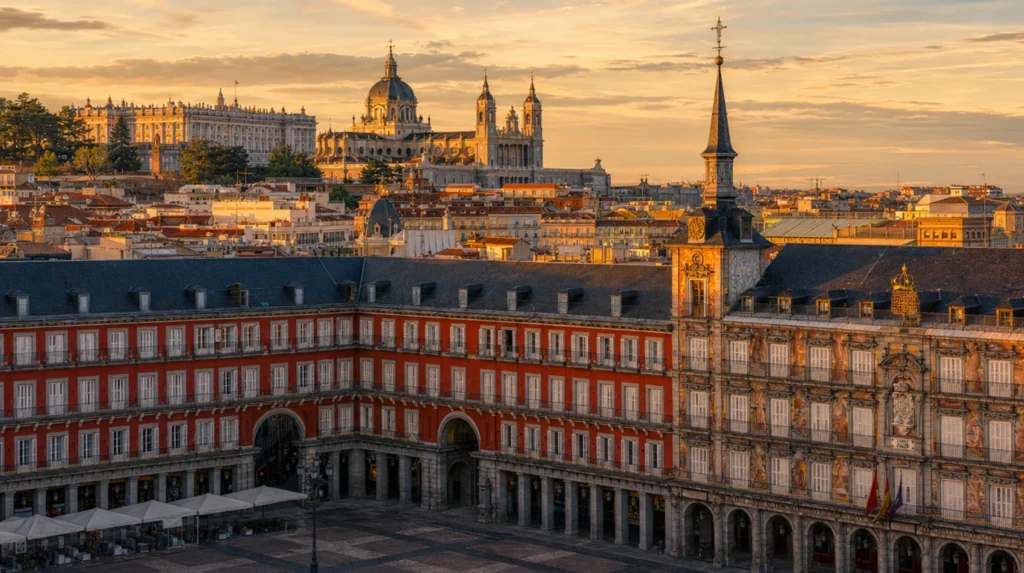
Madrid, Spain: Royal Capital of Late-Night Tapas, Velázquez & the Plaza Mayor
Part of our Spain travel guide.
Madrid is the highest capital in Western Europe — 667 metres above sea level on a Castilian plateau that produces winters cold enough to freeze the fountains in the Retiro and summers hot enough to half-empty the city in August — and a place where dinner does not start before 9 p.m. and the second drink rarely happens before midnight. The metropolitan area holds 6.7 million people, the city proper 3.4 million, and the historic centre packs the world’s densest concentration of Spanish Golden Age painting — the Prado, the Thyssen-Bornemisza and the Reina Sofía form the “Paseo del Arte” within a 1.2 km walk — into a quarter you can cross in 20 minutes if you don’t stop for a coffee. Most people stop for the coffee.
What makes Madrid different from the other great Spanish cities is that it was deliberately invented. Philip II made it the permanent capital in 1561, picking a small Moorish-era market town near the geometric centre of the Iberian Peninsula on the basis that no existing power-centre had a stronger claim. The city he built outward from the Plaza Mayor and the old Alcázar (the royal palace replaced after a fire in 1734 by the current 3,418-room Palacio Real) was an act of will, not geography. Five centuries later it remains a city that pulls people in from elsewhere — fewer than 40% of madrileños were born here — and that runs on a clock of its own.
This guide covers Madrid end to end — from the Habsburg core around Plaza Mayor to the new gastronomic edges in Chamberí and Lavapiés, from the Prado at opening time to the last vermouth poured at 3 a.m. in La Latina. If you’re planning a longer Iberian trip, our Spain travel guide has the country context; our Barcelona city guide handles the natural counterpart on the AVE high-speed line; Lisbon is six hours by sleeper train; Paris is the next big capital north. For multi-city itinerary help, the trip planner is the place to start.
📋 In This Guide
- Why Madrid — Royal Capital, Golden Age Painting, Late Hours
- 🌹 Late-April / Early-May 2026 — San Isidro, Spring & the Retiro
- Best Time to Visit Madrid (Season by Season)
- Getting There — Flights, AVE Trains & Buses
- Getting Around — Metro, Walking & the BiciMAD
- Neighbourhoods — Sol, Malasaña, La Latina, Chamberí & Beyond
- Cultural Sights — The Paseo del Arte & Royal Madrid
- Food & Drink — Cocido, Tapas, the New Wave
- Entertainment, Flamenco & the Late Night
- 🗓️ Sample Itineraries
- Day Trips — Toledo, Segovia & El Escorial
- 📸 Photography Notes
- Practical Tips
- Budget Breakdown
- ✅ Pre-Trip Checklist
- 🤔 What Surprises First-Timers
- Frequently Asked Questions
- Ready to Experience Madrid?
- Explore More
Why Madrid — Royal Capital, Golden Age Painting, Late Hours
Madrid was an obscure Moorish frontier town called Mayrit until Philip II moved his court here from Toledo in 1561. The court grew, the town grew, and within a century Madrid had become the political and artistic centre of an empire that stretched from the Philippines (named after that same Philip) to Mexico to the Spanish Netherlands. The Habsburg dynasty filled the new capital with Velázquez (court painter from 1623), El Greco’s circle, and the foundational collections that would later become the Prado. The Bourbon dynasty took over in 1700 with a dose of French taste — the Royal Palace, the Buen Retiro Park, the wide Paseo del Prado axis — and the modern city is still mostly built on those bones.
The geography is genuinely unusual. At 667 metres above sea level Madrid is the highest capital in Western Europe (only Andorra la Vella, at 1,023 m, is higher in Europe full stop). The altitude produces dry air, sharp blue light that has obsessed painters for 400 years, and a continental climate of the kind you’d expect from a city on a high plateau a long way from the sea — January nights drop below freezing, July afternoons hit 38°C, and the spring and autumn shoulder windows are unusually pleasant. The river — the Manzanares — is famously pathetic, prompting Quevedo’s 17th-century joke about a river “that learned to swim in winter and forgot in summer.” The city was never really built around it.
What you feel walking it, though, is the rhythm. Madrid keeps Mediterranean hours stretched even further than the Spanish norm: lunch at 2:30 p.m., dinner at 9 p.m. or later, the second drink at 11, the discoteca at 1 a.m., the chocolate-and-churros at San Ginés at 4 a.m. on a Saturday morning. The 1942 Franco-era decision to align Spain with Berlin time rather than London time — geographically Madrid sits squarely on the Greenwich meridian — pushed sunset an hour later, which is why the late-night culture became sustainable. Argue with Madrid’s clock and you’ll lose; surrender to it and you’ll discover it was right.
🏛️ Historical Context
Madrid’s Plaza Mayor — the rectangular cobbled square in the heart of the Habsburg quarter — was inaugurated in 1620 as Philip III’s “Plaza del Arrabal” and became the city’s principal stage for almost everything: bullfights, royal proclamations, autos-da-fé executions during the Spanish Inquisition (the last one held here was in 1680, attended by 30,000 people including the king), the canonisation ceremonies of Spanish saints, and the daily commerce that still occupies its 237 perimeter balconies. The current uniform red-and-grey façades date to a 1790 reconstruction by Juan de Villanueva after three successive fires, but the dimensions and the equestrian statue of Philip III in the centre (a 1616 work by Giambologna and Pietro Tacca, originally a gift from the Grand Duke of Florence) are the originals. The square is still the geographic centre of the city — Kilómetro Cero, the road-marker from which all Spanish national highway distances are measured, is set into the pavement of nearby Puerta del Sol.
🎌 Did You Know?
Madrileños drink an estimated 11.5 million cervezas (small draught beers) every year in the city’s bars — and that’s only the draught count, not bottled or supermarket sales. Madrid’s bar density is roughly one establishment per 132 residents (the city has roughly 25,000 licensed bars, cafés and restaurants), the highest ratio of any European capital and second globally only to Tokyo. The standard order is “una caña” — a small 200ml glass of cold lager that costs €1.80–3.50 depending on the barrio, and that arrives unbidden with a small free tapa in the older traditional bars. The city’s most famous “tapa with caña” deal is the free helping of paella at El Tigre on Calle de las Infantas — visible from the door, no menu required.
🌹 Late-April / Early-May 2026 — San Isidro, Spring & the Retiro
Late April through mid-May is statistically the best stretch of the Madrid year. Daytime highs climb from 19°C in late April to 23°C by mid-May, the Retiro’s roses begin opening in waves, the Madrid sky shifts to the cobalt-blue intensity that gave Velázquez and Goya their backgrounds, and the city is busy with locals doing what they do in spring: terrace season is officially open, the late afternoon paseo down Gran Vía and Calle de Alcalá fills the wide pavements between 6 and 8 p.m., and dinner moves from indoor to terrace seating in roughly 80% of the city’s restaurants. Sunset in late April is around 9 p.m.; by mid-May it’s pushed to 9:25 p.m., which means cocktail hour realistically runs to 11.
The single biggest event in Madrid’s annual calendar is the San Isidro Festival, May 8–15, honouring the city’s patron saint San Isidro Labrador (1082–1172, a peasant farmer beatified for the miracle of his oxen continuing to plough while he prayed). This is the city’s biggest annual fiesta — concerts in the Pradera de San Isidro park, free outdoor music every night on Plaza Mayor, processions, locals dressed in traditional chulapo (men) and chulapa (women) costume, and the most prestigious bullfighting feria of the Spanish season at Las Ventas (the world’s most important bullring, 23,798-seat capacity, San Isidro corridas run May 8 to early June). The two emblematic foods of the festival are the rosquillas (anise-flavoured ring biscuits, sold in three varieties — “tontas” plain, “listas” sugar-glazed and “Santa Clara” with meringue) and barquillos (rolled wafer cones). On May 15 itself everyone walks to the Pradera de San Isidro to drink the spring water from the saint’s holy well, which is — by tradition — supposed to inoculate you against rabies. The crowd by 1 p.m. is roughly 200,000 strong.
Beyond San Isidro, the Retiro Park itself is the spring set-piece. The 125-hectare former royal pleasure garden — opened to the public in 1868 — has its rose garden (La Rosaleda, on the south side) peaking from late April through May with 4,000 plants in 100+ varieties, the Crystal Palace (Palacio de Cristal, the 1887 wrought-iron-and-glass pavilion) hosting Reina Sofía contemporary art exhibitions on a rotating basis, and the central pond (Estanque) full of rented rowboats every weekend afternoon. The Jardín Botánico beside the Prado opens its iris and tulip displays the same week. Late April in Madrid is the city’s most generous spring, and you can do the Retiro and the Botanical Garden in a half-day before lunch.
⚠️ Important — Bullfighting at San Isidro
The San Isidro feria at Las Ventas (May 8 – early June 2026) is the most prestigious bullfighting season in the Spanish calendar — 28 corridas across the month, the matadors who triumph here become global names. Bullfighting remains legal in Madrid and most of Spain, defended as cultural patrimony under a 2013 Constitutional Court ruling. The ethical debate is real and unresolved: Catalonia banned bullfighting in 2010 (overturned by the same Court in 2016 but not actively reinstated), the Canary Islands have banned it since 1991, and Spanish public support has fallen below 20% in some 2024 polls. If you choose to attend, Las Ventas tickets run €6–150 depending on shade and proximity; if you choose not to, simply skip it. The city is full enough during San Isidro that you won’t accidentally encounter the rings. Animal welfare advocates can support PACMA (the Spanish animal-rights party) or Anima Naturalis at the protest demonstrations held on opening day each year.
Best Time to Visit Madrid (Season by Season)
Madrid’s continental climate produces sharper seasons than most Mediterranean capitals — drier, hotter in summer, colder in winter, and with a sky that locals call “el cielo velazqueño” (the Velázquez sky) for its painter’s clarity. The city has two genuine peak windows (late April–June and September–October) bracketed by extremes that drive locals out (August) or in (January–February).
Spring (March – May)
The shoulder window described above. Daytime highs climb from 14°C in early March to 23°C by late May. The Holy Week processions in Toledo (45 minutes south on the AVE) are within day-trip range; Madrid’s own Holy Week is more restrained but the silent Procesión de Jesús de Medinaceli on Good Friday from the basilica of the same name draws 10,000+ devotees. Hotel prices are 25–35% below October peak; restaurant terraces open in earnest from mid-April. May is the busiest spring month thanks to San Isidro.
Summer (June – August)
Increasingly punishing. June daytime highs sit around 31°C; July and August routinely hit 36–40°C, with heatwaves above 42°C now occurring two or three times a summer (Madrid hit 42.7°C on 16 August 2023). Madrileños evacuate from late July through August — the older neighbourhood bars often close for three weeks of “cierre por vacaciones” (closed for holidays), the office population thins by 60%, and the city becomes unexpectedly empty. The trade-off is heat: walking the Paseo del Prado at 3 p.m. in August is genuinely dangerous, and most museums and major sights become afternoon-only refuges. The Veranos de la Villa cultural programme (June–August) puts open-air concerts, theatre and dance into city plazas every night through the summer; the city’s many municipal swimming pools open mid-June. If you visit in August, plan around the heat: 8 a.m. walks, 11 a.m. museums, 3 p.m. siesta, 9 p.m. dinner.
Autumn (September – November)
The connoisseur’s window. The August evacuees return the first week of September, the heat breaks by mid-month, and October produces the second peak of the year — daytime highs around 22°C, the trees in the Retiro turning, and the cultural calendar at full tilt. The Madrid Autumn Festival (Festival de Otoño) runs the second half of October with international theatre, dance and music programming. The Día de la Hispanidad on October 12 is the national day with a military parade down the Castellana. By mid-November daytime highs drop to 13°C and the season’s first cocido (chickpea-and-meat stew, the Madrid winter signature) appears on menus.
Winter (December – February)
Cold and dry. January nights regularly drop below freezing, occasional snowfalls dust the Plaza Mayor (the 2021 Filomena storm dropped 50 cm and shut the city for a week), and the average daytime high in mid-January is 10°C. The Christmas season is exuberant — the Plaza Mayor Christmas market runs late November to December 31, the Three Kings Parade (Cabalgata de Reyes) on January 5 is the signature children’s event of Spanish Christmas, and New Year’s Eve in the Puerta del Sol with the 12 grapes (one per chime, eaten as the clock strikes midnight) is a tradition since 1909. After January 6 the city becomes blissfully empty; February is one of the cheapest months to visit and the museums genuinely uncrowded. Daytime highs around 12°C — chilly but not punishing.
🧳 Travel Guru Tip
If you want Madrid at its best with the smallest crowds, target the second half of September. The August evacuation has reversed, the heat has dropped to a perfect 25°C, the city’s cultural calendar restarts, and hotel prices have not yet climbed to their October peak. The two weekends of mid-September give you the Open House Madrid architecture festival (free access to 100+ normally closed buildings), a mostly-empty Prado, and terrace dinners that are still genuinely warm at 10 p.m. Most international guides flag October as the autumn peak — late September is quietly better.
Getting There — Flights, AVE Trains & Buses
Adolfo Suárez Madrid-Barajas Airport (MAD), 13 km northeast of the city centre, is Spain’s largest airport and the main hub for Iberia, Air Europa and the long-haul Latin American carriers. It handled 60.2 million passengers in 2024 — the fifth-busiest airport in Europe — and operates four terminals (T1, T2, T3 historic; T4 the newer 2006 Richard Rogers terminal that is itself a piece of architecture worth seeing). From North America: direct flights from New York (JFK and Newark, 7h45m), Boston, Miami, Dallas, Los Angeles and Chicago. From Europe: 2h25m from London Heathrow, 2h from Paris CDG, 2h35m from Frankfurt, 1h40m from Lisbon. From Latin America: 12 hours from Buenos Aires, 9h45m from Mexico City, the strongest hub for these routes in Europe.
The AVE high-speed rail network is the alternative, and for travellers already in Spain or southern France it’s better than flying. Madrid Atocha is the southern long-distance terminus (the famous tropical-garden concourse remains as a monument to the 2004 March 11 bombing victims); Madrid Chamartín handles the northern services. AVE journey times: Barcelona 2h30m (16+ daily, €30–140), Seville 2h20m, Valencia 1h50m, Málaga 2h35m, Córdoba 1h45m, Zaragoza 1h25m. The Paris–Madrid OUIGO/RENFE-SNCF service via Barcelona takes 9h45m total. The new low-cost AVLO and Iryo operators on the Madrid–Barcelona corridor have pulled fares as low as €19 if booked 8+ weeks ahead.
From Barajas Airport into the centre: the Metro Line 8 from T4 to Nuevos Ministerios is 30 minutes and €5 (a special airport supplement applies on top of the standard ticket); the Cercanías C-1 train from T4 to Atocha or Chamartín is 25 minutes and €2.60; the Express Bus 203 runs every 15 minutes 24/7 from all terminals to Atocha for €5. A taxi to Sol or Atocha is a flat €33 official tariff (ignore unmetered touts at arrivals). The EMT bus 200 is the local-only option to Avenida de América for €1.50 if you have time and patience.
✨ Pro Tip — AVE Booking, Not Flying
If you’re combining Madrid with Barcelona, Seville or Valencia, take the AVE rather than fly. Madrid–Barcelona on the AVE is 2h30m city-centre to city-centre versus a notional 1h15m flight that becomes 4 hours when you count Barajas-to-El Prat airport time, security and the metro at both ends. Book AVE 60+ days ahead through renfe.com or trainline.es for “Promo” fares from €30. The new low-cost competitors AVLO (Renfe’s own budget brand, since 2021) and Iryo (Italian Trenitalia subsidiary, since 2022) have driven prices down further — Iryo Madrid–Barcelona from €19 for off-peak afternoon trains. The frequency of trains (every 30 minutes peak hours) makes flexible day-of-travel realistic in a way that Spanish flights aren’t.
Getting Around — Metro, Walking & the BiciMAD
Madrid’s central neighbourhoods are walkable corner-to-corner — Sol to the Prado is 12 minutes on foot, Sol to Malasaña 8 minutes, Sol to La Latina 10 minutes — and a traveller staying anywhere within the M-30 ring road can do most of a day on foot. The city is, however, on a slight overall gradient (Sol to the Retiro climbs 30 metres) and has some genuinely steep streets in La Latina and Lavapiés that will work the calves of unprepared visitors.
For longer trips — Atocha to Chueca, Bernabéu Stadium to Lavapiés, the Reina Sofía to Chamartín station — the Metro de Madrid is among the world’s best urban rail networks. It runs 12 numbered lines and 3 light-rail lines, 302 stations, 294 km of track (the third-longest in Europe after London and Moscow), 6 a.m. to 1:30 a.m. with peak intervals of 2–3 minutes. A single ticket is €1.50–2.00; the 10-trip Metrobús ticket €12.20; tourist passes €8.40 (1-day) to €35.40 (7-day) for unlimited zone-A travel including Metro, EMT bus, Cercanías local trains and the airport supplement. The Metro is air-conditioned, the announcements bilingual, and the network covers everywhere a tourist needs to go.
The EMT bus network covers areas the Metro misses (the Casa de Campo, the Madrid Río park, the smaller residential barrios) at €1.50 a ticket — same Multi card as the Metro. The 24-hour buses (the “búhos,” 26 routes) run every 30 minutes through the night from Plaza de Cibeles. BiciMAD, the city’s electric-assist bike-share scheme since 2014, has 264 stations and roughly 4,000 bikes; €2 for a single 30-minute trip, €15 for a 7-day pass. Cycling infrastructure has improved dramatically since 2018 — the Madrid Río corridor along the Manzanares is the best bike route in the city, plus dedicated lanes on the Paseo del Prado and around the Retiro.
Taxis are abundant and metered — €2.50 base, then €1.30 per km, with airport flat fare €33 to anywhere within the M-30. Free Now (formerly MyTaxi) is the local app; Cabify and Uber operate as competitors at slightly higher fares. Driving is actively a bad idea: most of the historic centre is now within Madrid Central / Madrid 360 Low Emission Zone (see Practical Tips), parking is scarce, and the one-way medieval street pattern around the Habsburg quarter is genuinely confusing.
Neighbourhoods — Sol, Malasaña, La Latina, Chamberí & Beyond
Comparing Madrid with Barcelona, Seville or Granada? Our guide to where to stay in Spain covers them all.
📍 Madrid Map: Every Place in This Guide
Madrid’s character compresses into roughly seven distinct quarters within walking range of each other. Below are the bases worth structuring an itinerary around.
🏛️ Sol & Madrid de los Austrias — Habsburg Madrid
The geographic and historic centre. Puerta del Sol (the half-moon plaza with the Tío Pepe sign and the Kilómetro Cero road-marker) is where the city’s clock strikes midnight on New Year’s Eve and where most metro lines converge. Five minutes west, the Plaza Mayor is the 1620 Habsburg-era ceremonial heart. Five minutes south of that, the Mercado de San Miguel — the wrought-iron 1916 covered market, restored 2009 as a gourmet food hall — is the most-visited single attraction in the centre. Beyond Plaza Mayor lies the Madrid de los Austrias quarter: narrow streets of 17th-century convents and palaces, the Palacio Real to the west, the Cathedral of La Almudena (consecrated 1993 by John Paul II, the most recent major cathedral in Western Europe), and Plaza de la Villa with the Casa de la Villa (the old town hall).
- What to do: Royal Palace tour (€14, allow 2 hours, 3,418 rooms of which roughly 50 are open); the Almudena Cathedral and crypt (€7); a vermouth at La Casa del Abuelo on Calle Victoria (since 1906, the gambas-al-ajillo institution).
- Signature eats: Bocadillo de calamares (calamari sandwich) at La Campana on Calle Botoneras (€4, the iconic Madrid lunch); Sobrino de Botín (Calle Cuchilleros, since 1725, certified by Guinness as the world’s oldest restaurant — Hemingway ate the cochinillo asado here, €27).
- Where to base: The Madrid Edition (€520+); the Pestana Plaza Mayor (€280+ shoulder); Hostal Adriano on Calle de la Cruz (€90+, family-run, the value pick).
🌳 Retiro & Paseo del Arte
The 19th-century cultural quarter. The Paseo del Prado axis — the wide tree-lined boulevard between Atocha station and Plaza de Cibeles — was inscribed as a UNESCO World Heritage Site in 2021 as the “Paisaje de la Luz” (Landscape of Light), the first urban-landscape designation of its kind in a European capital. Along it sit the three great museums (Prado, Thyssen, Reina Sofía), the Botanical Garden, the CaixaForum, and Cibeles itself with its 1782 fountain and the wedding-cake Palacio de Cibeles (the former post office, now city hall and one of the city’s best free observation decks at €4 for non-residents). To the east lies the Retiro Park itself.
- What to do: Prado Museum (€15, free 6–8 p.m. weekdays — but expect queues); Reina Sofía (€12, free 7–9 p.m. weekdays — Picasso’s Guernica is here); Thyssen-Bornemisza (€13, the family-collection trip that fills the gap between the Prado and the Reina Sofía); Retiro Park rowing on the Estanque (€8 for 45 minutes).
- Signature eats: Estado Puro on Plaza de Cánovas del Castillo (Paco Roncero’s tapas-genius restaurant, the croquettes are legendary at €8 for six); the cafés inside the Prado and the Reina Sofía if you want to eat where the museum staff lunch.
- Where to base: The Hotel Ritz / Mandarin Oriental Ritz (€700+, the 1910 grande dame); Westin Palace (€450+); Hotel Único Madrid (€340+ in Salamanca next door).
🎨 Malasaña & Conde Duque — Indie Madrid
The bohemian centre. North of Gran Vía between Calle de Fuencarral and Calle de San Bernardo, Malasaña was the epicentre of La Movida Madrileña — the post-Franco cultural explosion of 1977–85 that produced Pedro Almodóvar, Alaska, Mecano, the entire visual-arts and music scene of democratic Spain — and remains the city’s coolest barrio. Plaza del Dos de Mayo is the social heart, ringed by bars and the most-photographed graffiti in Madrid. Conde Duque, just north, is more residential and architecturally striking — the 18th-century barracks complex now houses the Conde Duque cultural centre.
- What to do: Wander Calle Espíritu Santo and Calle Velarde for vintage clothing and independent bookshops; Museum of Romanticism (Museo del Romanticismo) on Calle San Mateo (€3, the small jewel-box museum of the early-19th-century cultural elite).
- Signature eats: Casa Julio for croquetas (Calle Madera, since 1921, the city’s most-cited croqueta bar, €1.50 each); Lamucca for natural wines and sharing plates; Ojalá on Calle de San Andrés for breakfast in a sand-floor terrace.
- Where to base: Hostal Casa de la Lirio (€110+); 7 Islas Hotel on Calle Valverde (€220+); independent flats on Airbnb (subject to the new short-let regulations — see Practical Tips).
🏠 La Latina & Lavapiés — Tapas Madrid & Multicultural Madrid
The two old working-class barrios south of the Plaza Mayor. La Latina is the Sunday-tapas-and-vermouth neighbourhood, with the Cava Baja street as its tapas spine — 50+ traditional bars in 400 metres, peak crowd Sundays 1–4 p.m. when the El Rastro flea market on the adjacent Ribera de Curtidores brings in 100,000+ people for the morning, then everyone migrates to the bars. Lavapiés, the neighbourhood east of La Latina, is the most diverse barrio in Madrid — over 90 nationalities live within its borders, the Tabacalera centro social cultural arts venue is its anchor, and the Mercado de Antón Martín on the boundary with Sol contains the city’s best Korean, Lebanese and Senegalese counter restaurants.
- What to do: El Rastro Sunday flea market (9 a.m.–3 p.m., Calle Ribera de Curtidores); a tapas crawl down Cava Baja from the top (Casa Lucio at no. 35) to the bottom (Taberna Tempranillo, Casa Lucas); Tabacalera arts centre on Calle Embajadores (free).
- Signature eats: Casa Lucio for huevos rotos with Iberian ham (since 1974, €18, the Spanish royal family eats here); Casa Botín if you want the Habsburg-era cochinillo experience; in Lavapiés, Bangladesh Cuisine on Calle del Mesón de Paredes for Bengali food at €12 a head.
- Where to base: Posada del León de Oro on Cava Baja (€180+, the hotel built into a 19th-century inn); ArtRoom Madrid on Mesón de Paredes (€95+, eccentric Lavapiés boutique).
🌈 Chueca — LGBT+ Madrid & Boutique Shopping
The barrio between Gran Vía and Malasaña that became Madrid’s LGBT+ centre in the 1980s and is now also the city’s best concentration of independent boutique shopping, contemporary cafés and the annual Madrid Pride / MADO (early July, the largest Pride parade in Europe with 1.5–2 million attendees in a typical year). Plaza de Chueca is the social heart; Calle Hortaleza and Calle de Fuencarral the shopping spines; the Mercado de San Antón is the gourmet market with rooftop terrace bar.
- What to do: Shop along Calle Fuencarral for Spanish independent fashion (Hoss Intropia, El Ganso, Adolfo Domínguez); rooftop drinks at Mercado de San Antón; if visiting in early July, the MADO Pride parade is the most extravagant in Europe.
- Signature eats: Bazaar on Calle de la Libertad (Mediterranean, €18 set lunch, the local power-lunch favourite); Triciclo on Calle Santa María for tapas-with-fine-dining-pretensions.
- Where to base: Only YOU Hotel Atocha or Boutique Madrid (€280+); Petit Palace Chueca (€170+).
🍷 Chamberí & Salesas — The New Wave
The 19th-century planned-grid neighbourhood north of Malasaña. Chamberí was Madrid’s most-quietly-fashionable barrio of the 2010s and remains the city’s best concentration of contemporary fine dining (DiverXO has 3 Michelin stars at the NH Eurobuilding hotel; Sacha is the city’s most-cited chef’s-favourite restaurant; Lúa has 1 star). Calle de Ponzano became the “Calle del Tapeo” of the 2020s — 50+ bars on a single street, the heart of new-Madrid social life. Salesas, on Chamberí’s south edge, is the boutique-hotel and Bauhaus-influenced retail strip around Calle de Almirante.
- What to do: Walk Calle Ponzano end-to-end on a Friday night for the new social scene; Sorolla Museum (Museo Sorolla) at the painter’s former house and studio (€3, the small jewel-box museum and garden); Museo Geominero at the geological institute (free, the under-rated curiosity).
- Signature eats: Sala de Despiece (Calle Ponzano, the gastronomic-laboratory tapas bar from chef Javier Bonet); Lakasa for the platonic Spanish bistro experience at €55; DiverXO at the very top end (€365 tasting menu, book 3 months ahead).
- Where to base: The Madrid Edition (€520+); Único Hotel Madrid in the Salamanca quarter next door (€340+).
💼 Salamanca — Aristocratic Madrid & Designer Shopping
The 19th-century planned barrio east of Salamanca was created in the 1860s by the Marqués de Salamanca for the upper-bourgeois class moving out of the Old City and remains Madrid’s most expensive residential and retail district. Calle de Serrano is the European luxury-shopping spine — Loewe, Hermès, Chanel, Cartier, plus the Spanish Prada-equivalent Loewe at no. 26 (which is itself a 1939 architectural set-piece). The neighbourhood also contains the National Archaeological Museum (Museo Arqueológico Nacional, free, the Lady of Elche pre-Roman bust is here) and the Lázaro Galdiano Museum (the small private collection, €7, with Goyas in the basement).
💬 The Voice
“Madrid is so high in the heavens, with such an electric, exciting air, such tremendous freshness in the early morning… it would be quite as much trouble to write of how Madrid is to live in as it would be to write of New York.”
— Ernest Hemingway, Death in the Afternoon (1932), on Madrid’s altitude and atmosphereCultural Sights — The Paseo del Arte & Royal Madrid
Madrid’s cultural offering compresses into the densest small-radius concentration of major museums in Europe. The “Big Three” of the Paseo del Arte are walkable in a single day — though no one with sense actually does that. Treat each as half a day minimum.
- Museo del Prado (€15, free 6–8 p.m. Mon–Sat / 5–7 p.m. Sun) — the Spanish royal collection assembled from Charles V onward and opened to the public in 1819. The Velázquez gallery (Las Meninas, the Surrender of Breda, the Forge of Vulcan) is the headline; the Goya holdings are the deepest in the world, including the Black Paintings; the Bosch room contains the Garden of Earthly Delights. Allow 4 hours minimum; pick a 30-painting itinerary if time is short.
- Museo Reina Sofía (€12, free 7–9 p.m. Mon and Wed–Sat / 12:30–2:30 p.m. Sun) — 20th-century Spanish art. Picasso’s Guernica (1937) is the headline; Dalí, Miró, Tàpies, the entire Spanish modernist canon. The 2005 Jean Nouvel extension doubled the gallery space.
- Museo Thyssen-Bornemisza (€13, free Mon 12–4 p.m.) — the Thyssen family’s private collection (acquired by the state in 1993) fills the gap between the Prado and the Reina Sofía: the European masters the Spanish Crown didn’t buy. Strong on Italian primitives, Dutch genre painting, and 19th-century French Impressionism. Smaller and quicker than the other two — 2 hours covers it.
Beyond the Big Three: the Royal Palace (€14, the largest royal palace in Europe by floor area at 135,000 m²); the Real Fábrica de Tapices (Royal Tapestry Factory since 1721, where Goya designed his early tapestry cartoons — €5 tour); the Sorolla Museum (the painter’s house and studio, €3); the Museum of Romanticism (€3, small and atmospheric); the National Archaeological Museum (free, the Lady of Elche and the Treasure of Guarrazar Visigothic crowns); the CaixaForum Madrid (the Herzog & de Meuron contemporary culture centre with the famous vertical garden facing it, free); and the Lázaro Galdiano (€7, the private-collection museum with second-tier Goyas and El Grecos).
Madrid by Numbers
- 667 m — altitude, making Madrid the highest capital in Western Europe
- 9 p.m. — the earliest most madrileños sit down to dinner
- 11.5 million — cervezas (small draught beers) drunk in Madrid bars annually
- 1.81 km — the Paseo del Arte from Reina Sofía to the Thyssen-Bornemisza
Food & Drink — Cocido, Tapas, the New Wave
Madrid’s food scene is, after roughly two decades of deliberate elevation, one of the most varied in Europe. The city holds 26 Michelin stars across 20 restaurants in 2026 — including DiverXO (3-star, the only 3-star in the city, chef Dabiz Muñoz at the NH Eurobuilding hotel), Coque (2-star), Deessa (2-star at the Mandarin Oriental Ritz) and a long list of one-stars. Below the starred tier sits the much wider Spanish bistro scene and the centuries-old taberna tradition. The local cuisine itself is hearty — central-plateau food evolved for cold winters, lots of pork and game and chickpeas, generous portions, served late.
Cocido madrileño is the city’s signature dish — a chickpea-and-meat-and-vegetables stew served in three courses (the broth as soup with vermicelli first, then the chickpeas and vegetables, then the meats) that is genuinely a winter institution. The classic restaurants for it are La Bola (Calle de la Bola, since 1870, cooked in individual clay pots over wood for 4 hours, €30), Lhardy (Carrera de San Jerónimo, since 1839, €38), and Malacatín (Calle de la Ruda in La Latina, since 1895, €30 and walk-in only). Eat the cocido at lunchtime — never dinner — and accept that the afternoon is gone.
Tapas culture is the daily-life rhythm. The standard scene: a small caña of beer (€1.80–3) plus a small free tapa, eaten standing at the bar, followed by the next bar. La Latina’s Cava Baja and Cava Alta are the dense traditional concentrations; Calle Ponzano in Chamberí is the contemporary equivalent. The single most famous Madrid tapa is the bocadillo de calamares (calamari sandwich, €4 at La Campana on Calle Botoneras, the “Plaza Mayor calamari sandwich” institution). Other essentials: huevos rotos (broken eggs over fried potato with Iberian ham, Casa Lucio version is the canonical), gambas al ajillo (garlic prawns, La Casa del Abuelo on Victoria), patatas bravas (the spicy potato cubes — the city argues bitterly about the right sauce, the consensus winner is Casa Toni on Calle de la Cruz).
Iberian ham deserves its own paragraph. Jamón ibérico de bellota — from black-foot pigs grazed on acorns in the Extremadura and Andalusia dehesa pastures — is among the world’s great cured meats, and Madrid is where most of it ends up. The 3-year-aged Cinco Jotas brand at €260/kg is the gold standard; cheaper supermarket grades start at €40/kg. Eat it at Hijos de Cándido (Plaza Mayor area), Mercado de San Miguel (the touristy but decent place to try by the slice), or any neighbourhood museo del jamón. Cut by hand from the leg; never with a machine.
Chocolate con churros is the late-night-into-morning Madrid finisher. Chocolatería San Ginés (Pasadizo de San Ginés, since 1894, open 24/7) is the famous one — the queue at 4 a.m. on a Saturday is full of clubbers heading home, the queue at 11 a.m. on a Sunday full of families. €5 for six churros and a thick chocolate. Locals will argue about whether porras (the thicker version) are better than churros (the thinner version); the answer is both.
The new wave is the 2010s-and-beyond fine-dining and casual-creative scene. DiverXO at the top (Dabiz Muñoz’s tasting menu €365, 4 hours, theatrical and divisive); Sacha (Chamberí, the chef’s-table Madrid landmark); Sala de Despiece (Calle Ponzano, the dissection-laboratory tapas bar); Bel Mondo (Italian, run by Andoni Aduriz alumni); Triciclo (Santa María, Modern Spanish, €60 set menu). For affordable fine-dining, the menú del día — the Spanish set lunch from €15–25 — works at almost every restaurant in the city Monday to Friday at midday.
✨ Pro Tip — The Menú del Día
Spanish labour law requires restaurants serving lunch to offer a fixed-price set menu Monday to Friday — the menú del día — typically a starter, main, dessert and a glass of wine or beer for €15–25 in Madrid. The same kitchens charging €60 for à la carte dinner will offer a lunchtime menú del día for a third of that price, and the food is genuinely the same quality. Bookable from 1 p.m., busiest at 2:30 p.m. The best examples in 2026: La Carbonería near Plaza Tirso de Molina (€18), Bazaar in Chueca (€18), Lakasa (€26), Zerain on Calle Quevedo (€26 — Basque cooking). Locals eat their main meal at lunch and have something light at 9 p.m.; foreign visitors who flip this around miss the city’s best food deal.
Entertainment, Flamenco & the Late Night
Madrid’s nightlife is the longest in Europe and the most layered. The standard rhythm: dinner 9–11 p.m., copas (cocktails) 11 p.m.–1 a.m., discoteca 1–6 a.m., chocolate-and-churros at San Ginés 5 a.m., bed by 7. The city’s club scene runs to professional schedules — bouncers are strict, doors open at 1 a.m. and don’t peak until 2:30, and the standard club shuts at 6 a.m. though Fabrik (the megaclub on the outskirts) runs until midday Sunday.
Flamenco in Madrid is not the regional flamenco of Seville or Granada — it’s the cosmopolitan version that the great Andalusian artists move to once they’re famous. The serious tablaos in 2026: Corral de la Morería (Calle Morería, since 1956, the city’s most prestigious — has a Michelin-starred restaurant attached, dinner-and-show €120+, show only €56); Cardamomo Tablao (Calle Echegaray, the new-school tablao with younger artists, €49); Las Tablas (Plaza de España, €31); Café de Chinitas (Calle Torija, the historic tablao with the Manolete connection, €45). Performances run roughly 90 minutes, two shows nightly at 8 p.m. and 10 p.m. Avoid hotel-restaurant flamenco; pay for a real tablao.
Live music and theatre. The Teatro Real on Plaza de Oriente is the opera house — the season runs September to June, world-class touring productions, €25–250. The Teatro de la Zarzuela on Calle Jovellanos is the home of zarzuela (Spanish operetta, the local genre invented in the 19th century, €20–80). The Wizink Center is the city’s main arena. For jazz: Café Central on Plaza del Ángel (since 1982, the city’s most respected jazz club, €15–25 cover); Bogui Jazz on Calle Barquillo. For indie and rock: Sala But, Sala La Riviera, Joy Eslava (the historic 19th-century theatre converted to disco).
The discotecas. Teatro Kapital on Calle Atocha (the seven-floor megaclub, each floor a different music genre, the most-photographed Madrid club — €20 cover); Joy Eslava on Arenal (since 1981, where La Movida drank in the early 1980s); Fabrik in Móstoles (the suburban superclub, electronic music, opens midnight Sunday and runs to midday); Mondo on Calle Pelayo (smaller, gay-friendly, the Chueca crowd). Door policy is real — well-dressed, sober-ish, not too drunk before midnight or you’ll be turned away.
🎯 Strategy — Pacing the Madrid Night
Foreign visitors typically arrive at restaurants at 7 p.m., are turned away because Madrid kitchens haven’t opened, then crash at 11 p.m. just as the city is starting. The local rhythm: 1 p.m. menú del día (the day’s main meal), 4–7 p.m. siesta or museum, 8 p.m. caña-and-tapa first round, 9:30 p.m. light dinner sharing plates, 11 p.m. cocktail in Malasaña or Salesas, 1 a.m. discoteca, 5 a.m. chocolate at San Ginés. If you can’t manage the full version, at minimum push dinner to 9 p.m. and accept that the kitchens close around 11:30 — there’s no point eating at 7. Everything closes earlier on Sundays and Mondays; Tuesday to Saturday is the real Madrid night.
🗓️ Sample Itineraries
Madrid kicks off our 10-day Madrid–Andalusia itinerary.
Below are templates for common visit lengths. Adjust for season — August itineraries should plan around the heat (museums in afternoon, walks at sunrise or dusk).
2 Days — The Madrid Essentials
Day 1: Plaza Mayor and Mercado de San Miguel for breakfast, Royal Palace 11 a.m. tour (book ahead), lunch at Casa Botín or La Bola for cocido, Prado Museum 4–7 p.m. (free entry 6–8 p.m. weekdays), tapas dinner on Cava Baja in La Latina. Day 2: Reina Sofía 10 a.m. for Guernica, lunch on Calle Huertas (the literary quarter, Cervantes’ grave is in the Trinitarias Convent here), Retiro Park rowing on the Estanque, vermouth at La Venencia (Calle Echegaray, since 1928, the unchanged sherry bar where Hemingway drank), late dinner in Malasaña.
4 Days — Adding Neighbourhoods & a Day Trip
Day 1: Plaza Mayor, Royal Palace, Habsburg Madrid, La Latina dinner. Day 2: Prado, lunch on Huertas, Retiro, Malasaña late night. Day 3: Reina Sofía morning, Thyssen-Bornemisza afternoon, Ponzano Street tapas crawl in Chamberí. Day 4: Day trip — Toledo (45 minutes south by AVE, the medieval walled city the painter El Greco lived and died in), or Segovia (28 minutes north by AVE, the Roman aqueduct and Disney-template Alcázar), back to Madrid for dinner.
7 Days — Madrid Plus the Region
Days 1–3: Madrid as above. Day 4: Toledo day trip (8 a.m. AVE, return 7 p.m. — the cathedral, the El Greco house museum, the Synagogue of El Tránsito, lunch at El Trébol). Day 5: Segovia day trip (Alcázar, Roman aqueduct, lunch on cochinillo at Mesón de Cándido under the aqueduct). Day 6: El Escorial monastery (45 minutes by Cercanías, Philip II’s monumental austere royal monastery, the burial place of every Spanish monarch since Charles V) plus Valle de los Caídos. Day 7: Aranjuez (the royal summer palace and gardens, 50 minutes south by Cercanías) and the Strawberry Train in season; back to Madrid for departure.
10 Days — The Iberian Triangle
For travellers wanting the full Spain experience using Madrid as base. Days 1–4: Madrid and Toledo. Day 5: AVE to Seville (2h20m), 2 nights — Alcázar, Cathedral, Triana, the flamenco. Day 7: AVE to Barcelona via Madrid (2h30m + 2h30m, do it in a single day if you must but ideally with a Madrid overnight). Days 8–10: Barcelona — Sagrada Família, Park Güell, Born district, Montjuïc, the Modernist masterpieces. Return flight from Barcelona, or AVE back to Madrid for the international flight. Our Barcelona city guide has the full breakdown.
Day Trips — Toledo, Segovia & El Escorial
Madrid’s location at the geographic centre of Spain makes it the country’s best base for day trips — three UNESCO World Heritage Sites are within an hour by AVE or Cercanías.
⛪ Toledo — Medieval Three-Religion City
The walled hilltop city 70 km south of Madrid, capital of Spain before Madrid (until 1561), former imperial capital under Charles V, the city where El Greco painted from 1577 to his death in 1614. UNESCO listed since 1986. The cathedral is one of the great Gothic cathedrals of Europe (€12 entry, the El Transparente Baroque feature alone is worth the trip); the El Greco House Museum (€3) preserves his studio; the Synagogue of El Tránsito (€3) is one of the best-preserved medieval synagogues in Europe; the Alcázar of Toledo dominates the skyline. AVE from Atocha takes 33 minutes, return €27. Day-trip rhythm: 8 a.m. AVE out, walk the city 9 a.m.–6 p.m. with lunch on cochinillo at Adolfo or El Trébol, return train 7 p.m.
🏰 Segovia — Roman Aqueduct & Disney Castle
The Castilian city 90 km northwest of Madrid (28 minutes by AVE — the fastest day-trip in Europe at that distance). The Roman aqueduct (1st century AD, 28 metres tall, 167 arches still standing without mortar) is on the city’s main square; the Alcázar (the cliff-edge fortress that inspired Walt Disney’s Cinderella Castle) is at the western tip; the cathedral is late-Gothic. Eat cochinillo asado (roast suckling pig) at Mesón de Cándido under the aqueduct — the carving ceremony, where the chef cuts the pig with the edge of a plate, is deliberately theatrical (€33). Day trip works: 9 a.m. AVE out, return at 7 p.m.
🏛️ El Escorial — Philip II’s Monastery
The monumental 16th-century royal monastery 45 km northwest of Madrid in the Sierra de Guadarrama foothills. Philip II built it 1563–84 as combined palace, monastery, basilica, library and royal pantheon — the burial place of every Spanish monarch from Charles V onward (with the exception of Philip V and Ferdinand VI). The Pantheon of Kings is the unsettling marble crypt; the Library is 16th-century perfection with frescoed ceiling and 40,000 manuscripts; the Basilica is austere and vast. €13 entry, 50 minutes from Atocha by Cercanías C-8a, allow 4 hours on site.
🌹 Aranjuez — Royal Summer Palace
The royal summer palace and gardens 50 km south of Madrid, a UNESCO Cultural Landscape since 2001. Begun by Philip II, completed by the Bourbons, set in 150 hectares of formal gardens at the confluence of the Tagus and Jarama rivers. The Strawberry Train (Tren de la Fresa) — a tourist train pulled by a vintage steam engine in season (May–October weekends) — is the romantic way in. €9 palace entry, gardens free. Lunch on pheasant or local strawberries at Casa Pablo.
🍷 Ribera del Duero or Rioja Wine Day
Two of Spain’s three top wine regions are within day-trip reach. Ribera del Duero (Vega Sicilia, Pesquera, the heaviest Tempranillos) is 2 hours northeast by car; Rioja (Marqués de Riscal, López de Heredia) is 3 hours north. Several Madrid-based operators (Madrid Wine Tours, Wine Tour Spain) run guided full-day visits with two bodega tours plus lunch for €165–195. For independent travellers with a rental car, Vega Sicilia requires written application; Pesquera and Bodegas Protos have walk-in tasting rooms.
📸 Photography Notes
Madrid’s altitude — 667 m — produces a sharp blue light that 17th-century Spanish painters from Velázquez onward made central to their palette. The famously crisp “cielo velazqueño” (Velázquez sky) is real and is the photographer’s secret weapon: skies are bluer here than in any other major European capital, especially in spring and autumn after the heat haze breaks.
Best light by month: April-May 8:30 a.m. and 8:30 p.m. for golden hour against the cathedral and the Royal Palace; June-July 6:30 a.m. and 9:30 p.m. (heat haze peaks 1–5 p.m. — avoid midday); September-October 7:45 a.m. and 7:30 p.m. with autumn colour in the Retiro; December-January 9 a.m. and 5:30 p.m. for the famously short winter days, frequently with the dry-air blue intensity that defines the city’s painting tradition.
Five locations worth the climb:
- Palacio de Cibeles rooftop (40.4191°N, 3.6925°W) — the wedding-cake city hall on Plaza de Cibeles has a viewing terrace at 70 m (€4), the best 360° view of the Castellana axis and the Cibeles fountain below. Best at sunset.
- Templo de Debod (40.4240°N, 3.7178°W) — the actual Egyptian temple gifted by Egypt to Spain in 1968 (in thanks for help saving Abu Simbel) and reassembled in Parque del Oeste, set on a low hill with a reflecting pool that catches sunset over the Guadarrama mountains. Free.
- Círculo de Bellas Artes rooftop (40.4193°N, 3.6987°W) — the 1926 cultural-society building on Calle de Alcalá has a top-floor café with the most-photographed Madrid skyline shot, looking west toward the Royal Palace. €5.
- Plaza Mayor at dawn (40.4156°N, 3.7074°W) — empty at 7 a.m., its 17th-century proportions visible without the crowds. The light from the south at 8 a.m. in October is exceptional.
- Faro de Moncloa (40.4445°N, 3.7174°W) — the 1992 communications-tower observation deck at 92 metres in the Moncloa quarter. €4. The least-touristy of the city’s high-up viewpoints, open Tue–Sun until 8:30 p.m.
Drone rules: Madrid enforces EU EASA Open Category rules. Drones under 250g (DJI Mini class) require Spanish AESA online operator registration but no licence. Flying over the historic centre is restricted — the city is classified as urban airspace, which means most flights need prior authorisation, especially over Plaza Mayor, Puerta del Sol, the Royal Palace, the Retiro, and any sporting venue. Flying directly over the Bernabéu, Vicente Calderón successor (Cívitas Metropolitano), Plaza de Toros de Las Ventas during events is illegal countrywide. The Casa de Campo and Madrid Río corridor are the practical drone-flight options. Fines start at €60 and can reach €4,500.
Practical Tips
Currency: Euro (€). Card payment is universal — contactless to €50 unattended. Cash still accepted everywhere but no longer the default. Tipping is light: round up to the nearest euro at café-bars, leave 5–10% on a sit-down restaurant bill if service was good. Madrid is not a heavy-tipping city; staff are paid a living wage.
Visa & entry: Spain is in the Schengen Area. US, UK, Canadian, Australian, NZ and most other passport-holders enter visa-free for 90 days within any 180-day period. The EU’s ETIAS authorisation, originally scheduled for 2025, is now expected to begin enforcement in late 2026 and will require non-EU travellers to register online (€7) before flying. Check travel-europe.europa.eu the week before booking. The new Madrid Central / Madrid 360 Low Emission Zone covers most of the historic centre — the Almendra Central perimeter — and restricts non-Madrid-registered combustion vehicles. Rental cars from Madrid agencies typically have the appropriate ECO/Cero label; travellers driving in from outside the city need to register their vehicle online before entering the perimeter or face a €200 fine. Most travellers don’t drive in Madrid; this is mostly relevant for travellers who pick up rental cars elsewhere and bring them in.
Language: Castilian Spanish is the official language. English fluency is moderate — better than Italy or France in tourist-facing roles, weaker than the Netherlands or Scandinavia. Younger madrileños under 35 generally speak workable English; older shopkeepers and taxi drivers may not. Learn “hola” (hello), “gracias” (thanks), “una caña por favor” (a small beer please), and “la cuenta” (the bill). Spanish is straightforwardly phonetic and forgiving of bad pronunciation.
Connectivity: 5G is universal in central Madrid on Movistar, Orange and Vodafone. eSIMs from those providers cost €15–35 for 30-day data plans; pay-as-you-go SIMs from any phone shop. Free Wi-Fi in cafés, hotels, the EMT buses, the Metro stations, and the city’s Plaza Mayor.
Tap water: Among the best in Europe — Madrid’s water comes from the Sierra de Guadarrama reservoirs, soft and unchlorinated by Spanish standards, and is genuinely good to drink. Bottled water is unnecessary except in some traditional restaurants where it’s a charged extra by default.
Plug type: Type F (European, two round pins, 230V/50Hz). Same as France and Germany. UK and US travellers need adapters.
📋 Regulatory — Madrid 360 LEZ & Short-Term Rentals
Three regulatory items materially affect Madrid visitors in 2026: (1) Madrid Central / Madrid 360 Low Emission Zone covers the central Almendra Central perimeter and restricts vehicles without Spanish DGT environmental labels (ECO, Cero or 0 Emisiones). Foreign-registered cars need to register at madrid360.es before entering the perimeter; €200 daily fines for breaches. (2) Short-term rental restrictions have tightened sharply since 2024 — the city of Madrid effectively froze new short-let licences in May 2024, and existing Airbnb-style listings in the Centro district must hold a Madrid Tourism Office licence. Some platforms have delisted unlicensed properties through 2025; check that the listing has a valid VFT/CR licence number before booking. Hotel rates have risen 15–20% as a consequence. (3) Bullfighting is legal and continues at Las Ventas during the May 8 – early June San Isidro feria — visitors choose whether to attend on ethical grounds; the city is full enough during San Isidro that you don’t need to engage with it accidentally.
Budget Breakdown
Madrid sits in the mid-range of European capital costs — cheaper than Paris, London or Copenhagen, slightly more expensive than Lisbon, comparable to Rome. The defining variables are season (October peak vs February quiet) and neighbourhood (Salamanca/Retiro premium, Lavapiés/Tetuán cheap). Below are realistic 2026 daily ranges for the three traveller tiers.
💚 Budget Traveller — €50–85 / day (~$55–95)
Hostel dorm bed €18–32 (Generator Madrid, Sungate One, OK Hostel), supermarket breakfast €4 from Mercadona or Carrefour, menú del día lunch €15, evening tapas crawl with three cañas and free tapas €12, free entries at the Prado 6–8 p.m. and Reina Sofía 7–9 p.m. weekdays, walking and Metro day-pass €8.40. Madrid in this tier is genuinely good — the free museum windows and the menú del día rule mean the cultural and culinary highlights stay accessible.
💙 Mid-Range — €140–250 / day (~$155–280)
Three- or four-star hotel double €110–190 in shoulder season, breakfast at a contemporary café €12, restaurant lunch €25, tapas-and-wine dinner €45, paid museum entry (Prado €15, Reina Sofía €12, Royal Palace €14), Metro day-pass €8.40, evening cocktail in Salesas or Chamberí €12. This is the comfortable couple’s daily spend in non-festival months.
💜 Luxury — €450+ / day (~$500+)
Mandarin Oriental Ritz, Four Seasons Madrid, Rosewood Villa Magna or the Madrid Edition €450–950 a night, breakfast at the Palace’s Rotunda Bar €38, DiverXO three-Michelin-star tasting €365 plus wine pairing €185, private guided tour of the Prado €280, flamenco dinner at Corral de la Morería €195, evening cocktail at Salmón Gurú €18. Madrid scales beautifully at the top end — the heritage stock of palaces-turned-hotels is among Europe’s best.
| Item | Budget (€) | Mid-range (€) | Luxury (€) |
|---|---|---|---|
| Bed (per night) | 18–32 (hostel) | 110–190 (hotel) | 450–950 (5-star) |
| Breakfast | 4 (supermarket) | 12 (cafe) | 38 (Rotunda Bar) |
| Dinner | 12 (tapas crawl) | 45 (sit-down + wine) | 185–365 (Michelin tasting) |
| Daily transport | 8.40 (day-pass) | 8.40 (day-pass) | 30+ (taxi) |
| One activity | 0 (free museum window) | 15 (Prado) | 280 (private tour) |
| USD daily | $55–95 | $155–280 | $500+ |
🧳 Travel Guru Tip — The Free Museum Windows
Madrid’s three major museums all have free weekday evening windows. Prado: 6–8 p.m. Mon–Sat, 5–7 p.m. Sun. Reina Sofía: 7–9 p.m. Mon and Wed–Sat, 12:30–2:30 p.m. Sun. Thyssen-Bornemisza: 12–4 p.m. Mon. A traveller spending three evenings in Madrid Mon–Wed can do all three “Big Three” museums for free, saving €40 a head. The trade-off is queues — arrive 20 minutes before the free window opens — and the time pressure of two hours rather than four. The Royal Palace also has free entry the last 2 hours of the day for EU citizens (Mon–Thu 4–6 p.m.). Combine free museum windows with the menú del día for a complete cultural day in Madrid for under €30.
✅ Pre-Trip Checklist
The minimum kit and admin to have sorted before you fly. Madrid is a cosmopolitan capital that punishes underprepared travellers less than its altitude and continental climate suggest, but the heat in July–August and the cold in January are both real, and the dinner-time culture catches first-timers out.
- Documents: Passport valid 3 months past return date. Print rental-car voucher if used. Register ETIAS (from late 2026 if non-EU). Travel insurance with €1m medical evacuation cover. Save offline copies of bookings to your phone.
- Layers: Madrid’s continental climate produces 15°C swings between morning and afternoon. Spring and autumn: light layers, a light jacket, sunglasses (mandatory year-round). Summer: linen, sunscreen SPF50, a wide-brimmed hat for the August sun. Winter: a wool overcoat is genuinely needed January and February.
- Footwear: Comfortable walking shoes — the historic centre’s cobblestones (especially Plaza Mayor and the Habsburg quarter streets) are punishing in heels. Trainers acceptable in restaurants except Michelin tier; Madrid is more relaxed than Paris on dress codes.
- Tickets booked in advance: Royal Palace timed slot (book on patrimonionacional.es); Prado and Reina Sofía if visiting in October peak (recommended, avoid 90-minute queues); flamenco at Corral de la Morería or Cardamomo (book 1 week ahead); DiverXO if interested (book 3 months ahead, releases on 1st of each month for the next quarter); San Isidro corrida tickets if attending (release in March).
- Apps to download: Metro de Madrid (the official app with route planner); Free Now (the local taxi-ride app); Renfe Cercanías for the regional trains; El Tenedor (the local restaurant booking platform); The Fork with local discounts up to 50%; EMT Madrid for the bus arrivals.
- Cash: €50–80 in small notes is enough — Madrid is mostly cashless. Some traditional family bars and taxis still prefer cash; the Sunday Rastro flea market is cash-only.
- Plug adapter: Type F — two round pins, the standard EU plug. UK and US travellers need adapters.
- Daypack: A light 15-litre rucksack for the day’s water bottle, sunglasses, sunscreen and the camera. The Madrid sun is genuinely strong year-round.
🤔 What Surprises First-Timers
- Dinner doesn’t start until 9 p.m. Visitors who arrive at restaurants at 7 p.m. find empty rooms or unopened kitchens. The standard local rhythm is dinner 9–11 p.m., with kitchens often closing only at midnight on weekends. If you must eat earlier, head to a tapas bar (cafés serve tapas all afternoon) or to the Mercado de San Miguel.
- The altitude is real. 667 metres is not Cusco, but it’s enough to dehydrate first-time visitors who don’t drink extra water. The dry air also accelerates sunburn — locals slap on sunscreen year-round, not just in summer.
- August empties out. Madrileños evacuate to the coast or the mountains for two to four weeks in August. Many of the city’s older neighbourhood bars close (“cerrado por vacaciones”), the office population thins by 60%, and the city becomes unexpectedly quiet — but also genuinely hot. If you’re in Madrid in August, prepare for both.
- The free tapa is real (in some bars). Order a caña and you’ll get a small free tapa with it in many traditional bars — a slice of tortilla, an olive, a small canapé. The custom is dying in central Madrid bars but survives in the older quarters and in working-class neighbourhoods.
- The siesta is mostly fictional. The famous Spanish siesta is largely a myth in central Madrid — most office workers work straight through 9 a.m. to 6 p.m. with a one-hour lunch break, and only smaller family businesses still close 2:30–5 p.m. The cultural truth is the late dinner, not the afternoon nap.
- Spanish “vale” is everywhere. “Vale” means “OK” — used as agreement, acknowledgment, or filler. Madrid speech is faster and sharper than Andalusian Spanish, the ‘th’ lisp on c and z is genuine (madrileño bartender is “ma-dree-LEN-yo,” gracias is “GRA-thee-as”). Once your ear catches it, the dialect is musical.
- Sundays are surprisingly active. El Rastro flea market on Sunday morning, La Latina tapas bars Sunday afternoon, the Retiro Park families and rowing boats — Sunday is the city’s most social day. Many shops are still closed (the Sunday-trading ban remains for retailers in most categories) but bars, restaurants and museums are open.
- Public transport is genuinely excellent. The Metro is air-conditioned, frequent, on-time, English-bilingual at every station, and reaches everywhere. Visitors used to London’s Tube or New York’s subway find Madrid’s network surprisingly modern.
Frequently Asked Questions
When is the best time to visit Madrid?
Late April through June and again September through October are the two peak windows. Spring brings San Isidro (May 8–15), the rose garden in the Retiro and the most pleasant temperatures of the year. Autumn brings the cultural-season restart and a second pleasant temperature window. Avoid late July and August unless you’re heat-resilient; January and February are quiet, cold and the cheapest months.
How many days do I need in Madrid?
Two days minimum to do the Big Three museums and the historic centre; four days to add the neighbourhoods and one day trip; a week if you’re combining Madrid with Toledo, Segovia and El Escorial. Ten days for the full Madrid plus Seville plus Barcelona triangle. Festival visitors at San Isidro should plan five days minimum.
Is Madrid expensive?
Mid-range. Cheaper than Paris, London or Copenhagen; comparable to Rome and Berlin; more expensive than Lisbon. A budget traveller can do Madrid well at €50–85 a day; a comfortable mid-range couple at €140–250 a day; the Michelin-and-Mandarin tier easily €450+. The free museum windows and the menú del día tradition keep day-to-day costs manageable; accommodation is the budget killer in October peak.
Is Madrid safe at night?
Yes, on the whole. Madrid’s overall crime rate is low for a capital and the late-night streets in Sol, Malasaña, La Latina and Chueca are genuinely lively until 3 a.m. Pickpocketing on the Metro and around Sol is the main risk; violent crime is rare. Standard urban precautions — keep phones in inside pockets, avoid empty back streets after 2 a.m. — apply. Solo female travellers consistently report Madrid as among the more comfortable European capitals to walk at night.
Do I need to book the Prado in advance?
In peak months (April–June and September–October) yes — book a timed slot at museodelprado.es 1–2 days ahead to skip 60-minute queues. In quieter months (July, August, January, February) walk-up entry works. The free 6–8 p.m. weekday window draws a queue of 30–60 minutes; arrive at 5:40 p.m. for the front of the line.
What’s the weather like?
Continental climate driven by altitude and distance from the sea. Daytime highs: January 10°C, March 15°C, May 23°C, July 33°C, August 33°C, October 19°C, December 10°C. Snow possible in January and February but rare in the city centre. Heat waves above 40°C now occur 2–3 times each summer.
Is Madrid good for kids?
Excellent. The Retiro Park (rowing boats, puppet shows, peacocks), the Madrid Zoo and Aquarium in Casa de Campo, Faunia animal park, the Wax Museum, Parque Warner Madrid theme park (40 minutes south) and the Atocha tropical-garden concourse all keep families occupied. The late dinner culture is the main friction — kid-friendly options exist but most restaurants don’t open until 8:30 p.m. The Mercado de San Miguel is the easy family-dinner option.
Madrid or Barcelona — which should I visit?
Both, ideally. They’re 2h30m apart on the AVE and offer genuinely different things — Madrid for the Habsburg history, the world-class painting collections, and the late-night culture; Barcelona for Modernist architecture (Gaudí), the Mediterranean coast, and Catalan cuisine. If forced to pick one for a first Spain trip, Madrid for art lovers and culture deepening; Barcelona for first-time European travellers wanting the iconic visuals. Our Barcelona city guide has the full breakdown.
Should I attend a bullfight?
An ethically-loaded question with no easy answer. Bullfighting remains legal in Madrid and is genuine cultural patrimony in the city; the San Isidro feria at Las Ventas is the most prestigious in the Spanish calendar. It is also undeniably violent — bulls die at the end of every fight, in distressing fashion. Some travellers consider attending a once-in-a-lifetime cultural experience; others find it morally untenable. Our position is to give you the information and let you decide. If you skip it, the city’s rhythms during San Isidro continue without you noticing the corridas.
What’s the best souvenir to bring home?
A leg of jamón ibérico de bellota from a vacuum-packed shop at Barajas Airport (€90–140, the airport sells the legitimate stuff with the export paperwork pre-filled); an espadrille from Casa Hernanz (Calle Toledo, since 1840); a hand-painted abanico (Spanish fan) from Casa de Diego on Puerta del Sol (since 1858); a bottle of Vega Sicilia Tempranillo if your budget extends; or any small Goya-print reproduction from the Prado gift shop.
“Madrid is the most Spanish of all cities, the best to live in, the finest people, month in and month out the finest climate.”
— Ernest Hemingway, Death in the Afternoon (1932)
Ready to Experience Madrid?
Madrid rewards travellers who give it more than a long weekend. The Big Three museums alone deserve a day each; the Habsburg quarter and the Royal Palace another day; the food and tapas culture a fourth; the day trips to Toledo and Segovia a fifth and sixth. Whether you’re chasing the late-April rose blooms in the Retiro, the May 8–15 San Isidro fiesta, an October cocido in La Bola, or the chaos of a Saturday night in Malasaña that ends with chocolate at 5 a.m. in San Ginés, the city scales to your time and your appetite for late hours.
Start by reading our broader Spain travel guide for the country context, our Barcelona city guide for the natural Spanish counterpart on the AVE high-speed line, our Lisbon city guide if you’re extending the trip into Portugal by sleeper train, and our Paris city guide for the next great capital north. The trip planner handles multi-city itinerary logistics across the Iberian peninsula.
Explore More
- Spain Travel Guide — country-level context, Andalusia, Valencia, Galicia, the Basque Country
- Barcelona City Guide — the natural counterpart on the AVE high-speed line
- Lisbon City Guide — the Iberian sister capital, six hours by sleeper train
- Paris City Guide — the next great capital north
- Plan Your Trip — itinerary builder, packing tools, budget calculators
More city guides you might like
Plan your trip to Madrid
The booking tools we use ourselves. FFU may earn a commission at no extra cost to you.
Plan & book your trip to Madrid
Booking through these searches supports our guides at no extra cost to you.