
Boracay Travel Guide — Inside the Philippines’ Rehabilitated White-Sand Icon
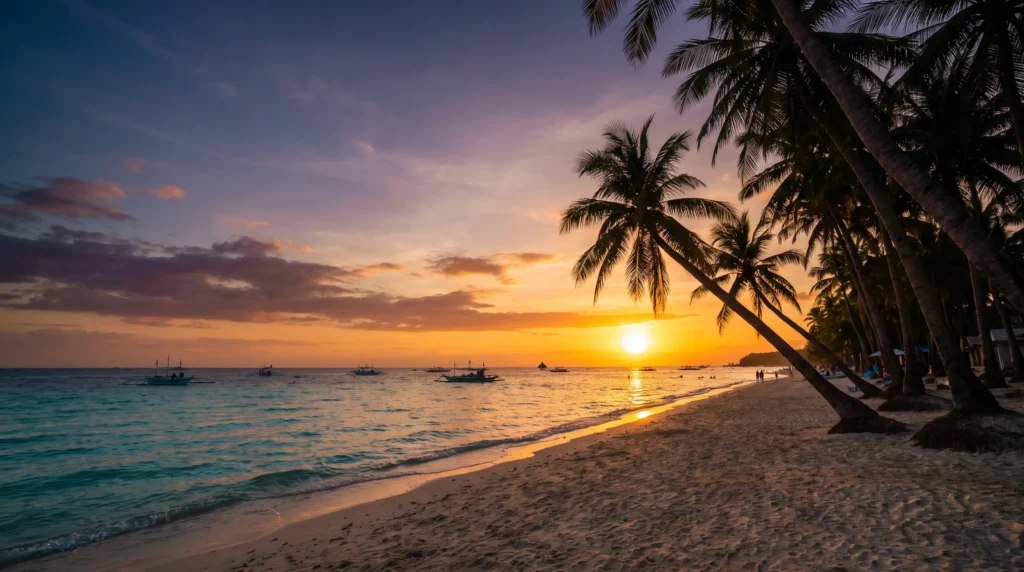
Boracay is a strange thing in travel: an island that got so popular it had to be shut down and fixed, then reopened better than before. It is tiny — a dog-bone-shaped speck barely seven kilometres long and, at its narrowest, under a kilometre wide, sitting just off the northwest tip of Panay in the Western Visayas. And yet White Beach, its four-kilometre west-facing crescent, is genuinely one of the best beaches I’ve stood on anywhere in Asia — powder-fine, sloping gently into water that goes through turquoise, teal and navy in about thirty metres. I’ll be upfront about the catch, because that’s the deal here: this is a developed, sometimes crowded resort island, not a castaway fantasy, and a chunk of every visitor’s day involves other visitors. What makes it worth your time anyway is that the 2018 closure actually changed things — cleaner water, a beach you can walk without dodging beach-bars-turned-into-the-surf, and sunsets that still stop conversations mid-sentence.
In This Guide
- Overview — Why Boracay Still Earns Its Reputation
- Ati-Atihan — the Region’s Biggest Festival, a Short Trip Away
- Best Time to Visit Boracay (Season by Season)
- Getting There — Caticlan, Kalibo & the Jetty Ports
- Getting Around — E-Trikes, Tricycles & Walking
- The Stations — Boracay’s Key Areas
- Culture & People
- A Food Lover’s Guide to Boracay
- Off the Beaten Path
- Day Trips From Boracay
- Practical Information
- Budget Breakdown — What Boracay Actually Costs in 2026
- Frequently Asked Questions
Overview — Why Boracay Still Earns Its Reputation
Boracay sits about 0.8 kilometres off the northwest coast of Panay Island, part of Aklan province in the Western Visayas, roughly 200 nautical miles southeast of Manila. The whole island is administered as three barangays — Balabag, Manoc-Manoc and Yapak — under the mainland municipality of Malay, and it packs around 37,800 residents into just over 10 square kilometres, one of the densest patches of population in the Philippines.
The headline act, obviously, is White Beach: about four kilometres of fine, almost flour-soft sand facing directly west, backed by a beachfront path, hundreds of resorts, and a sunset that has launched a thousand Instagram feeds. But Boracay’s real story in the last decade is the 2018 shutdown. President Rodrigo Duterte closed the island entirely for six months, from late April to late October 2018, citing a sewage system that had become “obsolete and insufficient” for the crowds it was hosting. It reopened with real teeth behind the rehabilitation: a mandatory 30-metre buffer zone from the waterline, the removal of beachfront bars, tables and massage stands that had crept onto the sand, and tighter caps on daily arrivals.
Was it worth the pain? Broadly, yes — water quality is measurably better and the beach itself feels less hemmed-in. But be honest with yourself about what Boracay is: a compact, built-up resort island that welcomed north of two million visitors in 2025 alone. This isn’t a quiet-cove trip. It’s a genuinely gorgeous beach experience wrapped in nightlife, watersports and a tourism economy running at full tilt — go in with that expectation and it delivers.
Ati-Atihan — the Region’s Biggest Festival, a Short Trip Away
Boracay itself doesn’t have its own island-wide festival on the scale of this one, but time a January trip around Ati-Atihan, held annually in Kalibo, the Aklan provincial capital about 1.5–2 hours from Boracay by road and ferry. The main celebration falls on the third Sunday of January, with a build-up of parades and street dancing through the preceding week.
Ati-Atihan is widely considered the oldest festival in the Philippines, tracing back over 800 years to when Malay settlers honored the indigenous Ati people by darkening their skin and dancing alongside them; Spanish missionaries later layered in devotion to the Santo Niño, and the two traditions still run together today. Expect tribal drumming, soot-and-paint body art, elaborate costumes and street parties that spill across Kalibo for days. Combine it with a Boracay beach week and you get both the region’s cultural centerpiece and its most famous sand in one trip — book Kalibo accommodation early, since the town fills up fast that week.
Best Time to Visit Boracay (Season by Season)
December – April · Dry season (peak)
The classic postcard window: minimal rain, calm seas on the White Beach side, warm water, and the busiest, priciest months of the year — Christmas through New Year and the whole of the Holy Week/Easter period sell out resorts well in advance.
May · Shoulder month, with a catch
Still largely dry and hot, with thinner crowds than peak, but this is also when Boracay’s seasonal green algae can bloom along parts of the shoreline. It’s a naturally occurring, cyclical event tied to nutrient upwelling rather than pollution, running roughly February through May, and it doesn’t affect every beach or every day — but it’s worth knowing about rather than being surprised by.
June – November · Wet/green season
Warm afternoon downpours, the Philippines’ broader typhoon season, and the year’s lowest room rates. Bulabog Beach on the island’s east side, the kiteboarding and windsurfing hub, actually gets its best wind during the amihan (northeast monsoon) months from roughly November to March — the opposite of White Beach’s calmest window, which is a useful thing to know if watersports are the point of your trip.
Getting There — Caticlan, Kalibo & the Jetty Ports
Boracay has no airport of its own; you fly into one of two gateways on neighboring Panay Island and finish the trip by ferry. Godofredo P. Ramos Airport (MPH) at Caticlan is the closer option, just a couple of kilometres from Caticlan Jetty Port, and takes domestic flights from Manila and Cebu plus some regional connections. The alternative is Kalibo International Airport, around 50 kilometres away — roughly a 1.5 to 2-hour van transfer — but it handles more international and low-cost carrier traffic, including direct flights from Seoul, and is often the cheaper booking even after you add the longer road transfer.
From Caticlan Jetty Port, outrigger “pump boats” cross the short Tabon Strait to Cagban Jetty Port on Boracay in about ten to fifteen minutes; expect small terminal and environmental fees payable at the port on top of the boat fare, in cash. Van and tricycle transfers between either airport and the jetty are easy to arrange on arrival, and most hotels can pre-book a transfer package that bundles the whole Caticlan-to-resort chain into one price.
Getting Around — E-Trikes, Tricycles & Walking
There is exactly one main road running the island’s spine, and since the rehabilitation, Boracay has pushed hard toward electric vehicles: e-trikes and e-jeepneys are now the standard way to move between Stations if you don’t want to walk the whole beach path. Fares are cheap and negotiable for short island hops, and most drivers know hotels by name rather than address.
Walking is genuinely the best way to experience White Beach itself — the paved beachfront path runs nearly its full length, past resorts, bars and sand-castle carts, and most of central Boracay (Stations 1 through 3) is comfortably walkable end to end in well under an hour. Bulabog Beach on the opposite coast is a short e-trike ride from the main strip, useful to know if you’re staying beachfront on one side and want to kite or windsurf on the other.
The Stations — Boracay’s Key Areas
Station 1
The northern, quieter and more upscale end of White Beach — wider sand, a calmer social scene, and the priciest resorts on the island. This is where couples and families skew when they want the beach without the beach-bar noise.
Station 2
The center of gravity: D’Mall and its knot of restaurants, souvenir shops and dive operators, plus the densest concentration of bars, water-sport touts and nightlife. Loud, busy, and honestly the most convenient base if you want everything within a five-minute walk — just don’t expect quiet.
Station 3
The southern, more budget-friendly stretch, with a narrower beach and a mellower, slightly more local feel. Good value guesthouses cluster here, a short e-trike ride from Station 2’s restaurants.
Bulabog Beach
The island’s east-facing kite and windsurf coast, thin on swimmable sand at low tide but the reason serious watersports travelers come to Boracay at all — schools and gear rental line the shore, busiest during the November–March wind season.
Diniwid & Puka Beach (Yapak)
North of Station 1, Diniwid is a small, quieter cove reached by a short cliffside path — a nice half-day escape without leaving the island. Further north still, Puka Beach in Yapak barangay is rougher and less developed, named for the puka shells that used to wash ashore in numbers, and is the closest thing on Boracay to a “get away from it” beach.
Mount Luho
The island’s highest point, reachable by a short zipline-and-ATV area or a straightforward walk/ride up, with a viewing deck that lays out the whole dog-bone shape of Boracay and both coastlines at once — worth the detour for orientation alone.
Culture & People
Boracay’s year-round population is a mix of Aklanon and Hiligaynon-speaking locals from Panay, migrant workers from across the Philippines drawn by the tourism economy, and a long-settled community of foreign residents and business owners — the island has effectively run as an international resort town since the 1980s. Filipino hospitality culture runs deep here: expect warmth, quick smiles, and a genuine willingness to help that isn’t purely transactional.
Catholicism shapes the calendar, as it does across most of the Philippines, and you’ll see small shrines and fiesta processions on the island even outside the big regional festivals. For a deeper dose of the culture behind the beach, Kalibo’s Ati-Atihan (see above) is the real thing — Boracay’s own nightly entertainment, by contrast, leans firmly toward fire dancers, beach bars and live cover bands rather than traditional ceremony, which is worth knowing if you’re hoping for one and not the other.
A Food Lover’s Guide to Boracay
Boracay’s food scene is unapologetically international — you can eat Italian, Korean, Indian or Filipino within one block of D’Mall — but the local standouts are worth prioritizing. Start with fresh seafood: talibong or D’Talipapa market lets you buy fish, prawns and squid straight off the boats and have a nearby stall grill it to order for a fraction of restaurant prices. Chori burger — a grilled Filipino chorizo patty in a bun, sold from carts along the beach path — is Boracay’s unofficial late-night snack.
For proper Filipino cooking, look for sisig (sizzling chopped pork), kinilaw (a Filipino take on ceviche, often with coconut vinegar and calamansi), and halo-halo for dessert — shaved ice, evaporated milk, sweet beans, jellies and ube ice cream layered into one glass. Mango is the island’s signature fruit; dried mango and mango shakes are everywhere and genuinely good, since Aklan and neighboring provinces grow some of the country’s best. San Miguel beer, brewed nationally since the late 19th century, is the standard cold drink on every beach chair.
Off the Beaten Path
Puka Beach at sunrise
Most visitors see Puka Beach midday via island-hopping tours; go independently at sunrise instead and you’ll often have the rougher, wilder northern sand almost to yourself.
Crystal Cove and Crocodile Island
Small islets just offshore with sea caves, cliff-jumping spots and snorkeling that skips the crowds of the main White Beach shallows — reachable on a shared or private boat tour.
Ilig-Iligan Beach
A forested, largely undeveloped cove on the east coast near Bulabog, popular with cliff-divers and almost entirely ignored by the main tourist circuit.
Panay mainland day trip
Skip the boat tours entirely and cross to Caticlan or Kalibo for a look at rural Panay — rice paddies, small-town markets and a version of the Philippines that has nothing to do with beach bars.
Day Trips From Boracay
Kalibo (1.5–2 hours) is the obvious pick outside festival season too — a working provincial capital with markets, colonial-era churches and the airport itself as a transit hub, giving a grounded contrast to Boracay’s resort bubble.
Carabao Island, a short boat ride further north, offers quieter beaches and decent surf breaks for travelers who’ve had their fill of White Beach’s crowds. Antique province, on Panay’s opposite coast, trades beach resorts for waterfalls, mountain trekking and a noticeably slower pace, reachable by road in a few hours. For a bigger detour, Iloilo City to the south connects Panay’s heritage architecture and its own strong food scene, easily paired with a Boracay trip via a short domestic flight or a longer overland run down the island.
Practical Information
Money. The Philippine Peso trades at roughly ₱61–62 to the US dollar as of mid-2026. Unlike some Caribbean or Central American destinations, US dollars are not routinely accepted for everyday purchases on Boracay — change pesos at a bank or licensed money-changer rather than assuming dollars will work at the beach bar. Cards are widely accepted at resorts and larger restaurants; carry cash for e-trikes, markets and smaller stalls.
Safety. The Philippines overall carries a Level 2 “Exercise Increased Caution” advisory from the US State Department, driven mainly by crime, terrorism and civil-unrest risks concentrated in specific regions — the more serious “Reconsider Travel” and “Do Not Travel” zones sit in parts of Mindanao and the Sulu Archipelago, well south of Boracay and Panay. Boracay itself is a heavily touristed, well-patrolled island; ordinary precautions around belongings on the beach and at night out are the main things to manage. Check your government’s current advisory before you travel regardless.
Health. The CDC recommends routine vaccines be current, plus Hepatitis A for most travelers and Hepatitis B and Typhoid depending on your itinerary; dengue is present, so daytime mosquito protection (repellent, covered clothing) matters as much as evening precautions, and swimming in unchlorinated freshwater is best avoided due to leptospirosis risk. Stick to bottled or filtered water outside resorts.
Connectivity, plugs & time. Mobile coverage and resort Wi-Fi are generally solid on Boracay given the tourism volume; an eSIM with Philippines data is an easy add before you land. Plugs are the US-style Type A/B, running 220V — bring a simple adapter if you’re arriving with North American electronics rated for 110V only. Time zone is Philippine Standard Time, UTC+8, with no daylight saving.
Budget Breakdown — What Boracay Actually Costs in 2026
Boracay sits mid-pack for Southeast Asian beach destinations — pricier than rural Philippines, cheaper than the region’s boutique-resort islands.
Budget (US$35–65/day): Station 3 guesthouse or hostel dorm, market seafood or street-cart chori burgers, e-trike hops instead of private tours, beach time that costs nothing at all.
Mid-range (US$90–200/day): Station 1 or 2 hotel with a pool, restaurant meals, an island-hopping boat tour (roughly US$20–35 with snorkeling gear and lunch included), maybe a half-day parasailing or diving add-on.
Luxury (US$350+/day): Beachfront Station 1 resort, private boat charters, spa days, and a Kalibo or Caticlan flight upgraded to business class for the short domestic hop.
Fixed costs to plan for: small port/terminal and environmental fees at both jetty ports, plus watersport activity fees (kiteboarding lessons, diving, parasailing) that add up quickly if you’re doing several. Tipping isn’t obligatory but is increasingly appreciated in tourist-facing spots.
Planning Your First Trip to Boracay
Four to five nights is the sweet spot for a first visit: enough time to settle into a Station, do one island-hopping day, catch a couple of sunsets from different points along the beach, and still have a slow day doing nothing at all. Fly into Kalibo if you find a cheaper fare and don’t mind the longer transfer, or Caticlan if convenience matters more than cost. If you’re building a longer Philippines trip, pair Boracay with a look at the capital via our Manila city guide, or read our full Philippines travel guide for how the islands fit together beyond this one beach.
Frequently Asked Questions
Is Boracay safe for tourists in 2026?
Yes, in the sense that matters for planning — Boracay and the surrounding Western Visayas sit well outside the Philippines’ higher-risk advisory zones, which concentrate in parts of Mindanao and the Sulu Sea. Normal beach-town precautions — watch your belongings, use licensed tour operators and transport — cover most of it.
Do I need a visa?
Most Western passport holders, including US, UK, EU, Canadian and Australian citizens, can enter visa-free for stays up to 30 days, but you must complete the Philippines’ e-Travel registration online before arrival. Check your specific nationality’s requirements before booking, since rules vary.
Is Boracay overcrowded now, after the 2018 closure?
It’s busy — over two million visitors came in 2025 — but the rehabilitation genuinely thinned out the worst of the old beachfront clutter and improved water quality. Expect company on White Beach; expect it to be manageable rather than overwhelming outside the absolute peak weeks around Christmas and Easter.
What’s this green algae I’ve read about?
A natural, cyclical bloom that can appear on parts of the shoreline roughly February through May, driven by seasonal nutrient shifts rather than pollution. It’s patchy, not constant, and not a reason to avoid those months outright — just worth knowing before you book if pristine sand every single day is non-negotiable for you.
Boracay or Palawan?
Choose Boracay for the single best beach-and-nightlife package with the easiest logistics; choose Palawan (El Nido or Coron) for dramatic limestone scenery, quieter island-hopping and a more remote feel. Many Philippines first-timers do both on one trip.
Can I visit as a day trip from Manila?
Technically yes with an early flight to Kalibo or Caticlan, but it’s a rushed, expensive way to see a beach that rewards at least a few nights — most visitors fly in and stay.
Ready to Explore Boracay?
A four-kilometre beach that earns every bit of its reputation, a hard-won cleanup story behind the postcard, and a sunset over the Sibuyan Sea that’s worth planning a whole evening around. Boracay isn’t a secret anymore, and it doesn’t pretend to be — go for what it actually is: one of Asia’s best executed beach holidays.
Explore More
- Manila City Guide — the Philippines’ capital gateway
- Philippines Travel Guide — see how Boracay fits into the wider archipelago
- Bali City Guide — Southeast Asia’s other iconic island escape
- Thailand Travel Guide — more Southeast Asian beach and island options
How this guide was built
Published as part of Facts From Upstairs’ city guide series. Built from authoritative sources — the Wikipedia entity pages for Boracay, Godofredo P. Ramos Airport and Ati-Atihan, the Bangko Sentral ng Pilipinas exchange-rate bulletin, the Philippines e-Travel/eVisa official policy page, the US State Department’s Philippines travel advisory, the US CDC traveler page for the Philippines, and Philippine Information Agency reporting on 2025 Boracay tourist arrivals. Numeric and checkable claims carry inline citations.
Sources cited on this page
- Wikipedia — Boracay
- Wikipedia — Godofredo P. Ramos Airport
- Wikipedia — Ati-Atihan
- Bangko Sentral ng Pilipinas — Daily Exchange Rate Bulletin
- Philippines e-Travel/eVisa — Visa Policy
- US State Department — Philippines Travel Advisory
- US CDC — Philippines Traveler Page
- Philippine Information Agency — Boracay 2025 Tourist Arrivals
More city guides you might like
Plan your trip to Boracay
The booking tools we use ourselves. FFU may earn a commission at no extra cost to you.
Plan & book your trip to Boracay
Booking through these searches supports our guides at no extra cost to you.