
Manila, Philippines: Spanish Walled City, Chinatown of 1594 and the World's Longest Christmas
Part of our Philippines travel guide.
Manila City Guide
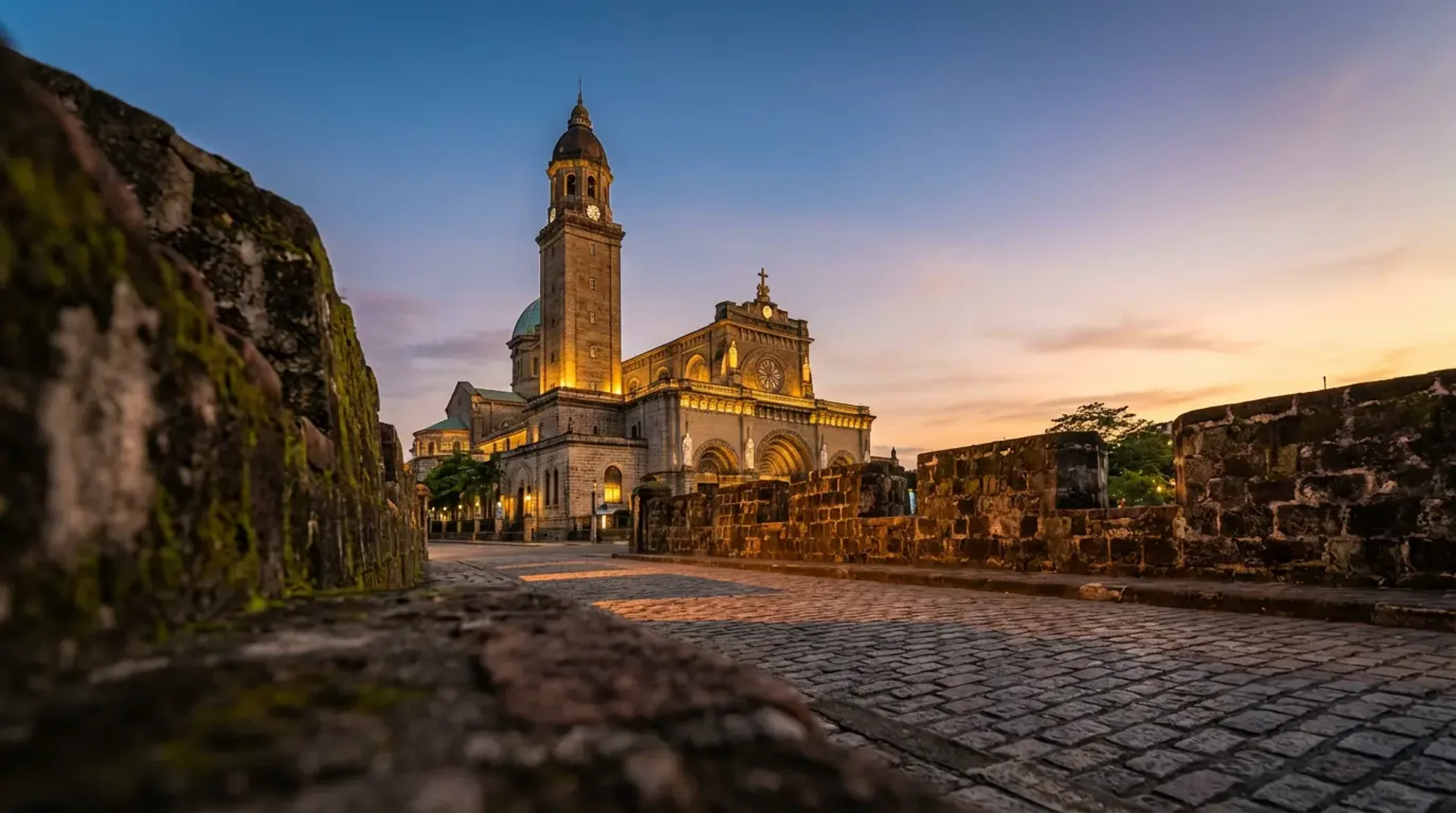
Table of Contents
Why Manila?
Manila is the only capital in Asia that layers a 1571 Spanish walled city, a Chinatown founded in 1594, a half-dozen American-era civic buildings and a ring of 21st-century glass-tower CBDs inside a single megalopolitan footprint of 636 square kilometres. The Spanish ruled here for 333 years, the Americans for 48, the Japanese for three, and the resulting cultural sediment — Catholic processions alongside lion-dance parades, adobo dinners followed by hopia breakfasts, jeepneys painted with the Virgin Mary idling next to Grab SUVs — is unlike anything else in Southeast Asia. The sprawl spans 16 chartered cities and one municipality governed under the Metro Manila Development Authority, stretching from Caloocan in the north to Muntinlupa in the south along the EDSA ring road. The city proper of Manila holds 1.85 million residents on just 38 square kilometres of land, making it one of the densest local government units in the world; Metro Manila as a whole holds 13.5 million residents per the 2020 PSA census, ranking it among the ten densest urban agglomerations on earth.
The contradiction every first-time visitor feels is the collision between traffic that regularly ranks in the global top five for lost drive time — TomTom's 2024 Traffic Index placed Metro Manila among the world's worst for rush-hour congestion — and hospitality that keeps you smiling through a three-hour taxi ride. English is a co-official language alongside Filipino, signage is entirely English outside wet markets, and more than 93% of Filipinos over 10 years old report they can read and understand English per PSA literacy data, which makes this the easiest-to-navigate megacity in the Pacific Rim for anglophone travellers. You will not need a phrasebook to order at a carinderia, flag down a jeepney or navigate the MRT-3 timetable; the language barrier that defines first trips to Tokyo, Seoul, Taipei or Bangkok is simply not present here.
One superlative worth anchoring the visit around: Binondo, across the Pasig from Intramuros, has been continuously occupied as a Chinese-Filipino trading quarter since 8 December 1594, making it the oldest Chinatown in the world by a margin of more than two centuries. Over the course of this guide you will get our shortlist of nine neighbourhoods worth structuring a visit around, a full tour of adobo and sinigang Filipino staples, Binondo dumpling routes, Jollibee "Chickenjoy" rituals and Asia's 50 Best-listed Toyo Eatery; the UNESCO-listed San Agustin Church inscribed in 1993 ; the Gold of Ancestors pre-Hispanic gold collection at the Ayala Museum; five day-trip escapes led by Tagaytay ridge views over Taal Volcano and Corregidor Island WWII ruins; the 2026 festival calendar led by Binondo Chinese New Year on 17 February 2026 and the longest Christmas season on the planet, stretching from September 1 through early January with the Simbang Gabi dawn-mass novena running 16-24 December every year.
Neighborhoods: Finding Your Manila
📍 Manila Map: Every Place in This Guide
Metro Manila is administratively divided into 16 cities and one municipality stretched across 636 square kilometres of the Luzon central plain, cleaved east-to-west by the muddy brown Pasig River and south-to-north by the perpetually jammed EDSA ring road. For travellers this sprawl compresses to roughly nine neighbourhoods that cover the Spanish colonial core, the oldest Chinatown in the world, the two principal post-war CBDs (Makati and BGC), the bayside heritage strip, the Pasig / Mandaluyong / Quezon City second CBD at Ortigas, the old capital of Quezon City itself, the Makati nightlife pocket of Poblacion, and the pearl-market suburb of San Juan / Greenhills. All nine are reachable on some combination of LRT-1, LRT-2, MRT-3, jeepney and Grab within about three-quarters of an hour off peak, though the same trips can double at rush hour. The following shortlist is ordered loosely by the arc most first-time visitors walk, starting inside the old Spanish walls and ending in the suburban weekend markets.
Intramuros
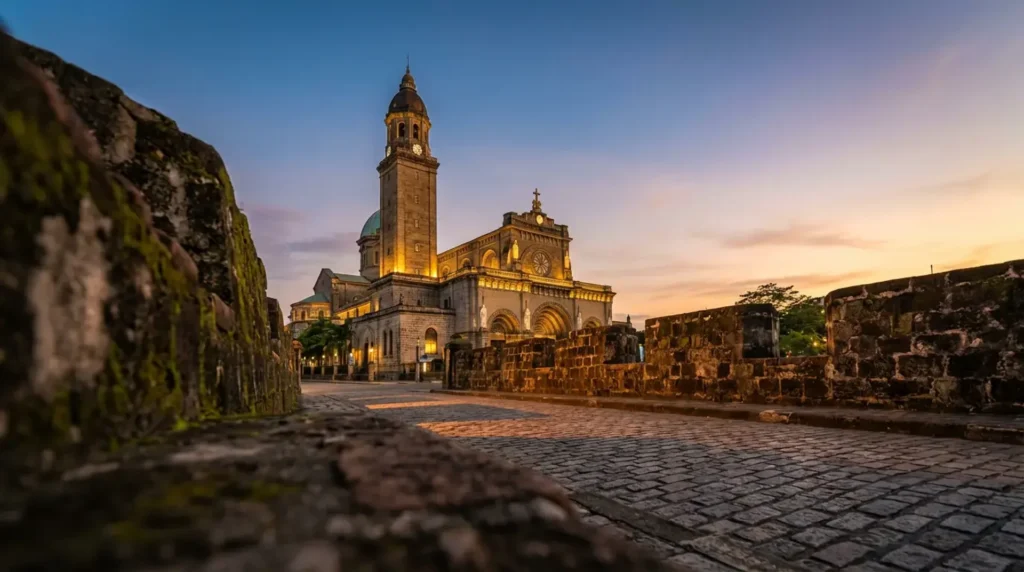
Intramuros is the original Spanish walled city, founded by Miguel López de Legazpi on 24 June 1571 on the south bank of the Pasig River at the western edge of the modern Manila LGU. Inside its surviving 4.5 km of rampart walls sit Fort Santiago (where Jose Rizal was imprisoned in 1896 before his execution at Luneta), San Agustin Church (the country's only UNESCO-inscribed Manila building ), Manila Cathedral (its eighth iteration, completed 1958), the rebuilt Casa Manila museum house, and a dozen hole-in-the-wall Kapampangan restaurants along General Luna Street. The district was almost totally levelled by the 1945 Battle of Manila — San Agustin is the only 16th-century structure that survived intact — and the post-war reconstruction is still continuing under the Intramuros Administration. Bamboo-bike and kalesa (horse-drawn carriage) tours run from the Plaza San Luis tourist office at about ₱350-500 (~$6-9) per hour. The whole quarter is walkable in four hours but deserves a full day if you plan to enter all three ticketed sites.
- Fort Santiago — Rizal's cell and the Pasig-side gate; admission ₱75 (~$1.30).
- San Agustin Church and Museum — oldest stone church in the Philippines; museum ₱200 (~$3.50).
- Manila Cathedral — minor basilica, free entry, daily masses.
- Casa Manila — reconstructed Spanish-era house museum; ₱75 (~$1.30).
Best for: history and Spanish colonial architecture. Access: LRT-1 Central Terminal, 10-minute walk or short Grab.
Binondo (Chinatown)
Binondo was established on 8 December 1594 when Spanish Governor Luis Pérez Dasmariñas granted the island parcel across the Pasig from Intramuros to Catholic Chinese ("Sangley") merchants, which makes it the oldest continuously inhabited Chinatown in the world — older than Malacca's Jonker Walk, older than San Francisco's, older than every Chinatown in the Western hemisphere by more than two centuries. Ongpin Street, the quarter's main artery, is a 900-metre food and pharmacy corridor lined with hopia-and-tikoy bakeries (Eng Bee Tin, Polland Hopia, Ho-Land), hand-pulled-noodle joints, lugaw porridge carts, and a dozen temple-and-apothecary alleys like Carvajal Street and Escolta-ward Quintin Paredes. Binondo Church (Minor Basilica of San Lorenzo Ruiz), built in 1596 and reconstructed several times since, sits at the northern head of the district on Plaza San Lorenzo Ruiz. The Big Binondo Food Wok walking tour with Ivan Man Dy is the long-running institution for first-time visitors at ₱1,500-1,800 (~$26-31) per head.
- Ongpin Street — 900-metre food corridor of hopia bakeries and noodle shops.
- Binondo Church (Minor Basilica of San Lorenzo Ruiz) — 1596 founding, free entry.
- Escolta — former "Wall Street of the Philippines", art-deco building cluster.
- Lucky Chinatown Mall — newer retail anchor with Chinese-style facade.
Best for: dumpling food tours, hopia bakeries, heritage walking. Access: LRT-1 Carriedo Station, 8-minute walk across Quezon Bridge.
Makati
Makati is the country's primary central business district — the Ayala-family-developed 27-square-kilometre city that has been the headquarters neighbourhood of the Philippine Stock Exchange (moved to BGC in 2017), most of the country's domestic conglomerates, and roughly 62% of the Philippines' Fortune-500 regional HQs. The commercial core is the Ayala Triangle bounded by Ayala Avenue, Makati Avenue and Paseo de Roxas, with the three interconnected Ayala Malls — Greenbelt (five buildings arranged around a landscaped central park), Glorietta (five interconnected malls) and Ayala Center — running continuously underground for roughly 1.2 kilometres. The Ayala Museum (reopened 2021 after a three-year renovation) holds the pre-Hispanic Gold of Ancestors collection of more than 1,000 pieces. Poblacion barangay, on the west side of Makati, is the nightlife pocket covered separately below.
- Ayala Museum — Gold of Ancestors collection; ₱650 (~$11.30).
- Greenbelt Chapel — circular 1983 open-air chapel inside the Greenbelt 1 garden.
- Ayala Triangle Gardens — fireflies-style Christmas light show November-January.
- Glorietta and Greenbelt Malls — continuous underground shopping corridor.
Best for: business travellers, high-end dining, museum-hopping. Access: MRT-3 Ayala Station.
Bonifacio Global City (BGC)
BGC is the planned new CBD built on a 440-hectare parcel of former military land in Taguig starting in 2003 and finishing its first full build-out around 2018. Inside the grid are Bonifacio High Street (a 700-metre pedestrian shopping strip), the Mind Museum (a 2012-opened interactive science centre, ₱750/$13 admission), the Venice Piazza McKinley Hill, the 2022-opened Metropolitan Museum of Manila-at-MKA Pavilion, and more than 40 pieces of large-format public art including the BGC Art Festival rotating installations. Burgos Circle is the weekend brunch anchor with 20+ restaurants including Wildflour, Early Night Shift and Your Local. The Fort Strip is the nightlife node (covered in Entertainment). BGC's streetgrid is laid out in a rare-for-Manila orthogonal pattern with wide pavements and clearly numbered blocks, which makes it the single most walkable district in Metro Manila. Grab rides from Makati CBD take a quarter-hour off peak for a ₱150-300 fare (~$2.60-5.20) .
- Bonifacio High Street — 700-metre pedestrian boulevard.
- Mind Museum — interactive science centre; ₱750 (~$13).
- Venice Grand Canal (McKinley Hill) — a man-made canal with gondola rides ₱200 (~$3.50).
- BGC Arts Center — independent theatre and dance venue.
Best for: families, walkable streets, craft coffee, contemporary art. Access: Bus or Grab from Ayala Station; MRT-7 extension under construction.
Malate & Ermita
Malate and Ermita together form the bayside heritage tourist belt that was the country's primary international visitor district from the 1950s through the 1990s before Makati and BGC displaced them. The strip runs from Rizal Park (formerly Luneta) and the National Museum Complex in the north down to Robinsons Place Manila and the Malate Church in the south, with Roxas Boulevard hugging Manila Bay the entire length. Nearly every civic memory of Manila's 20th century sits in this corridor: the Rizal Monument where the national hero was executed on 30 December 1896; the Quirino Grandstand where presidential inaugurations are held; the Manila Ocean Park marine-life complex; and the National Museum of the Philippines (free admission, three buildings: Fine Arts, Natural History, and Anthropology). The strip is dense with mid-range hotels (Bayview Park, Hotel H2O, Diamond Hotel), backpacker dorms and all-night eateries. After dark the bayside stretch is safe with visible PNP and Manila City police presence; the inland streets of Mabini and Adriatico see more caution (see Safety).
- Rizal Park (Luneta) — Rizal Monument, Chinese and Japanese gardens; free entry.
- National Museum Complex — Fine Arts (Spoliarium), Natural History, Anthropology; free admission.
- Manila Bay baywalk — sunset strip, seafront promenade.
- Robinsons Place Manila — seven-floor mall at Pedro Gil.
Best for: first-time visitors on a budget, museum days, sunset bay walks. Access: LRT-1 UN Avenue or Pedro Gil Station.
Quezon City
Quezon City was the national capital of the Philippines from 1948 to 1976 and remains the largest city in Metro Manila by both area (166 km²) and population (2.96 million per 2020 PSA), holding more residents than Manila proper by over a million. The district's heart is Araneta City (formerly Araneta Center) in Cubao, built around the 1960-inaugurated Smart Araneta Coliseum ("Big Dome", capacity 16,500) that hosts the PBA basketball finals, K-pop concerts and boxing title fights. To the north-east the 493-hectare University of the Philippines Diliman campus anchors the country's flagship public university and its sunken Sunken Garden oval. Tomas Morato Avenue in the east, between Timog and the old ABS-CBN compound, is the city's densest restaurant and live-music corridor. La Mesa Eco Park on the north rim offers one of Metro Manila's few genuine green escapes (2,700 hectares of watershed forest). Quezon City is the obvious base for budget travellers using LRT-2 or travellers chasing Filipino indie-music venues.
- Smart Araneta Coliseum — PBA and concert venue, 16,500 capacity.
- UP Diliman Sunken Garden and Oblation statue.
- Tomas Morato restaurant row.
- La Mesa Eco Park — 2,700-hectare watershed forest.
Best for: live music, student nightlife, PBA basketball. Access: MRT-3 Cubao or LRT-2 Katipunan.
Ortigas Center
Ortigas is the second CBD of Metro Manila, straddling three cities (Pasig, Mandaluyong and Quezon City) around the EDSA-Ortigas MRT-3 intersection. The 100-hectare business district was developed by the Ortigas family starting in the 1970s and is anchored by SM Megamall (the 5th-largest shopping mall in the world by gross leasable area at 474,000 m² after its 2018 expansion ), Shangri-La Plaza, Robinsons Galleria, Capitol Commons and Estancia. The Asian Development Bank headquarters, the Manila Golf Club, the San Miguel Corp. main office and the Lopez Museum all sit inside the district. Greenhills Shopping Center, a short jeepney ride north across EDSA in San Juan, is the famous pearl and tiangge (flea-market) complex where South Sea and freshwater pearls sell for a fraction of their mall-jeweller prices. Ortigas is a more corporate daytime district than Makati or BGC but is a popular mid-range accommodation base for business visitors and families.
- SM Megamall — 474,000 m² GLA, 5th-largest mall in the world.
- Shangri-La Plaza — upscale mall with daily orchid-display atrium.
- Capitol Commons — newer open-plan retail and food park.
- Greenhills Shopping Center (adjacent) — pearl tiangge market.
Best for: mall crawlers, business visitors, families. Access: MRT-3 Ortigas or Shaw Boulevard Station.
Poblacion (Makati)
Poblacion is the historic barangay inside Makati city that has, since roughly 2015, remade itself from a seedy red-light zone into Metro Manila's densest craft-cocktail and third-wave-coffee neighbourhood. The three parallel streets of Burgos (the original 1970s-80s girly-bar strip, still partly intact), Poblacion and Durban now host more than 70 bars and restaurants inside a 600-metre by 400-metre rectangle. The Curator Coffee & Cocktails (a speakeasy behind a coffee bar on Colon Street, on the Asia's 50 Best Bars longlist multiple years), OTO (the listening room with a vintage turntable and no-menu policy), Run Rabbit Run and Polilya anchor the craft-cocktail scene; Yardstick and Craft Coffee Workshop lead the coffee side; Lampara, Single Origin and Limbo serve the Instagram dinner crowd. Poblacion nightlife runs midnight-late, and it is one of the few Manila districts where solo travellers can reliably find a bar stool at 01:00 on a Tuesday.
- The Curator Coffee & Cocktails — speakeasy behind a daytime coffee bar.
- OTO — vintage-turntable listening bar on Durban Street.
- Polilya — neighbourhood-defining cocktail room.
- Lampara — contemporary Filipino dinner spot.
Best for: bar crawls, craft cocktails, solo nightlife. Access: Grab from Ayala Station (short ten-minute ride) — no direct rail.
San Juan & Greenhills
San Juan is the smallest city in Metro Manila by land area (under 6 km²) and the historic home of the Ortigas family, the Tuason-family land grants, and the original Katipunan uprising — the first shot of the Philippine Revolution was fired at the San Juan del Monte gunpowder magazine on 30 August 1896, which makes this the most historically weighted suburban barangay in the metropolitan region. The neighbourhood's contemporary draw is Greenhills Shopping Center, the sprawling tiangge-and-branded-retail complex occupying a 16-hectare parcel along Ortigas Avenue. Filipinos from across the country come here for South Sea and freshwater pearls (Connecticut Arcade is the pearl corridor), cheap electronics (V-Mall is the grey-market laptop and phone anchor), and mid-range tailored clothing. Promenade Greenhills and the newer Theatre Mall house Max's Restaurant, Mary Grace Cafe and Wildflour. San Juan is a short twenty-minute Grab ride east from Makati or north from Ortigas.
- Greenhills Shopping Center — 16-hectare pearl-and-electronics tiangge complex.
- Connecticut Arcade — pearl corridor inside Greenhills.
- V-Mall — grey-market electronics.
- Pinaglabanan Shrine — 1896 revolution historical marker.
Best for: pearl shopping, mid-range electronics, suburban dining. Access: MRT-3 Ortigas plus 10-minute jeepney, or direct Grab from Makati.
The Food
Filipino food is the last great underrated Asian cuisine — shaped by 333 years of Spanish rule, 48 years of American occupation, a millennium of Chinese and Malay trade, and the country's own pre-Hispanic native tradition — and Manila is the city where all four traditions collide on the same plate. The country's own headline dishes (adobo, sinigang, kare-kare, crispy pata, lechon) sit on menus next to Binondo dumplings, Jollibee "Chickenjoy", Asia's 50 Best-listed tasting menus led by Toyo Eatery, and the street-food merienda carts of Quiapo and Poblacion. The 2025 Michelin Guide has not yet arrived in the Philippines (Asia's 50 Best is the de-facto authority until it does), and the country's absence from the Michelin list is one of the most-debated omissions in regional food writing. What follows is structured the way most first-time visitors actually eat: a Filipino-staples lunch at Manam or Abe, a Binondo afternoon dumpling crawl, one Jollibee Chickenjoy induction ritual, one Asia's 50 Best splurge dinner, and a late-night merienda walk in Poblacion or Quiapo.
Filipino Staples — Adobo, Sinigang, Kare-Kare
Three dishes define the canon of Filipino home cooking and almost every traveller's first Manila meal includes at least one of them. Adobo is the de-facto national dish: pork or chicken stewed in vinegar, soy sauce, garlic, black pepper and bay leaves, with regional variants using coconut milk (Bicol), turmeric (Zamboanga) or annatto (Ilocos). Sinigang is the sour tamarind-and-fish-stock soup that serves as lunchtime comfort food across the archipelago, with regional proteins (shrimp, pork ribs, bangus milkfish, salmon head) and souring agents (kamias, guava, green mango). Kare-kare is the peanut-sauce oxtail-and-tripe stew traditionally served with banana heart, eggplant and okra, eaten with a side of fermented bagoong shrimp paste. The three are sold everywhere from ₱120 (~$2) neighbourhood carinderias to ₱750 (~$13) heritage restaurants. Manam in Greenbelt 2, BGC and SM Megamall is the contemporary-casual reference chain, and the half-order menu structure (you split every dish two ways) makes it the easiest place to taste six staples in one sitting. Abe in Serendra BGC is the Kapampangan benchmark for crispy pata (twice-fried pork knuckle) and sisig (chopped pork jowl, calamansi, onion). Sentro 1771 at Greenbelt 3 is famous for its corned-beef sinigang, a modern twist that went viral in 2008.
- Manam Comfort Filipino — modern-twist adobo, sinigang, kare-kare. ₱300-600 (~$5-10) per main; half orders available.
- Abe (Serendra, BGC) — Kapampangan comfort food, crispy pata and sisig. ₱450-850 (~$8-15).
- Sentro 1771 (Greenbelt 3) — corned-beef sinigang, kare-kare. ₱400-750 (~$7-13).
- Romulo Cafe — heirloom Filipino family recipes served in a granddaughter-of-president atmosphere. ₱350-700 (~$6-12).
- Kuya J — budget-friendly Cebuano-Filipino chain, lechon and liempo ₱180-380 (~$3-7).
Binondo — Dumplings, Hopia and Hand-Pulled Noodles
Binondo's 430-year-old Chinese-Filipino food scene runs on a different rulebook from the Filipino-staples corridor. Lan Zhou La Mien on Ongpin Street is the reference hand-pulled beef-noodle shop, turning out ₱150 (~$2.60) bowls of la mien through a window that opens onto the street. Dong Bei Dumplings, two blocks east, is the kuchay (Chinese chive) pork-dumpling institution at ₱140 (~$2.40) for 14 pieces. Ambos Mundos, founded 1888, is the longest-running restaurant in the country and pours 137-year-old pochero and caldereta recipes. Eng Bee Tin on Ongpin and Polland Hopia on Salazar are the two flagship hopia bakeries — buy the ube hopia and mongo (mung-bean) hopia boxes as the default souvenir at ₱60-120 (~$1-2) per box. Shanghai Fried Siopao just off Quintin Paredes sells bottom-crisped steamed-then-pan-fried pork buns at ₱40 (~$0.70) each. The unofficial rule: eat small portions at four or five stops rather than sitting down for one full meal, and bring small-denomination peso bills because many stalls do not take GCash or cards. Binondo food tours with Ivan Man Dy's Old Manila Walks run three to four hours for ₱1,500-1,800 (~$26-31) per head and cover roughly eight tasting stops.
- Lan Zhou La Mien — hand-pulled beef la mien, ₱150-220 (~$2.60-3.80).
- Dong Bei Dumplings — kuchay pork dumplings, ₱140-180 (~$2.40-3.10) per 14 pieces.
- Ambos Mundos — 1888 institution; pochero, caldereta, morcon. ₱220-450 (~$4-8).
- Eng Bee Tin (Ongpin Street) — ube and mongo hopia, ₱60-120 (~$1-2) per box.
- Polland Hopia (Salazar Street) — rival hopia bakery, ₱60-120 per box.
- Shanghai Fried Siopao (Quintin Paredes) — ₱40 (~$0.70) bottom-crisped pork buns.
Binondo pairs particularly well with Chinese New Year, when Ongpin closes to vehicles for the dragon-dance parade; the 2026 parade falls on 17 February (Year of the Horse) and draws an estimated half-million spectators. Outside festival windows the district also anchors the country's first Binondo-Intramuros pedestrian bridge, opened in 2022, which now makes the walk from Fort Santiago across the Pasig to Ongpin a 15-minute stroll rather than a traffic-bound cab ride.
Jollibee Culture — The Filipino Fast-Food Canon
No Manila food chapter is complete without Jollibee, the red-bee-mascot fast-food chain that has out-competed McDonald's on its home turf since 1981 and now operates more than 1,200 domestic branches and roughly 200 overseas in the US, UAE, UK, Canada, Italy and Vietnam. Chickenjoy (a double-fried fried chicken served with rice and optional gravy) is the hero product at ₱180-230 (~$3-4) for a 2-piece set with rice; Jolly Spaghetti (sweet banana-ketchup sauce, hot dog slices, Eden-cheese topping) is the one-of-a-kind cultural artefact most Western visitors remember, and is a legitimate national love-language dish at birthday parties. Mang Inasal, the Jollibee-owned competitor, runs the chicken-inasal (grilled chicken marinated in vinegar and annatto) and unli-rice format at ₱130-180 (~$2.30-3.10) per set. Chowking, also in the Jollibee Group family, is the Filipino-Chinese fast-food chain with halo-halo (₱140, ~$2.40) and siopao as the marquee items. The three chains combined have more storefronts in Metro Manila than McDonald's, KFC and Burger King put together, and their menus are the cultural reference point for an entire generation of Filipino diners at home and abroad.
- Jollibee (nationwide) — Chickenjoy 2-pc with rice, ₱180-230 (~$3-4); Jolly Spaghetti, ₱85-120 (~$1.50-2).
- Mang Inasal — chicken inasal with unli rice, ₱130-180 (~$2.30-3.10).
- Chowking — halo-halo ₱140 (~$2.40), siopao ₱80 (~$1.40).
- Goldilocks — Filipino bakery chain; ube roll ₱250-350 (~$4-6), polvoron ₱40 (~$0.70).
- Max's Restaurant — "Sarap to the Bones" fried-chicken institution since 1945; whole chicken ₱720 (~$13).
- Army Navy — Filipino-American military-themed burger-and-burrito chain; Freedom Burger ₱220 (~$3.80).
A cultural aside worth knowing: Filipinos eat five times a day, not three. The meal structure runs almusal (breakfast), merienda sa umaga (morning merienda around 10:00), tanghalian (lunch), merienda sa hapon (afternoon snack around 15:00), and hapunan (dinner). Jollibee, Chowking, Goldilocks and the neighbourhood pandesal bakeries (the small bread rolls served with hot chocolate at breakfast) all feed the merienda slots, which is why their storefronts never seem to close. Ordering a 2-pc Chickenjoy and a pineapple juice at 15:30 on a Tuesday will not earn you a confused look — it is the expected cadence of the Filipino food day. The Jollibee Group also operates Red Ribbon bakery (chocolate cake ₱550 / ~$9.50 whole), Mang Inasal and Chowking as subsidiaries, which gives it a larger domestic footprint than any other fast-food conglomerate in the Philippines by an order of magnitude.
Asia's 50 Best & Fine Dining Filipino
The fine-dining tier of Manila has matured rapidly since 2015, led by chefs who trained at Noma, Mugaritz and Narisawa and returned to build modern-Filipino tasting rooms inside the Makati, BGC and Pasig CBDs. Toyo Eatery, chef Jordy Navarra's 30-seat room in Karrivin Plaza Makati, ranked #43 on Asia's 50 Best Restaurants in 2019 and is the current standard-bearer for contemporary Filipino cooking; the degustation runs ₱4,200-5,800 (~$73-101) per person and walks diners through native ingredients (bagnet pork, kamayan hand-eating service, tsokolate eh chocolate) in ten courses. Gallery by Chele, at the same Karrivin Plaza, is chef Chele González's Spanish-Filipino hybrid tasting room which appeared on the Asia's 50 Best extended 51-100 list in 2024 at ₱4,800 (~$84). Metiz in Poblacion (₱4,500 / $78) and Helm by Josh Boutwood in BGC (₱5,500 / $96) round out the current top-four splurge tasting menus. For a la carte fine Filipino, Purple Yam in Malate (the Romulo-family heritage concept) and Casa Verde-affiliated Fely J's at Greenbelt 5 are the reference points. None of these rooms is Michelin-starred because the Philippines is not yet a Michelin Guide market as of 2026 — the country's fine-dining credibility rides entirely on Asia's 50 Best coverage.
- Toyo Eatery (Karrivin Plaza, Makati) — Asia's 50 Best #43 (2019), modern Filipino tasting. ₱4,200-5,800 (~$73-101).
- Gallery by Chele — Asia's 50 Best 51-100 (2024). ₱4,800 (~$84).
- Helm by Josh Boutwood (BGC) — contemporary tasting. ₱5,500 (~$96).
- Metiz (Poblacion) — Asia's 50 Best extended 2024. ₱4,500 (~$78).
- Purple Yam (Malate) — heritage Filipino with a New York pedigree. ₱800-1,500 (~$14-26) a la carte.
- Antonio's (Tagaytay) — highest-scoring Philippine restaurant on Asia's 50 Best extended list in prior years. ₱2,800-4,500 (~$49-78).
- Hapag — young-chef contemporary Filipino in QC, Asia's 50 Best one-to-watch. ₱3,500-5,000 (~$61-87).
A separate word on Filipino wine and drinks pairings: the country's native rice wine tapuy and coconut arrack lambanog have been largely replaced at fine-dining level by Spanish and New World wine lists, and cocktail pairings at Toyo, Metiz and Gallery by Chele run ₱2,200-3,800 (~$38-66) as an add-on course at all three tasting menus. San Miguel Pale Pilsen (₱90 / ~$1.60 bottle) remains the default casual beer at any carinderia or Jollibee; Red Horse Extra Strong and San Mig Light cover the other volume brands. Emperador brandy, produced by Alliance Global outside Manila, is the world's best-selling brandy by volume and runs ₱250-500 (~$4-9) per 750 ml bottle at any 7-Eleven or Mercury Drug.
Street Food & Merienda — Quiapo, Poblacion, Night Markets
Merienda (afternoon snack) is its own Filipino meal slot, sitting between lunch and dinner at roughly 15:00-17:00 every day, and the cart-and-stall food of Manila is built around it. Kwek-kwek (orange-battered deep-fried quail eggs dipped in spiced vinegar) is the iconic ₱20-40 (~$0.35-0.70) street snack; fishball, squidball, kikiam carts follow the same formula at ₱1-2 per piece. Isaw (grilled chicken intestines on a stick) and betamax (grilled coagulated chicken blood) are the grilled-cart staples found in Poblacion night alleys and along UP Diliman's Area 2 after 18:00. Balut, the famous fertilised duck egg, sells from roaming vendors calling out "baluuuut!" in the early evening at ₱25-35 (~$0.45-0.60) per egg. Mercato Centrale in BGC runs Friday-Saturday night markets with full-plate lechon belly, pares, sisig, and Filipino-taco fusion stalls at ₱200-350 (~$3.50-6) per plate. Quiapo's food strip around Quinta Market and Plaza Miranda is the most authentic street-food walking route, though crowd-wise it is also the most pickpocket-prone market district in the city — travel in daylight and leave the DSLR at the hotel. Razon's and Chowking are the reference halo-halo chains for the cold shaved-ice-and-beans dessert at ₱140-220 (~$2.40-3.80).
- Kwek-kwek (street carts) — orange-battered quail eggs, ₱20-40 (~$0.35-0.70).
- Mercato Centrale (BGC) — weekend night market, lechon belly, pares, sisig. ₱200-350 (~$3.50-6).
- Poblacion isaw and balut carts — ₱20-50 (~$0.35-0.90).
- Razon's halo-halo — Pampanga-style halo-halo, ₱140-220 (~$2.40-3.80).
- Quiapo Quinta Market street walk — kwek-kwek, taho, turon, lumpia.
- Salcedo Saturday Market (Makati) — weekend market, 90+ stalls, ₱200-500 plates.
Cultural Sights
Rizal Park (Luneta)
Rizal Park, originally Luneta (from the Spanish word for "crescent") and renamed in 1955 for the national hero Dr. Jose Rizal, is the 58-hectare civic green space that separates Intramuros from the Malate-Ermita tourist belt. Admission is free, opening hours are 05:00-21:00 daily, and hourly flag-raising and lowering ceremonies at the Rizal Monument run roughly 06:00 and 17:00. The park centres on the 12.7-metre Rizal Monument designed by Swiss sculptor Richard Kissling in 1913, which contains Rizal's remains and marks the spot where Spanish colonial authorities executed him by firing squad on 30 December 1896. The park also hosts the Chinese Garden, Japanese Garden, the open-air Rizal Park Auditorium (free weekend concerts), the Planetarium (₱50 / ~$0.87) and the Quirino Grandstand where presidential inaugurations take place. The parkside National Museum Complex is three sides of its northern frame. Expect the park to fill on Sundays with Filipino families, jogging clubs, and senior-citizen tai chi at 06:00.
San Agustin Church
San Agustin Church, completed in 1607 and inscribed on the UNESCO World Heritage List in 1993 as one of four "Baroque Churches of the Philippines", is the oldest stone church still standing in the country and the only structure inside Intramuros to survive the 1945 Battle of Manila intact. Admission to the church itself is free; the adjoining San Agustin Museum — housed in the former monastery — costs ₱200 (~$3.50) and holds colonial religious art, 17th-century carved choir stalls made from molave hardwood, and the tombs of Spanish governors including Miguel López de Legazpi (the founder of Manila), Juan de Salcedo and Martin de Goiti. Opening hours 08:00-12:00 and 13:00-18:00 daily; daily masses at 07:00 and 17:30. The ornate trompe-l'œil ceiling painted in the 1870s by Italian artists Cesare Dibella and Giovanni Alberoni is the single most photographed interior in Intramuros.
Intramuros & Fort Santiago
Intramuros itself is not on the inscribed UNESCO list (it remains on the tentative list inscription pending), but its 4.5 km of Spanish ramparts, five surviving gates and the Fort Santiago citadel constitute the country's densest colonial heritage cluster. Fort Santiago admission is ₱75 (~$1.30), open 08:00-18:00 daily. Inside the fort, the Rizal Shrine preserves the prison cell where the national hero was held from 3 November to 29 December 1896 before his execution, along with the last letter he wrote ("Mi Último Adiós") and the lamp in which the letter was hidden. Bronze footprints embedded in the Fort Santiago pavement trace his final walk from the prison cell to the firing squad at Bagumbayan (now Rizal Park). Walking-tour guides charge ₱300-500 (~$5-9) per hour at the entrance; alternatively rent a bamboo e-bike from Bambike Ecotours (₱800-1,200, ~$14-21) for a two-hour guided loop.
Cultural Center of the Philippines (CCP)
The Cultural Center of the Philippines (CCP), designed by National Artist Leandro Locsin and inaugurated by Imelda Marcos on 10 September 1969, is the monumental brutalist cultural complex along Roxas Boulevard that houses Ballet Philippines, the Philippine Philharmonic Orchestra, Tanghalang Pilipino (the national theatre company) and the country's two largest performance halls (the 1,821-seat Main Theater and the 413-seat Little Theater). The CCP Main Theater is closed for a full rehabilitation from 2024 through 2027 and satellite programming has been relocated to the adjacent CCP Black Box and to venues across Metro Manila; check the official schedule before booking tickets. Performance tickets run ₱500-3,000 (~$9-52) depending on production. The building itself, even closed, is the single most important piece of Philippine mid-century architecture and remains photogenic from the Roxas Boulevard side.
National Museum Complex
The National Museum of the Philippines comprises three buildings on the northern edge of Rizal Park: the National Museum of Fine Arts (the 1926 former Congress building), the National Museum of Anthropology, and the National Museum of Natural History (the 2018-opened tree-of-life atrium building). Admission to all three is free, Tue-Sun 09:00-18:00, closed Mondays and national holidays. The flagship object is Juan Luna's 1884 Spoliarium, the 4.22 m × 7.675 m oil painting of gladiators being dragged from the Roman Colosseum that won the first gold medal of the 1884 Madrid Exposition of Fine Arts and is considered the single most important Filipino artwork in the canon. The Gallery of Filipino Masters (upper floor) holds Resurrection by Felix Hidalgo, pre-war Amorsolo countryside landscapes and Botong Francisco's Filipino Struggles Through History mural cycle. Allow half a day across all three buildings.
Ayala Museum
Ayala Museum in Greenbelt 4, Makati, reopened December 2021 after a three-year renovation and now occupies a purpose-built six-floor building designed by Leandro Locsin Partners. Admission ₱650 (~$11.30) adult, Tue-Sun 09:00-18:00. The signature permanent exhibit is the Gold of Ancestors: Pre-Colonial Treasures in the Philippines, which holds more than 1,000 pieces of pre-Hispanic (9th-13th century) Filipino gold jewellery, ornaments, and ceremonial regalia — one of the largest surviving collections of ancient gold in Southeast Asia, with highlights including the Surigao treasure of 800+ pieces recovered in Mindanao in the 1980s. The Diorama Experience on the fourth floor walks visitors through Philippine history in 60 hand-crafted dioramas. The museum is a 10-minute walk from Ayala MRT-3 station.
Manila Cathedral
Manila Cathedral, officially the Minor Basilica and Metropolitan Cathedral of the Immaculate Conception, sits at Plaza Roma inside Intramuros two blocks east of San Agustin. Admission free, 07:00-18:00 daily. The current building, inaugurated in 1958 and consecrated in 1981, is the eighth iteration of a cathedral first built on this site in 1581 — each of the previous seven was destroyed by fire, typhoons, earthquakes or the 1945 Battle of Manila. The interior is dominated by a 4,500-pipe Ruffatti organ (one of the three largest in Asia), a 15-metre rose window depicting the Immaculate Conception, and a bronze main door designed by Filipino sculptor Napoleon Abueva. The cathedral remains a working minor basilica and the seat of the Archbishop of Manila; daily masses at 07:00, 12:10 and 17:30. Pair it with San Agustin (five-minute walk) for a complete Intramuros church morning.
Entertainment
Poblacion Nightlife
Poblacion is the highest-density nightlife barangay in Metro Manila, with 70+ bars and restaurants packed into a 600-metre by 400-metre rectangle around Makati Avenue. The Curator Coffee & Cocktails on Colon Street runs a long-running speakeasy behind a daytime coffee bar and has appeared on Asia's 50 Best Bars extended list multiple years; cocktails run ₱500-700 (~$9-12). OTO on Durban Street is the vinyl-listening bar with a no-menu, bartender-choice policy; ₱500-650 (~$9-11) per drink. Polilya (the hidden speakeasy behind Pura Vida restaurant) pours neighbourhood-defining modern cocktails at ₱450-600 (~$8-10). Run Rabbit Run on Polaris is the British-themed neighbourhood pub with craft beer on tap. Yes Please serves a tight seasonal cocktail list across two floors. The strip runs late: most bars close 02:00 weekdays, 04:00 Fridays and Saturdays. Entry is free at all but the largest clubs. The area is safe with visible Makati City police patrols but Uber-style pickpocketing and drink-spiking incidents have been reported periodically — keep drinks in sight.
BGC Nightlife & Clubs
BGC's nightlife is the higher-end counterpoint to Poblacion, concentrated around The Fort Strip and Forbes Town. The Palace Complex on 9th Avenue is the country's highest-profile club complex with Xylo, Revel, and Yes Please Rooftop — table minimums ₱2,000-15,000 (~$35-260), cover charge ₱500-1,500 for non-guestlist entry. OTO BGC (sibling to the Poblacion original) is a cleaner listening-bar take. A. Venue and the Burgos Circle restaurant strip cover the earlier-evening crowd with The Alchemy Bistro Bar and Craft Coffee Workshop. Dress code at The Palace trends smart-club: no flip-flops, no basketball shorts. Concert-wise, BGC's The Philippine Arena (55,000 seats, in Bulacan province) hosts the biggest K-pop and Western touring acts; tickets run ₱2,500-20,000 (~$44-348) through SM Tickets.
Mall Culture & SM Megamalls
Filipino mall culture is its own entertainment category — SM Megamall in Ortigas is one of the five largest shopping malls in the world by gross leasable area after its 2018 expansion, and SM Mall of Asia in Pasay ranks around tenth by the same measure. The Philippines hosts more than a dozen of the 50 largest malls on the planet, and a typical Metro Manila family weekend is structured around a single mall visit from morning until dinner — air-conditioning being the primary pull in the year-round tropical heat. Ayala Malls operate the upscale alternatives (Greenbelt in Makati, Ayala Malls Manila Bay in Parañaque, UP Town Center in Quezon City). Most malls are free to enter and open 10:00-22:00 daily. The entertainment layer inside them includes IMAX cinemas, indoor ice rinks, children's play zones, escape rooms, VR arcades, and 24-hour food courts.
Karaoke (KTV)
KTV — Filipino-style karaoke in private rooms — is the night-out backbone for group social events and is universally sung in a mix of Tagalog OPM (original Pilipino music) ballads, English Western pop and K-pop. Music 21 Plaza in Pasay is the largest multi-branch chain with 100+ rooms; private rooms for 4-8 people run ₱400-800 (~$7-14) per hour. Centerstage at Timog in Quezon City (two branches) is the more affordable neighbourhood option at ₱300-500 (~$5-9) per hour. Rooms are usually inclusive of a basic food-and-drink minimum order of ₱800-1,500 per head. Filipino karaoke machines (Magic Sing, WOW and MLTR brand) come with 10,000+ song libraries that include the most recent OPM releases. An iconic Filipino karaoke superstition worth knowing: "My Way" (Frank Sinatra's version) has been informally linked to dozens of bar fights over the decades and is sometimes quietly skipped from the songbook.
Cinema
Manila is one of the most cinema-devoted capitals in Asia and the opening weekend of a Marvel or Filipino MMFF (Metro Manila Film Festival) title regularly fills 400+ screens metro-wide. Mall-anchored cinema circuits (SM Cinemas, Ayala Cinemas, Robinsons Movieworld) operate premium formats including IMAX, Director's Club (reclining leather seats), Premiere Class and Dolby Atmos. Standard tickets run ₱280-380 (~$5-7); IMAX and Director's Club ₱450-600 (~$8-10). The Greenbelt 3 and SM Megamall IMAX are the reference premium screens. The Metro Manila Film Festival (MMFF) runs 25 December – 7 January each year with eight all-Filipino films shown exclusively in all Philippine cinemas; foreign releases are paused for the two-week window, which makes this the one time a year when Hollywood has zero Manila screen share.
Araneta Coliseum, Mall of Asia Arena & PBA Basketball
The Smart Araneta Coliseum in Cubao ("Big Dome", 16,500 capacity, inaugurated 1960) and the Mall of Asia Arena in Pasay (15,000-20,000 capacity, opened 2012) are Metro Manila's two primary indoor concert and sports venues. Both host the Philippine Basketball Association (PBA, the oldest pro basketball league in Asia, founded 1975) whose season runs August-June with three conferences; tickets ₱500-3,500 (~$9-61). K-pop concerts from BTS, Blackpink, TWICE and Stray Kids sell through SM Tickets and Ticketnet, with ₱4,500-15,000 (~$78-260) for the typical stadium show. The Mall of Asia Arena's roof-mounted retractable stage is the standard for Manila's US-circuit touring concerts.
Live Music Venues
Filipino live music is one of the loudest claims to cultural-export fame in the region, and Manila's bar circuit reflects it. 19 East in Taguig runs six-night-a-week cover-band shows (cover ₱500-800 / ~$9-14). Route 196 in Katipunan is the long-running Filipino indie-rock room that launched Up Dharma Down and Sandwich. 70s Bistro in Quezon City is the classic OPM singer-songwriter venue featuring live acts nightly from 21:00. The 80s Stuffs in Makati caters to Filipino-English new-wave covers. Jazz rooms cluster at PITZ Jazz Bar and Tago Jazz Cafe in Quezon City (cover ₱300-500). Many restaurants in BGC, Makati and Quezon City run "acoustic nights" with live duos Wednesday-Saturday without a cover charge, tucked inside the dinner service.
Day Trips
Tagaytay & Taal Volcano (1 hour 30 minutes by car via SLEX-CALAX)
Tagaytay ridge, roughly 55 km south of Manila , rises 640 metres above sea level and stares directly down into Taal Lake with the volcano island at its centre — the classic volcano-inside-a-lake-inside-an-island geological formation and one of the Philippines' most recognisable landscapes. Drive time is about an hour and a half off-peak via SLEX-CALAX; two to three hours in weekend traffic; bus from Cubao (Genesis, DLTB) runs ₱150 (~$2.60) one-way for roughly 2 hours. Taal Volcano erupted violently in January 2020, and the Philippine Institute of Volcanology and Seismology (PHIVOLCS) still restricts access to the volcano island itself; Alert Level 1 (low-level unrest) remains in place as of early 2026. The Tagaytay ridge viewpoints (People's Park in the Sky, Picnic Grove ₱50 entry) and the canonical Leslie's bulalo (beef-shank bone-marrow soup, ₱480-850 / ~$8-15) restaurant remain fully open. Pair with the Sky Ranch amusement park ride (₱150-250 per ride) and the Chapel on the Hill at the Church of our Lady of Mt. Carmel. Return to Manila before 17:00 to avoid the weekend northbound jam on CALAX.
Corregidor Island (1 hour 15 minutes by ferry from Esplanade Seaside Terminal)
Corregidor is the tadpole-shaped fortress island at the mouth of Manila Bay that served as the last American Pacific stronghold before the surrender of the Philippines to Japan on 6 May 1942 and was the site of Douglas MacArthur's 20 October 1944 "I shall return" Leyte landing's predecessor ground operation. Day tours run by Corregidor Philippines (formerly Sun Cruises) depart the Esplanade Seaside Terminal at 07:30 and return 15:30-16:00 for ₱3,200 (~$56) including the round-trip ferry, a tram tour of the ruins, the Malinta Tunnel sound-and-light show, and a buffet lunch at the Corregidor Inn. The guided loop hits the Mile Long Barracks, Pacific War Memorial, Battery Way 12-inch mortars, and the Japanese Memorial Garden of Peace. Tours operate Tuesday-Sunday weather-permitting; monsoon-season cancellations are common from July through October. Overnight packages at Corregidor Inn (₱5,500-8,000 / ~$96-140) include the same loop plus a ghost-tour night walk.
Villa Escudero Coconut Plantation (2 hours 30 minutes by car to San Pablo, Laguna)
Villa Escudero is a working 800-hectare coconut plantation in San Pablo, Laguna that has operated as a weekend heritage resort since 1981. The headline experience is the Labasin Waterfalls Restaurant, where guests eat Filipino buffet lunch (₱1,500-1,800 / ~$26-31) on bamboo tables at the base of a man-made cascading waterfall with their feet in the water. Carabao-cart rides (₱150 per person) through the coconut groves, a small museum of religious and Filipino folk artefacts, and bamboo-raft rides on the resort lake round out the day-pass experience. The plantation is 80 km south-east of Manila — roughly 2.5 hours by car via SLEX and Maharlika Highway. Bus options are Jac Liner or DLTB from Buendia or Cubao to San Pablo (2.5-3 hours, ₱200 / ~$3.50), plus a tricycle to the gate. The resort runs a ₱1,500 day-use package (lunch, cultural show, carabao ride) Tuesday-Sunday, and overnight villas from ₱8,500 (~$148) for a waterfront cottage.
Laguna Hot Springs — Los Baños & Pansol (1 hour 30 minutes by car via SLEX)
The Mount Makiling volcanic range roughly 65 km south-east of Manila shelters a belt of natural hot springs in Los Baños and the neighbouring barangay of Pansol, Calamba. Resort-style hot-spring day-use pools run ₱250-600 (~$4-10) per person; overnight private-pool villas for 10-20 people ₱5,000-20,000 (~$87-348) per night. The best-known operators are Hidden Valley Springs (₱1,500 / ~$26 day pass, classic forest-nestled pools), Splash Mountain (₱600 / ~$10 day pass, family waterslides), 88 Hotspring Resort and dozens of smaller private-pool properties rented through Airbnb. The area is a favourite for Manila corporate team-buildings and extended-family birthday weekends. Combine with a morning stop at the Rizal Shrine in Calamba (₱30 / ~$0.50, the national hero's birthplace) for a light-historical add-on. Bus options run from Buendia or Cubao (HM Transport, Green Star) to Calamba-Crossing for ₱120 (~$2) plus tricycle.
Antipolo (45 minutes by LRT-2 Antipolo Station plus jeepney)
Antipolo, roughly 30 km east of Manila in Rizal province, became a directly rail-accessible day trip when the LRT-2 extension to Antipolo Station opened in July 2021. Fare from Recto to Antipolo runs ₱30 (~$0.52) and the ride is 45-60 minutes, plus a 15-peso jeepney to the town proper. The main draw is Our Lady of Peace and Good Voyage, a minor basilica housing the 1626 Virgin statue that traditionally blesses overseas Filipino travellers before long journeys. The Pinto Art Museum (₱250 / ~$4.35) is a 1.2-hectare modern-art complex across six white-walled gallery buildings by architect Antonio Leano. Hinulugang Taktak Falls, the 70-foot cascade that gave the city its name, is a 15-minute tricycle ride from Antipolo Cathedral (₱80 / ~$1.40 entry). The Sumulong Highway ridge cafe strip — Crescent Moon Cafe and Stone House Cafe — offers Manila skyline views at sunset with draft beer and Filipino merienda for ₱300-600 per head.
Seasonal Guide
Spring (March – May)
Manila's tag-init (hot-dry) season runs March through May with daytime temperatures climbing from 25°C in early March to 34°C peaks in early May; the heat index regularly exceeds 40°C on April afternoons. The major calendar event is Holy Week, falling 29 March – 5 April 2026: Maundy Thursday, Good Friday and Black Saturday are all national holidays, millions of Metro Manila residents travel to home provinces, and most malls, offices and many restaurants close Thursday-Saturday. Airfares spike sharply Holy Week week; book accommodation by January.
Summer (June – August)
The southwest monsoon (habagat) starts in early June and dominates the weather through September, bringing daily afternoon thunderstorms and flooding on España, EDSA Kamuning and Katipunan-Ortigas when rainfall is intense. August averages the highest monthly rainfall total of the year. The first typhoons arrive in June-July — PAGASA tracks roughly 20 named tropical cyclones per year, around half of which affect Luzon. A Public Storm Warning Signal 2 closes schools; Signal 3 closes NAIA. Indoor museum-hopping and Binondo food tours remain viable. The Manila Day public holiday (24 June) marks the Spanish founding of the city in 1571.
Autumn (September – November)
September and October are the statistical peak of typhoon season. By November the northeast amihan monsoon starts displacing the habagat and weather turns drier and cooler. The key cultural dates are Undas (All Saints' and All Souls' Days, 1-2 November), when millions of Metro Manila residents visit cemeteries — these are national holidays and urban traffic reverses direction. "Ber months" start the Christmas season on 1 September; malls switch to full Christmas muzak before October. Late November is a sharp value window before the December surge.
Winter (December – February)
Winter is the amihan (northeast monsoon) dry-cool season, by consensus the best travel window of the year: daytime temperatures of 23-30°C, low humidity, clear skies, and the typhoon season has closed. The Simbang Gabi dawn-mass novena runs 16-24 December with 04:30 Catholic masses across every parish, and the pre-dawn crowd at the Manila Cathedral and at Quiapo Church is one of the most atmospheric free experiences in Southeast Asia. Christmas Day and Rizal Day (30 December) are national holidays. The Metro Manila Film Festival (25 December – 7 January) takes over cinemas with all-Filipino films, and for the two-week window Hollywood has zero Metro Manila screen share. Chinese New Year 2026 falls on 17 February (Year of the Horse) with the Binondo dragon-dance parade along Ongpin Street from noon, firecrackers at Binondo Church plaza after dark, and an estimated half-million spectators. Avoid Ongpin taxis that day; use Carriedo LRT-1 Station instead and walk. Hotel rates spike 25-45% through the Christmas-New Year week; late January offers the best-value dry-season window before the Chinese New Year weekend.
Getting Around
LRT-1, LRT-2 & MRT-3 — The Three-Line Network
Metro Manila runs three separate urban rail operators with combined daily ridership of roughly 1.3 million passengers: LRT-1 Yellow (Baclaran–Roosevelt, opened 1984 as Southeast Asia's first light-rail line) and LRT-2 Purple (Recto–Antipolo) run by the Light Rail Transit Authority; MRT-3 Blue (Taft–North EDSA, opened 1999) runs along EDSA. Fares are distance-based and tap-and-go: LRT-1 ₱15-35 (~$0.26-0.61), LRT-2 ₱15-30, MRT-3 ₱13-28. Use the rechargeable Beep card (sold at station booths and 7-Eleven) which works across all three lines and most P2P buses. MRT-3 is the main tourist artery (Ayala, Ortigas, Cubao); LRT-1 serves Intramuros (Central Terminal), Binondo (Carriedo) and Malate (Pedro Gil). Expect long rush-hour queues at Cubao and Ayala MRT-3 stations; women-only first-car during peak hours.
Jeepneys — The Philippine Icon
Jeepneys — the stretched, flamboyantly painted repurposed WWII US Army Jeep bodies running fixed neighbourhood routes — are the most iconic transport mode in the city. Base fare is ₱13 for the first few kilometres, rising ₱1.80 per additional kilometre. Pay by passing fare forward through the passengers ("bayad po"). The PUV Modernisation Programme is ongoing; as of April 2026 both traditional and modernised fleets still operate. Tourist-friendly routes include the Ongpin-Santa Cruz loop (Binondo) and the UP-Katipunan ring. Worth doing once as cultural experience; travellers with luggage should stick to Grab.
Tricycles — Neighbourhood Feeders
Tricycles (motorcycle plus a covered sidecar, usually seating 3-4) are the jeepney-and-LRT last-mile feeder vehicle for the 200-500 metre trips between station exits and destination streets. Rates vary by LGU but typical ranges are ₱10-50 (~$0.17-0.90) per ride on a fixed route, or ₱100-200 (~$1.75-3.50) for a private "special" hire. Tricycles are the only practical option in non-CBD residential barangays where jeepneys do not turn in; they are banned from EDSA, Ortigas Avenue, Ayala Avenue, and most of the 15 national highways. Always agree fare before boarding if you are going "special" — tricycle drivers occasionally upcharge foreign passengers.
Grab — The Dominant Ride-Hail
Grab operates as the dominant ride-hail app in Metro Manila (Uber sold its Southeast Asian operations to Grab in 2018) and is the default transport mode for most international visitors. Base fare is about ₱50 plus a per-km and per-minute charge; minimum fare roughly ₱60 (~$1). Rush-hour surge is typical; monsoon-rain surges are much higher. Register with a foreign credit card; the app sends a fare estimate before booking. GrabCar (sedans), GrabTaxi, GrabBike and Grab SUV are the main tiers. Most drivers speak English.
NAIA Airport Access
Ninoy Aquino International Airport (MNL), 7 km south of Makati CBD and 11 km south of BGC, handles roughly 95% of international arrivals into Metro Manila and is split across four terminals. Terminal 1 handles most foreign carriers; Terminal 2 is Philippine Airlines' domestic and international hub; Terminal 3 is the largest and handles Cebu Pacific and most full-service international; Terminal 4 is for AirAsia domestic.
- Airport metered taxi (NAIA accredited) — 30-90 minutes to Makati depending on traffic, ₱300-600 (~$5-10).
- NAIA Yellow Airport Taxi (fixed-rate) — 45-75 minutes, ₱500-900 (~$9-16) to Makati.
- Grab from NAIA — 30-90 min, ₱400-900 (~$7-16) depending on surge.
- Ubé Express P2P bus — 45-75 min to Makati, BGC or Ortigas, ₱300-500 (~$5-9).
- Clark (CRK) north of Manila — 2 hours via NLEX; PITX bus ₱350-500 (~$6-9).
Beep Card & Navigation Apps
Top up the Beep card at any MRT-3/LRT station booth or 7-Eleven register; minimum reload ₱100 (~$1.75), balance displayed at tap-out. The Beep app (iOS/Android) lets you check balance and top up with GCash or Visa/Mastercard. For navigation, Google Maps is fully functional for Metro Manila (unlike Seoul), with live traffic and transit directions. Waze is the standard local driver app and handles EDSA rush-hour reroutes better. Sakay.ph is the free Filipino public-transit routing app that calculates jeepney-plus-LRT routes across the city. Grab also includes an in-app "GrabMap" for walking directions.
Budget Breakdown: Making Your Peso Count
The Philippine peso sits around ₱57.4 to USD 1 in early 2026; all dollar figures below use that rate. Manila is noticeably cheaper than Bangkok, Ho Chi Minh City or Bali at equivalent quality tiers — a budget traveller can still run a three-meal day with dorm lodging and full MRT-3 coverage for well under ₱2,500 (~$44) per day — but the top tier of hotels and Asia's 50 Best tasting menus runs close to Singapore prices. Most international visitors find the daily budget compresses considerably if they eat at carinderias and Jollibee, use the LRT/MRT for long crossings and Grab only for late-night runs, and reserve splurges for a single dinner. Hotels price notably higher through the Christmas-New Year week (mid-December to 8 January) and the Chinese New Year weekend (mid-February); the best-value dry-season windows are late January after the MMFF closes, June once the monsoon starts, and early September before the ber-months Christmas season bumps urban pricing.
| Tier | Daily | Sleep | Eat | Transport | Activities | Extras |
|---|---|---|---|---|---|---|
Budget |
₱2,500 (~$44) | ₱800 hostel dorm | ₱500 (carinderia + Jollibee) | ₱150 LRT/MRT/jeepney | ₱200 (Intramuros + museums) | ₱850 |
Mid-Range |
₱6,500 (~$113) | ₱3,500 3-star hotel | ₱1,500 (Manam + casual) | ₱600 (Grab + MRT) | ₱900 (Ayala Museum + day trip) | ₱0 |
Luxury |
₱22,000+ (~$383+) | ₱14,000 Peninsula / Shangri-La BGC | ₱5,500 Toyo tasting | ₱2,500 private car | ₱3,000 Corregidor private | ₱2,000 spa |
Where Your Money Goes
The single biggest spend variable in Manila is accommodation: a Malate dorm is ₱800 (~$14) but a Peninsula Manila or Shangri-La at the Fort Manila suite runs above ₱14,000 (~$244) in high season. Food and transit barely scale with tier — a ₱180 Jollibee 2-pc Chickenjoy is the same price at any Metro Manila outlet, and LRT-1 from Baclaran to Roosevelt is ₱35 whether you are staying in a hostel or the Mandarin Oriental. Most travellers report that a ₱5,500-8,000 daily budget (~$96-140) lands in the sweet spot for a private 3-star hotel room, three decent meals, Intramuros admissions, a half-day museum, and Grab transit for everything outside the LRT-MRT core. Entertainment is unusually affordable: a karaoke hour for four people runs ₱1,500 total (~$6.50 per person), a PBA basketball game starts at ₱500, and cinema tickets are ₱300. The heaviest non-accommodation line items are Asia's 50 Best tasting menus (₱4,500+ per head) and private Corregidor day tours (₱6,500 per head).
Money-Saving Tips
- Use the LRT-MRT for every long axis (Makati-Quezon City, BGC-Ortigas, Intramuros-Malate) and reserve Grab only for last-mile pickups — the full end-to-end LRT-1 run costs ₱35 (~$0.61) vs. ₱500+ by Grab in rush hour.
- Eat lunch where you would otherwise eat dinner — Toyo, Gallery by Chele and Metiz all run lunch tasting menus at 25-35% below dinner pricing (₱3,200-4,200 vs. ₱4,500-5,800 tasting).
- Stay in Malate/Ermita, not BGC — 3-star rooms at the Bayview Park Hotel, Hotel H2O or the Diamond Hotel run ₱2,500-4,500 (~$44-78) vs. ₱6,000-10,000 for equivalent BGC quality.
- Go to museums Tue-Thu — the National Museum Complex, Rizal Shrine and Bahay Tsinoy are all free or ₱75 entry and empty on weekdays, while Saturday packs them with domestic-tourist school groups.
- Binondo is the cheapest dinner — a full four-person hand-pulled-noodle dinner plus dumplings plus hopia dessert runs ₱1,200 (~$21) total; the same meal in BGC would be ₱3,500+.
- Use Ubé Express P2P bus from NAIA to Makati at ₱300 (~$5) rather than airport taxi at ₱700 (~$12) — the time difference is 10 minutes.
Practical Tips
Language — Tagalog, English, Filipino
The Philippines is officially bilingual in Filipino (the standardised form of Tagalog, the Manila-region lingua franca) and English, and the country has one of the highest English proficiency rates in Asia. Every signage you will see in Metro Manila — MRT stations, airport, malls, government buildings, restaurant menus, hospital directions — is primarily in English. Tagalog comes second; mixed "Taglish" is the dominant spoken form on the street, in media and in offices. Travellers need no Tagalog phrasebook to get through a Manila trip; a few cultural fillers ("po" and "opo" to signal respect, "salamat" for thank you, "magandang umaga" for good morning) make waiters and Grab drivers warm up fast. Signage in Quiapo wet markets and some jeepney-route displays may be Tagalog-only.
Cash vs. Cards & GCash
Cash (PHP) is still king at carinderias, jeepneys, tricycles and sari-sari stores; Visa and Mastercard are universal at malls, hotels, chain restaurants and Grab. Carry ₱2,000-3,000 (~$35-52) in small notes for the informal sector. The dominant mobile-wallet apps are GCash and Maya. Foreign setup takes 1-2 business days and requires a PH SIM. ATMs at major banks accept foreign Visa/Mastercard with a ₱250 (~$4.35) foreign-transaction fee. 7-Eleven ATMs are reliable after hours.
Safety — Honest
Manila is safer than its reputation but requires more situational awareness than Seoul, Singapore or Taipei. Pickpocketing is the most common crime against foreign visitors, concentrated in Quiapo Market, Carriedo LRT-1, SM MOA and Cubao terminals; carry no visible valuables, zip bags closed, and keep phones inside pockets. Tondo and parts of North Manila should be avoided after dark unless you have a local escort. Taxi scams (meter-tampering, "broken" meter, inflated overnight rates) are common enough that Grab should be the default; if you must take a street taxi, insist on the meter. The separate US State Department Mindanao advisory does not apply to Manila. Nightlife districts (Poblacion, BGC, Malate) have reliable visible police patrols but solo women should take Grab home after 22:00 rather than walk to the hotel. Emergency numbers: 911 (unified emergency since 2016), 117 (police), 127 (fire).
Traffic Reality
Metro Manila's traffic is documented, not stereotype. TomTom's 2024 Traffic Index placed it in the global top 5 for rush-hour lost drive time, and a cross-CBD trip can double in length at 07:00-10:00 or 17:00-21:00. EDSA — the ring road connecting Makati, Ortigas and Quezon City — is the central choke point. Plan around it: rail first, P2P buses second, Grab last. For NAIA departures, leave your hotel more than three hours before the flight on weekday afternoons.
Typhoon Awareness
PAGASA tracks roughly 20 tropical cyclones per year in the Philippine Area of Responsibility, peak activity June through November. A Signal 2 closes schools and many offices; Signal 3 closes NAIA. Monitor PAGASA's daily bulletin in typhoon season. Flooding in EDSA, España and Katipunan can close roads after heavy habagat rain.
Tipping
Tipping is appreciated but not mandatory. Mid-to-upscale restaurants add a 10% service charge by default; if the receipt has no service charge line, a 10% cash tip is customary. Hotel bag handling ₱20-50 per bag (~$0.35-0.90), housekeeping ₱100-200 (~$1.75-3.50) per day. Grab fares should be rounded up to the nearest ₱10 at minimum; tips via the app are also accepted after the ride. Jeepney and tricycle drivers do not expect tips. Tour guides at Corregidor and Intramuros ₱200-500 (~$3.50-9) per person is standard for a group tour.
SIM Card, eSIM & Connectivity
All three telcos (Globe, Smart and DITO) sell tourist SIMs at NAIA. Typical plan: ₱500-1,000 (~$9-18) for a month of data. eSIM support is strong across iPhone and Android flagships; Airalo and Holafly offer eSIM plans from around $12 for a month. 5G covers BGC, Makati and Ortigas; 4G LTE elsewhere. Free public Wi-Fi is ubiquitous in malls, cafes and hotel lobbies.
eTravel Registration & Entry
All inbound international arrivals into the Philippines (including Filipinos and visa-waiver visitors) must complete the online eTravel health and arrival declaration within 72 hours before departure at etravel.gov.ph. The system issues a QR code you present at NAIA arrivals alongside your passport. There is no fee. Philippines visa-waiver stays are 30 days for 157 nationalities per the Bureau of Immigration; 30-day extensions are available at BI offices in Manila (Intramuros) for ₱3,130 (~$54). Departure tax at NAIA is included in most international ticket prices; some carriers still collect ₱1,620 (~$28) at check-in.
Frequently Asked Questions
How many days do I need in Manila?
Three full days is the minimum for a first visit that covers the Intramuros-Binondo-Rizal Park historical corridor, one Filipino-staples dinner, a day at the National Museum Complex and Ayala Museum, one evening of Poblacion or BGC nightlife, and a Corregidor or Tagaytay day trip. Four to five days is more comfortable and allows for a second day trip (Villa Escudero or Antipolo), a Greenhills pearl-market morning, and one unscheduled mall-and-cinema day. Most international visitors underestimate the transit-time cost of Metro Manila: a short cross-CBD hop can turn into a much longer Grab at rush hour, so a two-location day is a realistic upper bound. Budget three full days for the city and treat anything above that as day-trip capacity. Manila is typically paired with a 3-4 night beach extension (Boracay, Palawan, Cebu) for a full Philippine trip.
Is Manila safe?
Manila is safer than its international reputation suggests but less safe than Seoul, Singapore, Taipei or Tokyo. Violent crime against tourists is rare; pickpocketing is the real risk, concentrated in Quiapo, Carriedo LRT, SM MOA and Cubao MRT station. Tondo and parts of North Manila should be avoided at night. Taxi meter-tampering is common enough that Grab is the default recommendation. Nightlife districts (Poblacion, BGC, Malate) are safe with visible police presence; solo women should Grab home after 22:00 rather than walk. The US State Department Mindanao advisory does not apply to Metro Manila. General emergency number 911; tourism police can be reached through the Department of Tourism hotline (02) 8459-5200.
Is English widely spoken?
Yes, universally. The Philippines has one of the highest English proficiency rates in Asia, and English is the dominant language of government, higher education, media, and business. Every signage in Manila — MRT stations, NAIA, malls, restaurants, hospitals — is in English first. Grab drivers, restaurant servers, hotel staff, tour guides and museum attendants speak fluent-to-functional English. You need zero Tagalog to navigate Manila, although a few polite fillers ("salamat po" for thank you, "po" to signal respect when speaking to elders) go a long way. This is a major advantage over Tokyo, Seoul or Bangkok for first-time Asia travellers.
When is the best time to visit Manila?
December through February is the widely-agreed best travel window — the amihan dry-cool monsoon delivers 23-30°C days, low humidity, and clear skies for 70%+ of days. Avoid Holy Week (29 March – 5 April 2026) unless you specifically want the religious processions — much of the city closes and domestic flight and hotel prices spike 40-80%. Avoid peak typhoon season (September-October) if you are risk-averse; 20+ named storms track through the country each year. The March-May hot-dry season is uncomfortably humid with 34°C peaks and 40+ heat-index days. Chinese New Year 2026 falls 17 February and the Binondo dragon parade is a genuine highlight worth timing around if your window is flexible.
What's the deal with Jollibee?
Jollibee is not just a Filipino fast-food chain — it is a cultural institution. Founded in 1981 in Quezon City, it has out-competed McDonald's on its home turf for four decades, runs 1,200+ domestic branches plus 200+ overseas (US, UAE, UK, Canada, Italy, Vietnam) and is the default birthday-party, post-church-lunch, reunion-dinner and homecoming-gift venue for generations of Filipinos. Chickenjoy (double-fried crispy chicken, rice, gravy) at ₱180-230 (~$3-4) is the hero; Jolly Spaghetti (sweet banana-ketchup sauce, hot dogs, Eden cheese) is the genuinely unique cultural artefact. Eat at least one Chickenjoy 2-pc with rice during your visit — it is a cultural credential more than a meal, and every returning Filipino in the US or UK routinely flies back for it. The Kopiko 78°C-chilled coffee and Peach Mango pie are the strong side orders.
Is Metro Manila traffic really that bad?
Yes, and possibly worse than you expect. TomTom's 2024 Traffic Index placed Metro Manila among the global top 5 for lost drive time in rush hour. A 10 km Makati-to-Quezon City Grab trip can take 75-90 minutes during 07:00-10:00 or 17:00-21:00; the same distance on MRT-3 is 25 minutes. EDSA is the central choke point. Plan itineraries around rail first, Grab last, and for NAIA departures allow 3.5 hours from your hotel on weekday afternoons. The practical implication: consolidate each day around a single district (morning Intramuros plus afternoon Binondo; or morning BGC plus afternoon Makati) rather than bouncing across EDSA twice in the same day.
Do I need cash or are cards enough?
Carry both. Cards are universal at malls, hotels, chain restaurants, Grab and most supermarkets; cash is essential for carinderias, jeepneys, tricycles, public-market stalls and Binondo street food. A working reserve of ₱2,000-3,000 (~$35-52) in small bills (₱20, ₱50, ₱100 notes) handles every informal-sector transaction. ATMs at BDO, BPI, Metrobank and Landbank accept foreign Visa/Mastercard with a per-withdrawal cap of ₱10,000-20,000 (~$175-350) and a ₱250 (~$4.35) foreign-transaction fee. GCash is the dominant mobile wallet but setup requires a Philippine SIM and takes 1-2 days to activate for foreign visitors — cash plus credit card is simpler for a 3-5 day trip.
Ready to Experience Manila?
Manila rewards travellers who accept its contradictions rather than fight them — one morning inside Intramuros, one afternoon on Ongpin Street in Binondo, one evening in a Poblacion speakeasy, one Jollibee Chickenjoy initiation and a Corregidor ferry before sunrise, and the city's layered Spanish-American-Chinese-Filipino identity starts to resolve into something you can only experience here. For the full country context, inter-island routes to Cebu, Palawan and Boracay, and the national seasonal calendar, read the Philippines Travel Guide. Pair Manila with a 3-4 night beach extension on a Cebu Pacific or Philippine Airlines domestic hop for a complete archipelago trip.
Explore More City Guides
Where to Stay
Manila hotels guide — neighbourhood-by-neighbourhood picks from Malate heritage hotels to Makati business towers to BGC boutique properties.
- Cebu City Guide — lechon, island-hopping and Queen City of the South.
- Palawan City Guide — El Nido limestone karsts and Coron shipwrecks.
- Boracay City Guide — White Beach and Station 1-3 resort strip.
- Philippines Country Guide — archipelago-wide travel planning.
- All City Guides — the full FFU city index.
Alex the Travel Guru
Alex has spent 18 years building travel guides for first-time and repeat visitors to Southeast Asia, with a particular focus on the Philippines' tangled colonial heritage and rapidly evolving urban food scenes. On the Manila brief alone he has cross-referenced the Philippine Statistics Authority 2020 Census of Population and Housing, Department of Tourism visitor data, PAGASA typhoon statistics, the Manila International Airport Authority traffic advisories, and on-the-ground staff reports from the Intramuros Administration tourist-information office, the National Museum of the Philippines registrar, and the Binondo Tourism Office. If a figure changes — and in Manila they change often — he updates the page. The goal of every FFU city guide is a plan you can actually follow on the morning you land.
More city guides you might like
Plan your trip to Manila
The booking tools we use ourselves. FFU may earn a commission at no extra cost to you.
Plan & book your trip to Manila
Booking through these searches supports our guides at no extra cost to you.