
☰ On this page
- 📋 In This Guide
- Overview — Why Warsaw Belongs on Every Central Europe Trip
- 🌷 Late-April / Early-May 2026 — Why You’re Right in the Window
- Best Time to Visit (Season by Season)
- Getting There — Chopin Airport & Arrival
- Getting Around — Metro, Trams, the New Bike Network
- Top Districts & Neighbourhoods
- 🗓️ Sample Itineraries
- Polish Culture & Etiquette
- A Food Lover’s Guide to Warsaw
- 📸 Photography Notes
- Off the Beaten Path — Warsaw Beyond the Old Town
- Practical Information
- Budget Breakdown — What Warsaw Actually Costs
- ✅ Pre-Trip Checklist
- 🤔 What Surprises First-Timers
- Frequently Asked Questions
- Ready to Explore Warsaw?
- Explore More
Warsaw, Poland — Phoenix Capital, Old Town Reborn & Eastern Europe’s Most Resilient City
Part of our Poland travel guide.
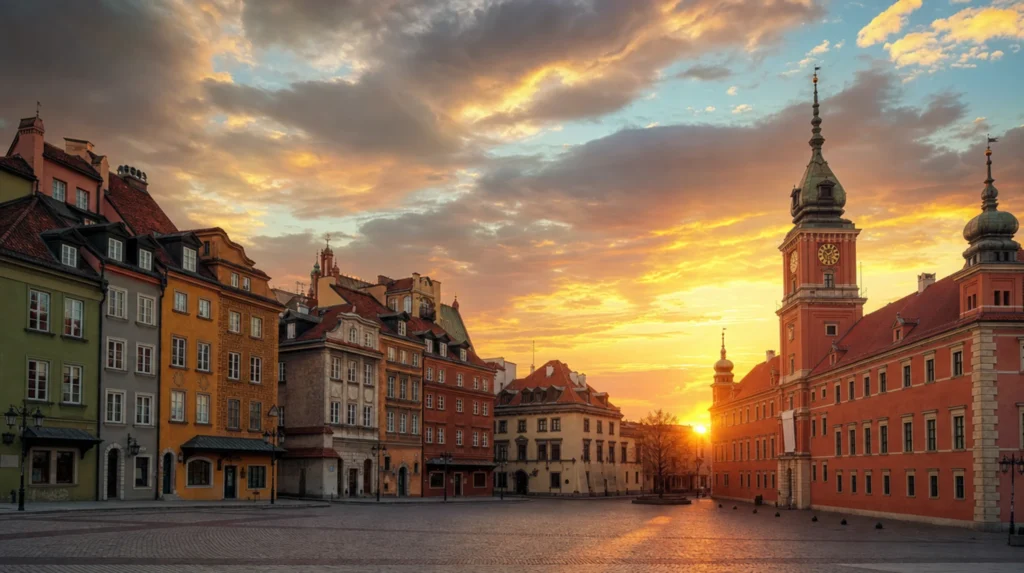
Warsaw is the only European capital that was deliberately erased and then deliberately rebuilt. In the autumn and winter of 1944 — after the failed Warsaw Uprising and the Red Army’s halt on the east bank of the Vistula — the German occupation forces dynamited the city block by block on Hitler’s explicit order. By January 1945, when the Soviets finally crossed the river, between 80% and 85% of the left-bank city was rubble. The Royal Castle was a hollow shell. The Old Town was a heap of brick. Three hundred thousand of its pre-war 1.3 million residents were dead. The decision to rebuild Stare Miasto — the Old Town — almost exactly as it had stood in the 18th century, using Bernardo Bellotto’s Canaletto-style cityscape paintings as architectural references, is one of the boldest cultural choices in modern European history. UNESCO inscribed the rebuilt Old Town as a World Heritage Site in 1980 specifically for the reconstruction itself, not despite it.
The contemporary city is the surprise. Warsaw has the youngest skyline in central Europe — most of the cluster of mirrored towers around Rondo Daszyńskiego in the western district was built between 2018 and 2024 — and one of the fastest-growing economies in the EU, expanding at 4–5% annually since 2019. The metro now runs two lines and counts toward 240 million annual rides. The 2025 cultural calendar saw Warsaw confirmed as host of the 2029 European Cultural Capital and saw the long-delayed Museum of Modern Art finally open its permanent home on Plac Defilad — an austere white box facing the Stalin-era Palace of Culture and Science directly across the square, like a 21st-century challenger to a 1955 incumbent. The juxtaposition is the city’s signature.
This guide covers Warsaw end to end — the rebuilt Old Town, the Praga district across the river that survived the war intact, the Wola business towers, the Łazienki and Wilanów royal parks, and the Jewish heritage sites concentrated around the rebuilt Muranów neighbourhood. For the rest of Poland, see our Poland travel guide. Travellers comparing Central European capitals should also look at our Prague city guide and our Berlin city guide — Warsaw reads as the historical bookend to both.
📋 In This Guide
- Overview — Why Warsaw Belongs on Every Central Europe Trip
- 🌷 Late-April / Early-May 2026 — Why You’re Right in the Window
- Best Time to Visit (Season by Season)
- Getting There — Chopin Airport & Arrival
- Getting Around — Metro, Trams, the New Bike Network
- Top Districts & Neighbourhoods
- 🗓️ Sample Itineraries — 2, 4 and 7 Days
- Polish Culture & Etiquette
- A Food Lover’s Guide to Warsaw
- 📸 Photography Notes
- Off the Beaten Path — Warsaw Beyond the Old Town
- Practical Information
- Budget Breakdown — What Warsaw Actually Costs
- ✅ Pre-Trip Checklist
- 🤔 What Surprises First-Timers
- Frequently Asked Questions
- Ready to Explore Warsaw?
Overview — Why Warsaw Belongs on Every Central Europe Trip
Warsaw became the capital of the Polish-Lithuanian Commonwealth in 1596, when King Sigismund III moved the royal seat from Kraków for the practical reason that Warsaw sat at the geographical centre of the dual kingdom. For the next 200 years it grew as a Baroque-and-Classical city of palaces, churches and townhouses, ringed by aristocratic estates that became today’s parks (Łazienki, Wilanów, Saxon Garden). The 18th-century painter Bernardo Bellotto, working as court painter to the last king Stanisław August Poniatowski between 1768 and 1780, produced 26 large-scale cityscape paintings of Warsaw with such architectural fidelity that they were used as the principal reference for the post-1945 reconstruction.
The 19th century was the long humiliation. After the Third Partition of Poland in 1795, Warsaw fell under Russian rule for 123 years; the city’s main avenue was renamed Aleja Jerozolimska but otherwise the russification was thorough — Cyrillic signage, Russian Orthodox churches built across pre-existing squares, a citadel constructed deliberately to dominate the skyline. Polish-speakers maintained their language and Catholic faith underground, in homes and parishes, and Warsaw became a particular kind of patriotic city: outwardly compliant, inwardly organised, with a gift for symbolic resistance that would later define it. Independence came in 1918 with the collapse of three empires (Russia, Germany, Austria-Hungary), and the interwar years gave Warsaw a 21-year window of cultural flowering before the Wehrmacht arrived in September 1939.
The war years are the city’s defining trauma. Warsaw was the largest Jewish city in Europe in 1939 — roughly 380,000 Jewish residents, 30% of the population — and the Warsaw Ghetto established in November 1940 was the largest Jewish ghetto in Nazi-occupied Europe. The 1943 Ghetto Uprising was the largest Jewish armed resistance of the Holocaust; the 1944 Warsaw Uprising was a 63-day non-Jewish Polish uprising against the German occupation that ended in catastrophic defeat as the Red Army watched from the Vistula’s east bank. The deliberate German destruction that followed was the worst urban devastation of any European capital in the war; only Stalingrad’s destruction was comparable. Warsaw lost 84% of its left-bank built environment.
For a traveller, the practical consequence is that you are visiting a city that has had to decide, twice, what it wants to be. The post-1945 reconstruction was the first decision: rebuild the Old Town and Royal Castle as exact replicas, build the rest as a Stalinist socialist city with the Palace of Culture as its centrepiece. The post-1989 reinvention was the second: glass towers, EU membership in 2004, the metro, the renewed riverbank, the Museum of the History of Polish Jews opened 2013, the Warsaw Uprising Museum opened 2004, and the Museum of Modern Art opened 2024. Warsaw’s two reconstructions have produced a city that wears its history more visibly than any other European capital — sometimes painfully, often beautifully.
🏛️ Historical Context
The Royal Castle on Plac Zamkowy was completely destroyed by the Germans in 1944 — dynamited block by block in a deliberate operation called Pioniersprengkommando. The reconstruction did not begin until 1971 (the communist government refused for two decades, citing more pressing housing needs) and was financed entirely by Polish citizens — domestic and emigré — through a public donation fund. Workers used Bellotto’s paintings, pre-war photographs, and rescued architectural fragments hidden by museum staff during the occupation. The interior was reopened in 1984. The Royal Castle today is genuinely the same building as the 1944 Royal Castle: the bricks are largely new, but every cornice, every painting placement, every window frame matches the original to a margin of millimetres. The building is 41 years old. It is also 400 years old.
🎌 Did You Know?
Warsaw’s Palace of Culture and Science (PKiN), the 237-metre Stalinist tower visible from almost every district, was a “gift from the Soviet people” personally signed off by Stalin in 1952 and built by 3,500 Soviet workers between 1952 and 1955. Most Varsovians spent the 50 years after its completion debating whether to demolish it; by the early 2000s the consensus had shifted to keeping it as a historical artefact. The building now houses four theatres, three universities, two cinemas and the city’s tourist information office. The 30th-floor observation deck (admission 26 PLN) gives the best skyline view in town — and is the only place in Warsaw where you cannot see the Palace of Culture and Science. Locals call it “Stalin’s Syringe” or, more affectionately, “the elephant in lacy underwear” for the building’s ornate stone tracery.
🌷 Late-April / Early-May 2026 — Why You’re Right in the Window
Late April through mid-May is genuinely the best three-week window on the Warsaw calendar. The chestnut trees on Aleja Ujazdowskie come into flower around April 20 — pink and white candle-blossoms that line the city’s most beautiful boulevard for two weeks — and the lilacs in Łazienki Park follow a week later. Daytime highs climb from 14°C in early April to 20°C by mid-May, with the first genuinely warm-shirt-sleeve afternoons typically arriving around April 25. The Vistula riverbank, freshly rehabilitated through the city’s 2017–2024 waterfront programme, becomes the city’s outdoor living room: weekend evenings see thousands on the bulwarks, beer in hand, looking across at Praga’s old wooden houses.
The cultural calendar is also full. May 3 is Polish Constitution Day, the public holiday celebrating the 1791 constitution (Europe’s first written constitution, second worldwide after the US). The day’s flag procession from Plac Zamkowy through the Krakowskie Przedmieście to the Tomb of the Unknown Soldier draws tens of thousands and is one of the genuine cultural events of the year. May 1 is Labour Day; combined with May 3 most Poles get an extended weekend, and the city fills with domestic tourists rather than emptying like a southern European capital does.
The other reason this window matters is the Museum of Modern Art (MSN). After 19 years of construction delays, location changes and political fights, MSN’s permanent home on Plac Defilad opened to the public in October 2024 with a temporary inaugural programme; the permanent collection installation completed in early 2025. By April 2026 the museum is in its second full operating year, the surrounding plaza redevelopment has finished, and the visual confrontation between MSN’s white concrete cube and the Palace of Culture and Science directly across the square is genuinely the most photographed urban contrast in central Europe. Pair an MSN visit with a Palace of Culture observation deck visit on the same afternoon — the experience moves between two competing visions of what Warsaw should be.
⚠️ Important — Constitution Day Crowds & Closures
May 3 itself is a national holiday with a major presidential ceremony at the Tomb of the Unknown Soldier (Plac Piłsudskiego) and a flag procession down Krakowskie Przedmieście. The Royal Castle, the Tomb area and the entire ceremonial route are closed to vehicle traffic and crowded with families from 9 a.m. to 2 p.m. If your interest is the Old Town, visit on May 2 or May 4 instead. The fireworks on the night of May 3 over the Vistula are best watched from the Świętokrzyski Bridge or from the river-facing terrace of the Copernicus Science Centre’s roof garden (free entry).
Best Time to Visit (Season by Season)
Warsaw has four distinct seasons and a continental climate — cold winters, warm-to-hot summers, mild springs and autumns. The latitude is 52.2°N, similar to Berlin and London, but the inland position means colder winters and warmer summers than the comparably-positioned coastal cities. The Vistula river, though shallow, modulates the climate slightly.
Spring (April – May)
The shoulder window described above. April starts cool — daytime highs around 12°C — and warms steadily, with the first reliably 18°C+ days arriving in early May. The chestnut and lilac blooms are the spring’s signature; the Łazienki royal park is at its most visited around the May 1–3 long weekend. Crowds in Old Town are 35% lower than the July peak, hotel prices 20–25% lower, and you can walk Krakowskie Przedmieście at 7 p.m. without crowd pressure. The genuine variable is rain: April averages 30 mm, May 50 mm, with most precipitation arriving as brief afternoon showers rather than all-day events.
Summer (June – August)
The high season. Daytime highs sit between 22°C and 26°C; July and August produce 28°C+ days regularly and occasional 32°C+ heatwaves (rare 20 years ago, increasingly common). Daylight runs 16+ hours through June and early July. The Vistula riverside fills with outdoor bars (Plac Zabaw, Cud nad Wisłą — the popular bulwark cafes), the Old Town crowds peak at the Royal Castle and Castle Square, and the cultural calendar includes the Chopin piano concerts at Łazienki (free, every Sunday June through September at noon and 4 p.m.). Hotel prices climb 25% above shoulder. Air conditioning is now standard at mid-range and above hotels but is genuinely unreliable at older budget hotels — check on booking.
Autumn (September – October)
The most photogenic stretch. Daytime highs drop steadily from 21°C in early September to 11°C by late October; the chestnut and oak leaves on Aleja Ujazdowskie turn through golden-yellow to copper and produce the city’s best photography window from approximately October 8 to October 25. The Łazienki and Wilanów parks are at their photographic best then. Rainfall remains moderate (50–60 mm/month). The cultural calendar’s headline events are the Warsaw Film Festival (October) and the Chopin International Piano Competition (held every five years; next edition is 2025, so 2026 falls between cycles).
Winter (November – March)
Cold and short-day. December averages -2°C with five hours of useable daylight; January is the coldest month with averages -3°C and overnight lows that can dip to -15°C in cold snaps. Snow cover is intermittent — Warsaw’s winters have warmed measurably in the last decade, and a December without permanent snow is now about 50% likely. The Christmas markets (the main one on Plac Zamkowy by the Royal Castle, plus Krakowskie Przedmieście and the smaller Saska Kępa version) operate from late November through January 6 and produce the city’s most romantic atmosphere. The hotel rates drop 30–40% below summer peak. Pack actually warm coats — synthetics tested to -10°C, not the lightweight Western European versions — and you’ll find a winter Warsaw that is significantly underrated.
🧳 Travel Guru Tip
If you have one weekend and want Warsaw at its most photogenic with the smallest crowds, target the second weekend of October. The autumn colour peaks across Łazienki and the Saxon Garden, the air is crisp enough for long walks, daylight runs from 7 a.m. to 5:30 p.m., and the city’s restaurant scene is fully operational without the summer’s tourist queues. Locals call it “złota jesień” (golden autumn). Most international guides default to summer recommendations and miss the better window.
| Experience | Best months | Best districts | Notes |
|---|---|---|---|
| Old Town walking | May – Sept | Stare Miasto, Royal Route | Rebuilt 1947–1962, UNESCO since 1980 |
| Chopin concerts (free) | Sun, Jun – Sept | Łazienki Park | Noon and 4 p.m. each Sunday |
| Vistula riverside | May – Sept | Powiśle, Praga bulwarks | Bars and outdoor cafés along bulwarks |
| Christmas markets | Late Nov – Jan 6 | Plac Zamkowy, Krakowskie Przedmieście | Best on weekday afternoons before crowds |
| Constitution Day procession | May 3 | Plac Piłsudskiego, Krakowskie Przedmieście | Major crowds 9 a.m. – 2 p.m. |
| Autumn colour in Łazienki | Mid Oct | Łazienki, Wilanów | Peak around Oct 15–25 |
Getting There — Chopin Airport & Arrival
Warsaw is served by two airports. Warsaw Chopin Airport (WAW) is the primary international hub, 10 km southwest of the city centre, handling roughly 22 million passengers in 2024 and connecting to most major European capitals plus long-haul service to North America (LOT operates direct New York JFK and Newark, Chicago, Toronto, and Los Angeles routes). Warsaw Modlin Airport (WMI), 35 km north, is the Ryanair-and-low-cost hub serving secondary European cities. The new Solidarity Transport Hub (Centralny Port Komunikacyjny, CPK), planned for completion in the early 2030s, will eventually replace Chopin — but until then, Chopin is the airport you arrive at.
From North America, direct flights run from New York JFK and Newark on LOT and United (8h45m), Chicago O’Hare on LOT (9h30m), and Toronto on LOT (9h15m). One-stop options via Frankfurt, Munich, Amsterdam, Paris and London are abundant; round-trip pricing in shoulder season typically lands $580–950. From Europe, expect 2h15m from London (Heathrow, Luton, Stansted), 2h05m from Paris CDG, 1h35m from Frankfurt, 1h45m from Berlin, and 2h45m from Madrid. Round-trip fares from London or Paris in shoulder season run €120–220 if booked 6–10 weeks ahead.
Chopin Airport is small, modern, and efficiently designed. The terminal connects directly to the SKM commuter rail line — the S2 and S3 trains run every 30 minutes to Warsaw Central Station (Warszawa Centralna), 25 minutes for 4.40 PLN. A metered taxi to the city centre runs 50–70 PLN; Bolt and Uber rideshares 35–55 PLN. The Bus 175 from the airport to the city centre takes 35 minutes for 4.40 PLN and runs every 15 minutes during the day. From Modlin Airport, a Modlin Bus shuttle to the city centre runs every flight arrival, 45 PLN, 50 minutes.
✨ Pro Tip
The SKM commuter train from Chopin Airport to the city is the cheapest, fastest, and most reliable option for solo travellers — and crucially, it deposits you at Warszawa Centralna, in the actual city centre, rather than at a terminal that requires another transfer. Buy the 4.40 PLN ticket at the platform machine (cards work). The same ticket is valid for any onward metro or tram for 75 minutes after activation, which means you can ride the S-train into the centre, change to the metro, and reach your hotel without a second purchase. The new contactless-payment system on Warsaw public transport (introduced 2023) lets you tap a credit card directly at the entry point — no ticket purchase required.
Getting Around — Metro, Trams, the New Bike Network
Warsaw runs one of central Europe’s better-organised public transport networks. Two metro lines, an extensive tram network (the longest in Poland), comprehensive bus coverage, and the Veturilo bike share scheme cover almost all useful trips. Tickets are integrated across all modes: a single 75-minute ticket costs 4.40 PLN, a 24-hour pass 15 PLN, a 72-hour pass 36 PLN. The metro runs 5 a.m. to midnight (later on weekends), trams and buses 4:30 a.m. to 11 p.m. with night service after.
The Warsaw Metro has two lines. Line 1 (M1, blue) runs north-south from Młociny through the city centre to Kabaty, 23 stations, opened in stages between 1995 and 2008. Line 2 (M2, red) runs east-west from Bemowo through the centre to Bródno, 21 stations, opened in stages between 2015 and 2024 with the eastern extension to Bródno completing in 2024. The two lines cross at Świętokrzyska, the central interchange. Line 3 is in early construction stages with completion estimated for the early 2030s. Line 1 alone now handles 220,000 daily riders.
Trams remain the workhorse of Warsaw transport — 27 lines covering districts the metro doesn’t reach. The most useful tourist tram is the 18 (running across the river to Praga and back), the 9 and 35 (along the Royal Route), and the 4 (south to Wilanów). The Veturilo bike share scheme has 350+ stations across the city, 4.50 PLN for the first 20 minutes free, then graduated pricing — one of the cheapest urban bike share schemes in Europe. The cycle network has expanded enormously since 2020 and now connects most central districts via dedicated lanes.
⚠️ Important — Tickets, Validators & Inspectors
Warsaw operates an honour-system public transport — there are no fare gates at metro stations or trams — but ticket inspectors check rigorously. A ticket is only valid once you’ve validated it at the yellow validator on board (trams and buses) or at the entry point (metro). The contactless-card tap-in/tap-out system since 2023 is the easier alternative — tap your credit card or phone at the validator on entry, tap again at exit, and the system charges the cheapest applicable fare automatically. Fines for unvalidated tickets are 266 PLN (roughly $65) and inspectors do not negotiate. Foreign tourists are not exempt.
Top Districts & Neighbourhoods
📍 Warsaw Map: Every Place in This Guide
Warsaw is administratively divided into 18 districts, but for a traveller the practical map is the central zone of seven: the Old Town and Royal Route corridor, Śródmieście (the central business district), Powiśle (the Vistula riverside), Praga-Północ (the surviving district across the river), Wola (the new business towers), and the Łazienki–Wilanów royal-park axis to the south.
🏰 Old Town (Stare Miasto) & New Town (Nowe Miasto)
The rebuilt UNESCO core. Old Town is genuinely small — a 0.4 km² walled medieval grid — and walkable in any direction in twenty minutes. Plac Zamkowy (Castle Square) at the south end is the symbolic centre, anchored by the Sigismund Column (Warsaw’s oldest non-religious monument, erected 1644, destroyed and replaced in identical form 1949) and the Royal Castle. The Old Town Market Square (Rynek Starego Miasta) is the postcard view: pastel-coloured townhouses around a square with the Mermaid statue in the centre, the symbol of the city. The northern adjacent quarter, Nowe Miasto (New Town), is also rebuilt but feels quieter and is where Marie Curie was born in 1867 (the modest house at Freta 16 is now a small museum).
The single must-do is the Royal Castle — interior galleries, the Senate Chamber, the Throne Room, and the Lanckoroński Gallery containing two original Rembrandts donated by a Polish aristocratic family. The audio guide is excellent. Allow two hours. The Castle’s Stairwell Hall has the original stairwell that survived the 1944 destruction by being entirely buried under rubble; it is the only entirely original element in the building.
- What to do: Tour the Royal Castle (40 PLN); climb the bell tower of St. Anne’s Church on Plac Zamkowy (10 PLN, the best Old Town panorama); walk the Barbakan medieval gate; have a coffee on the Old Town Market Square at noon.
- Signature eats: Pierogi at Pierogarnia na Bednarskiej — a small no-frills shop that serves the city’s most authoritative dumplings, around 35 PLN for a plate of 12.
- Access: Closest metro is Świętokrzyska (M1/M2 interchange); 8-minute walk north up the Krakowskie Przedmieście. Also tram lines 4, 18, 35 to Plac Zamkowy.
🎭 Krakowskie Przedmieście & the Royal Route
The 4-km ceremonial avenue running south from the Royal Castle to the Łazienki Palace, formed by Krakowskie Przedmieście, Nowy Świat, and Aleja Ujazdowskie linked end-to-end. This is the city’s grandest boulevard — pedestrianised in sections, lined with palaces, churches and monuments. Walk the full length and you pass: the Holy Cross Church (where Chopin’s heart is interred in a pillar — his body is in Paris but he asked for his heart to return to Warsaw), the Warsaw University main gate, the Adam Mickiewicz monument, the Ostrogski Palace housing the Chopin Museum, the Copernicus statue, the Presidential Palace, and the Tomb of the Unknown Soldier in Plac Piłsudskiego just off it.
Nowy Świat (the southern stretch) is the city’s main café-and-shopping spine. The cafés and small shops on Nowy Świat between Świętokrzyska and Aleje Jerozolimskie are where Warsaw students, professionals and tourists overlap. A.Blikle on Nowy Świat 35, the city’s most famous pastry shop (operating since 1869), serves the iconic pączek (Polish jelly doughnut) for 7 PLN — the queue at lunchtime is part of the experience.
- What to do: Walk the full Royal Route end-to-end (45 minutes one way); visit the Chopin Museum at Ostrogski Palace (24 PLN, multimedia and original manuscripts); see Chopin’s heart at Holy Cross Church.
- Signature eats: Pączek at A.Blikle (Nowy Świat 35); coffee at Café Kafka (Oboźna 3, university quarter).
- Access: Centrum (M1) station opens onto Nowy Świat; walking distance from Old Town.
🌲 Łazienki Park & Wilanów Palace
The royal park axis south of the centre. Łazienki, the 76-hectare park designed for the last king Stanisław August Poniatowski in the 1770s, is the city’s most beloved green space — squirrels and red squirrels are tame, peacocks roam free, and the Palace on the Isle (the king’s summer residence, Greek-Doric on a small lake) is one of the loveliest small palace interiors in central Europe. The Sunday Chopin concerts at the foot of the giant Chopin monument (June through September, free, noon and 4 p.m.) are the genuine cultural event of the warm-weather city.
Wilanów, six kilometres further south, is the Baroque country palace built by King Jan III Sobieski in the 1670s — the Polish equivalent of Versailles, smaller but more genuinely beautiful. The palace interiors are extensively original (it survived the war intact), the formal gardens are at their best in late spring, and the museum’s Polish portraiture collection covers four centuries. Allow a full half-day for Wilanów including the bus journey from the centre.
- What to do: Sunday Chopin concert at Łazienki (free, June–September); Palace on the Isle interior tour (20 PLN); Wilanów Palace gardens and interiors (50 PLN combined).
- Signature eats: Belvedere restaurant in Łazienki’s New Orangery — Modern Polish cuisine in a glass-walled orangery dating from 1788, around 350 PLN tasting menu.
- Access: Łazienki — Bus 116 from Krakowskie Przedmieście, 10 minutes; Wilanów — Bus 116 or 180 from the centre, 30 minutes.
🎨 Praga-Północ — The Surviving City
Across the Vistula on the east bank, Praga-Północ is the district that the Wehrmacht did not destroy — the Red Army arrived here first in September 1944, halted on the bank, and the German destruction was concentrated entirely on the left bank. The result is the only district in Warsaw where you can walk pre-1939 streets exactly as they stood: tenement courtyards, neighbourhood Catholic shrines (the kapliczki — small candlelit shrines built into building walls — are everywhere), Soviet-era murals, and a creeping gentrification driven by artists and craft-beer brewers.
The district’s anchors are the Cathedral of St. Florian (the rare 1904 brick church that survived), the Praga Museum (a former state-run shop that documents the district’s pre-war life), the Soho Factory (the converted vodka distillery now housing the Neon Museum and bars), and the Rzeźnia Praska — the former 1900 slaughterhouse complex now hosting the Warsaw Modern Art branch and the Rzeźnia food hall. Praga at night, particularly Friday and Saturday, has the city’s most interesting bar scene: W Oparach Absurdu (a small absinthe-and-cocktails bar), Skład Butelek, and the converted-warehouse Hydrozagadka music venue.
- What to do: Neon Museum (24 PLN — a private collection of communist-era neon signs); Praga walking tour through the courtyards on Ząbkowska street; Soho Factory food hall; Sunday flea market at Bazar Różyckiego.
- Signature eats: Rzeźnia food hall — modern takes on Polish cooking in a converted slaughterhouse; the za-pierogi pierogi shop on Ząbkowska street; craft beer at Cuda na Kiju (a Praga branch).
- Access: Metro Line 2 to Stadion Narodowy or Dworzec Wileński; tram 7, 22 across the river.
🏗️ Wola & the New Skyline
The western district is where contemporary Warsaw gets built. Wola was largely working-class and industrial through the 20th century; since 2015 it has become the city’s main business district, with a cluster of mirrored towers around Rondo Daszyńskiego. The Varso Tower (310 metres including spire, opened 2022) is the EU’s tallest building and the symbolic centre of the new skyline. The neighbouring Skyliner, Mennica Legacy and Generation Park towers form the rest of the cluster. The metro M2 line passes through and made the entire district accessible to commuters.
The genuine reason to come is the POLIN Museum of the History of Polish Jews, which opened in 2013 on Mordechaja Anielewicza street in Muranów — the rebuilt district that was the Warsaw Ghetto during the war. POLIN is one of Europe’s most architecturally impressive museums, and the permanent exhibition’s coverage of 1,000 years of Polish-Jewish history is comprehensive enough to need three to four hours. Combine with the Warsaw Ghetto memorial directly outside (Nathan Rapoport’s 1948 sculpture, the spot where Willy Brandt knelt in 1970), and the surviving fragment of ghetto wall on Sienna 55.
- What to do: POLIN Museum (45 PLN); Warsaw Uprising Museum on Grzybowska 79 (45 PLN, allow 3 hours minimum); Varso Tower viewing terrace (when public access opens).
- Signature eats: Browarmia near the towers (modern Polish + craft beer); Hala Koszyki — the rebuilt 1909 covered market, now a food hall.
- Access: Metro M2 to Rondo Daszyńskiego.
📚 Powiśle & the Vistula Riverbank
The narrow strip of land between Śródmieście and the Vistula. Powiśle was largely industrial through the 20th century — the Warsaw University Library (Biblioteka Uniwersytetu Warszawskiego, opened 1999, with the famous green roof garden open to the public until October 31) and the Copernicus Science Centre (one of Europe’s better hands-on science museums) anchor the district now. The riverbank itself was redeveloped between 2017 and 2023 with bulwarks, beaches, outdoor bars and pedestrian paths; in late spring through September the Vistula edge is the city’s best evening hangout.
The Multimedia Fountain Park at the foot of the Old Town stages laser-and-water shows on Friday and Saturday evenings from May through September (10:30 p.m., free). The river’s east bank, opposite Powiśle, is preserved as a wild riverside reserve — Warsaw is the only major European capital where wild riverbank persists in the centre — and the heron and beaver populations are visible from the bulwark side.
- What to do: Walk the Powiśle bulwark from the Świętokrzyski Bridge to Most Średnicowy; visit the BUW (Warsaw University Library) roof garden; Copernicus Science Centre (40 PLN, allow 3 hours); evening drinks at Cud nad Wisłą.
- Signature eats: Smaki Warszawy at Plac Defilad — modern Polish small plates; Vegan Ramen Shop on Nowy Świat (the city’s stronger vegan options skew Powiśle).
- Access: Metro Centrum Nauki Kopernik (M2); the riverside is a 10-minute walk from Old Town.
“The world is woven of stories, and we are storytellers. Every city is a story, every street is a story, every person is a story.”
— Olga Tokarczuk, Nobel Lecture (2019)
🗓️ Sample Itineraries
Warsaw rewards travellers who stay long enough to read the layered city — the medieval rebuilt over the Stalinist over the contemporary — and punishes rushed two-day stopovers that try to do everything. Below are three templates that work; pick the one that matches your time, then adjust by season. The morning-museum/afternoon-walking pattern works year-round.
2 Days — Warsaw Compressed
Day 1: Arrive Chopin Airport morning, SKM train to Centralna, drop bags. Walk Krakowskie Przedmieście from Świętokrzyska up to Plac Zamkowy. Royal Castle interior tour (2 hours minimum). Lunch on Old Town Market Square — Restauracja u Fukiera or the more affordable Polka. Afternoon at the Warsaw Uprising Museum (3 hours). Sunset at the Świętokrzyski Bridge looking back at the Old Town. Dinner at Atelier Amaro (modern Polish, Michelin) or Bibenda for casual. Day 2: Morning at POLIN Museum (3 hours including the Ghetto memorial outside). Lunch at Hala Koszyki food hall. Afternoon at Łazienki Park — Palace on the Isle, the Chopin monument, the peacocks. Evening tram across to Praga for dinner at Rzeźnia food hall and a craft beer at Cuda na Kiju. Late departure or one more night.
4 Days — Warsaw & the Royal Parks
Day 1: Arrive, Old Town walking, Royal Castle. Day 2: Morning Warsaw Uprising Museum, afternoon Krakowskie Przedmieście and Chopin Museum, evening Vistula bulwark. Day 3: POLIN Museum morning, Ghetto memorial walk, lunch at Hala Mirowska, afternoon at Wola business district and the Varso Tower observation deck (when public access opens — check 2026 status), evening dinner in Praga. Day 4: Day-trip to Wilanów Palace and gardens (half day), afternoon at Łazienki for the Palace on the Isle and Sunday Chopin concert if applicable, late dinner at Belvedere or Atelier Amaro, late departure.
7 Days — Warsaw & Day Trips
The version that lets Warsaw breathe and adds the major day trips. Day 1: Arrive, Old Town settle. Day 2: Old Town and Royal Route deep walk. Day 3: Warsaw Uprising Museum, evening Praga. Day 4: POLIN Museum, Wola, Varso Tower. Day 5: Day trip to Żelazowa Wola — Chopin’s birthplace, 60 km west of Warsaw, with weekend chamber concerts in the manor house garden. Half-day tour, return Warsaw evening. Day 6: Day trip to Treblinka — the death camp memorial 100 km northeast, 90 minutes by car or organised half-day tour from Warsaw, an essential balancing experience to the Uprising and POLIN museums. Sombre but important. Day 7: Łazienki and Wilanów combined day, late dinner, departure.
🎯 Strategy
If you only have one Warsaw trip, do the 4-day version with both POLIN and Warsaw Uprising museums on separate days — they are the city’s two most important museums and absolutely demand fresh attention. Trying to do both in one day produces emotional exhaustion and reduces what each museum can communicate. Reserve a “free afternoon” between them for the Łazienki park or the Vistula bulwark — somewhere green and quiet, where the weight of the morning’s history can settle.
Polish Culture & Etiquette
Varsovians are reserved on first encounter and warm once acquainted — the social radius takes about three encounters to open, but once it does the hospitality is genuine and unforgettable. The country runs on a cultural-Catholic substrate that shapes everything from family-name structures (the patronymic still appears in formal address) to the public calendar (every name day is celebrated, sometimes more than the birthday). Loud-on-arrival energy reads as “American” and is mildly off-putting; matching the volume of a Warsaw café is the single most efficient social calibration.
The single mandatory etiquette point is the formal-address structure. Polish has two registers: the formal (Pan/Pani — equivalent to “Mr/Ms”) used with strangers, older people, and in any service context; and the informal (ty — “you”) used with friends and family. The default with anyone you don’t know is the formal register; using the informal too quickly reads as presumptuous. Most service staff in central Warsaw will switch to English for foreign visitors and the issue dissolves, but a “dzień dobry” (good day) on entering a shop and a “dziękuję” (thank you) on leaving is the universally appreciated minimum.
The political dimension matters here, more than in most Central European capitals. Polish identity is constructed around the experience of partition (1795–1918) and the experience of war and Soviet domination (1939–1989). Conversations about World War II, about the Communist period, about the relationship with Germany or Russia, are sensitive in ways that take some calibration. Most Varsovians under 50 are happy to discuss these topics with curious foreigners; some older Varsovians prefer not to. Read the room. The Warsaw Uprising memorial is treated as sacred space — silence and respectful comportment are non-negotiable.
💬 The Saying
“Co kraj, to obyczaj.” Roughly: “Each country has its customs.” Varsovians use this phrase with a wry shrug to acknowledge the gap between how things are and how things might be — a national fatalism polished by 200 years of foreign rule, war and resistance. It is a phrase that travels with grace into a slightly absurd situation. Travellers who learn to deploy it correctly (gentle, knowing, never bitter) earn quick rapport. It also functions as a polite way to acknowledge that you have been politely told you are doing something wrong.
A Food Lover’s Guide to Warsaw
Polish food has come back from a 20th-century reputation that was, fairly or not, mostly cabbage and pork. The new Warsaw kitchen — informed by the Slow Food movement, the Polish foraging tradition, and a new generation of chefs trained in Copenhagen and Madrid — has produced one of central Europe’s most interesting food scenes. The 2025 Michelin Guide listed three starred restaurants and 14 Bib Gourmand recipients in Warsaw alone.
Pierogi are the universal answer. Polish dumplings, hand-pleated, filled with meat (z mięsem), cheese-and-potato (ruskie — confusingly named “Russian” but originating in eastern Polish lands), forest mushrooms (z grzybami), or sweet (with seasonal fruit, fresh cheese, or chocolate) and served pan-fried with butter and onion. Pierogarnia na Bednarskiej and Mateusz Gessler’s Zapiecek (a chain but reliable) are the addresses. 30–40 PLN for a plate of 12.
Żurek (sour rye soup) is the country’s signature soup — fermented rye starter as the base, with white sausage, hard-boiled egg, and potato. Warm, sour, and surprisingly addictive. Bar Mleczny Familijny on Nowy Świat (one of the surviving milk bars from the communist era) serves a 12 PLN bowl that is genuinely the best version in town. Other traditional soups: rosół (chicken broth, the Sunday lunch standard), barszcz czerwony (beetroot broth, often served with small dumplings called uszka), and pomidorowa (tomato with rice or noodles).
Bigos (hunter’s stew) is the slow-cooked meat-and-cabbage dish that’s the genuine Polish soul food — sauerkraut, fresh cabbage, pork, sausage, dried mushrooms, prunes, and red wine, simmered for 12+ hours. U Kucharzy in the Old Town serves the canonical version. 45 PLN.
Schabowy (breaded pork cutlet) is the working-lunch standard — a thin pork cutlet pounded flat, breaded, and pan-fried, served with mashed potatoes and sauerkraut or cucumber salad. Bar Mleczny Prasowy on Marszałkowska and Restauracja Polka in the Old Town are the addresses for the proper version. 32 PLN at a milk bar, 65 PLN at a sit-down restaurant.
Pączek (Polish jelly doughnut) is the country’s iconic pastry — a rich yeast dough, deep-fried, filled with rose-petal jam, glazed with white icing and sometimes candied orange peel. A.Blikle on Nowy Świat (since 1869) is the famous one; pace yourself, they’re enormous. The day before Lent (Tłusty Czwartek — Fat Thursday — six weeks before Easter) is when Poles eat them at industrial volume; Warsaw’s bakeries collectively sell roughly 50 million pączki on that day.
Modern Polish is the new headline. Atelier Amaro, the country’s first Michelin-starred restaurant, has now closed; its successor at the same level is Nolita on Wilcza, the wood-fire-driven Belvedere in Łazienki Park, and Senses on Bielańska. Tasting menus run 350–550 PLN. Bibenda on Nowogrodzka is the casual modern-Polish wine bar with small plates, around 200 PLN per person. Modern Polish leans heavily on game (venison, wild boar), forest mushrooms, root vegetables, and Polish wines from the south of the country.
The milk bar (bar mleczny) deserves its own paragraph. These are subsidised cafeterias from the communist era — the state guaranteed a hot meal under 10 zł — and the survivors have become beloved cultural artefacts. Bar Familijny on Nowy Świat, Bar Prasowy on Marszałkowska, Bar Sady on Smolna are the addresses. The food is unpretentious, hot, properly Polish, and a complete two-course lunch costs 22–32 PLN. The queue at lunchtime is the experience.
📸 Photography Notes
Warsaw is photographed less than its central European peers (Prague and Krakow win that contest) which is partly the city’s gift to the photographer who actually shows up. The light at 52° latitude is similar to Berlin: long blue hours in summer, low-angle gold in autumn, and a January noon-sun that barely climbs 18 degrees above the horizon. The dramatic visual contrast is the architectural one — the rebuilt 18th-century Old Town beside the Stalinist Palace of Culture beside the 21st-century Varso Tower, all visible from a single rooftop in Wola.
Best light by month: April–May 6:30–8 a.m. and 6:30–8:30 p.m. for golden hour; June–July 9:30–11 p.m. for the long blue hour over the Vistula; September–October 7–8:30 a.m. and 4:30–6 p.m. for the autumn-colour windows in Łazienki and on Aleja Ujazdowskie; December–February 9:30–10:30 a.m. and 3:30–4:30 p.m. for the brief winter light, and after dark for the Christmas markets on Plac Zamkowy.
Five locations worth the detour:
- Plac Zamkowy at Sigismund Column (52.2477°N, 21.0145°E) — the canonical Old Town entrance shot. Best at 7:30 a.m. before tourists arrive, or after 9 p.m. when the column lights warm.
- Świętokrzyski Bridge looking back at Old Town (52.2435°N, 21.0270°E) — the river-and-skyline composition, especially with the Royal Castle and St. Anne’s silhouetted in evening gold.
- Plac Defilad — Palace of Culture vs. MSN (52.2310°N, 21.0070°E) — the architectural confrontation. The 21st-century museum-as-rebuke to the 1955 Stalinist tower. Best at midday with the white concrete of MSN against the textured grey of PKiN.
- BUW (Warsaw University Library) roof garden (52.2419°N, 21.0263°E) — open through October 31 each year. The view over the Vistula and across to Praga is genuinely the best non-tower view in the city, and the garden itself (designed by Irena Bajerska) is photogenic in its own right.
- POLIN Museum facade (52.2502°N, 20.9926°E) — Rainer Mahlamäki’s 2013 building. The honeycomb-textured facade is best at 10 a.m. or 4 p.m. when low light catches the surface.
Drone rules: Poland enforces EASA Open Category rules — drones under 250g require online registration but no licence; 250g+ requires an A1/A3 certificate. Warsaw’s centre is largely a no-fly zone: the airport corridor extends across most of central Warsaw, the Old Town and Royal Route are explicit no-fly zones for security reasons, and the Presidential Palace, parliament and most government buildings are off-limits within 5 km. The Vistula riverbank south of the central bridges and the Łazienki park are technically allowed with prior notification but expect rangers to ask. Most travellers leave the drone at home.
✨ Pro Tip — Tomb of the Unknown Soldier
The Tomb of the Unknown Soldier in Plac Piłsudskiego is one of the most photographable ceremonial spaces in central Europe — an arcade fragment of the destroyed Saxon Palace, with eternal flame and a 24-hour ceremonial guard. The full guard-changing ceremony happens every Sunday at noon (10–15 minutes, free, the most reliably photographable scheduled event in the city). Smaller hourly guard rotations happen between 9 a.m. and 5 p.m. daily. Long-lens shots from the western edge of the square capture the soldiers without crowding them; respectful behaviour is non-negotiable.
Off the Beaten Path — Warsaw Beyond the Old Town
The Old Town and Royal Route corridor accounts for the majority of foreign visits to Warsaw and roughly 4% of the city’s actual surface. The 96% beyond it is harder to read for first-timers, less Instagram-saturated, and much closer to the Warsaw Varsovians actually use.
🌳 Park Skaryszewski & Saska Kępa
The 56-hectare park on the east bank of the Vistula in Praga-Południe district. Park Skaryszewski opened in 1922 and remains one of the city’s most beloved local parks — joggers, families, the Sunday afternoon picnic crowd, and a small lake with rowing boats in summer. The adjacent Saska Kępa neighbourhood is a 1930s villa quarter — modernist single-family houses, embassy compounds, and the city’s best concentration of independent designer shops. The Sunday morning farmers’ market on Bazar Szembeka is the genuine local-shopping experience.
⚓ The Vistula’s East Bank Wild Reserve
Warsaw is the only major European capital where the river’s natural floodplain is preserved in the city centre. The Vistula’s east bank, opposite Powiśle, is a Natura 2000 protected zone — wild riparian forest, sand banks, beaver lodges, and breeding heron colonies. Access is by ferry from the Powiśle bulwark (June–September, 10 PLN each way) or by the narrow paths from the Praga side. The 4-km walk along the wild bank from the Świętokrzyski Bridge south to the Łazienkowski Bridge is the city’s quietest piece of green infrastructure and is genuinely the best place in central Warsaw to be alone for an hour.
🪦 Powązki Cemetery
Warsaw’s oldest and most significant cemetery, opened 1790 in Wola district. Powązki contains roughly 200 hectares of densely-clustered graves including Władysław Reymont (Nobel-laureate novelist), Stanisław Moniuszko (the 19th-century composer), and the Solidarity-era priest Jerzy Popiełuszko, murdered by communist secret police in 1984. The All Saints’ Day candle-lighting on November 1 — when locals visit family graves with candles after dark — is one of the genuinely moving cultural events in the city. Allow 90 minutes minimum and bring a map.
🚂 The Praga Industrial Walk
Praga’s industrial heritage walking route runs from the Soho Factory (former vodka distillery, now art-and-bars) through the Koneser complex (former vodka brewery, now boutique hotel and shopping) to Centrum Praskie Koneser to the Bazar Różyckiego flea market and finishes at the Cathedral of St. Florian. Two hours, mostly on quiet streets, passes through the city’s most photogenic surviving 19th-century industrial architecture. The Polish Vodka Museum at Koneser (admission 50 PLN) is a credible introduction to one of the country’s stronger cultural exports.
🎬 The Warsaw Documentary Film Festival Trail
Warsaw was the home of the Polish Film School (a generation of post-war filmmakers including Andrzej Wajda, Krzysztof Kieślowski and Roman Polanski) and the city’s cinema culture is unusually deep. The Iluzjon Cinema in Mokotów (a 1956 communist-era cinema preserved as a working museum, screening classics nightly), the Kino Muranów (modern art-house in Muranów district), and the open-air summer cinema at Plac Zabaw on the Vistula bulwarks (June–August, free) form a circuit. The Warsaw Film Festival happens in October.
Warsaw by Numbers
- 1.86 million — city population (2024 estimate)
- 84% — share of left-bank Warsaw destroyed by Germans 1944
- 26 — Bellotto cityscape paintings used as 1945 reconstruction references
- 310 m — height of Varso Tower (EU’s tallest building, 2022)
- 76 ha — Łazienki Park area
- 2 — operating metro lines (M1 since 1995, M2 since 2015)
Practical Information
Currency: Polish złoty (PLN). Poland is in the EU but has not adopted the euro — the discussion has been politically alive since 2004 and has stalled repeatedly. Warsaw is functionally cashless: credit and debit cards work everywhere, contactless tap is universal, and Apple Pay and Google Pay are widely accepted. ATMs are everywhere; foreign cards work seamlessly. Tipping is appreciated but not compulsory; 10% at restaurants, rounding up at cafes and taxis. As of late 2025, EUR 1 = roughly 4.30 PLN, USD 1 = roughly 3.95 PLN.
Visa & entry: Poland is in the Schengen Area and the EU. US, UK, Canadian, Australian, NZ and most other passport-holders enter visa-free for 90 days within any 180-day period. The EU’s ETIAS authorisation, originally scheduled for 2025, is now expected to begin enforcement in late 2026 and will require non-EU travellers to register online (€7) before flying. Check the latest at travel-europe.europa.eu before booking. UK travellers post-Brexit need to ensure their passport meets the EU’s “issued in last 10 years” and “valid 3+ months past return” rules; the rules are stricter than they were pre-2020.
Language: Polish is the official language. English fluency is increasingly high — Warsaw scores higher than the Polish national average on the EF English Proficiency Index, and most service staff under 40 in central districts speak workable English. Older Varsovians may default to Russian (the second language taught during the communist era) or German. Polish phrases worth learning: “dzień dobry” (good day), “dziękuję” (thank you), “przepraszam” (excuse me / sorry), “smacznego” (bon appétit). The pronunciation challenge is real — Polish has six “sh”-class sounds — and locals appreciate the attempt without expecting accuracy.
Connectivity: 5G covers all central Warsaw districts and most outer districts. 4G is universal across the entire city and surrounding region. Polish SIM cards from Play, Plus, Orange and T-Mobile cost 30–60 PLN for 30 GB monthly packages; eSIM equivalents from Airalo or Holafly start at $9 for a week. Free Wi-Fi is universal in cafes, hotels, restaurants, public transport stations and most parks (the city operates a free public network across central districts).
Tap water: Drinkable. Warsaw’s tap water is well-treated, tested daily, and consumed by locals without filtering. The taste is moderate — slightly mineral — but it is genuinely safe and the city’s environmental authority promotes refilling water bottles at public refill points across central districts.
Plug type: Type E (European, two round pins, sometimes with a third earth pin). 230V/50Hz. North American travellers need a simple adapter; UK travellers also.
Budget Breakdown — What Warsaw Actually Costs
Warsaw is one of the most affordable EU capitals — measurably cheaper than Berlin, Vienna, Paris or Rome, and roughly comparable to Budapest, Bratislava and the Baltic capitals. The structural reasons are a strong domestic supply chain, lower restaurant labour costs than Western Europe, and a tourist-density that has not yet driven up prices to the levels seen in Prague or Kraków. Imported alcohol and high-end international hotels are the exceptions where costs climb to Western levels.
💚 Budget Traveller — $50–90 / day
Hostels in central Warsaw, $20–35/night for a dorm bed. Pierogi or żurek at a milk bar, 22–35 PLN per meal. Free entry at most public museums on designated days (the Warsaw Uprising Museum is free Mondays; POLIN free Thursdays). Public transport day pass 15 PLN. Self-catering from Carrefour or Biedronka supermarkets keeps food costs low. The trick is to eat lunch at the milk bars and dinner at any of the casual modern-Polish places that have proliferated in the last five years.
💙 Mid-Range — $130–230 / day
Three-or four-star hotel double in central Warsaw, $90–170/night in shoulder season. Restaurant dinner with a glass of wine, 110–180 PLN. One major museum per day (POLIN, Warsaw Uprising, Royal Castle 40–45 PLN each). Day-pass on public transport plus occasional Bolt rideshares. This is the realistic shoulder-season cost for a couple staying central.
💜 Luxury — $400+ / day
The high end runs from $250–500 a night for the Hotel Bristol (the city’s grand 1901 hotel, refurbished 2018), the Raffles Europejski (the rebuilt 1857 hotel that reopened 2018), the InterContinental, or the new Westin. Tasting-menu dinner at Senses or Nolita 350–550 PLN with pairing. Private guide for a half-day, 600–900 PLN. Warsaw’s high-end is a genuine value play compared to Western European capitals — a five-star hotel in Warsaw is typically 40% less than the equivalent in Berlin or Vienna.
| Item | Budget (PLN) | Mid-range (PLN) | Luxury (PLN) |
|---|---|---|---|
| Bed (per night) | 80–140 | 360–680 | 1,000–2,000+ |
| Dinner | 22–45 (milk bar) | 110–180 | 350–550 (tasting menu) |
| Daily transport | 15 (day pass) | 40 (day pass + 2 Bolts) | 250 (private driver hour) |
| One activity | 0 (free museum day) | 40–50 (museum entry) | 650 (private guide half-day) |
| USD daily | $50–90 | $130–230 | $400+ |
🧳 Travel Guru Tip — The Free Museum Days
Warsaw’s major museums each have a free admission day, and stacking two of them across a week saves real money. POLIN is free on Thursdays; Warsaw Uprising Museum is free on Mondays; the Royal Castle is free on Wednesdays; the National Museum on Tuesdays. Most major commercial galleries (Zachęta, the contemporary art Centre at the Ujazdowski Castle) have free Thursdays. The free entry days come with longer queues, so arrive at opening (10 a.m. typically) and use the saved admission money for a proper sit-down lunch at one of the modern-Polish casual restaurants. The 4-day mid-range version of this guide can shave $40 off a couple’s spend by stacking three free museum days correctly.
✅ Pre-Trip Checklist
The minimum kit and admin to have sorted before you fly. Warsaw is a comfortable city to travel — significantly less demanding than Asian or Latin American capitals — but the climate range across seasons is wider than Western European peers and the museum fatigue is real. Plan accordingly.
- Documents: Passport valid 3 months past return date. Print hotel reservation confirmation. Register ETIAS (from late 2026 onwards if non-EU). Save offline copies of bookings to your phone.
- Insurance: Travel insurance with cover for medical care (Polish public hospitals serve EU/EHIC card-holders well; non-EU travellers should ensure private cover) and EU-appropriate valuables and trip-cancellation. World Nomads, SafetyWing, AXA Schengen and SafeWing are the standard options.
- Layers: Continental climate means layers regardless of season. Spring/autumn — light wool or fleece mid-layer, light rain shell, comfortable trousers. Summer — moisture-wicking shirt, light layer for cool evenings on the Vistula. Winter — proper insulated coat (rated -10°C for January), thermal base layer, scarf, gloves, hat. Snow boots if visiting January–February.
- Footwear: Comfortable walking shoes — Warsaw is a walking city and you will easily cover 15+ km a day across the central districts. The Old Town’s cobblestones are unforgiving for thin-soled fashion shoes.
- Adapter: Type E (European). North American and UK travellers need adapters; most modern phone chargers handle 230V automatically.
- Apps to download: Jakdojade (the Polish public transport app — better than Google Maps for ZTM transit), Bolt (the dominant rideshare in Warsaw, a Polish-Estonian alternative to Uber), Citymapper (covers Warsaw transit), Google Translate with Polish offline pack, Veturilo (the bike-share app).
- Cash: 100–200 PLN as a fallback. Most ATMs work seamlessly; the cash backup is for the rare card-decline moment or for tipping cleaners and luggage handlers.
- Credit card: A no-foreign-transaction-fee Visa or Mastercard. Amex acceptance has improved but is still patchy at smaller restaurants.
🤔 What Surprises First-Timers
- The Old Town is genuinely a 1950s reconstruction — but it doesn’t feel like one. Visitors expect “rebuilt” to mean “fake” and the Warsaw Old Town defies that expectation. The reconstruction was so faithful, used so many original materials, and has aged so naturally over 75 years that the Old Town now feels indistinguishable from any 18th-century European core. The UNESCO 1980 inscription specifically acknowledges this.
- Warsaw is more affordable than Prague or Kraków. The reverse of what most first-time central Europe travellers assume. Prague and Kraków have built tourist economies that price the central districts at Western European levels; Warsaw has not yet, partly because it’s larger and the centre absorbs tourism more diffusely. A four-star hotel in central Warsaw is typically 25–35% less than the same standard in Prague.
- The food scene is genuinely surprising. The Polish-food cliché (cabbage, pork, dumplings) is wrong about contemporary Warsaw. The new Warsaw kitchen — modern Polish, foraged-and-fermented Slow Food, the milk bar revival, the wine-bar boom — produces some of the most interesting food in central Europe. Three Michelin stars in 2025 alone.
- Public transport is excellent. Warsaw’s metro, tram and bus network is among the better-organised in the EU, the contactless-card payment is seamless, and the time saved compared to taxis or rideshares is significant. Most central trips take 12–20 minutes.
- Younger Varsovians speak fluent English. Visitors who arrive expecting language difficulty find the opposite — anyone under 40 in central Warsaw will switch to English without prompting, signage at major sights is multilingual, and the customer-service quality at hotels and restaurants is reliably high.
- The summer Vistula bulwark culture is the city’s best secret. Most international visitors miss the riverbank scene entirely. From May through September, the Powiśle bulwark is where Warsaw socialises — outdoor bars, street food, music, the multimedia fountain shows on weekend evenings. The atmosphere is closer to a southern European riverside than a central European one.
- Sundays are calmer than expected. Most large supermarkets and shopping centres are closed on Sundays under Polish trade-restriction laws (with the exception of the few “open Sundays” specifically designated). Restaurants, cafes and museums remain open. Pack staples on Saturday if you’re self-catering.
Frequently Asked Questions
How many days do I need in Warsaw?
Three days minimum to do the city justice — one for the Old Town and Royal Route, one for the Warsaw Uprising and POLIN museums, one for Łazienki and Praga. Four to five days is the comfortable version. Two-day stopovers undersell what the city offers; if you only have two days, treat it as a focused historical visit rather than a full city break.
Is Warsaw safe for solo travellers?
Yes — among the safer EU capitals. Warsaw’s violent crime rate is significantly below Western European averages; the genuine risks are pickpocketing in crowded tourist areas (Old Town, Krakowskie Przedmieście, Centralna station), and the standard urban awareness around late-night transit. Solo female travellers consistently report Warsaw as a comfortable destination. The Praga district at night is now genuinely safe (the reputation as a rough area dates from the 1990s and has not been accurate for a decade), but well-lit main streets are still preferable to the deeper courtyards after midnight.
Should I visit Warsaw or Kraków if I only have one Polish city?
Depends on what you want. Kraków offers a perfectly preserved medieval old town, a more compact and walkable central area, and easier proximity to Auschwitz and the Wieliczka salt mine. Warsaw offers the more layered city with deeper 20th-century history (POLIN, the Warsaw Uprising Museum), the more interesting contemporary architecture, the better food scene at the modern-Polish tier, and the active business-capital energy. Most travellers visit both on the same trip — a 90-minute high-speed train connects them for 80 PLN, and a 2-night/3-night split works well.
Is the Old Town worth it if it’s a reconstruction?
Yes — and the reconstruction is the reason. UNESCO inscribed the Warsaw Old Town in 1980 specifically because the post-1945 rebuild was an exemplary case of cultural restoration. The neighbourhood feels genuinely 18th-century after 75 years of natural aging. Walking the Old Town on a quiet morning, knowing what stood there in 1945, is one of the more emotionally affecting tourist experiences in central Europe.
How does the weather compare to Western European capitals?
Warsaw is colder in winter (averaging 5°C below London or Paris in January) and warmer in summer (averaging 2°C above Berlin in July). The continental climate is the genuine difference — Warsaw experiences proper four-season variation, while Western European capitals tend toward year-round mild weather. Pack accordingly.
Can I visit Auschwitz from Warsaw?
Possible but logistically demanding. Auschwitz-Birkenau is in Oświęcim, near Kraków, 350 km from Warsaw — a 3-hour high-speed train each way plus a 90-minute connection from Kraków to the camp, totalling 9–10 hours of travel for a half-day visit. Most travellers visiting Auschwitz do so from Kraków rather than Warsaw. If your only base is Warsaw, the closer alternative for Holocaust history is Treblinka — the death camp 100 km northeast of Warsaw, reachable by car or organised half-day tour from the city.
Is the Polish food really that good?
Yes, and Warsaw is now genuinely competitive with central European peers (Prague, Vienna) for food quality. The Polish food cliché has been outdated for at least a decade. Modern Polish cuisine — informed by Slow Food, foraging traditions, and Scandinavian-influenced young chefs — produces compelling dishes at every price point. Three Michelin stars and 14 Bib Gourmand recipients in the 2025 guide are the institutional confirmation; the casual milk-bar lunch and the modern-Polish wine bar dinner are where the genuine eating happens.
What’s the one thing first-timers always regret skipping?
Praga at night. Most Warsaw visitors stick to the central districts for evening dining and miss the genuinely interesting bar scene across the river — the converted vodka distilleries, the craft beer at Cuda na Kiju, the music venues at the Soho Factory, the Sunday flea market at Bazar Różyckiego. A tram across to Stadion Narodowy at 7 p.m., a wander down Ząbkowska, and dinner at any of the Praga modern-Polish places delivers the best contemporary-Warsaw experience that the Old Town cannot reproduce.
Is the Palace of Culture and Science worth a visit?
Yes — for the observation deck, not the rest. The 30th-floor terrace (admission 26 PLN) gives you the best skyline view in the city and is the only place where you cannot see the Palace itself, which is the joke. The interior — theatres, universities, museums — is genuinely a working public building rather than a tourist site, and casual visits are welcomed. The adjacent Plac Defilad with the new Museum of Modern Art creates the architectural confrontation that defines contemporary Warsaw.
Ready to Explore Warsaw?
Warsaw rewards travellers who read the layered city and lets them choose the layer. The Old Town reborn, the Stalinist tower confronted by a 21st-century museum, the Praga district that the Wehrmacht did not destroy, the Vistula bulwark in May, the Łazienki peacocks, the Sunday Chopin concerts — they will be there. The light, the season and your patience for museums will decide the order. Build the itinerary, then let the city’s two reconstructions tell you where to walk next.
For a tailored Warsaw trip — including Constitution Day routing, Holocaust history pacing across multiple museums, or a Warsaw-Kraków combination by high-speed rail — start with our trip-planning team. We can match you with the right hotel district, museum sequence, and day-trip operator.
Explore More
🇵🇱 Poland travel guide
The country end-to-end — Kraków, Wrocław, Gdańsk, the Tatra mountains, the Białowieża forest, and the Baltic coast.
🏰 Prague city guide
The Czech capital — central Europe’s other great rebuilt city, smaller and more medieval, the natural Warsaw companion.
🐻 Berlin city guide
The German capital across the border — Warsaw’s wartime nemesis and post-war counterpart, 90 minutes by air or 6 hours by train.
🗺️ Plan a custom trip
Tell us when you’re going and we’ll design a day-by-day Warsaw itinerary that respects the museum density and the season.
More city guides you might like
Plan your trip to Warsaw
The booking tools we use ourselves. FFU may earn a commission at no extra cost to you.
Plan & book your trip to Warsaw
Booking through these searches supports our guides at no extra cost to you.