
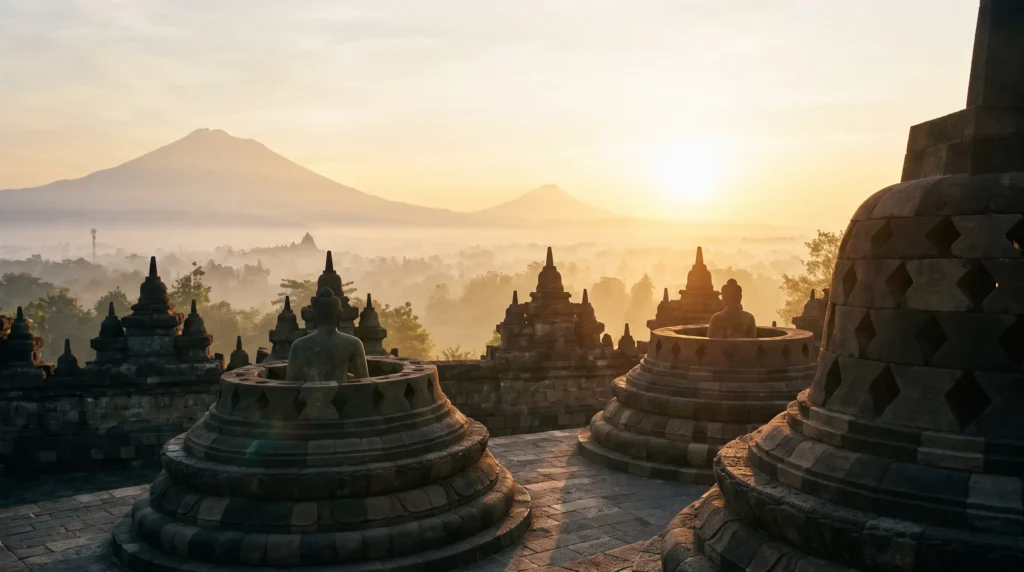
Yogyakarta Travel Guide — Java’s Living Palace City, Borobudur at Dawn & the Best Food in Indonesia
Yogyakarta is the only city in Indonesia that still has a working king. I don’t mean that as folklore — the Sultan of Yogyakarta is also, by law, the province’s governor, and his palace still runs its own gamelan orchestras, its own court rituals, its own calendar of ceremonies that have nothing to do with tourism and would happen with or without you watching. That’s the thing that took me by surprise on my first trip: I came for Borobudur, which is reason enough on its own, and left thinking about the city around it — the becak drivers, the batik workshops still using hot wax and a canting pen, the campus energy of a place built around one enormous university. Yogyakarta (locals just say “Jogja”) is compact, cheap, unfailingly warm to visitors, and sits within day-trip range of two of the greatest religious monuments on Earth. It is, without much competition, the best-value base in Southeast Asia for someone who wants ruins, culture and genuinely great food in one place.
In This Guide
- Overview — Why Yogyakarta Is Java’s Cultural Heart
- Sekaten — the Sultan’s Palace Throws a Week-Long Festival
- Best Time to Visit Yogyakarta (Season by Season)
- Getting There — YIA, Trains & Overnight Buses
- Getting Around — Becak, Ojek Apps & Rented Scooters
- Neighborhoods — Kraton, Malioboro, Kotagede & Beyond
- Culture & People — A Sultanate That Still Governs
- A Food Lover’s Guide to Yogyakarta
- Off the Beaten Path
- Day Trips — Borobudur, Prambanan & Merapi
- Practical Information
- Budget Breakdown — What Yogyakarta Actually Costs in 2026
- Frequently Asked Questions
Overview — Why Yogyakarta Is Java’s Cultural Heart
Yogyakarta sits in south-central Java at a modest 113 metres of elevation, a special autonomous region whose governor is, uniquely in Indonesia, a hereditary monarch rather than an elected official — a status granted after independence in recognition of the sultanate’s role sheltering the young Indonesian Republic during the 1945–1949 revolution. The city itself is home to roughly 376,000 people, but the wider metro area holds around 4 million, and it punches enormously above that weight culturally: this is where Javanese classical dance, gamelan music, wayang kulit shadow puppetry and batik textile art are practiced not as museum pieces but as living professions.
It also happens to be Indonesia’s biggest university town — Gadjah Mada University, the country’s largest, anchors a student population that keeps the city young, cheap and full of good coffee shops. And forty minutes to an hour outside the city sit two of Southeast Asia’s most important religious monuments: Borobudur, the world’s largest Buddhist temple, and Prambanan, the largest Hindu temple complex in Indonesia. Few cities anywhere let you combine working royal court, serious university town and two UNESCO World Heritage sites within a 45-minute radius — and Jogja does it at Southeast Asian backpacker prices, not European city-break prices.
The catch, if there is one: this is real, humid, traffic-snarled Java, not a resort bubble. Roads are chaotic, sidewalks are inconsistent, and the sights that make headlines (Borobudur sunrise, Prambanan at golden hour) require early alarms and some tolerance for tour-bus crowds. None of that outweighs what’s on offer, but go in expecting a living city, not a curated one.
Sekaten — the Sultan’s Palace Throws a Week-Long Festival
If your trip lines up with it, build a day around Sekaten, a week-long Javanese court festival marking Mawlid, the birthday of the Prophet Muhammad, held in the square north of the Kraton (the Sultan’s palace). Because it follows the Islamic calendar, the exact dates shift each Gregorian year — check ahead rather than planning around a fixed date. Two centuries-old gamelan ensembles, Kyai Nogo Wilogo and Kyai Guntur Madu, are carried out in royal procession and played continuously for seven days, alongside a sprawling night-market fair that takes over the palace square with rides, snacks and stalls.
It climaxes on the seventh night with the Grebeg Muludan procession: palace guards escort towering gunungan — mountain-shaped structures built from sticky rice, vegetables and sweets — from the Kraton to the Great Mosque, where crowds surge in to grab pieces, believed to carry blessing and protection. The festival was founded by Sultan Hamengkubuwana I, the sultanate’s own founder, specifically to draw crowds toward the mosque — six centuries later it still works.
Best Time to Visit Yogyakarta (Season by Season)
May – September · Dry season (peak)
The most reliable window: lower humidity, minimal rain, clear skies for Borobudur sunrise and Merapi views. July and August are the busiest and most expensive months for hotels near Malioboro — book ahead.
April & October · Shoulder months
Transitional weather, thinner crowds at the temples, and noticeably better hotel rates. A strong pick for travelers who want the dry-season experience without the peak-season price tag.
November – March · Wet season
Java’s tropical wet season brings humid heat and frequent afternoon downpours, heaviest around January–February. Temples stay open and rain rarely lasts all day, but pack a light rain shell and expect Borobudur’s sunrise views to be a coin flip with the clouds.
Getting There — YIA, Trains & Overnight Buses
Yogyakarta International Airport (YIA), in Kulon Progo Regency about 45 kilometres from the city centre, opened in stages from 2019 and reached full operations in March 2020, replacing the old in-town airport with a terminal built for up to 9 million passengers a year. Garuda Indonesia, Lion Air, Citilink and Batik Air run frequent domestic routes from Jakarta, Bali and other Indonesian hubs, with international connections to Kuala Lumpur and Singapore; a DAMRI airport bus and taxis cover the run into town in roughly an hour.
The scenic alternative is the train: Yogyakarta’s Tugu Station has been on Java’s rail network since 1872 and sits on the island’s main trunk line. Executive services like the Argo Lawu and Taksaka connect Jakarta Gambir to Yogyakarta in roughly 7–8 hours, a genuinely comfortable way to arrive that also lets you watch rural Java scroll past the window. Overnight buses from Jakarta, Bandung or Surabaya are the budget option, usually 8–12 hours depending on traffic.
Getting Around — Becak, Ojek Apps & Rented Scooters
Yogyakarta has no metro or light rail; the city runs on a mix of ride-hailing apps, rented scooters and a fair amount of walking within neighborhoods. Gojek and Grab are both active and by far the easiest way to move around — cheap, metered, and they sidestep the haggling that comes with unmetered taxis or becak (pedal rickshaws) hailed on the street.
Renting a scooter (roughly $4–7/day) is the most flexible way to reach Borobudur or Prambanan independently and is standard practice for both backpackers and families, though Jogja’s traffic is genuinely chaotic by Western standards — an international driving permit is technically required, and a heavier build of caution is warranted for anyone unused to Southeast Asian traffic. TransJogja city buses cover the main corridors cheaply if you’d rather skip driving altogether. Malioboro Street and the Kraton core are flat and very walkable, especially in early morning before the heat sets in.
Neighborhoods — Kraton, Malioboro, Kotagede & Beyond
Kraton (the Palace Quarter)
The walled royal complex is still the reigning Sultan’s residence and the ceremonial centre of the city — visitors can tour the outer pavilions, watch gamelan and classical dance rehearsals, and see royal heirlooms, while the inner palace remains private. The surrounding kampung (village) lanes are dense with small batik galleries and home workshops.
Malioboro
The city’s main artery, a roughly 2.5-kilometre stretch running from the Tugu monument down to the Kraton, lined with batik shops, street-food carts and the famous lesehan (floor-mat) night dining stalls. The name is widely believed to derive from “Marlborough,” a nod to the Duke of Marlborough from the era of British rule over Java in the early 1800s. It is touristy and crowded, and worth it anyway — go in the early morning or after 9pm to dodge the worst of the heat and crowds.
Kotagede
Java’s historic silver district and the original seat of the Mataram Sultanate, founded in 1582 by Panembahan Senopati, the dynasty’s first king. Narrow colonial-Javanese lanes hold silversmith workshops (many open for demonstrations), one of Java’s oldest mosques, and the royal cemetery where early Mataram rulers are buried.
Prawirotaman
The long-running backpacker enclave south of the Kraton — guesthouses, travel agents, laid-back cafes and bars, quieter and less frenetic than Malioboro.
Kotabaru
A leafy former Dutch colonial residential quarter with Art Deco houses, now home to some of Jogja’s better cafes and a genuinely pleasant place for a slow morning walk.
Sleman & the university belt
North of the old city, around Gadjah Mada University, this is student-city Jogja: cheap warungs, live-music bars and the jump-off point for Merapi’s slopes.
Bantul & the southern coast
An hour south, black-sand beaches like Parangtritis draw sunset crowds and cliffside warungs — a lower-key add-on for travelers with an extra day.
Culture & People — A Sultanate That Still Governs
Yogyakarta is the only Indonesian city where a hereditary monarch also holds constitutional executive power, serving as the province’s governor by law rather than election. That arrangement keeps court traditions — gamelan orchestras, classical Javanese dance, wayang kulit shadow-puppet theatre — funded and practiced as living state culture rather than tourist re-enactment, and public performances at the Kraton and nearby cultural centres are open to visitors most weeks.
Batik is the everyday craft you’ll see everywhere: the wax-resist dyeing technique was inscribed by UNESCO on the Representative List of the Intangible Cultural Heritage of Humanity in 2009, recognising patterns “handed down within families for generations” and worn across Indonesian life from infant carriers to wedding dress. Workshops around the Kraton and in Kotagede offer short hands-on classes if you want to try the canting pen yourself rather than just buying the finished cloth.
A Food Lover’s Guide to Yogyakarta
The dish to know is gudeg — young jackfruit slow-stewed for hours in coconut milk and palm sugar until it turns a deep brown, served with rice, chicken, a hard-boiled egg in sweet broth, and krecek (spicy crispy beef skin crackers). It’s sweeter than most Indonesian cooking and it is unmistakably Jogja’s own; the neighborhood of Wijilan near the Kraton is lined with long-running gudeg houses, several open into the early morning for gudeg as a 3am snack after a night out.
Beyond gudeg, graze the Malioboro lesehan stalls after dark for satay, nasi goreng and grilled seafood eaten cross-legged on floor mats, and look for bakpia, Jogja’s mung-bean-paste pastry, sold in boxes as the classic take-home souvenir. Angkringan carts — simple food stalls lit by a kerosene lamp, serving rice parcels called sego kucing (“cat rice,” a small portion of rice with a sliver of protein), skewers and sweet tea for a few thousand rupiah each — are the cheapest and most local way to eat in the city; find a busy one and pull up a low stool.
Off the Beaten Path
Taman Sari Water Castle
The Sultanate’s former royal bathing complex and pleasure garden, a maze of pools, underground passages and a sunken mosque a short walk from the Kraton — far quieter than Malioboro and easy to combine with a batik-workshop stop in the kampung around it.
Goa Pindul & the Gunung Kidul cave rivers
An hour southeast, this limestone region hides cave-tubing rivers where you float through underground caverns on inner tubes — a genuinely different Jogja experience from temples and palaces, and still relatively under-visited by international travelers.
Kaliurang & the Merapi slopes
A cooler hill town on Merapi’s southern flank with jeep tours through the 2010 eruption’s lava-flow debris and volcano-monitoring museum — sobering and fascinating in equal measure.
Kampung Wisata (village tourism programs)
Several kampung around the city run small-scale homestay and craft-tourism programs — batik, silver, pottery — that put tourism money directly into neighborhood hands rather than tour-bus operators.
Day Trips — Borobudur, Prambanan & Merapi
Borobudur
The single reason many travelers first book a Jogja trip: the world’s largest Buddhist monument, built around 780–833 CE, roughly 40 kilometres northwest of the city. Nine stacked platforms carry 2,672 relief panels and originally 504 Buddha statues, rising to 35 metres at the central stupa, all built from an estimated 55,000 cubic metres of volcanic andesite stone. It was inscribed as a UNESCO World Heritage Site in 1991 following a major restoration completed in 1983. Sunrise tours are the famous option — mist over the surrounding volcanoes, a fraction of the day’s eventual crowd — though they’ve become popular enough that “few other visitors” is no longer realistic; go anyway.
Prambanan
Roughly 17 kilometres northeast of the city sits the largest Hindu temple complex in Indonesia and the second-largest in Southeast Asia after Angkor Wat, built around 850 CE under the Hindu Sanjaya dynasty. The central Shiva temple rises 47 metres, and the complex originally comprised some 240 individual structures, most now ruined but a handful fully restored. Like Borobudur, it earned UNESCO World Heritage status in 1991. Many travelers combine both temples in a single long day; splitting them across two days with an early Borobudur sunrise and an unhurried Prambanan sunset is the better-paced version.
Mount Merapi
One of Indonesia’s most active volcanoes, rising 2,968 metres about 28 kilometres north of the city and classified as a Decade Volcano for the hazard it poses to surrounding populations. Its 2010 eruption killed 353 people and displaced 350,000 residents, and it has continued smaller eruptions since, including phreatic events in 2013 and 2018. Jeep tours from Kaliurang run through the old lava-flow zone rather than to the active crater; check current advisories before booking, since access changes with activity levels.
Practical Information
Money. The rupiah floats freely and traded around IDR 18,000 to the US dollar in mid-2026; carry small denominations for warungs and market stalls, and use ATMs at banks rather than street-side machines. Cards work at hotels and malls but cash is still king at food stalls and becak fares.
Visa. Most nationalities can arrive on a paid visa-on-arrival or apply for an e-VOA in advance, both typically valid 30 days and extendable once for a further 30 at a local immigration office — a June 2025 rule change means extensions now require an in-person visit rather than an online-only process. Passports need at least six months’ validity from your arrival date.
Safety. The US State Department rates Indonesia Level 2 (“exercise increased caution”) as of mid-2026, citing petty crime, occasional civil unrest and natural-disaster risk rather than anything specific to Jogja, which is broadly relaxed for tourists. The UK FCDO maintains standing exclusion zones around several active Indonesian volcanoes, including Merapi’s neighbor Merapi/Marapi systems — check current advice before any volcano trekking. Indonesia enforces severe penalties for drug possession, up to the death penalty, and some common prescription medications are restricted — check before you pack.
Health. The CDC recommends up-to-date routine vaccines plus Hepatitis A and typhoid for most travelers, with Japanese encephalitis and rabies worth discussing for extended rural stays; malaria risk is negligible in Jogja and Java’s main cities but real in parts of eastern Indonesia, so mention your full itinerary to a travel clinic. Stick to bottled or filtered water and use a strong DEET repellent against dengue-carrying mosquitoes.
Connectivity & other basics. A local SIM or eSIM is cheap and gets solid 4G coverage across the city. Plugs: European-style two-round-pin, 230V. Time zone: Western Indonesia Time, UTC+7, no daylight saving.
Budget Breakdown — What Yogyakarta Actually Costs in 2026
Jogja is one of the best-value cities in Southeast Asia — genuinely cheaper day-to-day than Bali, with the same access to major sights.
Budget (US$20–40/day): Hostel dorm or basic guesthouse in Prawirotaman, angkringan and warung meals, TransJogja buses or a shared scooter rental, entry to one temple.
Mid-range (US$60–120/day): Boutique guesthouse or 3-star hotel, restaurant meals, a private scooter or Gojek rides throughout, Borobudur and Prambanan entry with a guided sunrise tour.
Luxury (US$200+/day): Resort-style stays overlooking the rice paddies near Borobudur, private drivers for temple and Merapi day trips, fine-dining and cultural-performance packages.
Temple entry fees for Borobudur and Prambanan run higher for foreign visitors than for Indonesian nationals — budget roughly $25–35 per site, more for a combined ticket or premium sunrise access. Tipping isn’t obligatory but is appreciated for guides and drivers.
Planning Your First Trip to Yogyakarta
Three full days covers the essentials without rushing: one day in the city (Kraton, Taman Sari, Malioboro, a batik workshop), one for Borobudur sunrise plus an afternoon at Prambanan or vice versa, and one flexible day for Kotagede’s silversmiths, a Merapi jeep tour, or the Gunung Kidul cave rivers. Five to seven days lets you add the southern beaches or Solo (Surakarta), Jogja’s sister court city an hour east by train, which runs its own parallel version of the same royal-Javanese culture. Pair a Jogja trip with our Bali guide for a beach-and-culture combination, or our broader Indonesia guide for planning a longer multi-island route.
Frequently Asked Questions
Is Yogyakarta safe for tourists in 2026?
Yes, broadly — the US State Department rates Indonesia overall as Level 2 (“exercise increased caution”), driven mostly by petty crime and occasional unrest in other regions rather than anything specific to Jogja, which is one of the more relaxed, tourist-friendly cities in the country. Usual precautions apply: watch your belongings on Malioboro’s crowded stretches, use licensed transport apps, and check volcano-specific advisories before any Merapi trekking.
Do I need a visa for Yogyakarta?
Most nationalities can get a visa-on-arrival or apply for the e-VOA in advance, typically valid 30 days and extendable once for another 30 through Indonesia’s official immigration portal. Always confirm your specific nationality’s requirement before booking, since eligible-country lists change.
Can I visit Borobudur and Prambanan in one day?
Physically yes — many day tours combine both — but it’s a long day given the drive between them and Jogja’s traffic. Splitting them across two mornings (Borobudur at sunrise, Prambanan later or the next day) gives each site the unrushed time it deserves.
Yogyakarta or Bali?
Choose Jogja for temples, royal culture, batik and a serious food scene at a fraction of Bali’s prices; choose Bali for beaches and a more built-out resort infrastructure. Plenty of travelers do both — they’re a short flight apart and complement each other well.
What’s the cheapest way to see Borobudur?
Take a public shuttle or budget tour bus from Jogja rather than a private sunrise package, arrive at regular opening hours instead of the premium pre-dawn slot, and pair the entry ticket with a simple warung lunch in the surrounding village rather than the on-site restaurants.
What language is spoken and will English get me by?
Indonesian is the national language and Javanese is the everyday local tongue, but English is common in hotels, tour operations and around the main tourist areas — enough for a first-time visitor to get by comfortably, with a phrase-book’s worth of Indonesian appreciated everywhere else.
Ready to Explore Yogyakarta?
A sunrise over Borobudur’s stone stupas, a gamelan orchestra rehearsing behind palace walls, gudeg simmering in the same Wijilan kitchens it has for generations — Yogyakarta delivers an outsized dose of culture and history for one of the smallest budgets in Southeast Asia. Book the early alarm for the temples; the rest of the city rewards slower mornings.
Explore More
- Bali City Guide — Indonesia’s beach-and-culture icon, a short flight from Jogja
- Indonesia Travel Guide — plan a longer multi-island route
- Kuala Lumpur City Guide — a direct international connection from Yogyakarta’s airport
- Singapore City Guide — another easy onward hop from YIA
How this guide was built
Published as part of Facts From Upstairs’ city guide series. Built from authoritative sources — UNESCO’s World Heritage inscriptions for Borobudur and Prambanan and its Intangible Cultural Heritage listing for Indonesian batik, Indonesia’s official e-Visa immigration portal, Bank Indonesia, the US State Department and UK FCDO Indonesia advisory pages, the US CDC traveler page for Indonesia, and Wikipedia entity pages for Yogyakarta, Borobudur, Prambanan, Mount Merapi, Yogyakarta International Airport, Sekaten and the Argo Lawu train service. Numeric claims carry inline citations.
Sources cited on this page
- Wikipedia — Yogyakarta
- Wikipedia — Borobudur
- UNESCO — Borobudur Temple Compounds
- Wikipedia — Prambanan
- UNESCO — Prambanan Temple Compounds
- Wikipedia — Yogyakarta International Airport
- Wikipedia — Argo Lawu train
- Wikipedia — Mount Merapi
- Wikipedia — Sekaten
- UNESCO ICH — Indonesian Batik
- Indonesia Official e-Visa Portal
- Bank Indonesia
- US State Department — Indonesia
- UK FCDO — Indonesia
- US CDC — Indonesia traveler page
More city guides you might like
Plan your trip to Yogyakarta
The booking tools we use ourselves. FFU may earn a commission at no extra cost to you.
Plan & book your trip to Yogyakarta
Booking through these searches supports our guides at no extra cost to you.