Languages of Indonesia
All languages of Southeast Asia →fluent beta classical · classes by phone with Maya at ranas.ai/maya
Indonesia Travel Guide — Temples, Volcanoes & Seventeen Thousand Islands
Indonesia Travel Guide

📋 In This Guide
- Overview — Why Indonesia Belongs on Every Bucket List
- 🌙 Nyepi & Dry Season 2026
- Best Time to Visit Indonesia (Season by Season)
- Getting There — Flights & Arrival
- Getting Around
- Top Cities & Regions
- Indonesian Culture & Etiquette
- A Food Lover’s Guide to Indonesia
- Off the Beaten Path
- Practical Information
- Budget Breakdown
- Planning Your First Trip to Indonesia
- Frequently Asked Questions
Overview — Why Indonesia Belongs on Every Bucket List
Indonesia is not a country so much as an archipelago stitched together by faith, trade winds, and volcanic smoke — more than 17,000 islands flung across the equator between mainland Southeast Asia and Australia, home to roughly 281.6 million people who together make it the world’s fourth most populous nation. It is a place where the call to prayer drifts over rice terraces, where 127 active volcanoes rumble beneath sacred Hindu temples, and where lunch on Sumatra and dinner on Papua belong to two completely different worlds.
The geography alone reshapes any trip. Indonesia stretches about 5,200 km from Banda Aceh in the northwest to the Papuan border, spanning three time zones and straddling the equator. That is roughly the distance from London to Kabul, compressed into islands and sea. Java alone packs more than 150 million residents into a space smaller than England, while neighbouring Sulawesi and Papua hold rainforests where scientists are still cataloguing new species.
The cultural mix is equally disorienting in the best way. Indonesia is the world’s most populous Muslim-majority country, with around 87% of citizens identifying as Muslim, yet the island of Bali remains overwhelmingly Hindu, and pockets of Catholicism, Protestantism, Buddhism, and animist tradition shape Flores, Toraja, and Nias. The national motto, Bhinneka Tunggal Ika — “unity in diversity” — is carried on the coat of arms for a reason: more than 700 living languages are spoken across the archipelago.
Indonesia holds 10 UNESCO World Heritage sites including Borobudur, Prambanan, Komodo National Park, the Sumatran rainforests, Lorentz National Park in Papua, and the subak rice landscapes of Bali. Expect food that punches far above its price: a plate of nasi goreng on a Yogyakarta street for around Rp 20,000 (US$1.20), a bowl of soto ayam in Surabaya for Rp 25,000, a Bintang beer on Seminyak sand for Rp 45,000. Few destinations deliver this range of temple, reef, jungle, and surf inside one visa run — and few require so much honest planning to see any of it well.
Scale is the first thing that breaks Western assumptions. Indonesia’s land area of roughly 1.9 million km² is about three times the size of France, spread across an oceanic nation where distances are measured in flight hours rather than kilometres. A Bali–Raja Ampat flight burns four hours of air time and still lands you in the same country. Biodiversity tracks that scale: Indonesia hosts about 17% of the world’s bird species and more than 3,000 species of marine fish, and is one of only 17 nations classified as “megadiverse” by Conservation International. It is also a country shaped by seismic reality — the 2004 Indian Ocean earthquake and tsunami, the Krakatoa eruption of 1883, and recent eruptions of Merapi, Sinabung, and Agung all left cultural and physical marks that any honest traveller should factor into a route.
🌙 Nyepi & the Dry-Season Window 2026 — The Year to Go
If you’re picking dates for Indonesia in 2026, two things should anchor the calendar: Bali’s Day of Silence (Nyepi) on 19 March 2026, and the long dry-season window that runs from May through September across most of Java, Bali, and the Lesser Sunda chain. Nyepi is the Balinese Hindu new year, when the entire island — including the airport — shuts down for 24 hours of silence, fasting, and introspection. The night before brings the Ngrupuk parades: monstrous papier-mâché ogoh-ogoh effigies hauled through Denpasar, Ubud, and Kuta to banish evil spirits.
- Nyepi Day of Silence: 19 March 2026 — Ngurah Rai Airport closes for 24 hours
- Ogoh-ogoh parades: evening of 18 March 2026 across Bali
- Galungan & Kuningan: 18 February & 28 February 2026 — decorated penjor bamboo poles line Balinese streets
- Waisak at Borobudur: 11 May 2026 — Buddhist monks release sky lanterns at the 9th-century UNESCO temple
- Dry-season peak: May–September 2026 for Komodo sailing, Rinjani trekking, and Bromo sunrises
- Independence Day: 17 August 2026 — panjat pinang greased-pole climbs nationwide
Ramadan in 2026 runs from roughly 17 February to 19 March, overlapping the Nyepi window almost exactly. Outside Bali, the dry-season daytime pace slows — restaurants in Java and Sumatra may only open after sunset, alcohol is harder to find, and long-distance buses and trains book out around the Eid al-Fitr (Lebaran) holiday on 20–21 March 2026 as tens of millions of Indonesians travel home.
Best Time to Visit Indonesia (Season by Season)
Dry Season (May–Sep)
The high season for Bali, Java, Lombok, and Komodo — clear skies, reliable surf, and the only sensible window for climbing Rinjani (3,726 m) or Semeru (3,676 m). Daytime temperatures on the coast hover around 28–32°C, with cooler evenings in highland Ubud and around Lake Toba. July and August are peak for European and Australian school holidays; Borobudur and Komodo National Park both hit capacity. Expect higher accommodation rates across Bali and patchy wildfire haze in parts of Sumatra and Kalimantan if the dry season runs long.
Shoulder (Apr & Oct)
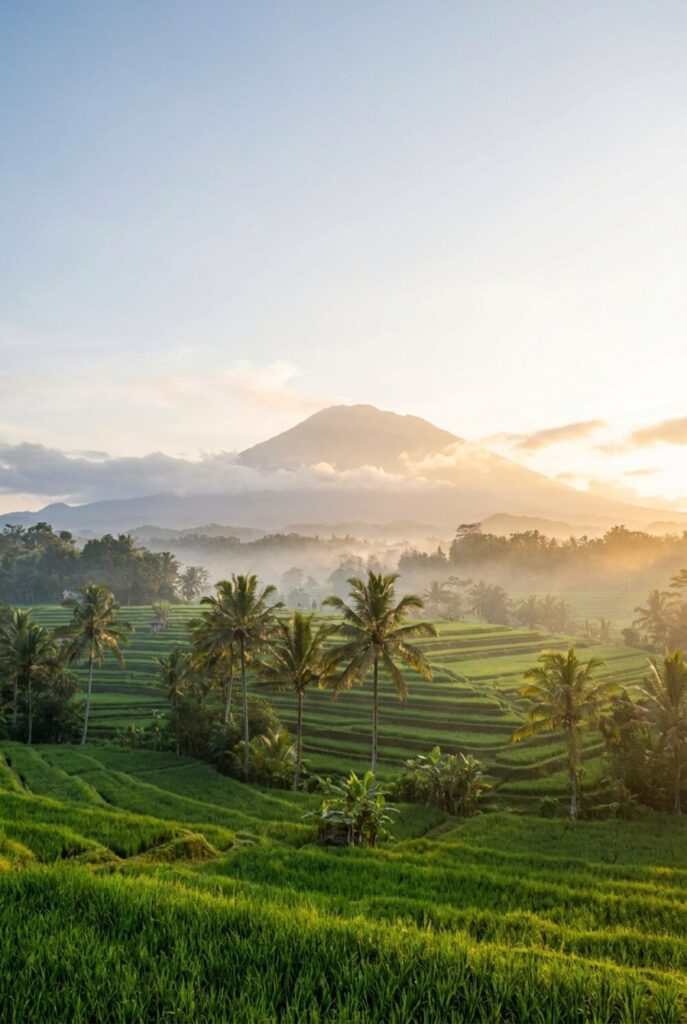
The savvy traveller’s sweet spot. April still catches the tail of the wet season but delivers emerald-green rice terraces in Tegalalang and Sidemen, while October dries out with warm seas and excellent visibility for diving Raja Ampat and Wakatobi. Prices drop 15–25% from peak, and dive operators in Komodo and the Gili Islands are fully staffed without the July crush.
Wet Season (Nov–Mar)
Monsoon rains hit western Indonesia hardest, with Jakarta, Bogor, and Bandung averaging more than 300 mm of rain in January alone. Afternoon downpours are heavy but usually short; mornings stay bright. It is the best window for surfing Java’s Mentawai Islands and for low-season Bali rates (30–40% off in February). Expect Komodo liveaboards to shut down from mid-January through February for rough seas, and Mount Bromo sunrises to be frequently fogged out.
Eastern Exception (Year-Round)
Papua, the Moluccas, and the eastern half of the archipelago follow a different rain pattern. Raja Ampat is best between October and April, when Komodo is in its off window — so a single Indonesia trip rarely covers both regions at their peak. Plan for one or the other and commit.
Temperatures across coastal Indonesia stay remarkably consistent year-round, averaging 26–32°C by day and 22–25°C at night, with humidity hovering near 80%. The real seasonal swings are rain and visibility, not heat. Mountain destinations behave differently — Bromo and the Dieng Plateau can drop to 4–8°C at dawn, and Rinjani and Kerinci summits occasionally see overnight frost. Pack a fleece for anywhere above 1,500 m.
Shoulder-season tip: Target late April or the first two weeks of October. You’ll catch the overlap between Bali and Komodo dry weather, beat the July–August peak pricing, and still have strong dive visibility in both the Banda and Flores seas.
Getting There — Flights & Arrival
Most international visitors still arrive at Bali or Jakarta, but Indonesia has five true international gateways and a growing roster of budget routes from Singapore, Kuala Lumpur, Bangkok, and Australia. Flag carrier Garuda Indonesia connects most intercontinental hubs, while Singapore Airlines, Qantas, Cathay Pacific, Emirates, Qatar Airways, and KLM all fly in daily.
- Soekarno–Hatta (CGK) — Jakarta, the busiest gateway; 35 km to centre, 55 min by Airport Rail Link to BNI City
- Ngurah Rai (DPS) — Bali’s Denpasar airport; 13 km to Kuta, 30 km to Ubud, 20–60 min by taxi depending on traffic
- Juanda (SUB) — Surabaya, gateway for eastern Java and Bromo; 20 km to city, 30–45 min by taxi
- Kualanamu (KNO) — Medan, the main entry into Sumatra; 39 km from centre, 45 min by Airport Railink
- Yogyakarta (YIA) — Kulon Progo; 45 km to centre, 40 min by YIA Airport Train to Tugu Station
Flight times: Singapore–Jakarta runs about 1 hr 50 min; Sydney–Denpasar roughly 6 hr; Amsterdam–Jakarta is around 14 hr nonstop on Garuda or KLM.
Flag carrier: Garuda Indonesia, with Lion Air, Batik Air, Citilink, and Super Air Jet covering domestic.
Visa / entry: Visa-on-arrival (VoA, Rp 500,000 ≈ US$35) for 97 eligible nationalities for a single 30-day stay, extendable once on-island. Pre-apply through the e-VoA portal at molina.imigrasi.go.id to skip the airport queue.
Getting Around — Flights, Ferries & Java’s New High-Speed Rail
With 17,000-plus islands to cover, you should assume every multi-region Indonesia itinerary involves at least two domestic flights. Java is the exception: Indonesia’s first high-speed rail, the Whoosh, now links Jakarta to Bandung at up to 350 km/h, and the classic overnight train from Jakarta to Yogyakarta remains excellent value.
- Whoosh high-speed rail: Jakarta–Bandung in 46 minutes at 350 km/h — Southeast Asia’s first bullet train
- Jakarta ↔ Yogyakarta: 7 hr by executive-class train (Argo Lawu, Argo Dwipangga); 1 hr 15 min by air
- Jakarta ↔ Bali (Denpasar): 1 hr 50 min nonstop by Garuda, Citilink, or Lion Air
- Bali ↔ Labuan Bajo (Komodo): 1 hr 20 min by air; the sea crossing takes about 36 hours by Pelni ferry
Rail passes: There is no single national rail pass. Book executive and luxury-class long-distance trains via the KAI Access app — prices for an 8-hour Jakarta–Yogyakarta sleeper start around Rp 420,000 (US$25).
Ride-hailing apps: Gojek and Grab dominate; they cover motorbike taxis (ojek), cars, food delivery, and airport transfers. A Ngurah Rai airport Grab to Seminyak runs around Rp 150,000 (US$9) versus Rp 350,000 for the airport taxi counter.
Ferries & fast boats: State operator Pelni runs inter-island ferries on long routes between Java, Sumatra, Sulawesi, and the Moluccas. Tourist-facing fast boats link Bali’s Sanur to the Gili Islands (2 hr) and Nusa Penida (45 min) via operators like Scoot, Eka Jaya, and OceanStar.
Self-drive caution: International driving permits are technically required, but enforcement is inconsistent. Traffic is heavy and left-hand drive like the UK; motorbike scooter injuries account for the single largest cause of foreign-traveller emergency evacuations from Bali each year, so ride slowly, wear a helmet, and always insure.
Top Cities & Regions
📍 Map of Indonesia: Every Place in This Guide
🌴 Bali
Indonesia’s Hindu island and the single biggest draw for foreign visitors — roughly 6.3 million tourists arrived at Ngurah Rai in 2024. A volcanic island of temples, rice terraces, surf breaks, and beach clubs, Bali works as both a first-timer’s introduction to Indonesia and a repeat-visit deep dive.
- Uluwatu Temple, Tanah Lot, and the Besakih “Mother Temple” complex
- Ubud — Monkey Forest, Tegalalang rice terraces, yoga studios
- Nusa Penida day trip — Kelingking Beach, manta rays at Manta Point
- Signature: babi guling (suckling pig), Bintang on the beach at Seminyak
🏙️ Jakarta
The sprawling capital and economic engine — Greater Jakarta (Jabodetabek) is home to around 32 million people, one of the largest urban agglomerations on Earth. Heavy, humid, and underrated by most first-timers, Jakarta rewards a day or two for colonial old town, modern mall culture, and the city’s exceptional food scene. The national capital function is scheduled to shift to the purpose-built Nusantara in East Kalimantan, but Jakarta remains the commercial, cultural, and aviation heart of the country.
- Kota Tua (old town), Merdeka Square, and the National Monument (Monas)
- Istiqlal Mosque (Southeast Asia’s largest) and Jakarta Cathedral across the road
- Thousand Islands (Kepulauan Seribu) day boat from Ancol
- Signature: soto Betawi (coconut-beef soup), kerak telor at street stalls
⛩️ Yogyakarta
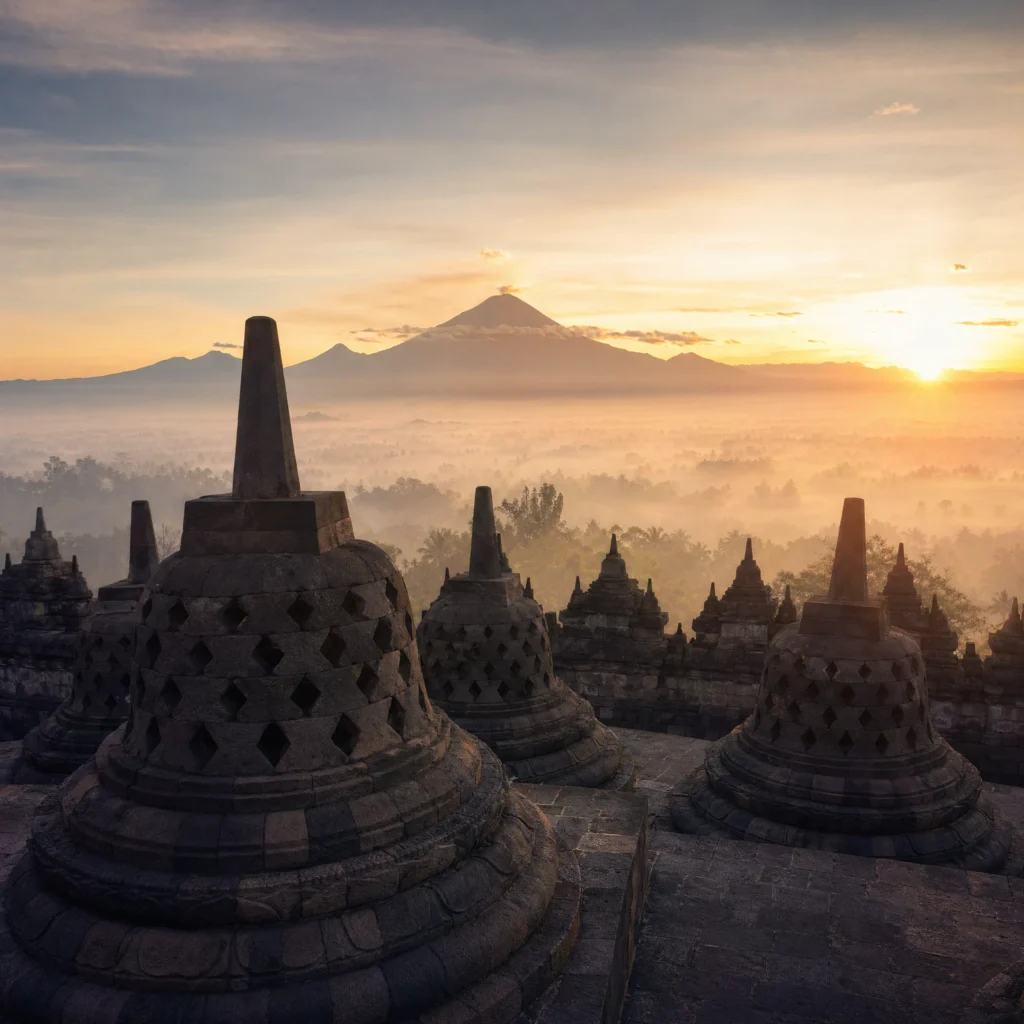
Indonesia’s cultural heartland and base for two of its greatest temples — the 9th-century Buddhist mandala of Borobudur and the Hindu spires of Prambanan, both UNESCO-listed. Jogja itself is a walkable sultanate city of palaces, batik workshops, gamelan music, and the country’s best-preserved royal culture.
- Borobudur sunrise climb and guided Kasut Pembatas access
- Prambanan Hindu temple complex and the Ramayana Ballet
- Malioboro Street, Kraton Palace, and the Taman Sari water castle
- Signature: gudeg (young-jackfruit stew) and bakpia pathok pastries
🐉 Komodo & Flores
The gateway to Komodo National Park — a UNESCO reserve famous for its 2,900-plus Komodo dragons, the world’s largest living lizards, plus some of the planet’s best drift-diving. Most travellers base in Labuan Bajo and explore by two-to-four-day liveaboard or day boat.
- Padar Island viewpoint and Pink Beach snorkel
- Komodo and Rinca ranger-led dragon walks
- Inland Flores: Kelimutu’s three-coloured crater lakes
🏝️ Lombok & the Gili Islands
Bali’s quieter eastern neighbour, with fewer temples and more white-sand coves. Mount Rinjani (3,726 m) is Indonesia’s second-highest volcano and the centrepiece of a 2–3 day trekking route for fit hikers. The three Gili Islands — Trawangan, Meno, and Air — are car-free and linked to Bali by 2 hr fast boats.
- Mount Rinjani summit trek and Segara Anak crater lake
- Gili Meno for quiet snorkelling; Gili T for nightlife
- Southern Lombok surf: Kuta Lombok and Selong Belanak
🐠 Raja Ampat, West Papua
Arguably the most biodiverse marine ecosystem on Earth — Raja Ampat’s 1,500 islands host more than 1,600 species of reef fish and 75% of the world’s known coral species. Access is still expensive and slow (fly Sorong via Jakarta or Makassar, then a 2-hr speedboat), but the snorkelling and diving are world-class and the region remains largely uncrowded.
- Piaynemo viewpoint and the karst archipelago
- Arborek Village for manta-ray drift dives
- Cape Kri, still the single fish-count-record reef
- Signature: papeda (sago porridge) with yellow fish soup, a true Papuan staple
Indonesian Culture & Etiquette — What to Know Before You Go
The Essentials
- Right hand only. Eat, pass, and receive with the right hand; the left is considered unclean. This matters at warungs (food stalls) and in homes.
- Dress modestly for temples and mosques. Shoulders and knees covered; women cover hair for mosque visits. A sarong is provided at most Balinese temples and at Borobudur.
- Shoes off indoors. Remove your shoes before entering homes, mosques, and many guesthouses; check the doorway for a shoe pile.
- Public affection is frowned upon. Outside Bali’s tourist zones Indonesia is a conservative Muslim-majority country — no hand-holding or kissing in public, and bikinis only at resort beaches.
- Tipping is gentle. 10% service is usually included at restaurants and hotels; round up taxi fares and leave Rp 10,000–20,000 for hotel porters.
Balinese Hindu Temple Etiquette
- Wear a sarong and sash. Both are provided free or for a small donation at temple entrances — wrap the sarong from the waist and tie the sash around it.
- Never step over offerings. Little woven canang sari baskets of flowers, rice, and incense sit on pavements, temples, and doorsteps; walk around them.
- Menstruating women may not enter inner temple courtyards. Signs at Besakih, Tirta Empul, and Uluwatu ask visitors to respect this long-standing rule.
- Stay below the priest. Do not position yourself or your camera higher than a priest or sacred statue during a ceremony.
Muslim-majority travel considerations: Outside Bali, Indonesia is a Muslim-majority country and Ramadan changes the rhythm of daytime service. Many restaurants in Sumatra, Central Java, and Sulawesi close until sunset during the fasting month; alcohol is harder to find in conservative provinces like Aceh (where it is banned entirely) and parts of West Sumatra. Dress is more conservative too — women should pack light long-sleeve shirts and trousers or long skirts for travel days in Java, Aceh, and Lombok’s inland villages. Bali and high-end resorts operate under tourist norms and are the exception rather than the rule.
A Food Lover’s Guide to Indonesia
Indonesian food is not a single cuisine so much as a mosaic of regional kitchens held together by rice, chilli, coconut, and fermented shrimp paste (terasi). Padang cooking from West Sumatra is heavy, coconut-rich, and fiery; Javanese cooking leans sweet; Balinese food foregrounds pork and grilled seafood; Manadonese cooking in North Sulawesi is among the spiciest in Southeast Asia. Street food is the glue — you can eat well for under US$3 a meal anywhere from Medan to Makassar.
Must-Try Dishes
| Dish | Description |
|---|---|
| Nasi goreng | Indonesian fried rice with kecap manis (sweet soy), shallots, chilli, and usually a fried egg on top; the unofficial national dish at Rp 20,000–35,000. |
| Rendang | Slow-cooked West Sumatran beef simmered in coconut milk and spice paste for many hours until dry and caramelised; repeatedly voted one of the world’s best dishes. |
| Satay (sate) | Skewered grilled meat — chicken (sate ayam), goat, or rabbit — served with peanut or kecap sauce; look for Madura-style carts with smoking charcoal braziers. |
| Gado-gado | Blanched vegetables, tofu, tempeh, and boiled egg dressed with thick peanut sauce — Indonesia’s answer to the composed salad, and reliably vegetarian. |
| Soto | Aromatic broth soup that changes by region: soto ayam (chicken, turmeric) in Surabaya, soto Betawi (coconut-beef) in Jakarta, coto Makassar (offal, dark broth) in Sulawesi. |
| Babi guling | Balinese spit-roast suckling pig rubbed with turmeric, lemongrass, and shallot paste — the island’s signature dish, famously served at Ibu Oka in Ubud. |
| Bakso | Beef meatball soup sold by pushcart everywhere; a full bowl with noodles costs Rp 15,000–25,000. |
Warung & Street Food Culture
The warung — a small family-run food stall or simple restaurant — is where Indonesians actually eat. Expect plastic stools, paper menus, and a handful of dishes made fresh all day. A filling warung meal of rice, a protein, sayur (vegetables), and sambal runs Rp 25,000–45,000 (US$1.50–2.75). For late-night eating, follow the smoke to a kaki lima (five-legged cart — two wheels plus the vendor’s legs plus two for the cart poles).
- Chains worth knowing: Sate Khas Senayan, Bakmi GM, Kopi Kenangan, Martabak San Francisco
- Signature street items: martabak manis (sweet stuffed pancake), pisang goreng (fried banana), es teler (mixed fruit shaved ice), cendol, kue cubit mini pancakes
Regional food tourism deserves trip planning. Padang in West Sumatra invented nasi padang — a dozen small dishes laid on the table where you only pay for what you eat. Manado on northern Sulawesi is the capital of extreme-heat Indonesian cooking, with tinutuan (corn-and-vegetable porridge) for breakfast and rica-rica (fierce chilli sauce) on almost everything. In Yogyakarta, gudeg — young jackfruit stewed overnight in palm sugar and coconut milk — is the signature breakfast dish, usually eaten with rice, chicken, and a hard-boiled egg.
Off the Beaten Path — Indonesia Beyond the Guidebook
Tana Toraja, South Sulawesi
The mountainous heartland of the Torajan people, whose elaborate multi-day funeral ceremonies, cliff-side tau-tau effigies, and boat-shaped tongkonan houses make Toraja one of Southeast Asia’s most unusual cultural destinations. Fly into Makassar and drive eight hours up to Rantepao, ideally in July–August when most ceremonies are scheduled.
Mount Bromo & Ijen, East Java
A volcanic double act. Bromo (2,329 m) delivers the classic caldera sunrise from Penanjakan viewpoint ; three hours east, the Ijen Crater glows with electric-blue sulphur flames visible only before dawn, and by day its turquoise crater lake is the most acidic body of water on Earth. Both are doable as a two-night loop from Malang.
Lake Toba, North Sumatra
The largest volcanic lake on the planet — roughly 100 km long and 30 km wide, created by a supereruption 74,000 years ago that is still one of the largest in human history. The Batak Christian cultures of Samosir Island, ancestral stone villages, and cool 900-m-altitude climate make it a complete contrast to tropical Bali.
Derawan & the Maratua Atoll, East Kalimantan
Four tiny islands off the east coast of Borneo where you can snorkel with resident sea turtles and, in Kakaban Lake, with millions of harmless stingless jellyfish — one of only two such lakes on Earth. Access is slow: fly to Berau via Balikpapan, then a 2-hr speedboat. Rewarded by reefs that still look like photographs from 1995.
Banda Islands, Maluku
The original Spice Islands — these ten tiny volcanic specks in the Banda Sea once produced all of the world’s nutmeg and triggered three centuries of Portuguese, Dutch, and British conflict. Today they are among the most remote Indonesian destinations you can realistically reach, with Dutch colonial forts, perfect pelagic diving on the Banda dropoff, and a population of about 18,000. Fly Ambon to Banda Neira on the Pelita Air route or arrive by overnight Pelni ferry.
Wakatobi, Southeast Sulawesi
A UNESCO Biosphere Reserve covering four islands — Wangi-Wangi, Kaledupa, Tomia, and Binongko — whose reef systems are considered some of the richest in the Coral Triangle. The marine park covers 1.4 million hectares and is home to more than 750 species of coral. Fly Denpasar–Wakatobi on Wings Air or splurge on the Wakatobi Dive Resort charter flight from Bali. It’s quieter and more affordable than Raja Ampat and visibility routinely tops 30 m.
Practical Information
| Currency | Indonesian Rupiah (IDR / Rp); 1 USD ≈ 16,750 IDR (April 2026) |
| Cash needs | Still largely a cash economy outside Bali, Jakarta, and major hotels. Carry Rp 500,000–1,000,000 for markets, warungs, ferries, and temple donations. |
| ATMs | Plentiful in cities; choose red-branded Mandiri or blue BCA ATMs for reliability. Most cap at Rp 2.5–3 million per withdrawal; fees on foreign cards run Rp 20,000–50,000. |
| Tipping | Not obligatory — a 10% service charge is usually on the bill. Round up taxi fares and leave Rp 10,000–20,000 for hotel porters and drivers. |
| Language | Bahasa Indonesia is the lingua franca; English is widespread in tourist areas but limited elsewhere. Google Translate with downloaded Indonesian offline pack handles most of it. |
| Safety | Indonesia ranks 49th on the 2024 Global Peace Index. Petty theft happens in Bali (Kuta) and Jakarta nightclub districts; motorbike scooter accidents are the largest real risk for travellers. |
| Connectivity | Telkomsel has the best regional coverage; Indosat is cheaper in Bali and Jakarta. 4G everywhere tourists go, 5G in Jakarta and Surabaya. |
| Power | Type C and Type F plugs, 230V, 50Hz. |
| Tap water | Data unavailable — tap water is not potable; stick to bottled, filtered, or boiled water and refill at Refill Stations where available. |
| Healthcare | Bali and Jakarta have good private international-standard hospitals (BIMC, Siloam, RS Pondok Indah). Travel insurance with medevac cover is essential for remote islands. |
Budget Breakdown — What Indonesia Actually Costs
💚 Budget Traveller
Around Rp 500,000–850,000 (US$30–50) per day. Hostel dorm beds in Bali and Yogyakarta run Rp 120,000–220,000, warung meals are Rp 25,000–45,000, and a Gojek ride across Ubud costs around Rp 20,000. Scooter hire on Bali or Lombok runs Rp 70,000–90,000 a day, and domestic LCC flights between islands often drop below Rp 700,000 if booked early.
💙 Mid-Range
Around Rp 1.7–3 million (US$100–180) per day. Three- and four-star hotels or boutique Balinese villas cost Rp 700,000–1,800,000 per night; a sit-down restaurant dinner runs Rp 150,000–300,000 per person; a Komodo day boat from Labuan Bajo is Rp 1.5–2 million per person.
💜 Luxury
From Rp 5 million (US$300) per day upward. Iconic stays like Amandari, COMO Shambhala Estate, Nihi Sumba, or Bawah Reserve start at Rp 9–22 million per night, full-board; private Komodo liveaboards with 4–6 cabins run Rp 60–120 million for a 3-night charter. Fine dining at Locavore NXT in Ubud or at a Mozaic sister property is around Rp 2.5–3.5 million per head. Bali’s top beach-club experiences at Potato Head or Finns add another Rp 500,000–1,500,000 per day for day-beds and cocktails.
What you’ll actually spend: Two weeks of mid-range travel across Java and Bali typically lands between US$1,800 and US$2,800 per person excluding international flights, with the single biggest line item almost always the domestic flight or liveaboard to Komodo or Raja Ampat. A two-week budget-backpacker version is achievable at US$650–900 per person if you stick to ferries, warungs, and hostels.
| Tier | Daily (USD) | Accommodation | Food | Transport |
|---|---|---|---|---|
| Budget | US$30–50 | Hostel dorm Rp 120–220k | Warungs, street food | Gojek/Grab + scooter |
| Mid-Range | US$100–180 | Boutique villa Rp 700k–1.8M | Cafés & mid-range restaurants | Private driver + LCC flights |
| Luxury | US$300+ | 5-star resort Rp 9–22M | Fine dining Rp 2.5–3.5M | Private transfers, liveaboards |
Planning Your First Trip to Indonesia
- Pick one or two islands, not five. The classic first-trip pairing is Bali plus Yogyakarta (temple-and-beach), or Bali plus Komodo (diving). Trying to add Sumatra or Papua usually ruins the pace.
- Apply for e-VoA online before you fly. The e-VoA at molina.imigrasi.go.id costs Rp 500,000 (US$35) and skips the 30-minute airport queue.
- Match season to region. Dry season (May–September) for Bali, Java, Komodo, Lombok; October–April for Raja Ampat and the Moluccas. Don’t fight the monsoon.
- Book domestic flights early. Bali–Komodo fares triple in July–August — lock in 3–4 months ahead through Garuda, Citilink, or Super Air Jet.
- Pack modestly and pack light. Scooter luggage limits and small island ferries punish big suitcases. Bring a sarong, reef-safe sunscreen, motion-sickness tablets for fast-boat crossings, and an unlocked phone for a local SIM.
Classic 14-Day Itinerary: Days 1–3 Jakarta & Bandung (Whoosh); Days 4–6 Yogyakarta (Borobudur & Prambanan); Days 7–10 Bali (Ubud, Uluwatu, Nusa Penida); Days 11–14 Labuan Bajo for a 3-night Komodo liveaboard. If you have only 10 days, cut Jakarta and add a rest day in Ubud; if you have 21, tack on Lombok and Rinjani before Komodo.
Cities & Regions to Explore
Frequently Asked Questions
Is Indonesia expensive to visit?
No — Indonesia is one of Southeast Asia’s better-value destinations. Budget travellers spend around US$30–50 a day, mid-range travellers US$100–180, and even the luxury tier runs 30–40% less than comparable resorts in Thailand or the Maldives. The real cost drivers are long-haul flights to Bali and internal hops to Komodo or Raja Ampat. Eat at warungs, ride Gojek, and scooter where legal to cut your on-the-ground costs sharply.
Do I need to speak Bahasa Indonesia?
No, but a few phrases go a long way. English is widely used in tourist Bali, in Jakarta hotels, and at dive resorts, but dries up quickly in rural Java, Sumatra, and Sulawesi. Download Google Translate’s offline Indonesian pack and learn five words — terima kasih (thank you), selamat pagi (good morning), berapa (how much), enak (delicious), and permisi (excuse me). You’ll unlock warmth that English alone won’t.
Is the Whoosh high-speed train worth it?
For Jakarta–Bandung, yes — the Whoosh cuts a 3-hour drive to 46 minutes for around Rp 250,000–450,000 in executive class. Beyond that corridor, domestic flights remain the default. Use the classic KAI executive-class overnight trains between Jakarta, Yogyakarta, and Surabaya for a scenic option.
Is Indonesia safe for solo travellers?
Yes, with caveats. Indonesia ranks 49th on the 2024 Global Peace Index and violent crime against foreigners is rare. The big real risks are motorbike-scooter accidents, rip currents on south-coast beaches, petty theft in Bali nightclub districts, and volcanic closures. Solo female travellers report feeling safe in Bali, Yogyakarta, and Lombok — dress modestly outside tourist zones.
When is the best time to visit Indonesia?
May through September for Bali, Java, Lombok, and Komodo — dry, warm, excellent visibility for diving. October through April for Raja Ampat, the Banda Islands, and the eastern archipelago. The sharpest shoulder windows are late April and early October, when you catch pleasant weather across most of the country with 15–25% lower prices than July–August peak.
Can I get by as a vegetarian or vegan?
Easily in Bali, Ubud in particular, which has one of Southeast Asia’s most developed vegan scenes. Nationwide, gado-gado, tempeh, tofu, pecel, lotek, and sayur urap are reliable plant-based options, and the word for vegetarian is “vegetarian” or simply “tanpa daging” (without meat). Be aware that terasi (shrimp paste) hides in many sambals and sauces — ask “ada terasi?” if you avoid seafood.
Do I need an e-Visa for Indonesia?
Most travellers arrive on a visa-on-arrival (VoA) for 97 eligible nationalities — Rp 500,000 (US$35), single entry, 30 days, extendable once in-country. Pre-apply online through the official e-VoA portal at molina.imigrasi.go.id to skip the arrival queue. For longer stays, the B211A social-cultural visa allows up to 180 days.
Ready to Explore Indonesia?
Indonesia rewards travellers who pick one region deeply over those who try to see the whole archipelago in two weeks. Start with Bali plus Yogyakarta for temples and rice terraces, add Komodo for dragons and diving, and come back later for Sumatra, Sulawesi, and Papua — this is a country built for repeat visits.
Explore More
Cities we cover in Indonesia
Cities to explore in Indonesia
Deep-dive guides to specific cities, neighbourhoods, and food scenes — written with the same magazine voice.
More country guides you might like


Plan your trip to Indonesia
The booking tools we use ourselves. FFU may earn a commission at no extra cost to you.
Plan & book your trip to Indonesia
Booking through these searches supports our guides at no extra cost to you.