
Languages of Costa Rica
All languages of Central America →fluent beta classical · classes by phone with Maya at ranas.ai/maya
Costa Rica Travel Guide — Cloud Forests, Two Oceans & Pura Vida
Costa Rica Travel Guide
📋 In This Guide
- Overview — Why Costa Rica Belongs on Every Bucket List
- ☀️ Dry Season & Turtle Nesting 2026
- Best Time to Visit Costa Rica (Season by Season)
- Getting There — Flights & Arrival
- Getting Around — Shuttles, Domestic Flights & the Rental 4WD
- Top Cities & Regions
- Costa Rican Culture & Etiquette — What to Know Before You Go
- A Food Lover’s Guide to Costa Rica
- Off the Beaten Path — Costa Rica Beyond the Guidebook
- Practical Information
- Budget Breakdown — What Costa Rica Actually Costs
- Planning Your First Trip to Costa Rica
- Frequently Asked Questions
Overview — Why Costa Rica Belongs on Every Bucket List
Costa Rica is the country where a howler monkey might wake you before the sun does, where a single highway can carry you from Caribbean reef to Pacific surf in under four hours, and where a casual greeting — pura vida — doubles as the national philosophy. Few small countries have managed to bottle this much wildness, coastline and ease into one trip.
Wedged between Nicaragua and Panama on the narrow isthmus of Central America, Costa Rica covers just 51,100 square kilometres — roughly the size of West Virginia — yet it punches extraordinarily far above its weight ecologically. The country holds about 5% of the planet’s known biodiversity on 0.03% of its land area, a ratio no other nation comes close to matching. Roughly 25% of national territory sits inside national parks, biological reserves and wildlife refuges administered by SINAC, and the national park system alone contains 30 parks spanning cloud forest, dry forest, volcanic highlands, mangroves and two separate coastlines.
The cultural fabric is just as distinct. Costa Rica abolished its army in 1948 and invested the savings in schools, clinics and conservation — a decision still cited in every political debate seventy-eight years later. Spanish is the official language, flavoured by Costa Rican slang nobody outside the country fully uses, and Ticos (as Costa Ricans call themselves) are famous across Latin America for their unhurried friendliness, their reflexive optimism and the sing-song way they end half their sentences with “con mucho gusto.” The Caribbean coast layers Afro-Caribbean Creole, Bribri and Cabécar Indigenous cultures on top of the Spanish-colonial Pacific side, producing a country that feels linguistically and culturally split down the middle.
And then there is the adventure. Zip-lining was invented here in the Monteverde cloud forest in 1979; whitewater rafting on the Pacuare, surfing on the Nicoya Peninsula, and hiking Corcovado are on serious travellers’ short-lists worldwide. A plate of gallo pinto for breakfast runs ₡2,500 (about USD 5), a casado lunch of rice, beans, plantains and a protein costs ₡4,500, and a bottle of Imperial beer to close the day is another ₡1,500. Add four UNESCO sites, two oceans, and a country that has run on more than 98% renewable electricity for years and the question stops being “should I go” and becomes “how long can I stay.”
☀️ Dry Season & Turtle Nesting 2026 — You’re Right on Time
If you’re planning Costa Rica for 2026, the calendar gives you two strong windows and a festival wildcard. The dry season — locally called verano — runs roughly December 2025 through April 2026, and it is the single best stretch for Pacific beaches, volcano hikes without cloud cover, and road trips across the Cordillera Central. Come July through October and you trade the blue skies for the country’s most spectacular wildlife event: green sea turtle nesting at Tortuguero National Park on the Caribbean coast, where thousands of females crawl ashore on a handful of beaches to lay eggs under the new moon. Humpback whales layer in on the Pacific side, with sightings reliable off the Osa Peninsula and Marino Ballena National Park from Jul–Nov and again Dec–Apr as separate southern and northern populations visit the same waters.
- Dry-season peak: late December 2025 through mid-April 2026 — book Manuel Antonio, Tamarindo and Arenal lodging 4–6 months ahead
- Envision Festival: late February 2026 at Uvita — a four-day music-and-wellness gathering on the Pacific coast
- Turtle nesting (Tortuguero): July through October 2026, with August–September the clearest peak for green sea turtles
- Whale watching (Osa & Marino Ballena): Jul–Nov and Dec–Apr — two humpback seasons back to back
- Semana Santa: 29 March – 4 April 2026 — a national holiday week; expect closed offices and crowded beach towns
Best Time to Visit Costa Rica (Season by Season)
Dry Season / High (Dec–Apr)
The classic travel window. Pacific-side skies are reliably blue, trails in Arenal and Monteverde are firm, and the beaches of Guanacaste hit their postcard peak. Daytime highs in San José run about 24°C with cool 15°C nights; Guanacaste pushes 32°C on the coast. Book everything — lodging, shuttles, zip-line slots — at least three months ahead for the Christmas-to-New-Year peak, when rates jump 40–60% and the Pacific-coast towns fill end-to-end. Semana Santa (29 March – 4 April 2026) is the tightest mid-season crunch.
Green / Shoulder (May–Jul)
Costa Ricans call it the temporada verde and it is the quiet sweet spot for value seekers. Mornings are typically clear, afternoon rains arrive around 2–4pm, and the forest feels electrically alive. Whale watching on the Osa Peninsula opens in July, rivers run high for rafting on the Pacuare, and lodge rates drop 20–30%. Downside: some dirt roads on the Nicoya Peninsula become 4WD-only, and a handful of remote Caribbean lodges close in May.
Wildlife / Wet Peak (Aug–Oct)
The rainiest months on the Pacific side, but also the headline wildlife window. Green sea turtles nest nightly at Tortuguero July through October, whales cruise the southern Pacific, and sloths seem to multiply in every tree. Caribbean-side weather is actually at its best in September and October — the regional microclimate runs opposite to the Pacific. Expect cheap lodging, empty beaches, and the occasional washed-out road.
Transition / Early Dry (Nov)
Late October into mid-November is hit-or-miss, but by late November the dry trade winds reassert themselves and the country snaps back into bluebird mode. Prices have not yet caught up, wildlife is still dense, and the Pacific coast is greener than you will ever see it in February. This is the travel-geek’s favourite month — you just have to accept a small rain-risk tax.
Shoulder-season tip: Aim for early May or late November if you want dry-season-style weather at green-season prices. The country’s two microclimates mean that when one coast is rainy, the other is often sunny — build both sides into a two-week itinerary.
Getting There — Flights & Arrival
Almost every Costa Rica trip starts at one of two international airports, each overseen by CORSA. Pick your gateway based on where you are going — the two sit four hours apart by road.
- Juan Santamaría International (SJO) — Alajuela, 20 km northwest of San José; 30–45 minutes downtown by shuttle. The main hub for Central Valley, Arenal, Monteverde and the Caribbean.
- Daniel Oduber Quirós International (LIR) — Liberia, Guanacaste; 45 minutes from Tamarindo and the northern Nicoya beaches. The sensible arrival for the northern Pacific coast.
- Tobías Bolaños (SYQ) — Pavas, San José; SANSA and Aerobell domestic flights to Osa, Drake Bay and Tortuguero.
Flight times: 5.5h Los Angeles, 3h Miami, 5h New York, 3h Mexico City, 10.5–11h Madrid. Flag carriers: Avianca flies the densest Latin American network into SJO; US majors and Air Canada serve both SJO and LIR. Visa / entry: US, Canadian, UK, EU and most Latin American passport holders enter visa-free up to 180 days; onward-ticket and six-month-validity rules apply.
Getting Around — Shuttles, Domestic Flights & the Rental 4WD
Costa Rica has no intercity rail network and no single tourist rail pass — the real transport menu is shared shuttles, occasional domestic flights, and a rental 4WD if you want the full run of the country. Distances look short on the map and take longer than you expect; mountains, single-lane bridges and afternoon rain are the reason.
- Rental vehicle: the most flexible option; most beach and mountain routes officially recommend 4WD, and many insurance policies require it.
- San José → La Fortuna (Arenal): 3–3.5 hours by road, 120 km via Route 141.
- San José → Monteverde: 3.5–4 hours by road via the Interamericana and a rough mountain ascent into Santa Elena.
- San José → Manuel Antonio (Quepos): 3 hours by road, or a 30-minute domestic flight with SANSA.
Shared shuttles: Interbus and Grayline are the two dominant operators connecting every major tourist town daily; expect USD 50–65 per person per leg, door-to-door. No rail pass exists — the old Pacific Railway runs only a short commuter line in the Central Valley. Domestic flights: SANSA and Aerobell run small-plane routes out of SJO and SYQ to Quepos, Tamarindo, Nosara, Drake Bay and Tortuguero — the fastest way into the Osa Peninsula and Caribbean lagoons.
Apps: Waze is the local default for driving (it handles gravel detours better than Google Maps), and Uber operates in and around San José, though technically in a legal grey zone — it works fine for tourists.
Top Cities & Regions
📍 Map of Costa Rica: Every Place in This Guide
🏛️ San José
The capital and cultural heart of the Central Valley — a working city of roughly 340,000 people, ringed by coffee highlands and easily overlooked by travellers racing to the coast. Give it a night or two: the museums, food scene and neighbourhood markets are where modern Costa Rican culture actually lives.
- Museo del Oro Precolombino — the pre-Columbian gold collection beneath the Plaza de la Cultura
- Teatro Nacional — the 1897 neoclassical theatre financed by the coffee boom, still hosting performances weekly
- Mercado Central and Barrio Escalante — the old downtown food market and the new gastro-neighbourhood, twenty minutes apart
- Essential plates: a full breakfast gallo pinto with sour cream and plantains, a lunch casado at any downtown soda
🌫️ Monteverde
A cloud-forest reserve in the Tilarán mountains where mist drips off every branch and the resplendent quetzal turns up if you’re patient. This is where commercial zip-lining was born in 1979, and where most travellers build their first big adrenaline day.
- Monteverde Cloud Forest Biological Preserve — suspended walkways through the canopy
- Selvatura or 100% Aventura — the original zip-line circuits and hanging bridges
- Santa Elena village — the cloud-forest base town, dense with cafés and tour desks
- Essential plates: casado with yuca and fried plantains at a family-run soda
🐒 Manuel Antonio
The most-visited national park in Costa Rica, for good reason — rainforest tumbles directly into white-sand Pacific beaches, and squirrel monkeys, capuchins, sloths and iguanas are nearly guaranteed within an hour of entering the gate.
- Manuel Antonio National Park — four beaches, rainforest trails, wildlife at arm’s length
- Quepos town and marina — the sportfishing base just north of the park
- Nauyaca Waterfalls — an hour south, a classic day-trip swim
- Essential plates: fresh-caught ceviche on the beach, patacones with garlic shrimp
🌋 Arenal & La Fortuna
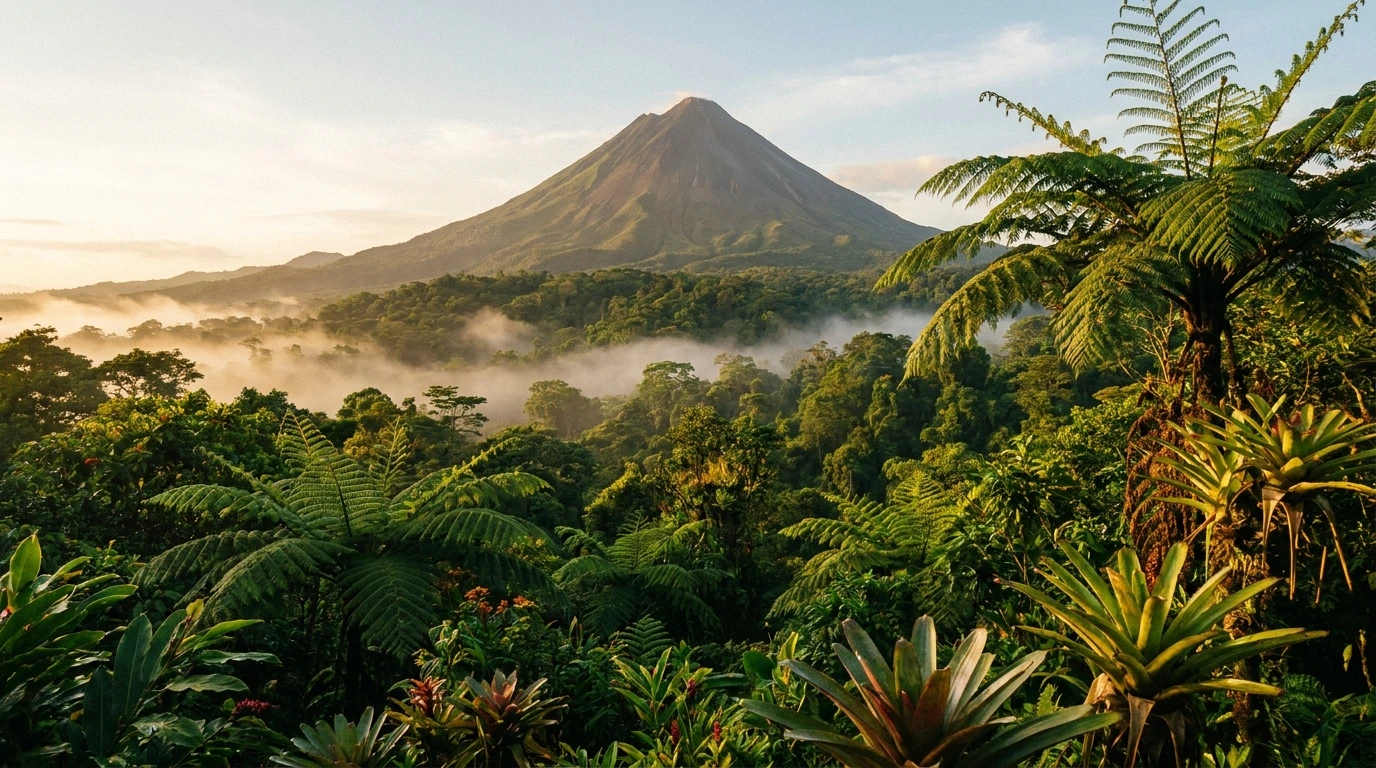
The near-perfect cone of Arenal Volcano looms over the town of La Fortuna — dormant since 2010 but still the dominant icon of interior Costa Rica. Hot springs, rainforest hanging bridges, and the country’s best single volcano view are all inside a fifteen-kilometre radius.
- Arenal Volcano National Park — lava-field trails around the 1968 flow
- Tabacón and EcoTermales — thermal rivers running straight out of the mountain
- La Fortuna Waterfall — a 75-metre drop into a jungle swimming hole
- Essential plates: chifrijo (rice, beans, chicharrón, pico de gallo) with a cold Imperial
🏄 Tamarindo & Nicoya Peninsula
The sun-baked Pacific coast of Guanacaste — dry forest, year-round surf, and a string of beach towns from Tamarindo south through Nosara and Santa Teresa. One of the world’s five Blue Zones (where people routinely live past 90) runs across the southern end.
- Playa Tamarindo and nearby Playa Grande — surf schools and leatherback turtle nesting
- Nosara and Santa Teresa — yoga-and-surf villages with a serious wellness scene
- Rincón de la Vieja National Park — volcanic mud pots and waterfall trails inland
- Essential plates: beachfront ceviche, gallo pinto with Lizano sauce, grilled pescado entero
🌴 Osa Peninsula & Corcovado
Described by National Geographic as “the most biologically intense place on Earth” — 2.5% of the planet’s biodiversity packed into 424 square kilometres of lowland rainforest on the Pacific south. Tapirs, all four Costa Rican monkey species, and the elusive jaguar still roam here.
- Corcovado National Park — guided-only hikes from Sirena ranger station
- Drake Bay and Puerto Jiménez — the two peninsula gateways
- Caño Island — a half-day snorkel-and-dive trip offshore
- Essential plates: arroz con pescado at a Drake Bay cabina, plantains fried twice
Costa Rican Culture & Etiquette — What to Know Before You Go
The Essentials
- Greetings are warm and unhurried. Handshakes for men, a light cheek-kiss between women and between men and women who already know each other. Rushing a greeting reads as rude.
- Time runs on tico time — arrive five to ten minutes late to social gatherings, on time for business, and never assume a 9am tour means 9am sharp. Breathe through it.
- Tipping is already included: Costa Rican restaurants add a 10% service charge by law, so rounding up for exceptional service is appreciated but not required.
- Spanish is standard; English is widely spoken in tourist towns but a handful of basic phrases and a “con mucho gusto” go a long way in the interior.
- Dress is generally casual — swimwear stays at the beach, modest clothing for churches, and long trousers plus sturdy shoes for any rainforest trail.
Pura Vida Etiquette
- “Pura vida” — literally “pure life” — is used as a hello, goodbye, thank-you, you’re welcome, and general affirmation. Overuse is not possible; mis-use is a dead giveaway you just landed.
- Patience is the implicit virtue. Roads flood, shuttles run late, a sloth blocks the path — locals simply shrug and keep moving. Match the pace and you’ll have a far better trip.
- Respect for wildlife is non-negotiable. Never touch, feed, or bait animals — penalties are serious, and park rangers do enforce them.
- Tap water in the Central Valley, Guanacaste and most tourist zones is safe; always ask at remote rural lodges where rainwater or well sources are in play.
A Food Lover’s Guide to Costa Rica
Costa Rican food is quietly excellent — not showy, not heavily spiced, but built on just-picked fruit, fresh Pacific fish, strong coffee grown at altitude, and a daily rhythm of rice-and-beans that travellers end up craving long after they leave. The cheapest plate of the day, the casado, often turns out to be the best.
Must-Try Dishes
| Dish | Description |
|---|---|
| Gallo pinto | The national breakfast — rice and black beans fried together with onion, bell pepper, cilantro and a hit of Salsa Lizano, typically served with eggs, sour cream and fried plantains. |
| Casado | The everyday lunch plate: rice, black beans, salad, sweet plantains, and your choice of protein (chicken, fish, beef or pork). ₡3,500–5,500 at a family-run soda. |
| Ceviche | Pacific white fish (usually corvina) cured in lime with onion, cilantro and minced sweet pepper, served with soda crackers or patacones — lighter than its Peruvian cousin. |
| Chifrijo | A layered bar-snack from Alajuela: rice, black beans, fried chicharrón (pork belly), and pico de gallo in a bowl with tortilla chips — always eaten with a cold Imperial. |
| Patacones & plátano maduro | Green plantains fried flat and crispy or ripe plantains fried sweet and caramelised — the country’s two default side dishes. |
| Olla de carne | The Sunday beef-and-root-vegetable stew — yuca, plantain, chayote, ayote and corn cooked down for hours, served with a side of rice. |
Soda Culture (The Family-Run Lunch Counter)
The backbone of everyday Costa Rican eating is the soda — small, family-owned restaurants, usually under a dozen tables, serving a short menu of classic plates at honest prices. Every town has one; every town’s best one is the one with the longest local lunchtime queue. A soda is where you learn that rice and beans are never “just” rice and beans, that the coffee comes poured through a cloth sock called a chorreador, and that a batido — fruit blended with water or milk — is lunch’s finishing touch. Costa Rican coffee itself deserves a stop: the country’s Tarrazú, Dota and Naranjo highlands produce some of Central America’s cleanest cup profiles, and most tours outside San José are free entry if you buy a pound to take home.
- Names to look for: Soda Tapia (San José), Soda Viquez (La Fortuna), Soda La Lechuza (Manuel Antonio), plus every unnamed roadside soda between them
- Signature items: full casado for ₡4,500, batidos in water or milk for ₡1,800, empanadas de queso, tres leches cake for ₡2,500, and a bottomless pot of coffee for ₡900
- Pair with: a local craft beer (Costa Rica Craft Brewing, Treintaycinco, Domingo 7), a glass of fresh-pressed cas or tamarindo juice, or a straight café chorreado poured through a cloth filter
- A note on Salsa Lizano: the brown, vaguely Worcestershire-like sauce on every Tico table is the country’s edible fingerprint — keep a bottle in your bag
Off the Beaten Path — Costa Rica Beyond the Guidebook
Puerto Viejo de Talamanca
The Caribbean coast is a different country — calypso music, Jamaican Creole, rice-and-beans cooked in coconut milk, and beaches framed by palms leaning at impossible angles. Puerto Viejo is the hub: Playa Cocles and Punta Uva stretch south toward the Panama border, and Cahuita National Park protects a living coral reef just up the road. September and October are the sunniest months here, exactly when the Pacific is at its wettest — a microclimate flip that locals exploit every year.
Río Celeste & Tenorio National Park
A six-kilometre round-trip hike through cloud forest leads to a waterfall the colour of blue curaçao — not dye, but a natural mineral phenomenon where two colourless rivers meet and refract light through suspended aluminium and silicon particles. Allocate a full day from La Fortuna or Bijagua, and arrive at the trailhead by 8am before afternoon rain closes the viewpoint.
Chirripó National Park
Costa Rica’s highest summit at 3,821 metres is a two-day trek through the only páramo ecosystem in the country — cloud forest gives way to tundra-like heathland near the top. Permits are capped daily by SINAC and must be reserved months ahead through the official online lottery system; the trek begins in the town of San Gerardo de Rivas.
Guayabo National Monument
Costa Rica’s most important pre-Columbian archaeological site — a 3,000-year-old settlement of stone-paved causeways, aqueducts and mound foundations tucked in rainforest forty minutes northeast of Turrialba. It rarely sees more than a handful of visitors a day, and the site remains partly unexcavated beneath thick canopy.
Isla del Coco
A 550-kilometre offshore journey from the Pacific puts you at one of the world’s great scuba dives — an uninhabited UNESCO-listed island ringed by scalloped hammerheads, whitetip reef sharks, manta rays and the occasional whale shark. Jacques Cousteau famously called it “the most beautiful island in the world.” Liveaboard trips of 10–12 days leave from Puntarenas and require advanced open-water diving certification, good sea legs, and some flexibility when weather closes the crossing.
Practical Information
| Currency | Costa Rican Colón (₡, CRC); 1 USD ≈ ₡515 (19 Apr 2026) |
| Cash needs | USD is widely accepted for tours, shuttles and mid-range hotels; colones are better for sodas, buses, taxis and markets. Carry both. |
| ATMs | Widespread in all towns; most dispense both colones and USD. Notify your bank and use ATMs inside banks or supermarkets for best rates. |
| Tipping | Restaurants include a 10% service charge by law, so extra tipping is optional. Guides, drivers and porters appreciate USD 5–10 per day. |
| Language | Spanish is official. English is widely spoken in tourism zones; Google Translate or DeepL works well offline for the interior. |
| Safety | One of the safest countries in Latin America; petty theft (car break-ins at trailheads) is the main concern. Never leave valuables visible in a parked rental. |
| Connectivity | 4G LTE is strong along every paved route; Kolbi and Claro prepaid SIMs or an Airalo eSIM work out of the box. |
| Power | Type A and B plugs (US-style), 120V, 60Hz — no adapter needed for US/Canadian devices. |
| Tap water | Potable in the Central Valley, Guanacaste and most tourist towns. Ask at remote rural lodges and along the southern Caribbean where rainwater is common. |
| Healthcare | Excellent public and private systems; private hospitals in San José (CIMA, Clínica Bíblica) are a regional medical-tourism destination. Travel insurance strongly recommended. |
Budget Breakdown — What Costa Rica Actually Costs
💚 Budget Traveller
Costa Rica is not a Central American bargain the way Nicaragua or Guatemala are, but it is still doable on a tight belt. Hostels in San José, Monteverde and Tamarindo run USD 15–25 per dorm bed; sodas keep a full casado at USD 7–9, and public buses between major hubs rarely crack USD 10. Budget travellers can hold USD 50–70 per day by skipping shuttles, self-guiding the cheaper national parks (Manuel Antonio is USD 18.08 entry), and using the soda-and-beach rhythm.
💙 Mid-Range
The country’s sweet spot. A small eco-lodge with breakfast runs USD 90–140 per night, shared shuttles between regions are USD 50–65 per leg, a guided Manuel Antonio tour is USD 65 with entry, a zip-line circuit USD 70–90, and a solid sit-down dinner with a couple of Imperials lands around USD 25–35. Plan USD 140–190 per day per person including activities.
💜 Luxury
Costa Rica’s luxury lodging scene — Nayara (Arenal), Lapa Rios (Osa), Four Seasons Papagayo, Kurà in Uvita — is world-class and priced accordingly. Nightly rates start around USD 550 and climb past USD 2,000, private SANSA charters run USD 400–900 per segment, and private-guided wildlife days are USD 250–400 per couple. Plan USD 600+ per day per person.
| Tier | Daily (USD) | Accommodation | Food | Transport |
|---|---|---|---|---|
| Budget | USD 50–70 | Hostel dorm / cabinas USD 15–25 | Soda casado USD 7–9 | Public bus USD 5–15 per leg |
| Mid-Range | USD 140–190 | Eco-lodge with breakfast USD 90–140 | Sit-down dinner USD 25–35 | Shared shuttle USD 50–65 per leg |
| Luxury | USD 600+ | All-inclusive resort USD 550–2,000 | Tasting menu USD 80–150 | SANSA private charter / rental 4WD |
Planning Your First Trip to Costa Rica
- Pick one ocean or both. A first-timer sample: three nights Arenal, two Monteverde, three Manuel Antonio or Tamarindo, one San José — ten days including travel. Two weeks lets you add the Caribbean or the Osa.
- Book lodging first, then connect the dots. Reserve the headliner lodges 3–6 months ahead for Dec–Apr; flights and shuttles can usually be locked in 6–8 weeks out.
- Decide shuttle vs. rental 4WD early. A 4WD opens Nosara, Drake Bay and the remote corners but doubles your logistics; shared shuttles are simpler and cheaper per person for a standard loop.
- Book the Corcovado guide before the flight. Sirena-station access requires a certified guide booked separately; slots sell out for Dec–Apr by late summer.
- Leave one day completely unscheduled. Rain, a river crossing, a shut road, or a simply perfect beach will all ask for it. Trust that.
Classic 10-Day Itinerary: San José (1) → Arenal / La Fortuna (3) → Monteverde (2) → Manuel Antonio (3) → return via SJO (1). Swap Manuel Antonio for Tamarindo if you prefer dry Pacific beach; extend by 4 days for the Osa Peninsula.
Frequently Asked Questions
Is Costa Rica expensive to visit?
More than its Central American neighbours, less than North America or Western Europe. A mid-range traveller typically spends USD 140–190 per day including lodging, food, and activities. Budget travellers using hostels, sodas and public buses can hold USD 50–70; luxury lodges easily push past USD 600 per day. Groceries, rental cars and national-park entries are the items most likely to surprise you.
Do I need to speak Spanish?
Not to travel successfully. English is widespread in tourism zones — Arenal, Monteverde, Manuel Antonio, Tamarindo and any hotel above USD 80. Off the tourist trail, in sodas and on local buses, basic Spanish doubles the quality of the trip and opens doors to a warmer, more candid version of the country. Learn ten phrases and “pura vida” — Ticos will do the rest.
Is a rental car worth it?
For flexibility, yes — but only if you are comfortable with steep mountain roads, the occasional ford, and Waze as your primary navigation. Choose a 4WD; most insurance policies require it for the classic routes into Monteverde and the Nicoya Peninsula. If your plan is two base towns plus day tours, shared shuttles (Interbus, Grayline) are cheaper and simpler.
Is Costa Rica safe for solo travellers?
Yes — it is consistently ranked among the safest destinations in Latin America. Petty theft (car break-ins at trailheads, grab-and-run in San José centro) is the real concern; violent crime against tourists is rare. Never leave valuables visible in a parked rental, use hotel safes, and stick to official taxis or Uber after dark in the capital.
When is the best time for wildlife?
For turtles, July–October at Tortuguero (green sea turtles nesting nightly). For whales, July–November and December–April on the Pacific south coast. For cloud-forest birds, the dry season December–April is reliably clearer. For general mammal sightings, Corcovado is remarkable year-round — just accept that October brings heavy rain on the Pacific side.
Can I get by as a vegetarian or vegan?
Easily. Gallo pinto, casado with any protein substitution, fresh tropical fruit, patacones, yuca, and arroz con vegetales are all naturally vegetarian. Vegan travellers should ask specifically about lard (manteca) in refried beans; most sodas will happily cook yours in oil instead. San José, Monteverde and Santa Teresa have full vegan restaurants.
Do I need a yellow fever vaccine?
Only if you are arriving from, or have recently visited, a country on Costa Rica’s yellow-fever risk list (most of South America and sub-Saharan Africa). Direct arrivals from North America or Europe are exempt. The rule is enforced at immigration; carry the yellow WHO vaccination card if applicable.
Ready to Explore Costa Rica?
Pura vida works best as a state of mind, not just a phrase on a postcard — you only really get it once you’re there. Start with Arenal, Monteverde and the Pacific coast for a first trip, add Tortuguero or the Osa Peninsula for a second, and expect to be planning a third before the plane home has landed.
Explore More
More country guides you might like
Plan your trip to Costa Rica
The booking tools we use ourselves. FFU may earn a commission at no extra cost to you.
Plan & book your trip to Costa Rica
Booking through these searches supports our guides at no extra cost to you.