
☰ On this page
- 📋 In This Guide
- Overview — Why Mongolia Belongs on Every Bucket List
- 🌾 Late-April / Early-May 2026 — The Steppe Window Before Naadam
- Best Time to Visit Mongolia (Season by Season)
- Getting There — How to Travel to Mongolia (Flights & Trains)
- Getting Around — Drivers, Domestic Flights, the Trans-Mongolian
- Top Regions & Experiences
- 🗓️ Sample Itineraries
- Mongolian Culture & Etiquette
- A Food Lover’s Guide to Mongolia
- 📸 Photography Notes
- Off the Beaten Path — An Insider’s Guide to Mongolia
- Practical Information
- Budget Breakdown — What Mongolia Actually Costs
- ✅ Pre-Trip Checklist
- 🤔 What Surprises First-Timers
- Frequently Asked Questions
- Ready to Explore Mongolia?
- Explore More
Languages of Mongolia
All languages of Eastern Asia →fluent beta classical · classes by phone with Maya at ranas.ai/maya
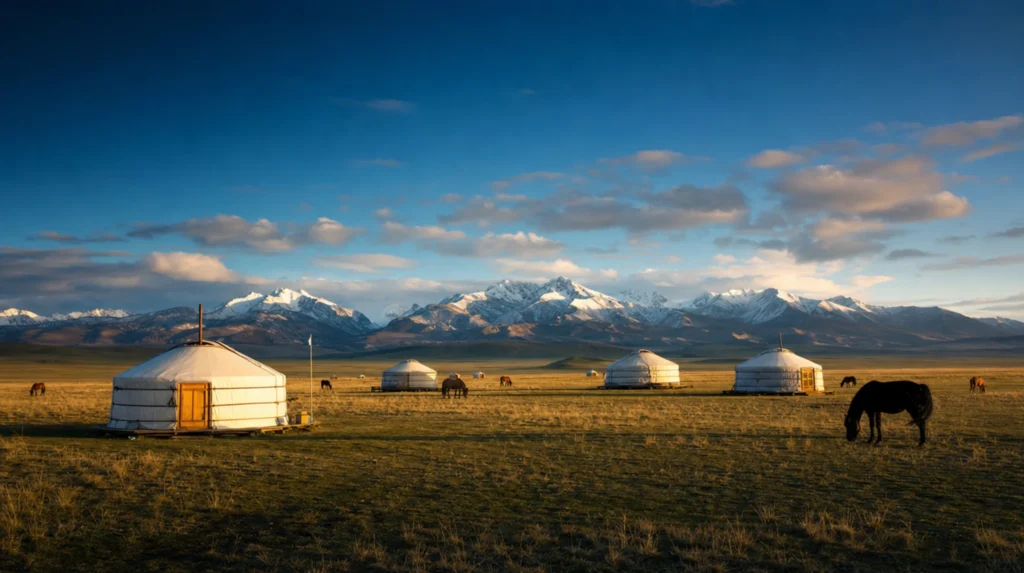
Mongolia is a country built almost entirely out of distance. It covers 1.56 million square kilometres — roughly the size of Alaska, Texas and California laid end to end — and holds 3.4 million people, nearly half of them packed into one valley around the capital. The rest is sky, grass, gravel, dune and ridge. Drive four hours from Ulaanbaatar and the asphalt runs out. Drive ten and the horizon does too. This is the least densely populated sovereign country on Earth, about 2 people per square kilometre, and the emptiness is not a bug. It is the reason you came — and the reason this Mongolia travel guide treats the logistics as seriously as the sights.
The thing first-timers misjudge is the scale of time as much as space. Mongolia runs on two simultaneous clocks — the Soviet-built apartment blocks of Ulaanbaatar tick on a 21st-century rhythm of K-pop cafés and lithium contracts, while four hours south the herder family hosting you for the night dismantles their ger in 90 minutes flat using the same dovetailed lattice their great-grandmother packed up in 1923. Nearly a quarter of the population still lives nomadically or semi-nomadically, moving 70 million head of livestock — sheep, goats, cattle, yaks, horses and the double-humped Bactrian camels of the Gobi — across pastures their families have grazed for centuries. When the host’s nine-year-old daughter rides off bareback at dawn to find the goats, you are not watching a re-enactment. You are watching Tuesday.
This guide covers Mongolia from the Naadam wrestling field in Ulaanbaatar to the singing dunes of Khongoryn Els — when to come, how to move across a country that has roughly 8% of its road network paved, what a herder family will refuse to let you pay for, and how to do all of it on $40 a day or $400 a day depending on how rough you like your accommodation. If you’re routing through Beijing or Seoul on the way in, see our China travel guide and South Korea travel guide; for the long-haul Trans-Mongolian story, our Japan travel guide picks up the eastern end of the same continental rhythm.
📋 In This Guide
- Overview — Why Mongolia Belongs on Every Bucket List
- 🌾 Late-April / Early-May 2026 — The Steppe Window Before Naadam
- Best Time to Visit Mongolia (Season by Season)
- Getting There — How to Travel to Mongolia (Flights & Trains)
- Getting Around — Drivers, Domestic Flights, the Trans-Mongolian
- Top Regions & Experiences
- 🗓️ Sample Itineraries — 5, 10 and 14 Days
- Mongolian Culture & Etiquette
- A Food Lover’s Guide to Mongolia
- 📸 Photography Notes
- Off the Beaten Path — An Insider’s Guide to Mongolia
- Practical Information
- Budget Breakdown — What Mongolia Actually Costs
- ✅ Pre-Trip Checklist
- 🤔 What Surprises First-Timers
- Frequently Asked Questions
- Ready to Explore Mongolia?
Overview — Why Mongolia Belongs on Every Bucket List
Mongolia sits between Russia and China — the two countries that have shaped its modern history and whose rail gauge meets, awkwardly, in the wheel-changing sheds of Erlian on the southern border. The country was the world’s second communist state (1924, after the USSR), broke peacefully from Moscow in 1990, and has been a parliamentary democracy with an enthusiastic mining industry and a stubborn herding economy ever since. Its current copper and coal exports underwrite roughly 90% of foreign earnings; its 70 million livestock outweigh its human population by roughly 21 to one.
What makes Mongolia different from any other country a traveller can plausibly visit in three weeks is that the traditional way of life is not preserved as performance — it is the actual current economy of about 800,000 people. The ger you sleep in is the ger the family lives in. The horse you ride is the horse the host’s son uses to round up sheep tomorrow. The fermented mare’s milk (airag) you are politely required to sip was made yesterday in a leather bag hanging by the door. Tourism is layered on top of an existing pastoral system rather than replacing it, which is the single most important fact to internalise before booking.
The historical resonance is just as outsized. Eight hundred years ago Chinggis Khaan (Genghis is the Persian-Latin transliteration; Mongolians use Chinggis) welded a confederation of feuding clans into the largest contiguous land empire the world has ever seen — at its 1279 peak it stretched from the Sea of Japan to the Carpathians, covered roughly 24 million km² and ruled an estimated 110 million people. The capital, Karakorum, sat in the Orkhon Valley, and for fifty years it was the political centre of half the planet. Today only a stone turtle and the rebuilt walls of Erdene Zuu Monastery (1585, partly built from Karakorum’s rubble) mark the spot. The 40-metre stainless-steel equestrian statue of Chinggis at Tsonjin Boldog, completed in 2008 and still the largest equestrian statue in the world, sits 54 km east of Ulaanbaatar and is the country’s polite reminder that the comeback is ongoing.
🏛️ Historical Context
The Mongol postal system (the örtöö, or yam) was the world’s first reliable long-distance courier network. Established by Ögedei Khaan around 1234, it ran 1,400 relay stations across the empire, each stocked with fresh horses and food, spaced roughly 40 km apart — a day’s hard ride. A message could cross from Karakorum to the Black Sea in under a month at a time when the same trip took European travellers six. Marco Polo described the system in the 1290s with audible envy. The word “post” in many European languages traces back, indirectly, to this Mongol blueprint. Modern Mongolian airag-buying farm taxis still use some of the same routes.
🎌 Did You Know?
Mongolians do not have surnames in the European sense. Communist-era policy in 1925 abolished clan names; a 1997 law made parents pick one again, and roughly 70% chose Borjigin — the clan name of Chinggis Khaan. The phone book is alphabetised by given name. The traditional script (Mongol bichig), which is written vertically and was banned by the Soviets in 1941 in favour of Cyrillic, is being phased back into government use by 2025; banknotes already carry both. Older Mongolians can read three writing systems for the same language.
🌾 Late-April / Early-May 2026 — The Steppe Window Before Naadam
Late April through mid-May is the most underrated three-week stretch on the Mongolian calendar, and almost no foreign guidebook flags it. This is the shoulder slice when the spring migration is in full swing — herder families are moving from winter pastures (öwöljöö) down to spring pastures (khavarjaa), foals are dropping daily, and the steppe is briefly the colour of weak green tea before the summer heat brings out the wildflowers. Daytime highs in the central provinces sit at 12–18°C; nights still freeze. The Gobi is dust-storm-prone (the famous khar shuurga, “black storm,” peaks in April) but the cliffs at Bayanzag are dramatic in the haze and entirely yours — the package-tour buses don’t arrive until late June.
The other reason this window matters: prices have not yet shifted to summer rates and Naadam (July 11–13, the country’s three-day national festival of “the three manly games” — wrestling, horse racing and archery) is still more than two months out. By late June Ulaanbaatar’s hotel rates roughly double; by early July the city is unbookable inside three weeks of arrival. In late April you can secure a Three Camel Lodge cabin, a private driver-guide, and a Bayanzag-Yolyn Am-Khongoryn Els loop for about 65% of July rate. Foal-naming festivals (Suuri Tahilakh) happen on individual herder calendars between mid-April and mid-May; if your driver knows the right family, you’ll be invited.
One important caveat for spring 2026: Mongolian Airlines (MIAT) and the Trans-Mongolian Railway both reduce frequency in the shoulder season. MIAT runs roughly four flights weekly from Beijing in April-May versus seven daily in July. The twice-weekly Trans-Mongolian (Ulaanbaatar-Beijing) becomes a once-weekly schedule in some shoulder weeks; book at least a month ahead through the state operator UBTZ. Internal roads to the western aimags (provinces) — Bayan-Ölgii, Khovd, Uvs — are 70–80% unpaved and turn to thaw mud in late April. Plan eastern and central itineraries for early-spring trips; save the western Altai for August-September.
⚠️ Important — Spring Dust Storms & Air Quality
Ulaanbaatar has the second-worst winter air quality in the world (after Delhi) — the city sits in a bowl, half its 1.6 million residents heat their gers with raw coal, and from November through March PM2.5 readings routinely exceed 500 µg/m³ (the WHO 24-hour limit is 15). The air clears dramatically by mid-April but spring dust storms blowing in from the Gobi can produce 24-hour visibility-reducing events into early May. Anyone with asthma should pack an N95-grade mask; the Mongolian government’s official forecast is at tsag-agaar.gov.mn. The clean air on the steppe two hours out of the city is a different planet.
Best Time to Visit Mongolia (Season by Season)
Mongolia has four real seasons and they are extreme. Ulaanbaatar is the coldest national capital in the world — average January temperature is minus 22°C, lower than Reykjavík, Helsinki or Oslo — and yet July sees daytime highs of 28°C and bright skies. The annual swing of 60°C+ is the kind of thing that defines what you wear, how you travel, and which year of which itinerary is even possible.
Spring (April – May)
The shoulder window described above. Daytime highs climb from 8°C in early April to 20°C by late May. Foals and lambs drop, the steppe greens, and the dust storms taper off by the second week of May. Ger-camp tourist season begins around May 15; many western lodges are still buttoned up. Crowds are 60% lower than Naadam week, prices roughly 30% lower, and the light at 6 a.m. across the central Khangai mountains is the best of the year. Bring layers — it can be 18°C at noon and minus 4°C at sunrise.
Summer (June – August)
The high season and Naadam season. Daytime highs in Ulaanbaatar sit at 22–28°C, the Gobi can hit 38°C at midday, and the steppe is at its postcard-green peak. Wildflowers — yellow Iceland poppies, blue gentian, red columbine — carpet the Khangai mountains through July. Naadam (July 11–13) is the year’s cultural anchor; the opening ceremony at Ulaanbaatar’s National Sports Stadium and the simultaneous regional Naadams across all 21 aimags book up six months ahead. Afternoon thunderstorms appear over the steppe with little warning — pack a shell. Mosquito season runs late June through August and is particularly intense around lakes (Khövsgöl especially).
Autumn (September – October)
Many Mongolia regulars argue this is the country’s best season. Skies are bone-dry and cobalt, daytime highs run 12–20°C in early September dropping to 0–8°C by late October, and the larch forests of the Khangai turn the colour of new copper. The Golden Eagle Festival in Bayan-Ölgii — the headline event of the Kazakh minority’s hunting calendar — is held the first weekend of October at Sagsai and the second weekend at Ölgii. Roughly 70 hunters with their golden eagles compete in skill events including a moving-fox lure pull. The festival is now well-attended by foreign photographers but still fundamentally a community gathering. Book ger camps and Ölgii flights at least three months ahead.
Winter (November – March)
Brutal and beautiful. Daytime highs of minus 15°C in Ulaanbaatar, minus 25°C overnight, and minus 40°C is recorded in the western aimags every January. The classic winter experience is travelling to Bayan-Ölgii to ride out with the eagle hunters in their working season — the eagles fly at fox and hare against snow, which is the photograph that has put Aralbai Tey and his peers on the cover of National Geographic. The Tsagaan Sar (White Moon, lunar new year, mid-February to early March) is the country’s other major festival — three days of family visits, mutton feasts, and ritual snuff-bottle exchanges. Tourism infrastructure is open in Ulaanbaatar year-round but most steppe ger camps close from late October to mid-May. Specialist operators (Nomadic Expeditions, Ger to Ger) run winter trips on request.
🧳 Travel Guru Tip
If you have one trip to Mongolia and want the country at its photogenic best with manageable crowds, target the second half of September. The summer monsoon haze has cleared, the steppe still has colour, the Eagle Festival is on, the major roads are dry, prices have dropped 20% off the August peak, and Naadam tourism has gone home. Most international guides default to “go in July for Naadam”; the regulars who have been four times go in September.
| Experience | Best months | Best regions | Notes |
|---|---|---|---|
| Naadam Festival | July 11–13 | Ulaanbaatar + every aimag capital | National holiday; book hotels Feb-March |
| Golden Eagle Festival | 1st & 2nd weekend Oct | Sagsai & Ölgii (Bayan-Ölgii) | ~70 hunters compete; flights book 3+ months out |
| Foal-naming & spring migration | Late Apr – mid-May | Central Khangai, Khentii | Quietest tourism window of the year |
| Wildflower steppe | Late June – mid-July | Khangai, Orkhon Valley | Carpet bloom for 2-3 weeks |
| Eagle hunting (working season) | Dec – Feb | Bayan-Ölgii (Altai foothills) | Minus 25°C; specialist operators only |
| Tsagaan Sar (Lunar New Year) | Mid-Feb – early Mar | Countrywide | Three-day national holiday; foreign visits welcomed |
Getting There — How to Travel to Mongolia (Flights & Trains)
Mongolia has one international airport that matters: Chinggis Khaan International (UBN, formerly ULN), opened in July 2021 and located 52 km south of central Ulaanbaatar. It replaced the old Buyant-Ukhaa airport whose runway was hemmed in by mountains. The new airport is sleek, Japanese-built (Mitsubishi-Chiyoda joint venture), and processes about 1.7 million passengers a year — modest by global standards but a fivefold expansion from the old facility.
Direct flights are limited. MIAT Mongolian Airlines (the flag carrier) and partner airlines run year-round routes from Beijing (2h45m), Seoul-Incheon (3h30m), Tokyo-Narita (5h), Frankfurt (9h, summer-only), Istanbul (8h, Turkish Airlines), Hong Kong, and Moscow. There is no direct flight from London or any North American city; most Western travellers connect via Seoul, Beijing, Frankfurt or Istanbul. Round-trip fares from London or New York in shoulder season typically land between £950–1,400 / $1,200–1,800 if booked 8–12 weeks ahead.
The romantic alternative is the Trans-Mongolian Railway. The full route — Beijing-Ulaanbaatar-Moscow — covers 7,621 km and takes 6 nights non-stop, but most travellers do segments. Beijing to Ulaanbaatar is 30 hours and crosses the Gobi at sunrise on day two; Ulaanbaatar to Moscow is roughly 4.5 days through Siberia. The wheel-bogie change at the Chinese-Mongolian border (Erlian/Zamiin-Üüd) takes 4-6 hours because the gauge changes from Chinese 1,435 mm to Mongolian/Russian 1,520 mm — passengers stay on board while the cars are jacked up. Tickets in 2026 run roughly $260 hard-sleeper Beijing-UB; book at least four weeks ahead through Real Russia, China DIY Travel or directly at Beijing Railway Station.
✨ Pro Tip — The Stopover Game
If you’re flying via Seoul on Korean Air, the stopover programme lets you break the journey for up to 72 hours visa-free in Seoul on either leg — effectively a free city break bolted onto a Mongolia trip. Air China offers the same 144-hour transit visa for Beijing if you’re routing through there. Most travellers don’t realise they qualify; the rule is “onward flight to a third country,” which Mongolia is. See our South Korea travel guide for the Seoul half of the trick.
Getting Around — Drivers, Domestic Flights, the Trans-Mongolian
The single most important practical fact about Mongolia is that you don’t drive yourself. Roughly 8% of the country’s roads are paved; the rest are tracks across grass, gravel and dry riverbed that branch, recombine and erode every year. There are no road signs, no fences and frequently no other vehicles for half a day. Hertz and Avis exist in Ulaanbaatar but renting a car as a foreign visitor for steppe travel is borderline irresponsible — every Mongolia regular hires a driver-guide combination, almost always in a Russian-built UAZ-452 minivan (“Furgon,” nicknamed “the loaf”) or a Toyota Land Cruiser 80-series.
Standard rates in 2026: a private driver-guide costs $80–140 a day all-in (vehicle, fuel, driver’s food and lodging, and a guide who speaks English well enough to translate). A two-week central-Mongolia loop with a UAZ and one driver runs about $1,800. Group tours through Nomadic Expeditions, Eternal Landscape, Tsenkher Travel and dozens of smaller Ulaanbaatar operators bundle the driver, ger camps, meals and Naadam tickets into a fixed package — usually $1,500–3,500 per person for 7–14 days, depending on accommodation tier. Solo travellers join group departures or shoulder the full driver cost for the privacy of going your own pace.
Domestic flights are how you reach the western aimags. AeroMongolia and Hunnu Air operate 50-seat Fokker and ATR aircraft from Ulaanbaatar to Ölgii (3h), Khovd (3h15m), Mörön for Khövsgöl (1h45m), Dalanzadgad in the Gobi (1h25m) and a handful of smaller strips. Single-leg fares run $180–320. Schedules are published weekly and frequently change; book through the airline’s Ulaanbaatar office or via your driver-guide. The trans-country drive Ulaanbaatar-Ölgii is 1,640 km and takes 3-4 days each way; the flight saves a week.
⚠️ Important — Steppe Driving & Self-Drive Rules
If you do hire a self-drive 4WD (and several agencies will rent you a Land Cruiser), be aware: foreign driving licences are not legally recognised in Mongolia — you need an International Driving Permit (the 1968 Vienna Convention version) and many police checkpoints will still pull you over to negotiate. There are no roadside services outside paved Ring Road segments. Off-road navigation requires a Mongolian SIM-loaded GPS, paper maps from Maps.mn, and a willingness to ask herders. Petrol stations are 80–200 km apart and run dry without warning; carry 40+ litres in jerry cans. The “loaf” UAZs your driver uses are mechanically simple specifically because they can be field-repaired with a Leatherman.
Top Regions & Experiences
📍 Map of Mongolia: Every Place in This Guide
Mongolia is conventionally split into four geographic zones — central, north, south (Gobi), and west (Altai) — plus the capital and its eastern Khentii hinterland. Below are the bases worth building an itinerary around.
🏙️ Ulaanbaatar & the Capital Area
The world’s coldest capital and home to roughly 47% of the country. Ulaanbaatar (often abbreviated UB) sits in the Tuul River valley at 1,350 m elevation, ringed by four sacred mountains the city’s grid stops at. The Soviet-built core around Sükhbaatar Square is studded with neoclassical government buildings, the National Museum of Mongolia (the country’s best single museum, with a stand-out costume gallery and a complete Hunnu burial set), the Choijin Lama Temple Museum, and the Gandantegchinlen Monastery — Mongolia’s largest functioning Buddhist monastery, home to the 26-metre gilded Migjid Janraisig statue rebuilt in 1996 after the Soviet original was melted down for ammunition in 1937.
The newer city centre — between Sükhbaatar Square and the Shangri-La hotel — has Korean coffee chains, K-pop boutiques, surprisingly good Japanese ramen, and a generation of returnees who studied in Sydney, Tokyo and Frankfurt. Outside this core the city is mostly the ger districts, neighbourhoods of free-standing yurts on individual fenced plots that house roughly 60% of UB’s population without piped water or sewerage. They are not slums — they are the result of a 1992 land law that gave every Mongolian the right to claim 0.07 hectares — but the air-quality and infrastructure consequences shape the city’s politics.
Day-trip from UB: the 40-metre Chinggis equestrian statue at Tsonjin Boldog (54 km east, 80,000₮ entry, climb to the horse’s mane for steppe views), Terelj National Park (66 km northeast, granite outcrops and the famous Turtle Rock), and the Hustai National Park (95 km west) where 400 reintroduced Przewalski’s horses — the only true wild horse species — graze openly. Genghis-Khan-statue-plus-Terelj-overnight is the standard 2-day Ulaanbaatar add-on. For street-level capital detail — hotels, restaurants and neighbourhood notes — see our dedicated Ulan Bator (Ulaanbaatar) guide.
- What to do: National Museum (15,000₮); Gandantegchinlen Monastery (free; morning chants 9 a.m. daily); Sükhbaatar Square; the State Department Store basement food hall.
- Signature eats: Modern Nomads (refined Mongolian, mains 28,000–45,000₮); Khaan Buuz (the takeaway dumpling chain locals use, 3,000₮ for six steamed buuz).
- Access: 52-km / 50-minute drive from Chinggis Khaan airport; airport shuttle bus 22,000₮; taxi 80,000–110,000₮.
🏜️ The Gobi — Bayanzag, Yolyn Am & Khongoryn Els
The Gobi covers roughly 1.3 million km² across southern Mongolia and northern China, of which the Mongolian portion is the third-largest desert in Asia. Despite the name, only about 5% is sand; the rest is gravel-covered semi-arid steppe with surprising biodiversity — Bactrian camels, wild ass (khulan), gazelle, the elusive Gobi bear (only about 30 left), and the Pallas’s cat that has become a niche internet celebrity. Daytime summer highs hit 40°C, winter lows minus 30°C, and the annual rainfall is under 200 mm.
Three sites anchor the Gobi loop. Bayanzag (the “Flaming Cliffs”) is the rust-red sandstone escarpment where Roy Chapman Andrews of the American Museum of Natural History found the world’s first identified dinosaur eggs in 1923 — a Protoceratops nest now on display at the AMNH in New York. The cliffs are a 30-minute walk from end to end and turn molten orange at sunset. Yolyn Am (“Vulture’s Mouth”) is a narrow gorge in the Gurvan Saikhan mountains where ice persists year-round in the shaded section, even at 35°C in July; the canyon hike is 2 km and the regular sightings of bearded vultures (lammergeiers) and ibex are the bonus. Khongoryn Els is the 180-km dune system locally called the “Singing Sands” — climb the 200-metre crest at sunset for the photograph that defines Gobi tourism, and listen for the actual low rumble that gives the dunes their name when the wind is right.
The standard Gobi loop from Ulaanbaatar is 5–7 days driving and takes in all three sites plus Tsagaan Suvarga (the white-cliff badlands), Ongi monastery ruins, and one or two herder-family overnights. Three Camel Lodge — owned by Nomadic Expeditions and consistently ranked among Asia’s best eco-lodges — sits 16 km from Bayanzag and runs $400+ per night for the all-included experience. Mid-range ger camps in the area are $40–80 per person all-meals.
- What to do: Sunset at the Flaming Cliffs; ride a Bactrian camel up Khongoryn Els (15,000₮/hour); ice-walk in Yolyn Am (Apr–early Jul ice still holds).
- Signature eats: Whatever your driver’s spouse cooks at the herder ger — usually mutton with rice, a salty milk tea (suutei tsai), and homemade airag if it’s foaling season.
- Access: Dalanzadgad airport (1h25m flight from UB) is the gateway; or 580-km drive south on partially paved A0301 (10–14 hours).
🐎 Central Mongolia — Orkhon Valley & Karakorum
The historical heartland. The Orkhon Valley is a UNESCO World Heritage site since 2004, recognised as the cradle of Mongolian nomadic culture and the location of multiple imperial capitals over 1,500 years. The valley is broad, green, lined with larch forest on the Khangai slopes, and threaded by the Orkhon River — one of Mongolia’s few year-round water systems. The Khar Khorin (Karakorum) site at the valley’s southern entrance is the polite ruin of Chinggis Khaan’s grandson Ögedei’s 1235 capital. Erdene Zuu Monastery (1585) — the country’s oldest surviving Buddhist monastery, built partly from Karakorum’s stones — sits next door and is the active highlight; about 30 monks still live there.
The valley’s other anchor is Tövkhön Khiid, a 17th-century mountain monastery perched on a 2,600-metre granite outcrop that the founder Zanabazar — Mongolia’s most important Buddhist artist and theologian, a contemporary of Louis XIV — used as his summer studio. The hike up takes 40 minutes from the road and rewards with the broadest steppe view in the country. Ulaan Tsutgalan (Orkhon waterfall), 24 metres tall and Mongolia’s largest, is two hours’ drive south of Karakorum; mid-July is peak flow.
This is also the country’s best horse-trekking corridor. Multi-day rides from Erdene Zuu over the Khangai pass to Tsenkher hot springs — a five-day route through unbroken steppe — are run by half a dozen outfitters from $90/person/day all-included. The Mongolian horse is short (135 cm at the withers), short-tempered, exceptionally hardy, and was the engine of the empire; learning the four-beat gait the herders call jiroo takes a morning.
- What to do: Erdene Zuu morning prayers; Tövkhön Khiid summit hike; multi-day horse trek; Tsenkher hot springs soak.
- Signature eats: Tsuivan (hand-cut noodles with mutton and onion) at the Karakorum highway-side eateries — 8,000–12,000₮ and the country’s universal road food.
- Access: 380-km drive west from UB on partially paved highway (7-9 hours); domestic flights to nearby Kharkhorin airstrip are seasonal and unreliable.
💧 Khövsgöl Lake — “The Dark Blue Pearl”
Mongolia’s freshwater inland sea, on the northern border with the Russian republic of Tuva. Khövsgöl is 136 km long, up to 262 m deep, and contains roughly 70% of Mongolia’s freshwater and 1.4% of the entire planet’s surface freshwater — second-largest in Asia by volume after Lake Baikal. The water is cold (peak summer temperature 14°C) and famously transparent — the boatman from Khatgal village will drop a coin in three metres of water and let you read its date through the surface.
The west shore is the tourist-developed side — Khatgal village (the only road-accessible lakeside town) is the base for boat trips, kayaking, and the multi-day horse treks into the surrounding taiga. The east shore is wilder; reaching it takes a 4-day boat-and-horse circuit. The headline here is the Tsaatan (Dukha) reindeer herders — about 250 people, the southernmost reindeer-herding ethnic group on Earth, who graze 1,500 reindeer in the high taiga north and west of the lake. Visiting their summer camps is possible but logistically substantial: 2-3 days on horseback from Tsagaannuur, May-September only, arranged via the Tsaatan Community & Visitors Centre in Ulaanbaatar to ensure direct payment to the families.
- What to do: Kayak from Khatgal (50,000₮/half-day); horse-trek the western taiga to Renchinlkhümbe (3-day ride); boat to Khaan Khöndii peninsula.
- Signature eats: Smoked omul (relative of the lenok salmon) at the Khatgal lakefront cafés.
- Access: Mörön airport (1h45m flight from UB), then 100-km drive north to Khatgal village; or 670-km drive northwest from UB on partially paved A0501 (10-14 hours).
🦅 Bayan-Ölgii — The Kazakh Eagle Country
The far western aimag against the Chinese-Russian-Kazakh border. Bayan-Ölgii is the only Mongolian province with a Muslim majority — about 90% ethnic Kazakh, descendants of families who crossed the Altai in the 19th century — and the cultural feel is dramatically different from the rest of the country: Kazakh language and Cyrillic Kazakh script alongside Mongolian, mosques rather than monasteries, baursak fried bread instead of buuz dumplings, and the famous golden eagle hunting tradition (berkutchi) that has no parallel in Mongolian-speaking regions.
The eagles are female (larger, stronger), trapped from cliff nests as juveniles at about three years old, trained for 10–15 years, and released back to the wild to breed. There are now roughly 250 active eagle hunters in Bayan-Ölgii — a number that crashed in the Soviet era and recovered after the 1990 democratic transition, helped by the international attention of the Kazakh-Mongolian film The Eagle Huntress (2016) and the rising profile of Aisholpan Nurgaiv, the teenage hunter the documentary followed. The October Eagle Festival is the headline tourist event; the working winter season (December-February) is what photographers chase.
The Altai-Tavan Bogd National Park, two hours west of Ölgii city, contains five of the country’s tallest peaks — Khüiten (4,374 m, the country highpoint), the Potanin Glacier, and the petroglyph fields of Tsagaan Salaa-Baga Oigor (UNESCO-listed, 10,000 carvings dating to 11,000 BCE). Park entry 30,000₮; the trek to Tavan Bogd base camp is a 3-4 day pony-supported expedition June through early October.
- What to do: Stay overnight with an eagle hunter family (Sagsai or Tsengel village); the Eagle Festival (1st-2nd weekend October); Tavan Bogd trek; Tsagaan Salaa petroglyphs.
- Signature eats: Beshbarmak (Kazakh hand-noodle and mutton dish, served at festivals); kuurdak (slow-cooked mutton stew); fermented horse milk (kymyz, the Kazakh cousin of airag).
- Access: Ölgii airport (3h flight from UB on AeroMongolia/Hunnu Air, $260-310 round trip); driving from UB is 1,640 km / 3-4 days each way.
🌲 Khentii — The Sacred Birthplace of Chinggis Khaan
The forested mountain region east of Ulaanbaatar, considered the birthplace and likely burial site of Chinggis Khaan. Khentii National Park covers 1.2 million hectares of mixed taiga and steppe; the Onon and Kherlen rivers — both rising in the park — gave the young Temüjin his name (his father’s clan camped on the Onon). The deliberately unmarked mausoleum is rumoured to be on the slopes of Burkhan Khaldun mountain (UNESCO listed 2015), but no archaeological survey has been conducted at the family’s request — the burial site is intentionally lost. Hiking the lower flanks is a respectful way to engage with the geography that produced him.
The park is also the country’s best fly-fishing destination. The taimen (Hucho taimen) — a salmonid that grows to 2 metres and 50 kilograms — is endemic to the Onon system, catch-and-release-only, and a target for serious anglers from the US, UK and Russia. Permits and outfitters (Mongolia River Outfitters, Hovsgol Travel) book up a year ahead.
- What to do: Hike Burkhan Khaldun lower flanks; Onon river fly-fishing for taimen and lenok; Dadal village (claimed birthplace) historical sites.
- Signature eats: Smoked taimen at the Dadal trail-head cafés.
- Access: 270-km drive east from UB on mostly paved A0201 (5-6 hours).
“There is no good in anything until it is finished.” (Бүх юм дуустлаа л юм биш.)
— Mongolian proverb attributed to Chinggis Khaan in The Secret History of the Mongols (~1240)
🗓️ Sample Itineraries
Mongolia rewards long trips and punishes rushed ones. Below are three templates that work for the realistic visitor calendar; pick the one that matches your time, then have your driver-guide adjust by region. All distances assume a UAZ Furgon at steppe pace; add 30% to drive time after rain, 50% after the first October snow.
5 Days — Ulaanbaatar + Terelj + Hustai
Day 1: Arrive UB, transfer to hotel, walk Sükhbaatar Square, dinner at Modern Nomads. Day 2: National Museum morning, Gandantegchinlen Monastery for noon chants, drive to Tsonjin Boldog and the 40-metre Chinggis equestrian statue (54 km east), continue to Terelj National Park, ger camp overnight at Turtle Rock. Day 3: Terelj horseback ride or hike to Aryabal meditation temple, return to UB. Day 4: Day trip to Hustai National Park (95 km west) for Przewalski’s horse spotting at dawn or dusk; sleep UB. Day 5: Departure. This is the realistic short-trip Mongolia introduction; do not extend it to the Gobi without adding three more days.
10 Days — Gobi + Central Mongolia
The classic first-trip itinerary. Day 1: Arrive UB. Day 2: UB highlights + Chinggis statue. Day 3: Fly Dalanzadgad (1h25m), drive to Yolyn Am, ger camp. Day 4: Yolyn Am ice gorge, drive to Khongoryn Els (singing dunes), ger camp at the dune base. Day 5: Sunrise climb of Khongoryn Els, camel ride, drive to Bayanzag (Flaming Cliffs), Three Camel Lodge or comparable. Day 6: Bayanzag morning, drive north to Ongi monastery ruins, herder family overnight. Day 7: Drive to Karakorum, visit Erdene Zuu Monastery, ger camp on Orkhon. Day 8: Tövkhön Khiid hike + Orkhon waterfall. Day 9: Drive UB via Kharkhorin road (8 hours). Day 10: Departure.
14 Days — Gobi + Khövsgöl + Bayan-Ölgii
For travellers willing to fly internally and cover ground. Take the 10-day template above as the spine, then insert: Days 11-12: Fly UB to Mörön (1h45m), drive to Khatgal on Khövsgöl Lake, kayak and short horse trek into the western taiga; sleep ger camp at Khatgal. Day 13: Fly Mörön-UB-Ölgii (same-day connection possible), evening with eagle hunter family in Sagsai. Day 14: Eagle Festival or eagle-hunter demonstration, fly Ölgii-UB late evening, departure overnight. The Bayan-Ölgii leg only makes sense if your trip overlaps the October Eagle Festival or December-February working season; otherwise substitute a four-day extension into Khentii National Park for taimen fishing and Burkhan Khaldun.
🎯 Strategy
If you only have one trip to Mongolia, do the 10-day Gobi-and-Central in mid-September — the steppe still has colour, the days are 12 hours of bright sun, the dust storms are done, the Naadam crowds have left, and prices are 25% off the August peak. Save Bayan-Ölgii for a dedicated second trip timed around the Eagle Festival in early October. The mistake first-timers make is trying to add the eagle country to a 10-day Gobi trip: the internal flight schedule isn’t reliable enough, and you end up rushing both halves.
Mongolian Culture & Etiquette
Mongolian culture is shaped by 800 years of nomadic pastoralism and a deep, often unspoken codification of host-guest obligation. Drop in unannounced at a herder family’s ger 200 km from any town and they will feed you, water your horse, and offer you a bunk on the lattice-side floor — not because they are unusually generous, but because that is the steppe-survival contract everyone has signed by being born here. Travellers who internalise this are repaid in unforgettable hospitality. Travellers who treat it transactionally — offering payment for an unrequested meal, refusing the offered airag, photographing without asking — leave a cooler impression than they realise.
The single non-negotiable ritual is the suutei tsai (salty milk tea) and snuff bottle exchange. When you enter a ger, the host offers a small bowl of suutei tsai with both hands; you accept with both hands or your right hand only, sip even if you don’t want to, and place the bowl back on the table when finished. Older male hosts then often offer a pinch of snuff from a small ornate bottle (khöörög); accept it with the right hand, sniff lightly, and pass it back. Refusing both readings as discourtesy. Finishing the bowl is not required; sipping is the gesture.
A handful of physical rules within the ger. Walk clockwise around the central stove — never counterclockwise. Step over the threshold without stepping on it (the threshold is a sacred barrier). The back wall opposite the door is the place of honour and where the family altar usually sits; don’t walk between guests and the altar. Don’t lean on the lattice walls (they are also the structural beams). Don’t whistle indoors. If you take photos, ask first — most herder families are happy to be photographed but the asking is the point. Never refuse food entirely; sip, taste, leave the rest if you must.
💬 The Saying
“Хол газар бол ойр, ойр газар бол хол.” Roughly: “Faraway places are near, nearby places are far.” Mongolians use this proverb constantly to mean that distance is psychological, not metric — a steppe town 800 km away you’ve been planning to visit for years feels close; a neighbour’s ger across the valley you’ve never bothered to walk to feels distant. It’s the national observation about how much intent matters more than kilometres, the kind of thing you’ll hear repeated by a driver-guide as you stare at a horizon that hasn’t changed in two hours.
A Food Lover’s Guide to Mongolia
Mongolian cuisine has a reputation problem in the West that the modern Ulaanbaatar restaurant scene is in the middle of fixing. The cliché — boiled mutton, fermented dairy, no vegetables — was earned, but the country’s high-altitude lamb (grazed wild on thyme moss and wormwood) is genuinely some of the best meat in Asia, the home-cured dairy products are a 4,000-year tradition, and the modern UB scene has produced a generation of chefs trained in Tokyo, Seoul and Berlin who now run restaurants like Modern Nomads, Caffè Bene’s higher-end siblings, and the tasting-menu ger restaurants on the city’s outskirts.
Mutton is the centre of everything. Mongolian sheep are a fat-tailed breed adapted to extreme cold; the fat is rendered separately, the meat is generally boiled or steamed rather than grilled, and a herder family’s freezer-equivalent (a cool-cellar pit) typically holds a butchered carcass per adult per winter. Buuz are the steamed mutton dumplings every Mongolian eats — folded with 28-32 pleats by skilled hands, 3,000–4,000₮ for six at a takeaway shop, served with vinegar and white pepper. Khuushuur are the fried mutton flatbread version, the universal Naadam-festival snack, sold from braziers near every wrestling field. Tsuivan is hand-cut mutton noodles with onion and a few cubes of carrot or potato; this is the road-trip dish, served at every highway-side eatery for 8,000–12,000₮.
Khorkhog is the dish the herder family will cook for you if you’ve stayed two nights and done one chore. Mutton, root vegetables, water and salt are placed in a metal milk churn with hot stones from the fire pit; the churn is sealed and the whole thing cooks for 90 minutes from the inside out. The stones are passed around at the table afterward — they are believed to draw fatigue from your hands. Boodog is the goat or marmot version, cooked inside the animal’s own skin with the hot stones; rarer, more ritual, and increasingly only seen at festivals.
Airag (fermented mare’s milk) is the country’s signature drink. Slightly carbonated, mildly alcoholic (about 2-3% ABV), tangy, and made fresh from May to September when mares are foaling. Every herder family has a leather bag (khökhüür) hanging by the door which is given a stir with a wooden plunger every time someone walks past — this distributes the fermenting yeast and aerates the milk. Drinking airag is not optional if offered; sip and accept gratefully. The shelf-stable bottled version sold in UB supermarkets is a faint shadow of the real thing.
Suutei tsai (salty milk tea) is the universal arrival drink — black tea brewed with milk and rock salt, sometimes with toasted millet floating on top. Aaruul is the dried curd snack found stacked on every ger roof drying in the sun; chalky, sour, an acquired taste, and the local equivalent of airline-snack mints. Boortsog are fried dough biscuits, often eaten with butter and clotted cream (öröm) at celebrations.
Vegetarians have a real challenge outside Ulaanbaatar — the rural diet is mutton-and-dairy-centric and the concept of a meatless meal is novel in much of the steppe. UB has a growing vegetarian scene (Loving Hut, Luna Blanca) and most ger camps will accommodate with notice, but expect rice and steamed vegetables rather than imaginative cuisine. Vegans should bring protein bars.
📸 Photography Notes
Mongolia is one of the world’s great landscape-photography destinations and almost the only place on Earth where the human-scale and the planetary-scale subject are routinely in the same frame. The light is the trick — at 47°N latitude with low humidity and bright continental skies, golden hour stretches for nearly an hour at each end of the day in summer, and the steppe air’s clarity at altitude (most of the country sits 1,200–2,500 m) gives you a depth of focus mountain photographers in wetter latitudes never get.
Best light by month: April-May 6–8 a.m. and 6–8 p.m. for cool spring light against pale steppe; June-July 5–6 a.m. and 8–9 p.m. for the wildflower-and-storm-cloud combination Naadam photographers chase; September is the year’s clearest air with 8–10 a.m. and 5–7 p.m. as the prime windows; February-March for the eagle-hunting work in Bayan-Ölgii, where the snow-on-snow conditions reward longer exposures and a deliberate underexposure of two-thirds stop.
Five locations worth the detour:
- Khongoryn Els ridge (43.7858°N, 102.3736°E) — the classic camel-and-dune-crest composition. Sunrise climb is the photograph; the wind erases yesterday’s footprints overnight.
- Bayanzag (Flaming Cliffs) (44.1389°N, 103.7253°E) — sunset frames the rust-red sandstone against indigo sky. The escarpment changes colour in 20-minute increments; arrive 90 minutes before sunset.
- Tövkhön Khiid summit (47.0867°N, 102.2475°E) — 360° steppe view from the granite outcrop. Mid-morning side-light defines the larch forest texture against the open valley.
- Khövsgöl Lake from Khaan Khöndii (51.0617°N, 100.5092°E) — clear blue water against the Sayan Mountains rising behind. Late August has the cleanest air; the boat departs Khatgal at 8 a.m.
- Tavan Bogd petroglyphs (49.0825°N, 88.1833°E) — 11,000-year-old rock art lit best by raking morning light at 7-9 a.m. in early October. Park ranger required for site access.
Drone rules: Mongolia loosely regulates drones — there is no specific national framework — but local sensitivities are real. Religious sites (Erdene Zuu, Tövkhön, Gandantegchinlen) and military areas prohibit drones outright; protected areas (Hustai, Terelj, Khövsgöl national parks) require a permit applied for at the park headquarters at least 7 days ahead, often free. Flying over a herder family’s ger without explicit verbal permission is poor form. Border zones (Bayan-Ölgii within 30 km of the Russian or Chinese border) require advance permission from the Border Patrol Authority — apply through your tour operator.
✨ Pro Tip — Eagle Hunter Etiquette
The Bayan-Ölgii eagle hunters are now well-photographed and many will pose for tourist money — that’s fine, and the rate is roughly 30,000–50,000₮ per session (negotiate via your guide). Far more rewarding is staying with a hunter family for two or three nights, helping with chores in the morning, and earning the photograph of the eagle on the family’s gloved fist as a byproduct rather than the goal. Aralbai Tey, the most-photographed hunter, is in his late 60s now and lives in Sagsai; the next generation (Bashakhan and others) are equally accomplished and less in demand.
Off the Beaten Path — An Insider’s Guide to Mongolia
The Gobi-Karakorum-UB triangle accounts for roughly 70% of foreign visits and about 15% of the country’s surface. The remaining 85% is harder to reach, less-photographed, and much closer to the Mongolia Mongolians actually use.
🦌 Tsaatan Reindeer Camps (East Taiga)
The Tsaatan (Dukha) people — about 250 individuals across 40 households — are the southernmost reindeer-herding ethnic group in the world. Their summer camps sit in the high taiga north and west of Khövsgöl Lake at 2,200-2,400 metres, and reaching them requires a 2-3 day horseback ride from Tsagaannuur village, May through September only. Visits should be arranged via the Tsaatan Community & Visitors Centre in Ulaanbaatar to ensure the family receives 80%+ of the fee directly. Single-night homestays are 200,000₮/person all-included.
🐪 Khar Us Lake & the Western Lakes Basin
A chain of saline and freshwater lakes in the Khovd-Uvs basin, west of the Altai range. Khar Us is the second-largest lake in Mongolia, supports 200+ bird species, and is the breeding ground for the rare relict gull. Uureg Lake nearby has a free hot spring on its eastern shore. The drive from Khovd town to the lake circuit is 80 km of unpaved track; herder homestays at Achit Lake are arranged through the Khovd-based operator Khovd Adventure.
⛰️ Otgontenger & the Khangai Sacred Peaks
Otgontenger (4,008 m) is one of the three sacred peaks of Mongolia and the highest in the Khangai range. The mountain is closed to climbing by Buddhist edict (a state-protected Strictly Protected Area since 1992), but the ger camps around its base — Tsetserleg lake area, the Ider river valley — offer some of the country’s best horse trekking and are entirely off the international tourist circuit. Reach via the regional capital Uliastai (440 km from UB; daily buses or 2-day drive).
🏛️ Amarbayasgalant Monastery
The country’s second-largest functioning monastery (after Erdene Zuu) and arguably its most beautiful. Built 1727-1736 by the Manchu Yongzheng Emperor as a memorial to Zanabazar, Amarbayasgalant survived the 1937 Stalinist purge with most of its 28 temples still standing. It sits in the Iven valley 360 km north of UB on the road to the Russian border — a 6-hour drive on good asphalt, making it the easiest of the country’s “off-beat” stops. Single-day visits possible; an overnight in the on-site ger camp lets you catch the 5 a.m. monk chants.
🦤 Eastern Steppe — Dornod & the Mongolian Gazelle Migration
The eastern aimag of Dornod contains one of the world’s last great ungulate migrations — about 1.5 million Mongolian gazelle (zeer) move seasonally across the steppe between June and October. The country’s eastern third is a flat, grass-dominated landscape that resembles Patagonia or the American high plains more than the mountain Mongolia of guidebook covers. Dadal village (Chinggis’s claimed birthplace), the Khalkh Gol World War II battlefield, and the rare Daurian crane breeding grounds at Mongol Daguur reserve are the thread. This is also Mongolia’s worst-served region for tourism infrastructure — book a UB-based driver-guide rather than expecting local lodges.
Mongolia by Numbers
- 3.4 million — country population (2025)
- 2 per km² — population density (least dense sovereign nation on Earth)
- 70 million — head of livestock (sheep, goats, cattle, yak, horse, camel)
- 8% — proportion of road network paved
- 24 million km² — peak size of Mongol Empire under Kublai Khan (1279)
- 40 metres — height of Chinggis Khaan equestrian statue at Tsonjin Boldog (largest in the world)
Practical Information
Currency: Mongolian tögrög (MNT, often written ₮). The exchange rate sits at roughly 3,500₮ to USD 1 in 2026; the currency has slid steadily since 2014 with the commodity-export cycle. Card acceptance is universal in Ulaanbaatar (Visa and Mastercard everywhere; Amex at hotels and Western chains only) but cash-only outside the city — withdraw 800,000–1,500,000₮ from a Khan Bank or Trade & Development Bank ATM in UB before any steppe trip. ATMs in aimag capitals work but are sometimes empty. Tipping is not historically expected but a 10% gesture in upscale UB restaurants is now standard; tip drivers and guides $10-15 per day at the end of the trip.
Visa & entry: Mongolia is visa-free for 30 days for US, UK, EU, Canadian, Australian, NZ, Japanese, South Korean and most other Western passports — a policy expanded in 2023 as part of the country’s tourism push. Citizens of other nations can apply for an e-visa at evisa.mn ($60). Passport must be valid 6 months past arrival. Foreign-registered border zones (within 100 km of the Russian or Chinese border, including parts of Bayan-Ölgii and the eastern aimags) require a separate permit your tour operator handles in advance — 5-7 day lead time.
Language: Mongolian (Khalkha dialect, written in Cyrillic since 1941, with traditional Mongol bichig phasing back into government use by 2025). English is increasingly common among the under-30 generation in UB but rare outside the capital. Russian is spoken by the over-50s. Kazakh (in Cyrillic) is the dominant language in Bayan-Ölgii. Learn “Сайн байна уу” (Sain baina uu — hello), “Баярлалаа” (bayarlalaa — thank you), “Тийм” (tiim — yes), “Үгүй” (ügüi — no) and “Сайхан амраарай” (sain khan amraarai — sleep well). Numbers and key food words are useful in markets.
Connectivity: 4G covers Ulaanbaatar, all aimag capitals, and most of the paved road network. Coverage on the steppe and in the Gobi is patchy — your driver-guide will know where signal returns. Mobicom and Unitel are the two main carriers; SIM cards cost 5,000–15,000₮ for 10-30 GB and are sold at any phone shop with passport ID. Free Wi-Fi is universal in UB cafés and most hotels; ger camp Wi-Fi is increasingly common at mid-range and above.
Tap water: Not safe to drink anywhere in Mongolia. Boil for 3 minutes or use a SteriPen / Grayl bottle filter. Bottled water is universal and cheap (1,500₮ for 1.5 L); tea (which uses boiled water) is the national hot drink for a reason.
Plug type: Type C and Type E (European, 230V/50Hz). North American travellers need a simple adapter; UK travellers also.
📋 Regulatory Note — Photography & Border Areas
Photographing border crossings, military installations, and police checkpoints is illegal and enforced. Border-zone permits (within 100 km of the Russian/Chinese/Kazakh borders) are easy to obtain through your tour operator but cannot be arranged on arrival — apply 7 days ahead minimum. Cultural objects more than 100 years old (antique snuff bottles, religious thangkas, old saddles) require a Customs export permit; without one they will be confiscated at airport departure. The Sükhbaatar Square antique stalls are largely modern reproductions despite the patina; ask for the export-permit paperwork before purchasing anything labelled “antique.”
Budget Breakdown — What Mongolia Actually Costs
Mongolia is a paradox on cost. The country itself is genuinely cheap — a bowl of tsuivan is $3, a hostel bed is $10, public transport in UB is $0.30 — but the actual logistics of seeing the country are expensive. There is no public bus to the Gobi. There is no train to Khövsgöl. The driver-and-vehicle is the budget item that defines the trip, and at $80–140/day that’s the floor for a customised experience. Group tours amortise it but cap your flexibility.
💚 Budget Traveller — $25–50 / day (₮90,000–175,000)
Hostels in UB ($10-15), local restaurants ($3-6 a meal), public transport, and group ger-camp tours that share a vehicle 6-8 ways ($45-60/person/day all-in). The realistic floor for a Gobi loop on a budget is $400 for a 7-day shared group tour booked from UB hostels — Lotus Guesthouse and Sunpath Hostel are the two long-running budget-tour clearing houses. Skip Western coffee shops; eat at Khaan Buuz takeaway counters.
💙 Mid-Range — $80–180 / day (₮280,000–630,000)
Three-star hotels in UB ($55-80/night double), private driver-guide-vehicle ($80-120/day shared by 2-3 travellers), mid-range ger camps with private bathroom blocks ($35-65/person/night), domestic flight Ölgii or Mörön ($180-260 round trip). This is the realistic shoulder-season cost for a couple doing a 10-day Gobi-and-Karakorum loop with their own driver — total $1,800-2,400 per person all-in including flights from London or New York.
💜 Luxury — $400+ / day (₮1,400,000+)
Three Camel Lodge in the Gobi ($450-650/night per person all-included), the Shangri-La Ulaanbaatar ($240-380/night), private 4WD with English-speaking guide ($180-240/day), Naadam VIP grandstand seats ($350-500), helicopter transfer to remote sites ($1,200-2,400). Nomadic Expeditions runs Mongolia’s only true luxury tier — 14-day private programme with Three Camel Lodge, Khövsgöl, Bayan-Ölgii internal flights and the entire driver-guide overhead $9,500-14,500 per person. Mongolia at this end gives you a Genghis-himself level of access — private Naadam tickets, eagle-hunter family stays, and helicopter Bactrian camel transfers.
| Item | Budget (₮ / USD) | Mid-range (₮ / USD) | Luxury (₮ / USD) |
|---|---|---|---|
| Bed (per night) | 35,000–55,000 / $10–16 | 180,000–280,000 / $52–80 | 800,000–2,200,000 / $230–650 |
| Dinner | 10,000–20,000 / $3–6 | 45,000–80,000 / $13–23 | 120,000–280,000 / $35–80 |
| Daily transport | Shared group tour 8,000 / $45 (group tour amortised) | 280,000 + fuel / $80–120 driver+vehicle | 700,000+ / $200+ private 4WD |
| One activity | 15,000 / $4 (museum entry) | 50,000 / $14 (camel ride) | 1,200,000+ / $350+ (Naadam VIP, helicopter) |
| USD daily | $25–50 | $80–180 | $400+ |
🧳 Travel Guru Tip — The Group-Tour Hostel Hack
UB’s two long-running budget hostels — Lotus Guesthouse and Sunpath Hostel — operate informal daily-departure group tours to the Gobi, Karakorum and Khövsgöl that bundle 4-7 travellers into a single UAZ van. The cost is roughly $45-65/person/day all-included (driver, fuel, ger camp, three meals) versus $120-180/day for a private driver. The catch is you share pace and route with strangers, but for solo travellers and tight-budget couples this is the way Mongolia regulars have done it for 25 years. Walk into either hostel reception and ask which group is leaving in the next 48 hours.
✅ Pre-Trip Checklist
The minimum kit and admin to have sorted before you fly. Mongolia punishes underprepared travellers harder than its hospitality suggests — daily temperature swings of 25°C are routine and the nearest pharmacy is often a four-hour drive.
- Documents: Passport valid 6 months past return date. e-visa printout if applicable. Border-zone permit (if visiting Bayan-Ölgii/Khövsgöl east shore/Dornod) — your tour operator arranges 7 days ahead. Print driver-guide contact details and ger-camp vouchers.
- Insurance: Travel insurance with cover for adventure activities (horse riding, camel riding, eagle-hunting demonstrations are usually classed as “extreme”), medical evacuation up to $1m (the country has limited medical facilities outside UB; helicopter evac to Beijing or Seoul is the realistic emergency), and trip cancellation. World Nomads Explorer plan, SafetyWing and IMG Patriot are the standard options.
- Layers: Merino base layer (Icebreaker 200 weight or equivalent — non-negotiable), fleece mid-layer, down jacket (even in summer; nights can drop to 5°C in July), waterproof shell. Wool socks. Cotton t-shirts are fine; jeans are not — they don’t dry.
- Footwear: Hiking boots with proper ankle support (the steppe is uneven and the riding stirrups are not adjustable). A second pair of trainers or sandals for ger evenings.
- Riding gear: Long trousers (riding pants if you have them), a hat with a chin strap (the wind takes hats), sunglasses, sunscreen SPF 50.
- Sleeping bag: Most ger camps provide bedding but the rougher herder-family overnights are bring-your-own. A 0°C-rated synthetic bag is the right call for May-September; minus 15°C for winter trips.
- Headlamp: Essential — gers have dim solar lights at best and the outhouse is a 50-metre walk in the dark.
- Apps to download: Maps.me with Mongolia downloaded offline, Maps.mn for Mongolian-specific overlays, Google Translate Mongolian and Kazakh offline packs, the Mobicom or Unitel SIM activation app, the official tsag-agaar.gov.mn weather app.
- Cash: 800,000–1,500,000₮ for a 10-day steppe trip — withdraw in UB before departure. USD $200-300 in clean small notes as backup.
- Credit card: A no-foreign-transaction-fee Visa or Mastercard. Amex acceptance is poor outside UB hotels.
- Medical kit: Diamox if you’ll be above 3,000 m (Tavan Bogd), broad-spectrum antibiotics, anti-diarrhoeal, rehydration sachets, blister plasters. Ger-camp food is generally fine but the dust and the dairy can both shift digestion.
🤔 What Surprises First-Timers
- The country is not a desert. The Gobi tourism imagery suggests sand from end to end; in reality, only 5% of the Gobi is sand, and most of central and northern Mongolia is wildflower steppe and larch forest. Travellers expecting Sahara-style dunes are repeatedly surprised to find Switzerland-with-yurts.
- Distances feel impossible until they are routine. A “short” drive in Mongolia is four hours. The two-hour drive does not exist; the whole steppe rhythm is a half-day commitment. By day three you stop checking the map and start watching the light.
- Genghis Khan is a national hero, not a controversial figure. The Soviets banned his image and name for decades; the post-1990 rehabilitation has been complete and enthusiastic. The airport, the largest beer brand, the international train, the 40-metre statue, banknotes from 500₮ to 20,000₮ — all named or imaged after Chinggis. This shocks Western visitors who arrive with European framing of his legacy.
- Naadam tickets are surprisingly affordable. Standard grandstand seats at the Ulaanbaatar opening ceremony are 30,000–60,000₮ ($9-17); VIP seats are $200-350. The wrestling and archery on the Naadam grounds are free to walk up to. The expense is the hotel inflation in UB during Naadam week.
- Vegetarianism is genuinely difficult. Outside Ulaanbaatar the rural diet is mutton and dairy; the concept of a meatless meal is novel in many ger camps. UB has good vegetarian options (Loving Hut, Luna Blanca, Veggie Vegan); rural Mongolia will serve you rice and a fried egg if asked.
- The wind is the actual climate. Temperatures matter less than wind speed. A still 5°C summer evening is comfortable; a 15°C day with 40 km/h wind is biting. Pack windproof layers regardless of forecast temperature.
- Mobile coverage is better than expected. 4G works in places you would not expect — including most paved roads, all aimag capitals, and increasingly even small herder-family settlements. The dead zones are the open Gobi and the Khangai high passes; these are still vast.
- Tipping for drivers and guides is now standard. The 1990s expectation was none; the 2026 reality is $10-15 per day for the driver and $15-20 for an English-speaking guide, paid in USD or tögrög at the end of the trip. Your tour operator will tell you the current local norm.
Frequently Asked Questions
Do I need a visa for Mongolia?
Most Western nationalities (US, UK, EU, Canadian, Australian, NZ, Japanese, South Korean) get 30 days visa-free on arrival as of the 2023 expansion of Mongolia’s tourism policy. Other passports apply at evisa.mn for $60. The passport must be valid 6 months past arrival; border-zone permits for parts of Bayan-Ölgii, Khövsgöl east shore and Dornod are arranged separately by your tour operator 7 days ahead.
Is Mongolia safe for solo travellers?
Yes — for the most part. Violent crime is rare in the steppe and the eagle-hunter regions; petty theft (pickpocketing in Ulaanbaatar’s Sükhbaatar Square area, distraction theft on city buses) is the urban concern. The genuine safety risks are environmental: weather, getting lost in the steppe (always travel with a driver-guide), horse-handling for inexperienced riders. Solo female travellers report Mongolia as comfortable; the cultural bias toward respectful host-guest relations protects visitors.
Can I drink the tap water?
No — anywhere in Mongolia. Bottled water is cheap and universal; if you’re filtering, a SteriPen or Grayl bottle handles the bacterial load. Tea (boiled water) is the universal hot drink and safe.
When is Naadam Festival exactly?
July 11-13 every year — fixed national-holiday dates. Opening ceremony at Ulaanbaatar’s National Sports Stadium morning of July 11; wrestling, horse racing and archery competitions across all three days. Smaller regional Naadams happen on adjacent dates in every aimag capital and many sum (district) centres — the Khövsgöl Naadam at Mörön and the Bayan-Ölgii Naadam at Ölgii are particularly cultural.
How long should I stay?
The minimum useful trip is 7 days (UB + Gobi loop or UB + Karakorum). 10 days gets you the standard Gobi-Karakorum-Khangai combination. 14 days adds Khövsgöl or Bayan-Ölgii. Anything under 5 days is essentially a Ulaanbaatar city break with a Terelj overnight, which sells the country short.
Is the Trans-Mongolian Railway worth it?
For the Beijing-UB or UB-Ulan Ude segments, yes — the 30-hour ride from Beijing crosses the Gobi at sunrise and is one of Asia’s signature journeys. The full UB-Moscow leg is 4.5 days through Siberia, which is a different (slower) commitment. Hard sleeper tickets run $260 Beijing-UB; book through UBTZ, China DIY Travel or Real Russia at least four weeks ahead.
Can I visit eagle hunters outside the October festival?
Yes — and arguably should. The October Eagle Festival is now a tourist event; the working winter season (December-February) is when the hunters actually fly their eagles at fox and hare. Specialist operators (Eagle Pro, Kazakh Tour Mongolia, Nomadic Expeditions) run winter expeditions to Bayan-Ölgii from $350/day all-included. Stay 2-3 nights with one family rather than chasing the festival circuit.
What’s the deal with Ulaanbaatar’s air pollution?
Severe in winter (November-March) — UB has the second-worst winter air in the world, with PM2.5 readings often above 500 µg/m³ from coal-stove emissions in the ger districts. Late April through October the air is clear. Travellers with asthma should plan winter trips around 2-3 day UB stays maximum and head to the steppe (which has fine air year-round). N95 masks are sold in every UB pharmacy.
Can I camp anywhere?
Effectively yes — Mongolia retains a public-land tradition where camping on unfenced steppe is legal and culturally accepted. The unspoken rule is to camp at least 200 metres from any ger, never in someone’s grazing rotation, never near a water source the herders use, and to take everything (including grey water) with you. Most travellers don’t need this — ger camps and herder-family overnights are the standard accommodation — but solo overlanders with their own vehicle are welcome on the open steppe.
What’s the one thing first-timers always regret skipping?
Staying with a herder family. Travellers spend $400 a night at Three Camel Lodge and skip the $25 night at a working herder ger — which is where the actual Mongolia is. The food is the same khorkhog you ordered at the lodge; the difference is you helped milk the goat at 7 a.m. and you learned how to fold a buuz from someone who has folded a million of them. The driver-guide can arrange this on 24 hours’ notice in any aimag.
When is the best time to visit Mongolia?
Mid-June to early September is the classic window — green steppe, open ger camps and the Naadam Festival (July 11–13). Repeat visitors favour the first half of September for clear air, thinner crowds and prices roughly 20–25% below the August peak, while late April to mid-May is the quiet foaling-season window. Winter (December–February) suits only the Bayan-Ölgii eagle-hunting season with a specialist operator. See the full season-by-season breakdown above.
How much does a trip to Mongolia cost?
Budget travellers manage on $25–50 a day using Ulaanbaatar hostels and shared group tours; mid-range trips with a private driver-guide run $80–180 a day; luxury lodges start around $400. A realistic all-in figure for a 10-day Gobi–Karakorum loop at mid-range comfort is $1,800–2,400 per person including international flights. The driver-and-vehicle is the defining cost — see the full budget breakdown above.
Ready to Explore Mongolia?
Mongolia rewards travellers who plan a little and improvise a lot. Naadam, the Gobi, Khövsgöl, the eagle hunters, the Trans-Mongolian — they will be there. The dust storms, the foaling calendar and the road conditions decide the order. Build the itinerary, then let the steppe set the pace.
For a tailored Mongolia trip — including a 2026 Naadam-week reservation, a Bayan-Ölgii eagle-hunter family stay, or a Trans-Mongolian segment with the right Beijing-UB sleeper class — start with our trip-planning team. We can match you with the right driver-guide, ger camp tier, and steppe rhythm.
Explore More
🏙️ Ulaanbaatar city guide
Ulaanbaatar is Mongolia’s flagship city guide — start here for the on-the-ground capital experience before heading out to the wider country.
🇨🇳 China travel guide
The southern neighbour and Trans-Mongolian gateway. Pair Beijing with Ulaanbaatar via the 30-hour overnight train.
🇰🇷 South Korea travel guide
The most common stopover route — Korean Air’s 72-hour Seoul transit visa stacks neatly onto a Mongolia trip.
🇯🇵 Japan travel guide
The eastern bookend of the Trans-Mongolian’s continental rhythm. Roundtrip Tokyo-UB-Tokyo via Korean Air is the standard pairing.
🗺️ Plan a custom trip
Tell us when you’re going and we’ll design a day-by-day Mongolia itinerary that respects the weather, the foaling calendar, and the dust storms.
More country guides you might like
Plan your trip to Mongolia
The booking tools we use ourselves. FFU may earn a commission at no extra cost to you.
Plan & book your trip to Mongolia
Booking through these searches supports our guides at no extra cost to you.