
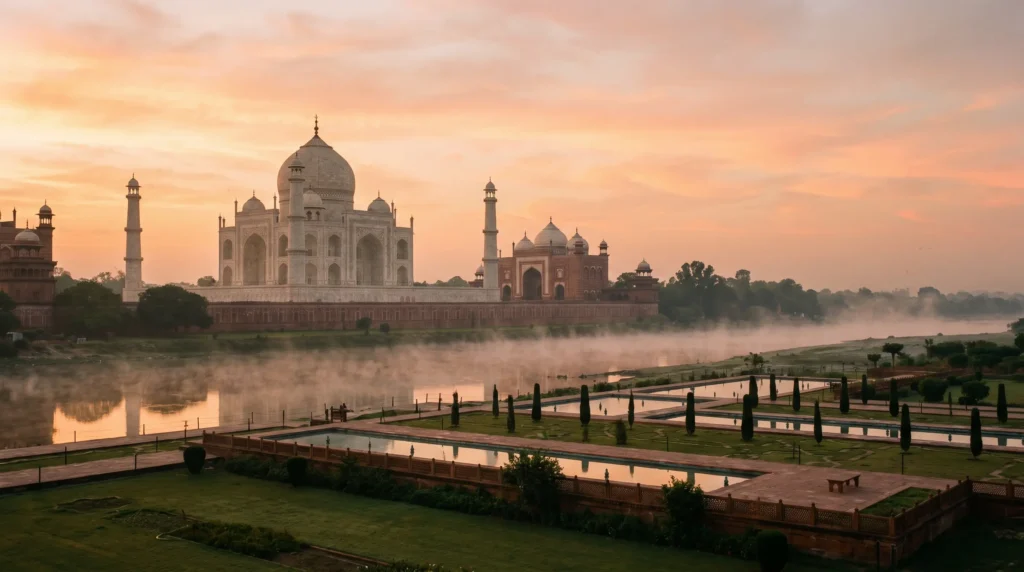
Agra Travel Guide — The Taj Mahal, Two More UNESCO Sites & the City Most People Rush Through
Most people do Agra wrong. They fly or train in from Delhi, spend two hours at the Taj Mahal, eat a rushed thali, and leave before dinner — checking a box instead of visiting a city. I get why: Agra’s traffic is relentless, the touts near the monuments are persistent, and the city itself doesn’t market its own charm the way the marble mausoleum does all the marketing for it. But Agra holds three UNESCO World Heritage Sites within a 40-kilometre radius — more than most countries — plus a old city of spice-lane bazaars, marble-inlay workshops descended from the same Mughal craftsmen who worked the Taj, and a skyline of red sandstone forts that most day-trippers never see because they’re back on the highway before sunset. Give it two full days, not two hours, and Agra stops being a monument you photograph and becomes a city you actually visited.
In This Guide
- Overview — Why Agra Is More Than a Day Trip From Delhi
- Taj Mahotsav & Full-Moon Nights — Agra’s Festival Calendar
- Best Time to Visit Agra (Season by Season)
- Getting There — Delhi Flights, the Gatimaan Express & the Yamuna Expressway
- Getting Around — Auto-Rickshaws, E-Rickshaws & the 500-Metre Rule
- Neighborhoods — Taj Ganj, Sadar Bazaar & the Old City
- Culture & People — Mughal Legacy, Marble Inlay & Everyday Agra
- A Food Lover’s Guide to Agra
- Off the Beaten Path
- Day Trips From Agra
- Practical Information
- Budget Breakdown — What Agra Actually Costs in 2026
- Frequently Asked Questions
Overview — Why Agra Is More Than a Day Trip From Delhi
Agra sits on the banks of the Yamuna River in Uttar Pradesh, about 210 kilometres south of Delhi, and carries a population of roughly 1.6 million, making it the fourth-largest city in the state. Its fame rests almost entirely on a 22-year run in the 16th and 17th centuries when it served as the capital of the Mughal Empire under Babur, Humayun, Akbar, Jahangir and Shah Jahan — the same Shah Jahan who, grieving his wife Mumtaz Mahal, commissioned the building that put Agra on every traveler’s list.
The Taj Mahal is, of course, the reason you’re reading this. Construction ran from 1632 to 1648 for the mausoleum itself, with the surrounding complex finished around 1653, using white marble hauled from Makrana in Rajasthan and red sandstone from nearby Fatehpur Sikri, inlaid with 28 types of precious and semi-precious stone by a workforce of more than 20,000 artisans drawn from as far as Persia and Bukhara. It draws close to 4.8 million visitors a year and was inscribed as a UNESCO World Heritage Site in 1983.
What most itineraries skip is that Agra was inscribed twice more: Agra Fort, the red sandstone imperial city with 2.5 kilometres of enclosure walls, also went on the list in 1983, and Fatehpur Sikri, Akbar’s abandoned capital 40 kilometres away, followed in 1986. Layer in tourism’s economic footprint — Agra pulls around 9.5 million visitor-days a year city-wide — and a working economy of leather goods, footwear (more than 1.5 lakh, or 150,000, pairs produced daily) and the marble-inlay handicraft trade descended straight from the Taj’s own workshops, and you have a city that rewards more than an afternoon.
Taj Mahotsav & Full-Moon Nights — Agra’s Festival Calendar
Time a February trip around the Taj Mahotsav, a ten-day arts, crafts and cuisine festival held near the Taj’s grounds, typically running 18–27 February, where several hundred artisans from across India sell and demonstrate textiles, pottery, marble inlay and more alongside classical music and dance performances. It’s the single best week to combine monument-viewing with a genuine cross-section of Indian craft traditions in one walkable venue.
The other date worth chasing is a full moon. The Taj Mahal opens for night viewing only on the full-moon night itself and the two nights before and after — five nights a month, in eight capped batches of 50 visitors between 8:30pm and 12:30am — when the marble shifts from white to a pale, almost luminous grey. Tickets are separate from daytime entry, capped, and released only for that window, so build any full-moon plan around checking the official schedule ahead of your trip rather than assuming you can walk up.
Best Time to Visit Agra (Season by Season)
October – March · Cool season (peak)
Daytime temperatures sit in the pleasant range for sightseeing and this is when most tourists come, so the Taj’s queues and Fatehabad Road’s hotel rates both climb. December and January mornings bring genuine winter fog that can delay flights and blur the Taj’s silhouette until mid-morning — factor in a buffer day if you’re flying in and out same-trip.
April – June · Extreme heat
Agra’s summers are brutal: the region recorded a high of 48.6°C in May 2024, and midday sightseeing at the marble-floored Taj becomes genuinely dangerous underfoot. If you must travel this window, do the Taj at dawn, retreat indoors by 10am, and never skip water.
July – September · Monsoon
Humid, with short intense downpours rather than all-day rain. Crowds and prices both drop, the light after a shower is some of the best Taj photography you’ll get, and this is the quiet-season sweet spot for travelers who don’t mind an umbrella.
Getting There — Delhi Flights, the Gatimaan Express & the Yamuna Expressway
Agra’s own airport (AGR), a civil enclave inside Kheria Air Force Station, runs limited and largely seasonal service, mostly Air India hops from Delhi — it is not a practical international gateway. Almost everyone flies into Delhi’s Indira Gandhi International Airport and continues overland, which is genuinely easy: the Gatimaan Express, India’s first semi-high-speed train, covers Delhi (Hazrat Nizamuddin station) to Agra Cantt in about 1 hour 40 minutes, departing Delhi around 8:10am and returning from Agra around 5:50pm — built for exactly this same-day itinerary.
By road, the Yamuna Expressway covers the 210 kilometres in roughly three to four hours depending on traffic, and is the route most private cars and tour operators use. Agra has five railway stations in total — Agra Cantt is the main one for long-distance and Gatimaan services, with Agra Fort, Raja ki Mandi, Agra City and Idgah handling regional trains — so double-check which station your ticket names before booking a pickup.
Getting Around — Auto-Rickshaws, E-Rickshaws & the 500-Metre Rule
Agra’s most important transport rule has nothing to do with traffic: petrol and diesel vehicles are banned within 500 metres of the Taj Mahal to protect the marble from pollution, so every visitor finishes the last stretch on foot, by cycle-rickshaw, or aboard a battery-operated electric shuttle from the designated parking areas. Budget an extra 15–20 minutes for this hand-off, especially in the morning rush.
Beyond that buffer zone, auto-rickshaws (agree the fare before getting in, or use a ride app where available) and e-rickshaws cover short hops across town cheaply. Pre-paid taxi counters at Agra Cantt station and the airport are the least hassle for airport/station transfers. Renting a car with driver for the day (commonly done through your hotel) is the standard way to cover the Taj, Agra Fort and a day-trip site like Fatehpur Sikri without juggling separate rickshaws for each stop — walking the old city lanes around Kinari Bazaar, though, is genuinely the best way to see them.
Neighborhoods — Taj Ganj, Sadar Bazaar & the Old City
Taj Ganj
The neighborhood built to house the Taj Mahal’s own construction workers now houses its visitors: a dense tangle of budget guesthouses, rooftop restaurants angling for a Taj-dome view, and touts working the lanes between the East and South Gates. Stay here for walk-to-the-gate convenience and sunrise access; expect noise and persistent hawking in exchange.
Sadar Bazaar & Cantonment
The colonial-era cantonment area, calmer and greener, with the bulk of Agra’s mid-range hotels, Western-style restaurants, and the main railway station. A sensible base if you’d rather not sleep inside the tourist bubble.
Fatehabad Road
Agra’s hotel strip, lined with the city’s international chain and boutique properties, all pitched toward the same selling point — a Taj-adjacent address — with easy access to Shilpgram, the craft village that hosts the Taj Mahotsav.
Kinari Bazaar & the Old City
The working heart of Agra, predating the Mughals in places: narrow lanes stacked with spice merchants, sari and textile shops, sweet shops selling petha by the kilo, and marble-inlay workshops where craftsmen still cut stone using techniques passed down from the Taj’s own artisans. This is where you eat like a local and buy handicrafts at something closer to a fair price.
Agra Fort area
The red sandstone fortress itself anchors this district — a 2.5-kilometre walled imperial city where Shah Jahan was later held under house arrest by his own son, reportedly gazing across the Yamuna at the very monument he’d built. The surrounding streets are more residential and less touristed than Taj Ganj.
Sikandra
A quieter northern suburb about 35 kilometres from central Agra’s other sites, built around Akbar’s Tomb — a striking red sandstone and marble mausoleum the emperor began planning himself. Worth the detour for travelers who want their Mughal monuments without the Taj-scale crowds.
Culture & People — Mughal Legacy, Marble Inlay & Everyday Agra
Agra’s identity is inseparable from its 16th- and 17th-century run as a Mughal capital under Babur, Humayun, Akbar, Jahangir and Shah Jahan, and that history is still a living craft economy, not just a museum piece. The pietra dura marble-inlay technique used on the Taj — cutting and fitting semi-precious stone into marble to form floral patterns — is still taught and practiced by artisan families in workshops around Kinari Bazaar and the old city, many of whom trace their training back generations to the original construction crews.
Hindi and Urdu are both widely spoken, a legacy of Agra’s role as a literary and courtly center under the Mughals, and English is common in the tourism trade. Leatherwork and footwear are the other major traditional industries, with the city producing well over a hundred thousand pairs of shoes daily. As in the rest of Uttar Pradesh, modest dress is appreciated at religious sites and in the old city, and a respectful, unhurried approach to the marble-inlay shops — most welcome browsers without obligation to buy — tends to get a warmer reception than a rushed one.
A Food Lover’s Guide to Agra
Agra’s signature sweet is petha — a translucent, syrup-soaked candy made from ash gourd, sold by weight in dozens of flavors (plain, kesar/saffron, angoori, paan) at shops throughout the old city and Sadar Bazaar. It travels well and is the default souvenir. Pair it with a glass of lassi from one of the old city’s long-running dairies.
For meals, Agra sits squarely in North Indian Mughlai territory: rich, slow-cooked curries, tandoor-grilled meats, and bedai — a puffed, spiced fried bread served with a spicy potato curry (aloo sabzi), traditionally a breakfast dish and a genuine local specialty worth seeking out over the more generic paratha. Street stalls around Sadar Bazaar and the old city serve chaat, kachori and Agra-style dahi bhalla; rooftop restaurants in Taj Ganj trade some authenticity for a Taj-dome view over dinner, which is a fair trade at least once. Vegetarian thalis are the easiest, safest introduction to the local repertoire if you’re pacing yourself for a longer trip through India.
Off the Beaten Path
Mehtab Bagh
A restored Mughal charbagh (four-part garden) directly across the Yamuna from the Taj Mahal, believed to have been laid out as a moonlit viewing garden for the monument itself. It’s the best spot in the city for an uncrowded, reflection-free sunset photograph of the Taj’s back side — and a fraction of the crowd.
Itmad-ud-Daulah’s Tomb (“Baby Taj”)
A smaller marble-and-inlay tomb built roughly a decade before the Taj Mahal, on the Yamuna’s opposite bank, often cited as a design precursor to the larger monument. Far fewer visitors, same craftsmanship, a genuinely underrated stop.
Kinari Bazaar’s back lanes
Wander a block or two past the main tourist-facing stalls and you’re in a working spice-and-textile market with no English signage and no interest in selling to you specifically — which is exactly the point.
Guru Ka Tal
A lesser-visited stepped water tank and gurdwara complex on Agra’s outskirts, associated with a visit by Guru Nanak, that draws almost none of the Taj’s crowds.
Day Trips From Agra
Fatehpur Sikri
Emperor Akbar’s purpose-built capital, roughly 40 kilometres from Agra, occupied for only about a decade before it was abandoned, reportedly over water supply problems — leaving behind a remarkably intact red sandstone palace-and-mosque complex inscribed as a UNESCO World Heritage Site in 1986. Easily combined with Agra Fort and the Taj in a two-day itinerary, or done as its own half-day trip by car.
Mathura & Vrindavan
The twin pilgrimage towns tied to Krishna’s birth and childhood, roughly 55–70 kilometres from Agra, packed with temples, ghats and a very different, devotional energy from Agra’s Mughal monuments. A full-day trip if you want to see both towns properly.
Keoladeo National Park, Bharatpur
A former royal hunting reserve turned bird sanctuary just across the Rajasthan border, around 55 kilometres from Agra, and a UNESCO World Heritage Site in its own right since 1985 — home to hundreds of resident and migratory bird species and best visited in the cooler months when migrants are present. A good pairing for travelers who want a nature counterpoint to three straight days of monuments.
Practical Information
Money. The Indian Rupee (INR) floats freely and is issued by the Reserve Bank of India; ATMs are widespread in every tourist district, and cards are increasingly accepted at hotels and larger restaurants, though small vendors, rickshaws and old-city shops remain cash-first.
Visa. Most Western nationalities, including US, UK, EU and Canadian citizens, need an e-Tourist visa arranged in advance online — it is not available on arrival — with 30-day, one-year and five-year options and applications accepted from 4 to 120 days before travel.
Safety. The US State Department rates India Level 2 (Exercise Increased Caution) overall, citing crime and terrorism risk, with explicit guidance advising against women traveling alone and recommending women-only transport options and vetted drivers after dark. None of this is specific to Agra’s well-trafficked tourist sites, but it should shape how you plan transport and evenings, especially for solo women. Check current advisories from your own government before you travel.
Health. The US CDC recommends being current on routine vaccines plus Hepatitis A for all travelers and Hepatitis B, typhoid and Japanese encephalitis depending on itinerary; malaria risk is present nationwide, so discuss antimalarial medication with a travel clinic, use strong DEET-based repellent, and stick to bottled or treated water.
Connectivity & practicalities. A local SIM or eSIM is cheap and easy to arrange in Delhi or Agra with a passport and photo. Plugs: Type C, D and M sockets, 230V. Time zone: India Standard Time, UTC+5:30 year-round, with no daylight saving — an unusual half-hour offset worth double-checking against your flight times.
Budget Breakdown — What Agra Actually Costs in 2026
Agra is inexpensive by international standards, even against Delhi, but Taj Mahal entry itself carries a steep dual-pricing structure: Indian citizens pay around ₹50, while foreign visitors pay roughly ₹1,100 (around US$12–13 at 2026 rates), with SAARC/BIMSTEC nationals in between.
Budget (US$25–45/day): Taj Ganj guesthouse, thali and street-food meals, auto-rickshaws and e-rickshaws for transport, a single-day monument circuit.
Mid-range (US$60–150/day): Cantonment or Fatehabad Road hotel, restaurant meals, a full-day car-with-driver for the Taj, Agra Fort and Fatehpur Sikri, Gatimaan Express tickets to/from Delhi.
Luxury (US$250+/day): Taj-view suite hotels along Fatehabad Road, private guided tours, sunrise Taj access with a specialist photography guide, a driver-and-car for the full Golden Triangle loop.
Build in the Taj’s foreign-visitor entry fee and similar (smaller) fees at Agra Fort and Fatehpur Sikri as fixed costs, and tip guides and drivers 10% or a modest flat sum where service isn’t already built into a package rate.
Planning Your First Trip to Agra
The classic itinerary is the Golden Triangle: Delhi, Agra and Jaipur, each a comfortable half-day to full-day’s travel from the next. Take the Gatimaan Express from Delhi in the morning, spend two full days in Agra covering the Taj at sunrise, Agra Fort, Fatehpur Sikri and the old city’s bazaars, then continue on to Rajasthan. Two nights in Agra is enough to see it properly without rushing; add a third if Mathura-Vrindavan or Bharatpur is on your list. Pair this guide with our Delhi city guide for the gateway city, our India travel guide for the bigger picture, and our Mumbai or Delhi guides if you’re extending the trip beyond the Triangle.
Frequently Asked Questions
Is Agra safe for tourists in 2026?
Agra’s main tourist sites and hotel districts are generally safe and heavily policed given the volume of visitors. The broader US State Department advisory for India sits at Level 2 (Exercise Increased Caution), with explicit guidance against women traveling alone anywhere in the country — plan reliable transport and avoid isolated areas after dark.
Do I need a visa to visit Agra?
Yes — India requires an e-Tourist visa arranged online in advance for most Western nationalities; it is not issued on arrival. Apply between 4 and 120 days before your trip through the official government portal.
Can I visit the Taj Mahal on a Friday?
No — the Taj Mahal is closed to general visitors on Fridays. Plan your itinerary around this if Friday would otherwise be your only day in Agra.
Is one day enough to see Agra?
You can technically hit the Taj Mahal and Agra Fort in a single long day from Delhi, and many tour packages sell exactly that. But it leaves no room for Fatehpur Sikri, the old city bazaars, or a relaxed sunrise visit — two days is the honest minimum to see Agra rather than just the Taj.
How do I avoid the Taj Mahal crowds?
Buy tickets online in advance, arrive at the gate for the sunrise opening slot, and go on a weekday outside the October–March peak season if your schedule allows. The crowds build fast after mid-morning and stay heavy until closing.
Agra or Jaipur — which deserves more time?
They’re not really a choice — most Golden Triangle itineraries do both. Agra is denser (three UNESCO sites within 40km) and better suited to two focused days; Jaipur’s forts and old city reward a similarly compact stay but spread wider across the city.
Ready to Explore Agra?
A sunrise walk to a monument that took 20,000 people over two decades to build, a red sandstone fort where an emperor was held prisoner by his own son, and a plate of bedai eaten standing up in a lane that hasn’t changed its layout in centuries — Agra gives you all of it if you stay past the tour-bus schedule. Slow down, book two nights instead of a day trip, and let the city outside the Taj’s gates do some of the work too.
Explore More
- Delhi City Guide — the Golden Triangle’s gateway city
- Delhi City Guide — the Golden Triangle’s gateway capital
- India Travel Guide — the full country picture
- Mumbai City Guide — extend the trip to India’s coast
How this guide was built
Published . Built from authoritative sources — UNESCO’s World Heritage listings for the Taj Mahal, Agra Fort and Fatehpur Sikri, the official Taj Mahal visitor information site (tajmahal.gov.in), India’s official e-Visa portal, the Reserve Bank of India, the US State Department’s India travel advisory, the US CDC’s India traveler page, India’s official tourism site (incredibleindia.gov.in) for the Taj Mahotsav, and Wikipedia entity pages for Agra, the Taj Mahal, Agra Fort and Keoladeo National Park. Numeric claims carry inline citations.
Sources cited on this page
- Wikipedia — Agra
- Wikipedia — Taj Mahal
- Wikipedia — Keoladeo National Park
- UNESCO — Taj Mahal
- UNESCO — Agra Fort
- UNESCO — Fatehpur Sikri
- Official Taj Mahal site — Visiting Hours
- Government of India — e-Visa portal
- Reserve Bank of India — Currency
- US State Department — India Travel Advisory
- US CDC — India traveler page
- Incredible India — Taj Mahotsav
More city guides you might like
Plan your trip to Agra
The booking tools we use ourselves. FFU may earn a commission at no extra cost to you.
Plan & book your trip to Agra
Booking through these searches supports our guides at no extra cost to you.