
City Guide · India · Northern plains
Delhi, India: Eight Cities Stacked on One Floodplain
I have arrived in Delhi at every hour the clock offers, and the city has never once felt the same twice. My standing brief to first-timers is to stop trying to “do” Delhi as a single place: what you are actually visiting is at least eight historic capitals stacked on the same Yamuna floodplain over a thousand years, from the 12th-century Qutub complex to Lutyens’ 1931 imperial avenues to the glass towers of Gurugram across the border. We treat Delhi as the front door to the whole of northern India — the apex of the Golden Triangle and the rail-and-air hub you will pass through on the way to Agra, Jaipur, Varanasi, and the Himalaya. Treat this guide as the briefing I hand my own family before they fly into Terminal 3.

Table of Contents
Why Delhi?
Delhi is the capital of India and, after Mumbai, its second-largest city, with roughly 16.7 million residents inside the National Capital Territory at the 2011 census and well over 30 million across the wider National Capital Region today. It sits on the western bank of the Yamuna River on the northern plains, at the historic pinch-point where every overland invader, trader, and empire entering the Indian subcontinent from the north-west had to pass. That geography is the whole story: Delhi is not one city but the layered remains of at least eight historic capitals built on the same ground over a thousand years, from Lal Kot and the 12th-century Qutub complex through the Mughal Shahjahanabad of 1648 to the British-built New Delhi inaugurated in 1931.
The scale claims are blunt. Delhi holds three of India’s UNESCO World Heritage Sites — the Qutub Minar, Humayun’s Tomb, and the Red Fort — more than any other Indian city. The Delhi Metro, opened in 2002, has grown into one of the world’s largest rapid-transit systems, with roughly 395 route-kilometres and around 290 stations carrying more than six million passenger journeys on a typical day. Indira Gandhi International Airport (DEL) handled more than 73 million passengers in the 2023–24 financial year and ranks among the ten busiest airports in the world, making Delhi the single biggest air gateway into India.
The contradiction underneath those numbers is what makes Delhi worth several days rather than a single Golden-Triangle pit stop. This is simultaneously the most chaotic and the most stately of India’s big cities — the medieval crush of Chandni Chowk’s spice lanes sits a 15-minute drive from the wide, tree-lined imperial avenues of Lutyens’ New Delhi, where India’s parliament, ministries, and embassies occupy garden bungalows on circular roads. A rickshaw ride that begins at a 17th-century Mughal fort can end at a glass-and-steel metro interchange, and a street that smells of frying jalebi can open onto a 73-metre minaret begun in 1192.
Delhi runs at a density of superlatives few cities match: India’s tallest brick minaret (the 72.5-metre Qutub Minar), its largest mosque (the Jama Masjid, with a courtyard for 25,000 worshippers), the world’s largest comprehensive museum of toilets, and the country’s seat of government all sit inside the same urban sprawl. It is also one of the easier major Indian cities for first-time visitors: the air-conditioned Metro is clean, cheap, and reliable; English is an official language and is spoken across every tourist-facing service; and the city is the natural launch point for Agra (the Taj Mahal), Jaipur, Rishikesh, and the Himalayan foothills.
This guide covers the ten neighbourhoods that define Delhi from Mughal Shahjahanabad to leafy South Delhi, the food scene behind the city’s street chaat, Mughlai kebabs, and Punjabi tandoor cooking, the cultural and architectural sights from the Qutub complex to the Lotus Temple, the day trips that turn Delhi into a base camp for the Golden Triangle, and the transit, budget, monsoon, dress-code, and air-quality details that first-time visitors need to plan a trip in any season.

Neighborhoods: Finding Your Delhi
📍 Delhi Map: Every Place in This Guide
Delhi is functionally a cluster of distinct cities rather than one continuous downtown, and the fastest way to understand it is to think in two halves split by the colonial line. Old Delhi (Shahjahanabad), north of Connaught Place, is the dense, medieval Mughal core of bazaars, mosques, and havelis. New Delhi, the Lutyens-planned imperial capital below it, is wide, green, and administrative. South of both, the modern residential and nightlife districts sprawl toward the Qutub belt and the Gurugram border. A Metro pass and a willingness to switch between rickshaw, cab, and train will get you through all ten below.


Read the neighbourhoods below as a rough north-to-south sweep, from the medieval Mughal core down through the colonial centre to the affluent southern colonies and the Qutub belt. Most visitors base themselves around Connaught Place or in South Delhi and day-trip into Old Delhi, since staying inside Shahjahanabad itself is atmospheric but noisy. Whichever base you choose, the Metro stitches them together: a single Yellow Line runs almost the full length of this list, from Chandni Chowk in the north to Qutub Minar in the south, so you can sample several districts in a day without ever sitting in traffic.
Old Delhi (Shahjahanabad)
The walled Mughal city laid out by Shah Jahan in 1648 around the Red Fort and Jama Masjid — a medieval crush of spice warehouses, jewellers, wedding-card printers, and 19th-century havelis threaded by lanes too narrow for cars. This is the Delhi of the postcard imagination: cycle-rickshaws nosing through crowds, electrical wires tangled overhead, the smell of frying ghee and cardamom, and 400-year-old mosques rising over street stalls. It is loud, dense, and occasionally overwhelming, but it is also where the city’s history is most legible. Come in the morning before the heat and the wedding-shopping crowds peak, and consider a guided walk for your first visit — the lanes are easy to get lost in, and a local guide turns chaos into context.
- Chandni Chowk — the historic ceremonial avenue and food street
- Khari Baoli — Asia’s largest wholesale spice market
- Paranthe Wali Gali — the lane of stuffed-flatbread shops
Best for: food walks, history, photography. Access: Chandni Chowk or Lal Qila Metro (Yellow / Violet lines).
Connaught Place (CP / Rajiv Chowk)
The white colonnaded Georgian circle at the geographic centre of the city, built in the 1930s as New Delhi’s commercial heart and still the main shopping, dining, and transit hub where the Metro’s busiest interchange sits. CP, as everyone calls it, is the practical heart of a Delhi trip: it is where the Airport Express deposits you near New Delhi station, where the Blue and Yellow metro lines cross at Rajiv Chowk, and where you can eat, change money, buy a SIM, and shop for handicrafts within a ten-minute walk. The Georgian arcades have aged into a slightly worn elegance, but the energy is unmistakable, and the hidden 14th-century Agrasen ki Baoli stepwell a few minutes away is one of the city’s great surprises.
- The inner and outer Georgian circles of shops and cafes
- Janpath market for handicrafts and textiles
- Agrasen ki Baoli, a stepwell hidden a short walk away
Best for: first-timers, shopping, transit base. Access: Rajiv Chowk Metro (Blue / Yellow interchange).
Lutyens’ New Delhi
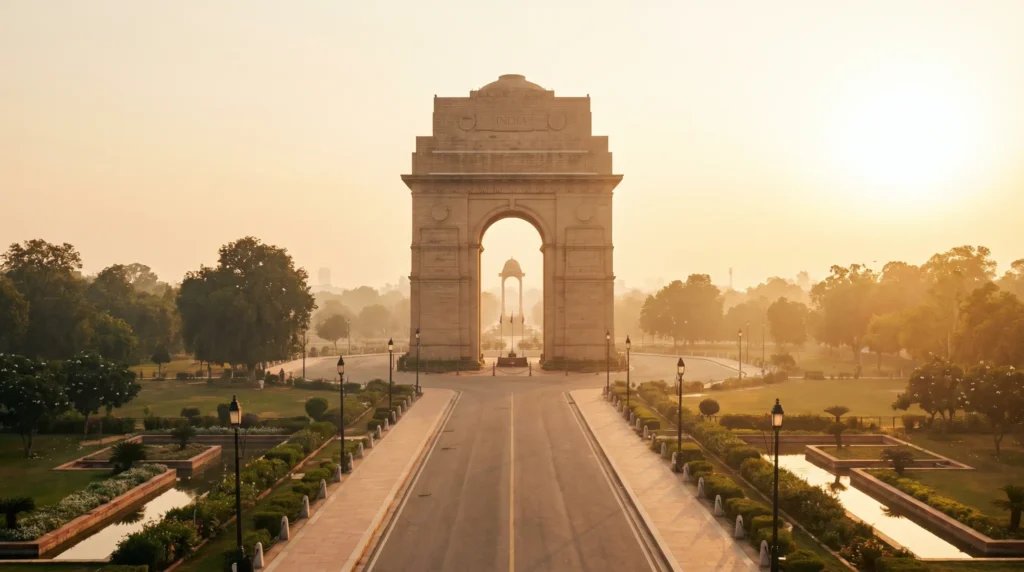
The ceremonial imperial capital of wide avenues, roundabouts, and garden bungalows designed by Edwin Lutyens and Herbert Baker, running from Rashtrapati Bhavan along Kartavya Path to India Gate — Delhi at its most stately and green. After the press of Old Delhi, the scale here feels almost startling: hexagonal road systems, vast roundabouts, flowering trees, and low garden bungalows that house ministries and embassies. This is best experienced on foot or by cycle in the early morning, when joggers and birdsong own the avenues. The museum belt around Janpath — the National Museum, the National Gallery of Modern Art — gives you a half-day of indoor refuge from the heat, and the ceremonial axis comes alive at dusk when families gather at India Gate.
- Rashtrapati Bhavan and the North/South Blocks
- India Gate and the National War Memorial
- The museum belt around Janpath
Best for: architecture, museums, morning walks. Access: Central Secretariat or Udyog Bhawan Metro (Yellow / Violet).
Hauz Khas
A South Delhi village wrapped around a 13th-century reservoir and madrasa ruins, reinvented as a designer-boutique, gallery, and rooftop-bar district — one of the city’s most photogenic blends of medieval stone and contemporary nightlife. By day it is a maze of design boutiques and cafes wrapped around the deer park and the 13th-century reservoir; by night the same lanes fill with twenty-somethings climbing to rooftop bars that look out over the ruins. It is the clearest expression of how Delhi layers eras on top of one another — you can sip a craft beer with a view of a Tughlaq-era madrasa — and it is the default answer when visitors ask where the city goes out.
- Hauz Khas Complex and reservoir (Deer Park)
- The village lane of boutiques and rooftop bars
- Independent art galleries and design studios
Best for: nightlife, design, sunset over the lake. Access: Hauz Khas or Green Park Metro (Magenta / Yellow).
Khan Market & Lodhi Colony
Delhi’s most expensive retail square-footage, a compact grid of bookshops, delis, and designer boutiques next to the Lodhi Gardens and the open-air Lodhi Art District murals — the polished, diplomatic-quarter face of the city. This is where Delhi’s professional and expat classes browse for books, eat brunch, and buy designer kurtas, and where you will find some of the city’s best independent shops in a walkable square. The adjacent Lodhi Gardens are the loveliest green space in central Delhi — a landscaped park dotted with crumbling 15th-century tombs — and the Lodhi Art District nearby has turned a colony of government housing into an open-air gallery of large-scale murals.
- Khan Market bookshops, cafes, and boutiques
- Lodhi Gardens and its 15th-century tombs
- The Lodhi Art District street-mural trail
Best for: cafes, slow afternoons, gardens. Access: Khan Market or Jor Bagh Metro (Violet / Yellow).
Nizamuddin
A medieval Sufi quarter built around the 14th-century shrine (dargah) of the saint Nizamuddin Auliya, where qawwali devotional singing still fills the lanes on Thursday evenings, a short walk from Humayun’s Tomb. The basti (settlement) around the dargah is one of the most atmospheric corners of the city, especially on Thursday evenings when qawwals sing late into the night and the lanes fill with the smell of slow-cooked kebabs and biryani. It is a working religious neighbourhood, not a tourist set-piece, so go with respect: cover your head, remove your shoes, and follow the lead of the worshippers around you. The combination of the shrine, the kebab stalls, and the adjacent Mughal gardens makes for one of Delhi’s richest evenings.
- Hazrat Nizamuddin Dargah and its Thursday qawwali
- Humayun’s Tomb and the Sundar Nursery gardens
- The kebab and biryani stalls of Nizamuddin Basti
Best for: music, Mughal history, evening atmosphere. Access: JLN Stadium or Jangpura Metro (Violet); Hazrat Nizamuddin railway station nearby.
Paharganj
The gritty backpacker bazaar opposite New Delhi Railway Station — cheap guesthouses, money-changers, travel agents, and a wall-to-wall main bazaar that has been the first Indian street scene for budget travellers for fifty years. It is chaotic, occasionally seedy, and not to everyone’s taste, but it is unbeatable for cheap beds, last-minute train and bus tickets, and the practical business of arriving in India. The proximity to New Delhi Railway Station and the Airport Express makes it a convenient base for travellers who plan to move on quickly. Keep your wits about touts and over-helpful “tourist office” agents, and you will find Paharganj an efficient, if frenetic, launch pad.
- The Main Bazaar of guesthouses and street stalls
- Budget cafes and rooftop hostels
- Quick access to New Delhi Railway Station and the Airport Express
Best for: budget travellers, rail connections. Access: New Delhi or RK Ashram Marg Metro (Yellow / Blue).
South Delhi (Saket, Greater Kailash, Vasant Kunj)
The leafy, affluent residential belt of gated colonies, large malls, and standalone restaurants stretching toward the Qutub complex and the Gurugram border — where much of the city’s contemporary dining and shopping has migrated. If Old Delhi is the city’s past, South Delhi is its present: this is where many residents actually live, eat, and shop, in a sprawl of tree-lined colonies, glossy malls, and neighbourhood markets. It lacks the concentrated drama of the historic core, but it rewards visitors who want good restaurants, reliable cafes, and an easy pace — and it puts you within striking distance of the Qutub complex, the Mehrauli Archaeological Park, and the Saket multiplex-and-mall cluster.
- Select Citywalk and DLF mall clusters in Saket
- The M-Block and N-Block markets of Greater Kailash
- The Qutub Minar complex on the southern edge
Best for: dining, malls, families. Access: Saket, Malviya Nagar, or Qutub Minar Metro (Yellow).
Where to Base Yourself
For a first visit, Connaught Place is the most logical base — it is central, well connected by the Airport Express and two Metro lines, and within a short ride of both Old Delhi and the southern monuments. Travellers who prize quiet, good restaurants, and a residential feel should look at South Delhi colonies such as Greater Kailash or Hauz Khas, accepting longer rides into the historic core in exchange for calmer evenings. Budget travellers gravitate to Paharganj for its cheap beds and rail access, while those chasing atmosphere over comfort can find heritage guesthouses inside Old Delhi itself. Wherever you land, plan your days by geography rather than by checklist: cluster the Old Delhi sights together, the Lutyens museums and India Gate together, and the Qutub-and-Humayun southern belt together, so you spend your time inside monuments rather than crossing the city. The Yellow Line is your spine for exactly this reason, linking Chandni Chowk in the north to Qutub Minar in the south on a single fare.
The Food

Delhi’s food is the layered inheritance of every empire that ruled it: Mughal kebabs and biryanis from the imperial kitchens, Punjabi tandoor cooking carried in by Partition refugees in 1947, and a vast street-chaat tradition that turns flour, chickpeas, tamarind, and yoghurt into a hundred small dishes. The headline experiences split into two camps — the medieval Muslim cooking of Old Delhi around Jama Masjid, and the butter-rich Punjabi food that became the city’s default after 1947. Prices below are indicative and were current at the time of writing; treat them as ranges, not quotes.
Old Delhi Mughlai & Kebabs
The lanes around the Jama Masjid are the oldest continuous food district in the city, where shops measure their age in centuries and the cooking leans on slow-braised meat, charcoal, and ghee. This is where to eat nihari, korma, and seekh kebabs in their original setting.
- Karim’s (Gali Kababian, Jama Masjid) — mutton burra and mutton korma, founded 1913 (₹250–500, ~$3–6)
- Al Jawahar (beside Karim’s) — mutton nihari and chicken jahangiri (₹200–450, ~$2.50–5.50)
- Aslam Chicken (Matia Mahal) — butter-drenched chicken tikka (₹300–500, ~$3.50–6)
Punjabi & North Indian
The food most visitors picture as “Indian” — butter chicken, dal makhani, tandoori breads — is largely Delhi-Punjabi, refined after Partition by refugee restaurateurs. It is rich, tomato-and-cream heavy, and built for the tandoor.
- Moti Mahal (Daryaganj) — butter chicken and dal makhani, claimed birthplace of both (₹450–700, ~$5.50–8.50)
- Kake Da Hotel (Connaught Place) — mutton curry and tandoori roti (₹300–550, ~$3.50–6.50)
- Gulati (Pandara Road) — dal Gulati and kebabs in a sit-down setting (₹600–1,000, ~$7–12)
Beyond Kebabs and Butter Chicken
Delhi’s street food is a full cuisine in its own right, eaten standing up at carts and hole-in-the-wall shops across the city. Hygiene varies; stick to busy stalls with high turnover, and prefer freshly fried or griddled items over anything sitting in standing water.
- Chaat — gol gappe (pani puri), aloo tikki, and papdi chaat (₹40–120 a plate, ~$0.50–1.50)
- Paranthe — stuffed griddled flatbreads from Paranthe Wali Gali (₹60–150, ~$0.70–1.80)
- Chole bhature — spiced chickpeas with fried bread, a Delhi breakfast staple (₹80–200, ~$1–2.50)
- Jalebi & rabri — hot syrup-soaked spirals with thickened milk at the Old Famous Jalebi Wala (₹50–150, ~$0.60–1.80)
Food Experiences You Can’t Miss
- A guided Chandni Chowk food walk, eating your way from Paranthe Wali Gali to the Old Famous Jalebi Wala
- A thali at a sit-down restaurant — an all-in-one tray sampling a dozen dishes for ₹250–600 (~$3–7)
- Filter coffee and a South Indian dosa breakfast at the Andhra Bhavan or Saravana Bhavan canteens
Where the Empires Meet: Understanding Delhi’s Plate
To eat well in Delhi is to read its history backwards. The slow-braised nihari simmered overnight in Old Delhi descends directly from the kitchens that fed the Mughal court; the cream-and-tomato butter chicken that now defines “Indian food” abroad was invented here in the late 1940s by Punjabi refugees improvising with the day’s leftover tandoori chicken; the tangy, layered chaat sold from carts is a folk cuisine refined over generations of street vendors. No single restaurant captures the city — the real map runs from century-old kebab shops to glass-fronted malls in the south, from Sufi-shrine biryani stalls to South Indian government-canteen dosas. The smartest approach is to treat each meal as a chance to taste a different layer rather than trying to find one definitive Delhi dish, because there isn’t one. Eat breakfast in one tradition, lunch in another, and dinner in a third, and you will have travelled through four centuries in a single day. This layering is also why Delhi rewards curiosity over caution: the most memorable meals are rarely in hotel dining rooms but in century-old shops, government canteens, and roadside carts where a single dish has been perfected over decades. Pace yourself, share plates so you can taste more, and do not be afraid to ask a local what they are eating — Delhiites are fiercely opinionated about food and almost always happy to point you to their favourite hole-in-the-wall.
One practical note on prices and value: nearly everything in this section costs a fraction of what comparable food would in a Western capital, which means the usual budgeting instinct — trading down to save money — rarely applies. The best nihari, the best jalebi, and the best chaat are cheap precisely because they are made at volume by specialists, so chase reputation and queues rather than price. Where you do spend more — a sit-down Punjabi dinner, a heritage-hotel buffet — you are paying for the setting and the air-conditioning as much as the cooking, which can be a worthwhile trade in the heat but is never a guarantee of better flavour than the street. If you are nervous about street food on a first trip, a guided food walk is the best on-ramp: a knowledgeable guide picks the hygienic, high-turnover stalls, orders the right dishes in the right sequence, and explains what you are eating, turning what can feel like a gamble into the highlight of the trip. Many Old Delhi walks run in the early morning or the cool of the evening and cover six or eight tastings for the price of a single restaurant meal, and they double as an introduction to the lanes you will then feel confident exploring on your own. Book a reputable operator with good recent reviews, go hungry, and wear shoes you do not mind getting dusty — the best stalls are rarely on the main road. Above all, arrive curious rather than cautious: Delhi’s street food is a genuine cuisine perfected over generations, and a careful, well-guided introduction is one of the great pleasures of any visit to the city.
A Day of Eating, Hour by Hour
Start early in Old Delhi with nihari and khameeri roti while the lanes are still cool and the meat has had its full overnight braise — the dish runs out by mid-morning at the best shops. Move to chole bhature or a stuffed paratha for a heavier mid-morning meal, washed down with sweet milky chai from a roadside stall. Save the late morning for chaat, when the gol gappe and aloo tikki carts hit their stride. Lunch is the moment for a thali — an all-in-one steel tray that lets you sample a dozen dishes at once — or a South Indian dosa at a government bhavan canteen, where the food is regional, cheap, and reliably clean. Take an afternoon break from eating (your stomach will thank you), then return after dark for Mughlai kebabs around Jama Masjid or sit-down Punjabi food in Daryaganj or Pandara Road. Finish with hot jalebi and rabri, or kulfi falooda from a sweet shop. This rhythm spaces out the rich food and keeps you eating where each neighbourhood does its best work.
South Indian, Bengali & Regional Delhi
Delhi is a migrant city, and entire regional cuisines have put down roots far from their home states. The government “bhavans” — state guesthouses with public canteens — serve some of the best regional food in the city at canteen prices: Andhra Bhavan for a fiery Andhra thali and biryani, Karnataka and Kerala bhavans for southern breakfasts, and Bengali food in the Chittaranjan Park (CR Park) neighbourhood, a Bengali enclave whose fish-market lanes and sweet shops feel transplanted from Kolkata. These places rarely make tourist lists, but they are where Delhi residents go for an authentic taste of a region, and they are an easy, inexpensive way to broaden your sense of Indian food beyond the Mughlai-and-Punjabi headline.
- Andhra Bhavan canteen (near India Gate) — unlimited Andhra thali and Sunday biryani (₹200–350, ~$2.50–4)
- Saravana Bhavan (CP & Janpath) — reliable South Indian dosas, idli, and filter coffee (₹150–400, ~$2–5)
- CR Park markets — Bengali fish curries, kosha mangsho, and mishti sweets (₹150–500, ~$2–6)
Sweets, Drinks & the Chai Ritual
No food tour of Delhi is complete without its sweets and its chai. The Mughlai-influenced sweet tradition runs to syrup-soaked jalebi eaten hot with thickened rabri, dense milk-fudge barfi, and the layered kulfi-falooda that is the city’s answer to ice cream. The Old Famous Jalebi Wala at the corner of Dariba Kalan has been frying jalebis since the 1880s and is the benchmark. For drinks, the default is chai — spiced, milky, and sweet — served in small glasses at every street corner; in summer, switch to fresh lime soda (nimbu pani), sugarcane juice, or a salty-or-sweet lassi. Coffee culture has arrived in the south and centre, with serious independent roasters in Hauz Khas and Khan Market, but the soul of Delhi’s drinking life is still the roadside chai stall, where a glass costs ten or fifteen rupees and comes with as much conversation as you want.
Vegetarian & Dietary Notes
Delhi is one of the easiest major cities in the world to eat vegetarian: a huge share of restaurants are pure-veg, menus clearly mark veg and non-veg with green and red dots, and Jain (no root vegetables) options are widely understood. Vegans should watch for ghee, paneer, cream, and curd, which appear in much North Indian cooking even where meat does not — say “no dairy” clearly and ask about ghee in breads and dals. Spice levels are negotiable; ask for “less spicy” if you are sensitive, and remember that the chilli heat of street chaat and Andhra food is genuine. Halal meat is the norm around Old Delhi and the Nizamuddin and Jama Masjid areas given their Muslim heritage. Beef is largely unavailable; the meats you will see are mutton (goat), chicken, and, less often, buffalo.
Cultural Sights

Qutub Minar Complex
The 72.5-metre victory tower begun in 1192 and the surrounding ruins of Delhi’s earliest Islamic city, including the rust-resistant 4th-century iron pillar. Founded 1192. Admission ₹40 Indian / ₹600 foreign (~$7). Open daily sunrise to sunset; go early to beat the heat and crowds.
Humayun’s Tomb
The 1570s garden tomb of the second Mughal emperor, the first major Mughal mausoleum in India and the architectural ancestor of the Taj Mahal. Admission ₹40 Indian / ₹600 foreign (~$7). Best in the soft light of early morning or late afternoon.
Red Fort (Lal Qila)
Shah Jahan’s 17th-century imperial residence and the symbolic heart of Mughal Delhi, from whose ramparts the Prime Minister addresses the nation every Independence Day. Founded 1648. Admission ₹35 Indian / ₹600 foreign (~$7). Closed Mondays; 9:30–16:30.
Jama Masjid
India’s largest mosque, completed in 1656, with a courtyard that holds 25,000 worshippers and a southern minaret you can climb for the best rooftop view over Old Delhi. Entry free; camera fee ₹300. Closed to tourists during prayer times; dress modestly and cover shoulders and knees.
Lotus Temple
The Bahá’í House of Worship completed in 1986, shaped like a half-open lotus of 27 white marble petals and open to people of every faith for silent meditation. Entry free. Closed Mondays; expect queues on weekends.
Akshardham Temple
A vast Hindu temple complex opened in 2005, hand-carved in pink sandstone and white marble without structural steel. Entry free; exhibitions ticketed. Closed Mondays; strict security, with phones and bags not permitted inside.
Lodhi Gardens & Safdarjung’s Tomb
A 90-acre landscaped park studded with 15th-century Sayyid and Lodhi-dynasty tombs, beside the last great garden tomb of the Mughal era. Both free (Safdarjung ₹25 Indian / ₹300 foreign). Best at dawn, when Delhi’s walkers and yoga groups fill the lawns.
India Gate & the National War Memorial
The 42-metre sandstone arch on Kartavya Path, designed by Edwin Lutyens and completed in 1931, commemorates the Indian soldiers who died in the First World War and the Third Anglo-Afghan War; the adjacent National War Memorial, opened in 2019, honours the fallen since independence. Entry free; the lawns are a favourite evening gathering spot for Delhi families, with ice-cream carts and balloon sellers. Come at dusk when the arch is floodlit and the ceremonial axis to Rashtrapati Bhavan glows in the last light.
The National Museum & Museum Belt
Delhi’s indoor cultural heart sits in the Lutyens zone around Janpath. The National Museum holds 5,000 years of subcontinental history, from Indus Valley seals and Buddhist sculpture to Mughal miniatures and the relics of the Buddha. Nearby are the National Gallery of Modern Art and the moving museums at the Gandhi Smriti and Teen Murti Bhavan. Admission to the National Museum is modest (around ₹20 Indian / ₹650 foreign); most close on Mondays. These collections are also the best way to escape the midday heat with a few hours of air-conditioned culture.
Planning Your Sightseeing
Delhi’s monuments divide neatly by geography, which is how you should plan them. Group the Red Fort, Jama Masjid, and Chandni Chowk into one Old Delhi morning; the Qutub Minar, Humayun’s Tomb, and the southern temples into a second day; and the Lutyens belt — India Gate, the museums, Lodhi Gardens — into a third. Almost all sites now sell tickets online through the ASM/ASI portal, which lets you skip the foreigner-ticket queues; carry your passport, since foreign-national tickets require it. Most monuments open sunrise to sunset, with the major Mughal sites closing on Mondays, so check the day before. Early morning gives you soft light, thin crowds, and bearable temperatures — in summer the difference between a 7 a.m. and an 11 a.m. visit is the difference between pleasant and punishing. A final tip: hire a licensed guide or download a reputable audio tour for the two big UNESCO sites — the Qutub complex and Humayun’s Tomb — because their layers of history are easy to walk past unread, and a good guide turns a pile of handsome ruins into a coherent story of conquest, dynasty, and architectural evolution. Photography is permitted at most sites, sometimes for a small extra fee, but tripods and drones are restricted, and a few interiors ban phones entirely. Carry water and a hat for the open sites, since shade is scarce, and budget more time than you expect at the Red Fort and the Qutub complex, both of which are large enough to absorb a couple of unhurried hours each rather than the quick stop many itineraries pencil in. Wear comfortable shoes for the uneven stone, and start with whichever site opens earliest to stay ahead of the tour-bus crowds.
Entertainment

Rooftop Bars & Nightlife (Hauz Khas, CP, Aerocity)
Delhi’s licensed nightlife clusters in Hauz Khas Village, Connaught Place, and the hotel-district bars of Aerocity, ranging from craft-beer rooftops to late-night clubs. Typical cost ₹800–2,500 (~$10–30) for an evening with drinks. The legal drinking age in Delhi is 25, and most venues stop service by 01:00.
Qawwali at Nizamuddin Dargah
On Thursday evenings, devotional qawwali singers perform at the 14th-century shrine of Nizamuddin Auliya, one of the most atmospheric free experiences in the city. Typical cost free (a small offering is customary). Arrive before sunset, cover your head, and remove shoes at the entrance.
Cultural Performances (Kingdom of Dreams legacy venues & Kamani)
Classical Indian dance, theatre, and music play at venues like the Kamani Auditorium and the India Habitat Centre, with the Sound & Light show at the Red Fort covering Mughal history. Typical cost ₹300–1,500 (~$3.50–18).
Markets & Bazaars by Night
Dilli Haat, a permanent open-air crafts-and-food market, and the night-time buzz of Sarojini Nagar and Janpath are entertainment in their own right. Typical cost ₹30 entry to Dilli Haat (~$0.40), plus whatever you spend bargaining.
Comedy & Live Music
Delhi has a strong English-language stand-up and indie-music circuit at venues like the Piano Man Jazz Club in Safdarjung and various CP basements. Typical cost ₹500–1,500 (~$6–18); book ahead for weekend shows.
Cricket at the Arun Jaitley Stadium
When the IPL or an international fixture is on, the Feroz Shah Kotla ground (Arun Jaitley Stadium) is the loudest room in the city. Typical cost ₹800–6,000 (~$10–72) depending on the match and stand. Book through the official ticketing partner well ahead for marquee fixtures, carry photo ID, and travel light, since stadium security bars bags, bottles, and large cameras.
Sound & Light, and Heritage Evenings
For a gentler night out, the Red Fort hosts an evening Sound & Light show (the “Ishq-e-Dilli” spectacle) that walks through the city’s history in projection and narration, while Purana Qila runs its own son-et-lumière among the ramparts of Delhi’s oldest fort. Both are inexpensive (₹80–250, ~$1–3), family-friendly, and an easy way to absorb history without a guide. Check the day’s English-language showtime in advance, since Hindi and English sittings alternate, and dress for the open air — winter evenings get cold.
How Delhi Goes Out
Delhi’s nightlife is unusual among Indian cities for how early and how regulated it runs. The legal drinking age is 25 — one of the highest in the country — and most bars and clubs stop service around 1 a.m. under city licensing rules, so the night peaks earlier than visitors from Europe or East Asia might expect. The scene also splits sharply by district: Hauz Khas Village for rooftop bars over medieval ruins, Connaught Place for old-school pubs and microbreweries, and the hotel-district bars of Aerocity near the airport for a polished, late-ish drink. Dilli Haat and the night bazaars offer an alcohol-free alternative built around crafts, regional food, and people-watching. Whatever you choose, the practical rule is the same: pre-book your ride home through Uber or Ola, carry ID, and do not rely on flagging a street auto late at night. It is also worth knowing that Delhi observes several “dry days” around national holidays and elections, when alcohol sales are suspended citywide, so a quiet bar night can be scuppered by the calendar rather than the venue — check before you plan a big evening, and remember that the neighbouring satellite city of Gurugram keeps later hours and a lower drinking age if Delhi’s rules cramp your plans. For a more cultural evening that sidesteps the bar scene entirely, the India Habitat Centre and the India International Centre run a steady programme of concerts, film screenings, and talks, much of it free or nearly so, and they offer a window into the city’s intellectual and artistic life that most visitors never see. Check their public listings online before you visit, as many of the best events are ticketed cheaply but fill up fast.
Day Trips

Agra & the Taj Mahal (1h 40m by Gatimaan/Vande Bharat express)
The fastest trains from Hazrat Nizamuddin reach Agra in under two hours, making a dawn-to-dusk Taj Mahal day trip entirely feasible. Pair the Taj (closed Fridays) with Agra Fort and Itimad-ud-Daulah. Book the express train weeks ahead and carry your passport for the Taj foreigner ticket.
Jaipur (4h 30m by car or 4h 30m by Vande Bharat)
The pink-walled Rajasthan capital completes the Golden Triangle, with the Amber Fort, Hawa Mahal, and City Palace. It is a stretch as a single day but works as an overnight; the morning Vande Bharat express is the most comfortable option.
Mathura & Vrindavan (3h by car)
The twin towns associated with the god Krishna draw pilgrims year-round and explode into colour during Holi. Expect dense crowds, narrow lanes, and an intensely devotional atmosphere; go with a guide if it is your first temple-town experience.
Neemrana Fort-Palace (2h 30m by car)
A restored 15th-century hillside fort turned heritage hotel on the Delhi–Jaipur highway, popular for a long lunch, a zip-line, and a wander through its tiered ramparts. Day visits are ticketed; lunch should be reserved.
Sultanpur National Park & Bird Sanctuary (1h 30m by car)
A compact wetland reserve on the Gurugram side that fills with migratory birds between October and March, an easy half-day escape from the city for birdwatchers. Best in winter at first light; carry binoculars and water.
Kuchesar & the Rural Heritage Stays (2h by car)
For a complete change of pace, the mud-fort heritage stays around Kuchesar in the western Uttar Pradesh countryside offer bullock-cart rides, village walks, and farm meals within easy reach of Delhi. It is the antidote to the city’s intensity — flat farmland, slow afternoons, and clear night skies — and works best as an overnight rather than a rushed day visit. Book the stay and meals in advance, since these are small family-run properties rather than hotels.
How to Choose & Book
The single most important decision for any Delhi day trip is train versus road. For Agra, the fast Gatimaan or Vande Bharat expresses are transformative: they remove the highway’s unpredictable traffic, deliver you to the monument before the midday haze, and cost a fraction of a private car. Book these through the IRCTC portal or a reputable agent two to four weeks ahead in peak winter, as the best seats sell out. For destinations off the express-rail network — Mathura-Vrindavan, Neemrana, the bird sanctuary — a hired car with a driver is the practical choice, and is inexpensive by international standards at roughly ₹2,500–4,000 (~$30–48) for a full day including fuel and the driver’s time. Always agree the price, the itinerary, and the inclusions in writing before you set off, leave early to beat both the heat and the traffic, and confirm each monument’s closing day — the Taj Mahal is shut every Friday, and many forts and museums close on Mondays. If you only have time for one trip, make it Agra by fast train; if you have two, add Jaipur as an overnight rather than a brutal single-day round trip. And resist the temptation to cram three monument cities into a single day — the Golden Triangle is genuinely spread out, and rushing it means spending your time in transit rather than at the places themselves. Whatever you pick, set out at first light: the roads and the monuments are both at their best, and an early start buys you a margin against the delays that are a fact of life on any Indian journey.
Seasonal Guide

Spring (March – May)
March is pleasant (20–32°C) and good for sightseeing, with Holi in March turning the city to colour, but heat climbs fast. By May, daytime highs routinely hit 40–45°C and outdoor monuments become punishing after 10:00. Hotel rates dip as the heat builds.
Summer (June – August)
The pre-monsoon heat (often 40°C+) breaks with the arrival of the monsoon in late June/July, bringing humidity, dramatic downpours, and waterlogged streets. It is the cheapest and least crowded season; pack for rain and accept that some days are washouts.
Autumn (September – November)
The monsoon retreats and the weather turns glorious through October (20–32°C), the start of peak season and festival time — Dussehra and Diwali fall here. The downside is the post-Diwali air-quality spike, when crop-burning and firecrackers push smog to hazardous levels in late October–November.
Winter (December – February)
Cool to cold (8–25°C), with chilly foggy mornings that can ground flights and delay trains in late December and January. This is the most comfortable sightseeing window and peak tourist season; pack layers, and build buffer time into early-morning travel during the fog weeks.
When Should You Actually Go?
The honest answer for most visitors is mid-October to mid-March, with two important caveats at either end. The clear winter weather is glorious for walking monuments, but the post-Diwali window from late October into January brings Delhi’s notorious air pollution, when crop-burning in neighbouring states combines with cooler, stagnant air to push the AQI into hazardous territory for days at a time. If clean air matters to you, target late February and March, when the smog has lifted but the brutal heat has not yet arrived — arguably the city’s sweet spot. The flip side is festival timing: Diwali (October–November) and Holi (March) are extraordinary to witness but bring crowds, higher prices, and, in Diwali’s case, the worst air of the year. Summer travellers get rock-bottom prices and empty monuments in exchange for genuine 45°C heat that limits sightseeing to early mornings and air-conditioned interiors. Whatever the season, plan outdoor sightseeing for the first hours after sunrise, keep the middle of the day for museums and long lunches, and always check the live AQI and the weather forecast before locking in your itinerary. Booking around festivals cuts both ways: witnessing Holi or Diwali in Delhi is unforgettable, but expect packed trains, premium hotel rates, and, at Diwali, the year’s worst pollution, so weigh the spectacle against the practicalities.
Getting Around

The Delhi Metro
The Metro is the backbone of getting around: roughly 395 route-kilometres across ten colour-coded lines and around 290 stations, air-conditioned, punctual, and carrying over six million journeys a day. Fares run ₹10–60 (~$0.12–0.72) by distance. The first coach of every train is reserved for women.
Buses (DTC & cluster)
Delhi’s public buses, including a growing electric fleet, are cheap (₹10–25) but slow, crowded, and hard to navigate without Hindi; most visitors skip them in favour of the Metro and app cabs. Women travel free on DTC buses under a city scheme.
Smart Cards / Prepaid Transit
Buy a rechargeable DMRC smart card or use the contactless QR-ticket option in the DMRC app; the card gives a 10% fare discount and saves queuing. The same card works across all Metro lines and the Airport Express.
Airport Access
- Airport Express Metro (Orange Line) — New Delhi station to T3 in ~20 min, ₹60 (~$0.72)
- Pre-paid taxi or Uber/Ola — 45–75 min to central Delhi depending on traffic, ₹400–700 (~$5–8.50)
Autos & Taxis
Auto-rickshaws are metered by law but rarely use it; agree the fare first or insist on the meter, or use the Uber/Ola auto option to lock the price. App cabs are the simplest choice for visitors and avoid haggling entirely.
Cycle-Rickshaws & E-Rickshaws
Inside the dense lanes of Old Delhi and around many Metro stations, the cycle-rickshaw and battery-powered e-rickshaw remain the most practical way to cover the last mile, threading through traffic that defeats cars. Fares are small — ₹30–100 (~$0.40–1.20) for a short hop — but always agreed, not metered, so settle the price before you climb in. For a first run through Chandni Chowk, a cycle-rickshaw is also simply the most atmospheric way to travel, sitting at street level in the middle of the bazaar.
Walking & Realistic Expectations
Delhi is not a walking city in the way of a compact European capital: distances between sights are long, pavements are uneven or missing, and the heat and traffic make ambitious walks unpleasant for much of the year. That said, individual districts reward walking — the Lutyens avenues at dawn, the Old Delhi lanes on a food walk, the boutique grid of Khan Market, the village core of Hauz Khas. The winning strategy is to ride the Metro between districts and then explore each one on foot, rather than trying to walk across the city. Build in generous buffer time for any cross-town road journey, because Delhi traffic is heavy, unpredictable, and worst in the morning and evening rush.
Navigation Tips
Apps: Google Maps, DMRC Momentum/Ridlr. Download an offline map, screenshot your destination in Hindi to show drivers, and budget generous time for cross-city road trips — Delhi traffic is heavy and unpredictable, and the Metro almost always wins on cross-town journeys. Save your hotel’s address and landmark in both English and Hindi in your phone, keep a little cash for the inevitable cash-only auto, and do not rely on street numbering, which is inconsistent — navigate by the nearest Metro station or a well-known landmark instead. One more habit worth forming: check the first and last train times for your line before a late night out, keep the Uber and Ola apps installed with a payment method loaded, and screenshot the Metro map so you can plan interchanges offline when the network signal drops underground.
Budget Breakdown: Making Your Rupee Count
| Tier | Daily | Sleep | Eat | Transport | Activities | Extras |
|---|---|---|---|---|---|---|
| Budget | ₹1,800–3,000 (~$22–36) | ₹700–1,500 hostel/guesthouse | ₹300–600 street & thalis | ₹100–200 Metro | ₹300–600 entries | ₹200 SIM/water |
| Mid-Range | ₹5,000–12,000 (~$60–144) | ₹3,000–7,000 3-star hotel | ₹1,000–2,500 restaurants | ₹500–1,200 cabs | ₹800–1,500 tours | ₹500 tips/extras |
| Luxury | ₹20,000+ (~$240+) | ₹12,000+ 5-star | ₹4,000+ fine dining | ₹2,500+ car & driver | ₹3,000+ private guide | ₹2,000+ spa/shopping |
Where Your Money Goes
Delhi is one of the cheapest major capitals in the world for food and transport: a full street meal can cost under ₹200 (~$2.50) and a cross-city Metro ride under ₹60 (~$0.72). The big variable is accommodation, which spans ₹700 hostel dorms to ₹30,000 heritage-hotel suites. Foreigner monument tickets (typically ₹600 / ~$7) are far higher than the Indian rate but still modest by global standards.
Sample Daily Budgets
To make the table concrete: a shoestring backpacker sleeping in a Paharganj dorm, eating street food and thalis, riding the Metro, and seeing two monuments can run a comfortable day on around ₹2,000–2,500 (~$24–30), with the foreigner monument tickets being the single biggest line item. A mid-range traveller in a clean three-star hotel near Connaught Place, mixing app-cab rides with the Metro, eating in proper restaurants, and taking the occasional guided walk, should plan for ₹7,000–10,000 (~$85–120) a day. At the luxury end — a heritage or five-star hotel, a private car and driver, fine dining, and a personal guide — ₹25,000–40,000 (~$300–480) a day is realistic and still represents strong value compared with a Western capital. The biggest swing factor is always accommodation; food and transport stay cheap across all tiers, which is why even comfortable travel in Delhi costs far less than in Europe or East Asia. A few costs are easy to forget when budgeting: the foreigner monument tickets (typically ₹600 / ~$7 each) add up quickly across a sightseeing-heavy day, a prepaid tourist SIM and bottled water are small but daily, and day trips to Agra or Jaipur sit outside the daily figures entirely — allow a separate ₹3,000–8,000 (~$36–96) per person for the train, tickets, and guide on those days. Travel insurance, a buffer for the occasional splurge meal, and tips across a trip are also worth penciling in, since individually small amounts add up over a week of constant small transactions.
Money-Saving Tips
- Use the Metro for cross-town trips — it is faster than a cab in traffic and a fraction of the cost, and a rechargeable smart card shaves a further 10% off every fare
- Eat where the queues are: busy street stalls and thali canteens beat hotel restaurants on both price and flavour, and a full street meal can cost under ₹200 (~$2.50)
- Carry small notes (₹10/20/50) for autos, tips, and street vendors who rarely have change for large bills
- Buy monument tickets online through the official ASI portal to skip the foreigner queue, and visit free or near-free sights — India Gate, the Lotus Temple, Lodhi Gardens, the Nizamuddin dargah — to balance the ticketed Mughal monuments
- Book app cabs rather than negotiating with street drivers, and use the Airport Express Metro (₹60) instead of a ₹500–700 taxi to and from the airport
Practical Tips

Language
Hindi and English are both official languages of the city, and English is spoken across hotels, restaurants, transit, and tourist sites — you can travel comfortably on English alone. A few words of Hindi (namaste, dhanyavaad, kitne ka) are warmly received. Punjabi and Urdu are also widely heard.
Cash vs. Cards
Cards and UPI mobile payments are accepted at hotels, malls, and mid-range restaurants, but cash is still essential for autos, street food, small shops, and monument tickets. Carry ₹1,000–2,000 in small notes per day, and use bank ATMs over standalone machines.
Safety
Delhi is broadly safe for tourists in daylight, with petty scams (overcharging, fake “closed” monuments, gem-shop touts) the main hazard rather than violent crime. Solo women should take extra care after dark, use the women’s Metro coach, pre-book cabs at night, and avoid empty streets and unlicensed taxis.
What to Wear
Dress modestly — shoulders and knees covered — especially at temples, mosques, and in Old Delhi; carry a scarf to cover your head at religious sites. Light cottons for the heat, layers for cool winter mornings, and comfortable closed shoes for dusty, uneven lanes.
Cultural Etiquette
Remove shoes before entering temples, mosques, and many homes; use your right hand for eating and giving. Ask before photographing people, especially at religious sites and the Nizamuddin dargah. Public displays of affection are frowned upon, and many temples restrict leather items inside.
Connectivity
Buy a prepaid tourist SIM (Airtel or Jio) at the airport or an official store with your passport and a photo; data is extremely cheap. Wi-Fi is common in hotels and cafes, and free at many Metro stations. Activation can take a few hours.
Health & Air Quality
Drink only sealed bottled or filtered water, including for brushing teeth, and be cautious with street food in your first days. Delhi’s air quality is hazardous in the post-Diwali winter window (late October–January); asthma and respiratory-sensitive travellers should check the AQI and carry an N95 mask.
Visas & Arrival
Most visitors need a visa, and the e-Visa system makes it straightforward for many nationalities: apply online a few days before travel, receive electronic approval, and present it on arrival at Indira Gandhi International Airport (IGI). Check the latest eligibility and fees on the official Indian government e-Visa portal, since rules and categories change. At the airport, use only the pre-paid taxi counter or a booked Uber/Ola rather than touts in the arrivals hall, and consider buying your tourist SIM and changing a small amount of cash before you leave the terminal.
Tipping & Money Etiquette
Tipping is appreciated but not rigid: round up or add 5–10% in restaurants that do not already add a service charge, give ₹20–50 to porters and helpful drivers, and keep small notes handy for the constant small transactions of a Delhi day. Bargaining is expected in markets and with street-hailed autos but not in fixed-price shops, malls, or restaurants; negotiate with good humour and a smile, and be prepared to walk away, which is often the most effective tactic. As a rough rule, an opening market price is often double what the seller will accept, so counter low and settle somewhere in the middle; for autos, the app-cab price gives you a fair benchmark to negotiate against if you prefer to hail on the street. When in doubt, a confident, friendly “no, thank you” and continuing to walk defuses most persistent touts without rudeness.
Luggage & Storage
New Delhi and Hazrat Nizamuddin railway stations have paid cloakrooms, and the airport has left-luggage facilities, useful for day trips and long layovers. Most hotels will hold bags after checkout at no charge.
Frequently Asked Questions
How many days do I need in Delhi?
Three full days is the realistic minimum to see the city without rushing: one for Old Delhi (Red Fort, Jama Masjid, Chandni Chowk), one for New Delhi and the museums, and one for the southern Mughal monuments (Qutub Minar, Humayun’s Tomb) and South Delhi markets. Add a fourth day for an Agra/Taj Mahal day trip, and a fifth if you want to fold in Jaipur for the full Golden Triangle.
Is Delhi good for solo travellers?
Yes, with sensible precautions. The Metro, English-language signage, and abundant budget accommodation in Paharganj make Delhi easy to navigate solo. Solo women should be more cautious after dark — use the women-only Metro coach, pre-book cabs at night, dress modestly, and trust your instincts around persistent touts. Daytime travel across the main sights is straightforward for everyone.
Do I need a travel pass or smart card for the Metro?
A rechargeable DMRC smart card is worth it if you will ride more than a couple of times: it gives a 10% fare discount, works on every line including the Airport Express, and saves queuing for paper tokens. Otherwise, the DMRC app’s QR-ticket option lets you pay per ride from your phone. Tourist cards (one- and three-day) are also sold at major stations.
What about the language barrier?
It is minimal. English is one of Delhi’s two official languages and is spoken across all tourist-facing services — hotels, restaurants, the Metro, monuments, and app cabs all default to English. You will not need Hindi to get around, though a few polite phrases and a screenshot of your destination in Hindi script help with auto drivers.
When is the best time to visit, and what about the smog?
October to March is the comfortable window, with cool, clear weather ideal for sightseeing. The major caveat is air quality: in the post-Diwali period (late October through January), crop-burning and firecrackers push Delhi’s smog to hazardous levels. If you are respiratory-sensitive, aim for late February–March or check the AQI before booking and pack an N95 mask.
Can I use credit cards everywhere?
Cards and UPI are accepted at hotels, malls, and mid-range and upscale restaurants, but Delhi is still substantially a cash economy at street level. Auto-rickshaws, street-food vendors, small shops, and monument ticket counters often want cash, so carry ₹1,000–2,000 in small notes per day even if you plan to pay by card where you can.
Is the tap water safe, and how do I avoid “Delhi belly”?
No — do not drink Delhi tap water, and use sealed bottled or filtered water even for brushing teeth. To avoid stomach trouble, skip ice in roadside drinks, eat at busy stalls with high turnover, favour freshly cooked hot food over anything lukewarm, peel your own fruit, and ease into street food over your first couple of days rather than going all-in on arrival.
How do I get from the airport into the city?
The cheapest and often fastest option is the Airport Express Metro (Orange Line), which runs from Terminal 3 to New Delhi station in about 20 minutes for ₹60 (~$0.72), connecting there to the rest of the Metro. If you have heavy bags or arrive late at night, use the airport’s official pre-paid taxi counter or a pre-booked Uber/Ola rather than the touts in arrivals; expect ₹400–700 (~$5–8.50) and 45–75 minutes to central Delhi depending on traffic. Buy a SIM and change a little cash before leaving the terminal.
Is Delhi safe, and what scams should I watch for?
Delhi is broadly safe for tourists by day, and violent crime against visitors is rare; the real risk is scams. The classics are the fake “your hotel is closed/full” routine that steers you to a commission-paying alternative, bogus “government tourist offices” near the railway station, gem and carpet shop touts, and auto drivers who claim the meter is broken. Counter all of these by pre-booking your first night, ignoring unsolicited “help,” using app cabs for fixed fares, and trusting your instincts. Solo women should add nighttime precautions: the women-only Metro coach, pre-booked cabs after dark, and modest dress.
What should I pack for Delhi?
Pack for the season and for cultural modesty. Lightweight, breathable cottons that cover shoulders and knees work year-round and respect temple and mosque dress codes; add warm layers for cool winter mornings (December–February) and a scarf to cover your head at religious sites. Bring comfortable closed walking shoes for dusty, uneven lanes, hand sanitiser, any personal medication, and — if you visit in the post-Diwali smog window — an N95 mask. A small daypack, a refillable water bottle, and a stash of small rupee notes round out the essentials.
Ready to Experience Delhi?
Delhi rewards travellers who slow down and take it one layered city at a time. The clean, cheap Metro, English-language signage, and the city’s position at the apex of the Golden Triangle make it both an easy first stop and the natural launch point for Agra, Jaipur, and the wider north. For the full country context — visa rules, regional routes, country-wide seasons, and the broader cultural picture — read the India Travel Guide before booking. Reserve your Agra express train and Taj Mahal tickets a few weeks ahead in peak winter; most Delhi sights can be visited on the day.
Explore More City Guides
Where to Stay
Delhi hotels guide — backpacker bases in Paharganj, mid-range business hotels around Connaught Place and Aerocity, and heritage and luxury stays in Lutyens’ New Delhi and the southern colonies.
- Dubai City Guide — the Gulf megahub a 3.5-hour flight west, and the most common stopover en route between Delhi and Europe
- Bangkok City Guide — Southeast Asia’s street-food and temple capital, a 4-hour flight east and a classic onward hop from Delhi
- Hong Kong City Guide — the harbour-city gateway to East Asia, pairing skyline density with mountain trails
- India Country Guide — national context for visas, regional routes, country-wide seasons, and the bigger cultural picture
- All City Guides
More city guides you might like


Plan your trip to Delhi
The booking tools we use ourselves. FFU may earn a commission at no extra cost to you.
Plan & book your trip to Delhi
Booking through these searches supports our guides at no extra cost to you.