
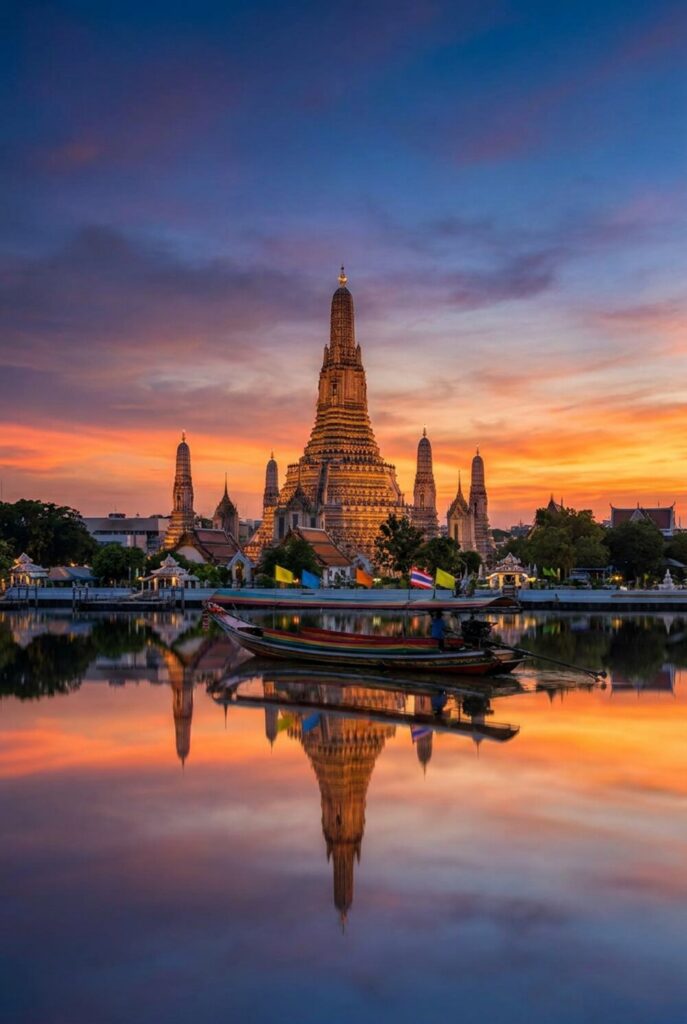
Thailand · River, monks, and 2026 Songkran
Bangkok, Thailand: Temple-and-Tuktuk Capital, Street-Food Olympiad, Skytrain City
Part of our Thailand travel guide.
I have lost count of how many times I have walked out of Suvarnabhumi at midnight, taken the Airport Rail Link to Phaya Thai, and ordered a 60-baht plate of pad krapao within fifteen minutes of clearing immigration. Bangkok is the only city I know where the temples, the food carts, the Skytrain, the river boats and the rooftop bars all run on different clocks and somehow synchronise. We tell first-time travellers that Bangkok rewards stamina and a willingness to switch micro-neighborhoods every two hours. My favourite ritual is a 7 a.m. boat from Sathorn Pier up the Chao Phraya to Tha Tien, then breakfast at Tha Maharaj before the Grand Palace gates open. Treat this guide as the brief I would hand my own family before they boarded the BTS at Siam.

Table of Contents
Why Bangkok?
Bangkok is South-East Asia’s biggest city by metropolitan population — roughly 10.7 million people in the Bangkok Metropolitan Region, of which about 5.5 million live inside the Bangkok Metropolitan Administration boundary. It is also the country’s only true megacity: Thailand has 76 provinces, but Bangkok alone produces nearly half of national GDP. The result is a capital where temple architecture from the 18th-century Rattanakosin foundation sits next to glass-and-steel BTS Skytrain stations from 1999, and where a 60-baht street-food plate is a five-minute walk from a tasting menu at one of the city’s seven Michelin-starred restaurants.
What makes Bangkok feel bigger than its skyline is the density of micro-neighborhoods. Rattanakosin (the old royal island) holds the Grand Palace, Wat Phra Kaew and Wat Pho. Sukhumvit east of the BTS Asok interchange is the modern hospitality spine, lined with embassies, malls (Terminal 21, EmQuartier, EmSphere) and the largest concentration of international hotel chains in the country. Yaowarat (Chinatown), settled in 1782, wakes up at 6 p.m. for the country’s most concentrated street-food run. Thonburi, the pre-1782 capital across the river, still holds surviving canal (khlong) life, and Ari plus Ekkamai are where the new generation of independent coffee, design and natural-wine venues cluster. The BTS Skytrain and MRT subway connect almost all of these areas within 25 minutes during off-peak hours, with seamless interchanges at Asok, Siam, Sala Daeng and Mo Chit.
The city is also the airline hub of mainland South-East Asia and the busiest passenger airport in the region by international transfers. Suvarnabhumi (BKK) is the main international gateway, 30 km east of downtown, with the Airport Rail Link reaching Phaya Thai BTS in 26 minutes for 45 baht. Don Mueang (DMK) handles low-cost carriers, 25 km north. From Bangkok you can be in Chiang Mai in 75 minutes by air, in Siem Reap in ninety, or in Singapore in two hours. Plan four full days here as your urban anchor before you fly onward — the city earns it through sheer density of food, temples and transit.
The other layer that elevates Bangkok above its peers is the calendar of public festivals — Songkran in April, the Vegetarian Festival in autumn, Loy Krathong in November and the Royal Ploughing Ceremony in May — each of which transforms specific neighborhoods for one to three days at a time. Plan a trip around any of those and you double the cultural payoff for the same flight cost. The cool-season window of November to February is the easy default, but the rainy-season May-to-September window is the cheapest and the least crowded.
Neighborhoods: Finding Your Bangkok
📍 Bangkok Map: Every Place in This Guide


Rattanakosin (the Old Royal Island)
The 1782 royal foundation sits on a man-made island bounded by the Chao Phraya and three concentric canals. The Grand Palace, Wat Phra Kaew (Temple of the Emerald Buddha), Wat Pho (the reclining Buddha) and the National Museum all sit within walking distance. There is no BTS or MRT inside Rattanakosin — arrive by Chao Phraya Express boat to Tha Chang or Tha Tien pier, or by MRT Sanam Chai (the closest subway).
- The Grand Palace & Wat Phra Kaew (admission 500฿, dress code strictly enforced)
- Wat Pho — the reclining Buddha and the country’s traditional-massage school
- Tha Maharaj — riverside food court with Chao Phraya views
Best for: first-time visitors, temple architecture, river views. Access: MRT Sanam Chai or Chao Phraya boat to Tha Tien.
Yaowarat (Chinatown)
Bangkok’s Chinatown was settled in 1782 when the Teochew Chinese community was relocated from Rattanakosin to make way for the Grand Palace. The neighborhood now operates on two clocks: by day it is a gold-shop and dried-goods district, by night it transforms into the densest street-food strip in mainland South-East Asia. The MRT Blue Line extension reached Wat Mangkon station in 2019, ending a long era of taxi-only access.
- Yaowarat Road after 6 p.m. — boat noodles, Hokkien fried noodles, mango sticky rice
- Wat Traimit — the 5.5-tonne solid-gold Buddha
- Talat Kao (Old Market) — daytime dried seafood and Chinese herbal lanes
Best for: street-food evenings, photography, market culture. Access: MRT Wat Mangkon (exit 1).
Sukhumvit (Asok & Phrom Phong)
Modern Bangkok’s hospitality spine runs east-west along Sukhumvit Road from BTS Nana to Ekkamai. The Asok interchange (BTS Asok / MRT Sukhumvit) is the gravity centre — a single-station hop reaches Terminal 21, the EmQuartier mall, and the Benjasiri Park lawn. Phrom Phong is the family-and-Japanese-expat enclave; Thong Lo is the late-night cocktail and natural-wine corridor; Ekkamai is where the design studios and indie cafés cluster. Most international hotel chains park on this spine.
- Terminal 21 (BTS Asok) — themed mall and one of the city’s best food courts
- Benjasiri Park — green lawn with a free open-air gym
- Soi Thong Lo — cocktail bars and Sunday brunches
Best for: first-time business travellers, mall-and-mid-range hotels, late dinners. Access: BTS Asok / MRT Sukhumvit.
Silom & Sathorn
The original CBD, anchored by the BTS Sala Daeng and Chong Nonsi stations and the MRT Silom and Lumphini stops. Lumphini Park is the city’s lung — open from 4:30 a.m. for tai-chi and joggers. Silom Road runs from Lumphini to the Chao Phraya. Sathorn south of Silom holds the Mahanakhon Skywalk (314 m, the fourth-tallest building in Thailand) and most of the river-view luxury hotels.
- Lumphini Park — 4:30 a.m. tai-chi shift
- King Power Mahanakhon Skywalk (314 m, glass tray observation deck)
- Patpong night market — touristy but historic
Best for: business travellers, river-view hotels, sunrise park runs. Access: BTS Sala Daeng / MRT Silom.
Banglamphu & Khao San Road
The original backpacker enclave — Khao San Road’s 1980s-era hostels still operate, but the neighborhood has matured into a mid-range zone with riverside boutique stays along Phra Athit Road. Wat Saket (the Golden Mount) sits on the eastern edge with one of the city’s only walkable hills (78 m of climb).
- Khao San Road night market and pad-thai stalls
- Wat Saket / the Golden Mount
- Phra Athit Road riverside strolls
Best for: budget travellers, late-night cheap eats. Access: MRT Sam Yot, or river boat to Phra Athit Pier.
Ari & Phahon Yothin
The new-Bangkok creative neighborhood north of Victory Monument on the BTS Sukhumvit Line. Independent coffee, brunch cafés, design studios and natural-wine bars cluster between BTS Ari and BTS Saphan Khwai. No tourist traps yet — this is where local design professionals actually live.
- Salt & Pepper Café and Featherstone Bistro for brunch
- Phahon Yothin Soi 7 art-and-design lane
- Pier 32 natural-wine bar
Best for: repeat visitors, design-conscious travellers, brunch culture. Access: BTS Ari.
Thonburi & the Khlongs
The west bank of the Chao Phraya — the city’s pre-1782 capital, now a quieter residential district with surviving canal (khlong) life. Wat Arun (the Temple of Dawn) is the headline sight, but the longer reward is a longtail-boat tour of the Bangkok Yai and Bangkok Noi canals where wooden stilt houses still front the water.
- Wat Arun (cross by 4฿ ferry from Tha Tien)
- Bangkok Noi canal longtail tour (1,500–2,500฿ private)
- Wang Lang Market — riverside Thai-Muslim food
Best for: photography, slower-paced day trips, river culture. Access: Cross-river ferry from Tha Tien.
Ekkamai & Thong Lo
Eastern Sukhumvit’s late-night corridor — the city’s densest cluster of cocktail bars, natural-wine venues and Sunday-brunch spots. The neighborhood matured rapidly between 2018 and 2024 and now competes with Singapore’s Tanjong Pagar for the regional cocktail crown.
- Tep Bar (Thai-style live folk music)
- BKK Social Club at the Four Seasons
- Soi Sukhumvit 38 street-food alley (in evenings)
Best for: nightlife, cocktail bars, repeat visitors. Access: BTS Thong Lo or BTS Ekkamai.
The Food

Street Food Standards
UNESCO and the Michelin Guide both recognise Bangkok as one of the world’s great street-food cities, and the Tourism Authority of Thailand maintains an official street-food directory. The headline dishes are pad thai, pad krapao moo sap (minced pork with holy basil), tom yum goong, kaeng khiao wan (green curry), som tam (papaya salad) and khao man gai (Hainanese chicken rice). A typical street-cart plate runs 50 to 80 baht (~one-and-a-half to two-and-a-half dollars). The five vendors below are the most-cited in TAT’s own listings and in the Michelin Bib Gourmand guide.
- Jay Fai (Phra Nakhon) — Michelin-starred crab omelette and drunken noodles, the most famous street kitchen on Earth (1,000–1,500฿)
- Thip Samai Pad Thai (Mahachai Road) — the country’s most cited pad thai (60–180฿)
- Krua Apsorn (Dinso Road, Banglamphu) — palace-style central-Thai cooking; the crab fried rice is the order (180–350฿)
Yaowarat (Chinatown) Night Run
From 6 p.m. on Yaowarat Road and the parallel Charoen Krung lanes the entire neighborhood becomes a street-food court. Boat noodles, Hokkien fried noodles, dim sum, fish-maw soup, mango sticky rice and Chinese herbal-tea stands cluster across a 600-metre strip from the Odeon roundabout to Wat Traimit. Cash-only at most carts; the credit-card culture has not penetrated the strip. The MRT Blue Line stops at Wat Mangkon station — exit 1 lands you directly on the strip and exit 4 puts you outside Wat Traimit. Avoid Mondays, when many family-run vendors close.
- Nai Mong Hoi Tod — oyster omelette and mussel pancake (80–150฿)
- T&K Seafood — green-shirt grill on Phadungdao Road, whole grilled prawns (300–500฿)
- Guay Jub Ouan Pochana — Michelin Bib Gourmand peppery rolled-noodle pork soup (60–100฿)
Beyond Pad Thai and Tom Yum
Bangkok cooks more than the seven dishes most foreigners arrive expecting. The everyday rotation of a Bangkok local includes a deeper bench of regional Thai cooking from the central plains, the north (Lanna), the north-east (Isan) and the deep south (Yala / Pattani). Most of these dishes are not on tourist-zone English menus; you find them at office-lunch shophouses, food courts in residential malls, and the Or Tor Kor wet market north of Chatuchak. The everyday Bangkok rotation:
- Khao mok gai — Thai-Muslim chicken biryani, best at the Charoen Pochana stalls in Bang Rak (60–90฿)
- Boat noodles (kuay tiew rua) — small bowls (15–20฿ each) of dark beef-or-pork broth, originally sold from canal boats; Victory Monument has a famous strip
- Kuay teow nuea (beef noodle soup) — clear or peppery broth; Wattana Panich on Ekkamai Soi 18 simmers a single fifty-year-old master stock (150–250฿)
- Khao soi — northern Thai egg-noodle curry, originally Chiang Mai’s signature, now served city-wide; Khao Soi Khun Yai near Suan Rod Fai is the local favourite (80–120฿)
- Khanom buang — crispy filled mini-pancakes; the Or Tor Kor market vendors are the city benchmark (~25฿ for two)
- Mango sticky rice (khao niao mamuang) — Mae Varee on Soi Thong Lo runs the most famous version (~150–200฿)
Food Experiences You Can’t Miss
- A 6 p.m. street-food walk along Yaowarat with a 100-baht starting allowance and an empty stomach
- The 4 a.m. Pak Khlong Talat flower-and-fruit market with a 7-Eleven iced coffee in hand
- A weekend Or Tor Kor wet-market breakfast at the food-court counter (next to Chatuchak, MRT Kamphaeng Phet)
- A Michelin tasting menu at Sorn (southern Thai, two stars), Le Du (modern Thai, one star) or Sühring (modern German, two stars) — book six weeks ahead
Cooking Classes & Markets
Bangkok is one of the world’s best cities to take a cooking class — most begin with a 7 a.m. wet-market visit (Or Tor Kor or Khlong Toei), continue at a teaching kitchen, and break for lunch over the four dishes you cooked. The Blue Elephant cooking school in the historic Thai-Chino Portuguese Tinakorn Mansion (BTS Surasak) is the upmarket choice; Silom Thai Cooking School and the May Kaidee vegetarian school are reliable mid-range options. Half-day classes typically run 1,200–2,500 baht; full-day with market visit 2,500–4,000 baht. Book ahead in cool season — the popular schools fill four to five days out.
Coffee & the Third-Wave Wave
Bangkok’s third-wave specialty-coffee scene reached critical mass between 2018 and 2024, and the city now competes with Melbourne and Tokyo for regional crown. The neighborhoods to know are Ari (Roots, Cottontree, Featherstone), Ekkamai (Roast, Casa Lapin), Charoen Krung (Tropic City, Brave Roasters) and Phrom Phong (Roast Phrom Phong, % Arabica EmQuartier). Single-origin pour-overs run 130–220 baht; latte 110–160 baht. Most third-wave shops open 08:00 and close 17:00–18:00, so plan accordingly.
Cultural Sights

The Grand Palace & Wat Phra Kaew
The official residence of the kings of Siam from 1782 until 1925 and still the ceremonial seat of the Thai monarchy. Founded 1782 by King Rama I to legitimise the new Chakri dynasty after the Burmese sack of Ayutthaya in 1767. Admission 500฿ (includes Wat Phra Kaew, the Queen Sirikit Museum of Textiles and the Royal Decorations and Coin Pavilion). Open daily 08:30–15:30; dress code strictly enforced — long pants or skirt and covered shoulders, with free sarongs available at the entrance for a 200฿ refundable deposit. The Emerald Buddha — a 66-centimetre jade statue moved from Vientiane in 1779 — is the holiest object in the kingdom; do not photograph the inner sanctum and never point your feet toward the image. Plan three hours minimum, arrive at 08:30 sharp to beat the tour-bus crush, and combine with Wat Pho immediately to the south.
Wat Pho (Reclining Buddha)
The 1788 royal temple immediately south of the Grand Palace. Houses the 46-metre gold-leaf reclining Buddha (the largest in Thailand) and the country’s first traditional-massage school, where you can book a one-hour Thai massage for 480฿ in the temple grounds. Admission 300฿ (includes a complimentary bottle of water). Open 08:00–18:30. The Buddha’s feet are inlaid with mother-of-pearl panels depicting the 108 auspicious signs; the head is at the wall opposite the entrance, so visitors walk past the soles first — that is intentional, not an etiquette violation.
Wat Arun (Temple of Dawn)
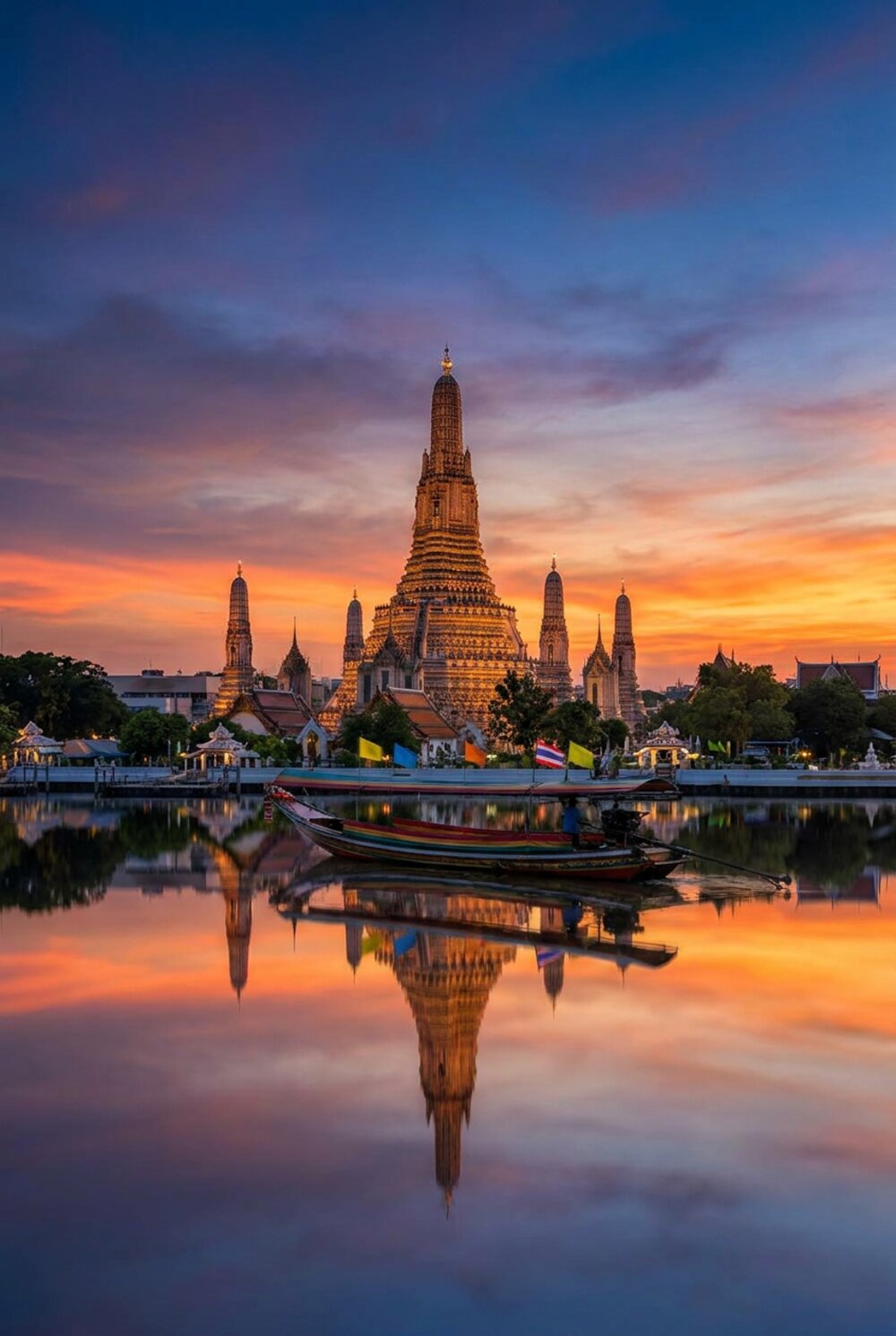
The seventy-nine-metre central prang clad in broken Chinese porcelain on the Thonburi (west) bank — visible from the Grand Palace side and best photographed from a Chao Phraya river boat at sunset. Founded in the seventeenth century during the Ayutthaya period and expanded to its current form by King Rama II in 1820. Admission 200฿. Open 08:00–17:30. Cross by the 4฿ public ferry from Tha Tien Pier (the same pier that lands Wat Pho visitors); the round-trip is one of the cheapest authentic transit experiences in the city. The temple is named for Aruna, the Hindu god of dawn — the porcelain decoration was donated by Chinese merchants who used broken trade-ship ballast.
Jim Thompson House
The 1950s-era teak compound of the American silk-trade revivalist who disappeared in Malaysia in 1967. Six traditional Thai teak houses were moved here from Ayutthaya in 1959, joined edge-to-edge to create a single courtyard residence; the result is a small museum of Asian art and a window into mid-century Thai-Western architectural fusion. Admission 200฿ for adults, 100฿ for students under 22. Compulsory 45-minute guided tours run every fifteen minutes in English, Thai, French, Japanese and Mandarin. Open daily 09:00–18:00. BTS National Stadium, exit 1, then a five-minute walk along Soi Kasemsan 2.
National Museum of Thailand
The country’s largest museum, housed in the eighteenth-century Wang Na (Front Palace) on Sanam Luang. Strong galleries on Sukhothai, Ayutthaya and Rattanakosin sculpture; the royal funeral chariots are the show-stopper, and the gallery of Buddhist iconography is the best primer for the temple-touring you will do across the rest of Thailand. Admission 200฿. Open Wed–Sun 09:00–16:00 (closed Mon, Tue). Free guided tours in English run Wed and Thu at 09:30 and on Saturdays at 09:30. The bookshop near the entrance is the best stop in Bangkok for English-language scholarly Thai history.
Wat Saket (Golden Mount)
The seventy-eight-metre artificial hill topped by a gold chedi — Bangkok’s only walkable elevation in an otherwise pancake-flat city. The 318-step spiral climb passes a wishing wall, an offering bell-line and a row of Buddha images, and ends with a 360-degree view of Rattanakosin, the Chao Phraya bend, and (on a clear day) the Mahanakhon and Baiyoke towers in the modern downtown. Admission 100฿ (the walking grounds below the chedi are free). Open 07:00–19:00. Best at sunset; the November Wat Saket fair coincides with Loy Krathong and is one of the city’s largest temple festivals.
Bangkok Art & Culture Centre (BACC)
The contemporary-art counterweight to the historical sights — a free 11-storey rotunda gallery directly across from MBK Centre. Rotating shows of Thai and South-East Asian artists, plus indie cinema, an architectural-bookshop, design shops and a top-floor library with free Wi-Fi. Admission free. Open Tue–Sun 10:00–20:00 (closed Mon). BTS National Stadium, exit 3, with a covered skywalk straight into the building. The 9th-floor balcony has the best free skyline view in the central downtown.
Erawan Shrine & the Bangkok Folk Spirit Houses
The Erawan Shrine on Ratchaprasong corner (BTS Chit Lom) is the most-photographed urban Buddhist-Hindu shrine in the country — built in 1956 to ward off accidents during the construction of the original Erawan Hotel. Free; open 24 hours. Traditional Thai dancers perform paid blessings throughout the day for a fee paid to the shrine committee. Combine with the four other Ratchaprasong shrines (Trimurti, Lakshmi, Ganesh and Indra) within a 200-metre radius — the corner functions as a free outdoor temple complex sandwiched between the malls.
Entertainment

Rooftop Bars
Bangkok has the highest concentration of skyscraper rooftop bars in Asia. Vertigo & Moon Bar at the Banyan Tree (61st floor, opened 2003), Sky Bar at Lebua (64th floor, the Hangover Part II bar) and the Mahanakhon Skywalk are the iconic three; expect 350–600฿ for a beer and 450–900฿ for a cocktail. Smart-casual dress, no shorts/sandals. Typical cost 600–1,200฿ per person. Walk-in usually fine on weeknights; book Friday/Saturday.
Muay Thai (Thai Boxing)
The two original Bangkok stadiums are Rajadamnern (founded 1945, the older one, near Khao San) and Lumpinee (now relocated to Ramintra Road). Match nights run twice weekly at each. Tourist-tier seats 1,500–2,000฿; ringside 2,000–2,500฿. The Sunday-night card at Rajadamnern is the most accessible for first-timers.
Asiatique The Riverfront
The 2012-opened riverside open-air mall built on the bones of the East Asiatic Company’s 1900s warehouses. Free shuttle boat from Sathorn Pier (BTS Saphan Taksin) every 15 minutes from 16:00. Sky-view ferris wheel (350฿), open-air food court, and the Calypso Cabaret. Cost 500–1,500฿ per person depending on dinner. Open daily 16:00–24:00.
Live Music & Jazz
The Bamboo Bar at the Mandarin Oriental (since 1953) is Bangkok’s oldest jazz club and runs the city’s most-cited live programme — international touring acts share the bill with the resident Mandarin Quartet. Saxophone Pub at Victory Monument is the local-favourite cheaper option; Tep Bar in Talat Noi runs Thai-folk jam sessions Wed–Sun. Cost 400–800 baht for a cover-and-drink minimum at most venues. Brown Sugar (the long-running Thai jazz club) closed in 2018; its successor venues are scattered across the Sukhumvit night corridor.
Sea Life Bangkok & Madame Tussauds (Siam Paragon)
Family-day-rainy-day defaults. Sea Life Bangkok is the basement-level aquarium under Siam Paragon (BTS Siam, ~1,090 baht adults, ~890 baht children) with a 270-degree underwater tunnel and a glass-bottom-boat add-on. Madame Tussauds is the wax-museum next door (~990 baht). Combo tickets reduce the price by roughly twenty-five per cent. Open daily 10:00–20:00. The KidZania children’s role-play attraction, also at Siam Paragon, is a separate booking and runs 1,425 baht for a full-day pass.
Asiatique & the Riverside Night Markets
Beyond Asiatique itself, the riverside is Bangkok’s quietest evening-out option: Lhong 1919 (a restored Sino-Thai compound on the Thonburi side, free entry, BTS Saphan Taksin then ferry), the ICONSIAM mall food hall (its 6th-floor SookSiam recreation of a Thai floating market is touristy but free to wander), and the Wang Lang Market on the Thonburi side near Siriraj Hospital all run later than the Sukhumvit malls. Expect 300–800 baht per person for a riverside walk-and-eat evening.
Songkran 2026 (April 13–15)
Thailand’s traditional New Year — three days of public-square water fights across the country, derived from the older Buddhist tradition of pouring water over Buddha images and the hands of elders for blessing. In Bangkok the action concentrates on Khao San Road and Silom Road, both of which become car-free wet zones from roughly 10:00 to 22:00 on Apr 13–15. Wear quick-dry clothes, waterproof your phone in a Ziploc bag, and accept the soaking philosophically. Hotel prices spike thirty to fifty per cent — book six weeks ahead. UNESCO inscribed Songkran on the Representative List of the Intangible Cultural Heritage of Humanity in 2023, formalising what was already the country’s biggest festival.

Day Trips

Ayutthaya UNESCO Park (one and a half hours by train or van)
Thailand’s old capital, founded 1351 and sacked by Burmese forces in 1767, now a vast UNESCO archaeological park of ruined chedis and Buddha images. The headline image — a sandstone Buddha head wrapped in bodhi-tree roots at Wat Mahathat — is one of the most reproduced photographs in South-East Asia. Take the State Railway of Thailand train from Krung Thep Aphiwat Central Terminal to Ayutthaya (third-class 15–35฿, second-class 245฿, ninety minutes), or the minivan from Mo Chit (60฿, sixty minutes). Rent a bicycle at the railway station for 50฿ per day; the historic park is too spread out to walk. The headline temples are Wat Mahathat, Wat Phra Si Sanphet and Wat Chaiwatthanaram — the last is best at sunset over the Chao Phraya.
Maeklong Railway Market & Damnoen Saduak Floating Market (two hours by van)
The classic combo. Maeklong Railway Market — where vendors fold their awnings four times a day as a working passenger train passes through the produce stalls — runs at 06:20, 08:30, 11:10 and 14:30 daily. Damnoen Saduak floating market is busiest 07:00–09:00 (avoid the 11:00 tour-bus crush). Most travellers take a 600–900฿ joint van tour from Khao San or Pratunam; the do-it-yourself train option (Wong Wian Yai station, 80฿, two hours) is the photographer’s choice. The Amphawa floating market on Friday-to-Sunday evenings is the alternative — same area, less touristy, with fireflies on the river after dark.
Kanchanaburi (Bridge over the River Kwai) (two-and-a-half hours by train)
The Second World War Death Railway and the cantilever steel bridge of the David Lean film. The third-class State Railway train from Thonburi station departs 07:50 and 13:55, returns 13:25 and 14:48 — bring water, the carriages have no air-conditioning, and bring small bills for the river-side food vendors who board at intermediate stations. The JEATH War Museum and the Kanchanaburi War Cemetery sit a short tuk-tuk ride from the bridge. Allow a full overnight if you want to do the Hellfire Pass walk and the Erawan Falls — both are an additional one-and-a-half hours from town.
Khao Yai National Park (three hours by minivan)
Thailand’s first national park (declared 1962) and most-visited — part of the UNESCO Dong Phayayen-Khao Yai Forest Complex, 168 km north-east of Bangkok in Nakhon Ratchasima Province. Wild elephants (best chance at the salt licks south of the visitor centre), the Haew Narok and Haew Suwat waterfalls (the latter from The Beach), and a growing wine country at the park edge — the Granmonte and PB Valley vineyards both run cellar-door tastings on weekends. Day-trip is feasible with a private driver (4,000–6,000฿ for the day) but an overnight at one of the park-edge resorts is the fuller experience.
Pattaya & the Eastern Beaches (two hours by bus)
The closest beach city to Bangkok — 145 km south-east, reachable in two hours by Bell Travel coach from BTS Ekkamai (Eastern Bus Terminal, 130฿) or Roong Reuang Coach. Honest assessment: Jomtien Beach (south end) is acceptable for a swim and a Thai-massage afternoon; Koh Larn (the offshore island, thirty-minute ferry from Bali Hai pier) is the better option if you want clear water. Hua Hin (three hours south-west, by State Railway train or by bus from Sai Tai Mai) is the calmer family alternative — the same coastline without the late-night Pattaya bar scene.
Bang Pa-In Royal Palace (one hour by train)
The summer royal palace twenty kilometres south of Ayutthaya — a fusion of Thai pavilions, Chinese pagodas and Italianate halls built between 1872 and 1889 by King Rama V. Admission 100฿. Most Ayutthaya day-trippers combine the two on a single private-driver day (3,500–4,500฿). Strict dress code (covered shoulders, long pants/skirt) — sarongs available at the entrance.
Seasonal Guide
Cool Season (November – February)
The annual peak window — daytime highs of thirty to thirty-two degrees Celsius, nights dropping to twenty-one to twenty-four degrees, humidity at its lowest, almost no rain. Hotel rates and street-food crowds peak in late December and January. Book Christmas-to-New Year stays eight weeks ahead. Loy Krathong (the floating-lantern festival) usually falls on the full moon of the twelfth lunar month; Loy Krathong 2026 is November 24, with the largest public gatherings at the Chao Phraya riverside and the canals around Thonburi. Sukhumvit malls run “Christmas in Bangkok” decorations from late November and the BTS plays seasonal music — surprising in a Buddhist-majority city, but it has been part of the cool-season retail rhythm since the early 1990s.
Hot Season (March – May)
The hardest weather — daytime highs reach thirty-five to thirty-eight degrees in April with overnight lows of twenty-seven to twenty-eight degrees. Songkran 2026 (April 13–15) is the cultural highlight: three days of public water fights on Khao San and Silom Roads. The trade-off is steep — hotel rates spike, transport is congested, and the heat is genuinely punishing for outdoor sightseeing without a midday break. Pre-book everything six weeks ahead if you target Songkran. May usually delivers the first rainstorms; the Royal Ploughing Ceremony at Sanam Luang opens the rice-planting season and is one of the oldest royal rituals in continuous practice.
Rainy Season (June – October)
The south-west monsoon delivers afternoon thundershowers most days, peaking in September with the highest rainfall total of the year. The mornings are usually clear and the daytime temperature drops three to four degrees below the hot-season norm. Hotel rates are at their lowest — June and July are the best price-to-quality trade-off of the year, when high-season Sukhumvit hotels can run forty per cent below their January rate. Pack a 7-Eleven 30฿ poncho and a small umbrella; localised flooding occasionally hits Sukhumvit Soi 11 and the lower Thonburi side after particularly heavy storms.
Festival Layering Note
The Vegetarian Festival (Phuket-headquartered but observed in Bangkok’s Yaowarat) typically falls in late September or early October — yellow flags appear above Chinatown stalls and the menu shifts to entirely meatless street food for nine days. The Royal Barge Procession on the Chao Phraya is held only for major royal occasions and is not annual; check tourismthailand.org for current-year scheduling. The November Wat Saket Temple Fair coincides with Loy Krathong and is one of the city’s largest temple-grounds carnivals — worth a side-trip if you are already at the Golden Mount. The Chinese New Year (Trut Chin) brings Yaowarat’s biggest annual public party, with dragon dances on Yaowarat Road and a temporary closure of the strip to vehicles for two days; the 2026 dates are February 17-19.
Air Quality & PM2.5
Bangkok’s worst air-quality window runs January through early March, when post-harvest agricultural burning in central Thailand combines with low-wind temperature inversions to push PM2.5 into “unhealthy” range (US AQI 150–250) on individual days. The Pollution Control Department publishes hourly AQI data at air4thai.pcd.go.th and the IQAir AirVisual app aggregates the same readings. Travellers with asthma or respiratory conditions should pack KF94 or N95 masks for January-February travel; the rest of the year is generally below WHO guideline levels.
Getting Around
BTS Skytrain (the elevated rail)
Two lines — Sukhumvit (light green) and Silom (dark green) — interchange at Siam. Coverage runs from Mo Chit/Chatuchak in the north to Bearing and Kheha in the south-east, plus the Silom branch from National Stadium to Bang Wa across the river in Thonburi. Operating hours 06:00–24:00. Single fares 17–62 baht depending on distance. Stations are clean, air-conditioned, English-signed and CCTV-monitored; service intervals run two-and-a-half minutes during peak hours and five minutes off-peak. The Sukhumvit Line extension to Khu Khot opened the BTS into the northern outer suburbs in 2020.
MRT Subway
The Blue Line is the workhorse — a circular line that touches Hua Lamphong (the old central rail station), Wat Mangkon (Chinatown), Sanam Chai (Wat Pho), Sukhumvit (Asok interchange) and Chatuchak Park. The Purple Line extends north to Bang Yai in suburban Nonthaburi province; the Yellow and Pink Lines (monorails opened 2023–2024) connect the eastern and northern outer suburbs respectively. Operating hours 06:00–24:00. Fares 17–43 baht. The MRT and BTS interchange at Asok / Sukhumvit, Silom / Sala Daeng and Bang Wa, but the systems are operationally separate; expect to tap out and re-tap at every interchange.
Rabbit Card & MRT Stored Value
The BTS uses the Rabbit Card (200 baht deposit plus 100 baht initial stored value, sold at every station ticket counter); the MRT uses its own stored-value card or a single-trip plastic token. The systems do not share fares — tap out, walk to the other system, tap in. Tourists who plan more than three BTS trips a day should buy a one-day BTS pass (140 baht) at any Skytrain ticket counter. The combined Mangmoom (Saturn) card promised by the government has been repeatedly delayed and is not yet usable in 2026; until it launches, carry both. The State Railway of Thailand SRT Red Line (commuter rail) uses its own ticket — relevant if you are catching the long-distance train from Krung Thep Aphiwat Central Terminal.
Chao Phraya Express Boat
The river is a working public transit line. The Chao Phraya Express Boat orange-flag service runs Sathorn Pier (Saphan Taksin BTS) to Phra Athit Pier (Banglamphu) every twenty minutes for a flat 16 baht. The Tourist Boat (200฿ all-day, hop-on-hop-off) covers the same piers with English commentary; the local-flag service is the better deal if you have downloaded the route. Total transit time Sathorn → Tha Tien (the Wat Pho / Wat Arun ferry pier) is thirty minutes; sunset-to-blue-hour boats from Sathorn at around 17:30 are the most photogenic moment of the city day.
Airport Access
- Suvarnabhumi (BKK): Airport Rail Link (City Line) to Phaya Thai BTS — 26 minutes, 45฿. Metered taxi to Sukhumvit/Silom — 350–500฿ including tolls and the 50฿ airport surcharge, 35–60 minutes.
- Don Mueang (DMK): A1/A2 airport bus to Mo Chit BTS — 30 baht, 30 minutes. Metered taxi to downtown — 250–350฿, 30–50 minutes.
Taxis & Ride-Hail
Metered taxis are pink, blue, green, yellow or two-tone. Flag-fall is 35฿; the meter ticks up by 2–6฿ per kilometre. Always insist on the meter (“meter, krap/ka“). Refuse “fixed-rate” offers. Tolls (60–80฿ each) on the expressway are paid by the passenger and are usually worth it. Grab and Bolt are widely used and avoid the meter-bypass problem. Tuk-tuks are tourist-priced — fun for one short hop but not a real transport option.
Navigation Tips
Apps: Google Maps (the BTS/MRT routing is now reliable), Grab for rides, and the official BMTA app for buses if you adventure. Bangkok addresses use a soi (lane) system — Sukhumvit Soi 11 is a numbered lane off the main Sukhumvit Road. Even-numbered sois are on the south side, odd on the north. Memorise that one rule and addresses become legible.
Budget Breakdown: Making Your Baht Count
| Tier | Daily | Sleep | Eat | Transport | Activities | Extras |
|---|---|---|---|---|---|---|
| Budget | 1,200–1,800฿ ($35–55) | Hostel dorm 350–550฿ | Street food 60–120฿/meal | BTS+MRT day pass 140฿ | Wat 200฿ + free parks | 1 rooftop beer 350฿ |
| Mid-Range | 3,200–5,500฿ ($90–160) | 4-star hotel 2,200–3,800฿ | Sit-down 250–500฿/meal | Grab + boat 400฿ | Grand Palace 500฿ + Jim Thompson 200฿ | Cocktail 450฿ + Muay Thai 1,500฿ |
| Luxury | 10,000฿+ ($300+) | 5-star riverside 8,000–18,000฿ | Tasting menu 3,500–6,000฿ | Private car 4,000฿/day | Spa + tour 4,000฿ | Le Du / Sorn 4,500฿ |
Where Your Money Goes
The Bangkok cost stack is bottom-heavy — sleeping and eating are cheap by global-capital standards, but the headline cultural experiences (Grand Palace 500 baht, Jim Thompson 200 baht, BACC free, National Museum 200 baht) are state-subsidised and remain accessible to budget travellers. The luxury tier diverges sharply at the upper end: a Mandarin Oriental river-suite, a Le Normandie tasting menu and a Bamboo Bar nightcap can crack 30,000 baht in a single evening, but the same district holds 250-baht curry-and-rice shophouses across the street. Thailand’s standard VAT is seven per cent and is included in marked prices; tourist-priced restaurants add a ten per cent service charge on top, and most international hotel chains add an additional ten per cent service plus the seven per cent VAT for a fifteen-to-eighteen per cent total surcharge. The cost-of-living gap between Bangkok and the rest of Thailand is also real: a Chiang Mai mid-range hotel runs roughly seventy per cent of its Bangkok equivalent, and street food in Isaan averages thirty per cent below Bangkok prices.
Money-Saving Tips
- Eat at street stalls and food courts (Terminal 21, MBK Food Island, EmQuartier and the Or Tor Kor market) — the food is regulated by the BMA Food Hygiene programme, the prices are roughly a quarter of mall sit-down restaurants, and the volume of options is the highest in Asia.
- Buy a one-day BTS pass (140 baht) only if you plan four or more rides; otherwise pay-as-you-go on the Rabbit Card is cheaper.
- Skip the Tourist Boat (200 baht) if you are river-hopping fewer than three times in a day — the orange-flag commuter boat is 16 baht flat and runs the same piers.
- Tax-free shopping (a VAT refund of approximately six per cent net) is available on purchases over 2,000 baht at participating stores; collect the form at point of sale and process at the airport at least ninety minutes before your flight.
- Use Grab and Bolt instead of metered taxis for short hops where the meter-bypass scam is common (Sukhumvit Sois, Khao San, Yaowarat) — fares are typically the same and the trip is logged.
- Visit museums on the day they offer free or reduced admission: the BACC is free year-round, the National Museum is free on the international Museum Day (May 18), and Wat Pho’s basement-floor traditional-medicine museum is included in the temple admission.
- Book the Grand Palace tickets online via the Bureau of the Royal Household website to skip the entry-line queue, which can hit forty-five minutes during cool-season peak.
- Stay in Phra Khanong, Bang Na or Wong Wian Yai if you are price-sensitive — these BTS-adjacent neighborhoods run a forty per cent discount on Sukhumvit hotel rates and the BTS gets you to Asok in twelve to twenty minutes.
Currency & Exchange
The Thai baht (฿, THB) trades around 35–37 to the US dollar through 2026 — current rates published daily by the Bank of Thailand. SuperRich (orange logo, multiple branches at BTS Chit Lom and Siam) and Vasu Exchange (Sukhumvit Soi 7) consistently beat airport and bank rates by 0.30–0.60 baht per dollar. Avoid the airport money-changers for anything above pocket money — the rate spread is the worst in the country. ATMs are reliable but charge a flat 220-baht foreign-card fee per withdrawal, so withdraw 8,000–15,000 baht at a time to amortise. Card-issuing banks at home may charge an additional 1–3% foreign-transaction fee — check before you fly.
Practical Tips
Language
Thai is the official language. English is functional in tourist zones, the BTS/MRT, mid-range-and-up hotels, and most Sukhumvit and Silom restaurants — but vanishes quickly in residential neighborhoods and at street carts. Learn five phrases: sawasdee krap/ka (hello), khop khun krap/ka (thanks), mai phet (not spicy), mai ao thung (no plastic bag), tao rai krap/ka (how much). The “krap” (male speaker) / “ka” (female speaker) ending is the universal politeness suffix.
Cash vs. Cards
Bangkok is in transition — cards work at every hotel, mall, BTS ticket machine and mid-range-up restaurant; cash is mandatory at street stalls, tuk-tuks, the Chao Phraya Express boats, traditional markets and most temple admission counters. ATMs charge a 220฿ foreign-card fee per withdrawal (the highest in the region). Bring or withdraw 5,000–10,000฿ at a time to amortise. Visa and Mastercard work everywhere; Amex acceptance is mid-range hotels and up only.
Safety
Bangkok is statistically among the safer Asian capitals for tourists — violent crime is rare. The real risks are scams (gem-shop tuk-tuks, “Grand Palace closed today” diversions) and traffic accidents (motorbike-taxis cause more tourist injuries than any other category). The U.S. State Department maintains Thailand at travel advisory Level 1 (exercise normal precautions). Emergency numbers: 191 (police), 1669 (ambulance), Tourist Police 1155 (English-speaking).
What to Wear
Temple dress code is strictly enforced at the Grand Palace, Wat Phra Kaew and Wat Pho — long pants/skirt below the knee, covered shoulders, no see-through fabrics. The Grand Palace rents sarongs for a 200฿ deposit. Outside temples, light cotton, sandals and a sun hat are the year-round defaults; pack one light long-sleeve for the heavily air-conditioned Skytrain and malls.
Cultural Etiquette
Three rules: (1) the head is the highest part of the body, the feet the lowest — never touch a Thai person’s head, never point feet at a Buddha image or a person. (2) The royal family is protected by the strictest lèse-majesté law in the world (Article 112) — do not photograph royal motorcades, do not joke about the monarchy, stand for the royal anthem when it plays in cinemas. (3) Remove shoes before entering a temple, a private home, and most traditional-house museums.
Connectivity
Thai SIM cards are the cheapest in the region — AIS Tourist SIM at the airport offers 15GB for 10 days at 299฿; True and DTAC offer similar packages. eSIM activations (Airalo, Holafly) work fine. Hotel Wi-Fi is universal and generally fast; mall and BTS Wi-Fi is patchy. Coverage outside Bangkok is good but drops on rural day trips.
Health & Medications
Bangkok’s private hospitals (Bumrungrad, Samitivej, BNH and Bangkok Hospital) are world-class and English-speaking — the city is the regional medical-tourism hub for South-East Asia, with patient-volume figures rivalling Singapore. Tap water is not potable; bottled water is sold at every 7-Eleven for 7 baht and at all hotels for free in-room. Travel insurance is strongly advised — minor traffic incidents on motorbike-taxis are the leading hospitalisation cause for foreign tourists, and treatment costs at private hospitals can run into the six-digit baht range without insurance. Pack motion-sickness tablets if you plan boat day trips, antihistamines for the late-rainy-season insect spike, and a basic stomach-upset kit (Imodium plus rehydration salts) for the inevitable initial gastric adjustment to the chilli-and-coriander-heavy diet.
Luggage & Storage
Suvarnabhumi has twenty-four-hour left-luggage at level two of the main terminal (75–125 baht per piece per day). Don Mueang offers similar service at terminal one. Most BTS and MRT stations do NOT have lockers; most mid-range hotels will hold luggage for free between checkout and an evening flight. The Mango Storage app and the Bounce app run a network of independent storage points across Sukhumvit and Silom for around 50 baht per piece per six hours, useful if you have a 22:00 flight and a noon checkout.
Tipping
Tipping is not mandatory in Thailand but is increasingly expected at tourist-priced venues. Restaurants: round up to the nearest 20 or 50 baht at street stalls; leave the small change at sit-down restaurants if no service charge is added; nothing extra if the bill already includes a ten per cent service. Hotel porters: 20–50 baht per bag. Taxi drivers: round up to the nearest 10 baht. Spa therapists: 50–100 baht per hour of treatment is genuinely appreciated. Tour guides on full-day trips: 200–400 baht per group is the convention.
Frequently Asked Questions
How many days do I need in Bangkok?
Four full days is the sweet spot. Day 1: Rattanakosin temples (Grand Palace + Wat Pho + river boat home). Day 2: Yaowarat (Chinatown) street-food evening + a Talad Noi morning walk. Day 3: Sukhumvit Skytrain hop + a rooftop sundowner. Day 4: a day trip out (Ayutthaya by train, or Maeklong + Damnoen Saduak by van). Two days is enough for the temples-and-food highlights but feels rushed; three is the genuine minimum. Five-plus days unlocks Ari, Ekkamai and a Khao Yai overnight.
Is Bangkok good for solo travellers?
Yes — Thailand consistently ranks among the world’s most solo-traveller-friendly destinations. Bangkok specifically: BTS/MRT signage in English, abundant English-speaking hostels and capsule hotels, low violent-crime rates, and a hospitality culture that does not stigmatise dining alone. Female solo travellers report Bangkok as one of the easiest Asian capitals. Stick to BTS/MRT routes after midnight; avoid Khao San Road’s late-night bar scene if you are uncomfortable with aggressive touts.
Is the BTS Skytrain Tourist Pass worth it?
Yes if you plan four-plus BTS rides in a single day. The 1-day pass costs 140฿; four single-trip rides at 30฿ each already break even. The Rabbit Card (200฿ deposit + 100฿ stored value, refundable on departure) is the better choice for a multi-day trip — pay-as-you-go fares average 26฿ versus the 140฿/day pass. Buy at any BTS ticket counter. Note the BTS and MRT systems are NOT integrated — separate cards required for each.
What about the language barrier?
It exists outside tourist zones but rarely blocks travel. BTS/MRT signage is English-first. Mid-range and up hotels operate in English. Tourist-zone restaurants have English menus. Where it matters: addressing a taxi driver (write your destination in Thai script — most hotels print cards), ordering at street stalls (point at what the next-table customer is eating), and any interaction with the Tourist Police, who are explicitly English-speaking on 1155.
When are the busiest weeks?
Songkran (April 13–15, 2026) and Christmas–New Year are the two unambiguous peaks — hotel rates spike 30–50%, Khao San and Silom Roads close for the water fights, and BTS platforms hit standing-room-only at 18:00. Loy Krathong (November 24, 2026) adds a smaller surge to riverside neighborhoods. The cool-season month of January is the broadest “high season” — book Sukhumvit and riverside stays six weeks ahead. The June–September rainy season is the cheapest window with the lowest crowds.
Can I use credit cards everywhere?
No — Bangkok is in cash-card transition. Cards (Visa, Mastercard) work at every hotel, BTS ticket machine, mall, mid-range-and-up restaurant, and most chain pharmacies. Cash is mandatory at street stalls, tuk-tuks, the Chao Phraya Express commuter boats, traditional markets, temple admission counters, and most independent taxis. Plan to carry 1,500–3,000฿ in cash for any given day. ATMs charge 220฿ per foreign-card withdrawal, so withdraw in 5,000–10,000฿ chunks.
Songkran 2026 — should I visit during the water festival or avoid it?
Visit if you specifically want the cultural experience and have packed a 7-Eleven thirty-baht poncho, a waterproof phone bag and quick-dry clothes — it is the country’s biggest annual festival and Bangkok’s Khao San and Silom Roads run a three-day public-square water fight April 13–15, 2026. Avoid if you are travelling with electronics-laden work, fragile elders or a tight schedule — BTS, MRT and roads all run on holiday timetables, and temples close for the religious ceremonies on April 14. Hotel rates run thirty to fifty per cent above cool-season norms; book six weeks ahead. UNESCO inscribed Songkran on the Intangible Cultural Heritage list in 2023, formalising the festival’s cultural status.
Bangkok or Chiang Mai for a first-time Thailand trip?
Both, ideally. The classic two-city Thailand starter is four nights in Bangkok plus three nights in Chiang Mai — a one-hour, fifteen-minute Bangkok Airways or Thai Lion Air flight links them for around 1,500–2,500 baht. Bangkok is the temples, the food, the nightlife and the airport hub; Chiang Mai is the old-walled city, the elephant sanctuaries (the ethical ones, not the riding camps), the Lanna culture and the cooler climate at 310 metres above sea level. If forced to pick one, Bangkok is the better single-week base because of the airport, the variety and the day-trip range.
Is Bangkok safe for women travelling alone?
Yes — and one of the most accessible Asian capitals for solo female travellers. The U.S. State Department maintains Thailand at travel advisory Level 1 (exercise normal precautions), the lowest tier. Sexual-violence rates against tourists are very low; the most common complaints are pickpocketing on Khao San Road, taxi-meter scams, and the occasional cat-call in nightlife districts. The Tourist Police run a free 1155 hotline in English. The BTS and MRT are CCTV-monitored and well-lit; late-night solo Grab rides are the safer option if you are returning past midnight.
Ready to Experience Bangkok?
Four days, two Skytrain hubs, one Chao Phraya boat ride at sunset and at least one 6 p.m. Yaowarat street-food walk — that is the Bangkok rhythm. For the full country context, read the Thailand Travel Guide; if you are looping north, see our Chiang Mai City Guide.
Explore More City Guides
Where to Stay
- Chiang Mai City Guide — Northern Thailand’s old-walled-city capital and Lanna kingdom seat
- Phuket City Guide — Andaman Sea island capital and Thailand’s beach gateway
- Krabi City Guide — limestone-karst peninsula and Phi Phi Islands base
- Hanoi City Guide — Vietnam’s old-quarter capital, regional sibling
- Thailand Country Guide
- All City Guides
Alex the Travel Guru
Alex has been writing destination guides for FFU since 2019, with eleven Thailand trips on the docket and a long-running Bangkok-as-base habit. The city is Alex’s reset point between the Mekong sub-region and the rest of Asia — anchor airport, anchor pad krapao, anchor 6 a.m. Sathorn Pier boat ride. For the full country context, read the Thailand Travel Guide.
More city guides you might like
Plan your trip to Bangkok
The booking tools we use ourselves. FFU may earn a commission at no extra cost to you.
Plan & book your trip to Bangkok
Booking through these searches supports our guides at no extra cost to you.